






Abstract
Solar Power Finance is not a book for energy economists, engineers, or Energy Journal readers. However, Solar Power Finance Without the Jargon or financial analysis is the story of an emerging technology in the early 2000s. Today, solar power has the potential, in fact is, changing our sustainable energy worlds. In the book, the investment analyst Jenny Chase takes us on her discovery of solar power as a competitive source of electricity.
Today, energy economists and engineers turn to International Energy Agency (IEA), U.S. Energy Information Administration (EIA), International Renewable Energy Agency (IRENA), and other more technical journals for data, detailed graphs, and analysis. But investors and those not schooled in discounted cash flows (DCF), levelized cost of energy (LCOE), experience curves, and fundamental market values may be pleased to experience the ups/downs and crashes of early solar ventures introduced in this book. Jenny Chase reminds us of the missteps of government policies with feed in tariffs – booms and busts of photovoltaic (PV) prices and the unforeseen5matWhlpph&hENE cost of government policies – enough to give investors pause.
Readers of this personal account of a hardworking energy analyst with an undergraduate physics degree will see the miasma of data – or lack of it – the snake-oil salesmen full of future prognostications and upward sloping hockey curves that say invest now or miss the boat.
So will solar, fusion, small nuclear, wind, or green hydrogen save the world? After twenty years, it seems that it will take many different solutions. However, there are still true believers. Solar developers, the focus of this book, are among such believers. In the first couple of chapters, Jenny Chase takes us through the early development of solar with some simple physics, how to convert direct sun rays into electricity. Photovoltaics is not that straightforward, however, inventive engineers over the years have built more productive fab plants to make silicon wafers. She spares us the manufacturing details, but this is where understanding the technology of converting direct sun rays to electricity is critical. The economics of the physics moving from 10% to 20%–23% photovoltaic efficiency or maybe even 30% conversion makes a huge cost difference.
We also learn from the beginning days of solar that the cost of manufacturing and large fab plants for solar are critical to the development of this industry. Production and experience curves have dropped dramatically over the first ten years. In 2010 to 2012, a fab solar PV might cost $1 billion in the USA and only $200 million in China. She suggests early estimates of the cost of a PV cell can be anywhere from “x” to “xy” depending upon supply and demand imbalances. Throughout the book, Chase views the world through her Bloomburg investor lens with numbers scattered throughout the chapters as a way to illustrate market volatility.
For the economists, there are few easy-to-read empirical cost curves or verified accounting numbers even as more information became more available. Why you might ask? Because in the 2000s, information in the early-stage industry was not public. Stary-eyed entrepreneurs and overworked plant managers were selling their vision to venture capitalists and convincing government policy people of climate threats. Solar subsidies jump-started the industry. The data, of course, was not there, and the explosion in solar growth was full of entrepreneurial promises. The financial forecasts in these emerging companies was not market tested, except, of course, the need for more money and large investments.
So, we readers travel with Jenny Chase and down Bloomberg Finance’s solar learning curve – not enough data, some physics, simple spreadsheets, the need for more funding, coupled with government subsidies, and investors who believe. The book takes us through the fog of what is possible combined with the faith that solar cost curves would drop dramatically – like Moore’s law. The question became, “when will solar push out dirty coal?”
Back then, you had to believe or walk away. Solar Power Finance takes us through this learning experience, not unlike many other emerging technologies. Lots of promises and plunging cost curves. Who do you believe and what company, or it turns out country will build a viable industry?
The economists and engineers in our bones want a more logical, data driven story with scientific details. That information did not exist back then. But investors, financial analysts like Jenny Chase, and even the government policy makers were caught with the early venture promoters. The trick of this story is that solar and wind – intermittent sustainable energy sources – have delivered a tremendous decline in costs and spectacular growth. Maybe even a ways toward net zero carbon emission (NZE). For example, the following Figure 1 shows the IEA stated policy scenarios from 2010 through 2035. Solar PV and wind become dominant over the next ten years, edging out coal and natural gas. If the stated policies play out, the early 2010 bets on solar, particularly in China, will have paid off.
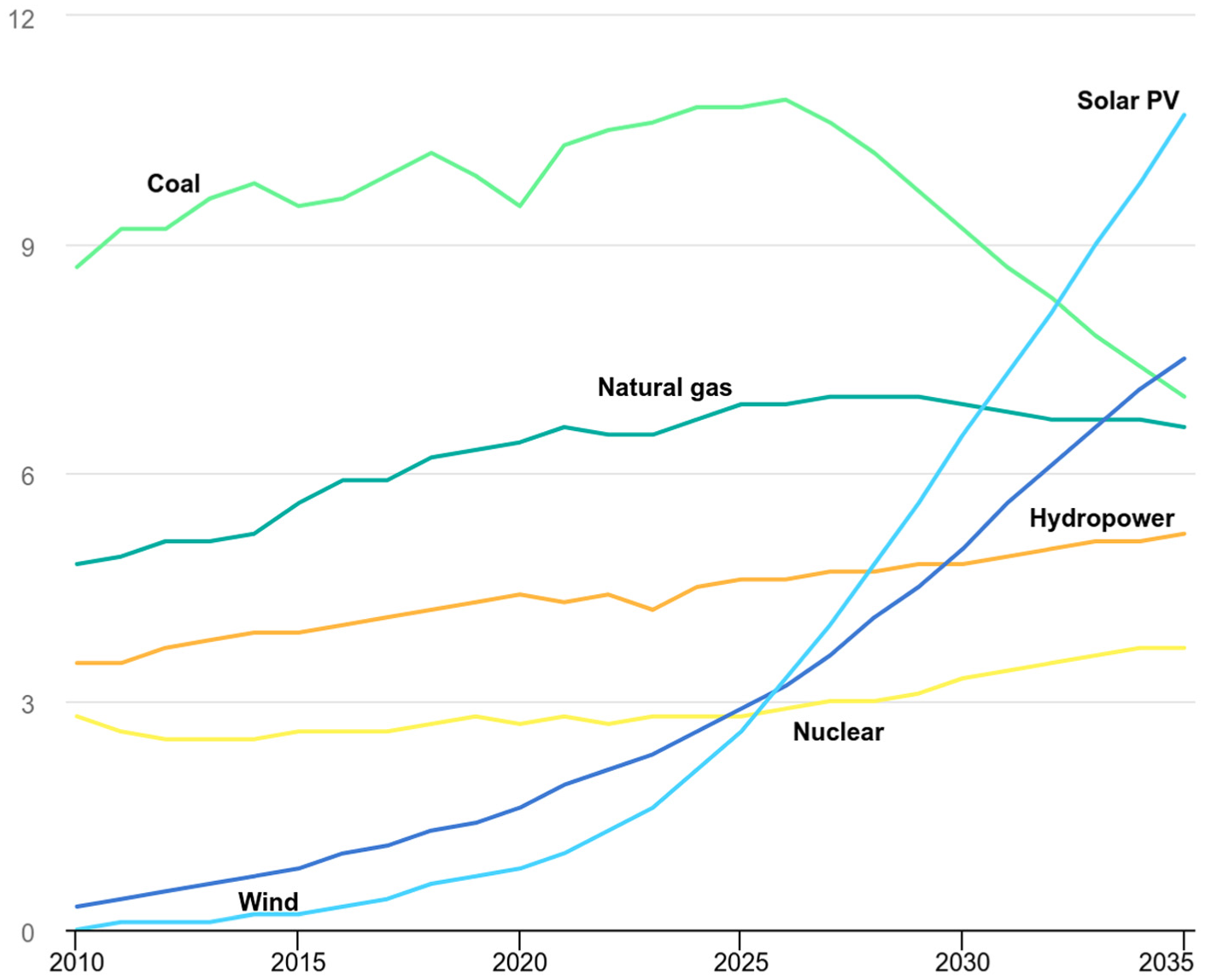
IEA Stated Policies Scenario 2010 to 2035.
Again, the story told in this book is of an energy analyst learning on the job as solar emerges as a viable electricity source. In between, Jenny Chase explains DCF and value analysis for the uninitiated without plunging into detailed spreadsheets. She shows how levelized costs helps us compare various energy sources even when the data is not available. IEA, IRENA, and EIA or other sources were then barely operational.
So, we readers experience the maze-like journey through solar energy and government policies. This is not a textbook, we learn with her. Little in the early 2000s seemed clear, except maybe the climate threats. Then we hit the disasters, the bubbles, the auctions, and the complexity of energy grids, the need for more storage, and our complicated energy system. Jenny Chase takes us through these journeys – what she and others did not know.
Not unlike other emerging technologies, solar investors were learning on the job. For example, the creative destruction of the early automotive industry pushing out horse drawn carriages – Ford and GM, the winners in a crowded industry as they manufactured lower cost and more appealing cars. Or the early mainframes and PCs rapidly advancing to the Iphones that are many times more powerful than the Apollo 13 computers. “Houston, we have a problem.”
Jenny Chase tells the tales of the crashes and over supply – Solyndra and Suntech – where investors and state funds bet on US based winners and lost. Cautionary lessons. The feed-in-tariffs in Germany and Spain where governments were forced to pull back budget commitments when solar demand exploded outstripping all forecasts. She reminds us again of the consequences of demand subsidies where Demand (D)>Supply (S) leads to booms and then busts in PV prices when supply surges.
In such a market there is no equilibrium, price (P) does not equal marginal cost (MC), the basics of textbook microeconomics. Start-up company profits quickly disappear when the lower cost producer enters the market. Again, Jenny Chase does not dive into the details – except to note that the Chinese solar manufacturers, supported with a set of strong industrial policy initiatives, have significantly lower costs (20%–50%) than OECD competitors.
Between the emergence of the much lower cost Chinese solar sector by 2015, we get a quick lesson in electricity, energy grids, intermittent wind and solar, batteries, and the importance of longer-term storage. She takes swipes at energy modelers, scenario forecasts, and much of the stuff that we economists and engineers spend years trying to grasp and model. Uncertainty, S and D, and complexity is what keeps us engaged, drawing portraits of possible energy futures. Of course, both investors and energy economists have a role – presenting the promise of future technologies and analyzing the underlying market fundamentals that generate twenty year forecasts.
Today it is clear that our energy world is rapidly changing. Still our futures are uncertain as financial analysts, investors, policy makers, companies, and futurologists take us to different worlds in 2050. Maybe artificial intelligence (AI), driverless cars, and well-managed grids will distribute electricity with equilibrium prices. More likely booms, busts, and bubbles will persist. Surprising winners will emerge. Tesla may have created the electric vehicle (EV) market, but the Chinese BYD and other experienced manufacturers look like the winners.
Jenny Chase tells of uncertain solar days striving to create a sustainable energy world. Some believed many did not. Maybe the early TV Jetsons gliding over our cities, or HAL computer taking over in 2001, is a better way to imagine our futures. Better than all the hard work, research, models of economists, scenarios, and engineers looking out thirty years. Maybe the entrepreneur, the pitch artists taking us to a different future with solar roofs, wind turbines, and driverless cars is better way to imagine 2050. However, most economists and engineers want a road map with details and logical steps even if they are sketchy.
The challenge for those of us who believe in technology and our search for a better mouse trap is how do we get there? When will we leap forward, leaving our fossil fuel economy behind? The ingenuity of those working in some garage or attic may shift our energy mix. But we must invest a lot of money to dodge the apocalyptic world of 3°C of the Intergovernmental Panel on Climate Change (IPCC) scenarios. Solar Energy Finance tells the investor part of the story, but not all the pieces are there. Our energy system is complex and interconnected. Solar is only part of the energy puzzle.
Looking forward, we know that solar and wind will play an important role. Nuclear appears to be rising in some countries, and cleaner hydrogen will be used in hard to decarbonize sectors. Carbon capture is important. And a more efficient, distributed grid with significant storage capacity will be key to meeting electricity demand. But the road map for investing in such a world is not straight forward.
We know that solar supply penetration will vary significantly by region and that operating costs will show wide variances. Much lower costs and higher penetration in Asia; higher costs in USA; and lots of local grids across Africa. There is no single success template. Solar Energy Finance reminds us of the stumbles and progress around solar power and greener grids. The academic in me would like more graphs, data filled tables, and fewer detours. We learn how solar succeeded over the last twenty years, but does that success predict its future? Of course, experience tells us that is not the way of new technologies. Technological change is bumpy.
Solar Power Finance tells the story of an investor working in the pits – building models, valuation spreadsheets, and future guesses – with entrepreneurs wanting more money. We economists step back making longer term estimates of demand, energy efficiency, and maybe prices. Between the investor hopes and economic modeler, investments are made and change happens. For the professors and teachers among us reading Solar Power Finance is a complementary resource along with IEA or IRENA chapters on solar. Reading more broadly is probably the best way to draw a better picture of our futures. In twenty-five years, readers will know how we got to 2050.