






Abstract

Against all odds, I found some (suspect) science in this new 2026 Endangerment Finding by the United States Environmental Protection Agency (EPA 26Finding) on greenhouse gas emissions (GHG’s) from fossil fuel vehicles in the United States. EPA 26Finding claims without asserting its level of confidence that those emissions make at most insignificant contributions to observed increases in global mean temperatures. This more recent assessment follows from the administration’s earlier Critical Review by the United States Department of Energy’s Climate Working Group (DOECWG (2025)) denying the impact of GHG’s on climate. EPA26Finding further reveals that EPA has no confidence in the science that shows that warming driven by human activity causes significant harm to public health and general welfare. As if unsure about even their own insecurity, EPA26Finding additionally announces the exclusion of that science in footnote #8. In so doing, they excuse themselves from considering the overwhelming scientific evidence published since 2009 when the original EPA Endangerment Finding was published (EPA 2009). Most notably this widely accepted evidence by the scientific community includes a thorough review of the peer reviewed climate science since 2009 by the National Academies of Science, Engineering, and Medicine (NASEM 2025) and The Climate Experts’ Review of the DOE Climate Working Group Report (Dessler and Kopp 2025). My review finds fault in not only the above omissions of scientific evidence supporting the role of U.S. vehicle emission’s role in climate change but also in the limited science included in support of EPA26Finding’s claims of insignificance.
After providing some context drawn around the release of EPA26Finding in my Section I, my Section II applies some first principles of atmospheric physics. I examine the range of future temperature implications that can be expected if actions taken to reduce vehicle emissions were canceled moving forward through 2050 and 2100. The third section then explores the temperature and billion-dollar climate-related extreme events that the United States did experience since 2009. Section IV follows with coverage of two sources of serious harm and large damage that are not captured in the billion-dollar estimates, while Section V closes with some concluding remarks about the confidence we should attach to the Administration’s attempts to justify EPA26Finding.
Section I: A Brief Review of the Events Surrounding the Posting of EPA
Only twenty-five days into what could have been a ninety-day review period conducted by the Office of Management and Budget (OMB), President Trump and Administrator Zeldin announced that the EPA had published the final version of EPA26Finding. Their intent was to eliminate the legal necessity that EPA restrict greenhouse gas (GHG) emissions regardless of their source.
In both the text of EPA26Finding and the Administrator’s remarks (EPA 2026), the EPA made it clear that their practical goal is to rescind the 2009 Endangerment Finding (EPA 2009). EPA26Finding decided to justify the new findings almost exclusively with legal and not scientific arguments. Zeldin summarizes this approach succinctly: “Unlike our predecessors, the Trump EPA is committed to following the law exactly as it is written and as Congress intended—not as others might wish it to be.”
Neither the President nor the Administrator revealed in their rollout event that the EPA had removed all mention of the underlying science that attributes observed warming to human emissions of GHGs. Not even their much-maligned version of the science from the United States Department of Energy’s Climate Working Group (DOECWG 2025) made the final cut.
Why did the EPA back away from the science? EPA26Finding tells its readers why. It includes the revelation that the “Administrator continues to harbor concerns regarding many of the scientific inputs and analyses underlying the Endangerment Finding.” In fact, the notorious footnote reads “… in light of concerns by some commentators about the draft reports of the DOE’s Climate Working Group,” the EPA is not relying on DOECWG (2025) or earlier drafts “for any aspects of this final acton.”
These decisions allowed the EPA to come to a startling and unsettling conclusion: “The legal interpretation finalized in this action means that we cannot resolve remaining scientific controversies in this regulatory context and renders it unnecessary and inappropriate to invoke our authority under CAA section 202(a)(1).”
Section II: Some Atmospheric Physics and Chemistry of Carbon Emissions
Despite the care that the EPA took to eliminate science, a careful reading of the final version of EPA 26Finding (2026a) reveals that a little bit of science did, in fact, make it into the official announcement. At the announcement event, Administrator Zeldin explained that: “Using the same types of models utilized by the previous administrations and climate change zealots, EPA now finds that even if the U.S. were to eliminate all GHG emissions from all vehicles, there would be no material impact on global climate indicators through 2100. Therefore, maintaining GHG emission standards is not necessary for EPA to fulfill its core mission of protecting human health and the environment …” The details behind the results of these exercises were scantily reported without any supporting documentation for two illustrative cases: one assuming that GHG emissions restraints were 100% effective and the other assuming only 50% efficiency (relative to design standards).
For the first assumption, EPA26Finding predicts that eliminating EPA (2009) restrictions would cause 0.013 and 0.037 degrees Celsius of extra warming through 2050 and 2100, respectively. For 50% effectiveness, the corresponding predictions are 0.007 and 0.019 degrees.
These predictions gave me pause for several reasons. First of all, the EPA reported only single estimates for both sets of estimates after complaining for months about projection uncertainty. And without documentation, their readers have no way of replicating any of their work.
Secondly, it would appear from data provided by EPA (2023) that EPA26Finding’s estimates are very small for a sector of the U.S. economy whose carbon dioxide emissions had hovered around 1.75 gigatonnes of CO2(GtCO2) per year since the turn of this century. For the same period of time, global emissions from all fossil sources climbed from 25.5 GtCO2 in 1990 to 36.8 GtCO2. Thus the U.S. transport sector alone accounted for about 4.7% of the
These percentages are illuminating, but the actual emissions are more useful in judging confidence regarding their authority. Around 2010, the National Academies of Science, Engineering, and Medicine (NASEM 2011) tasked an expert panel to produce a consensus report about climate stabilization. The panel worked from first principles of atmospheric physics and atmospheric dynamics to explain that (1) annual carbon emissions contribute directly to cumulative emissions, (2) atmospheric concentrations are directly dependent on cumulative emissions, and (3) higher atmospheric concentrations drive warming.
The report relied on then current literature to exercise a quasi-linear representation of the downstream causal relationship between cumulative emissions and rising temperatures. Allen et al. (2009) is a perfect example of a synthesis contribution. Their results surrounded a most likely temperature sensitivity of 2°C/1,000 Giga tons carbon (GtCO2) with a 5% to 95% confidence range between 1.3 and 3.9°/1,000 GtCO2.
The projections of extra warming caused by rescinding EPA (2009) (an extra 1.75 GtCO2 per year for these three sensitivities) are much higher than the predictions reported in EPA26Finding. Through 2050, the modal estimate of 0.09 degrees Celsius is bracketed by 5th and 95th percentile estimates of 0.06 and 0.17 degrees; through 2100, these projections climb to bracket a modal estimate of 0.26 degrees with 5th and 95th estimates of 0.17 and 0.51 degrees. The 5th percentile projections for both 2050 and 2100 are four times higher than those reported in EPA26Finding.
Section III: Twenty-first Century Impacts and Damages
As displayed in Figure 1, Berkeley Earth (2026) has persistently reported over the past decade or so that the pace of warming has accelerated since the turn of the century. The eleven warmest years on record are the eleven years that started in 2015. Global mean temperatures increases averaged 1.18°C from 2020 through 2022 and 1.47°C from 2023 through 2025. For every month since May of 2023, average global temperatures exceeded past record highs since 1850, sometimes by more than 0.3°C.
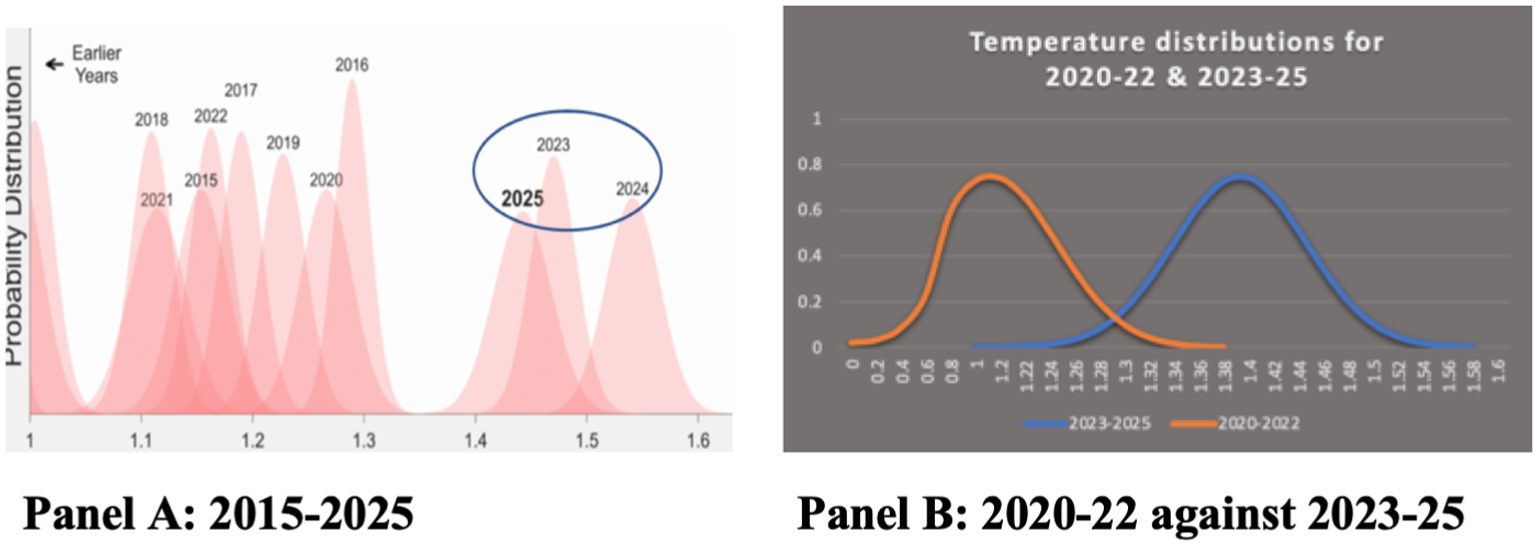
Distributions of global mean temperature anomalies since 2015.
Figure 2 from Climate Central (2026) presents data for billion-dollar climate related events that occurred across the United States from 1980 through 2025. Panel A locates twenty-three extreme climate-related events across the country for 2025. The other panels show that extreme events have generally become more frequent over time. It is of particular interest that the years 2023 through 2025 (the hottest on record) brought more disasters and more severe storms to the United States (Panels B and D) with higher frequency (Panel C) than any year since 1980.
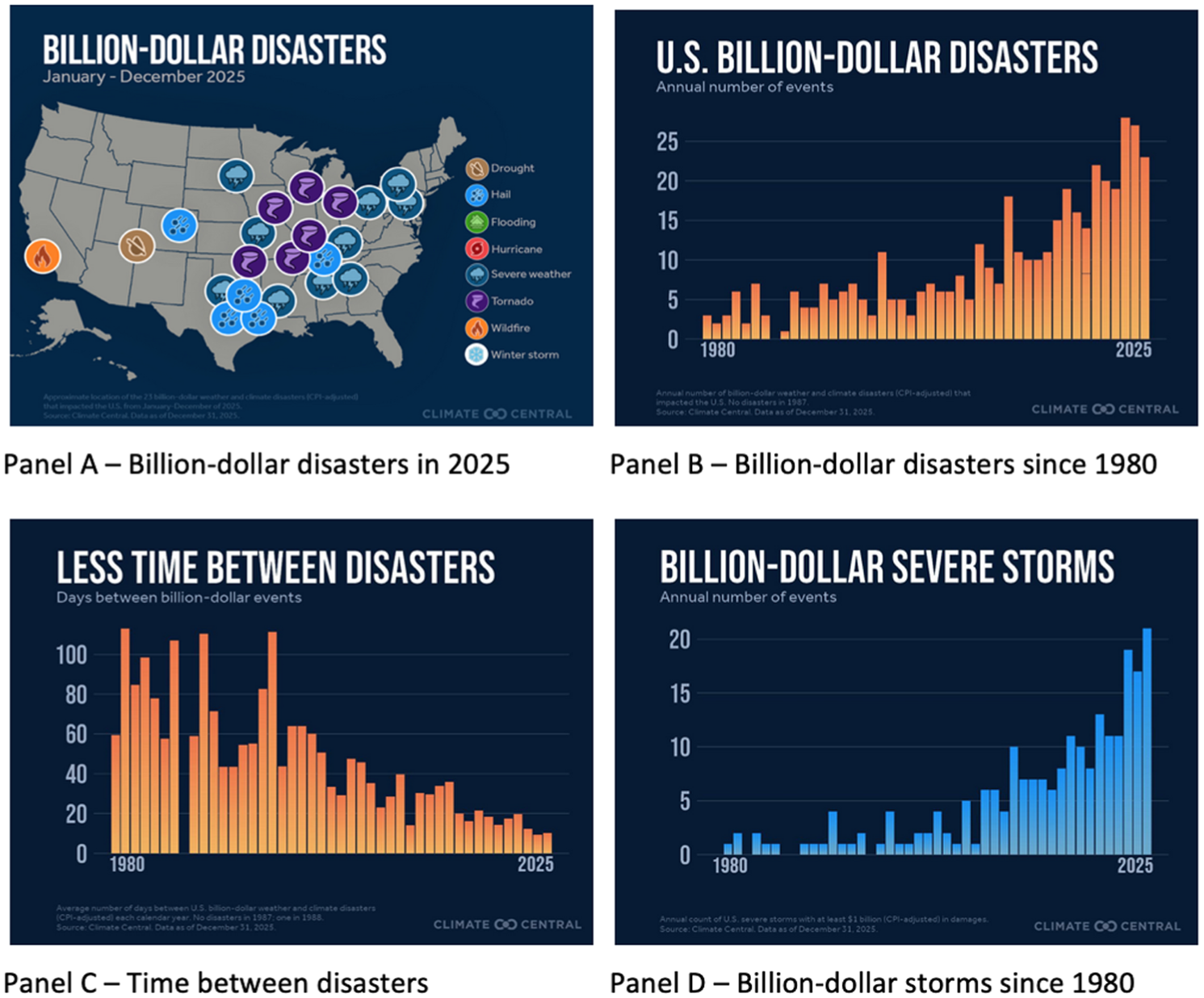
Properties of billion-dollar climate related disasters over time including 2025.
Damages per year before 2009, when EPA (2009) was published, average around $31 billion while the average since 2009 is roughly $134 billion. That means an extra $103 billion in direct financial cost per year for sixteen years since 2009 for a total of $1.65 trillion exceeding EPA26Finding’s claim of $1.3 trillion in consumer expense resulting from EPA (2009). More importantly for present purposes, estimated damages from the last three years alone, when temperatures have been so much higher than ever before, totaled more than two-thirds of a trillion dollars – a big change in a short period of time. Imagine how much higher these numbers might have been had EPA (2009) not been enacted.
Figure 3 from National Oceanic and Atmospheric Agency (NOAA) Climate (2025) reveals that damage estimates have behaved as expected with regard to warming since 1980 and particularly since 2015. A careful reading of the monthly values through to December reveals that the ten years in which the US experienced the expensive climate disasters are the ten years that followed 2015.
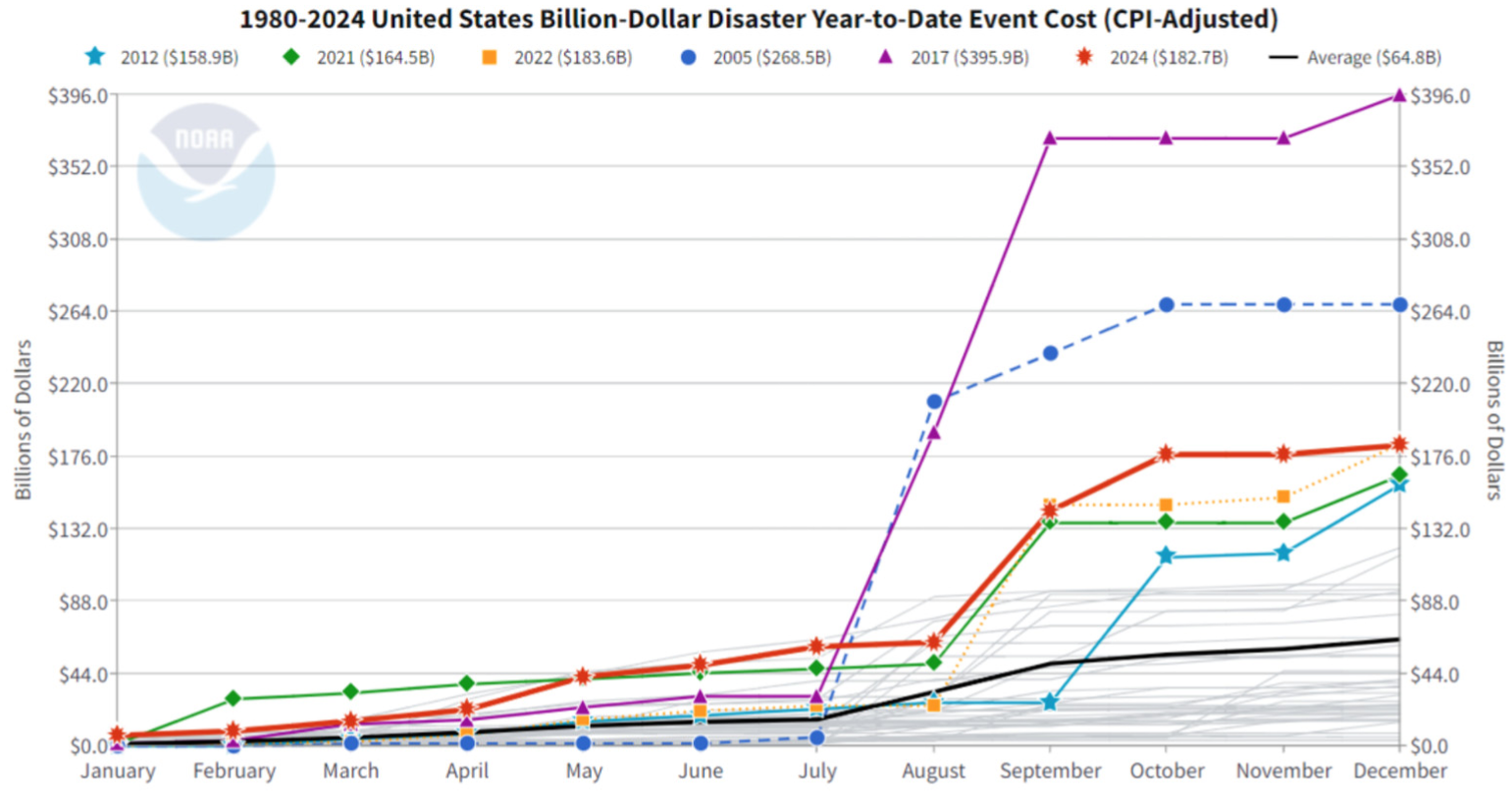
Cumulative monthly total inflation-adjusted damages from billion-dollar disasters from 1980 through 2024.
Section IV: Caveats in the Damage Estimates for Extreme Events
The damage estimates cited above include only extreme events that caused damages in excess of $1 billion. There were, of course in every year, scores of smaller events whose direct damages did not make the cut. Some may have inflicted $999 million in damage; others perhaps only $200 million; and so on. Such smaller-event damages could easily sum to many more billions of dollars in extra damages each year. They really cannot be ignored because they occur much more frequently than singular severe extremes. Sometimes the events occur simultaneously so that their consequences compound each other. In all cases, whether billion-dollar or otherwise, it is clear that coping with warming caused damaging climate events of various frequencies and increasing intensities has become a daily occurrence in twenty-first century America.
Finally, it is important to understand that direct damage estimates do not tell the whole story. They do not include the financial harm caused by downstream economic disruptions – closed airports and canceled flights, interrupted supply chains, lost business days, and the like; these are the downstream effects that constitute most of EPA26Finding’s (2026a) $1.3 trillion cost estimate of climate action since 2009. Nor do they speak to the significant loss of human life. Some people die from extreme heat and cold. Some drown in coastal and riverine flooding. Others die fighting fires. Or they die because they do not listen to and/or maintain early warning systems. These are all threats to the personal security costs of climate inaction that EPA26Finding’s cost of action calculations completely ignores.
Some Concluding Remarks
Section II takes a look at U.S. fossil fueled vehicle emission effects on global mean temperature. It casts some significant shade on the EPA26Finding’s claim that their contribution to global warming has been and will continue to be “insignificant” as we move relentlessly toward 2050 and on to 2100. Whatever they did in their analyses using the usual models of the climate system to produce two single-value projections for 2050 and 2100 does not proport well with Susan Solomon’s physics-based projections for the National Academies. Only the EPA knows why because the details of their analysis using the “usual suspect models” is a complete black box that produced single-value predictions that are most certainly incorrect; nobody can claim that much certainty when looking into the future, especially across an ensemble of different models with different strengths and weaknesses and different imbedded representations of how the planet and its human systems work.
I am not a lawyer, so I do not have the credentials to express a legal opinion about the current Administration’s claims that Supreme Court of the United State (2007) overreached its authority in 2007 and EPA (2009) did the same. I am, though, a long-term contributor to climate science from an economist’s perspective, and I have participated in many public policy assessments. I am therefore comfortable in offering one opinion on the EPA’s current handling of climate science.
Simply put, I feel strongly that closing off debate between faux and honest science by ignoring both can never be an acceptable strategy with which to inform enormously significant policy findings. My reasoning is simple: The 2007 Supreme Court decision instructed the EPA to determine “whether or not emissions from new motor vehicles cause or contribute to air pollution which may reasonably be anticipated to endanger public health or welfare.” That is, the EPA was tasked to determine with high confidence that GHG emissions did indeed cause sufficient harm to be classified as a pollutant under the Clean Air Act (CAA) of 1970 as amended in 1990 (United States Library of Congress 2007).
By design, the authorities who produced EPA 26Finding decided that they would not do that. They did so by choice, but humanity does not have to agree. From what they have presented as justification for their rescinding of EPA (2009), we should now have very low confidence that they are leading us in the right direction – one more reason for those of us who take climate risk seriously to keep a list of actions of the current administration that will need to be undone.