







Abstract
This article explores the relationship between advertisings’ directive to consume and the binary-based “legitimizing myths” surrounding feminine identity found in magazine advertisements by first presenting a theory of gender identity dissonance, and then examining the complexity of marketing gender identity dissonance to women. Key to establishing and developing the relationship between consumption, identity, and pleasure is the dissemination of gender-based dichotomies that work to both create and reinforce stereotypical notions of appropriate female gender identities as well as link self-actualization with the embodiment of contradictory identity positions. To illustrate this point, this article provides an in-depth analysis of the De Beer’s right-hand ring print advertising campaign featured in women’s magazines from 1998 to 2006. Advertisements and information gathered from industry sources indicate that there is a conscious focus within the industry, especially within recent years, towards the representation and utilization of feminine complexity and female gender identity dissonance in product marketing.
Identity, consumption, and advertising are inextricably linked. Not only do advertisements reflect their historical and cultural moment, their role in the development of public discourse and dissemination of community values and attitudes ensures that they assist individuals and society with adapting to changing circumstances (see Marchand, 1985). By fusing desire and consumption, advertisers promote fears associated with an incomplete or less than desirable self in order to fuel a capitalist-based agenda. Especially with advertising’s shifted role “from merely announcing the availability of goods and merchandise to attempting to define wants and needs, it went from being part of business enterprise to becoming a social institution” (Budgeon, 1994, p. 55). Advertising has a significant impact on people’s psyche (e.g., Berger, 1972), and, as a social institution, cannot help but construct, reflect, and distort the psychological experiences and lives of those who consume it. As a result, advertising provides an important arena in which the psychological ramifications for women living in our current highly commodified society can be investigated.
It is no surprise, given the personalized and contradictory nature of our contemporary media environment, that postfeminism should feature prominently within 21st-century advertising discourse. Postfeminism’s presence within advertising is particularly problematic, as it ensures that real problems for women are concealed under a guise of individual self-empowerment, superficial solutions, and artificial transformations that in fact undermine true agency and real feminist change. Rather than buoying women’s status and shoring up power, postfeminist culture undermines feminist goals. Thus, within a postfeminist media landscape, gender equality is framed as achieved, and feminism is regarded as a ridiculous and obsolete movement (see McRobbie, 2008; Negra, 2009; Tasker & Negra, 2007). Key to postfeminism is the celebration of consumption. Its focus on personal freedom through lifestyle ensures that commodities and consumerism are intimately linked with self-knowledge and agency. This problematic and contradiction-riddled relationship is both accentuated and reinforced by ads featuring gender identity dissonance.
Magazines, and the advertisements they contain, are incredibly influential—especially with young women. Studies report that over 72% of teenagers read magazines regularly (Klein et al.,1993; “Magazine handbook,” 2010), with more than 60% of college-age women reading beauty magazines on a monthly basis (Thomsen, McCoy, Gustafson, & Williams, 2002). Angela McRobbie’s (1996) investigation of women’s magazines, along with her assessment of prior media research, has led her to conclude that magazines function as powerful and highly ambivalent “media-scapes for the construction of normative femininity” (p. 172). She observes that unlike other mass media, the specificity of women’s magazine’s gendered address plays an important role in the construction of the feminine subject. Thus, print magazines and the advertisements they contain provide critical spaces for those interested in investigating the impact of media on women’s lived experiences, as “advertising in women’s magazines plays an influential role in formulating, maintaining, and altering how readers understand the construction of socially acceptable gender norms” (Inness, 2004, p. 125).
Scholarly investigation into the impact of magazines on young women demonstrates a growing awareness of the incredibly mixed messages contained within these texts (e.g., Inness, 2004; McRobbie, 1996, 2008). Magazines not only present contradictory representations of female gender identity, but actually benefit from the “complexity of what womanhood entails” (Inness, 2004, p. 128). This paper explores the relationship between advertising’s directive to consume and the binary-based “legitimizing myths” surrounding feminine identity found in magazine advertisements by first presenting a theory of gender identity dissonance, and then examining the complexity of marketing gender identity dissonance to women. Key to establishing and developing the relationship between consumption, identity, and pleasure is the dissemination of gender based dichotomies that work to both create and reinforce stereotypical postfeminist notions of appropriate female gender identities, as well as link self-actualization with the embodiment of contradictory identity positions. To illustrate this point, this paper provides an in-depth analysis of the De Beer’s “Raise Your Right Hand” right-hand ring print advertising campaign featured in women’s magazines dating from 2003 to 2006. These advertisements effectively illustrate how feminine multiplicity and gender identity dissonance are key characteristics of the appeal made to consumers, and allow for a revealing exploration of the relationship between advertising and identity.
The dissonance-themed right-hand ring campaign by De Beers draws attention to the ways in which the advertising industry works consciously and unconsciously to capitalize upon women’s ambivalent feelings and gender identity construction. This particular ad campaign was chosen because of its clear use of feminine multiplicity and gender identity dissonance, wide circulation in high-profile magazines, and cohesive vision, aimed at reaching a national audience with broad-based appeal to young female magazine consumers. Advertisements and information gathered from industry sources indicate that there is a conscious focus within the advertising industry, especially within recent years, towards the representation and utilization of feminine complexity and female gender identity dissonance in product marketing.
Media’s role in articulating—constructing and disseminating—discourses of identity, those that preoccupy and characterize individuals and society, make it a critically important arena for investigating the relationship between psychological processes and cultural dynamics. The narratives that frame media texts, in particular the affective components (values, emotions, and desires) that reside within mass forms of communication, are actively implicated in meaning-making at both the individual and societal level. Consequently, the mass media, and more specifically print magazine advertisements, are an essential locality for exploring the embodiment and management of identities, and how the process of identification is marked by conflicting desires and representations. Contradictions matter—understanding why certain contradictions prevail and are desired and desirable matters. At the core of this project is the belief that there is an intrinsic link between the representations of feminine contradiction that we see in postfeminist culture and the manner in which individuals personally develop and manage identity. Identity dissonance as a concept is put forth in the hope that it can heighten our awareness of the conflict-ridden nature of our society and the identities that many women inhabit, and, better illuminate the manner in which mediated contradictions both reinforce and challenge hegemonic notions of female gender roles and identities.
A Theory of Identity Dissonance
The theory of identity dissonance is an elaboration of Leon Festinger’s theory of cognitive dissonance (1957) and views identity dissonance as an unsettling feeling of psychological disquiet, occurring when people make a commitment to two or more conflicting identities. Identity dissonance occurs when an individual regards particular identities as essential components of his or her self-concept yet also considers, consciously or unconsciously, these identities to be antithetical. The experience of dissonance indicates that the individual has reached the conclusion that these identities, or parts of these identities, should not simultaneously coexist. Like cognitive dissonance theory, the resulting psychological anxiety that occurs from dissonance acts as a motivating tension, encouraging individuals to either remove one of the offending identities from their self-concept; continue to wrestle with the tension, ideally finding alternative psychological and/or behavioral strategies (e.g., distraction) in order to mitigate the resulting anxiety; or thirdly, adjust their conception of the identities in order to conceive them as corresponding (modification of Festinger, 1957). What this means is that self, and usually society, presume that identities are an “either—or” proposition. An example is the simplistic Madonna-Whore dichotomy. You can be either a saint or a sinner, but not both. Consequently, within a unified sense of self there can exist competing or oppositional identities, that while recognized as integral to who we are, when embraced, can result in anxiety.
Gender identity dissonance theory proposes that the range of valued gender identities that a modern and effective self-concept has available for integration are very often perceived as contradictory in nature and that everyday life and normal self-concept development encourage the adoption of identities in opposition. For example, socially acceptable adolescent female identities stress the desirability of being both active, independent, and self-centered in addition to being passive, dependent, and other-centered. If an adolescent girl accepts and integrates both opposing psychological approaches is she irrational or in danger of emotional collapse? Identity dissonance theory proposes that this girl is not in psychological danger, but rather predicts that she should experience a degree of dissonance in her life. Different contexts will prompt individuals to enact differing identities based upon fluctuating environmental and personal demands and desires, thus, identities will vary as environments change, increasing the likelihood of dissonance. Ultimately, according to the theory of identity dissonance, a “stable” self-concept is also a dissonant one.
Although the theory of identity dissonance recognizes that individuals are motivated by a drive for consistency, it nevertheless is based upon the presumption that our self-concepts are inconsistent; that individuals are contradictory by nature. Identity dissonance suggests that selves are composed of needs and desires that are often in opposition to each other and that this reality may explain why individuals experience the drive towards internal consistency, which is the most “comfortable” state for the psyche (Heider, 1958). Therefore North Americans are motivated to try and attain this state of being even though the natural process of identity development would seem to render this an unachievable goal, as societal influences and personal desires promote the development of an inconsistent self-temperament.
Ultimately, this theory argues that not only do individual differences shape the experience of gender identity dissonance but also that key determining factors in the degree of self-inconsistency will be informed by cultural perceptions surrounding gender identities and demands placed upon an individual by his or her ever-changing environment (see Crymble, 2009). It is women’s personal experiences and shifting cultural/social circumstances that gender identity dissonant advertising is capitalizing on. Postfeminism touts women’s choices while suppressing the real structural, ideological, and personal frameworks that limit women’s options. Therefore, it is the contradictory identity-based intricacies of navigating our postfeminist era that ensure that contradiction and conflict shape our psyche, proliferate within our media representations and discourse, and, ultimately, affect our advertising.
Feminine Complexity and Gender Identity Dissonance in Marketing to Women
While there is no doubt that advertising presents a distorted representation of people and culture, it still reflects the cultural moment in which it is embedded. As a consequence, marketing appeals will surely draw upon and exploit the experience of gender identity dissonance. Roland Marchand astutely observed that as early as the turn of the 20th century advertising was meticulous at replicating the cultural standards of its day, as “advertising leaders recognized the necessity of associating their selling messages with the values and attitudes already held by their audience” (1985, p. xix).
When society’s opinions shift regarding certain tastes or practices, advertisers must scramble to change their appeals in order to refrain from alienating or offending consumers. While few big businesses have tried to be as sensitive to this reality as the tobacco industry, in early 2000 Philip Morris, producer of Virginia Slims cigarettes, was once again reminded of this marketing imperative. Their “Find Your Voice” advertising slogan and campaign was regarded as offensive by millions of people who argued that it was insensitive to those suffering from smoking-related diseases, especially throat cancer. While testifying under oath during a class action suit initiated by Florida residents with smoking-related illnesses, head of tobacco operations Michael E. Szymanczyk responded to angry Florida residents by assuring them that there would not be a “‘hint of rebelliousness’ in future advertising. ‘We don’t want controversial advertising . . . I don’t want people to look at our advertising and say that we’re trying to do something wrong’” (Fairclough, 2000, p. A6). Months later Philip Morris launched a campaign that prominently featured an identity dissonance-based appeal, with a tagline “i know that i’m very complicated. i like it that way.” For Virginia Slims (2000) this new promotion represented both a fresh and benign approach to advertising cigarettes. “Brands need to reinvent themselves” observes Richard Kirshenbaum, cochairman and chief creative officer at Kirshenbaum Bond, the advertising agency behind Hennessy’s Appropriately Complex advertising campaign (Elliot, 1998, p. C7). One of the key ways it seems that products are able to redefine their image is by using dissonance-themed advertising campaigns.
A company’s desire to associate complexity with their product is reflected in the marketing choices they make, such as the name of their product and the model-spokesperson for their brand. According to leading trend-watcher J. Walker Smith, “when Calvin Klein does something I listen . . . He has the best ear around for American pop culture” (Shapiro, 1998, p. 5A). Thus, in 1997, when the renowned fashion and accessories designer launched a new women’s perfume, the fact that he chose to call his fragrance “Contradiction” spoke volumes about the historical moment. Klein already had a reputation for marketing perfume that was symbolic of an era, as during the 1980s his fragrance Obsession for Women and its advertising campaign featuring a young Kate Moss were heralded as an iconic expression of the excessive, sexual, and superficial nature of the 1980s. In the late 1990s Calvin Klein once again had his hand on the pulse of America, building a product brand that attempted to reflect the true paradoxes and uncertainties of the cultural moment, a moment in which, as Walter Shapiro of USA Today then observed, “contradiction sells” (1998, p. 5A).
Calvin Klein picked Christy Turlington to be the face of his fragrance campaign for Contradiction because he felt she had “many different sides” (Aktar, 1997, p. 6). Not only a famous model but also an established businesswoman and student studying comparative religion and eastern philosophy at New York University; it was the diversity of the representations associated with her public persona that signaled “a depth to her that [Calvin Klein] really wanted to capture” (Aktar, 1997, p. 6). The initial print advertisements associated with this campaign were extremely minimalist in their aesthetic. Primarily black and white, the ads feature the model casually posing against a shadowy white backdrop (see Figure 1). Many of the ads depict Turlington in loose tweed pants and black T-shirt, or, wearing a boxy black suit without a shirt—her modest cleavage suggesting the slope of a man’s chest more than a woman’s breasts—a subtle play between masculine and feminine. The advertising slogan associated with this campaign is “she is always and never the same.” This tag line helped reinforce both the traditional/classic and progressive/avant-garde tone that Klein wished to personify in his advertising for Contradiction. Ultimately, the general approach of the campaign was to demonstrate the pleasure to be gained from both embodying and demonstrating complexity. “We wanted her to be having some fun” in the ads argued Sheila Hewett, vice president of global marketing, advertising, and communications at Klein Cosmetics, and this happiness is seen clearly in the big joyous grin that Turlington exhibits in so many of the print advertisements (Aktar, 1997, p. 6). While Contradiction never evolved into a classic scent like Obsession, for women between the ages of 25 and 49 Contradiction for Women did extremely well; within its 1st year the perfume ranked 7th among women’s “prestige” fragrances (Born, 1998) and became one of the best-selling scents in the United States in 1998 (Aktar, 1998).
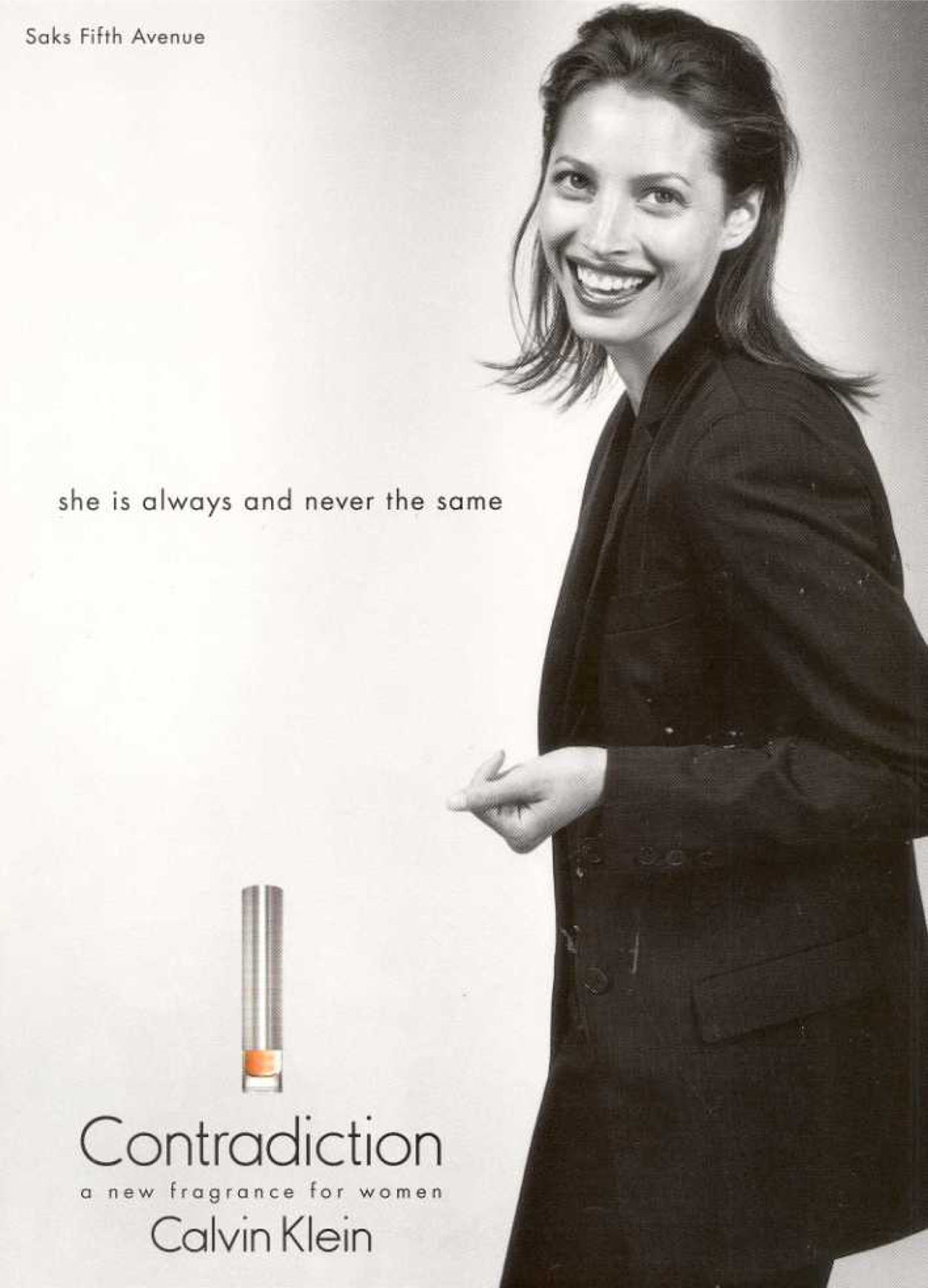
Calvin Klein advertisement for Contradiction Perfume
Few campaigns have been as explicit in their appeal to, and endorsement of, women’s experience of dissonance as Calvin Klein’s advertising and marketing campaign for Contradiction perfume. The October 1997 issue of Glamour magazine featured a promotional partnership with Calvin Klein in which the magazine asked readers to submit personal accounts of how contradiction in their lives helped them to be successful and accomplish their goals. Readers whose stories where chosen were honored at receptions where they were lauded and presented with a personal letter from Calvin Klein and a gift of a silver frame (Aktar, 1997). The distinguished historian Roland Marchand observed that advertisers discover “vacuums of advice and psychological deprivations in modern society” in order to play “a therapeutic role in helping Americans adapt to new social and technological complexities” (1985, p. xxii), which could well explain the expression and utilization of gender identity dissonance-based themes in advertising. In the case of Calvin Klein’s Contradiction, the fragrance ads tried to position themselves as an expression of women’s essential complexity—the perfume seeks to capture an abstracted desire, an experience that is almost beyond words or too difficult to articulate, and/or a desired or aspired-for self. Ultimately, the advertising industry not only seems to exploit these wished for selves but also cultivates consumers by acknowledging the difficulty of managing certain psychological and cultural experiences, in particular, those associated with identity-based complexity, and its repercussion, and dissonance.
Ads that reflect and exploit the psychological complexity of consumers are regarded as effective marketing tools. Barbara Lippert, a celebrated advertising critic and columnist for Adweek, a weekly trade publication, praised the use of “cognitive dissonance” in a series of 2003 identity theft ads by Citibank (2003a, p. 22). Finding the use of dissonance “inspired,” she raves about the disjunctures depicted, suggesting that “the dissonance becomes like an interactive game” (Lippert, 2003a, p. 22), providing an important element for the promotion of viewer engagement.
Both print and television ads in Citibank’s identity theft campaign rely upon identity-based juxtapositions that are meant to be humorously jarring—a ridiculous situation is depicted where a purchase seems improbable based upon the identity of the cardholder, thus becoming evidence for identity theft. For example, one print ad (see Figure 2) depicts a seemingly demure Asian woman in a tailored pink suit and conservative pearls standing in front of a Monster truck with the tag line “It didn’t seem right to us, either.” It is the humorous discord between identities represented in these ads, the actual dissonance or antithetical nature of the identities depicted, that appeals. Creating “wickedly funny juxtapositions” (Parpis, 2004, p. 30), the Citibank identity theft solutions’ ads were within the top 5 advertising campaigns when it came to retention and recall by television viewers for October of 2003 (“Ad Age/IAG’s Top Spots,” 2003). These dissonance-themed ads were extremely effective, as according to the Magazine Publishers of America (“Advertising & PIB,” 2008) the advertisements led to an increase of over 10,000 new applications and 2,100 new accounts for Citibank. In addition, the campaign was a 2004 MPA Kelly Finalist and won Adweek’s Campaign of the Year honors for 2003. It is important to note that the dissonance between identities depicted in both Citibank’s print and television ads is vital to their success. In contrast, for example, to the ads for Calvin Klein’s Contradiction, which present feminine multiplicity as a natural and ideal experience, the gender-based identity dissonance depicted within the Citibank ads is used to mock contradiction rather than promote it. As a consequence, Citibank’s award-winning advertising works to reinforce the importance, expectation, and value of consistency in people.

Citibank advertisement for Citi Identity Theft Solutions
Cultural and marketing/advertising critics have drawn attention to how various companies have consciously cultivated and/or pursued advertising campaigns that clearly use dissonance as a means to attract customers (e.g., Lippert, 2003a; Walker, 2005). Thus, there seems to be a general awareness by those who monitor the industry of how companies capitalize on dissonance and the pleasure and/or attraction that it has for their consumers. In another instance, Edward Jay Epstein (1982) notes how research conducted in the 1970s for N. W. Ayer on behalf of De Beers, revealed how diamonds were purposefully marketed in a manner that sought to mitigate the dissonance many women experienced when receiving a diamond from a partner. The investigation by the advertising agency concluded that women experienced a strong sense of guilt when their requirement for practicality clashed with their desire for expensive jewelery. Consequently, N. W. Ayer set out to design a campaign promoting diamonds as a gift to surprise women with, as
the element of surprise, even if it is feigned, plays the same role of accommodating dissonance in accepting a diamond gift as it does in prim sexual seductions: it permits the woman to pretend that she has not actively participated in the decision. She thus retains both her innocence—and the diamond. (Epstein, 1982, p. 27)
Like most (successful) advertising appeals, De Beers connects the purchase of its products with a desired emotional outcome—in this instance, the goal was not only the presumed feelings of love and desirability that the gift of a diamond is proposed to help women feel but also the alleviation of any possible dissonance that might be affiliated with the acceptance and/or desire for this gift of diamonds.
Apparently recognizing the success that a dissonance-laden campaign could provide their business, De Beers expanded upon this strategy to a great result when it came time to market right-hand rings. Analysis of De Beers approach provides an important illustration of how one company, and their advertising and marketing partners, consciously and effectively utilized gender identity dissonance as a means to encourage consumption.
Contradiction and Consumption: The De Beers’ Right-Hand Ring Campaign
At the turn of the 21st century, a key aim of the Diamond Trading Company, the sales and marketing arm of De Beers, was to develop a product that would utilize smaller, more plentiful, and less desirable stones (Lippert, 2003b)—an accomplishment they achieved through the development of the fashionable “right-hand ring,” which linked female empowerment with the purchase of jewelry. While men have been the traditional purchasers of diamond jewelry, the right-hand ring campaign shifted its sights towards inspiring women to buy for themselves. And, though much of the campaign is aimed at married women, it should be no surprise that at a time when marriage rates are falling, and thus, the number of engagement rings purchased declining, a campaign that also targets single, middle-class women should be launched.
While advertisements for right-hand rings had been circulating for a number of years due to an industry-wide initiative to promote this type of jewelry, in the Fall of 2003 the immensely powerful J. Walter Thompson advertising agency introduced a new visually unified and iconic advertising campaign for De Beers notable for its tag line “Women of the world, raise your right hand” (hereafter referred to as the Raise Your Right Hand campaign). Part of the US$200 million a year that De Beers spends on marketing (“Changing facets,” 2007), these eye-catching advertisements set out to establish diamonds as a potent expression of a woman’s own distinctive style and personality (O’Loughlin, 2004). Comprised of at least 21 ads, all but one featuring a variation of the same gender identity dissonant theme, the Raise Your Right Hand print campaign appeared in magazines as diverse as Vogue, Entertainment Weekly, House & Garden, Glamour, Redbook, and Architectural Digest. What unites these magazines is that they all target an established or aspiring upscale, or presumably empowered female audience (Braverman, 2005). Right-hand rings are what the industry refers to as “fashion jewelery,” designed to capitalize on women’s desire to buy accessories reflective of their personal flare and individuality. Sally Morrison, a spokesperson for De Beers, suggested that the ultimate goal for the Raise Your Right-Hand campaign was to create a “cultural imperative” (Zoellner, 2006, p. 246)—the development of a mythology or need where none before existed. According to research conducted by J. Walter Thompson, this campaign succeeded in convincing women to regard diamonds in new ways (O’Loughlin, 2004); since its inception in 2003, there has been an increase in women’s recognition of diamond rings as something that can be purchased for themselves, as not tied to marriage, nor particularly a reflection of a man’s love, but instead a stylish accessory that is able to indicate one’s authenticity, independence, and self-love. Regardless of the many reasons that lead women to acquire a right-hand ring, it is clear that the purchase of a diamond ring is no longer directly linked to a heterosexual marriage proposal, and thus the sole terrain of men.
Acknowledging the advantageous identifications associated with being both single and in a relationship, De Beers appears to recognize that women may feel anxiety due to the fact that one of these desirable identities must always be forsaken for the other. Thus they built an advertising campaign around a woman’s relationship status and the suggestion that she could assume/display both identities (which express valued characteristics of the self) by the overt wearing of a right-hand ring. This campaign created a new purchasing imperative—the right-hand ring phenomenon—utilizing dissonance-themed advertising. Attempting to capitalize on women’s possible feelings of division and anxiety, and aspirations towards self-actualization, the advertisements focus on the hurdle of negotiating antithetical identity constructions that are part of being single or coupled. Thus, the Raise Your Right Hand print magazine campaign by De Beers was able to establish “a new dialectic of diamonds: the split between romance and independence” (Lippert, 2003b, p. 18).
The tag line reads, “Your left hand says you’re taken. Your right hand says you can take over. Your left hand celebrates the day you were married. Your right hand celebrates the day you were born. Women of the world, raise your right hand” (see Figure 3). Womanhood, both physically and psychologically, is divided down the middle—and this division is an important reflection of a larger discursive trend. Relationship statuses are socially constructed in such a way that very different requirements and pleasures are linked with either identity. For example, having a partner is often characterized as a “trade-off” with a significant sacrifice of freedom and self-indulgence made in order to attain economic and emotional stability (Kimmel, 2000). And, while a strong argument against whether these identity claims are truthful or acceptable can be made, the fact remains that society is replete with images and representations of single and coupled women that reinforce these divisions.
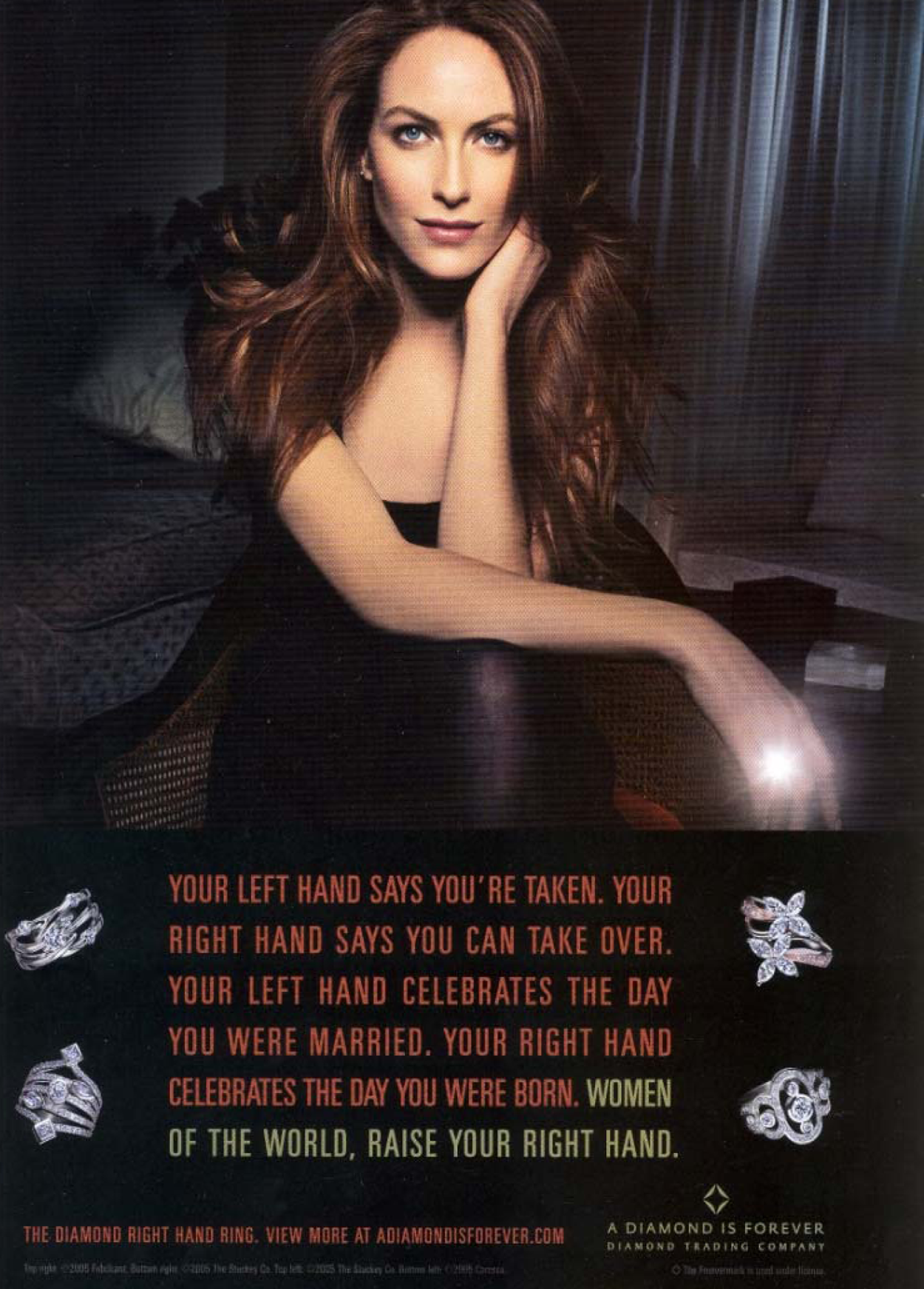
De Beers advertisement for Raise Your Right Hand Campaign
Since the 1970s, the presence of what Ruth Rosen (2000) refers to as “consumer feminism,” has ensured that the imagery and language of liberation and emancipation associated with the women’s movement has been effectively co-opted to sell goods and services. The result is that advertising appeals have sold feminine agency and achievement as easily attainable through consumption. Postfeminist culture ensures that consumer choice masquerades as personal and progressive choice. Consequently, “we need to be fully attentive to the instrumentalization of feminism as a source of innovation and dynamism for consumer culture” (McRobbie, 2008, p. 548). De Beers, then, appears to capitalize on tensions associated with the contemporary feminist movement, specifically women and men’s ever-more-public struggle over domestic and occupational roles, by constructing advertisements that address the conflict between modern feminist tendencies and traditional notions of desire and identity. This is evident in one of their early ads promoting right-hand rings: “On my left hand you will see a symbol of my commitment. But my right hand is my independence. My uncaptured spirit that also wants to shine” (De Beers, 1999). De Beers seems to presume that women will experience dissonance due to competing desires to enact equally valued identity positions, and, it is implied in this ad that such tension will continue to live on after the purchase of a diamond engagement ring. Fear of losing customers is what seems to be motivating this ad, as De Beers encourages women to recognize that “independence” may be compromised after making a marriage commitment, and in order to be regained, another diamond needs to be purchased for the right hand to help facilitate the expression of the “uncaptured spirit.”
A Raise Your Right Hand ad, published in 2006, declares, “Your left hand sees red and thinks roses. Your right hand sees red and thinks wine. Your left hand says, ‘I love you.’ Your right hand says, ‘I love me, too.’ Women of the world, raise your right hand” (Diamond Trading Company 2006a). The Diamond Trading Company overtly petitions women to conceive of purchasing a diamond ring as a form of empowerment, employing the notion that loving a man (as this campaign is firmly heterosexist) means losing yourself. In these new millennial advertisements consumers are presented with the evocative cry at the end of every right-hand ring ad for women of the world to raise their right hand. Using the language of self-respect and self-actualization—seen here in the assertion “I love me too”—the ads from this campaign stand as a prime example of consumer feminism. They petition women to regard consumption as the best path to collective social action, a situation presented as being achieved by appearing in public with outstretched hands bearing flashy, beacon-like diamond rings. Under the current hegemonic “common sense” of postfeminism, personal agency and defiance of the social order is reduced to a goal best reached by simply shifting the meanings associated with the baubles we use to adorn ourselves.
A popular advertising approach is to feature the act of purchasing as providing an easy fix to untenable situations. Addressing women’s fight for gender equality, Raise Your Right Hand ads position their jewelry as assisting women to negotiate the divide between the public and the private sphere: “Your left hand likes evenings at home. Your right hand loves a night out. Your left hand reads stories before bed. Your right hand lives a story worth reading. Women of the world, raise your right hand” (see Figure 4). Many of the advertisements feature models who are clearly wearing wedding bands, seemingly trying to encourage married female magazine readers to feel that by acquiring a new diamond ring they will be able to physically express to the world that there is more to them than what their married identity, and their wedding rings, would indicate. De Beers’ proposes that the right-hand ring can function as a bridge, demonstrating a woman’s ability to traverse between the private marital home and the world at large with ease and grace. Their ads suggest that through the correct purchase a married woman is able to escape the normative feminine trajectory, which presumes the abdication of positive, productive, and agentic characteristics of self that are so often associated in our culture, and these ads, with singlehood.
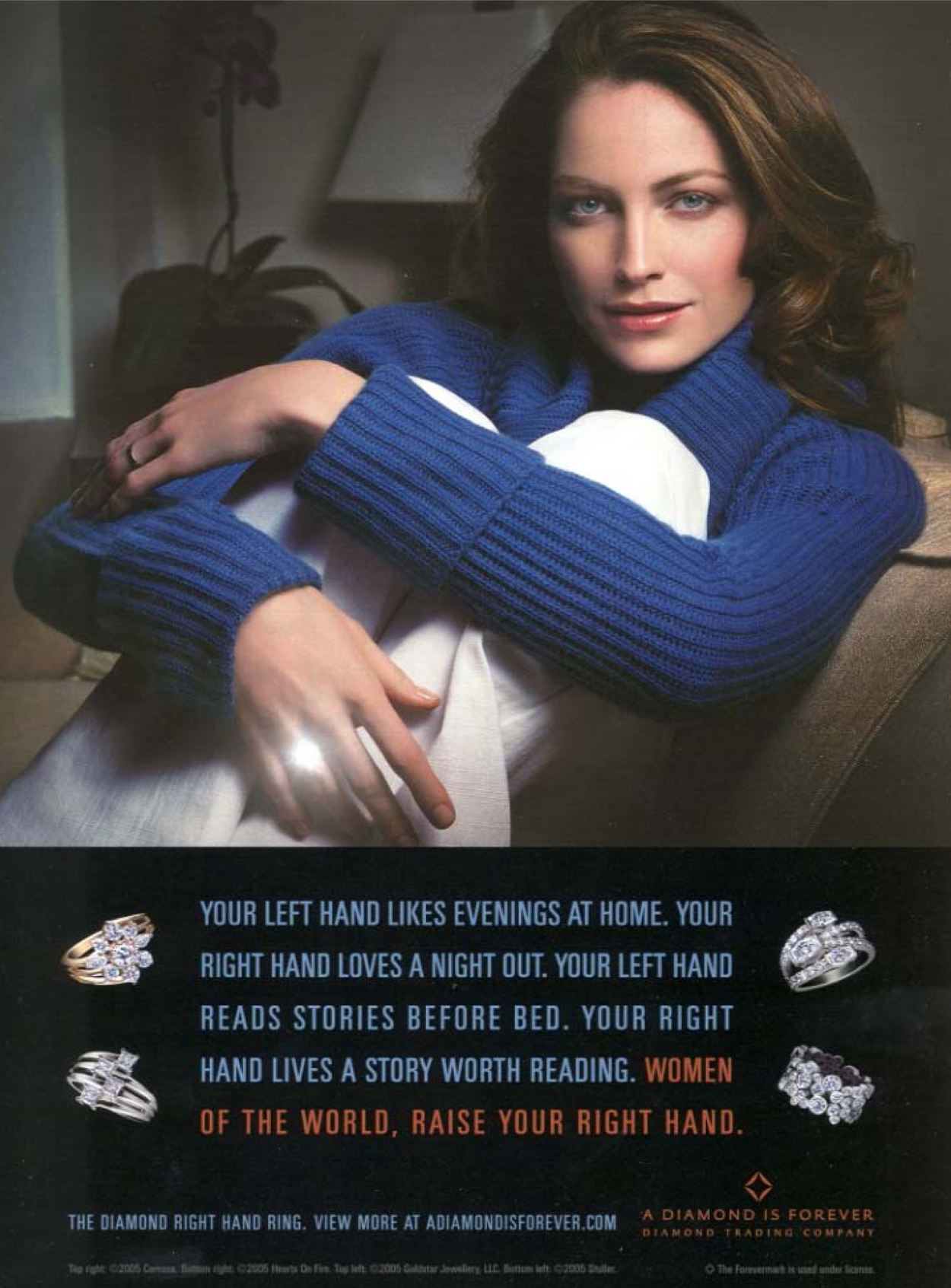
De Beers advertisement for Raise Your Right Hand Campaign
Characteristic of the postfeminist culture in which they reside, these advertisements labor to reinscribe very traditional notions of mothers and wives. Married mothers are constructed, for example, as romantic not passionate figures, and are very clearly relegated to the domestic rather than the public sphere—she is left reading stories before bed. In contrast, the modern single girl’s territory is “out there,” her energies are directed inward towards pleasing herself, and outward in ways that mark the world as hers—living a story worth reading. While the polysemic nature of the ads ensure that women will interpret them in a myriad of ways, these advertisements strive to promote certain interpretations that capitalize on the experience of gender identity dissonance, and correspond with the traditional nature of postfeminist discourse. Ultimately, the Raise Your Right Hand ads work hard to strengthen and magnify gender identity conflict by featuring language that normalizes conservative forms of womanhood and the supposed oppositional nature of women’s relationship status. By reinforcing the antithetical nature of these identities, these kinds of ads could mobilize feelings of dissonance in their female audience, encouraging women to resolve their anxiety through the hollow show of resistance and/or solidarity that is the purchase of a diamond ring.
One of the ways in which these ads address and attempt to manage anxiety associated with the negative connotations of single and couplehood is by utilizing older models in their campaign. By featuring women in their 30s and 40s, with all the markers of wealth and sophistication, the ads are able to target women who may be wrestling with the derogatory connotations of being either longtime single or longtime married, offering them ways to reinvigorate their lives by bringing more meanings and identities into play. In addition, another equally relevant interpretation would be that this campaign is trying to capitalize on women’s desire to display a symbol that overtly reflects their retention of valued characteristics associated with an identity that is abdicated upon marriage (as marriage, more and more, occurs far later in life for women these days). One advertisement from this campaign states,
Your left hand says “we.” Your right hand says “me.” Your left hand loves candlelight. Your right hand loves the spotlight. Your left hand rocks the cradle. Your right hand rules the world. Women of the world, raise your right hand. (see Figure 5)
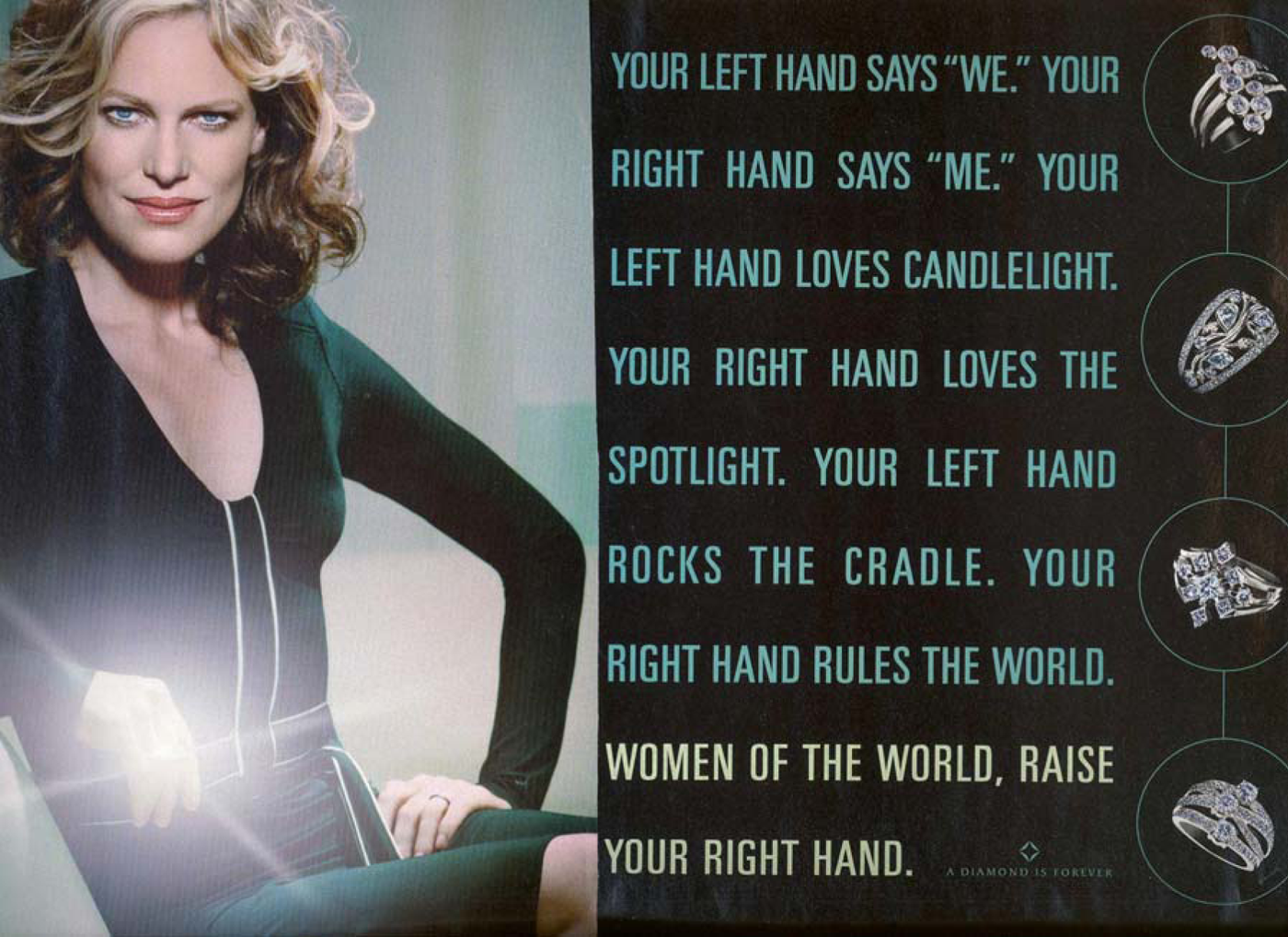
De Beers advertisement for Raise Your Right Hand Campaign
The diamond that this more mature woman who could be a mother to numerous children wears is being promoted as the means to display her ability to both “rock the cradle” and “rule the world.”
While a woman’s single identity is forfeited the moment she gets married, qualities inherent to singlehood are not necessarily excised from the self. Women who wish to incorporate those valued characteristics, while accepting the problematic belief that they are tied intrinsically to singlehood, will experience dissonance. Thus the pleasure of having one’s diversity recognized, even if it is done in a way that reinforces the antithetical nature of the desired identifications, can be both important and productive for those women who may be struggling to express and possibly reconcile the conflictual nature of their lives. While there is no doubt that some women have either worked to shift their self-understanding, or in fact, have never conceived of the feminine subject, or single and coupled identity, as divided up in such punishing and adversarial ways, it must be recognized that for many this division may have a significant impact. Careful not to alienate their female demographic, the Diamond Trading Company beseeches women to buy more diamonds as a form of true self-expression—a way for a woman to communicate to her self, and the world at large, all the varied aspects of who she is and what she does. By acknowledging the catch-22 that shapes certain women’s lives, it seems the Diamond Trading Company is benefiting from women’s discomfort when it comes to the choices they must make in regard to identity. Expressing an understanding of feminine struggles, they offer an easy but expensive solution to their problems.
As they state in one of their ads, it is the hope of De Beers that you will come to believe that “a diamond [is] forever. Forever timeless. Forever unique. Forever a force of nature. Forever all the things that make a woman” (Diamond Trading Company, 2005b). In a manner similar to Jackson Lears’ (1983) discussion of therapeutic-oriented advertising as a means of social control, the Diamond Trading Company attempts to arouse consumer demand by associating their product with an imaginary state of well-being—one based upon the desire to attain harmony between competing anxiety-provoking identifications. These ads promote personal feelings and experiences in order to both exploit and proffer solutions to gender identity dissonance. By presenting their product as a means to manage competing desires, while at the same time working to reinscribe the very same problematic dichotomies, this company ensures that such consumption-invoking anxiety will continue for many years to come.
The Raise Your Right Hand print magazine campaign by the Diamond Trading Company, on behalf of De Beers, was extremely successful. According to J. Walter Thompson, over half of the women they surveyed said that the ads had a direct impact on the way they now viewed diamonds; 25% of the women interviewed said they were willing to consider a diamond ring for their next jewelry purchase as a direct result of viewing the print advertisements for the Raise Your Right Hand campaign (O’Loughlin, 2004). In just the first year of the campaign right-hand ring sales jumped 15% (Braverman, 2006). In addition, the campaign won a “They Get It” award from Advertising Women of New York—an organization run by women in the industry whose goal it is to promote the overall professional and personal success of females in the field and advertising that reflects positive representations of women. By numerous measures the Raise Your Right Hand campaign was a tremendous success.
By late 2006, De Beers finally replaced their highly successful and well-received identity dissonance-themed right-hand ring campaign with a new marketing approach that focused on demonstrating how these rings should be regarded as everyday accessories. Comparatively simple, both visually and narratively, the ads featured groupings of right-hand rings adorning everyday household objects such as pincushions, clothes hangers, and towel hooks. Gone was the appeal to feminist desires and the contradictions inherent to postfeminist “choice,” replaced by a series of ads firmly rooted in traditional notions of womanhood. This new campaign utilized a very conventional marketing approach that reinforced, as the ad copy repeatedly stressed, the “timeless” nature of right-hand rings while/by reinforcing the feminization of house work and domesticity. Not long after the “Timeless” campaign was released, De Beers shifted their marketing focus away from the promotion of right-hand rings—but not before their goal had been achieved. Indeed, a new purchasing initiative had been established, as right-hand rings were now a resonant and forceful “cultural imperative,” with symbolism and value firmly entrenched in popular consciousness.
Advertising and Identity
Since the advent of modern advertising in the 19th century, the industry has capitalized upon the anxiety women experience when attempting to fulfill societal roles and express identity in a socially acceptable manner. While early advertising campaigns were characterized by rationalistic appeals that explained how the product would directly improve the material requirements of consumers’ lives, such as creating greater health, or more leisure time (Goldman, 1984; Leiss, Kline, & Jhally 1990; Williams, 1980), the pressure was on women to enhance their beauty, and ensure that only the very best products were introduced to the family. As advertising came to rely on using nonrational or symbolic/emotional appeals in the 20th century (Leiss et al., 1990), women were targeted in ever more effective ways—in particular, it was now their own self-understanding and psychological well-being that was at stake (Lears, 1983). Since then, women have been encouraged to turn to advertising as a source of information and validation about self, and advertising featuring gender identity dissonance is just another in a long line of appeals which the industry has used to effectively exploit women’s fears in order to fuel consumption.
Gender dissonant advertising presents women with an often disconcerting array of ideal(ized) identities. While there may be a vast range of options on display, the ads often contain a subtle but significant ideological slant that promotes the adoption of traditional gender identities over those that could be deemed rebellious or nonnormative. The epitome of postfeminist culture, which tends to privilege traditional femininities and punish “alternative” gender sensibilities (Negra, 2009), gender dissonant advertising encourages conventional identity choices. This is because, as Diane Negra astutely points out, while postfeminist culture thrives on the anxieties and contradictions that abound, it simultaneously provides an “aggressive (re)codification of female types” (2009, p. 10). For example, although the Madonna-Whore dichotomy is ever-present within gender dissonant advertising appeals it is the traditional “Madonna”or virginal role that is normalized and idealized. Women’s sexual assertiveness or agency (the “Whore”) is most often presented as fantastical—more specifically, a fantasy for men—rather than a realistic and acceptable identity for a socially desirable woman to express for herself. Sexuality for women is traditionally tied with reproductive function and motherhood. Accordingly, female sexual agency and desire is generally excised from hegemonic notions of womanhood, as it is considered a threat to patriarchy (Cranny-Francis, Waring, Stavropoulos, & Kirkby, 2003). Although these advertisements can be regarded as progressive in their celebration and support of feminine complexity, promoting satisfaction and understanding through the acknowledgement of multiplicity, they also exploit feminine contradiction—the goal seemingly to promote anxiety-fuelled consumption and to reach the widest variety of consumers.
While a useful tool for an industry whose goal it is to encourage women to find and understand their selves through what and how they consume, gender identity dissonance functions within advertising in a manner that ensures problematic binaries are constructed out of the multiple identities and roles that frame women’s lives. Perpetuating the false presumption that identities must be singular in temperament or goal—a dichotomous understanding of female gender identity that is constructed for social desirability, and not a psychological requirement—has weighty consequences. While it may be easier for a patriarchal society to manage femininity by endorsing a limited array of gender identities and positioning them in simple either-or/good-bad options, this manner of depicting and organizing gender identity narrows women’s lives and undermines their agency.
Ads featuring gender identity dissonance not only propagate the standards of patriarchy and buoy postfeminist discourse but also promote heteronormativity and normalize whiteness. Whereas under certain circumstances a company may seek to attract minority consumers (e.g., Hennessy cognac’s “Never Blend In” and “Are you Privileged” campaigns that targeted wealthy African American men), the general advertising approach of gender identity dissonant advertising privileges whiteness. Racially diverse models are “used”/“useful,” and presented sparingly in advertisements (e.g., the De Beer’s Raise Your Right Hand and Citibank’s Identity Theft campaigns).
Rather than pursuing an authentic agenda of difference, occasional inclusion of non-White models appears to be mere tokenism, not a true reflection of a company’s desire to embrace racial and cultural diversity. In a similar vein, heterosexuality is reinforced and normalized over and over again in both imagery and text. Homosexuality between models in the gender dissonant ads examined is never overtly implied, and, if intimated, is in aid of heterosexual fantasy (see Crymble, 2009). Mainstream magazine advertising most often transmits a populous/popular sensibility, and as a result, campaigns tend to reinforce troubling hegemonic ideologies pertaining to gender, race, and sexuality, and advertising featuring gender identity dissonance is no exception.
While dissonant media representations work to perpetuate patriarchal notions of womanhood, by providing a rationale for repression and restricting feminine potential, it is also feasible that these images present more liberating possibilities—though, undoubtedly, within the confines of capitalist consumer culture. Expanding upon Roland Marchand’s (1985) observation that advertising provides an important space where information about “delicate” or taboo social issues can be discussed, 1 it is reasonable to suggest that advertisers not only assist society by talking about issues deemed sensitive but also provide a forum for discussing topics that until represented in advertising were not prominently articulated within the mainstream. With the advertising industry’s focus on being “dialed in” to social trends and psychological predispositions, along with their aesthetic reliance on iconography, symbolism, and metaphor as a means for effective communication, print ads in particular may be able to circumvent some of the barriers to talking about taboo, or yet to be effectively articulated, issues within popular culture. It can take time for language to emerge that allows society to effectively discuss new beliefs, ideas, and feelings. Consequently, the visuals, titles, and tag lines associated with gender identity dissonance-themed advertising campaigns might function in a valuable way—by naturalizing, legitimizing, and shifting gender regimes these ads may assist in changing society’s feelings regarding women, and more specifically, the effective expression of female gender identity.
Because dissonant advertisements so explicitly illustrate the unreasonable social constructions that frame female gender identity, they may well offer an important liberatory space for resistant readings and social critiques—specifically providing a platform for discussing the burdensome norms and untenable social expectations that frame idealized femininity. Mediated contradictions themselves function in highly ambivalent ways. It is media’s role in producing, reproducing, and policing ambivalent feminine identities—their boundaries, intersections, and ruptures—that make mass forms of communication such a vital field of inquiry. Accordingly, the De Beers’ Raise Your Right Hand advertising campaign could prompt important societal and individual consequences ranging from mass critique of postfeminism and current gender norms to the politicization of individual women who are tired of being told that they must abdicate one prized identification for another, or suffer from dissonance. The hope is that identity dissonance-themed magazine advertisements do not merely reinforce but also challenge dominant ideological presumptions and binary-based discourses and point to the real possibility of concrete changes in women’s self-understanding, gender identity constructions, and ultimately, lived experiences.
Footnotes
Acknowledgements
The author would like to thank Amanda Benjamin, Megan Biddinger, Robin Means Coleman, Susan Douglas, Dara Greenwood, Bambi Haggins, Emily Chivers Yochim, and the anonymous reviewers for their valuable and insightful feedback on earlier drafts of this article.
The author declared no potential conflicts of interest with respect to the research, authorship, and/or publication of this article.
The author received no financial support for the research, authorship, and/or publication of this article.