







Abstract
This study examines how two publications with a common religious affiliation—“Muslim/Islamic”—but different racial affiliations—“indigenous/Black” and “immigrant/Arab”—frame news events. It develops two interrelated ideas. First, identity is not simply an “individual level” but also a higher, “organizational level” of influence on news. Second, news organizations perform their identities in how they frame news. Comparative frame analysis reveals that identity performance, even at the organizational level, is context sensitive. The two publications, Muslim Journal and Islamic Horizons, use similar news frames when their shared religious identity is salient, but framing diverges in contexts where their differing racial identities become active. Racial identities also color how these publications construct and relate to “America.” Conceptualizing news organizations as reflexive actors with fluid identities and news frames as the contextual identity performance of these actors allows us to see how news media simultaneously reflect and reproduce social reality.
At the turn of this century, the United States witnessed one of the most controversial presidential elections in history: the contest between George W. Bush and Al Gore. A little-known aspect of this extensively reported election was the split in American-Muslim support. Political action committees of immigrant Muslims endorsed the Republican Bush, while Black Muslims backed the Democrat Gore. The key reason for this divergence was Gore's vice-presidential nominee Joseph Lieberman, well known for his staunchly pro-Israel and anti-Palestinian views. His presence on the Democratic ticket made Gore an unacceptable choice for those American-Muslims who, or whose forebears, came from the Middle East. Lieberman's views on Middle Eastern politics, however, were not enough of a concern for Black Muslims and, like other African Americans, they decided to endorse Gore (Khan, 2002).
This electoral divide is telling in itself as much as the fact that it was hardly noticed. It reveals a social schism within America's Muslim minority—a schism that the rest of the nation is barely aware of, tending to view Muslims as a sociocultural monolith (Kumar, 2010). On one side of this schism are immigrant American-Muslims, mostly from the Middle East and South Asia. On the other side are Black American-Muslims, most of whom are born and brought up in the United States (Curtis, 2005; Smith, 1999). Immigrants are much larger in number (Pew, 2011) and constitute the “mainstream” Muslim population, while Black Muslims are the minority within the minority (Khan, 2002).
This article explores the contours of this rupture by focusing on how it is reflected and reproduced in the country's Muslim media. I examine two major American-Muslim publications, Islamic Horizons and Muslim Journal, to understand the ways in which the minority press interprets and represents the social world, and what these representations reveal about the social structure of the community and its relationship with the rest of the country (see also Shahin, 2014). Drawing on the idiom of identity, I develop a theoretical approach on how social friction influences the production of community news. While Muslim Journal has its roots in the historic Nation of Islam movement of Black American-Muslims (Lincoln, 1961), Islamic Horizons is affiliated with the immigrant Muslim community (Malinovich, 2006). Thus, even as both publications avow a common religious—Muslim/Islamic—identity, they have differing racial identities. Examining the interplay of religion and race in their coverage, the article demonstrates that (a) identities are not simply an individual but a higher, organizational level of influence on news and (b) news organizations perform their identities in the framing of news coverage.
Conceptual Framework
Social Construction of Identity
The view of identity as a social construct departs radically from its commonplace understanding as something natural, innate, and unique to an individual. Identity is instead conceptualized in terms of an ongoing process of social interaction among reflexive agents. Jenkins (2010) defines identity as follows: The complex generic human capacity to work out who's who, individually and collectively, in the human world—the multidimensional mapping of a human world that is in perpetual motion, of our place in that world, and of the places of others. (p. 769)
Taken together, these features draw attention to some other key aspects of identity. If agents have multiple identities that are negotiated in a perpetually changing world, then identities must be context sensitive. Particular identities become salient in particular social contexts (Stryker & Serpe, 1982). While some contexts easily activate particular identities, other contexts are more ambiguous. Multiple identities compete for salience in such contexts (Turner, Hogg, Oakes, Reicher, & Wetherell, 1987). Moreover, constant renegotiation implies that agents do not simply have identities—rather, they reflexively practice identities in their actions. Having an identity thus mandates performing identity: enacting the characteristics, norms, and values associated with that identity (Butler, 1990; Goffman, 1956). As Hall (1996) noted, “[I]dentities are never unified and, in late modern times, increasingly fragmented and fractured; never singular but multiply constructed across different, often intersecting and antagonistic, discourses, practices and positions” (p. 4).
At the collective level, the competition for salience among multiple identities represents the social and cultural fractures within a community. Many such fractures exist within the American-Muslim community, as a series of recent studies report. While American-Muslims are commonly perceived as a homogeneous, monolithic group (Kumar, 2010; Said, 1981), Witteborn (2007) shows that their self-identifications could vary across religious (e.g., Muslim and Christian), sectarian (e.g., Sunni and Shiite), national (e.g., Palestinian and Egyptian), and hybrid (e.g., Lebanese American and Arab American) dimensions, “depending on the audience, the setting, and the sociopolitical scene” (p. 562). On similar lines, Ali (2011) argues that “the histories of the ‘Muslim world’ and the ‘West,’ nationalism, inter-generational struggles, and the politics of race/ethnicity, gender, and class come into contact” (p. 355) in the practice of American-Muslim identity. Indeed, American-Muslim self-identification has become even more fluid and amorphous post-9/11 (Alsultany, 2012; Shaheen, 2008; Sirin & Fine, 2007). But while recognizing how the complexities of history, demographics, and politics modulate American-Muslim identity construction, these studies have mostly focused on immigrant—and especially Arab—Muslims. Although a parallel literature exists on Black American-Muslims (Banks, 1997; Curtis, 2005; Lincoln, 1961), little effort has been made so far to comparatively examine the situational performance of American-Muslim identities across the racial divide.
Mass media are vital for the construction of collective identities in modern society. Anderson (1983) has talked of nations as “imagined communities” (p. 6) and shed light on how newspapers and novels were historically critical to the evolution of nationhood (see also Gauntlett, 2002). Drawing on this insight, much of the literature on ethnic or diasporic media views community publications as playing a vital role in mobilizing minorities and nurturing their cultural and political imagination (e.g., Atton, 2002; Croucher, Oommen, Borton, Anarbaeva, & Turner, 2010; Gillespie, 1995; Hargreaves & Mahdjoub, 1997). But this line of research typically fails to consider that identities are not innate or absolute but multidimensional and context sensitive. If communities, including minorities, are not seamless monoliths, then their media should not be expected to simply construct one common collective identity. The media should, instead, be viewed as a site where multiple identities constantly compete for salience in ever-changing contexts. The production of media content, from this perspective, becomes the reflexive performance of a community's collective identity.
Identity and News Sociology
Research on the sociology of news distinguishes social, cultural, economic, political, and ideological factors that influence news production as well as the mechanisms by which such influences are enacted. News, thus, is less a representation of objective reality and more a social construct that recursively reconstructs reality. News media do not just give news; instead, they make news (Tuchman, 1978). Scholars have studied the influence of journalists' professional identity (Deuze, 2005; Sigal, 1973), gender-based identity (Hanitzsch & Hanusch, 2012), and national identity (Nossek, 2004) on news making. But this line of research has largely been microfoundational and committed to methodological individualism. Accordingly, Shoemaker and Reese (2013) locate identity as an “individual level of influence” in their hierarchy of influences model of news making. The model considers the individual journalist as the lowest level of influence on news, preceded by the levels of media routines, media organizations, social institutions, and the social system. Each level is subsumed within, and thus influenced by, the higher levels.
Reducing identities to an individual level assumes that even though identities may be socially constructed, they are actualized through individuals alone. However, if identity is not just an individual but also a collective capacity, collective agents—such as media organizations—can also have identities that bear upon news making. If operationalized in terms of the collective agency of a media organization, identity no longer remains simply as an individual-level phenomenon but becomes a higher level of influence on news making.
Research on organizational behavior supports this contention. For Albert and Whetten (1985), the identity of an organization is its members' shared beliefs about its central, distinctive, and enduring features. Such beliefs become shared through a process of internal socialization and guide the actions of its members: Indeed, these actions constitute the very process by which socialization takes place. Individual members act in line with the organization's identity, sometimes even if they individually do not identify with the organization (Ashforth & Mael, 1989). Organizational identity is thus not simply an aggregate of members' self-conceptions: It is a structural phenomenon that informs and inflects the cognition, attitudes, and actions of its members—and thereby the products the organization creates. For media organizations, this implies that organizational identities shape how journalists make news.
Identity and Framing
Journalists and news organizations routinely pick and choose what events and issues to cover and how to cover them. While the hierarchy of influences model (Shoemaker & Reese, 2013) provides a heuristic framework to study the factors that influence what journalists and media organizations produce as news, framing is the embodiment of these influences in the news itself. According to Entman (1993), “to frame is to select some aspects of a perceived reality and make them more salient in a communicating text” (p. 52). Reese (2001) takes a broader view of framing, defining frames as “organizing principles that are socially shared and persistent over time, that work symbolically to meaningfully structure the social world” (p. 11). In the social world of journalism, frames function as organizing principles for news.
Like frames, identities are also organizing principles. They are also socially shared, persistent over time, and work symbolically to meaningfully structure the social world. Research on new social movements has developed a deep link between identity construction and framing. Benford and Snow (2000) note that identity construction is “an inherent feature of the framing process” (p. 632). Frames “not only . . . link individuals and groups ideologically but they proffer, buttress, and embellish identities that range from collaborative to conflictual” (Hunt, Benford, & Snow, 1994, p. 185). They do so indirectly “by situating or placing relevant sets of actors in time and space and by attributing characteristics to them” (Hunt et al., 1994, p. 185) as well as directly in the course of “identity talk” (Hunt & Benford, 1994, p. 488).
Like the framing of rhetoric in social movements, news framing can also be viewed as identity performance. When reflexive agents perform an identity, they interpret the social world in a particular way and act in line with that interpretation. For news media, this means framing an event or issue in a particular manner—adhering to an identity that has been activated in the context of that event or issue. Indeed, as this is a reflexive process, the act of framing is itself the activation of that particular identity. This can, in principle, happen at the level of both the journalist and the organization. But as discussed earlier, organizational identities subsume those of the individual journalist. Also, media organizations, like other agents, have multiple identities. Exploring how these identities compete for salience in a community's news media can elucidate the ruptures within the community—social structures that are reflected in and reproduced through the mass dissemination of news.
This article, thus, develops the idea that multiple identities compete for salience in a community's collective imagination, and community media are a site where this contestation takes place. This social tension influences news as a cultural artifact and can be elicited in the framing of news. A media organization, as a collective agent, reflexively performs identity in news framing by constructing the Self and the Other either directly or indirectly, and the relationship between the Self and the Other can range from collaborative to conflictual. Within this framework, this study asks the following research questions: Research Question (RQ1): How do religious and racial identities compete for salience in the news frames of the American-Muslim press? Research Question (RQ2): What does this contest reveal about the social structure of the American-Muslim community?
Method
This research opens the black box of American-Muslim identity by studying two publications with a common religious identity—“Muslim/Islamic”—but different racial identities. Muslim Journal (MJ), a weekly tabloid newspaper, was launched in 1960 as Muhammad Speaks and has historically been associated with Nation of Islam, the country's largest Black Muslim movement (Lincoln, 1961). Islamic Horizons (IH), a bimonthly newsmagazine launched in 1983, is published by the Islamic Society of North America, which considers itself an umbrella group of Muslim organizations across the continent and is dominated by immigrant Muslims from the Middle East and South Asia (Malinovich, 2006).
This article examines how these publications' shared religious and divergent racial identities compete for salience in their framing of three major post-9/11 events: (a) the 2003 U.S. invasion of Iraq, (b) the 2008 election of President Barack Obama, and (c) the 2011 Middle Eastern pro-democracy protests. Unlike mainstream news publications, which typically differentiate between news reporting, analysis, and commentary, IH and MJ often blend various forms of journalistic writing. So the corpus includes all reports, editorials, and opinion pieces related to the three events in the editions listed below. MJ articles were obtained from microfilms while IH articles were available on its Web site.
MJ: March 21, March 28, April 4, and April 11, 2003 for invasion of Iraq; November 7, November 14, November 21, and November 28, 2008 for President Obama's election; and February 4, February 11, February 18, and February 25, 2011 for Middle Eastern protests.
IH: March–April 2003 and May–June 2003 for invasion of Iraq; November–December 2008 and January–February 2009 for President Obama's election; and March–April 2011 and May–June 2011 for Middle Eastern protest.
The time periods are overlapping but not identical as MJ and IH have different publication schedules—the former is a weekly and the latter a bimonthly. This difference also causes the variation in the size of the two samples. A total of 40 articles were studied, 29 from MJ and 11 from IH—representing the entire coverage of the three events in the period specified.
The method of analysis is ideological criticism. Van Dijk (1998) defines ideology as a group's beliefs about “who we are, what we stand for, what our values are, and what our relationships are with other groups” (p. 69). Ideology is thus tethered to group identities and laying bare ideologies can be a means of uncovering the identities being performed in discourse. Also, framing decisions are often “driven by ideology” (Edelman, 1993, p. 232; see also Snow & Benford, 1988). The notion of ideology thus bridges identity performance and news framing, making ideological criticism an apt analytical lens for examining news framing as identity performance.
Foss (2004) outlined a two-step process for conducting ideological criticism. The first step is to identify the nature of the ideology, as embodied in a cultural artifact, along the dimensions of membership, activities, goals, values/norms, position and group-relations, and resources. While an ideology may organize beliefs across all these six dimensions, the analyst is “likely to find that various groups focus their beliefs in one or a few areas of the schema” (p. 244). The next step is to identify strategies in support of the ideology, or the “rhetorical mechanisms used to advocate for and defend that ideology” (p. 245). A large array of strategies can be used, relating to content and style, communicative genres, size of the audience, and so on.
Using ideological criticism, the analysis below compares how IH and MJ framed the 2003 U.S. invasion of Iraq, the 2008 election of President Obama, and the 2011 Middle Eastern protests. Each event serves as a different context in which the publications' religious and racial identities compete for salience. The frames represent particular dimensions of the nature of the ideology, or identity, being articulated in each context, with the aid of content and stylistic strategies that prop up those frames.
U.S. Invasion of Iraq
MJ strongly opposed the 2003 invasion, framing it mainly as problematic for American morality. This frame was consonant with the values/norms dimension of an attributed American identity. A signed piece began with this moral dilemma: How could it have come to this? The fundamentally decent people of the United States destroying the homes and lives of innocent Iraqis, and just 28 years from the time in which most Americans were so sickened by war-making that they chose to abandon the ill-conceived war in Vietnam! (Lerner, 2003)
Several articles stressed that war might claim “tens of thousands” of lives (e.g., Diab & Mustafaa, 2003; Mustafaa, 2003). They pointed out that control over Iraq's oil and President Bush's hopes of reelection—rather than Iraq's alleged weapons of mass destruction (WMDs)—were the “real” reasons for going to war. Moral concern was heightened by emphasizing the many injustices the situation entailed. The publication drew attention to the disingenuousness of the United States, with the world's largest stockpile of WMDs, invading another country on the pretext that it was building such weapons.
The second frame of MJ's coverage was that common Americans were opposed to the war—and thus it did not fit with the nation's goals. Youth marches against the war were extensively reported and photographed. Cultural metaphors were mobilized. One article began with the Beatles song: “Imagine all the people living just the same, no reason to fight for, no war, only peace should remain, imagine no war …” (Diab, 2003). The newspaper published verbatim letters written by students to President Bush, urging him not to wage war (Diab, 2003). Religious leaders' public appeals against the war were also reported. MJ thus split America into “American people” and “American government,” constructing a collaborative identity with the former and a conflictual one with the latter.
A third frame considered Iraq war as an opportunity for Black American-Muslims to express their unique identity. This related to the position and group relations dimension of MJ's identity. One author, while lamenting the spread of “anti-Arab” attitudes in the run up to the war, suggested that Black American-Muslims become “a bridge of understanding between America and those in the Muslim world who are suffering from ‘damaged psyches.’ I think this is our defining moment.” Black American-Muslims, he pointed out, could also “help close the breach between the immigrant Muslim community in America and the citizenry of America” (Mustafa, 2003). In doing so, MJ distinguished Black American-Muslims from immigrant American-Muslims and avowed a unique identity for the former. It thus engaged in direct identity talk as a “Black American-Muslim” publication and constructed an “immigrant American-Muslim” Other. However, the relationship between Blacks and immigrants was framed as collaborative rather than conflictual.
IH also primarily framed the war as a moral concern for the United States (values/norms dimension). Opponents of the war were quoted as calling it “immoral.” Iraqi President Saddam Hussein was acknowledged as a dictator and Iraqi people his victims, but the magazine also stressed that the same Iraqis would face the brunt of any military invasion. Control over Iraq's oil wells was identified as the key factor behind Bush's desire to wage war, with photos of antiwar protests focusing on banners with the word “oil” on them. War was also portrayed as un-Christian, a recourse that Jesus would never recommend. Much of this was quite similar to MJ. But unlike MJ, which saw the looming war as a continuation of American militarism, IH went back in time to bring the progress in civil rights, women's rights, and social justice that American society had witnessed into the discourse. The war, it pointed out, would “turn back the clock” on these advancements and would therefore be a historical anomaly. In this way, IH split the American Other into “America of the past” and “America of the present” and framed its own identity as collaborative with the former and conflictual with the latter.
The magazine's second frame, like that of MJ, was that common Americans were opposed to the war (goals dimension). A news report highlighted that just 400 people participated in a pro-war march, while 500,000 had gathered at an antiwar protest in Washington, DC (“Not Everybody Wants War,” 2003). The antiwar statements of religious leaders, Hollywood stars, and other public figures were reported.
Both IH and MJ, thus, used similar frames to cover the Iraq invasion. Unlike the mainstream U.S. media, both these publications staunchly opposed the war, appealing to America's values/norms and suggesting that it did not fit the nation's goals as common Americans were opposed to it. But there was one crucial difference in their framing: MJ used the context of Iraq war to avow a unique Black American-Muslim identity and draw a clear boundary between Black and immigrant American-Muslims.
Election of President Obama
MJ framed Obama's election primarily as a Black American success story—in consonance with the membership dimension of its identity. Almost every article reflected this frame. Several stories noted that it had been impossible for a Black American to seriously imagine becoming the President until Obama came along. One story mentioned an old cartoon about a Black boy selling his right to be President for a nickel, knowing that it was a bargain. Another story in the run-up to the election urged Black voters to remember the sacrifices their forefathers had made to earn electoral rights for them and make it count in this particular election. Various stories noted the near unanimous support Obama received from Black voters. Support from Black political leaders across the aisle formed another important aspect of this frame.
The second frame in MJ's coverage was the historicity of Obama's success, focusing on how it had suddenly changed the position and group relations of Blacks vis-à-vis Whites. The fact that Obama had become the country's first Black President was stressed in a number of ways. Here's an account of a voter's experience: I voted early this year. It was early, but it still took two hours, snaking through lines. The people were polite buy joyful. Every once in a while, someone couldn't hold it in any longer—‘This is history! We're making history!’ would come out. Parents with children. So many young, Black men. Middle-aged women waving their purses in the air, shouting, ‘I voted!’ (Gonzales, 2008)
Indeed, the election was not simply historic—the coverage viewed Obama's victory as the culmination of history. The new President was often named at the end of a longline of historic Black American leaders such as Martin Luther King, Jr. and Rev. Jesse Jackson. Articles drew personal and political connections between Obama and President Lincoln, emphasizing Obama's success as the final stage of a process of Black political empowerment that had started a century and a half ago (Mustafaa, 2008). There was little talk of what the Obama presidency might actually look like, of how Obama might go on to change American politics or improve the lot of Black Americans. His election itself represented all of this.
IH also focused on the membership dimension but framed Obama as a president with Muslim, rather than Black, lineage. Several articles used his full name, Barack Hussein Obama, and one even italicized his Arabic middle name (Mazrui, 2009). The report on his election victory read: “… despite being bombarded for seven years with hate and Islamophobia, large numbers of us voted for a person called Barack Hussein Obama. Those who missed his Arabic first name must have noted his middle name, a popular Muslim name” (Americans Reject Hate, 2009). The magazine noted that Obama's support among Muslims rivaled that among African Americans, while voicing concern about “the exclusion of a visible Muslim American presence” in Obama's campaign (Americans Reject Hate, 2009). It also discussed the “problems” with Obama's blackness, including his mixed heritage, and noted that many Black Americans were not prepared to consider Obama one of them (Karam, 2008; Mazrui, 2009). Thus, while emphasizing Obama's Muslim membership, IH tried to undercut his blackness.
Like MJ, IH also viewed Obama's victory as “historic,” but history had a very different meaning in its pages. Obama represented change from the Bush years, but not the end of history. Articles noted that Obama had become the world's most powerful Black man “up to this point in time” (Mazrui, 2009). The magazine also stressed that Obama's election would be meaningful only if he ushered in specific changes in U.S. policy: closing down Guantanamo Bay and banning torture (Obama must ban U.S. torture, 2009), forging direct contacts with the mainstream American-Muslim leadership, and rejuvenating White House's iftar—breaking fast during Ramadan—tradition (Americans Reject Hate, 2009). One article went: “… undoing the xenophobia produced by Obama's predecessor in the White House remains a long and arduous journey” (Americans Reject Hate, 2009). Thus, even as IH celebrated Obama's election, it did not treat this as an end in itself. Instead, it once again split the American Other temporally, into “America of the present” and “America of the future.” It constructed a conflictual identity with the former and a potentially collaborative one with the latter. This frame thus articulated the position and group relations dimension of IH's identity.
MJ and IH thus framed President Obama's election on opposite sides of the same dimensions—membership and position and group relations. For MJ, Obama's victory was a Black American success story. Obama was the fulfillment of a 150-year-old promise. His victory marked a happy end of history. For IH, Obama's victory was noteworthy less for his skin color and more for his Muslim name and connections. It was remarkable not because of America's history of slavery but because it had happened at a time when Islamophobia was rife. Obama represented a promise for American-Muslims, but whether that promise would be kept was yet to be seen.
Protests in the Middle East
IH's first frame was its ascription of an Arab/Muslim membership to the pro-democracy protests that spread across the Middle East and North Africa in 2011. This was achieved in a number of ways. The stories went under a section labeled The Arab Awakening. The label appeared on the magazine's cover as well as above the story headlines, making the frame quite prominent. Even when stories focused on one country, they mentioned that the protests had been spreading country to country, suggesting that phenomenon was “Arab” rather than Tunisian, Egyptian, or Libyan. However, the term Arab was conflated with “Muslim/Islamic.” The magazine lamented that “nationalism and ethnic divisions cause compartmentalization in communities around the U.S., let alone the world” and viewed the protests as a chance for Muslims to come together as an ummah, the global Muslim community (Himayathullah, 2011). None of the stories mentioned that Christians, such as the Copts of Egypt, were also participating in the protests.
The magazine's second frame was that the protests represented the modernization of the Arab world (goals dimension). The use of the label The Arab Awakening was meaningful for this frame as well. For long, the Arab world had stood out as an antiquarian bastion of absolutism even as democratic governance became the norm around the modern world. Framing the protests as “Awakening” suggested that this anachronistic period had been an aberrant interlude in Arab history, a period of sleep that was now over. With the protests, the Arab world had now woken up and joined the rest of “normal” society. Frequent use of terms such as “revolution” to describe the protests reinforced this sense of turning a historical corner.
A third frame was the construction of resonance with the United States, relating to the position and group relations dimension of IH's identity. This was mainly achieved by the frequent use of Arab-American or American sources in the stories. One article (Aduib, 2011) focused on a Libyan-American family that had run away from Libya to stay together and had found refuge in the United States. Although the article told the story of Libyan leader Muammar Gaddafi's tyranny as viewed through the eyes of a single family, it weaved in the family's intimacy with their host country. The article also pointed out that the family members were among “thousands of Libyans (who) have built communities throughout the U.S.” Another article focused on an American activist participating in the Egyptian protests and talked about how people living in the United States could contribute to the protests (Khan, 2011).
MJ used very different frames in its coverage, albeit along the same dimensions. First, it denied the protests any Arab/Muslim membership. Not once was the adjective “Arab” used to describe the protests. Many articles were personalized accounts of the protests or signed opinion pieces, and the writers invariably had non-Arabic, non-Muslim names. One such article was by a rabbi, talking about why Jews were praying for the victory of Egyptian protesters, linking the protests with the repression of Jews by the Egyptian Pharaoh (Lerner, 2011). Some articles even ascribed the protests a Black/African membership. One of these, entitled “The Egypt of Africa and its Impact on Africa's Future,” pointed out in bold and italicized text that “[w]hile the Western media characterizes Egypt as an Arab nation located in the Middle East, it is actually located in Northern Africa and is an African nation” (Chavis, 2011). Another article asked, “Where are the ‘black voices’ on Egypt and Tunisia?” and criticized the Congressional Black caucus for hesitating to support the protesters. MJ thus engaged in direct identity talk as a “Black” publication.
A second frame in MJ's coverage, articulating its position and group relations dimension, was that the “hostile” U.S. government and media posed a challenge to the protests. The U.S. media, it said, blacked out news about the historic protests because of friendly ties between the U.S. government and the regimes under pressure (Near Total Media Blackout for Egyptian “March of a Million,” 2011). It charged the U.S. government, as well as Britain and Israel, with undermining popular sentiment in Egypt by trying to replace President Hosni Mubarak with his intelligence chief Omer Suleiman to make sure there is no real change in the country's pro-West power structure. It even compared U.S. policy vis-à-vis Egypt with the American spy agency Central Intelligence Agency's coup against a democratically elected Iranian government in 1953.
IH and MJ thus differed sharply in their framing of the Middle Eastern protests. IH ascribed the protesters a clear Arab/Muslim membership and viewed the protests as the harbinger of an Arab renaissance. MJ, on the other hand, ascribed the protesters a Black/African membership and saw the protests as heralding change across Africa. IH used the protests to link Arabs with Americans, relying on Arab-American sources. MJ, instead, viewed the United States as inimical to the protests and to democracy in the region and often used American officials as sources.
Contesting Frames, Competing Identities
Comparative frame analysis discloses not only what is but also what can be. It shows that there is nothing objective about how a news publication covers an event. The same event could be—and indeed, was—covered in a different manner by a different publication. It thus reveals news coverage to be a construct of the norms and values that permeate a news organization's journalistic processes, which in turn cohere with its social identities. “Reality” is not something lying out there in the event, waiting to be reported. Instead, it is constructed in the interaction between the event and the media.
The analysis presented here reveals a complex interplay of identities in MJ and IH, operating at a number of levels. On the surface, both publications took the same normative stance in all the three contexts that were studied. Both opposed the U.S. invasion of Iraq, differing with the mainstream U.S. media in doing so. Both celebrated Obama's election and both hailed Middle Eastern pro-democracy protests. These shared positions indicate a common, overarching identity that binds them together and makes it meaningful to consider them as part of one broad social collective—the American-Muslim community.
Comparing the Frames in Muslim Journal and Islamic Horizons Across Contexts and Dimensions.
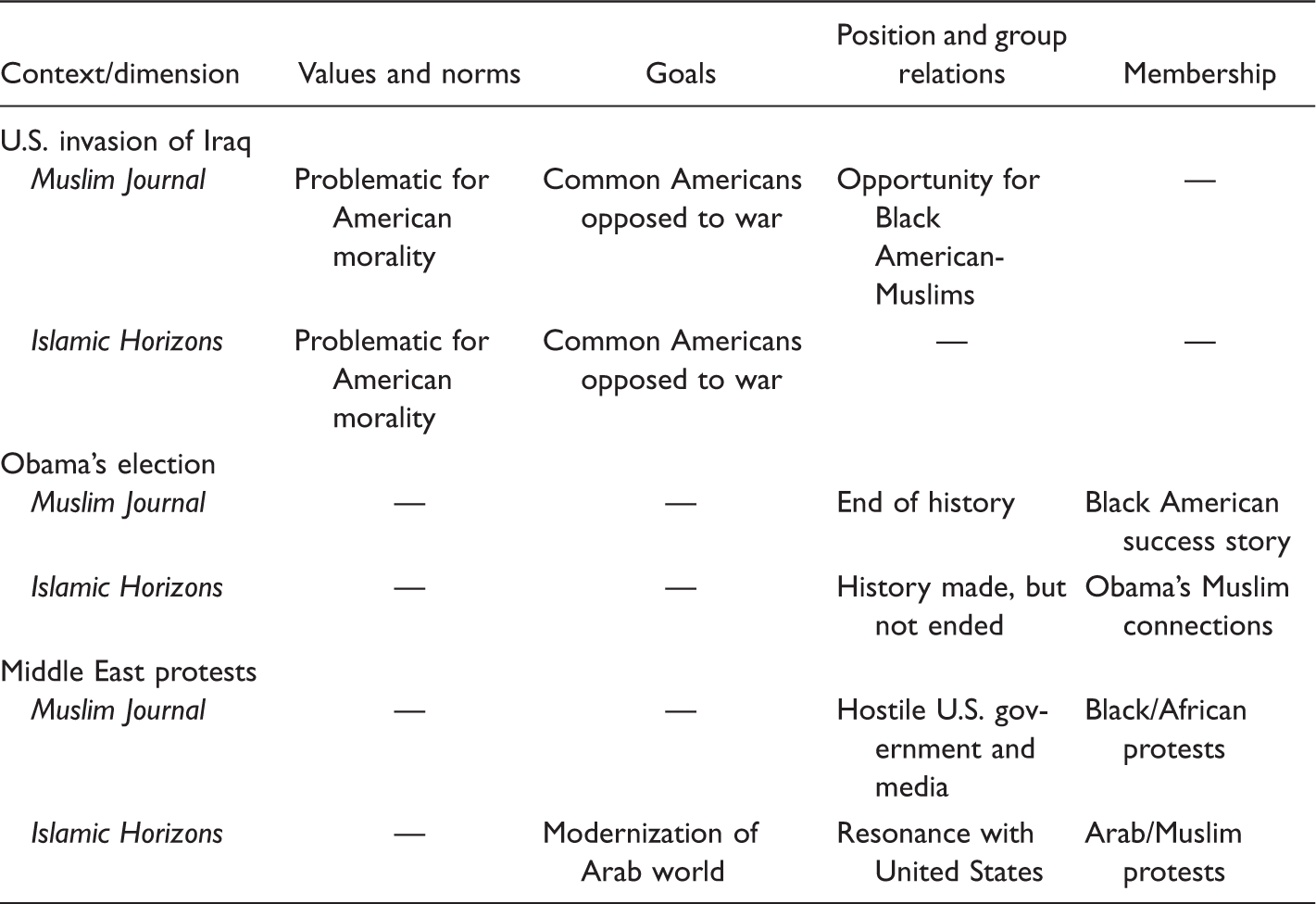
But this was not the case during the 2008 presidential election. Race was the more salient identity in this context as the country chose its first Black president. But MJ and IH have different racial identities and their news framing diverged dramatically. The same happened in their coverage of the 2011 Middle Eastern protests. The protests were widely seen as an “Arab” phenomenon. Race was once again the more salient identity, and the two publications differed in their framing of this event as well. Interestingly, both publications used the same ideological dimensions in their framing of Obama's election and Middle Eastern protests: membership and position and group relations. But their frames were on the opposite ends of these dimensions, constituting a Self–Other dynamic.
Religion and race thus constantly compete for salience, as these two publications perform their identities in their news frames. However, neither religion nor race dominates this contest at all times. Instead, identity performance is dynamic and context sensitive—an ongoing process of negotiation in an ever-changing social world (Butler, 1990; Hall, 1996; Jenkins, 2010). This process also draws attention to identity performance as a meaning-making capacity (Mead, 1934). As new events unfold and new contexts emerge, news publications try to make sense of them—and they do so by interpreting them in line with their available identities. One or the other identity dominates as their interpretation imprints itself upon their news frames. While the organizations have agency in making these interpretations, they often take cues from the social world around them in doing so, revealing the dialectical nature of identity performance.
Identity performance in this account, when viewed within Shoemaker and Reese's (2013) hierarchy of influences model, takes place at the organizational rather than the individual level. The identities were performed in news frames spanning the entire coverage of each publication, even though different journalists worked on the articles. Indeed, MJ often published signed articles by nonstaff members and even these adhered to its identity frames, lending more credence to the contention that organizational identities supersede individual ones and impress themselves upon what the organization produces (Ashforth & Mael, 1989). This is not to suggest that individual identities do not matter, but that identity can be a higher level of influence on news making than usually recognized, subsuming individual identities.
The comparative frame analysis also lays bare the relational character of these identities and their social significance. MJ performed its racial identity in direct identity talk in every context, but never its religious identity. The publication simultaneously constructed an “immigrant Muslim” Other to its “Black” Self. But the relationship between Self and Other was framed as collaborative rather than conflictual. The newspaper also split the American Other into “American public” and “American government,” framing its own identity as collaborative with the former and conflictual with the latter.
IH directly constructed both racial and religious—“Arab” and “Muslim”—identities when it engaged in direct identity talk. It split the American Other into temporal entities—“America of the past” versus “America of the present” in Iraq war coverage, and “America of the present” versus “America of the future” in the Obama election coverage. It then framed its own identity as collaborative with “America of the past,” conflictual with “America of the present,” and potentially collaborative with “America of the future,” subject to the possibility that the future America would indeed differ from its present. This reveals an ideological belief that “America” and “Islam” are not natural or congenital enemies: Muslims recognize and appreciate the values that America stood for in an idealized past and can do so again if the country reverts to those values in future.
Conclusion
Interpreting news frames using the idiom of identity thus exposes the texture of American-Muslim society. There is a definite awareness of being Muslim in a largely non-Muslim nation, an awareness that straddles the racial schism. But the schism is real nonetheless, and it colors the community's collective imagination. While religious and racial identities become salient contextually, race is perhaps a stickier identity for Black American-Muslims. This may be attributed to the country's long history of racial discrimination. Indeed, some scholars (e.g., Lincoln, 1961) view Black Americans' turn to Islam in large numbers from the 1920s as a means of constructing an alternative identification rather than an Islamic identification per se. It may also be attributed to Black Muslims' status as a minority within the American-Muslim minority (Khan, 2002). But more empirical research is required in this area.
American-Muslims' relationship with the rest of the country also comes across as highly nuanced. Different racial segments construct “America” differently, depending on their differing experiences and histories. For Black American-Muslims, the scope of history is much broader. MJ constructed Obama's victory as the culmination of a history that began with President Lincoln's abolition of slavery a century-and-a-half ago. For immigrant American-Muslims, the difference between the recent past—perhaps pre-9/11—and the present was full of meaning, even as they looked with hope toward an uncertain future.
These findings have several important implications. First, this study demonstrates that the American-Muslim community is far more complex and diverse than is typically realized—by the American public, politicians, mainstream media, and even media scholars. Second, recognizing this diversity is vital for dealing with social and political issues such as Islamophobia and Islamist extremism and violence and for building better relations among Muslims and other sections of American society. Third, viewing (a) news organizations as reflexive actors with fluid identities and (b) news framing as contextually sensitive performance of identity by these actors allows us to see how the news media not only reflect but also reproduce the phenomenology of the social world. The present study has developed this theoretical perspective in a minority media setting. Future research can extend these ideas by examining them in the news coverage of mainstream media organizations.
Footnotes
Declaration of Conflicting Interests
The author declared no potential conflicts of interest with respect to the research, authorship, and/or publication of this article.
Funding
The author received no financial support for the research, authorship, and/or publication of this article.