






Abstract
This article examines representations of immigration in Chilean newspapers. From January to December 2016, a total of 507 articles from three mainstream newspapers were analyzed. The findings show a dual discourse on immigration in the Chileans press: a criminalization of immigrants, which frame them as delinquents, deviant, and dangerous people, and a positive and more humanizing discourse, which portrays them as people who deserve to be protected by the Chilean society. The study also finds a shift in the way media sources are representing immigration compared to previous reports, characterized by presenting alternative images of migrants, a more cautious use of language, and increased attention to the voices of governmental and religious leaders. Nevertheless, this shift has also intensified the “difference” and “otherness” of foreigners in Chile by repeatedly focusing on their nationality and differentiating between the “good” and “bad” immigrants.
Introduction
Even though the immigration rate in Chile is not significant as compared to other nations, the number of immigrants is growing rapidly each year, and the immigrant profile is changing considerably. Between 2010 and 2015, Chile registered the largest increases in immigration in Latin America, reaching 4.9% per year (Economic Commission for Latin America and the Caribbean & Latin America of the International Labour Organization, 2017). In 2014, there were 410,988 immigrants, representing 2.3% of the total population (Ministerio del Interior y Seguridad Pública, Sección Estudios Departamento de Extranjería y Migración, 2016). This number increased drastically to almost one million in 2017, which represents 5.5% of the total population. Most of the immigrants came from Latin American countries, most commonly Peru, Colombia, Venezuela, Bolivia, Haiti, and Argentina (Ministerio del Interior y Seguridad Pública, 2017).
Scholarly literature confirms that immigrants who arrive at the country, primarily from Latin American countries, are segregated and discriminated against. The multidimensional index—including indicators of labor, education, health, and housing—shows a higher incidence of poverty among immigrants than among Chileans (Rojas Pedemonte & Silva, 2016). Their access to subsidized housing has historically been limited, and currently, they are living in segregated neighborhoods with high levels of overcrowding (14.9% immigrants vs. 7.9% Chileans). In addition, immigrants tend to engage in informal and precarious labor including domestic and service work, agricultural and construction work, and also selling cheap electronics, clothes, and food (Pávez & Chan, 2018; Stefoni, Leiva, & Bonhomme, 2017). The situation of immigrant students is also critical. In Chile, scholars find that immigrant students (a) are concentrated in schools with high rates of poverty (Mardones, 2006); (b) experience high levels of discrimination and racism in schools (de la Torre Díaz, 2011; Hein, 2012; Pávez, 2012; Riedemann & Stefoni, 2015; Tijoux, 2013); and (c) experience lower expectations and support from their teachers (Hernández, 2016).
But, despite poverty rates and housing conditions, immigrants have, on average, higher educational levels compared to Chileans (12.6 and 10.7 years, respectively; Rojas Pedemonte & Silva, 2016) and lower rate of criminality. During 2015, a total of 5,415 immigrants went through the Chilean judicial system after being apprehended by law enforcement officers, which is equivalent to 1.1% of all foreigners in Chile (Mesa Interisntitucional de Acceso a la Justicia de Migrantes y Extranjeros, 2016). Contrary to the immigration situation of many European or North American countries, most of the immigrants coming to Chile share cultural characteristics with Chileans. For example, immigrants arriving in Chile generally have a high level of local language skills (Lafortune & Tessada, 2016), and less than 1 in 10 first-generation immigrant students speaks a language other than Spanish (Organisation for Economic Co-operation and Development, 2015).
The significant growth in immigration rates has also led to a national debate on race, racism, and national identity in Chile. Horacio Gutiérrez (2010) argues that processes of racialization in Chile are related to the constant search for national homogeneity, with the idea that a national identity has to be rooted in a homogeneous race and that diversity and multiculturalism is incompatible with the existence of a national identity. In the 19th century, racial and ethnic homogenization was proposed and attempted with various measures such as encouraging the immigration of international populations deemed to be “superior” and promoting the mixture of races in order to decrease the presence of groups considered to be “inferior” over the long run (Gutiérrez, 2010). In addition, some scholars argue that the discussion of racial difference in Chile has only been expressed as ethnic difference (Barandiarán, 2012). Indigenous groups, especially Mapuches, have been the primary target of racist attitudes and practices since the beginning of colonialism (Espinosa & Cueto, 2014). In that way, Chile has historically lived under the illusion of cultural homogeneity since its consolidation as a nation, which has been reproduced by different institutions such as the mass media and the educational system (Poblete Melis & Galaz, 2007). However, the increase in immigration rates, mainly from Colombia, the Dominican Republic, and Haiti, has heightened the discussion of race in Chile. A recent survey shows that 41% of Chileans believe that immigrants raise crime rates; 40% say that immigrants deprive them of work possibilities; and 57% think that Chile must take more drastic measures to exclude undocumented immigrants (CEP, 2017). Mass media could have profound effects on shaping the opinions of Chileans. Scholars have found negative media portrayals of this group commonly associated to violence, crime, delinquency, corruption, and smuggling (Browne & Romero, 2010; Doña, 2001; Fernández Ortiz, 2004; Romero Lizama, 2011).
The rise in immigration rates in Chile during the last years and the exceptional characteristics of recent immigrants, with their higher levels of education and a lower incidence of criminality compared to their Chilean counterparts, have come together to make the subject of immigration in Chile an exceptional case study. This article investigates the representation of immigration in the Chilean press: What are the dominant frames in media coverage of immigration? What is the tone of the media coverage of immigrants in Chile? Who is discussing immigration in Chile? Is print media, for example, portraying their elevated levels of education and lower rates of crime compared to Chileans?
News Framing
One way of studying immigration is to analyze mass media outlets, as these present one version of our society, the main changes that it is experiencing as well as a reflection of its values and norms. Media discourse plays a crucial role in depicting immigration to society, but its portrayal is far from being neutral. Van Dijk (2001) argues that media discourse is shaped by power relations, which in turn reflect societal dominance. The press’s discourse produces knowledge, imparts ideas that reflect the interests of a dominant group, presents a specific version of reality, and provides a framework for what should and should not be presented. In that way, discourse, and more precisely, language, plays a fundamental role in shaping unequal relations of power. However, not all discourses are equal; some of them have high levels of dominance or legitimacy and others do not or have lower levels of dominance or legitimacy (Rojo & Van Dijk, 1997).
Scholars have demonstrated the key role that media play in framing certain issues of immigration. According to Entman (1993), To frame is to select some aspects of a perceived reality and make them more salient in a communicating text, in such a way as to promote a particular problem definition, causal interpretation, moral evaluation, and/or treatment recommendation for the item described. (p. 52)
Media can influence the way people think about issues by using a different tone of voice in the news. De Vreese and Boomgaarden (2003) define “valence framing” as those frames that present a particular issue in either positive or negative terms. These frames have important effects on perceptions, judgments, evaluations, and behavior of the readers. Scholars have shown how news frame immigration in terms of good and bad, which means to represent immigrants as a threat and a risk to the country, or immigrants seen as contributors and opportunity. Stephan, Renfro, Esses, Stephan, and Martin (2005) argue that negative attitudes toward immigration are a result of the perception of immigrants as a threat to the country. When immigrants are seen as a threat to the economy, to the access of social programs, or to security issues, people develop negative attitudes toward immigrants. About this point, scholars also rely on the “otherness” frame or “othering,” which represent immigrants as inferior and alien to the native population (Lakoff & Ferguson, 2006). Immigrants are seen as other whose presence challenges the political and cultural order of the country and, therefore, need to be excluded (Triandafyllidou, 2000).
In the United States, most of the studies suggest that the media shows negative aspects of immigrants. For example, negative representations of Latino immigrants have been found in the U.S. press. Chavez (2008) finds that Latinos are usually represented as a threat and a danger to the country, as most of the news refers to crime, lack of documentation, and illegal border crossings. Moreover, the media has used recurrent metaphors depicting Latinos as “a brown tide,” “parasites,” and “animals” (Santa Ana, 2002); “immigrants as pollutant” (Cisneros, 2008); and “immigrants as invaders” (Chavez, 2008). These metaphors have shaped the U.S. public opinion about Latinos by misrepresenting them as unwanted immigrants.
Despite most of the studies focus on the threat framing of immigration, some scholars have found how media represents immigrants from a “humanitarian victim” frame (Benson, 2013; Van Gorp, 2005). Using a more sympathetic tone, the humanitarian frame sees immigrants as people who deserve to be protected. Analyzing the representation of African immigrants in the Finnish press, Horsti (2008) finds that despite illegality and control, frames are the most recurrent ones in the press; the immigrants are also framed as victims and as heroes. Van Gorp (2005) finds news coverage of asylum seeker seen in a victim frame, portrayed as tragic person, in need of help.
Immigration and the Print Media in Chile
In Chile, different scholars have focused on mass media’s representation of immigrants, particularly on how they discuss their lives, their cultures, and their behaviors. Scholars have highlighted how Chilean media representation of immigrants remains largely negative. Most studies suggest that mass media usually associates them with violence, crime, delinquency, corruption, illegality, and smuggling (Browne & Romero, 2010; Doña, 2001; Fernández Ortiz, 2004; Romero Lizama, 2011). Fernández Ortiz (2004) analyzes news items about Peruvian and Bolivian immigrants in Chile contained in two mainstream newspapers between the years 2000 and 2003. He concludes that 97% of the news stories display negative incidents involving these groups and that the most common terms used to describe Peruvian immigration waves into Chile were “invasion,” “avalanche,” “explosion,” and “inundation.” Similarly, Doña (2001) finds that the media show immigration as a problem for the country, and it is associated with criminality, marginality, and poverty. Moreover, immigration is presented as a threat to the national economy, the job market, and social services (Doña, 2001). Topics related to their daily life experiences, success stories, position of the elites, and immigrants’ contribution to Chileans culture, arts, and business are practically ignored by the press (Fernández Ortiz, 2004). Furthermore, immigrants’ voices are essentially absent in the media (Romero Lizama, 2011).
Mass media outlets refer to immigrants differently depending on their country of origin. In particular, the Chilean print media tend to construct categories or place labels onto immigrants, linking immigrants’ acts with their country of origin (Doña, 2001; Fernández Ortiz, 2004). While European immigrants are associated with economic development and success, people from non-European countries are linked to illegality and crime. Assumptions such as “All Colombians and Bolivians are drug dealers,” or “Every Peruvian woman is a domestic worker” start to become commonplace (Doña, 2001). Moreover, high levels of discrimination and stigmatization have been found in the Chilean press’ discourse. Fernández Ortiz (2004) finds derogatory terms in El Mercurio and La Tercera, referring to Bolivians and Peruvian immigrants as “dark skinned,” “domestic,” “indigenous,” “donkeys,” “criminals,” “violent,” “angry,” “alcoholics,” “domestic workers,” “needy,” “illiterate,” “minority,” and “drug traffickers.”
Chilean mass media construct a collective stereotype about some groups, generating apathy, suspicion, distrust, and even rejection of particular groups (Doña, 2001). However, the majority of the literature available about immigrants and print media in Chile focuses on particular communities, such as Peruvian, Bolivian, or Colombian immigrants. There are limited studies that analyze how the press portrays immigration in Chile from a broader viewpoint, that analyze the differences in discourse depending on the immigrants’ country of origin, or that connect with previous findings on this issue. This article examines how immigration in Chile appears in the press. In particular, the essay focuses on the following questions: What are the dominant frames in media coverage of immigration? What is the tone of the media coverage of immigrants in Chile? Who is discussing immigration in Chile? Do they have a particular discourse? And, are the findings different from those of previous studies?
Method and Data
The sample consists of a set of daily news stories and reports concerning immigration from three Chileans newspapers: El Mercurio, La Tercera, and La Estrella de Arica. El Mercurio and La Tercera, located in Santiago, are the two most important national newspapers in the country. They constitute the duopoly of El Mercurio S.A.P. and Copesa S.A., concentrating more than 80% of the press circulation and readership (Monckeberg, 2011). La Estrella de Arica is a regional daily newspaper published in the city of Arica, Chile’s northernmost city. Affiliated with El Mercurio S.A.P., this newspaper is the most read in the region (Vicuña & Rojas, 2015), and it was added to the sample to include local news about immigration in a border region.
I collected all newspaper articles published by El Mercurio, La Tercera, and La Estrella de Arica between January 1 and December 31, 2016. This period was chosen because, as a consequence of the significant increase of immigrant rates in 2016, the topic of immigration in Chile acquired a previously unseen relevance in both the media and in public and political discussions. Moreover, immigration gained major visibility due to the debate of a new national immigration policy discussed in the Congress and during the presidential election campaigns. As Gissi-Barbieri and Ghio-Suárez (2017) stated, in 2016, Chile experienced an unprecedented “politicization of immigration” in which even some presidential candidates raised the issue of immigration as a problem.
All articles were located using each newspaper’s online archives. The main criterion for selection was that the major topic in each article refers to the situation of immigration in Chile. I used keywords such as “migrant” and “immigrant” to search for articles and also the nationalities of the most important communities such as “Peruvians,” “Colombians,” “Dominicans,” “Argentineans,” and “Haitians.” A total of 507 articles were identified including news reports, editorial columns, letters to the editor, and interviews.
The study uses qualitative content analysis to investigate how news media in Chile has covered immigration issues during 2016. According to Schwandt (1997), content analysis is “a generic name for a variety of means of textual analysis that involve comparing, contrasting, and categorization a corpus of data” (p. 21). The method of study consists of an inductive, in-depth, and reflexive approach of the print news to investigate the deeper meanings of the articles (Altheide & Schneider, 2013). Instead of using preexisting codes, I develop a coding schema grounded in the data, thus allowing categories, frames, and meanings to emerge throughout the study. The unit of analysis was each newspaper story. In a first phase, I read all the articles selected in the analysis and created a standardized coding sheet, identifying the name of the newspaper, date of publication, section of the newspaper, story type, the length of the news items, source selection, country of origin of immigrants, and tentative identification of frames of immigration. In a second phase, I reread each article and refined the coding schema using a constant comparative approach (Glaser & Strauss, 1967), in which coded data and categories were continually compared and contrast to identify thematic patterns, develop explanations for similarities and differences, and better understand the meanings of the research topic. I examined in detail the tone of the article, the language, how immigrants were labeled, and the type of actions that were associated with them. I also examined not only which aspects of immigration were highlight by newspapers but also which ones were omitted (de Vreese et al., 2001).
The analysis led to six themes by which the press represents immigration: (a) “security issues” that include immigrants’ criminal activity, court cases, and violence; (b) “immigration policies” that include articles about legislation and policy reforms relating to immigration; (c) “magnitude news” or statistics of immigration, which are news that commonly show the increase in percentage of immigrants; (d) “immigrants’ civil society” that tell stories on daily activities, work, culture, and social relationships of immigrants; (e) “education” that encompasses stories of schooling and professional training; and (f) “other immigration issues” that include issues related to refugees, children and youth, television and entertainment, and seminars and conferences about immigration.
I also code the prevailing tone of each story (de Vreese & Boomgaarden, 2003). A negative tone was indicated by a focus on migration as a problem or threat to Chile. A positive tone was identified as expressing sympathy or support toward immigrants, for example, seen them as contributors to the economy, culture, or politics of the country. A neutral tone was understood as having neither a positive nor a negative tone. The qualitative analyses were conducted entirely by the author of the study. No second coder was involved, and intercoder reliability was not measured for the study.
Figure 1 shows the number of news items on immigration in Chile published by El Mercurio, La Tercera, and La Estrella de Arica per month in 2016. On average, I found 42 articles per month about immigration, with an increase at the end of the year. El Mercurio published the greatest number of news items (41%), followed by La Estrella de Arica (34%). The newspaper articles varied in length, ranging from 24 to 3,452 words, and 75% were informative pieces. The details of the frequencies and percentages of the type of news are shown in table 1.
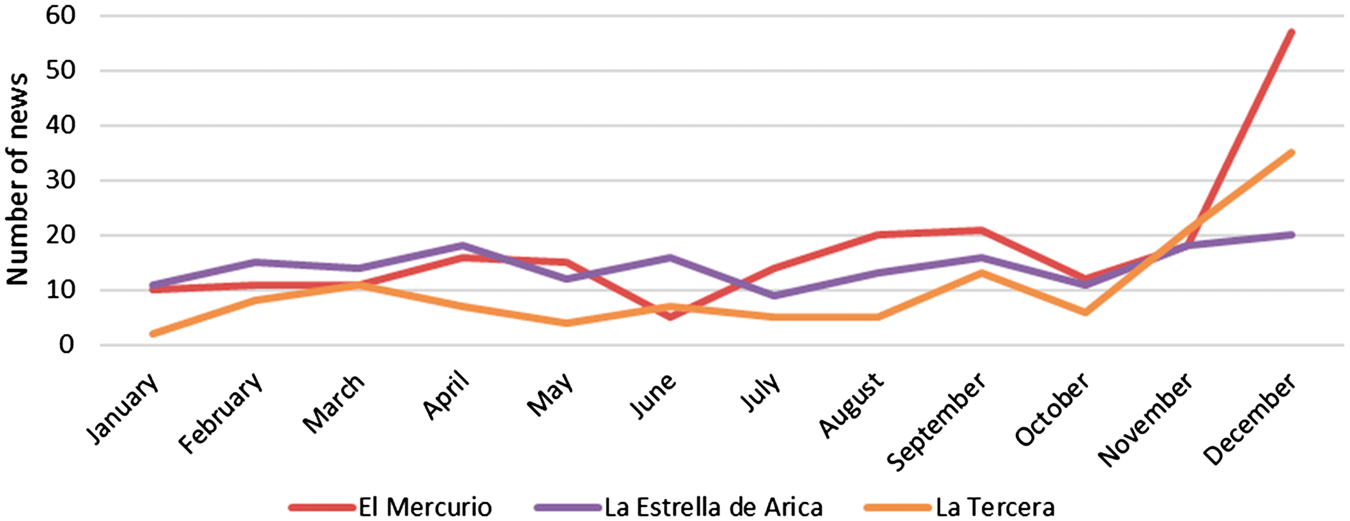
Number of news items on immigration in Chile covered by El Mercurio, La Estrella de Arica, and La Tercera in 2016 (N = 507).
Type of News.

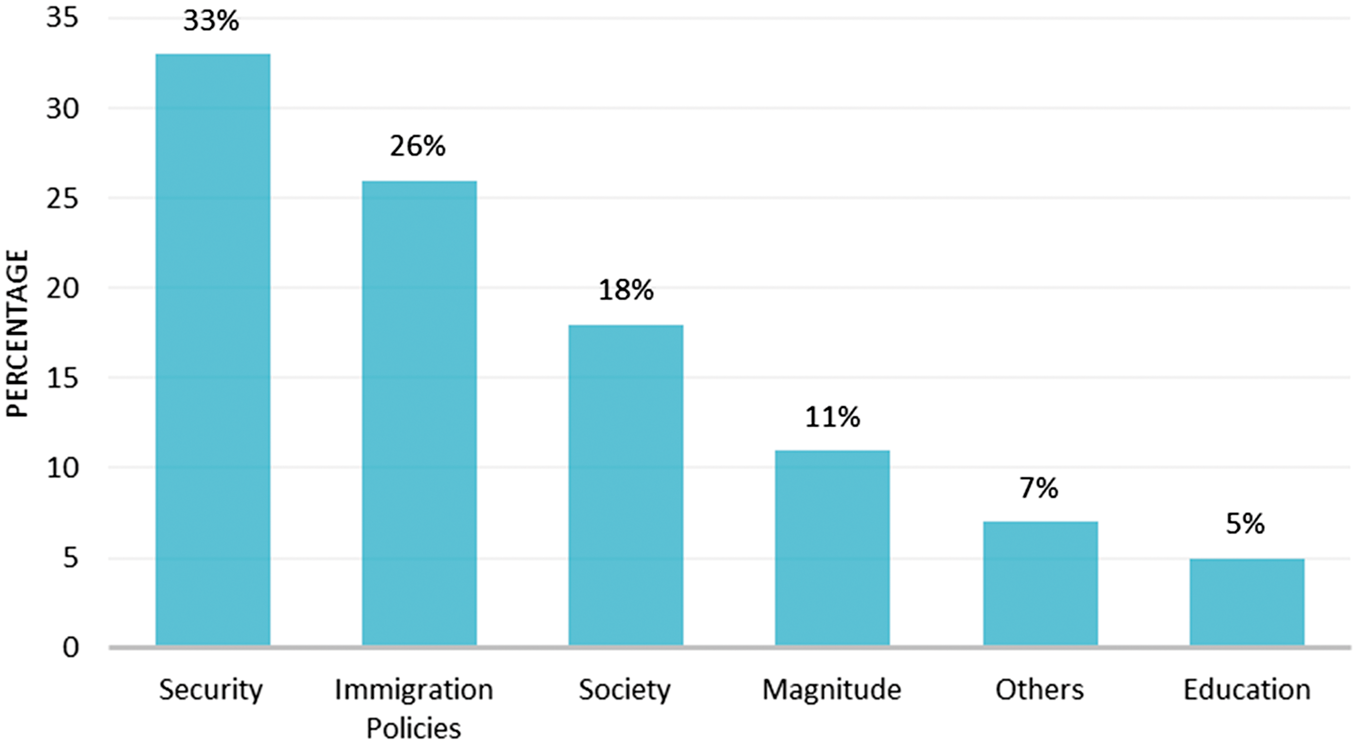
Main topics covered by El Mercurio, La Tercera, and La Estrella de Arica in 2016 (N = 507).
Sixty-one percent of the news items referred to Latin American immigrants, mostly Peruvians, Colombians, Dominicans, and Bolivians; 36% focused on “immigrants in general” without specifying nationality; and only 2% reported on Asian immigrants (Syria, Iraq, and China).
Regarding press language, the media are using different terms to refer to immigrants, depending on their countries of origin. Press reports use terms like “immigrant,” “foreign,” “refugees,” “non-Chilean citizens,” “undocumented,” and “illegal alien” interchangeably. Racist and xenophobic terms previously found in the press by scholars in the 1990s and 2000s, such as “dark-skinned,” “indigenous,” “needy,” “illiterate,” or “minority,” were not commonly found in this study.
The next section shows the main findings of the study including the dominant frames and source selection in media coverage of immigration in Chile. The last part discusses whether there is a shift in the way media sources are representing immigration compared to previous reports.
Analysis
Newspaper Coverage of Immigration in Chile: A Dual Discourse
The main topics highlighted by El Mercurio, La Tercera, and La Estrella de Arica were security (33%), followed by immigration policies (26%), and immigrants’ civil society (18%). Figure 2 shows the main topics covered by the three Chilean newspapers in 2016.
A dual discourse of immigration prevails in the Chileans press. On the one hand, there is a criminalization discourse of immigrants in security and magnitude news, which frame them as delinquents, deviant, and dangerous people. On the other hand, a positive and humanizing discourse on immigration is used in most of the immigration policy news and civil society news.
The criminalization of immigrants: Security and magnitude issues
News items about security news are recurrent in the Chilean press. Reported as small notes in the national editorials section, this group of news shows specific “social problems,” whereby the most common are drug trafficking (26%), and “illegal” or “clandestine” entry into the country (18%). Less frequent are news articles about immigrants accused of smuggling, public disturbances, human trafficking, theft, and kidnapping. Only five articles referred to cases in which immigrants were the victims of crime.
Of the three newspapers, La Estrella de Arica is the one that publishes the highest number of news stories on security. This is hardly surprising, as Arica shares a border with Peru and Bolivia and is an entry point for many immigrants. In that regard, La Estrella de Arica, responding to local needs and the demands of its community, tends to publish short notes about immigrants’ arrests for crossing different borderlands such as the Atacama Desert, the railway Arica-La Paz, the international airport, Arica’s harbor, and the border crossing of Chacalluta-Santa Rosa.
Practically all security news refer to immigrants from Latin American countries, mostly from Peru, the Dominican Republic, and Colombia. Using a criminalizing framework, editorials associate these communities to certain types of crime, where the most frequent are the link between Colombians and drug trafficking and public disturbances, and Peruvians and Dominicans, with undocumented status and human trafficking.
The stereotype that associates Colombian immigrants with drug-related issues has been widely dispersed by the mass media (Guarnizo & Diaz, 1999). The Chilean press follows a similar pattern with common headlines like: “Colombian bikers attempt to smuggle a massive shipment of synthetic drugs into the country” (El Mercurio, May 2016) and “Colombian should be imprisoned until 2022 for smuggling drugs in shampoo and towels” (El Mercurio, May 2016). The majority of arrests take place in the Atacama Desert, the Chacalluta Border, and other borderlands and are due to drug trafficking, specifically of marijuana, ecstasy, LSD, and cocaine. A group of news stories refers to the variety of ways in which Colombians hide drugs upon entering the country, using cosmetics, sheets, body lotions, rocks, woods, and boxes of candy. As the news notes, these “unusual techniques” and “innovative strategies” have been introduced, thereby complicating the work of border patrol. In addition, Colombian immigrants used to be associated with violent crimes such as homicides, fights, and public disturbances, contributing to their image as problematic and dangerous to Chilean society. These stories often highlight the coordinated work of police officers disrupting organized crime groups, controlling public disturbances and detaining undocumented immigrants.
Several times, security reports use the term illegal referring to immigrants that do not have a legalized status in the country, but they also use terms such as “clandestine” and “undocumented” immigrant. The association between Dominican immigrants and “illegal” crossing and human trafficking is powerful. The news items, published especially by La Estrella de Arica, emphasize the number of detentions: “Caught 18 Dominicans for crossing the border,” “11 Dominicans arrested on Tacna-Arica railroad,” and “9 Dominicans caught walking on the border.” They label immigrants as “illegal aliens” or “illegal Dominicans.” This is even more problematic when news stories employ testimonies that use “Dominican immigrants” as synonyms for “undocumented persons” or “human trafficking”: In fact, according to prosecutors and the police, not a week goes by without the initiation of a dangerous police operation: in minefields, on the coastal border, on the railroad line between Arica (Chile) and Tacna (Peru), or near the border checkpoint at Chacalluta (…) and regarding the trafficking of immigrants, the figures are all but monopolized by the Dominicans. (El Mercurio, August 2016) When renting out properties, we have been told not to rent to Dominicans, only to legal people. (El Mercurio, January 2016)
The criminalization discourse of immigrants is also present on articles about magnitude. The assumption that immigration rates in Chile are growing is present in most of the news items analyzed, but 11% of the articles focus exclusively on this issue. This coverage is different in many ways: Reports are long and detailed, sometimes appearing on the front page, using national surveys and statistics, showing graphs and tables, and referring to immigrants as a whole (and as a homogenous group). Here, numbers are the focus of study: “Number of foreigners settled in the country rises by 123% over a 13 year period, according to official figures” (El Mercurio, January 2016); “In six months, eight times more Haitians have arrived than all the arrivals in 2013” (El Mercurio, August 2016); “Immigrant population increased from 2.1% to 2.7% in two years” (La Estrella de Arica, December 2016). Immigration is still being presented as a recent phenomenon, with new waves of immigrants arriving at the country, and making a series of changes in Chilean society. These news stories highlight an increase in the percentage of immigrants, although the total remains low, and significantly lower than other countries, contributing to an exaggerated perception of the phenomenon.
As some scholars have found, news regarding the magnitude of immigration contained a clear sense of exaggeration and sensationalism, in some cases employing pejorative terms when referring to the rise in immigration. The main concerns are “the massive influx of Haitians,” the increase in undocumented immigrants, makeshift settlements in the North of Chile, the “strong rise” in traffic and crime, and the lack of regulation in the remittance market. Reports alert readers that Chile is experiencing a “new” immigration phenomenon and that urgent public policies are needed to control and regulate this situation. This is similar to what Santa Ana (2002) found regarding Latinos’ immigration into the United States, and how metaphoric systems have shaped the public opinion about them. As the author says, one way of dealing metaphorically with Latinos was to brandish them as invaders, misrepresenting them as unwanted immigrants. Such news does not foster learning about immigration but instead serves to bolster the idea that immigration is an “unresolved problem.”
The most controversial news item of the year was published by El Mercurio on August 30. On the cover of the editorial section, the article states that “52% of people accused of crimes in the extreme north of the country are foreigners.” Using military language, the report suggests that, according to the police, not a week goes by that law enforcement does not have to embark on a dangerous police operation: alongside minefields, on the coastal border, on the railroad line between Arica (Chile) and Tacna (Peru), or near the border control of Chacalluta. In three instances, the article reiterates the nationalities of the immigrants detained: Peruvians, Dominicans, Bolivians, and Colombians charged with human and drug trafficking, as well as crossing the border in an unauthorized area. The different types of crime are analyzed and treated in the same way, thereby creating a huge distortion. Headlines like this one could have substantial effects on the public’s perception of immigration. In that way, it is not surprising that 41% of the Chileans believe that immigrants raise crime rates (CEP, 2017) despite the fact that they have lower rates of criminality compared to Chileans.
Humanizing immigrants: Immigration policy and civil society
In contrast to the previous dominant narrative of immigrants, which portray them as criminals, drugs dealers, “illegals” and violent people, a counter-narrative, which humanize immigrants is present in most of the news regarding immigration policy and immigrants’ civil society.
First, reports on immigration policy include both, news regarding immigration legislation as well as specific public policies targeting this population. The need to formulate a new national immigration policy is the most frequent and pressing topic and makes up the majority of letters and opinion pieces reacting to the political debate on immigration. Much of the recent news refer to delays, misunderstanding, and problems with a new law being discussed in Congress. A congressional debate increased its press coverage during the last months of the year. A group of immigration policy news promotes the ideas of integration and social protection of immigrants. Captions inform us that “we are all immigrants” and that “Chile is a country with open doors” and “open borders.” Chile is portrayed as an open country that has promoted tolerance, cooperation, and the inclusion of immigrants. Nevertheless, this image is not new in the Chilean press, and the debate about the need to modernize immigration laws has been present in the press for a long time, without major progress on this front.
Second, news on immigrants’ civil society, which includes notes on daily activities work, culture, and social relationships of immigrants also use a more humanizing discourse. Overall, these reports show positive attributes of immigrants, use more cautious language, include immigrants’ viewpoints, and clear up previous misconceptions about immigrants. Referring to them as “foreign,” or “immigrants” without any additional labels, reports recount successful stories of immigrants’ integration in Chilean society, lauding their courage and strength in traversing the country, and reporting on their cultural contribution through the introduction of their cuisine, celebrations, and traditions. Moreover, the news emphasizes immigrants’ higher educational and professional levels, as compared to that of the average Chilean.
Some news articles depict immigrants as an active and organized group interested in political issues. These stories report on their reactions to immigration policies, public protests against discrimination, immigrants’ social movements, and their interest and participation in national elections. A report published by El Mercurio shows how the immigrant vote can be extremely influential in the next municipal elections. One caption reads: “Seven of the 11 municipalities with the highest proportion of foreign voters are in the Metropolitan Region. According to the Director of Immigration, these new voters will have a higher voter turnout rate than Chileans” (El Mercurio in June 2016). This article is the newspaper’s featured story and uses pictures, graphs, and infographics to support its arguments.
Immigrants’ interest and engagement in Chilean politics can be a powerful tool for social integration. Reports showing immigrants’ celebrations and participation in soccer games and tournaments also help with immigrants’ integration. During 2016’s Centennial Copa America, headlines such as these were commonplace: “A fervent passion for soccer unites Haitians in Chile” (El Mercurio, June 2016); “Colombians celebrate awaiting their next opponent”; “Now Colombians place their chips on La Roja” (La Estrella de Arica, June 2016); “Bolivians celebrate with fricassee and chicken sajta” (La Estrella de Arica, June 2016). Using an appealing narrative, these news items show how immigrants celebrated the tournament, which kind of food they ate, and which cabalas or superstitions they performed. As immigrants’ testimonies indicate, their celebrations are “always happy,” “enthusiastic,” and “at home with family.” These reports show a more humanizing narrative, in contrast to the previous hegemonic discourse of immigrants, which portrayed them as criminals or “illegals.”
A small number of news reports inform the public about immigration and education in Chile. Most of the stories tell specific policies schools are implementing to integrate immigrants’ children including the celebration of a multicultural day, incorporation of the Peruvian national anthem, changes in the educational curriculum, and even includes the implementation of exchange and cooperation programs with schools from immigrant children’s countries of origin. For example, in July, La Tercera published a report entitled “Immigrants’ children in schools: a work in progress,” which details some policies introduced to integrate the growing number of immigrant students in the classroom, including changes in the educational curriculum and traditional celebrations.
Only two reports are describing the situation of European immigrants in Chile: “Italians in Arica” and “Germans colonies in the South of Chile.” Using a positive tone, reports associate these communities with notions of progress, development, and success. Moreover, journalists highlight immigrants’ contributions by mentioning their professions: “amateur merchant,” “Italian merchants,” and “foreign businessmen.” Thus, immigrants’ professions and their contributions acquired importance, sometimes more than their countries of origins. About this, an interview with a religious leader underscores the point: “We call Europeans foreigners and Latinos, immigrants” (La Tercera, December 2016).
Although some positive aspects of immigrants are shown in the Chilean press’s discourse, it is relevant to note that most of these are published in special editions, supplements, or specialized sections of the newspaper like Economy and Business, Revista Campo, Revista Del Domingo, Revista Ya, and Reportajes. These kinds of reports have a narrower distribution, access, and exposure to readership than the main body of the newspaper (Fernández Ortiz, 2004). In addition, only a small group of news stories shows the struggles and problems faced by immigrants in Chile, such as poverty and discrimination, issues related to immigration status, lack of secure housing, limited access to services, language barriers, and a lack of recognition of their professional qualifications. Regarding education and immigration, no significant information provided about social exclusion, racism, and bullying at schools. During the entire year, there was only one news article reporting a situation of discrimination and xenophobia at schools based on a study: “Immigrants’ families feel that schools have no authority to prevent discrimination” (El Mercurio, January 2016). There is an absence of discussion regarding the situation of immigrants’ children, what their situation at school is, how they feel, and their profile. The case of immigrant university students is notoriously absent in the media debate as well.
Immigration Experts in Chile
Who is discussing immigration in Chile? Do they have a particular discourse? How often do they appear in the print media? Seventy-eight percent of newspaper reports use interviews as a primary source. Twenty-four percent of the news items quote governmental officials such as ministers, senators, congressmen, national directors, and mayors. In the second place, 20% of news items quote individuals from the field of justice, including lawyers, national and regional prosecutors, police, majors of the antidrug unit, lieutenants, public defenders, police commissioners, and investigative police subprefects. In contrast to findings that argue that the immigrant voice is practically absent in mass media, close to one fifth of news releases use the direct narrative of immigrants in Chile. The most common testimonies are from Colombian, Dominican, and Peruvian immigrants.
Although the media tends to interview individuals from different sectors to cover immigration issues, during 2016, the debate was dominated by two authorities: The National Director of the Foreign and Migration Department (DEM) and the Director of the Jesuits’ Service for Migrants and Refugees (JSM).
a
Their immigration discourse, which is based on an inclusive and human rights approach, received media coverage, as journalists appealed to both leaders to define concepts and explain and clarify immigrants’ issues, especially regarding immigration policies and security concerns: We have a very clear signal from the President of the Republic to promote integration and tolerance for diversity. (National Director of the DEM in La Tercera, April 2016) Immigrant children are a component of social cohesion for the future. (National Director of the DEM in La Tercera, July 2016) We need an immigration policy that understands that immigrants, before being workers, are subjects of rights. (National Director of the JSM in El Mercurio, January 2016) When you believe you are regulating because it creates more bureaucracy or more barriers, what it does is prepare the land for these gangs to appear. And the tremendous thing about it is that these gangs, which thrive off excluded and vulnerable people, are beginning to behave like the gangs I saw on the U.S. border with Mexico, and that operate with great violence. (Director of the JSM in La Tercera, November 2016)
The continued reliance of the media on government and religious leaders may be associated with the fact that immigration in Chile remains understudied, and there are limited sources and experts on the topic. Other reasons could be that some institutions are working on strategic communication, and media outlets are developing affiliations with these sources. Regardless of the reason, the strong presence of the governmental and religious leaders during the year and their robust human right discourse undoubtedly contribute to show immigration as a more humanized issue. However, the discourse on immigration in the Chilean print media is limited, as the media turns to the same pundits over and over again and offers minimal coverage of other experts such as immigrant leaders or national and international scholars. Relying on experts who are government leaders is inherently problematic because the discourse then becomes dependent upon the views on immigration of whichever political party happens to be in power.
Is the Way That the Media Portrays the Immigration Discourse Changing?
Analyzing news representation of immigration in Chile is especially important as the country is currently facing a significant increase in the number of immigrants, mainly from neighboring countries. The country is in a transitional period from being an immigrant-sending country to a newly emerging immigrant-receiving country. The increase in the number of immigrants in Chile and the lack of studies about the current situation of this group put media in a central role as most of the information that people have about immigration comes from media. This is the first study that analyzed how the Chilean press portrays immigration in Chile from a broader viewpoint, that analyze the differences in discourse depending on the immigrants’ country of origin, and that connect with previous findings on this issue.
The study shows how is media covering immigration issues from a South-to-South perspective. The representation of immigration by the Chilean print media context shows interesting and contradictory results: a dual discourse of immigration; a shift in the way media are representing immigration compared to previous reports; and the absence of race in media discourse of immigration.
First, the analysis shows how the Chilean newsprint media reproduce and maintain a dual discourse of immigration that can have serious consequences to the public perception of the audience. On the one hand, Chilean print media are prioritizing security news, framing immigration mostly as a threat. Despite the reduced number of immigrants’ detentions as reflected in national statistics, news outlets report daily incidents of drug trafficking, illegal border crossing, human trafficking, and cases of violence, fueling the dominant opinion that immigrants are criminals. On the other hand, a positive and humanizing discourse on immigration is used in most of the immigration policy news and civil society news, portraying them as a welcoming group to the country, in need of public services, or as integrated into the Chilean society. The dual discourse that criminalizes and humanizes immigrants contributes to seeing them as “good” and “bad” immigrants, reinforcing the difference and otherness of foreigners. As Gonzales (2013) argues, the good/bad immigrant binary is an ideological framework, a “common sense” rhetoric assuming that some immigrants may “pass,” and others must be controlled and cleansed from the nation. The Chilean press installs imaginaries of “bad” immigrants: “illegal Dominicans,” “Colombians drug traffickers,” “massive influx of Haitians.” A “good” immigrant, in contrast, is one who deserves to be protected by the Chilean government, one who participates in political elections and celebrates Chileans triumphs on soccer tournaments. Showing a good/bad immigrant binary can have a significant effect on the audience ranging from experiencing fear, violence to feelings of tolerance and empathy, which result in increasing difference. In both cases, nationality and its repetition across the news are the key strategy that media use to frame immigrants’ news.
In addition, the Chilean case shows how frames can change throughout the coverage of immigration issues. Vis-à-vis previous studies on mass media coverage of immigration during the 1990s and 2000s in Chile, this analysis shows a shift in the way media are representing immigration. El Mercurio, La Estrella de Arica, and La Tercera are offering new and different narratives; journalists are using more cautious language; and the media are attempting to dispel old misconceptions and stereotypes about immigrants that were common in press pieces of past decades. However, it is important not to categorically assume that the Chilean press is becoming more tolerant than before. First, the exceptional characteristics of immigrants in Chile, with their higher income levels, education, health conditions, and lower rate of criminality compared to Chile’s national average, is being addressed by media, but mostly superficially and reactively. These assumptions are rarely headlines or explained in depth by the newspapers, and most of the headlines and cover pages give priority to stories covering the magnitude of immigration and security issues. Second, this “shift” on the immigration discourse has to do with the significance coverage of governmental and nongovernmental organization leaders that have contributed to portray a more humanizing view of immigrants. This can be problematic, as the discourse on immigration can change abruptly due to a change in government leadership. Given this scenario, the print media should employ other sources to enrich and diversify their press reports. A related point is that, even though the media have been including the voice of immigrants, immigrant organizations and immigrant social movements are not included.
Finally, the idea that immigrants are contributing to the debate of race in Chile is also not evident in the media. The immigration discourse avoids talking about racism, race, and xenophobia, and there is not a problematization of these issues. This was clear in the analysis of education’s news, which highlights stories of inclusion and successful practices that schools were implementing in order to integrate immigrant children, while experiences of social exclusion, racism, and bullying at schools were not considered. As Van Dijk (1992) points out, racial denial in the press is not an unconscious practice; it takes the form of resignation, mitigation, euphemisms, and transference, which have an important effect on people’s reception of the information. In this way, racism survives only when it is reproduced daily through multiple acts of exclusion, internalization, or marginalization.
The Chilean print media offers us one version of the changes in immigration in Chile; however, there are topics not yet covered by the press. The study leads to important new questions about how news is framing immigration in Chile. For instance, what is happening with immigrants that come from Argentina, from Europe, or from other Latin American countries like Mexico? Information about immigrants from other countries has not been covered by the press and has not even been considered as part of the same phenomenon of immigration. In addition, it is crucial to generate more information and news about other immigration topics that are still absent from the media, such as human trafficking, refugees, women, children and youth, asylum seekers, immigrants’ housing conditions, and immigrants’ social networks.
Footnotes
Declaration of Conflicting Interests
The author declared no potential conflicts of interest with respect to the research, authorship, and/or publication of this article.
Funding
The author received no financial support for the research, authorship, and/or publication of this article.