







Abstract
This study considers the possibility that students are subversive actors in a hidden curriculum of anti-intellectualism. Mass communication provides the arena in which intellectuals are held up to public judgment, and consequently media education represents a promising context for observing the enculturation of resentment. The hidden curriculum framework incorporates three sources of influence: socio-demographics, student-oriented anti-intellectualism (impatience with education, disliking instructors), and three dimensions of journalism ideology: the consumer-oriented and loyal roles and accountability to the public. Data are drawn from questionnaires distributed to undergraduates at five U.S. colleges with comprehensive programs in journalism and mass communication (JMC). Republican identity, student anti-intellectualism, and journalism ideology predict support for news media exposing faculty as subversive. The study concludes with suggestions for future research on how JMC education, from a comparative perspective, could be vulnerable to anti-intellectual incursions depending on media system and populist climate.
Cultural obligations of journalism, from a critical perspective, include the surveillance and sanction of intellectual dissent (Thorbjørnsrud & Figenschou, 2018). Narratives of this type portray intellectuals as divisive, subversive, unhinged, and dangerous (McDevitt, 2020). If historians and sociologists are accurate in characterizing the United States as profoundly anti-intellectual (e.g., Hofstadter, 1963; Peters, 2019), this sentiment likely seeps into media education.
Lurking within the hierarchical, institutional matrix of academia is a potentially hostile actor—the undergraduate student. College students who dislike instructors, for example, or would rather just pay for a diploma, might enjoy narratives that expose faculty as arrogant. Populist inflections in journalism ideology could cultivate anti-elitist dispositions for other students. For students who identify with cultural conservatism, a journalism of accountability is appropriately directed at intellectuals who offend mainstream sentiment.
We propose that holding intellectuals accountable to public opinion can be viewed as a form of anti-intellectual agency in youth political development. This study considers the possibility that students are subversive actors in a hidden curriculum of anti-intellectualism. The concept of a hidden or implicit curriculum is useful in capturing the idea of covert, tacit, and potentially damaging “lessons” that students pick up while negotiating college life (Alsubaie, 2015). Mass communication provides the arena in which intellect and intellectuals are held up to public judgment, and consequently media education represents a promising context for observing the enculturation of resentment.
Richard Hofstadter famously portrayed American culture as anti-intellectual in the post-war era (1963), and psychologists have deployed a student anti-intellectualism scale for several decades (Eigenberger & Sealander, 2001; Laverghetta et al., 2007; Marques et al., 2017). The present study, however, is the first to model student support for journalists exposing faculty as subversive. We are not interested in critiquing pedagogy so much as mapping how emerging adults internalize a punitive anti-intellectualism. Data are drawn from questionnaires distributed to undergraduates at five U.S. colleges with comprehensive programs in journalism and mass communication (JMC).
The article begins with a brief discussion on anti-intellectualism as an enduring feature of U.S. culture. We then develop a hidden curriculum framework to explain why students might endorse exposing professors as subversive. The model incorporates three sources of influence: socio-demographics, student-oriented anti-intellectualism (impatience with education, disliking instructors), and support for dimensions of journalism ideology. We find that Republican identity, student anti-intellectualism, and journalism ideology predict support for exposing professors to journalistic audiences. Interactions of Republican identity with other predictors suggest that even as partisan allegiance motivates resentment, journalism ideology offers justification for other students. Put differently, support for journalism ideology can stimulate antipathy not yet crystallized. The paper concludes with suggestions for future research on how JMC education, from a comparative perspective, could be vulnerable to anti-intellectual incursions depending on media system and populist climate.
Anti-intellectualism in U.S. Culture
Anti-intellectualism is typically understood as a generalized antipathy to the life of the mind that can range in affect from disregard to suspicion to overt contempt (Hofstadter, 1963). In a relatively benign interpretation, anti-intellectualism constitutes a style of thinking that prefers recipe knowledge and rote learning over the critical thinking associated with intellect (Elias, 2008). Anti-intellectualism is often characterized as latent resentment, but the sentiment is actualized in media through populist anti-elitism (Krämer, 2014).
Populist discourse portrays educated elites as hostile toward the interests and values of ordinary citizens (Fawzi & Krämer, 2021). Mudde's ideational definition of populism accommodates the appeal of this mindset across the political spectrum. Populism refers to “a thin-centered ideology that considers society to be ultimately separated into two homogeneous and antagonistic groups, ‘the pure people’ and ‘the corrupt elite,’ and which argues that politics should be an expression of the volonté générale (general will) of the people” (2004, p. 543).
Anti-elitism in popular media is a formidable expression of disaffection in established democracies. Anti-elitism resents “claims to superior knowledge or wisdom on the part of an educated elite” (Rigney, 1991, p. 441). In reactionary inflections, populist anti-elitism is often directed at intellectuals, a social category viewed as disloyal. The restless probing of intellect is, in fact, “neither reverential nor patriotic” (Said, 1996, p. 223). Anti-intellectual ideologies circulate in the “outrage machine” of right-wing media, regularly reinforced in targeted attacks against faculty (Lawless & Cole, 2021; Scott, 2019).
News outlets but also many other sectors of contemporary media provide venues in which the policing of intellectuals occurs (Claussen, 2004; MacGregor, 2009). To the extent that JMC students internalize populist thinking, they would imagine audiences through the lens of an innocent “pure people” periodically roused by arrogant elites (Mudde, 2004). Faculty represent the type of intellectuals college students have had the most direct contact with, and we consequently introduce a measure of student support for journalism exposing professors as subversive. The next section explains why some college students would be attracted to anti-intellectualism, and why journalism ideology for JMC students provides an additional rationale for retribution.
A Hidden Curriculum of Resentment
Jackson coined the term “hidden curriculum” in Life in Classrooms (1968, 1990), an “inquiry into inquiry” that juxtaposed what is overtly taught in elementary schools from what students learn. Apart from any formal curriculum, students must learn and abide by expectations such as obedience, neatness, and punctuality. School “is a place in which yawns are stifled and initials scratched on desktops, where milk money is collected and recess lines are formed” (1990, p. 4). In contemporary scholarship, critiques of the cultural influences that infiltrate higher education build on the premise that unintended and tacit lessons contribute to social order (Giroux & Penna, 2012). A hidden curriculum is not a singular concept. It “encapsulates a diversity of premeditated, inadvertent, transmitted and received ‘lessons’ that intersect and co-exist” with explicit aims of college degrees across disciplines (Cotton et al., 2013, p. 200).
Normative theory and curricula assessment in JMC education have not taken up hidden curriculum as a conceptual lens in any sustained work. An initial application addressed the dearth of female authors in mass communication courses (Golombisky, 2002). Alemán (2014) subsequently documented how whiteness in journalism pedagogy persists as unmarked privilege. An implicit curriculum of anti-intellectualism is yet to be recognized, although the intellectual status of journalism at universities has been debated for generations (Nolan, 2008). Today, in a post-truth era, there is some acknowledgement that critical thinking of media savvy students can take perverse forms. Instruction in media literacy can backfire, for example, encouraging students to doubt all media, leaving them less discerning (Boyd, 2018).
Our application of hidden curriculum to the crystallization of anti-intellectual sentiment follows the logic of youth political development. Emerging adults are exposed to a widening circle of influences on how they assimilate or reject critical thinking (Bronfenbrenner, 1979; Kemmers et al., 2016). Resentment of intellectuals is ingrained in cultural milieu and reinforced, generation by generation, in contexts such as journalism, education, religion, and politics (Claussen, 2004; Rigney, 1991). The adoption of anti-intellectual attitudes is consequently caught up in the desire for acceptance as youth learn to conform to a social order in which critical thinking is suspect depending on circumstances. Indeed, anti-intellectualism is subservient to higher-order values such as authority, conformity, and security (Haidt, 2012). When intellect is perceived as a threat to the sanctity of binding belief, resentment is felt at the deepest levels of social allegiance (McDevitt, 2020).
A hidden curriculum is broad enough, conceptually, to encompass “how students develop as members of an interdisciplinary community” and the ways students “are inculcated into maintaining the social order through conformity” (Cotton et al., 2013, p. 193). Impatience and frustration with the demands of critical thinking transcend JMC education and often reflect not just conformity but preferences for vocational training and hedonistic college experiences (Claussen, 2004). These feelings, while possibly more benign in other curricula, portend a troubling populism in media education if negative learning experiences impact the evaluation of academic intellectuals in news coverage. An implicit curriculum of anti-intellectualism would manifest in attitudes that not only subvert critical thinking within the college setting, but justify resentment directed outward—toward a mass media realm in which journalism exposes faculty with dissident views. The current study updates and refines hidden curriculum theory by highlighting how the internalization of social order is applied in media politics. A punitive anti-intellectualism in mass communication references an affective drive—the desire for retribution and media exposure.
We foresee three sources of influence in a hidden JMC curriculum: socio-demographics, i.e., religiosity and partisan leanings that youth bring to college; student anti-intellectualism (impatience with education, disliking instructors); and support for dimensions of journalism ideology that, when mis-appropriated, justify a punitive and populist press. This section considers each in turn and then the possibility of interactions.
Socio-Demographics
We expect that religious anti-rationalism—a strain of anti-intellectualism likely enculturated in families prior to college instruction—will predict support for exposing professors. Students predisposed toward religious anti-rationalism privilege their faith over secular reasoning in comprehending the world. In prior research, a global measure of anti-intellectualism correlated with religiosity, authoritarianism, and narrow-mindedness among undergraduates in a wide variety of majors (Eigenberger & Sealander, 2001; Laverghetta et al., 2007). The focal outcome here is exposing faculty perceived as offensive, not anti-intellectualism more generally speaking, but associations of anti-intellectualism with religiosity and authoritarianism imply a desire to punish.
While critical thinking espoused in higher education ostensibly promotes intellectual articulations of political identity, Laverghetta et al. found that anti-intellectualism also correlated with political conservatism (r = .37, p < .01). We asked students to identify their partisan allegiance; options were Democrat, Republican, and independent/no party. Research in political psychology characterizes Republican identity as anchored in uncertainty avoidance and need for cognitive closure (Jost, 2017). Students (or any citizens) with conservative leanings are likely agitated by discourse that dissects foundational belief. Portrayals of intellectuals as subversive and disloyal make salient the populist remedy of sanction through exposure.
Student Anti-intellectualism
Negative experiences with college education are likely contributors to student anti-intellectualism, a kind of antipathy proximate to the learning environment (Attewell, 2011). We introduce measures for impatience with education and disliking instructors as affective dimensions of student anti-intellectualism. Individuals experience varying degrees of arousal when engaged in conceptual integration and other epistemic activities (Marques et al., 2017). Some people will experience frustration, for instance, others pleasure and curiosity. A student-oriented anti-intellectualism is likely to embody, in part, the presumption of consumer entitlement, the notion that students are buying goods and services that should include, for example, entertaining instructors.
Attewell writes that “many undergraduates hold a planful but highly instrumental view of education that rejects academics’ notions of the central importance of the life of the mind” (p. 225). We expect this attitude to manifest as impatience with education. In prior studies, students measured high on unreflective instrumentalism were prone to boredom (Laverghetta, 2015); scored low on academic self-efficacy (Elias, 2008); and preferred professional majors over more theoretically oriented disciplines (Laverghetta & Nash, 2010). Anti-intellectual students are also more likely to admit affinity for classroom incivility in behavior such as arriving late to class (Laverghetta, 2018).
Instrumental attitudes toward learning imply intolerance toward a free-ranging intellect and its seemingly pointless privileging of knowledge without immediate payoffs. If impatience is experienced at a personal level and reinforced in classroom experience, students should find opportunities to project resentment when professors are caught up in controversy. The same scenario applies to students who dislike instructors. We presume that student anti-intellectualism becomes a basis for antipathy directed outward, beyond the classroom, as the personal becomes political. Resentment could manifest as punitive in the endorsement of journalism holding academic intellectuals accountable to the public.
Journalism Ideology
Impatience and dislike of individual instructors are not in themselves rationales for surveillance and sanction. In media education, an implicit curriculum would vindicate these feelings by way of journalism ideology. We acknowledge that JMC students who harbor anti-intellectual dispositions might modulate their inclinations through exposure to normative theory (e.g., the public sphere). That said, an elective affinity of journalism ideology with populist anti-elitism offers opportunities for students to vindicate anti-intellectualism (Bødker & Anderson, 2019; Krämer, 2014). Mass media are favorable to populist positions when they circumvent elites to speak directly for “the people” (Krämer, p. 49). Populist media such as talk radio and tabloid newspapers rely on schemata of the “common people” and their presumed wisdom as “antidote to the knowledge of elites alienated from the everyday world.”
This environment provides ample opportunity for youth to develop anti-elitist expectations for how news media should operate in a democracy. Role conceptions of journalism, in this respect, are potentially complicit in the rationalization of anti-intellectualism. In a study of journalism students in the United States and six other countries, Mellado et al. (2013) conducted a factor analysis to distinguish perceptions of how news media should serve society. Four functions emerged: the citizen-oriented, consumer-oriented, watchdog, and loyal roles. Among these, the consumer-oriented and loyal roles would seem to justify support for journalists exposing professors under some circumstances. The consumer-oriented role is populist in its emphasis on news of interest to “the widest possible audience.” In conjunction with schools, entertainment media, and other agents of socialization, news media reinforce base-level expectations for intellectual work, and this occurs in part through hedonism and unreflective instrumentalism (Claussen, 2004). Ideas and discourse that fail to give pleasure or a pragmatic payoff are downgraded. Consumers of U.S. news media are familiar with a domesticated version of intellect, one filtered into technical expertise or the binaries of partisan discourse (McDevitt, 2020). Ideas not commodified as expected could be viewed as odd if not gratuitously offensive. Students reticent to push the tolerance of news consumers are likely susceptible to imaging audiences as quite pleased to see wayward academics pilloried.
Obligations of journalism to society, from a cultural perspective, include the protection of binding beliefs and collective memory from intellect's probing. This imperative should apply to students who identify with the loyal role: the perceived duty to promote patriotism. In this way of thinking, academics who show themselves to be disloyal are suspect and deserving of sanction. Students with this inclination can draw from ideology of the press as a Fourth Estate. “Journalists share a sense of ‘doing it for the public,’ of working as some kind of representative … in the name of people” (Deuze, 2005, p. 447).
Apart from any anti-intellectual inclinations, JMC students should support the notion that journalists themselves must answer to the public when questions arise about reporting methods. Accountability by way of transparency is, in fact, a principle of communication ethics (Glasser & Ettema, 1989) and is not necessarily motivated by a desire to expose intellectuals. We nevertheless anticipate a misappropriation of this principle, at least among some students. Accountability can justify the policing of intellect, such that the press must conform to perceived orthodoxies in climates of opinion (Krämer, 2014). Because society is divided between a virtuous public (“the pure people”) and “the corrupt elite” in a populist mindset, media are obliged to expose professors who offend audience when binding values are at stake. Accountability to the public in this respect overrides autonomy of free inquiry. The seemingly democratic principle of making visible—in transparency of reporting and exposure of cultural elites—succumbs to the imperative of social control.
Interactions
Journalism ideology establishes an alternative to partisanship as motivation for exposing professors. This would manifest in negative interactions between Republican identity and aspects of journalism ideology. We do expect Republican students to score higher on exposing professors when they support the two journalism roles and accountability to the public, but relationships between journalism ideology and exposing professors will be stronger for non-Republican students. This prediction is consistent with the conceptualization of populism as a “thin ideology” that readily grafts onto other ideologies (including journalism) in emphasizing a Manichean opposition between “the elite” and “the people” (Schroeder, 2020). The political appeal of populism in redeeming democracy—in giving power back to the people—transcends partisan ideology. Indeed, the appeal lies at a deeper level of political logic (Laclau, 2005). Journalism ideology is likewise non-partisan (or is intended to be so). Thus, we do not expect populist affinities with the consumer-oriented role, the loyal role, and accountability to the public to reinforce Republican antipathy so much as grant other students a non-partisan rationale for sanctioning intellectual elites.
Method
The field sites for college instruction and media markets encompass the Northeast, Southeast, Midwest, and Rocky Mountain West. A purposive sample was drawn from five comprehensive JMC programs. 1 Among these, four come from public universities: Southeast (n = 274), Midwest 1 (n = 242), Midwest 2 (n = 423), and West (n = 288). The fifth campus is a liberal arts college in the Northeast (n = 245). The goal was to capture regional and socio-demographic diversity while recognizing that self-recruitment to JMC majors is likely to constrain the spectrum of attitudes associated with anti-intellectualism. Students collectively at the five colleges follow sequences in online/news-editorial, broadcast production, visual communication and design, media studies and communication, public relations, and advertising.
Data collection began on October 8, 2015, following IRB approval and ended December 23, 2015. 2 Student research pools established at Midwest 1, Midwest 2, and Southeast allowed us to administer questionnaires with a web-based, data-collection system. At Northwest, students completed paper-and-pencil questionnaires in classrooms. Questionnaires at West were administered in two modes: a web-based survey platform and paper-and-pencil questionnaires distributed in classrooms. The response rate for the online questionnaires is 41.7% and the rate for in-class participation is 57%. Mode of response is not predictive of support for exposing professors or the antecedent variables used in hypotheses. 3 The overall response rate (44%) compares favorably to rates obtained by questionnaire administration in journalism courses in the United States and six other nations (Mellado et al., 2013).
Gender (68.5% female) is roughly similar to the female majority (61.6%) for undergraduates reported in the 2018 Survey of Journalism & Mass Communication Enrollments (McLaughlin et al., 2020). The ethnic profile for the present study, however, is less diverse: 79.5% White/Anglo, 7.7% Asian, 4.7% Black/African American, 4.2% Hispanic/Latino, 2.7% multi-ethnic, 1% Native American, and 1% other. While 20.5% of students report identity other than White/Anglo, 35.7% of students in the 2018 sample identify as non-White.
Measures
The measurement strategy for exposing professors was to capture resentment activated by journalistic context and to thereby cue latent sentiment. Students are unlikely to openly endorse anti-intellectualism, but we presumed that at least some would find reasonable the assertion that journalists should expose professors who ridicule or undermine American values. The media backdrop to such confrontations implies widespread audience support for exposure. The goal was to avoid respondents simply echoing platitudes of critical thinking in a university environment, to essentially shift thinking from the classroom to mass media. By contrast, measures for impatience with education and dislike of instructors are intended to tap into what it feels like to be a student in college. For each dimension, item wording follows efforts in hidden curriculum research to access “theory in action” rather than “espoused theory” (Argyris & Schon, 1974).
Items for anti-intellectual orientations use a response scale of 1 (strongly disagree) to 7 (strongly agree). They come from a larger battery of items used in prior studies (McDevitt, 2020; McDevitt et al., 2018) to measure a range of anti-intellectual attitudes and behaviors in a college student sample. For each index we summed scores and divided by the number of items to facilitate comparisons of means.
Support for Journalists Exposing Professors
Students estimated their support for two statements (M = 3.48, SD = 1.50, Spearman-Brown coefficient = .91). 4 “Journalists should expose professors who ridicule American values,” and “Journalists should expose professors who undermine American values in their instruction.”
Impatience with Education
Students responded to six items (M = 3.37, SD = 1.11, α = .76). “Many of my college courses are a waste of time for me,” “I don't like taking courses that are not directly related to my goals after college,” “I would rather just pay money for a diploma than have to take so many useless courses,” “A big reason I’m in college is that I value learning for its own sake” (reverse coded), “Requirements to take humanities and liberal arts courses should be reduced or eliminated,” and “I’m in a hurry to get my education over with.”
Dislike of Instructors
Respondents estimated their support for four statements (M = 3.53, SD = 1.11 α = .75). “Some college professors are alright, but as a whole I don't care much for them,” “I often feel angry toward many of my professors,” “A lot of professors think they’re better than everyone,” and “Academics are often pretentious in the way that they talk and write.”
Religious Anti-Rationalism
We measured a fourth dimension of anti-intellectualism, religious anti-rationalism, as a control for predictors included in the hypotheses. Students responded to two items (M = 3.24, SD = 1.44, Spearman-Brown coefficient = .66). “You can learn as much from your religion about the world as you can from academic research” and “Creationism is as valid an explanation for the universe as any.”
For journalism roles, we used a 1–5 response scale and adapted items from Mellado et al. (2013) to facilitate comparisons with their survey of college students in seven nations.
Consumer-Oiented Role
“How important is it for journalists to concentrate on news that's of interest to the widest possible audience?” (M = 3.68, SD = .97).
Loyal Role
“How important is it for journalism to cultivate patriotism?” (M = 3.10, SD = 1.09).
Accountable to Public
Students used the 1–7 scale to convey level of agreement with the principle that journalists should make themselves accountable to audiences (M = 5.20, SD = 1.25). “Journalists must ultimately answer to the public when questions arise about reporting methods.”
Item wording and coding for socio-demographics are provided in the Appendix; these include ethnicity, gender, partisan identity (PID), grade level, and grade point average (GPA).
Analysis Strategy
Hierarchical multiple regression will document the relative strength of religious anti-rationalism, PID, student anti-intellectualism, and journalism ideology as predictors of support for journalism exposing professors. We considered multi-level modeling to account for nesting of students at the college level. A two-level model, however, assumes that the identifiable clusters are drawn randomly from a population, in this case a population of colleges. 5 We nevertheless looked for multilevel influence by running empty models in ordinary least squares. College location accounts for the following variance in anti-intellectualism: .014% (exposing professors), .03% (religious anti-rationalism), .029% (impatience with education), and .014% (dislike instructors). The results suggest marginal within-cluster homogeneity.
Specification of the regression model presumes that socio-demographics will account for variance in student anti-intellectualism (impatience, dislike instructors). GPA, for example, should associate negatively with student anti-intellectualism. We expect, in turn, that Republican identity (a proxy for cultural conservatism), student anti-intellectualism, and journalism ideology will fortify support for exposing professors. We weighted the data to adjust for unequal sampling probabilities for JMC major.
Results
Prior to testing hypotheses, we examined whether the four dimensions of anti-intellectualism are significantly associated with each other. If so, co-variance of journalists exposing professors with religious anti-rationalism, impatience with education, and dislike of instructors establishes a rigorous control for subsequent analyses that assess the journalism ideology dimensions as predictors. All correlations in the anti-intellectualism block are significant at p < .001. The largest coefficient is the association of impatience with education and dislike of instructors (r = .47, p < .001).
A second preliminary analysis establishes the strength and consistency of Republican identity as a predictor of anti-intellectualism. Table 1 reports means for Democrats, Republicans, independents, and students who chose “other” for PID. The highest means for religious anti-rationalism, disliking instructors, impatience with education, and journalists exposing professors all fall under the Republican column. Effects sizes for PID are strongest for religious anti-rationalism (η2 = .07, p < .001) and exposing professors (η2 = .07, p < .001). Gaps between Democrats and Republicans are also most pronounced for religious anti-rationalism (Mdiff. = .94, p < .001) and exposing professors (Mdiff. = .92, p < .001).
Differences in Anti-Intellectualism by Student Partisan Identity.
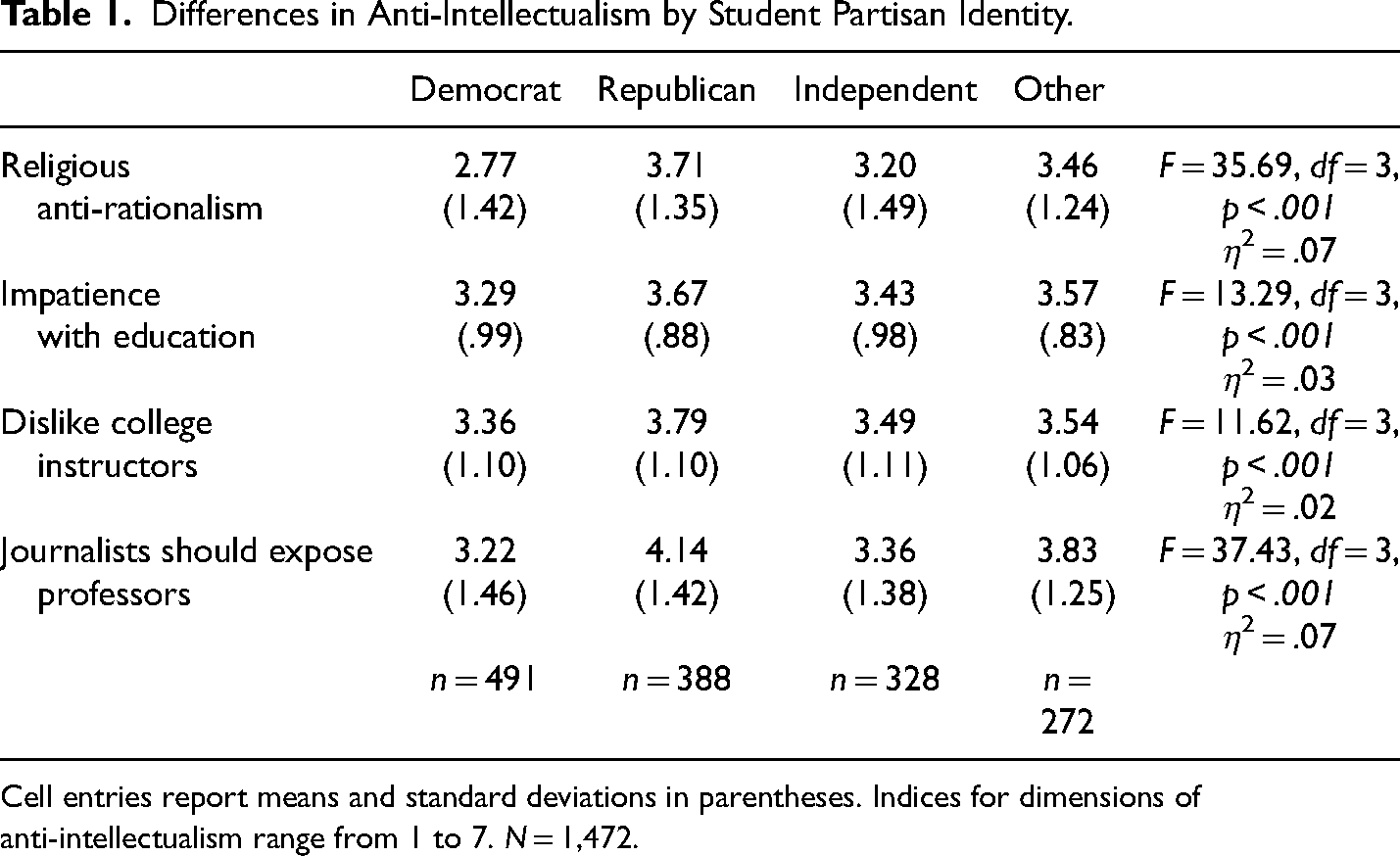
Cell entries report means and standard deviations in parentheses. Indices for dimensions of anti-intellectualism range from 1 to 7. N = 1,472.
The first block of predictors in Table 2, socio-demographics, accounts for variance in the two dimensions of student anti-intellectualism along with exposing professors. Ethnicity (coded White) predicts disliking instructors while gender (male) predicts impatience with education (both p < .001). Religious anti-rationalism, as expected, predicts the two student anti-intellectual attitudes and exposing professors (all at p < .001). The strong association of religious anti-rationalism with exposing professors lends support to H1. Party ID also reveals a clear pattern with the Democrat coefficients negative and corresponding Republican coefficients uniformly positive. All of the latter results are significant at p < .001. H2 is consequently supported: Republican identity predicts support for exposing professors.
Influence of Student Socio-Demographics, Education, and Journalism Ideology on Anti-Intellectualism.
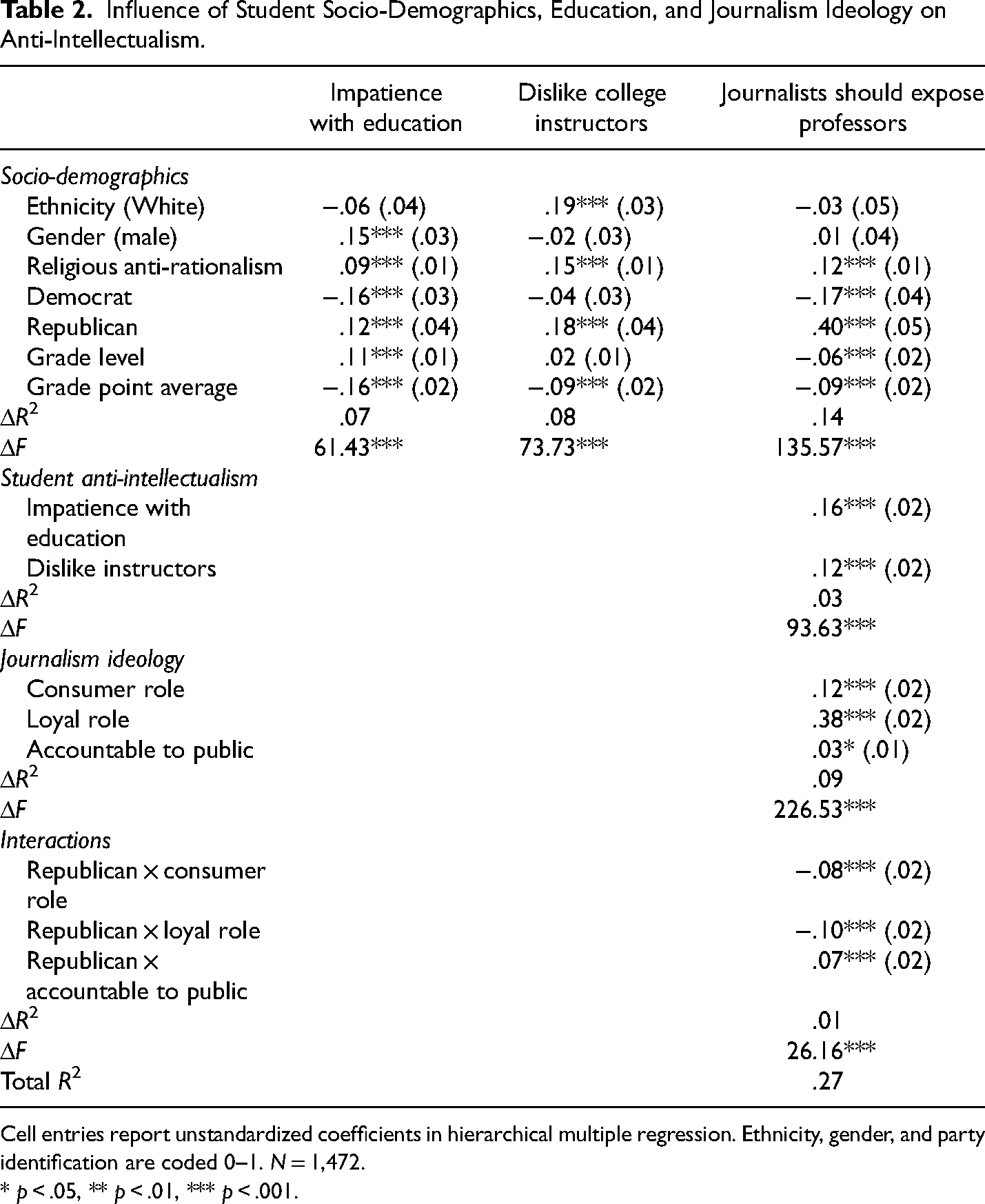
Cell entries report unstandardized coefficients in hierarchical multiple regression. Ethnicity, gender, and party identification are coded 0–1. N = 1,472.
* p < .05, ** p < .01, *** p < .001.
While grade level correlates with impatience, it produces a negative coefficient for exposing professors (p < .001). GPA offers consistently strong protection against the three forms of anti-intellectualism.
Subsequent steps in hierarchical regression are designed to address the remaining hypotheses, which highlight student anti-intellectualism and journalism ideology as predictors of exposing professors. Impatience and disliking instructors are entered as the second block of predictors, following socio-demographics. Block 3 introduces journalism ideology, and the final block adds the interactions for Republican ID with journalism ideology. The two journalism roles and accountable to the public were mean centered to compute the product for each interaction term.
Impatience with education (H3a) and disliking instructors (H3b) stand out as robust predictors (p <.001) of exposing professors despite the control for religious anti-rationalism and other socio-demographics. The results support the inference that anti-intellectualism incubated in student experiences can help to motivate a more public, outwardly directed resentment.
Moving from student anti-intellectualism to journalism ideology, the consumer-oriented (H4a) and loyal roles (H4b) account for substantial variance in exposing professors (p < .001), while accountable to public (H4c) is a modest albeit significant predictor (p < .05). The pattern gives credence to the premise that journalism ideology provides footholds for students inclined toward anti-intellectualism but requiring justification of some sort for the sentiment to crystallize as a punitive disposition. Producing news of interest to large audience (consumer-oriented role) and promoting patriotism (loyal role) offer commercial and civic rationales, respectively, for exposing intellectuals as subversive.
The final hypothesis anticipates interactions based on the premise that even as Republican identity encompasses a punitive inclination toward intellectuals, journalism ideology offers an alternative justification. H5 proposes that the relationships between the two journalism roles and accountability with exposing professors will be stronger for non-Republican than Republican students. To plot the interactions, we split the sample at the mean for the three measures of journalism ideology.
As shown in the final block of predictors, interaction coefficients for the two journalism roles are negative and significant (both at p < .001), in support of H5. While exposing professors is impacted by support for the consumer-oriented and loyal roles, the relationships are stronger for non-Republicans (Figure 1). Contrary to H5, however, the coefficient for Republican × accountable is positive (p < .001). Elevated support for accountability makes little difference for non-Republicans students but amplifies endorsement of exposing professors among Republicans (Figure 1).
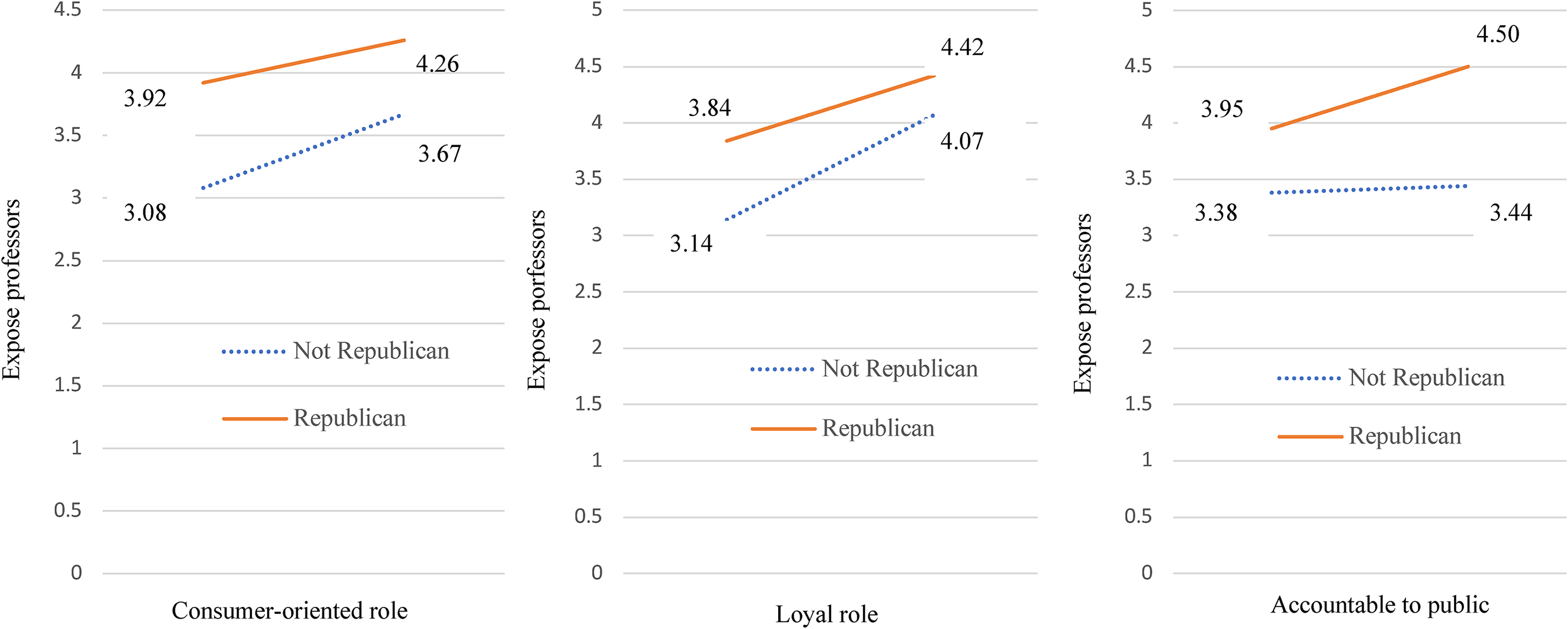
Interaction effects of party identity and journalism ideology on exposing professors.
Discussion
Jackson evocatively captured the lifeworld of the classroom, a place where “yawns are stifled” and initials are “scratched on desktops” (1990, p. 4). The current study on college students is far removed from that world, but in both contexts, students are learning obedience and their place in the social order. To the extent that human development leads to authoritarian inclinations, children become adults when they internalize the social hierarchy and rationalize how to impose obedience on others. The findings here contribute to the construct validity of hidden curriculum as applied for the first time to anti-intellectualism of college students. White students are more likely to dislike instructors and male students are more likely to express impatience with education. A hidden curriculum in the reinforcement of social hierarchy should indeed manifest in White and male students showing more aggression compared to other students. Anti-intellectualism can be viewed as an expression of privilege and power for these students.
Aggression of this sort is not an assertion of liberation in a progressive sense but a rejection of the discipline of critical thinking. Disliking of instructors and impatience with education are robust predictors of support for journalists exposing professors. Young adults are already suspicious of intellect depending on religious and partisan identities. The association of these attributes with anti-intellectualism is not surprising. What is perhaps surprising is the appropriation of journalism ideology to justify the targeting of professors. Journalism's unintended contribution to political socialization becomes evident in the transition from internalization of social order to the rationalization of retribution as youth leave childhood behind.
Enculturation of anti-intellectualism contributes to the social order of hegemonic ideas when students endorse the policing of intellect and intellectuals. This outcome is, of course, antithetical to the mission of higher education in the safeguarding of disciplinary authority against the tyranny of public opinion (Scott, 2019). And while news outlets share with universities a commitment to free inquiry, journalism is obliged to honor a society's core beliefs and values (Kenix, 2015). JMC education consequently represents a promising context for observing how an unintended curriculum might shape anti-intellectualism in ways that justify a punitive press.
This study helps to explain why JMC students are attracted to anti-intellectualism. We proposed and documented three sources of influence. The first two, socio-demographics and student anti-intellectualism, should apply beyond media education. The third, journalism ideology, is particularly salient for JMC students. The most striking finding, we believe, is that journalism role conceptions compensate for the absence of cultural conservatism in justifying a desire to expose intellectuals.
We can align these disparate findings in a more deductive, theory-building approach by inferring how anti-intellectualism functions in human development. The internalization of social hierarchy that begins in childhood requires justification when emerging adults assert religious and political identities. The process manifests in an escalation of conflict, from passive acceptance of epistemic authority to impatience with education and resentment of instructors. Prior research on student anti-intellectualism across many majors suggests that some kind of hidden curriculum undermines critical thinking in each program. If students happen to be enrolled in JMC programs, the implicit curriculum culminates in (mis)-appropriation of journalism ideology.
We were not able to tease out student self-selection to JMC programs from attitudes acquired through curriculum and informal college experiences. Reliance on cross-sectional data presents a serious limitation to any inference about students’ intellectual development. While the analysis incorporated important controls—including religious anti-rationalism, grade level, and GPA—questions about causality or more functional dynamics remain. A punitive attitude toward intellect might precede negative experiences with college instructors. Such feelings might likewise precede and facilitate assertion of partisan identity. Ideally, in future research, the same respondents would be interviewed before they enter college and upon graduation to isolate with more precision complicit learning experiences.
Scholars of hidden curriculum deploy a range of methods, and there is no consensus about the most appropriate approach, but qualitative observations are used more often than surveys to capture the subtlety of unintended influence (Cotton et al., 2013). A hidden curriculum of anti-intellectualism presents a formidable challenge in that resentment is typically felt rather than openly acknowledged. This dynamic would still apply to observations of student-instructor interactions. We do recognize the limited evidence the current study provides when it comes to motivations behind support for exposing professors. We recommend in-depth interviews of instructors and students to identify motives at play when intellectual dissent is deemed newsworthy.
The present study is hardly exhaustive in documenting a hidden curriculum of anti-intellectualism. Beyond impatience with education, disliking of instructors, and Republican identity, future research should explore learning experience and political dispositions that contribute to anti-intellectualism. Our focal dependent variable, support for exposing professors as subversive, should be viewed as only one sub-category of anti-intellectual expectations for journalistic performance in the academic-media nexus.
We can expect, at least on theoretical grounds, that dimensions of journalism ideology provide opportunities for JMC students to rationalize antipathy. Populist anti-elitism is typically understood as an inchoate style of thinking in a climate of opinion (Mudde, 2004), a syndrome more than a doctrine (Krämer, 2014). It requires some type of rationalization such that the attitude is applicable in motivated reasoning. Student exposure to populist inflections in journalism ideology should increase the salience of democratic dispositions associated with anti-intellectualism, including resentment of cultural elites. The findings are consistent with this reasoning. Support for the consumer-oriented role, the loyal role, and journalistic accountability to the public predicted support for exposing faculty.
Contemplation of the ways in which journalism ideology might resonate with partisan thinking provides some clarity for the inconsistent interactions. Recent scholarship demonstrates that framing politics as a clash between cultural elites and average citizens primes anti-intellectualism in ideologically motivated reasoning (Merkley, 2020). Journalism accountability to the public, unlike the consumer-oriented and loyal roles, directly invokes a predilection toward sanction. Reporters and editors, like professors, are viewed by many conservatives as elitist in the culture wars that inflame U.S. politics (Shogan, 2007). Journalists like faculty are reasonably classified as intellectuals. In this admittedly post hoc reasoning, Republican identity and support for journalists holding themselves accountable to the public reinforce each other as justification for exposing intellectuals.
By contrast, the loyal and consumer-oriented roles produce negative interactions with Republican identity. Wording for the loyal item taps into mainstream support for patriotism. If it instead conjured America First sentiment, the interaction might have been positive. Support for the consumer-oriented role is likewise more mainstream than partisan. Taken together, the results suggest that journalism ideology offers an alternative to conservative ideology as justification for anti-intellectualism. The negative interactions warrant further effort to identify other dimensions of journalism ideology that might rationalize retribution beyond PID.
JMC Education and the Global Appeal of Populism
Our findings are relevant to JMC education outside the United States. A recent review of literature on global JMC education concludes that curricula are relatively consistent despite huge variations in media systems and political culture (Vlad, 2021). Core commitments to critical thinking create opportunities for comparative studies on how JMC programs are coping with the global appeal of populist politics. Vlad warns of a growing discrepancy between media education and the constraints on professional journalism in populist climates roiled by nationalistic fervor. We would only add that JMC programs are not immune to the infiltration of anti-elitist dispositions. Global democratic backsliding proceeds from dominating politics to co-opting civil society (Yabanci, 2016).
Cross-national study of student affinities for journalism ideology should generate insight into how JMC programs become vulnerable to anti-intellectual climates. Mellado et al. (2013) found that U.S. journalism students endorse the consumer-oriented role to a greater extent than students in Chile, Brazil, Mexico, and Spain. The result for U.S. students is consistent with Hallin and Mancini's (2004) original three models of media and politics—the news industry is most commercialized in liberal, North Atlantic countries.
Students in the Ibero-American nations, by contrast, are more likely to support the loyal role compared with the U.S. sample (Mellado et al.). Future research should distinguish between loyalty to political leadership—which is typically higher in journalism cultures within developing democracies—from loyalty to one's country in a patriotic sense. We expect the latter to be most concerning for JMC programs in nations where anti-intellectualism manifests in threats to academic freedom. The Global Public Policy Institute warns that academic freedom has eroded dramatically in nations as diverse as Poland, Turkey, Brazil, Colombia, Nicaragua, Hong Kong, and Zambia (Kinzelbach et al., 2021). Future research should track student support for dissent across media systems.
JMC students represent a relatively attentive audience for the news, and consequently the appropriation of journalism ideology could apply to audiences beyond students. The news can be viewed as a hidden curriculum in at least two respects. First, appropriation of journalistic ideology is not necessarily a process of conscious deliberation. Second, appropriation runs counter to the best intentions of journalists in a civic or educational sense. If news consumption operates like the survey cues used here to measure support for exposing intellectuals, the news would activate partisan judgment or stimulate resentment not yet crystallized.
Footnotes
Declaration of Conflicting Interests
The author(s) declared no potential conflicts of interest with respect to the research, authorship, and/or publication of this article.
Funding
The author(s) received no financial support for the research, authorship, and/or publication of this article
