






Abstract
Pay-to-go programs are incentive-based policies implemented by immigrant-receiving nations with the intention of enticing migrants home. Spain introduced such a program following its recent economic downturn. We assess its effectiveness using a difference-in-differences methodology. We test if the policy lowered the unemployment likelihood of eligible migrants by comparing changes in their propensity to be unemployed from before to after program implementation to changes experienced by similar non-eligible migrants. The Spanish pay-to-go policy did not entice immigrants to return home, except among Latin Americans, who enjoyed statistically and economically significant reductions in their unemployment likelihood following program implementation.
Introduction
Pay-to-go programs are incentive-based policies implemented by immigrant-receiving nations with the intention of enticing migrants to return home. They are often introduced during economic downturns, when migrant-hosting nations are searching for ways to address large unemployment levels in their communities. In this study, we seek to assess the effectiveness of this type of policy in reducing unemployment among the immigrant population when it was introduced in Spain — a country that received an inordinate number of immigrants over the past few decades but found that they swelled the ranks of the unemployed on account of the global recession. While similar programs have been assessed using informal descriptive methods, to the best of our knowledge, their labor market impacts, specifically whether they are successful in lowering immigrant unemployment through the voluntary repatriation of those unemployed, have not been addressed.
During much of the twentieth century, Spain contributed handsomely to the world’s international migrant population by sending its nationals abroad (Ortega Pérez 2003). However, the arrival of democracy in 1975, the entry of Spain into the European Union (EU) in the 1980s, the long-standing decline in many African economies, as well as the economic crises that hit many Latin American countries during the 1990s, marked a sudden change. Spain became a leading migrant destination. By 2010, immigrants came to represent nearly 14 percent of the Spanish population (World Development Indicators). Spain housed 4.9 million immigrants and ranked 7th among all nations in the size of its immigrant population (Ratha, Mohapatra, and Silwal 2011).
While Spain easily absorbed the massive inflow of immigrants during its economic boom, its capability to do so changed in the post-2007 period (Rodríguez-Planas and Nollenberger 2014a). Spain’s national unemployment rate, which had been fluctuating between 8 and 9 percent from 2000 to about 2007, abruptly changed course with the advent of the global recession, steadily rising to 26 percent by 2013. Unemployment rates were even higher among the foreign-born, for whom they reached 32.9 percent in 2011 relative to the 19 percent unemployment rate of natives (Instituto Nacional de Estadísticas 2012). Given their growing share of the Spanish workforce and their significantly higher unemployment rate, discouraging new immigration and inducing the foreign-born to return to their home countries were viewed as potentially helpful in reducing or containing the mounting pool of unemployed (Domínguez-Mujica, Guerra-Talavera, and Parreño-Castellano 2014). In addition to upping requirements for obtaining residency permits and reducing the number of working quotas, Spain introduced the Programa de Abono Anticipado de Prestación a Extranjeros (henceforth Retorno Voluntario or Voluntary Return program) in 2008. 2 This program, still in place in December 2016, offered certain unemployed immigrants a non-coercive incentive to return home. Program-eligible and unemployed immigrants who agreed to return home were paid their unemployment insurance benefits in two lump sums ahead of time, that is, pay-to-go. This program was available to immigrants from 20 countries with which Spain had a bilateral treaty concerning social security, namely Andorra, Argentina, Australia, Brazil, Canada, Chile, Colombia, Dominican Republic, Ecuador, Russian Federation, Morocco, Mexico, Paraguay, Peru, Philippines, Tunisia, Ukraine, United States, Uruguay, or Venezuela. 3 This requirement helped assure that the migrant would be able to legally collect and keep the unemployment insurance payment once back home.
Program-eligible immigrants who chose to participate in the program were paid their unemployment insurance in two lump sums, instead of in regular smaller periodic payments over an extended period (as unemployment compensation schemes are normally structured). 4 Specifically, participants in the voluntary return program received 40 percent of their accumulated unemployment benefits immediately, but they had to leave the country within 30 days. The remaining balance was received following their physical visit to the Spanish embassy in their home country (to provide evidence of having complied with the return condition), where they surrendered their Spanish identity and residency cards and agreed not to apply for a work/residence permit for at least three years (European Commission, 2012; Plewa 2012).
The program had the potential to benefit its participants by providing them with a lump sum to finance job search costs or defray investments in entrepreneurial activities in their home countries — where the cost of living might have been lower and the lump sum payments might have gone further. At the same time, it could help contain or reduce the pool of unemployed. As a sweetener, the Spanish government paid the airfare for the applicant and his or her family, along with some additional expenses to defray the costs of traveling home. Despite the relatively large incentive (averaging 9,000 euros, excluding travel stipends), Plewa (2012) notes that the migrants who were the intended targets of the program (i.e., those with families and originating from less developed countries) proved less responsive than did other groups. Migrants with a family in Spain were, perhaps, more reluctant to take their children out of school to resettle in areas with potentially inferior educational systems. Additionally, if their spouses still had a job, giving that up for more uncertainty back home might have proven difficult. In contrast, individuals with no family in Spain and from better off nations had a less costly decision to make and, consequently, it might have been easier for them to make use of the program.
In this research, we evaluate the effectiveness of the Retorno Voluntario program in reducing the unemployment likelihood of immigrants deemed eligible to participate in it according to what are observable traits (henceforth: eligible immigrants) and, in the process, gain a better understanding of whether, how, and for whom voluntary return policies work. 5 Our approach differs from the research to date in that we use microlevel data from the national labor force surveys (Encuesta de Población Activa) and a difference-in-differences approach to test whether the implemented pay-to-go policy helped lower the unemployment likelihood of eligible migrants. Specifically, we compare changes in their propensity to be unemployed from before to after the program implementation to the changes experienced by similar non-eligible migrants. In this manner, we are able to model individuals’ unemployment propensity as a function of their personal traits and eligibility for the program, while controlling for unobserved factors potentially impacting the unemployment propensity of immigrants who are eligible as well as the propensity of those who are not.
We find that the policy has been mildly effective for a particular subset of eligible immigrants. Specifically, we associate a small reduction in the unemployment likelihood of Latin American eligible immigrants with the implementation of the program, suggesting that eligible immigrants from this region of the world did take part in the program and returned home. It is interesting that we do not observe similar reductions in the unemployment likelihood of eligible immigrants from other regions of the world. We discuss possible explanations for this variance in behavior in the concluding section.
Finding whether pay-to-go policies, such as the Spanish Retorno Voluntario program, are effective in reducing the unemployment likelihood of eligible immigrants is important to inform about alternative, incentive-based policies addressing immigration concerns when unemployment rates escalate. If they are effective, pay-to-go programs might temper the anti-immigrant rhetoric that tends to surface during tougher economic times. The minimization of social discord can result in better outcomes that benefit society at large.
Background
Pay-to-go policies are part of a broader group of return programs that can be classified into two subgroups, depending on the migrant category they are aimed at (1) so-called irregular immigrants 6 and (2) authorized immigrants. Return programs aimed at the former group focus on immigrant flows that arrive undetected, overstay their non-immigrant visas, or have not received asylum or refugee status. In contrast, return programs addressing authorized migrants are aimed at migrants who are legally residing in the host country.
While our interest is on the second group — namely authorized immigrants — it is insightful to say a few words about return programs aimed at irregular immigrants given that the majority of return programs focus on the irregular demographic (Black, Collyer, and Somerville 2011). The latter tend to pay for transportation home and provide an additional cash payout in order to raise the incentive to voluntarily depart. For example, a joint French/UK program offered irregular migrants in Calais, France, a 2,000 euro stipend and airline ticket home as an incentive to forgo crossing the English Channel (Fix et al. 2009; McCabe et al. 2009). While this may seem costly, Black, Collyer, and Somerville (2011) note that forced returns are about 10 times more expensive. They require chartering an aircraft, securing medical and administrative personnel to accompany the aircraft, and, possibly most importantly, keeping those in detention for long periods of time as they exhaust the administrative and judicial procedures.
Return programs aimed at authorized immigrants generally target the unemployed while providing many benefits in common with the programs targeting unauthorized immigrants. For instance, the Czech voluntary return program covers transportation expenses for returning home of authorized unemployed migrants and their dependents, along with cash stipends (Fix et al. 2009). Some programs target specific ethnic groups. For example, Japan has a return program aimed at ethnic Japanese who were born in South America and emigrated to work in Japan (Nikkeijin). The program pays applicants $3,000 plus $2,000 for each dependent to finance travel costs. An additional stipend intended to compensate for uncollected unemployment benefits is also provided (Fix et al. 2009), making this scheme reminiscent of the Spanish Retorno Voluntario program. The programs generally bar applicants from applying for work authorization for a specified period of time (Fix et al. 2009), hinting at host countries’ rationale for incurring the costs of implementing voluntary return programs. Perhaps, they wish to avoid housing a potentially long-term unemployed and marginalized immigrant population, while reducing emerging or existing strains on the health and education sectors.
Do these programs result in a reduced pool of unemployed immigrants? In the case of the Spanish Retorno Voluntario program, there have been contradictory evaluations. On the one hand, the Spanish government has defended the success of the program, citing the statistic that about 12,000 migrants (of a pool of 120,000 migrants who were program-eligible) or roughly 10 percent returned home (Papademetriou et al. 2010). 7 However, many judge the program based on an incorrect metric — the percent of all immigrants who return home (Plewa 2009; Manzano and Vaccaro 2009; Black, Collyer, and Somerville 2011; Pabón López 2011). The correct metric is the share of program-eligible immigrants who return home — a fraction of all immigrants. To be program-eligible, one must be a registered worker, a national from one of the 20 countries participating in the program without dual citizenship in an EU country, and must have not exhausted all of one’s unemployment compensation. If unemployed, these individuals can obtain their unemployment compensation in two lump sums. As such, judging the success of the program based on the share of all immigrants returning home is not appropriate. In this study, we address this shortcoming by providing an assessment of the success of the program among those most likely to satisfy key conditions to potentially participate in the first place — a group we refer to as “eligible immigrants.”
Methodology
Our main aim is to learn about the effectiveness of the pay-to-go policy implemented by the Spanish government in 2008 in reducing the unemployment likelihood of individuals who could take advantage of the program. Using a difference-in-differences methodology and data from the Spanish labor force survey (i.e., Encuesta de Población Activa, EPA), we test whether the return policy had a differential impact on the unemployment propensity of eligible immigrants when compared with their non-eligible counterparts. 8 The EPA has been administered since 1964. About 65,000 households are surveyed on a quarterly basis, corresponding to about 180,000 individuals 16 years of age and above. The intent of the survey is to gather information on the working-age population, regardless of their labor force status. The survey inquires about the respondent’s labor force activities in the prior week, as well as about their birthplace and current nationality. This information allows us to identify the labor force status of individuals as well as their country of origin.
The analysis uses data on registered foreign-born non-citizens from the 2nd quarter of the 2005 through 2010 waves of the EPA. 9 We restrict our attention to this time period because it encompasses a period of stable employment (2005–2007), that was followed by the recessionary years of 2008–2010 when the unemployment rate shot up sharply, enabling us to have data on a reasonable pool of likely program-eligible immigrants. While being an unemployed national from one of the 20 countries is a necessary condition for having access to the incentive, it is also necessary for the migrant to have a “significant” sum in the social security system to draw from. In other words, an immigrant could meet qualifications in terms of his or her labor force and citizenship statuses. However, if the unemployment benefits he or she can withdraw were small, the incentive to participate in the program could be nil. For that reason, immigrants might have had less of an incentive to participate in the program late in the recession as they might have practically exhausted their unemployment insurance benefits by then. 10 As we lack information on unemployment compensation credit levels, we focus our attention on the two-year period (2009–2010) during which unemployment sharply increased after the earlier period of brisk economic growth. Immigrants over that period were more likely to not have depleted their unemployment benefits and thus more likely to meet all the qualification to take advantage of the program.
If the policy proved effective, eligible immigrants should display a lower unemployment propensity than other immigrants. For example, if Ecuadorians are eligible to participate in the pay-to-go program, whereas Hondurans are not, it should be the case that:


The vector X includes individual-level characteristics known to impact labor market outcomes. These are gender, age, EU nationality (when applicable), educational attainment (dummy variables for secondary education and for tertiary education), marital status, household head status, and household size. Years of residency in the host country is also incorporated into the model. 11 A full detailing of each variable and its source is presented in Table A1 in Appendix.
Equation (2) also includes a number of country-of-origin fixed effects (φ c ), provincial fixed-effects (δ p ), time fixed-effects (θ t ), and country-of-origin-time and provincial-time trends (φ c t and δ p t, respectively) to capture fixed and time-varying regional as well as aggregated macroeconomic factors potentially impacting migrants’ unemployment likelihood. For example, the transferability of any acquired human capital might be greater among migrants from countries that share a common language and cultural background with Spain than among migrants from other nations. Therefore, accounting for time-invariant country-of-origin characteristics could prove important when modeling the migrant’s unemployment likelihood while residing in Spain. In addition, country-of-origin-time trends can help us address policy changes back in the migrant’s origin that could be affecting his or her likelihood of finding a job in Spain, such as educational reforms, civil wars, or political instability that might have impacted the migrant’s educational attainment. In addition, it helps us capture trends in immigration inflows by migrants’ country of origin.
In a similar vein, provincial fixed-effects can help capture time-invariant geographic characteristics, such as a political environment hostile to immigration — a characteristic that could potentially affect immigrants’ labor market outcomes. Provincial fixed-effects, along with provincial-time trends, can also help capture the presence and evolution of networks of countrymen possibly facilitating immigrants’ employment likelihood and their propensities to return home.
Finally, time fixed-effects are also incorporated in the model to account for economy-wide shocks, such as the economic downturn starting in 2008, which seriously damaged labor market prospects. 12 Standard errors are clustered at the level of variation of the eligibility dummy — namely at the country-of-origin level.
Some Descriptive Statistics
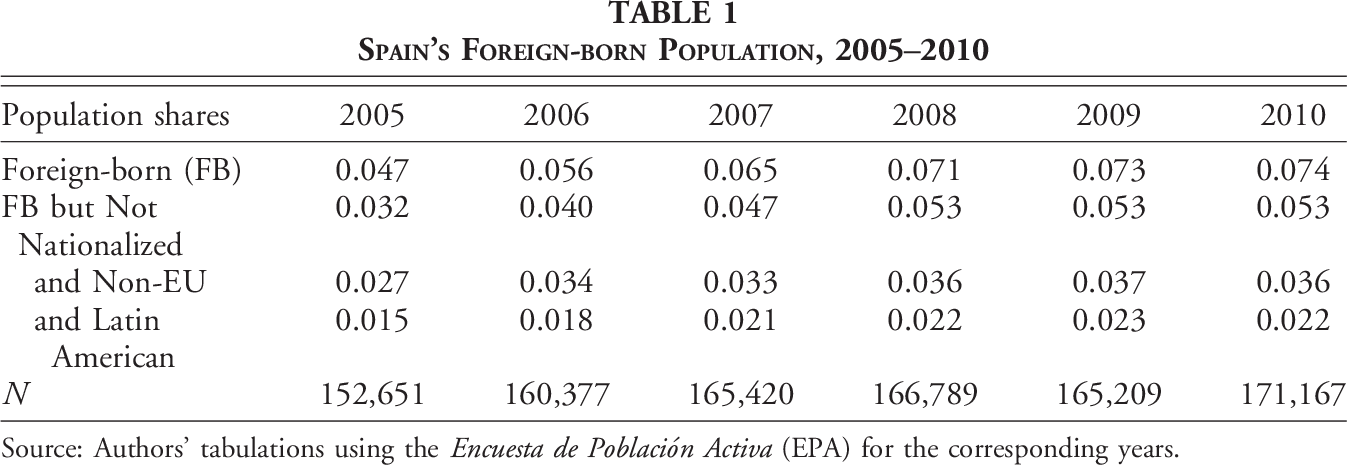
Table 1 highlights the significant growth in the share of foreign-born immigrants in Spain’s labor force survey or Encuesta de Población Activa (EPA). The EPA covers the registered population aged 16 and above. The share of foreign-born individuals rose rapidly from 4.7 percent in 2005 to 7.1 percent in 2008. Thereafter, the growth of the foreign-born population came to almost a standstill, coinciding with the Spanish economic contraction.
Spain’s Foreign-born Population, 2005–2010
Source: Authors’ tabulations using the Encuesta de Población Activa (EPA) for the corresponding years.
In Table 1, we also report on specific groups of foreign-born individuals over the 2005–2010 period. Some immigrants assumed Spanish nationality. Their employment prospects likely differed from those of foreign-born noncitizens, and, understandably, they were not the target of the pay-to-go program. Therefore, in the second row, we focus our attention on the non-naturalized foreign-born as a share of the total population. Subsequently, we further zoom in on foreign-born noncitizens from countries outside the European Union (EU). Unlike EU nationals, this group does not enjoy free labor mobility across the European Union. As such, their employment opportunities in the union were likely more limited than those of EU nationals. Their population share grew from 2.7 percent in 2005 to about 3.6 percent prior to the onset of the recession. As can be inferred from the next row, the vast majority of these foreign-born and non-EU citizens originated from Latin America. This is true despite the fact that many Latin Americans naturalized owing to the ease of assuming Spanish nationality based on ancestry. Nonetheless, the population share of non-naturalized Latin American migrants rose from 1.5 percent in 2005 to roughly 2.2 percent by 2008.
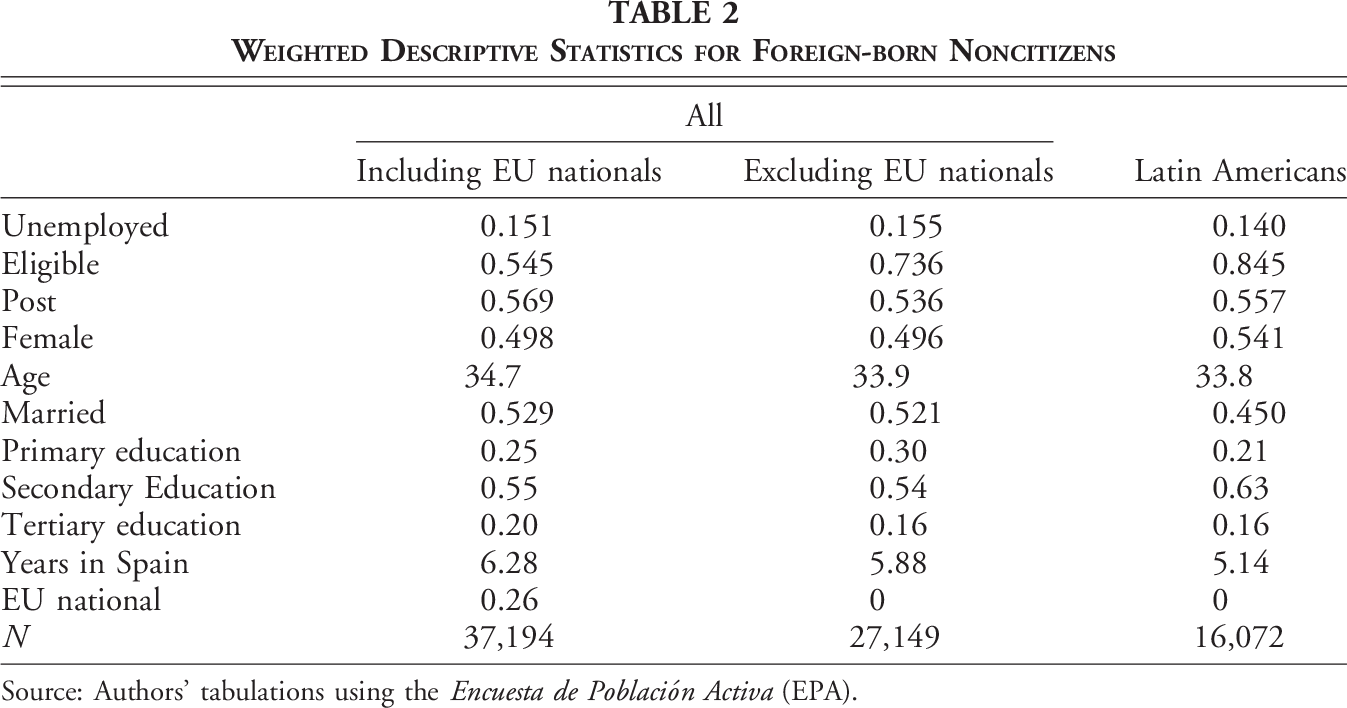
Table 2 provides a glimpse of basic descriptive statistics for all foreign-born noncitizens, non-EU foreign-born non-citizens, and Latin American foreign-born noncitizens in our sample. Over the time span under examination, unemployment rates for migrants in these groups averaged between 14 and 15.5 percent. A five-percentage point higher share of Latin Americans, than of non-citizens from outside the EU, was at work — namely 70 percent versus 65 percent. Of note for the study at hand is the higher eligibility rate among Latin Americans. About 85 percent of Latin Americans were eligible, as opposed to 74 percent of other non-citizens from outside the EU.
Weighted Descriptive Statistics for Foreign-born Noncitizens
Source: Authors’ tabulations using the Encuesta de Población Activa (EPA).
Other demographic differences worth pointing out include the higher share of female migrants among Latin Americans, as well as Latin American’s shorter Spanish residences (averaging five years) relative to those of other noncitizens from outside the European Union, for whom they averaged 6 years in duration. Additionally, a smaller share of Latin Americans had only a primary education when compared to other non-citizen counterparts from outside the European Union (21 percent versus 30 percent). The opposite was true for secondary education (in that case, the respective shares were 63 percent versus 54 percent). However, a similar share (about 16 percent) in both groups of non-EU nationals had some tertiary education.
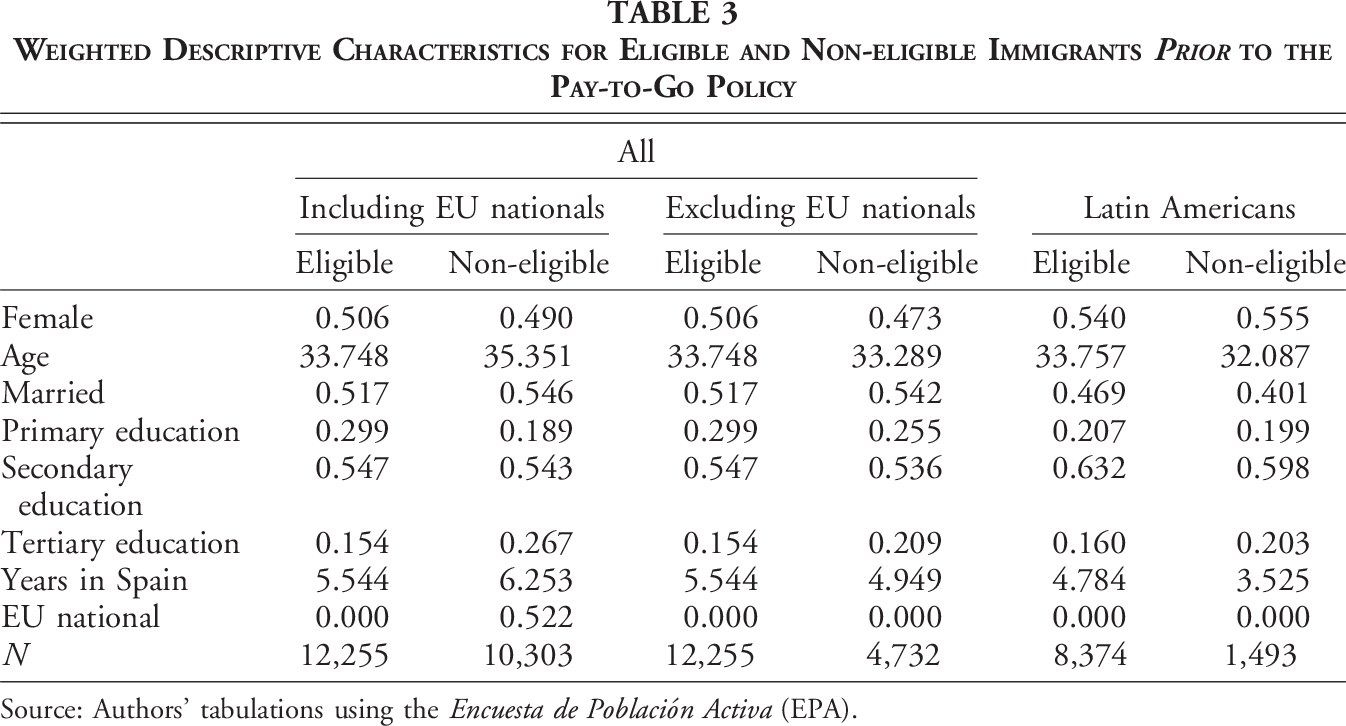
While differences across the various groups of immigrants help explain differential impacts across groups, it is also of interest to explore differences in eligible and non-eligible immigrants within each of the three groups, defined in Table 2, prior to the pay-to-go program. Doing so allows us to decipher the degree to which eligible and non-eligible immigrants within each of the three groups significantly differed from each other prior to the implementation of the policy. The statistics in Table 3 allow us to do so. Overall, such differences are relatively small. The gender breakup of eligible versus non-eligible groups of immigrants in each of the three subcategories fluctuates between one and three percentage points. Age differences do not exceed one year on average. Differences in the time they have resided in Spain are between 0 and 1 year. Perhaps the main differences are in the share married, which fluctuates between three and seven percentage points, and the share with a tertiary education (with differences of five to 10 percentage points) — traits we will also control for in the regression analysis.
Weighted Descriptive Characteristics for Eligible and Non-eligible Immigrants Prior to the Pay-to-Go Policy
Source: Authors’ tabulations using the Encuesta de Población Activa (EPA).
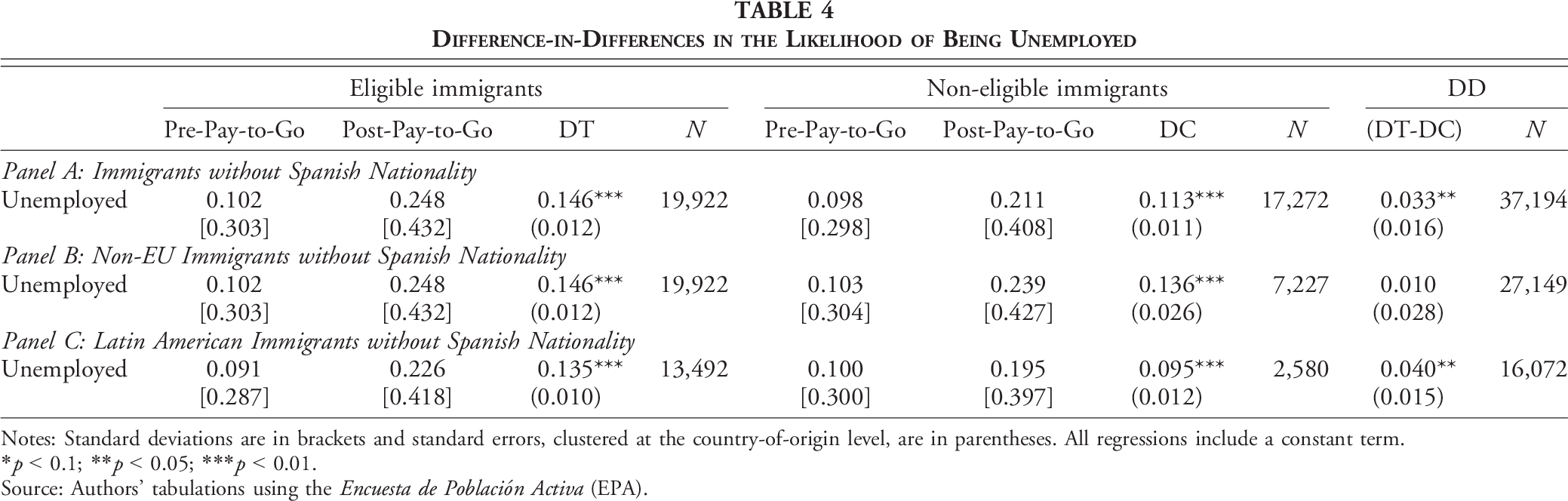
Our main objective is to learn about the extent to which pay-to-go programs are successful in reducing the unemployment propensity of the eligible population, presumably by helping clear the labor market through the quick voluntary repatriation of immigrants who are unemployed, using the recent Spanish experience with this type of program. To that end, we first compute difference-in-differences in the share of those unemployed from eligible, as opposed to individuals from non-eligible, countries following the program implementation, with the period 2005–2008 serving as our pre-program period, and 2009–2010 as the program period. Nationals from eligible countries by virtue of a bilateral social security treaty constitute our treated (T) group, whereas other migrants constitute our control (C) group.
According to the results in Table 4, the unemployment likelihood of eligible immigrants increased about 14 percentage points from before to after the implementation of the pay-to-go program, regardless of our sample definition (see the coefficient estimates under the DT — for difference among the treated — column). This is not surprising, as the program implementation coincided with the onset of the so-called Great Recession. The unemployment propensity also increased for noncitizens who were not eligible (DC column — for difference among the control group). These increases ranged from 9.5 percentage points in the sample restricted to Latin Americans (Panel C) to 13.6 percentage points among the sample restricted to immigrants from non-EU nations (Panel B). The difference-in-differences estimates in column DD suggest that unemployment increased more among the immigrants from eligible countries when we consider all regions of the world and when we restrict our focus to Latin Americans — a perverse outcome. However, these simple difference-in-differences do not account for differences in other characteristics potentially responsible for the observed patterns, such as higher immigration flows during economic upturns and lower immigration flows during downturns. Therefore, in what follows, we address this shortcoming to be able to make more concrete inferences regarding the policy impact.
Difference-in-Differences in the Likelihood of Being Unemployed
Notes: Standard deviations are in brackets and standard errors, clustered at the country-of-origin level, are in parentheses. All regressions include a constant term.
*p < 0.1; **p < 0.05; ***p < 0.01.
Source: Authors’ tabulations using the Encuesta de Población Activa (EPA).
Did the Retorno Voluntario Program Induce the Return of Unemployed Migrants?
While the estimates in Table 4 do not lend support to the notion that the pay-to-go program helped lower the unemployment of eligible immigrants, they fail to control for other factors that could have potentially overridden the impact of the policy, such as the long-lasting impact of the economic downturn and the potentially different recovery patterns of Spanish provinces. Therefore, in Tables 5 and 6, we explore more thoroughly the effect that the pay-to-go policy might have had on the unemployment likelihood of eligible immigrants. To that end, we estimate equation (2) using the three subgroups of foreign-born noncitizens delineated in Tables 2 and 3 — namely all foreign-born noncitizens, non-EU foreign-born noncitizens, and Latin American foreign-born noncitizens. For each group, we estimate a number of model specifications that progressively add controls to assess any meaningful changes in the impact of the policy on eligible immigrants relative to their non-eligible counterparts. 13
Likelihood of Being Unemployed of Immigrants without Spanish Nationality
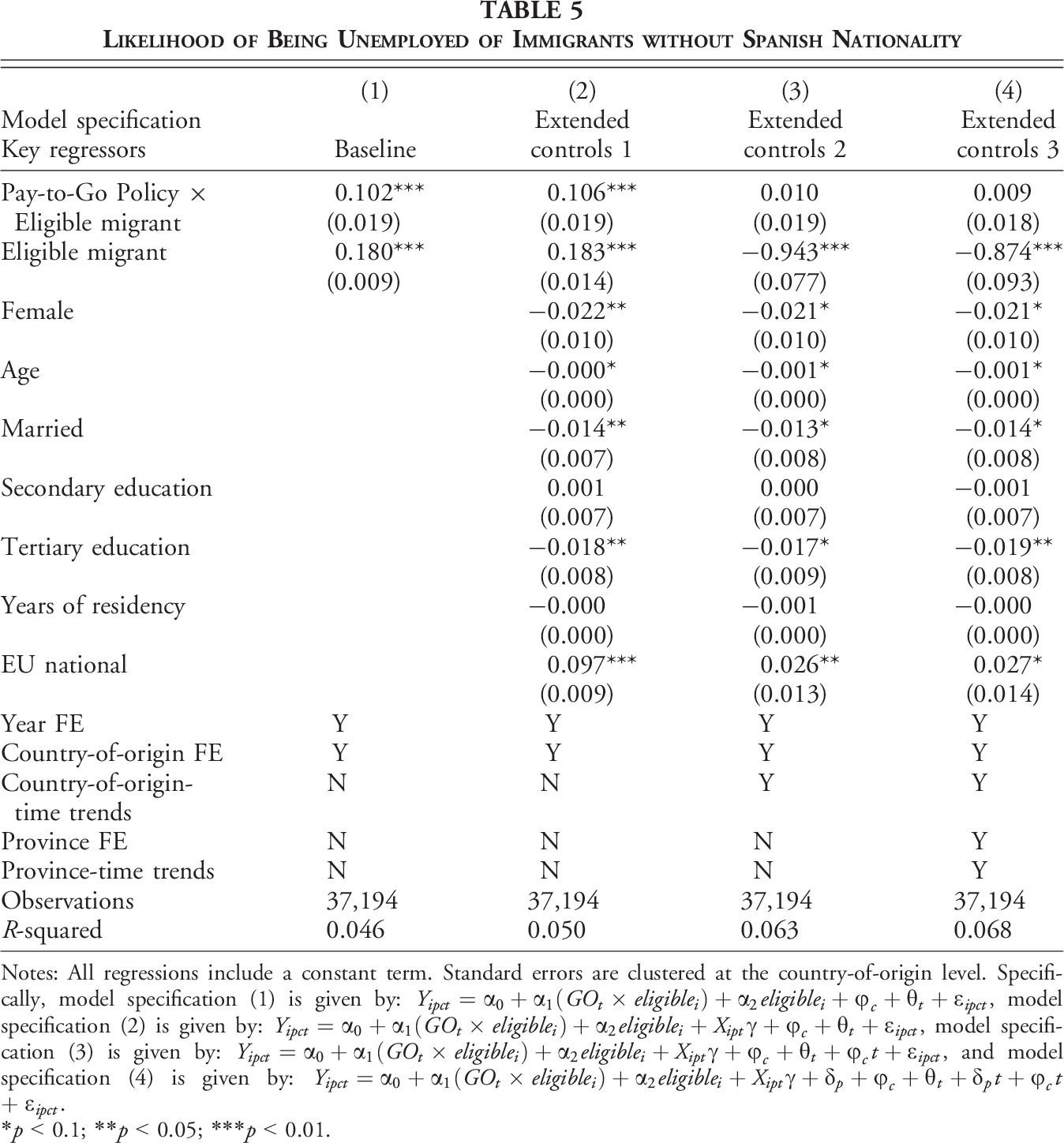
Notes: All regressions include a constant term. Standard errors are clustered at the country-of-origin level. Specifically, model specification (1) is given by:
*p < 0.1; **p < 0.05; ***p < 0.01.
Likelihood of Being Unemployed of Various Non-EU Citizen Groups
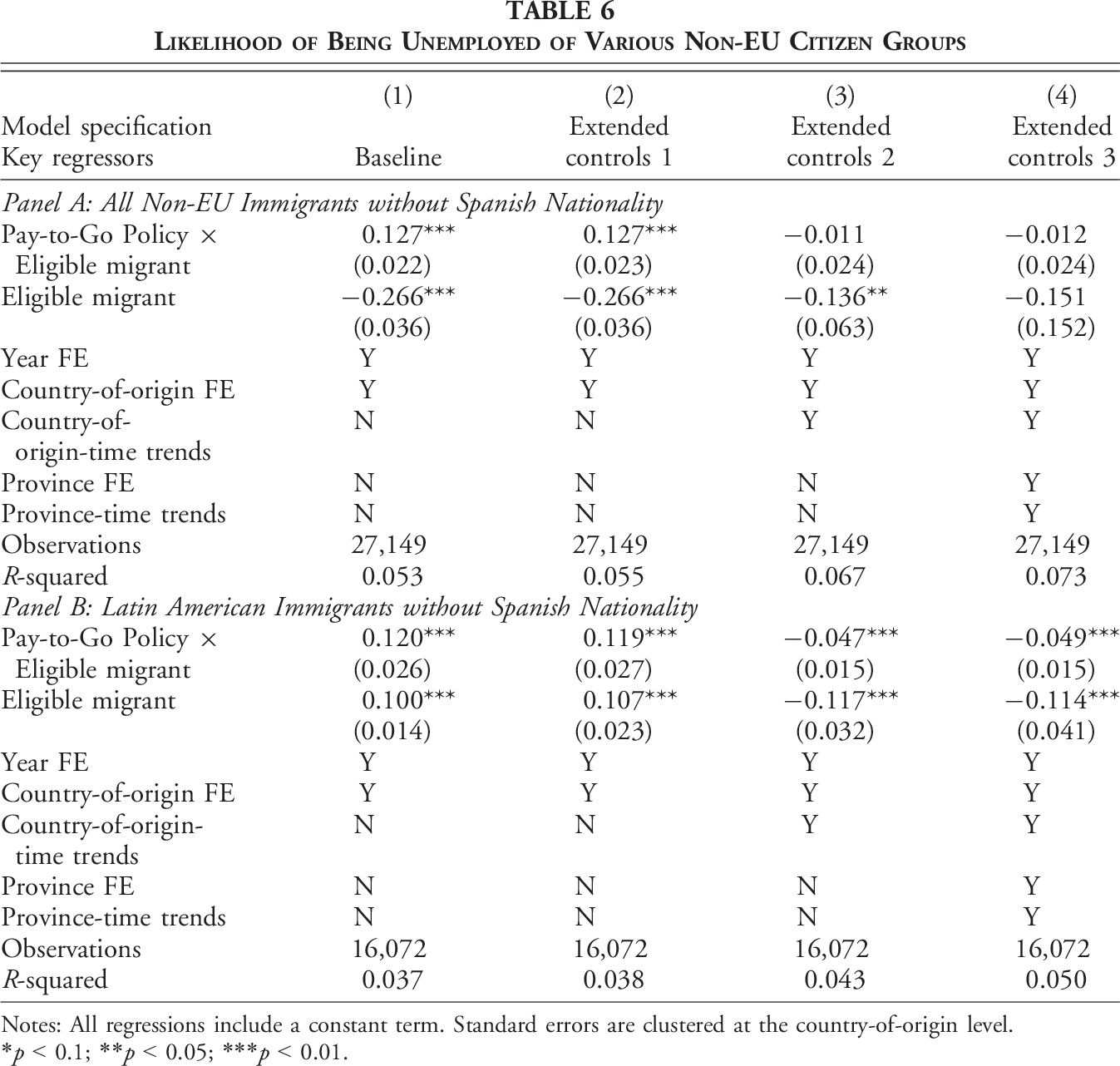
Notes: All regressions include a constant term. Standard errors are clustered at the country-of-origin level.
*p < 0.1; **p < 0.05; ***p < 0.01.
Turning first to Table 5, and the most complete specification, it becomes apparent that the results are not consistent with the notion that the policy reduced the unemployment propensity of eligible immigrants. But focusing on all immigrants is not appropriate. About 25 percent of the full sample of immigrants originate from EU nations. Yet, EU migrants are unique because of their free labor mobility throughout the European Union, evident in their labor market success relative to other immigrants. 14 If EU nationals become unemployed in Spain, there are no barriers preventing them from migrating to another EU nation where jobs may be more plentiful, thus lowering the unemployment propensity of non-eligible immigrants. In essence, EU nationals differ in their opportunities and should not be used in this comparison. 15
Overall, the estimates in Table 5 lead us to conclude that the pay-to-go policy did not significantly help lower eligible immigrants’ unemployment propensity. Yet, modeling the unemployment likelihood of EU nationals alongside that of other immigrants from non-EU member countries is not appropriate given the labor mobility that EU nationals enjoy. Hence, in the upper panel of Table 6, we repeat the analysis focusing, exclusively, on foreign-born noncitizens from non-EU member countries. Nonetheless, focusing on the most complete model specification, we continue to find no impact of the program on the likelihood of being unemployed.
Because many of the immigrant arrivals in the late 1990s and early 2000s were from Latin America, 16 we turn our focus to that subsample of foreign-born noncitizens. The main results are displayed on the bottom half of Table 6. It is among this group that we find evidence of the pay-to-go policy’s effectiveness in lowering migrants’ unemployment likelihood. In particular, the unemployment propensity of eligible immigrants (when we restrict our sample to the Latin American region) dropped by 4.9 percentage points (or 35 percent) following the implementation of the pay-to-go policy relative to the unemployment likelihood of non-eligible immigrants from the region. 17 In addition, the estimates in Table 6 uncover the significantly lower likelihood of eligible, as opposed to non-eligible, Latin American migrants of being unemployed. This finding, which is also observed for the other foreign-born noncitizen groups in Table 5 and Panel A of Table 6, might be reflective of labor advantages enjoyed by immigrants from eligible nations due to tax benefits or social security coordination programs that facilitate the employment of those countries’ nationals.
In sum, the results in Tables 5 and 6 inform about the impact of the pay-to-go policy on eligible migrants’ unemployment propensity. The lack of a significant impact across most foreign-born noncitizens supports the Retorno Voluntario’s reputation of being ineffective. Yet, when we restrict our attention to a more homogenous group of Latin American immigrants, a group exhibiting similar employment opportunities (or impediments) in other EU nations and, in many instances, language and cultural similarities, this group appears to have responded to the incentive in a statistically and economically significant manner. 18
Identification Checks
Support for the Parallel Trends Assumption
One of the main threats to our empirical approach and the findings for Latin American immigrants, in particular, is whether there existed differential trends in the propensity of being unemployed among Latin American eligible immigrants relative to their Latin American non-eligible counterparts, prior to the enactment of the policy in late 2008. To investigate whether this was the case, we perform a number of checks. First, we construct placebo indicators for the three years prior to the enactment of the pay-to-go policy (i.e., 2008, 2007, and 2006, leaving 2005 as the reference year). 19 We interact each of these placebo policy dummies with our eligibility indicator. Then, we include the placebo policy dummies and their interaction terms, along with the true policy indicator and its interaction term with the eligibility dummy, in equation (2). If the impact captured in Table 6 was pre-existing, we would expect the placebo interaction terms to have a statistically significant effect in the same direction as the pay-to-go policy impact reported in Table 6. The results of this test are displayed in Table 7, Panel A. The placebo interaction terms are not statistically different from zero, thus signaling that the policy impact in Table 6 was not pre-existing. Furthermore, we continue to find that the policy lowered the unemployment likelihood of eligible Latin American immigrants by a statistically significant amount, despite the inclusion of placebo indicators leading to the true policy.
Testing for Pre-existing Policy Impacts (Dependent Variable: Likelihood of Being Unemployed)
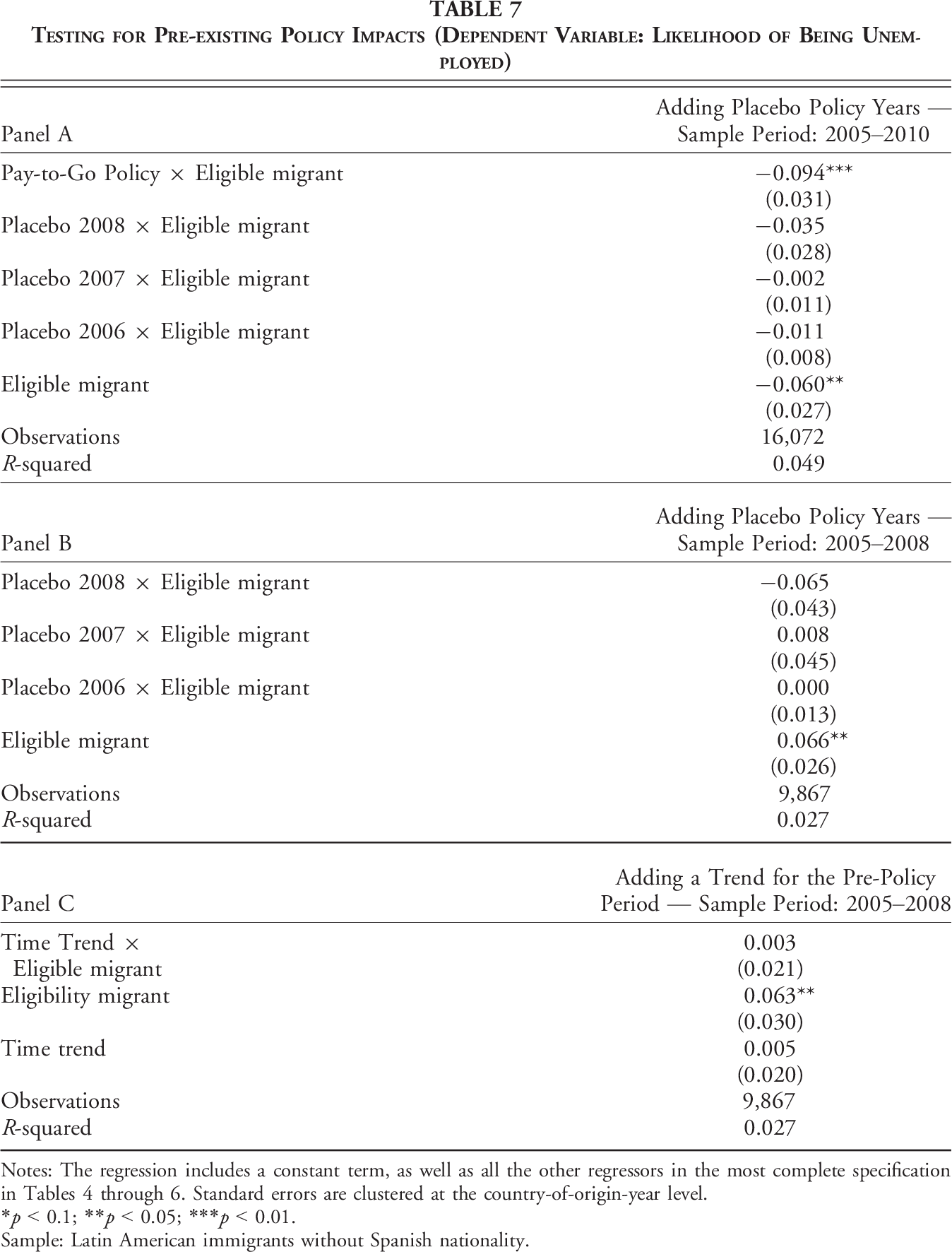
Notes: The regression includes a constant term, as well as all the other regressors in the most complete specification in Tables 4 through 6. Standard errors are clustered at the country-of-origin-year level.
*p < 0.1; **p < 0.05; ***p < 0.01.
Sample: Latin American immigrants without Spanish nationality.
To offer further reassurance that the results are not driven by a pre-trend, we restrict our sample to the pre-policy period — namely 2005 through 2008, and re-estimate the previous model. In this case, we exclude the true policy indicator and incorporate the placebo indicators and their interaction terms with our eligibility dummy. The results of this falsification test are documented in Table 7, Panel B. As in Panel A, the placebo interaction terms are not statistically different from zero, confirming that the policy impact in Table 6 was not pre-existing.
To conclude, we create a time trend for the pre-policy period under consideration and interact it with the eligibility dummy. The interaction term, along with the eligibility dummy, is then included in the model. Panel C in Table 7 displays the results from this exercise. Consistent with the parallel trends assumption, we find no evidence of a pre-existing trend driving our results. The coefficient on the interaction term is not statistically different from zero.
Endogeneity of Country Eligibility
Another challenge to the proper identification of our policy impact refers to the potential endogeneity of eligibility at the country-of-origin level with respect to the incidence of unemployment among immigrants. Endogeneity can stem from the non-random designation of which nationals are eligible to participate in the program. To be eligible, an immigrant had to be from a country with a social security treaty with Spain. These treaties tend to be negotiated with countries with large immigrant populations in Spain or countries with a large number of Spanish nationals. After all, these treaties are designed to help non-nationals or dual national individuals navigate credits/benefits with two distinct social security systems. 20 In other circumstances, these treaties help individuals avoid double taxation. 21 While we might be concerned about the potential endogeneity between country eligibility and the unemployment rates of nationals from those countries in Spain, this is unlikely to be the case. For the most part, these treaties were negotiated well before the downturn of the Spanish economy and the design and implementation of the Retorno Voluntario program. Table A2 in Appendix provides the effective starting date of the treaties currently in place — the earliest one negotiated in 1959.
Nonetheless, to address the concern that the treaties were negotiated with countries whose nationals experience higher or lower unemployment rates, we follow La Ferrara, Chong, and Duryea (2012) and aggregate the data for the period preceding the policy enactment at the country-of-origin level. We then estimate the following model:

Table 8 displays the results from this exercise. We estimate two different model specifications. 22 Regardless of the model specification used, we find no evidence of a significant correlation between the unemployment rate of individuals from a participating country prior to the enactment of the pay-to-go policy and the likelihood of being from a participating nation. Therefore, while not arbitrary, the selection of some nations as eligible to participate in the pay-to-go program does not appear to have been correlated with the unemployment rate of their nationals in Spain prior to the adoption of the policy.
Assessing the Endogeneity of Country Eligibility (Dependent Variable: Likelihood of Being an Eligible Country)
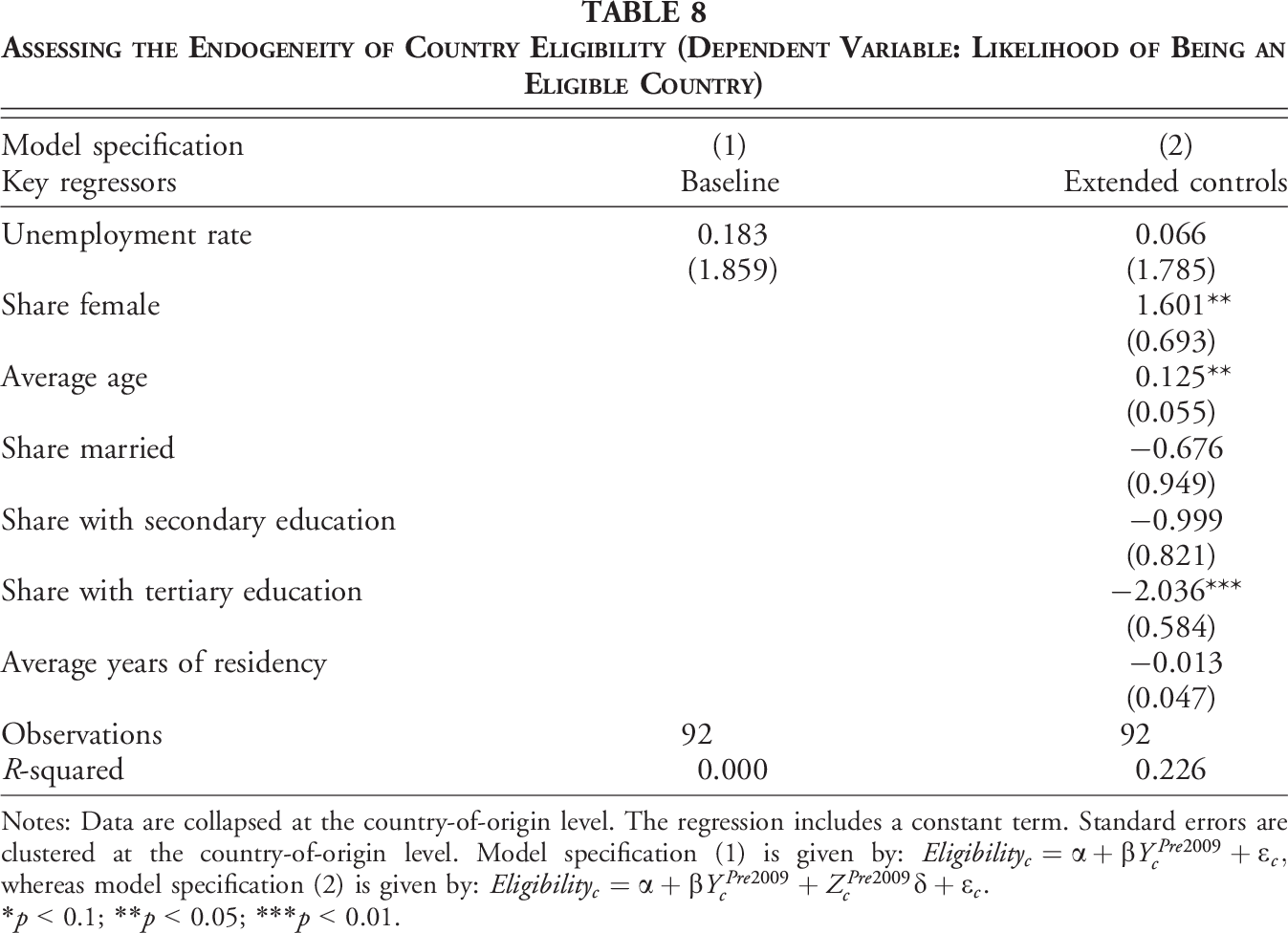
Notes: Data are collapsed at the country-of-origin level. The regression includes a constant term. Standard errors are clustered at the country-of-origin level. Model specification (1) is given by:
*p < 0.1; **p < 0.05; ***p < 0.01.
Heterogeneous Impacts
Our results, thus far, suggest that Latin Americans responded to the pay-to-go incentive. To further understand such impacts, we explore heterogeneous responses to the policy incentive along a number of personal traits included in our regressions, such as age, gender, and time of residency in Spain. Table 9 displays our findings.
Heterogeneous Policy Impacts (Dependent Variable: Likelihood of Being Unemployed)
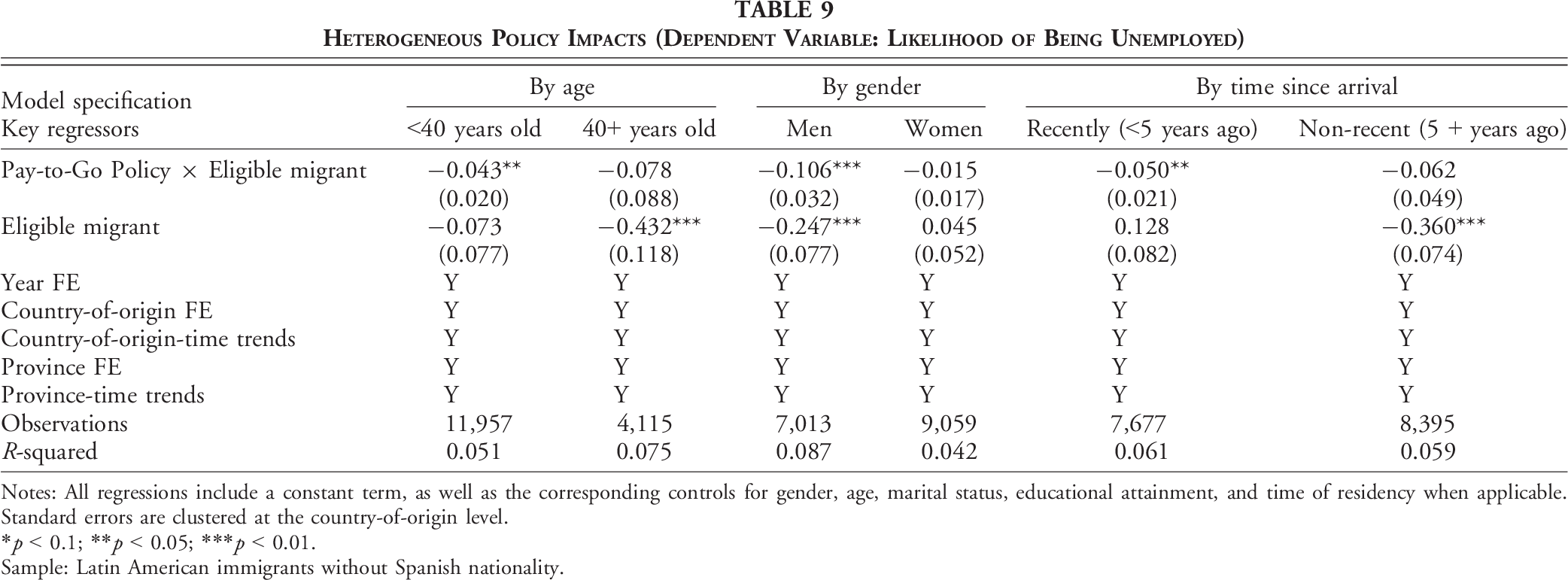
Notes: All regressions include a constant term, as well as the corresponding controls for gender, age, marital status, educational attainment, and time of residency when applicable. Standard errors are clustered at the country-of-origin level.
*p < 0.1; **p < 0.05; ***p < 0.01.
Sample: Latin American immigrants without Spanish nationality.
As we might expect, the program proved particularly effective among younger workers, for whom their unemployment likelihood dropped by 4.3 percentage points over the period under consideration. Younger workers may have an easier time adjusting to both the host and home labor markets. They might be more flexible and willing to “work their way up” than older workers might upon their return home. In addition, they may have contracted fewer family responsibilities in Spain than their older counterparts, making it easier for them to go back home.
The estimates in Table 9 also show how the program proved particularly effective among men, but not women. This is not surprising. After all, men are less likely to play the role of main childcare providers. As such, they are more likely to enjoy greater mobility and, for the purpose of our analysis, are at greater liberty to respond to the incentives offered by the program. Hence, their unemployment propensity is significantly lower than that of their non-eligible male counterparts.
Finally, we also find evidence of a heterogeneous response to the policy according to migrants’ length of residency in Spain. The program appeared to have been particularly effective among migrants who arrived recently — less than five years ago. The policy helped lower their unemployment propensity by 4.9 percentage points. Perhaps, the more recent the arrival, the easier it is to go home. Once more, this is understandable. Migrants who migrated recently are likely to have developed fewer attachments in Spain, making it easier for them to leave. In addition, they might have been in a better position to return and exploit their still relatively fresh labor market contacts back home.
Overall, the results in Table 9 provide support for the notion that unemployed Latin American immigrants are responding to the program incentives. Groups for whom the return home might be easier, less costly, or less risky, as in the case of younger, male, and recently arrived immigrants, are more likely to display a lower unemployment likelihood.
Summary and Discussion
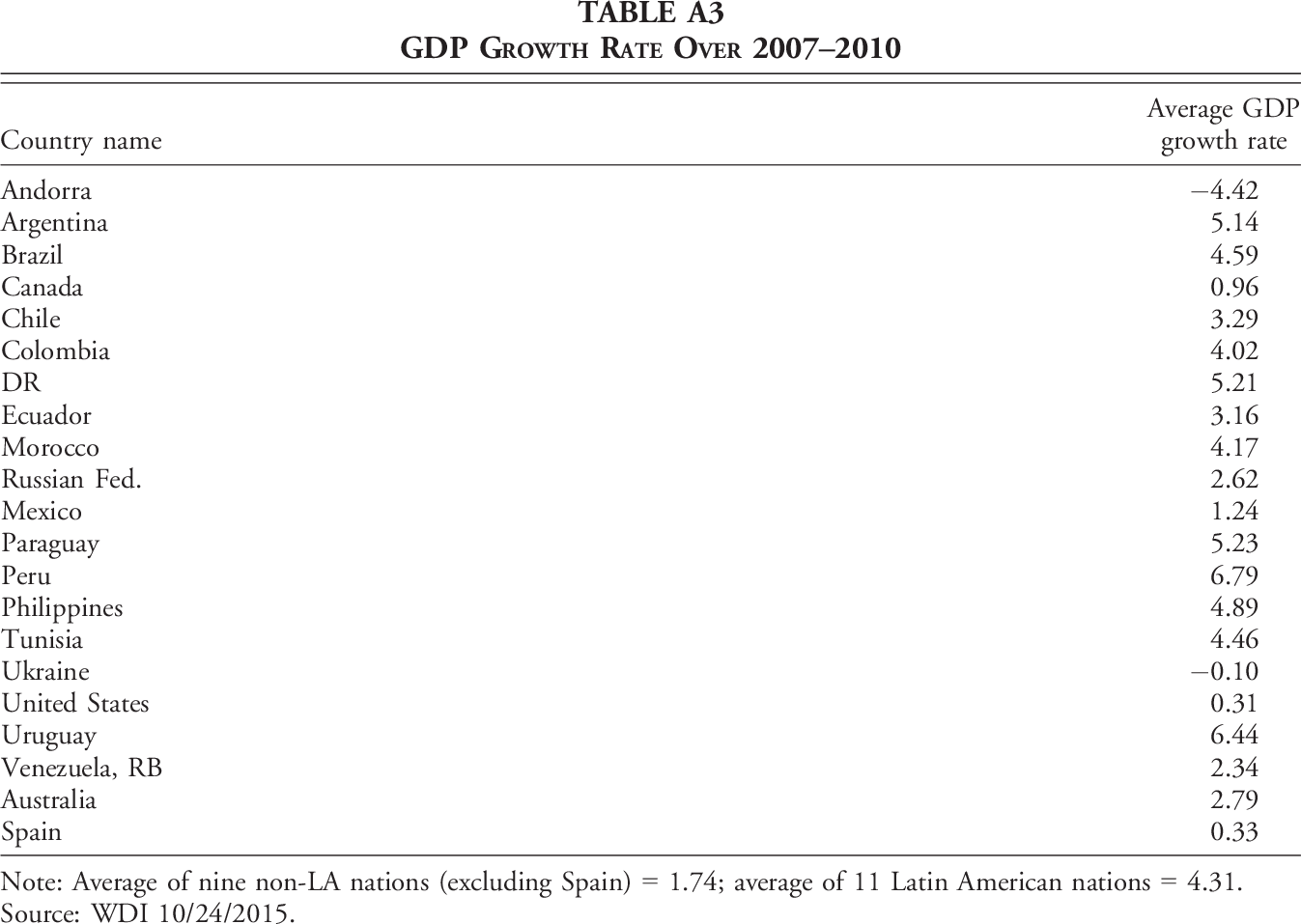
In this study, we have examined the effectiveness of the Spanish Retorno Voluntario program in lowering the unemployment likelihood of eligible migrants, possibly by inducing their return home. On the surface, the Spanish pay-to-go policy does not appear to have achieved this aim, except among Latin Americans, who enjoyed statistically and economically significant reductions in their unemployment likelihood following program implementation. We can only hypothesize as to why we observe this difference across geography. Perhaps, for many of the non-Latin American nationalities, conditions at home were not that much better than in Spain. As such, the incentive provided by the program to return home might not have been enough. Table A3 in Appendix shows average annual growth rates (for 2007–2010 obtained from World Development Indicators) for various countries represented in our data. Average GDP growth for the nine participating countries outside Latin America was 1.74 percent over the 2007–2010 period; while better than Spain’s average growth rate over that same time period (a third of one percent), it was still fairly low. In contrast, Latin American economies were growing relatively rapidly at the time of the Spanish recession and beyond. Unlike other areas of the world, the global recession had minimal negative impacts on the region, which prospered fueled by the insatiable demand for commodities on the part of the then, briskly growing, Chinese economy. Over the 2007–2010 period, average GDP growth rate for the 11 Latin American nations participating in the Retorno Voluntario program was 4.31 percent. Strong economic conditions at home likely provided an added incentive for Latin Americans to return relative to immigrants from Africa, Asia, and non-EU Europe.
A second hypothesis explaining the differential impacts of the program across the various foreign-born noncitizen groups rests on the ability to transfer any acquired human capital back home. Because of the common language and earlier colonial ties, it is conceivable that Latin Americans residing in Spain acquired human capital that was valued and more easily transferred home relative to nationals from other regions of the world. Among Latin Americans, returning home and exploiting newly acquired skills might have been a good alternative to remaining unemployed in Spain. In contrast, individuals from other areas of the world might not have benefited in their home countries, to the same degree, from Spanish-acquired human capital in their home countries. This hypothesis is supported by studies that find that Latin Americans are more likely to engage in return migration from Spain (independent of the business cycle), when compared with African and Asian immigrants (Arce and Mahia 2012).
Related to this is Latin Americans’ proficiency in the Spanish language. This proficiency may have steered Latin Americans into jobs where they acquired higher skills or human capital, for example, working as a bank teller rather than as an agricultural worker or nanny. For these individuals, returning home might have proven more lucrative than for individuals from other areas of the world who did not acquire those higher-ordered skills.
Finally, the structure of Latin American economies may have also played a role in the differential response to the incentive. Latin America’s large informal sectors might have made the lump sum payments provided by the program particularly valuable given the low capital entry barriers in the informal sector. While unemployment compensation payouts might seem to be relatively modest for starting a formal sector business, they may have provided enough start-up funds in the case of informal businesses, such as in operating a taxi, starting a small food stand, or purchasing the capital to run a home-based hair salon.
Future research identifying the factors that make the policy effective among certain immigrant subgroups might shed some light on how to design pay-to-go programs that serve as an alternative non-coercive tool to address unemployment pressures during stressful economic times.
Footnotes
Appendix
GDP Growth Rate Over 2007–2010
| Country name | Average GDP growth rate |
|---|---|
| Andorra | −4.42 |
| Argentina | 5.14 |
| Brazil | 4.59 |
| Canada | 0.96 |
| Chile | 3.29 |
| Colombia | 4.02 |
| DR | 5.21 |
| Ecuador | 3.16 |
| Morocco | 4.17 |
| Russian Fed. | 2.62 |
| Mexico | 1.24 |
| Paraguay | 5.23 |
| Peru | 6.79 |
| Philippines | 4.89 |
| Tunisia | 4.46 |
| Ukraine | −0.10 |
| United States | 0.31 |
| Uruguay | 6.44 |
| Venezuela, RB | 2.34 |
| Australia | 2.79 |
| Spain | 0.33 |
Note: Average of nine non-LA nations (excluding Spain) = 1.74; average of 11 Latin American nations = 4.31.
Source: WDI 10/24/2015.