







Abstract
Immigration is among the most vividly discussed topics in Europe’s national parliaments in recent years, often with a particular emphasis on the inflow of Muslims. This article examines the link between articulations of national political parties (political elite discourses) and natives’ attitudes toward immigrants in Europe. It provides a nuanced view of this relationship by (i) distinguishing more (inclusionary) from less (exclusionary) immigration-friendly political elites and (ii) isolating natives’ openness toward two specific groups: Muslim immigrants and ethnically similar immigrants. Combining the European Social Survey with party manifesto data and other sources, the analysis reveals that political elite discourses perform better in explaining natives’ attitudes compared to national demographic or economic aspects. Native Europeans’ attitudes toward Muslim immigrants are more hostile in countries where political elites are more exclusionary and more welcoming where political elites are more inclusionary. In contrast, Europeans’ views on ethnically similar immigrants seem largely unaffected by exclusionary political elites. These findings suggest that political elites can play an important role in fostering or impeding immigrant integration by shaping public opinion, particularly toward more marginalized immigrant groups.
Introduction
In recent years, immigration has become a highly politicized issue in Europe (Grande, Schwarzbözl, and Fatke 2018), increasing the polarization of European societies (Semyonov, Raijman, and Gorodzeisky 2006; Bohman and Hjerm 2016). In many countries, anti-immigration rhetoric among political elites is prevalent and not limited to far-right parties (van Spanje 2010; Alonso and da Fonseca 2012). Previous research suggests that such elite rhetoric is not without consequences: When political parties frequently articulate anti-immigration positions, Europeans are more negative toward immigration in general (Hjerm 2007; Bohman 2011), more exclusionary regarding national identities (Helbling, Reeskens, and Wright 2016), and less supportive of economic redistribution (Schmidt and Spies 2014). While these studies shed light on important aspects of public opinion, they do not address the fact that attitudes toward immigrants are generally nuanced, as people tend to perceive different kinds of immigrants as differently threatening (Czymara and Schmidt-Catran 2017; Meuleman et al. 2018; Gorodzeisky and Semyonov 2019b). Equally important, the role of political elites in shaping attitudes toward specific immigrant groups is largely unexplored. In this article, I examine how Europeans’ openness toward Muslim and ethnically similar immigrants varies across countries and how these views correspond with the way national political elites debate immigration-related issues, which I refer to as political elite discourses.
Muslims compose an increasing share of Europe’s population (Pew Research Center 2017), and political elites throughout Europe vividly argue over the inflow of people from Muslim countries (e.g., Kaminski 2015; Peachey 2018). At the same time, negative views of Muslims are relatively widespread in Europe (Strabac and Listhaug 2008), while individuals who are ethnically similar to the respective host society are usually more welcome (Gorodzeisky and Semyonov 2019b). This article shows that political elite discourses can, to some degree, account for cross-national differences in attitudes toward these two groups of immigrants. Building on this finding, I argue that political elite discourses are a theoretically and empirically important aspect of the canonical group-threat paradigm, albeit one that has received only limited attention in comparative research so far.
This article’s structure is the following. I first discuss how political elites can shape natives’ views on immigrant groups and why Muslim immigration is particularly relevant in the current European context. Subsequently, I introduce the data as well as the statistical model underlying the empirical part of this study. In the results section, I present a set of random effects models showing that native Europeans reject Muslim, but not ethnically similar, immigrants more often in countries where political elites are more exclusionary. Where political elites are more inclusionary, natives are more welcoming toward both groups of immigrants. Contrary to theoretical expectations, interactions between political elite discourses and, first, political orientation and, second, political interest are not statistically significant once random slopes are modeled. Next, several robustness tests ensure that these findings are stable to various modeling strategies and not driven by outlier countries. In the final section, I summarize the key results and address potential limitations of this study. To end, I discuss the social and political implications of these findings.
Political Elite Discourses, Threat Perceptions, and Attitudes toward Immigrants
Europeans’ openness toward newcomers varies across countries (Semyonov, Raijman, and Gorodzeisky 2006; Hjerm 2007; Sides and Citrin 2007), especially regarding Muslim immigrants (Savelkoul et al. 2012). A prominent explanation for cross-national differences in anti-immigrant resentments is the group-threat paradigm, according to which such attitudes stem from perceived threats that immigrants pose to a society’s majority (Blumer 1958). One aspect related to such threats is group size: (Mis)perceiving a large share of immigrants in a country is a core determinant of restrictive attitudes — notably independent of whether these perceptions correspond to actual circumstances or not (Hjerm 2007; Sides and Citrin 2007; Gorodzeisky and Semyonov 2019a). However, natives’ estimates of the national number of immigrants are, in many cases, largely disconnected from reality in both Europe and the United States (Sides and Citrin 2007; Wong 2007; Herda 2010). Empirically, a country’s actual share of immigrants is often a weak predictor of immigration-related attitudes (Hainmueller and Hopkins 2014, 231). Variation in anti-immigrant sentiments across European countries, thus, seems to be rooted in more than the actual presence of immigrants. As this article shows, the way national political elites debate immigration is a factor that can help explain such cross-national differences. In his classic paper on intergroup relations, Herbert Blumer argued: The collective image of the abstract group grows up not by generalizing from experiences gained in close, first-hand contacts but through the transcending characterizations that are made of the group as an entity. Thus, one must seek the central stream of definition in those areas where the dominant group as such is characterizing the subordinate group as such. This occurs in the “public arena” wherein the spokesmen appear as representatives and agents of the dominant group. (Blumer 1958, 6; emphases added)
Political elites are such representatives. They shape national discourses by providing information related to certain immigrant groups and articulating specific arguments about these groups (Flores 2018). In their review of the literature on public attitudes toward immigration, Hainmueller and Hopkins (2014, 244) conclude that “Information environments and elite rhetoric play central theoretical roles in explanations of immigration attitudes.” Political elites inform the general public about social and political circumstances, interpreting and contextualizing such information and, thus, affecting people’s understanding of reality (Careja 2015). In related fashion, regular or recent exposure to certain information can make positive or negative dimensions of complex issues more accessible in peoples’ memories (Chong and Druckman 2007). By framing immigrant groups in a certain way, political elites can alter natives’ evaluation of these groups (Bohman 2011). Research from the United States indicates that the way political elites frame immigrants (Flores 2018) or immigration policies (Merolla, Ramakrishnan, and Haynes 2013) influences individual attitudes toward the matter, which, in turn, can affect voting outcomes (Abrajano and Hajnal 2017). Moreover, evidence from Germany shows that natives’ attitudes toward immigrants reflect arguments put forward in national political discussions (Czymara and Schmidt-Catran 2017).
My interest in this article is in national political elite discourses and their relationship with natives’ views on immigrants in Europe. I define political elite discourses as the sum of political elites’ frames, arguments, and narratives. Discourses are an important part of a country’s political climate and have a contextual character, in the sense that they are a feature of a country at a certain time point. Modelling discourses as a contextual influence implies that, first, they are not limited to single frames (cf. Merolla, Ramakrishnan, and Haynes 2013; Czymara and Schmidt-Catran 2017; Flores 2018) and that, second, they relate to the general public beyond supporters of particular parties (cf. Jolly and DiGiusto 2014; Vrânceanu and Lachat 2018). Such macro-level discourses theoretically concern all residents, although not necessarily to the same degree. People can be directly exposed to political information, for example, through mass media consumption (Czymara and Dochow 2018; van Klingeren et al. 2015). Moreover, exposure to such information can be indirect through interpersonal communication (Kalogeropoulos and Hopmann 2018), social media (Bail et al. 2018), or other sources. Previous research has demonstrated that political elite articulations directly (Hjerm 2007; Bohman 2011) or indirectly (Careja 2015) correlate with Europeans’ broader attitudes related to immigration. However, the impact of political elite discourses on the immigrant preferences of the autochthonous population is largely unexplored. Since prejudice is context specific (Meuleman et al. 2018), the effect of discourses on attitudes of those belonging to a society’s ethnic majority should depend on the evaluated group of immigrants. Following Blumer, the collective image that is the foundation of anti-immigrant resentments should be specific to the subordinate group characterized by public speakers.
Political Discourses on Muslim Immigration in Europe
Muslim immigration has played a prominent role in political debates throughout Europe in recent years (Aisch, Pearce, and Rousseau 2017). Existing research points to lower levels of acceptance of Muslim immigrants compared to other migrant groups (Strabac and Listhaug 2008; Bansak, Hainmueller, and Hangartner 2016; Czymara and Schmidt-Catran 2016). This difference can be explained by a combination of developments and events. One factor concerns demographic shifts caused by the increasing migration of people from Islamic countries to several European societies (Pew Research Center 2017). For example, about half the 1.3 million persons that applied for asylum in the European Union (EU) in 2015 originated from Syria, Afghanistan, and Iraq (Connor 2016), all of which are Muslim-majority countries. As discussed above, the group-threat paradigm predicts that an increase in size of an immigrant group leads to higher levels of rejection among natives (e.g., Semyonov, Raijman, and Gorodzeisky 2006). Moreover, many Europeans consider (some) Muslims as threatening liberal and secular values (van der Noll 2010; Helbling 2014; Helbling and Traunmüller 2018; see also Koopmans 2015). Several Islamist terror attacks in Europe have further sparked political debates, with public speakers sometimes directly connecting Muslim immigration to terrorism (e.g., Kaminski 2015; Waterfield 2015). Notably, even in some European countries with a very small Muslim population, such as Hungary (see below), political elites regularly articulate anti-Muslim positions (e.g., Peachey 2018).
While political debates on immigration might not revolve around Muslim immigration alone, exclusionary arguments in general imply a reinforcement of ethnic boundaries (Bohman 2011) and should mainly concern those immigrants considered different from one’s own culture. Research has shown that many Europeans perceive Muslims in this way (van der Noll 2010; Helbling 2014). A political elite discourse that is generally more exclusionary should, thus, lead to more dismissive attitudes toward Muslims in particular. For these reasons, I hypothesize that an exclusionary politica l elite d iscourse leads to higher levels of rejection of Muslim immigrants (Hypothesis 1a). In contrast, immigrants who are ethnically similar to a country’s majority are usually also seen to share the country’s culture and, thus, to pose less threat to national identity (Gorodzeisky and Semyonov 2019b). Hence, I hypothesize that the impact of an exclusionary political elite discourse and attitudes toward ethnically similar immigrants is negligible (Hypothesis 1b).
Some political elites also show support for Muslims, such as Germany’s chancellor, Angela Merkel, who stated that “Islam belongs to Germany” in early 2015 (Rinke 2015). While scholars tend to focus on the emergence of anti-immigration attitudes, from a theoretical viewpoint, it is just as plausible that positive political elite rhetoric leads to more acceptance of immigrants among natives. Inclusionary arguments mitigate ethnic boundaries by emphasizing similarities (Bohman 2011), which should lead to more openness toward newcomers. Therefore, negative attitudes should be scarcer in political environments characterized by a positive, open political elite discourse. Ethnic boundaries can most strongly be mitigated for immigrant groups that are otherwise considered different, which, as argued above, corresponds more to Muslim immigrants in a European context (van der Noll 2010; Helbling 2014). Thus, I hypothesize that, similar to exclusionary discourse but in opposite direction, an inclusionary political elite discourse leads to more positive views of Muslim immigrants but does not alter attitudes toward ethnically similar immigrants (Hypothesis 2a). On the other hand, inclusionary arguments tend to have a universal scope as they are essentially about the equality of all people (Davidov et al. 2014). Schwartz (2007, 711) argues that “where moral inclusiveness is high, people understand universalism…as applying to all members of society.” If this reasoning holds, the mechanisms underlying the effects of exclusionary and inclusionary discourses differ, leading to the competing hypothesis that an inclusionary political elite discourse leads to welcoming attitudes toward the immigration of both Muslim and ethnically similar people (Hypothesis 2b).
It should be noted that even in countries that are not majority Muslim, Muslims and ethnically similar people are not two poles of one dimension since ethnicity and religiosity are not identical concepts. However, religion is a central aspect of many ethnic identifications, and for this reason, some scholars treat religiosity and ethnicity as functionally equivalent (see Brubaker 2013, 3–4). Tibi (2010, 128), for example, argues that, although Islam is not an ethnic identity, European Muslims “invent an ‘Islamic ethnicity’. In their interaction with Europeans under diasporic conditions their belonging to the umma becomes an ethnic one.” On the other hand, Helbling and Traunmüller (2018) show that it is not ethnic discrimination but considerations of religious fundamentalism that drive many Europeans’ evaluation of Muslims. Yet the sources of Europeans’ hostility toward Muslim immigrants are still largely unexplored from a comparative perspective. I examine political elites as drivers of attitudes toward Muslim immigrants and toward ethnically similar immigrants. In particular, I will show how attitudes toward both immigrant groups differ, depending on the discursive political context.
The Moderating Role of Individual Openness to Political Messages
Modelling political elite discourses as a country characteristic does not necessarily mean that such discourses affect all natives in a country equally. Natives might be more likely to incorporate political information that is congruent with their existing orientations into their own views (Careja 2015; Bail et al. 2018). Since the political right in Europe usually favors a more restrictive, and the political left a more liberal, immigration policy (de Vries, Hakhverdian, and Lancee 2013), the link between an exclusionary (inclusionary) political elite discourse and attitudes should be stronger for those belonging to the political right (left) (Hypothesis 3). Moreover, individuals who are more interested in politics might be more likely to encounter the arguments political elites put forward in their debates. If this assumption is correct, the effects of political elite discourses should be more pronounced for Europeans who are highly interested in politics (Hypothesis 4a). On the other hand, framing theory suggests that politically sophisticated individuals are more resistant to framing effects because their worldview is more stable (Chong and Druckman 2007; Careja 2015). This perspective leads to the competing hypothesis that the effects of political elite discourses are stronger for those Europeans who are not interested in politics (Hypothesis 4b).
Data
Individual-level data come from the seventh wave of the European Social Survey (ESS7), version ESS7e02_1. The European Social Survey is an ongoing project initiated by the European Science Foundation. Its data are based on personal interviews of random samples of the resident population over the age of 15 years in each country. The high level of standardization of the questionnaires used in the ESS makes it an ideal, and one of the most used, source for comparative survey research (e.g., Hjerm 2007; Sides and Citrin 2007; Legewie 2013; Davidov et al. 2014; Schmidt and Spies 2014; Careja 2015; Bohman and Hjerm 2016; Gorodzeisky and Semyonov 2019b).
The ESS7 fieldwork period ranged from August 2014 to December 2015, with about 75 percent of interviews conducted by the end of March 2015. My analysis draws upon data from 19 of the 21 countries included in the ESS7: Austria (AT), Belgium (BE), Switzerland (CH), Czech Republic (CZ), Germany (DE), Denmark (DK), Estonia (EE), Spain (ES), Finland (FI), France (FR), United Kingdom (GB), Hungary (HU), Ireland (IE), the Netherlands (NL), Norway (NO), Poland (PL), Portugal (PT), Sweden (SE), and Slovenia (SI). 1 All countries are EU members, with the exception of Switzerland and Norway, which both closely cooperate with the EU. Moreover, all countries but the United Kingdom and Ireland are part of the Schengen area, where citizens, many non-EU nationals, business people, and tourists can circulate without being subjected to border checks (Marzocchi 2019). Thus, the countries under investigation are interdependent and to some degree subject to EU regulations but still have distinct demographics, histories, and political cultures.
Outcomes: Immigrant Preferences
I measure opposition toward Muslim immigration with the ESS7 item, “Please tell me to what extent you think [country] should allow Muslims from other countries to come and live in [country]?” To contrast attitudes toward Muslim immigration with immigration of ethnically similar people, I employ the item, “To what extent do you think [country] should allow people of the same race or ethnic group as most [country]’s people to come and live here?” Respondents were asked to rate both items on a 4-point scale ranging from one (“Allow many to come and live here”) to four (“Allow none”).
Explanatory Variables: Political Elite Discourses
Measures of national political elite discourses come from the Comparative Party Manifesto data (CPM, version 2018b), collected by the Manifesto Research on Political Representation project, which belongs to the WZB Berlin Social Science Center. 2 The CPM provides quantitative content analyses of election manifestos 3 for parties competing in democratic elections after World War II in OECD and EU member states, as well as in Central and Eastern Europe, Latin America, and other countries (Werner, Lacewell, and Volkens 2015, 2). The content analyses of manifestos consist of manual coding performed by trained humans working with a fixed set of coding rules (Werner, Lacewell, and Volkens 2015). In particular, coders quantify how much of a manifesto is devoted to certain pre-defined topics (Klingemann et al. 2006), theoretically ranging from 0 percent (issue not mentioned in a manifesto) to 100 percent (no other issues mentioned in a manifesto). These measures are based on the same coding instructions for all countries. This systematical collection makes the CPM data ideally suited for cross-national comparisons (e.g., Bohman 2011; Schmidt and Spies 2014; Careja 2015; Helbling, Reeskens, and Wright 2016). The statements of party manifestos proxy for the positions of political elites belonging to this party, and their arguments often have high visibility (Helbling et al. 2016, 752). Research on the cross-validation of the CPM data and expert surveys conclude that both approaches measure party positions similarly (Marks et al. 2007; Netjes and Binnema 2007). For these reasons, I consider the manifesto data as valid measures of a country’s political elite discourses.
I employ two CPM items that include immigration-related topics: national way of life and multiculturalism. There is a positive and a negative version for each. The coding instructions 4 for positive statements about a national way of life (per601) cover “Favorable mentions of the manifesto country’s nation, history, and general appeals” and include appeals to patriotism, national pride, or nationalism, as well as “Statement advocating the restriction of the process of immigration, that is, accepting new immigrants.” In contrast, negative statements about a national way of life (per602) comprise “Unfavorable mentions of the manifesto country’s nation and history” and “Statements favoring new immigrants.” 5 The positive item about multiculturalism (per607) consists of “Favorable mentions of cultural diversity and cultural plurality” and “Statements favoring the idea that immigrants keep their cultural traits.” The item that includes negative statements about multiculturalism (per608) includes “The enforcement or encouragement of cultural integration” and “Calls for immigrants that are in the country to adopt [its] culture and fully assimilate.” 6
I operationalize a country’s overall political elite discourses with the following procedure: First, I take the values of the four items from the CPM data for each party in the closest national election preceding the ESS7 fieldwork period. I weight these items with the respective party’s vote share to account for the fact that an argument is likely to be more visible in the national discourse if it comes from a more prominent party. Subsequently, I generate the country-specific mean for each of the four weighted items and combine these country means by summing them in the following way for each country
7
: Exclusionary discourse = multiculturalism(negative) + national way of life(positive) Inclusionary discourse = multiculturalism(positive) + national way of life(negative)
Moderators and Controls
To investigate whether the associations between elite discourses and Europeans’ attitudes depend on individual receptiveness, I include two potential moderators: political interest, measured on a 4-point scale (1: ‘Very interested’ to 4: ‘Not at all interested’), and political orientation, measured on a left-right scale (0: ‘Left’ to 10: ‘Right’). Following previous research (e.g., Bohman 2011; Hjerm and Nagayoshi 2011; Careja 2015), I account for various confounding factors to avoid spurious relationships. On the country level, I include control variables for the share of the Muslim population (2010 estimates taken from Pew Research Center 2011, cross-validated with data from the Association of Religion Data Archives), the share of foreigners (as percent foreign born of the total population, 2013), and the national unemployment rate (2014, taken from the OECD). To account for possible composition effects, I control for education, employment status, income satisfaction, age, and gender on the individual level. I exclude Muslim respondents and respondents with a migration background in order not to estimate attitudes of people on themselves (Hjerm 2007; but see Sarrasin et al. 2015).
Statistical Model and Final Sample
I employ random effects models accounting for the nesting of individuals in countries. 8 I assume a quasi-metric character of the outcome variables, which is a rather strong assumption for 4-point scale measures. However, the results are similar for multilevel ordered logit regression models (see Supplemental Table A2 in the Supplemental Appendix). Because the conclusions do not depend on the link function, I opt for linear models for two reasons. First, they allow direct comparison of coefficients across models (Breen et al. 2018), which is crucial for my purpose. Second, the interpretation of effects estimated by linear models is most straightforward, as they are linear and additive.
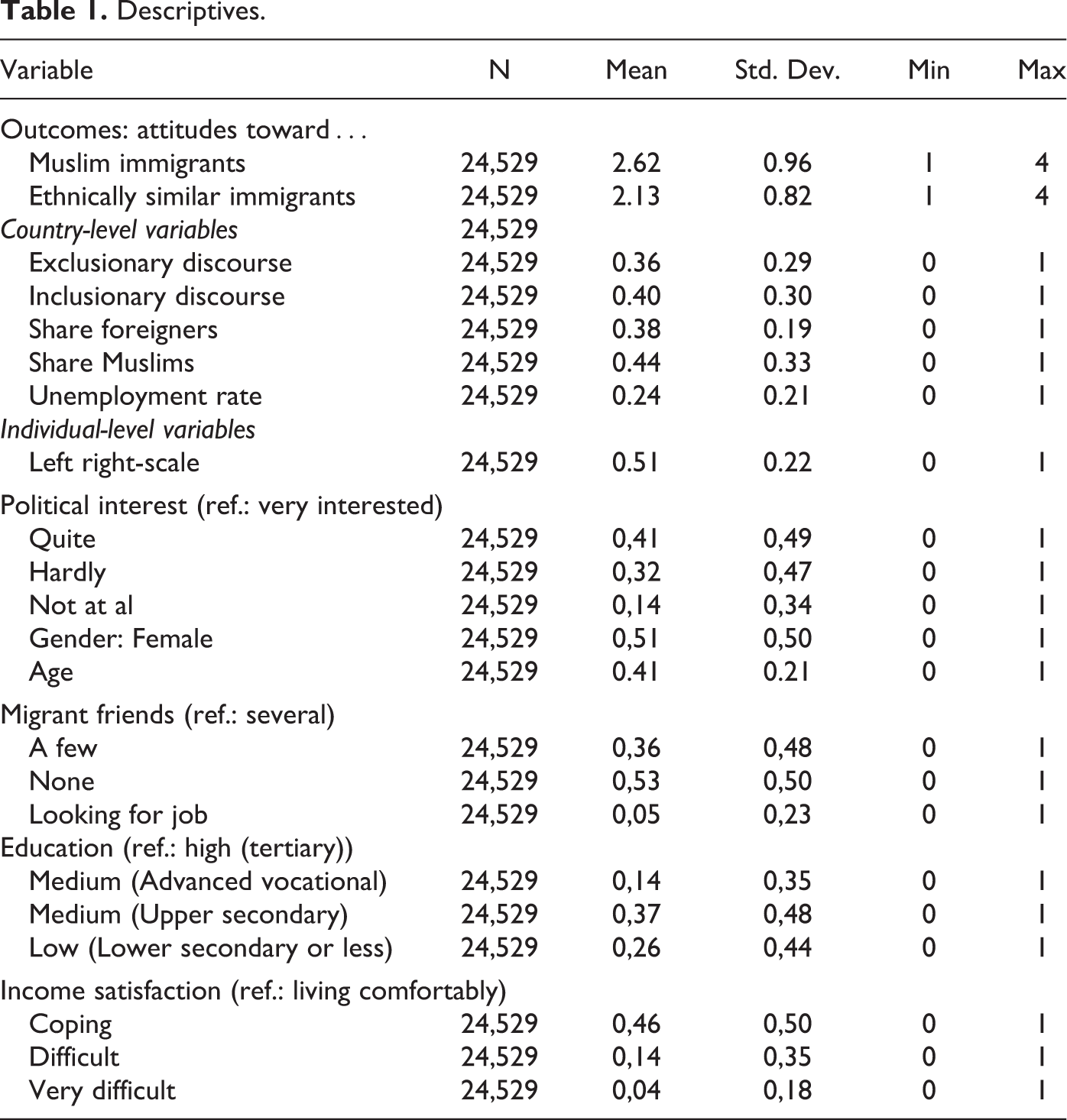
I linearly transform all continuous explanatory variables to range from zero to one for easier interpretation. In this way, the coefficients for continuous variables are standardized and directly comparable. They always represent the difference between each variable’s observed minimum and maximum. I exclude respondents with missing values for all analyses because the standardization draws upon sample-specific statistics (i.e., empirical minima and maxima). The final sample contains 24,529 individuals in 19 countries. Table 1 presents descriptive statistics of all variables included in the analysis, while Supplemental Table A1 in the Supplemental Appendix shows descriptive statistics of the key variables for each country.
Descriptives.
Results
Political Elite Discourses and Attitudes toward Immigrants: Descriptive Overview
Political elite discourses on immigration issues vary across Europe, as Figure 1 shows. First, political elites in Scandinavian countries are mainly positive (right panel) on such topics while the opposite is true for Hungary, where political elites are mainly negative (left panel). Second, there are differences in the issue’s overall prominence in national political debates. For example, political elites in Spain and Poland 9 do not discuss immigration much in either a positive or a negative manner. In contrast, immigration is much more prominent in Denmark, Austria, and Switzerland, where both positive and negative articulations of political elites are highly visible.
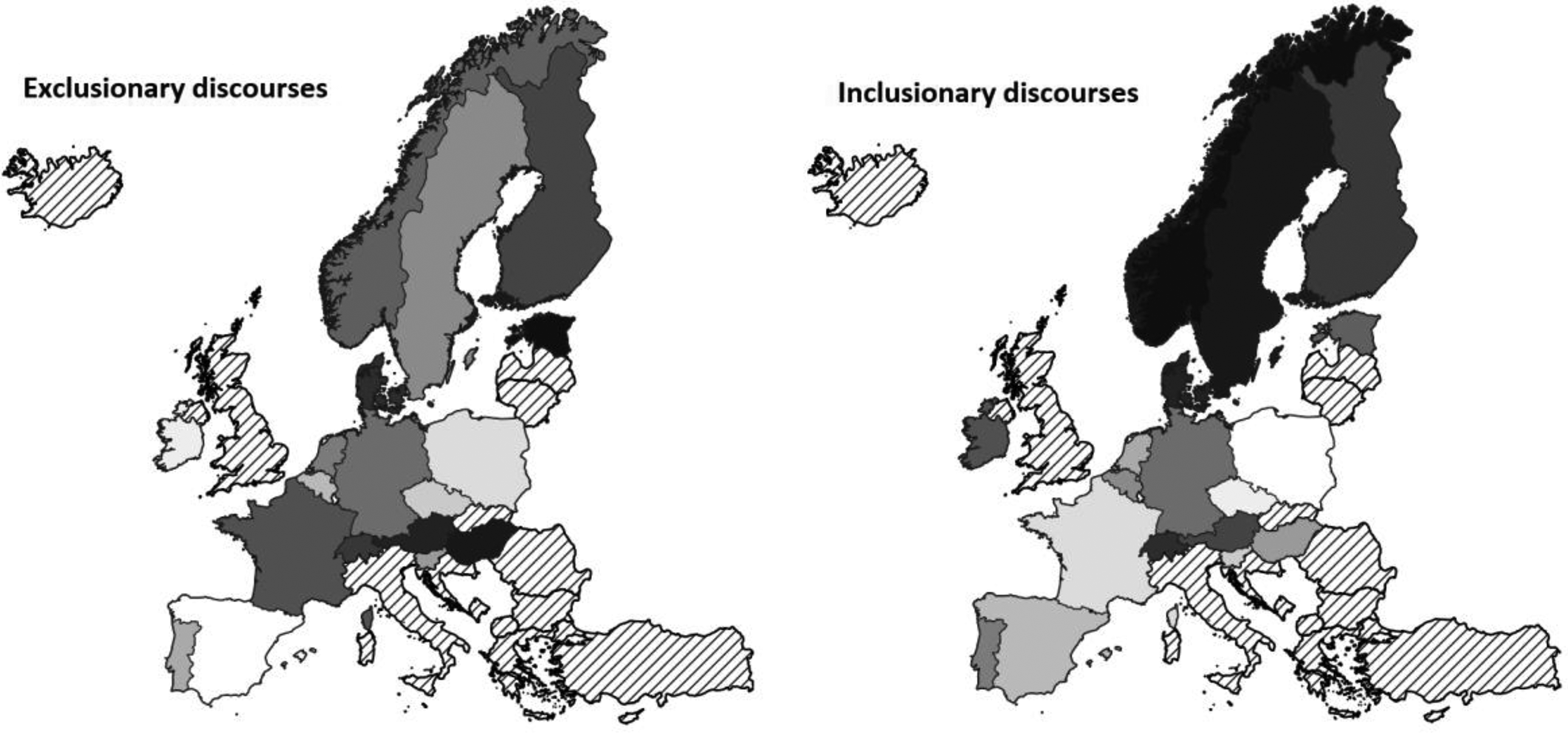
Prevalence of Exclusionary and Inclusionary Political Elite Discourses in Europe.
Political elite discourses relate to attitudes toward the immigration of Muslims and of ethnically similar people in different ways. Figure 2 shows the bivariate relationships between the two macro-level discourse variables and the country means of each attitude. Although there is dispersion in all cases, the grey regression lines yield insights into the overall connection between discourses and public opinion. First, natives’ attitude toward Muslim immigrants is, on average, less positive compared to their attitude toward ethnically similar immigrants (global means: 2.6 vs. 2.1). In many cases, however, attitudes vary with political elite discourses. The upper-left panel indicates a positive, but moderate, correlation between exclusionary discourse and attitudes toward Muslim immigrants (r = 0.19). In contrast, the connection between exclusionary party discourse and the attitude toward the immigration of ethnically similar people is close to zero (r = –0.08, lower-left panel). In Hungary and Estonia, political elites are very exclusionary, and natives’ attitudes are very negative toward Muslim immigrants but not so much toward ethnically similar immigrants. However, political elites in the Czech Republic are not very exclusionary, according to this measure, even though public opinion on Muslims is hostile. In Denmark and Austria, on the other hand, political elites are rather exclusionary, but the public is not. The two panels on the right-hand side of Figure 2 indicate that an inclusionary discourse is associated with less negative attitudes toward both Muslim and ethnically similar immigrants (Muslim: r = –0.52, similar ethnicity: r = –0.61). Political elites in the Czech Republic and Poland rarely articulate positive statements, and natives in both countries tend to harbor dismissive views on Muslim immigrants, and the opposite is true in Sweden, Denmark, and Norway. A preliminary conclusion concerning the impact of political elites on public opinion, then, is that an exclusionary discourse primarily correlates with the rejection of Muslim immigrants but not ethnically similar ones, whereas an inclusionary political discourse is associated with more openness toward both groups. To test the hypotheses more thoroughly, I turn to the regression models.
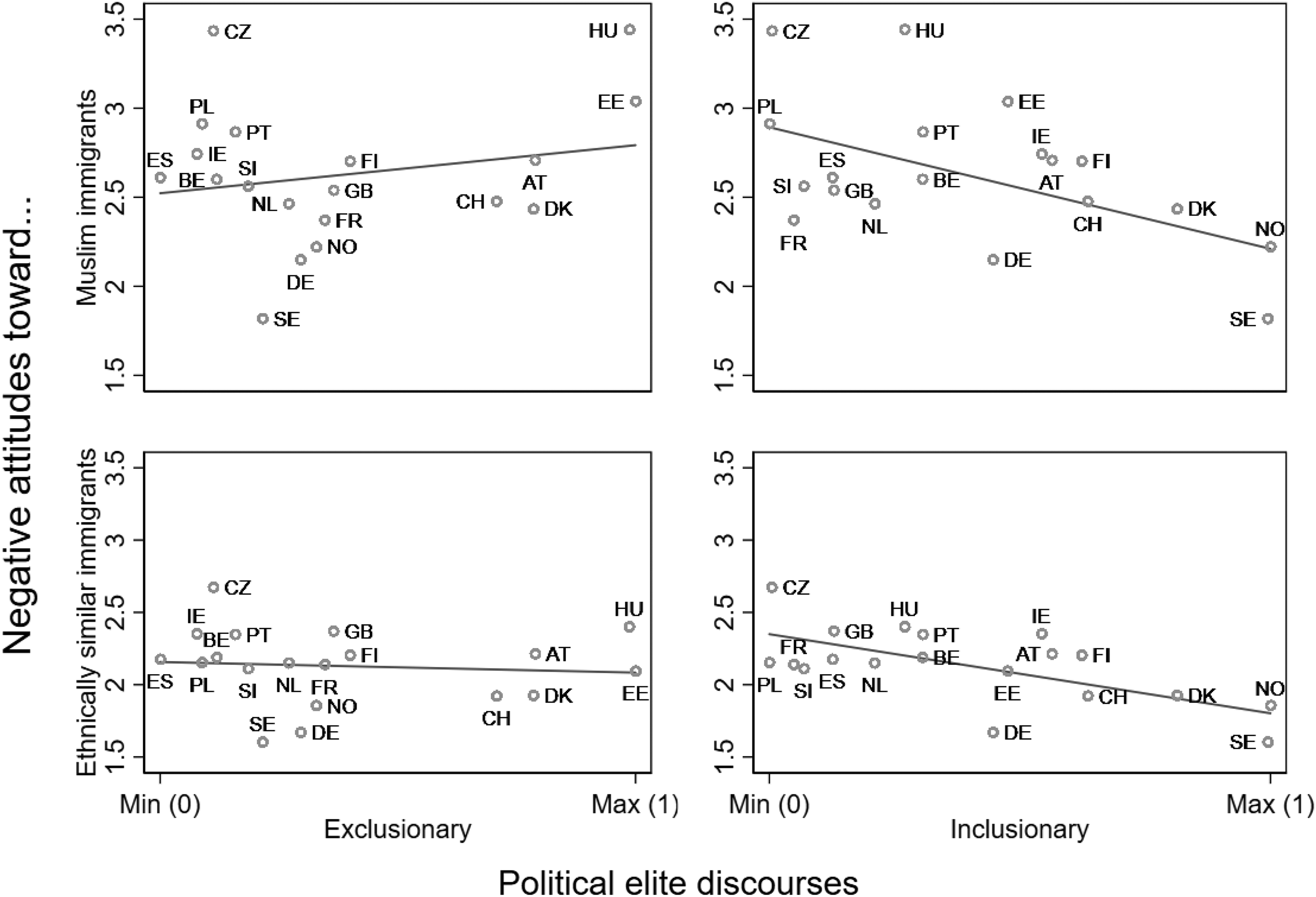
Political Elite Discourses and Public Opinion toward Muslim and Ethnically Similar Immigrants.
Random Effect Models
Null models reveal that the share of variance on the country level is 16.3 percent for the rejection of Muslim immigrants but only 9.5 percent for the rejection of ethnically similar immigrants. This finding indicates that native Europeans across the analyzed countries differ more in their views on Muslim immigrants than in their attitudes toward ethnically similar ones. Put differently, there seems to be more consensus between countries when it comes to the immigration of ethnically similar people compared to the immigration of Muslims. In the following, I examine whether political elite discourses account for this variation in these attitudes across countries.
Table 2 contains the results of four models, two examining attitudes toward Muslim immigrants and two analyzing attitudes toward ethnically similar immigrants. Models m1 show that, when controlling individual-level variables, an exclusionary discourse correlates significantly with a more negative view on Muslim immigrants, but not with the opinion on ethnically similar ones. In contrast, an inclusionary discourse is significantly associated with more welcoming natives regarding both immigrant groups. These findings are stable when country-level control variables are added, as models m2 show. 10 Figure 3 depicts the effects of the discourse variables net of all control variables based on the m2 models.
Effects on Exclusionary Attitudes toward Muslim and Ethnically similar Immigrants
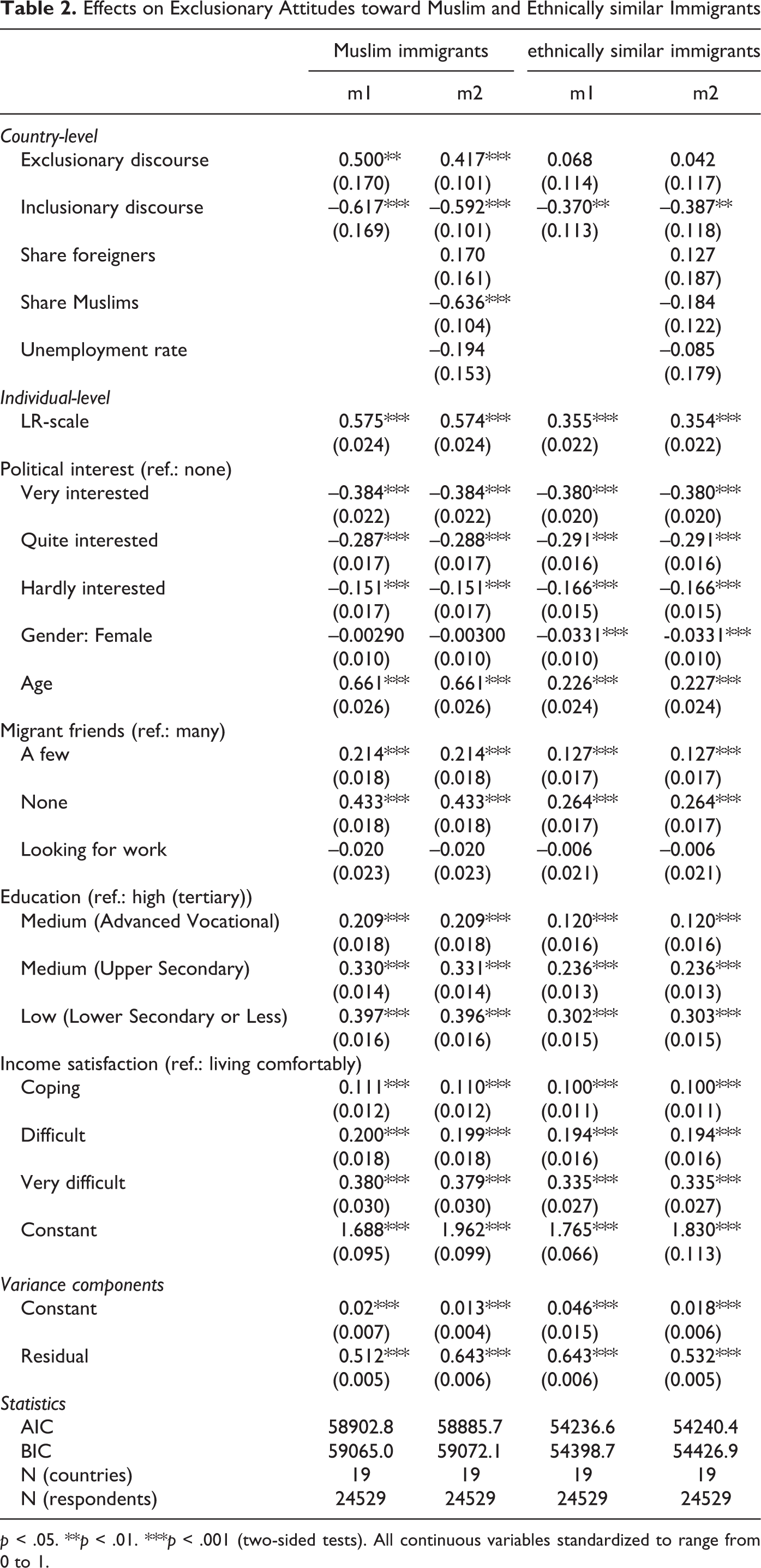
p < .05. **p < .01. ***p < .001 (two-sided tests). All continuous variables standardized to range from 0 to 1.
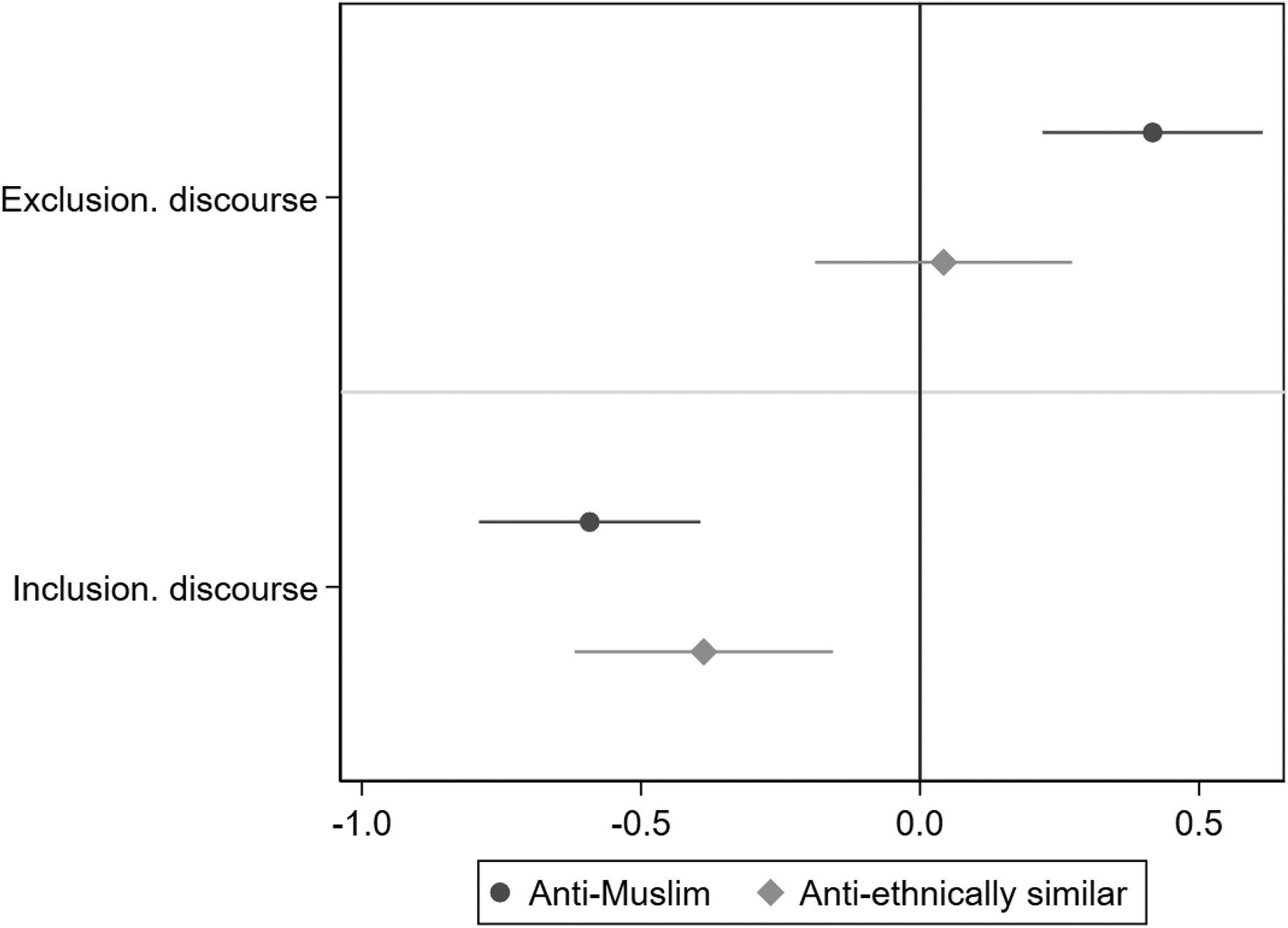
Effects of Political Elite Discourses on Negative Attitudes toward Muslim and Ethnically Similar Immigrants.
The upper part of Figure 3 tests Hypotheses 1a and 1b, respectively. Hypothesis 1a states that an exclusionary discourse correlates with more negative opinions toward Muslim immigrants, which is empirically supported by the statistically significant positive effect shown by the dark grey dot in the upper part of Figure 3. Moving from the observed minimum of exclusionary discourse, which corresponds to Spain, to the maximum, which is Estonia and Hungary, is associated with 0.42 points more negative attitudes on the 4-point scale (95 percent confidence interval (CI): 0.22–0.61). This association size amounts to 44 percent of this variable’s standard deviation (SD: 0.96) and resembles roughly the effect of lower education or having no immigrants as friends. However, an exclusionary discourse has virtually zero effect on attitudes toward ethnically similar immigrants, which is in line with Hypothesis 1b.
To test Hypotheses 2a and 2b, the lower part of Figure 3 reports the impact of inclusionary political elite discourse. This variable significantly correlates with less negative attitudes toward both groups of immigrants. This finding is in line with Hypothesis 2b and refutes 2a. In contrast to exclusionary discourse, an inclusionary discourse is associated with higher levels of openness toward both immigrant groups. An explanation for this finding is that, while exclusionary discourses are often more target specific (Meuleman et al. 2018), inclusionary discourses are more likely to promote openness universally (Schwartz 2007). 11 If natives incorporate these arguments into their own views, they consequently reject those immigrant groups that political elites frame negatively, which in the examined setting corresponds more to Muslims than to ethnically similar immigrants. In contrast, if the rhetoric of universal openness resonates with natives, they are more welcoming toward various types of immigrants.
Hypotheses 3, 4a, and 4b state that the associations between discourses and attitudes are stronger for certain individuals. To this end, I add two interactions to the models and a random slope for the respective individual-level variable (Table 3). For the sake of clarity, I focus on anti-Muslim immigrant attitudes because these attitudes are of theoretical interest and because the effects of both discourse predictors are statistically significant.
Interaction Effects on Exclusionary Attitudes toward Muslim Immigrants.
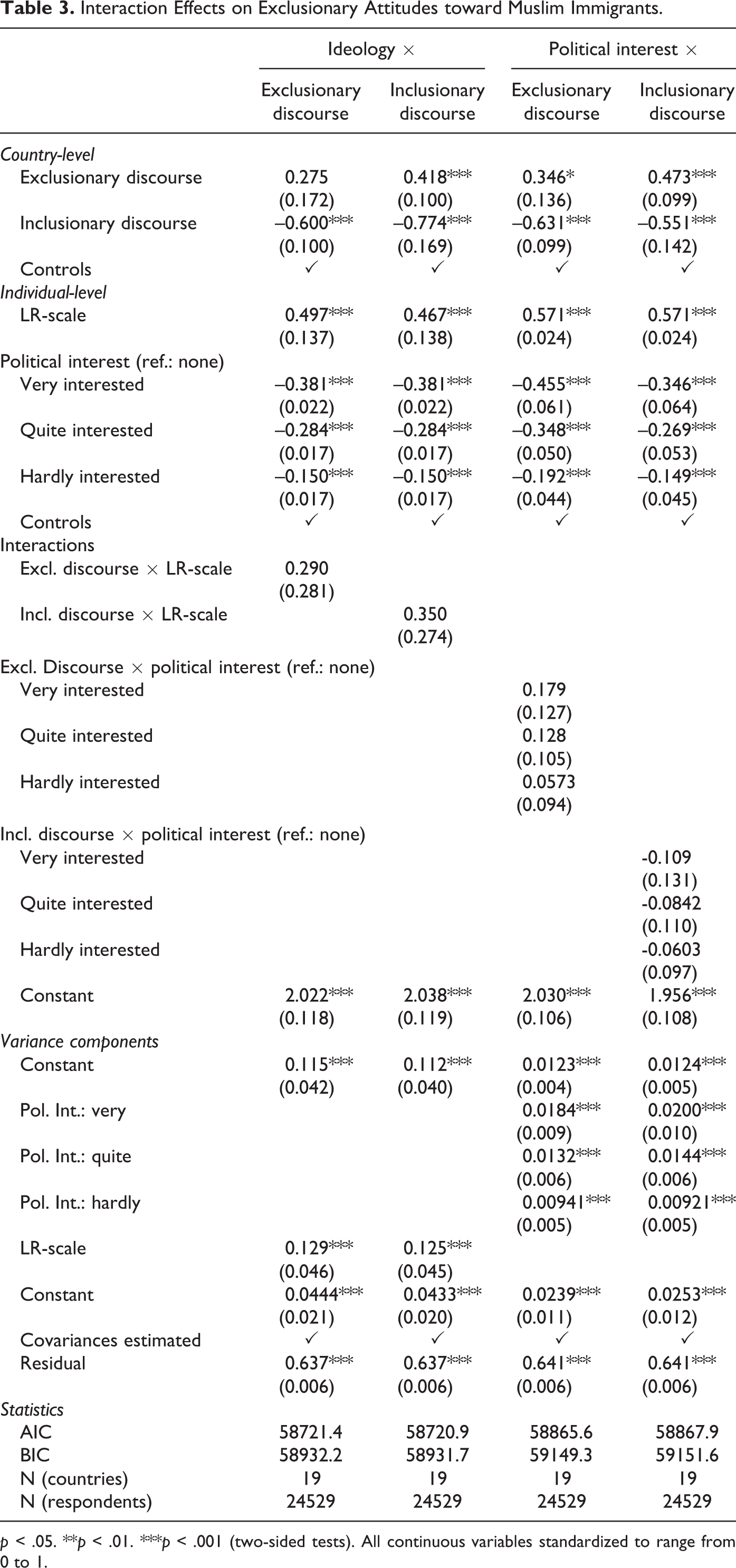
p < .05. **p < .01. ***p < .001 (two-sided tests). All continuous variables standardized to range from 0 to 1.
Hypothesis 3 concerns the question how political orientation moderates the link between political elite discourses and attitudes. The left panel of Figure 4 shows that the association between exclusionary discourse and an anti-Muslim immigrant attitude is statistically insignificant for those with a left-leaning political orientation (95 percent CI: –0.06 - 0.6). For those on the political right, this correlation is more than twice as large and significant (95 percent CI: 0.23–0.9). However, this difference itself is not statistically significant. Regarding the negative correlation between inclusionary discourse and an anti-Muslim attitude, the right panel of Figure 4 suggests that it is double the size for those with a left-leaning orientation (95 percent CI: –1.1 - –0.44) compared to those on the political right (95 percent CI: –0.76 - –0.09) but that the interaction is again not statistically significant. 12 Although the direction of effects are in line with the argument that elite rhetoric resonates more when it is congruent with existing ideology, the results are too imprecise to clearly support this reasoning.
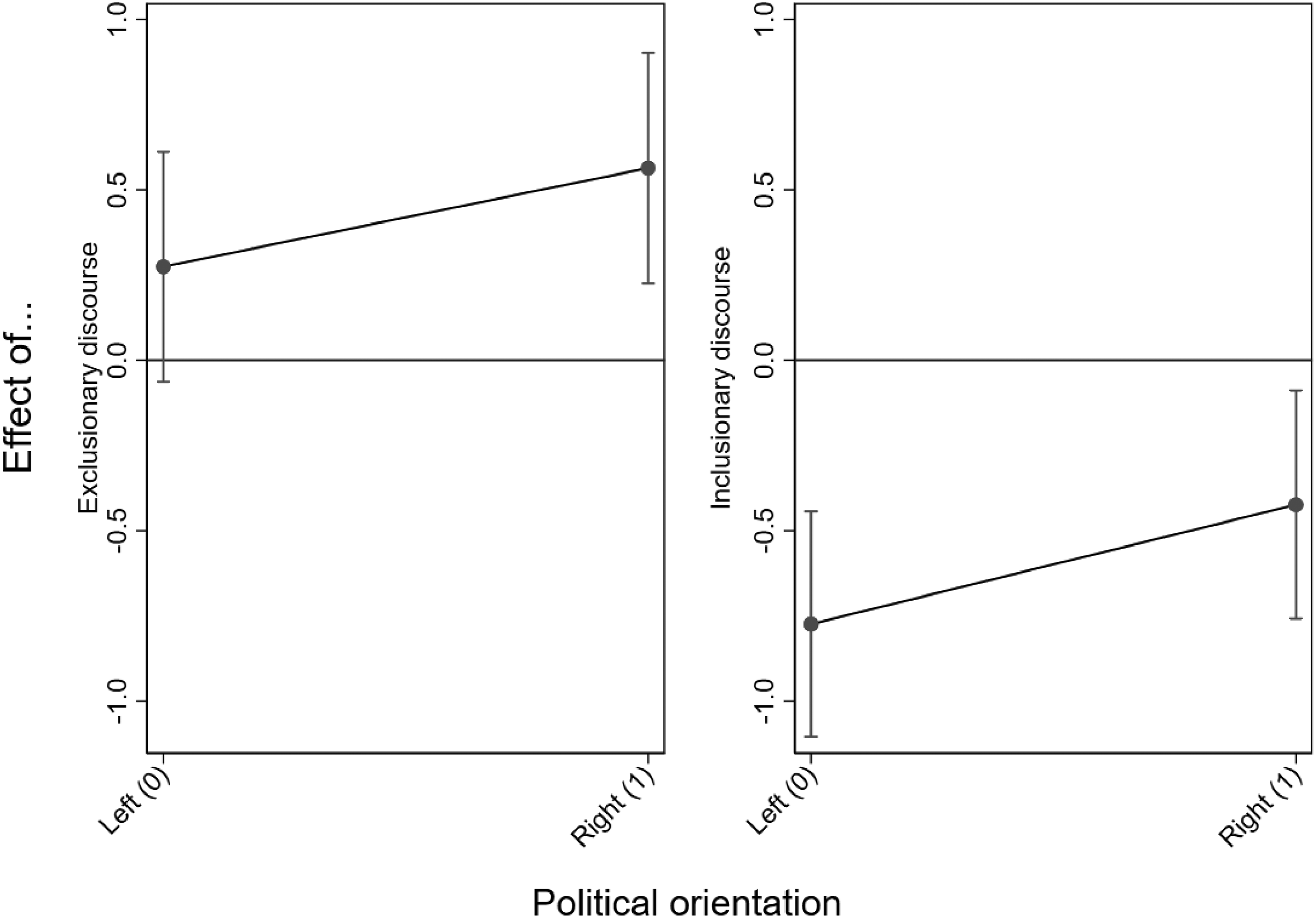
Effects of Discourses on Negative Attitude toward Muslim Immigrants Conditional on Political Orientation.
Hypotheses 4a and 4b state that the effects of political elite discourses on attitudes differ with individual political interest. Table 2 exhibits a stronger positive interaction effect of exclusionary discourse for those very interested in politics compared to those not interested at all (third model in Table 3) and a stronger negative interaction of inclusionary discourse (fourth model in Table 3), which is more in line with Hypothesis 3a than with Hypothesis 3b. However, since neither interaction is statistically significant, 13 the results do not allow valid conclusions in this respect. I return to possible explanations for the statistical insignificance of the interaction effects in the conclusion.
Robustness Checks
Because of the limited number of countries in the analysis, it is crucial that findings are not driven by single-outlier countries. I re-estimated the models 19 times, leaving out one country at a time, and calculated the averages across these models (delete-one Jackknife). Supplemental Table A2 in the Supplemental Appendix shows the results of these 19 models, which are very stable to such resampling. Across all subsamples, the relationship between exclusionary discourse and the attitude toward Muslim immigrants ranges from 0.37 (without Sweden) to 0.51 (without Czech Republic) and from –0.035 (without Poland) to 0.11 (without Czech Republic) for the attitude toward ethnically similar immigrants. The correlation between inclusionary discourse and attitudes varies from –0.49 (without Czech Republic) to –0.63 (without Denmark) for Muslim immigrants and from –0.29 (without Sweden) to –0.44 (without Poland) for ethnically similar immigrants. All estimated effects are statistically significant on the 5-percent level, and all but two are significant on the 0.1-percent level. As in the results reported above, the only exceptions are the associations for exclusionary discourse and the attitude toward ethnically similar immigrants, for which p-values are far above the usual levels of significance throughout all subsamples. The estimated effects also remain significant on at least the five percent level when using bootstrapped standard errors (last row of Supplemental Table A2). Thus, individual outlier countries do not cause the results.
To draw valid conclusions from such comparative analyses, it is necessary that the constructs under investigation are comparable across countries. Recent research on the measurement equivalence of the two dependent variables suggests that comparisons are valid for the ESS7, although France, Ireland, and Slovenia might be problematic cases (Davidov, Cieciuch, and Schmidt 2018). Excluding these three countries reduces the number of country cases to 16. However, the results remain strikingly similar to the ones reported above, as Supplemental Table A3 in the Supplemental Appendix shows.
The relationships between the discourse variables and the outcomes do not depend on different model specifications regarding the inclusion or exclusion of macro-level variables, nor do the conclusions change when estimating hierarchical ordered logit models 14 (columns 4 and 5 in Supplemental Table A3) or keeping individuals with migration background as well as Muslims in the analysis (Sarrasin et al. 2015). In sum, decisions regarding the sample or modeling strategy do not influence the results reported in the main analysis.
Conclusion: Do Political Elites Shape Immigrant Preferences?
Muslim immigration is subject to vivid debates among political elites throughout Europe (e.g., Peachey 2018; Rinke 2015; Waterfield 2015). This article shows that natives in countries with exclusionary political elites are, on average, more hostile toward Muslim immigrants but not toward ethnically similar ones. This finding is in line with the argument that a rhetoric of exclusion tends to be tailored toward specific groups (see Meeusen and Jacobs 2017; Meuleman et al. 2018), which concerns ethnically similar immigrants less (Gorodzeisky and Semyonov 2019b). In contrast, people are more welcoming toward both kinds of immigrants when political elites are inclusive. Inclusionary arguments tend to promote openness universally (Schwartz 2007), which can lead to higher levels of acceptance of various groups of immigrants. Further research on the content and effects of such discourses may test these explanations in more detail. In their mass media analysis, van Klingeren et al. (2015) report that it is mostly positive news about immigration that are associated with fewer concerns about immigration, whereas negative immigration news have little impact. The findings of the present study add that positive discourses might have a broader scope compared to negative discourses.
Contrary to theoretical expectations, neither political orientation nor political interest significantly moderated the relationship between discourses and attitudes. One reason for the statistical insignificance might be methodological. Simulation studies have shown that models with cross-level interactions must include random slopes for the individual-level moderator (Heisig and Schaeffer 2019). However, the complex random effects structure in combination with the limited number of cases on the second level can lead to an (correctly) imprecise estimate. One should, therefore, keep in mind that “a statistically insignificant effect might also be compatible with substantively significant effects” (Bernardi, Chakhaia, and Leopold 2017, 2). Such a reasoning is supported by the substantial size of the interactions’ point estimates, which range from 30 to 75 percent of the respective main effects. Nonetheless, it could also be that discourses that are more specifically about certain issues, such as security concerns, relate to existing beliefs more clearly. For example, prior research shows that Donald Trump’s reference to Mexican immigrants as “rapists” and “criminals” mostly affected the opinions of Americans with more anti-immigration dispositions (Flores 2018). In this case, more differentiated measures of individual discourses would be helpful, quantifying how often political elites frame Muslim immigrants as threatening national identity or collective security. On the other hand, the impact of discourses that are limited to certain countries is hard to examine from a cross-national perspective. Put differently, the abstraction from highly country-specific discourses is exactly what enables this comparative study.
Analyzing attitudes toward Muslim immigrants limits the investigation to a cross-sectional design, due to data availability. While this article focused on the impact of elite discourses on natives’ attitudes, it is also plausible that political parties aim at maximizing their popularity by picking up public sentiments. A relationship of mutual response seems most likely where both aspects are also affected by significant external events (e.g., Legewie 2013; Czymara and Schmidt-Catran 2017). I tried to counter spurious correlations by controlling for important confounding variables on individual and country levels, comparing various model specifications, systematic resampling, and allowing the treatments (political elite discourses) to precede the outcomes (attitudes). While these considerations are no panacea regarding the causal direction, this article’s main claim is to inform about the link between different kinds of elite discourses and individual immigrant preferences. Future research based on longitudinal or quasi-experimental designs could help clarify the direction(s) of causality.
If natives are susceptible to political elites’ rhetoric, politicians’ use of inflammatory language is an obstacle to immigrant integration into the host society. Political elites using dehumanizing language can reinforce or activate prejudice, thereby contributing to conflicts along ethnic lines (Flores 2018). Recent research even suggests that elite rhetoric can spark anti-immigrant violence (Jäckle and König 2018). Inclusive political elites can, in contrast, facilitate newcomers’ incorporation by improving openness among the autochthonous population (see also Esses, Hamilton, and Gaucher 2017, 104–05). Since immigration to Europe is likely to continue, including a growing Muslim population (Pew Research Center 2017), political elites play an important role in fostering social cohesion.
Supplemental Material
Supplemental Material, Propagating_migrant_preferences_appendix - Propagated Preferences? Political Elite Discourses and Europeans’ Openness toward Muslim Immigrants
Supplemental Material, Propagating_migrant_preferences_appendix for Propagated Preferences? Political Elite Discourses and Europeans’ Openness toward Muslim Immigrants by Christian S. Czymara in International Migration Review
Footnotes
Acknowledgements
Earlier versions of this paper were presented at the 71st annual meeting of the World Association for Public Opinion Research, the GESIS Conference on Migration and Interethnic Relations 2018, the fifth Ruppin International Conference on Immigration and Social Integration as well as research seminars at the universities of Cologne, Nijmegen and Tilburg. I thank Marijn van Klingeren and Francesca Zanasi and the participants for their constructive feedback. I am particularly grateful to Eldad Davidov, Conrad Ziller, Lucas Drouhot, the editor Jamie Winders and three anonymous reviewers for their valuable comments and suggestions and to Lewis Taylor for proofreading.
Declaration of Conflicting Interests
The author(s) declared no potential conflicts of interest with respect to the research, authorship, and/or publication of this article.
Funding
The author(s) received no financial support for the research, authorship, and/or publication of this article.

Notes
References
Supplementary Material
Please find the following supplemental material available below.
For Open Access articles published under a Creative Commons License, all supplemental material carries the same license as the article it is associated with.
For non-Open Access articles published, all supplemental material carries a non-exclusive license, and permission requests for re-use of supplemental material or any part of supplemental material shall be sent directly to the copyright owner as specified in the copyright notice associated with the article.
