







Abstract
This study examines how welfare benefit generosity impacts refugees’ integration into their new country. The effects of welfare benefit generosity are identified from a policy reform that reduced welfare benefits, first for newly arrived refugees, and second for those who had been in the country for at least 10 months. The results suggest that refugees respond quickly to the benefit reduction, but men and women react on different margins. Male refugees enter employment faster when they experience a benefit reduction, whereas no effect on the labor market is found for female refugees. Even though some men succeed in finding a job, both men and women experience a drop in disposable income of 20 percent. This seems to adversely affect women as they seek more health care, are more often hospitalized, and are more often charged with property crimes. No such unintended effects are found for men.
Introduction
It is well documented that refugees have low employment rates in many Western countries even when they have lived for a substantial number of years in their new host countries (Åslund et al. 2017; Bratsberg et al. 2017; Dustmann et al. 2017; Fasani et al. 2017; Schultz-Nielsen 2017; Brell, Dustmann, and Preston 2020). The lack of integration presents great challenges and is often contributing to social tensions in receiving countries. While some countries have responded to the challenges by increasing funds for further support to integration, other countries have limited the access to social support or welfare benefits for immigrants to incentivize further labor market integration. Restrictive policies have, for instance, been implemented in recent years in the United States, Denmark, the Netherlands, Hungary, and Austria (OECD 2018, 2019). It is therefore crucial to understand and document how such policies work.
While many studies have compared welfare states with different levels of generosity (Valenta and Bunar 2010; Goodman and Wright 2015; Kevins and van Kersbergen 2019), several scholars have acknowledged that there is a lack of causal evidence about the effectiveness of specific policies (Ersanilli and Koopmans 2011; Goodman and Wright 2015).
This study contributes to the literature by examining the consequences of a particular element of welfare state regimes: welfare benefit generosity. Very few previous studies shed light on the consequences of welfare benefit reduction for refugees, and there is mixed evidence about the labor market consequences. This study provides new estimates of the labor market consequence and new estimates for the potential unintended consequences outside the labor market. A previous study has found that an earlier but similar welfare benefit reduction raised crime rates for refugees (Andersen, Dustmann, and Landersø 2019) and I examine if these results can be replicated under new settings. I add to the previous analyses by examining if the welfare benefit reduction has consequences for family formation and health care utilization.
The combination of relatively generous welfare benefits and high labor income taxes that prevails in some Western countries may leave the refugees with limited economic incentives to work. Standard neoclassical economic theory predicts that welfare benefit reductions should raise employment rates because they increase the economic incentive to work (Chiswick and Miller 1995). Koopmans (2010) argues that the economic incentive may be weaker for immigrants from nondeveloped countries because they may compare welfare benefit levels with economic living standards from their home country. However, this line of reasoning overlooks job barriers specific to refugees: The effort needed to find a job may be higher because of a lack of knowledge about the local labor market, lack of network, lower skill levels, and health problems.
To the extent that the labor market response to the benefit reduction is not sufficient to alleviate the income reduction and total income is reduced in the longer term, neoclassical economic theory predicts that the benefit reduction may affect outcomes as diverse as the demand for children (Becker and Tomes 1976), the propensity to commit crimes (Becker 1968; Freeman 1999) and the demand for health care (Grossman 1972, 2000) 1 . In addition to such direct effects, welfare benefit reductions may impact behavior through other mechanisms. If, for instance, health and employment are uncertain outcomes, and reactions to a benefit reduction cannot be immediately foreseen, economic theory predicts that behavior would track income changes more closely (Dardanoni and Wagstaff 1990; Liljas 1998). I therefore hypothesize that a reduction in nonearned income can affect the family formation, crime, and health care utilization because it reduces economic resources and adds to the uncertainty with respect to future living conditions, but that the size of the effect depends on the labor market response.
To isolate the causal effect of welfare benefit reductions, I utilize a policy reform as a quasi-experiment. The reform occurred in Denmark in 2015 and it reduced the welfare benefit level that newly arrived immigrants were entitled to by up to 43 percent if they received asylum from September 2015. Refugees who were granted asylum before September experienced the same welfare benefit reduction in July 2016, that is, at least 10 months later than for later arriving cohorts. I compare refugees who arrive just before and after September 2015, and hence, refugees who are, to a large extent, fleeing from the same countries, and experience similar macro conditions once arrived, but differ in terms of the timing with which they experience the welfare benefit reduction. The effect is estimated by means of the regression discontinuity (RD) design and, under certain conditions, can be interpreted as the effect of the welfare benefit reduction at the time of arrival compared to the benefit reduction 10 months after arrival.
The study benefits from access to unique administrative register data that enables the identification of entire refugee populations based on their actual residency status and provides longitudinal information without attrition problems.
The results show that the early benefit reduction has the expected positive association with employment for men, relative to the later benefit reduction: Those who experience the early benefit reduction have nearly 50 percent higher employment rates after 10 months in the country. Contrary to the findings for men, female refugees do not respond to the benefit reduction in the labor market. Instead, female refugees seem to respond to the income reduction on margins outside the labor market. A few women respond by committing more crimes: The crime charge rate increases from less than 1 percent to 2.5 percent after nearly two years in the country. There are no clear effects on family formation, but many female refugees respond to the benefit reduction by seeking more health care: Contacts with general practice increase by nearly 17 percent and women have a 60 percent higher risk of hospitalization in the first year after arrival, when they experience the benefit reduction. The increased risk of hospitalization and use of general practice vanishes one year after all refugees in the study population have experienced the welfare benefit reduction, and as for the male labor market response, it indicates that the later treated “catches up” and increase their health care utilization to the same level of the early treated, once the later treated experience the benefit reduction. Even though refugees cannot react to the policy change prior to arrival, and there is no reason to expect that refugees who receive residency just before and after the reform date should be different, I do observe a few significant differences in terms of country of origin and asylum status: Refugees arriving on September 2015 are more likely to be Syrian refugees. Therefore, it cannot be ruled out that the estimated effects partly reflect a bias to the extent that Syrian men are more employable and Syrian women seek the doctor more often.
The study adds to the empirical literature on welfare state generosity, particularly to the sparse literature that considers the consequences of welfare benefit generosity for refugee integration. Even though general welfare state generosity has been linked to a more inclusive stand on immigrant rights (Römer 2017), a convergence in terms of more restrictive integration strategies has been observed across different welfare states, sometimes labeled “the civic turn” (Joppke 2007; Borevi 2014). Thus, studies have found that even within countries with universal provision of welfare services, more restrictive policies seem to counter refugee integration (Hernes et al. 2020; Kevin and van Kensbergen 2019), and some scholars even conclude that the generous Scandinavian welfare states fail in terms of securing refugee integration (Valenta and Bunar 2010).
As mentioned above, it is difficult to draw explicit causal interpretations from these cross-country studies. To the best of our knowledge, only few studies have examined the causal impact of welfare benefit generosity on refugee integration. A few studies find that welfare benefit reduction that occurred in Denmark in 2002 had a substantial, but temporary, employment effect on refugees (Huynh, Schultz-Nielsen, and Tranæs 2010, Rosholm and Vejlin 2010, Andersen, Dustmann, and Landersø 2019). The first contribution of the current study is to examine if the short-term results on employment and crime found from the 2002 reduction can be replicated under the new settings in 2015. This is important, not only because refugees who were affected by the 2002 reform arrived from different countries under other circumstances than refugees affected by the 2015 reform, but also because evidence from other countries points in another direction: LoPalo (2019) finds that refugees who arrived in the US states with more generous welfare benefits experienced higher wages in the longer run, without experiencing changes in their employment rates. Relatedly, it has been found that US welfare reforms in the 1990s provided increased work incentives, and raised employment and income for nonrefugee immigrants (Kaestner and Kaushal 2005; Borjas 2016) 2 . By altering work incentives, welfare reforms can, however, have unintended (positive or negative) effects outside the labor market. I confirm the previous findings in Andersen, Dustmann, and Landersø (2019) of unintended effects of welfare benefit reduction on crime, even though overall crime rates have gone done significantly since the period studied by Andersen, Dustmann, and Landersø (2019). The current study contributes further to this literature by providing new results for additional outcomes: family formation and health care utilization. The finding, that welfare benefit reductions raise health care utilization, is related to descriptive literature showing that refugees often suffer from mental and physical problems at arrival and that health and that health care utilization covary with post-migration conditions (Fazel, Wheeler, and Danesh 2005; Porter and Haslam 2005; Tinghög et al. 2017; Hynie 2018; Javanbahkt et al. 2019; Peconga and Thøgersen 2019). Disentangling whether such correlations constitute causal effects of post-migration conditions or are a result of selection into more generous receiving countries is of immense importance for how to address post-migration differences politically, and the current study contributes to this end.
The findings of the current study also contribute to a broader literature on the effectiveness of integration policies that seek to foster better labor market integration of refugees (Edin et al. 2003; Särvimäki and Hämäläinen 2016; Arendt 2020; Brell, Dustmann, and Preston 2020; Hangartner and Särvimäki 2021; Foged et al. 2022). The current study confirms that benefit generosity is important for job search and labor market behaviour of refugees but that benefit policies should carefully balance such positive effects against the possible negative ones. As such, there is no simple answer to whether more generous welfare regimes foster better integration.
Institutional Settings
This section describes the institutional settings that govern the admission and public support for the population of interest, refugees. Further details are provided in Appendix B. Refugees who are granted residency are allowed to work, are eligible for welfare benefits and have access to free public health care 3 . The welfare benefits for unemployed are not time limited and, prior to the benefit reduction considered in this study, were generous when viewed in an international context (Hansen and Schultz-Nielsen 2015). The social benefit system is means-tested, so any other income in the household is subtracted from the welfare benefits, which reduces the incentive to work. It can be difficult to find even low-skilled jobs for refugees, because the minimum wage is relatively high: It varies across occupation, but with a mean level around USD 18 per hour. The pre-reform welfare benefit level for a provider constituted around 70 percent of income levels for a full-time worker hired at such minimum wage.
The Welfare Benefit Reduction
This study focuses on a policy from 2015 that reduced the level of welfare benefits for newly arrived immigrants. The bill behind the reduction was proposed on July 3, 2015, and came into force on September 1, 2015, for immigrants who had obtained legal residence and had been registered in the Central Person Registry with an address in Denmark from this date and onwards (Consolidated Act No. 1000, 2015, section 16(5) and (6)) 4 . The policy was implemented with the objective to “provide a greater incentive for newly arrived foreigners to work and become integrated in the Danish society. It is the impression of the government, that the high level of welfare benefits constitutes a barrier for better labor market attachment and successful integration” (own translation, see official presentation of the policy) 5 .
Table 1 illustrates the pre- and post-reform welfare benefit levels for different types of families. The table shows that the reform reduced benefit levels by up to 43 percent. The largest reductions occur for couples with children and persons older than 25 with no children (relative to the level that includes the activity bonus). The reduction is smaller for single persons with a child and for young persons below 25. Immigrants are also entitled to housing benefits and child support, and these benefits did not change during the period of consideration. The level of the reduced welfare benefits falls below a poverty line estimated from a minimum budget covering basic necessities, even when housing benefits and child support are included (Bonke and Christensen 2016). Hence, many benefit receivers have insufficient means for adequate food and lack means for transportation, medicine, sufficient clothes, and report being socially and mentally deprived.
The Level of Pre- and Post-Reform Monthly Welfare Benefits, by Sub-Populations (USD).
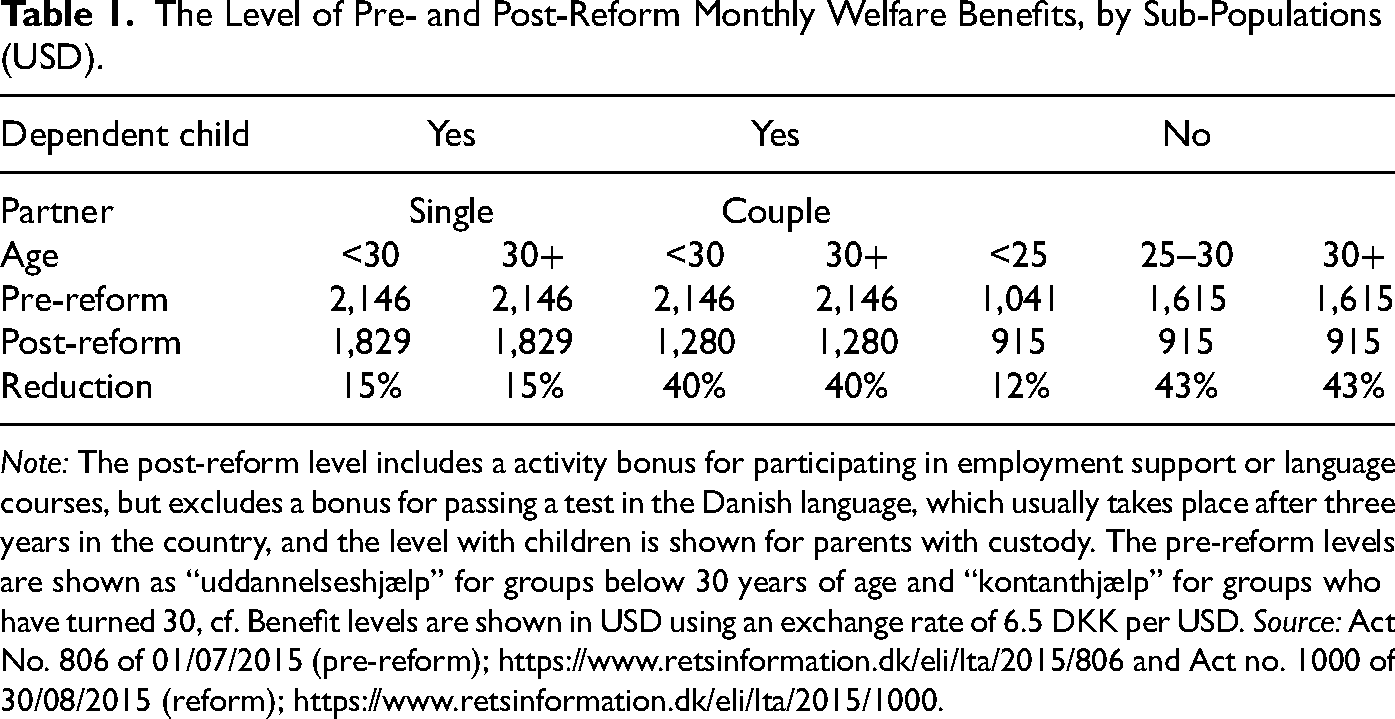
Note: The post-reform level includes a activity bonus for participating in employment support or language courses, but excludes a bonus for passing a test in the Danish language, which usually takes place after three years in the country, and the level with children is shown for parents with custody. The pre-reform levels are shown as “uddannelseshjælp” for groups below 30 years of age and “kontanthjælp” for groups who have turned 30, cf. Benefit levels are shown in USD using an exchange rate of 6.5 DKK per USD. Source: Act No. 806 of 01/07/2015 (pre-reform); https://www.retsinformation.dk/eli/lta/2015/806 and Act no. 1000 of 30/08/2015 (reform); https://www.retsinformation.dk/eli/lta/2015/1000.
An amendment to the policy entailed that all immigrants who arrived before September 2015 and have resided in Denmark for less than seven years within the past eight years were finally subjected to the benefit reduction (Consolidated Act No. 300, 2016). The amendment entered into force on July 1, 2016. The amendment therefore implied that the group who arrived before September 2015 also experienced the benefit reduction after 10 months or more in the country.
As in many other European countries, Danish politicians responded to the rise in the number of asylum seekers during 2014–2016. By March 2015, the government introduced a new temporary residency status for refugees arriving after February 19, 2015, that postponed the option for family reunification. By July 2016, the government adjusted the introduction program that is offered to all refugees by July 2016, with the objective to expedite entry into the labor market. While these reforms as well as other civic events may affect outcomes for refugees arriving at different points in time, it is crucial to stress that there were no changes to the Danish integration policy that occurred simultaneously with the first benefit reduction. This is important since it implies that I can interpret the estimated effects as causal (see the next section for methodological details).
Data
The population of interest consists of immigrants who are granted asylum in accordance with the Refugee convention, immigrants who are granted protection according to subsidiary rules, as well as their adult family members who are granted residency through family reunification. I refer to this population as refugees, in short. I focus on the group aged between 18 and 64 when they settle, who receives welfare benefits within one month upon settlement (96% of the group).
I use data from public authorities with information on type of residency, health care utilization, crime charges, employment, welfare benefits, and income 6 . These data are collected on basis of social security numbers for administrative purposes and therefore problems with measurement error and attrition are limited. Employment, crime charges, and labor income can be measured monthly, while health care utilization is measured annually. Further details are provided in Appendix B.
I focus on refugees who settled one year before or after the benefit reduction: From September 2014 to August 2016. This sample consists of 7,400 men and 4,781 women. Table 2 presents the mean of background characteristics by gender and shows that both men and women are 30 years of age, on average, in the year of settlement and that a larger fraction of the women arrive with a child and as part of a couple. Around three of four of the refugees in the period are from Syria, and close to 100 percent participate in the Danish language course offered as part of the integration program (the table also shows other statistics, which I return to in the next section).
Mean Characteristics at Arrival and Tests of Discontinuity, by Gender.
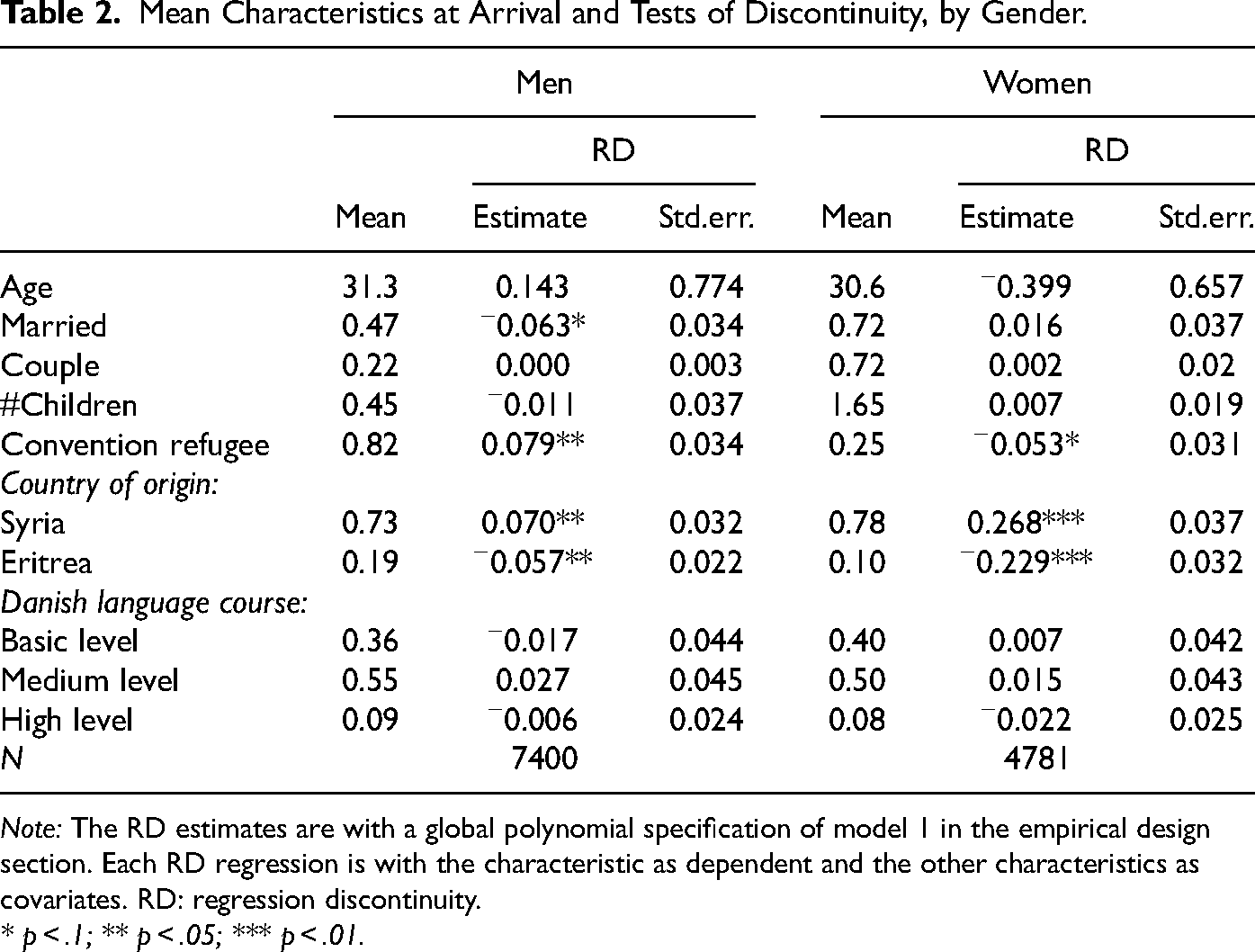
Note: The RD estimates are with a global polynomial specification of model 1 in the empirical design section. Each RD regression is with the characteristic as dependent and the other characteristics as covariates. RD: regression discontinuity.
* p < .1; ** p < .05; *** p < .01.
I refer to the group arriving from September 2015 as the early treated and the group arriving before September 2015 as the later treated (or the control group), since they also experience the benefit reduction from July 1, 2016.
Since income and health care data are recorded annually, there are additional differences in outcomes across annual arrival cohorts, as shown in Figure 1. Figure 1 shows the mean annual level of welfare benefits in the whole first calendar year by settlement week, centered around the policy cut-off of September 1, 2015. The vertical dashed lines in Figure 1 indicate that the settlement week crosses a calendar year. Thus, refugees settling in 2014 have their first annual income measured in 2015, where they are not affected by the benefit reductions. While male refugees depicted in panel A received welfare benefits equal to around USD 22,000, on average, the level for women is slightly higher among others because more women are living with children (cf. Table 1). Refugees settling from January to August 2015 are not affected by the early benefit reduction from September 2015, but by the later one in July 2016, that is, during half their first whole calendar year. It is seen that their welfare benefit level drops to around USD 15,000 for men and just below USD 20,000 for women. Refugees who settled from September to December 2015 are affected from September 2015, that is, throughout the entire 2016, and their benefit level drops further to roughly USD 12,000 and USD 15,000, for men and women, respectively. Finally, benefits for refugees settling in 2016 are measured in 2017 and they are therefore also affected by the benefit reduction throughout the year. The drop for the first weekly cohort settling in 2016 compared to those settling in the last week of 2015 (17 vs. 18 weeks after the cut-off) is therefore not due to a benefit reduction, but due to a longer length of stay for the former group at the point in time when benefits are measured. Similar within-year upward trends are seen in other years.
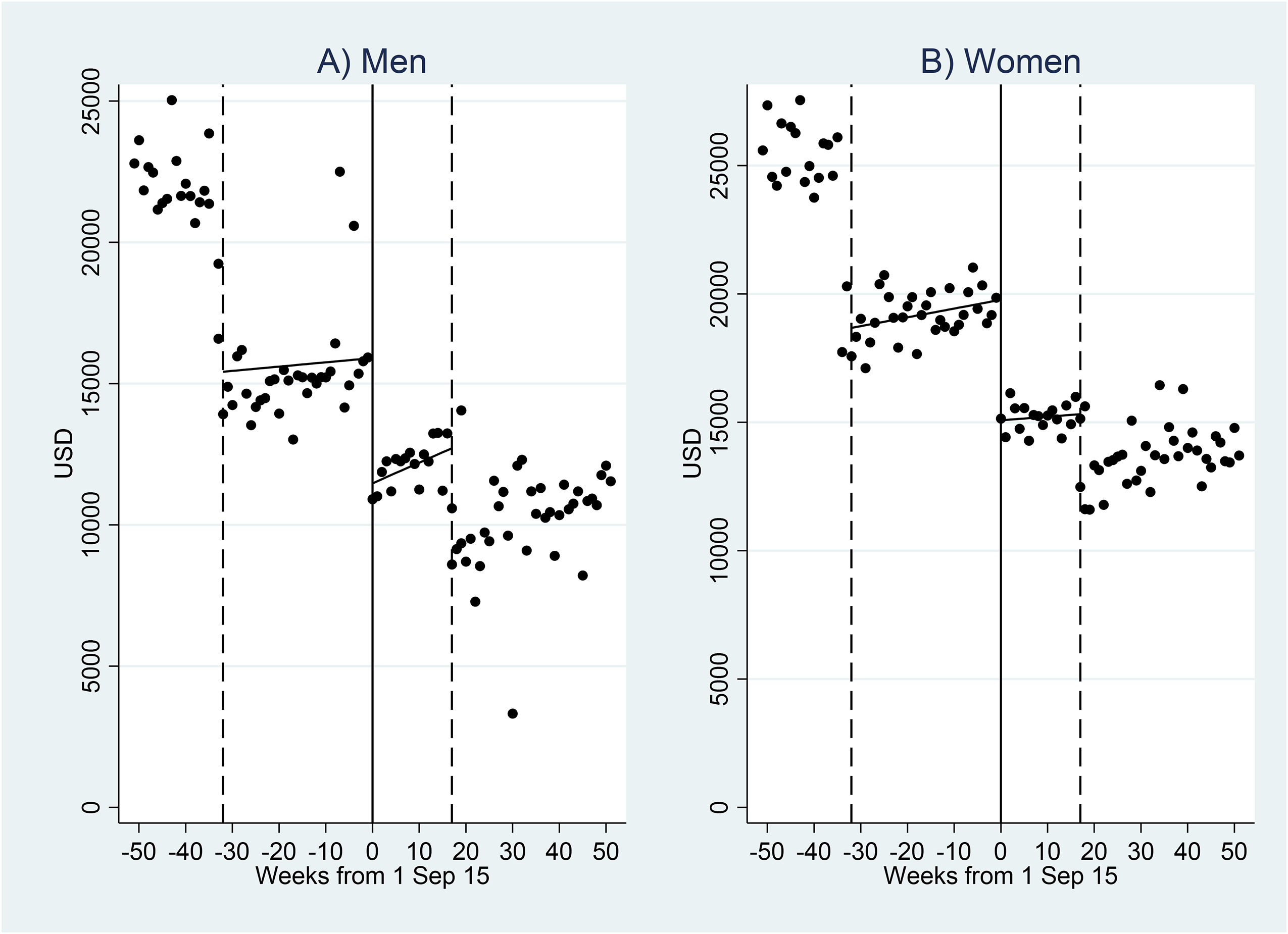
Welfare benefits (DKK) received, by settlement week and gender.
Empirical Design
I use an RD design to estimate the causal effect of the benefit reduction for the main part of the analysis (Thistlethwaite and Campbell 1960; Lee and Lemieux 2010). The intuition behind this design in the current context is that refugees who settle just before and after September 2015 are likely similar, have similar labor market opportunities and face the same need for health care. Note that the design does not require that all immigrants in the estimation sample arriving before and after September 2015 are alike, only those just before and after.
Therefore, given that the only thing that separates refugees who settle just before and after 2015 is that the latter are eligible for the reduced welfare benefits, while the former group are eligible for the higher level at the time of settlement (cf. The Welfare Benefit Reduction section), the effect estimated by RD design identifies the causal effect of the benefit reduction.
Formally, the RD design is defined by a running variable and a threshold. The running variable in the current context is the date, where the refugee has received residency and is registered with an address in the municipality. Since I focus on refugees who receive welfare benefits within one month from the date of residency, this can be measured as the first week receiving welfare benefits
7
. I refer to this point as the date of settlement. The threshold point is September 1, 2015, so the reduced benefit level applies to all refugees with running variable crossing this point. The RD estimates are obtained by the ordinary least square estimator of the following equation:
The estimate of
I use two complementary approaches to estimate the effect of the benefit reduction on annual income and health care utilization. First, I use the RD design solely for the cohorts that settled in 2015. As illustrated in Figure 1, this allows me to focus on the source of variation in benefits that derives from the reduction for cohorts arriving before September 2015 without mixing it with the variation that stems from a differential time spend in the country. A drawback of the annual data is, however, that I never observe the controls when they are never treated (i.e., before 10 months in the country). When outcomes are measured, say, in 2016, the early treated have been treated for the entire year (since their settlement), and the later treated have been treated for the last part of the year. In 2017, early and late treated have been treated the entire year, but for a different amount of time in prior years. An effect at this point therefore implies that the timing of treatment matters for the permanence of the effect. To be able to distinguish the within- and cross-year variation when using annual outcomes, I use a complementary approach including the larger population that settled from 2014 to 2016. For this sample, I define treatment as an indicator variable, 
Validation of the RD Design
This section examines the validity of the RD design by testing for discontinuities in the amount of welfare benefit received at the date expected from the 2015 policy and examines the main threat to the RD design: Manipulation in the running variable and discontinuities in background characteristics.
There is limited scope for manipulation around the threshold by the refugees since most of the refugees applied for residency several months before the benefit reduction was proposed. The welfare benefit reduction was enacted only two months after its proposal and the waiting time for processing applications for asylum was around half a year at the time (Hvidtfeldt and Schultz-Nielsen 2018) and the duration for processing family reunifications also took at least five months (The Danish Immigration Services 2016). Figure 2 illustrates the number of refugees who settled one year before or after September 1, 2015, centered around this date. It shows no signs of heaping around the threshold beyond within-monthly variation.
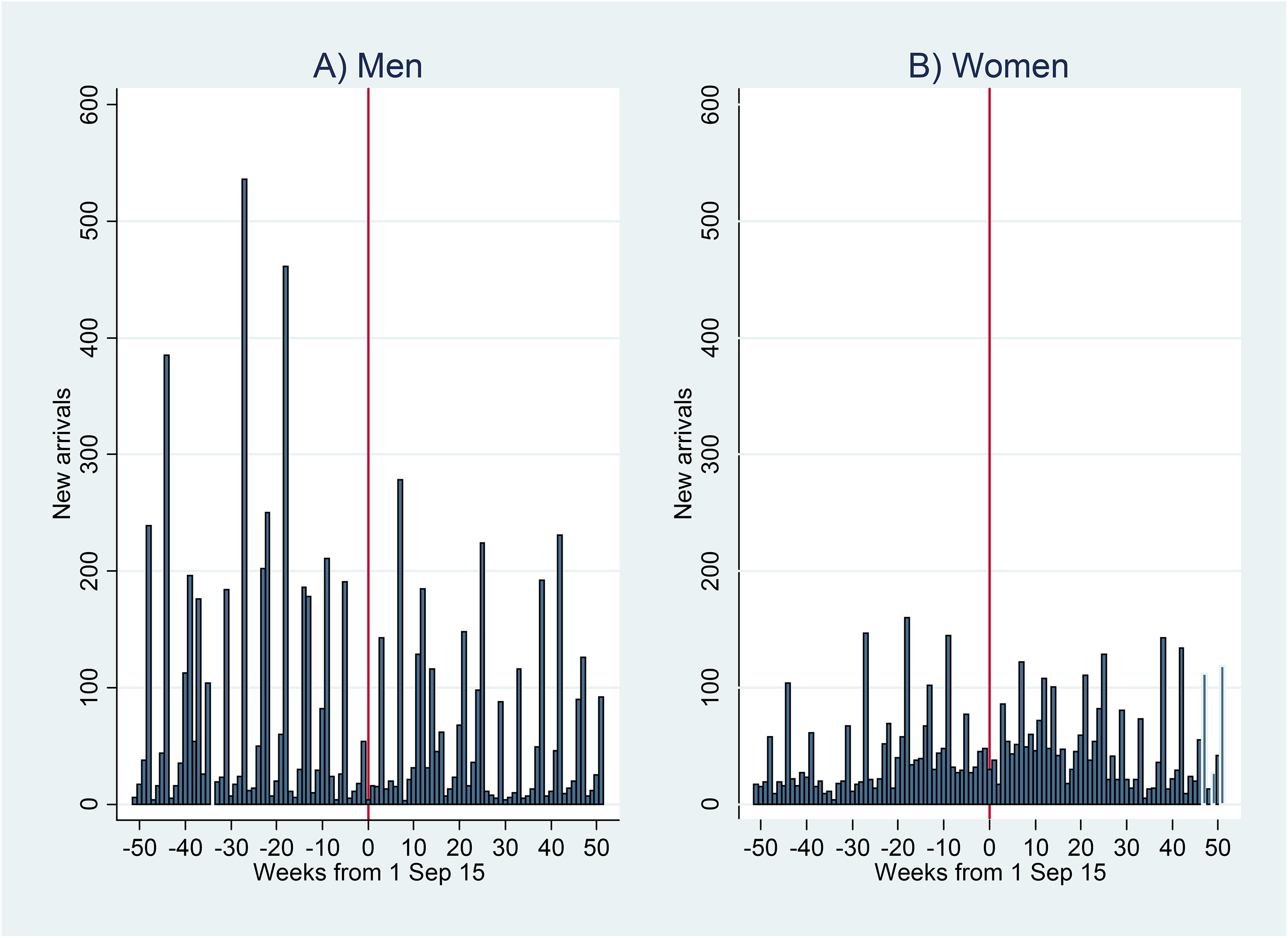
Number of weekly settlers, by gender.
Figure A.1 and A.2 in the appendix show the means of eight characteristics for male and female refugees by the time of settlement. They show that the characteristics vary smoothly over the period with no signs of discontinuous shifts at the threshold. I estimate formally whether a discontinuity is present by estimating model 1 with each covariate as a dependent variable. The results are shown in Table 2 and reveal that many of the coefficient, including the level of Danish course which is based on education prior to arrival, are insignificant. However, there are significant differences in country of origin, also when using alternative RD specifications (Appendix table A.1 and A.2). As an omnibus test, I predict the running variable from a regression of it on the individual characteristics. The predicted running variable has no significant discontinuity around the threshold, supporting that the differences in individual characteristics do not impact the RD estimates (Figure A.3). Below I also show that the observed characteristics do not confound the results when included one at a time in model 1 and further test the design using placebo tests. Nevertheless, I cannot reject that the significant covariate discontinuities can produce biases in the estimated effects.
Results
Effects on Labor Market Outcomes
Table 3 shows the RD effects of the first benefit reform on three monthly labor market outcomes: employment, labor income, and hourly wages. The estimates are obtained with a linear RD specification, controlling for characteristics at settlement that were described in Table 2 8 . Row 1 in Table 3 shows that the effect of the benefit reduction on employment is positive already at eight months after settlement and rises to 3.5 percentage point after 10 months. This is a large effect relative to the counterfactual level of 7.6 percent being employed in the control group after 10 months (shown as baseline in the row below the estimates).
RD Estimates of the Early Benefit Reduction on Labor Market Outcomes.
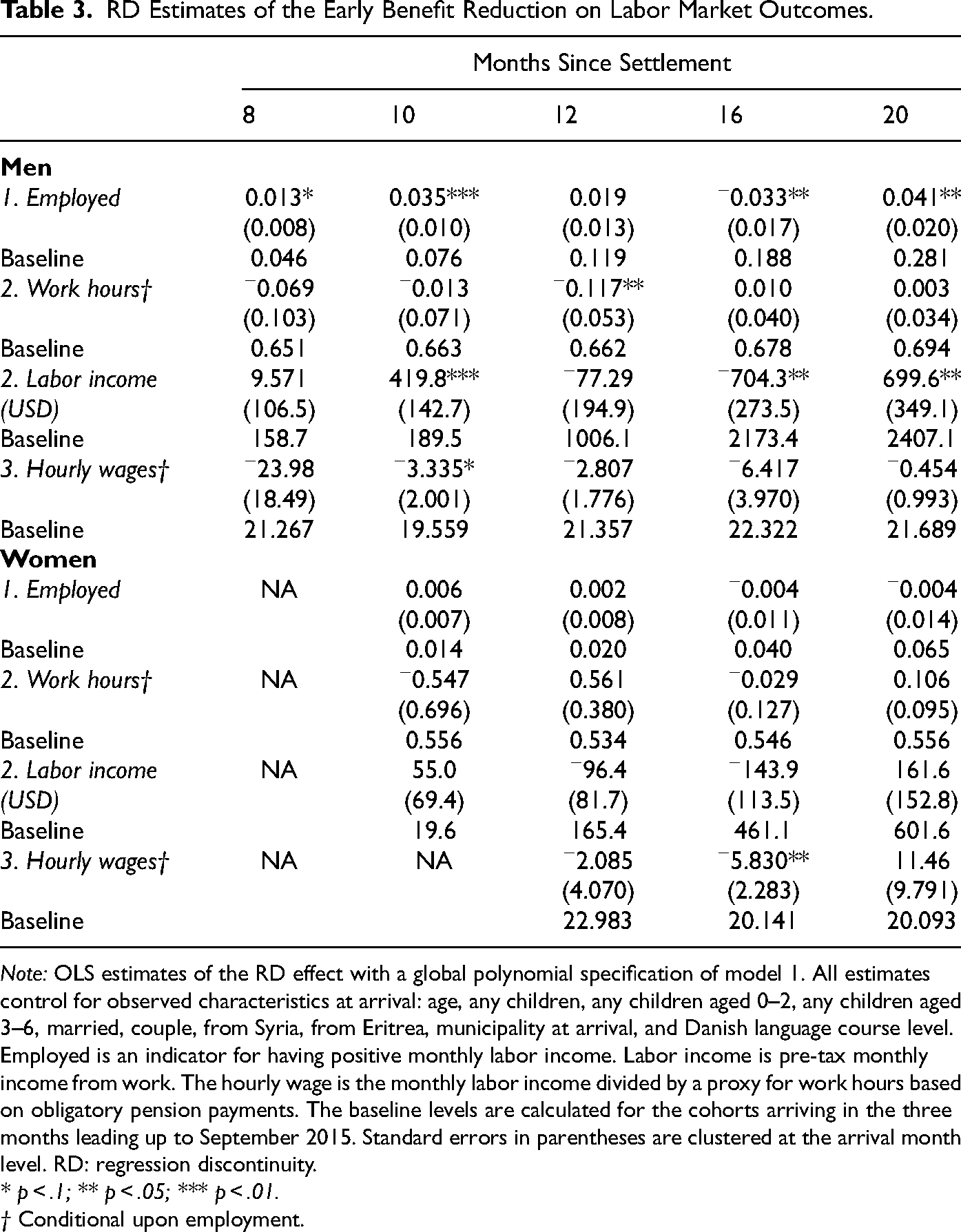
Note: OLS estimates of the RD effect with a global polynomial specification of model 1. All estimates control for observed characteristics at arrival: age, any children, any children aged 0–2, any children aged 3–6, married, couple, from Syria, from Eritrea, municipality at arrival, and Danish language course level. Employed is an indicator for having positive monthly labor income. Labor income is pre-tax monthly income from work. The hourly wage is the monthly labor income divided by a proxy for work hours based on obligatory pension payments. The baseline levels are calculated for the cohorts arriving in the three months leading up to September 2015. Standard errors in parentheses are clustered at the arrival month level. RD: regression discontinuity.
* p < .1; ** p < .05; *** p < .01.
† Conditional upon employment.
The 10 months period is the time when the control group arriving just prior to the threshold also experiences the benefit reduction (because of the amendment to the reform in July 2016). The effect drops at later periods since settlement and becomes significantly negative after 16 months. This pattern is consistent with an interpretation that once the control group experiences the benefit reduction, they catch up relatively quickly. The later treated are expected to be able to respond to the economic incentive faster than the early treated, because the later treated have had time to learn some language and local customs. There is therefore an effect at the extensive labor margin, and row 2 provides evidence as to whether this is also found on the intensive labor margin. Row 2 shows the effect on hours worked, conditionally on employment. The estimates are negative, but all but one are insignificant. The significant effect is large, but not robust to alternative RD specifications (this is further explored in appendix B), and I am therefore hesitant to put too much weight on it. Rows 3 and 4 show that monthly labor income follows a pattern like that for employment, and that there is a tendency for a negative effect on hourly wages conditional upon employment. The baseline hourly wage is around USD 20–23, which is just above the minimum wages determined by collective bargaining. By contrast to these findings, there are no significant labor market effects from the benefit reduction for women (bottom of Table 3).
Figure 3 illustrates the employment effects after 10 months for men and women, by plotting employment levels by weekly settlement cohorts. This figure shows that there is an increasing trend in employment levels for later arriving cohorts, probably due to improved business cycle or other initiatives toward refugees. It however also shows the presence of a discontinuous jump in the level for men affected by the early benefit reduction (i.e., when the running variable is zero, corresponding to settlement at September 2015) over above such a trend, and likewise the absence of any jump for women.
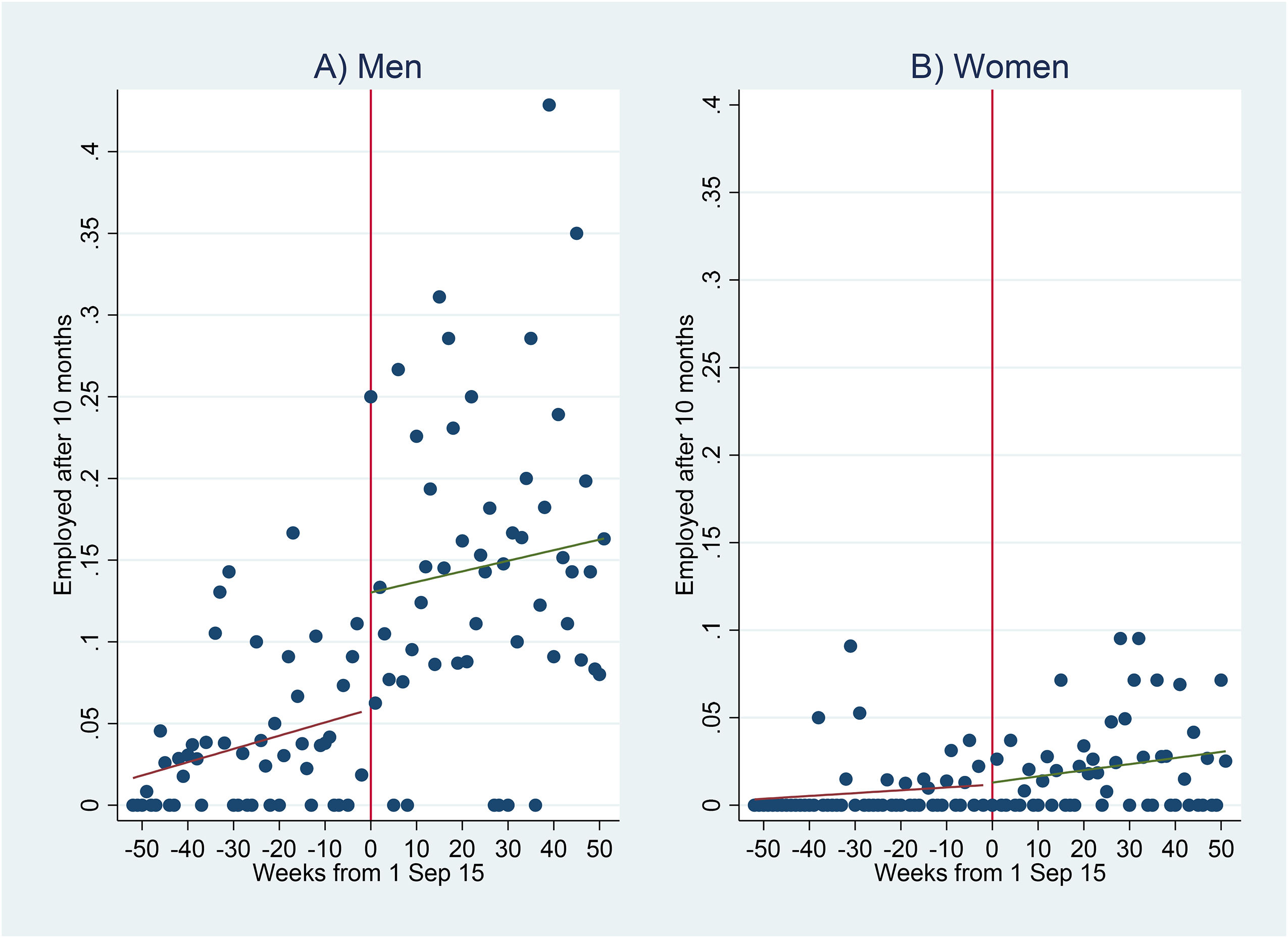
Employment rate after 10 months, by settlement week and gender.
I conclude that the benefit reduction seems to have worked as intended by speeding up labor market entry for some men, possibly because they accept lower paying jobs, although most refugees were already ending up in low paying jobs before the benefit reduction. The results support an interpretation where faster job entry takes place for both the early and the late treated, once treated, as indicated by the catch-up for the later treated. It is nevertheless the case that many male refugees are without work after nearly two years in the country. The benefit reduction did not have the intended effect on women and potential reasons for this are examined below.
The consequences of the welfare benefit reduction on the level of welfare benefits received and on disposable income are described in Table 4. The results are shown for those who settled in 2015 to allow the use of the RD design (see the discussion in the previous section), and the row marked “2016” confirms the substantial drop in welfare benefits that was illustrated in Figure 2. The estimated effects of the policy correspond to reductions of 26 percent and 25 percent for women and men, respectively, relative to the baseline means of the late treated group, even though the latter group have also experienced a benefit reduction during half of 2016.
RD Estimates of the Early Benefit Reduction on Annual Incomes (USD).
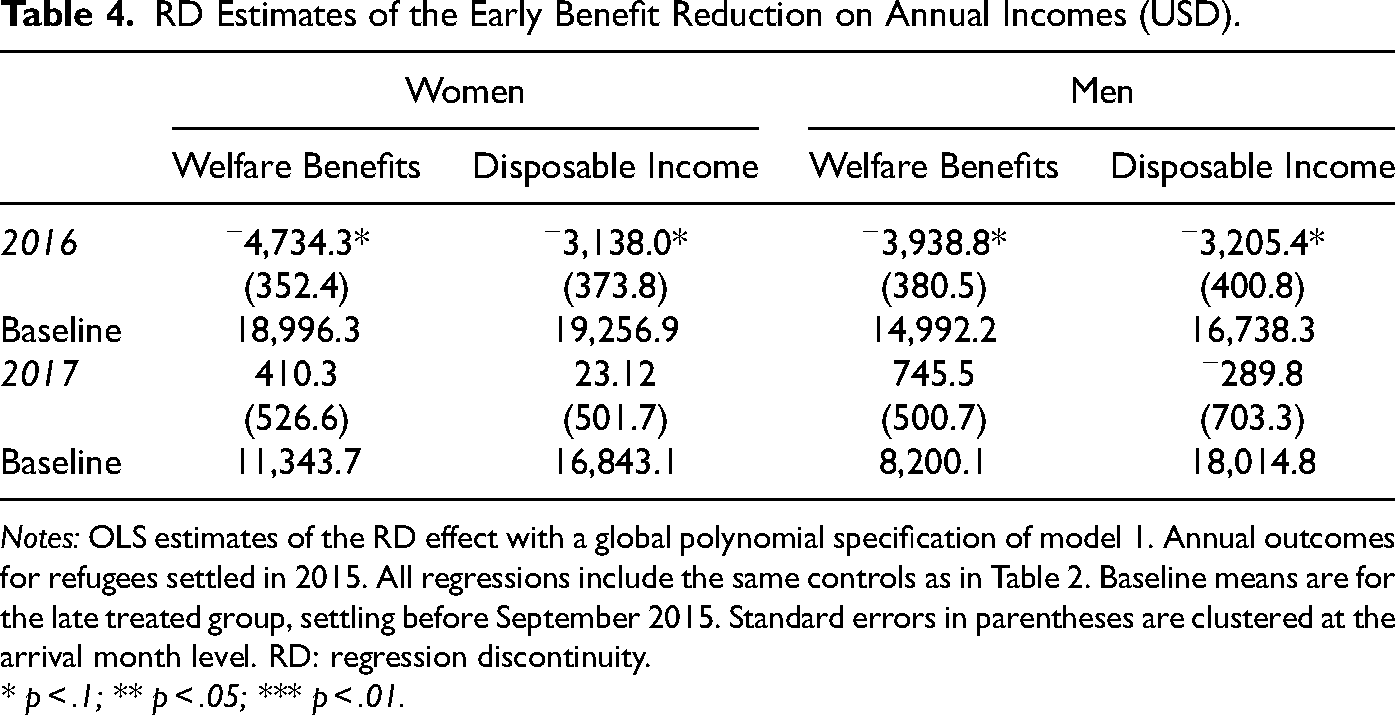
Notes: OLS estimates of the RD effect with a global polynomial specification of model 1. Annual outcomes for refugees settled in 2015. All regressions include the same controls as in Table 2. Baseline means are for the late treated group, settling before September 2015. Standard errors in parentheses are clustered at the arrival month level. RD: regression discontinuity.
* p < .1; ** p < .05; *** p < .01.
Table 4 also shows that the employment response for the early treated that was shown in Table 3 does not counter the benefit reduction in 2016: Disposable income for the early treated refugees drops by USD 3000 compared to the later treated in 2016, that is, by more than two-thirds the size of the drop in welfare benefits. Compared to the baseline mean in the late treated group, this is a drop of 20 percent. The next rows (marked “2017”) show that there is no difference in welfare benefits or disposable income in 2017, once both groups experience the benefit reduction through the entire year.
Effect Heterogeneity in Employment Effects
Before proceeding to consider other outcomes, I examine whether the employment effect after 10 months of the early benefit reduction differs across different demographic groups who, among others, differ in the size of the benefit reduction they experience. I first show this for two different groupings related to the size of the benefit reduction (cf. Table 1). While single providers experience a benefit reduction of up to 15 percent, couples experience a reduction of 40 percent. Likewise, families without children experience benefit reductions of up 12 percent if they are younger than 25 and up to 43 percent if they are older than 30. I show results for both genders, even though there are few singles who are living with children and few women living without children.
Table 5 shows that among men with children, the effect is smaller and insignificant for singles than for men living in couples (columns 1 and 2). This is as expected, since the latter group experience a larger benefit reduction than the former. However, when comparing men without children, those above 30 experience the larger benefit reduction than those below 25, but the impact of the reform is smaller (columns 3 and 4). It is possible that the demographic differences across the groups obscure the results. Indeed, columns 5 and 6 show that effects vary by demographic groups, even when benefit reductions do not: The benefit reduction does not depend on being a single or a couple for families without children. Nevertheless, columns 5 and 6 in Table 5 show that the effect is larger for men living in couples than for single men. There is a slight tendency for the opposite to be true for women. These results indicate that the labor market response differs across family types for men and women, given a similar benefit reduction, which might indicate that the difference between the effect for men and women is related to gender roles, and that — within couples — the male is expected to be the breadwinner.
RD Effects of the Early Benefit Reduction on Employment After 10 Months, by Family Type.
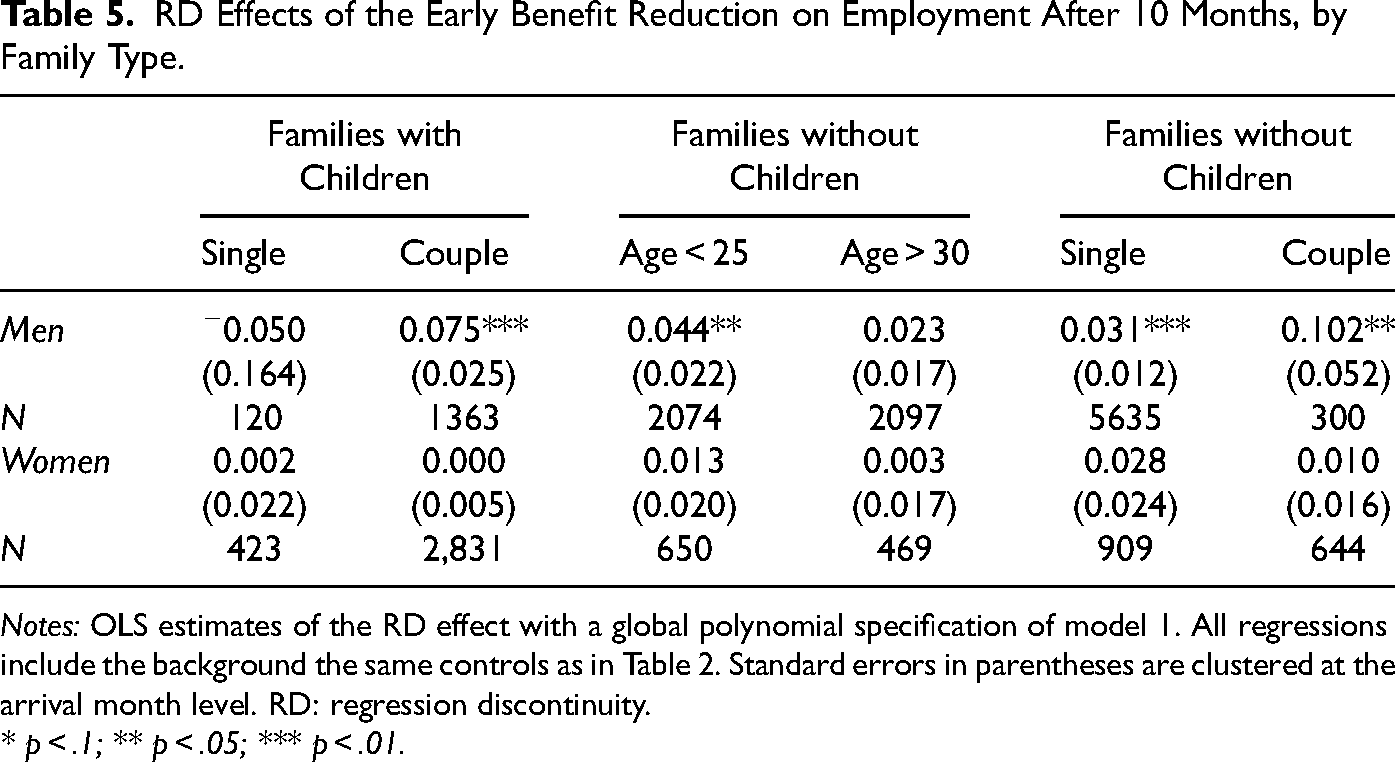
Notes: OLS estimates of the RD effect with a global polynomial specification of model 1. All regressions include the background the same controls as in Table 2. Standard errors in parentheses are clustered at the arrival month level. RD: regression discontinuity.
* p < .1; ** p < .05; *** p < .01.
Effects on Crime
Criminal charges and particularly convictions are relatively rare in this sample: 4 percent of the men in the control group had been charged with a crime after two years in the country and less than 1 percent were convicted. For women in the control group only 0.8 percent had been charged with a crime and only 0.5 percent were convicted after two years. This is a much lower prevalence rate than reported in a previous study of benefit reductions (Andersen, Dustmann, and Landersø 2019) and aligns well with the general decrease in crime charges and convictions based on criminal law (mainly violence and property crime) observed over the last decades in Denmark (Statistics Denmark 2021).
The greater similarity between charges and convictions for women than for men probably reflects that theft constitutes a much large share of the charges for women, and the time needed to reach a conviction, once charged, is much lower for this type of crime than for most other types of crime. Given that the share of crimes is so low, I only present the effects on whether the individual has ever been charged with a crime after 22 months. Table 6 shows that the early benefit reduction has a very small and insignificant effect on men and a positive effect on women, which is significant on a 10 percent level.
RD Effects of the Early Benefit Reduction on Criminal Charges After 22 Months.
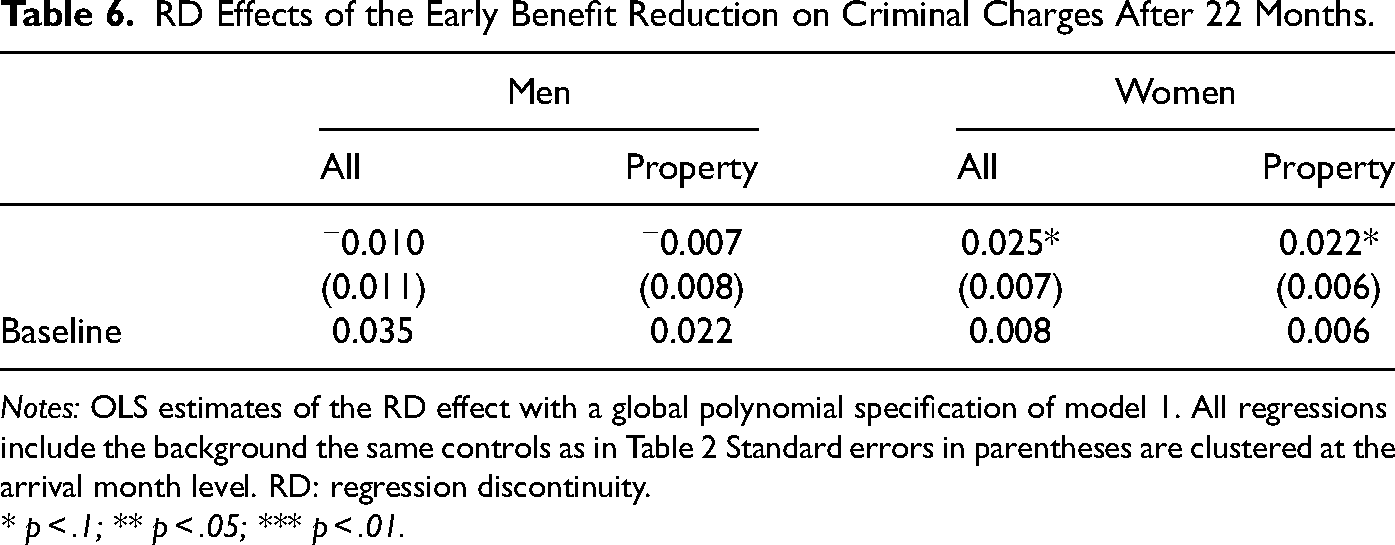
Notes: OLS estimates of the RD effect with a global polynomial specification of model 1. All regressions include the background the same controls as in Table 2 Standard errors in parentheses are clustered at the arrival month level. RD: regression discontinuity.
* p < .1; ** p < .05; *** p < .01.
Effects on Health Care Utilization
In this section I consider annual health-care utilization in 2016 and 2017. As with the annual measures of income I focus on refugees who arrived in 2015. It is shown in Appendix B that this restriction does not affect the estimates on monthly labor market outcomes and is therefore not expected to do so here either.
Table 7 shows the RD effects on annual health care utilization and reveals that the early benefit reduction increases the total number of health care contacts for women by nearly four contacts in 2016. It also shows that the number of contacts to general practice alone increases by 3.4. Relative to the baseline mean in the later treated group, this is an increase of 17 percent (3.4/20.2). There is no significant change in the use of specialized care providers treating mental (psychologists or physiotherapists) or physical injuries (chiropractors and physiotherapists). The results also show an increase of 5.5 percentage points in the incidence of being hospitalized for women (excluding pregnancies and births) in 2016. Relative to the control group, this is an increase of nearly 60 percent (0.055/0.093). The last column shows no effect on hospitalizations due to pregnancies and births. Looking at men at the bottom of the table, there are no significant effects on health care utilization in 2016. The effect on hospitalization is positive, as for women, but insignificant.
RD Effects of the Early Benefit Reduction on Primary Health-Care Utilization.
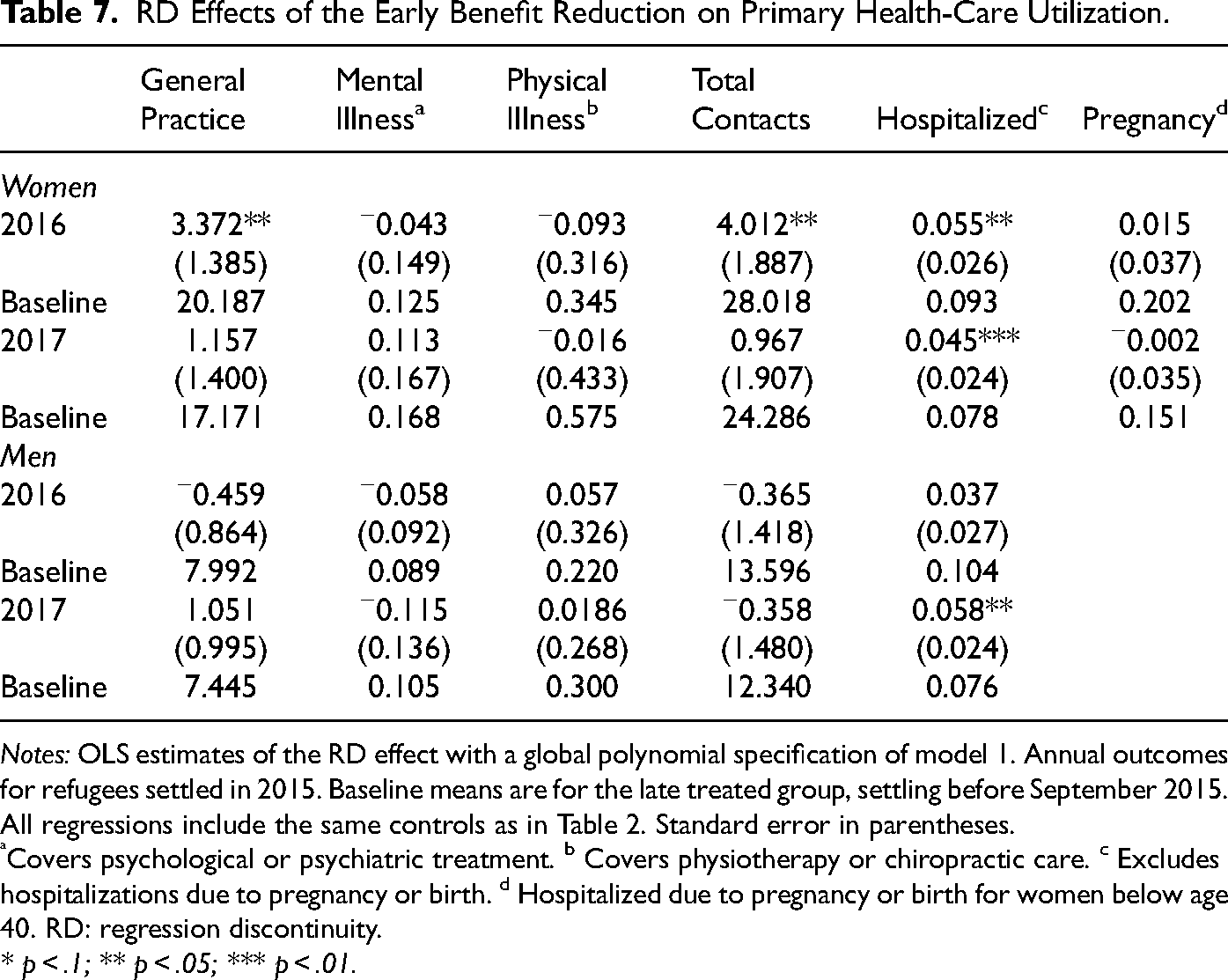
Notes: OLS estimates of the RD effect with a global polynomial specification of model 1. Annual outcomes for refugees settled in 2015. Baseline means are for the late treated group, settling before September 2015. All regressions include the same controls as in Table 2. Standard error in parentheses.
Covers psychological or psychiatric treatment. b Covers physiotherapy or chiropractic care. c Excludes hospitalizations due to pregnancy or birth. d Hospitalized due to pregnancy or birth for women below age 40. RD: regression discontinuity.
* p < .1; ** p < .05; *** p < .01.
There are also no significant effects on contacts to general practice or other types of health care providers for men or women in 2017, after the later treated have also experienced the benefit reduction. The risk of hospitalization remains positive and significant for women and becomes significant for men in 2017.
I supplement these results with estimates of model 2, where I utilize another part of the variation in the benefit reduction, and control for within- and cross-year variation in health care utilization. The results are shown in Table 8. The estimates confirm the absence of an effect for men and a positive and significant effect on hospitalization and general practice for women in the first year after settlement, although both effects are smaller than the RD estimates.
OLS Effects of the Benefit Reduction on Health Care Utilization, 2014−2016 Arrivals.
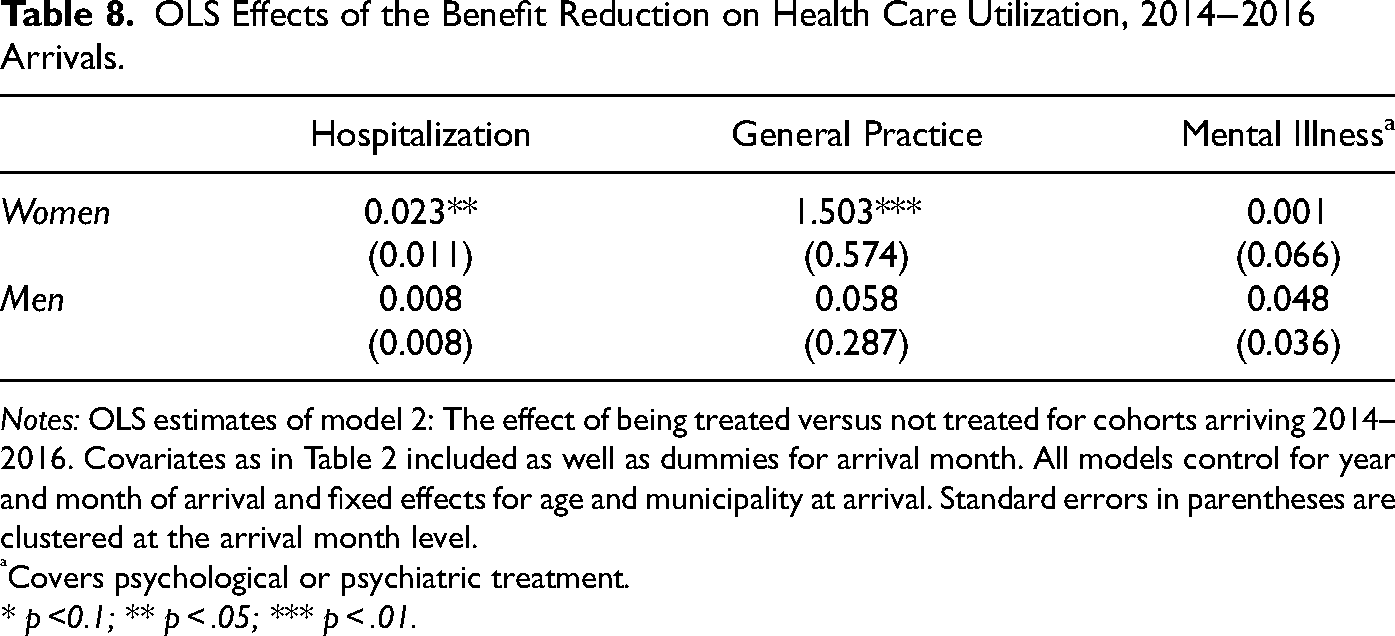
Notes: OLS estimates of model 2: The effect of being treated versus not treated for cohorts arriving 2014–2016. Covariates as in Table 2 included as well as dummies for arrival month. All models control for year and month of arrival and fixed effects for age and municipality at arrival. Standard errors in parentheses are clustered at the arrival month level.
Covers psychological or psychiatric treatment.
* p <0.1; ** p < .05; *** p < .01.
Effects on Family Formation
I finally examine whether the benefit reduction alters family formation by considering changes in couple status and parenthood. If more refugees self-select into groups with relatively smaller benefit reductions, that is, get children or split up to live as singles, such selection will mitigate the intention of the policy. Table 9 shows there is indeed a small and negative effect of the early benefit reduction on the likelihood that men start to live in a couple after two years. The effect on parenthood is also negative. The results are, however, not clearly supported by the robustness analyses (see Appendix B), so I do not put too much emphasis on these results.
RD Effects of the Early Benefit Reduction on Family status After Two Years, by Gender.
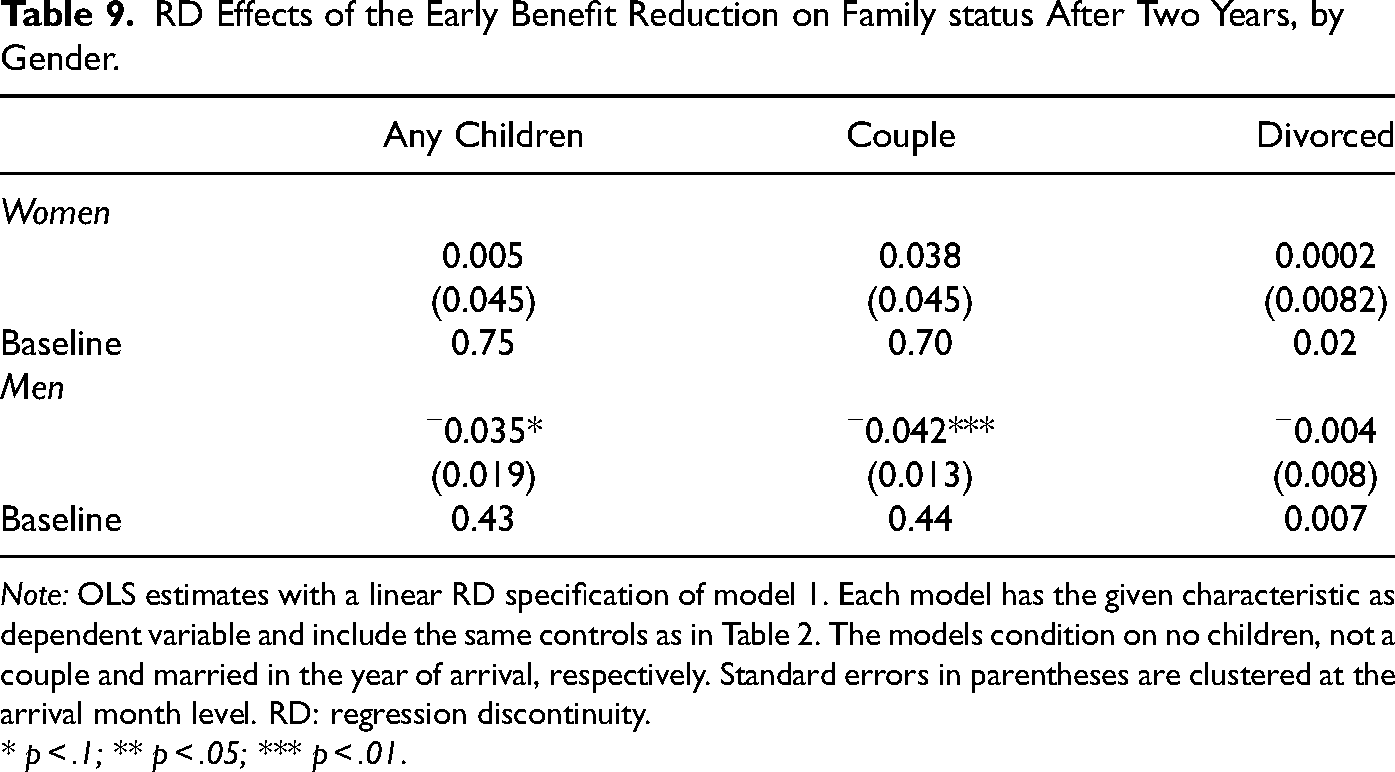
Note: OLS estimates with a linear RD specification of model 1. Each model has the given characteristic as dependent variable and include the same controls as in Table 2. The models condition on no children, not a couple and married in the year of arrival, respectively. Standard errors in parentheses are clustered at the arrival month level. RD: regression discontinuity.
* p < .1; ** p < .05; *** p < .01.
Robustness
I conduct several analyses to examine the robustness of the findings. I mainly focus on the main employment effect since it is hypothesized to be driving much of the other findings. The robustness analyses include examination of the sensitivity of findings to alternative RD specifications, limitation of the sample window to a narrower window of arrivals around September 2015, and changes in estimates when including covariates. These results can be found in Appendix B. None of these robustness checks provide strong evidence against the RD design nor against the finding that the welfare benefit reduction does not raise employment for men nor raise health care for women.
In addition to the robustness analyses, I include two sets of placebo estimates for employment after 10 and 16 months and for hospitalization. First, I estimate the RD model for native Danes who have stayed in Denmark for eight years in 2015 and are not subjected to the benefit reduction (cf. The Welfare Benefit Reduction section). As a running variable, I use the date when a new welfare benefit spell begins. Second, I estimate the RD model for refugees who arrived in 2013, who therefore were not affected by the welfare benefit reduction in their first year since arrival. For both placebo designs I artificially set the threshold in the RD model to September (in 2013 and 2015, respectively). Table 10 shows that all the placebo estimates are insignificant. Some of the estimates for the natives are relatively large, but negative, suggesting that — if they are capturing labor market conditions or political changes for welfare benefit recipients that are also affecting refugees — I am underestimating the true effect.
Placebo RD Estimates of the Early Benefit Reduction on Employment and Hospitalization.
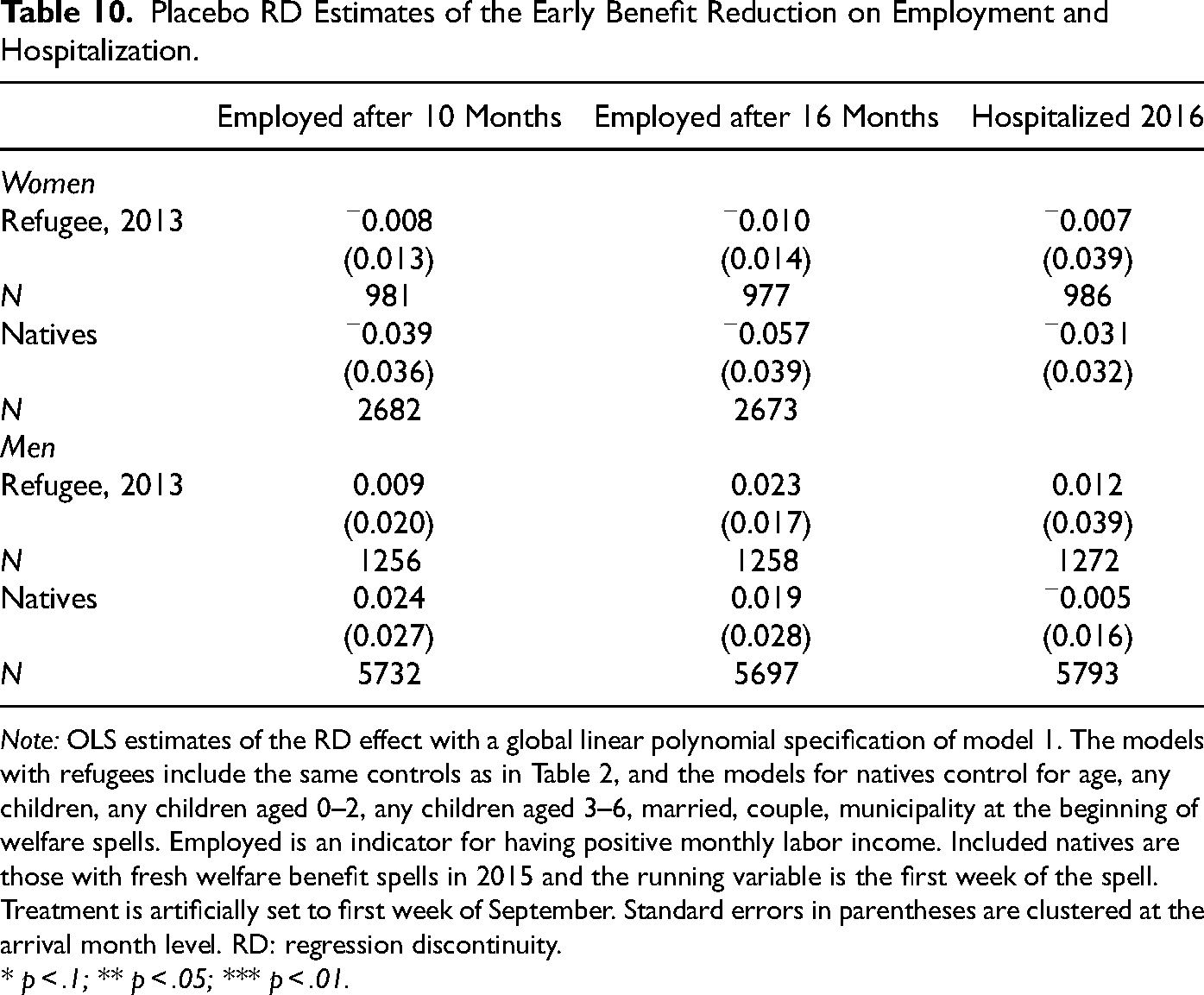
Note: OLS estimates of the RD effect with a global linear polynomial specification of model 1. The models with refugees include the same controls as in Table 2, and the models for natives control for age, any children, any children aged 0–2, any children aged 3–6, married, couple, municipality at the beginning of welfare spells. Employed is an indicator for having positive monthly labor income. Included natives are those with fresh welfare benefit spells in 2015 and the running variable is the first week of the spell. Treatment is artificially set to first week of September. Standard errors in parentheses are clustered at the arrival month level. RD: regression discontinuity.
* p < .1; ** p < .05; *** p < .01.
Discussion
I show that an early benefit reduction triggers an expected labor market effect for male refugees and raises their employment in the first year since settlement. For the population of refugee women, the benefit reduction has no effect on their labor market behavior, but triggers an unwarranted effect: More women seek health care, are hospitalized, and a small portion of the affected female refugee commit more thefts, presumably attempting to sustain living standards.
The findings are in concordance with studies that examine an earlier benefit reduction in 2002 in Denmark (Huynh, Schultz-Nielsen, and Tranæs 2010; Rosholm and Vejlin 2010; Andersen et al. 2019, Andersen, Dustmann, and Landersø 2019). They too find a large positive labor market effect for men, a smaller or insignificant employment effect for women, and an effect on crime for women (Andersen, Dustmann, and Landersø 2019). The effects on crime are also in concordance with other studies that examine how income changes affect the propensity to commit crimes for groups with low income (Corman, Dave, and Reichman 2014, 2017; Liebertz and Bunch 2017). The replication of the labor market effects found in the study of the 2002 reform is particularly important because the 2002 reform differed in several respects from the one considered in the current study, and because the effects of the 2002 reform are at odds with findings for refugees in the United States, where a higher benefit level did not impact employment but raised hourly wages (LoPalo 2019). To start with the differences between the reforms: the benefit reduction in 2002 was larger than in 2015, it affected a smaller group of refugees originating from different countries, and while the total number of refugees increased sharply in 2015, the opposite was true in 2002. Another important difference is the 2002 reform was implemented at a time where there was a maximum level of welfare benefits that couples could receive, roughly corresponding to the pre-reform level for one individual. Therefore, women who arrived after the reform were not affected if their husband arrived prior to the reform. A salient contribution of Andersen, Dustmann, and Landersø (2019) is that they show that this mitigates the impact of the welfare reduction for women. Notably, the ceiling was abandoned in 2011 and only reintroduced in 2016 9 . The absence of an effect for women in 2015 is therefore not due to the welfare ceiling. The current study therefore shows that the benefit reduction has a short-term employment effect under such different conditions.
There are several potential reasons for the discrepancy in results from Denmark and the United States, which makes comparison difficult. Refugees in the United States differ from refugees arriving in Europe, among others because a majority are selected by US Admission programs, whereas refugees mostly come to Europe as asylum applicants (Poutvaara and Wech 2016). Another reason is that the welfare benefits available to refugees are often lower in the United States than in Northern Europe and that it is easier to respond to the economic incentive because the number of low-wage jobs is higher 10 . In concordance with these differences, employment rates increase much faster in the United States than in Europe, whereas similar trajectories are found with respect to wage levels (Brell, Dustmann, and Preston 2020).
I add to this literature and find that the early benefit reduction also increases the risk of hospitalization and the use of general practice in the first year after arrival for the female refugees. The increased use of general practice for women concurrent with an absence of any effect on use of psychological treatment may indicate an increase in mild or undiagnosed conditions that can be treated by the general practitioner and use of medication. It is also possible that more severe diagnoses, such as post-traumatic stress syndrome, have not yet developed. I cannot rule out that they seek care for other reasons, for instance, simply because they are worried or experience mild distress, or simply to avoid the benefit reduction. However, the increased risk of hospitalization, where a referral from a general practitioner is needed, supports the interpretation that the income reduction is stressful and triggers the need for care or further examinations. I find no effect on family formation and parenthood, but the time horizon is likely too limited to detect any such effects.
The lack of an effect on the use of general practice for men could be the results of utilization patterns where men are more reluctant to seek health care until there are physical symptoms that warrant examinations at the hospital (Galdas et al. 2005; Wang et al. 2013). Such a pattern is likely to be exacerbated in the short run by the response in the labor market: The welfare benefit reduction almost doubles the share of men who are employed 10 months after their arrival, whereas no employment effect is seen for women. Therefore, it is possible that men use less time to consult general practice, and hence receive fewer subsequent referrals for further examinations at hospitals, because they spend more time searching for jobs and working. The differential gender pattern may also arise because gender roles play a particular significant role for the refugees, where men act as breadwinners and more women react by distress, that may lead some to commit more shoplifting to contribute to uphold everyday living standards.
The current study has some limitations that need to be highlighted. First, I examine a benefit reduction compared to a later benefit reduction. Therefore, I cannot infer the long-term effects of the benefit reduction relative to permanent eligibility for the higher level. As seen in Andersen, Dustmann, and Landersø (2019), the previous benefit reduction in Denmark from 2002 did not have lasting labor market effects, whereas unintended effects on crime and children of the affected refugees were of a more lasting nature. A second limitation is that I only examine intent-to-treat effects. However, since take-up rates of welfare benefits are high (96% in the first year after they settle), the intent-to-treat effects are expected to be close to average treatment effects for the treated. A third limitation is that the study is not very informative about mechanisms. Thus, we still fall short of explaining how benefit reductions affect job search behavior, and why some seek more health care. To mention one potential mechanism which is unfortunately not possible to examine with the data; benefit reductions might affect the degree to which refugees participate in the informal sector. Fourth, I do not measure health directly, only health care utilization. I believe though that the use of objective measures of health care utilization, particularly the indicator of hospitalization, supplements the use of self-reported health measures which has mainly been used in previous literature (Porter and Haslam 2005; Hynie 2018). Fifth, I only consider partial effects. It cannot be ruled out that the sudden increase in refugees that occurred in 2015 and 2016 had a general equilibrium effect, which likely would reduce wage levels and lower the economic incentive to work. It is also possible that the sudden increase prolongs unemployment duration from the increased competitiveness for jobs. Such effects are, however, most likely not very large, since only 12,000 adult refugees settled one year before and after the benefit reduction, while the Danish labor market includes close to 400,000 manual jobs and more than 1,000,000 additional jobs requiring basic skills 11 . Finally, it must be stressed that even though the model survives several placebo tests, I cannot rule out that the failure of some of the validation tests, the significant discontinuities on covariates like country of origin and convention status, can bias the results.
With these caveats in mind, the results may have important policy consequences since they show that when welfare reforms do not have the intended effects of raising income through increased labor market participation, they may backfire on other dimensions. This result adds to previous findings on unintended consequences of welfare restrictions on education, crime, drug use, and outcomes for the next generations (Dave, Reichman, and Corman 2012; Corman et al. 2014; Dave et al. 2019; Andersen, Dustmann, and Landersø 2019). In the current setting, unintended effects reveal themselves in terms of increased crime rates and health care utilization. This is obviously important both for the well-being of the refugees but also for the long-term fiscal costs of immigration. The political rationale behind welfare restrictions may obviously differ: Some may justify restrictions with references to economic fairness, that rights must be earned, others to deter refugees from applying for asylum, and political preferences across integration domains (employment, civic integration, social rights, etc.) may differ. I interpret the findings as a lack of support for the motivation behind many welfare benefit restrictions, including the current Danish case, where it has been argued that economic incentives are crucial for integration. Whether this is the case for other types of welfare state support or restrictions deserves separate attention.
Supplemental Material
sj-docx-1-mrx-10.1177_01979183231160713 - Supplemental material for Welfare Benefit Generosity and Refugee Integration
Supplemental material, sj-docx-1-mrx-10.1177_01979183231160713 for Welfare Benefit Generosity and Refugee Integration by Jacob Nielsen Arendt in International Migration Review
Supplemental Material
sj-docx-2-mrx-10.1177_01979183231160713 - Supplemental material for Welfare Benefit Generosity and Refugee Integration
Supplemental material, sj-docx-2-mrx-10.1177_01979183231160713 for Welfare Benefit Generosity and Refugee Integration by Jacob Nielsen Arendt in International Migration Review
Footnotes
Acknowledgements
The study has benefited greatly from Rasmus Landersø and from participants at seminars at the ROCKWOOL Foundation and the Danish Center for Social Science Research. I am alone responsible for the content and any errors therein.
Declaration of Conflicting Interests
The author declared no potential conflicts of interest with respect to the research, authorship, and/or publication of this article.
Funding
The author disclosed receipt of the following financial support for the research, authorship, and/or publication of this article: This work was supported by the Rockwool Fonden (grant number 1191).

Supplemental Material
Supplemental material for this article is available online.
Notes
References
Supplementary Material
Please find the following supplemental material available below.
For Open Access articles published under a Creative Commons License, all supplemental material carries the same license as the article it is associated with.
For non-Open Access articles published, all supplemental material carries a non-exclusive license, and permission requests for re-use of supplemental material or any part of supplemental material shall be sent directly to the copyright owner as specified in the copyright notice associated with the article.
