







Abstract
Social science research has produced evidence of an “integration paradox”: immigrants and their descendants who appear to have greater access to mainstream middle-class society, as indicated by their education or labor market success, often report experiencing more discrimination. Several explanations have been put forth to account for this counterintuitive pattern, supported by a wealth of empirical evidence. To assess the reliable insights generated by this line of research, this article presents a review and meta-analytic analysis of the integration paradox. The article reviews the major theoretical arguments advanced in literature, and derives crucial hypotheses concerning the phenomenon's overall nature, underlying mechanisms, and two key moderating conditions. Specifically, it discusses how factors like better education, which appear to signal improved integration into mainstream society, may also lead to greater exposure to mainstream members, heightened familiarity with exclusionary public discourse, or a heightened risk of downward social mobility. By increasing cognitive susceptibility to framing experiences in terms of discrimination or simply the opportunities to encounter discrimination, these mechanisms are expected to increase reports of discrimination. To test these propositions, the study summarizes and evaluates 280 statistical estimates published in 42 studies, utilizing recent developments in multilevel meta-analysis. The findings support the credibility of the integration paradox, particularly for immigrant minorities who are easily distinguishable from the mainstream and for those who reside in countries with a more open socio-political context of reception. However, the results also suggest that additional research is needed to fully comprehend the underlying mechanisms of the paradox.
Introduction
Social science research has revealed an “integration paradox”: immigrants and their descendants with seemingly better access to mainstream middle-class society — as evidenced by their education, labor market success, length of residence, or generational status — often report more discrimination than those on the societal margins (Steinmann 2019; Verkuyten 2016). In other words, even though they appear integrated into middle-class mainstream society based on their education, labor market success, and so on, their reports of discrimination indicate continued exclusion from it. These findings contradict one of the assumptions of classic assimilation theory, which suggests that discrimination should disappear among immigrants who have successfully assimilated into mainstream society (Gordon 1964). This assumption is based on the argument that better language skills, acculturation, and improved economic status should blur group boundaries and consequently reduce experiences of discrimination (Horr, Hunkler and Kroneberg 2018; Koopmans, Veit and Yemane 2019).
However, 40 years ago, Portes, Parker and Cobas (1980) challenged this assumption by arguing that improvements in terms of language skills or education do not necessarily blur group boundaries or guarantee integration into mainstream society. Instead, such acculturation can lead to an increased awareness of facing a persistent ethno-racial minority status in society. This mechanism, according to their argument, can cause indicators of integration — that is, indicators that typically suggest access to middle-class mainstream society (Alba and Nee 2009; Drouhot and Nee 2019) — to predict increased perceptions of discrimination. More recently, scholars have developed these ideas into the “integration paradox” and its two basic mechanisms: better integration may increase opportunities to experience discrimination, and it may increase cognitive susceptibility to frame experiences in terms of discrimination (Buijs, Demant and Hamdy 2006; Doorn, Scheepers and Dagevos 2013; Vroome, Martinovic and Verkuyten 2014; Geurts, Davids and Spierings 2021).
As is typical in the social sciences, studies on the integration paradox have produced a range of mixed evidence, including studies that contradict it altogether (e.g., Maaren and Rijt 2018). This manuscript provides a review of the integration paradox and a meta-analysis of quantitative studies to identify reliable insights produced by this line of research. Using recent developments in multilevel meta-analysis (Konstantopoulos 2011; Van den Noortgate et al. 2013), we analyze a diverse sample of 280 estimates reported in 42 studies. Our results indicate systematic evidence of an integration paradox and no indication of publication bias. Indicators of better access to mainstream society are typically associated with increased perceptions of discrimination, especially among more easily identifiable immigrant minorities and those who reside in countries with a more open socio-political context of reception, which eases immigrants’ and their descendants’ access to mainstream society. The latter finding links the rather micro-level oriented debate about the integration paradox to classic macro-level research on Tocqueville's paradox, which argues that social and equal-treatment policies may increase the salience of remaining inequalities (Tocqueville 2015 [1840]). However, we find little support for the presumed mechanisms of the integration paradox in mediating the relationship between reported discrimination and broad indicators of integration.
In the following, we start by reviewing the key theoretical arguments about the integration paradox put forward in the qualitative and quantitative literature on the topic. We derive three hypotheses about the underlying mechanisms and two about moderating conditions. We then explain the sampling, coding, and statistical modeling strategy of our meta-analysis of quantitative studies in the field. Thereafter the results section starts with an overall meta-estimate of the integration paradox, continues into testing different broad indicators of integration, and then discusses support for the proposed mechanisms and moderating conditions. We conclude by discussing problems of the integration paradox literature arising from the ambivalent nature of the indicators of integration typically used in the debate. For example, a higher share of mainstream members in the neighborhood can imply more superficial contact with frequent discriminatory experiences, or self-selection into a safe neighborhood with selected mainstream friends. This ambivalence gives the debate its paradoxical and hence interesting appeal. But it also results in inevitably mixed evidence and the need for improved measures in future research.
Theoretical Background: Why and When an Integration Paradox?
The Thomas Theorem (Thomas and Thomas 1928), according to which situations are real in their consequences if we define them as real, is a cornerstone of the social sciences. Therefore, it should not be surprising that “mere” perceptions of discrimination are a menace to immigrants and their descendants — irrespective of the actual discrimination they face (Pascoe and Richman 2009; Safi 2010; Spencer, Logel and Davies 2016; Verwiebe et al. 2016). Classic assimilation theory formulates the optimistic outlook that the menace of discrimination will decline, the better immigrants and their descendants establish themselves as part of mainstream society (Gordon 1964).
The literature on the integration paradox, however, challenges the notion that the process is straightforward. Factors that typically indicate access to mainstream society, such as education and length of residence or generation, often predict more reported discrimination, which suggests ongoing exclusion (Flores 2015; Diehl, Liebau and Mühlau 2021; Tuppat and Gerhards 2021). In other words, even though immigrants and their descendants may appear to be integrated into middle-class mainstream society based on their education, labor market success, and so on, their reports of discrimination imply continued marginalization. Social scientists have proposed several explanations of this counter-intuitive pattern. On a fundamental level, all these explanations can be reduced to two basic mechanisms: Better integration in terms of access to the mainstream may increase opportunities to face discrimination and increase the cognitive susceptibility to frame experiences in terms of discrimination (Doorn, Scheepers and Dagevos 2013; Maxwell 2015; Schaeffer 2019). Some scholars further argue that via increased perceived discrimination, immigrants and their descendants may turn away from identifying with mainstream society (Geurts, Davids and Spierings 2021; Verkuyten 2016). But because reduced identification with mainstream society is only one among several consequences (e.g., mental and physical health, religiosity), this article focuses on reports of discrimination for reasons of brevity.
Figure 1 visualizes the integration paradox model as synthesized from the literature. The model consists of two basic mechanisms and two basic moderating conditions that alter the relation between integration and reported discrimination (as indicated by the four white X). Before turning to these mechanisms and moderating conditions below, we would like to stress that from the left-hand side, the model starts with broad indicators of integration, that is, access to mainstream society. This is because broad indicators of immigrant integration plausibly set off both mechanisms leading to increased reports of discrimination. In other words, from a theoretical point of view these broad indicators of integration should be regarded as causally prior to others, such as the frequency of news media consumption, or social exposure to mainstream members in the neighborhood (Doorn, Scheepers and Dagevos 2013; Vroome, Martinovic and Verkuyten 2014; Steinmann 2019). The four most obvious broad indicators of integration are: education (including education attained abroad), labor market attainment, and length of residence or generational status. There may be some who question whether education attained abroad, the length of one's residence, or generational status are accurate indicators of integration. However, many scholars contend that, with regards to the integration paradox, these two indicators share a crucial trait with the more definitive indicators of domestic education and labor market attainment. All of these broad indicators assist in gaining access to mainstream middle-class society, but in doing so, they also heighten (i) exposure to mainstream members and therefore the likelihood of encountering discrimination, as well as (ii) the cognitive susceptibility to frame experiences in terms of discrimination. This argument leads to the central hypothesis of the integration paradox: increased access to mainstream middle-class society, as broadly indicated by education, labor market attainment, and length of residency or generational status, predicts increased reports of discrimination among immigrants and their descendants (H1).
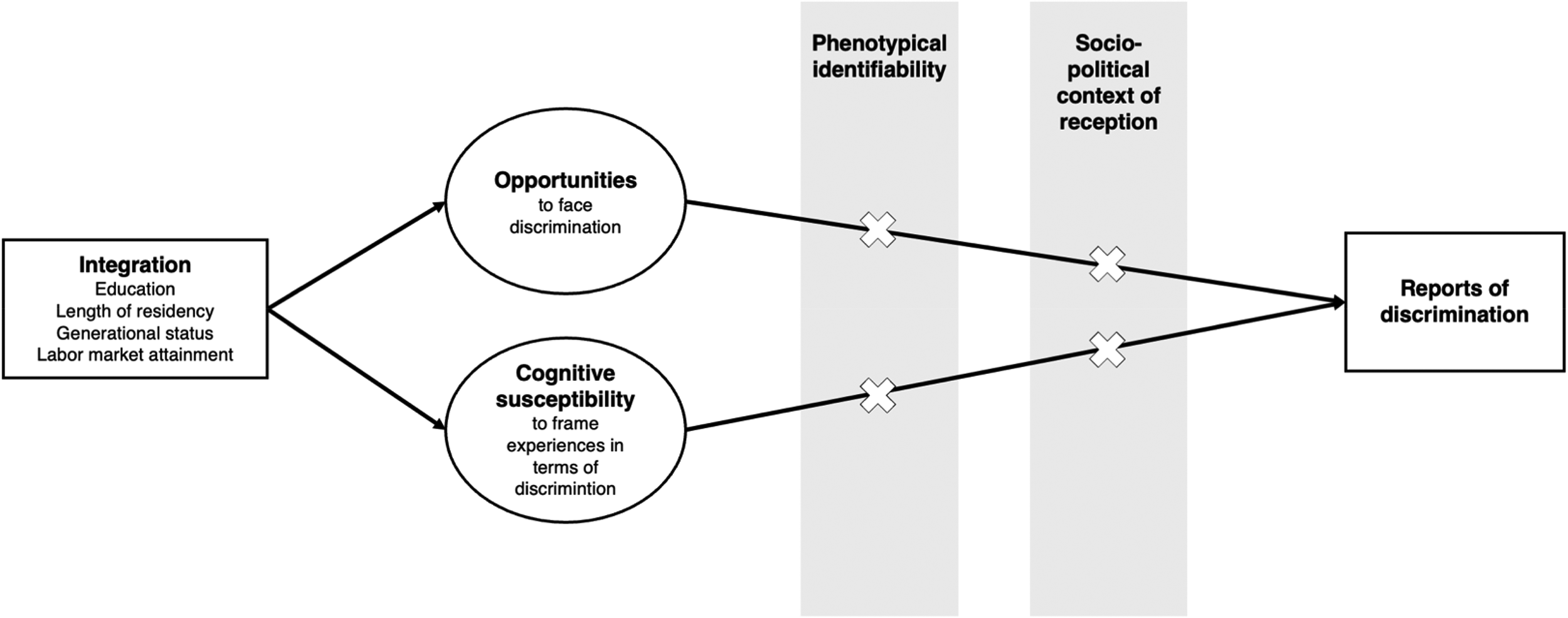
Synthesized Theoretical Model.
Opportunities to Face Discrimination
Why should immigrants and their descendants with better access to mainstream society report more discrimination than those who remain at the margins of society? Although we tend to regard the less integrated as being marginalized or as facing marginalization by mainstream members, we need to recognize that access to mainstream society also implies increased social exposure to mainstream members and thereby more opportunities to face discrimination. Several studies demonstrate that reports of discrimination are higher among immigrants and their descendants who have more frequent social exposure to mainstream members at work, in school, or in the neighborhood they live in (Doorn, Scheepers and Dagevos 2013; Rollock et al. 2011). In line with Allport's (1954) early warning against the negative consequences of superficial contact, Steinmann (2019) specifies that social exposure leads to increased reports of discrimination if it is incidental and superficial, as for example indicated by the neighborhood share of mainstream members. By contrast, close and thus selective friendships are more likely to be indicative of reduced levels of discrimination. In summary, better integration leads to increased social exposure to mainstream members of native-born parents and thereby predicts increased reports of discrimination (H2).
Cognitive Susceptibility to Frame Experiences in Terms of Discrimination
Reports of discrimination presume the cognitive awareness that one has in fact been discriminated against. Education, labor market attainment, and familiarity with a society as indicated by length of stay or generational status blur the ethnic boundary to mainstream members. But they also increase comprehension of discriminatory acts and thus a person's capability to frame experiences in terms of discrimination. This argument was first proposed by Portes, Parker and Cobas (1980), who argue that the better immigrants and their descendants establish themselves as part of mainstream society, the more grows their awareness about their group's enduring marginalized ethno-racial status in society (see also Waters 1994; Flores 2015; Diehl, Liebau and Mühlau 2021). Limited language skills, for example, may prohibit less integrated immigrants to fully understand verbal attacks (Pierre, Martinovic and Vroome 2015). Similarly, if immigrants or their descendants do not read local news media, they tend to lack awareness of exclusionary portrayals of their group and its enduring racial marginalization in public discourse, or of the frequency of far-right political mobilization (Holtz, Dahinden and Wagner 2013; Alanya et al. 2017). Accordingly, both news media consumption and better language skills have been linked to increased reports of discrimination (Doorn, Scheepers and Dagevos 2013; Steinmann 2019). Qualitative research adds that among certain immigrants, better integration may also increase the awareness and understanding of their precarious legal status (Tsegay 2021) or their sensitivity for what constitutes discrimination (Runfors 2016; Jaskulowski and Pawlak 2020). An example of the latter is when native-born children of immigrants feel discriminated for being regarded as foreign rather than fellow citizens, while their parents may tend to agree and see no discrimination (Runfors 2016). Accordingly, better integration results in increased familiarity with public discourse, resulting from better language skills and increased consumption of local news media, and thereby predicts higher levels of reported discrimination (H3).
Expectations may also increase in tandem with better integration. According to Cooney's (2009) “hypothesis of rising expectations,” the better integrated report discrimination more frequently because they have heavily invested into education under the expectation that this will grant them equal access to middle-class occupations and standards of living. Qualitative research makes a similar case, especially with respect to the expected advantages of acquiring citizenship (Ali 2010; Eijberts and Ghorashi 2017; Charsley et al. 2020). In other words, the more immigrants and their descendants establish themselves as part of mainstream society, the more does the mainstream's standard of life become their frame of reference (Zagefka and Brown 2005; Vroome, Martinovic and Verkuyten 2014). If they cannot attain or sustain a comparable middle-class standard of life, immigrants and their descendants may frame their experience of stalled attainment in terms of discrimination (Silberman, Alba and Fournier 2007; Schaeffer 2019). To provide evidence for these arguments, studies demonstrate how intra-generational (Lindemann 2019), inter-generational (Schaeffer 2019), or international (Silberman, Alba and Fournier 2007; Doorn, Scheepers and Dagevos 2013; Steinmann 2019) downward mobility — the unsuccessful attempt to sustain a middle-class standard of living — predict increased perceptions of discrimination. 1 Hence, immigrants and their descendants who are better integrated may report higher levels of discrimination due to the risk of downward social mobility, which is a more prevalent threat among them (H4).
Moderating Conditions
The working of mechanisms is not universal but mitigated or amplified by moderating conditions. The most important moderating condition of the integration paradox is the identifiability of immigrants and their descendants as ethno-racial minority by mainstream members. Flores (2015) suggests that increased integration in terms of education or length of residence leads to an increased cognitive susceptibility to frame experiences in terms of discrimination only among immigrants and their descendants with racial features (e.g., skin color or hair structure) that distinct them from the mainstream (see also Diehl, Liebau and Mühlau 2021). Their phenotype sets them apart constantly, and therefore incites systematic and non-declining racism by mainstream members. Vice versa, those who are phenotypically similar to mainstream members tend to blend in with mainstream society and thus do not face a non-declining marginalized racial status that they could become increasingly aware of. Tuppat and Gerhards (2021) extend this argument beyond race, by showing how holding a first name that is uncommon among mainstream members increases the strength of the integration paradox. Thereby they qualify that the moderating condition is not only race, but identifiability as ethno-racial minority more generally. Beyond race, identifiability can include characteristics like religious dress (e.g., hijab), or names. Nevertheless, race dominates identifiability because racial phenotype does not fade over time. Taken together, these arguments suggest that the integration paradox is more pronounced among immigrants and their descendants who are more easily identifiable as ethno-racial minority (H5).
While the integration paradox debate has primarily concentrated on individual-level factors such as education, news media consumption, and skin color, recent evidence indicates the need for a broader consideration of macro-level conditions that could act as catalysts for the integration paradox. Notably, country-comparative research has produced counterintuitive results, indicating that reports of discrimination are more common in countries with a more open socio-political context of reception (Koopmans et al. 2005; Yazdiha 2019). The term “socio-political context of reception” refers to the legal barriers (i.e., access to citizenship rights), discursive barriers (i.e., media climate), and social barriers (i.e., racism and residential segregation) that immigrants and their descendants face (Portes and Rumbaut 2001). Countries with an open socio-political context of reception are viewed as facilitating immigrants’ and their descendants’ access to mainstream society. Typically, an open socio-political context of reception correlates with lower average levels of prejudice among mainstream citizens (Schlueter, Meuleman and Davidov 2013; Green et al. 2020), which suggests, contrary to the above-cited evidence, that exposure to discrimination should also be lower in such countries. However, the focus here is not on debates about the association between socio-political contexts of reception and average levels of prejudice and discrimination, but on the question of whether a country's socio-political context of reception alters the strength of the integration paradox. In this regard, we argue that by facilitating immigrants’ and their descendants’ access to mainstream society, these countries may also catalyze the mechanisms driving the integration paradox. In countries with a more open socio-political context of reception, immigrants tend to be less socially and geographically segregated from mainstream members and thus more exposed to opportunities to face discrimination, even if mainstream members are less prejudiced on average in these countries. Furthermore, access to more legal rights and information, as well as greater news media coverage, may increase immigrants’ cognitive susceptibility to frame experiences in terms of discrimination. The latter argument links the integration paradox to a political science classic: according to Tocqueville's paradox, social and equal-treatment policies may increase the salience of remaining inequalities: “The hatred that men bear to privilege increases in proportion as privileges become fewer and less considerable, […] the love of equality should constantly increase together with equality itself” (Tocqueville 2015 [1840]). In summary, we hypothesize that the integration paradox is more pronounced in countries with an open socio-political context of reception (H6).
Data and Methods
This study meta-analyzes 280 estimates published in 42 quantitative studies of the association between reported discrimination and various indicators of integration. Meta-analysis was originally developed to identify reliable (causal) effects from several equivalent experimental studies (Card 2015; Cuijpers 2016; Harrer et al. 2019). Examples are recent meta-analyses of correspondence field experiments on ethnic discrimination (Thijssen et al. 2021). The integration paradox literature does not meet these standards, because various studies are correlational and use different measures of reported discrimination, or different types of regression models — to mention just some of the differences. Therefore, we adopt the recent trend of using meta-analysis in a more restrained manner to explore the broader systematic patterns that emerge from a scientific debate, moving beyond individual studies to gain more general insight (cf. Dinesen, Schaeffer and Sønderskov 2020; Shor and Roelfs 2021). Below, we describe how we generate the data used in the meta-analysis and give a nontechnical explanation of the meta-analytical approach applied. Because our collected data and analysis code are available along with this article, all steps of the analyses can be reproduced and checked.
Sample: Definition, Search Protocol, and Selection of Estimates
To qualify as part of the sample for this meta-analysis, an estimate must meet the following four criteria. First, the outcome must be reported (ethnic) discrimination. We thus include studies on discrimination in general or on linguistic, religious, national, or phenotypic discrimination. But we exclude those on gender, class, or age discrimination. We did not encounter any studies focusing particularly on discrimination by dress or style that could be seen as tapping into ethnic discrimination. Second, the population whose reports of discrimination are being investigated must be immigrants, descendants of immigrants, or members of an ethnic, religious, or racial minority group. Third, the estimate needs to be a correlation or regression coefficient along with an associated inference statistic. The coefficient needs to express the relation between reported discrimination and either a broad indicator of integration, or an indicator of one of the mechanisms seen as driving the integration paradox (for details see “Predictors” below). Finally, the study in which the estimate is reported needs to be written in English and for quality reasons cannot be a student's bachelor or master thesis.
To identify estimates meeting these criteria, we created an initial sample of non-duplicate published studies using the search string “(“integration paradox” OR “Paradox of Integration”) AND discrimination” for Google Scholar (779 results), and (without the addon “AND discrimination”) Web of Science (47 additional results), as well as PsycInfo and SocIndex (no additional results beyond those found via Google Scholar and Web of Science) on April 7, 2021 and June 22, 2022. Note that if we had refrained from adding the AND to the Google Scholar search, we would have produced a sample of thousands of unrelated studies from the natural sciences. Based on the titles and abstracts of these articles, we then coded whether a study meets the above-mentioned criteria for inclusion in our meta-analysis, resulting in an initial sample of 69 studies, which reduced to 30 once we considered the full text. Finally, we further extended the sample by an additional 12 studies that were either cited by the initial 30 studies or that we came across as researchers in the field. Since we imposed no geographic or time restrictions, our sample of studies cover the period from 1973 to 2020 and a broad range of mostly European and North American countries but also Ghana and China.
The overall 42 studies in our sample typically report several estimates of the association between reports of discrimination and integration. Only some of the differences between these estimates are of interest to this meta-analysis — for example, whether the association is stronger for different types of integration indicators. We therefore selectively coded estimates according to the following seven rules. First, we preferred results on composite scales of perceived discrimination over those on single items because composite scales tend to contain less measurement error (Spector 1992, page 10ff.). Second, we preferred estimates on racial over ethnic, over national, over religious, and finally over linguistic discrimination. We do so, because of Portes et al.'s (1980) and Flores’ (2015) arguments that the integration paradox is driven by enduring racial marginalization. Our ordering thus attempts to go from the most enduring to the most malleable and adaptable. Third, in the case of categorical predictors we used the theoretically strongest contrast to the reference group (e.g., high versus low educated), which is a transparent and unequivocal rule and typically should identify the contrast for which there is most statistical power. Fourth, we preferred estimates based on full samples over those based on sub-samples, unless the sub-samples differ in their distinctiveness from mainstream members (e.g., persons of Polish as compared to Pakistani origin in Germany). Fifth, we chose the estimate with the largest number of demographic controls (e.g., gender, family status, or federal state) and the smallest number of control variables that either tap into potential outcomes of perceived discrimination (e.g., health, or identification) or that are indicators of integration themselves. Sixth, we preferred estimates from models that contain only one mediator at a time to clearly identify that one mediator's contribution to a potentially reduced effect size of the broad indicators of integration. Note that the downside of this strategy is that estimates of the relation between the mediator and reported discrimination may contain omitted variable bias stemming from alternative mediators not adjusted for in the model. Finally, we did not code estimates that are part of an interaction effect, because they are conditional on often arbitrary values of the involved moderator (e.g., being 0 years of age).
These seven rules exclude many estimates reported in the 42 studies, but still leave room for every study to contain several estimates that meet our criteria. An example of this is Yazdiha (2019) who reports differences in perceived hostility between native- and foreign-born Muslims living in the UK, France, Germany, or Spain. Her study contains four estimates, one for each country, each of which meets our criteria. Another example is Cheung and Yao (2022) who report an estimate for education and one for income. Overall, our coding strategy results in 280 estimates published in 42 studies. Below we explain how our multilevel modeling strategy handles dependencies between estimates published in the same study.
Dependent Variable: Fully Partial Correlation
The dependent variable consists of the 280 estimates of the relation between reported discrimination and indicators of integration, along with their inference statistic used as a weight of its reliability. We code the direction of these estimates such that negative estimates speak against the integration paradox and positive ones in favor of it. Because studies report different types of estimates, such as linear or logit coefficients, we transform them to “fully partial correlations” and associated standard errors following the procedures outlined by Aloe and Thompson (2013):

Another potential pitfall is that it is unknown whether the transformations outlined in Aloe and Thompson (2013) are appropriate for estimates from generalized linear models. Thus, the resulting fully partial correlations may perhaps best be interpreted as the expected effect sizes, had the relation been estimated as linear.
Finally, a considerable share of studies (ca. 50% of all coded estimates) only reports significance levels rather than actual inference statistics (e.g., p < .05 as indicated by *). In these cases, we assign a p-value randomly drawn from a uniform distribution within the indicated interval (e.g., p = [.05; .01]). Note that this likely introduces a considerable bias toward zero to our meta-estimates, because based on typically large datasets used in the social sciences, the true p-value is likely much smaller than indicated by the minimum threshold. As a sensitivity test, we report results exclusively based on the strongly reduced sample of estimates for which numeric inference statistics were reported and no p-values needed imputation in the Online supplemental material — the results based on this reduced sample are less reliable but not systematically different from those presented in this article.
Predictors
To indicate certain qualities of the 280 estimates, we employ one continuous and three categorical variables with multiple levels or categories. These variables help us explain heterogeneity in the strength of the association between reports of discrimination and integration. The first categorical variable has four levels that identify the type of broad indicator of integration used to predict reports of discrimination and allows us to test Hypothesis 1. We code the predictors used as one of four broad indicators of access to mainstream society: education, labor market attainment (e.g., income, employment, or occupational status), length or residence, or generational status.
The second categorical variable has three levels that identify mechanisms of the integration paradox. We code measures of superficial social exposure to mainstream members (e.g., share of mainstream members in the neighborhood) as a driver of the opportunities to face discrimination mechanism (Hypothesis 2). For higher cognitive susceptibility to frame experiences in terms of discrimination stemming from an increased familiarity with public discourse (Hypothesis 3), we consider measures of language skills or local news media consumption, while measures of intra-generational or international downward social mobility allow us to test Hypothesis 4.
The third categorical variable has three levels and serves to test Hypothesis 5 by indicating the identifiability of the minority population studied. Our coding strategy is based on Portes et al.'s (1980) and Flores’ (2015) claim that the integration paradox is driven by enduring racial marginalization. Because the identifiability variable is meant to test Hypothesis 5, which is based on Flores’ (2015) arguments, we code racial minorities (e.g., Somali immigrants in Sweden) as “easily identifiable.” Following Tuppat and Gerhards’ (2021) extension of this argument, we classify immigrant minorities some of whose members may wear distinct dress like a Hijab or typically have distinct names as “rather identifiable” (e.g., Moroccan immigrants in Belgium). Finally, we code those that tend to have similar racial phenotypes, dress, and names (e.g., often Christian names) as “not easily identifiable” (e.g., Polish immigrants in Britain). While we acknowledge that this coding is based on our subjective judgment, one should recognize that most studies do not have the sample size to report separate estimates for different origin group. For example, Geurts, Lubbers and Spierings (2020) report estimates pooled for a sample of Bulgarian, Polish, Spanish, and Turkish immigrants and their descendants living in the Netherlands, while ten Teije, Coenders and Verkuyten (2013) do so for a sample of persons of Moroccan, Surinamese, Antillean, and Turkish origin. If the population studied are immigrants and their descendants from different origins that combine “rather” and “not easily” identifiable minorities, as we argue is the case for Geurts, Lubbers and Spierings (2020), we code them as “not easily” identifiable. Moreover, because most studies report pooled estimates, we only have two studies reporting estimates for Black or Asian Americans as meeting our criteria for “easily identifiable” racial minorities. We therefore decided to collapse the category of “easily identifiable” with that of “rather identifiable.”
The fourth and only continuous variable used in our analysis is the Migrant Integration Policy Index (MIPEX) and its sub-index on anti-discrimination policies (Giacomo and Huddleston 2020), which we use as proxy of countries’ socio-political context of reception (Hypothesis 6). MIPEX is in many regards an imperfect indicator of countries’ socio-political context of reception because it does not explicitly entail important aspects of the concept such a public discourse, patterns of residential ethnic segregation, or histories of immigration. However, MIPEX covers the longest period (2007 to 2020) and the biggest sample of countries. Moreover, the policies it summarizes are highly indicative of public attitudes towards immigrants and other important aspects of a county's socio-political context of reception. That is, the advantage of MIPEX over other indices is that it is measured on a yearly basis, allowing us to join meta and MIPEX data by country and year in which the study was conducted. Note that if no MIPEX data are available for a certain year we use the next recent MIPEX data. Studies that pool populations from several countries receive a missing value. Our analysis of countries’ socio-political context of reception is thus based on only 227 of the overall 280 estimates of the association between reported discrimination and indicators of integration.
Further Meta-Moderators
Our meta-analyses further consider whether the outcome was measured as a form of personal or group discrimination. On the one hand, authors like Portes, Parker and Cobas (1980) emphasize that increased integration drives minorities awareness of the true extent of discrimination and racism in society implying particularly strong relations to measures of group discrimination but not particularly to personal experiences. On the other hand, Schaeffer (2019) argues that survey questions about group discrimination are prone to capture more measurement error and are thus generally less well predicted by all kinds of variables.
Methods and Strategy of Analysis
We use meta-analytical multilevel random effects models to analyze our data (Viechtbauer 2010; Konstantopoulos 2011). The goal of these models is to pool the single estimates of the association between reports of discrimination and integration to an overall meta-estimate by giving more weight to more reliable original estimates. Beyond pooling, these models also allow investigating in how far study characteristics (e.g., the identifiability of the population studied) account for variation between the estimates. Finally, with these models we can also address the dependencies between the various estimates. Partly we have already addressed the problem that several estimates are based on the same population via our selective coding strategy (see above). We model the remaining dependencies by specifying two cross-classified random effects: one for the 42 studies in which the estimates were reported, and one for the 32 data sets used (e.g., the European Social Survey). In models in which we include MIPEX as predictor, we additionally consider a random effect for the 15 country-year combinations in which the data was collected.
Pre-Registration
We pre-registered this meta-analysis on the Open Science Framework after an initial coding of five studies, which we used as pilot sample to calibrate all steps of the analyses and to draft a full first version of the manuscript: https://bit.ly/3CXvrlf. After peer-review, we thoroughly revised our analyses and thus diverged from the pre-registration in several regards.
Results
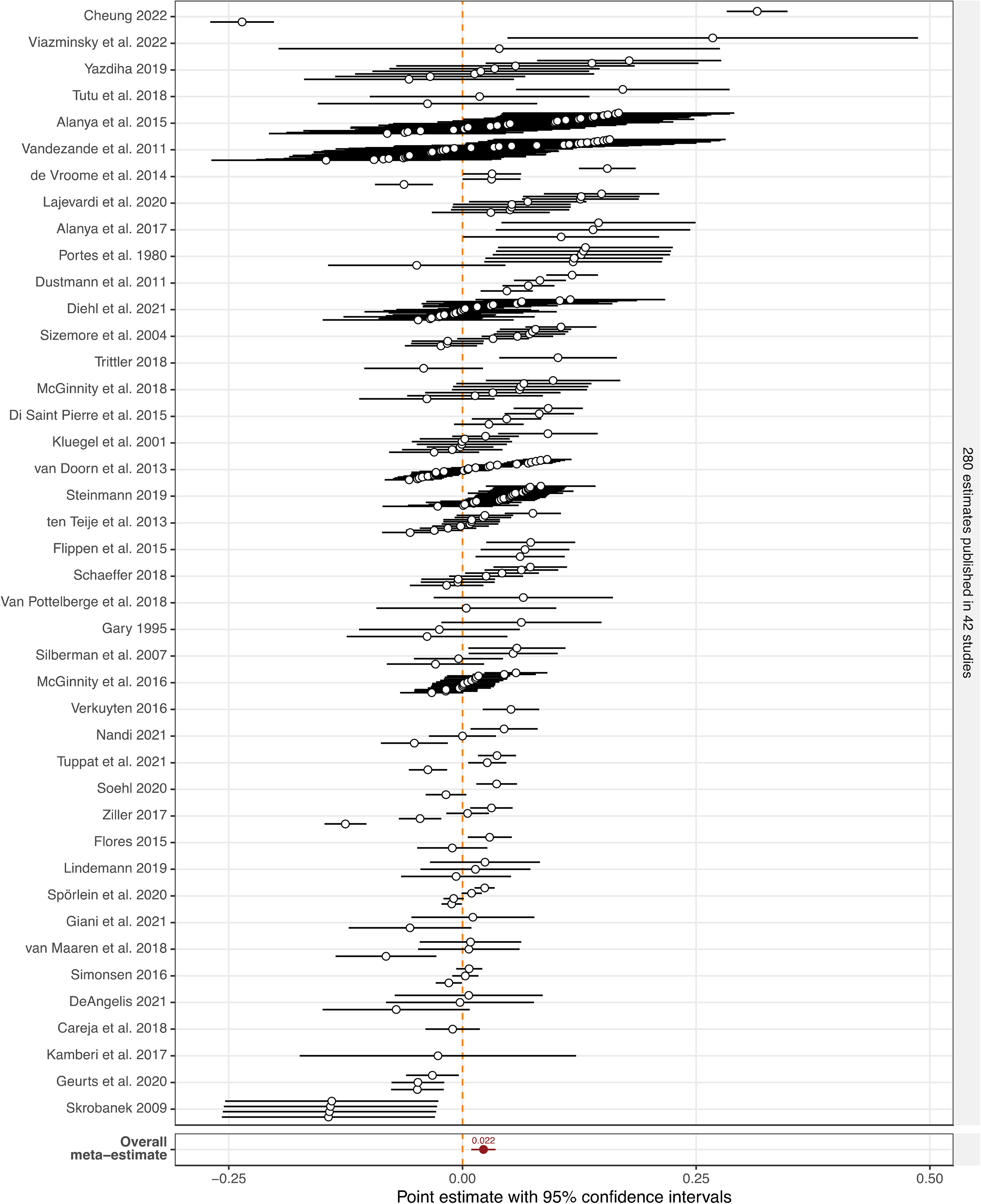
Do immigrants and their descendants with better access to mainstream society report more discrimination than those who remain at the margins of society? To put this rather broad and general question to a test, Figure 2 visualizes 280 estimates of the relation between reports of discrimination and various indicators of integration documented in 42 studies. At the bottom of Figure 2, an overall meta-estimate summarizes the evidence and affirms the raised question: the better integrated report discrimination significantly more often, although the difference is rather small with
Single Estimates and Overall Meta-Estimate.
That said, Figure 2 displays substantial heterogeneity across estimates, not only between but also within single studies. An example is Yazdiha (2019) who reports differences in perceived hostility between native- and foreign-born Muslims. While native-born Muslims perceive more hostility in the UK and France, Yazdiha reports no such differences for Germany and Spain. Thus, the integration paradox is far from universal and therefore better understood as a possibility that access to mainstream society can predict increased reports of discrimination. Under which conditions is this more likely to happen? Figure 3 displays results of a meta-analysis of the 197 estimates of the association between reports of discrimination and the four broad indicators of integration, that is, tests of Hypothesis 1. Instead of one overall, it displays four meta-estimates, one for each type of broad indicator of integration. We see that education is by far the strongest and only statistically significant predictor of increased reports of discrimination (
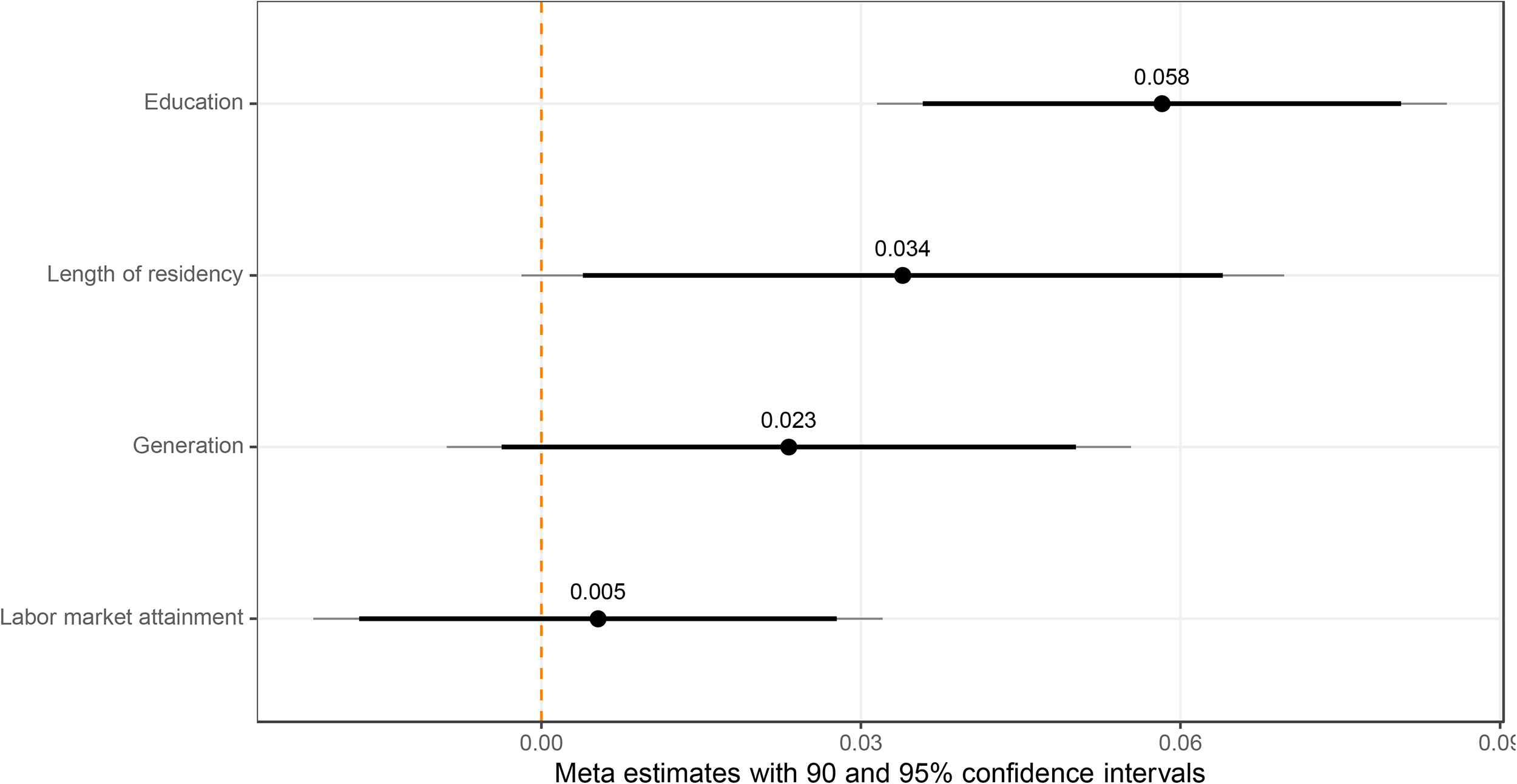
Coefficient Plot of a Meta-Analytic Regression of the Integration Paradox by Broad Indicator of Integration.
Turning to the presumed mechanisms of the integration paradox, Figure 4 illustrates the findings from a meta-analysis of 83 estimates examining the link between reports of discrimination and indicators associated with the assumed mechanisms of the integration paradox. This is in contrast to the 197 estimates analyzed in Figure 3, which focused on the four broad indicators of integration. It displays three meta-estimates testing Hypotheses 2 to 4, respectively. Among the three, increased familiarity with public discourse, such as language skills or local news media consumption, is the strongest and only statistically significant predictor of higher levels of reported discrimination (
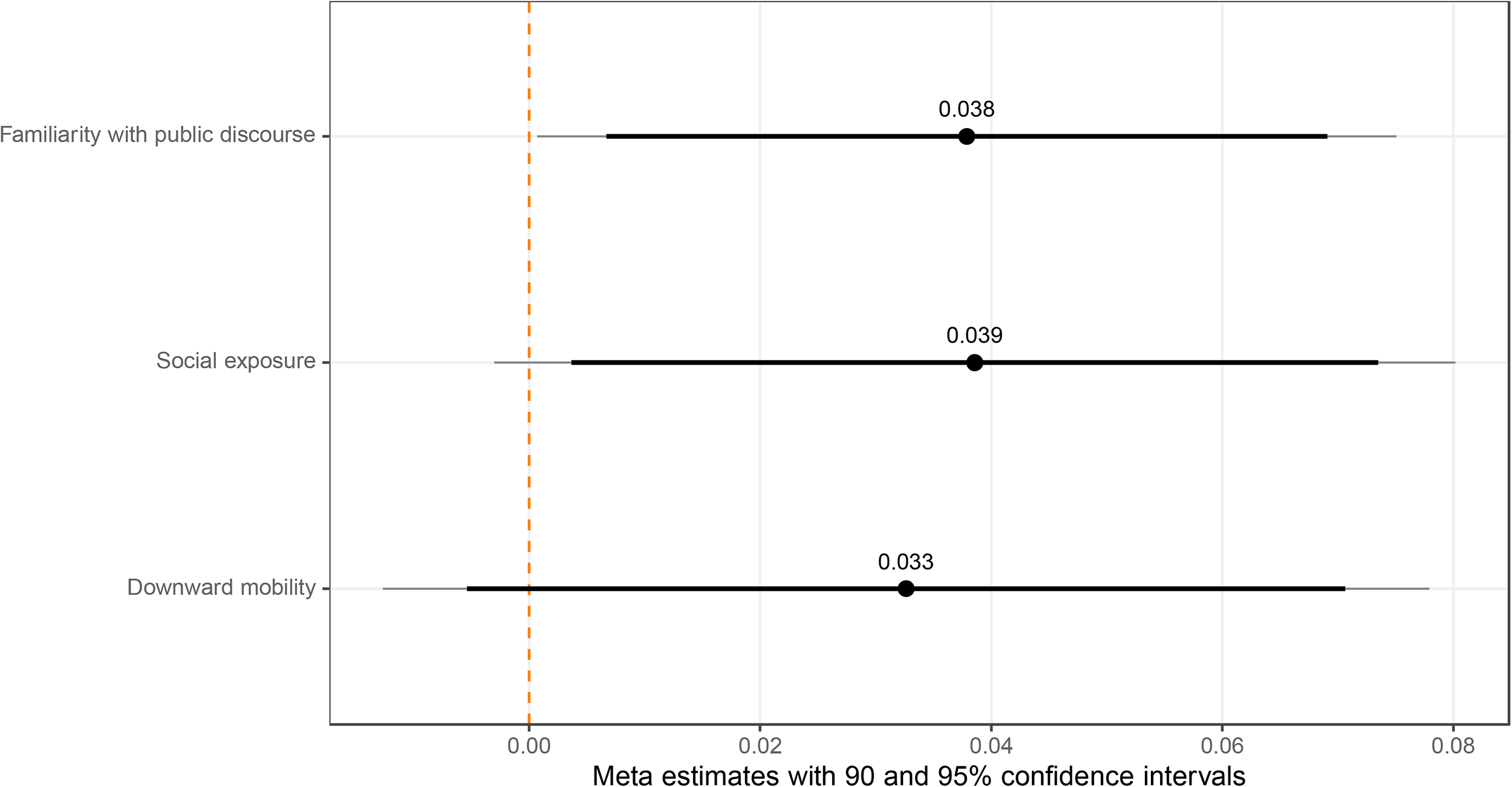
Coefficient Plot of a Meta-Analytic Regression of the Mechanisms of the Integration Paradox.
While the drivers of the integration paradox indeed predict higher levels of reported discrimination, however, they do not seem to mediate the relationship between reports of discrimination and broad indicators of integration (e.g., education and length of residency). Figure 5 again focuses on the 197 estimates of the association between reports of discrimination and broad indicators of integration (similar to Figure 3). But in contrast to Figure 3, it displays how the overall meta-estimate between reports of discrimination and these broad indicators changes, once indicators of the presumed mechanisms of the integration paradox are controlled for in the same regression model. The figure displays results from our standard multilevel random effects model (hollow dots) and from another model that includes study fixed effects and thus only uses within-study variation between models with more or fewer indicators of the presumed mechanisms controlled for in the original regression models (filled dots). Either way, we find no evidence that controlling for indicators of the presumed mechanisms of the integration paradox reduces the association between reports of discrimination and broad indicators of integration. This casts doubt on Hypotheses 2 to 4, which posit that greater familiarity with public discourse, increased social exposure to mainstream individuals, and heightened risk of downward mobility are the means through which improved integration leads to higher instances of reported discrimination.
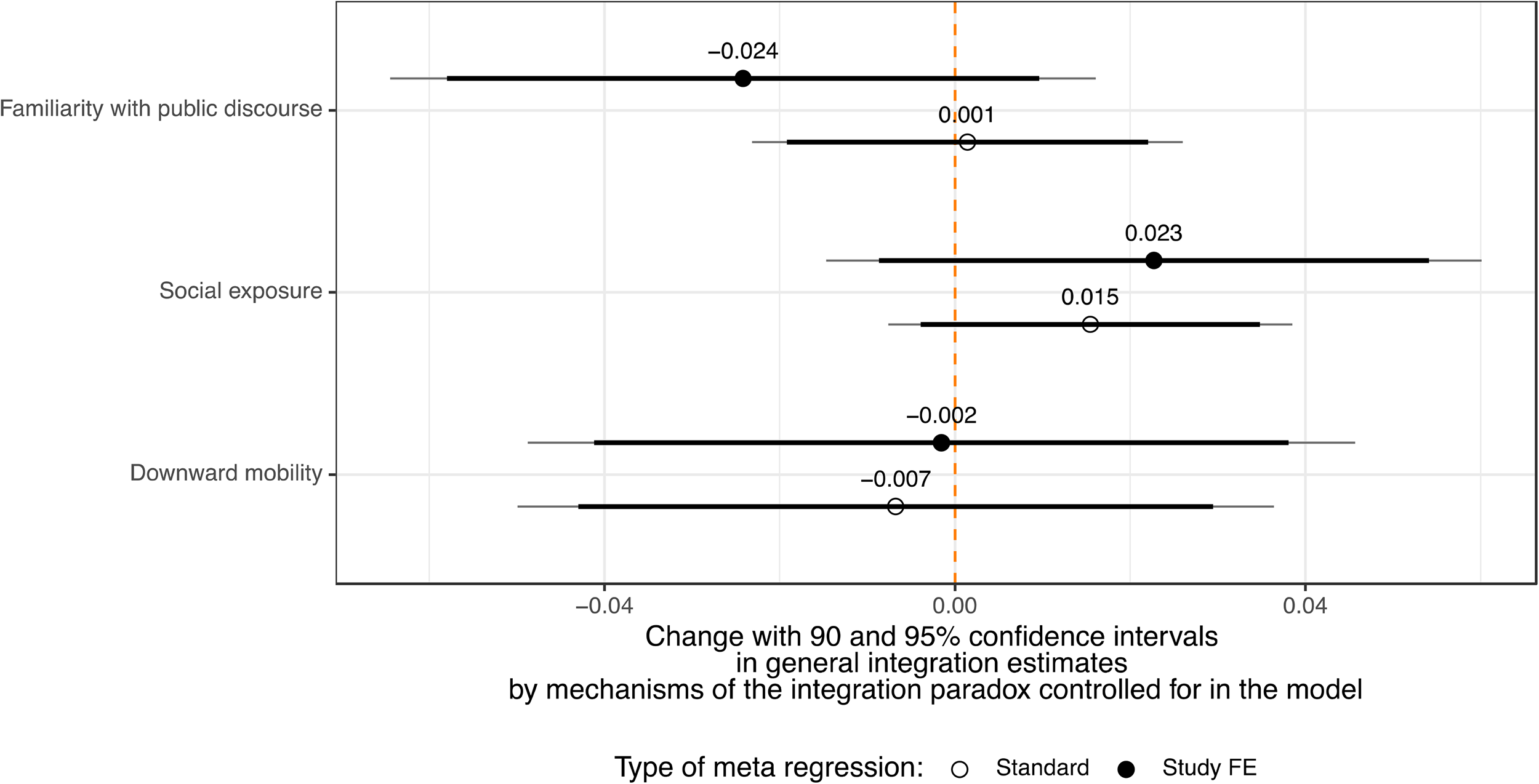
Meta-Analysis of Whether the Mechanisms of the Integration Paradox Reduce the Association Between Reports of Discrimination and Broad Indicators of Integration.
Finally, we examine two conditions that potentially moderate the integration paradox. We begin with Hypothesis 5, which is based on Flores’ (2015) assertion that the integration paradox is only applicable to immigrants and their descendants who possess characteristics that distinguish them from the mainstream. In light of this claim, Panel A of the figure displays the strength of the integration paradox, which is the meta-estimate of the association between integration indicators and reported discrimination, separately for “rather” and “not easily” identifiable minorities. The integration paradox is statistically significant only for the former, more easily identifiable immigrant minorities and about 50 percent weaker among the “not easily” identifiable ones. The results of the meta-analysis thus support Hypothesis 5.
Finally, Hypothesis 6 is motivated by Tocqueville's classic and asks whether the integration paradox is more pronounced in countries with a more open socio-political context of reception. Panel B of Figure 6 visualizes the results of two meta-analyses to answer this question, one using the overall MIPEX indicator as our proxy of countries’ socio-political context of reception, and a second one where we use MIPEX's anti-discrimination subindex as a proxy that reflects the integration paradox's focus on reports of discrimination more directly. Although this test is merely bivariate, it also shows the potential of meta-analysis to go beyond investigating the importance of study characteristics and to thereby consider factors not yet discussed in the literature. Figure 6 is based on 229 estimates out of the overall 280 for which we could match MIPEX information. Based on these estimates, Figure 6 shows the strength of the meta-estimate of the relation between indicators of integration and reports of discrimination (on the Y-axis) by MIPEX values (on the X-axis). Both panels of Figure 6 indeed show the expected positive relationship indicating a stronger integration paradox in countries with a more open socio-political context of reception. However, this moderation is statistically significant only if we use the anti-discrimination sub-index as proxy with a more direct fit to the integration paradox's focus on perceptions of discrimination (see Table 4 in the Online supplemental material).
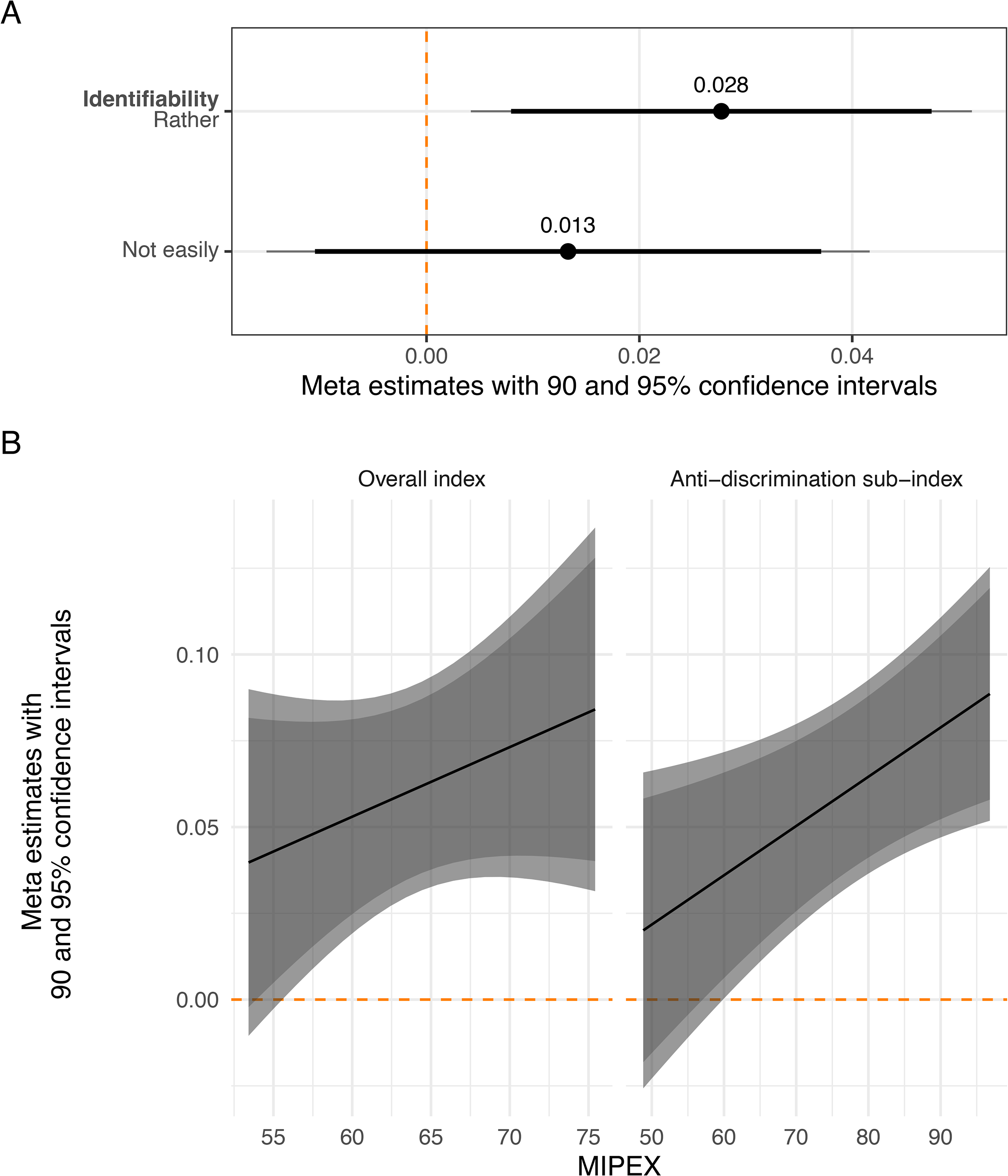
Meta-Analytic Regression of the Moderating Conditions of the Integration Paradox.
Conclusion
Is there a tendency for immigrants and their descendants with better access to mainstream society to report more discrimination than those who remain at the margins of society? Our review and meta-analysis of 280 estimates reported across 42 studies confirms this so-called integration paradox. Especially among immigrants and their descendants who possess characteristics that distinguish them from the mainstream and who live in countries with a more open socio-political context of reception, do higher education, length of residence, language skills and news media consumption, as well as increased social exposure to mainstream members go along with more frequent reports of discrimination. But indicators of labor market attainment, another important dimensions of integration and access to mainstream society, do not predict higher levels of reported discrimination. Several sensitivity tests find no indication that this finding is the result of small-sample or publication bias. Hence, factually better conditions — in both personal and institutional terms — may be linked to more reports of discrimination. This fundamental insight possesses a remarkable similarity to Tocqueville's paradox, a classic concept in political science.
However, our analyses offer only limited evidence in support of the notion that the presumed mechanisms of the integration paradox –greater exposure to public discourse, increased social interaction, or heightened risk of downward mobility — mediate the correlation between reports of discrimination and broad indicators of integration. Better education and familiarity with public discourse are the strongest and most reliable predictors of increased reports of discrimination. This and the finding that the integration paradox holds particularly for more easily identifiable immigrant minorities seems to support Portes et al.'s (1980) original argument about an increased cognitive awareness of their enduring marginalized ethno-racial status. But while indicators of the presumed mechanisms of the integration paradox predict more reports of discrimination, they do not seem to reduce the association between reported discrimination and broad indicators of integration if controlled for in the same regression models.
In conclusion, it is important for scholars and policymakers to consider the integration paradox as it may result in unintended consequences and counter-intuitive feedback to progressive policies and social change. Improved factual conditions for immigrants and their descendants might — in the short and mid run — result in opposite subjective reactions among minority members than those intended. Pundits may be inclined to judge such reactions as ungrateful or misguided, especially if they are voiced by better-established minority members. But the integration paradox suggests that they can instead stem from an increased awareness for remaining and enduring forms of discrimination. The integration paradox is therefore one example why social cohesion in ethnically diverse immigration societies is complex and why indicators of cohesion, such as reports of discrimination, can have conflicting interpretations. Few reports of discrimination among immigrants and their descendants can imply a cohesive society, but also one where immigrant minorities are segregated and have limited awareness of their marginalized status.
Our study also demonstrates the potential and the challenges of meta-analysis for the social sciences. Recent developments in multilevel meta-analysis allow for an improved handling of dependencies between estimates. By tapping into the heterogeneity of the studied populations across time and space, we can even test moderating conditions beyond those considered in the literature so far. This has allowed us to go beyond the debate's primary focus on individual-level factors — such as education, news media consumption, or skin color — and to additionally consider the importance of countries’ socio-political context of reception. Nevertheless, inconsistent reporting and quality standards, as well as the wide variety of survey and statistical techniques used remain considerable challenges for the application of meta-analyses to debates such as this.
Finally, we would like to draw two conclusions for future research on the integration paradox. First, further research is necessary to fully comprehend the mechanisms that contribute to the integration paradox. At present, most of the indicators used to examine these mechanisms are quite ambiguous with regards to their association with reported discrimination. For instance, a higher proportion of mainstream members in one's neighborhood can indicate more frequent discriminatory experiences due to superficial contact. However, it can also suggest positive interactions with mainstream members in everyday situations or even a deliberate choice to live in a neighborhood where one feels safe among selected mainstream friends. Similar arguments can be put forth concerning language skills, media consumption, and virtually all variables studied in this area. This ambiguity is likely the reason, why individual studies may report conclusive results regarding the mechanisms driving the integration paradox, while no systematic pattern emerges across multiple studies. Therefore, future research should focus on refining measures to differentiate between contradictory pathways. Second, a focus on driving mechanisms implies a need for improved causal inference. Currently research on the integration paradox is near-exclusively correlational. Recent longitudinal analyses are an important step forward (Lindemann 2019; Geurts, Lubbers and Spierings 2020; Diehl, Liebau and Mühlau 2021). Another such step to increase the validity of findings are survey or field experimental studies, such as the one conducted by (Schaeffer and Kas 2023), which experimentally induces awareness of discrimination by requesting participants to read a news article reporting on the outcomes of a social science study on ethnic penalties in the labor market or a control article about recent astrophysics research.
Supplemental Material
sj-xlsx-1-mrx-10.1177_01979183231170809 - Supplemental material for The Integration Paradox: A Review and Meta-Analysis of the Complex Relationship Between Integration and Reports of Discrimination
Supplemental material, sj-xlsx-1-mrx-10.1177_01979183231170809 for The Integration Paradox: A Review and Meta-Analysis of the Complex Relationship Between Integration and Reports of Discrimination by Merlin Schaeffer and Judith Kas in International Migration Review
Supplemental Material
sj-xlsx-2-mrx-10.1177_01979183231170809 - Supplemental material for The Integration Paradox: A Review and Meta-Analysis of the Complex Relationship Between Integration and Reports of Discrimination
Supplemental material, sj-xlsx-2-mrx-10.1177_01979183231170809 for The Integration Paradox: A Review and Meta-Analysis of the Complex Relationship Between Integration and Reports of Discrimination by Merlin Schaeffer and Judith Kas in International Migration Review
Supplemental Material
sj-bib-3-mrx-10.1177_01979183231170809 - Supplemental material for The Integration Paradox: A Review and Meta-Analysis of the Complex Relationship Between Integration and Reports of Discrimination
Supplemental material, sj-bib-3-mrx-10.1177_01979183231170809 for The Integration Paradox: A Review and Meta-Analysis of the Complex Relationship Between Integration and Reports of Discrimination by Merlin Schaeffer and Judith Kas in International Migration Review
Supplemental Material
sj-pdf-4-mrx-10.1177_01979183231170809 - Supplemental material for The Integration Paradox: A Review and Meta-Analysis of the Complex Relationship Between Integration and Reports of Discrimination
Supplemental material, sj-pdf-4-mrx-10.1177_01979183231170809 for The Integration Paradox: A Review and Meta-Analysis of the Complex Relationship Between Integration and Reports of Discrimination by Merlin Schaeffer and Judith Kas in International Migration Review
Supplemental Material
sj-rmd-5-mrx-10.1177_01979183231170809 - Supplemental material for The Integration Paradox: A Review and Meta-Analysis of the Complex Relationship Between Integration and Reports of Discrimination
Supplemental material, sj-rmd-5-mrx-10.1177_01979183231170809 for The Integration Paradox: A Review and Meta-Analysis of the Complex Relationship Between Integration and Reports of Discrimination by Merlin Schaeffer and Judith Kas in International Migration Review
Footnotes
Declaration of Conflicting Interests
The author(s) declared no potential conflicts of interest with respect to the research, authorship, and/or publication of this article.
Funding
The author(s) disclosed receipt of the following financial support for the research, authorship, and/or publication of this article: This research was funded by the Deutsche Forschungsgemeinschaft (DFG) under the grant number: 428878477.
Supplemental Material
Supplemental material for this article is available online.

Notes
References
Supplementary Material
Please find the following supplemental material available below.
For Open Access articles published under a Creative Commons License, all supplemental material carries the same license as the article it is associated with.
For non-Open Access articles published, all supplemental material carries a non-exclusive license, and permission requests for re-use of supplemental material or any part of supplemental material shall be sent directly to the copyright owner as specified in the copyright notice associated with the article.
