







Abstract
Which arguments for refugee admissions are most persuasive to publics in receiving states? Some refugee scholars and advocates insist that the way to maximize support for refugee admissions is to emphasize their instrumental economic benefit to receiving states. Others prefer arguments based in legal or moral obligations, arguing that economic arguments risk undermining support for the most vulnerable or needy refugees. In this article, we assess whether and how economic, legal, and moral arguments affect Americans’ support for refugee admissions, and which types of refugees they prefer to admit. We report results from a nationally representative survey in the United States (N = 1,297), with an embedded survey experiment and conjoint decision task. We find that the moral argument led to more support for refugee admissions, while the legal argument increased support only among non-Republicans, and the economic argument had no discernible impact. In the conjoint task, the economic argument increased preferences for economically productive potential refugees, but in a way that focused on lower-status occupations. Our findings suggest that while the economic argument may not reduce support, other approaches are more likely to increase Americans’ support for refugees.
Introduction
In the past decade, both the United States and Europe have experienced a rise in populist, right-wing political opposition to immigration, including by people fleeing war and violence (Berman 2021; Joppke 2021). The current political climate has led some observers to suggest that the global refugee regime established in the post-WWII era has come to an end (Mourad and Norman 2019; Nyabola 2019). It has also caused advocates to seize on new kinds of arguments for why wealthy Global North states should consider opening their doors to displaced people. These frames have been embraced by many without empirical support for their effectiveness.
A recent trend has been to insist forcefully that the way to maximize support for admissions is to emphasize refugees’ instrumental economic benefits to receiving states, assuring publics that new arrivals will contribute to the country's prosperity, and are unlikely to require long-term financial support (e.g., Betts et al. 2017; Collier and Betts 2017). For example, the website of the International Rescue Committee notes:
As these advocacy frameworks have taken hold, other scholars and advocates continue to insist that highlighting the legal obligation to assist displaced people in need of refugee protection is the better frame, since Global North destination states have signed on to the relevant international instruments and incorporated their values into domestic legislation. They sometimes object that economic arguments can be dangerous because they obscure the true purpose of legal instruments designed to protect those in need, and risk undermining support for vulnerable people who may not be economic contributors (e.g., Momin 2017; Thompson 2017). A third subset of advocacy frames primarily focus on the powerful moral obligation to avoid condemning people to death or danger by inaction. According to this perspective, it should not matter whether admitting refugees is a legal requirement or would bring economic rewards. It is simply the right thing to do (e.g., Parekh 2020).
Existing studies have found support for the notion that frames matter, and various scholars have taken strong positions on which ones best promote acceptance of refugees (Munro 2017; Webber 2018; Ramsay 2020; Betts 2021; Leon-Reyes 2021; Bjørkhaug and Sandvik 2022; Bender 2024). Yet, empirical evidence that would inform such debates is surprisingly sparse, and no study has compared these three dominant frames against one another. We simply do not know which kind of information is most effective in changing attitudes about refugees among receiving state publics.
To address this question, this article presents the results of a nationally representative survey in the United States, which includes an experiment varying the framing of pro-refugee arguments. The experiment offers an initial assessment of the relative impact of economic, legal, and moral arguments on public attitudes toward refugees. We find clear evidence that a moral argument led to increased support for refugee admissions, and mixed evidence indicating that an argument based on international law may be persuasive, particularly to Democrats. In contrast, we find no evidence that an economic argument increased support for refugees. Further, we find that the economic argument did little to increase perceptions that refugees are in fact economically beneficial, a finding with implications for a long-standing debate over the direction of causality in observed correlations between attitudes toward immigration and beliefs about immigrants’ economic impacts.
The second part of our study addresses a related but distinct question. As noted above, critics of the economic argument fear that its promotion may undermine support for those most in need of refugee protection. Although the logic of this claim is clear, its empirical validity has not been tested. Therefore, we supplemented our framing experiment with a conjoint study assessing how each argument influenced the types of potential refugees that members of the public prefer for admission. We find little change in these preferences, although we find weak support for the possibility that the economic treatment shifted preferences away from the least economically productive refugee candidates, i.e., older and unemployed people.
Overall, our findings illuminate the factors influencing policy support for admitting displaced people, providing insight into the debate about which arguments shift members of the public from opposition or indifference to support. While economic arguments may be en vogue, we find them less effective than proponents insist. In contrast, pro-refugee arguments that resonate with common (if exaggerated) conceptualizations of refugees as distinct from other types of migrants, and thus having stronger moral or legal claims to admission, may be more persuasive to more people.
The Effect of Economic, Legal, and Moral Arguments on Attitudes Toward Refugees
We begin this section by placing our study in the context of theoretical perspectives from the immigration attitudes literature. We then show how and why findings from public opinion studies may vary depending on how border crossers are labeled, before zeroing in on the scholarly work relating to the effectiveness of each frame in turn: legal, moral, and economic. We conclude by drawing on this literature to state our expectations about the impact of these three frames on support for refugees and on preferences for particular refugee characteristics.
Theories of Immigration Attitudes
The topic of our study—the determinants of pro-refugee attitudes—departs from the center of gravity in the literature in two major ways. First, we examine responses to refugees specifically, whereas most scholarship on attitudes toward border crossers has focused on immigration generally (Esses 2021; Levy, Wright and Citrin 2016). Second, while most of the literature examines drivers of opposition to immigration (Newman et al. 2015), we examine arguments that might increase support for refugee admissions.
Aiming to explain opposition to immigration, leading theories center on perceptions of “threat” among receiving state populations (e.g., Sniderman, Hagendoorn and Prior 2004; Brader, Valentino and Suhay 2008; Stephan 2014). Perceptions of threat can take many forms, including threats to physical safety (Hellwig and Sinno 2017), political power (Dancygier 2010), or group status (Craig, Rucker and Richeson 2018). Nonetheless, scholarship across multiple disciplines converges on two main types of threats: economic and cultural. Review essays in political science, sociology, and more recently psychology and economics share this framing; further, they agree that the impact of “cultural” threats is well-established, while the evidence for economic threat is more mixed (Ceobanu and Escandell 2010; Hainmueller and Hopkins 2014; Esses 2021; Alesina and Tabellini 2024).
Both cultural and economic threat theories include considerable breadth. “Cultural” threat may be triggered by many sorts of group-based differences—racial, ethnic, religious, linguistic—and may be viewed as rooted in prejudice or stereotypes, or in fears of cultural change (Esses 2021). Economic threats may involve “sociotropic” concerns about national economic performance (Citrin et al. 1997) and/or “pocketbook” threats to one's own finances; the latter include both labor market competition (Scheve and Slaughter 2001; Mayda 2006) and fiscal burdens on government budgets (Gerber et al. 2017). There is mixed evidence for the causal impact of economic pathways (Alesina and Tabellini 2024; Esses 2021). Labor market concerns may be important but only for a small slice of the workforce (Malhotra, Margalit and Mo 2013) and beliefs about fiscal burdens may be an effect rather than a cause of anti-immigration sentiment (Gerber et al. 2017, p. 167).
Moreover, cultural and economic concerns might reinforce one another. Recent research argues for blended explanations. For example, Filindra, Nassar and Buyuker (2022) find that cultural and economic threats interact to generate opposition to refugees. Other scholars highlight concepts such as status anxiety (Gidron and Hall 2017) or local “politics of place” (Adler and Ansell 2020) in which economic discontent helps constitute cultural grievances that in turn fuel anti-immigrant attitudes or right-wing party support (Halikiopoulou and Vlandas 2020).
Distinct Attitudes Toward Refugees
As refugee movements have become more salient in Global North countries, scholarly interest has grown in studying public opinion towards refugees in particular, rather than assuming that general attitudes about “immigrants” apply. Descriptively, Global North receiving-state publics are more welcoming of people who are perceived as forced to flee violence, as opposed those seen as voluntary and economically motivated (Czymara and Schmidt-Catran 2017; Verkuyten, Mepham and Kros 2018; De Coninck 2020; Abdelaaty and Steele 2022). This finding holds even when vulnerability is emphasized for all border crossers: “vulnerable refugees” are preferred over “vulnerable immigrants” (Hamlin 2021; De Coninck 2020). These perceptual categories matter even though in reality migrants’ motivations are often multiple and blurred, evolve across the migration experience, and are not easily separable into the categories of forced and voluntary, to the point that the migrant/refugee binary can be considered a constructed legal fiction (Crawley and Skleparis 2018; Hamlin 2021; Abdelaaty and Hamlin 2022; Holmes and Castañeda 2016; Kotzur, Forsbach and Wagner 2017).
What might explain this preference for those identified as refugees? Research in various host countries identifies a range of determinants of attitudes toward refugees, including respondents’ personal contact with and direct exposure to refugees (Ghosn, Braithwaite and Chu 2019; Hangartner et al. 2019), perceptions of cultural and other forms of threat (Landmann, Gaschler and Rohmann 2019; Al’Rababa’h et al. 2021), and temporal dynamics (Czymara 2021). However, when focusing on factors that increase support specific to refugees, moral motivations such as humanitarian values and related pro-social emotions or intuitions stand out. Humanitarian motives predict support for refugees in Jordan (Al’Rababa’h et al. 2021) and Colombia (Allen, Ruiz and Vargas-Silva 2024). Similarly, humanitarian values predict support for refugees but not for immigration in general in both the United States (Levy, Wright and Citrin 2016) and Japan (Fraser and Murakami 2022). Sana (2021) argues for a “sympathy effect” specific to refugees while documenting rising support for refugees in the United States.
Arguments for Admitting Refugees: Economic
Given this background, we hone in on our empirical research question: among the arguments or frames used by pro-refugee advocates, which ones increase support for refugees? We focus on three frames that appear prominently in the policy and advocacy world, and to varying degrees in the scholarly literature as well: arguments based on economic benefit, international law, and humanitarian values (or what we call simply the moral argument). Note that we use the term “framing” in the sense of “emphasis frames” rather than “equivalency frames” (see Schaffner and Sellers 2010; Oxley 2020). 3 We are not suggesting that these three frames are mutually exclusive or have no conceptual links. Rather, we have found that empirically, advocates have used them quite separately in their real-world advocacy campaigns. Future studies could test the impact of more nuanced combinations of messaging approaches, but for this study, given the lack of empirical research on this topic, we chose to test each frame individually.
The economic case for refugees, as noted above, has been increasingly promoted by scholars and adopted by advocates, and the impacts of that shift in strategy have not been studied. Most economists seem to agree that after an initial outlay of government support, resettled refugees have a net positive impact on the economies of developed host states (Hugo 2014; Fratzscher and Junker 2015; Özyilmaz, Bayraktar and Büyükakin 2020). Of course, the impact on public opinion is a separate question. Immigration attitudes are normally considered stable over time, and difficult to change with factual intervention (Hopkins, Sides and Citrin 2017; Kustov, Laaker and Reller 2021; Jørgensen and Osmundsen 2022). However, in a few recent studies, information about immigrants’ economic contr
Despite these successful interventions, mainly regarding immigrants, there are theoretical reasons for skepticism about the effectiveness of the economic argument for refugees. Economic arguments fit poorly with public perceptions of a binary distinction between involuntary “political refugees” and voluntary “economic migrants.” Blurring these perceptual lines by insisting that refugees should be valued for economic reasons may fall on deaf ears, or even undermine the humanitarian motives that create distinctive support for refugees. Further, opposition rooted in perceived cultural threats may not be susceptible to information about the economic benefits of hosting refugees. Indeed, cultural threats may undermine economic arguments, perceptually: Racialized newcomers are more likely to be perceived as a likely financial burden (Bridges and Mateut 2014).
Legal and Moral Arguments for Admitting Refugees
Unlike the economic argument, legal and moral arguments fit more closely with sources of positive attitudes distinctive to refugees. Although legal reasoning rarely appears in the literature on immigration attitudes, international agreements provide a clear foundation for legal arguments favoring refugee admissions. The 1951 Refugee Convention—broadened via a 1967 Protocol—created an internationally recognized set of obligations toward people who meet the criteria for refugee status (i.e., demonstrating a well-founded fear of persecution if they were to return to their country). Support for international law in general might plausibly lead to support for refugee admissions.
Several studies provide evidence that arguments based in international law can significantly impact public opinion, both in the context of refugee acceptance and in other policy areas such as prisoners’ rights (Chilton 2014) and climate change (Tingley and Tomz 2021). Typically, these experiments examine the impact of information showing that certain policies breach international law. In the case of international refugee law, Strezhnev, Simmons and Kim (2019) show that messages emphasizing the requirements of international law reduced support for restrictive policies in the United States, Australia, and India. Similarly, Sheppard and von Stein (2022) find that Australians strongly oppose refugee policies that are explicitly framed as being in violation of international law. In contrast, Cope and Crabtree (2020) find that reminding Turkish citizens about their government's responsibility under international law decreased support for accepting displaced people.
Moral arguments or related interventions, meanwhile, may have a distinct appeal grounded in humanitarian values, rather than in national self-interest or support for international law. As noted above, prior research links humanitarian values to the preference for refugees over immigrants in public opinion. Broader scholarship on refugees and policy reinforces this connection. Jeannet, Heidland and Ruhs (2021), for example, find that policy options rooted in humanitarian values garner increased public support, although publics also preferred limits to admissions (e.g., supporting family reunification, but only if the refugee claimant can support their family members economically). Maestri and Monforte (2020) observe the importance of compassion and humanitarian values in the actions of individuals who do volunteer work with refugees, suggesting the centrality of moral values among the stronger supporters of refugees. These findings are consistent with the oft-stated primacy of humanitarian values in justifying the international protection of refugees both in theory (e.g., Zolberg 2012) and in practice (Morris 2021), even when this reliance is seen as a tactical mistake (Bender 2024).
Research drawing on Moral Foundations Theory (MFT) also strengthens the connection between certain moral intuitions and public perceptions of refugees. MFT argues for multiple intuitive bases for moral judgments (Graham et al. 2013). Further work argues that liberals’ moral views draw primarily on two “individuating” moral foundations, a “care/harm” foundation centered on individual welfare and harm prevention, and a “fairness/reciprocity” foundation centered on equitable treatment, while conservatives’ moral views additionally draw on “binding” foundations such as loyalty, authority, and purity (Graham, Haidt and Nosek 2009). Applying this framework to public opinion toward refugees, nonexperimental studies link the “individuating” moral foundations with perceptions of, and reduced prejudice toward, Syrian refugees (Captari et al. 2019; Hoewe et al. 2022).
Further, in a small number of targeted experimental studies, moral framings have shown signs of increasing support for refugees. Simonsen and Bonikowski (2022) find that moralized anti-immigrant rhetoric does not shift attitudes, but instead increases the moral weight that respondents place on their pre-existing opinions. Adida, Lo, and Platas (2018) show that encouraging Americans to imagine themselves as refugees increased inclusionary behavior toward Syrian refugees. Selsky (2024) finds increased tolerance among Lebanese participants exposed to a religious leader making an ethical case for accepting refugees.
Notably, in the only study to use both legal and moral framings in the same persuasion experiment, Sheppard and von Stein (2022) show that framing focused on ethical principles increased opposition to restrictive policies in the Australian context, but the legal framing effect noted above was larger. Thus, in line with this result as well as the larger body of findings on the impact of international law and treaties, we expect that legal arguments will increase support for refugees. Moral arguments that appeal to humanitarian values or individuating moral foundations may be effective as well. In contrast, we expect that economic arguments will have little or no effect on support for refugee admissions. Still, we note that the extant literature provides ample theoretical and empirical justification for hypothesizing an increase in support for refugee admissions in response to each of the three treatments, even if our reading of that literature suggests more skepticism about the economic argument than the moral or legal.
Moderation of Experimental Effects: Refugees and Partisanship
In light of partisan polarization in the United States (Mason 2018), it is critical to account for partisanship as a potential moderator in any political persuasion experiment. Attitudes toward refugees are strongly correlated with partisanship (Newman 2018). 4 In prior work, partisanship moderated both refugee support and preferences for refugee characteristics; Republicans were less responsive to a perspective-taking exercise meant to induce empathy, and more likely to favor Christian over Muslim refugees (Adida, Lo and Platas 2018, 2019). Meanwhile, Republicans were more likely than Democrats to show positive attitudinal change when given economic and other factual information about immigrants (Grigorieff, Roth and Ubfal 2020). On the other hand, prior research finds Democrats and Independents more responsive to humanitarian objectives in considering military intervention (Kreps and Maxey 2018), although not so in the context of immigration policy (Newman et al. 2015). And, as noted above, moral arguments based on harm avoidance may be more appealing to liberals than conservatives (Graham, Haidt and Nosek 2009). Thus, we suggest that the moral argument may affect Democrats and Independents more than Republicans. Meanwhile, the economic argument may be more effective for Republicans, although prior precedent is thin and somewhat mixed as described above.
Preferences Over Refugee Characteristics
In addition to support for refugee admissions, we also examine whether and how pro-refugee arguments affect the type of refugees that members of the public prefer for admission. Previous studies from the United States and Europe suggest that preferred characteristics for prospective refugees or immigrants include: being Christian rather than Muslim, female, young, fluent in the receiving country's language, and employed—especially in high-paying and/or “socially useful” occupations such as doctors or teachers (Hainmueller and Hopkins 2015; Bansak, Hainmueller and Hangartner 2016; Adida, Lo and Platas 2019). Many of these findings mirror the literature on deservingness, with its overtones of economic considerations. If recipient state populations are concerned about burdens on social services (Sales 2002), refugees who are assimilable, economically productive, and therefore “independent” will be seen as more deserving, although these perceptions of deservingness may be dampened by refugees’ ethnicity or other identity differences (van Oorschot 2006; Kootstra 2016; Ford, Sobolewska and Kootstra 2025). Further, in a slightly contradictory twist, economic motives can work against refugees: Those who are seen as “genuinely” fleeing violence need protection and assistance, while “bogus” refugees who are seeking economic opportunity do not (Hardy and Phillips 1999; Bansak, Hainmueller and Hangartner 2016, 2023). In other words, refugees who fit the “vulnerable victim” frame are seen as more deserving (Walaardt 2015), as are those who meet requirements for refugee status in international law (Bansak, Hainmueller and Hangartner 2016, 2023).
These considerations lead us to hypothesize that economic arguments will increase receptivity toward potential refugees who are seen as economic contributors (based on occupation, age, and perhaps gender), and away from those who are seen as more needy or vulnerable. Legal and moral arguments, meanwhile, might induce a greater preference for refugees who seem most vulnerable, and for those whose motivations are seen as more “genuine,” perhaps based on country of origin.
Data and Methods
Our research design is a two-part survey experiment. It tests the impact of pro-refugee arguments on, first, support for refugee admissions (measured by a survey question) and, second, preferred characteristics for potential refugees (assessed by a conjoint experiment). In June 2023, we fielded a survey via Lucid, a commercial firm that creates representative survey samples by using quota sampling, a type of nonprobability sampling in which respondents are selected to match targets within demographic categories. Lucid respondents are quota-matched to US Census proportions on dimensions of age, gender, race, ethnicity, and geographic region (Stagnaro et al. 2024). Lucid's samples suit our purposes well, as they perform well on measures of representativeness, responding to survey questions and experimental treatments in ways that are similar to probability samples (Coppock and McClellan 2019; Stagnaro et al. 2024). Stagnaro and colleagues (2024) report a trade-off, in that Lucid's respondents are more representative but less attentive than other firms’ samples; however, they also note that researchers can use attention checks to mitigate this issue, a suggestion that we implemented.
In total, 1,297 people completed the experimental portion of the survey; of these, 78 failed the attention check and were excluded from the analysis, leaving a valid sample of 1,219. The sample matched Census demographics on most dimensions, with some over-representation of the college-educated Table A1 (Appendix) shows demographics for the full sample, as well as within experimental treatment groups. 5
Framing Experiment
All respondents viewed these introductory sentences: “Refugees are people who have fled war, violence, conflict or persecution and have crossed an international border to find safety in another country. Every year some people come to the United States and apply for refugee status on the grounds that they fear persecution in their own country.” 6 The respondents were then randomly assigned to one of four possible conditions: control, economic, legal, and moral. The control group proceeded directly to subsequent questions (described below). Respondents in each of the treatment groups viewed one of the pro-refugee arguments shown in Table 1, then proceeded to the same subsequent questions as the control group. As this is a between-subjects, rather than within-subjects experimental design, the control group provides the baseline against which we compare the groups treated with each of the three arguments.
Experimental Treatments.
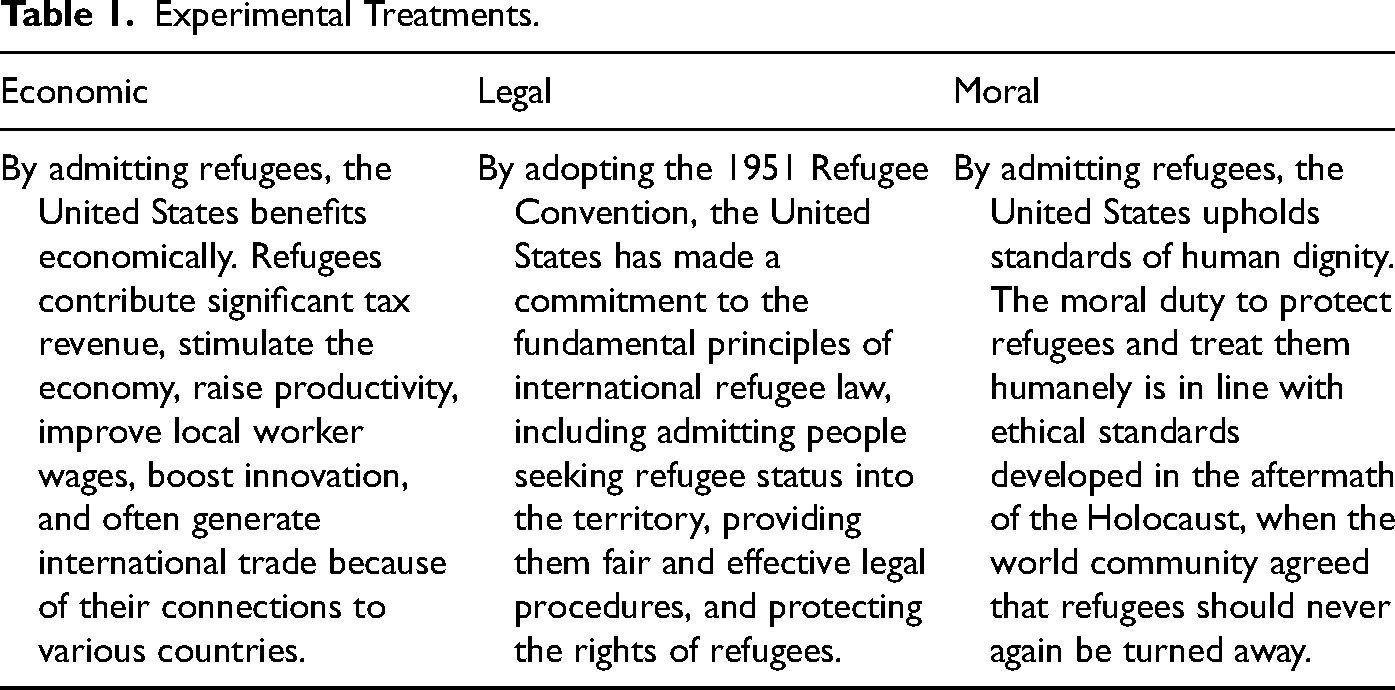
In crafting the treatment messages, we aimed for arguments that were not only theoretically relevant, but also in use in current public discussion and advocacy. To do so, we reviewed a wide range of examples of arguments in favor of refugee admissions from advocacy groups in the United States and Europe. 7 While they occasionally combined messages, their arguments generally fell into the three distinct categories central to the debates among scholars and activists, namely the economic, legal, and moral arguments. We developed short arguments from the most commonly used frames and examples, making them similar to one another in length, structure, and complexity. We recognize that the reference to the Holocaust in the moral treatment is a very particular way of making a moral argument for refugee protection. We chose this approach in part because the Holocaust was so frequently invoked in the real-world examples of moral arguments we found in use by advocacy groups. 8 Further, for the purposes of this experiment, we wanted to test the strongest versions of each argument, and invoking the Holocaust is arguably the most powerful moral appeal to protecting refugees there is, since it was the impetus for the 1951 Refugee Convention.
Following the message, all respondents were asked a standard attitudinal question, “Generally speaking, how much do you support or oppose admitting refugees to stay in the United States?” with response options on a 5-point Likert scale. These responses are the initial outcome measure for the experiment.
Conjoint Experiment
Next, all respondents participated in a conjoint experiment. In a conjoint experiment, participants are presented with a series of paired profiles or descriptions in which each profile has a limited set of attributes, and takes on randomly assigned values for each of these attributes. These values are randomly selected within each attribute, and therefore do not co-vary with one another. This means that analysts can observe the independent impact of each attribute value on the likelihood of a profile being selected (Hainmueller, Hopkins and Yamamoto 2014). Conjoint experiments first became popular in marketing studies, revealing which features were important to consumers choosing a brand of washing machine or television, before being adopted by scholars of political behavior (Bansak et al. 2021) to assess how citizens choose between candidates for office (see Schwarz and Coppock 2022 for a review) or how they evaluate potential immigrants or refugees (e.g., Hainmueller and Hopkins 2015; Bansak, Hainmueller and Hangartner 2016, 2023; Adida, Lo and Platas 2019).
In our experiment, participants were presented with a pair of profiles of prospective refugees. Each profile was composed of randomly assigned values for each of five attributes: gender, country of origin, occupation, religion, and age. Table 2 lists the attributes and the possible values each attribute could take. These attributes were drawn from the above-cited conjoint studies; as importantly, they capture potential impacts of our three pro-refugee arguments on which types of refugees are preferred. 9 Critics of the economic argument (Malik 2016; Momin 2017; Thompson 2017) argue that its use will diminish support for the most vulnerable refugees. We therefore assess whether age, gender, and occupation become more important considerations in economic framings, and perhaps less important in moral and legal framings as these apply to all potential refugees, including those from negatively stereotyped national origins and/or religious backgrounds.
List of Attributes and Values for Refugee Profiles in Conjoint Experiment.
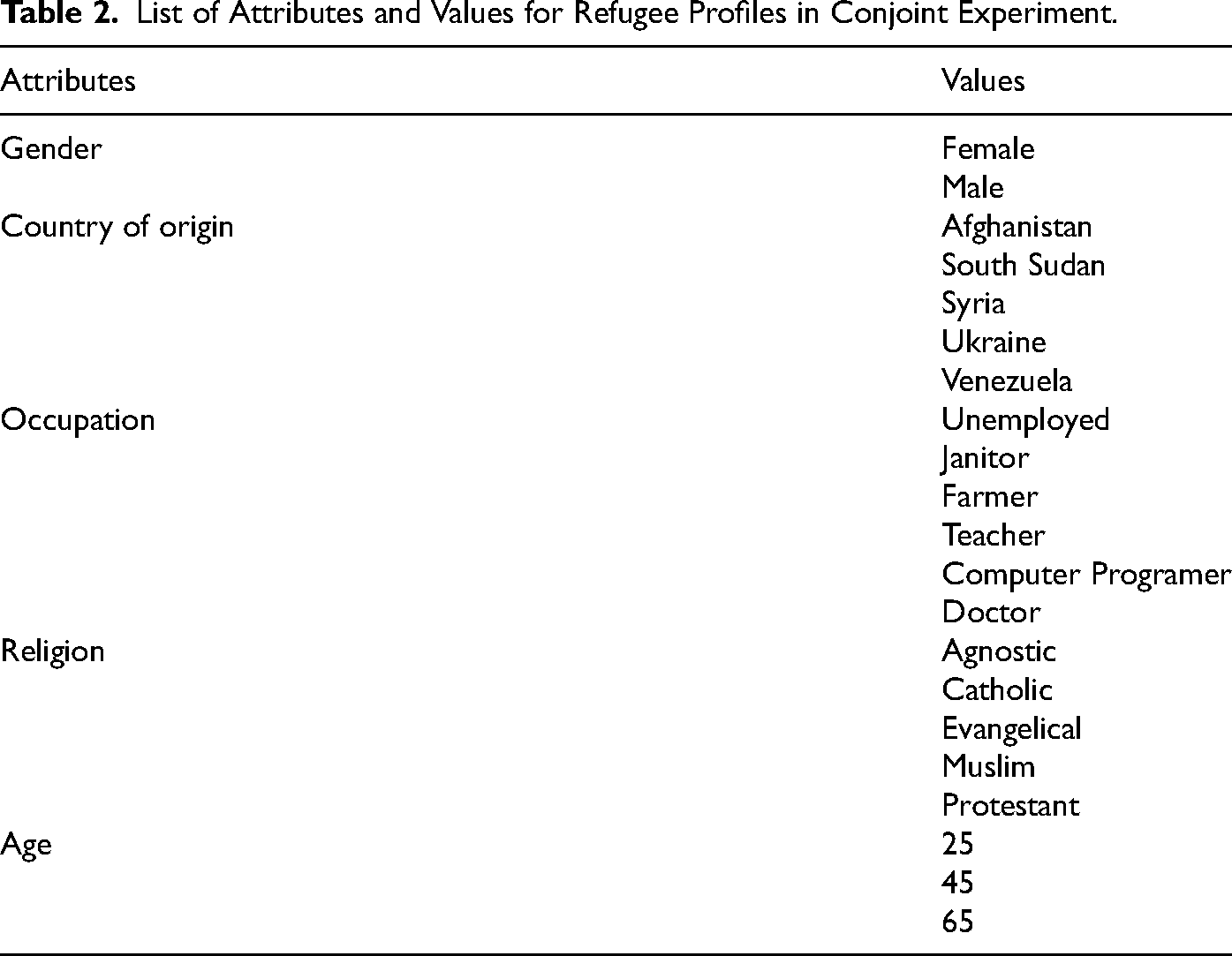
Each respondent completed six decision tasks. 10 A task consisted of a choice between two profiles of potential refugees, displayed side-by-side in columns. Respondents were instructed as follows: “Choose which one you would rather see admitted to the United States as a refugee on the basis of the information given.” Within each task, the order of presentation of attributes was randomized, so, in the aggregate, the impact of particular attribute values could not have been related to the order in which they were presented.
Manipulation Check and Attention Check
After completing both experiments, respondents were asked a battery of five agree/disagree items that included both a manipulation check for the economic treatment and an attention check for the general survey. A manipulation check aims to assess whether—and how frequently—an experimental treatment had its intended impact on study participants. In this case, we focus on the economic treatment, asking respondents whether refugees are net contributors to the economy (see Appendix, Figure A1 for exact wording). 11 Our item shows how many participants endorsed this belief in the economic treatment group, relative to those in other treatments or the control condition. Following Aronow et al. (2019) we do not exclude respondents on the basis of responses to the manipulation check.
An attention check, meanwhile, identifies inattentive respondents who answered questions haphazardly or without heeding their meaning. Inattentive respondents pose a challenge for on-line surveys (Berinsky et al. 2024; Stagnaro et al. 2024). We adapted two items from Berinsky et al. (2021); these items merely require participants to follow clear instructions in the question. We placed these items amidst two distractor questions to prevent respondents from detecting the purpose of the attention check too easily. We excluded those who failed the attention check from the data analysis, because our main purpose was to assess the effects of the experimental treatments, and this requires respondents attentive enough to actually receive the treatment (Alvarez et al. 2019; Berinsky et al. 2021). Fortunately, the sample was relatively attentive, perhaps aided by the short length of the survey; the inattentiveness rate of 6 percent was far smaller than the 36 percent observed by Alvarez et al. (2019).
Plan for Analysis
The first set of analyses assess the impacts of the pro-refugee arguments on support for refugee admissions. We begin by presenting the distribution of responses graphically, then proceed to estimation of the independent impact of each treatment. We use ordered logistic regression to estimate these effects, as our dependent variable is a five-point Likert scale item which is most safely treated as an ordinal rather than cardinal variable. After estimating the effects on the whole sample, we then estimate a model to test for the possible moderating effect of party identification. We also include a logit model estimating the relationship between refugee support and various typical demographic variables.
In the second set of results, we describe and analyze findings from the conjoint experiment. We follow Leeper, Hobolt and Tilley (2020) recommendation to report and analyze marginal means (MMs) rather than the more commonly reported average marginal component effects (AMCEs). The MMs are the average outcome for each attribute level. In a conjoint design such as ours, in which respondents must choose between one of two alternative profiles, an MM for a particular attribute value can be interpreted directly as the conditional probability of choosing a profile, given that said profile has that specific attribute value (e.g., the female value for the gender attribute). For example, an MM for “female” of 0.57 would mean that female refugee profiles were chosen 57 percent of the time when they were an option. AMCEs, by contrast, are less informative and potentially misleading in sub-group analyses. AMCEs require an arbitrarily selected reference category; this can lead to misleading visualizations and incorrect inferences about the preferences of respondent subgroups (Leeper, Hobolt and Tilley 2020; Heiss 2023).
Descriptively, we present MMs for the full sample, showing which features are more likely to be preferred. Analytically, we present MMs differentiated by experimental condition, enabling us to show where the treatments might have shifted not only attitudes toward refugees, but also preferences about what characteristics are most valued in applicants for refugee status. Analyses were conducted using the Cregg package in R (Leeper 2020). Finally, in a post hoc analysis reserved for the more speculative discussion section, we analyze the manipulation check for the economic treatment, testing to see if the economic treatment produced changes in respondents’ beliefs about the economics of refugees, and to see whether its impact differed from that of the other treatments.
Results: Framing Experiment
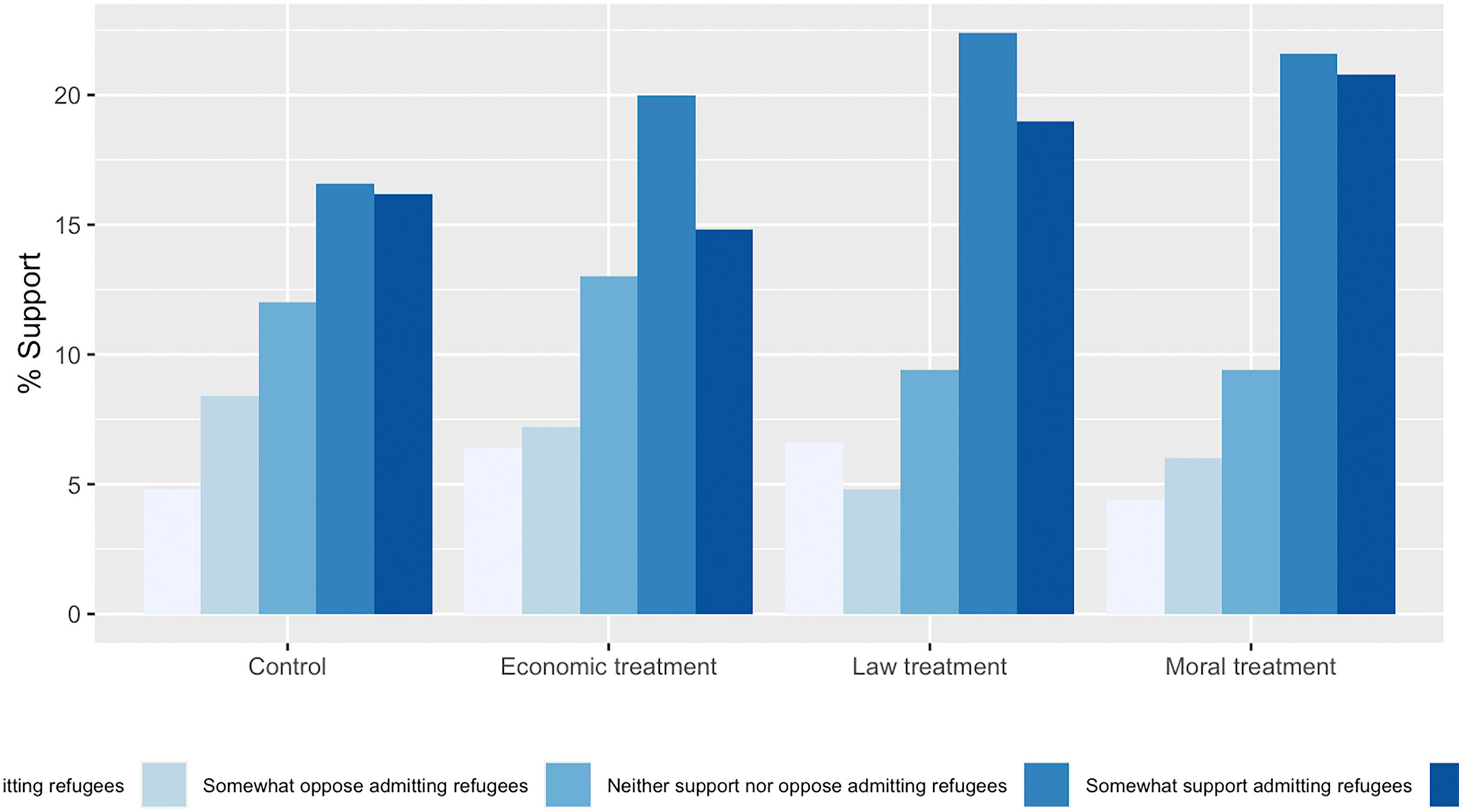
Before presenting experimental results, we note that overall support for refugee admissions in our sample is relatively high, in line with recent public opinion surveys (Lipka 2022). In the control condition, people who simply read a definition of refugees without any persuasive information were still more likely than not to support admitting refugees to the United States: 57 percent either “somewhat” or “strongly” supported refugee admissions, with only 23 percent opposed. We discuss implications of this relatively supportive baseline in the conclusion.
Moving to experimental results, we illustrate the distribution of responses within each experimental condition in Figure 1. Before moving to statistical analysis, we note that the proportion of respondents who support or strongly support refugee admissions rises to 67 percent and 68 percent, respectively, in the law and moral treatments, while combined support remained at 57 percent among those in the economic treatment group. These initial percentages suggest treatment effects of 10–11 percentage points; even in the short-term survey experiment context, we suggest that differences of this magnitude indicate substantively meaningful effects.
Refugee Admission Support, by Experimental Treatment.
In terms of statistical significance, since the dependent variable is ordinal, a Kruskal-Wallis test assesses differences across the four groups in their support for refugee admissions; results show a statistically significant difference between actual and expected data (Kruskal–Wallis χ2 = 12.37, p < .01). A follow-up many-to-one Mann Whitney U-test uses paired comparisons to show which treatment or treatments (if any) were different from the control group. Here, only the moral treatment showed a statistically significant difference from the control (p = .02 [moral], p = .23 [economic] and p = .25 [law]). 12
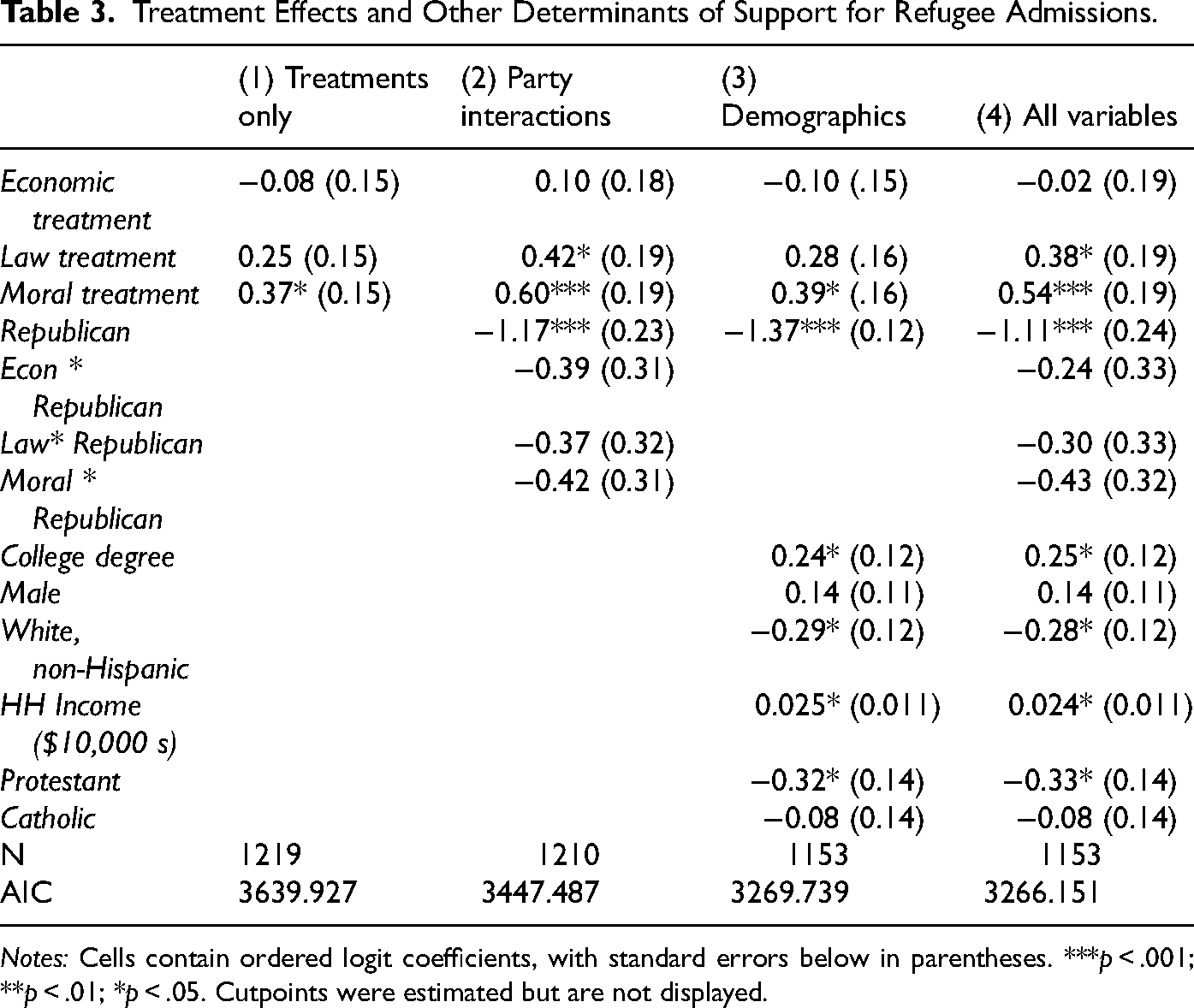
For further analysis, we move to ordered logistic regression models (Table 3). The first column replicates the results above: Only the moral treatment has a positive, statistically significant effect on support for refugee admissions. The coefficient for the legal argument was positively signed but not statistically significant at conventional levels, so the estimated increase in support in this condition could be due to chance. The estimated impact of the economic argument was negatively signed and not statistically significant.
Treatment Effects and Other Determinants of Support for Refugee Admissions.
Notes: Cells contain ordered logit coefficients, with standard errors below in parentheses. ***p < .001; **p < .01; *p < .05. Cutpoints were estimated but are not displayed.
As discussed, we expected heterogenous treatment effects by partisanship. Model 2 adds a variable for Republican identification (including Republican “leaners” as well as strong and weak identifiers), and interactions between Republican identification and each of the three messages. This allows us to test whether Republican partisanship moderates the experimental effects estimated in Model 1.
The first key finding is a null result: contrary to expectations, the economic message does not perform better among Republicans. The coefficient for the interaction remains negatively-signed and not significant. Similar results obtain for the interaction between Republican identification and each of the other two treatments. Also, the negative coefficient for the Republican dummy variable shows that Republicans are less supportive of refugee admissions than non-Republicans. In short, Republicans showed less initial support for refugee admissions, and none of the arguments offered increased their support in the aggregate.
On the other hand, both the legal and moral treatments increased refugee support among non-Republicans in the sample. The first three rows of Model 2 estimate treatment effects for Democrats and Independents (pooled), since effects on Republicans are accounted for in the interaction terms. This suggests that the moral and legal treatments increased refugee support among Democrats and Independents, although the economic treatment did not.
How large are these effects? One way to see substantive effect size is by calculating predicted probabilities for responses to the refugee support item within each experimental condition, based on the coefficient in Model 2. Full results appear in the Appendix (Table A4). Among Democrats and Independents, the predicted probability of strongly supporting refugees increased from 31.6 percent in the control group to 41.2 percent in the legal condition and 45.6 percent for the moral treatment. Combining predicted probabilities for “strong” and “somewhat” support, we find that predicted support among Democrats and Independents rose from 58.9 percent in the control group to 64.8 percent in the law treatment and 67.5 percent in the moral treatment.
We include additional logit models for descriptive purposes, showing demographic correlates of refugee support (columns 3 and 4), even though causal inference from experiments is valid without inclusion of covariates (Mutz 2011: p. 126). Being white and non-Hispanic and being Protestant are each associated with lower levels of support for refugees, while college education and higher incomes are associated with greater support.
Results: Conjoint Analysis
We move to the conjoint analysis to addresses the question of which types of refugees are most preferred, rather than looking at effects on overall support. We present descriptive results from the conjoint as a whole, then analyze how preferences changed after receiving a prorefugee argument. Figure 2 shows estimated MMs for each attribute value in the conjoint. Note that in a forced-choice conjoint, a respondent must choose one and only one of the two profiles presented in each trial, meaning that exactly 50 percent of all profiles are chosen. Therefore, a marginal mean of 0.5 means that profiles with that value were chosen in half of the trials in which they appeared, which, in turn, means that the attribute value had no impact on respondents’ choices. If a characteristic has an MM significantly greater than 0.5, then its presence increased the likelihood that respondents would choose it.
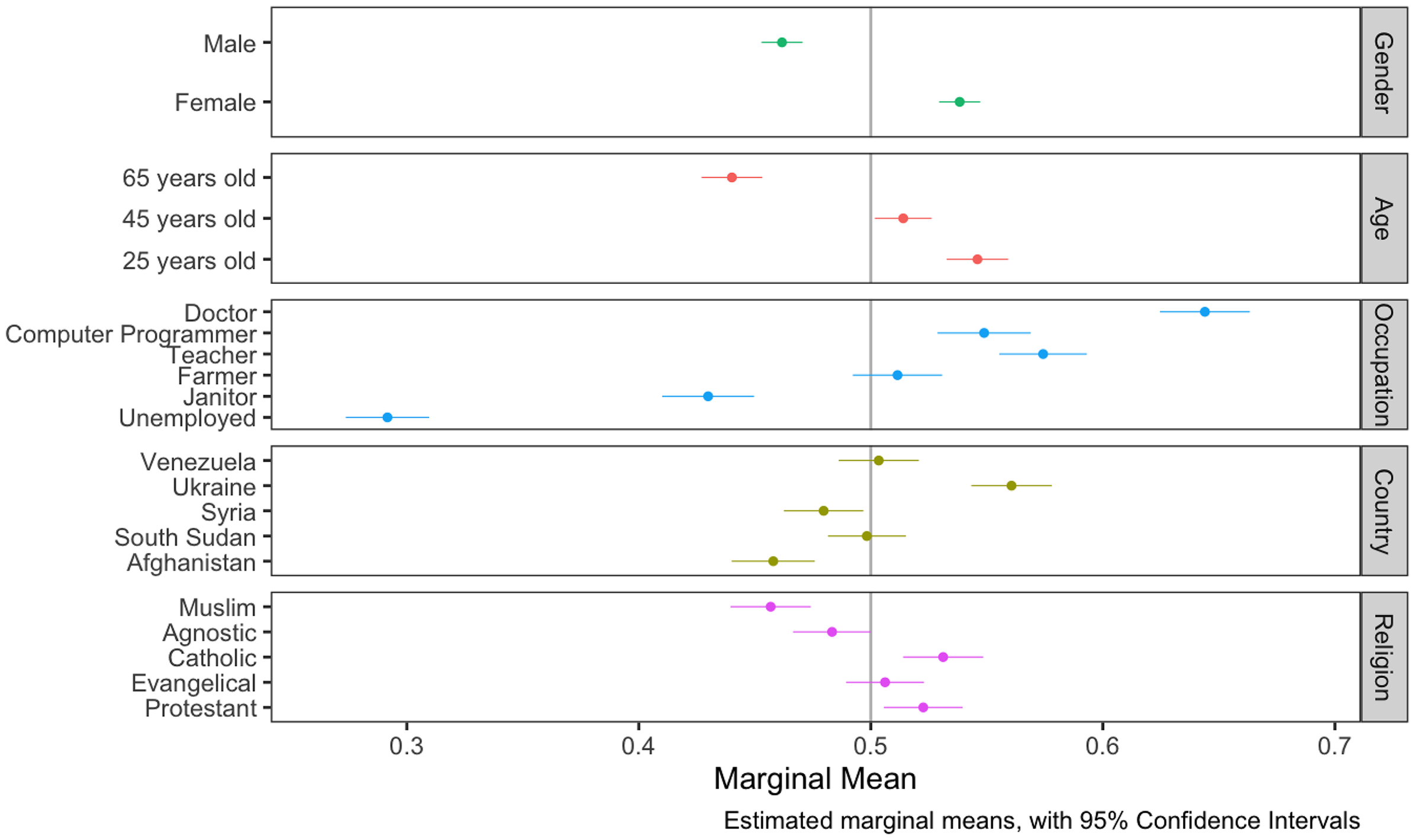
Preferences for Refugee Profiles, by Conjoint Feature.
The marginal mean for female is greater than 0.5, meaning that female profiles were chosen in more than half of the trials in which they appeared. With respect to age, we find younger profiles preferred to older ones: 65-year-olds were chosen in fewer than half of the trials in which one appeared, while 45-year-olds had an MM over 0.5, and 25-years-olds even higher. These patterns mirror Bansak, Hainmueller and Hangartner (2016) findings for European countries; Adida, Lo and Platas (2019) found a similar pattern in the United States for gender but not age.
Examining occupation reveals larger substantive effects. Unsurprisingly, doctors were the most preferred profile feature among the occupational categories, chosen in roughly two-thirds of the trials in which they appeared. Computer programers and teachers were also more likely than not to be chosen. Farmers were near the midpoint. Unemployed profiles were the least popular by a considerable distance with a MM under 0.3. Janitors were also chosen in fewer than half of the trials in which they appeared. Again, the pattern replicates prior work in Europe (Bansak, Hainmueller and Hangartner 2016) and the United States (Adida, Lo and Platas 2019). Country-of-origin effects were relatively modest; Ukraine was the most popular of the five countries-of-origin included while Afghanistan was least frequently chosen. Finally, again consistent with prior work in Europe and the United States (Bansak, Hainmueller and Hangartner 2016; Adida, Lo and Platas 2019), Muslims were less likely to be chosen relative to Christians (whether Catholic, Protestant, or Evangelical).
Beyond these initial descriptions, we next analyze the impact of our experimental treatments on these preference patterns. Figure 3 is again based on MMs for each attribute value. However, in this case, we take two additional steps: First, we separate respondents by experimental treatment, and second, we present the difference between the MM in the control group and the MM in each treatment group. This provides a direct measure of the extent to which each treatment changed the preference for each refugee attribute, relative to the control group.
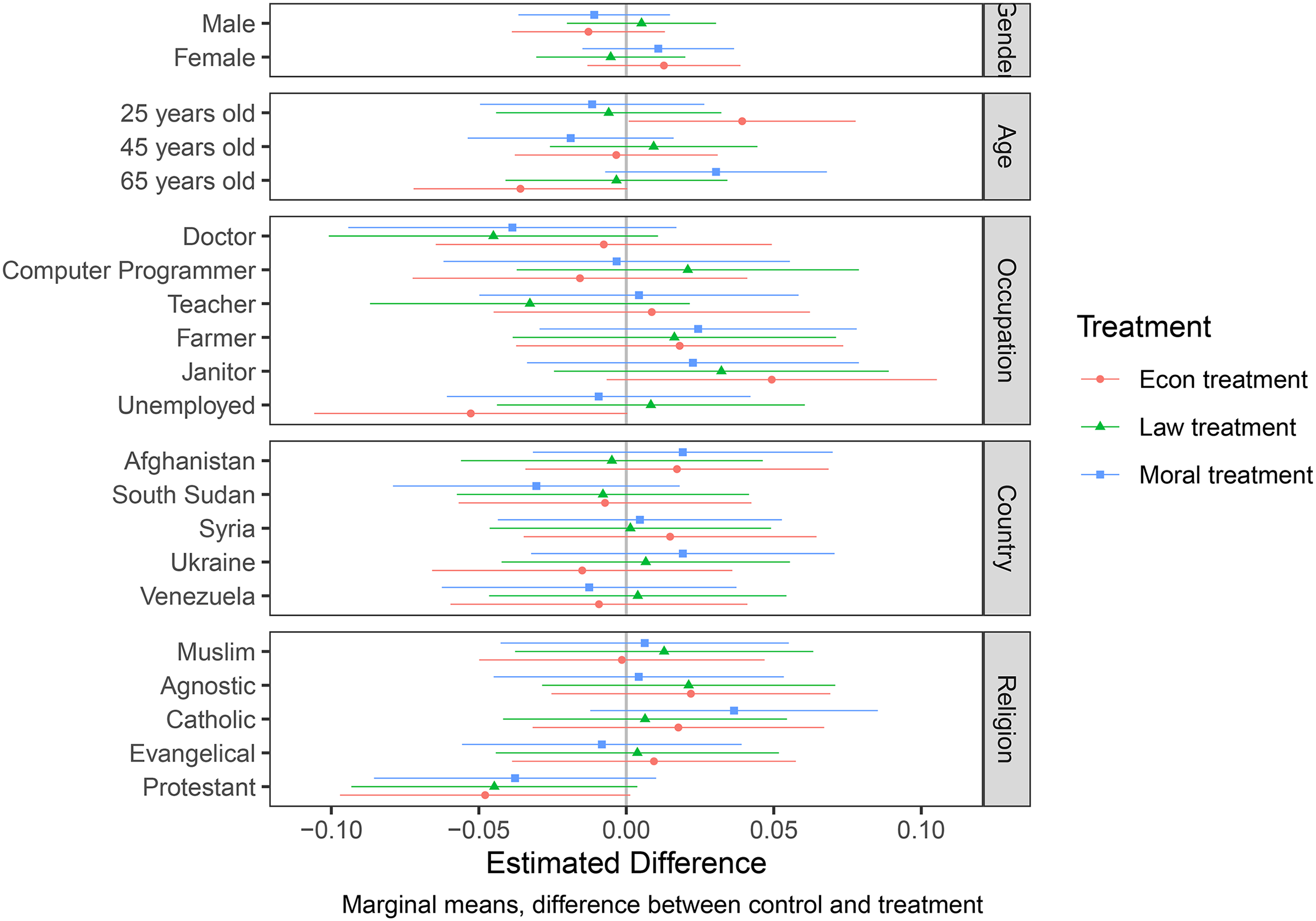
Effects of Treatments on Preferred Refugee Attributes.
We hypothesized that the economic argument would increase preferences for those refugees seen as economic contributors, i.e., those who are younger and in higher-earning occupations. Results provided mainly suggestive evidence for these expectations. The difference in MMs for 25-year-olds (p < .05) and 65-year-olds were in the expected direction; the same held for the unemployed and janitor values in the occupation attribute. However, except for the 25-year-old value, these differences did not reach conventional statistical significance (in each case, 0.05 < p < 0.10). Moreover, correcting for multiple comparisons using the Benjamini–Hochberg procedure (Liu and Shiraito 2023) suggests a failure to reject the null hypothesis even for the one coefficient for which p < 0.05). We do not observe significant impacts of the economic treatment on preferences for refugees’ gender, nationality, or religion.
Meanwhile, the law argument and moral argument had little or no substantial impact on the pattern of preferences. Trends suggest a possible shifting of preferences toward more vulnerable-seeming refugee profiles such as older refugees (moral treatment), but none were substantively large or statistically significant. The three treatment groups collectively showed less of a preference for Protestant refugees than the control group did; we simply note this as a possible unintended impact of pro-refugee messages that could be investigated further.
The conjoint design also enables us to analyze partisan differences in preferences. This analysis is not connected to the experimental treatment, so we note it only briefly here. Figure 4 shows that the preference for non-Muslim refugee profiles is strongest among Republicans, who also (unlike Democrats) prefer Christians to agnostics. Again, this is consistent with Bansak, Hainmueller and Hangartner (2016) cross-national European study, which found right-leaning ideology associated with less support for Muslim refugees. We also observe shifting preferences for countries of origin; for example, all partisan groups favored Ukraine, but Democrats did so less than Republicans and Independents. A cautionary note in interpretation: estimates include the experimental groups as well as control group; therefore results might reflect differences in how the treatments affect Democrats and Republicans’ preferences.
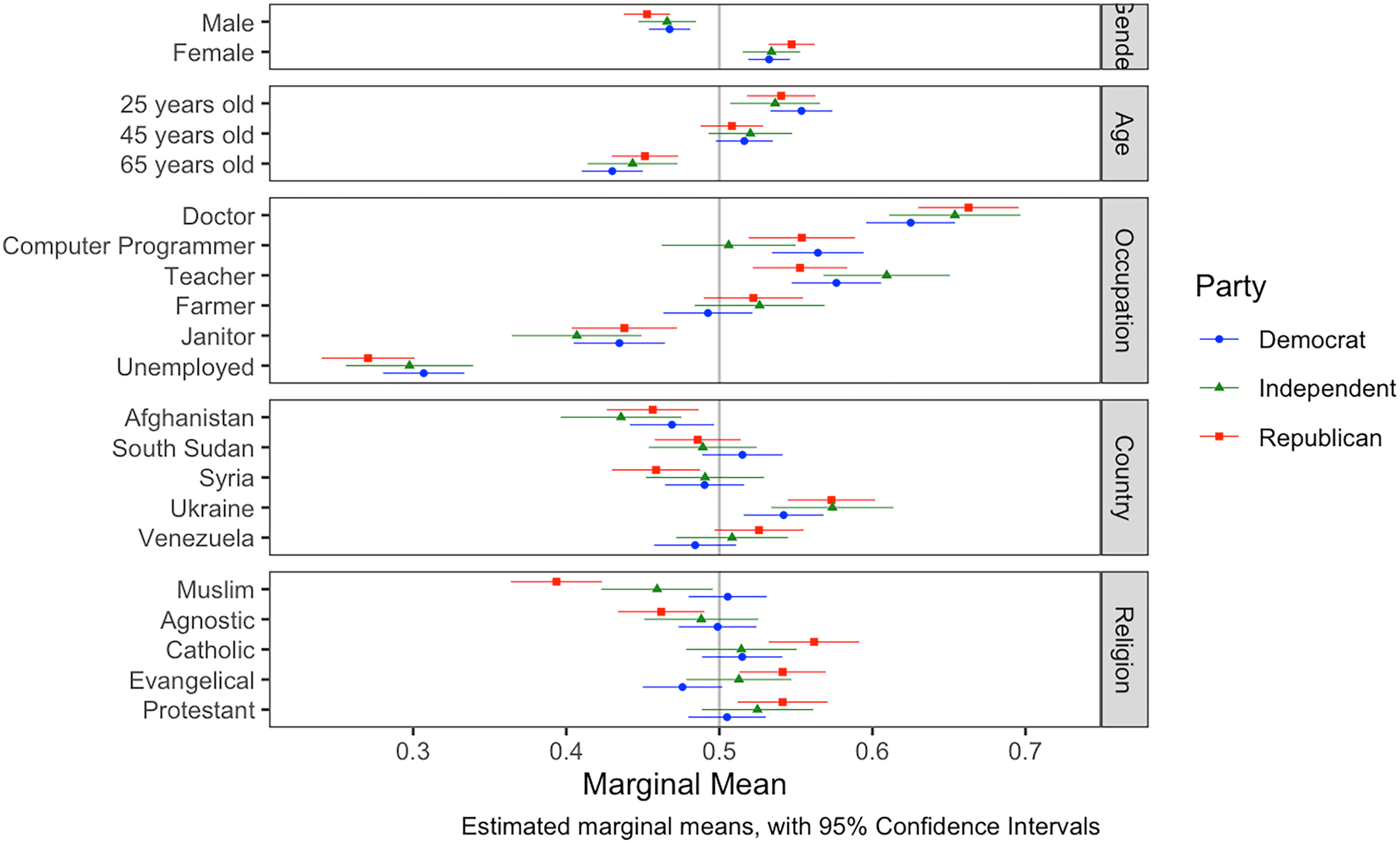
Preferences for Refugee Features, by Partisanship.
Interpreting the Message Experiment: Manipulation Check
Summarizing our two main sets of results: the moral message and (for non-Republicans) the legal message increased support for refugee admissions, while the economic message did not. The economic message might have slightly shifted preferences toward more economically productive refugee profiles in some but not all of the ways that critics have feared, and the evidence is not strong enough to reject the null hypotheses of no effect.
We now turn to the manipulation check to address a key question raised by the first set of results: Why did the economic argument fail to increase support for refugee admissions? We suggest this null result cannot be easily attributed to the statistical power of the experiment or to the format and strength of our treatments. All of the treatments were presented in a similar fashion, and both of the other arguments had detectable persuasive power, at least for a partisan subset of the sample. Moreover, the economic message itself had some impact on other responses, producing a change in preferences for refugee profiles in the conjoint experiment. This suggests that our design was sufficiently powered to be able to detect message effects, and that the economic message was able to produce at least signs of preference change in the conjoint study, even as it failed to increase support for refugee admissions. The null finding is therefore unlikely to be an artifact of the experimental design or treatment strength.
One possible explanation for the null finding is that respondents did not believe the information presented to them. To investigate this, we examine the results of the manipulation check item administered immediately after the conjoint task. Respondents were asked if they agree or disagree (or neither) with the claim that refugees contribute more to the economy than they take away. Responses provide some information about why the economic argument failed to persuade: did respondents reject (or quickly forget) the claim that refugees help the economy, or did they accept the claim but still not increase their support for refugee admission?
As Table 4 shows, the economic treatment had little if any impact, with an observed increase from 41 to 47 percent in agreement that refugees are net economic contributors, a change that was not statistically significant (p = 0.23). More surprisingly, the other two treatments led to similar results on this item, with only the moral argument showing a statistically significant difference from the control group. The economic argument not only failed to persuade people to become more supportive of refugee admissions, it also was not accepted on its own terms.
Belief That Refugees Have a Positive Economic Impact, by Experimental Treatment.
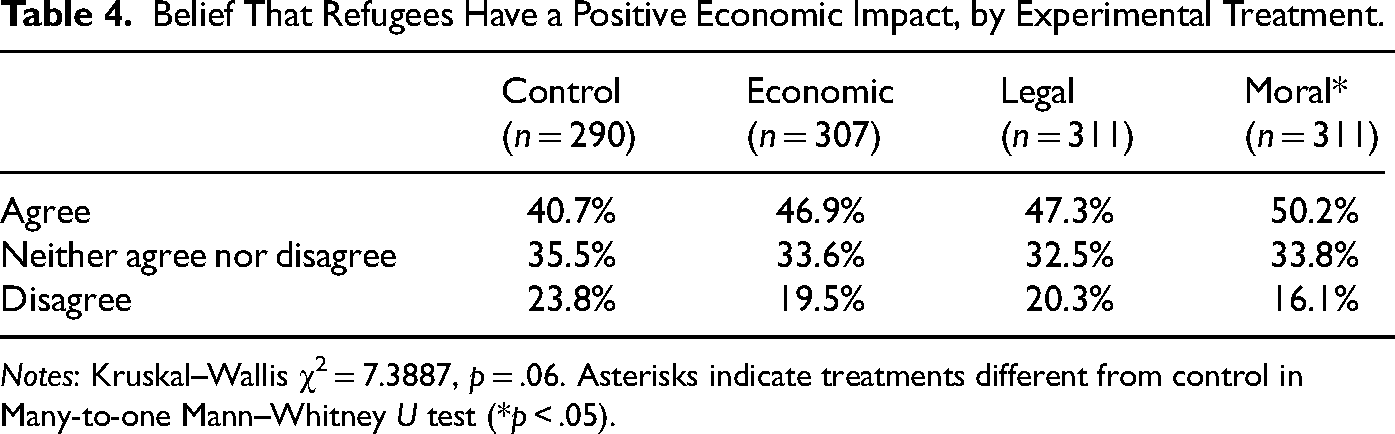
Notes: Kruskal–Wallis χ2 = 7.3887, p = .06. Asterisks indicate treatments different from control in Many-to-one Mann–Whitney U test (*p < .05).
In addition, the finding that a moral argument had a detectable impact on economic perceptions is suggestive evidence for reverse causality in the correlation between economic perceptions and support for refugees. This is inherently speculative—a post hoc interpretation rather than a hypothesis test. Still, while prior research establishes a correlation between attitudes toward immigration and beliefs about their economic impact, there remains debate over direction of causality (Gerber et al. 2017, p. 167; Esses 2021).
The pattern of responses to our manipulation check is consistent with this reverse causal pathway. The moral treatment, we conjecture, primed positive overall feelings about refugees, which then led to more positive evaluations of refugees’ particular economic contributions (in a small but detectable proportion of respondents), without any direct mention of economic impacts. This would exemplify the reverse causal pathway—general positive feelings about refugees improving evaluations of their economic contribution. Future work should investigate this question of causal pathways directly. However, if our speculation is correct, it would suggest that the economic argument for refugees is not merely ineffective but in fact barking up the wrong tree, at least in the short-run: Perceptions of refugees’ economic contributions may follow from attitudes toward refugees, rather than independently influencing those attitudes.
Discussion
Proponents of arguments that center the economic benefits of welcoming refugees, both in the Global North and in Global South host states have been celebrated by the world's elite, invited to Davos, and promoted for their innovative framing of a contentious issue (Webber 2018). However, a high-profile example of this research agenda, the University of Oxford's “Refugee Economies Programme,” has also been criticized by scholars of displacement for its neoliberal tone and its lack of acknowledgement that the economic policies of entities such as the World Bank and IMF have contributed to displacement from South to North (Munro 2017; Webber 2018; Leon-Reyes 2021; Bjørkhaug and Sandvik 2022).
In this article, our aim was to move beyond debates about the ethics of framing refugee deservingness and political appeal in terms of their potential economic contributions, and instead empirically test the effectiveness of such arguments. We found economic arguments lacking in the impact their proponents suggest they carry, at least in the US context. Instead, we find strong evidence for the effectiveness of moral arguments and mixed evidence supporting the effectiveness of distinct legal arguments, particularly among Democrats.
On the other hand, we found only weak and mixed evidence for any negative impacts of the economic argument. In the conjoint study, the economic treatment produced trends toward increased preference for youth and employment, consistent with the idea that emphasizing economic benefits might push public attitudes toward conditioning support for refugees on economic productivity and undermine support for the most vulnerable. However, our findings here are qualified in several important ways. First, these trends fell short of statistical significance. Second, the economic treatment at most strengthened a pattern that already existed: the unemployed were the least preferred set of profiles across all treatment groups, including the control group, while the highest-income or highest-status workers were also the most preferred profiles in all treatment groups. Also, the economic treatment did not lead to a preference for male over female refugees even though men are higher earners than women on average. So, while the economic argument may not have convinced people to support refugees, it also did little to harm attitudes toward the most vulnerable.
A broader qualification for our conclusions stems from the way in which the economic argument was presented. Our intervention was a short, text-based assertion, as opposed to a more extensive presentation of information. Presenting concrete, direct evidence for the economic argument might have had more impact on respondents; for example, Allen et al. (2023) economic evidence did produce attitude change (albeit in a different immigration context), and this held for their text-only treatment as well as those involving graphics or videos. Still, it should be noted that our other treatments increased support overall or for sub-groups, despite being of similar scale and format; so, this is not a case of an underpowered treatment or a sample size too small to detect effects. Thus, we view the test among the three arguments as a fair one, while acknowledging that economic data presented differently, or perhaps in combination with moral or legal framings, might prove more effective than our short text-based example. Of course, the same can be said for the legal and moral arguments. As noted above, these two framings are conceptually linked and could be more powerful when combined.
In addition, the message experiment did not specify a country-of-origin for refugees, meaning that respondents were free to fill in that blank implicitly, from their own imaginations (Blinder 2015). The conjoint results show that country-of-origin and religion can be consequential for preferences; what we cannot tell from our design is whether the effectiveness of the three arguments is conditional on refugees’ identity. Persuasion efforts might work differently in cases of different particular groups of refugees; our results do not imply a one-size-fits-all recommendation.
Another related limitation of our study is the single-country context for attitude-holders. Future research might add a cross-national comparison. Prior research suggests that the impact of the law treatment is especially likely to vary by country. Also, extending the study to Global South receiving states might revive the economic argument; perhaps it would be more effective in middle-income or low-income states, in contrast with the United States (see Whitaker and Giersch 2015; Gonnot, Dražanová and Brunori 2020). Even within the United States, there is contextual variation that we were not able to explore: Future work might investigate, for example, whether responses differ in areas with more or less visible refugee populations, or more broadly in urban versus rural areas.
Conclusion
We find no support for the view that economic arguments are critical to generating support for refugee admissions in the United States. On the contrary, moral and legal arguments were more effective, even if those impacts were concentrated among Democrats and Independents. This is important information for advocates who hope to influence public opinion on this issue and who have been increasingly drawn to economic frames. Does the relative effectiveness of messages about refugees matter in an environment in which the majority of the US population already supports refugee admissions (see above, and Table A2)? We suggest that it does, for several reasons relating to the political vulnerability of the case for refugees. First, while outright opposition is relatively low, there is plenty of equivocation (20 percent choosing the middle alternative on our scale) and soft support. Thus, from an advocacy standpoint, public support has plenty of room to grow and solidify. Further, especially with the rise of far-right populism, opponents of refugee admissions continue to make their case in public as well, so it is certainly possible for support to erode over time. Indeed, this erosion often occurs whenever a large new source of refugees actually seeks settlement in the United States (Krogstad 2019). Also, opponents of immigration tend to feel more strongly about the issue, and therefore wield more political influence through their potential voting power (Kustov 2023). Strengthening as well as broadening support for refugees would mitigate this imbalance. Furthermore, policy usually does not reflect majoritarian public opinion directly and immediately; rather public opinion works as a “soft constraint” on policy-makers choices (Ruhs 2022). Changes in either the breadth or depth of support for refugee admissions might loosen this constraint relative to any status quo ante. Thus, our findings have practical implications for advocates and policy-makers.
In more theoretical implications, our findings reinforce the importance of the perceptual distinction that members of the public make between refugees and other border crossers. The fact that arguments that emphasized the distinct legal and moral claims to deservingness associated with refugee status were more effective than the economic argument, which blurs the distinction, reveals the power of the migrant/refugee distinction in the minds of the general public.
Going further, the notable effectiveness of the moral argument offers avenues for future theorizing as well as empirical research. We have suggested that the persuasiveness of the moral argument may stem from links to humanitarian values or to the care/harm foundation of MFT, both more prevalent among liberals than conservatives. Critics of MFT argue that the liberal-conservative moral divide is better explained by attitudes toward in-groups and out-groups (Voelkel and Brandt 2019) or by authoritarianism and support for existing social hierarchies (Kugler, Jost and Noorbaloochi 2014). Still, it may be worth crafting pro-refugee arguments to appeal to “binding” moral foundations, and testing whether these would prove effective for Republicans or conservatives, in a way that economic arguments did not.
In addition, future work might take up from Skitka's body of work showing that individuals vary in the extent to which they hold moralized attitudes about a particular issue (e.g., Skitka and Morgan 2014). We would be curious to learn whether our moral treatment encouraged more people to move toward a moral conviction in favor of refugees’ rights, or whether it merely led to a short-term shift in their conceptions of refugees’ identities. Likewise, future work might investigate whether moralized attitudes toward refugees are an important moderator of experimental effects. Perhaps some individuals do not see refugee admissions as a moral issue, and are thus beyond the reach of moral appeals. In sum, there is much more work to be done to understand how messaging about particular kinds of border crossers impacts the ways in which people think about them.
Supplemental Material
sj-pdf-1-mrx-10.1177_01979183251353452 - Supplemental material for It's Not the Economy: The Effect of Framing Arguments on Attitudes Toward Refugees
Supplemental material, sj-pdf-1-mrx-10.1177_01979183251353452 for It's Not the Economy: The Effect of Framing Arguments on Attitudes Toward Refugees by Lamis Abdelaaty, Scott Blinder, and Rebecca Hamlin in International Migration Review
Footnotes
Declaration of Conflicting Interests
The authors declared no potential conflicts of interest with respect to the research, authorship, and/or publication of this article.
Funding
The authors disclosed receipt of the following financial support for the research, authorship, and/or publication of this article: This work was supported by the Massachusetts Society of Professors Research Support Fund at the University of Massachusetts, Amherst.

Supplemental Material
Supplemental material for this article is available online.
Notes
References
Supplementary Material
Please find the following supplemental material available below.
For Open Access articles published under a Creative Commons License, all supplemental material carries the same license as the article it is associated with.
For non-Open Access articles published, all supplemental material carries a non-exclusive license, and permission requests for re-use of supplemental material or any part of supplemental material shall be sent directly to the copyright owner as specified in the copyright notice associated with the article.
