







Abstract
This article studies how domestic and international remittances respond to weather shocks in Mexico and whether local violence affects the use of remittances as insurance. I use a novel combination of state-level, administrative, survey, and remotely sensed panel data to investigate these questions. Estimating a gravity model that accounts for network characteristics and potential spatial dependence, I find that remittances are selective, responding positively to drought but negatively to violence. The negative impact of violence is even larger in areas experiencing drought, suggesting that households facing violence are especially vulnerable to weather shocks as they are less able to cope using remittances. I further unpack the costs of both drought and violence by studying spillovers from neighboring states. I find that the degree of violence in neighboring states magnifies the main impact, motivating regional policy approaches.
Introduction
Households across the world, and especially in low- and middle-income countries, are vulnerable to increasingly common severe weather shocks. Often, they use a variety of strategies to cope, such as adjusting livestock and asset portfolios (Acosta, Nicolli, and Karfakis 2021; Dercon 2002; Zimmerman and Carter 2003; Kazianga and Udry 2006; Acosta, Nicolli, and Karfakis 2021), converting agricultural land (Azadi et al. 2018), altering consumption (Gao and Mills 2018), using savings (Paxson 1992), off-farm employment (Kochar 1999; Ito and Kurosaki 2009; Bezabih et al. 2010), or migration (Rosenzweig and Stark 1989). There are a number of barriers that may prevent families from taking advantage of these options, including labor market frictions, financial market gaps, and violence, a possible transaction cost (Becker 1968). In this article, I investigate whether domestic and international remittances in Mexico increase in response to a drought and whether violence impedes the use of remittances as informal insurance.
Understanding how remittances respond to drought underscores the role migration can play in building climate-resilient communities, especially for places like Mexico with long histories of migration. Drought is particularly relevant in Mexico where over 70% of agriculture is rain-fed and formal insurance is often limited or incomplete (Fuchs and Wolf 2011).
I first establish the impact of drought in sending and receiving states using novel panel data on state-to-state remittance flows that I construct by combining administrative data on Mexican immigrants in the US, internal migration in Mexico, and total remittance flows to and within Mexico. I analyze both international flows and internal transfers. I then assess the impact of violence on remittances and use the interaction between drought and violence to highlight the specific impact of instability in a state also experiencing drought. I adopt techniques from the spatial econometric literature to estimate credible, causal parameters that account for the role of networks and address spillovers from neighboring states. Going further, I study data on just Mexican state-level remittances that originate anywhere in the US (country-to-state analysis) and data on remittances to anywhere in Mexico from an US state (state-to-country). I include a number of robustness checks and extensions to unpack the relationships between remittances, climate change, and violence.
Throughout this article, I will discuss remittance-sending states (places a migrant has moved to and from which they remit) and remittance receiving states (the origin of the migrant and where the household receives these remittances). I find that drought 1 in the receiving state increases international remittances by about 17% suggesting that migrating and remitting are important coping strategies for those experiencing drought.
Next, I find that a 1% increase in violence in the receiving state, proxied by homicide rate, has a significant negative impact on remittance flows, reducing flows by about 0.05%. This direct effect is smaller than the impact of drought, but it is a more meaningful predictor of remittance behavior. I decompose the amount of variation that the model explains into its component parts and show that different levels of violence explain a much greater portion of the variation in remittances across Mexican states. Similarly, a 1% increase in homicides is quite small and many states experience much larger annual changes in violence so the actual reduction in remittances could be substantial. Finally, in two states experiencing drought, the state with more violence sees significantly smaller remittances flows, further suggesting that violence seriously undercuts remitting as a strategy to cope with the effects of climate change. In contrast, I find remittances do not respond to violence and drought in sending states, whether in the US or Mexico.
I also find evidence of spillovers, in the same direction of the direct effects, for both drought and violence. Drought in the three nearest neighbors increases remittances while higher violence reduces remittances. Ignoring these spillovers would overestimate the direct impact of drought and violence on remittances. This analysis highlights the unique cost of regionally correlated violence, which could include organized crime or sectarian conflict, and widespread weather shocks, motivating policy approaches coordinated across state and even national borders.
My results speak to the New Economics of Labor Migration theory which posits that migration may serve as a risk diversification strategy (Taylor 1999). As drought becomes more frequent across Mexico, using remittances as insurance may enable the remaining family members to stay in Mexico. I discuss the theory in detail in the following section.
This research relates to the growing body of literature on climate change and migration. Climate change may impact migration decisions and the effectiveness of remittances as a tool to manage severe weather fluctuations (Rapoport and Docquier 2006; Yang and Choi 2007; Bryan, Chowdhury, and Mobarak 2014; Munshi and Rosenzweig 2016). Weather shocks are important push factors that spur migration (Mahajan and Yang 2020; Beine and Jeusette 2021), including in Mexico where drought can increase both international and internal migration (Chort and de la Rupelle 2016; Ruiz 2017; Khamis and Li 2020).
Similarly, violence across Mexico is closely related to migration. Violence in Mexico increased when then-President Felipe Calderón initiated the decapitation strategy targeting cartel leaders around 2007 (Guerrero 2013; Calderón et al. 2015), negatively impacting the Mexican economy (Ashby and Ramos 2013; Enamorado, López-Calva, and Rodríguez-Castelán 2014; BenYishay and Pearlman 2014; Bel and Holst 2018; Ríos 2019; Carrasco and Duran-Bustamante 2022). Existing work finds that local violence limits international migration (Chort and de la Rupelle 2016; Massey, Durand, and Pren 2020) but increases internal migration (Ybáñez Zepeda and Alarcón 2014; Massey, Durand, and Pren 2020; Rodríguez Chávez 2021, 2022).
Building on this migration research, I speak to the existing literature on risk-sharing across migration networks. Migrants provide insurance to their families and occasionally families provide insurance for migrants (Rosenzweig and Stark 1989; Amuedo-Dorantes and Pozo 2006; de Weerdt and Dercon 2006; Rapoport and Docquier 2006; Hagen-Zanker and Siegel 2007; Yang and Choi 2007; Lueth and Luiz-Arranz 2008; Mazzucato 2009; Basu and Bang 2013; de Weerdt and Hirvonen 2016; Bettin and Zazzaro 2017). While migration may be an important risk-sharing tool, certain remittance-networks may be more active if the destination offers higher incomes or faces fewer climate shocks (Gröger and Zylberberg 2016; Millán 2020).
I also connect to the broader literature on the economics of crime (Becker 1995, 1968) and the costs of crime, including lower economic activity and development (Heinemann and Verner 2006; Soares 2006; Detotto and Otranto 2010; Blanco and Ruiz 2013; Wickramasekera et al. 2015; Motta 2017). While the literature is still emerging, prior works finds a negative impact of crime on remittances, suggesting that people may send less money if it makes family members vulnerable a crime or because potential investments become less valuable (Vargas-Silva 2009; Meseguer, Ley, and Ibarra-Olivo 2017; López García and Maydom 2021).
I contribute to the literature in two key ways. This work bridges studies that use household-level survey data relying on self-reported remittances (Yang and Choi 2007), and national administrative data which may miss key impacts of local shocks by averaging over an entire country (Laurent, Margaretic, and Thomas-Agnan 2022). I expand on the existing literature by incorporating longer, more recent, sub-national, panel data. The state-level data is administrative similar to national level data but allows me to assign drought and violence experiences more accurately at the smaller geographic scale; it is also more intuitive to picture spillovers from neighboring states rather than large countries.
More significantly, I contribute by specifically considering situations where conflict is present in addition to drought. Many other countries, such as Yemen or Somalia, also suffer under the devastating effects of climate change and ongoing violence. I am able to look at the direct impact of violence on remittances, another shock families may insure against. Then, by considering the controlled direct effect of drought on remittances holding violence constant, I demonstrate that households may want to use remittances to insure against drought shocks but that violence prevents this strategy, introducing a new discussion on the indirect costs of violence in Mexico. In this article, I link the literature on strategies to cope with weather shocks, the determinants of remittances, and the costs of crime using novel data to address an important empirical question.
Section “The Decision to Remit” describes the literature and the intuition of the research question. Section “Data” describes the data, followed by Section “Empirical Framework” discussing the empirical strategy. Section “Results” contains the results from various specifications, including extensions and robustness checks, and Section “Conclusion” concludes.
The Decision to Remit
Is the decision to remit independent from the decision to migrate? In other words, we may wonder if individuals decide to migrate specifically because of the potential to remit or if the decision to migrate is driven by individual considerations regarding personal well-being and remitting is a separate decision process. The New Economics of Labor Migration theory suggests we consider the migrant, the household, and the broader community together when we model the migration decision process. Taylor (1999) argues that migration can foster growth in origin communities if remittances insure against risk in areas that lack formal options. Households, as a unit, may use migration to increase home-production by allowing the family to take on potentially lucrative risks, knowing the migrant can remit to offset any losses. Thus, the migration decision is a household, rather than individual, one and remittances reflect that connection between the migrant and household.
Following this theory, we would expect to see remittances increase when a shock, such as a drought, occurs at the origin. Speaking to this idea, Rosenzweig and Stark (1989) find that households in India are more likely to marry daughters into families in areas that face different weather shocks, providing early evidence of migration as a household-level insurance strategy. More recently, Yang and Choi (2007) find evidence that remittances to the Philippines may offset at least some household consumption loss following a weather shock. Gröger and Zylberberg (2016) and de Weerdt and Hirvonen (2016) find evidence that internal migration in Vietnam and Tanzania, respectively, provides insurance to those who stay behind. Gröger and Zylberberg (2016) also show that following a typhoon in Vietnam, households with migrants farther away benefited from increased remittances but those nearby, who were presumably affected by the same shock, were not able to offer similar support.
To study the use of remittances as insurance in Mexico, I exploit the harmful droughts the country frequently faces (Boyd and Ibarrarán 2009; Dobler-Morales and Bocco 2021; Varela, Guerrero, and Miguel 2021). Liverman (1990) provides historic evidence of the negative impact of drought on farming communities in Mexico, especially those without agricultural technology like drought resistant seeds and irrigation. The negative impacts of drought in Mexico are not just meteorological but social and political, with the poorest and least powerful facing the greatest consequences (Robles Chávez 2022; Hernández-Pérez and Jerez-Ramírez 2023). Most broadly, Arceo-Gómez, Hernández-Cortés, and López-Feldman (2020) find that the severe 2011 drought in Mexico had a substantial negative impact on rural households’ well-being, not just their income as this drought increased poverty, reduced investments in children's education, and reduced female employment.
This article first looks at the impact of drought at the origin on remittance flows, which would increase if the household originally sent the migrant with the explicit purpose of offering insurance or if the individual migrated for other reasons but now chooses to remit because of the new challenge at home. Evidence of the former would support the NELM framework while evidence of the latter would suggest that even if risk-sharing is not the initial motivation for migration, remittances can offer important relief when a drought does occur.
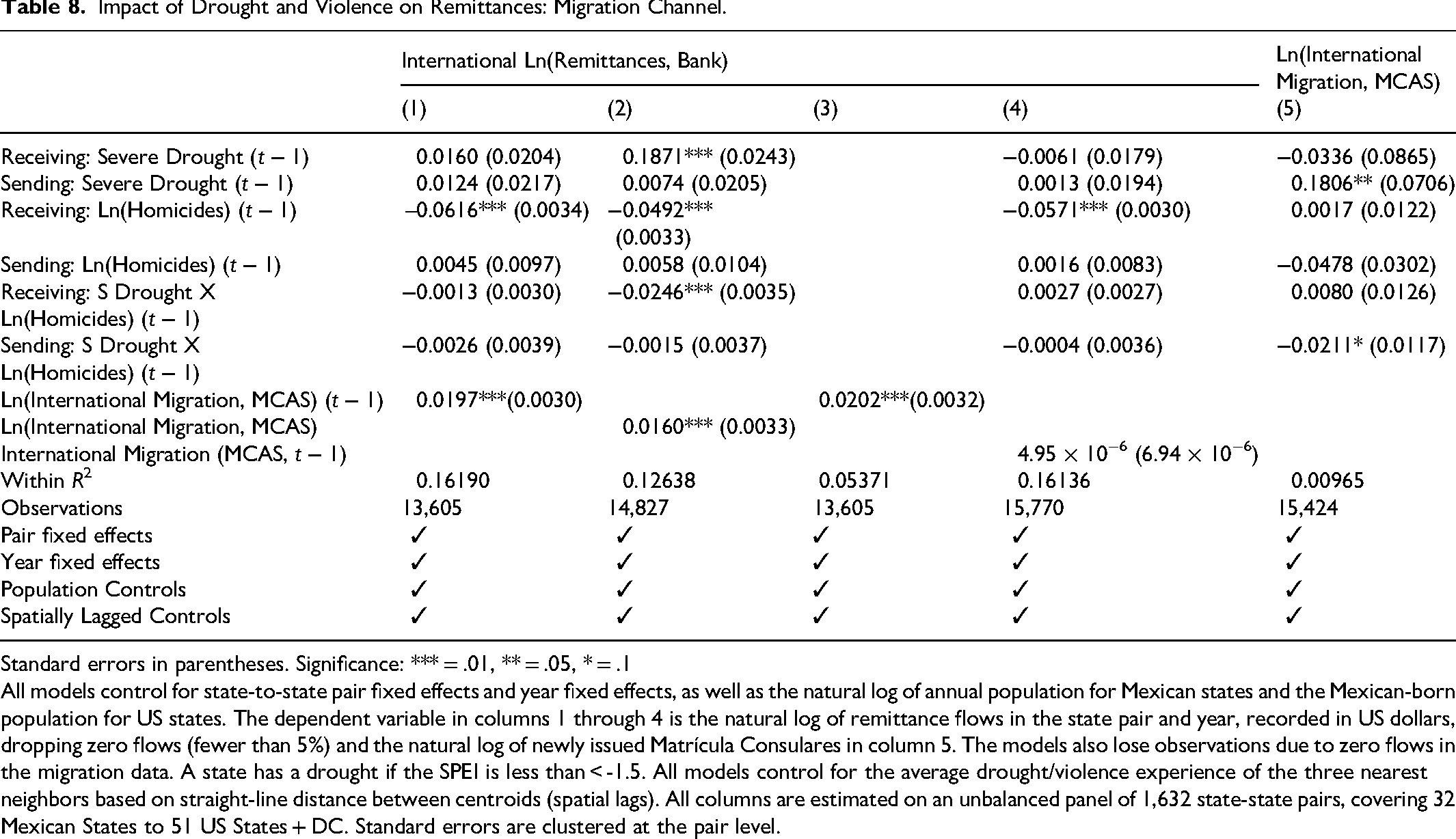
To attempt to disentangle whether the increase in remittances is driven by new migrants responding to the drought or existing migrants, I control for recent migration in various models and investigate migration directly in Table 8 and Table D5. Briefly, I find that both stories are plausible. Recent drought may induce some people to migrate and then immediately remit but even when holding migration levels constant, I find that international remittances increase in response to drought. It's also possible the earlier immigrants were sent for insurance purposes and repeatedly respond as shocks occur at home.
After establishing that migration and remitting can help families cope with drought shocks, I investigate whether violence would augment or impede this strategy. Massey, Durand, and Pren (2020) and Rodríguez Chávez (2021) find that violence may increase internal migration, suggesting there is some negative cost to living in a violent area. Atuesta and Paredes (2016) quantify this cost, showing that while people still do move towards violent areas, they only do so when their earnings at the destination will be much higher. While the relationship between violence and migration is complicated by a variety of factors (see Rodríguez-Chávez 2024 and Chort and de la Rupelle 2016), a number of studies, including qualitative interviews with migrants find that violence is costly and motivates migration (Gómez-Johnson 2015).
If violence spurs migration, then remittances may increase simply because there are more migrants from a particular area available to send remittances, especially if the household is saving up to leave entirely (although this could lead to a decline in remittances if the entire household leaves). Additionally, violence (Soares 2006), drug trafficking (Banco Interamericano de Desarrollo), and the police actions taken to address drug trafficking (Carrasco and Duran-Bustamante 2022) have a negative impact on local economies and broader welfare in these communities. As this is a negative shock, households may use remittances as insurance, similar to the response to drought.
On the other hand, if remittance-receiving households are targets for extortion, then households in unsafe areas may want fewer remittances so as not to become victims of a crime. López García and Maydom (2021) find that across Latin America, remittance-receiving households are more likely to report that they fear crime and have been victims of crime. Vargas-Silva (2009) finds that both international and domestic remittances in Colombia decrease when the recipient is the victim of a crime. Meseguer, Ley, and Ibarra-Olivo (2017) looks at Mexico from 2006 to 2010 finding that municipalities in Mexico with higher homicide and violent crime rates have a lower percentage of households receiving remittances.
The NELM theory explains how migration offers households a tool to diversify risk. But, another relevant piece of the theory is that migration can help raise capital for business investments at the origin.
Adams and Cuecuecha (2010) find that remittances to Guatemala increase spending on investment goods such as education and housing and Giuliano and Ruiz-Arranz (2009) find that, at the national level, remittances boost growth in countries with underdeveloped financial systems, highlighting the importance of migration and remittances as a factor in long-term growth at the origin. Yang (2006) finds that middle-income families use migration to raise capital for small business enterprises and Woodruff and Zenteno (2007) finds that small-businesses in Mexico that are connected to US migration networks report higher investment and profits.
Following this theory, either drought or violence could reduce remittances if these shocks reduce the productive capacity of an investment. For example, a farming household may use remittances to buy new machinery but decide not to invest in equipment if a drought recently impacted the harvest. Similarly, families may not want to invest in any large or fixed assets if their community is becoming increasingly violent and they are considering leaving or are worried about the assets being stolen (Vargas-Silva 2009).
Thus, the impact of drought on remittances and the role violence may play remain empirical questions. One concern may be that drought causes an increase in violence, complicating the results from an empirical standpoint. Currently there is mixed evidence on the impact of weather on large-scale violence without an obvious causal relationship in one direction or the other (Maystadt and Echer 2014; Adaawen et al. 2019; Koubi 2019). Ishak (2022) does find that drought increases violent crime in Brazil, pointing to economic deprivation as a mechanism. In Mexico specifically, Cohen and Gonzalez (2024) find a positive relationship between temperature and crime, while Baysan et al. (2018) find that high temperatures increase both drug-related and regular homicides, with a larger impact on drug-related violence. In this specific context, Chaparro (2022) at Vice News reports that when drought hits, water becomes an even more valuable resource, leading cartels to a new revenue source. Increasingly scarce water could lead to inter-cartel conflict over the control of water and could increase the average person's interaction with the cartel and possibly violence. Though not the focus of this work, I find an insignificant but positive relationship between drought and homicides at the state level in Mexico (Table E1).
The fact that both drought and violence may impact remittances and that drought may impact violence means we must be cautious and specific when interpreting the regression coefficients. The primary analysis presents the controlled direct effect of drought on remittances (Cinelli, Forney, and Pearl 2024). In other words, these models reflect the impact of drought on remittances that remains when holding violence constant. I will present total effect models, those that evaluate just the impact of drought or violence on remittances, and then controlled direct effect models. If the effect of drought occurred entirely because of the relationship between drought and violence (i.e., remittances really don’t respond to drought on its own and instead drought impacts violence which is what impacts remittances) then there would be no controlled direct effect. If, absent violence, remittances would respond quickly to drought shocks in Mexico, but violence impedes this strategy we would observe a smaller total effect of drought on remittances.
Finally, I consider the impact of drought and violence in remittance-sending states, both in the US and Mexico. A drought may decrease the earnings of a migrant, especially in the US where many immigrants from Mexico work in agriculture (USDA ERS 2020). We would expect this to decrease remittances as the migrant has less money to send. This may be less likely for domestic remittances since the typical internal migration pattern is from rural to urban areas (Nawrotzki et al. 2017). Theoretically, violence could influence remittances in the same way if a migrant is robbed or chooses lower-paying but safer jobs. Coon (2015) finds that migrants in the US are often victims of crime because people expect they will be carrying cash. He finds that robbery decreases remittances, likely because people fear being robbed on the way to a remittance terminal, but burglary increases remittances possibly because the migrant does not have a good way to store money and feels it will be safer in their family's hands.
Below I discuss the data and methods I use to study this question and I revisit these intuitive predictions in the “Results” section. Supplemental Appendix B includes a more formal model of the remittance decision problem from the households’ perspective.
Data
Dependent Variables
I use annual remittance data from the Central Bank of Mexico, available at the Mexican state level and measured in millions of US dollars. The bank is able to observe online transfers and bank deposits, and also accounts for cash and in-kind informal remittances. These data only include international remittances and I use the data from 2010 to 2020 for the main analysis. While these remittances originate in the US, the raw data does not indicate a specific US state. This would limit my ability to address the impact of sending-state conditions on remittances and prevent me from controlling for state-pair networks. The bank also provides similar data at the US state level from 2013 to 2020, but this only indicates that the remittances went to Mexico, not to which state. I use these US-to-Mexican state data in Tables 6 and 7, but the main results adopt a state-to-state approach.
To construct state-to-state data, I begin by assuming that the share of the total remittances coming from each state j to i is proportional to the share of migrants from i to j out of all migrants from i. I use data on Matrículas Consulares de Alta Seguridad (MCAS) applications to construct migration shares,
It is not appropriate, though, to assume remittance shares would exactly reflect migration shares, so this is only a first step. I use the US-state-level data from the bank to “correct” these state-to-state flows. I discuss the approach in detail in Supplemental Appendix A but, briefly, I aggregate my constructed data to the US state level and compare that to the actual data from the bank. 2 I calculate how far off the constructed data is for each state and then correct all the constructed flows by the size of that error. For example, using migration shares, I would assign about 36% of all remittances to California but the observed data shows 31% of total flows originated in California. I calculate the difference between constructed and observed shares (–0.05 for California) and then add this difference to every ij pair to obtain a “corrected” share of remittance flows. For example, 29% of all migrants from Baja California traveled to California so prior to the correction I assign 29% of remittances received in Baja California to California but after the correction I assign 24%. 3
The correction addresses the fact that some US destinations may be different from others in ways that impact remittances. There may be some condition in j that impacts remittance flows out of that state to any/all i, such as a high cost of living in California, reducing all immigrants’ disposable income or how well-advertised the MCAS is to remittance senders in each state. With the data available, I must assume that this affects all migrants from Mexico similarly, which is likely true for conditions like higher average wages, access to banking, or the political and social inclusion of immigrants.
I supplement the Central Bank data with household survey data from the Encuesta Nacional de Ingresos y Gastos de los Hogares (ENIGH). This survey is conducted every two years and I aggregate individual data to the state level using the sampling weights. This survey includes both international remittances and household transfers within Mexico and will pick up remittances outside of the formal banking system which the main data may miss despite the bank's attempts to incorporate these. These data are reported in pesos and correspond to just one quarter, 4 rather than the whole year, so I do not directly compare them to the Central Bank data but rather use the household survey to extend the main analysis.
I use a similar process to assign internal transfers to ij pairs within Mexico using the 2010 Mexican Census (available from IPUMS International; Ruggles et al. 2020) to measure the share of migration between two states within Mexico from 2005 to 2009 following the methodology in Jones et al. (2019). I include people who moved from one municipality to another within a state when calculating migration shares and I assign the appropriate number of observed internal transfers to that channel as within state migration and remitting may be common. I then drop this self-pair from the analysis since the state-level drought and weather shocks would be the same for both sender and receiver. For each of the 32 Mexican states, there are 31 potential remittance-sending states. For this data I am not able to make the same adjustments as with the international data so the flows are assigned by just pre-period migration share.
Table 1 presents the average remittance inflow at the state level each year. 5 In general, remittance flows are quite large and are increasing over time both internationally and domestically.
State-Level Remittance Inflows.
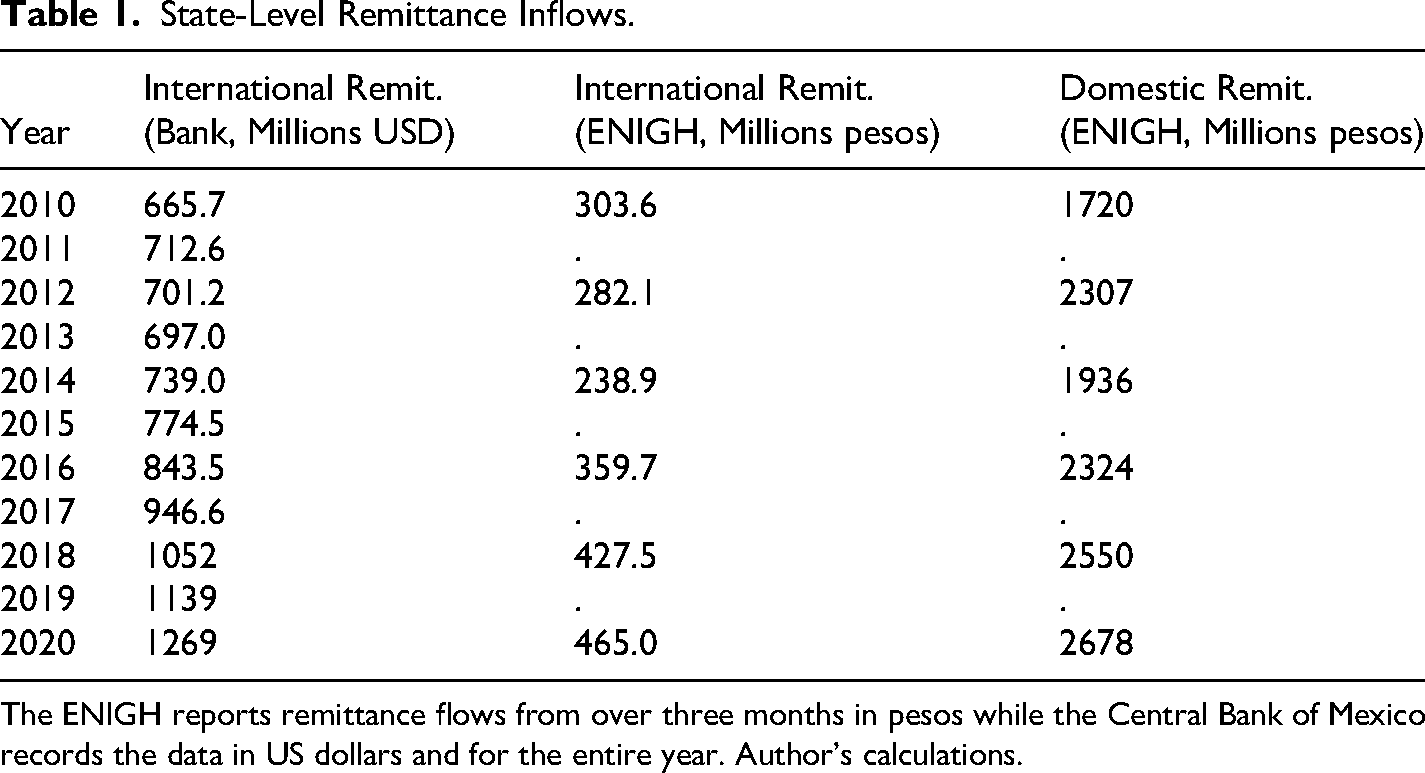
The ENIGH reports remittance flows from over three months in pesos while the Central Bank of Mexico records the data in US dollars and for the entire year. Author's calculations.
Independent Variables
I use remotely sensed data from the Daymet database, managed by NASA and the Oak Ridge National Laboratory to measure drought. I use temperature and precipitation to calculate the twelve-month Standardized Precipitation Evapotranspiration Index (SPEI) for states in Mexico and the US. The SPEI is a multiscalar index that neatly summarizes deviations in precipitation and temperature from long-term means. The SPEI improves on the earlier standardized precipitation index (SPI) by including the impact of temperature, which is a crucial factor when discussing drought and water scarcity (Vicente-Serrano, Beguería, and Lopez-Morena 2010). The SPEI value reflects the number of standard deviations a current year's rainfall and evaporation level is above or below its 30-year average.
For both the US and Mexico, I use the twelve-month period from December in the year prior to November to define a drought in the year. 6 I calculate the index using the R package “spei” from Beguería et al. (2014). A location has a severe drought if the SPEI is less than −1.5 (at least 1.5 standard deviations below the long-term norm) following the typical scale established in McKee, Doeksen, and Kleist (1993). Any other SPEI value reflects a typical or high level of rainfall. As a middle-income country with a history of drought, I expect severe drought to have an impact on Mexican households who may have adapted to moderate droughts. Figures 1 and 2 below show the distribution of the SPEI in 2014 in Mexico and the US.
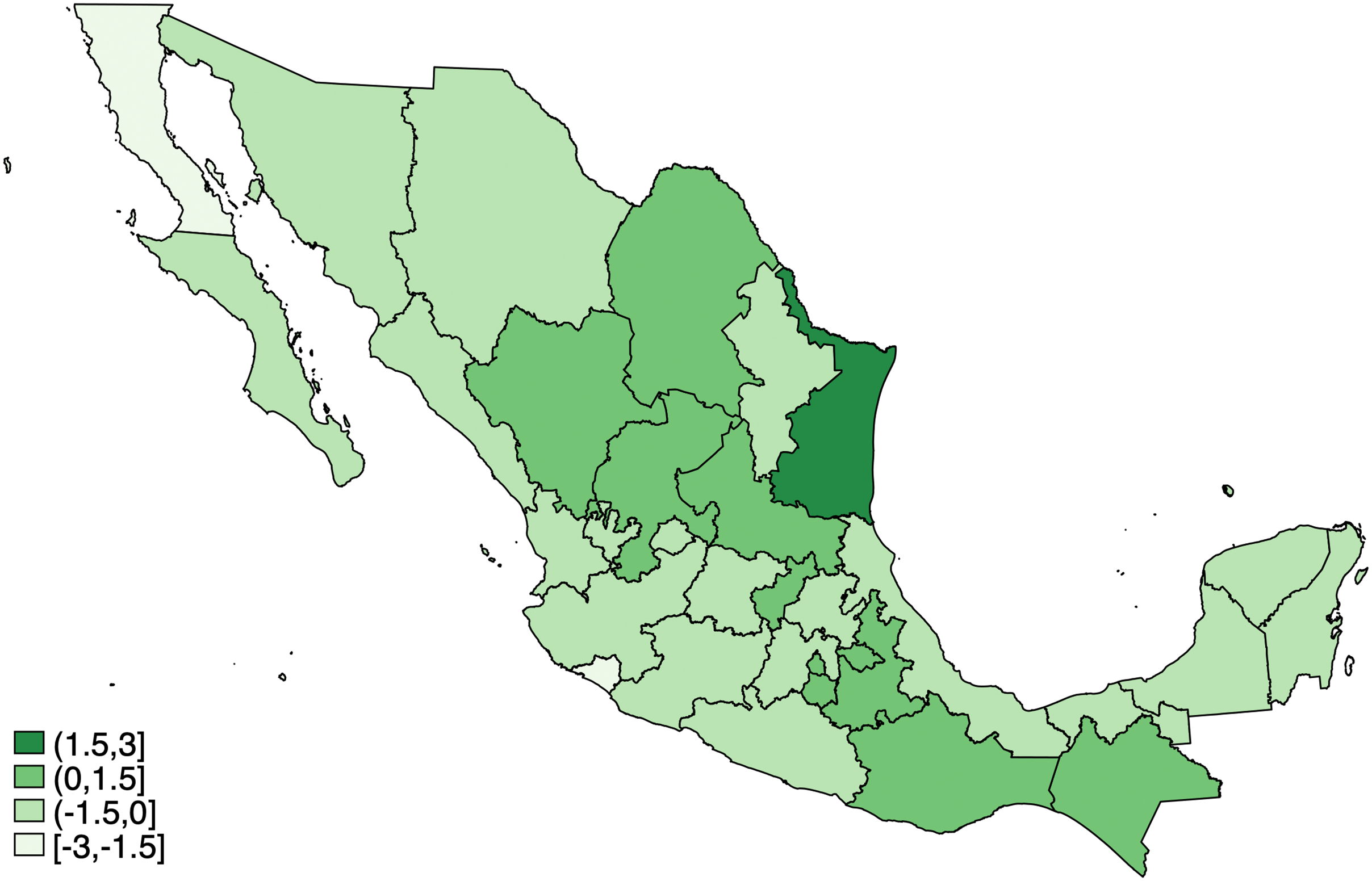
SPEI Value Across Mexico (2014).
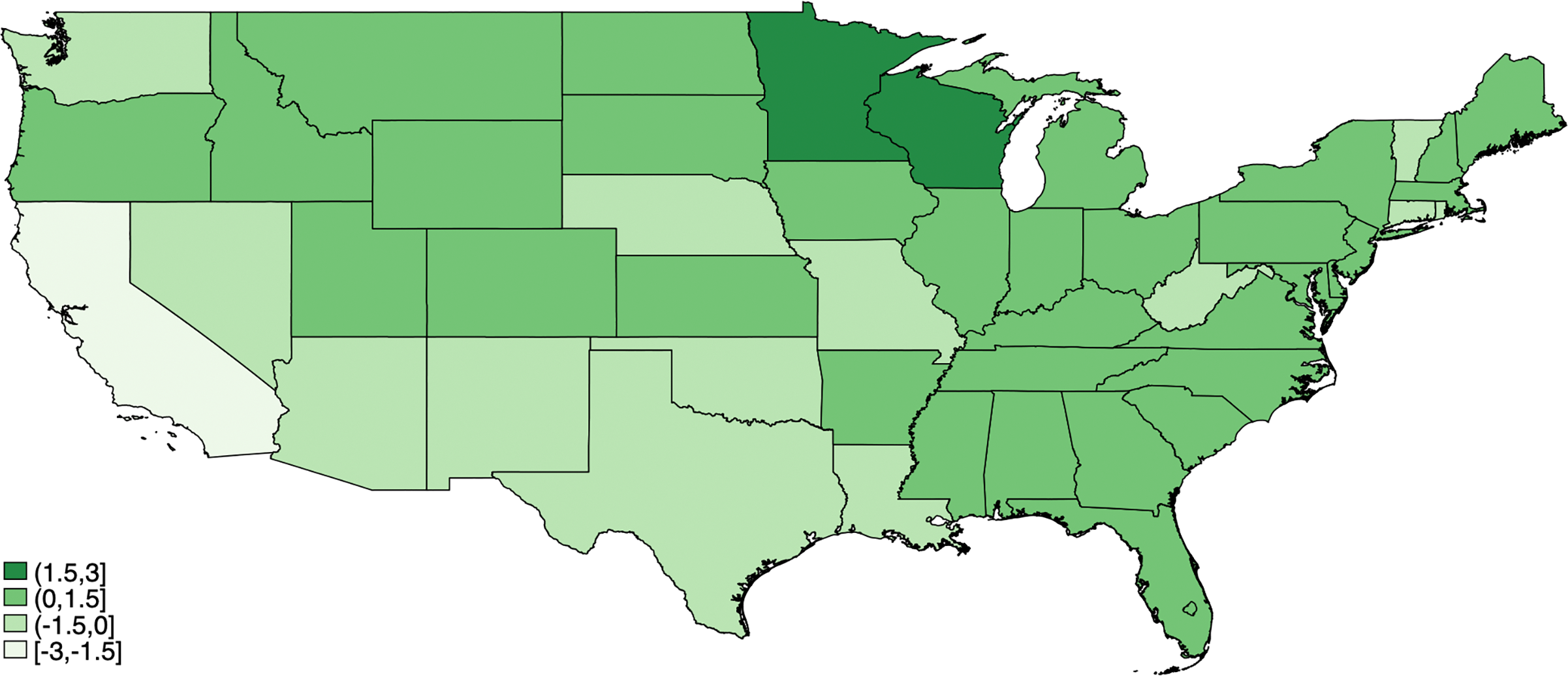
SPEI Value Across the United States (2014).
In robustness checks, I supplement this measure of drought using similar data from the North American Drought Monitor, which I describe in Supplemental Appendix A. I include this as a robustness check because different weather data sources (i.e., the raw rainfall data I use to construct the SPEI) can vary slightly and I show that any uniqueness about the NASA weather data is not driving the results.
I gather state-level homicide data from the national mortality statistics in Mexico and the US. I use the national mortality statistics rather than police-reported homicide data because those agencies may have more reason to misrepresent violence and may be inaccurate if certain deaths are not reported. In police data, homicides are recorded when the prosecutor opens an investigation into a death as a homicide, whereas the mortality statistics I use count alleged homicide deaths that coroners determine based on the circumstances they observe. For the US, I will similarly use the national mortality statistics from the CDC. Figure 3 shows the distribution of homicides across Mexico. For some specifications I will instead use the number of cartels operating in that state based on information from the University of Maryland's Tracking Cartels project (Henkin et al. 2020). Increases in violence in Mexico largely stem from multiple cartels fighting over territory so having more cartels in the area is also a proxy for local violence (Figure A18).
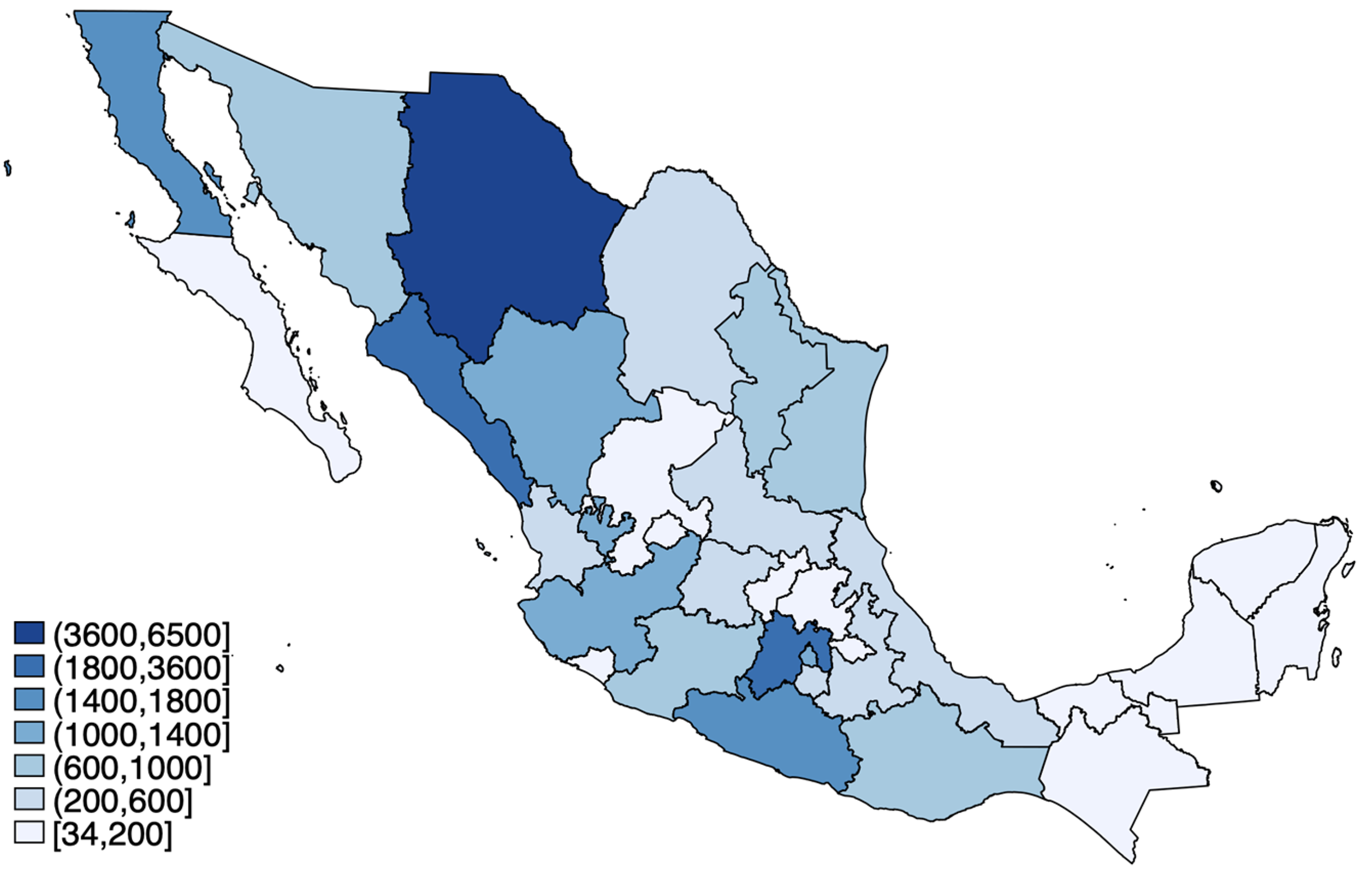
Total Homicides (2014).
I conduct robustness checks using the police data published by the Secretariado Ejecutivo del Sistema Nacional de Seguridad Pública (SESNSP) in Mexico and the US equivalent from the FBI, which I describe in detail in Supplemental Appendix A.
For specifications that include recent migration, I am limited to international migration only as the primary internal migration data for Mexico, either from the Census and Intercensal surveys or the Encuesta Nacional de la Dinámica Demográfica (ENADID), is not collected annually.
To measure international migration, I use a version of the MCAS data that reflects only new ID cards, available upon request from the Instituto de los Mexicanos en el Exterior (ime.gob.mx). Recall that I use the complete data on all IDs, including renewals, to construct the state-to-state remittance data. The complete data are the best reflection of the current stock of Mexican immigrants living in each US state but to measure the flow of immigrants, I limit the sample to only people applying for their ID cards for the first time. One issue may be that an individual does not decide to apply for an ID as soon as they migrate; thus, the annual data may not reflect only recent movers. Additionally, though all Mexican immigrants can obtain consular IDs, they are largely popular among undocumented immigrants who cannot obtain other forms of identification, raising concerns about representativeness. Given the immigration restrictions in the US, it is likely that many people who move quickly in response to drought are undocumented. As I detail in Supplemental Appendix A, this data is highly representative of Mexican migration and it is the only administrative data available on immigrants from each Mexican state to each US state.
I also use annual survey data from the Migración en la Frontera Norte de México (EMIF Norte) which is collected at major border crossing points in the North of Mexico. This data asks migrants where they are from and where they intend to go in the US. Using the available survey weights, I aggregate this data to the state-to-state level. Two major short-comings limit this data. First, that there is no guarantee the migrant actually reaches the US or their stated destination. More critically, due to a lack of funding, the survey was not collected in 2018 or 2019, two key years of my analysis (Table 2).
Summary Statistics of Key Variables.
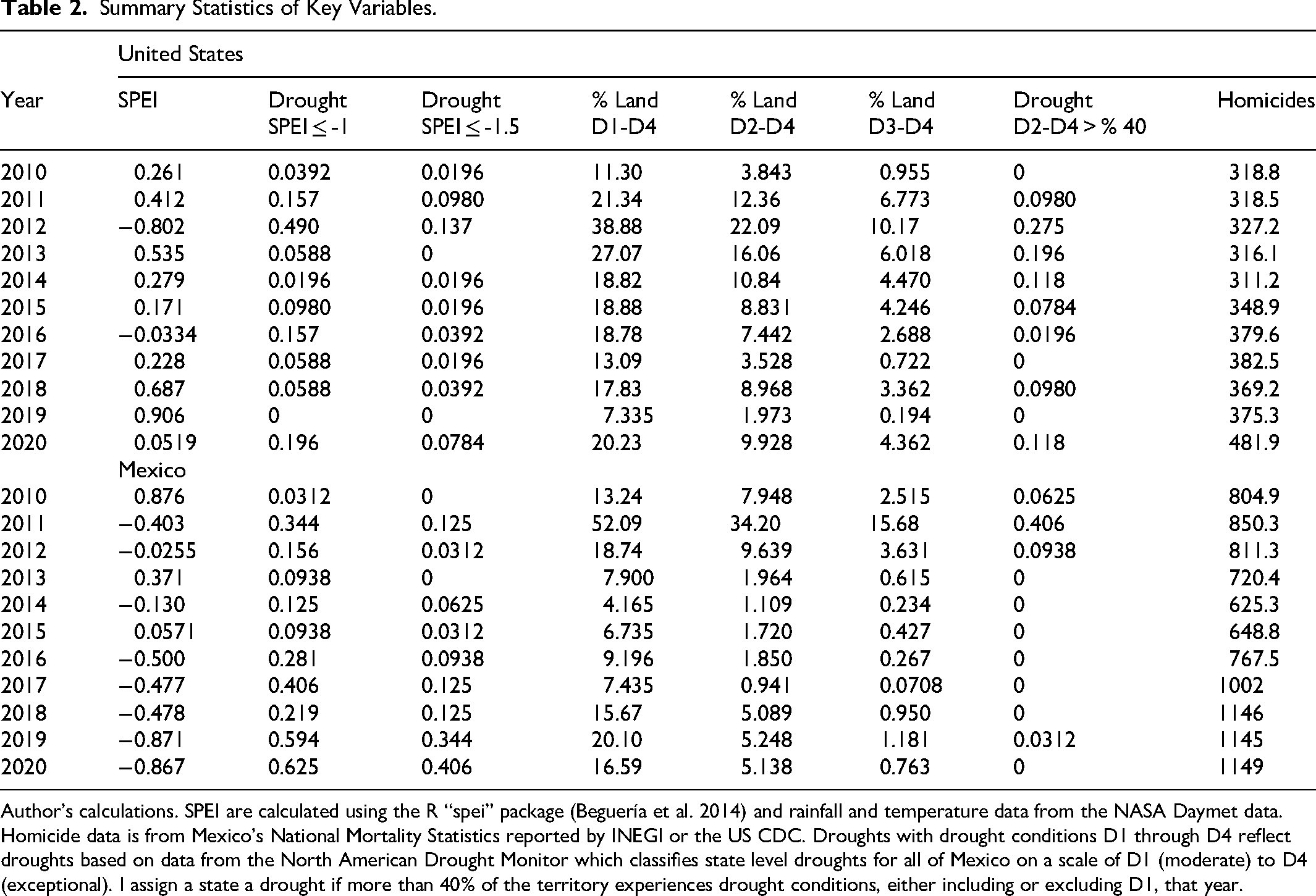
Author's calculations. SPEI are calculated using the R “spei” package (Beguería et al. 2014) and rainfall and temperature data from the NASA Daymet data. Homicide data is from Mexico's National Mortality Statistics reported by INEGI or the US CDC. Droughts with drought conditions D1 through D4 reflect droughts based on data from the North American Drought Monitor which classifies state level droughts for all of Mexico on a scale of D1 (moderate) to D4 (exceptional). I assign a state a drought if more than 40% of the territory experiences drought conditions, either including or excluding D1, that year.
Lastly, the main models control for predicted state populations in Mexico (from Data México), as more populous states are likely to send more immigrants and receive more remittances, and the size of the Mexican-born population in each US state each year, derived from the American Community Survey (Ruggles et al. 2020). Since I control for population, I do not convert remittances or homicides into per capita measures. For additional controls in the robustness checks, I collect real GDP, the value of agricultural production, and public spending for each Mexican state from INEGI, the Mexican statistical agency. For the US, I collect state-level real GDP from the BEA and the value of agricultural production from the USDA ERS.
Empirical Framework
I estimate a gravity model specification with year and state-pair fixed effects. A gravity model draws on Newton's law of gravity measuring the force between two objects as a function of distance and characteristics, like mass, of those two objects (Bergstrand 1985; Anderson 2011). Similarly, the international trade literature and the migration/remittance literature use the gravity model to estimate the size of a flow between two points as a function of push and pull factors (Karemera, Iwuagwu Oguledo, and Davis 2000; Laurent, Margaretic, and Thomas-Agnan 2022).
Following the gravity model literature, I estimate a log-log specification so the coefficients will represent quasi-elasticities. The log specification has the added benefit of addressing the substantial skew of both remittance flows and homicides 7 but it can introduce problems if there are many zeroes present in the data. Every year each state had at least one homicide so there are no issues there. Meanwhile, fewer than five percent of all remittance flows are zero. Following Chen and Roth (2024), I exclude these observations from my analysis as any adjustment to be able to include zero flows risks introducing other biases. 8
The spatial economics field has highlighted a number of situations where outcomes are correlated across neighboring locations. For example, commute times may be shorter in one county because of a well-maintained highway system. Because these roads would cross into other nearby counties, those likely also have shorter commute times. Unless we can directly control for all regionally correlated variables, controlling for average conditions in neighboring states may help address some of the underlying factors that impact the region. Recent developments, particularly in Laurent, Margaretic, and Thomas-Agnan (2022), have extended this idea to consider data that has a two-sided, origin-destination structure. Motivated by their work, I include the average drought and violence experience of the three nearest states as additional controls. 9 This allows me to address spillovers from neighboring states similar to methods in recent experimental work (Egger et al. 2021; Muralidharan, Niehaus, and Sukhtankar 2022).
There are many reasons why migration decisions and the capacity or willingness to remit may be spatially correlated. Imagine a particular immigrant will remit no matter where she lands but she is hoping to reach New York City where she's heard there are good jobs and a community of immigrants. Given similarities between New York and New Jersey, perhaps she finds herself equally happy with a job in New Jersey. Her remittance flow would be assigned to New Jersey, but her location choice, and therefore the remittance origin, was more about the region than a specific characteristic of New Jersey. Similarly, on the Mexican side, indigenous communities and traditional lands can cover multiple states. Perhaps indigenous immigrants settled near each other even if they moved from different states in Mexico. If they all send remittances back to their respective, neighboring states, these remittance flows are in part regionally determined.
Laurent, Margaretic, and Thomas-Agnan (2022) show that at the international level, countries that receive substantial remittances from a particular source country often also receive substantial inflows from its neighbors, and vice versa. I find similar patterns for states in Mexico for both international (Figure 4) and domestic remittance flows (Figure 5). As expected, weather shocks and homicides are also spatially correlated in Mexico and the US (Figures 1 to 3). 10
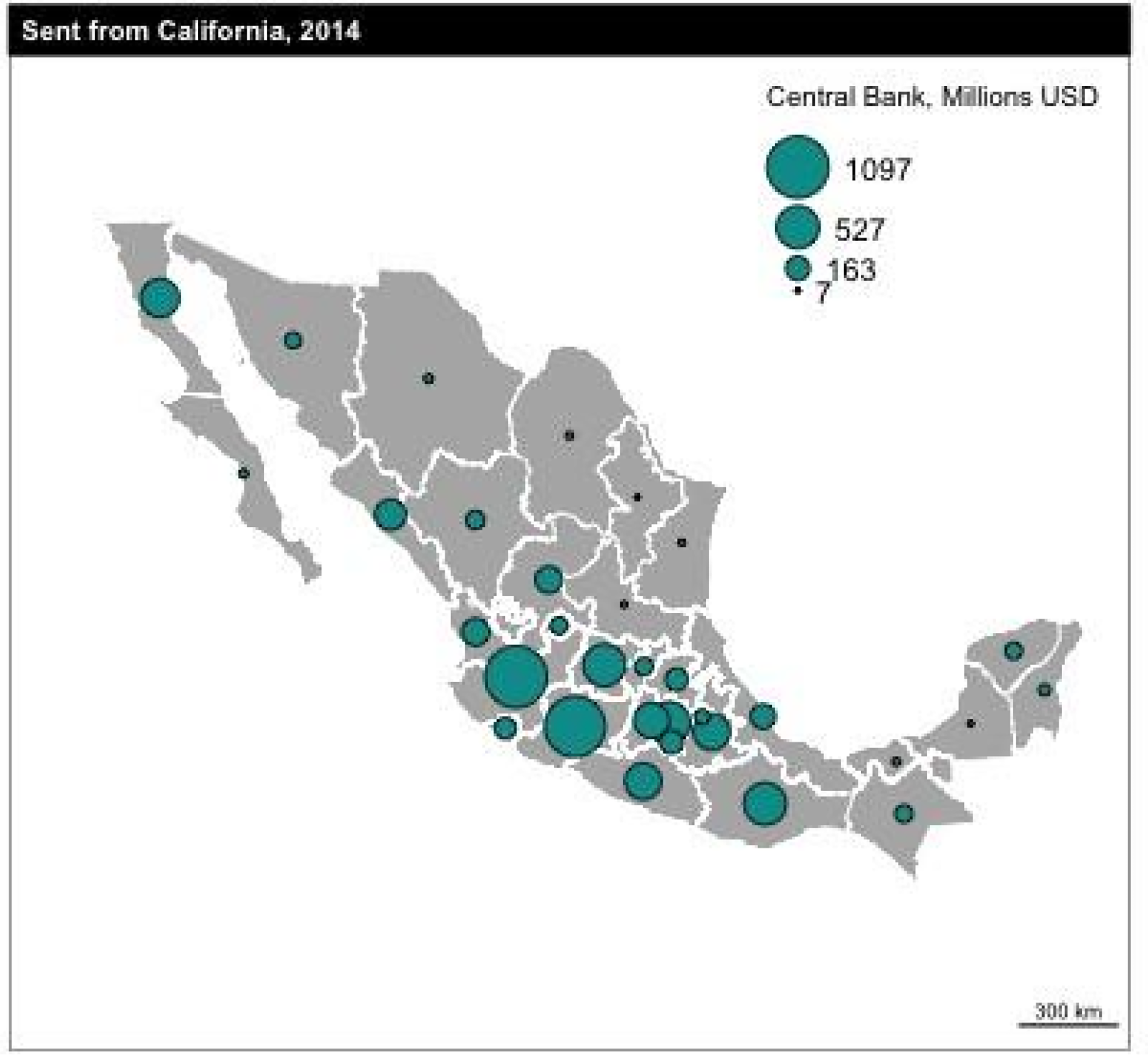
Remittance Flows From California in 2014.
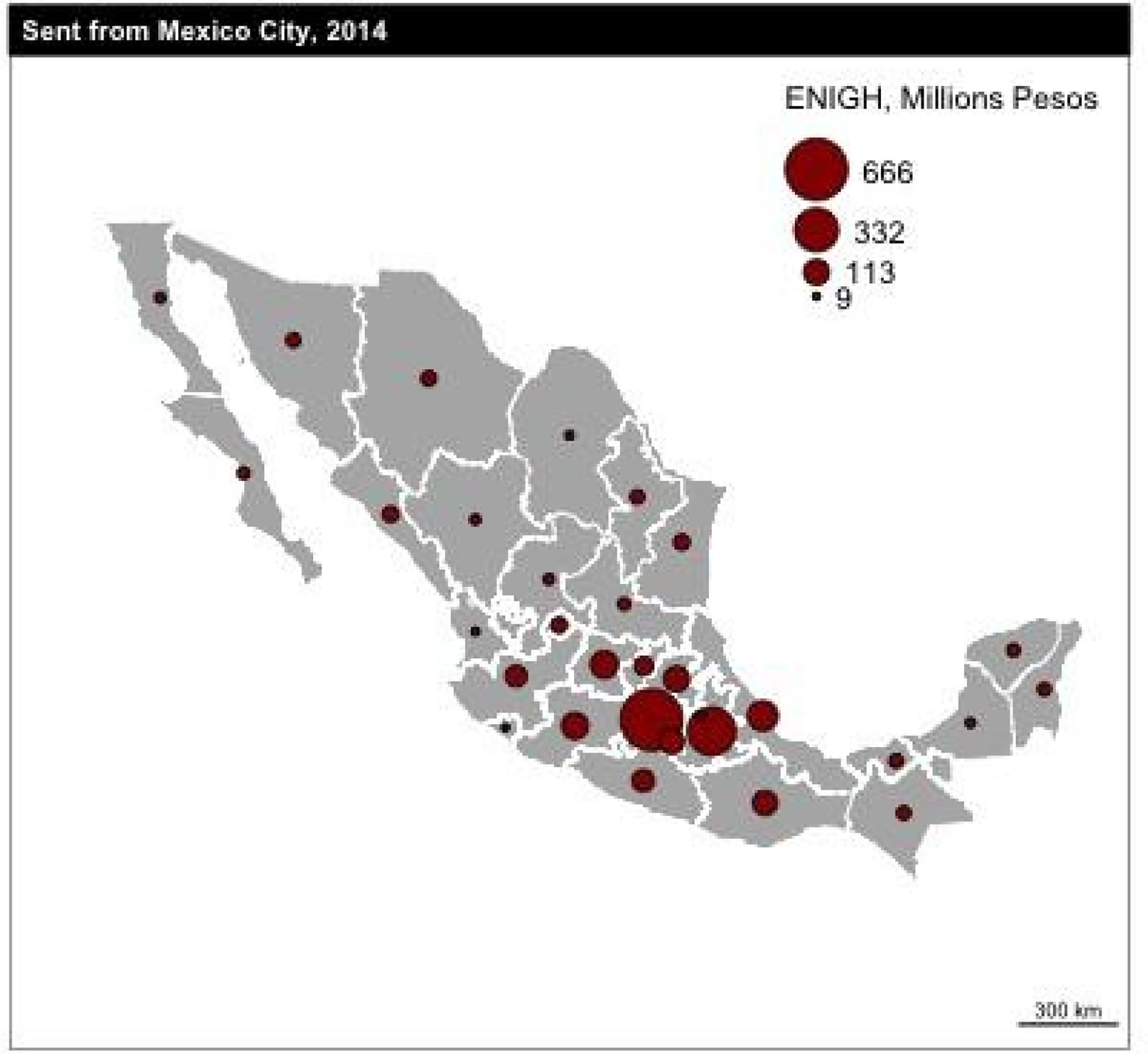
Remittance Flows From Mexico City in 2014.
I estimate the following specification where Rjit represents remittance flows from j to i in year t, S are dummy variables indicating a weather shock in each location, and H is a measure of local violence. The fixed effects capture other characteristics that could impact remittance flows, such as distance, shared borders, and networks. I also control directly for population in each state
11
and cluster standard errors at the state-pair level. To address potential reverse causality and allow time for drought to develop and remittances to respond, I lag all independent variables by one year. Xj and Xi are the spatial weighting matrices for sending and receiving locations, in both the international remittance model and domestic remittance model.
To address the role of recent and potentially drought-induced migration, I control directly for the natural log of immigrants in a variety of models. Again, in those instances I drop any zero observations. I expect η1 to be less than zero, η2 to be greater than zero, and η3, η4, and η5 are theoretically ambiguous.
The state-to-state model has the advantage of controlling for networks which may play an important role in remittance patterns. It may be that migrants from particular communities are inherently more likely to remit and that they settle near each other in a particular destination. The state-to-state model is also useful to address the impact of drought and violence in the sending state, which should, in theory, impact the migrant's ability to remit. On the other hand, the data limitations did require some significant assumptions to construct the state-to-state panel. I therefore conduct separate, US-to-state analysis using the original data as well as the US state-to-Mexico flows. The regression specifications are identical to equation (1) with only sending states (j terms) or only receiving states (i terms) and with only state fixed effects.
In both state-to-state and country-to-state (or state-to-country) models, I assess the total effect of both violence and drought on remittances by including models with just drought terms and just homicides before presenting the main results that include all terms.
Identification
I take advantage of the wide variation across fifty US states plus D.C., thirty-two Mexican states, and eleven years to identify my results after controlling for the fixed time and state-pair factors. Controlling for state-to-state pairs not only accounts for unobservable characteristics impacting remittance flows in each individual sending and receiving state but also controls for pair-specific features like network effects and distance.
To identify the total impacts of weather and violence on remittances I rely on exogenous weather shocks and homicide rates. Weather is plausibly exogenous and each state's shock is defined relative to its own typical weather to account for the general variation in climate across large countries like the US and Mexico. For homicides, using a one-year lag addresses the concern that remittances may directly impact homicide rates if money makes people a target. Generally, though, this is unlikely. Remittances may increase crimes like robbery but homicides are more likely to be driven by unrelated trends in drug trafficking and organized crime, especially if a criminal intends to rob or extort someone again in the future. Tables A1 and A2 show that key variables of interest are well balanced across high homicide and low homicide states so it's unlikely some underlying pattern of violence or selection into violence (so to speak) is driving the results.
If weather shocks induce violence and violence has a negative impact on remittances, then results focused just on the impact of drought, the total effect, would be smaller than the conditional direct effect of drought on remittances. Both of these effects are interesting; controlling for violence and interacting violence with the weather shock helps untangle these relationships. I ask: given a drought, how does violence affect remittance flows and how does this compare to less-violent areas.
Results
State-to-State Models
Tables 3 and 4 consider just the impact of drought then homicides in sending and receiving states. On the receiving side, experiencing a drought significantly increases both international and domestic remittance flows (columns 1 and 2). Experiencing a drought increases remittances into that state by about 2.8%. 12 Given that the average size of these flows is over 700 million US dollars, this is not a small amount of money. Thus, migration and remittances can help households offset losses due to drought in Mexico. This result holds when controlling for contemporaneous migration, suggesting that, for a drought that occurred last year, remittances this year are not entirely driven by migration this year. I explore the role of recent migration further in Table 8.
Impact of Drought on Remittances.
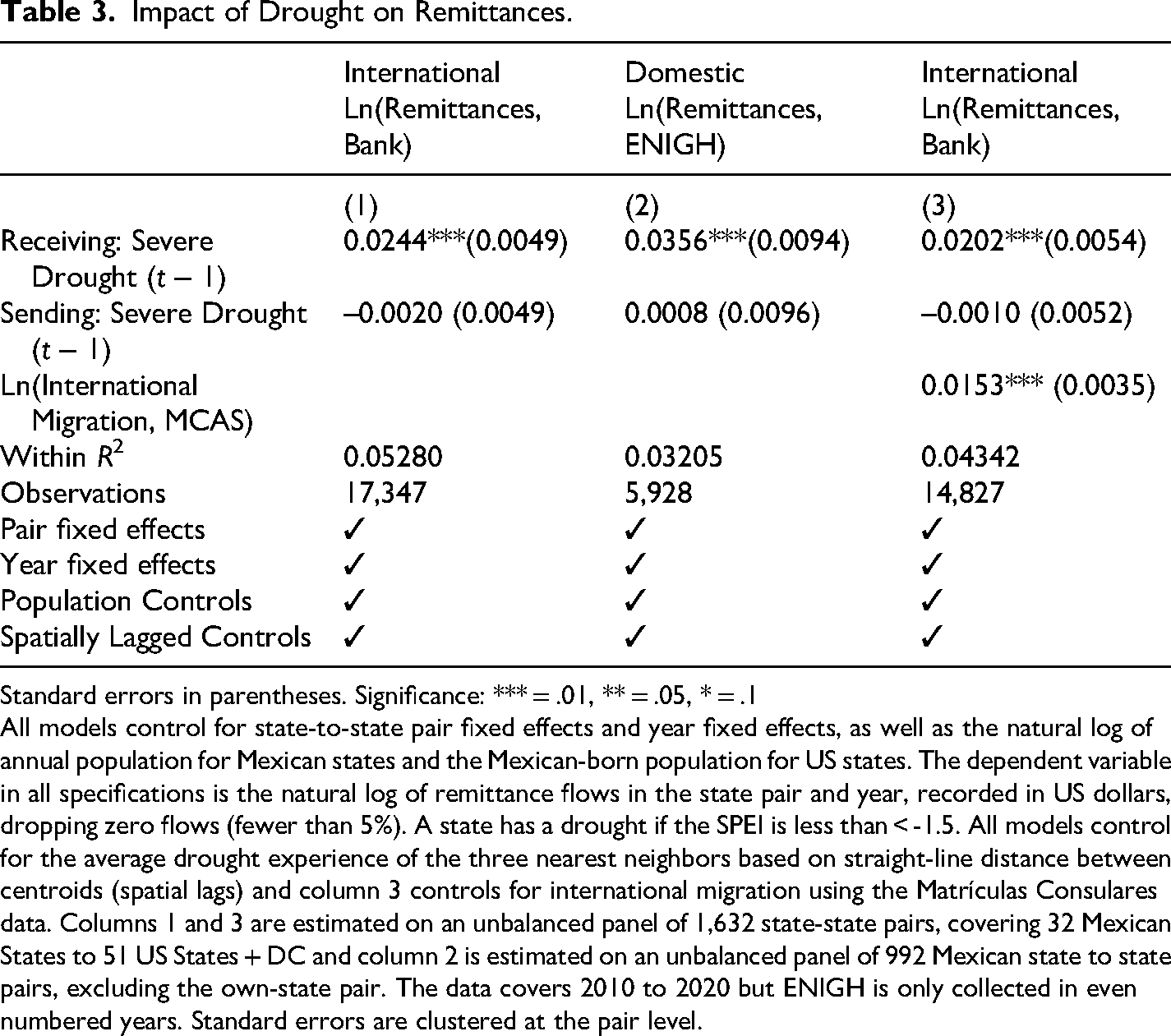
Standard errors in parentheses. Significance: *** = .01, ** = .05, * = .1
All models control for state-to-state pair fixed effects and year fixed effects, as well as the natural log of annual population for Mexican states and the Mexican-born population for US states. The dependent variable in all specifications is the natural log of remittance flows in the state pair and year, recorded in US dollars, dropping zero flows (fewer than 5%). A state has a drought if the SPEI is less than < -1.5. All models control for the average drought experience of the three nearest neighbors based on straight-line distance between centroids (spatial lags) and column 3 controls for international migration using the Matrículas Consulares data. Columns 1 and 3 are estimated on an unbalanced panel of 1,632 state-state pairs, covering 32 Mexican States to 51 US States + DC and column 2 is estimated on an unbalanced panel of 992 Mexican state to state pairs, excluding the own-state pair. The data covers 2010 to 2020 but ENIGH is only collected in even numbered years. Standard errors are clustered at the pair level.
Impact of Violence on Remittances.
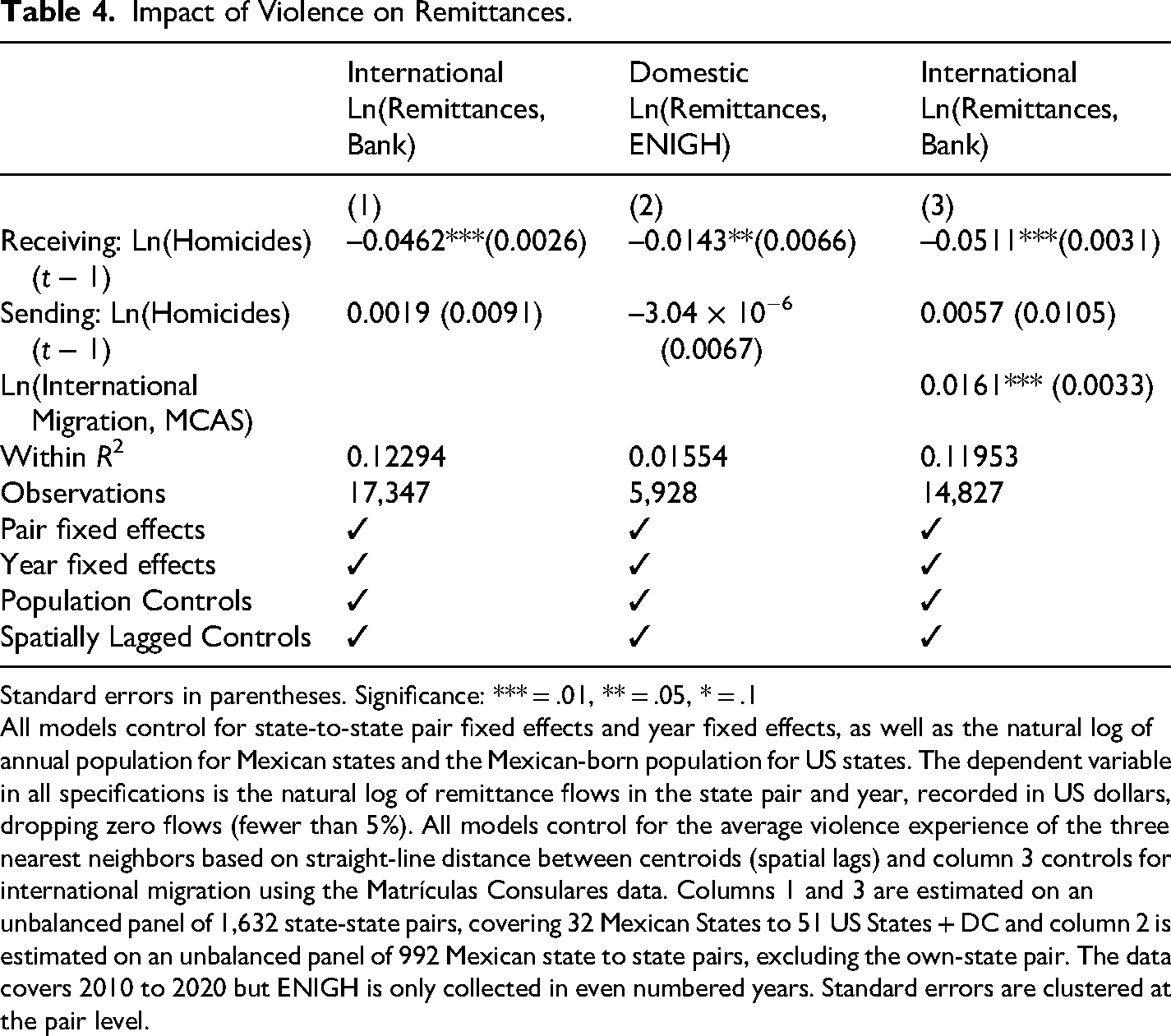
Standard errors in parentheses. Significance: *** = .01, ** = .05, * = .1
All models control for state-to-state pair fixed effects and year fixed effects, as well as the natural log of annual population for Mexican states and the Mexican-born population for US states. The dependent variable in all specifications is the natural log of remittance flows in the state pair and year, recorded in US dollars, dropping zero flows (fewer than 5%). All models control for the average violence experience of the three nearest neighbors based on straight-line distance between centroids (spatial lags) and column 3 controls for international migration using the Matrículas Consulares data. Columns 1 and 3 are estimated on an unbalanced panel of 1,632 state-state pairs, covering 32 Mexican States to 51 US States + DC and column 2 is estimated on an unbalanced panel of 992 Mexican state to state pairs, excluding the own-state pair. The data covers 2010 to 2020 but ENIGH is only collected in even numbered years. Standard errors are clustered at the pair level.
In contrast, there is no evidence that drought in sending states reduces remittance flows. People may migrate specifically because they are looking for jobs that are less weather dependent and thus are able to continue providing remittances even when faced with their own drought shock. The coefficient on drought in US states (columns 1 and 3) is negative as we may expect but insignificant.
Violence in the receiving state reduces international remittances by about 0.05% and domestic remittances by about 0.01%. Similar to the drought results, homicides in the sending state do not impact remittances and the results are consistent when controlling for contemporaneous migration (Column 3). Prior work has found that violence may reduce migration so the negative impact of homicides on remittances could have been due to fewer people leaving those states, thus fewer people available to remit. Instead, I find homicides still have a negative impact on remittances when controlling for migration.
If droughts increase violence, which lowers remittances, then this will attenuate the results in Table 3. It would be interesting to study the relationship between drought and homicides further in the case of Mexico but that is beyond the scope of this article. 13 For now, I will allow that it is possible drought is correlated with higher rates of violence in my data and present the main findings in Table 5. By controlling for both drought and violence in Table 5, I show the impact of drought on remittances outside of its impact through the violence channel and the direct impact of violence.
Impact of Drought and Violence on Remittances.
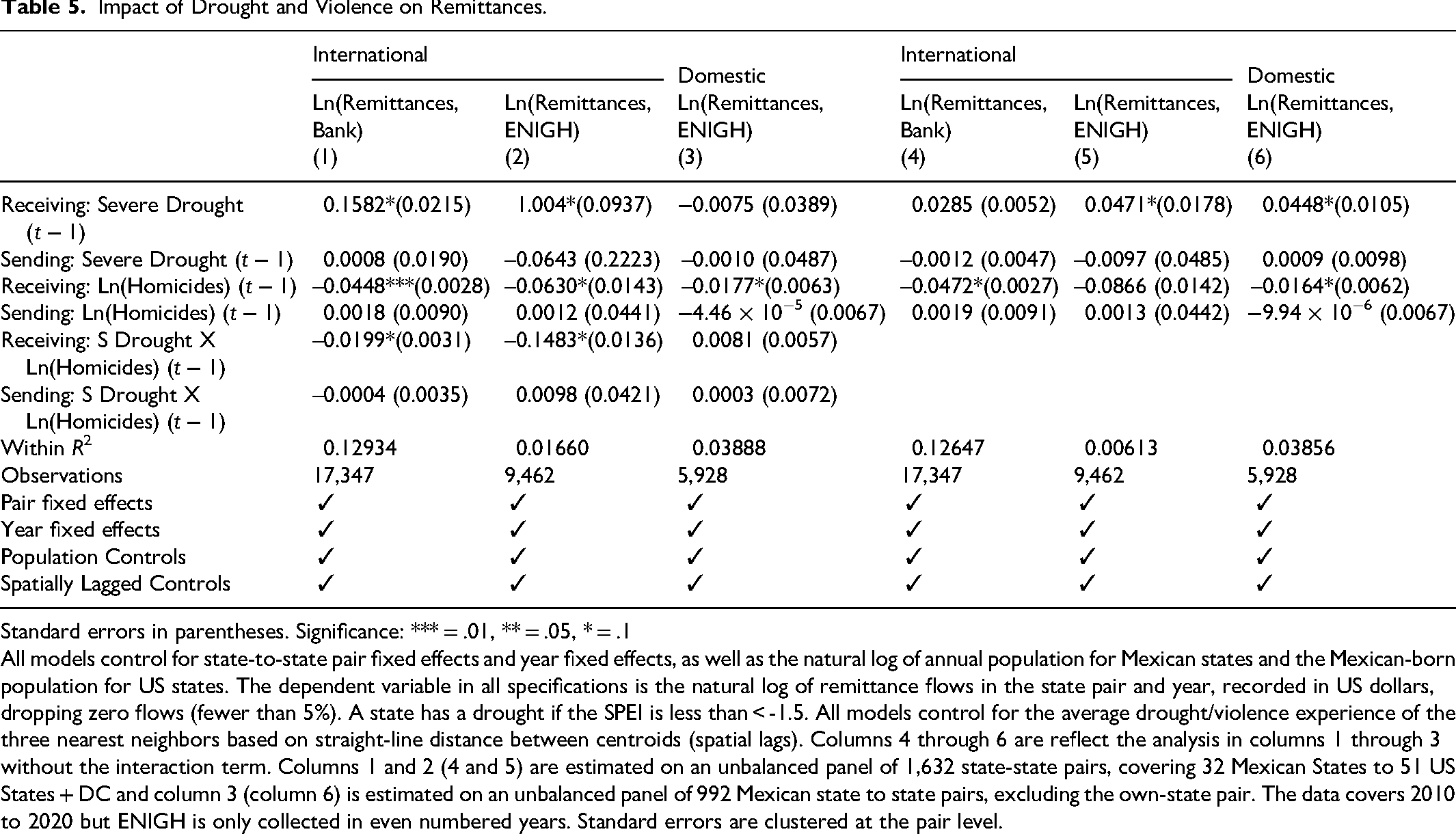
Standard errors in parentheses. Significance: *** = .01, ** = .05, * = .1
All models control for state-to-state pair fixed effects and year fixed effects, as well as the natural log of annual population for Mexican states and the Mexican-born population for US states. The dependent variable in all specifications is the natural log of remittance flows in the state pair and year, recorded in US dollars, dropping zero flows (fewer than 5%). A state has a drought if the SPEI is less than < -1.5. All models control for the average drought/violence experience of the three nearest neighbors based on straight-line distance between centroids (spatial lags). Columns 4 through 6 are reflect the analysis in columns 1 through 3 without the interaction term. Columns 1 and 2 (4 and 5) are estimated on an unbalanced panel of 1,632 state-state pairs, covering 32 Mexican States to 51 US States + DC and column 3 (column 6) is estimated on an unbalanced panel of 992 Mexican state to state pairs, excluding the own-state pair. The data covers 2010 to 2020 but ENIGH is only collected in even numbered years. Standard errors are clustered at the pair level.
Impact of Drought and Violence on Remittances: United States.
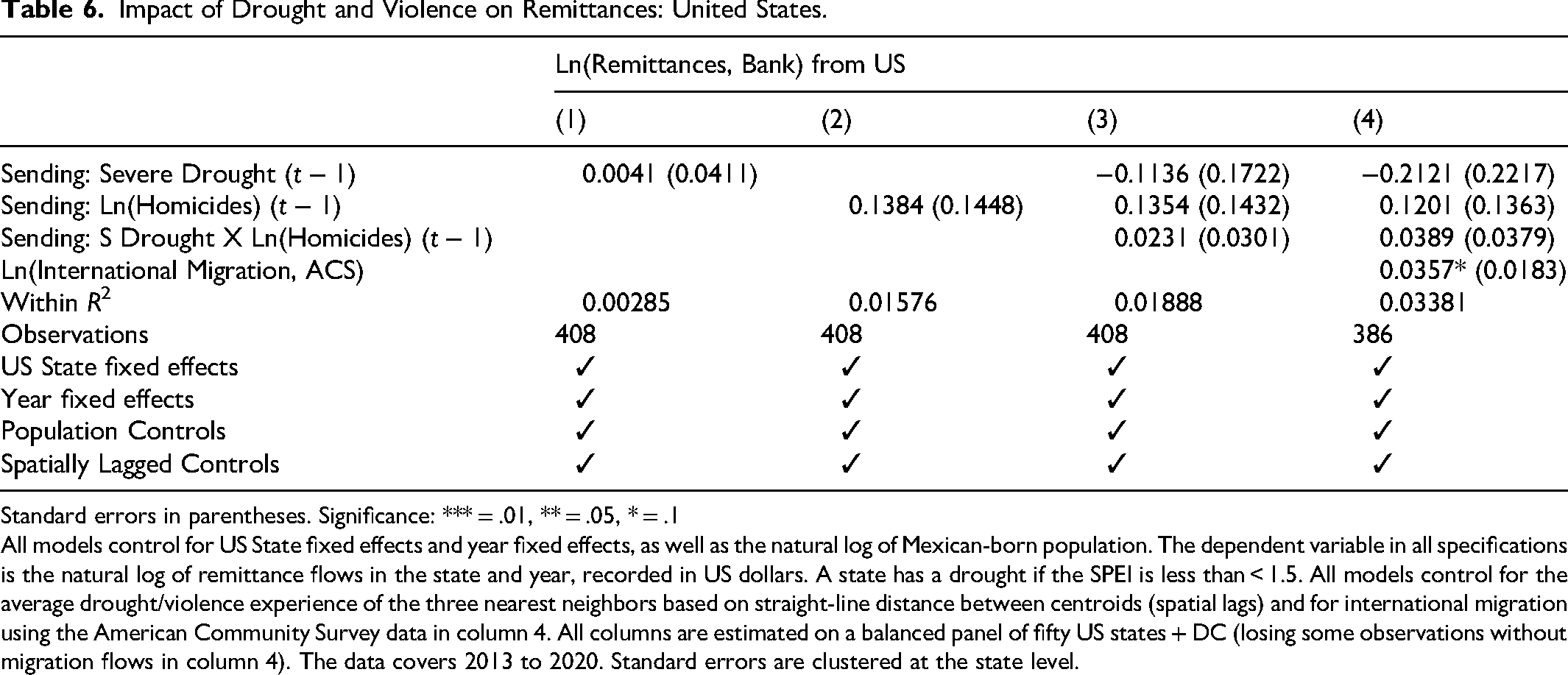
Standard errors in parentheses. Significance: *** = .01, ** = .05, * = .1
All models control for US State fixed effects and year fixed effects, as well as the natural log of Mexican-born population. The dependent variable in all specifications is the natural log of remittance flows in the state and year, recorded in US dollars. A state has a drought if the SPEI is less than < 1.5. All models control for the average drought/violence experience of the three nearest neighbors based on straight-line distance between centroids (spatial lags) and for international migration using the American Community Survey data in column 4. All columns are estimated on a balanced panel of fifty US states + DC (losing some observations without migration flows in column 4). The data covers 2013 to 2020. Standard errors are clustered at the state level.
Impact of Drought and Violence on Remittances: Mexico.
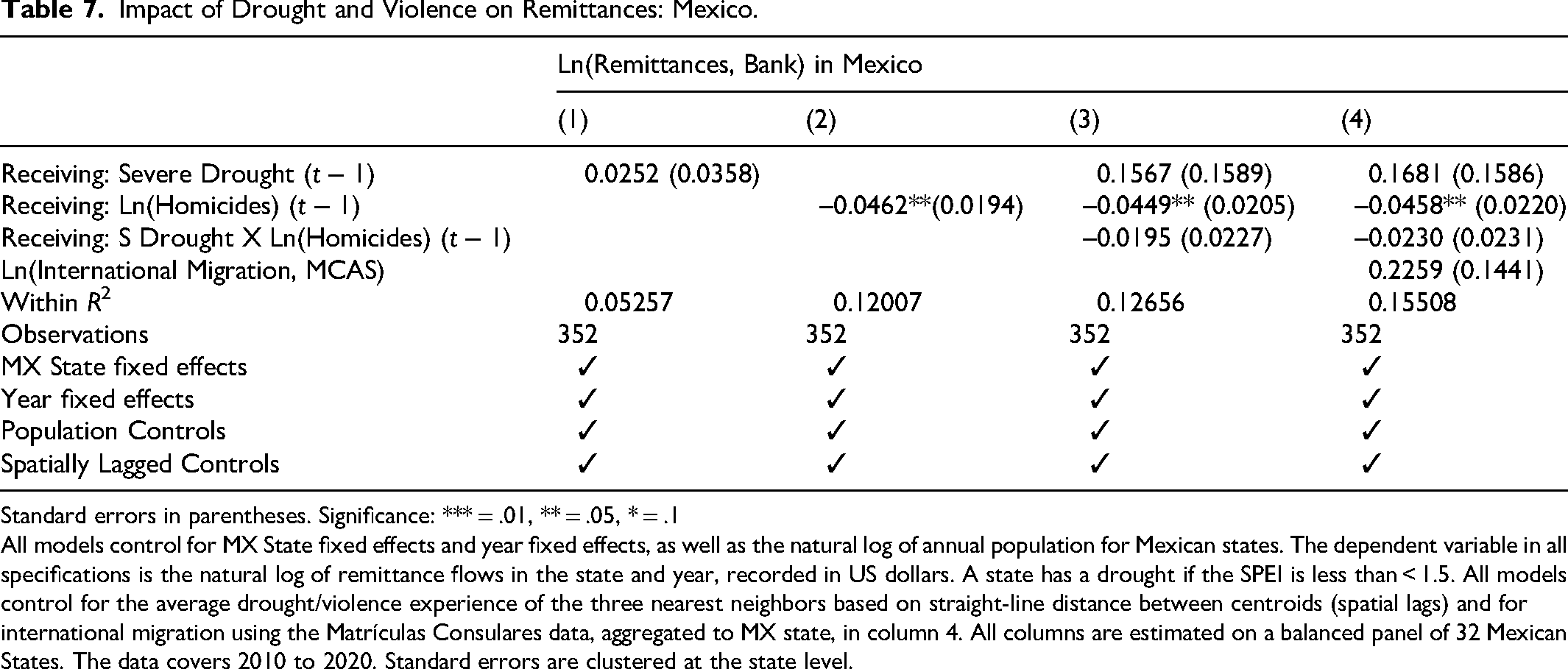
Standard errors in parentheses. Significance: *** = .01, ** = .05, * = .1
All models control for MX State fixed effects and year fixed effects, as well as the natural log of annual population for Mexican states. The dependent variable in all specifications is the natural log of remittance flows in the state and year, recorded in US dollars. A state has a drought if the SPEI is less than < 1.5. All models control for the average drought/violence experience of the three nearest neighbors based on straight-line distance between centroids (spatial lags) and for international migration using the Matrículas Consulares data, aggregated to MX state, in column 4. All columns are estimated on a balanced panel of 32 Mexican States. The data covers 2010 to 2020. Standard errors are clustered at the state level.
Impact of Drought and Violence on Remittances: Migration Channel.
Standard errors in parentheses. Significance: *** = .01, ** = .05, * = .1
All models control for state-to-state pair fixed effects and year fixed effects, as well as the natural log of annual population for Mexican states and the Mexican-born population for US states. The dependent variable in columns 1 through 4 is the natural log of remittance flows in the state pair and year, recorded in US dollars, dropping zero flows (fewer than 5%) and the natural log of newly issued Matrícula Consulares in column 5. The models also lose observations due to zero flows in the migration data. A state has a drought if the SPEI is less than < -1.5. All models control for the average drought/violence experience of the three nearest neighbors based on straight-line distance between centroids (spatial lags). All columns are estimated on an unbalanced panel of 1,632 state-state pairs, covering 32 Mexican States to 51 US States + DC. Standard errors are clustered at the pair level.
These results in Table 5 show that drought in the receiving state has a positive and significant impact on international remittances. Having a drought increases international remittances recorded in the Central Bank data by about 17%.
Remittances recorded in the ENIGH are even more responsive though this may be a feature of non-classical measurement error. Cervantes González and Jiménez Torres (2023) highlight that the household survey underestimates remittances from abroad by up to 92% and that this error is getting worse over time. The error is also worse in certain states for no predictable reason. Remittances to wealthier households are also much more likely to be recorded in the ENIGH so if wealthy households report differently and experience migration, remittances, and drought in fundamentally different ways than other households, this survey error will affect the results. Overall, I interpret these results with caution and just highlight that they are consistent with the main results using the Central Bank data.
When also addressing the role of violence, I no longer find that domestic remittances respond to drought shocks in the receiving state suggesting that international migration is particularly important for households facing drought shocks. This may be due to the initial motivation to migrate; perhaps households view international migration as a way to diversify risk and insure themselves against shocks while other factors motivate domestic migration. It is also possible that only migration to the US and the much higher earnings available there enable a migrant to remit more following a shock.
Violence in receiving states has a consistent negative impact on all remittance flows. A 1% increase in homicides reduces international remittances by 0.04 to 0.06% and domestic remittances by 0.02%. The interaction term between drought and homicides also shows that for two states with similar drought experiences, greater risk of violence significantly decreases remittances into that state, which may have been critical for households coping with the drought shock.
Columns 4 through 6 of Table 5 remove the interaction term but still address both drought and violence. The interpretation of these results is that, holding violence constant, the direct effect of a drought on remittances is to increase flows by about 3% to 5%, in line with Table 3. The fact that this effect is a little larger than that of Table 3 implies that there is a small relationship between drought and violence, and the negative relationship between violence and remittances is pulling the total effect in Table 3 down.
Mathematically, this says that suppose we draw a line to explain the relationship between homicides and remittances so every 1% increase in homicides reduces remittances by about 0.05%. Experiencing a drought shifts this line upwards about 3%. Adding the interaction term (as in columns 1 through 3) helps further unpack the relationship between drought, violence, and remittances. Absent drought, a 1% increase in homicides decreases remittances by about 0.045%. Experiencing a drought would actually shift average remittance flows up about 17% (rather than 3%) but the interaction shows us that when drought is present, remittances don’t fall by just 0.045% with each increase in homicides but also by an additional 0.02%. Because drought and violence are both fairly common in the data, the results without the interaction term are masking the additional negative impact of violence when drought is present. It appears that drought alone with no change in violence whatsoever would have a large impact on remittances but the prevalent violence is rapidly reducing these flows. Violence, especially in the presence of drought, is very costly. 14
Despite the small effect size, taking violence into account also increases the amount of variation the model explains substantially, implying this is an important part of the story. In any model there is a certain amount of variation between observations that is explained by differences in the chosen independent variables. In this case, state-pair and year fixed effects will explain a lot of the variation across remittance flows and then beyond that, drought, homicides, and population will also explain why we observe different size remittance flows. The Shapley–Owen decomposition technique can separate the total variation a model explains into component parts by assessing how the overall R2 changes as certain variables are included or excluded. I find that violence-related variables (including the interaction between drought and homicides) explain about 51% of the variation not explained by the fixed effects while the drought-related variables in both sending and receiving states explain about 2.5% (the rest is explained by differences in population). Violence is clearly an important factor determining remittances into Mexico. Remittances offer a vital tool to offset losses due to drought, but continued violence in Mexico appears to prevent families from taking full advantage of this strategy.
Finally, remittance flows respond to conditions in receiving states but not sending states. Interestingly, this is true for both domestic and international flows so it appears remitting behavior is largely based on the family at home rather than the migrant's experience. The coefficient on sending state drought is negative but insignificant for the international and domestic models using the ENIGH data but using the main data, I find a very small positive impact of drought in the US on remittances though the result is not statistically significantly different from zero. Overall, it does not appear that drought (or violence) in the sending state has an impact on remittances.
Country-to-State Models
One concern may be that, in constructing the state-to-state data, I introduced some artificial variation that is not reflective of true remittance flow patterns. I use the raw data available at the Mexican state level from 2010 to 2020 and the US state level from 2013 to 2020 to investigate just the impact of drought and violence on remittance-sending (in the US case) and -receiving (in the Mexican case) sides.
Table 6 confirms that neither drought nor violence have a significant impact on remittances out of US states to Mexico. To address the role of migration here, I use the American Community Survey, a common standard to measure state-level data in the US. As we would expect, I find that migration from Mexico to the US increases remittances but again, neither drought nor homicides impact the flows in a meaningful way. One issue may be that I lack power given that there are just fifty states and DC and eight years of data.
While the small, positive coefficient on drought in Column 1 may be counterintuitive, the standard deviation is large, indicating the range of values where the true relationship between these variables lies is quite wide and includes negative and zero values as well. The positive (though again insignificant) relationship between homicides and remittances relates to Coon (2015) who shows that immigrants may worry about burglary if they are storing large volumes of cash and therefore migrants may increase their remittances. The coefficient on drought is negative when controlling for violence, as we would expect. Perhaps drought in the US makes an area less stable which then encourages immigrants to increase remittances because they can’t store the money safely. In that case, we would expect to see a positive total effect of drought in the US on remittances due to the violence channel that disappears when we control for violence. But I caution against causal claims.
Table 7 also is largely in line with the main findings on the receiving side. I do lose significance on the coefficients related to drought but the effect size is nearly identical to that in the main results. With fewer observations the models lack statistical power and cannot address differences across networks, which may play an important part in explaining the size of a particular remittance flow. Interestingly, the negative impact of violence is still significant. Though the effect size is smaller, violence has a more consistent, and negative, impact on remittances.
The Role of Recent Migration
This data and setting cannot conclusively determine whether insurance motivated the initial decision to migrate but I am able to investigate whether these recent droughts also impacted migration and whether that explains the entire relationship between drought and/or violence and remittances. Table 8 presents variations on the main, state-to-state model using migration data from the newly issued Matrículas Consulares data. Column 1 is identical to Table 5 Column 1 except that it also includes the natural log of migration in the year prior, which would be the same year as the drought. I find that migration last year, as measured by new ID cards issued in the US, increases remittances this year, and seems to explain all of the impact of drought, but not violence, on remittances. One big caveat with this though is I do not have the migration data from 2009 so the model is estimated on a different sample, excluding any remittances from 2010 and drought or violence shocks from 2009. Column 2 instead uses contemporaneous migration data so I can include the full data set. I again find the expected positive impact of recent migration on remittances but I still find an additional, positive impact of drought on remittances. It's possible that it takes some time for an immigrant to get a Matrícula so even the “contemporaneous” migration data may really represent a short lag. Finally, because there are some zero flows in the migration data, taking the log alters the sample. Given these limitations in the data, most tables that include a column controlling for migration will use contemporaneous migration. 15
These results suggest recent migration explains at least some of the relationship between drought and remittances but there is still a positive impact of drought on remittances after controlling for migration so the results may not be entirely driven by new, drought-driven migrants. Similarly, the consistent, strong, negative effect of homicides suggests that the decline is not due entirely to complete households leaving the area. In fact, in Column 5 I regress migration on drought and homicide, finding no significant relationship between drought or violence last year and migration this year. Surprisingly, there's a marginally significant, positive relationship between drought at the destination and migration. Investigating further is beyond the scope of this article but these results suggest there is a complicated relationship between drought, violence, and migration which other articles have also highlighted (see Massey, Durand, and Pren 2020 and Rodríguez Chávez 2021).
This is not evidence against the NELM theory, but rather suggests that remittances do offer a valuable tool to insure households against drought but a recent drought alone may not spark a significant number of new migrants right away. 16
Spillovers
I also investigate the impact of drought or violence in neighboring states on local remittances. To create the spatially lagged controls, I create a weighting matrix for each state in the US and Mexico where the three nearest neighbors, determined by distance between centroids, each receive a weight of 1/3, and all other states have weight 0. Using nearest neighbors rather than contiguous states ensures that every state has a complete spatial weighting matrix. It is possible for State A to be one of the neighbors of State B, but State B is not necessarily one of A's three neighbors. Figures A17 and A16 in Supplemental Appendix A show the neighborhood structure for both countries.
Table C2 shows that the results are consistent when excluding the spatial controls altogether but that including these controls is important to accurately measure the direct effect rather than overstate it. Table C1 presents the main table but showing the spatially lagged coefficients as well. Drought in neighboring states positively, though insignificantly in international models, impacts local remittances. For households close to state borders, droughts in commuting zones may negatively impact the family, thus leading to a greater dependence on remittances. Similarly, if markets, especially for food, are regional, drought in nearby states could raise prices, again negatively impacting the family's consumption and increasing remittances. Widespread drought could also spread any government response thin across the different locations.
I also find that higher homicide rates nearby significantly decrease remittances into the receiving state. Many cartels, particularly the major actors in Mexico, cross state boundaries so violence is not contained to one state. Particularly for households near the border, violence that occurs across a state line may affect them. This finding may also reflect the idea that the negative impact of violence on remittances is a result of especially powerful violent actors and organized crime creating a generally unsafe and uncertain environment. This type of atmosphere comes from the control cartels have over swaths of territory, rather than more random crime that may pop up in a place and time. There are many obvious consequences of organized crime and these results only add to the call to introduce an effective strategy to address violence across Mexico. Reducing violence can not only increase remittances into a state but a coordinated effort in all states can multiply this effect by also reducing the spillovers.
As with the main results, I do not find evidence of spillovers on the sending side. For robustness, I repeat this analysis but instead of weighting the three nearest neighbors by 1/3 I reweight these neighbors by population and find similar results (Table C3). I also create a spatial weighting matrix that includes all other states within the country, weighted by their inverse distance in kilometers, normalized so that the sum of the weights still equals one (Table C4). I discuss these in Supplemental Appendix C alongside models using a two-year lag for all independent variables and those using contemporaneous independent variables.
Robustness Checks
I consider whether there is a threshold level of violence, only after which the negative impact of homicides on remittances appears. Intuitively, a 1% increase in homicides may matter fairly little for households in states where that is only a few deaths, 17 compared to others where such an increase may reflect many deaths. To investigate this, I create an indicator for each quartile of violence based on the number of homicides per capita in that state in 2010 and interact this indicator with the ln(homicides) variable. These results are available in Table E8 but interestingly the negative impact of violence on remittances is apparent even in the least violent group of states, suggesting that if there is some threshold below which this result would not hold, that threshold is very low. In fact, the effect appears largest in the first quartile with the interaction between homicides and quartiles two through three showing less-negative results than the quartile one baseline. Even in relatively safe states, violence appears to deter remittances in Mexico perhaps because even one homicide in an area where violence is rare weighs heavily on the local community.
The main results are robust to using alternate measures of drought including defining drought as an SPEI less than −1 rather than −1.5 (Table D1, though the effect size is smaller unsurprisingly), using drought measures from the North American Drought Monitor (Table D2), and using the SPEI directly as a continuous variable where higher values reflect wetter conditions (Table D3).
Drought-related results are also robust to using violent crime as a proxy for violence rather than homicides (Table D4). One difference for the models using crime in the receiving state is that violent crime alone has a positive impact on remittances though the interaction term with drought is negative. It may be that high reported rates crime are seen as a sign of effective policing. This data also relies on police reports, publicly available from the government of Mexico. It is possible that crime is under-reported and thus the data does not reflect the true violence of an area. I define violent crime as sexual crimes, homicide, kidnapping, injuries, extortion, threats, and anything “with violence” but it is possible that this is picking up many robberies. There may also be more reverse causality driving this result if remittances increase theft but not an overall situation of instability, which is in line with Mahesh (2020) who finds that remittances increase nonviolent crime.
To show that the results are not driven by dropping the zero remittance flow observations, Table E3 confirms the main findings using an inverse hyperbolic sine transformation that still addresses the skewed data but allows the inclusion of zeroes. Columns 1 and 2 of this table use state-to-state data that assigns remittances using only prior migration shares, without the additional correction, finding consistent results. In Table E9, I exclude potentially overly influential states such as California, with very high levels of migration, and Montana, with very low levels of migration and again confirm the main results.
The results are also consistent when using sending and receiving state fixed effects rather than the pair fixed effect (Table E4). This technique only reduces the amount of variation explained in the model which is what we would expect, some of which may be driven by the mechanical relationship between the pair fixed effect and the fixed migration share I use to partially assign remittances in the state-to-state model which I discuss in Supplemental Appendix A2.
Following the climate literature, I have intentionally excluded controlling for other economic conditions that may impact remittances and may also be impacted by drought and violence. The main results do not change when I control for receiving state government spending, which may be particularly important during a weather shock (Table E5), sending and receiving state GDP (Table E6), and the value of agricultural production normalized by GDP in sending and receiving states (Table E7).
Conclusion
According to the New Economics of Labor Migration theory, migration can be a tool for development when remittances help households and communities offset risks. In Mexico, diversifying income may be particularly important now as families face more frequent and more severe droughts. Building on this theory, this article expands on earlier work studying remittances as insurance and the impact of crime on remittances, linking these literatures to address the critical modern issue of simultaneous drought and violence. I study how remittance flows respond to drought in Mexico and whether violence mitigates this potentially important coping strategy. I use administrative remittance data in Mexico to address the question at a sub-national level and account for spillovers from neighboring states in both sending and receiving areas.
I find that experiencing a drought increases remittances in Mexico but that this effect is larger and more consistent for international remittances suggesting the US provides critical support that internal destinations may not. While migration within Mexico is quite common, these findings suggest that households do not specifically use internal migration to insure against drought shock. Per NELM theory, it may just be that internal migration is motivated by other factors, such as a specific job in a city, higher education, or marriage. It also may be that while other parts of Mexico offer higher incomes, the increase is not large enough to fund significant, on demand transfers when a drought hits at home. The same drought may also impact these nearby destinations, making it hard for the migrant to send extra funds. I caution against strong claims though as the internal transfer data is from household survey data, rather than administrative data, and many people may struggle to accurately remember and report transfers, especially if they are small and in cash.
On the other hand, international remittances consistently increase significantly when the home state in Mexico experiences a drought. Meanwhile, I find no evidence that drought or violence in the sending state reduces remittances, highlighting the value of international migration as an informal insurance strategy. Immediate migration in response to drought explains some, but not all, of the relationship between drought and remittances, in line with the NELM theory. Earlier immigrants still may have been sent for insurance purposes but it is possible that migrants who left for other reasons still respond when the family faces a shock. These results are robust to different specifications and drought measures.
Regarding violence, I find that an increase in homicides decreases remittance flows into a state. I also find that for two states experiencing drought, a state with a greater risk of violence receives significantly less money in remittances. Additionally, I find that high homicide rates in neighboring states also decrease remittances. This may also relate to a core tenet of the NELM theory: that migration may help foster productive investments at home. The negative impact of violence on remittances could be due to fears of theft or total family outmigration, but it could also reflect that households in violent areas worry about making productive investments which may now have lower returns. Future work in the Mexican setting could speak more directly to the specific motivations to remit and untangle the insurance and investment stories that this current work supports.
Violence not only has a direct impact on people's well-being but I find that it can indirectly hurt a local economy by preventing remittance inflows. Holding violence constant, a drought causes about a 2.9% increase in remittances. Then, each 1% increase in violence decreases remittance flows by about 0.05%. I dig deeper to differentiate between states that have violence but no drought, drought but not violence, and those with both. I find that if a state experiences a drought but has no change in violence at all, remittances would increase an average of about 17% but as violence increases specifically in a drought-ridden state, each 1% increase in violence decreases remittances by the approximately 0.05% reported above and also 0.02% more, as shown in the interaction term. Drought changes the way violence impacts remittances, augmenting the negative impact. Ignoring the difference between states that experience just drought and those that experience both shocks masks the high potential to use remittances as insurance if there were truly no change in violence. When discussing the cost of organized crime in Mexico, it will be important to not only account for the direct impacts on human life and the economy, but the many ways ongoing cartel activity harms families in Mexico. Remittances were equivalent to 4% of Mexico's GDP in 2022 so any disruption due to violence is quite costly.
As drought conditions worsen in Mexico and in many parts of the world, migration provides a chance to diversify incomes across sectors and climate zones but this is far from a perfect solution. Climate change is a global phenomenon and not all destinations are safe from climate shocks. Similarly, dangerous journeys, harsh immigration policy, and hostile attitudes make it more difficult for new and existing immigrants to work in the US, potentially cutting off this income diversification strategy.
For policymakers expanding access to drought insurance may help farmers and others in water dependent industries. Safe, reliable ways to send and store money may also help families, particularly in unstable areas, make the most of remittance dollars. This work suggests that reducing criminal violence goes hand in hand with climate policy. Improving public safety not only has a general benefit to the local community, but it is also an important part of building resilience to climate change. That higher homicide rates in neighboring states also augment the impact of local violence motivates systematic efforts to promote public safety across state lines and address regional violence associated with cartel territories.
Future work could expand this analysis to other shock-prone areas affected by conflict, especially to compare state-led and criminal violence. There is also more work to be done on the distributional impacts of imperfect insurance markets in the face of climate change.
Supplemental Material
sj-docx-1-mrx-10.1177_01979183251392493 - Supplemental material for Climate Change, Violence, and Remittance Flows in Mexico
Supplemental material, sj-docx-1-mrx-10.1177_01979183251392493 for Climate Change, Violence, and Remittance Flows in Mexico by Dana J. Smith in International Migration Review
Footnotes

Funding
The author received no financial support for the research, authorship, and/or publication of this article.
Conflicting Interests
The author declared no potential conflicts of interest with respect to the research, authorship, and/or publication of this article.
Supplemental Material
Supplemental material for this article is available online.
Notes
References
Supplementary Material
Please find the following supplemental material available below.
For Open Access articles published under a Creative Commons License, all supplemental material carries the same license as the article it is associated with.
For non-Open Access articles published, all supplemental material carries a non-exclusive license, and permission requests for re-use of supplemental material or any part of supplemental material shall be sent directly to the copyright owner as specified in the copyright notice associated with the article.
