







Abstract
Studies of urban segregation have paid little attention to when immigrants arrive, whereas research on age at arrival has rarely considered segregation as an outcome. This study bridges these two literatures. Exploiting variation in age at arrival between siblings, we causally show that immigrants who arrive at younger ages are more likely to live in less segregated neighborhoods as adults, with the effect being particularly pronounced among refugees. A descriptive decomposition suggests that economic factors account for a larger share of the relationship among non-refugees, whereas for refugees, intermarriage and economic factors contribute roughly equally to explaining the variation in the effect of age at immigration.
Introduction
Immigrants who move to a new country during early childhood tend to do better in adulthood along a host of dimensions: they achieve better educational and labor market outcomes (Böhlmark 2008; Hermansen 2017; Alexander and Ward 2018; Lemmermann and Riphahn 2018; Ansala, Hämäläinen, and Sarvimäki 2019), they enjoy better health (Van den Berg et al. 2014), and they exhibit higher levels of social and political integration (Åslund, Böhlmark, and Skans 2015; Andersson, Dehdari, and Lindgren 2025). More generally, immigrants also tend to live in segregated neighborhoods, and this holds even decades after arrival and across host countries (e.g., Cutler, Glaeser, and Vigdor 2008; Malmberg et al. 2018). In this article, we ask whether age at arrival affects residential segregation in adulthood. While previous studies focus on non-residential outcomes or use the minority share of a neighborhood as a measure of residential integration, the more complex outcome of residential segregation has largely been ignored.
We use high-quality register data from Sweden and apply a siblings design to immigrant cohorts born between 1974 and 1987 to study whether a younger age at arrival has an impact on the level of segregation in the neighborhoods they reside in at age 30 and how that effect differs for refugees and non-refugees. In addition, we explore potential integration channels through which earlier age at arrival may lead to lower segregation outcomes.
We use the neighborhood contribution to the dissimilarity index as a novel dependent variable (DV). This widely used index of urban segregation is the population-weighted sum of each neighborhood's absolute divergence from the municipality-level immigrant average share. The higher the divergence, the more the neighborhood contributes to total urban segregation. Using each immigrant's neighborhood contribution as DV, we exploit variation in age at arrival between siblings to estimate the effect of arriving at different ages during childhood (and before 16) relative to a reference group that arrives between ages 0 and 3. The within-family analysis enables us to address potential selection bias stemming from the fact that parents with better unobserved characteristics may move abroad when their children are younger. 1
Our overall finding is that compared to immigrant children arriving between the ages of 0 and 3, immigrant children arriving later live in more segregated neighborhoods. This result is even stronger for refugees than for non-refugee immigrants. Moreover, the timing of effects looks different for the two groups: for refugees, arriving at age 4 or later increases the neighborhood contribution, while for non-refugees, the positive effect starts emerging only around age 11. At that same age, the effects increase further for refugees. This suggests the existence of a critical age for non-refugees and multiple sensitive periods for refugees. Previous research finds that for outcomes such as education and language attainment, the critical age is 8–10 (Böhlmark 2008; Basu 2018) or even 6 (Lemmermann and Riphahn 2018).
Spatial assimilation theories suggest that residential integration is the end-product of the integration process (Massey and Denton 1988). We therefore expect to see similar patterns of age at arrival effects on other integration outcomes. In particular, we would expect age at arrival effects to be flat until age 11 for non-refugees, and increasing in age for refugees, with stronger effects after age 11. To test for this, we apply our analysis to the following outcomes: income rank, education, and intermarriage. We find that the age at arrival effects on these other outcomes are more similar in magnitudes for the two groups, despite the differences in segregation effects. At the same time, the effects level off for non-refugees around ages 10–11, but not for refugees. This result suggests that the mechanisms underlying segregation operate differently for refugees versus non-refugees.
To probe this hypothesis more thoroughly, we conduct a decomposition analysis in the style of Heckman, Pinto, and Savelyev (2013) to quantify how much of the effect of age at arrival on neighborhood integration goes through these three important mechanisms. For non-refugees, residential segregation largely reflects economic integration — consistent with spatial assimilation theories linking income and education to residential mobility. Among refugees, both economic and social integration matter, yet substantial unexplained gaps persist despite similar labor market and intermarriage patterns. This could be related to refugees facing more structural barriers in accessing good jobs (Helgesson et al. 2019) or good housing (Andersson, Bråmå, and Holmqvist 2010) when compared to non-refugees. However, we interpret this analysis as descriptive and suggestive rather than causal; identifying the precise mechanisms requires future research.
Our paper makes two main contributions. First, we introduce residential segregation as an outcome in the age-at-arrival literature. While previous studies have shown that earlier arrival leads to better outcomes across multiple dimensions, residential segregation has remained largely unexplored. Integration is a multidimensional process, and understanding how it unfolds along these multiple dimensions is important for developing adequate policy responses (see Harder et al. 2018; Aksoy, Poutvaara, and Schikora 2023). Second, we focus specifically on refugees rather than economic migrants. Brell, Dustmann, and Preston (2020) argue that this distinction matters because refugees face fundamentally different circumstances. Unlike children of economic migrants whose parents select the destination based on economic opportunities, refugee children arrive in host countries that their parents did not necessarily choose. Refugee children often also experience disrupted schooling due to conflict, displacement, or time spent in refugee camps. They are more likely to have been exposed to violence, persecution, and traumatic experiences during displacement, potentially affecting their mental health and educational outcomes. The importance of these factors varies with age at arrival: younger children may face fewer difficulties navigating these challenges compared to older arrivals. Until recently, most datasets did not distinguish between refugees and other immigrants (Brell, Dustmann, and Preston 2020). Swedish administrative data reliably records refugee status, addressing a key data limitation in the existing literature.
The study most closely related to ours is Åslund, Böhlmark, and Skans (2015), but our work differs in two key ways. While we focus on recent cohorts of refugees, Åslund, Böhlmark, and Skans (2015) examine the children of earlier cohorts of labor immigrants, primarily from other Nordic or other European countries. Additionally, Åslund, Böhlmark, and Skans (2015) interpret their findings as suggesting that economic factors play a marginal role in shaping segregation later in life, with cultural identity being more influential. In contrast, our analysis shows that for refugees, cultural identity (proxied by intermarriage) and economic factors (education and income) contribute equally to explaining segregation outcomes. For non-refugees, economic factors play a more dominant role.
This research note first introduces the unique data that allow us to implement our empirical strategy, then presents the results in three steps: effects on residential segregation, effects on other integration outcomes, and a decomposition of the residential segregation effects into labor market and social integration channels.
Data, Empirical Strategy, and Descriptive Statistics
Data and Sample Selection
We use Swedish geo-coded register data from the GeoSweden database, which contains information on all residents in Sweden. The data is collected on a yearly basis from 1990 to 2017 and consists of variables from the population and tax registers. Importantly for our study, it also contains information on the country of birth, reason for, and year of immigration. It additionally includes detailed geographic information on residential location.
Our sample consists of immigrant children born between 1974 and 1987 and whose age upon arrival in Sweden is between zero and fifteen. 2 We measure outcomes at age 30, similarly to prior studies (e.g., Hermansen 2017), an age by which most individuals have made at least one independent residential choice and are likely to be relatively settled. Measuring outcomes at older ages would substantially reduce the sample size and limit the number of immigrant cohorts that we can include. About 87 percent of individuals in our sample live outside the parental home at age 30, indicating that residential patterns at this age primarily reflect adult location decisions. Because outcomes are observed at age 30, the analysis necessarily focuses on immigrants who remain in the host country up to that age, excluding those who return to their country of origin earlier.
We classify immigrant children into three categories: all immigrants, refugees, and non-refugees. An individual is considered a refugee if either their own permit is a refugee permit or, absent this information, if they have at least one parent classified as a refugee. A non-refugee is an individual who does not fulfill these criteria. 3 The “all immigrants” category pools together refugees and non-refugees. Regardless of refugee status, all immigrants are born abroad to foreign-born parents.
Outcomes
Residential Segregation
We are interested in the degree of residential segregation in the neighborhood where an immigrant who arrived in Sweden as a child resides at age 30. Our neighborhood measure is the so-called DeSO (Demographic Statistical Area or demografiska statistikområden in Swedish), an administrative unit defined by Statistics Sweden such that the boundaries follow, to the extent possible, streets, waterways, and railways. There are ∼6,000 DeSOs in Sweden, with populations ranging from 700 to 2,700 and thus slightly smaller than US Census Tracts, for example.
4
DeSOs are often used in Swedish migrant segregation research when the goal is to capture lived experiences of segregation at smaller geographical scales (Cederström and Dunlavy 2025). To measure segregation, we use the well-established dissimilarity index (Duncan and Duncan 1955), which captures the evenness dimension of segregation (Massey and Denton 1988). For robustness, we also report results using the isolation index, which reflects the exposure dimension. The dissimilarity index is generally defined as follows:

We use the neighborhood contribution to the dissimilarity index as our outcome variable. For each neighborhood i, this corresponds to |ai/A–bi/B| in equation (1) above. This measure captures how much each neighborhood contributes to overall municipal segregation. Individuals who live in the same neighborhood i have identical values of this contribution measure. If such a neighborhood were a perfect copy of the municipality, the contribution would be zero. Higher values indicate residence in neighborhoods that diverge more from the municipality's average and contribute more to municipal segregation. To compute D and the neighborhood-level contribution, we restrict the groups (ai, bi, A, and B) to be aged between 18 and 60 and define the group of immigrants as born abroad to foreign-born parents.
In our pooled sample, the municipality-level D ranges from 0.009 to 0.99, from almost zero to complete segregation, with a median value of 0.74, while the neighborhood-level contribution ranges from 0 to 0.36, with a median value of 0.007 and a mean of 0.02 (cf. Table 1, Panel A), suggesting fairly uneven contributions across neighborhoods. This difference in the amount of variation is important for interpreting the magnitude of our results below.
Summary Statistics for the Siblings Sample.
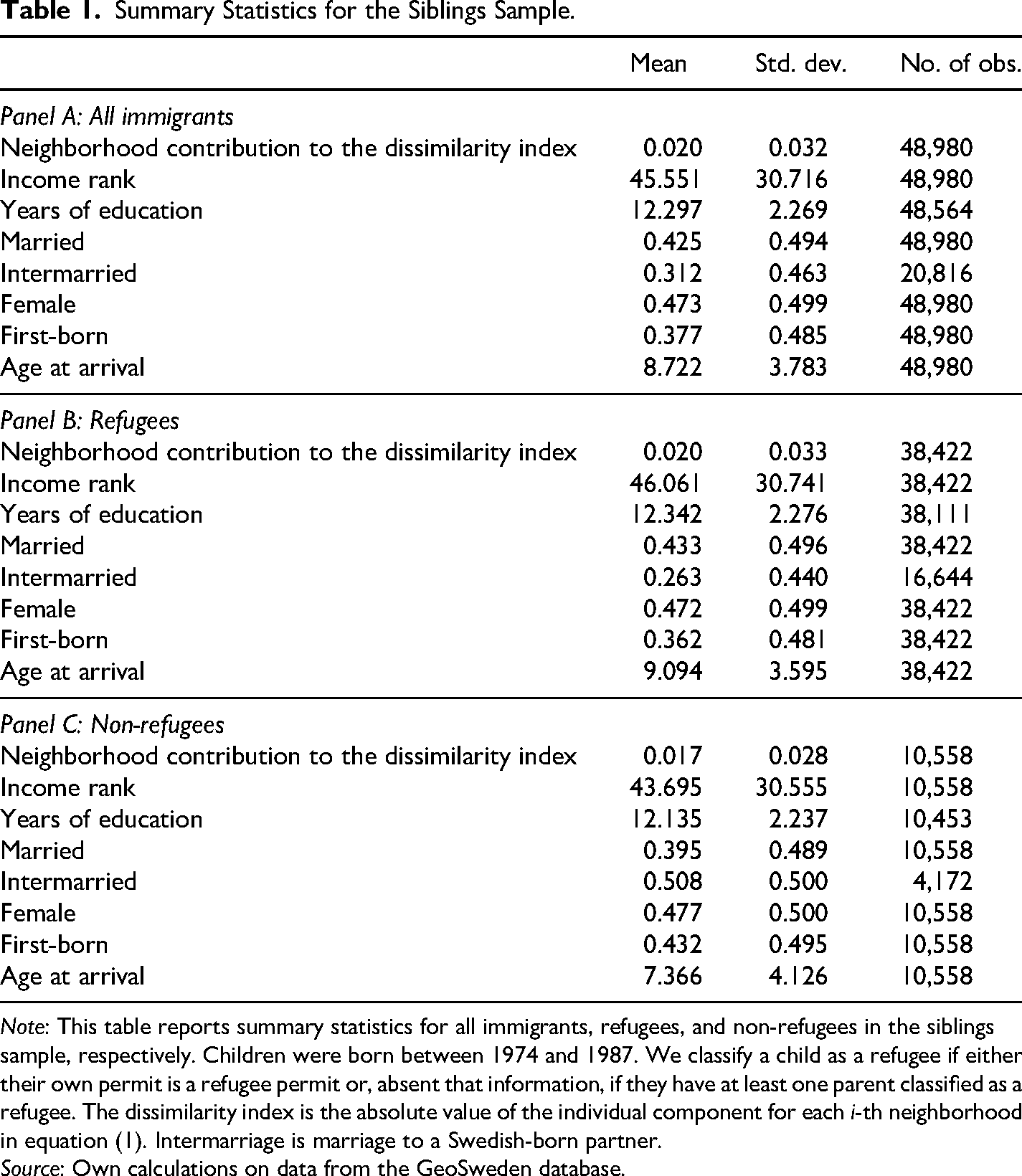
Note: This table reports summary statistics for all immigrants, refugees, and non-refugees in the siblings sample, respectively. Children were born between 1974 and 1987. We classify a child as a refugee if either their own permit is a refugee permit or, absent that information, if they have at least one parent classified as a refugee. The dissimilarity index is the absolute value of the individual component for each i-th neighborhood in equation (1). Intermarriage is marriage to a Swedish-born partner.
Source: Own calculations on data from the GeoSweden database.
Using this neighborhood-level measure is preferable to using the aggregate municipal dissimilarity index D for several reasons. First, our identification strategy requires within-family variation in outcomes (see the “Empirical Strategy” section). Since D is calculated at the municipal level, siblings living in the same municipality would have identical values, eliminating the variation needed for identification. Our measure varies across neighborhoods within municipalities, capturing differences in where siblings reside. Moreover, segregation research highlights stark intra-urban differences, which the Swedish data quality uniquely allows to capture. Second, our measure reflects where individuals actually reside within their municipality, not just the overall segregation level of their municipality. Two individuals in municipalities with similar D values may live in very different neighborhood contexts — one in a highly segregated enclave, another in a mixed area. Our measure captures these residential sorting patterns. Finally, as segregation measures are much discussed, we do also show results for the simpler neighborhood share of immigrants and the alternative isolation index, proxying the exposure dimension of segregation, for robustness.
Other Outcomes
In a complementary analysis, we quantify the extent to which the residential segregation outcomes work through labor market and social integration. Therefore, we also study the effect of age at arrival on income rank, years of education, marriage, and intermarriage. An individual's income rank is the percentile rank based on his or her position in the national distribution of incomes relative to all individuals in the same birth cohort. The income definition includes labor income and income from self-employment. The years of education variable is constructed by translating educational levels into corresponding years of education. Marriage is defined as either married or cohabiting with children. We consider an individual to be intermarried if their partner is born in Sweden.
Empirical Strategy
We use the samples of immigrant children as defined in the “Data and Sample Selection” section to estimate the following equation:
Our empirical strategy addresses the concern that parents with better unobserved characteristics (in terms of, for example, motivation, parenting skills, and other variables that might be correlated with the outcome variables but that are not observed in the data) may migrate to a larger extent when their children are young. Identification of the βa coefficients of interest comes from variation in age at arrival between siblings. Using this approach, the coefficients reflect the combined effect of age at arrival and length of stay in Sweden. 6 We follow the previous literature that highlights the importance of birth order effects and add a dummy for first-born children (Böhlmark 2008). The female dummy captures gender differences in the outcomes we consider. Table 1 shows summary characteristics for each immigrant group in the siblings sample. 7 Focusing on Panels B and C, we see that, on average, refugees and non-refugees live in neighborhoods that are similar in terms of segregation. In terms of labor market integration, refugees have, on average, a higher income rank and more years of education. However, they are more likely to be married and less likely to be married to a native partner. On average, refugees arrive when they are 1.7 years older than non-refugees. 8
Results
We present our results in the following three sections. In the “Effects on Residential Segregation” section, we first show the effects of age at arrival on residential segregation at age 30, defined above as the neighborhood-level contribution to the municipality-level dissimilarity index. In order to examine the extent to which the effects on residential segregation work through labor market and social integration, we then separately estimate the effects of age at arrival on income rank, educational attainment, and marriage and intermarriage in the “Effects on Labor Market, Educational, and Social Integration” section. Finally, we decompose the main effect estimated in the “Effects on Residential Segregation” section into parts attributable to the different channels in the “Decomposing the Main Effect on Residential Segregation” section.
Effects on Residential Segregation
Figure 1 plots the βa coefficients obtained when estimating equation (2) with the neighborhood contribution to the dissimilarity index as the dependent variable. Overall, we see that immigrants who arrive later live in more segregated areas at age 30. Relative to those arriving at age 0–3 (our reference category), whose neighborhood contribution to dissimilarity is 0.014 (Supplemental Table A.3), immigrants arriving at age 15 live in neighborhoods that contribute an additional 0.009 to municipal segregation, which represents 64 percent of the baseline. Another way to interpret this magnitude is to note that it represents 0.28 standard deviations in the immigrant distribution of neighborhood contributions (Table 1, Panel A), indicating a meaningful difference in residential outcomes. While individual neighborhood contributions are by construction small in absolute terms, these effects aggregate across the many neighborhoods within municipalities where immigrants concentrate. 9
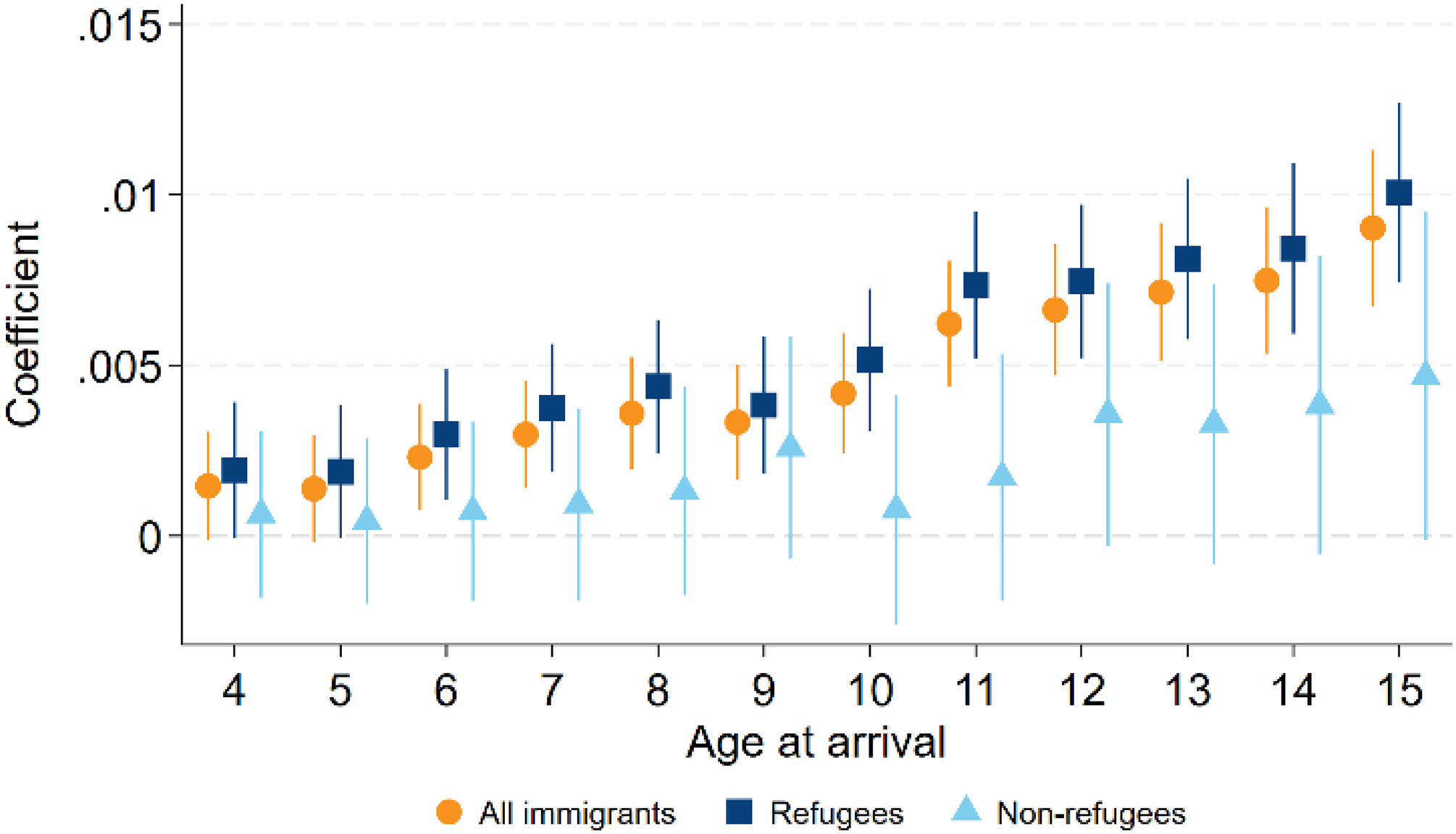
Effect of Age at Arrival on the Neighborhood Contribution to Dissimilarity Index.
Both refugees and non-refugees show a marked change in slope at age 11, with noticeably different patterns before this threshold. 10 For refugees (squares), non-zero effects start immediately at age 4 and increase roughly linearly until age 11, after which the slope steepens. This suggests that each year of delayed arrival matters for refugees, with effects intensifying after age 11. In contrast, for non-refugees (triangles), effects remain largely flat until age 11, when they start increasing slightly. This flat initial pattern indicates that for non-refugee individuals, barriers to residential integration emerge only for those arriving after age 11. This result is even more striking when we look at Supplemental Table A.3, which shows that both refugees and non-refugees arriving at ages 0–3 live in neighborhoods that contribute similarly to the municipality-level segregation. The effect on all immigrants (circles) is therefore primarily driven by the effect on refugees, with non-refugee effects remaining roughly half the size of refugee effects even at age 15.
Robustness Checks
In this subsection, we examine the robustness of our main results to alternative dependent variables and alternative definitions of our samples.
Alternative Dependent Variables
Our dependent variable captures how much a neighborhood contributes to the overall municipal uneven dimension of segregation. We now analyze to what extent our results are sensitive to using two alternative dependent variables: (i) the neighborhood contribution to the isolation index, 11 which captures the exposure or interaction dimension (Supplemental Figure A.1), and (ii) the share of immigrants in a neighborhood, which simply captures the composition of a neighborhood (Supplemental Figure A.1).
In Supplemental Figure A.1, we see that for non-refugees, age at arrival does not matter for the neighborhood contribution to the isolation index: the coefficients are 0 across all ages, which could be explicable by their lower segregation rates and larger group size on which the isolation index depends, in contrast to the dissimilarity index. For refugees, by contrast, we see a flat pattern and coefficients close to 0 up to the age of 11 — the same threshold as before, when the coefficients increase slightly. For this measure of segregation, the magnitudes are lower than in our previous results. For example, arriving at age 15 increases the neighborhood contribution by 0.004, which is 40 percent of the baseline mean of 0.01, compared to 64 percent of the baseline mean in the neighborhood contribution to dissimilarity. As the total sum of the isolation index also depends on the size of the minority group, however, the contribution numbers are not directly comparable.
Supplemental Figure A.2 reveals a mostly flat and negative pattern across all groups. In other words, later arrivals do not systematically sort into neighborhoods with different compositions relative to earlier arrivals. Across the board, from age 5 onwards, immigrants reside in neighborhoods with lower immigrant shares than those arriving at ages 0–3. Together with the results from the “Effects on Residential Segregation” section, our results show that later-arriving immigrants live in neighborhoods with higher contributions to the dissimilarity index but slightly lower neighborhood immigrant shares.
To make sense of these results, we note the following statistics: those that arrive at ages 0–3 live in neighborhoods with, on average, 34 percent immigrants (Supplemental Table A.3), but in municipalities with, on average, 27 percent immigrants. Those who arrive at age 15, for example, live in neighborhoods with 38 percent immigrants, in municipalities with, on average, 23 percent immigrants. Later arrivals tend to settle in immigrant-heavier neighborhoods within these lower-immigrant municipalities, producing high neighborhood-level dissimilarity. In contrast, early arrivals are more likely to reside in municipalities with higher overall immigrant shares, where neighborhood compositions are closer to the municipal average and thus contribute less to overall segregation. One plausible explanation is that later arrivals are more likely to stay in their initial location; if those locations were assigned through refugee dispersal policies, for example, we would expect the municipality immigrant average to be smaller. Using the neighborhood contribution to the dissimilarity index as the DV accounts for divergence from the municipality mean and thus captures within-municipality differences across neighborhoods, which the simple share of foreigners does not.
Alternative Sample Definitions
Our identification strategy relies on variation in age at arrival across siblings. However, for siblings with large age gaps, the older child may experience the parents’ early, less stable integration years, while the younger child may grow up in a more established environment. Because such differences are time-varying and correlated with age at arrival, they can introduce attenuation bias.
We therefore assess whether our results change when we exclude sibling pairs with an age gap larger than 5 years. 12 Supplemental Figures A.3a (refugees) and A.3b (non-refugees) show that the coefficients increase for both groups (with no changes in precision), but they increase relatively more for non-refugees, suggesting the presence of attenuation bias in our baseline specification. Nonetheless, the result that the effect of age at arrival on residential segregation is stronger for refugees than it is for non-refugees stands.
Effects on Labor Market, Educational, and Social Integration
The earlier immigrant children arrive in a new country, the more time they have to build country-specific knowledge (e.g., different types of networks, language, cultural habits, and institutional knowledge). This country-specific knowledge might also affect other forms of (integration) outcomes that, in turn, might affect residential integration. Here, we examine the effects on three other important margins: labor market, educational, and social integration.
In Figure 2, across all outcomes, we see very strong age at arrival effects for both refugees and non-refugees, but with slightly differing patterns. First, when it comes to income rank (Panel a), refugees experience steadily increasing negative effects of age at arrival, with a drop of up to 15 percentile ranks lower in the national income distribution for those who arrive at age 15 compared to those who arrive at ages 0–3. For non-refugees, the coefficients are very similar in magnitude but only up to age 10, when they level off. 13
Panel b (years of education) shows a rather flat pattern for both groups up to the ages of 7–8, when the coefficients start to noticeably drop. For refugees, they continue to drop rather linearly up to the age of 15, when the effect is 0.8 years of education lower than the reference category. For non-refugees, effects are constant from age 8 to 11, when they drop again. From age 10 onward, the effects are always less negative than for refugees. These results echo previous findings in the literature identifying critical ages around the time immigrants enter school (e.g., Böhlmark 2008, etc.).
Panel c reveals that the probability of being married at age 30 increases with age at arrival. Here, the effects for non-refugees again flatten at around age 10, with the increasing pattern continuing for refugees. For both groups, the intermarriage probability conditional on being married goes down with age and flattens at around age 11 (panel d): those who arrive at age 15 have a 20-percentage-point lower probability of marrying a native than those who arrive at ages 0–3.
Overall, both groups experience lower income ranks, fewer years of education, and reduced intermarriage rates when arriving later compared to arriving at ages 0–3. However, the effects flatten off only for non-refugees.
Given that age at arrival matters for labor market, education, and intermarriage outcomes, our final step of inquiry is to estimate how much of the baseline effects of age at arrival on residential segregation can be explained by these three intermediate channels. We turn to this in the next section.
Decomposing the Main Effect on Residential Segregation
We decompose the effects of age at immigration on neighborhood integration into components attributable to labor market integration (through income rank and education) and social integration (through intermarriage) in the style of Heckman, Pinto, and Savelyev (2013). While this exercise brings important insights into why we may observe the residential segregation patterns above, a word of caution is warranted with respect to this analysis. To be able to interpret these results as causal effects of the mediators, we need to make strong assumptions. In particular, we need to assume that all unobserved factors should be uncorrelated with both age at arrival and the mediators, and orthogonal to the link between the mediators and residential segregation. Additionally, we measure mediators and outcomes at the same age, raising potential reverse causality concerns. While this concern is minimal for education, which is largely completed before residential decisions, causality could run in both directions for income (e.g., neighborhoods affecting income through local job opportunities) and intermarriage (e.g., immigrants meeting spouses in their neighborhoods). For these reasons, we think of this method as describing patterns to help us better understand our results — showing which factors are associated with residential sorting patterns — rather than identifying strict causal mechanisms.
Since we are interested in how both labor market integration and social integration (through intermarriage) contribute to residential segregation, we conduct the decomposition analysis on the married sample. We describe in detail the steps involved in this exercise in Supplemental Section A.3. We estimate equation (2) with the age of the child entering linearly in the decomposition exercise (i.e., we decompose a linear effect of age at arrival). The main reason for this choice is clarity; instead of presenting a decomposition analysis for each and every age coefficient estimated in Figures 1 and 2, we present an overall decomposition analysis. We note, however, that our analysis has revealed non-linearities in effects and therefore these results should be interpreted with that caveat in mind.
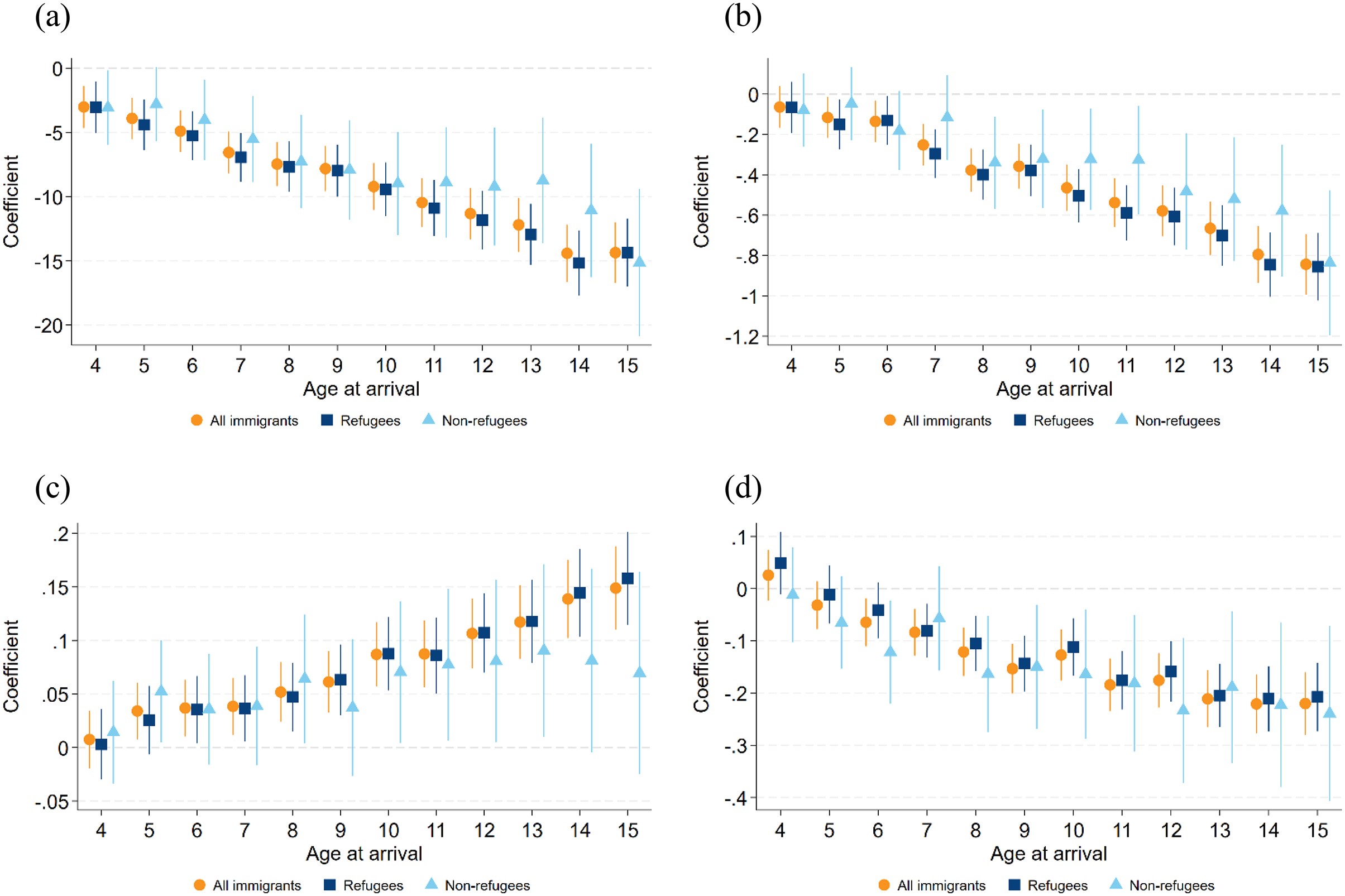
Effect of Age at Arrival on Other Integration Outcomes. (a) Income Rank; (b) Years of Education; (c) Married or Cohabiting With Children; (d) Married to Native, Conditional on Being Married.
Figure 3 shows the contributions of each channel to the overall effect on residential segregation. We see that the groups of refugees and non-refugees differ in how much each channel contributes. While for non-refugees, income rank and years of education contribute roughly 20 percent, these two channels are only half as important for refugees. The intermarriage channel contributes equally in terms of absolute shares. Yet, given that for refugees there is a larger part of the variation that is unexplained, intermarriage actually contributes equally with respect to the other channels, whereas for non-refugees intermarriage is half as important. Supplemental Figure A.5, which shows the results for the full sample, where we cannot estimate the contribution of intermarriage, also reveals that the unexplained part is larger for refugees than it is for non-refugees, suggesting the presence of other factors that prevent refugees from integrating residentially.
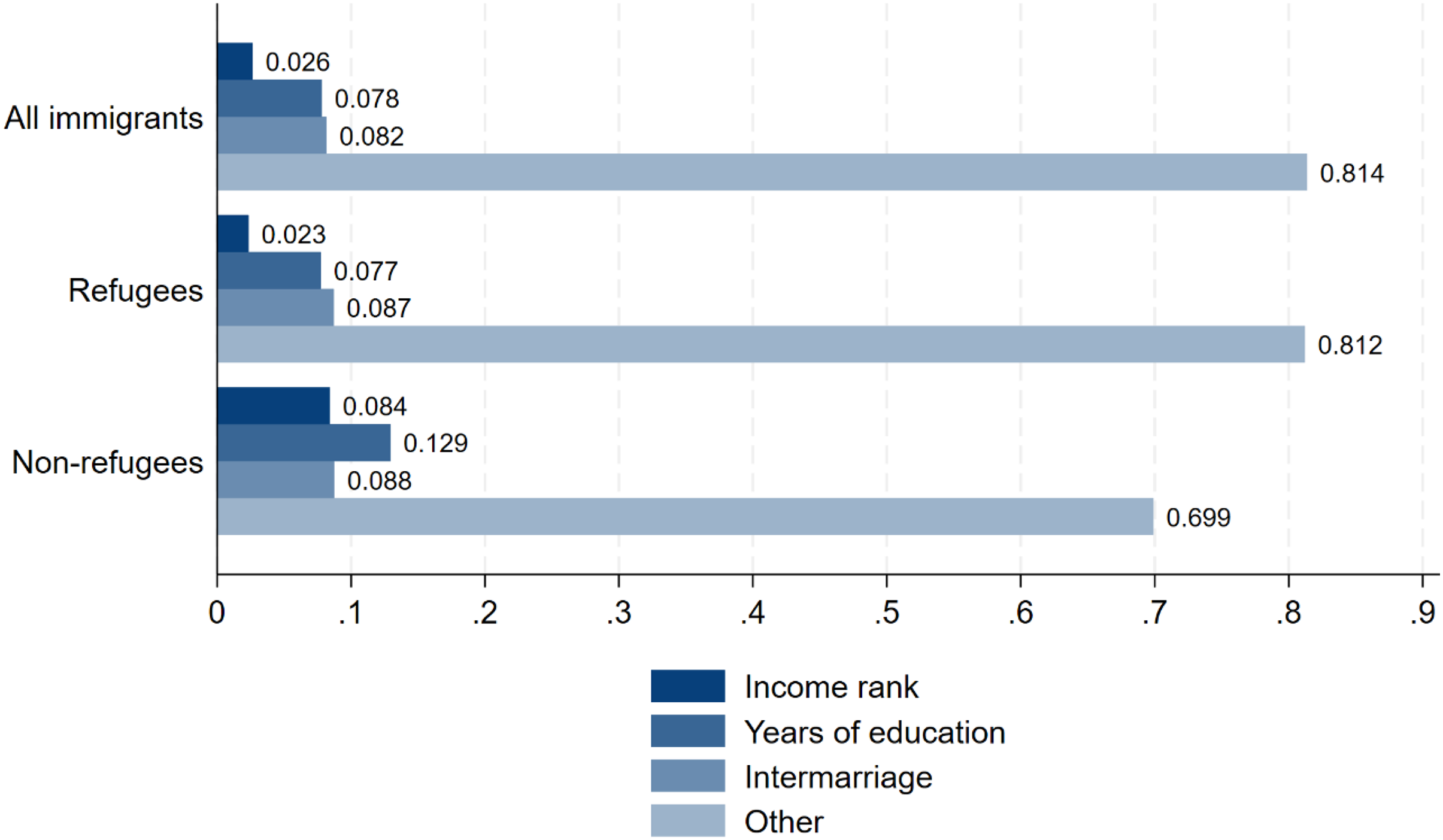
Decomposition.
These results tie our previous findings together: while refugees and non-refugees arriving later integrate similarly in labor markets and marriage markets, they differ substantially in residential outcomes. For non-refugees, economic integration (income and education) explains a meaningful share of residential segregation, consistent with spatial assimilation theories where economic success facilitates residential mobility. For refugees, economic and social integration contribute more equally, but large unexplained residuals remain — particularly notable given their similar labor market and intermarriage patterns to non-refugees. This suggests that refugees face additional structural barriers to residential integration. Such barriers likely include housing market discrimination (Ahmed and Hammarstedt 2008; Molla, Rhawi, and Lampi 2022) or dispersal policies that constrain initial settlement locations.
Conclusions
In this article, we have shown that the age at which immigrant children — particularly those with refugee status — arrive in their new country significantly affects the level of segregation in their neighborhoods in adulthood. Our results indicate that early arrival can have a non-negligible contribution to the overall (municipality-level) segregation level. Our analysis of potential mechanisms tentatively suggests that economic factors play a larger role for non-refugees, whereas for refugees, intermarriage and economic variables contribute equally to explaining the variation in the effect of age at immigration.
These results suggest that integration policies should be differentiated both by age at arrival and by refugee status. Our results on the importance of economic integration channels indicate that policies strengthening school acclimatization, language acquisition, flexible schooling options, and labor market programs can help those arriving later in childhood. Interventions that foster social ties — such as programs facilitating contact with native peers — may be especially crucial for refugees, for whom intermarriage plays a larger role. More generally, policies need to recognize that late-arriving children require targeted educational and social support, and that refugees face unique constraints that extend beyond the labor market. Given the importance of age at arrival, it is also worth noting the benefits of a fast asylum decision process, which allows early access to education and training for refugees.
While prior studies often lump together refugee- and non-refugee immigrants, we find important differences between these groups: effects differ in magnitude, emerge at different ages, and operate through different channels. Future research could examine how these results differ by ethnicity or country of origin, by different ages beyond 30, or for different cohorts.
Supplemental Material
sj-pdf-1-mrx-10.1177_01979183251414111 - Supplemental material for Age at Arrival and Immigrant Segregation: A Between-Siblings Analysis
Supplemental material, sj-pdf-1-mrx-10.1177_01979183251414111 for Age at Arrival and Immigrant Segregation: A Between-Siblings Analysis by Cristina Bratu, Matz Dahlberg, Sebastian Kohl, and Madhinee Valeyatheepillay in International Migration Review
Footnotes

Funding
The authors received no financial support for the research, authorship, and/or publication of this article.
Declaration of Conflicting Interests
The authors declared no potential conflicts of interest with respect to the research, authorship, and/or publication of this article.
Supplemental Material
Supplemental material for this article is available online.
Notes
References
Supplementary Material
Please find the following supplemental material available below.
For Open Access articles published under a Creative Commons License, all supplemental material carries the same license as the article it is associated with.
For non-Open Access articles published, all supplemental material carries a non-exclusive license, and permission requests for re-use of supplemental material or any part of supplemental material shall be sent directly to the copyright owner as specified in the copyright notice associated with the article.
