







Abstract
The debate surrounding disproportionality in the identification of culturally and linguistically diverse students for special education, and in the category of emotional disturbance in particular, remains highly contentious, particularly as scholars grapple with the meaning and causes of disproportionality. In this article, I discuss assumptions underpinning this line of scholarship and implications for the meaning we make of research findings related to disparities in special education and students’ needs. Efforts to understand and address inequity must be juxtaposed with the imprecise, and at times inscrutable, conceptual, psychometric, procedural, and causal issues surrounding identification and potential disproportionality, even while maintaining a fundamental desire to benefit students.
The debate surrounding disproportionality in the special education identification of culturally and linguistically diverse (CLD) students, and in the category of emotional disturbance (ED) in particular, remains highly contentious. As a field, we continue to grapple with the process of making meaning of observed patterns of representation and related outcomes; of the relations to conceptualizations of difference, development, and pathology; and of the implications for policy and practice (e.g., Cartledge, Kea, Watson, & Oif, 2016; Cavendish, Artiles, & Harry, 2014; Dunn, 1968). Much of the discourse as of late surrounds the basic meaning of disproportionality in research and practice spurred by divergent interpretations of recent studies (e.g., Morgan et al., 2015). Because the patterns of disproportionality (e.g., Donovan & Cross, 2002; Morgan & Farkas, 2016a; Waitoller, Artiles, & Cheney, 2010) and issues related to methodology and resulting inferences in recent research have been addressed elsewhere (e.g., Cohen, Burns, Riley-Tillman, & Hosp, 2015; Fish, 2017; Skiba, Artiles, Kozleski, Losen, & Harry, 2016; see also 2016 special issue of Multiple Voices for Ethnically Diverse Exceptional Learners), I do not belabor them here. Instead, in this article, I discuss the assumptions underpinning this line of scholarship and the implications for understanding potential disparities and students’ needs.
Having studied patterns and predictors of ED disproportionality (Sullivan, 2011; Sullivan & Artiles, 2011; Sullivan & Bal, 2013), outcomes of students with ED and other disabilities (Kohli, Sullivan, Sadeh, & Zopluoglu, 2015; Sullivan & Sadeh, 2015; Sullivan, Van Norman, & Klingbeil, 2014; Useche, Sullivan, Merk, & Orobio de Castro, 2014), various special education and psychoeducational practices (Harris, Sullivan, Oades-Sese, & Sotelo-Dynega, 2015; Sullivan, Long, & Kucera, 2011; Sullivan & Sadeh, 2014b; Sullivan, Sadeh, & Nortey, 2016), and the legal context of ED identification (Sullivan & Sadeh, 2014a), the scholarship and commentary surrounding disproportionality in special education and ED seems increasingly convoluted. As a disproportionality scholar, psychologist, and graduate educator of school psychologists who will inevitably engage students in psychoeducational evaluations for potential ED eligibility, the perplexity of the processes and assumptions related to ED identification and disproportionality in research and practice is particularly salient and troubling in many areas of my professional work. Here, I use ED to refer to the category of special education eligibility, as related to, but separate from, other broader, and often related, conditions encompassed within the term emotional and behavioral disorders and use of ED in other classification systems. Although ED identification and treatment may intersect with both professional and lay conceptualizations of mental health, psychopathology, volition, and so forth, my focus is on ED as a distinct special education construct because this is generally the focal concern in studies of disproportionality.
Are There Inequities in Identification of ED?
When we contemplate disproportionality, often what we are actually asking is, “Are there inequities in identification?” An inequity is more than a matter of mere difference or even differential susceptibility; it is matter of fairness and justice (Inequity, n.d.). Although disproportionality has been defined simply in terms of group differences in the given outcome (Coutinho, Oswald, & Best, 2002), use of the term generally reflects an assumption that the observed differences are indicative of inequities in the treatment of individuals and groups. This has long been true in both discussions of over- and underrepresentation of CLD students within special education and its specific eligibility categories (e.g., Dunn, 1968; Klingner et al., 2005; Sullivan, 2013) even when differential susceptibility to disabling conditions is also assumed (e.g., Morgan et al., 2015).
Thus, applications of various lenses or analytic approaches have yielded diverging observations and interpretations, but they generally share problematization of disproportionality. McCall and Skrtic (2009) dubbed disproportionality a “wicked policy problem” because of the variety of interpretations and their corresponding assumptions, consequences, and posited solutions (p. 3). For example, the current continuum of perspectives can be represented in (a) Morgan and colleagues’ (2015) and Morgan and Farkas’s (2016b) portrayal of underrepresentation emerging from lack of cultural competence and denial of civil rights of CLD students with elevated risk of disability to (b) varied arguments of historic, institutionalized educational disparities that deprive CLD students of educational opportunity and pathologize their behavior (e.g., Blanchett, 2006; Chhuon & Sullivan, 2013; McCall and Skrtic, 2009; Skiba et al., 2016), particularly given the history of disability as a basis for marginalization (Artiles, Dorn, & Bal, 2016) and special education as a means for the marginalization of CLD students (e.g., Dunn, 1968; Hoffman, 1975).
Embedded in various perspectives are often assumptions regarding the two fundamental questions that inform whether disproportionality is perceived as problematic: (a) Are we identifying the right students? and (b) Are special education services beneficial? (Donovan & Cross, 2002). Figure 1 presents a sampling of potential interpretations of patterns in disproportionality based on one’s position on these two questions. Although there is an abundance of support for various types of interventions that can be provided through special education (e.g., Burns, Kanive, Zaslofsky, & Parker, 2013; Cook & Schirmer, 2003), large-scale research has challenged the effectiveness of special education identification and service receipt for the average P12 recipient (Morgan, Frisco, Farkas, & Hibel, 2010; Sullivan & Field, 2013) and others have found limited use of research-based practices by special educators (e.g., Burns & Ysseldyke, 2009; Kavale & Forness, 1999). When combined with concern about the stigma and exclusion commonly associated with disability labels (see Cohen et al., 2015; Gold & Richards, 2012, for discussion) and evidence of poor outcomes among students with disabilities, particularly students with ED (Bradley, Doolittle, & Bartolotta, 2008), many scholars are concerned that special education services may not be beneficial for many CLD students, particularly those identified with disabilities for which validity and accuracy of identification is questioned (Klingner et al., 2005).
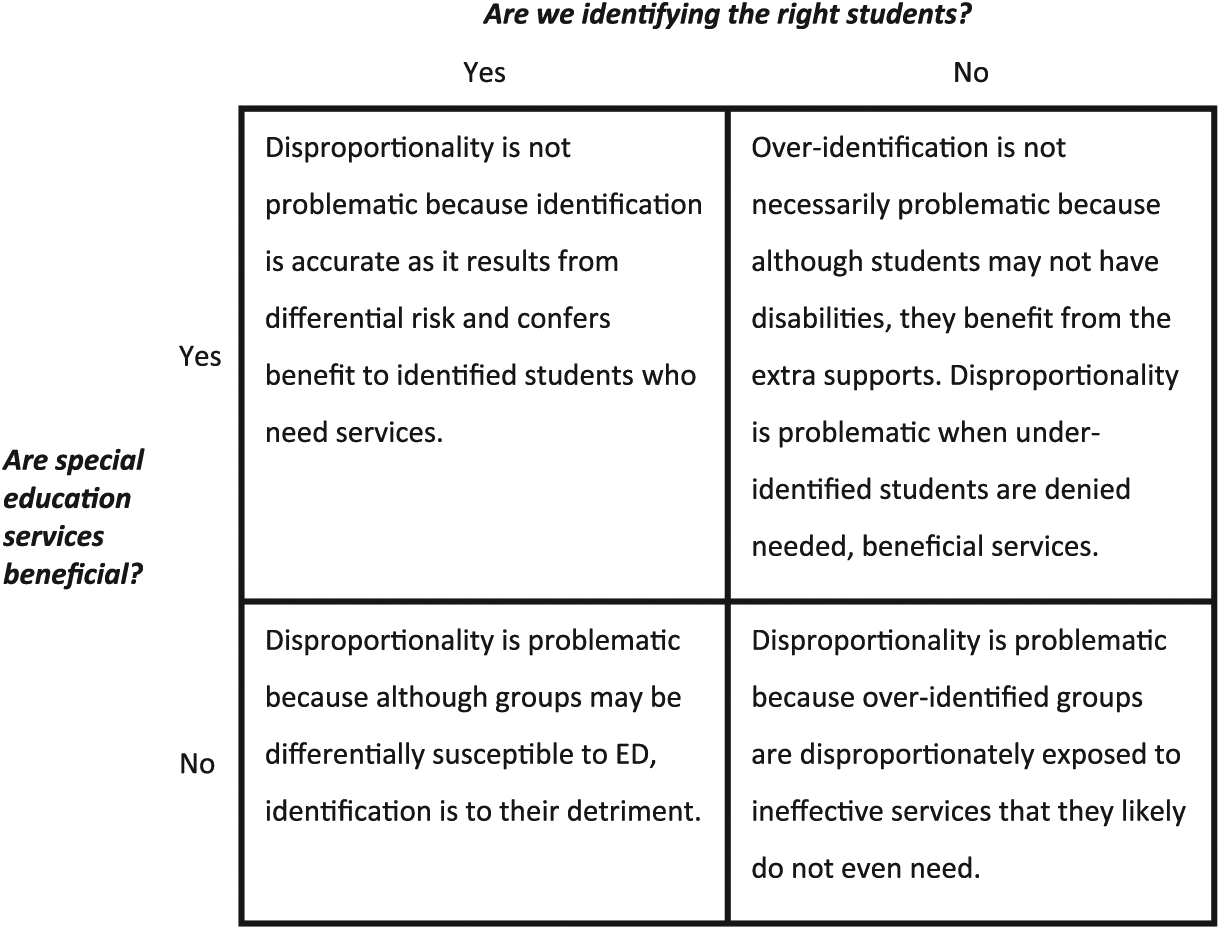
Sampling of interpretations of disproportionality patterns based on combinations of assumptions about accuracy of identification and benefit of services.
These assumptions are especially relevant because little of the disproportionality research allows for determination of the appropriateness of the identification studied (Sullivan & Proctor, 2016). As a consequence, scholars often extrapolate from research in related fields of education and the broader social sciences, but the varied findings throughout contribute to contradictory inferences regarding special education needs and identification. In the case of ED disproportionality, answering the first question regarding identification must be preceded by more foundational questions: What is emotional disturbance? Can we reliably identify ED? and Are ED identification and related educational decisions unbiased? Unpacking these questions reveals issues underpinning divergent characterizations of disproportionality in ED.
What Is ED?
The study of disproportionality cannot be separated from the meaning of special education disabilities. Because disproportionality in special education refers to differences in the identification and treatment of students within the system governed by state and federal rules and regulations and professionals’ interpretations thereof, this ongoing contention about ED disproportionality is inextricably linked to the conceptualization of disabilities within the law and professional communities that enact it. The Individuals With Disabilities Education Act (IDEA) defines ED as
a condition exhibiting one or more of the following characteristics over a long period of time and to a marked degree that adversely affects a child’s educational performance: (A) an inability to learn that cannot be explained by intellectual, sensory, or health factors; (B) an inability to maintain satisfactory interpersonal relationships with peers and teachers; (C) inappropriate types of behavior or feelings under normal circumstances; (D) a general pervasive mood of unhappiness or depression; and (E) a tendency to develop physical symptoms or fears associated with personal or school problems. (ii) Emotional disturbance includes schizophrenia. The term does not apply to children who are socially maladjusted, unless it is determined that they have an emotional disturbance under paragraph (c)(4)(i) of this section. (34 C.F.R. § 300.8(c)(4))
IDEA’s rules and regulations do not offer definitions for any of these elements.
As such, the very nature of ED as a category of special education eligibility remains indistinct—some would even say unintelligible—in both scholarship and practice. Indeed, the “ambiguity of language and frailty of logic” that Kauffman (1980, p. 524) noted remains as relevant today as nearly 40 years ago given the subjectivity of key elements in the definition (How does one determine “long period of time,” “marked degree,” “satisfactory” relationship, or “inappropriate” feelings or behaviors?) and resultant variability in local interpretations in policy and practice (Sullivan & Sadeh, 2014a). Furthermore, the federal definition was based largely on Bower’s 1957 research, yet ignored that Bower defined ED by social maladjustment, drawing harsh criticism:
To use a definition that operationally and conceptually defines emotional disturbance by their social maladjustments, then disqualifies them on the same basis, fits Tweedledee’s logic, “If it were so, it might be; and if it were so, it would be; but as it isn’t, it ain’t.” (Bower, 1982, p. 58)
Thus, from its codification, the definition of ED has been fraught with conflict because of its lack of specificity and reliance on circular reasoning that remains unresolved (for discussion, see Algozzine, 2017; Bower, 1982; Forness, 1992; Forness & Kavale, 2000; Olympia et al., 2004; Skiba & Grizzle, 1992; Weinberg & Weinberg, 1990). Studies of professional practices and interpretations in case law suggest that as a field, there is no consensus on the meaning of ED or how best to determine eligibility for special education (Merrell & Walker, 2004; Sullivan & Sadeh, 2014a). Case law reveals contradictory interpretations of the category by the range of actors—educators, related service providers, families, judges—involved in making decisions about the meaning of ED and its applicability to individuals. More fundamentally, this case law reveals varying, and at times wildly inappropriate (e.g., irrational and unempirical), conceptualizations of psychopathology, volition, culpability, the purpose of special education, and students’ rights to treatment versus penalty that parallel divergent scholarly perspectives (Sadeh & Sullivan, 2017; Sullivan & Sadeh, 2014a).
Deviations in law and its interpretation mean than ED has different connotations in different contexts and locales, not to mention for the individuals within them (Cloth, Evans, Becker, & Paternite, 2014). The legal or administrative meaning of ED in a given local context via state or district policy may be very different from that applied in research, which inevitably confounds interpretation of findings, restricts generalizability of large-scale analyses, and hinders inferences about the appropriateness of identification and any observed disparities. For instance, some states may enumerate eligible behavioral presentations, define the undefined elements above, or omit the social maladjustment clause (Sullivan & Sadeh, 2014a). What is more, reconciling the muddle that is ED is mired in differing perspectives on diversity and difference, behavior and psychopathology, identification/diagnosis (Eaves, 1982), and the role of (special) education in contributing to and responding to difference and disability, particularly when individuals demonstrate differences in social, emotional, or behavioral functioning.
Also problematic is the conflation of emotional or behavioral difficulties and psychiatric diagnoses with special education disability. It is not uncommon for scholars to equate measures of a singular emotional or behavioral difference with ED eligibility. Such an approach, however, is overly simplistic and in direct contradiction of legal requirements for eligibility determination despite some scholars’ evocation of CLD students’ “legal rights” and “civil rights” when inferring eligibility based on these measures (Morgan & Farkas, 2016a, p. 124). Reliance on individual measures or scores of emotional or behavioral functioning makes little sense conceptually, methodologically, or professionally because individual measures of academic and behavioral performance fall short of the range of data needed to substantiate disability (IDEA, 2004, 34 C.F.R. § 300.301-304). At best, such efforts serve as loose proxies for an indistinct construct; at worst, they reflect false equivalence. Special education eligibility is steeped in legal and professional requirements concerning evaluation procedures and interpretations (e.g., 34 C.F.R. § 300.301-304; National Association of School Psychologists, 2010) that make it nearly impossible to approximate an individual’s likelihood of ED eligibility, even applying sophisticated analyses and extensive controls, necessitating caution in interpretation of findings.
It is also prudent to remain cognizant that ED—at least within the general usage in disproportionality literature—refers to an administrative category, not clinical disorder, and its definition ultimately was determined by policy makers, not the scholarly and practice communities. Unlike disorders (e.g., psychiatric conditions enumerated in the American Psychiatric Association’s 2013 Diagnostic and Statistical Manual of Mental Disorders [5th ed.; DSM-5] and related scholarship), which provide common nomenclature, features, and thorough description, and can be used to inform treatment and predict outcomes, at most, ED can be considered a “crude categorization” that “offers little help in understanding individual children” (Wodrich & Schmitt, 2006, pp. 16–17). Thus, in the study of special education disparities, scholars are dealing with study of applied administrative labels, but not necessarily emotional and behavioral disorders, and should avoid unintended conflation and subsequent unfounded inferences. Congress has repeatedly declined to amend or clarify the language of ED in IDEA (Sullivan & Sadeh, 2014a). Yet, even in the absence of clear policy, ED and disproportionality scholars should have consensus in the use of ED in research, or, at a minimum, be clear about usage and conceptualization of ED in individual studies and any distinctions from others’ usage of the term, and from clinical disorders, to avoid misinterpretation, and further contributing to the confusion surrounding ED identification and disproportionality.
Can We Reliably Identify ED?
As Eaves (1982) noted, identification of ED “borders on mindless” because of the “muddled” definition in federal law and variability in how ED is conceptualized by professionals and localities (p. 464). Special education identification is generally considered to be unreliable (Donovan & Cross, 2002) given early and continued studies indicating inappropriate referral and evaluation practices, arbitrariness of decisions, and limited adherence to legal criteria for eligibility (e.g., Harris et al., 2015; Harry & Klingner, 2006; Knotek, 2003; MacMillan, Gresham, & Bocian, 1998; Singer, Palfrey, Butler, & Walker, 1989; Ysseldyke, Algozzine, Richey, & Graden, 1982). Identification of ED is particularly capricious. Without consensus on the meaning of ED, special education law, nonetheless, requires educators to make eligibility determinations. Even if one accepts the conceptualization of ED offered in a given context, identification practices and decisions are often unreliable (e.g., Allen & Hanchon, 2013; Costenbader & Buntaine, 1999). Much of the literature has focused on decisions related to identification of learning disabilities, but research suggests identification of ED is similarly affected by conflicting conceptualizations of the category and by practices of limited reliability and validity (e.g., Costenbader & Buntaine, 1999; Della Toffalo & Pedersen, 2005; Kelley, Reitman, & Noell, 2006). Unsurprisingly, there seems to also be little agreement among educators and service providers involved in the eligibility determination process (e.g., Stein & Merrell, 1992). But then, how can scholars or educators reliably identify a condition that has no agreed upon definition? In the absence of better policy and professional consensus, educators and practitioners should, at a minimum, rely on best practice recommendations and make assumptions and interpretations explicit while striving to make legally defensible decisions (Sullivan & Sadeh, 2014a). In research, this unreliability means scholars must be cautious about interpreting both results of studies designed to infer ED eligibility and those designed to evaluate disparities in observed identification by school professionals.
Is Identification of ED (and Related Educational Decisions) Unbiased?
Evidence of bias in ED identification is inconclusive. Bias in referral for eligibility has been accepted (Donovan & Cross, 2002), but there are few studies of bias in eligibility decisions, particularly related to ED identification. Nonetheless, it is frequently recognized that ED is largely subjective (i.e., in the “eye of the beholder”; Algozzine, 2017, p. 138) and based more on culturally based perceptions of “troubling” behavior than psychopathology or “internal disturbance” (Hart, Cramer, Harry, Klingner, & Sturges, 2010, p. 149; for example, disrespect, loitering, and aggression; Skiba et al., 2011). Researchers can (cautiously) look to scholarship in other areas of education and the social sciences to extrapolate the dynamics underpinning special education decisions and the educational experiences that precede them. Although not yet well substantiated in special education, behavioral differences between children from dominant and nondominant cultural backgrounds may be related to general tendencies for White observers to interpret behavior differently based on the race and gender of the actor. Research has frequently demonstrated racial bias in numerous decision-making contexts related to capability, culpability, and treatment—all of which are certainly interwoven in notions of ED—across a variety of fields including social psychology, criminal justice, economics, and various helping professions (e.g., Abreu, 1999; Bertrand & Mullainathan, 2004; Jacoby-Senghor, Sinclair, & Shelton, 2016; Sargent & Bradfield, 2004; Whaley, 1998). It is unlikely educators and related service providers involved in special education disability identification are immune to such biases when the decisions rendered parallel those in other contexts where there is robust evidence of bias. Furthermore, educational research indicates teachers’ tendencies to perceive and respond differently to students’ behavior in ways that disadvantage students from some racial minority backgrounds (for discussion, see Gregory, Skiba, & Noguera, 2014; Milner, 2013; Staats, 2014) and may contribute to problematic behaviors or spill over into special education processes.
In addition, if disproportionality is understood as related to a broader constellation of opportunity gaps, this complicates inferences about disparities in ED because problem behavior is often at least partially determined by context and shaped by educational experiences (e.g., Reinke & Herman, 2002). As such, an additional confound in this debate emerges from the role of context, race, and perspective in students’ presentation of undesirable or maladaptive behaviors, and educators’ interpretation thereof, particularly for externalizing, internalizing, and self-regulatory behaviors (e.g., Cherng, 2016; Wright, Gottfried, & Le, 2017) that have been the focus of recent disproportionality scholarship (e.g., Morgan et al., 2015). Students’ observed emotional and behavioral difficulties may be related to a range of factors related to adult behaviors and expectations, including behavior management, instruction, emotional support, and discipline, as well as to policies and practices that contribute to school climate, school connectedness, and student–teacher relationships (e.g., Decker, Dona, & Christenson, 2007; Gregory, Cornell, & Fan, 2011; Griggs, Mikami, & Rimm-Kaufman, 2016; Hart et al., 2010; McGrath & Van Bergen, 2015; McKown & Weinstein, 2008; Pate, Maras, Whitney, & Bradshaw, 2017; Tenenbaum & Ruck, 2007).
It is a relevant concern then that resulting student behaviors may be interpreted as indicative of special needs as opposed to being a product of the environment (Skiba et al., 2006). Given that improved teacher practice can enhance not only students’ achievement, but the more salient behavioral features of ED (e.g., peer interactions, engagement; Gregory et al., 2016), there is value in considering the ways classroom and school environments may contribute to supposed ED. This perspective is also consistent with a best practice orientation that prioritizes ruling out of low-inference, often ecological, hypotheses for student difficulties before applying high-inference explanations such as psychopathology (Christ & Arañas, 2014).
Furthermore, contextual factors that contribute to inappropriate behaviors are more prevalent in the urban, low socioeconomic status schools commonly attended by students from CLD backgrounds (Brayboy, Castagno, & Maughan, 2007; Duncan & Murnane, 2011; Ferreira & Gignoux, 2011). Students from CLD backgrounds are disproportionately exposed to educational contexts that increase risk of maladaptive behavioral or social-emotional responses (e.g., less close student–teacher relationships; McGrath & Van Bergen, 2015; inappropriate discipline; Skiba et al., 2011; Smolkowski, Girvan, McIntosh, Nese, & Horner, 2016), so it becomes difficult to tease apart these contextual factors from other factors that may contribute to observed or assumed difficulties. IDEA presumes the causes of students’ difficulties can be determined despite scientific evidence to the contrary (Sadeh & Sullivan, 2017). Accordingly, many disproportionality scholars take a more cautious approach and emphasize the need to consider contextual determinants to avoid inappropriately identifying students as having a disability when their difficulties result from ineffectual practices or insufficient educational experience (Cohen et al., 2015; Sullivan & Proctor, 2016).
In addition, as noted elsewhere, it is impossible to conduct analyses where the “ceteris paribus condition of ‘all other things being equal’” (Morgan & Farkas, 2016a, p. 122, emphasis in original) is truly met (Cohen et al., 2015). Whereas analog studies may approximate equivalence between fictional individuals (e.g., Bertrand & Mullainathan, 2004), such equivalence cannot be achieved when scholars rely on observational data. One cannot approximate equal conditions statistically because the differences, for instance, between otherwise similar White and Black children cannot be attributed to race as an inherent characteristic of an individual but rather to the treatment of race. To assume otherwise is to essentialize race—that is, to assume it is characterized by clear, static markers and determines a predisposition or condition (Chao, Hong, & Chiu, 2013)—which, as has been recognized in other fields, is “problematic at best and harmful at worst” (Yudell, Roberts, DeSalle, & Tishkoff, 2016, p. 564).
Given deeply entrenched social inequities, the experience of race in the United States, and known disparities in treatment from cradle to classroom—indeed in utero and beyond (e.g., Smedley, Smith, & Nelson, 2003)—caution when making inferences about the relations of students’ observed behaviors or others’ perceptions of them, the presence of psychopathology or ED, or the false positives or negatives in the identification of ED. Meaning making is even more complicated when considering the potential implications of culturally based orientations to social-emotional functioning, mental health, and help seeking, as well as the historical legacies of the pathologization of cultural differences and gross mistreatment of racial, linguistic, and cultural minority groups’ medical and educational institutions (Smedley et al., 2003). These factors can influence students’ and families’ experiences and responses in educational processes, including intervention and special education eligibility determination, when students display behaviors or emotional responses considered problematic. Researchers must temper our conclusions and recommendations in light of these dynamics. Put simply, determining bias or disparities in the identification of ED is no simple matter.
Conclusion
Taken together, the issues in definition of ED, reliability of identification, and potential bias in the educational processes and decisions that precede and surround ED eligibility determinations mean that, at best, when we study ED disproportionality, we make inferences about the patterns and potential mechanisms underpinning identification or application of ED as an administrative label conferring special education eligibility, but that inferences about the emotional and behavioral functioning or psychopathology of individuals or groups are generally beyond the scope of valid interpretation. Far more than semantics, this distinction reflects the complexity of our sense making of a relatively nonsensical category steeped in questionable practices and related disparities. When studying and elucidating disproportionality in the identification of ED, we must be mindful of the pitfalls of oversimplification (Skiba et al., 2016) and be prepared to wade through the quicksand of imprecise, and at times inscrutable, conceptual, psychometric, procedural, and causal issues surrounding identification of ED in schools, and potential disproportionality, even while maintaining a fundamental desire to do right by students.
Footnotes
Declaration of Conflicting Interests
The author(s) declared no potential conflicts of interest with respect to the research, authorship, and/or publication of this article.
Funding
The author(s) received no financial support for the research, authorship, and/or publication of this article.