







Abstract
This exploratory, qualitative case study examines the interplay between identity, arts integration and agency in an arts-integrated writing workshop for 10 disabled high school students in the United States. Participants were enrolled in a language arts classroom that offered a writers’ workshop every Tuesday for 16 weeks. Classroom observations, questionnaires, interviews and students’ artefacts provided insight into how the workshop served as a space for students to consider how to integrate their disability identity into their overall sense of self and the agency to choose when and how they wanted to share this part of themselves. This study expands upon current research by highlighting how arts integration equips disabled students with tools to cultivate a sense of self, develop agency and challenge normative discourse.
Societal perceptions of disability can significantly impact an individual’s sense of self and identity formation, as disability can be a source of stigma and marginalization (Dunn & Burcaw, 2013). Identities can contain traits, personal characteristics, roles and one’s ties to social groups, as identity is heterogeneous, complex and fluid (Evans, 2017; Gee, 2001; Gomzina, 2012). Moreover, Monereo and Hermans (2023) emphasized that the ongoing development of one’s identity is a dynamic process, characterized by its multifaceted nature. This enables individuals to seamlessly adapt and interchange various roles in response to the diverse demands presented by different situations they encounter. Researchers examining disability identity avoid viewing it in a vacuum; rather, they pay attention to an individual’s context, experiences and how they create and negotiate their disability identity and sense of self. Not all disabled people choose to integrate their impairment into their identity formation (Davis, 2006). In academic contexts, disabled individuals might identify as disabled or ‘pass’ as nondisabled to circumvent stigma and to evade misconceptions of frailty or limited capability (Valero Sanchez, 2023).
When the student is labelled with ‘special needs’ or as disabled there seems to be an assumption that the disability status defines the individual (Demetriou, 2022). Doing so ignores all other foundational parts that make the individual who they are and shifts the focus to what the student cannot do/be. The history of disability, as Brown (2002) emphasizes, is dominated by a medicalized discourse that views the individual through a deficit lens. Viewing disability through a deficit-oriented lens has the potential to constrain the development of one’s sense of self, as it tends to emphasize a singular identity — disability identity, in this case — as the sole representation of one’s being.
Now, more than ever, as students recover from a worldwide pandemic and cope with events that are out of their control, teachers can empower them with a learner-centred pedagogy that emboldens their agency, explores their sense of self and reclaims their education. Arts integration is one such educational approach that combines arts education with traditional academic subjects to enhance learning and understanding across multiple disciplines (Greene, 2009; Gullatt, 2008; Hughes et al., 2022; Jensen, 2001; Peppler et al., 2023). It involves using the arts, such as visual arts, music, dance, drama and other creative forms, to explore and deepen the understanding of core subjects like language arts, social studies, maths, science, history, etc. Broderick (2014) suggested that arts integration can function as a powerful pedagogy of resistance by giving precedence to students’ agency and encouraging them to assert authority over their learning (Silverstein & Layne, 2010). A pedagogy of resistance is a critical pedagogy that allows students to not only resist but also to counteract normative discourses (Jones, 2011).
Arts integration allows students to demonstrate and construct understanding through mixing diverse modes of communication. Studies have found that students in an arts curriculum were more skilled in creative thinking, problem-solving and self-expression (Alhomaidi & Salleh, 2022; Burton et al., 1999; Mossing, 2013). Moreover, they were more prone to taking risks. Khan and Ali (2016) asserted that students’ exposure to the arts could promote better self-esteem, motivation, creativity, improved emotional expression, aesthetic awareness and social harmony. Hence, arts integration can function as a powerful way to foster disabled students’ identity development.
This study explores the interplay between identity, arts integration and agency in an arts-integrated writing workshop for disabled students. Specifically, this research examines the question: ‘In what ways does participation in an arts-integrated language arts course impact disabled students’ sense of self and agency?’ The study privileges disabled students’ agency and highlights the potential of arts integration to serve as a tool for identity development.
Sense of self, student agency and arts integration
While the concept of ‘sense of self’ has been conceptualized in numerous ways — historically, scientifically and psychologically — scholars have posited that it ‘incorporates both how people might describe themselves and the value that they attribute to who and how they are as a person’ (Hodge et al., 2019, p. 1355). Self-esteem can also act as an evaluator of the self (Harter, 2012; Hodge et al., 2019). Given the prevalence of negative attitudes towards disability, many disabled people grow up internalizing the view that their way of being is undesirable and they are a problem to be fixed (Hodge et al., 2019). This, in turn, can affect a disabled person’s self-esteem and diminish their positive sense of self.
Deficit-related perceptions of disability are rooted in the medical model, which is the most prevalent in the Global North (Bacon & Lalvani, 2023; Heller et al., 2018). The medical model views disabled individuals as needing to be corrected or treated by medical institutions, irrespective of whether an impairment causes discomfort or illness (Degener, 2016). Medical model ideologies are reinforced in healthcare systems, public attitudes, the media (Heller et al., 2018) and education (Bacon & Lalvani, 2023). The medical model presents a negative view of disability by focusing on what a disabled individual lacks instead of what they possess and influences social attitudes towards disability by setting low expectations for disabled individuals. In addition to impacting disabled individuals’ sense of self and identity, societal barriers erected by the medical model can reduce disabled people’s independence, agency and control over their lives (Degener, 2016).
Conversely, the social model focuses on the experiences of disabled individuals and recognizes the ways that disability is socially constructed; this paper is grounded in the social model of disability. The social model states that the origin of the disability depends heavily on the organization of the society that contextualizes it rather than on the impairment of the individual (Degener, 2016). In the present study, the word ‘impairment’ refers to the physical state of the body, whereas ‘disability’ is used to reference the societal barriers that disable. Impairments alone do not produce barriers; rather, attitudes towards disability can restrict disabled individuals from having equitable opportunities to be members of their society (Degener, 2016; Mac, 2022).
Klemenčič (2015) defined student agency as ‘the quality of engagement of students with their environment’ (p. 6), that is, their choices of action and interaction with their world. Student agency arises or is exerted when students engage with others or with something (e.g., a project) in an intentional manner and that interaction is accompanied by critical reflection. Expectancy of the probable outcomes and students’ beliefs in their success are two vital components of students developing their agency. Goodlad’s (1984) work has shown that reducing teaching solely to direct or lecture-based instruction positions students as passive consumers of knowledge. Theories of student agency provide a powerful lens for understanding the effects of arts integration on disabled students, as ‘so much of life is scripted for disabled individuals, and when well crafted, the educational experience of making art puts the script in the hands of the individual‘ (Mason et al., 2008, pp. 40–41). The importance of arts integration lies in its power to develop students’ agency, as it creates students who are ‘agents of text rather than victims of text’ (Albers & Harste, 2007, p. 7). Agency provides disabled students with the opportunity to push back against deficit frameworks and put forward their own conceptions of disability as it relates to their respective identities (Mason, 2004). The arts involve disabled students with ‘the acts of observation, rehearsing, weighing, judging all of which are essential tools for learning in general’ (p. 41). The students decide how they want to execute their work, and accordingly they are enhancing their ‘critical capacity of decision making that will enable them to be active and independent members of society’ (p. 42).
Transmediation, a critical component of arts integration, is a necessary part of the agentic process. It is defined as the ‘movement of meaning’ (Harste, 2014, p. 91) or ‘the translation of content’ (Siegel, 1995, p. 461) from one sign system to another (e.g., from the arts to writing or vice versa) (Harste, 2014; McGinnis, 2020; Siegel, 1995). Transmediation encourages students to switch roles from passive consumers to active makers of knowledge, as it emboldens students to ‘find and frame problems worth pursuing, negotiate interpretations, forge new connections, and represent meanings in new ways’ (Siegel, 1995, p. 455). Transmediation is also essential to the learning experience because students need more than just words to learn and make meaning (Harste, 2014; McGinnis, 2020; Siegel, 1995). Arts integration enables students to ‘talk back’ to dominant disability discourse and challenge prevailing narratives concerning the concept of disability identity (Harste, 2014). Through arts integration, students can explore who they are, how they are different and unique and what contributions they can make to current conversations, even if their contribution differs drastically from current thought.
Methodology
This case study examined the perspectives of 10 disabled students enrolled in one class at a northeastern state’s public secondary school, hereby referred to as ‘TechEd High School’. The authors selected the research design of a single instrumental case study (Creswell, 2013). Case study design allowed the in-depth exploration of the students’ perspectives as situated within a real-life context and placed emphasis on their voices. The study drew upon multiple sources of data including questionnaires, interviews, class observations and students’ original work.
Participants
Ten students between 15 to 17 years old and two teachers participated in this study. Each of the students in the programme had an Individualized Education Plan (IEP) and received emotional support services. Students were diagnosed with a mix of cognitive and/or social-emotional disabilities. The specific diagnosis of each student participant was not provided to maintain confidentiality. The socioeconomic status of the participants varied. Participants selected their own pseudonyms to maintain anonymity. Table 1 provides an overview of the study participants.
Participant demographics.
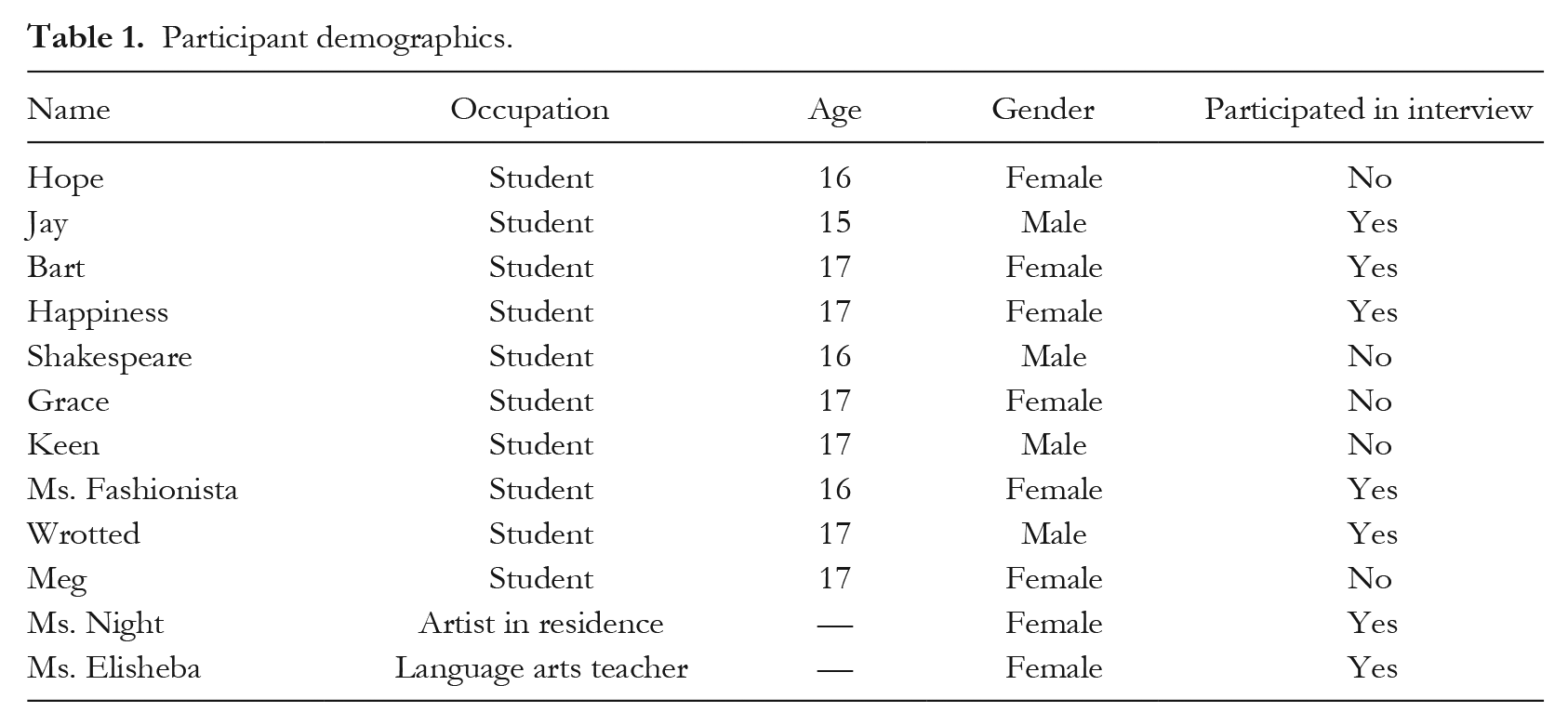
Case study context
TechEd High School specializes in career and technical education for students in grades nine through twelve. The setting for this study was a language arts classroom at TechEd High that offered a writers’ workshop every Tuesday for 16 weeks; each session took place over two hours (October 2017 through March 2018). The language arts teacher, Ms. Elisheba, chose to fully integrate the arts into her writers’ workshop. Ms. Elisheba chose an interdisciplinary approach that targeted the arts, English and civics. Arts integration in this class also involved partnering with an urban nonprofit arts centre that offered an artist residency programme. The artist in residence, Ms. Night, visited the writers’ workshop once a week during the 16 weeks.
During each session of the writers’ workshop, students were taught a preselected artistic skill and addressed a different aspect of the printing process from formulating ideas, drawing and using studio materials to learning design composition and incorporating text into design. The students used what they had learned and incorporated it into the creation of their final product, a bound journal and final silkscreen. During the workshop, students worked both independently and in small-group settings.
The writers’ workshop also involved two field trips to the city’s non-profit arts centre. During their first visit, the students engaged in a study tour, viewed the current exhibition and learned how to create original hand silk-screened prints in the professional art studio. During the second trip, the students explored the exhibition on display at the time and printed a pre-selected artistic piece from their journals onto fabric, creating a silkscreen art piece.
The teachers grounded the writers’ workshop on the idea that students’ own life experiences colour the way they interpret what they read and see. For this reason, they asked the students to generate a list of topics that interested them. The students selected the following: mental illness, acceptance (social acceptance, insecurity and self-acceptance), space, technology, power, identity and making a difference. The students explored these topics through English essays, poems, short stories, song lyrics, written expression and social studies. Students then chose one topic from this list as a primary theme to explore through written and artistic interpretations. While students could jump between topics, they were encouraged by the language arts teacher to focus on one topic from the list in their research. They created their own artwork and journals after analysing the work created by Louis I. Kahn, which focused on modernist art and architecture. Students were required to produce three artefacts related to their targeted topic, and the students were evaluated through the process of creating a portfolio and a journal. Lastly, with the help of the artist in residence, students created a silkscreen art piece based on their written and artistic interpretations of the explored topics.
Data sources
Student questionnaires
All participants (students and teachers) completed a written questionnaire during the first week of the writers’ workshop. The questionnaires consisted of questions requiring open-ended, short answers and responses along a Likert scale (see Appendix 1).
Interviews
The first author conducted structured interviews with the teachers and five students in the class: Jay, Bart, Happiness, Ms. Fashionista and Wrotted (see Appendices 2 and 3). Students’ interviews were completed at TechEd High School and lasted between 15 and 20 minutes. The purpose of the interviews was to provide the teachers and students with the space to reflect on their experience in the writers’ workshop. The 10 questions focused on students’ perspectives on their interaction with the arts, their reflections on making decisions throughout the process and aspects of their identity.
Observations
During class observation, the first author functioned as a participant observer in the classroom. All observation notes were hand-recorded into a notebook. The first author helped both the language arts teacher and the artist in residence, conversed with students, participated in the artistic work of the writers’ workshop and collected and analysed data. Doing so provided her with a deeper insight as she was able to hear students’ comments, listen to their side talk and sometimes be part of their conversations. Such involvement enabled the first author to gain a level of trust from the students, which helped the students to feel more comfortable around her.
Field notes
The first author attended nine writers’ workshop sessions and language arts classes at TechEd High and accompanied the class on their two field trips to the arts centre. She spent 47 hours with the students. The first author recorded field notes during and after class. She focused her field notes on students’ comments and their interactions with their work and with each other. After class, she included analytical memos in which she reflected on her observations.
Student artefacts
The first author also collected copies of student work as another point of access into their perspectives on the writers’ workshop. The following examples of student work served as artefacts for analysis: any artistic production (e.g., their zines, silkscreens), their portfolios and their journals. With students’ permission and consent, the first author documented students’ work by taking photographs, as she could not take the artefacts outside the classroom.
Data analysis
Surveys, interviews, observations and students’ work were collected and analysed to answer the research question. Student responses from the questionnaires were compiled into a table to determine frequencies in responses to certain questions. Then, interview recordings were transcribed verbatim. Students’ work was collected and compiled in a secure folder. Field notes were transferred into a word document.
In line with case study analysis, the researchers analysed themes that allowed for a greater understanding of the case (Creswell, 2007). They coded the corpus of data using Braun and Clarke’s (2012) six phases of thematic analysis, a method for identifying, analysing and reporting patterns within the data. These phases included (1) becoming familiar with the data, (2) generating initial codes, (3) searching for themes, (4) reviewing themes, (5) defining and naming themes and (6) producing a report. The initial coding process (step 2) resulted in 34 codes, which included ‘processing feelings’, ‘branching out’ and ‘exercising agency’. When reviewing the same sections of data, the researchers agreed upon initial codes 75% of the time. In 25% of cases where researchers coded data differently, discussion ensued to resolve discrepancies to 100% agreement.
During steps three and four of the analytic process, the researchers identified seven initial themes: (1) the arts facilitated a more engaging classroom; (2) the arts fostered students’ agency; (3) the arts fostered a positive identity; (4) the arts fostered self-expression; (5) the arts helped students relieve stress; (6) the arts nurtured a sense of community; and (7) the arts allowed students to assume new identities (see Supplementary File for an overview of sub-themes and corresponding codes, code definitions and code examples).
Next, the researchers discussed the themes as related to participants’ sense of self, agency and the process of transmediation. For example, themes three and seven highlighted participants’ evolving sense of self, as they captured the evolution of participants’ understanding of their respective disability identities, while themes four and five were both indicative of the process of transmediation, as they addressed instances where students used visual representations to complement the writing in their zines. Themes one, two and six highlighted the development of student agency, which was facilitated by the classroom content and context. The final stage of analysis (step five) culminated in naming and defining three overarching themes, which are described in detail in the Findings section.
Trustworthiness
Methodological triangulation was used to collect data to increase the validity of the study’s findings (Bogdan & Biklen, 2006). Qualitative field notes are an essential component of rigorous qualitative research. Creswell (2013) asserts that field notes ‘aid in constructing thick, rich descriptions of the study context, encounter, interview, […] and document valuable contextual data’ (p. 381).
Researcher positionality
The first author is a female postdoctoral fellow who, at the time of this study, was working towards her master’s degree in education. The second and third authors are female associate education professors. As related to disability identity, the first author has an autoimmune disorder, and the third author has a mental health disorder; the second author identifies as a disability ally.
Findings
This study focused on the perspectives of disabled high school students in an arts-integrated writing workshop. The following themes were formulated from data analysis: (1) arts integration enabled student agency; (2) arts integration provided an outlet to process stress and anxiety; and (3) arts integration fostered exploration of disability identity. Each of these themes will be discussed in turn.
Arts integration enabled student agency
Students noted that art projects in the workshop provided a space for them to be agentic and make choices. Whenever the students were given the space to make the work their own, they were able to voice their interests and opinions and even share personal views about themselves and the world around them. The students actively made decisions on what themes they wanted to work on, how they wanted to execute each piece, what story they wanted to tell and what they wanted to share. Before the beginning of the workshop, the students selected three main themes to explore and centre their work: ‘acceptance’ (social acceptance), ‘space’ and ‘mental illness’. However, based upon the students’ interests and requests, they added the topics of ‘power’, ‘technology’, ‘making a difference’, ‘self-acceptance’ and ‘insecurities’ to the original three themes. When it came to themes, they decided on them as a group and later expanded on them individually as they saw appropriate. They also had the space to execute and finalize their work as they desired.
When reflecting on how she felt about choosing themes for the workshop, Happiness explained, ‘I had more of my own voice and choice in the matter. Sometimes you really do not have that. It made me more motivated. I was able to express myself more without feeling judged’ (interview, 27 March 2018). Wrotted said that it made him feel ‘pretty good and safe. I like having a lot of room to be able to do what I feel like is right for me and make my own choices’ (interview, 27 March 2018). Keen’s original print provides an example of how students exercised agency in the workshop. Keen mixed his own drawing, a silkscreen print and embroidery to represent the idea of ‘power’. (Figure 1).
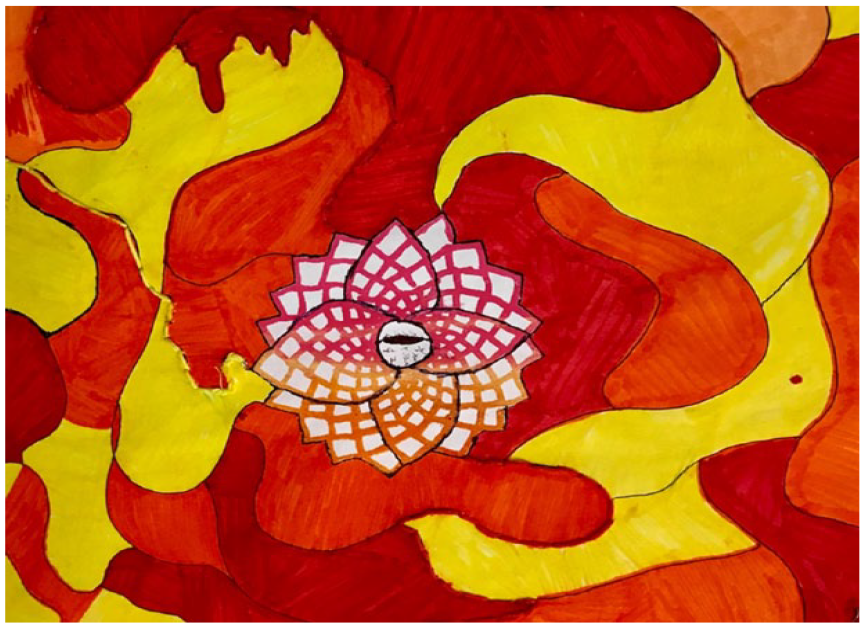
Keen’s silkscreen.
During their interviews, all five students confirmed that they freely expressed opinions. Jay appreciated having the freedom to jump from one theme to another, as he ‘wanted to try everything’. Throughout the workshop, he expressed himself through his choice of themes ‘independence, power and mental illness’. Wrotted explained, ‘I am kind of reserved at school but when I was given the chance, I did take it, like in this class, which is nice. Art is a pretty good way for people to get to know me’ (interview, 27 March 2018). Ms. Fashionista said:
I love how the arts have to come from a personal place and from one’s own creativity and experiences. If it’s your own experience then you are transforming it in the process as you are presenting it, whether visually or by text. In that way your voice can be shown and heard, and this was a great example of how we could show our voices and our ideas to the world. (Interview, 27 March 2018)
The two teachers also noted the ways that the workshop nurtured student agency. Ms. Elisheba said that students were agentic ‘in their creativity, in the artwork, writings, other contributions and in sharing ideas with peers’. Ms. Night focused on the students’ interaction and reaction to the task at hand. She explained that most of the students’ expressions were ‘verbal and arise in the moment of actually making whatever it is they are working on. They’ll say out loud that something is frustrating/confusing/cool/interesting/etc’. (Interview, 27 March 2018). During their interviews, both Ms. Elisheba and Ms. Night agreed that students were active agents in the process. Ms. Night elaborated: ‘they were definitely not passive consumers of text […] the art classes are very much about making creative choices and working on a project that will result in a tangible object. In that way, I think students do practise their agency’ (interview, 27 March 2018).
Arts integration as an outlet for students to process stress and anxiety
Students felt the arts provided them with the means to cope with and relieve their stress and anxiety. Expressing their sentiments, thoughts and emotions in visual forms appeared to help students release powerful emotions. As Happiness explained, ‘[Art] makes me happy so it was kind of like a stress reliever, and we used to tell our teacher we need more days not only Tuesday, it empowered me in that sense’ (interview, 27 March 2018). Wrotted shared that the arts integration made writing ‘less stressful’:
I really like art, so it was kind of fun to kind of like have it be integrated with like writing […] in some ways. It made it [writing] less stressful; it makes me a lot less tense which makes things a lot easier […] I felt comfortable, so it did not come with a lot of anxiety. It did not make me feel that the things I was doing were forced and I was able to do them (Interview, 27 March 2018).
Students also used art production as a medium to process their feelings. Keen shared a poem he wrote about anxiety and mixed it with his own personal drawing in a ‘zine’, which is a self-published, original work including text and images. Keen explained to the researcher during observations that he is very intentional regarding his presentation. He shared that he always has a plan on how he is going to mix the words with the visuals to create his art. On the first page of the zine, Keen wrote the words ‘I don’t want to live here anymore’ on a road that runs from the top of the page to the bottom of the page (Figure 2). When flipped to the second page, the road reads, ‘I wish I could live in here.’ He used the roadmap motif and abstract art to connect the following phrases in the next several pages of his zine: ‘head’ — ‘so I can see’ — ‘what it means’ — ‘feel’ — ‘so cold’. The word ‘feel’ is paired again on a later page with the word ‘horrible’. On the last page of Keen’s zine, he wrote, ‘Damn I’m at it again I got the whole block bumping, and I just popped another Xan.’ Through his writing and artwork, Keen communicated significant dissatisfaction with his life and shared that he used medication to help with his depression. This zine provided Keen an outlet for naming and addressing emotions with which he was struggling.
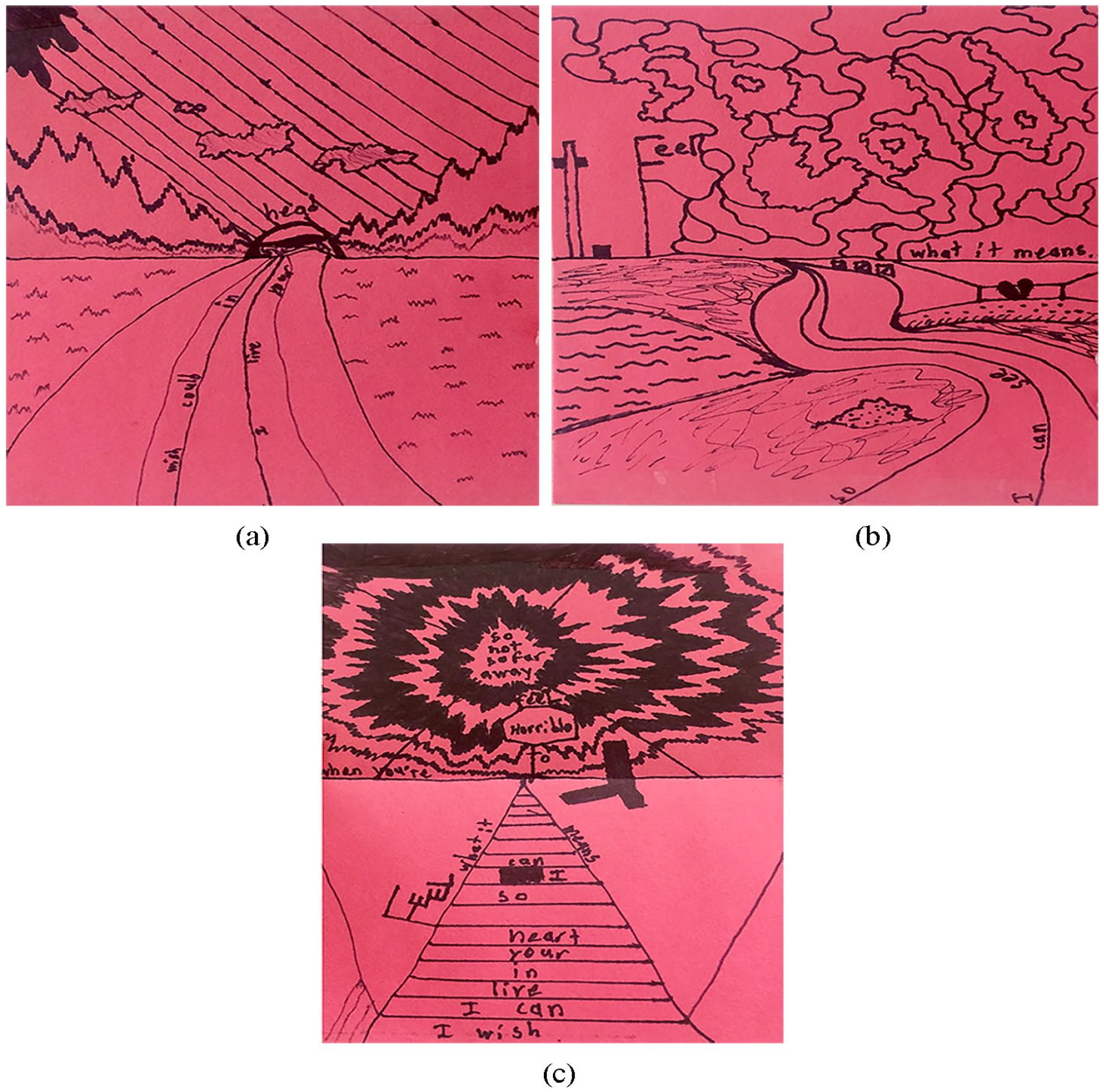
(a–c) Keen’s zine.
Similarly, Wrotted used art as a vehicle for communicating aspects of his life that were stressful to him. Wrotted created two zines. One depicted how he copes with the lack of personal space and the second targeted his fears and insecurities. On the zine titled ‘Fears and insecurities’, he drew a picture of an individual who is covering him/herself with a blanket (see Figure 3). On the next page, he wrote, ‘I’m scared to speak too scared to say the wrong thing. I’d prefer my voice to sound like static and to come out like smoke.’ He accompanied each of those lines with images that represent them. For example, he drew a television next to the phrase about his wanting his voice to sound static. He continued, ‘I’m not afraid of the big bad wolf. I’m more afraid of the ones who hunted him down.’ Other written expressions in Wrotted’s zine include ‘sometimes I wonder that if I spend all day in bed, it will eat me up’ and ‘I love blood and guts yet I’m afraid of love itself’. He followed that with ‘I don’t know why I am so scared of communication, but it can be quite suffocating.’ Wrotted concludes his zine with the sentiment, ‘Maybe if I hide long enough it’ll all go away the thought of it helps just a little.’
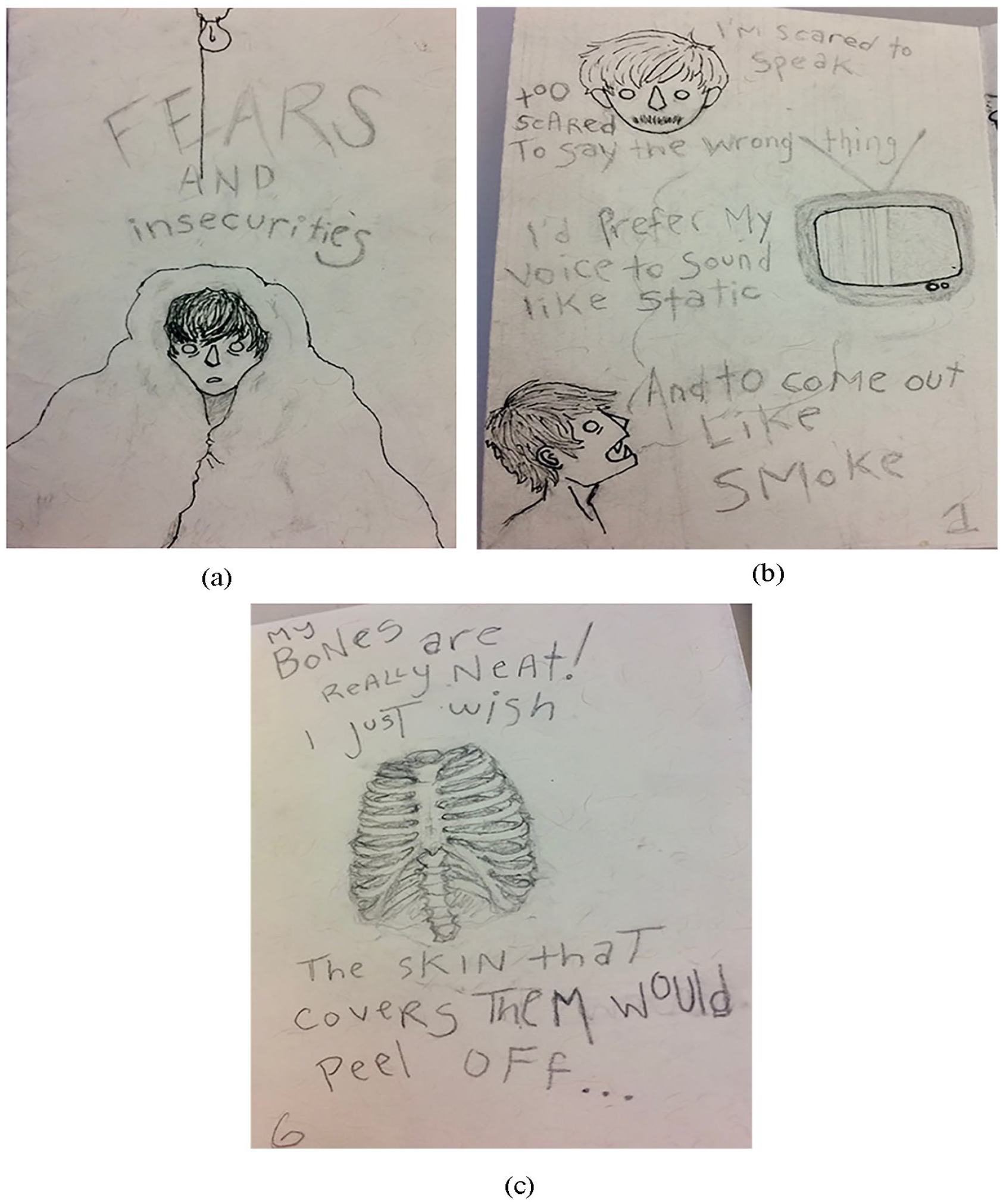
(a–c) Wrotted’s zine.
Through arts integration in the writers’ workshop, students found a space to address fears and insecurities. Through the process of transmediation, both Keen and Wrotted used visual representations of many of the written words in their zines, thereby connecting different sign systems to convey meaning in a powerful manner. The students used the arts as an outlet for exploring personal issues, intimate feelings and parts of who they were.
Arts integration fostered students’ exploration of disability identity
In their surveys, which were given to the students at the beginning of this study, none of the student participants mentioned their disability as part of their identity. However, after almost three weeks in the programme, the students started incorporating the theme of mental illness into their work. They started bringing their disability identity to the forefront of who they were and assigned it more importance.
Midway through the observations, the first author asked Jay, Hope and Happiness why they chose to include mental illness in their projects. This was the first time that students started incorporating mental illness into their work. During this exchange, Jay said that he identified with the theme of mental illness and shared, ‘I am still figuring it out’ (field notes, 27 March 2018). Happiness shared that she wanted to use the term ‘mental disorder’ instead of ‘mental disability’ (field notes, 27 March 2018), the term that she had previously used. In this way, Happiness was negotiating how she defined and identified with mental illness, as she resisted one label and accepted the other.
Hope’s response to the question was: ‘Well, I was the one who actually chose that theme because my whole life revolves around it, I have been going to therapy since forever, so it is only natural that I chose it’ (field notes, 27 March 2018). The theme of mental illness is clearly depicted in her collage (Figure 4), which features words and images cut out of an article describing the contemporary importance of Nelly Bly’s historic exposure of Blackwell’s Asylum. Further, she explained that the central message of her collage was to portray the social perception of mental illness; she expressed that she was bothered by the harsh treatment and negative view of disabled individuals both historically and today. As she noted, the collage was her way of contesting society’s view and treatment of mental illness.
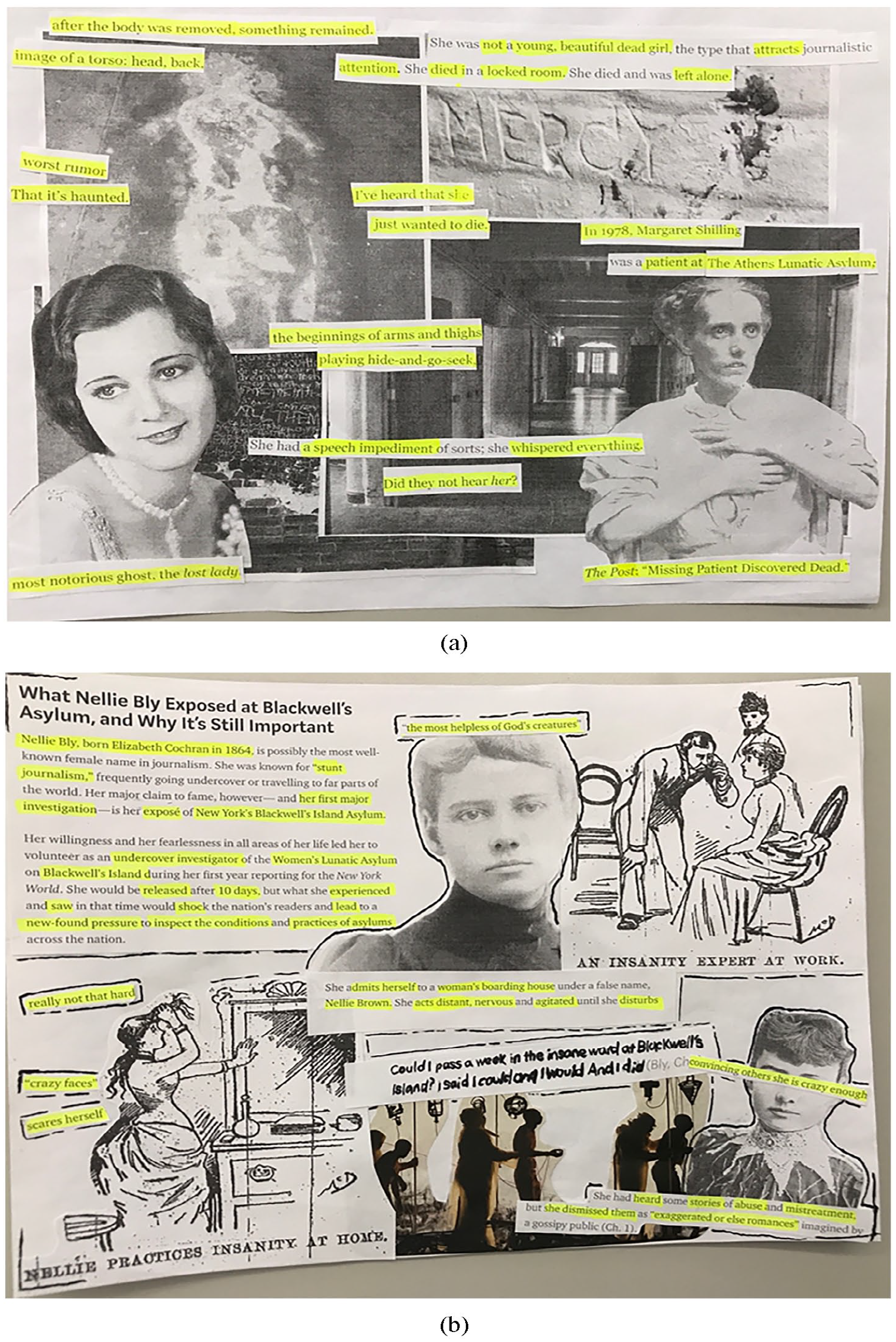
(a & b) Hope’s collage.
While Hope and Happiness chose to focus their work on mental illness, Jay used an intersectional approach to incorporating his disability identity. In his identity map, Jay chose to draw a goat symbol as a frame to give shape to his map, which he then divided into cubes. He chose a group of adjectives that represent him, like mental illness, trauma, adapted, funny, artistic, smart, different, spiritual, free, struggle, over-think and young (Figure 5).
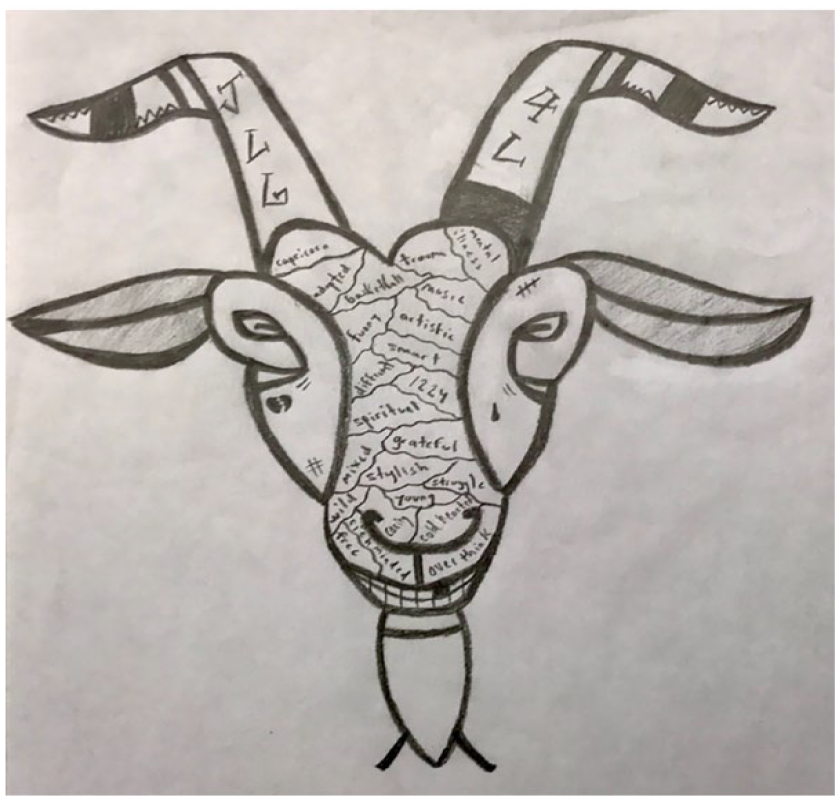
Jay’s identity map.
Comparing this identity map to Jay’s previous sense of self from the survey (where he did not mention his disability identity), Jay chose to represent a more complex view of how he saw himself.
Discussion
Educational systems often reinforce normative cultural and political discourses through a curriculum that ‘privileges certain cultural ways of knowing over others’ (Scott et al., 2015, pp. 140–141). This study illustrated how arts integration functioned as a tool for identity development. First, by encouraging the use of visual and artistic media such as screen prints, identity maps, collages and zines, the writers’ workshop expanded the ways in which students could make meaning and demonstrate their knowledge (i.e., forms of assessment), resisting the predominant place of verbal-written modalities in the language arts classroom and moving towards an artefact-oriented learning model like the one theorized by Peppler et al. (2023). These acts of transmediation transformed students from consumers to creators of knowledge. Second, arts integration opened spaces for students to critically engage with curricular content, specifically the topic of disability. Through the arts, the students ‘talked back’ in personal and meaningful ways to dominant views concerning the nature and perception of disability in general and disability identity in particular.
Student agency is the quality of self-reflective and intentional action and interaction (Biesta, 2008). As this study illustrated, arts integration nurtured agency in the students. Students in the writers’ workshop were proactive, reflective, critical thinkers, self-engaged and self-regulated. Hence, the students shifted their passive position in the classroom to an active one. This study confirms previous work by Mason et al. (2008), who concluded that the arts ‘provided both access to learning and opportunities for students [with disabilities] to express preferences and interests’ (p. 36). Similarly, in the present study, the student participants were able to make the art their own and communicated information about the material they explored along with who they are and how they view their world. This decision-making authority empowered the students to explore aspects of themselves, and it was their choice to develop and shape their findings according to their chosen direction.
In the writers’ workshop, arts integration provided a medium for the students to explore their disability identity status. The medical model assumes a deficit perspective which highlights what the students ‘lack’ and ignores what they have to offer. Students’ potential is restricted by the labels given to them as these labels impose an identity defined by the medical model which can contribute to their struggles (Gee, 2001). Such an imposed identity imprisons individuals within a frame that excludes and devalues their individual experiences and other aspects of who they are. In contrast, the writers’ workshop offered a safe space for students to question, resist and redefine medical labels assigned to them. Arts integration elevates the importance of the personal experience of the individual. Arts integration gave the students a platform to explore their individual experiences of disability and the freedom to embody and express their disability identity as they saw fit.
This is not to say that all students involved in this research chose to forefront their disability identity as most salient — or that they cannot construct an identity beyond their disability. Rather, these findings indicate that students were provided with an opportunity to consider how to integrate their disability identity into their overall sense of self. Additionally, the arts provided students with the agency to choose when and how they wanted to share this part of themselves. As noted in theme three, while Jay, Happiness and Hope each maintained disability as part of their respective identities, each student’s relationship to their disability identity was unique. While Hope placed disability as a salient identity, Jay reflected that he was still in the process of ‘figuring it out’, and the arts offered a vehicle for him to do so. These findings further the work of Dunn and Burcaw (2013), who noted that ‘finding personal meaning — searching for significance, engaging in sense-making and finding benefits associated with disability’ is a critical component of disability identity development, though disability identity does not necessarily supersede the other identities that a person may possess (p. 150).
The journey of self-discovery is one of the most important journeys an adolescent can take. In the context of this study, self-expression refers to students taking a personal vision and transmediating it into an external form, a process that requires a degree of self-awareness. Arts integration in the writers’ workshop class provided a prime opportunity for the students to start this process of self-expression. Such a process of self-awareness and expression helped in reimagining their identities in ways that challenged society’s negative perceptions of them as students with a ‘mental illness’ or ‘disability’. This process resonates with the integrative construction aspect of Monereo and Hermans’ (2023) Dialogical Self Theory. In the present study, the students’ process of identity construction through the arts allowed their previous and current identities to ‘interact with each other and . . . form new combinations that are more than the sum of its components’ (Monereo & Hermans, 2023, p. 447).
Interestingly, none of the participants initially self-identified as disabled, hence their disability identity was not embodied in their identity construction at the beginning of the writers’ workshop. The students’ omission of identifying themselves as ‘disabled‘ does not necessarily indicate a negative view of self per se. Rather, it could mean that these students looked at their disability as a ‘normal’ part of who they were and that it did not need to be highlighted in the survey. Their response to the survey was a matter of negotiation of what they chose to highlight. It could also mean that some students were in the process of naming this part of their identity. The freedom to choose how and when to identify is especially important for disabled students whose voices may have been silenced in the process of diagnosis-centred labeling and standardized instruction (Mason et al., 2008).
Limitations and future directions
Several contextual factors limited this case study. Multiple student absences during the period of the study and students dropping or joining the programme at any time made it difficult for the first author to collect data from all the students consistently. Accordingly, the author focused on 10 students who were the most consistent from the start of the study. Lastly, information regarding the student participants’ specific educational needs and disability diagnoses was either limited or unavailable due to privacy concerns.
This research study offers several possibilities for future iterations. The sample could be expanded to include more than one classroom in the same school. Researchers might also explore the integration of the arts into language arts classes in multiple schools. Yet another option would be to compare the students’ perspectives across multiple sets of class subjects in which the arts might be integrated, e.g., mathematics, social studies and science. Regarding research design, while this study employed a variable-centred approach, future research might consider using a qualitative person-centred approach or within-participants design to garner even greater individualized detail.
Conclusion
This study explored the perspectives of disabled students in an arts-integrated language arts classroom. Through transmediation, the students challenged preconceived notions of disability, literacies and structures of sign systems of knowledge. The integration of the arts nurtured agency in the students, provided an outlet for them to process stress and anxiety and afforded them a medium to explore their sense of self along with their disability identity. Most importantly, in their classroom at TechEd High School, Ms. Elisheba and Ms. Night created a model of arts integration that empowers an agentic educational setting and provides learners with a space to explore their respective identities.
Footnotes
Appendix 1
Appendix 2
Appendix 3
Supplementary Material
Please find the following supplemental material available below.
For Open Access articles published under a Creative Commons License, all supplemental material carries the same license as the article it is associated with.
For non-Open Access articles published, all supplemental material carries a non-exclusive license, and permission requests for re-use of supplemental material or any part of supplemental material shall be sent directly to the copyright owner as specified in the copyright notice associated with the article.
