







Abstract
The learning patterns model has been widely discussed in different European and Asian countries, but scarcely so in Latin America, let alone based on data from university students of native people. Our research focuses on which learning patterns appear and their relationship with certain associated factors. One hundred first-year university students from Southern Mexico participated. They answered a Spanish version of the Inventory of Learning patterns of Students (ILS). The results reported a four-learning-pattern structure: meaning-directed in action (MD/ac), passive-idealistic (PI), reproduction-directed (RD) and lack of regulation. As regards the associated factors, we found that an MD/ac pattern characterizes men with an exclusive dedication to their studies and positive significant relationships between age and academic performance. The PI pattern is related to male students with a partial dedication to their studies and older age. Thus, it is necessary to design personalized learning itineraries that take into consideration the learning patterns and the previous influence that many students have of certain personal and/or contextual factors that hinder their learning processes at university.
The analysis of learning processes from a student learning perspective has been constructed based on data from WEIRD communities (Henrich et al., 2010). It is, therefore, one of the many areas of study that require a wider diversification of the student samples to be analysed to understand and improve learning processes from a more global and inclusive view of educational psychology. Additionally, the analysis of the learning processes should consider each student’s endless personal features, which reveal individual differences concerning their learning motivations, conceptions and strategies. For that reason, many authors, at the end of the twentieth century, were already analysing these variables, but with little clarity about the directional links between them. It is Vermunt (1998), from the area of student learning, who proposes four clearly linked components in the explanation of learning processes: learning conceptions, learning orientations, processing and regulation strategies. In this field, the author proposes four learning patterns that arise from the combination of certain categories of each of these components. Likewise, in this integrating model, the author analysed the influence that certain personal and contextual factors have on learning patterns (Vermunt, 2005), and later, Vermunt and Donche (2017) call for the need for more studies in different contexts and populations to discuss the cross-cultural nature of learning patterns.
In this sense, reflecting this general background, we consider it necessary to extend the investigation of the learning patterns model to other cultural contexts, moreover, in underrepresented student populations in Latin America itself. Students from native peoples have unequal access to higher education, and their continuity indicators (extremely low) are a clear red flag (Villalobos et al., 2017). Thus, the purpose of this study was to analyse the learning patterns in a sample of Mexican university students of native people and the relationship of these patterns with certain personal and contextual factors at the beginning of university studies.
This is, therefore, a pioneering study that focuses on the analysis of a sample of students of Mexican native people in a situation of social exclusion but who have reached university and whose ways of learning are of clear interest for the understanding of socio-cultural differences in the study of learning processes. As such, the JSED editors' invitation to discuss data from less privileged groups is strongly supported (Bautista et al., 2023).
Learning patterns
Vermunt (1998) formulated an interesting model, based on learning patterns, which implicitly carries a conception of instability, adaptability and even modifiability. Thus, a learning pattern is defined on the basis of the specific interaction between four components, two from the framework of beliefs (learning conceptions and motivational orientations) and two from the perspective of actions (regulation and processing strategies) and their respective directional links. Likewise, it delimits the influence they can have on such components through specific personal and contextual factors (Vermunt, 2005).
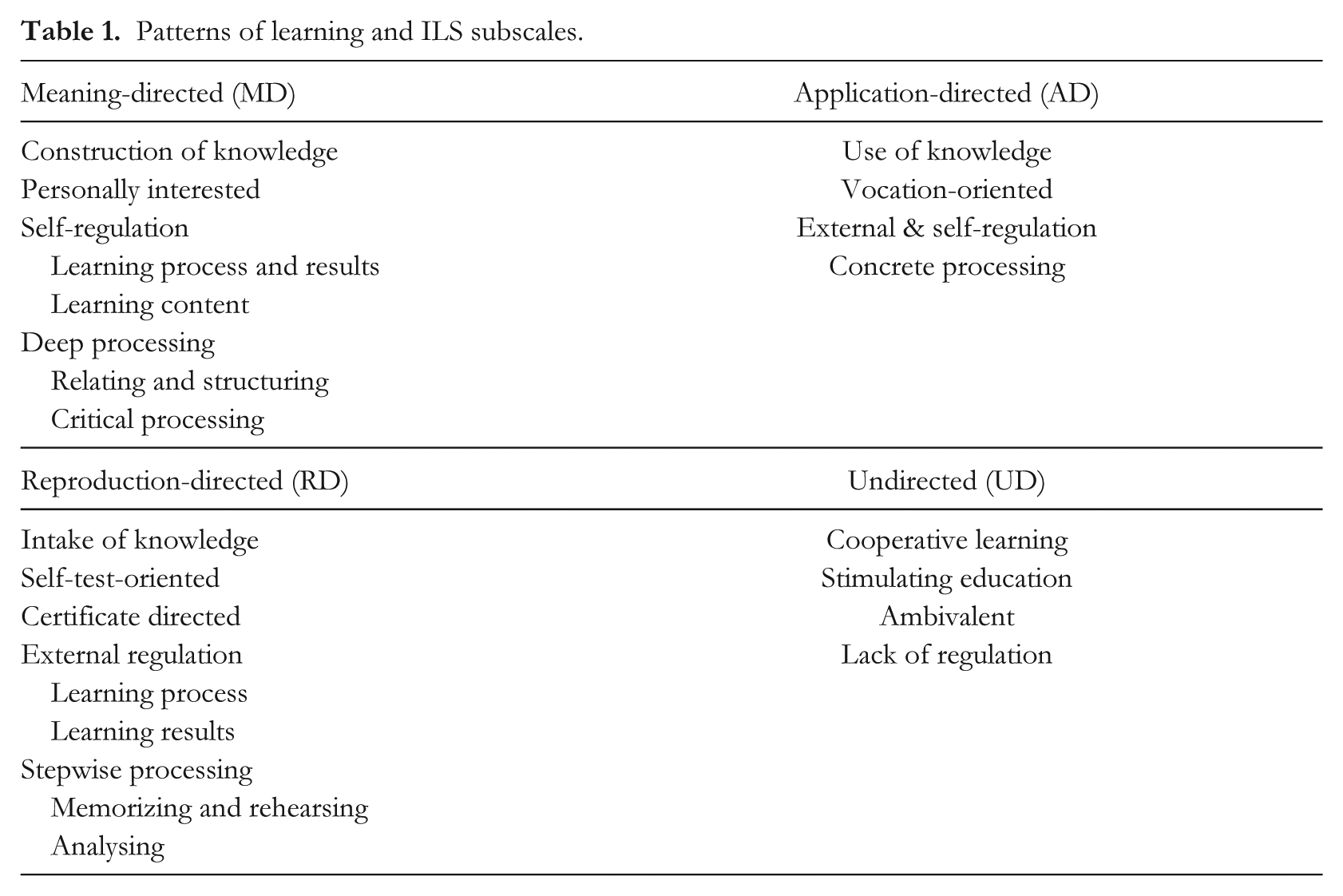
Vermunt (1998, 2020) formulated a model that allows the identification of learning patterns according to the students’ coherent position between their beliefs and their actions. He defined four learning patterns: (a) meaning-directed — MD — (based on construction of knowledge with personal interest, self-regulation and deep processing). This is the so-called meaningful and deep learning that characterizes people who reflect, question, ask questions and are passionate about learning; (b) reproduction-directed — RD — (based on intake of knowledge, self-test-oriented, certificate-directed, external regulation and stepwise processing). This pattern is seen in people who learn by rote, do not question and follow the voice of the teaching authority; (c) application-directed — AD — (based on use of knowledge, vocation-oriented, external and self-regulation and concrete processing). This pattern is typically associated with people who ask themselves, ‘What good is this to me?’, seeking the usefulness of the information being learned; and (d) undirected — UD — (based on cooperative learning, stimulating education, ambivalent orientation and lack of regulation), a pattern that characterizes people who have doubts, do not question, do not ask questions and are paralysed in the face of learning challenges (see Table 1). Additionally, to identify which learning pattern characterizes each student, Vermunt (1998, 2020) designed the Inventory of Learning patterns of Students (ILS). As has been mentioned, delving into the model led Vermunt to inquire on the influence that specific personal and contextual factors may have on learning (Vermunt, 2005). Therefore, and based on Vermunt (2005), we considered the following associated factors: age, gender, effort, dedication to study, perception of teaching and academic performance.
Patterns of learning and ILS subscales.
Learning patterns and associated factors
Vermunt (2005) publishes a pioneering study in which he analyses the relationship of learning patterns with certain personal and contextual factors. These factors are considered, and therefore, the studies that have taken them into account are reviewed in relation to the learning patterns.
Concerning age, several studies have related older students — with enriching educational experiences — to an MD learning pattern, albeit with certain relations to the RD, UD and AD patterns (García-Ravidá, 2017; Martínez-Fernández & García-Ravidá, 2012; Vermunt, 2005). Likewise, other authors have related younger students to a tendency towards the RD pattern (Beccaria et al., 2014).
Regarding gender, a positive relationship appears between male students and the RD learning pattern (García-Ravidá, 2017). Contrarily, Sadler-Smith and Tsang (1998) related men to a higher tendency towards deep learning (features of MD). In some studies, women show a higher score in beliefs and learning orientations (Martínez-Fernández & García-Ravidá, 2012) in cooperative conceptions (Vermunt, 2005) and external regulation (García-Ravidá, 2017). However, de la Barrera et al. (2010), in a sample of Argentinian students, reported that women showed a higher command of deep processing strategies and better academic performance than their male peers.
Regarding effort and dedication to study, Martínez-Fernández and García-Ravidá (2012) differentiate both concepts. Effort would be characterized by the subjects’ will to learn and better themselves, whereas dedication would refer to the amount of time the students use to carry out the learning activities. In a way, effort is defined as quality, while study time is defined as quantity. Nevertheless, no differences were found in these variables concerning the learning patterns in a sample of students of the Master’s Degree in Teacher Education (Martínez-Fernández & García-Ravidá, 2012). Phan (2009) found no relationship between effort and deep processing either. Other authors have pointed out that the bigger the effort and the dedication linked with the MD pattern (Loyens et al., 2008), the better the academic performance (López-Aguado & Gutiérrez-Provecho, 2014; Martínez-Fernández & Vermunt, 2015).
Concerning the perception of teaching, García-Ravidá (2017) found that effort is linked with the better assessment of teaching. Contrarily, other studies (Martínez-Fernández & García-Ravidá, 2012) yielded no significant relationship between the learning patterns and the perception of teaching. Even so, they considered that when teachers show commitment and they propose active learning, their students perceive them in a better way, while they also obtain a better academic performance (Shum et al., 2022). Likewise, Tynjälä (1999) reported a positive significant relationship between the conceptions of deep learning and a teaching practice that is active, dynamic and innovative. Moreover, other authors (Shum et al., 2022) have explained that students unsatisfied with the teaching quality usually show a worse performance and a superficial approach.
As regards the relationship between the learning patterns and the academic performance, some authors have related a good academic performance to deep strategies (Ruffing et al., 2015; Shum et al., 2022), to a higher dedication to study (Donche et al., 2013; Martínez-Fernández & Vermunt, 2015), as well as to an MD pattern (Loyens et al., 2008; Phan, 2009; Vermunt, 2005). Somewhat surprising are the results reported by Vanthournout et al. (2012), since they established a relationship between deep learning, external regulation (featured in the RD pattern) and academic performance, results also sustained by Martínez-Fernández and Vermunt (2015) and recently by Shum et al. (2022). On the other hand, some authors found a relationship between a low academic performance, superficial learning processing and the lack of regulation (featured in the UD pattern) (Donche et al., 2014; Vanthournout et al., 2012). In sum, it seems clear that research on learning patterns continues to need in-depth analysis from different contextual viewpoints and at different points in the academic trajectory in a similar way to learning as an epistemic activity (Richter & Tiffin-Richards, 2024).
Learning patterns from an international viewpoint
Vermunt’s (1998) model has been validated over the years in different samples of university students from diverse territories. Generally, the four learning patterns can be identified, but with certain nuances apparently due to aspects of the context (Ciraso-Calí, 2023; Vermunt & Donche, 2017).
Likewise, the analysis of the learning patterns — through the ILS — also expanded to other territories (Marambe et al., 2012), such as Australia, China, Indonesia, Sri Lanka and Turkey, among others. The authors conducted a meta-analysis on these studies, and they reported the identification of four patterns, albeit with nuances such as the following:
- a meaning-directed pattern with some components of the reproductive pattern (external regulation and analysis);
- a reproduction-directed pattern combined with the application-directed one (vocational orientation);
- a pattern called passive-idealistic, characterized by grouping all the learning conceptions;
- an undirected pattern.
This way, and despite the distances and the specificities of each sample, in the studies mentioned above, we should note the importance of identifying a four-learning-pattern structure. Although this characteristic strengthens the model internationally, the patterns are not always grouped in compliance with the congruence between beliefs and actions posed by Vermunt (1998). Therefore, in most cases, three of the patterns were reported (MD, RD and UD), and in some studies, either one type of pattern appeared grouping all the conceptions (passive-idealistic, PI) (Ajisuksmo & Vermunt, 1999; Shum et al., 2022; Vega-Martínez et al., 2023) or else a pattern grouping the motivational orientations (passive-motivational, PM) (Marambe et al., 2012; Martínez-Fernández et al., 2019). Both patterns, though, seem to be more related to high school students. Additionally, they identified a pattern resulting from the combination of the meaning-directed and application-directed patterns, which Donche and Van Petegem (2009) called flexible, or patterns resulting from the combination of strategies (action component) (Dinsmore & Fryer, 2018; Fryer & Vermunt, 2018).
However, research on learning patterns of Spanish and Latin American students is still scarce. Although, since 2010 and the adaptation of the instrument by Martínez-Fernández et al. (2009), the number of studies analysing the model has been growing, and they are reporting data on learning patterns in these territories. Accordingly, recent studies indicate that Latin American undergraduates resemble their European peers on the one hand and their Asian peers on the other (Shum et al., 2024). Therefore, they identify MD patterns related to high performance, but also academic success related to the RD pattern. At the same time, they identify specific nuances that point to a third aspect in which successful students show an MD pattern but with predominance of external regulation strategies (Caizapanta Suárez, 2023; de la Barrera et al., 2010; García-Béjar et al., 2023; García-Ravidá, 2017; González & Difabio de Anglat, 2016; Martínez-Fernández & García-Ravidá, 2012; Martínez-Fernández & Vermunt, 2015; Martínez-Fernández et al., 2019; Vega-Martínez et al., 2023). Concerning these results, Martínez-Fernández and Vermunt (2015) express the existence of a paradoxical impact of external regulation strategies on the activation of self-regulation, thus creating the Latin American and Spanish Paradox (p. 283). In some cases, the AD pattern has been identified as the dominant pattern (Alves de Lima et al., 2006).
Finally, in the last 20 years, Vermunt has conducted two revisions of his model in which he analysed the internal consistency of the instrument used (ILS) (Vermunt & Vermetten, 2004) and the international impact of the theoretical model of the learning patterns (Vermunt & Donche, 2017). However, we should note that, in the second revision, he reported only two studies with samples from Ibero-American students (e.g., Cano & García Berbén, 2014; Martínez-Fernández & Vermunt, 2015). Although we are aware of the existence of some research carried out in Latin America and Spain, which has used the Spanish version of the ILS, it is little known in the international field of studies on the student learning approach with samples from this territory (e.g., Alves de Lima et al., 2006; Caizapanta Suárez, 2023; Gaeta González et al., 2020; González & Difabio de Anglat, 2016; Martínez-Fernández & García-Ravidá, 2012; Martínez-Fernández et al., 2019). Thus, based on the reviewed background, three issues are considered, that: (1) previous studies point to the relationship of certain factors with learning patterns; (2) such learning patterns influence academic performance; and (3) studies with Latin American students are scarce. We suggest the analysis of learning patterns and associated factors in a sample of native Mexican students.
Thus, the aim is to contribute to a more inclusive, global and integrated view of the learning processes at university by contemplating data from people coming from little explored territories. In this sense, the following questions were suggested.
Research questions
What learning patterns were identified in a sample of Mexican undergraduates of native people?
What is the relationship between the associated factors and the learning patterns identified?
Method
Participants
One hundred students (33.7% of the total students in their first academic year) from native people participated in the study. The sampling was intentional and was based on a group of students starting college and attending tutoring sessions for their adjustment in the transition to higher education. They are students of the educational sciences degree of the Universidad Autónoma de Chiapas (México) (Total of students = 297). This sample (N = 100) was made up of 14 men and 86 women with a mean age of 20.6 years (SD = 1.45; range = 19–26 years). Of the total number of participants, the majority are dedicated exclusively to study (72%).
Generally, these students have a low socio-economic level, with poorly educated parents who work in agriculture or small companies. In total, the participants attended public schools, and many were the first university students in their families. Likewise, due to their financial situation, some of the participants worked occasionally, part-time and in activities with little remuneration to aid their expenses, since many need to move away from their towns to the city. Therefore, we are aware of the significant effort it means for many students and their families to go to university. In line with Kyndt et al. (2017), the students face substantial challenges in crafting their professional future. As regards their expectations of the degree, most base their choice on the possibility of achieving a position as an elementary education teacher that will guarantee their future career, which will help them improve their quality of life and that of their families. However, this is a group of university students who have had few enriching academic experiences, given their socioeconomic status, and this is a handicap but at the same time a strength to face university studies (Montané et al., 2019).
We should note that Chiapas is historically one of the Mexican states with the highest indexes of poverty, illiteracy and school tardiness, especially in rural areas with a scattered population, most of them native people. Undoubtedly, these socio-economic and cultural conditions are present in the students participating in this study, who can consider themselves successful for reaching higher education.
Instruments
Socio-demographic data sheet
The first instrument administered was a sheet of socio-demographic data, which enquires about a series of personal and contextual variables, the so-called associated factors: age, gender, effort (assessment of 0–10), dedication to study (shared with work, family or other activities, or exclusive dedication), perception of teaching (score of 0–10) and mean grade (0–10).
Inventory of Learning patterns of Students (ILS)
To identify the learning patterns, we used a Spanish version of the ILS prepared by a group of researchers from Argentina, Colombia, Mexico, Spain and Venezuela (Martínez-Fernández et al., 2009). This translation and adaptation took place through expert judgement using focus groups. Therefore, an adaptation was discussed, in person and through video conference, to guarantee content validity (Martínez-Fernández & Vermunt, 2015). In this study, we use the 2009 version, which we know was widely discussed to give meaning and coherence to the 120 items of the instrument in the different countries of Ibero-America. In the translation and adaptation study, the authors report the back translation of the items, the focus groups between researchers from different Latin American countries to reach agreements and the pilot tests to check the comprehension of the items. A version of the ILS (Martínez-Fernández et al., 2009) that has been widely used since 2009, reporting clear evidence of reliability and validity.
The instrument consists of 120 statements that enquire about the activities, the strategies and the motives to study. These statements define the four components of the learning patterns described above, and they are presented in two parts (A and B). Part A, with a total of 55 items, assesses the components of processing (27 items) and regulation strategies (28 items), and it is answered following a Likert scale from (1) ‘I rarely or never do it’ to (5) ‘I always do it’. Part B, with a total of 65 items, identifies the components of learning conceptions (40 items) and motivational orientation (25 items), and it is answered following a Likert scale from (1) ‘completely disagree’ to (5) ‘completely agree’ (see Table 2).
ILS: examples of items according to the components.
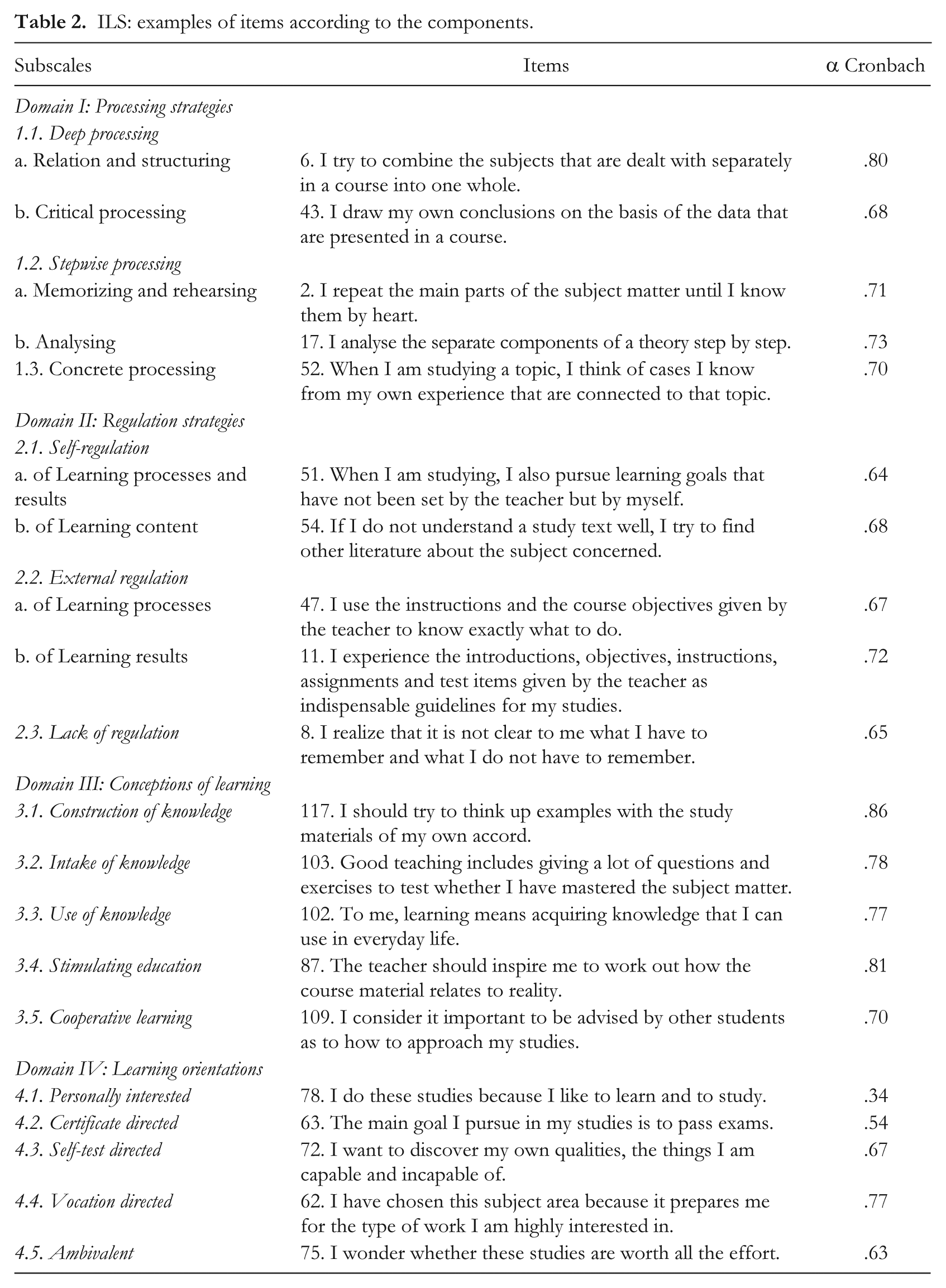
In order to identify the learning patterns, we calculated a Cronbach's alpha reliability index for each of the ILS subscales according to Vermunt’s theoretical model. Subsequently, we conducted a factor analysis. Thus, 16 of the 20 subscales present reliability indices, which, based on previous studies using the ILS, we can consider adequate (α > .65) (Ciraso-Calí, 2023; Vermunt et al., 2014). In three other subscales, very tight coefficients were obtained (α > .50), and one of them, the personal interest subscale, presented an inadequate index (α = .34). Similar data to those reported in previous studies, in various territories, analysing the learning patterns model (García-Ravidá, 2017; Marambe et al., 2012; Martínez-Fernández & García-Ravidá, 2012; Martínez-Fernández & Vermunt, 2015). For that reason, we decided to remove the personal interest subscale from the rest of the analyses of the current sample.
Procedure
In an early stage, we managed the corresponding permits and ethical issues inside the university, and we guaranteed the confidentiality of the information provided by the subjects. In addition, at the beginning of data collection, the objectives of the study were explained to the participants and the confidentiality of the information was guaranteed. There were no questions, and all students agreed to respond to the socio-demographic information and the ILS. We proceeded to apply the instruments during one school hour in the first-year classrooms/groups. Students were instructed to read the socio-demographic data sheet, answer it and then the ILS. The possibility of clarifying doubts was offered. There were no questions, and all participants responded at the same time, on the same day and in the same room. Once we had collected the data, we moved on to analysing the results obtained.
Statistical analysis
We analysed the results through the SPSS statistic software, version 20.0. To identify learning patterns — the first research question — we conducted reliability index analysis and exploratory factor analysis. The choice of this technique is justified because it is the one employed in all previous studies analysing this model. Thus, we have ensured the possibility of comparative analyses. Regarding the second question, we considered that the most appropriate way of analysis was multivariate analysis (MANOVA), because of its robust criterion in the analysis of differences from a criterion variable (the factors) and Pearson's correlation analysis between the identified learning patterns and the associated factors measured on a continuous scale.
Results
Learning patterns
To answer the first research question on the patterns identified in the sample, we conducted an exploratory factor analysis where we identified a four-factor structure (see Table 3) with an adequate fit (KMO = .82; χ² Bartlett = 1,152.78; p < .01).
Factor loadings of ILS scales in a four-factor Oblimin solution for the whole sample (N = 100) (principal component analysis; loadings > −.30 and < .30 omitted). Means and standard deviations for each subscale.
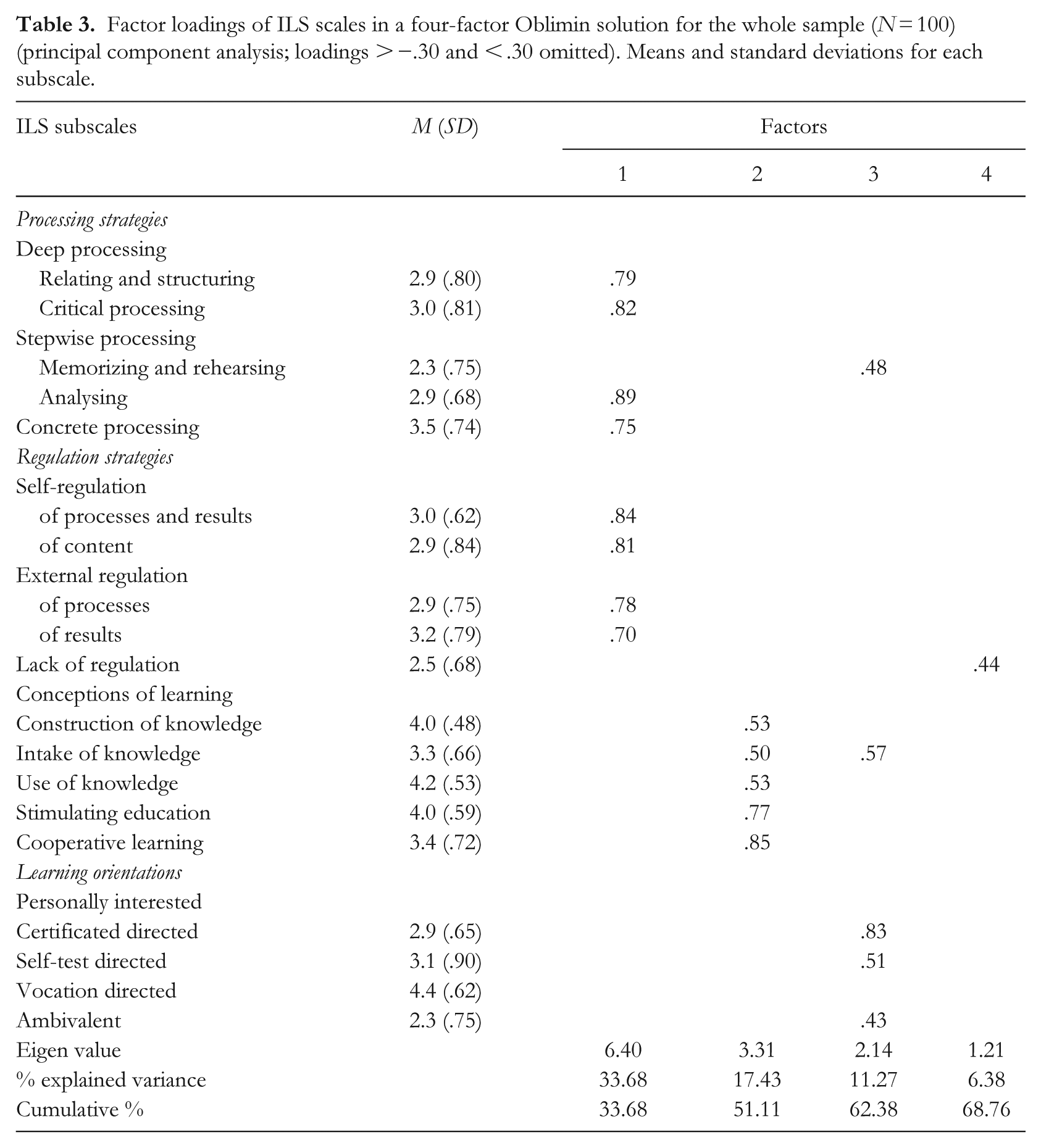
The first factor (α = .92) grouped the following subscales: deep processing, analysis and concrete processing, along with the external regulation and self-regulation strategies. We defined this pattern characterized by strategies, without the corresponding learning beliefs, as a meaning-directed learning pattern in action (MD/ac). The second factor (α = .85) was built exclusively from the learning conceptions, that is, learning construction, use of knowledge, teacher as stimulus and cooperative learning. For that reason, we named it passive-idealistic pattern (PI). The third factor (α = .66) yielded saturations in step-by-step processing strategies, motivational orientation (towards certificates, self-assessment and ambivalent) and the increase of knowledge as a conception of learning. This pattern is very similar to the reproduction-directed learning pattern (RD) defined by Vermunt (1998). We found the fourth factor (α = .65) only with the lack of regulation subscale: lack of regulation (lr).
The factors obtained report adequate reliability indices. As regards factors 1 (MD/ac) and 2 (PI), we can state that they are robust indices. However, for factors 3 (RD) and 4 (lr), the least desirable, the indices are tighter.
Relationship between the learning patterns and certain associated factors
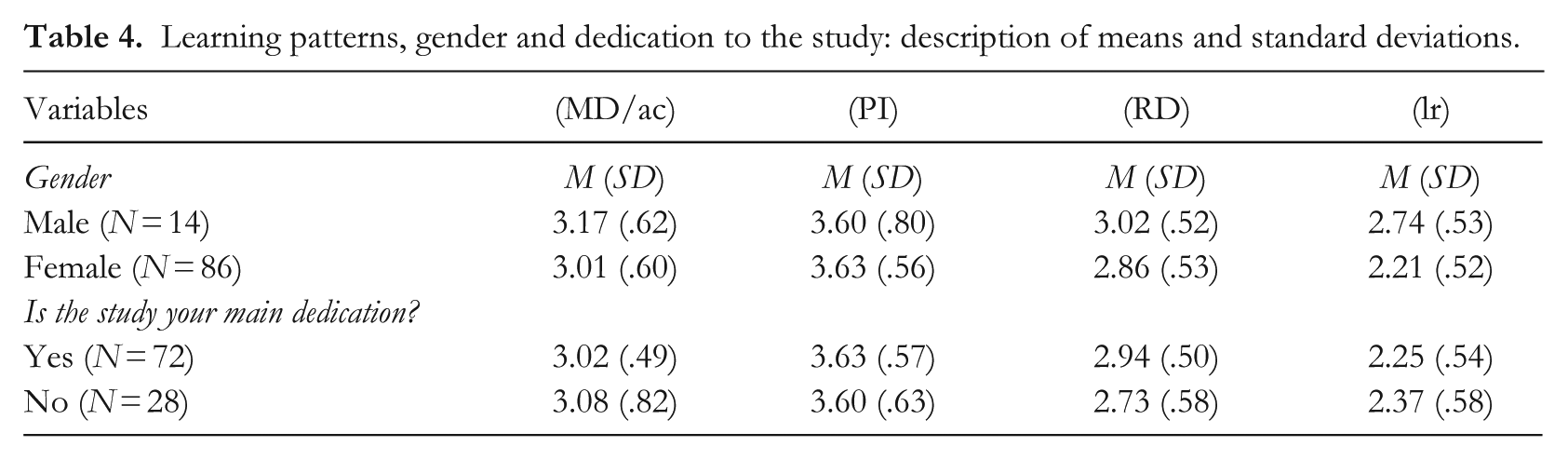
To answer the question about the relationship between certain associated factors and the learning patterns identified previously, we conducted statistical analyses according to the type of measurement of the variables. Therefore, in the case of categorical variables (gender and dedication to study) — and to analyse the differences in the scores of each learning pattern — we obtained the descriptive data, and we conducted a 2 × 2 MANOVA analysis (gender × dedication to study) (see Tables 4 and 5).
Learning patterns, gender and dedication to the study: description of means and standard deviations.
Learning patterns, gender and dedication to the study: mean differences (MANOVA).
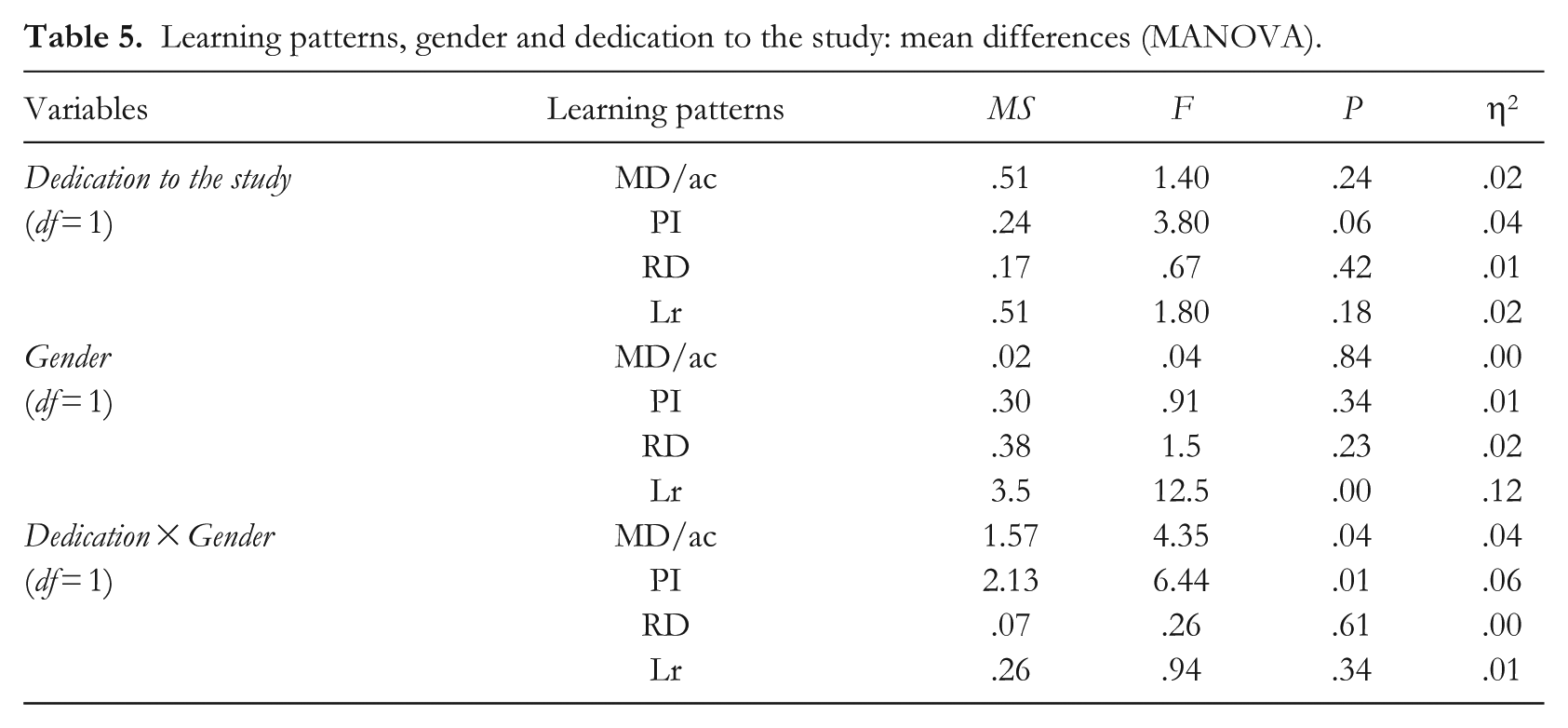
Accordingly, we found significant differences with respect to gender (F = 3.35; p = .01; η2 = .13). Male students scored higher in the lr pattern (M = 2.74). Regarding the intersection between learning patterns, gender and dedication to study, we report significant differences (F = 4.35; p = .04; η2 = .04) in favour of men with exclusive dedication in the MD/ac pattern (M = 3.09), as well as in male students combining their studies with other activities (M = 3.60) in the PI pattern (F = 6.44; p = .01; η2 = .06). We should note that we found no significant differences in the RD pattern.
To analyse the relationships between the learning patterns and the rest of the associated factors/quantitative variables (perception of teaching, age, effort and academic performance), we conducted Pearson’s correlation analysis (see Table 6).
Learning patterns, teaching perception, age, effort and GPA: Pearson correlations.
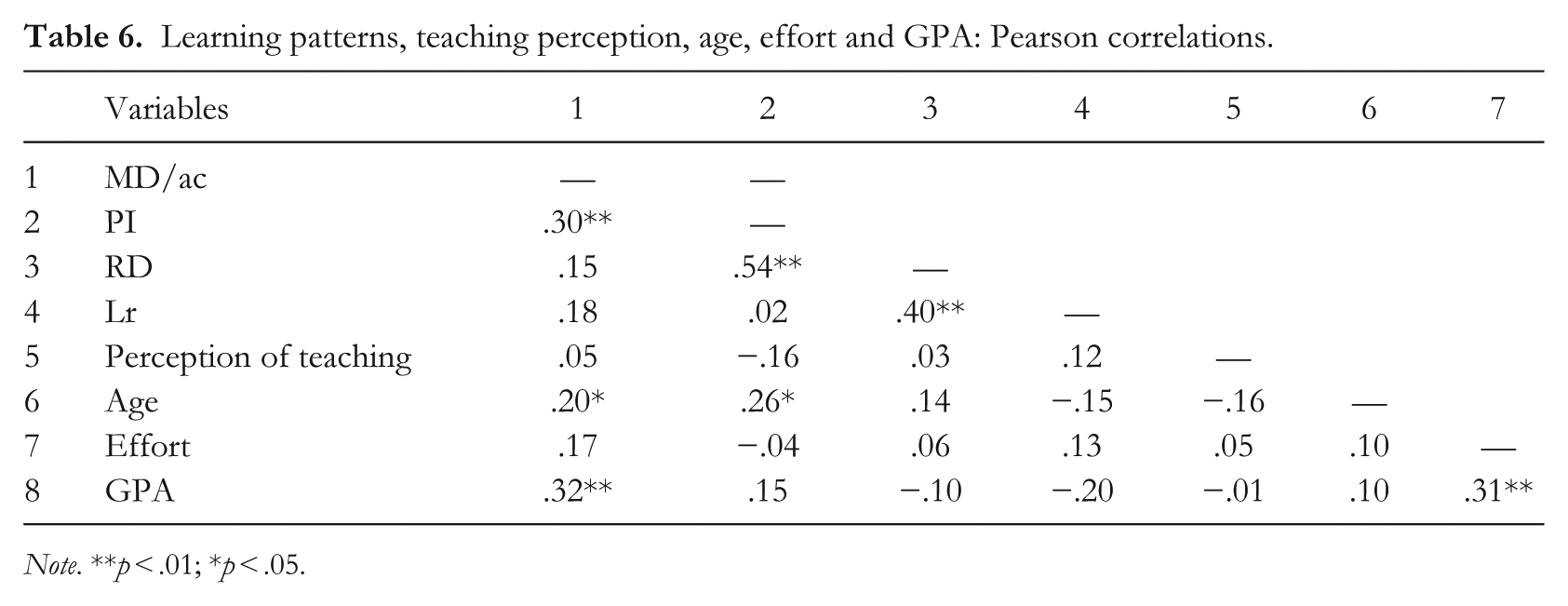
Note. **p < .01; *p < .05.
The results show a positive significant relationship between the MD/ac pattern, age (r = .20; p = .04) and academic performance (r = .32; p < .01). The PI pattern is related to age in a positive significant manner (r = .26; p = .01). The scores in the RD and lr patterns show no significant relationships with any of the factors mentioned. Likewise, we found a positive significant relationship between effort and academic performance (r = .31; p < .01).
Discussion and conclusions
In this study, we proposed the identification of learning patterns and their relationship with certain associated factors in a sample of Mexican university students of native origin. This objective points to the discussion of Vermunt’s (1998, 2020) model in a population underrepresented in previous studies with this line of research.
Regarding the first research question, we identified four learning patterns following Vermunt’s (1998) model. However, and although the patterns have been constructed from the same subscales, these show different configurations, as reported by some authors who discuss the model using data from Latin American students (Hederich-Martínez & Camargo-Uribe, 2019). Therefore, we have described the following patterns:
- two patterns like the original model for university students (MD/ac and RD);
- one pattern that is more similar to secondary education students (PI) — but similar to the results of other studies analysing samples of university students (Ajisuksmo & Vermunt, 1999; Vega-Martínez et al., 2023);
- a fourth pattern consisting of the isolated lack of regulation (lr), a characteristic featured in the undirected pattern (UD).
Therefore, we called the first learning pattern meaning-directed in action because this pattern’s characteristic is that it has been constructed from the combination of processing and regulation strategies, without the corresponding presence of beliefs and motives to learn. This fact has already appeared in other studies that use samples of Latin American students (García-Béjar et al., 2023; García-Ravidá, 2017; Martínez-Fernández, 2019; Martínez-Fernández & Vermunt, 2015; Vega-Martínez, 2022) or in other studies with Asian students (Marambe et al., 2012). A type of pattern, based on strategies, which requires more attention in relation to its configuration and stability, or not, since it lacks a specific relation to learning beliefs (Dinsmore & Fryer, 2018; Fryer & Vermunt, 2018; Richter & Tiffin-Richards, 2024; Vermunt, 2020). An appropriate approach to study, but in terms of action — perhaps survival at university? In that sense, such a weak connection to the belief framework raises the need for more academic work towards awareness of the meaning of learning processes, in the way of Richter and Tiffin-Richards’ (2024) study’.
As for the second pattern identified, the passive-idealistic (PI), we find it in students who are not only mainly epistemic, but these beliefs are unrelated to specific actions or strategies (similar to García-Béjar et al., 2023, and Martínez-Fernández et al., 2019, in Mexican and Colombian students, respectively). As mentioned above, this characteristic — which we usually find in secondary education students — may be adequate in these first-year undergraduates, since it is a transition moment that may paralyse actions. This leads us to think that they have yet to finish the perception and adaption to all the situations occurring during the transition and its demands. However, they are activating several conceptions of learning, which can be considered an adaptive reaction (Martínez-Fernández, 2019), a counterapproach to the first one based on action. In this case, it is a pattern that idealizes but has little connection with their learning strategies. A pattern associated with younger people that seems curious in this sample of students of native people. Perhaps these students are in an evolutionary and contextual moment that demands commitment and responsibility in the face of a challenge that paralyses them (university). Therefore, they require greater and more effective support from their tutors (from external regulation) to encourage and guide them towards self-regulation from a clear vision of self-efficacy. Undoubtedly, this is a challenge for teachers and for the design of educational interventions that must address individual differences, and in this regard, those rooted in culture.
The reproduction-directed pattern (RD) is the third we identified and the most like the original model. It is usually characteristic of younger and first-year students (Beccaria et al., 2014). However, it is a type of approach to learning processes that is unsuitable for university students. In this sense, students must overcome the superficial conception of learning that encourages memorization and external regulation. Therefore, educational intervention should be oriented to the promotion of a constructive conception of learning, with intrinsic and self-regulated orientation.
The fourth pattern, which shows isolation of the lack of regulation subscale (lr), is not reported in previous studies. This feature may be distinctive in these students of Mexican native people and a high rural component when faced with a university and urban context that destabilizes them. This is undoubtedly an interesting finding that may indicate the presence of certain levels of academic stress (Vega-Martínez et al., 2023) or shortcomings in emotional management (Ahmedi & Martínez-Fernández, 2023) that need to be addressed. In short, a type of profile characterized by students who do not have clarity about learning objectives, who manifest problems in processing large amounts of information and who do not even know what to do in the face of learning difficulties (Vermunt, 1998).
Based on all the above, we consider that Vermunt’s (1998) model presents a factor structure and some highly interesting directional links applied internationally. However, it seems clear that the range of patterns is wider than the four identified initially (MD, RD, AD and UD). Moreover, although it is true that this highlighted the role of certain personal and contextual factors (Vermunt, 2005), it is still necessary to conduct a deep reflection, contextualization and theorizing on how and why certain patterns appear (in line with Hederich-Martínez & Camargo-Uribe, 2019).
In the case of this sample, and considering the cultural dimension of Latin America, it could be argued that family relationships, cultural heritage and even citizen security problems cause the students from these territories to require, need and learn high doses of external regulation, in every sense (Martínez-Fernández et al., 2019). Therefore, we have identified a meaning-directed (MD) pattern with external regulation or a PI pattern that groups a set of beliefs, desires and motives without a clear correspondence to the strategies or actions because they depend on the learning context, the other (family, colleagues, friends) significant ones and maybe even luck (similar to Caizapanta Suárez, 2023; Martínez-Fernández et al., 2019; Shum et al., 2022). In this sense, we do have profound differences in dominant learning patterns at the beginning of college as a function of socioeconomic status (De Clercq et al., 2021). Undoubtedly, this is an interesting area of development in the psychology of education: the learning patterns at the beginning of college, because there is still much to contribute to the comprehension, follow-up and ‘modification’ of the learning processes from a theoretical, methodological, cross-cultural and applied point of view. We need a type of scientific research that is much more global and inclusive in understanding learning patterns.
As regards the second question on the relationship between the learning patterns and certain associated factors, the results indicate that the scores of the students in the MD/ac pattern related to a greater age and better GPA, in agreement with other authors (García-Ravidá, 2017; Martínez-Fernández & García-Ravidá, 2012; Shum et al., 2022; Ruffing et al., 2015; Vermunt, 2005). This significant positive relationship of the MD pattern with GPA is interesting, since it indicates that in less advantaged socio-economic groups, the orientation to meaningful learning also makes a difference. In this sense, a clear sign of positive resilience from the type of approach to learning. So, the socio-economic vulnerability of students (Montané et al., 2019) can be overcome by an appropriate approach to learning. In this sense, the identification of learning patterns and their associated factors, at the beginning of college, are presented as a relevant diagnosis to promote the continuity of studies of these vulnerable groups and contribute to the reduction of the equality gap described in the Latin American context (Villalobos et al., 2017).
Regarding associated factors, we have noted significant differences in this pattern in favour of the male students with an exclusive dedication to their studies (Loyens et al., 2008; Phan, 2009; Sadler-Smith & Tsang, 1998). However, the men who combine their studies with other activities obtain higher scores in the PI pattern (more passive), contrary to what was initially reported by Sadler-Smith and Tsang (1998), who linked men with higher scores in the MD pattern. Likewise, unlike expected, this PI pattern also related to older students. Finally, the lr pattern also seems to predominate in male students. Thus, it seems that there is no clear relationship between gender and learning patterns; rather, it is a more complex issue involving a variety of personal and cultural factors.
Although the results reported come from a small sample of undergraduates mostly of native people in Southern Mexico, they reveal three key aspects to consider. The need exists to continue discussing Vermunt's theoretical and instrumental model based on data obtained with university students outside Europe, such as in Latin America. In this sense, the habits and reasoning rooted in the culture can determine certain conceptions that define the nuances found in the learning patterns. Consequently, in a global world, we need to comprehend better the individual and cultural differences to favour learning in mobility situations and in order to develop a more inclusive educational psychology comprehension of the learning processes (Bautista et al., 2023; Henrich et al., 2010). For example, expecting a clear self-regulated action from university students, and that a large part of them depend on external regulation, seems to generate frictions in the teaching action. Thus, the design of learning activities should consider, at least, these different forms of regulation (self-, external- and lack of) for a person-adjusted approach.
The second aspect, about methodology, relates to the need to review the personal interest subscale since several studies have shown its low reliability, especially in Latin America. In addition, evidence of the validity of Vermunt's model invites us to improve the reliability of the subscales from a cross-cultural adaptation (In line with Ciraso-Calí, 2023). This involves a more in-depth review of the items used and the use of other methodological approaches such as interviews and systematic observation.
Finally, the third aspect regards the fact that these are first-year students mostly of Mexican native people and they are, therefore, in a transition stage that may account for passive or a lack of regulation patterns, all of it on top of a context of significant academic, economic and family challenges. In this sense, it is very necessary that we delve into studies that analyse multiple factors in the explanation of learning processes and academic performance (De Clercq et al., 2021; Montané et al., 2019). Thus, understanding the different factors that shape academic transitions analysed in conjunction with learning patterns undoubtedly provides us with a clear diagnosis of individual differences. Based on this type of information, we consider that educational action should be oriented to the design of personalized learning itineraries. That is, starting from this knowledge, beliefs and previous strategies to ‘accompany’ in the promotion of a more self-regulated, intrinsic and reflective learning action.
In conclusion, four considerations stem from this research as regards the current situation of the learning patterns model in Latin America and its future perspectives.
This model provides clear evidence of reliability and cross-cultural validity for the identification of learning patterns. In addition, it indicates the impact that each type of pattern has on academic performance. Therefore, it is a very interesting source of diagnostic information for intervention.
However, the first consideration is that future studies should delve into the reasons that account for the different combinations between the subscales and the educational implications they entail. The second consideration regards the need to review the conceptual adaptation of the personal interest subscale to improve cultural comprehension. Explicitly, in the Latin American context, defining an intrinsic motivational orientation from the pleasure of studying (item 69) does not seem to be a belief related to interest. We should instead consider studying as a personal challenge. The third consideration concerns the need to increase joint research among Spanish-speaking researchers, thus fostering the dissemination of the results in English through high-impact journals. This may be one of the great tasks for behavioural sciences researchers in Latin America. More inclusive, global science is required, one that looks to diverse contexts. Learning and teaching models should be discussed from several diverse realities. The fourth and last consideration involves the need to carry out confirmatory, structural and regression analyses of both the ILS questionnaire and its subscales, as well as the associated variables. Likewise, we need longitudinal studies to report on what changes take place and when in academic life. Likewise, the area of study of learning patterns should be enriched with mixed method approaches that include interviews, observations and qualitative data collection that provide a richer understanding of learning processes.
Finally, we strongly agree with the role of personal and contextual factors in the analysis of learning patterns (Vermunt, 2005). Also, the need to analyse more deeply the frictions (Kyndt et al., 2017) at the beginning of university and even more so in contexts with high dependence on external regulation (Shum et al., 2024).