






Abstract
This study examines the relationship between maternal self-esteem and children’s reading time, mediated sequentially by maternal educational involvement and children’s academic stress. Using a large (N = 1,190) sample of Korean sixth-grade elementary students, Mage = 12.23 years, from the thirteenth wave of the Panel Study on Korean Children (2020), this study conducted a mediation analysis. The findings indicate that higher maternal self-esteem is associated with greater maternal educational involvement, which is in turn related to lower levels of children’s academic stress and linked to increased reading time. These patterns are notable in the context of sixth-grade students—the final year of elementary school in Korea—where parental involvement may still be perceived as encouraging rather than controlling. The data were collected during the COVID-19 pandemic, a period in which home-based support may have been salient due to the combination of in-person and remote learning. These associations remained significant after controlling for mother’s employment status, mother’s education, children’s gender and household income. These insights contribute to a deeper understanding of how to foster a positive reading environment for children.
Introduction
Reading plays a crucial role in helping children understand themselves and the broader world while developing critical thinking skills. It fosters deep immersion in texts, enabling the acquisition of vocabulary and background knowledge, which serve as the foundation for all learning. Specifically, studies highlight the academic benefits of reading time; for instance, Locher and Pfost (2020) found a moderate correlation between reading time and reading comprehension in middle childhood, and McHale et al. (2001) demonstrated that time spent on reading can significantly predict better school grades in early adolescence. Beyond academics, reading also contributes to broader developmental outcomes. For example, sufficient reading time during the transition to adolescence has been linked to enhanced self-concept development and career maturity (Park, 2022), and a positive correlation has been observed between early adolescents’ reading time and the volume of brain areas related to cognitive control and executive function (Li et al., 2024).
Despite its recognized benefits, reading is often deprioritized in Korea due to the education system’s emphasis on test-related learning. This phenomenon is deeply intertwined with the paramount importance placed on college entrance examinations. Korea has frequently been highlighted for its pervasive investment in education and intense academic competition (Hannum et al., 2019). Indeed, even vocational school students, traditionally aiming for direct employment, are increasingly pursuing higher education (Park et al., 2011). Marginson (2018) also noted the surge in higher education participation in East Asian countries like Korea and China, interpreting this as a phenomenon tied to expanding middle classes and social mobility. This societal emphasis on education often translates into high levels of educational fever from early childhood, with parents supporting this through extensive participation in private educational institutions, known as hakwon (Woo & Hodges, 2015). Children are thus immersed in academic competition from a young age, developing habits of learning and memorization primarily geared towards college entrance. Consequently, the limited hours in a day are typically devoted to repetitive academic tasks, perceived as the most direct route to higher test scores and career success (An & Chung, 2020).
Reading differs fundamentally from the typical demands of academic study. It is generally a self-paced and intrinsically motivated activity that enables children to explore their interests and experience enjoyment. In contrast, academic study in Korea is largely externally driven, emphasizing test preparation, performance evaluation, and competition among peers. Prior research supports this distinction, showing that children’s reading amount is positively associated with intrinsic motivation (Becker et al., 2010; Troyer et al., 2019). Within such a competitive educational context, however, children’s discretionary time is often consumed by schoolwork and private tutoring aimed at academic achievement, leaving little room for voluntary reading.
Recent national statistics provide crucial insights into this dynamic. The 2023 National Reading Survey conducted by the Ministry of Culture, Sports, and Tourism in South Korea revealed that while both students (77.4%) and adults (67.3%) acknowledge the value of reading, students in grades 4–12 often cite a lack of time due to academic commitments as a primary obstacle (Ministry of Culture, Sports and Tourism, 2024). This aligns with findings from the International Survey of Children’s Well-Being (ISCWeB), in which Korean children ranked 31st out of 35 countries in satisfaction with time use, primarily due to academic stress (Save the Children, 2021).
Collectively, these observations suggest that while Korean students and their families recognize the importance of reading, opportunities for sustained and self-directed reading may be constrained within Korea’s highly competitive academic environment. Academic stress is likely to channel students’ time and energy toward mandatory academic activities such as studying, homework, and test preparation, potentially leaving fewer cognitive and emotional resources for voluntary and intrinsically motivated reading.
Although prior research has reported a positive association between academic stress and reading practice among sixth-grade students (Choi, 2024), this finding should be interpreted with caution. In that study, reading was operationalized as a binary indicator of reading engagement rather than as reading time or as intrinsically motivated reading. Thus, the observed association may reflect academically driven reading behaviors rather than sustained voluntary reading.
Considering that academic pressure intensifies as students advance to higher grades—becoming especially pronounced in sixth-grade students preparing for middle school entrance (Aum & Lee, 2012)—the present study focuses on this critical transitional period to examine the relationship between academic stress and reading time among sixth-grade students. By doing so, this study seeks to deepen understanding of how academic pressures are associated with children’s everyday reading practices and to continue to broader discussions of reading habits within the Korean educational context.
Maternal Contributions to Children’s Reading
Children’s reading habits are influenced by various family factors. Prior research has shown that parents’ book-buying habits, reading frequency, beliefs about reading, and educational level are all associated with children’s reading behaviors (Jabbar et al., 2021). These findings highlight the important role of parental attitudes and the broader socioeconomic context in shaping children’s literacy development. However, while these environmental and behavioral factors have been relatively well established, less attention has been paid to the psychosocial characteristics of parents that may underlie and sustain these literacy-related practices. Among these, self-esteem can be considered an important personal resource that may shape how mothers engage with their children’s learning and academic experiences.
In Korea, the strongly achievement-oriented environment often compels mothers to take an active role in their children’s education―providing financial support, seeking academic information, and effectively becoming co-actors in their children’s academic pursuits (Chae, 2022). The continuous assessment of children through tests and grades, which often results in ranking, can lead to a situation where not only the children but also the mothers themselves feel constantly evaluated, with some mothers tying their sense of self-worth closely to their children’s academic performance or success. This is supported by findings showing that mothers whose self-esteem is contingent on their child’s achievements tend to promote extrinsic goals in their children (Soenens et al., 2015) and may exhibit more controlling behaviors toward them in evaluative situations (Grolnick et al., 2007).
Empirical studies have provided evidence linking maternal self-esteem to various aspects of children’s socioemotional and behavioral adjustment. For example, Lim and Choi (2021) found that mothers with higher self-esteem were associated with young children exhibiting better self-control, and Hwang (2022) demonstrated a relationship between maternal self-esteem and children’s resilience. Moreover, Kim and Doh (2021) found that higher maternal self-esteem was associated with fewer internalizing problems, such as children’s anxiety and depression, as well as fewer externalizing problem behaviors, including rule-breaking and aggression. Taken together, these findings suggest that maternal self-esteem may function as an important psychological resource linked to children’s adjustment and development, underscoring its relevance as a starting point for understanding family influences on children’s reading-related outcomes.
Maternal Self-Esteem, Educational Involvement, and Academic Stress
Building on this perspective, the present study draws on Belsky’s (1984) Process Model of the Determinants of Parenting, which posits that parents’ psychosocial characteristics shape their parenting behaviors, thereby influencing children’s developmental outcomes. Within this framework, maternal self-esteem is conceptualized as a key psychological resource that may shape how mothers involve themselves in their children’s education. Such involvement structures children’s daily academic experiences, which are closely linked to how children perceive academic demands as stressful. Academic stress, in turn, may constrain children’s emotional and temporal resources, which can be associated with fewer opportunities for intrinsically motivated activities, such as reading.
Moving beyond outcome-level associations, process-oriented research has illustrated how parental psychological characteristics are linked to children’s outcomes through parenting behaviors and children’s emotional or cognitive experiences. For example, a Korean study demonstrated a sequential pathway in which maternal cognitive flexibility was indirectly associated with young children’s conflict resolution abilities through mothers’ responses to children’s negative emotional expressions and children’s theory of mind (Park & Lee, 2023). This line of research provides empirical support for conceptualizing parental psychological characteristics, parenting behaviors, and children’s stress-related experiences as part of an interconnected process rather than as independent factors, thereby offering a theoretical rational for examining the proposed sequential mediation model in the present study.
Applying this process-oriented perspective to maternal self-esteem, an individual’s self-esteem can be understood as a psychological resource expressed through the various roles they perform. Research has shown that individuals with higher self-esteem tend to be more attuned to others’ signals and reactions (Lee, 2016; Orth & Robins, 2014), which may facilitate thoughtful and empathetic interactions in closer relationships. In family settings, parents with greater self-esteem are more likely to engage positively with their children and to feel confident in fulfilling parental responsibilities. Stets and Lee (2021) suggested that mothers with higher self-esteem may feel more confident in various aspects of their maternal role, including active engagement in their children’s education. Such involvement may include participating in school-related activities, communicating with teachers, and providing guidance with homework, all of which contribute to children’s academic experiences. Similarly, Kim (2018) reported that maternal self-esteem is associated with positive parenting behaviors and children’s happiness, and Goodman et al. (2022) found that mothers’ psychological resources were positively related to confidence in the parenting role.
While prior research has documented the negative effects of excessive parental educational expectations (Kim & Kim, 2009), the present study focuses on the positive aspects of maternal educational involvement. Rather than emphasizing intensified investment in private education (hakwon), maternal educational involvement is conceptualized as genuine interest in, understanding of, and encouragement of children’s learning processes. Supporting this perspective, a meta-analysis by Kim (2020) revealed a significant positive relationship between parental involvement and children’s academic achievement across East Asian countries.
Maternal educational involvement may be linked to lower levels of academic stress when expressed through consistent and supportive guidance rather than control or pressure. Previous studies have examined how various forms of parental involvement relate to children’s cognitive development, academic achievement, and engagement in learning. For example, Wang and Kim (2024) explored associations between parental educational involvement and academic stress, suggesting that appropriate parental support may be connected to lower stress and greater engagement in learning activities, including reading. Extending this line of inquiry, Zhao et al. (2024) found that parental educational involvement mediated the relationship between parents’ attitudes toward reading and mathematics and children’s learning interests in these domains, further underscoring the role of parental involvement in fostering children’s academic engagement.
The Current Study
This study proposes a mediational model exploring how maternal self-esteem is associated with maternal educational involvement, which in turn related children’s academic stress and reading time. Although previous research has examined these factors individually, this is one of the first empirical investigations of a sequential mediation model that incorporates both maternal and child factors related to children’s reading time. By addressing this gap, the study aims to contribute to fostering positive reading behaviors and academic experiences among school-aged children. The research questions are as follows:
What are the associations between maternal self-esteem, educational involvement, children’s academic stress, and reading time?
Is there a sequential mediation effect of maternal educational involvement and children’s academic stress on the relationship between maternal self-esteem and children’s reading time?
Method
Participants
This study used data from the thirteenth wave (2020) of the Panel Study on Korean Children (PSKC), conducted by the Korea Institute of Child Care and Education. The PSKC, initiated in 2008, aims to provide a comprehensive understanding of child development and family dynamics in South Korea by following children born that year. The initial sample (first wave) comprised 2,150 newborns and their families, selected from medical facilities across South Korea. The thirteenth wave corresponds to children in Grade 6 of primary school, which is the final year of elementary education in South Korea. While 1,359 children and 1,397 guardians participated in this wave, our analysis focused solely on child–guardian pairs where both responded to all key variables, ensuring a matched dataset for our research objectives. Additionally, since this study focused on mothers, cases where the respondent was the father or grandparent were removed. Subsequently, four outliers were removed. These cases had children’s reading time beyond three standard deviations from the mean and showed unusual patterns in their relationship with the maternal self-esteem. A final sample of 1,190 child–mother pairs, representing 85% of the original dataset, was retained for analysis.
Table 1 presents the general characteristics of the study participants. The sample included 599 boys (50.3%) and 591 girls (49.7%). The average monthly household income was 5.7 million won, indicating that the sample primarily comprised middle- to upper-income households. For reference, the quarterly average monthly household income in South Korea in 2020 ranged from 4,315,385 to 4,377,301 won (Statistics Korea, 2024). Parental characteristics were as follows: The average age was 45.54 years (SD = 3.85) for fathers and 43.11 years (SD = 3.62) for mothers. 61.8% of mothers were employed or in school. The most common education level for both parents was a bachelor’s degree.
Demographic Characteristics of the Participants.
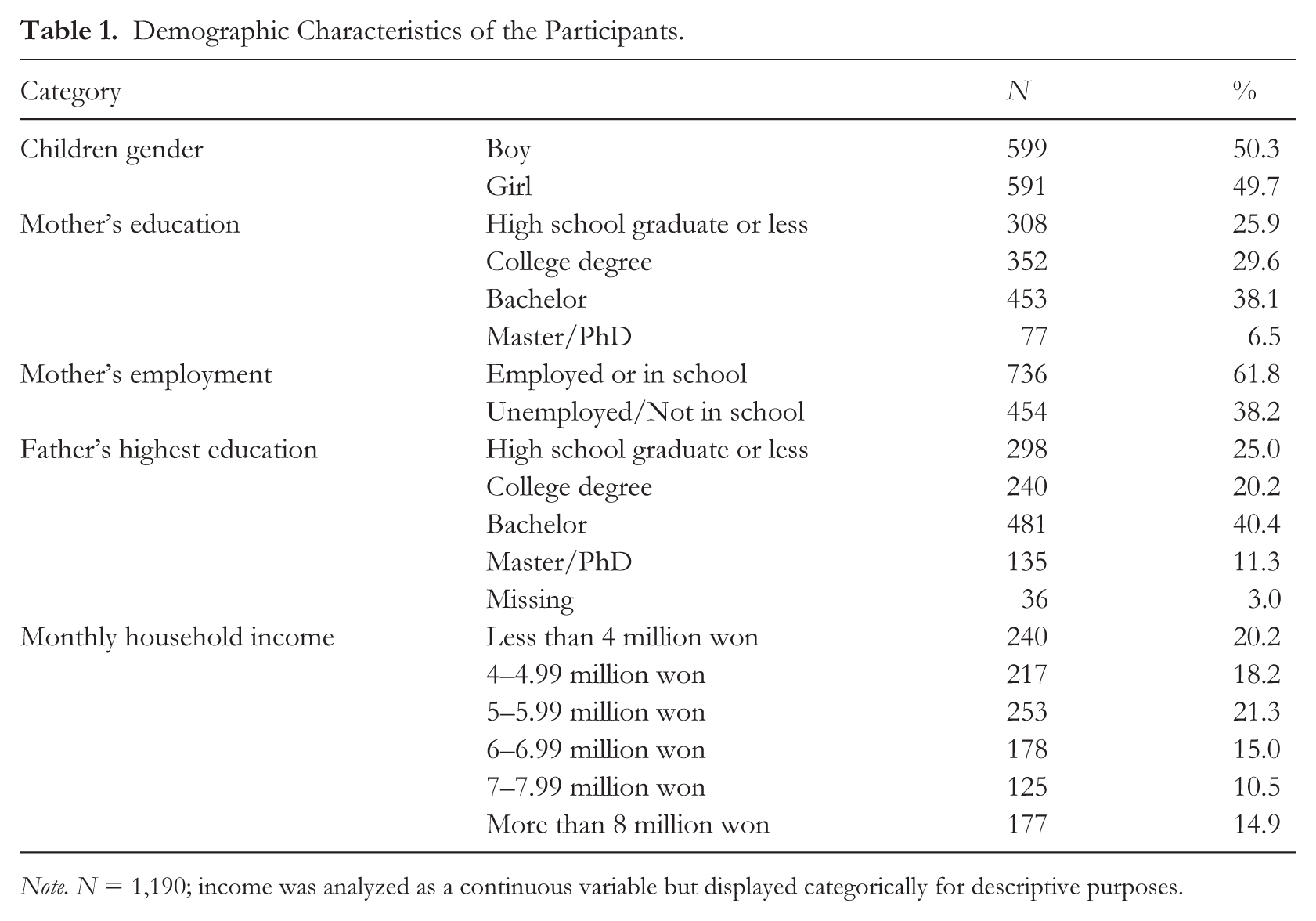
Note. N = 1,190; income was analyzed as a continuous variable but displayed categorically for descriptive purposes.
Materials
Maternal Self-Esteem
To measure the maternal self-esteem, this study used the Rosenberg Self-Esteem Scale (Rosenberg, 1989), translated for use in Korea by the Korea Children’s Panel research team (Panel Study on Korean Children, 2025a). Mothers completed this 10-item self-report questionnaire, which was rated on a five-point Likert scale, ranging from “strongly disagree” (one point) to “strongly agree” (five points). Sample items include “I feel that I am a person of worth, at least on an equal basis with others” and “I take a positive attitude toward myself.” The reliability coefficient (Cronbach’s α) of the scale was .89.
Maternal Educational Involvement
To measure mothers’ educational involvement, this study used a modified version of the ‘Family Involvement Questionnaire’ scale by Manz et al. (2004), adapted by the Korea Children’s Panel research team for the context of Korean elementary school students (Panel Study on Korean Children, 2025b). The scale includes 17 items across two sub-domains: home-based learning (10 items) and school-based involvement (seven items). In this study, only the home-based learning subscale was analyzed, which assess mothers’ engagement in their children’s learning activities at home. All items were completed by mothers. Responses were recorded on a four-point Likert scale, ranging from “rarely” (one point) to “always” (four points), with higher average scores indicating greater involvement. Sample items include “I review my child’s schoolwork,” “I keep educational materials at home for my child,” and “I help my child with homework.” The reliability coefficient (Cronbach’s α) of the scale was .77.
Children’s Academic Stress
To measure children’s academic stress, this study used an instrument from the Korean Youth Panel Survey conducted by the National Youth Policy Institute (Panel Study on Korean Children, 2025c). The scale consists of three items completed by the children. Responses ranging from “never” (one point) to “always” (five points). Higher scores indicate higher levels of stress. Sample items include “I feel stressed because of poor school grades” and “I feel stressed because of homework or exams.” The reliability coefficient (Cronbach’s α) of the scale was .80.
Children’s Reading Time
Children’s reading time was calculated by summing caregivers’ responses regarding the child’s typical reading time during the school term. Only cases in which the caregiver was the mother were included in the analysis. Reading time was assessed separately for weekdays and weekends, with response options structured as follows: 0 minutes (.0), 30 minutes (.5), 1 hour (1.0), 1 hour 30 minutes (1.5), 2 hours (2.0), and so on. In this study, referring to related previous research (Ahn et al., 2017; Kim et al., 2021), the child’s total weekly reading time was calculated by multiplying the weekday reading time by five and the weekend day reading time by two, then summing these values.
Control Variables
Based on prior research indicating gender differences in children’s reading time, reading habits, and academic stress (Hu et al., 2024; Kim et al., 2021; Kim & Kim, 2015; Ye et al., 2018), the child’s gender was included as a control variable. Monthly household income, which has been associated with maternal educational involvement (Park et al., 2011), was also controlled for using the log-transformed value of self-reported average monthly household income.
In addition, maternal education and employment status were included as control variables, since these factors are closely associated with maternal educational involvement (Choi & Yang, 2023; Jabbar et al., 2021). Maternal education was coded as 1 for mothers with a two- or three-year college degree or higher and 0 for those with a high school education or below. Maternal employment was coded as 1 for mothers engaged in paid work or formal education and 0 for those not engaged in either. Therefore, the child’s gender, monthly household income, maternal education, and maternal employment were included as control variables in this study.
Procedure
This study used SPSS 29.0.2 for data analysis. First, frequency analysis was conducted to examine the general characteristics of the research subjects, and Cronbach’s α was calculated to assess the internal consistency of the research instruments. Second, descriptive statistics and Pearson’s correlation coefficients were calculated. To investigate whether maternal educational involvement and children’s academic stress mediate the relationship between mothers’ self-esteem and children’s weekly reading time, a sequential mediation analysis was performed using Model 6 of PROCESS macro version 4.2 (Hayes, 2022). The significance of indirect effects was verified through bootstrapping (k = 5,000, 95% confidence interval).
Results
Descriptive Statistics and Correlations
Table 2 shows the descriptive statistics and correlation analysis results for the variables examined in this study. All variables met normality assumption, with skewness and kurtosis values not exceeding 3 and 10, respectively (Kline, 2005). Maternal self-esteem averaged 3.79 points (SD = .56) out of a 1–5-point range, indicating a relatively high level. Maternal educational involvement averaged 2.45 points (SD = .47) out of a 1–4-point range, also showing a relatively high level. Children’s academic stress averaged 2.28 points (SD = .91) out of a 1–5-point range, slightly below the midpoint, and children’s reading time averaged 2.01 hours per day (SD = 1.53).
Correlations and Descriptive Statistics of Variables.
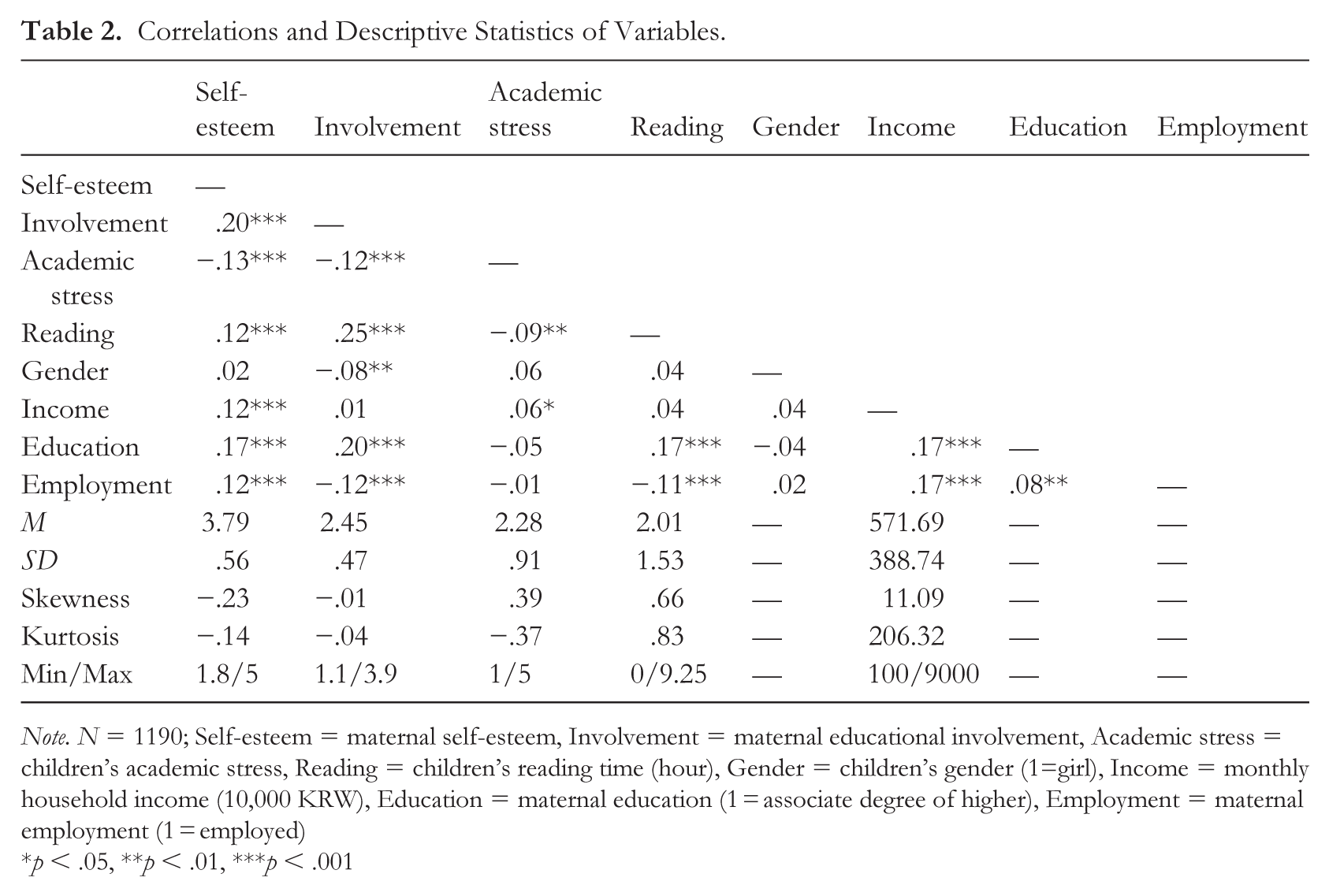
Note. N = 1190; Self-esteem = maternal self-esteem, Involvement = maternal educational involvement, Academic stress = children’s academic stress, Reading = children’s reading time (hour), Gender = children’s gender (1=girl), Income = monthly household income (10,000 KRW), Education = maternal education (1 = associate degree of higher), Employment = maternal employment (1 = employed)
p < .05, **p < .01, ***p < .001
The correlation results among the main variables are as follows. Significant correlations were found between all the variables. First, the correlation coefficient between maternal self-esteem and children’s reading time was .12 (p < .001), showing a weak positive correlation. This means that the higher the maternal perceived self-esteem, the longer the child’s weekly reading time tends to be. Second, the correlation coefficient between maternal educational involvement and children’s reading time was moderate and positive at .25 (p < .001), while children’s academic stress and children’s reading time showed a weak and negative correlation at −.09 (p < .01). These results suggest that more frequent maternal educational involvement tends to be associated with longer weekly reading time for children, and children who experience less academic stress tend to have longer weekly reading times.
Third, the correlation coefficient between maternal self-esteem and children’s academic stress was −.13 (p < .001), showing a weak negative correlation, and the correlation coefficient between maternal educational involvement and children’s academic stress was also weak and negative at −.12 (p < .001). In other words, higher maternal self-esteem and more maternal educational involvement tended to be associated with lower academic stress in children. Lastly, the correlation coefficient between maternal self-esteem and maternal educational involvement was .20 (p < .001), showing a weak positive correlation. This means that mothers who perceived higher self-esteem tended to participate more in educational involvement.
Regarding control variables, children’s gender and maternal educational involvement showed a weak negative correlation with a coefficient of −.08 (p < .01), while monthly household income showed weak and positive correlations with maternal self-esteem and children’s academic stress, with correlation coefficients of .12 (p < .001) and .06 (p < .05), respectively. This suggests that a maternal educational involvement is greater for male children than for female children, and that higher household income is associated with higher maternal self-esteem and greater academic stress in children.
Additionally, maternal education was weakly and positively correlated with maternal self-esteem, r = .17, p < .001, as well as with maternal educational involvement, r = .20, p < .001, and children’s reading time, r = .17, p < .001. Maternal employment status also showed weak and positive associations with maternal self-esteem, r = .12, p < .001, but weak and negative associations with maternal educational involvement, r = −.12, p < .001, and children’s reading time, r = −.11, p < .001, see Table 2.
Testing the Sequential Mediation Effect of Measurement Variables
Table 3 presents the results of the sequential mediation model analysis examining the relationship between maternal self-esteem and children’s reading time, with maternal educational involvement and children’s academic stress as mediating variables. The analysis controlled for children’s gender, maternal education, maternal employment status, and monthly household income, with the natural logarithm applied to monthly household income to account for the dispersion of the data. Examining the path coefficients shown in Figure 1, the maternal self-esteem was positively associated with the maternal educational involvement, B = .16, p < .001. Additionally, maternal self-esteem showed a negative relationship with children’s academic stress, B = −.21, p < .001. No significant association was observed between maternal self-esteem and children’s reading time, p > .05.
Sequential Mediating Effects of Maternal Educational Involvement and Children’s Academic Stress on the Relation Between Maternal Self-Esteem and Children’s Reading Time.
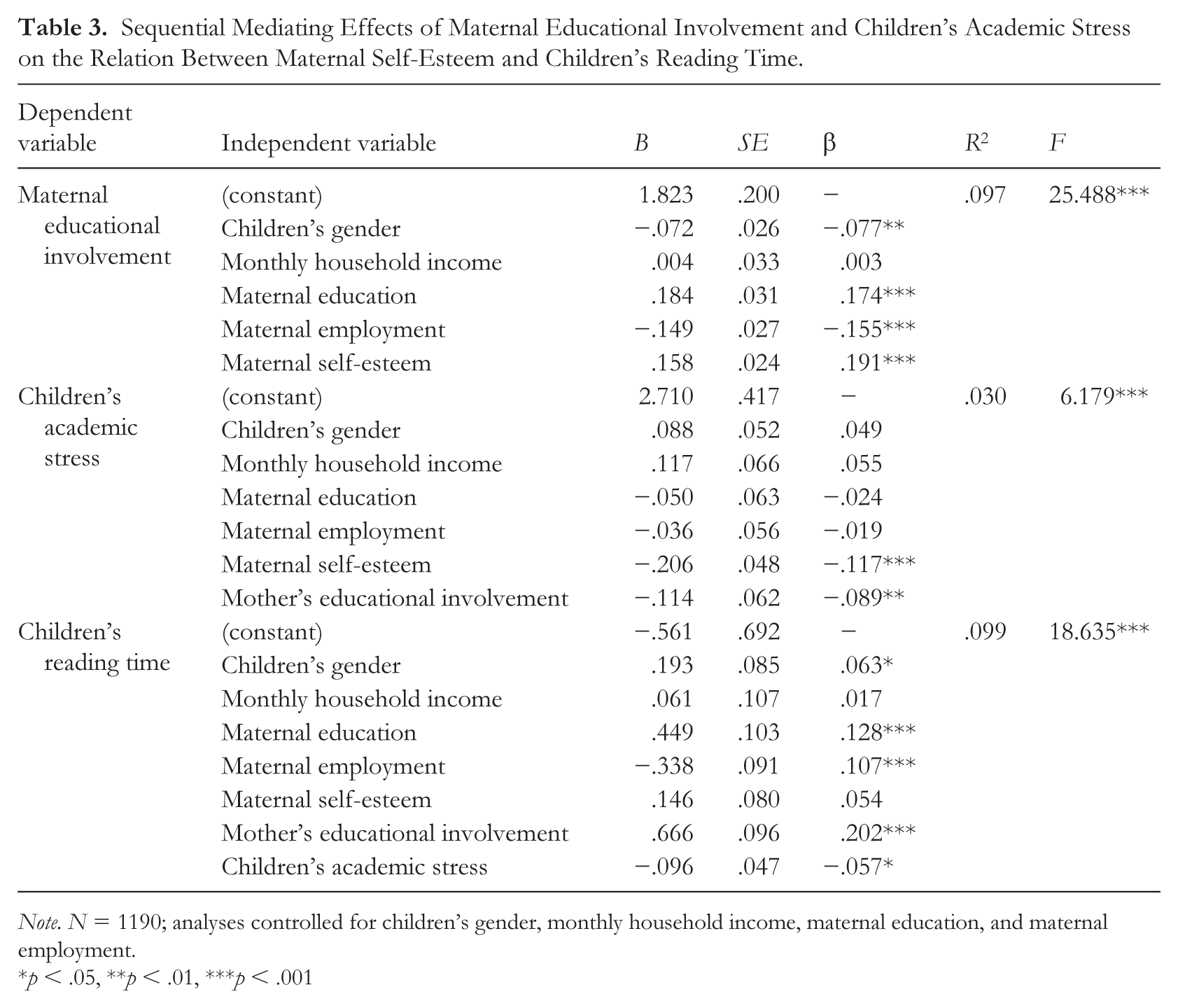
Note. N = 1190; analyses controlled for children’s gender, monthly household income, maternal education, and maternal employment.
p < .05, **p < .01, ***p < .001
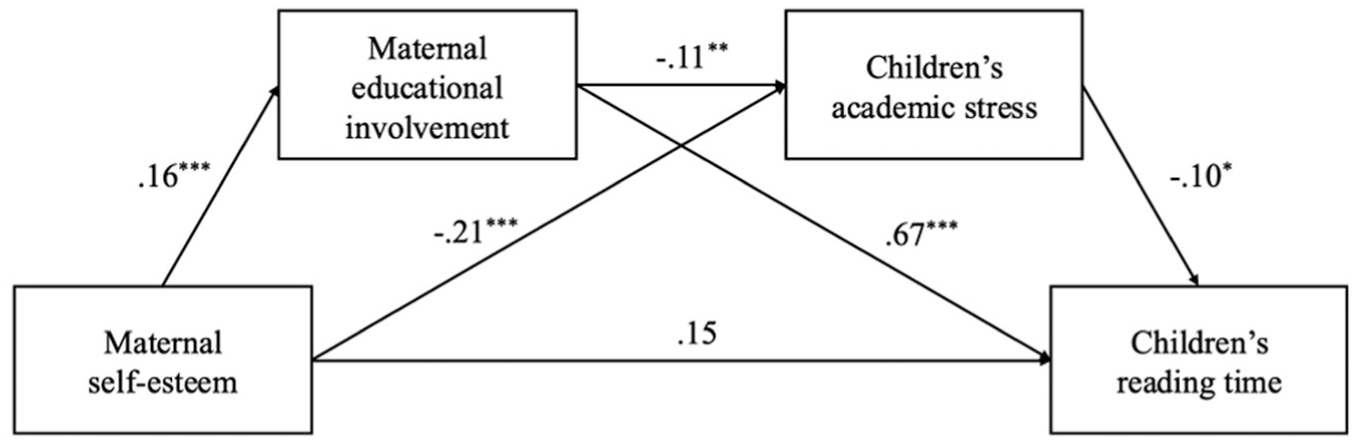
The results of sequential mediating effects on maternal self-esteem and children’s reading time.
Next, the maternal educational involvement showed a negative relationship with children’s academic stress, B = −.11, p < .01, and a positive relationship with children’s reading time, B = .67, p < .001. Finally, children’s academic stress was found to link negatively with children’s reading time, B = −.10, p < .05. The analysis revealed a significant total effect, B = .27, p < .001, whereas the direct effect was not significant, B = .15, p = .068.
The results of the bootstrapping analysis conducted to examine the mediating roles of maternal educational involvement and children’s academic stress are presented in Table 4. Upon examining the 95% confidence intervals for the indirect effects, the following observations were made: the confidence interval for the relationship between the maternal self-esteem and children’s reading time, as mediated by the maternal educational involvement, was [.06, .16].
Bootstrapping Estimates and Confidence Intervals for the Indirect Effects.
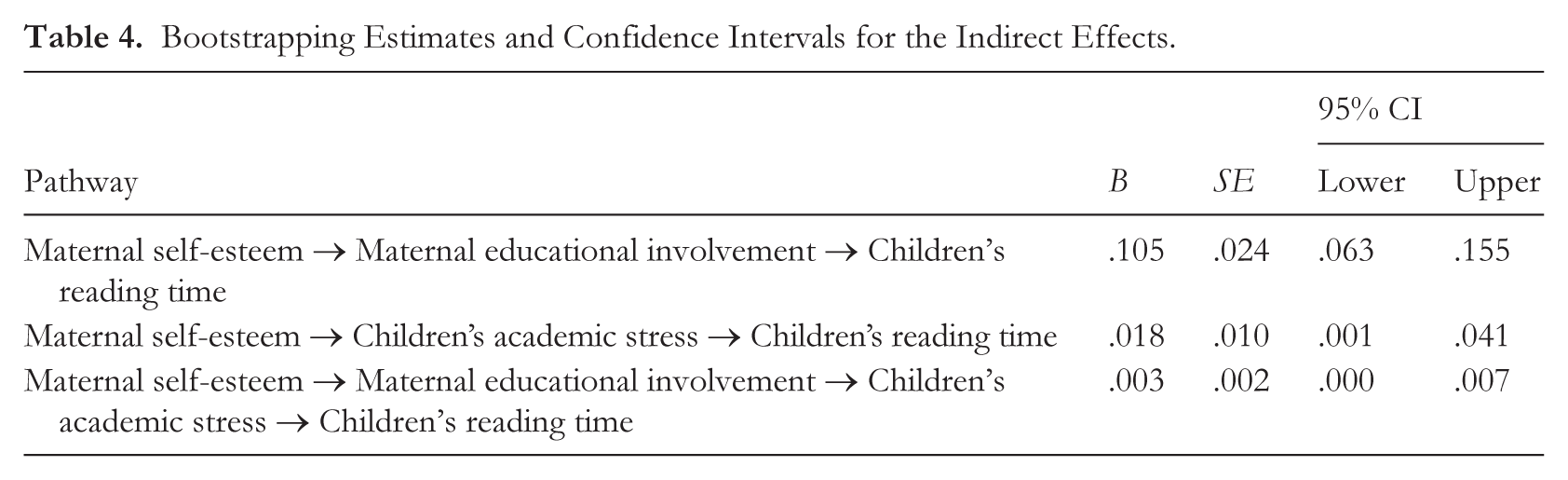
For the relationship between maternal self-esteem and children’s reading time, with children’s academic stress as a mediator, the confidence interval was [.00, .04]. The confidence interval for the relationship between maternal self-esteem and children’s reading time, considering both maternal educational involvement and children’s academic stress as mediators, was [.00, .01].
Since the confidence intervals do not include 0, the results suggest that all indirect effects are statistically significant. This includes the sequential mediation pathway. The analysis revealed significant associations in the relationship between maternal self-esteem and children’s reading time, with maternal educational involvement and children’s academic stress serving as mediating variables. The significance of the sequential mediation pathway suggests a potential chain of relationships: the maternal self-esteem is associated with educational involvement, which is related to children’s academic stress, which in turn is associated with reading time. Notably, these significant associations persisted even after controlling for children’s gender, maternal education, maternal employment status, and monthly household income.
Discussion
The first research question examined the associations among maternal self-esteem, educational involvement, children’s academic stress, and reading time. Consistent with theoretical predictions, higher maternal self-esteem was positively associated with mothers’ educational involvement and children’s reading time, while it was negatively associated with children’s academic stress. This finding extends Belsky’s (1984) process model, which posits that parents’ psychosocial characteristics—such as self-esteem—shape their parenting behaviors and, in turn, children’s development. By considering educational involvement and academic stress together, this study illustrates how maternal psychological well-being is associated with supportive parenting practices that, in turn, relate to children’s reading engagement. The results also align with prior research demonstrating connections between parental characteristics and children’s developmental outcomes (e.g., Bayer et al., 2006; Small, 1988; Park & Yoon, 2021) and with Stets and Lee’s (2021) view that higher maternal self-esteem enhances confidence in fulfilling parenting roles.
Overall, the findings underscore that parental psychological well-being, beyond behavioral involvement, constitutes a key component of effective parenting—one that should be supported in educational and family contexts.
Parental involvement and support are still essential for children in early adolescence. While previous research has pointed to the potential drawbacks of excessive educational expectations from parents (Kim & Kim, 2009), the present findings highlight that constructive and supportive maternal educational involvement is associated with lower academic stress and greater reading time among children. It is worth considering that these results were observed in sixth-grade students, which in the Korean school system corresponds to the final year of elementary school. At this stage, parental participation in education may still be perceived as helpful. This aligns with Kim’s (2020) meta-analysis on East Asian countries, which revealed a significant positive relationship between parental involvement and children’s academic achievement.
Importantly, while expectations can themselves be considered a form of parental behavior, there may be a meaningful difference in how children perceive expressed expectations vs. involvement in educational activities. Children may feel more supported when their mothers participate in educational activities through actions rather than solely offering verbal encouragement. Notably, this study used data collected in the latter half of 2020, during the COVID-19 pandemic (Korea Institute of Child Care and Education [KICCE], 2021), a period in which in-person and remote schooling were often combined in Korea. Given the heightened importance of support from home during this time, maternal educational involvement may have been perceived as especially salient by children.
An important interpretive note is that the measure of educational involvement used in this study encompasses a range of behaviors, including both supportive activities (e.g., reviewing schoolwork) and more structured forms of guidance (e.g., setting limits on screen time). The interpretation of these behaviors may vary depending on the quality of the parent–child relationship and individual differences. Future research should therefore differentiate among types of involvement to clarify their distinct associations with children’s academic and emotional experiences.
It is crucial to protect students from excessive academic stress and to continuously make efforts to identify and address the causes of academic stress. Descriptive statistics show that this study’s participants’ academic stress averaged 2.28 on a 1–5 scale, slightly below the midpoint. Despite concerns about high academic stress among Korean school-aged children, the sample showed lower levels. Nevertheless, a significant negative correlation was found between academic stress and children’s reading time. Given the highly competitive and time-pressured academic environment in Korea, where children often report limited discretionary time for reading (Ministry of Culture, Sports and Tourism, 2024; Save the Children, 2021), this finding remains noteworthy. The observed negative association suggests that even moderate levels of stress may reflect the broader educational pressures that constrain children’s voluntary reading. Although intrinsic motivation and enjoyment of learning were not directly examined in this study, reduced academic stress may be indirectly related to increased reading time through such psychological mechanisms. Future research could explore whether lower stress levels enhance students’ openness to reading-related experiences.
The second research question addressed whether maternal educational involvement and children’s academic stress sequentially mediated the association between maternal self-esteem and children’s reading time. Although the direct effect of maternal self-esteem on children’s reading time was not significant, the analysis revealed a significant sequential mediation effect through maternal education involvement and children’s academic stress. This finding is in line with Belsky’s (1984) process model, suggesting that mothers’ psychosocial resources can influence children indirectly through daily educational practices and emotional climates. It also aligns with prior research suggesting that higher self-esteem is associated with greater sensitivity to others’ needs and responsiveness in relationships (Lee, 2016; Orth & Robins, 2014; Stets & Lee, 2021).
In contrast, when mothers’ sense of self-worth becomes contingent upon their children’s academic performance, they are more likely to emphasize achievement-oriented goals and display controlling behaviors in evaluative situations (Grolnick et al., 2007; Soenens et al., 2015). Within Korea’s competitive and performance-focused educational environment, such contingent self-esteem may be easily undermined, reinforcing parental pressure rather than support. Against this backdrop, the present findings underscore the importance of fostering stable maternal self-esteem as a protective factor that promotes positive educational involvement, reduces children’s academic stress, and, consequently, supports their voluntary engagement in reading.
This pattern suggests that mothers with higher self-esteem may, through their general attitudes and interactions, foster greater educational involvement and reduce children’s academic stress. In turn, these processes may create an environment that naturally supports children’s reading. This aligns with Shin and Won’s (2009) observation that enhancing parents’ self-awareness and self-worth can lead to positive outcomes for children, indicating the potential benefits of focusing on mothers’ self-esteem as well as parenting strategies. Strengthening maternal self-esteem, therefore, may represent a valuable avenue for interventions aimed at fostering children’s reading habits, warranting future research to examine its long-term impacts and cultural applicability.
Limitations and Implications for Future Research
Some limitations of this study should be noted. First, this study elucidated the relationship between maternal self-esteem and children’s reading time, as well as the mediating roles of maternal educational involvement and children’s academic stress. However, it is limited by its cross-sectional design, which precludes the establishment of causal relationships. Notably, maternal educational involvement may be influenced by their work schedules (Kim et al., 2022) and children’s characteristics (Tunkkari et al., 2022), varying in consistency over time and necessitating a longitudinal examination. A longitudinal study would allow for deeper interpretations, including potential causal relationships.
Additionally, although the observed indirect pathways were statistically significant, the effect sizes were relatively small. This may partly reflect differences in informants, since children reported their own academic stress while mothers reported the other variables. Such a design reduces potential common method bias but may also attenuate the observed effects. Moreover, this study did not account for literacy-related variables that are known to influence children’s reading behaviors, such as the home literacy environment or mothers’ reading habits and attitudes (e.g., Zauche et al., 2016). Future research could incorporate these factors to provide a more comprehensive understanding of the pathways linking maternal psychosocial characteristics to children’s reading engagement and time.
Second, relying on secondary data from the Panel Study on Korean Children (PSKC), while providing robust and comprehensive information, restricted our ability to customize variables. Although the dataset effectively measured key constructs such as maternal self-esteem, educational involvement, children’s academic stress, and reading time, some variables were assessed using a limited number of items, potentially not capturing their full complexity.
Furthermore, while served as a quantitative measure in this study, it may not fully capture children’s broader reading behaviors, including their intrinsic motivation and qualitative aspects of reading engagement. Future research would benefit from incorporating additional psychological and behavioral measures to better understand the relationship between caregiver characteristics and children’s reading development. Although this study did not focus on it, there are groups of school-aged children for whom screen time occupies a significant proportion of their movement behavior (Park et al., 2023). Additionally, the relationship between reading time and screen time has been identified (Horowitz-Kraus et al., 2021), suggesting that it is important to examine screen time in relation to children’s reading development.
Lastly, this study focused exclusively on mothers, yet there is a need to examine relationships with other primary caregivers, particularly fathers. Notably, recent research has highlighted associations between paternal self-esteem and outcomes in elementary school children (Kim & Yoon, 2024), suggesting the value of investigating how fathers’ self-esteem and educational involvement may relate to children’s reading time. Such research would allow for comparison with our findings on mothers and contribute to a more comprehensive understanding of caregiver role in children’s reading time.
Despite these limitations, this study makes significant contributions by examining school-aged children in Korea who experience challenges with time management and reading engagement. Notably, our findings demonstrate that caregiver involvement continues to be relevant for sixth-graders in elementary school as they transition to middle school. Furthermore, the study reveals the important role of maternal psychological factors in shaping specific parenting behaviors, highlighting their significance in school-aged children’s development.
Given that the effects of short-term programs may be challenging to sustain, continuous attention and effort from both families and society are necessary to help mothers develop positive and strong self-esteem. Moreover, this study reaffirmed the relationship between children’s perceived academic stress and reading time. Since our research revealed that active maternal educational involvement can be linked to children’s lower academic stress, this study emphasizes the importance of mothers’ engagement in their children’s education at home. This includes providing necessary learning materials and showing interest in their children’s school life at home. Therefore, this study suggests that schools help diversify parents’ involvement by establishing communication channels, such as creating self-help groups for parents of children in the same class.
Notably, 61.8% of mothers in this study were employed, highlighting the need for strategies to support the self-esteem and educational involvement of working mothers with school-aged children. There is a need for societal and workplace changes to create an atmosphere that allows mothers to balance childcare for school-aged children with their work. This could include measures such as flexible working hours or enabling work-from-home options. These initiatives may contribute to a comprehensive support system linked to better educational outcomes and lower levels of academic stress in children.
In the Korean context, these needs are particularly pressing given the widespread participation in private education. For example, in 2020, during the COVID-19 pandemic, 69.2% of elementary school students participated in private education, with an average of 4.6 hours per week (Statistics Korea, 2021). The most recent data show a sharp rise, with 87.8% participation and 7.8 hours per week in 2024 (Statistics Korea, 2025). The most common and substantial form of private tutoring is instruction at for-profit cram schools, hakwon, where students are taught core subjects such as Korean, math, and English or sports by private instructors in structured settings.
Many parents invest considerable time and effort in selecting appropriate private tutoring services and closely monitor their child’s progress by communicating with tutors and hakwon teachers (Park et al., 2011). While these activities can be considered forms of parental educational involvement, such involvement often places a significant burden on working mothers. In fact, previous research has shown that the proportion of mothers using private education for childcare purposes was relatively higher among working mothers (Yoo & Kang, 2021). These realities underscore the importance of policies that allow mothers to spend more meaningful time with their children—rather than outsourcing care and supervision—without compromising their employment.
Conclusion
This study contributes to the literature by explaining how maternal self-esteem and educational involvement relate to children’s academic stress and reading time in a non-Western context. Guided by Belsky’s (1984) Process Model of the Determinants of Parenting, the findings demonstrate that higher maternal self-esteem is associated with greater educational involvement, lower academic stress, and longer reading time among sixth-grade students. These associations remained significant even after controlling for children’s gender, household income, maternal education, and employment status.
Importantly, this study highlights maternal self-esteem as a key psychological resource that supports children’s learning during late childhood—a period often overlooked under the assumption that older children require less parental guidance. The results emphasize that school-aged children continue to benefit from mothers’ emotional stability and supportive engagement in learning.
In conclusion, this study contributes to the growing body of literature on the role of parental characteristics in child development. The findings emphasize the need for programs that not only enhance parenting skills but also support the psychological well-being of mothers. By fostering positive maternal self-esteem and encouraging active educational involvement, such initiatives could play a crucial role in reducing academic stress and promoting healthy academic behaviors among school-aged children.