







Abstract
The existence of symbols is present from birth in human development and plays a core role in child development. This study seeks to understand how symbolization processes occur in preschool education. We conducted a systematic literature review with articles indexed in the Scopus, Web of Science and ERIC databases between September 2023 and January 2024. Nineteen articles were found. After reading these studies, three categories of analysis were determined: symbolic play/co-creation/holistic development; quality standards in preschool education (convergences and divergences); and gaps in the research on play. We found a stronger emphasis on the interrelation between play, learning and development, with a stress on playful learning as a parameter for the quality of preschool education programmes; symbolic play was the kind that was researched the most.
Preschool education is recognized in article 208, section IV, of the 1998 Federal Brazilian Constitution as a state duty and a right of children from birth to age five (Brazil, 1988), and it is defined as the first stage of basic education in articles 29 and 30 of the 1996 Law on Guidelines and Foundations of National Education (Brazil, 1996).
Certain literacy practices found in the everyday dynamic of preschool education, like storytelling (verbal creation and dramatization), fantasy and drawing, are directly related to children’s symbolic development. Their immersion in these educational experiences enables imaginary situations to be created, which are a means for the development of abstract thinking, allowing the children to act independently from the immediate perceptual situation and to act in the field of meanings (Vygotsky, 2018, 2021).
In line with this perspective, some authors advocate a greater role for play in preschool education; for example, Cooper and Quiñones (2022) claim that immersing small children in play situations focused on objects in co-authorship with adults at preschool helps children to develop skills, autonomy and agency through this experience. Quiñones et al. (2021) stress that this co-construction of play between children and teachers breaks with spontaneous, mechanistic conceptions of symbolic development and is also a complex, dynamic perspective based on reciprocal relations between the children and their educators via adaptive, collaborative relationships. Prestes (2016), however, warns that there is an instructionist trend in preschool education in Brazil today, demonstrated by the pre-eminence of curricular programmes with contents predefined by adults and far from children’s experiences. This increasingly limits and controls the spaces and times devoted to pretend play and places this activity in a secondary role.
However, according to Vygotsky, pretend play is characterized by being an orienting activity, that is, one that determines the preschool child’s development. Therefore, it is one of the most important issues in psychology and early childhood education (Vygotsky, 2018, 2021).
Prestes goes on to say:
There is no doubt that children learn by playing, but the outcome of this learning is not what should be analysed from the standpoint of child development. For development to occur, something new has to appear, something that did not exist before. And this novelty in imaginary play is the action that is in the child’s mind, not the situation they have before them. As Vygotsky says, the imagination is the new thing that emerges in play; it is the new formation that arises from this activity, from the child’s action with objects to which they assign new meanings. (Prestes, 2016, p. 35)
Therefore, pretend play is crucially important in the development of symbolic thinking. Vygotsky and Luria (2007) also criticized spontaneous perspectives (the comparison of the child’s growth with a plant’s growth) and mechanistic perspectives (comparative studies of children’s and animals’ intelligence, equating them) of child development. In contrast, these authors view development as a bio-historical-cultural process in which complex, varied qualitative transformations occur through social-relational experiences during the first few years of life and become core factors in the acquisition and mastery of signs and symbols.
In light of the importance of symbolic development in early childhood, the purpose of this article is to delineate how recent research has addressed symbolization processes in preschool education settings, in addition to providing proposals for future research.
Symbolic development from the bio-historical-cultural perspective
Understanding symbolization processes is intertwined with understanding human development both phylogenetically (biological constitution of the subject in the history of the human species) and ontogenetically (individual and cultural constitution of the subject) (Rodríguez, 2006; Vygotsky & Luria, 2007). Thus, understanding symbolic development entails examining a crucial aspect of human development: human relations occur through graphic symbols, images, gestures, artefacts and languages (Rodríguez, 2006; Rodríguez & Moro, 1999).
Human beings’ relationship with the world is mediated by technical instruments (tools) and psychological instruments (signs), which are characterized as complex human constructions developed from cultural needs like language, calculation, writing and the arts (Silva et al., 2017).
Symbols are present in the person’s development from birth and can be found in the verbal language, cultural rites, institutions, social relations, customs and more (Rodríguez, 2006; Vygotsky & Luria, 2007). They can be defined as powerful tools for communication and interaction among people, even before speech develops in children, and as a way to give meaning to thoughts and to develop self-awareness (Rodríguez, 2006). Upon birth, human babies are immersed in relationships with other people who are experienced in the culture; they are thus immersed in the culture and enter the human dimension, which enables them to be able to understand and use the symbols in their environs by the end of their first year of life (Rodríguez, 2022).
The child’s discovery of the relationship between sign and meaning lies at the root of symbolic development, but this does not happen spontaneously. To the contrary, it is a cultural process whereby higher psychological functions such as perception, language, concept-based thinking, logical memory, voluntary attention, imagination and emotion are developed (Vygotsky, 1987). This understanding leads us to break with mechanistic perspectives which view symbolic development processes as based on coding and decoding, repetition, imitation and the adaption of the use of signs (Vygotsky & Luria, 2007). From another standpoint, it situates us before a kind of psychology with a bio-historical-cultural perspective, which points to activity mediated by language and instruments as a means of forming the typically human psyche, given that all the cultural psychological functions are made semiotic (Vygotsky, 2000).
In the bio-historical-cultural perspective, biological birth is not enough to state that the human exists, so Barbosa (2011) claims that a second birth is needed that is also biological but is cultural and social as well. The mechanisms that enable cultural psychological processes to develop are symbolization processes, whereby the self is constituted in the other. Signs begin to work as tools constitutive of the human psyche through social relations in a certain cultural context, and a being develops who learns how to react, think and feel, always in interrelation with the other and themselves.
Thus, development is viewed as a bio-historical-cultural process, although the child’s entry and adaptation to the culture is not a natural process, since they learn the uses and purposes of the objects around them through social relations. Adults play a crucial role in this process, since starting at birth they help the child adapt to the cultural world in a triadic relationship: child, adult and object (Rodríguez & Moro, 1999). These triadic relationships are the basic unit through which it is possible to understand the development of the semiotic processes that occur in the socio-historical and cultural context (Rodríguez & Moro, 1999).
Furthermore, the instruments and signs are the result of human creation: human creative activity is viewed as one in which something new is devised, be it an object, a mental construct or a feeling. The imagination is the foundation of all human creative activity and can be observed in all spheres of cultural life, encompassing the arts, science and technical creation (Vygotsky, 2018). These creative processes can be intensely perceived after the child begins to develop through their pretend play; as stated above, this style of play is characterized by being the orienting activity, that is, the one that determines the child’s development at preschool age. Therefore, it is one of the most important topics in psychology and child psychology (Vygotsky, 2018, 2021).
Furthering this reflection, Cangià and Zittoun (2020) define imagination as the foundation of human creative processes, a continuous process that broadens human experience by allowing people to exist in the physical environment (body movement), the psychological dimension (movement of the self) and the virtual dimension (symbolic movement), thereby creating or reshaping individual and collective worlds.
Children’s creative processes do not manifest spontaneously through impulses but are motivated by maladaptations, needs and desires that are not immediately achievable by the child, and they are always constructed with materials taken from reality (Vygotsky, 2018). Therefore, children’s creative imagination can be provoked experimentally in the preschool setting by organizing spaces and times that allow the children to generate needs and possibilities for this purpose. Herein lies the importance of preschool teachers intentionally planning children’s play activity by proposing challenges and materializing the conditions needed to implement them (Vygotsky, 2021).
Considering the importance of prompting creative imagination in preschool, authors like Rodríguez and Moro (2002), Guevara and Rodríguez (2023) and Guevara et al. (2024) state that symbolic uses of objects (a type of use that makes it possible to create imaginary situations) enable qualitative leaps in development, since they allow children to detach from the here and now. In this context, Palacios et al. (2018) state that in imaginary play situations, two main factors may contribute to expanding children’s symbolic development: the use of intentional semiotic mediators (gestures, guides, emotional expressions, demonstrations, etc.) by adults and the provision of different types of everyday objects (replicas, artefacts and natural objects).
Symbolic development from the instructionist perspective
In an instructionist perspective, curricular proposals are inflexible and the organization of pedagogical work revolves around unilateral instructional processes focused on the teacher’s knowledge and decision-making. Play is secondary in the children’s learning process (Prestes, 2016).
Play is considered a spontaneous, fantasy-based pastime of children which generally occurs without teacher supervision or guidance. Teachers do not watch the actions, questions and accomplishments that the children achieve via play (Silva, 2012).
A uniform, homogeneous assessment process prevails which ignores children’s pluralities (Quiñones et al., 2021). The activities are not very diverse, and there is an overemphasis on silence and the stillness of the children’s bodies as evidence of good behaviour and concentration, which lead to learning (Barbosa, 2011).
As we consider these main aspects of the instructionist perspective, we can consider it inappropriate for preschool, since it clearly supports teaching strategies that are not meaningful or challenging for the children, which has a negative impact on their commitment, knowledge construction and autonomy (Quiñones et al., 2021).
Furthermore, it disregards children as active, participatory subjects who need to move and speak as they act, and who learn by playing and interacting (Barbosa, 2011; Prestes, 2016). This prevents preschool children from trying creative experiences and taking qualitative leaps (Vygotsky, 2018, 2021).
Purpose of the research
With this study, we aim to understand how research from the past five years has addressed symbolization processes in preschool settings, with particular attention to symbolic play.
Method
Systematic literature reviews are a method that enables researchers to identify, choose, assess, analyse and critically summarize relevant studies on a given topic in an organized fashion. To do so, the Preferred Reporting Items for Systematic Reviews and Meta-Analyses or ‘PRISMA’ checklist is used, an instrument that helps to describe and critically analyse review reports (Galvão et al., 2015).
Therefore, this study was conducted via the following steps: (1) development of the research question using the PICO strategy (population, intervention, comparison and outcome to be researched; Akobeng, 2005; Flemming, 1999); (2) definition of the search terms; (3) choice of the databases; (4) definition of inclusion and exclusion criteria; (5) search and storage of results; (6) choice of articles by reading titles and abstracts; (7) complete reading of the articles chosen; (8) choice of articles to be used; and (9) summary of findings and interpretation of results.
To create the research question using the PICO strategy, the following elements were combined: population — children; intervention — educational; comparison — development of symbolic processes in preschool education; outcome — children’s development via symbolic play.
This study is grounded on the following question: how do symbolic processes develop in children through symbolic play in the preschool education setting?
The choice of the search terms is based on the research question, which was, in turn, based on the constructs found in the literature on the same phenomenon. The search strategy used the Boolean operators ‘OR’ and ‘AND’. An initial search with the following terms was conducted to confirm the presence or absence of results: ‘symbolic development OR symbolic play AND early childhood education’. This yielded enough results that we kept the terms.
The databases chosen for the search were Scopus, Web of Science and ERIC, because they are multidisciplinary and cover the social sciences, arts and humanities, thus providing access to high-quality, peer-reviewed scholarly articles. The search was conducted remotely between September 2023 and January 2024 via access to the Comunidad Académica Federada de Búsqueda (CAFe) on the CAPES Journal Portal via access from an accredited federal university.
The inclusion criteria defined for this study were: selection of academic articles written in Portuguese, English and Spanish; published between January 2019 and January 2024; with complete texts available that emphasized the development of children’s symbolization processes within the preschool setting. The choice of this time bracket was justified by the need to update and further explore how child development researchers have addressed the research topic in the past five years.
The exclusion criteria established were: articles written in other languages or outside the time frame; texts that stress the development of symbolization processes in children over the age of five; articles focused on the development of symbolization processes outside the preschool setting, that is, in a clinical setting, clinical evaluations, families or other non-school institutions; articles focused on educational actions or pedagogical projects conducted by student teachers.
The articles included were read, recorded and analysed through a complete, interpretative reading. The following information was prioritized when analysing the documents: general descriptions, authors and year, title, country, main results and considerations, with an emphasis on child symbolization processes and the preschool settings in which they occur.
Results
In the initial search, 827 articles were found in the databases chosen, with 84 in Web of Science, eight in Scopus and 735 in ERIC. After applying filters following this study’s inclusion criteria, the number dropped to 112, 27 of which were in Web of Science, two in Scopus and 83 in ERIC. After the initial selection (reading titles and abstracts, excluding duplicates), 33 articles remained, 11 from Web of Science, two from Scopus and 20 from ERIC. After the second reading (complete, interpretative reading), 19 studies were chosen for the critical analysis of their findings, as shown in Figure 1.
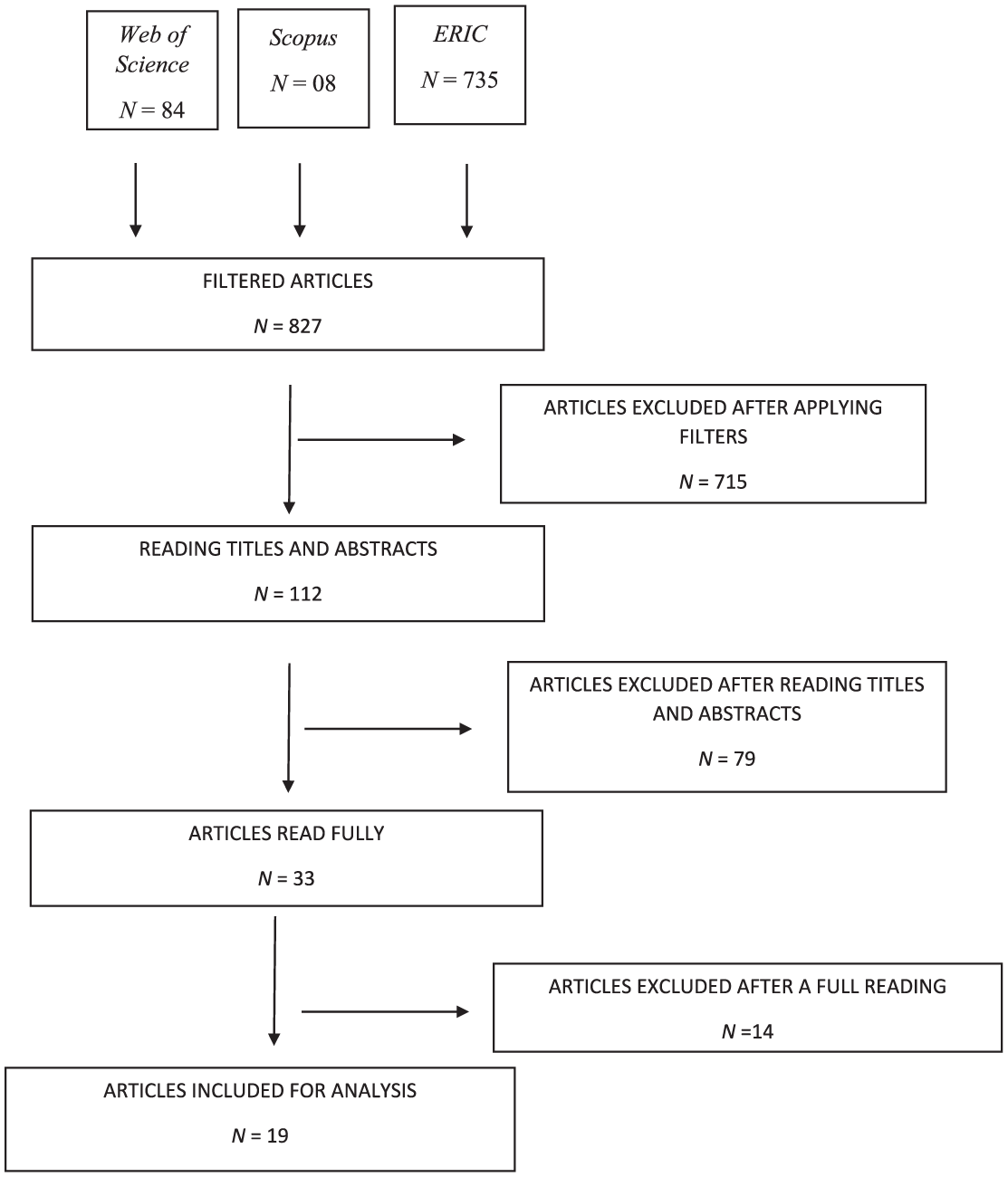
Flow of the collection and selection of articles in databases.
We found that no period stood out for more studies within the timeframe chosen (2019 to 2024); this balance and consistency in the research highlights the scientific salience of this study topic.
Regarding the countries of origin of the research, the United States predominates (seven articles out of a total of 19), followed by the United Kingdom and Finland (two articles each). The other countries identified in the results were China, Saudi Arabia, Malaysia, Italy, Turkey, South Africa, Spain and Norway, each with one article out of the total of 19.
Regarding the titles of the articles chosen, most of them used terms related to the interaction between play–learning–development. Therefore, the importance of playful learning stood out as a quality parameter for the preschool programmes.
The development processes related to the construction of symbolism in children reported in the studies referred to the cognitive, affective and psychomotor aspects of development. Table 1 provides a detailed description of these processes.
Development processes in the construction of symbolism.
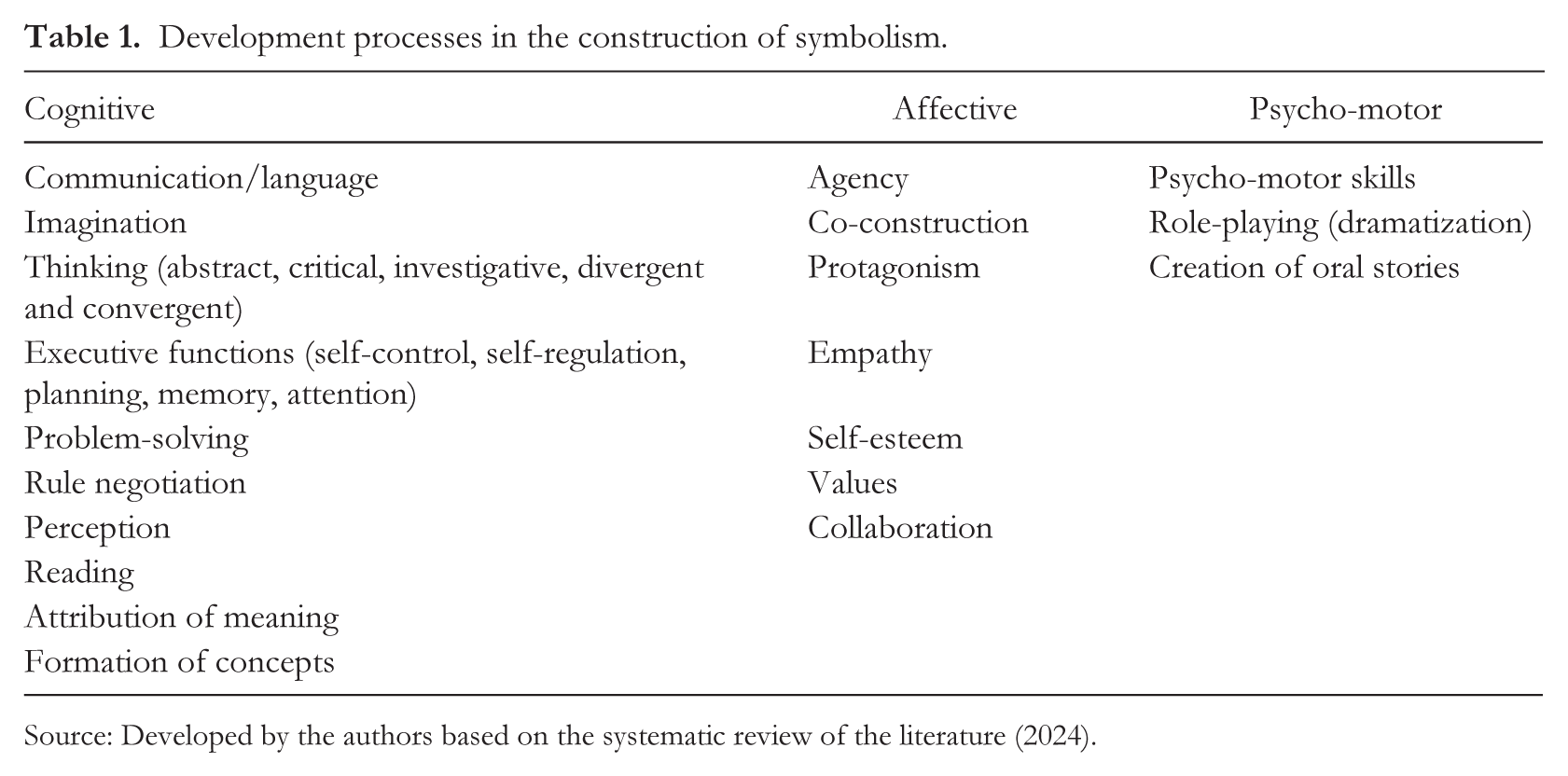
Source: Developed by the authors based on the systematic review of the literature (2024).
The articles investigated identified different interactions between children and teachers mediated by the symbolic use of objects (drawing, dramatizations, storytelling, music and singing, arts and crafts, reading, educational games, races, puppet theatre and imaginary play). These interactions took place in a wide variety of settings (inside and outside the school). It is important to note that imaginary play was the activity cited the most in the studies. Figure 2 shows the details of the interactions, participants, mediators (objects) and settings researched.
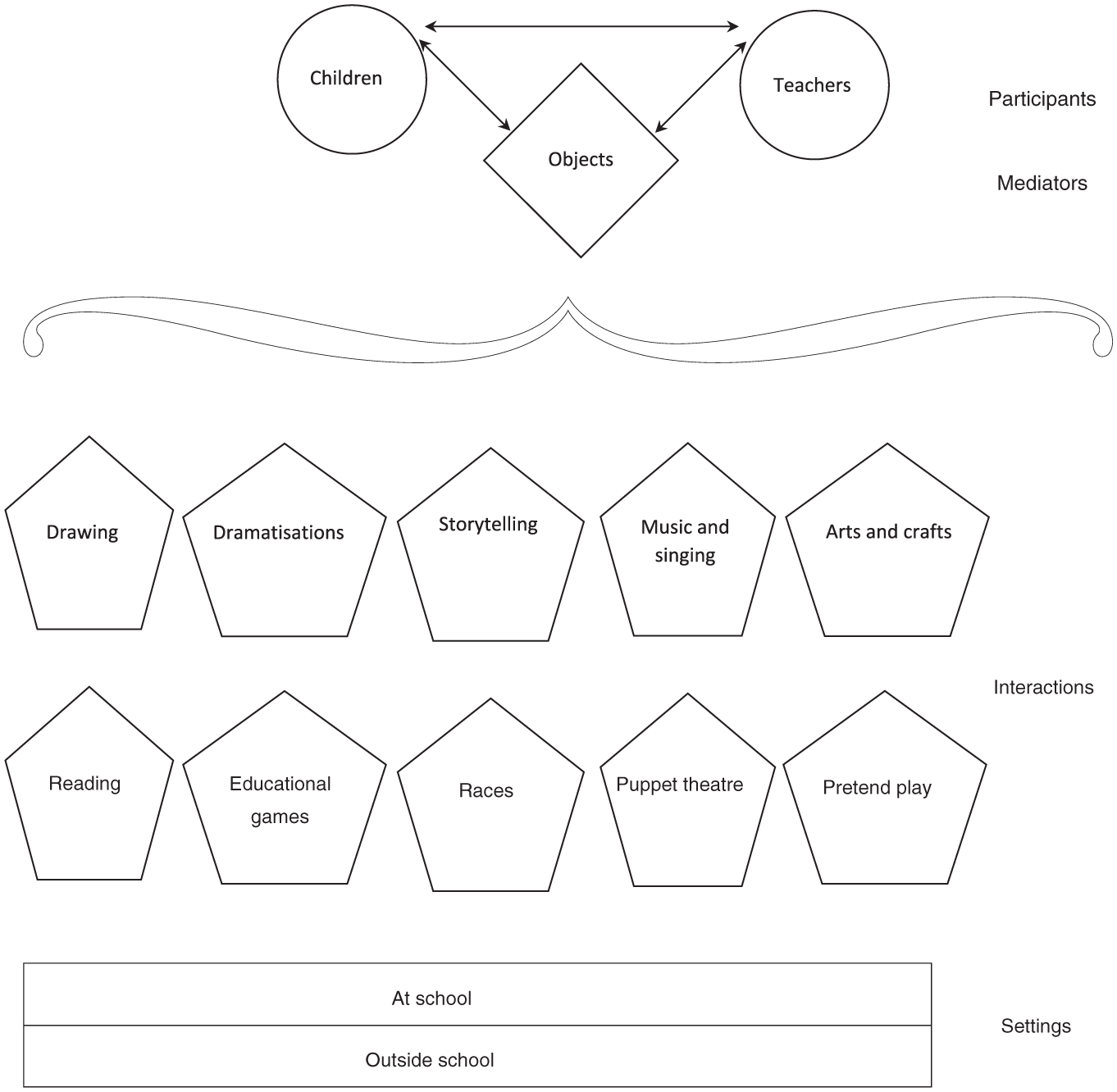
Interactions, participants, mediators and settings researched in the articles analysed.
Analysis and discussion
When analysing these empirical results, we found that the majority of the articles chosen stressed the role of play from a perspective which prioritizes the symbolic interrelation between play–learning–development, stressing the importance of pretend play in preschool. Likewise, criticisms of instructionism were identified, as well as arguments in defence of playful learning in preschool. However, some researchers advocated expanding research aimed at achieving a higher quality pattern in preschool programmes based on constructing and improving standardized assessment instruments and measuring symbolic play. The authors chosen come from a variety of origins; we believe this indicates that this is not an isolated issue in a certain culture but a shared concern among researchers from the different continents identified (Europe, North America, Asia and Africa).
The results were grouped into three analytical categories: symbolic play/co-creation/holistic development; quality standards in preschool education (convergences and divergences); and gaps in the research on play.
Symbolic play/co-creation/holistic development
Generally speaking, these results point to transformations, beyond imagination, that occur in child development in pretend play, which is also called sociodramatic or symbolic play. The research stories show that other complex symbolic processes are developed along with creative imagination which can contribute comprehensively to the child’s cultural development during the preschool education stage.
From this perspective, according to the articles examined, other processes are developed by means of pretend play, such as (see Table 1): divergent, convergent and abstract higher thinking (Lunga et al., 2022; Sando et al., 2023); executive functions like self-regulation, planning, memory and joint attention (Bodrova & Leong, 2019; Bondioli & Savio, 2021; Fedewa et al., 2024; Germeroth et al., 2019; Lunga et al., 2022; Sando et al., 2023); agency, co-construction and protagonism (Bodrova & Leong, 2019; Bondioli & Savio, 2021; Delfin & Wang, 2023; Hà, 2022; Wang & Delfin, 2024); communication/language (Alharbi & Alzahrani, 2020; Fedewa et al., 2024; Germeroth et al., 2019; Hà, 2022; Lunga et al., 2022; Wang & Delfin, 2024); empathy, self-esteem, problem-solving, cooperation, rules negotiation and values (Alharbi & Alzahrani, 2020; Bondioli & Savio, 2021; Lunga et al., 2022; Sando et al., 2023); psycho-motor skills, considering body–mind unity (Morales et al., 2022); and early literacy, attribution of new meanings, role-playing, story creation and concept formation (Bondioli & Savio, 2021; Delfin & Wang, 2023; Germeroth et al., 2019; Morales et al., 2022).
This suggests that symbolic play is positively interrelated with qualitative changes in the development of children’s cultural psychological processes, which matches Vygotsky’s (1987, 2000) criticism of mechanistic and biological perspectives on symbolization processes.
In order for the symbolic play that takes place in the preschool setting to have positive implications on children’s development, several equally important factors should be considered: the children’s individual needs and the essential role of teachers as the children’s ludic companions in imaginative co-creation experiences (Hà, 2022); the creation of ‘ludic ecosystems’ or intentionally planned contexts that favour children’s imaginative creations (Morales et al., 2022); and the provision of objects with multiple purposes (natural, everyday, toys, art supplies, building supplies, fantasy materials, etc.) to foster experimentation, creative imagination, concept formation, the understanding of the symbolic function of representation and children’s deep learning (Bodrova & Leong, 2019; Fedewa et al., 2024; Sando et al., 2023; Wang & Delfin, 2024).
Sando et al. (2023) define deep learning as a learning experience in which the child shows autonomy, well-being, concentration and commitment. Within the context of symbolic play, the autonomous, self-initiated and social aspects characteristic of this playing style positively influence the way children feel, and this has an impact on their participation and motivation during play. This type of experience leads to situations in which the children can feel well-being and commitment and therefore deep learning.
Even from this perspective, the importance that Bodrova and Leong (2019), Fedewa et al. (2024), Sando et al. (2023) and Wang and Delfin (2024) attach to the purpose of objects and that Hà (2022) places on the essential role of teachers as play companions renders it necessary to revisit Rodríguez and Moro’s (1999) proposals on the importance of triadic relationships (child–adult–object) in the child’s sociocultural development.
Regarding the purpose of objects for symbolic development, Bodrova and Leong (2019) claim that children need to practise imaginary actions with real objects and play accessories that they can use as pivots for the transfer of meaning, such as a pencil that becomes a magic wand, a rocket or a stick. However, the objects usually used to develop children’s imagination in preschool, like realistic toys (restaurant menus with tacos, sushi, etc.) or mechanical and electronic toys that move and speak, are actually resources that can only be used in a limited way and that therefore do not foster the children’s transition to creating more complex imaginary situations.
According to Hà (2022), playful connection refers to the teacher’s intentional act of planning and engaging in play with the child. Within this context of cooperative play, Bondioli and Savio (2021) assert that it is possible to create and recreate imaginative scripts between the teacher and child, which results in the development of complex skills like decentralization (admitting others as subjects in joint play), decontextualization (using replacement objects and assigning them a purpose different than their usual one) and integration (combining fictitious acts in a sequence of events and creating stories).
Despite this, in this process of playful cooperation, it is essential for the educator to strike a balance between providing support and giving children the freedom to create, and they must also be aware of the right time to offer support and collaboration in the play (Bodrova & Leong, 2019). Therefore, constructing an atmosphere that is propitious for symbolic play in preschool entails dynamic, purposeful teacher action; thus, in addition to organizing and supervising spaces and times, teachers perform intentional acts to instigate the children’s imagination and foster their psychological development (Bondioli & Savio, 2021).
Similarly, an important reflection in Germeroth et al. (2019) refers to the role of adult mediation in play. The authors clarify that within the preschool setting, pedagogical mediation is generally missing in symbolic play, or when it is promoted, little time is given to this activity, instead fostering more time to include adult-guided children’s recreation focused on developing academic skills through the proliferation of toys and games that limit children’s imagination. We believe that this type of situation occurs frequently because the erroneous idea that play is a natural act that is part of children’s nature and therefore requires no learning still prevails.
In this regard, Alharbi and Alzahrani (2020) stress that to promote a teaching practice based on a pedagogical approach that values the role of play in achieving effective learning, it is essential that these professionals’ pre-service and continuous training aims to develop an understanding of symbolic play and its value and importance in development. Given that play is an effective, suitable approach to holistic child development, when teachers support children’s learning through social-dramatic games, they are fostering the development of linguistic and social-emotional skills, laying the foundation for the next stage in school.
During the first few years of life, children tend to participate in social-dramatic play in which they simulate, create and take on roles using culturally mediated psychological symbols and instruments (Wang & Delfin, 2024). Small children’s holistic development can be expanded via a pedagogy based on both free and guided play (exploratory and manipulative play, and play with miniatures; games with rules, dramatization and imaginary play), because in these situations children challenge themselves to take decisions and solve problems, which results in them learning cognitive, linguistic and social-emotional skills (Lunga et al., 2022).
Delfin and Wang (2023) stress the fact that through imaginary play, children perform symbolic and embodied acts, take on imaginary roles, change their voices and produce culturally contextualized conversational content. Therefore, the cognitive development referred to here is not viewed as a mere linear progression in which the mind and body are separated: children’s imaginary constructions are anchored in the inseparable body/mind conjuncture (Delfin & Wang, 2023).
These reflections confirm the fact that child creation does not take place exclusively based on internal impulses but is instead developed through the social mediation of children’s needs and wishes through the use of symbols (Vygotsky, 2018). Furthermore, the creative imagination can be sparked experimentally in the preschool setting via a pedagogical approach that acknowledges the role of play in this stage in school and is planned with this intention in mind (Vygotsky, 2021).
In our opinion, all of these possibilities of holistic development through imaginary play (cited in the aforementioned studies) point to the need for this activity to be explored to the utmost in the daily routine in preschool education, making the school a space and time in which children imagine, create, learn and develop. Likewise, they also pose the issue of prioritizing the questioning of the purpose of imaginary play in this educational stage in order to break with the distorted perspective of this action as a secondary activity.
Quality standards in preschool education: convergences and divergences
The results point to three trends regarding the role of pretend play in preschool, two of them convergent and one of them disputed. The convergent ones highlight the interrelation between playful learning, children playing a prime role and the quality of preschool programmes. They are also opposed to instructionism in early childhood school learning. The controversial approach highlights the interrelation between standardized instruments to measure the act of playing and the quality of preschool programmes.
Within this context, Aden and Theodotou (2019), Bodrova and Leong (2019), Heikka et al. (2022), Liu et al. (2019), Lunga et al. (2022), Sintonen (2020) and Wang and Delfin (2024) point out that the quality of preschool curricular programmes depends on the specific use of playful learning and the children’s inclusion in decision-making processes — from planning to implementation and assessment of activities — from a perspective of the co-creation of play and culture, with an emphasis on children playing a prime role. From this perspective, too, Alharbi and Alzahrani (2020) and Bodrova and Leong (2019) criticize instructionism in preschool education and highlight the essential role of play as a pedagogical practice style that effectively supports early childhood learning.
Furthermore, Alharbi and Alzahrani (2020) state that instructionism is characterized by prioritizing direct academic instruction of small children instead of generating learning through play. In this educational context, routines are organized by goals and rigid assessment processes designed by the teacher without the children’s participation. Practically speaking, the materials, settings and times are not planned based on the children’s needs and interests. Likewise, there is an excessive focus on direct instructional activities and little time spent on free and exploratory play. This approach leads to an inflexible routine which is meaningless to the children and focuses on repetitive activities, memorization and automated tasks (Bodrova & Leong, 2019).
Further critiquing instructionism, Alharbi and Alzahrani (2020) report that it is under debate in certain countries: in the United Kingdom, the United States of America, Saudi Arabia, China, Canada, New Zealand, Sweden and the United Arab Emirates, there is a movement towards direct academic instruction in children’s early years, with the adoption of more standardized curricula. However, many educators have attempted to organize movements to resist this trend.
Expanding this debate, Heikka et al. (2022) and Sando et al. (2023) state that there is a movement against instructionism in preschool in the northern European countries, especially Sweden, Finland and Norway. These researchers claim that the governments of these countries prioritize flexible curricular guidelines and children’s active participation in decision-making processes. They also say that these countries are regarded as pioneers in including children in decision-making processes in preschool education, and that this is a legal achievement, given that the inclusion of children is guaranteed in official government programmes.
From this standpoint, the proposal of a playful pedagogy that prioritizes learning through play means considering the implementation of a flexible curriculum defined for and with children and the construction of a multimodal environment with a diverse range of resources that bear children’s needs in mind (Aden & Theodotou, 2019). Therefore, the goal is to provide the conditions needed for the children to play in a playful association without hindering their creative freedom (Bodrova & Leong, 2019).
A balanced approach between self-initiated play and play supported by preschool teachers is the right way to prevent symbolic play from becoming an exhausting, meaningless experience for children (Liu et al., 2019). Activities based on adult–child collaboration, a balance of power and trust in children’s agency are decisive changes for constructing curricular proposals based on a playful, participatory pedagogy in early childhood (Heikka et al., 2022).
For that reason, and in light of what the authors of the articles analysed have written, it is extremely important to revisit the propositions of Vygotsky (2018), who defended children as creative people, as well as more contemporary authors (Barbosa, 2011; Rodríguez, 2022) who show that children come to play the role of subject and protagonist of play through social relations in a given social context, and that their opinions and needs should be taken into account in the development of play within the context of preschool education.
However, from a different vantage point that emphasizes the standardization of processes, Germeroth et al. (2019) and Bondioli and Savio (2021) claim that the quality of preschool curricular programmes should be assessed via instruments that measure imaginary play. This means investing in the creation, fine-tuning and validation of measurement tools or standardized tests to assess the effectiveness of symbolic play in preschool education, and to provide educators and researchers with reliable, comprehensive assessments of children’s learning.
In our viewpoint, this proposal to measure imaginary play characterizes it as a mere pedagogical tool or assessment resource of the quality standards of preschool education and is a utilitarian or instrumentalizing perspective on play centred around the assessing adult. Furthermore, this approach distorts Vygotsky’s (2021) proposed understanding of imaginary play as a leading activity of children’s development in preschool education, and it neglects the child’s role as the subject and protagonist of play. Therefore, we believe that it is an erroneous and controversial way of viewing the role of play in child development and learning.
Gaps in the research on play
In our perspective, the studies analysed emphasize the importance of symbolic play and further explore its role in preschool education; however, they reveal that there are still research gaps in this field which may guide future studies on this topic and contribute to a broader understanding of the interrelated development and educational processes in early childhood.
Generally speaking, the research gaps identified in the period analysed (2019 to 2023) revolve around four main interrelated axes: the role of symbolic play in holistic development and deep learning in preschool education; the collision with instructionism in preschool education; children’s active participation in decision-making processes in preschool education; and teacher training with an emphasis on the role of play in early childhood educational practices.
Table 2 provides a summary of the future directions of research according to the authors of the articles analysed in this study.
Gaps in the research on play according to the articles analysed.
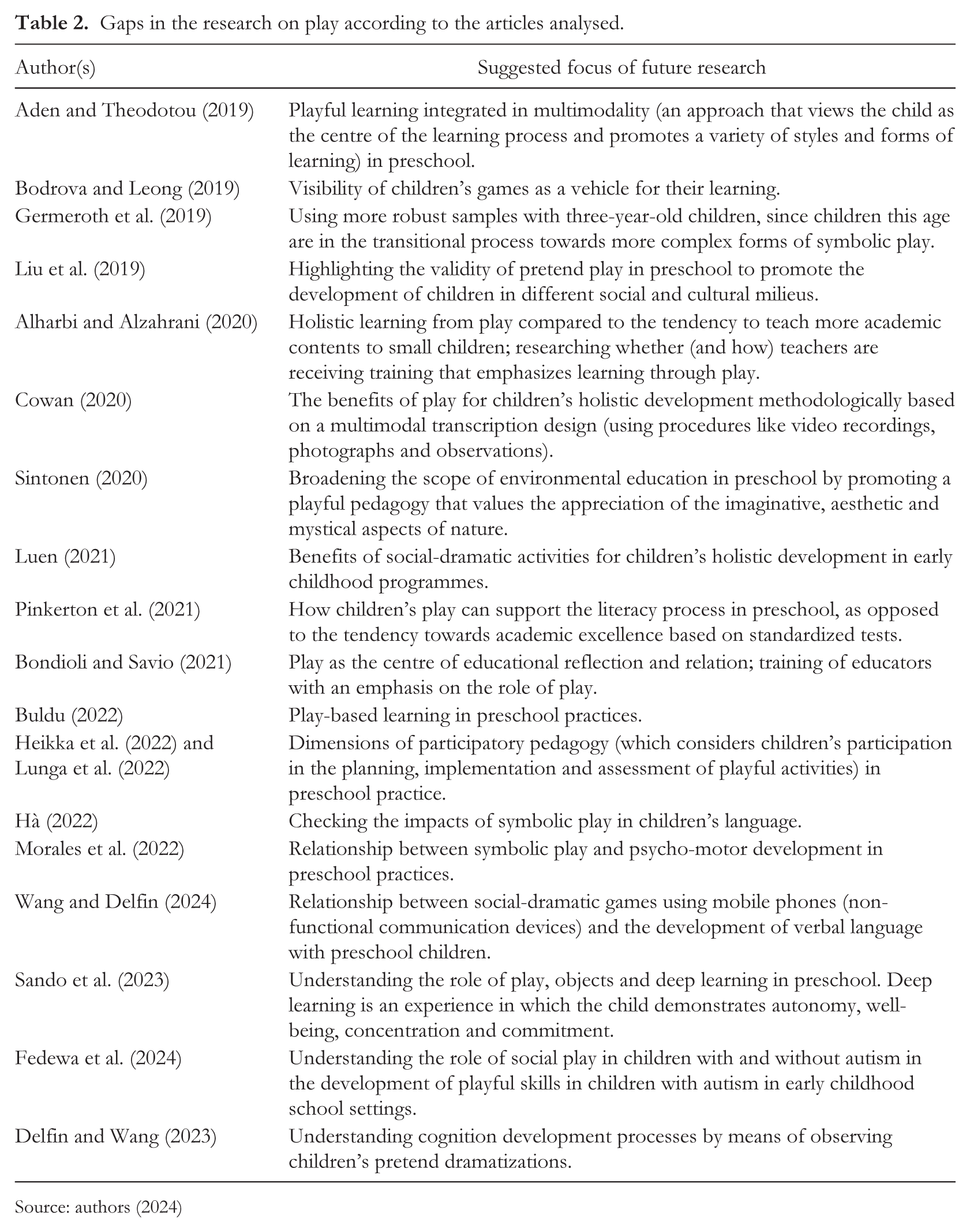
Source: authors (2024)
Final considerations
This study analysed how recent studies have addressed symbolization processes in preschool education settings. The study was based on the theoretical contribution of psychology from a bio-historical-cultural perspective, and we believe that the construction of symbolism in preschool children is a sociocultural process in which mediation through signs and the other is needed for learning and development to take place.
Throughout the course of this study, it became clear that even though many studies have been performed on the role of play in child learning and development, it requires further study. This need is especially clear in light of the critiques of rising instructionist movements in several contemporary countries studied by Alharbi and Alzahrani (2020), Bodrova and Leong (2019), Heikka et al. (2022), Prestes (2016) and Sando et al. (2023).
In our opinion, based on the reflections provided here on symbolic development in preschool settings, there is clearly an urgent need to define the social role played by schools in this educational stage and to revive and validate the purpose of play as an orientative, vital activity for children’s learning and development in this stage of childhood.