







Abstract
This study compares levels of intergroup threat and tolerance towards Venezuelan immigrants in Chile among university students and members of the general population, examining whether distinct latent profiles emerged in the full pooled sample. A total of 490 Chilean adults participated in the study, including 289 university students (M = 21.69, SD = 3.08) and 201 members of the general population (M = 41.88, SD = 15.77). Participants completed validated Chilean versions of the Intergroup Threat Scale and the Tolerance Scale. Descriptive analyses and independent-samples t-tests were conducted using JASP. To identify latent attitudinal profiles, latent class analysis (LCA) was conducted in the combined sample including both groups, and sample type (university students vs. general population) was subsequently included as a covariate to examine whether it predicted class membership. Results showed that university students reported significantly lower levels of perceived symbolic, realistic and security/safety threat than the general population, with large effect sizes. They also scored higher on appreciation of diversity, although no significant differences were observed in terms of acceptance or respect. The LCA conducted on the full sample supported a two-class solution. The first profile, labelled Committed-Tolerant (63%), was characterised by high levels of acceptance, respect and appreciation, together with low perceived threat. The second profile, labelled Ambivalent-Tolerant (37%), combined relatively high acceptance and respect with higher levels of perceived symbolic, realistic and security/safety threat. Additional analyses indicated that belonging to the general population significantly increased the likelihood of membership in the ambivalent, higher perceived threat profile. Overall, the findings suggest that attitudes towards Venezuelan immigrants in Chile are heterogeneous and cannot be reduced to a simple opposition between tolerance and rejection.
Introduction
In recent years, there has been sustained and accelerated growth in the immigrant population in Chile. According to the 2024 Census, the numbers of international immigrants reached 1,608,650, equivalent to 8.8% of the habitual resident population, whereas in 2017, this figure was 745,772 people (4.4%). This implies growth of 115.7% in seven years, showing that the demographic weight of this segment in the country doubled during the period (Instituto Nacional de Estadísticas, 2025). This scenario is partly responsible for placing migration processes front and centre of Chilean political and social debate.
In this context, the growing centrality of migration in the Chilean public debate has been accompanied by the consolidation of political discourses that frame it as an issue of security, sovereignty and social order. One of the most visible expressions of this trend has been Chile’s Partido Republicano (Republican Party). This populist radical right-wing movement has gained many followers by connecting authoritarian ideas with concern for national security and protection of the country’s sovereignty, all associated with the defence of the neoliberal economic model (Díaz et al., 2023). It is unsurprising, therefore, that one of the primary targets of their attack is immigration. Within this discourse, immigrants are presented as individuals who threaten national cohesion and the country’s stability. This became evident when, following the 2021 presidential campaign, the current president of the country and leader of the Chilean Republican Party, Jose Antonio Kast, proposed tightening penalties for undocumented immigrants and creating a trench to prevent undocumented immigrants from entering Chile (Díaz et al., 2023; Kast, 2021). The discourse of this party, therefore, also helps to understand how, in the recent Chilean context, immigration has been increasingly associated with frameworks of threat, danger and defence of social order.
Although these transformations acquire specific characteristics in Chile, they are part of a broader global scenario characterised by the sustained increase in international migrations. In their classic book published more than three decades ago, Castles and Miller (1993) anticipated the advent of the ‘age of migrations’, arguing that deep economic inequalities between countries would drive massive flows of people seeking better living conditions in the twenty-first century. This prediction has been widely confirmed since international migrations are an unavoidable topic on contemporary political and academic agendas. According to a recent report by the International Organization for Migration (McAuliffe & Oucho, 2024), 281 million people reside outside their country of origin, representing 3.6% of the global population. However, economic factors are not the only ones that drive people to migrate. Political instability and widespread violence have forced 117.3 million people to displace to preserve their lives and those of their families (United Nations High Commissioner for Refugees, 2025).
Faced with this scenario, negative perceptions towards immigration are frequent and often fuel xenophobic attitudes. In these reactions, Huntington’s (1993) thesis seems to resonate, positing that future conflicts would be marked by a ‘clash of civilisations’, stemming from the alleged incompatibility between the cultural matrices of the West and other traditions, particularly Islamic ones. In this context, migratory flows, especially from the Middle East to the West, have contributed to immigrants being perceived as an economic threat as well as a peril to individual and group safety and security (Xavier, 2018). However, as various authors argue (Ayoob, 2012; Lucassen, 2025), a review of historical sources shows that although immigration often arouses distrust, there are numerous cases where cultural integration has not led to the disappearance of the host society but rather to its revitalisation and enrichment. In that sense, both real and virtual intergroup contact have also fostered favourable attitudes towards immigration in certain sectors of society, especially among younger and more educated individuals.
Social psychology was one of the earliest disciplines to recognise the importance of this phenomenon, as evidenced by the special issue that the Journal of Social Issues devoted to this subject in 2001. Since then, interest in migration has only intensified, resulting in a large body of research addressing both the perspective of the immigrants themselves and that of the host societies (Esses, 2021; Navas, 2020; Schwartz et al., 2025). The present study is situated in the domain of the host society and focuses on analysing perceived threat and tolerant attitudes towards immigration, using Venezuelan migration in Chile as a case study, a phenomenon of particular relevance in the Latin American context.
Within this line of research, special attention has been given to psychosocial constructs linked to xenophobic attitudes and behaviours, which represent a serious obstacle to the integration of immigrants (Albarello et al., 2023). Among them, one of the most widely analysed constructs is perceived intergroup threat (Stephan & Stephan, 2000), in its realist, symbolic and security/safety dimensions (Lutz & Bitschnau, 2023). The literature shows that these threats channel prejudice into specific forms of rejection. For example, realistic threat explains why prejudice increases rejection towards immigration in general, while symbolic threat explains why prejudice increases rejection towards immigrants obtaining citizenship in the country of residence (Pereira et al., 2010). In these investigations, however, the dominant approach treats the different types of threat separately, neglecting to explore how they interact and combine within individual cognition, thereby limiting the capacity to identify subgroups with distinctive threat profiles.
Although the abundant research on intergroup threat has provided valuable information for understanding negative attitudes towards immigrants, less attention has been given to factors that promote positive coexistence such as intergroup tolerance (Navas, 2020; Verkuyten, 2018). This asymmetry in scientific production proves problematic, since understanding only the mechanisms of rejection offers an incomplete view of intergroup dynamics in contexts of increasing diversity (Sirlopú et al., 2024). Recently, research has begun to analyse tolerance from a multifaceted perspective, recognising that it is not a unitary phenomenon but comprises different dimensions such as acceptance, respect and appreciation of diversity, which can vary in intensity and configuration from one individual to another (Hjerm et al., 2020; Verkuyten et al., 2020). Contemporary research also highlights that respect based on equality constitutes a key normative foundation for tolerance towards minorities, serving as a more robust predictor of positive attitudes than mere acceptance (Gurbisz et al., 2025; Samba et al., 2025).
In a scenario of intraregional migration like the one found in Chile, this distinction proves particularly significant due to the coexistence of high levels of acceptance with a sector of Chilean society expressing perceived threats in relation to Venezuelan immigrants, as reported by recent studies (Geist, 2020; Navarro-Conticello, 2024). Consequently, moving beyond a one-dimensional conception that positions intergroup threat and tolerance as opposites on a continuum and instead adopting an approach that understands them as relatively independent dimensions, yet capable of combining in complex ways among different social groups—as is the case, for example, between the highly educated population and the general population—could represent a valuable contribution to the social psychology of immigration.
Much of the evidence on social attitudes comes from university samples. The data usually show a positive association between a higher level of education and favourable attitudes towards diversity, such as support for minorities, greater intergroup contact and increased acceptance of cultural differences (Heerwig & McCabe, 2009; Hello et al., 2006; Pettigrew & Tropp, 2006; Weldon, 2006). However, direct comparisons on attitudes between university students and general samples remain scarce and do not yield consistent differences. Moreover, some authors question this association, suggesting that individuals with higher education are not necessarily less prejudiced or more tolerant but rather respond more consciously or in a socially desirable manner to such measures (Adman & Gschwind, 2023).
Considering previous research findings, the aim of this study is to identify possible joint profiles of intergroup threat and tolerance towards Venezuelan immigrants through latent class analysis. To do this, we compare attitudes towards this minority in two samples of Chileans (university students and members of general society). The following sections develop each of the key concepts.
Perceived Intergroup Threat
Intergroup threat arises when members of one group perceive that another group represents a danger to their survival, which activates intense negative emotions (Stephan & Mealy, 2011). The importance of this construct is reflected in a list of models that include it as a central component, namely, Realistic Group Conflict Theory (Sherif, 1966), Integrated Threat Theory (Stephan et al., 1999), the Socio-Functional Model of Prejudice (Cottrell & Neuberg, 2005) and the Unified Instrumental Model of Group Conflict (Esses et al., 2005).
The literature has mainly dealt with two types of threats related to immigration. The first one is realistic threat based on the suspicion that immigrants might take tangible resources away from nationals, such as jobs or access to schools (Martínez et al., 2022; Stephan et al., 2009). In this regard, this minority is perceived as direct competition that will deprive them of their privileged social position to which they feel entitled, having been born in that country (Esses et al., 2010; Hjerm & Nagayoshi, 2011). The second type is symbolic threat and is associated with the concern of nationals that their traditions and values may be altered by this minority. When the lifestyles of immigrants are perceived as very different from those of the host society, the members of this group feel their social identity is under threat, which accentuates in-group bias and rejection of immigrants (Gonçalves et al., 2023).
The distinction between these two types of threat has been established in previous research, confirming that, independently or together, they predict negative attitudes towards immigrants (Cottrell & Neuberg, 2005; Riek et al., 2006). For example, symbolic threat more strongly predicts opposition to immigrants obtaining nationality from the host country than realistic threat (Pereira et al., 2010). Research has also found differences in the emotions linked to both types of perceived threat. Thus, nationals who perceive immigrants as a threat to their economic security mostly express anger, while those who perceive threats to their traditional values evoke a sense of pity, in that immigrants are seen as incapable of adequately reciprocating in intergroup relations (Aubé & Ric, 2019; Yao et al., 2025). However, despite the significant amount of research devoted to both threats, a robust theory explaining their psychological foundations is yet to be established (Yong et al., 2021).
A third type of threat that has been studied to a lesser degree is related to safety and security. This emerges when nationals believe that immigrants represent a serious danger to the individual and collective integrity of their society. This threat is more common in countries that have experienced increases in crime rates or where terrorist acts have occurred (Helbling & Meierrieks, 2022; Lutz & Bitschnau, 2023). The evidence shows that the threat to security/safety is a very sensitive issue for citizens, causing many of its members to hold immigrants responsible for all crimes committed in a country (Ajzenman et al., 2020). For example, in the case of Islamophobia, evidence indicates that different forms of perceived threat influence attitudes towards Islamism differently. Thus, symbolic threat is positively associated with prejudice towards Muslim individuals and with rejection of Islamism. For its part, realistic threat is specifically linked to prejudice against Muslims, while security/safety threat, in this case, terrorism, solely predicts anti-Islamic sentiments (Uenal, 2016). These findings underline the importance of considering the multiple dimensions of perceived threat as distinct when studying attitudes towards immigrants.
Intergroup Tolerance
Tolerance has been explored by two theoretical perspectives within social psychology. The first has a long tradition and establishes that although the lifestyles and values of immigrants may generate discomfort among nationals, in democracies it is assumed that all individuals in society (including said minority) must be respected as citizens with equal rights. Under this principle, nationals tolerate the cultural practices of immigrants and allow their expression (B. Simon, 2023; Verkuyten et al., 2020). Evidence supporting this approach is provided by Gurbisz et al. (2025), who reported that respect as equals among the Polish majority is positively associated with tolerance towards the Jewish minority in this country.
The second approach is more recent and proposes that tolerance should be understood as a positive appreciation of any type of diversity and can be expressed in different forms (Forst, 2017). This notion has been incorporated into the guidelines of various international organisations (United Nations, 2004). Within the framework of this approach, Hjerm et al. (2020) developed an instrument to assess tolerance for diversity that includes three dimensions: acceptance, respect and positive valuation. Cuadrado et al. (2021) corroborated this structure in a Spanish sample in which these dimensions were negatively related to contemporary racism towards Moroccan immigrants. Workplace studies report that individuals with low levels of tolerance and high levels of perceived threat tend to rate immigrant candidates (Moroccan) more negatively and show less willingness to assist them (Cuadrado et al., 2025).
Relationship Between Perceived Threat and Tolerance Toward Diversity
While the varieties of intergroup threat and tolerance have been studied separately, both constructs are closely related. The evidence suggests that when the perceived threat of an outgroup increases, tolerance towards them tends to decrease significantly (Gibson & Bingham, 1982). In the US and Europe, it has been reported that economic threat intensifies political intolerance towards immigrants, which translates into less willingness to grant them the same civil liberties as members of the majority ingroup (Gandenberger et al., 2025). An experimental study with South African university students showed similar results, where greater intergroup threat significantly increased political intolerance towards different outgroups among the students (Ojiambo & Louw, 2015). Altogether, these findings emphasise that perceived threat fosters support for exclusionary behaviours and policies towards immigrants, undermining tolerance towards this group in the host society.
Venezuelan Migration in Chile
One of the human mobilisations that are sparking interest among social scientists is Venezuelan migration. Hyperinflation, the scarcity of basic resources and the collapse of its institutions have led almost eight million people to leave Venezuela in just a few years (González Rubio et al., 2024). Eighty per cent of Venezuelans (including whole families) have chosen countries in Latin America and the Caribbean as their destination, mainly Colombia (29.9%), Peru (19.8%) and Chile (19.7%) (Alto Comisionado de las Naciones Unidas para los Refugiados, 2023). In Chile, according to figures from the country’s National Institute of Statistics and its National Immigration Service (Instituto Nacional de Estadísticas de Chile y Servicio Nacional de Migraciones, 2024), Venezuelan migration increased from 2% in 2018 to almost 30%. Currently, about 700,000 Venezuelans live in Chile (41.6% of the total foreign population), making them the largest immigrant group in this country.
Research has shown that the arrival of immigrants often generates reactions of suspicion, fear and even rejection among citizens, and Chile is no exception. The first wave of Venezuelan immigrants who arrived in Chile before the Covid pandemic was favourably received because the vast majority were professionals in disciplines that were necessary in society, such as medicine (Universidad Central de Chile, 2025). After this period, this favourable reception changed drastically due to various factors, including the increase in medium- and low-socioeconomic-level immigrants, many of whom entered the country irregularly (Reyes, 2023). For their part, traditional and social media began to spotlight news about crimes involving foreigners, including Venezuelans (Bezerra Ferreira, 2023). This not only created a very hostile climate in public opinion but also permeated governmental decisions. Thus, Law 21325 was passed in 2021, introducing stricter measures to regulate the entry of immigrants, including administrative expulsions for individuals entering Chile through unauthorised crossings (Biblioteca del Congreso Nacional de Chile, 2021).
National surveys and public opinion studies show that Chileans’ attitudes towards immigration vary significantly depending on the migrant’s nationality, with more restrictive attitudes shown particularly towards Venezuelans and Colombians (Salgado, 2024). These stances are not primarily explained by racial criteria but rather by the symbolic association of certain nationalities with preconceptions regarding public safety, institutional pressure and social disorder, which are reinforced both by the recent composition of migration flows and by widely disseminated discursive frameworks in public and media debates (Salgado, 2024).
Research from social sciences reports that the attitudes of the national populace towards Venezuelan immigration are configured in an ambivalent manner, combining affective expressions of relational proximity with persistent perceptions of distance and threat (Geist, 2020). On the one hand, studies on intergroup contact and affect show that Chileans express relatively more favourable evaluations of the Venezuelan population compared to other Latin American groups, such as Peruvians or Colombians, expressing higher levels of intergroup and affective closeness towards this group (Arancibia & Cárdenas, 2022). But, on the other hand, analysis of digital discourse shows very negative opinions towards Venezuelan immigration. For instance, the analysis of 1,796 reader comments on digital news stories published in the Chilean press identified 33 predominant themes, where Venezuelan immigrants are described as criminals, invaders, political operators associated with Chavismo or unfair beneficiaries of the social system (Navarro-Conticello, 2024). Consistent with these findings, reports highlight a strong association of this group with crime, drug trafficking and violence, portraying them not only as responsible for thefts or crimes but also as bearers of a general threat to the country’s security. Likewise, they are attributed with mundane, cultural traits such as being noisy, problematic and not fitting in with local norms, which reinforces the notion that they would represent not only a security or safety problem but also a symbolic threat to the national culture. However, within this same discursive repertoire, some positive evaluations emerge that describe them as nice people, ‘cool’, friendly and fun-loving, traits associated with preconceptions surrounding ‘being Caribbean’ (Universidad Central de Chile, 2025). Finally, from the perspective of the migrant experience, a significant proportion of South American migrants (mainly Venezuelans) perceive high levels of discrimination in the Chilean context (Navarro-Conticello & Moyano-Díaz, 2023).
In our view, in order to tackle this attitudinal ambivalence towards Venezuelan immigrants, we must go beyond literature-focused approaches, which tend to average out individuals’ responses. However, this methodological decision may conceal the presence of heterogeneous attitudinal patterns, impoverishing the theoretical interpretation of the data. For this reason, the present study employs a person-centred approach through latent class analysis (LCA). The aim is to identify differentiated profiles of perceived threat towards Venezuelan immigrants and tolerance toward diversity among members of Chilean society. Likewise, it seeks to examine the existence of variations among Chileans depending on whether they are university students or members of the general population. This approach allows us to capture the coexistence of negative and positive attitudes in an individual and, in turn, identify population subgroups that may require differentiated psychosocial interventions to promote an environment for adequate intercultural coexistence.
General Description of the Study
This study has two objectives. The first is to compare the levels of perceived intergroup threat towards Venezuelan immigrants and tolerance towards diversity in Chile across two samples: one consisting of university students and the other of individuals from the general population. This decision is due to the fact that university students tend to express favourable opinions towards minorities compared to the rest of society (E. Simon et al., 2025). Sociodemographic factors, such as level of education, modulate both perceived threat and tolerance towards migrants. The evidence available shows that individuals with higher levels of education tend to perceive immigrants as less threatening because education fosters more open and cosmopolitan values (Konings & Mosaico, 2020). Consequently, university students are expected to express lower levels of perceived intergroup threat and greater tolerance towards Venezuelan immigrants compared to the general sample.
The second objective was to identify latent classes of intergroup threat towards Venezuelan immigrants and tolerance towards diversity based on the complete sample. This decision is based on the understanding that the interest of the study is not to estimate independent class solutions for university students and the general population but rather to examine whether differentiated attitudinal configurations emerge within the group of participants based on the combination of both variables and their dimensions. According to this logic, the type of sample is not treated as a basis for estimating separate models but rather as a subsequent covariate intended to evaluate whether belonging to one group or another is associated with a higher probability of integration into the identified profiles. For this purpose, LCA will be used, a statistical technique capable of identifying underlying classes or subgroups in a population based on similar response patterns to two or more items among individuals (Vermunt & Magidson, 2002). Since LCA is an exploratory process, no specific number of classes is hypothesised.
Method
Participants
The sample size was determined considering the criteria proposed for conducting LCA, which suggest having at least 50–60 cases in the smallest class to ensure stable model identification (Collins & Lanza, 2010). The two-class solution yielded an entropy of .976 and a significant LMR-LRT, indicating adequate class separation and sufficient statistical power (Dziak et al., 2014; Nylund-Gibson & Choi, 2018).
The survey was completed by 490 participants: 289 university students between 18 and 58 years old (M = 21.69; SD = 3.08) and 201 Chileans from the general population between 18 and 75 years old (M = 41.88; SD = 15.77). Regarding the gender of the participants, in the university sample, 68.4% identified as female and 28.7% as male, and 2.8% identified as ‘other’. In the general population sample, the gender distribution was practically balanced with 50.2% women. Regarding the region of residence, in the university sample (n = 282), all participants (100%) reported residing in the Biobío Region. For its part, the general population sample (n = 201) presented a more diverse geographical distribution, although with a marked predominance of the Metropolitan Region, which accounted for 37.8% of the cases (n = 76). This was followed by the Biobío Region (11.4%, n = 23) and the Valparaíso Region (10.9%, n = 22).
The general population sample was obtained through the survey company Netquest, which has panels of people throughout all regions of Chile. A sample of 200 individuals was requested, representing the following aspects: the number of people from each of Chile’s 16 regions, gender and age. For the university sample, convenience sampling was used, sending out an invitation email to students at a private university in Chile, with prior authorisation from the institution’s ethics committee.
Instruments
Both instruments were scored on a five-point Likert scale (1 = ‘strongly disagree’, 5 = ‘strongly agree’).
Perceived Threat Scale
Developed by Navas et al. (2012), with validity evidence in Chile by Carmona-Halty et al. (2018). It consists of 13 items distributed across the three types of threat: symbolic (four items: ‘Our cultural traditions, for example, celebration of festivals, Chilean traditions’), realistic (six items: ‘Access to the state benefits system, for example, housing benefits, unemployment benefits’) and safety and security (three items: ‘Personal safety, for example, likelihood of being a victim of a crime’).
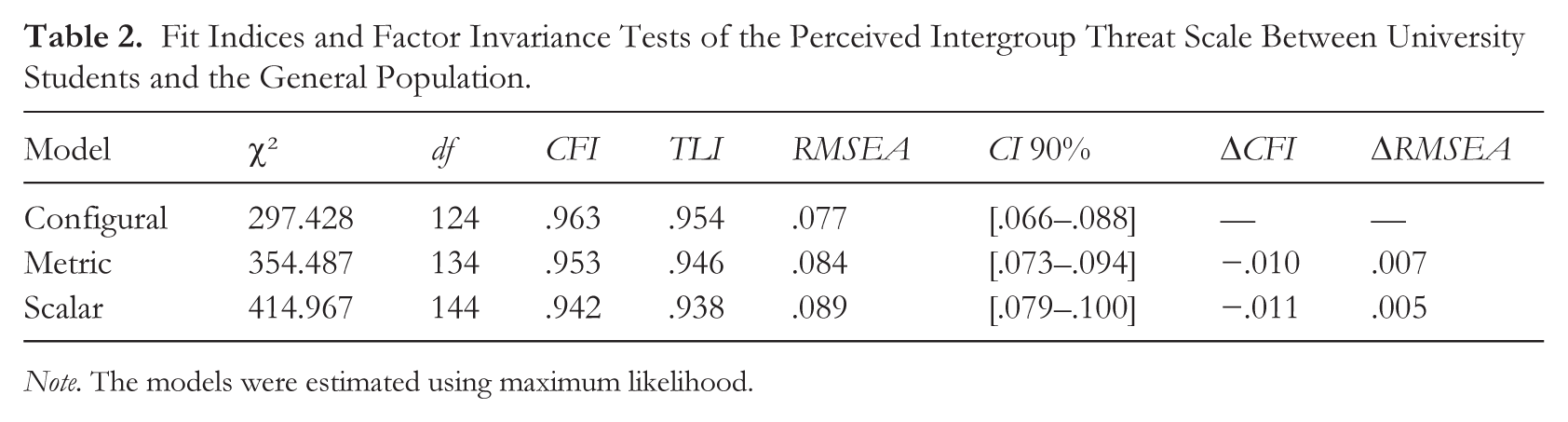
The factorial invariance of the intergroup threat scale between the two samples was evaluated (Table 1). The configural model showed a good fit, CFI = .963, TLI = .954, RMSEA = .077, 90% CI [.066, .088], supporting the equivalence of the factorial structure between the two groups. Subsequently, the imposition of metric restrictions resulted in a minimal change in the fit indices (ΔCFI = −.010; ΔRMSEA = .007), supporting metric invariance, values that are within the recommended criteria (Cheung & Rensvold, 2002), suggesting that the relationships between the indicators and the latent construct are comparable across both samples. Finally, the scalar model, which adds restrictions on the intercepts, showed a change in CFI compared to the metric model of ΔCFI = .011. Although the ΔCFI slightly exceeds the conventional cut-off point, the changes in RMSEA (.005) remain within the recommended limits for evaluating scalar invariance. This suggests that the additional restrictions do not substantially impair the model’s fit.
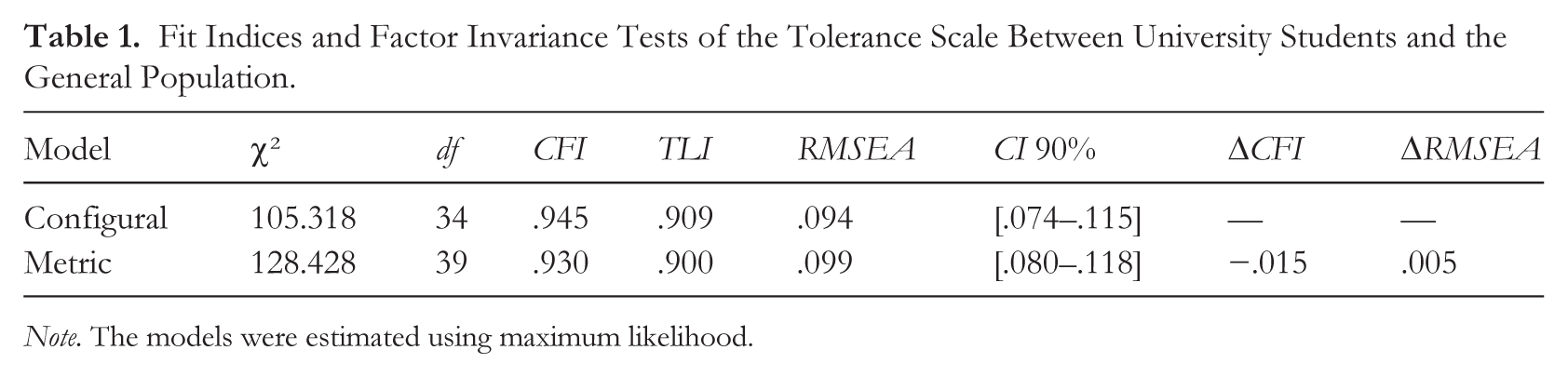
Fit Indices and Factor Invariance Tests of the Tolerance Scale Between University Students and the General Population.
Note. The models were estimated using maximum likelihood.
Concerning reliability, the three dimensions of the threat scale—symbolic, realistic and safety/security—demonstrated high internal consistency: symbolic threat, ω = .91, 95% CI [.895, .922], realistic threat, ω = .95, 95% CI [.940, .955], and safety/security threat, ω = .92, 95% CI [.911, .935]. Overall, the coefficients demonstrate high reliability and adequate precision of the subscales.
Tolerance Scale
Developed by Hjerm et al. (2020), with validity evidence in Chile by Sirlopú et al. (2024). It contains eight items that comprise three dimensions of tolerance for diversity: acceptance (three items: ‘It is important that people have the freedom to live their lives as they wish’), respect (two items: ‘I respect the opinions of other people even when I don’t agree’) and appreciation (three items: ‘Society benefits from a diversity of traditions and lifestyles’).
The factorial invariance of the tolerance scale was examined by means of multi-group confirmatory factor analysis (Table 2). Firstly, the configural model showed an acceptable fit to the data, CFI = .945, TLI = 909., RMSEA = .094, 90% CI [.074, .115], indicating that the factorial structure is equivalent in both samples. Subsequently, metric invariance was assessed by restricting the factor loadings, noting a poorer fit, CFI = .930, TLI = .900, RMSEA = .099, 90% CI [.080, .118]. The results suggest partial evidence of metric invariance. Although the RMSEA indicated model stability (ΔRMSEA = .005), the change in CFI exceeded the conventional threshold (ΔCFI = −.015), suggesting possible differences in the relative contribution of indicators to the construct between groups. Finally, the estimation of the complete scalar model was limited by the structure of the scale, since the respect dimension is composed of only two indicators. Methodological research indicates that factors with two items present less parametric stability and can generate unstable estimates in multi-group confirmatory models, especially when additional constraints are imposed on intercepts (Marsh & Bailey, 1991; Marsh et al., 1992).
Fit Indices and Factor Invariance Tests of the Perceived Intergroup Threat Scale Between University Students and the General Population.
Note. The models were estimated using maximum likelihood.
Regarding the internal consistency of the dimensions of the tolerance scale, the results show differentiated levels of reliability. Acceptance showed a high level of consistency (ω = .85), followed by respect, which presented an adequate level (ω = .77). In contrast, the appreciation dimension showed moderate consistency, ω = .67, 95% CI [.618, .718], indicating sufficient internal consistency, although lower than that observed in the other dimensions.
Data Analysis
Data processing and statistical analysis were carried out using the software JASP (JASP Team, 2026) and Mplus 8.5 (Muthén & Muthén, 1998–2017). Descriptive statistics were calculated for the study variables. To address the first objective of the research, Student’s t-tests for independent samples were conducted to compare the average levels of perceived threat and tolerance between the university sample and the general population. The magnitude of the differences found was assessed using Cohen’s d estimator.
To address the second objective and identify threat and tolerance classes in the total sample, Latent Class Analysis (LCA) was conducted using items from both scales. Given the exploratory nature of this technique, successive models from one to five classes were tested. The selection of the optimal factor solution (number of classes) was based on the integration of statistical fit criteria commonly used in the literature (Sinha et al., 2021): the Akaike Information Criterion (AIC), the Bayesian Information Criterion (BIC), the adjusted BIC (aBIC), the Lo-Mendell-Rubin Likelihood Ratio Test (LMR-LRT), and Entropy to assess classification accuracy and the theoretical interpretability of the resulting profiles. Finally, after selecting the most appropriate model, we examined whether belonging to the sample (university students vs. the general population) predicted the probability of integration into the classes identified, incorporating this categorical variable as a covariate in the latent model and analysing the resulting Odds Ratios through logistic regression.
Results
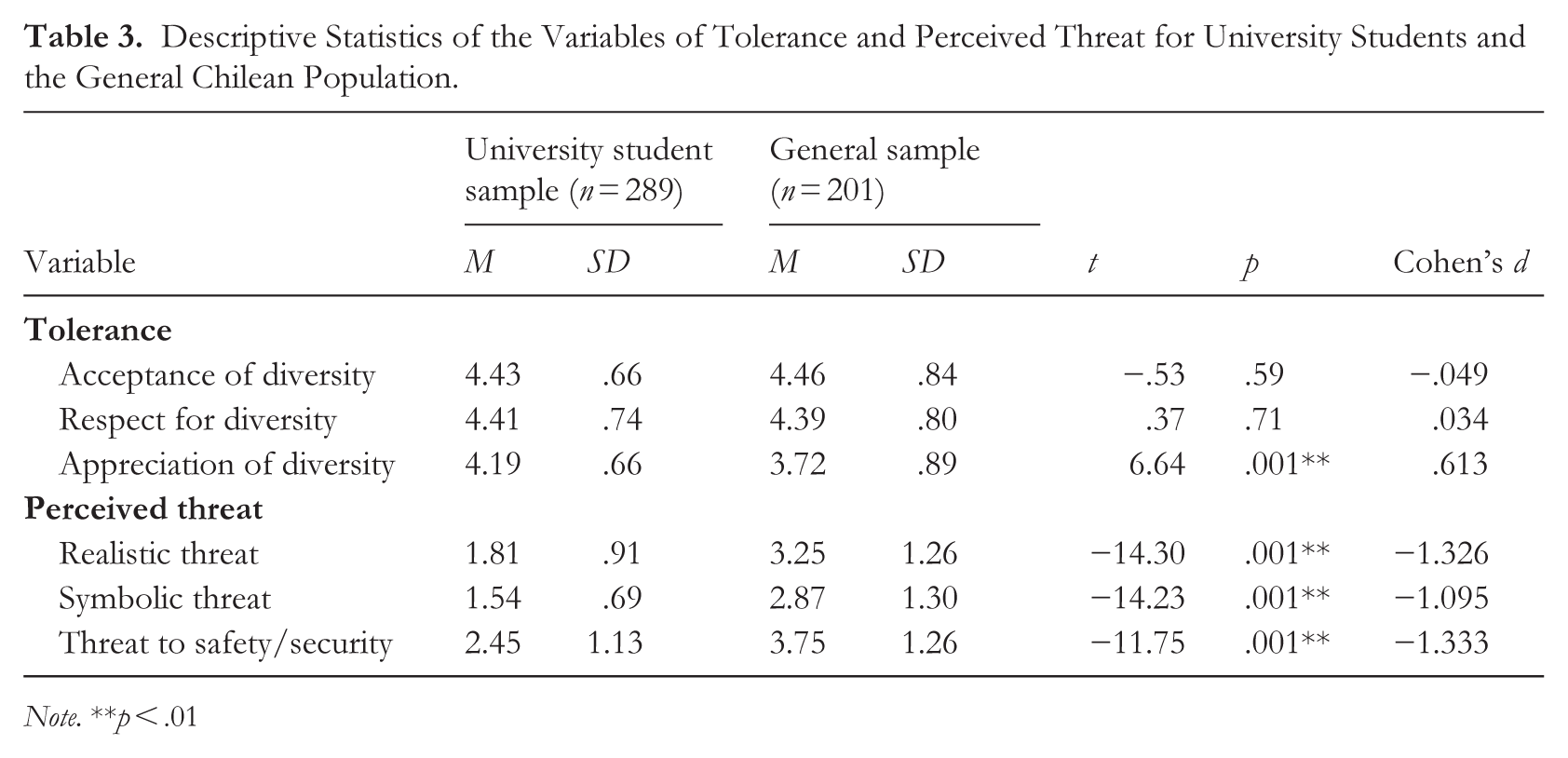
Descriptive analysis was conducted on the perceived intergroup threat and tolerance scales, including comparisons between the two samples. At the top of Table 3, we can see that, as predicted, university students obtained lower scores in the three types of perceived intergroup threat compared to the general sample. Regarding tolerance, both samples obtained tolerance levels above the midpoint (3) of the scale. However, university students only expressed greater appreciation for diversity than the general sample, so our prediction is partially accepted. The results indicate statistically significant differences between the university sample and the general population in the three dimensions of threat: realistic, symbolic and safety/security (all p < .001). These differences are accompanied by large effect sizes, with Cohen’s d values ranging from −1.095 to −1.333, suggesting substantive discrepancies between both groups in the perceived threat associated with Venezuelan immigration. Regarding tolerance dimensions, no statistically significant differences were observed between the university sample and the general population in terms of acceptance or respect, also showing small effect sizes (d = −.049 and d = .034, respectively). In contrast, a statistically significant difference was identified in the dimension of appreciation for tolerance to diversity (p < .001), accompanied by a moderate effect size (d = .613), suggesting a relevant difference between university students and the general population.
Descriptive Statistics of the Variables of Tolerance and Perceived Threat for University Students and the General Chilean Population.
Note. **p < .01
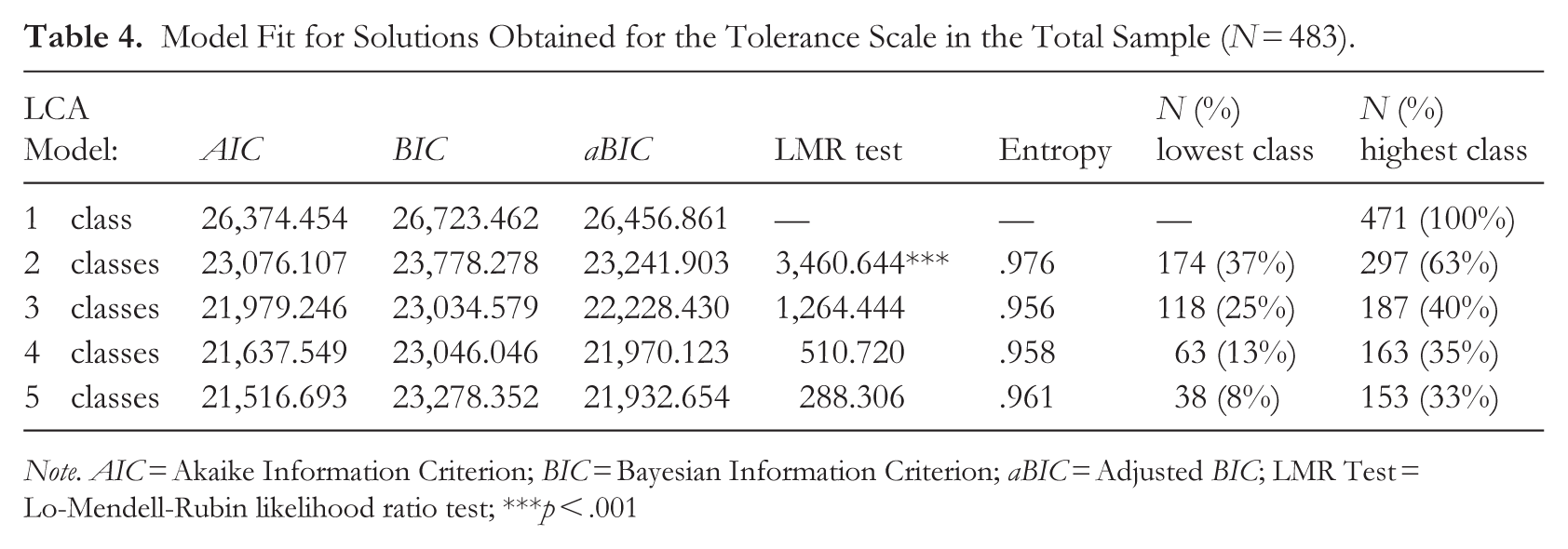
To perform the LCA, the data from both samples were combined, and 19 cases (4%) were removed due to lack of information, with the analysis conducted on the responses of 471 participants (96%). Table 4 reports models with one to five latent classes for tolerance and threat scales, with the two-class solution being selected. The choice of this model was based on several criteria that included fit, classification quality, class sizes, parsimony and theoretical meaning. The two-class solution offered the best balance among the chosen indicators. Looking at the AIC, a five-class solution is supported, but this indicator tends to overestimate the number of classes and also shows classes with a small number of participants. As for BIC and aBIC, the three- and four-class solutions presented minimal improvements in values when compared to the two-class solution, so additional measures were adopted. The LMR test indicated that the two-class model exhibited a significantly better fit than the one-class model (p < .001), while the three- and four-class models did not significantly improve on the two-class solution (p > .05). Likewise, the entropy of the two-class solution was the highest, indicating a higher level of accuracy when separating the classes. The quality of the classification was adequate, demonstrating high accuracy in assigning individuals to their respective latent classes, with a high level of entropy (.976) and average posterior probabilities exceeding .99 on the diagonal, supporting the robustness of the two-profile model.
Model Fit for Solutions Obtained for the Tolerance Scale in the Total Sample (N = 483).
Note. AIC = Akaike Information Criterion; BIC = Bayesian Information Criterion; aBIC = Adjusted BIC; LMR Test = Lo-Mendell-Rubin likelihood ratio test; ***p < .001
The sizes of each class and the item averages for the tolerance and threat scales are given in Table 5. The largest class, accounting for approximately 63% of the sample, is characterised by high levels of acceptance, respect and appreciation for diversity, along with consistently low levels of symbolic and realistic threat. This pattern reflects a clearly favourable and non-defensive stance towards cultural diversity, which is why this class was labelled ‘committed-tolerant’ towards diversity.
Class Sizes and Mean Averages by Indicator of the Tolerance and Threat Scales for the Total Sample (N = 471).
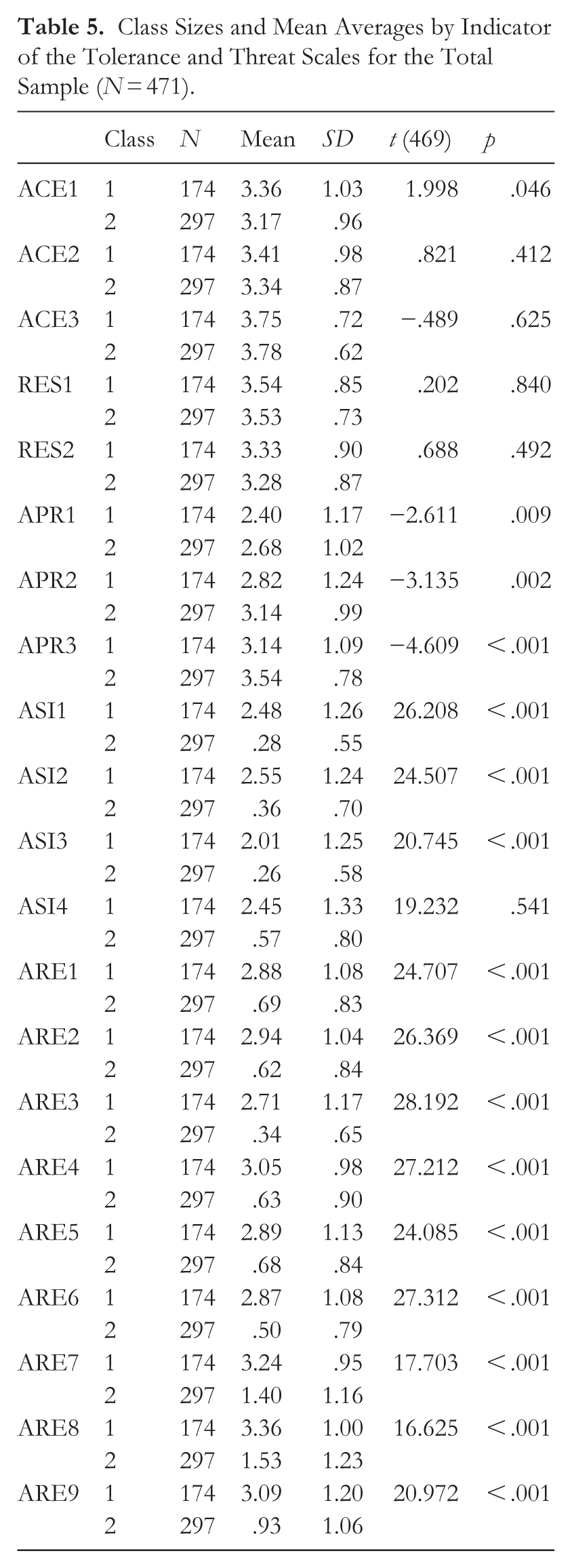
Class 1, which represents approximately 37% of the participants, exhibits relatively high levels of tolerance, particularly in the dimensions of respect and acceptance, though lower in the dimension of appreciation, accompanied by significantly higher levels of symbolic, realistic and security/safety threats compared to the previous class. This profile suggests an ambivalent orientation towards cultural diversity, where attitudes of acceptance coexist with persistent perceptions of threat, which is why this class was identified as ‘ambivalent-tolerant‘ towards diversity.
Figure 1 shows the two classes with their names, which emerged from the analysis described in the previous paragraph.
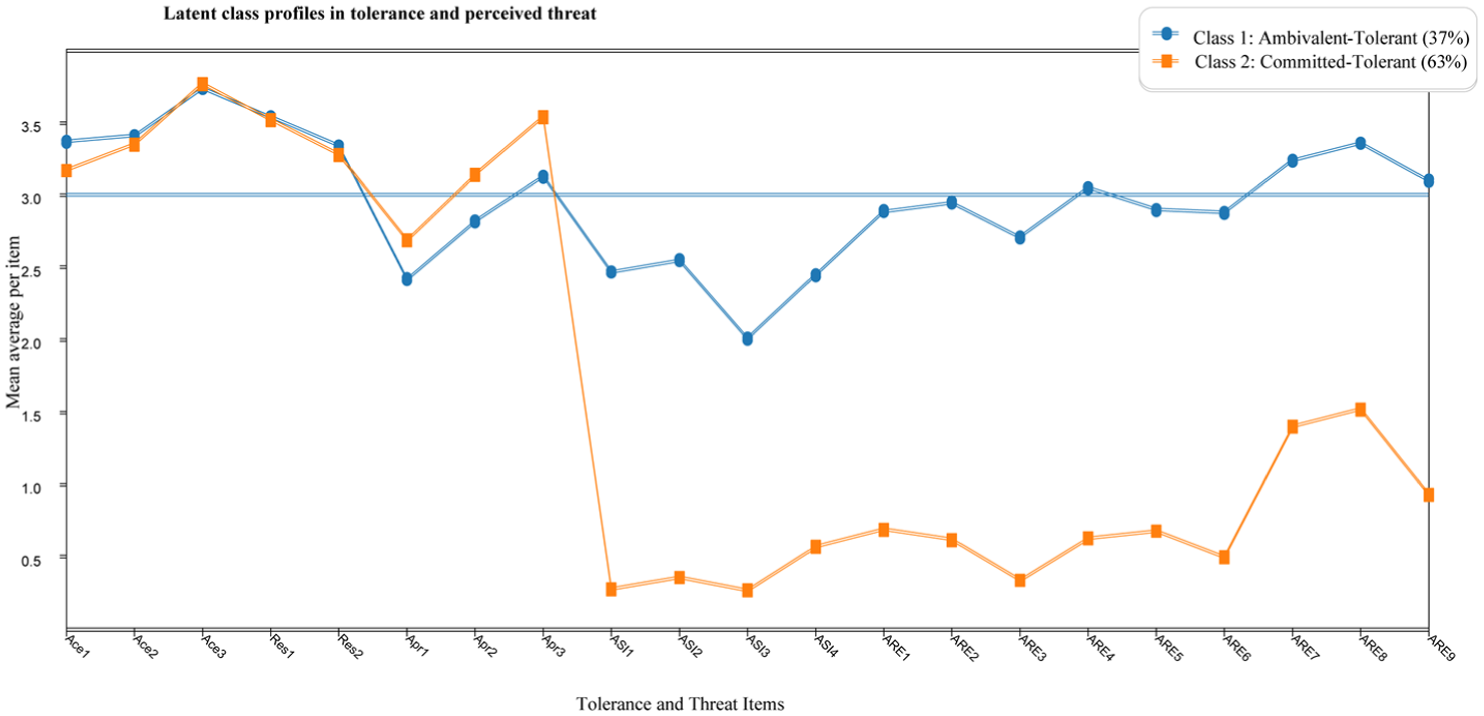
Latent Class Analysis (LCA) on the Tolerance and Threat Scale.
In order to examine whether membership in the sample was associated with the likelihood of belonging to the latent classes identified, the sample type (university students vs. general population) was included as a covariate in the model. The results indicated that belonging to the general population significantly predicted membership in Class 1, characterised by higher levels of intergroup threat (B = 2.78, SE = .25, z = 11.10, p < .001). In terms of the odds ratio, this effect corresponds to an odds ratio (OR) = 16.04, with a 95% confidence interval [9.82, 26.18], which confirms the statistical robustness of the association. This result indicates that, keeping the other variables of the model constant, participants from the general population were approximately 16 times more likely to belong to the class characterised by higher levels of intergroup threat compared to university students.
Conclusions
Our main finding highlights that the latent profiles of threat and tolerance towards immigration are distributed in a markedly different way between university students and the general population. In particular, belonging to the general population increased the probability of being part of the class characterised by higher levels of perceived intergroup threat by 16.04 times, indicating a strong association between the sample type and the configuration of the profiles identified. This result questions the frequent practice of extrapolating findings obtained with university students to the general population, especially in research on social attitudes. Our data suggest that university samples may differ not only in the intensity of certain attitudes but also in the underlying structure in which these are organised. This interpretation is consistent with the work of Hanel and Vione (2016), who compared the attitudes of students and the general population in 59 countries. These authors concluded that the differences between both groups were substantial in several cases and inconsistent across contexts (e.g., the students’ results vary both between countries and within them, as does the general population). Therefore, the generalisation of results from student samples to more heterogeneous samples may be problematic when studying personal and attitudinal variables. Likewise, it has been recently reported that the university experience may be associated with shifts, albeit subtle, towards more liberal and left-wing positions, suggesting that university students constitute a socially and politically specific group rather than a representative proportion of the general population (E. Simon et al., 2025). In this sense, our findings not only contribute to the study of intergroup threat and tolerance but also to the methodological discussion on the representativeness limits of university samples in social psychology.
Regarding the first objective, as posited, the evidence shows a lower level of perceived intergroup threat towards Venezuelan immigrants and greater tolerance towards diversity among university students compared to the general sample. This result corroborates the findings in other studies that report the presence of favourable attitudes towards Venezuelan migrants and high intercultural sensitivity among Chilean university students (Madariaga et al., 2025).
The LCA results indicate the existence of differentiated attitudinal profiles in both samples. Specifically, two very distinct groups were identified: one includes participants who are tolerant and have a low perception of threat, while the other gathers participants with a higher perception of threat towards Venezuelan immigrants, yet with similar levels of tolerance towards diversity. This pattern suggests that perceived threat and tolerance do not necessarily operate as opposing poles but can instead be linked in more complex combinations. In other words, not everyone holds extreme positions (e.g., pro-migration vs. anti-migration), but a significant proportion may express intermediate or ambivalent attitudes. This finding is consistent with international evidence that questions the idea of homogeneous or completely polarised opinions. Thus, in European contexts, a continuum between inclusion and exclusion has been described (Sam Nariman et al., 2021). A study conducted in 20 European countries found that the most common profile among participants is precisely one of ambivalence; many people believe that immigration enriches national culture but at the same time consider that it brings few economic benefits (Kwon et al., 2024). Similarly, Mora et al. (2025), in a sample from California in the US, identified five classes of attitudes towards immigration, with three representing intermediate positions between support and extreme opposition (about 40% of respondents). These classes do not express uniform visions but rather patterns of selective uncertainty, which support certain aspects of immigration and mistrust of others. Altogether, this background suggests that the profiles identified in the Chilean case do not constitute an exception but rather fall within a broader trend, according to which attitudes towards immigration are often organised into mixed configurations, where acceptance and distrust can coexist to varying degrees.
Beyond their theoretical contribution, these findings have a direct practical implication for applied research and public policy design. If university students and the general population exhibit markedly different latent distributions, then diagnoses based solely on students may underestimate or distort the magnitude and configuration of the perceived threat in the general population. This is especially relevant when research results are used to guide public decisions, communication strategies or programmes that promote intercultural coexistence. Recent research has emphasised that external validity should be explicitly evaluated based on the target population, rather than assuming that findings observed in convenience samples can be automatically generalised (Egami & Hartman, 2023). In the Chilean case, moreover, we have seen that higher levels of education are associated with lower levels of economic and cultural threat towards immigrants, which reinforces the need to consider the educational composition of samples when studying attitudes towards immigration (Velásquez, 2024). Consequently, a practical contribution of this study is to show that research and surveys on attitudes towards immigration should be based on more diverse samples, or incorporate analytical strategies that allow for a more precise estimation of the extent to which findings are transferable to the population being described or the subject of intervention.
It is important to recognise the methodological limitations of this study. Firstly, the use of self-reported measures may have introduced social desirability biases into the responses. It is possible that some participants may have minimised the expression of intolerant attitudes, considering it socially undesirable to admit them, whereby the actual levels of prejudice might be underestimated (Adman & Gschwind, 2023). Future studies could complement the questionnaires with indirect or observational measures (for example, implicit behaviour experiments). Secondly, the cross-sectional design of the research prevents the establishment of causal relationships. Future research should incorporate longitudinal methodologies that allow for observations on how perceived intergroup threat and tolerance evolve based on political, media and legislation changes, especially following the victory of a far-right candidate in Chile. Thirdly, although the overall sample size (N = 471) was adequate for our statistical analyses, the composition of the sample limits the representativity of the findings. The selection of participants through an online panel (for the general population) and a convenience sample of university students implies that we do not have a probabilistic sample of Chilean society as a whole. Lastly, although basic variables such as gender, age and region of residence were reported, this limitation restricts the possibility of specifying in greater detail which segments of the population the data represent and complicates comparisons with previous studies on attitudes towards Venezuelan immigration. Consequently, the results must be interpreted considering this limitation, and future research should incorporate more comprehensive information about sociodemographic data as well as political orientation.