






Abstract
This article addresses precarity, denigration and activism of women and sexual dissidents in the fast-food sector in Chile. Grounded in a Latin American feminist ontology of precarity that foregrounds subjective experience, this study employs a thematic analysis of 25 interviews with fast-food workers across multiple cities in Chile. The analysis inductively and systematically identified patterns of meaning, with findings organised into three themes: (a) accentuated job precarity; (b) women and dissidents at the forefront – shedding light on demands and struggles; and (c) denigration as the invisible trenches of activism. The article contributes to understanding women’s and dissidents’ precarity as a situated phenomenon in the Global South and to social psychology by showing how women fast-food workers enact collective action against the inequalities and injustices faced by subaltern groups in contemporary labour markets.
Introduction
Participation in the job market by women and sex/gender dissidents has increased steadily in Chile and across Latin America. In some countries their employment rates are close to reaching the same levels as men’s (Guerra Arrau, 2018; Yopo, 2023). However, these advances in job market participation have not necessarily translated into improved working conditions or a more gender-equitable distribution of power and income (Guerra Arrau, 2018; Palma et al., 2025). Women and sex-gender dissidents are predominantly employed in feminised sectors such as services, retail, care and cleaning, which have historically been undervalued and characterised by low salaries, high turnover, limited social protection and restricted access to leadership positions (da Silva Évora, 2024; Guerra Arrau & Calquín Donoso, 2021; Guglialmelli, 2024).
In this article we explore the experiences of women and sex-gender dissidents in the fast-food sector, an emblematic sector of contemporary work precarisation. Multinationals such as Starbucks, McDonald’s, Burger King and Papa John’s operate through business models characterised by extreme flexibility, including part-time hires, high rotation and intensified working conditions (Rivera-Aguilera et al., 2023). These business structures are maintained by a predominantly young and feminised workforce that is poorly paid and exposed to various forms of workplace abuse and harassment (Caro & Cárdenas, 2022; Espino & De los Santos, 2019). Within this context, precarity is expressed not only in economic instability but also in the workers’ bodies, affects and social ties, revealing its ontological and gender dimension (Butler, 2004; Gutiérrez-Rodríguez, 2014; Lorey, 2016).
Building on this understanding of precarity as a structural, embodied and gendered condition, this study takes Chile as its empirical reference point – a country profoundly shaped by neoliberal restructuring since the late twentieth century (Moulian, 2002). In this context, working conditions have become progressively more precarious over recent decades (Julián Vejar, 2020a; Rivera-Aguilera et al., 2022). These forms of working life are sustained by dominant discourses that naturalise instability and shift structural vulnerability onto the level of individual subjectivity (Butler, 2004; Mandiola et al., 2022). From this perspective, we examine working conditions in the fast-food sector in order to analyse how agency is constructed under conditions of structural and symbolic job vulnerability. Specifically, we ask: How do women workers – including cis, trans and non-binary women – develop strategies and forms of action in response to job precarity? In Chile, such strategies have given rise to organisational experiences that shape feminist collective and union action, revealing emergent forms of leadership and processes of politicising care (Bermúdez & Roca, 2019; Rivera-Aguilera et al., 2023).
We position this study within a Latin American social psychology of work (SPW), a critical tradition that conceptualises work as a psychological phenomenon shaped by power relations, structural inequalities and historically situated processes of subjectification (Carvalho Cardoso, 2025; Lopes da Silva & Araújo Lima, 2024; Pulido-Martínez, 2020; Sato, 2003; Sato & Pulido-Martínez, 2013). From this perspective, the article advances an understanding of women’s and sex-gender dissidents’ precarity as a situated phenomenon emerging from Global South contexts, thereby contributing to critical developments in the field of SPW (Pulido-Martínez & Sato, 2013). It also foregrounds struggles in the fast-food sector as a key site of collective action through which subaltern groups contest labour market inequalities and injustices.
This article is organised as follows: first, we elaborate on the theoretical foundations of job precarity as a structural and ontological regime, examining how it is accentuated in the experiences of women and sex-gender dissidents, and incorporating a Latin American feminist perspective. Secondly, we outline our methodology, a qualitative narrative approach based on interviews with 25 research participants. Thirdly, we present the findings across three analytical categories: (a) accentuated job precarity; (b) women and dissidents at the forefront: shedding light on demands and struggles; and (c) denigration: the invisible trenches of activism. Finally, we discuss the study’s contributions, highlighting their transformative power within historically masculinised organisational and labour structures.
Social Psychology of Work and Job Precarity
This article examines job precarity through the social psychology of work, a perspective rooted in social realities and attentive to jobs and working conditions largely neglected in Latin America until recent decades (Pulido-Martínez & Sato, 2013). These conditions reflect the social inequalities experienced across different spheres of Latin American societies and have generated a range of conceptual and methodological contributions (Pulido-Martínez, 2020). For example, work is analysed as a nonlinear construct that reveals the power relations embedded in its distribution and their impact on workers, within the framework of the current economic system and its historical configuration (Carvalho Cardoso, 2025). In this regard, Ribeiro et al. (2018) argue that SPW extends its focus beyond the formal labour market by examining everyday work processes that reproduce social inequalities.
Following and adopting a social psychology of work (SPW) framework, we focus in this study on inequities associated with job precarity and gender. Job precarity is understood as a global phenomenon encompassing unstable working conditions, low wages and the erosion of minimal social protections that affect diverse groups of workers (Antunes, 2019; Standing, 2013). In Latin America, this manifests in the employability of workers who face heightened insecurity, uncertainty and vulnerability in relation to their labour rights – particularly young people and women, who exemplify the intensified precarisation of life (Carbajo Padilla & Santamaría López, 2019; Morales Muñoz & Abal Medina, 2020; Santamaría, 2018). Our conceptualisation of precarity is informed by an ontological perspective that transcends the socioeconomic relationship to employment. As Butler (2004) and Lorey (2016) argue, precarity is a condition rooted in the vulnerability of being, linked to the marginalisation experienced by specific populations and communities (Mandiola et al., 2022).
In this study, precarity is also examined from a multidimensional perspective that incorporates regional, family and individual factors linked to social vulnerability (Julián Vejar, 2017; Mora Salas, 2012). Drawing on Julián Vejar (2020a), work-related precarity is understood as a form of social inequality that reflects a precarised society, whose core dimensions include instability (informal entrepreneurship, short-term contracts), insecurity (absence of social protection and health coverage), insufficiency (underemployment, low wages), working conditions (hygiene, workplace characteristics) and time ownership (hours worked). This configuration points to a problem of ultra-flexibility, in which responsibility for employability is shifted onto individuals themselves, who must adapt and sustain their participation in an ever-changing labour market. Consequently, precarity permeates all spheres of life, substantially shaping living conditions that are marked not only by low pay but also by demotivation, health problems – both physical and mental – and other adverse factors (Rivera-Aguilera et al., 2022).
In Latin America, different feminist approaches have shown that precarity takes shape as not only a condition of vulnerability but also a terrain of resistance. Gago (2019) posits that the shared experience of precarisation may become a collective power capable of articulating new forms of political and economic action from the margins of formal work. Svampa (2019), likewise, identifies a situated response to neoliberalism in these expressions of feminist and grassroots organisation, where the defence of life and work become the cores of political articulation.
Considering the previously mentioned core dimensions of precarity, it is relevant to examine the organisation of women and dissidents who embody emancipation and agency in response to these living conditions, positioning themselves as key social actors in advancing our understanding of precarity in labour markets (De la Barra-Eltit et al., 2022; Julián Vejar, 2017, 2018, 2022; Rivera-Aguilera et al., 2020, 2022).
Women and Dissidents: Accentuated Precarity
To understand job precarity in feminised sectors, we have to consider how gender inequalities shape different positions within the job market. These inequalities are upheld on historically sedimented gender norms and hierarchies that delimit who is recognised as a valid subject and which bodies are marginalised (Butler, 1990). From this perspective, Butler (1990) posits that gender works as a normative regime that regulates the conditions of social recognition, leading to the exclusion of those who deviate from their expectations.
In this sense, gender can be viewed as a relational construct that organises inequalities and distributes value in everyday life and workplaces. This field has shown how institutional and organisational discourses shape communities of interpretation that sustain inequities in access to power, recognition and legitimacy based on gender (Burin, 2007; Cadena-López & Ramos-Luna, 2022). By incorporating a feminist perspective, this interpretation illustrates how gender norms also produce exclusion towards those who dissent from binarism, shedding light on the fact that precarity is not only about work but, as mentioned in the section above, is also ontological and associated with being a woman: precarity of recognition.
As Butler (1990, 2006) asserts, being recognised as a ‘man’ or ‘woman’ depends on fitting normative expectations, and anyone who deviates from them – such as women who do not fulfil the ideal of docility, non-binary people or sexual dissidents – are exposed to symbolic, material and affective punishment. Thus, from a feminist viewpoint, precarity refers to not only a lack of job stability but also the fragility of one’s very social existence, which is threatened with the constant possibility of exclusion and violence (Butler, 2004). Federici (2013, 2018a) complements Butler’s position by suggesting that the precarity of women and dissidents is not merely symbolic but also material and indeed constitutive of capitalism. In this vein, Federici points to the reshaping of the patriarchy whereby accumulation is guaranteed through the domestication of female work, the naturalisation of reproductive roles and salary exclusion (Federici, 2018). From this position, the feminine and the dissident appear as invisible social life supports that are undervalued and excluded by capital and the patriarchy (Bhattacharya, 2017; Fraser, 2016; Pérez Orozco, 2014).
The sexual division of labour, as a central device of this order, separated the productive from the reproductive: while men were situated as providers and public subjects, women were relegated to caring for life and everyday reproduction (Fraser, 2016). Dissidents, in turn, have historically been marginalised from both spaces, perceived as ‘anomalous’ compared to the ideals of family, work and citizens (Butler, 2004; Halberstam, 2005; Spade, 2015). These distinctions structure not only the economy but also cultural meanings and morals: women are asked for availability, sensitivity and self-control, while the intelligibility of dissidents is denied, or they are assigned subaltern places (Muñoz, 2009). Thus, precarity in a feminist sense must be understood as a regime that organises who produces, who cares and who accesses salaries, rest and the future. In this sense, the experiences of women and dissidents tend to be permeated with invisibilisation, exclusion or violence, which precede their insertion into paid work, shaping the unequal conditions under which they enter the job market. From this perspective, precarity is also corporal and affective: it is inscribed in bodies, possibilities of recognition and the capacity to imagine a future (Butler, 2004; Gutiérrez-Rodríguez, 2014; Lorey, 2016). This structural dimension of precarity is reproduced and revamped in organisations, where job hierarchies and gender expectations reinforce inequalities and condition the experiences of women and dissidents (Caro et al., 2021; Clark-Saboda & Lemke, 2023). However, it is important to note that experiences of precarisation are not homogeneous between cis women and sex-gender dissidents. Even though both social positions may be affected by gender-inequality structures, the ways they are expressed in work and social life may differ significantly. In this article, we are not seeking to equate these experiences but to explore the points of convergence that emerge in specific contexts of precarised work and union organisation.
Women and Dissidents in Fast Food: Organisation and Agency in Chile
Organisations created and managed by young workers – often expressed through committees and unions in fast-food companies such as Starbucks, McDonald’s, Burger King and Papa John’s – stand out for developing self-management strategies to defend their interests across political, legal and social spheres. In doing so, they have become strategic actors of resistance and collective action in response to the precarity they experience (Julián Vejar, 2020b). These forms of organisation have significantly influenced recent sociopolitical processes in Chile, including the May 2018 feminist protest march and the Social Outburst of October 2019, shaping new expressions of feminist leadership and political subjectivities (Rivera-Aguilera et al., 2023; Zerán, 2020).
Such organisations are characterised by a strong presence of women and dissidents, who often employ repertoires of action that are more disruptive than traditional union practices (Ratto Ribó, 2019). Affiliation claims within workplace organisations also serve as collective strategies for new fast-food workers, offering safety and stability while challenging abusive corporate policies (Aravena, 2012; Stecher & Sisto, 2019; Stecher et al., 2020). Recent studies highlight initiatives such as the Committee of Women and Dissidents in the Starbucks Chile Union, which introduces feminist and intersectional perspectives into union action (Rivera-Aguilera et al., 2023).
These actions illuminate the social crisis of care and call for union policies that build support networks among women colleagues, providing spaces for training and emotional solidarity while politicising care as part of organisational struggle (Bermúdez & Roca, 2019; Federici, 2004; Fraser, 2015). In this way, collective experiences challenge the masculinised values of classical unionism and broaden agendas to include issues of care, motherhood and workplace harassment. They also recognise that precarity is experienced differently depending on gender and social position (Barrientos, 2022).
However, women’s participation and leadership in these organisations intensify the conflict between family and work life, often resulting in a ‘triple workday’ that combines paid employment, care responsibilities and union demands (Arteaga et al., 2021). This burden is exacerbated by the traditional sexual division of labour, which limits women’s full participation in committees or leadership roles, since they are forced to sacrifice family and affective bonds (Bermúdez & Roca, 2019; Gaete Quezada & Oro Maturana, 2021). Many must delegate childcare or reduce time with loved ones, leading to feelings of guilt and self-surveillance as they struggle to meet the expectations of multiple roles (Castro, 2016).
Thus, it becomes clear that analysing the work of women and dissidents in fast-food chains entails recognising that gender is crucial to understanding how processes of precarisation are shaped, experienced and accentuated in contemporary job markets.
Methodology
This study is part of a three-year research project (2022–2025) that seeks to understand how young workers in Chile organise in response to job precarity through three interrelated studies: (a) analysis of social networks (Rivera et al., 2022, 2023); (b) organisational ethnography; and (c) youth narratives on the future of work. The findings presented in this article derive from the second study, the organisational ethnography.
A descriptive exploratory qualitative methodology was employed, drawing on reflexive thematic analysis (Braun & Clarke, 2006). This approach is particularly suitable for understanding how participants subjectively construct reality and for identifying and interpreting patterns of meaning across the dataset. It aligns with the tradition of qualitative social psychology, where reflexive thematic analysis has become a widely used tool for studying the social production of meaning and situated experience (Braun & Clarke, 2022). Moreover, it resonates with classical contributions in applied psychology, where thematic analysis has been recognised as a method for systematically identifying patterns of meaning and organising qualitative evidence in social contexts (Boyatzis, 1998). Taken together, these traditions confirm its suitability for addressing sensitive and complex issues such as job precarity.
Data Production
The data were generated through active interviews, following the methodology proposed by Holstein and Gubrium (2004), which emphasises socially situated constructions produced in dialogic interaction. In this approach, the interviewer is not a neutral recorder but a co-constructor of meaning, enabling a deeper exploration of how experiences and interpretations are formed. This perspective is particularly valuable for sensitive topics such as job precarity and aligns with the reflexivity required by reflexive thematic analysis (Braun & Clarke, 2022). Moreover, examining the forms of organisation among women and dissidents demands a high degree of reflexivity in the production of data (Alvesson & Sköldberg, 2018), reinforcing the coherence between the interview method and the analytic strategy adopted.
Participants
Twenty-five women workers in the fast-food sector participated, including cis women and sex-gender dissidents. They were all over the age of 18 and worked at different fast-food chains located in three urban centres in Chile: Santiago, Valparaíso and Concepción.
The inclusion criteria were defined considering work experiences permeated by conditions of precarity, along with diverse gender positions. First, cis women and sex-gender dissidents who worked in the fast-food sector were included. Their inclusion reflects the study’s interest in understanding how job precarity takes shape in relation to gender and sexuality and enabled us to access stories on how these individuals are positioned in the workspaces and how they experience these conditions in their everyday lives. Likewise, the diversity of gender identities made it possible to explore how intersectionality shapes these experiences and its implications in forms of collective organisation.
Secondly, the participants were required to be currently working in the fast-food sector for at least three months in order to ensure recent work experiences in the sector. Thirdly, the participation of women workers linked to union or collective organisation processes in the sector was prioritised to gain access to stories about work experiences and forms of organisation. Finally, the participants were reached via networks associated with existing organisations, especially fast-food workers’ committees and unions in Chile.
Data Collection
The data were generated by the research team through individual, in-depth interviews conducted between January 2023 and January 2025. Each interview lasted approximately 30 to 40 minutes and was held in private settings to ensure participants’ confidentiality. All interviews were audio-recorded and subsequently transcribed for analysis. The data-generation phase was considered complete not on the basis of a predetermined number of interviews but according to the criterion of qualitative data saturation (Flick, 2012). Table 1 presents the main characteristics of the research participants.
Characteristics of the Participants in the Study.
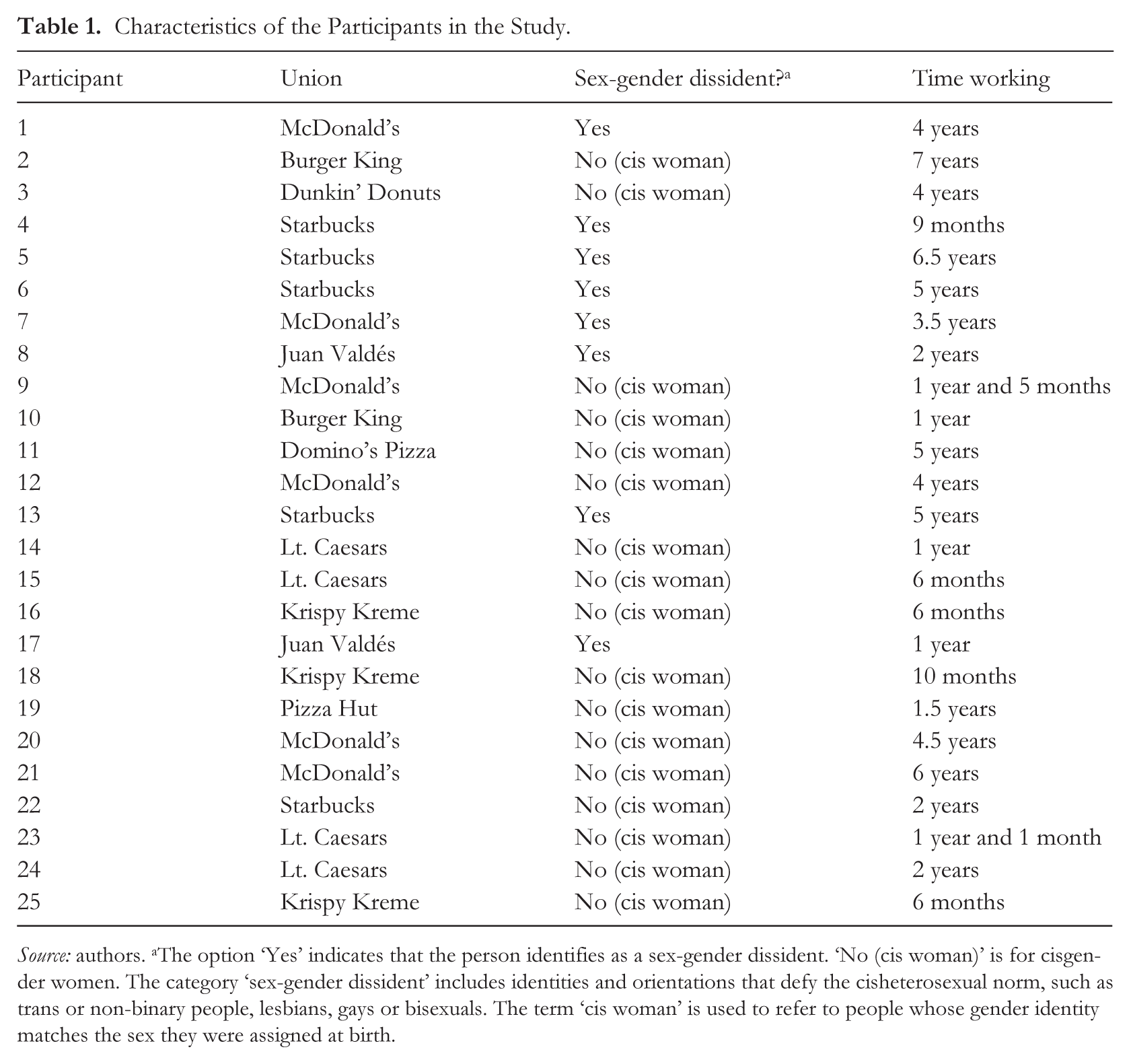
Source: authors. aThe option ‘Yes’ indicates that the person identifies as a sex-gender dissident. ‘No (cis woman)’ is for cisgender women. The category ‘sex-gender dissident’ includes identities and orientations that defy the cisheterosexual norm, such as trans or non-binary people, lesbians, gays or bisexuals. The term ‘cis woman’ is used to refer to people whose gender identity matches the sex they were assigned at birth.
Information Analysis
The data were analysed using reflexive thematic analysis (Braun & Clarke, 2006, 2022), a method well suited to exploring patterns of meaning in how women and dissidents working in fast food construct their experiences of precarity and collective organisation. This approach is iterative, flexible and interpretative, grounded in close engagement with the data and the reflexivity of the research team.
Codification Process
First, the interview corpus was managed and organised in Atlas.ti, followed by intensive familiarisation through repeated readings and the production of analytical notes. Initial coding was primarily inductive, with codes developed directly from the interview content rather than from a rigid prior framework. These codes were recursively refined across successive rounds, in dialogue with the research question and the literature. This iterative process reflects the nature of qualitative inquiry (Cáceres, 2007) and is consistent with the reflexive practice central to thematic analysis (Braun & Clarke, 2022).
On the basis of this coding, we constructed themes – interpretative patterns of meaning relevant to the research questions (e.g., ways of experiencing/naming precarity, forms of organisation, workplace positionings). This step went beyond the hierarchical aggregation of codes and involved analytical work to identify organising concepts that illuminate the data as a whole. The quality of the analysis relied on continuous reflexive practice – reviewing the team’s positions, assumptions and decisions – rather than on inter-coder reliability or formal consensus, in line with the reflexive approach to thematic analysis (Alvesson & Sköldberg, 2018).
Structure of the Results
The analytical themes were generated inductively from the data, allowing us to capture the complex ways in which participants articulated meaning. On the basis of this systematic analysis, the findings presented in this study are organised into three thematic areas that reflect the core results: (a) women and dissidents: accentuated job precarity; (b) women and dissidents at the forefront: shedding light on demands and struggles; and (c) denigration: the invisible trenches of activism.
Ethical Considerations
The research design was approved by the Ethics Committee of the Pontificia Universidad Católica of Valparaíso, Chile. All participants provided informed consent, ensuring that their identities would remain protected. The research team declares that they have no conflicts of interest in conducting this study or in reporting its results.
Results
Accentuated Job Precarity
The first thematic area examines how women, mothers and dissidents working in fast food experience heightened forms of precarisation linked to gender inequalities, which profoundly affect their dignity and well-being. These experiences intersect with identity-related dimensions such as gender transition, gender expression and motherhood, exposing workers to harassment, ridicule and mistreatment – particularly pregnant women and those whose sexual orientations challenge the companies’ normative frameworks. Such practices have direct consequences for workers’ mental health, since they confront multiple forms of violence enacted by peers, supervisors and customers alike.
I started at Starbucks when I was cis. And during the pandemic I had time to reflect on whether I truly felt like a cis woman or whether really felt like I wasn’t. I reached the realisation that I was not binary (. . .). It was very hard for me to go back, especially because I joined the union as I had a severe experience of workplace harassment. Essentially people at work started giving me lots of nicknames; they began to treat me really badly like talking behind my back (. . .) Fortunately, I had a manager who was very open-minded and allowed me to talk to human resources so I could be called my social name and not my ‘dead’ name, if you wish. My social name has been respected, but I know that this isn’t true of many people. I know I’ve been lucky, but at some point I’m going to have to deal with homophobic people; some people are really sexist. It is very difficult to fend for yourself on your own; you always need support from other people, and when you’re alone it’s very easy to feel overwhelmed by the way they ridicule us, especially if we’re a dissident with a female body. It’s really hard; it’s really hard to go around with the mindset that not only do you have to go to work, which is exhausting because we work with a demanding public, but you also have to expose yourself to mistreatment and humiliation. (interview with participant no. 6)
In this first quote, the participant describes their gender transition during the pandemic and their return to work. The process of accepting oneself as a nonbinary person and adopting a social name conflicts with organisational routines and cultures: nicknames are created, the person is ridiculed and talked about behind their back, and there is the latent possibility of punishment from peers and bosses. The need to manage recognition of their social name via human resources and the importance of having people near them show that respect for dissident identities depends more on individual will than on clear institutional policies.
The story itself underscores the fact that ‘It is very difficult to fend for yourself on your own; you always need support from other people’, which reflects how these forms of violence generate isolation and emotional exhaustion. In this scenario, collective support through networks or organisations is essential in dealing with the mistreatment that comes with customer service jobs. The experience embodies what Butler (2004, 2006) calls precarity of recognition, in which people who do not fit the binary gender norms are exposed to symbolic and material punishment. The constant fear of new acts of discrimination (‘at some point I’m going to have to deal with homophobic people’) reveals that precarity is not limited to present work but also serves as an affective and corporal regime (Lorey, 2016), where exposure to violence becomes a constitutive part of the future work life.
Another problem was, for example, that they discriminated against my female colleagues who were going to have children or were mothers. I had a colleague who was six months pregnant and the old manager we had made her work standing up; she didn’t let her sit down when she was tired. Or I see colleagues who have recently become pregnant and they were afraid to say it because they thought they would be treated badly, that they were going to be discriminated against (. . .) they think getting pregnant is taking advantage of the employer. There is discrimination against young women who are mothers and want to work. (interview with participant no. 23)
The story in this second quote illustrates discrimination against pregnant workers in fast-food chains, where an advanced pregnancy does not allow for minimal conditions of care or protection. The fear of revealing a pregnancy shows that it is experienced as a necessary ‘secret’ to avoid punishment and mistreatment. The idea that ‘getting pregnant is treated as taking advantage of the employer’ is striking, in that it reveals a business logic that views motherhood as an economic cost that should be penalised. In consequence, basic care and protection needs that should be legally and ethically guaranteed are rendered invisible.
As Federici (2013, 2018b) suggests, care tasks are systematically undervalued and transformed into a burden that capital seeks to minimise, even at the expense of women’s health. This story shows how the social condition of being a young woman and mother multiplies the possibilities of being harassed in an already precarised work environment. Motherhood thus becomes a marker of job vulnerability which enables managers to apply symbolic and material punishment mechanisms: denying basic breaks, assigning physically demanding tasks or exerting psychological pressure. These practices are not solely individual decisions but are part of a shared staff management repertoire where treating pregnant women ‘badly’ is perceived as a legitimate form of discipline and a way to discourage motherhood.
Through these stories, we realise that discrimination towards dissident identities and motherhood is not just isolated events but recurring practices in the field of fast food. What used to be borne in silence is transformed today into shared experiences that reveal how precarity is heightened and accentuated in specific groups.
Women and Dissidents at the Forefront: Shedding Light on Demands and Struggles
This second thematic area addresses how, based on specific experiences of precarity, women workers and dissidents promote forms of organisation and activism geared at shedding light on problems that have historically been ignored in the workplace. While traditional collective struggles focused on structural demands like salary, contracts or the right to strike, other dimensions associated with care, motherhood, harassment and discrimination tend to be downplayed. In contrast, these new groups are developing initiatives that emerge from everyday experience and are transforming them into collective political action. These forms of organisation are not limited to unions but are also expressed in informal practices of mutual support, solidarity and social media visibility. In this way, their broad participation is redefining collective practices and making them more inclusive, heterogeneous and sensitive of the diversity of work experiences.
I’m a mother and I joined the union because of the unilateral suspension of women with maternity protection. This is an issue that I wanted to equalise for others because generally, in mostly male unions, the demands are somewhat broader and there are not as many issues related to care, whereas they do bring up issues like minimum salary or the right to strike. Even though they are important issues, gender and women’s rights issues have always been the lowest priority and have not been given the same visibility. This also has to do with problems of harassment and bullying, because mostly women and dissidents suffer from harassment and are the ones in charge of caring for kids, disabled people or family members who are trying to get custody of another kid. So, based on my experience as a worker and what I’ve seen with my female colleagues, I’ve tried to push these demands so that they gain equal visibility in the union and social media. (interview with participant no. 2)
In this story, participant no. 2 shows how personal experience becomes an engine for collective organisation. Her status as a mother, characterised by unilateral suspensions of women with maternity protection, reveals a blind spot in spaces of representation dominated by men: while the traditional demands focus on salary, workdays or the right to strike, issues related to care, harassment and bullying are ignored. Embodied experience translates into agency to ensure that these issues are foregrounded in both unions and the social media in an effort to make them as prominent as the historically legitimised demands. The difficulty of bringing up these issues reveals the precarity of recognition (Butler, 2004), in that certain bodies and experiences are left outside the dominant frameworks of intelligibility. By bringing these experiences to the collective sphere, the interviewee questions these hierarchies and shows how precarity is experienced differently according to gender, thus opening up a space to dispute the very meaning of collective action.
I’m just a normal person; I’m neither he nor she; I’m a person . . . and I feel so impotent that this issue isn’t discussed. When the Committee of Women and Dissidents was created, I felt relieved because I knew that I could count on the girls, who are very competent and supportive. Whenever you need them, they’re there. They’re people who I’d like to see in more important roles in the company, not only because they’re unionised but because they’re open people who achieve things and defend us, both women and dissidents. They make sure there is no discrimination and that there’s respect and quality, which I’ve seen very little in the company and senior management. (interview with participant no. 13)
In this testimonial, the story of participant no. 13, a worker who is a sexual dissident, reveals the everyday invisibilisation of identities that do not fit within binarism in both companies and traditional collective movements. Their story shows the failure to recognise experiences that fall outside the normative gender framework, confirming that precarity is not only contractual but also related to social legitimacy. This situation falls within a governmentality of precarity (Lorey, 2016), in which certain bodies are managed by constant exposure to exclusion and symbolic violence and relegated to the peripheries of working life.
The Committee of Women and Dissidents, created as a parallel body within the Starbucks Union, emerged precisely to dispute these margins. What makes this committee valuable is not solely its formal existence but its ability to create solidarity and care in an environment marked by senior management’s indifference and the rigidity of traditional unionism. As noted by the interviewee, this space is held up by its members’ willingness to ‘make sure there is no discrimination and that there’s respect and quality’, turning it into an alternative form of organisation and activism. This expresses a feminist power (Gago, 2019) which turns shared vulnerability into organisational and affective power, thus extending beyond the boundaries of salaried work and traditional forms of action.
As a whole, these stories show how women and dissidents are transforming experiences of discrimination and exclusion, which are historically ignored in workplaces, into collective demands that are expanding the margins of political action (Federici, 2018b; Fraser, 2016). Precarity thus appears not only as a condition of vulnerability but also as an engine of agency that drives situated, collective forms of activism against structural inequalities at work (Rivera-Aguilera et al., 2023; Svampa, 2019).
Denigration: The Invisible Trenches of Activism
This third thematic area addresses the difficulties that women and dissidents face when they take on leadership roles in historically masculinised spaces. Work demands are joined by care responsibilities and tasks related to activism, creating a triple workday that magnifies their physical and emotional overload. Furthermore, they have to deal with the denigration of their authority and a culture that forces them to ‘win’ space, that is, to be twice as competent to be recognised as equal to their male peers. These experiences create feelings of guilt, self-policing and exhaustion, reflecting the persistence of dynamics that subordinate their voices and hinder the sustainability of their participation in collective spaces.
I was feeling a bit guilty, like maybe I’m not being such a good mother because I should spend time more with them, because they’re only children once, so I felt super guilty in my personal life. I think that everyone else who works and leaves their children feels this guilt, but mine was optional because it wasn’t only my work but also something I wanted to do, which is the union work. So, because as a woman I feel this kind of burden of motherhood, the idea was to try to balance these two aspects, and that’s why it was suddenly like, I’m giving too much on one side and ignoring my kids. So then I had to choose, either work or kids or the union; at some point I had to give something up. (interview with participant no. 20)
The story of participant no. 20 reflects the profound emotional conflict that many female workers experience when they try to balance work, care and activism, which translates into a triple workday (Arteaga et al., 2021). The interviewee describes how this effort is permeated with guilt for being unable to fulfil the social expectations of motherhood, in that her union participation is perceived as a ‘personal choice’ which takes time away from her kids. This perception heightens the emotional burden of the experience and reveals how the maternal mandate operates as a device of control that naturalises female subordination (Bermúdez & Roca, 2019; Gaete Quezada & Oro Maturana, 2021).
Within this framework, guilt appears as a form of relational precarity, which Butler (2004) contends is articulated with the lack of recognition of those who transgress gender norms, in this case by questioning motherhood as the priority role. The story also reveals the costs of this overburden: physical exhaustion, loss of leisure and rest and the constant denigration of the effort made. This denigration is structural, given that recognition of women’s work is still fragile (Castro, 2016), situating women in a position of vulnerability that limits the amount of time they can stay in leadership roles. Thus, the triple workday has both subjective costs (guilt, exhaustion, forced sacrifices) and objective ones (rotation and discontinuity in leadership positions), which shows the need to shift the focus from individual blame to a social and structural reorganisation of work and care that enables women and dissidents to sustain their political participation in contexts of high precarity.
For example, he had lots of respect because he was president. Or if I were a male leader, I think that I’d have more respect just because of that. But I have to earn it. I have to demonstrate that I know how to work, that I know things well, that I get on well. And if I don’t demonstrate this, it’s all over, no matter the area, in the kitchen, as a manager, or anywhere (. . .). I once filed a complaint and was told, sorry, this complaint is no good. They virtually forced me to read, like, the criminal code, virtually sent me to study law, which is something that didn’t need to happen because the complaint was valid. And after that I went back and they accepted it. The only difference is that a woman accepted it. So, as a woman I feel, at least I think, that within society you have to be twice as good as a man. (interview with participant no. 24)
In this sixth quote, interviewee no. 24 points out that while men are automatically given authority, women have to demonstrate time and time again that they ‘know how to work’ and ‘do things well’ in order to be respected. This difference reveals a structural inequality in the way authority is constructed and validated according to gender. The story shows how male legitimacy operates as a naturalised standard, while female leadership is perceived as exceptional and is constantly tested (Caro et al., 2021; Clark-Saboda & Lemke, 2023). This constant demand may be interpreted through what Butler (2004) calls norms of intelligibility, which in this testimonial are revealed in the way credibility is hierarchically organised, situating the male as the standard of legitimacy and forcing women to validate their authority again and again. Thus, the story shows how the performativity of gender and the material subordination of the feminine are intertwined to sustain a regime of unequal recognition that erodes the sustainability of the leadership of women and dissidents in masculinised spaces (Butler, 2004; Mandiola et al., 2022).
As a whole, these stories show that activism from a position of precarity entails not only a task overburden but also exposure to a constant regime of symbolic denigration. The triple workday and the demand to ‘be twice as good as a man’ reveal how gender acts as a filter that conditions the legitimacy of their contributions and generates a physical and emotional exhaustion that affects the continuity of the forms of organisation. These invisible trenches of activism demonstrate that the difficulty of sustaining female participation and leadership does not stem from individual commitment but from workplace and cultural structures that reproduce the subordination of women and dissidents in spaces that have historically been dominated by male logics.
Discussion and Conclusion
Throughout this article, we have questioned the forms of organisation of working women and dissidents in response to job precarity in fast-food chains. The analysis took SPW as a reference, which has enabled us to recognise work as something that structures both social relations and the subject, making it possible to research degrading work situations that produce suffering and injustices from an ethical-political position (Carvalho Cardoso, 2025; Sato & Pulido-Martínez, 2013). As our results show, women working in this sector experience denigration within conditions of vulnerability and precarity (Juárez, 2025). This reflects a despair rooted in the entanglement of multiple systems of oppression, including gender, sexual identity, age and motherhood, among other factors (Bonilla Valencia, 2024). At the same time, the findings highlight these women’s politicisation through the groups they form to resist and challenge this vulnerability in labour markets. In this vein, Tilly (2002) and Gago (2019) point out that through mobilisation (strikes, stoppages and assemblies), women not only make their job precarity visible but also expand the repertoire of struggle and resistance by incorporating aspects of femininity. They transform their lived reality into feminist activism, which, as Fraser (2016) argues, becomes an axis of collective action that temporarily restores their agency and capacity to live as free, emancipated women. Based on these results, this study offers three key insights on how women actively organise and adopt feminist ideologies from positions of precarity (Butler, 2004; Federici, 2013; Gelabert, 2016).
The first is how precarity is intensified within the fast-food sector, exposing these women to denigration and humiliation due to their identities as sexual dissidents or simply because of their maternal condition. Women workers suffer from harassment and exclusion because they do not conform to heteronormativity (Espíndola & Jara, 2024). According to Azarian (2021), this condition is punished because it violates sex-gender norms. This further deepens systemic (cis)heteronormativity, which is inextricably linked to the class-based, racist and ableist inequalities that are so deeply rooted in neoliberalism (Azarian, 2021). Likewise, pregnant women suffer from profound rejection, causing psychosocial damage that exposes them to workplace inequality (Galindo, 2022). In this way, the job market and legal discourse endorsing fast-food companies contribute to constant discrimination, oppression and injustice, which diminish the subjectivity and job performance of the women interviewed.
Secondly, our analysis highlights how women make their demands and struggles visible when they organise collectively within union structures. This expands the scope of union action by incorporating inclusive, heterogenous practices that embrace diversity. Natalucci et al. (2020) report that this intersection (Crenshaw, 2012) between gender and trade unionism opens up a broad, heterogeneous, polycentric, multifaceted and polyphonic field which spotlights the false disjoint between demands for recognition (adjudicated to feminist movements and by sexual diversity) and the demands for redistribution (adjudicated to unions). These authors also talk about unionism from a gender perspective, where women and dissidents can deploy an intersectional policy aimed at unmasking the neoliberal patriarchy that oppresses anyone who does not conform to sexual heteronormativity (Crenshaw, 2012). Thus, the analysis demonstrates that this condition of vulnerability that the women recount and live also acts as a driver of agency that promotes a situational, collective activism against the structural inequality of work in fast-food chains (Rivera-Aguilera et al., 2023; Svampa, 2019).
Thirdly, this study helps us to understand the denigration that happens when women take on a politically active role, given that the increase in their workload and the ‘triple workday’ hinder their care responsibilities, which affects them emotionally and physically. Martínez et al. (2018) define this situation as a kind of (workplace) inequality that primarily affects women, with clear practices that entail greater vulnerability and precarity, such as care for children and the elderly and household chores. Arpini (2012) and Pérez Orozco (2014) show that in these work scenarios, women are exposed to worse mental health conditions, leading to chronic diseases associated with stress and anxiety. Despite the emancipatory activism that emerges from their political participation as they claim their equal rights, women and dissidents have to cope with their own sense of guilt, self-policing and exhaustion, which once again subordinates them and keeps them precarious. According to Abrams et al. (2025), this reveals a postfeminist awareness in which there are contradictions and paradoxes in their struggle to feel valued and appreciated as colleagues, workers, dissidents, mothers or pregnant women, which end in an invisible trench where the subordination of their person and collectivity prevails (Gill et al., 2017; Malleville & Beliera, 2020).
This study does have several limitations which should be taken into account. In particular, the research included both cis women and sex-gender dissidents, whose experiences of job precarisation may differ significantly. Even though the focus of this study is located at the points of convergence that emerge in organisational processes to counter precarity in the fast-food sector, future studies could further explore the specificities of each group and show how their experiences of work, care, discrimination and union activism are shaped differently. Addressing these differences would enrich our understanding of the multiple ways job precarisation intersects with gender and sexual diversity in the working world.
Finally, even though this research was conducted in Chile, we firmly believe that it sheds light on a Latin American reality, in which female activism in precarised settings like fast food combines a transformative potential with the persistence of historical inequalities (Román González, 2024; Sagot, 2025). Therefore, a situated study based on SPW makes it possible to give a voice to the workers and promote a transformation in job markets, trying to assure greater guarantees of rights, which are often either not seen or rendered invisible (Carvalho Cardoso, 2025; Rivera-Aguilera et al., 2023). From this perspective, it is important that studies situated in the Global South give room for marginalised communities, especially women, to fight for their rights, thus expanding their visibility and support networks. Analysing these dimensions implies recognising that female agency does not emerge from a neutral terrain but is exercised from and against both the material and symbolic conditions of precarity (Meliou et al., 2024), which, as we have reported in this article, generate organisational forms that question and try to transform historically masculinised structures.