






Abstract
Economic inequality is a pronounced and persistent phenomenon in Latin America, with consequences that transcend the structural and affect psychological well-being. However, the evidence linking inequality and status anxiety is inconsistent, partly due to the distinction between objective and subjective indicators of inequality. Furthermore, most studies originate from the Global North, limiting a comprehensive understanding of the phenomenon. This study analyses the relationship between the perception of economic inequality in everyday life (PEIEL) and status anxiety (SA), while also considering materialism and status-seeking (SS). A first instrumental study (N = 604) validated the PEIEL scale in a Colombian population, finding adequate reliability, a one-factor structure and gender invariance. A second ex post facto study (N = 207) showed that higher PEIEL scores predict higher SA, even after controlling for sociodemographic variables, materialism and SS. These findings provide empirical evidence from a Latin American context and underscore the importance of considering how everyday experiences of inequality predict status anxiety and reinforce materialistic and status-seeking orientations.
Introduction
The consolidation of economic inequality is undeniable. In 2024, the wealthiest 1% of the world’s population held 43% of global financial assets (Riddell et al., 2024). Within these circumstances, Latin America has had the highest levels of economic inequality in the world for over three decades (Comisión Económica para América Latina y el Caribe [CEPAL], 2024). There is evidence that economic inequality has negative psychological effects associated with lower self-perceived satisfaction and lower levels of personal well-being (Oishi & Kesebir, 2015). One of the variables associated with personal well-being, which is also viewed as a consequence of economic inequality, is status anxiety, meaning a constant concern with the position one occupies on the social ladder (De Botton, 2004; Melita et al., 2025). Related studies show that in settings with high economic inequality, people may feel obligated to compete for their social status, which lowers their subjective well-being (Buttrick & Oishi, 2017). Nevertheless, studies that relate economic inequality with status anxiety have had mixed results (positive, negative or no effects), which partly stems from the difference of studying inequality as an objective indicator vs. analysing what people assess and perceive about the inequality they experience in everyday life (García-Castro et al., 2019). Likewise, variables intrinsic to the culture, though unknown, also play a role (García-Sánchez et al., 2024; Melita et al., 2021). Coupling this with the fact that research on the psychosocial effects of inequality is primarily centred in the Global North, there is a clear need to broaden perspectives and study Latin American realities to improve our understanding of these effects.
The present study aims to examine the relationship between economic inequality and status anxiety, but with several important methodological nuances. Specifically, perceived economic inequality in everyday life, that is, the perception grounded on personal experiences, will be measured. Furthermore, this study will be conducted in Colombia, one of the most unequal economics in both the world and Latin America (Benza & Kessler, 2021).
Psychosocial Effects and the Perceived Economic Inequality in Everyday Life (PEIEL)
Beyond the multiple negative consequences of objective economic inequality, the social psychology of inequality has proven that a major predictor of these negative effects is the person’s perception and interpretation of inequality (Willis et al., 2022). The perception of economic inequality is shaped by daily life experiences, which reveal the gaps in access to resources among people and groups (Akyelken, 2020; García-Castro et al., 2019, 2020). This perception of inequality is constructed via interacting with the other people with whom one shares everyday life, because they observe differences in the possession of resources and what this means in people’s lives precisely in these interactions (García-Castro et al., 2020; Gugushvili et al., 2020).
In recent years, there has been a burgeoning interest in studying the effects of the perception of economic inequality, focused on inequality in everyday life, given that the evidence shows that this experience is what affects attitudes and behaviours more than just the objective information one may have on inequality nationally or globally (Ambrosio et al., 2025). In this vein, studies have found that the information one has on the closest reference groups affects one’s estimates of inequality; for example, there is a relationship between a community having higher unemployment rates and a more pessimistic view of the national economy (Bisgaard et al., 2016). Furthermore, people living in urban settings, where information on status and possessions is more salient, perceive greater inequality than those who live in rural settings, where status indicators are not as prominent (Binelli & Loveless, 2016).
Likewise, perceiving greater economic inequality in everyday life promotes more collective actions to lower it, such as people working more closely with their neighbours to bring about changes in their communities (Thal, 2017). It also raises the intention to vote (Ambrosio et al., 2025), lowers tolerance for inequality and promotes more democratic attitudes (García-Castro et al., 2020). This reveals how information on the economic and social reality is taken from the immediate environs in which people live (neighbourhoods or workplaces), where their everyday lives unfold (Ambrosio et al., 2025).
Even though it is clear that everyday experiences with economic inequality have effects on the psychosocial dynamics of individuals and groups, the majority of the studies have been conducted with people from Western, educated, industrialised, rich and democratic (WEIRD) societies (Thalmayer et al., 2021). This highlights the importance of adding other regions, such as Latin America, not only because they have historically been underrepresented in the social sciences but also because the contextual realities in these regions shape significantly different psychosocial processes that should be taken into account in order to further our knowledge, in this case of the psychology of inequality.
Relationship Between Perceived Inequality and Status Anxiety
Taking a psychosocial approach to analyse the effects of economic inequality goes beyond studying deficient structural conditions. Instead, it posits that inequality shapes environments with specific characteristics that change the way individuals perceive themselves, other groups and the social milieu, thus interfering with interpersonal and intergroup processes (Delhey et al., 2017). This approach has made it possible to study and identify how perceived inequality impacts social comparison processes, assessments about social hierarchies and consequently general and personal well-being (Delhey & Steckermeier, 2024).
Social comparison can be defined as people’s assessment of their own vs. others’ results, generally choosing people who have a higher social status (Festinger, 1954). Socially comparing oneself provides information on the milieu and helps to identify the skills that are valued within it (Goya-Tocchetto & Payne, 2022). It also enables one to infer one’s relative status using different social dimensions (Bratanova et al., 2019). Even though social comparison is inherent in groups, it is often done more frequently and saliently in settings that are more competitive and individualistic, intrinsic features of more unequal societies (Buttrick & Oishi, 2017). This is because in more unequal societies greater importance is attached to personal success (Du et al., 2024), people depend more on income to define their social status (Kim & Sommet, 2025) and they tend to divide themselves into the ‘haves’ and ‘have nots’ (Peters et al., 2022). This leads people to assess themselves and others according to their economic resources (Jetten et al., 2017). This, in turn, ultimately creates a normative environment based on status competitiveness (Sánchez-Rodríguez et al., 2023), where the wealth and resources one has become signs of the status one occupies in society and are used as sources of social comparison (O’Cass & McEwen, 2004). This is what Veblen (2018) calls ‘keeping up with the Joneses’, that is, considering people with more possessions as social status references (Paskov et al., 2017).
Similarly, in unequal environments, social hierarchies are magnified and status becomes more salient, which increases class identification and the importance attached to one’s social status. This is important because status grants social competence (Bratanova et al., 2019), since it is used to infer or determine the person’s success within the social group and, depending on this, provides material and psychological rewards, such as access to better resources and opportunities (e.g., jobs) or receiving resources (e.g., recognition; Paskov et al., 2013). This normative climate fosters a zero-sum mentality, where one person’s win is perceived as another’s loss, thus heightening social comparison and competitiveness (Melita et al., 2026).
This constant social comparison increases concern with the social ladder, which leads to status anxiety over time (De Botton, 2004), a cognitive-emotional state unleashed by the perceived threat of not achieving the social standards of success (Melita et al., 2026), or by the impossibility of staying in that position after having achieved it (Paskov et al., 2013). Thus, status anxiety can exist regardless of one’s social status, since those who are on the lower rungs of the social ladder are concerned because they cannot rise and those who are on the upper rungs are afraid of falling (Velandia-Morales et al., 2021). Different studies concur that economic inequality contributes significantly to status anxiety and affects both psychological well-being and social dynamics (Delhey & Steckermeier, 2024; Melita et al., 2025; Willis et al., 2022). Surveys systematically show that people in countries with greater inequality feel looked down upon due to their job or income (Delhey & Dragolov, 2014); coupled with constant status concerns, this mediates the relationship between economic inequality and deterioration of health and well-being (Delhey & Dragolov, 2014; García-Sánchez et al., 2024; Melita et al., 2025).
Understanding that status anxiety emerges from perceived gaps in the distribution of resources, but without including assessments of justice, distinguishes it from relative deprivation (Melita et al., 2026). Relative deprivation is the perception of disadvantage that a person or group experiences when comparing themselves to others. It occurs when they believe that they receive fewer resources, opportunities or recognition than what they think they deserve, which entails an assessment of injustice that goes beyond the objective lack and is often accompanied by anger and resentment (Smith et al., 2012). Thus, both constructs contribute to an analysis of the effects of economic inequality. On the one hand, relative deprivation explains the results from the perception of disadvantage through feelings of injustice, while status anxiety does so through hierarchisation and a chronic concern with status via feelings of inferiority (Melita et al., 2026).
Consequences of Status Anxiety: Status-seeking and Materialism
One of the consequences of status anxiety stemming from social comparisons based on materialistic dimensions (economic resources, wealth) is status-seeking. The material rank hypothesis proposed by Walasek and Brown (2019) assumes that when inequality is high, people pay more attention to their status according to their income, wealth or material success and less to their status according to other dimensions like their personal skills. This explains why status anxiety is related to status-seeking behaviours, such as through buying goods that symbolise status or luxury brands, whose main goal is to improve one’s social status (Muggleton et al., 2022; Velandia-Morales et al., 2022).
This preference for status-related consumption may also be backed by materialistic beliefs, which claim that owning material goods is one way of achieving success. Richins and Dawson (1992) define materialism as the intentional use of material possessions as a source of happiness and a means of symbolising success and social status. It has three core components: (a) the acquisition of goods as a life goal; (b) success based on owning goods; and (c) happiness as a consequence, given that owning material goods may be one way of escaping negative emotions related to feelings of insecurity (Donnelly et al., 2016). From this perspective, materialism is a socially constructed value, a characteristic of societies whose economies are geared towards consumption, given that as spending to purchase material goods increases, the economy grows (Rözer et al., 2022).
General Approach
As seen above, perceiving more inequality increases the subjective importance of status and heightens comparisons and social competition, which translates into lower subjective well-being and a greater concern with social status (Melita et al., 2025; Willis et al., 2022). However, the majority of these studies were performed in the Global North (Uskul et al., 2024), which limits our understanding of how inequality works in socioeconomic and cultural environments characterised by greater structural precarity and historically persistent inequality (e.g., Latin America), where the mechanisms of social comparison and subjective experiences of injustice and exclusion are heightened.
Therefore, the purpose of this research is to analyse whether perceived economic inequality in everyday life acts as an antecedent associated with higher levels of status anxiety within a Latin American context. To determine this, two studies were conducted with the general population of Colombia. The first instrumental study was performed to validate the Perceived Economic Inequality in Everyday Life (PEIEL) scale in Colombia. The second, an ex post facto study, sought to identify the relationship between the PEIEL and status anxiety, controlling for status-seeking and materialism. We predict that perceiving inequality in everyday life leads to keener status anxiety (H1). We also predict a higher trend towards status-seeking (H2) and materialism (H3). This study is based on a broader project, which is why the instruments used include other additional measures that are not mentioned in the manuscript. Both the instruments and the data and code that back the results of these studies are available at https://osf.io/8uhz6/overview.
Study 1
Study 1 was instrumental (León & Montero, 2007) and sought to analyse the psychometric properties and explore the factor structure of the Perceived Economic Inequality in Everyday Life (PEIEL) scale (García-Castro et al., 2019). Its purposes were: (a) to adapt the PEIEL to the perceptions of everyday economic inequality within the Colombian context; (b) to validate and establish the internal consistency of the theoretical structure proposed in a sample of the general Colombian population; and (c) to test the measure’s invariance by gender.
Method
Procedure and Participants
Through non-probabilistic sampling, we obtained a sample of the general population living in the city of Bogotá, bearing in mind the inclusion criteria defined (being a legal adult and a current resident of the country). The final sample size was 604 people, 39.7% of them women and most of them between the ages of 18 and 25 (86.6%). Data were collected via an online survey that was administered via Google forms and distributed via the digital social media.
To perform the factor analysis, the sample was randomly divided into two subsamples of 302 people each. The first one was used to identify the factor structure underlying the items, which was later confirmed by the other half of the sample (Brown, 2006). That is, an exploratory factor analysis (EFA) was performed with the first subsample (N = 302), which is considered an adequate sample size for the EFA (Lloret-Segura et al., 2014).
The present research (Studies 1 and 2) abides by Colombian law 1090, from 2006, which regulates the exercise of the profession of psychology (Deontological and Bioethical Code). The data collected were anonymised with alphanumerical codes to ensure personal data protection. Each participant signed an informed consent form which outlined the goal of the research, its scope, how the information supplied would be used, the estimated time needed, the effort their participation would require and the risk level (defined as minimal, given that the study entails no associated physical or psychological danger). The people who took part in the research were all legal adults who participated voluntarily and had the opportunity to withdraw at any time if they so wished, without any associated negative consequences.
Instruments
The Perceived Economic Inequality in Everyday Life (PEIEL) Scale, by García-Castro et al
In its original version, this scale is made up of 12 items, but after the cognitive assessment performed to adapt it to the Colombian context, the scale had 11 items (e.g., ‘I know people with very different income levels’, ‘Among the people around me, some people can afford to access a better education than others’; 1 = ‘totally disagree’ and 7 = ‘totally agree’; α = .83).
Before administering the scale, a cognitive validation of it was performed using the cognitive interview procedure, in which 10 people participated. The cognitive interview is a semi-structured interview focused on ascertaining any difficulties that may be associated with the questions asked on the questionnaire to be validated, such as understanding the questions, the information retrieval tasks or the way to formulate the responses (Padilla et al., 2007). Thus, the ultimate purpose of this phase was to undertake a semantic assessment to adjust the questions to the expressions used and the specific situations in Colombia. As a result of this cognitive validation, the item ‘I know as many people who can afford to keep their home at a suitable temperature as people who cannot afford this’ was eliminated. Therefore, the validated scale was comprised of 11 items. The cognitive interview model used and the comparison between the wording of the original items vs. the wording based on the cognitive validation are available at https://osf.io/8uhz6/overview.
Demographic Information
Each participant was asked sociodemographic data, like educational level, age, sex and socioeconomic level (SEL). The latter was determined bearing in mind the socioeconomic stratification system in Colombia. This system, established by Law 142, from 1994, defines six socioeconomic strata which influence the urban configuration (i.e., the organisation of neighbourhoods). The classification was devised considering the infrastructure of the sector and the physical characteristics of the homes (Bogliacino et al., 2015), which directly affects the cost of the home (rental, purchase) and public utilities (water, electricity). Thus, belonging to a specific stratum is associated with the household’s income level. Strata one, two and three encompass people with lower incomes; stratum four corresponds to mid-level income; and strata five and six to the segments with the most resources (National Administrative Department of Statistics [DANE], n.d.). Thus, this variable enables us to objectively determine the socioeconomic level of the interviewees. The demographic information from the sample in both studies can be seen in Table 1.
Demographic Information on the Sample – Studies 1 and 2.
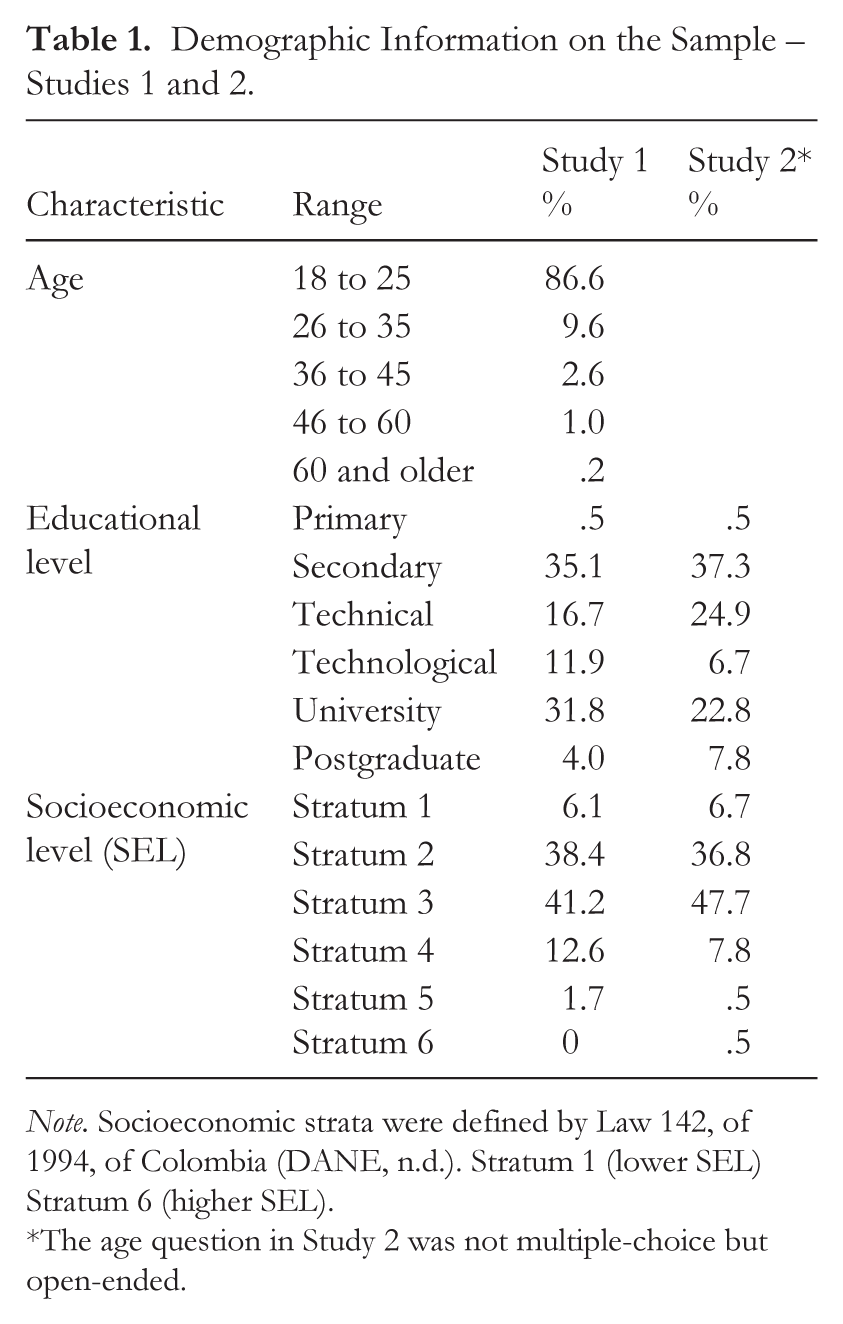
Note. Socioeconomic strata were defined by Law 142, of 1994, of Colombia (DANE, n.d.). Stratum 1 (lower SEL) Stratum 6 (higher SEL).
The age question in Study 2 was not multiple-choice but open-ended.
Results
Exploratory Factor Analysis (EFA)
Before performing the exploratory factor analysis, a Kaiser-Meyer-Olkin (KMO) test and a Bartlett sphericity test were perform to ascertain whether the scale met with the condition of sharing enough common variance among the items (Pizarro Romero & Martínez Mora, 2020). The results revealed a KMO = .89, which is considered very good, and a significant Bartlett sphericity, χ2(55) = 1,199.728, p < .001, suggesting that the factor analysis is viable. Because the scale has only one factor, no rotation was applied, and the maximum likelihood method was used because a psychological construct with a prior theoretical model was being assessed. Table 2 shows the results of the EFA.
Mean, Standard Deviation, Asymmetry, Kurtosis, Item-Total Correlation, Alpha if the Item is Eliminated, Factor Load and Communality of the PEIEL Scale.
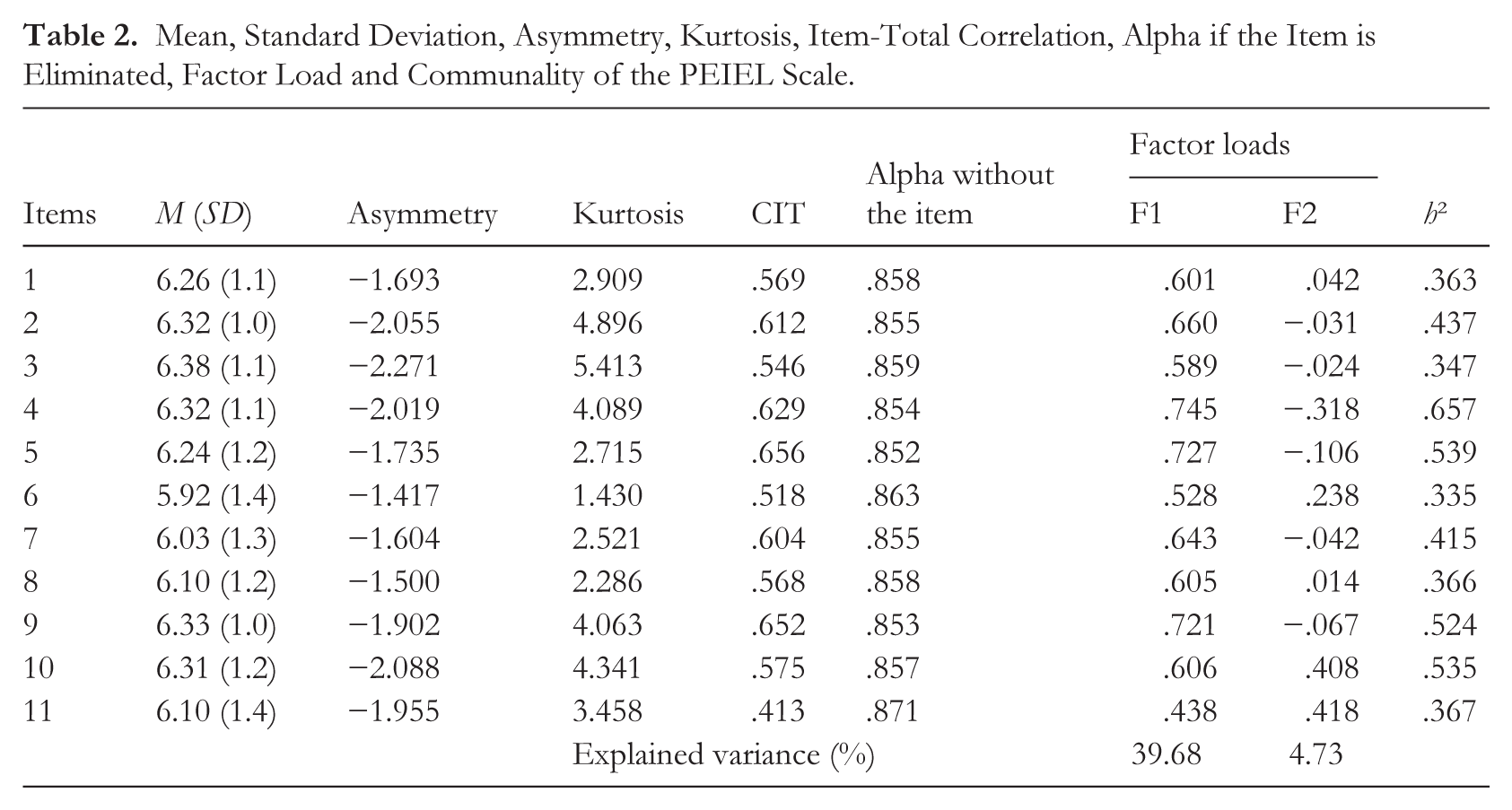
Even though the items had a factor load higher than .40 in the main factor and a communality higher than .20, item 11, ‘I know people who have to work more than others to earn the same’, also has a load higher than .40 in the second factor, without a significant difference with the factor load of the first factor. Likewise, this is the item that raises the reliability of the scale once eliminated, so we repeated the EFA without the item. The EFA without the item explains 41.4% of the variance and shows a suitable factor load in a single factor. Next, we present the Confirmatory Factor Analysis (CFA) of a single factor according to these results and previous theory.
Confirmatory Factor Analysis (CFA)
Once we confirmed that the theoretical structure of just one dimension works well in the first analysis, in this second analysis with the other half of the subsample we wanted to confirm the structure’s fit with just one dimension. Therefore, we performed a CFA with the robust maximum likelihood (RML) estimator, because the items on the scale are assumed to be approximately continuous and standard errors are eliminated with eventual normality adjustments (Rhemtulla et al., 2012), which are frequent in psychosocial constructs. The lavaan package in RStudio was used for the analysis. The results show that the structure of the 10-item scale is adequate, χ2(35) = 129.288, p < .001; CFI = .93, TLI = .92, RMSEA = .07 SRMR = .05.
Analysis of Invariance
Following the criteria of Cheung and Rensvold (2002), a factor invariance analysis was performed to examine whether the structure of the model remained equivalent among the groups compared (women and men). This analysis was performed with the sample used for the CFA of Study 1 (N = 302; 119 women). The configural model showed an acceptable fit of the data. Subsequently, the metric model, on which equality restrictions in the factor loads were imposed, showed adequate fit, χ²(79) = 177.52, p < .001; CFI = .926; TLI = .916; RMSEA = .091, CI90% [.073, .109]; SRMR = .054, without a significant deterioration in the fit indexes compared to the configural model (ΔCFI = .005). Therefore, metric invariance is supported, suggesting that the relations among the items and the factors are equivalent between the two groups. Finally, the scalar model, which includes the additional restriction of equality in the intercepts, also showed satisfactory fit, χ²(88) = 186.50, p < .001; CFI = .926; TLI = .925; RMSEA = .086, CI90% [.069, .103]; SRMR = .056. No noticeable deterioration in the fit compared to the metric model was observed (ΔCFI = .000; ΔRMSEA = .005).
In summary, these results acceptably support the presence of configural, metric and scalar invariance, which indicates that the model maintains a stable factor structure that is comparable between the groups analysed. Therefore, we can conclude that it is appropriate to make latent mean comparisons between the groups, given that the measurements can be considered equivalent in all the levels assessed. The results of these tests are shown in Table 3.
Analysis of Factor Invariance in the Gender Variable.
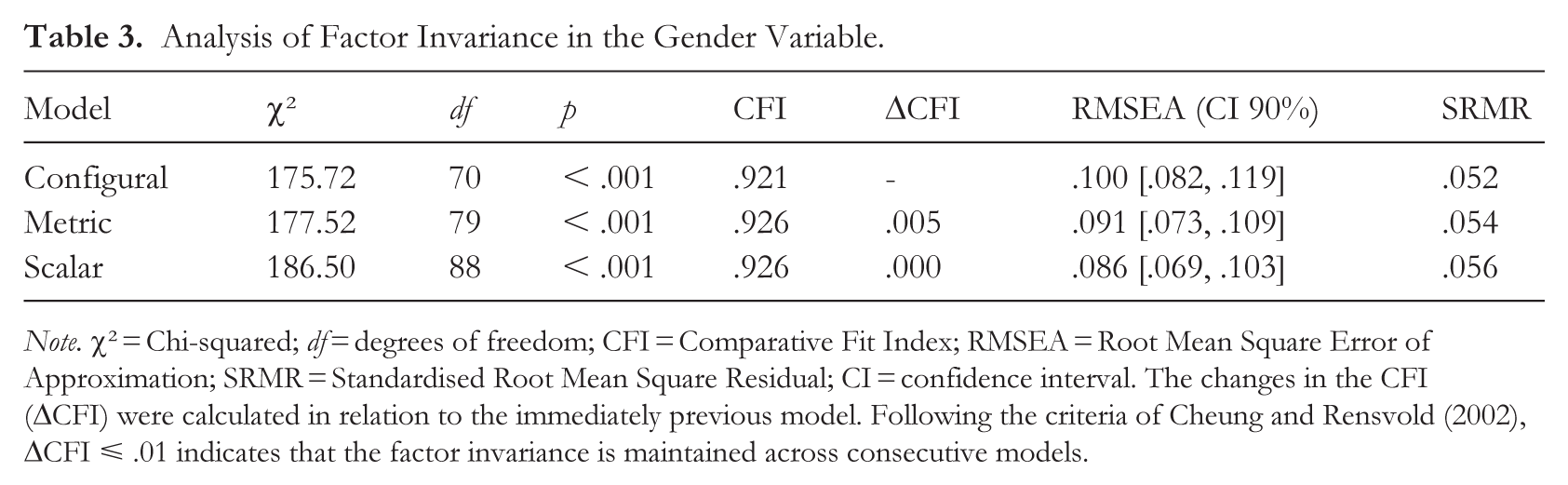
Note. χ² = Chi-squared; df = degrees of freedom; CFI = Comparative Fit Index; RMSEA = Root Mean Square Error of Approximation; SRMR = Standardised Root Mean Square Residual; CI = confidence interval. The changes in the CFI (ΔCFI) were calculated in relation to the immediately previous model. Following the criteria of Cheung and Rensvold (2002), ΔCFI ⩽ .01 indicates that the factor invariance is maintained across consecutive models.
Discussion
The results of Study 1 show an adequate adaptation of the measurement instrument to the Colombian context with 10 items; therefore, it may be used with this population. Furthermore, it shows how the results point to configural, metric and scalar invariance by gender. The results of Study 1 thus align with other results in such diverse settings as Japan (Willis et al., 2024), Costa Rica (Chaves & Sedano, 2024), Italy (Ambrosio et al., 2025) and Chile (Rodríguez-González et al., 2024), where the PEIEL scale has been adapted with sound psychometric results. This study adds evidence regarding the properties of how it works with regard to the participants’ gender.
The first result of this study is having an adaptation of the PEIEL scale to the Colombian context, which is enormously important for future studies. In the next study, we determined the scale’s predictive level of other related variables.
Study 2
Study 2 was ex post facto (León & Montero, 2007), since the predictive variable was not manipulated but only measured. Its purpose was to validate the predictive level of the PEIEL on status anxiety, status-seeking and materialism. Specifically, we hoped to identify whether high levels of PEIEL are related to more status anxiety, more status-seeking and more materialism.
Method
Procedure and Participants
We used a sample of 282 people from the general population living in the city of Bogotá through non-probabilistic sampling. Bearing in mind the inclusion criteria (being a legal adult and a current resident of the country), the final sample was 207 people (Mage = 23.28, SD = 7.70, 39.1% women). The data were collected online via a form developed in Qualtrics that was distributed in the social media.
Instruments
Status-Seeking Scale
This is made up of five items (e.g., ‘I would buy a product because it gives me status; 1 = ‘totally disagree’ to 5 = ‘totally agree’; α = .75) (Kilsheimer, 1993).
Demographic Information
The respondents’ sociodemographic information was requested, namely educational level, age, sex and socioeconomic level (See Table 1).
Analytical Procedure
A three-step hierarchical linear regression analysis was performed with the purpose of assessing the incremental contribution of the different sets of predictors on the criterion variable (status anxiety), previously controlling for the influence of relevant variables. In the first step, the control variables – age, gender and socioeconomic level – were introduced given that the literature states that they may interfere in perceptions related to status and psychological well-being (Melita et al., 2025), and thus in levels of status anxiety. In the second step, status-seeking and materialism (relevant theoretical variables) were added to estimate their additional contribution to explaining the variance of the criterion once the sociodemographic factors are controlled for. Finally, in the third step, the core variable (PEIEL) was added to identify whether it provides additional explanatory variance on status anxiety beyond the variables included in the previous steps. The analyses were performed with IBM SPSS Statistics Version 29.
Results
Descriptive Statistics
Both the descriptive statistics and the Pearson correlations found among the variables are reported in Table 4.
Descriptive Statistics and Correlations Among Variables.
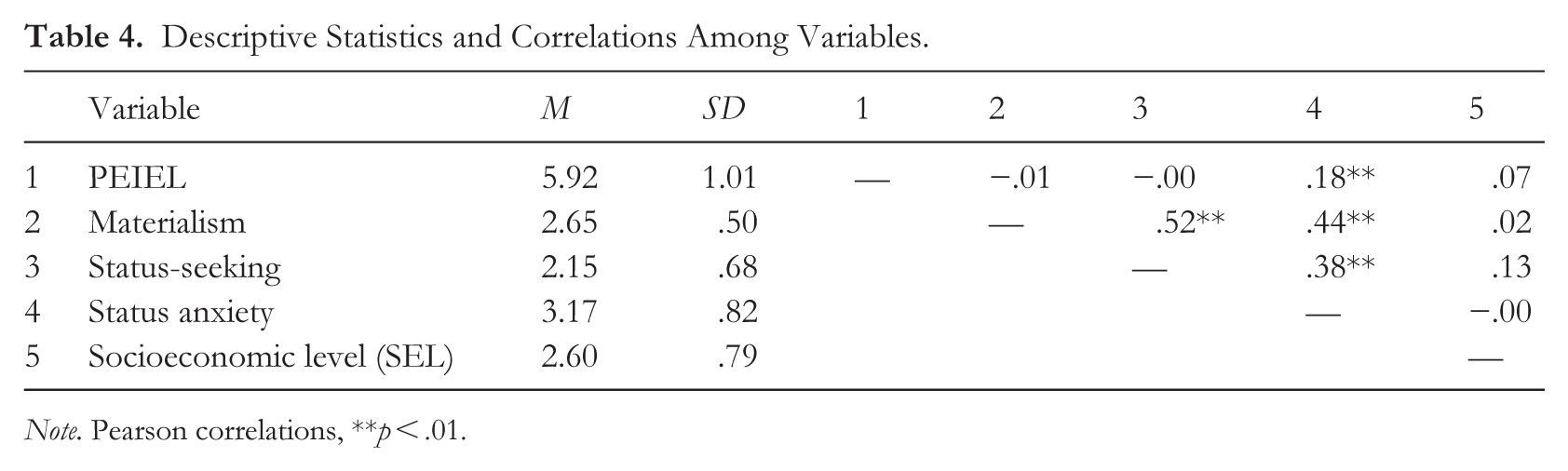
Note. Pearson correlations, **p < .01.
Principal Analyses
To respond to the hypotheses, a three-step hierarchical linear regression was performed with status anxiety as the criterion variable. In Model 1, the sociodemographic variables (age, gender, socioeconomic status) were included as predictive variables; this explained 4.2% of the criterion variance, R² = .042, F(3,189) = 3.79, p = .011. Even though the model was significant, gender was the only variable that had predictive value (β = −.29, p = .009). In Model 2, we added status-seeking and materialism as additional predictors, which significantly increased the explained variance, R² = .24, ΔR² = .18, F(5, 187) = 22.91, p < .001, f² = .22. In Model 2, both status-seeking (β = .24, p = .009) and materialism (β = .50, p < .001) had a significant predictive value over status anxiety but gender lost its effect. Finally, Model 3 incorporated the PEIEL and significantly increased the explained variance by an additional 4.3% (ΔR² = .043), with a total R² of .28, F(6, 186) = 11.218, p < .001, f² = .05. In this model, the PEIEL predicts status anxiety (β = .17, p < .001), while status-seeking (β = .24, p = .007) and materialism (β = .49, p < .001) remain significant predictors (see Table 5). These findings support the predictions that the perception of inequality in everyday life increases status anxiety (H1), status-seeking (H2) and materialism (H3).
Three-Step Hierarchical Regression. Status Anxiety as Criterion Variable.
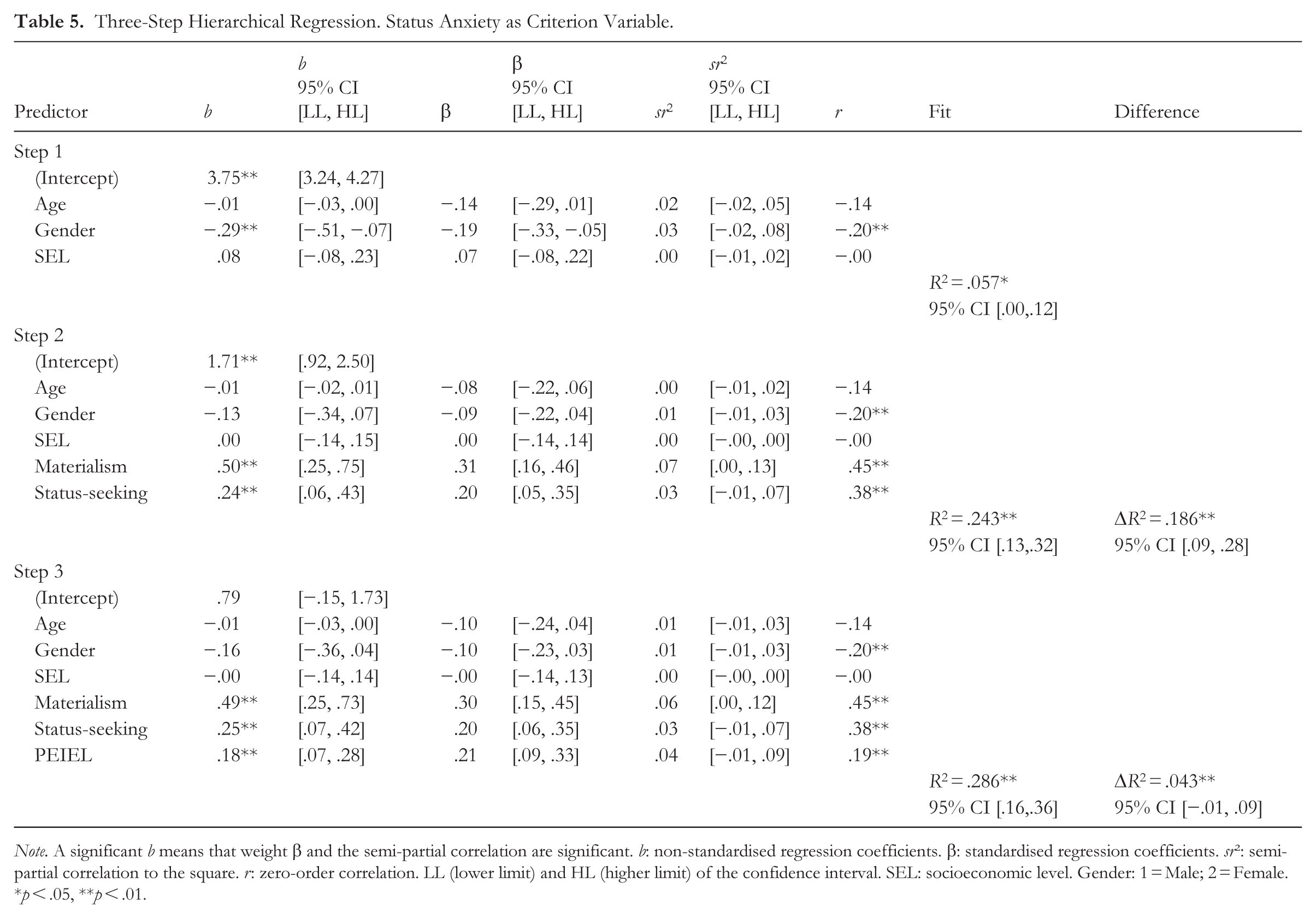
Note. A significant b means that weight β and the semi-partial correlation are significant. b: non-standardised regression coefficients. β: standardised regression coefficients. sr²: semi-partial correlation to the square. r: zero-order correlation. LL (lower limit) and HL (higher limit) of the confidence interval. SEL: socioeconomic level. Gender: 1 = Male; 2 = Female. *p < .05, **p < .01.
Discussion
This study examined the predictive validity of the adaptation of the Perceived Economic Inequality in Everyday Life scale (PEIEL) by analysing its relationship with status anxiety and simultaneously considering the role of status-seeking and materialism. The results indicate that the perception of higher levels of inequality in everyday life is associated with higher levels of status anxiety, even after controlling for relevant dispositional sociodemographic variables. Even though gender initially showed an association with status anxiety, this effect ceased being significant when psychosocial variables like materialism and status-seeking were included in the model. This suggests that the differences found between men and women can largely be explained by value and motivational orientations related to status more than by gender per se. Importantly, the results show that the everyday perception of inequality predicts status anxiety regardless of the participants’ socioeconomic status. This finding suggests that the psychological impact of inequality does not depend solely on one’s objective status within the social hierarchy but also on the way this inequality is perceived, experienced and interpreted in daily life. In other words, everyday exposure to visible economic differences may activate concerns over both social ascent and the possible loss of status, generating a constant state of vigilance regarding one’s relative status (Melita et al., 2025; Velandia-Morales et al., 2022, 2023).
General Discussion
The primary goal of this study was to examine whether perceived economic inequality in everyday life is associated with higher levels of status anxiety in a Latin American context. The study was carried out in two complementary phases. First, the Perceived Economic Inequality in Everyday Life scale (PEIEL) was psychometrically validated in a sample of the general Colombian population. Secondly, its predictive validity was assessed by analysing whether the PEIEL served as an antecedent of status anxiety, while also bearing in mind the role of status-seeking and materialism in this relationship.
The results of the first study support the validity and reliability of the PEIEL as an adequate instrument to assess perceived economic inequality in everyday life in the Colombian context. The exploratory and confirmatory factor analyses showed a coherent internal structure, as well as a robust one-dimensional structure, with satisfactory factor loads and suitable levels of explained variance. Likewise, the invariance analyses indicated that the scale measures the construct equivalently in men and women, which is an important contribution given that this aspect had not been assessed in previous adaptations of the instrument (e.g., Chaves & Sedano, 2024; Rodríguez-González et al., 2024). Having performed the study in a sample that encompasses all the socioeconomic levels defined in the Colombian stratification system, using cognitive interviews to validate the semantic content of the questions on the scale and the results of the statistical tests all suggest that the PEIEL consistently captures the everyday experiences of exposure to inequality in the Colombian context, a consideration highlighted as particularly important in understanding the psychosocial effects of economic hierarchies (García-Castro et al., 2024).
In contexts characterised by high levels of structural inequality, as in many Latin American countries, including Colombia, economic differences are not only reflected in macroeconomic indicators but are also part of everyday social experience, shaping perceptions, comparisons and individual expectations. This is why it is particularly important to have an instrument validated in a social context characterised by clear structural asymmetries, like Colombia, where the socioeconomic stratification system whose original design had a redistributive purpose (the higher strata would subsidise the public services for the lower strata) ended up becoming a mechanism of urban segmentation. This has only furthered the social distance among economic groups, which affects social dynamics and fosters discriminatory practices based on the strata, contributing to naturalising income-associated inequalities (Bogliacino et al., 2015).
Regarding the hypotheses, the results showed that higher perceived economic inequality in everyday life is associated with higher levels of status anxiety. This finding is consistent with theoretical perspectives that posit that when inequality becomes more visible in everyday environments, social hierarchies become more psychologically salient, magnifying social comparison processes among individuals (Sánchez-Rodríguez et al., 2019). In this sense, perceived inequality can act as a contextual signal that communicates the existence of large social distances, which increases the importance of one’s relative status within the economic hierarchy. In consequence, people may experience a keener concern with maintaining, improving or protecting their social status, which translates into higher levels of status anxiety (Sánchez-Rodríguez et al., 2023).
From this perspective, the results show that the PEIEL serves as an important psychological mechanism to explain how everyday experiences of inequality are associated with social comparison processes and subjective distress. The fact that the PEIEL predicts status anxiety even after controlling for demographic and dispositional variables reinforces the idea that the perception of inequality not only reflects the structural reality but internalises it, turning it into an everyday source of stress and social vigilance (Melita et al., 2025). This result dovetails with previous studies that show that the effects of perceived inequality are more powerful in explaining psychological well-being than the effects of objective inequality (García-Sánchez et al., 2024; John et al., 2025; Willis et al., 2022).
These findings can also be explained by the materialist rank hypothesis (Walasek & Brown, 2019), which posits that in more unequal contexts, people tend to define their and others’ value through material dimensions like income, visible consumption and the possession of goods. According to this hypothesis, inequality makes economic status become the main social metric, displacing other dimensions of personal assessment (e.g., effort, social skills or interpersonal relationships). In line with this perspective, the study shows that the perception of inequality is positively related to status-seeking and materiality, variables that, in turn, predict higher levels of status anxiety. This suggests that when inequality becomes more evident in everyday life, the symbolic pressure to demonstrate success or social belonging via material signals increases, while upward social comparison and dissatisfaction with one’s relative status are also magnified (Jetten et al., 2017; Veblen, 2018).
This relationship between perceived inequality, status-seeking, materialism and status anxiety suggests the possible existence of a psychosocial cycle of inequality reproduction, which may contribute to maintaining inequality and its subjective consequences. Inasmuch as individuals internalise materialistic values as core indicators of social success, status anxiety may become a driver of competitive consumption (‘keeping up with the Joneses’), reinforcing the symbolic hierarchies that sustain economic differences (Paskov et al., 2017; Velandia-Morales et al., 2025). This mechanism may help to explain why more unequal societies have not only larger economic gaps but also higher levels of psychological distress, concern with social image and competitive stress (Wang et al., 2022).
One of the most important contributions of this study is the fact that it addresses these phenomena in a Latin American context, specifically in Colombia, one of the most unequal countries in the world (Benza & Kessler, 2021; CEPAL, 2024). The majority of studies on the psychological effects of inequality have been performed in the Global North, in contexts characterised by higher levels of social mobility and a more stable institutional structure (Uskul et al., 2024). These factors differ significantly from Latin American contexts, where inequality is experienced in everyday life as a persistent structural condition, opportunities and possibilities for upward mobility are limited and differences among groups are perceived as more rigid (Melita et al., 2023). This environment may modulate the effects of inequality on status anxiety, given that the perception of structural limitations amplifies the sense of a lack of control and relative deprivation (Manstead, 2018). In this sense, the results of this study contribute to a more contextualised understanding of the psychology of inequality by showing that social comparison and competition mechanisms are nuanced differently in environments where social mobility is limited and the economic hierarchy is deeply rooted.
The Colombian cultural context is characterised by a focus on interpersonal relations, appreciation of social recognition and a collective orientation (Krys et al., 2022). This may intensify the emotional impact of perceived inequality by connecting social status not only with material resources but also with prestige, respect and recognition within the community. For this reason, status anxiety may reflect not only economic concerns but also fears related to the loss of social recognition or symbolic appreciation within the social milieu. This interpretation suggests that within the context studied, the effects of inequality may be mediated by a combination of structural factors (restricted mobility) and cultural factors (importance of social recognition), which is fertile ground for future studies that explore other consequences of inequality. For example, it would be interesting to inquire into the potential relationship with legitimisation of the use of violence, given that inequality is not only evidence of social inequity but also creates specific social dynamics marked by social mistrust and competition for resources, which may influence the legitimisation of violence as a mechanism to counter the negative consequences of inequality (García-Castro et al., 2024).
Limitations and Future Lines of Research
Despite the theoretical and empirical contributions of this study, it is important to recognise several limitations that should be considered when interpreting the results. First, the ex post facto transversal design prevents us from establishing causal relationships between the perception of economic inequality and status anxiety; future studies could use longitudinal or experimental designs that would make it possible to examine the directionality of these effects and the mediation processes involved. Secondly, even though the Colombian sample is an advancement in our understanding of the psychological effects of inequality in Latin American contexts, it would be valuable to replicate the study in other countries in the region to explore possible cultural and structural differences in the relationship between perceived inequality, materialism and status anxiety, such as in Central America, another distinct region within Latin America. Likewise, the use of exclusively self-reporting measures may have been influenced by social desirability biases or the subjective interpretation of the items; future studies could complement this with behavioural or experimental indicators. Finally, it would be worthwhile to examine the moderating role of contextual variables like perceived social mobility, collectivism and social recognition orientation, since they may nuance the impact of perceived inequality on well-being and status anxiety. As a whole, addressing these limitations would strengthen our understanding of the psychosocial mechanisms that connect inequality with well-being in Latin America and would help us advance towards theoretical models that are more sensitive to the cultural and structural realities of the region.
As a whole, the results show that perceived economic inequality in everyday life is an important psychosocial predictor of status anxiety by magnifying social comparison processes and reinforcing materialist orientations and status-seeking. These results further the literature on the psychology of inequality by providing evidence from a setting that has been hardly explored and is socioculturally different to the majority of existing studies. Thus, this study shows that perceived inequality not only affects individual well-being but also shapes the dynamics of interaction, aspiration and recognition in societies like Colombia, where relative social status has become a core source of identity and anxiety.