






Abstract
The degree to which people accept inequality influences their socio-political attitudes. However, we do not yet know the extent to which such acceptance is associated with trust in the incumbent government and, going a step further, how both relate to the perceived economic performance of the country in question. In our research, we analyse this relationship in Costa Rica, an economically unequal country with a moderate level of support for the government. First, we use structural equation modelling to analyse data from a national survey and subsequently from the Latinobarómetro public opinion survey. In the first study (N = 939), we find that acceptance of economic inequality is positively associated with trust in government and the president. In the second study (N = 862), we find that acceptance of inequality is related to a higher level of perceived economic performance, and an indirect effect through greater trust in government. Acceptance of inequality impacts politically on favourable attitudes towards government and economic performance, representing a distorted view of the country’s economic reality.
Introduction
Latin America has long been characterised by extreme and persistent economic inequality, which has shaped the daily lives of its inhabitants and has been reflected in political-institutional instability with popular uprisings, coups and dictatorships (Assusa & Benza, 2024). In this context, the Costa Rican State promoted the welfare of its population and social mobility in the mid-twentieth century, forging a social identity of igualiticos, with a conception that the entire population was similar and had the same opportunities (Robles-Rivera et al., 2025). This social myth, which persists to this day, stands in stark contrast to current levels of objective inequality, which rank the country as one of the most unequal in Latin America and the most unequal in the Organisation for Economic Co-operation and Development (OECD, 2024).
High levels of economic inequality in Latin America go hand in hand with low levels of political trust (García-Sánchez et al., 2025). In recent decades, Latin America has consistently shown low levels of political trust relative to other parts of the world (Parra Saiani et al., 2024), which has led, among other consequences, to the slowing down of economic growth and innovation (Keefer et al., 2022). Against this backdrop, the international community has tended to see Costa Rica as an oasis in Central America, as one of the countries with the greatest institutional stability and no armed forces (Robles-Rivera et al., 2025). However, this democratic idealisation has changed in recent years. For example, in 2023, 43% of the population expressed little or no trust in government (OECD, 2024).
Social psychology’s contribution to this research agenda remains scarce, even with the great contribution of Latin American social sciences to the study of inequality and its socio-political consequences (see, e.g., Dependency Theory; Assusa & Benza, 2024). For example, despite its relevance, there is little research in the region on the psychosocial intersection between acceptance of economic inequality, government trust and people’s perceptions of their country’s economic performance. Furthermore, if scientific research on Latin America already tends to be under-represented in the international literature, research on Central America is almost non-existent (García-Castro & Robles-Rivera, 2025). In this study, we aim to contribute in two ways to the psychosocial development of scientific knowledge on economic inequality: firstly, by examining the relationship between the variables mentioned; and secondly, by strengthening the scientific literature on Latin America and, more specifically, on Central America.
This paper seeks to answer whether people’s prior attitudes towards economic inequality are associated with trust in government and the incumbent president. People who accept inequality may be more trusting of the government and the president, as they may see the government, and thus the ruler, as succeeding in maintaining the status quo in society. Furthermore, we propose that this trust in government may be one of the psychosocial mechanisms through which the acceptance of inequality is associated with perceived economic performance, since the belief in good governmental performance may lead to a more positive evaluation of the country’s financial direction. We test these ideas in a particularly significant setting, since Costa Rica is a Central American country with a long democratic tradition but high levels of economic inequality.
Acceptance of Economic Inequality
Living in unequal contexts does not imply that people seek greater equality. Although the negative consequences of economic inequality at both the individual and societal levels are widely recognised – such as reduced personal well-being (García-Sánchez et al., 2024) and reduced social cohesion (Delhey & Steckermeier, 2020) – many people adopt an attitude of acceptance towards such inequality. Previous literature has used the terms ‘tolerance of inequality’ and ‘acceptance of inequality’ interchangeably (Montoya-Lozano et al., 2023; Wiwad et al., 2019). Acceptance of economic inequality, or tolerance of economic inequality, is understood as the degree of support for perceived economic differences between the most and least well-off people in a society (Bernardo, 2021; Castillo et al., 2012).
Previous research suggests that the more economic inequality exists in society, the more inequality is perceived and, consequently, the more inequality is tolerated (Carrasco et al., 2024; Castillo, 2011). However, this is particularly true of those who defend the system (García-Sánchez et al., 2019). Those who perceive a high level of inequality in society and consider the social system to be fair tend to support higher levels of economic inequality: for example, because they attribute inequality to a meritocratic functioning in which some have more because they have worked harder (Banco Interamericano de Desarrollo, 2024; McCoy & Major, 2007; Rottenbacher de Rojas & Córdova Cáceres, 2014). However, other research has shown that perceived economic inequality is negatively associated with the acceptance of economic inequality (Castillo et al., 2012; Knell & Stix, 2020). Thus, the relationship between economic inequality and acceptance of economic inequality is not linear but depends, in part, on perceived injustice (Starmans et al., 2017). In this sense, people accept or do not accept economic inequality depending on whether they consider it fair or unfair, respectively (Trump, 2020).
Some people not only support current inequality but prefer a relative level of economic inequality. This preference is because they believe that economic differences between individuals and also between groups encourage individual hard work, which can lead to greater economic advancement and thus greater collective well-being (Cho et al., 2023). Furthermore, as inequality increases, people can underestimate its true magnitude (Song Hing et al., 2019). That is, this environment of inequality is normalised, which leads to rationalisation and acceptance of greater economic differences (García-Castro et al., 2020).
Acceptance of economic inequality directly influences socio-political matters. On the one hand, in relation to economic order, experimental studies have shown that a lower acceptance of economic inequality is associated with greater support for resource redistribution policies (García-Castro et al., 2020). On the other hand, with respect to the political order, people’s assessment of economic inequality influences political trust (e.g., Chi & Kwon, 2016, Zmerli & Castillo, 2015). However, most research has focused on political trust in general terms, such as trust in the democratic system, in parliament or in political institutions in the abstract (e.g., García-Sánchez et al., 2025; Lipps & Schraff, 2021), without specifically examining how acceptance of economic inequality is linked to trust in specific political leaders, such as the president and the current government. 1 This distinction is particularly relevant in the Latin American context, where high levels of economic inequality coexist with high levels of institutional disaffection (Porta et al., 2017; García-Sánchez et al., 2025; Loveless, 2013; Ortiz et al., 2022) and, more specifically, in Costa Rica, where recent events relating to possible cases of corruption (Conte, 2025) lead us to examine which psychosocial factors cause the population to trust the government and the president.
Trust in Government
The trust that the population has in various institutions operating in their environment (e.g., the central government and the president) has routinely been studied as political or institutional trust and refers to an assessment of how institutions are viewed and what is expected of them (Catterberg & Moreno, 2006; García-Sánchez et al., 2025). Two dimensions of public political trust can be identified, as people broadly categorise the responsibilities and characteristics of political institutions into two groups (Breustedt, 2018). On the one hand, representative political institutions such as political parties, government and parliament serve to make collectively binding decisions. In general, their work is characterised by political controversies and competition between proposals (Breustedt, 2018; Rothstein & Stolle, 2003). On the other hand, political enforcement institutions, such as the courts and the police, are responsible for maintaining order and enforcing the law. In our research, we will focus on the former, mainly trust in government and the president. In line with this distinction, Mattes and Moreno (2017) found that in Latin America, trust in government is a stronger predictor of trust in institutions in general than trust in enforcement institutions, such as the police.
Political trust is a concept marked by remarkable ambiguity, which has made it difficult to measure accurately (Seyd, 2016). One of the main challenges in the literature has been the lack of a clear distinction between trust in political institutions and assessments of government performance (Catterberg & Moreno 2006; Kanji & Nevitte 2002). Furthermore, government responsiveness, which refers to the responsiveness of the political system to the needs and preferences of society, has been suggested as a determinant of political trust (Goubin, 2020; Mansbridge, 2003). For example, when people perceive that government action negatively affects their quality of life, they are likely to be less willing to trust government institutions (Yonk & Smith, 2018). Some studies have measured trust in government to do the right thing, using a single item (Goubin, 2020; World Values Survey, 2024) or scales that included this item and others on the ability and intelligence of government officials (Craig, 1979). For their part, some public databases have asked directly about the level of trust in government and/or the president (Corporación Latinobarómetro, 2023; European Social Survey, 2023), and some research has used this type of measure (Clemente & De Sousa, 2024; García-Sánchez et al., 2025). In line with these studies, our research uses the measures available in opinion databases that best fit the conceptualisation of trust in government to pursue our objective.
Acceptance of Inequality and Trust in Government as Legitimisers of Economic Performance
Numerous research studies have shown that objective economic inequality is accompanied by lower levels of citizen support for political institutions (Krieckhaus et al., 2014; Zmerli & Castillo, 2015). At a subjective level, there is also a negative association between anti-inequality attitudes and positive evaluation of democratic institutions (Bobzien, 2023; García-Sánchez et al., 2025; Simpson & Loveless, 2017), and some evidence that anti-inequality attitudes decrease trust in the political system (Benson et al., 2021). In other words, there is a positive relationship between pro-inequality attitudes and institutional trust. In this regard, evidence from the Spanish context shows that those who were more supportive of inequality showed greater trust in institutions (Montoya-Lozano et al., 2023). In line with this result, we expect a positive relationship between acceptance of inequality and trust in government.
Similarly, the perception of inequality as unfair influences public support for the functioning of political institutions and approval of the government of the day (Linde, 2012). Evidence from the region has shown that assessments of unfairness in income distribution at the individual level are negatively associated with political trust (García-Sánchez et al., 2025; Zmerli & Castillo 2015). Specifically, multilevel evidence indicates that people were more likely to report higher levels of institutional trust when they perceived the distribution of income as fair. In our research, we will examine how attitudes towards inequality are associated with trust in government and the president, and the consequences of such an assessment. Specifically, we will explore the relationship between acceptance of inequality and trust in Costa Rica’s government and president with perceptions of the country’s economic performance.
Perception of a country’s economic performance or situation has been widely studied in political science (e.g., Torcal, 2014). The relationship between a country’s economic performance and institutional trust has been examined at both an objective (e.g., Miller & Listhaug, 1999) and subjective level (e.g., Corporación Latinobarómetro, 2023; Zmerli & Castillo, 2015). A number of studies have proposed that perceptions of good economic performance can predict people’s trust in political institutions (Hetherington & Rudolph, 2008; Hopkins, 2012). However, some authors suggest that the direction of this relationship is less clear since the results are mixed, largely due to methodological differences (Van Erkel & Van Der Meer, 2016). Specifically, in this research, we propose that acceptance of economic inequality and trust in government could work as psychosocial mechanisms of legitimisation of the country’s current economic situation. Previous research has shown that people’s perceptions of their country’s economic performance are biased by their political leanings (Gerber & Huber, 2009). For example, during the same time period, pro-government voters have a more positive perception of economic performance than voters opposed to the government (Kirchgässner, 1991). More recently, in an increasingly politically polarised context (Jost et al., 2022; Mudde & Rovira Kaltwasser, 2017; Webster & Abramowitz, 2017), it has been shown that people sympathetic to the government in power are less likely to evaluate economic performance negatively, regardless of objective indicators (Moreira, 2025).
Thus, given the most recent evidence indicating that perceptions of economic performance are biased by attitudes towards the government and the president in power (e.g., Bailey, 2022), in our research we propose that trust in government and the president is positively related to perceptions of the country’s economic performance. Also, considering that positive attitudes towards inequality predict trust in government (e.g., Montoya-Lozano et al., 2023), which in turn influences perceived economic performance, we posit that acceptance of economic inequality is positively related to perceived economic performance through greater trust in government and the president.
The Present Research
The main objective of this research is to examine the relationship between acceptance of economic inequality and trust in the Costa Rican government and president. Previous studies have shown that positive attitudes towards economic inequality are associated with greater institutional trust (e.g., Bobzien, 2023). However, to the best of our knowledge, the relationship between acceptance of economic inequality and trust in government and the president has not been specifically studied. Examining this relationship in the Costa Rican context is relevant because the country has one of the most consolidated democracies in the region, but at the same time one of the highest rates of economic inequality in Latin America. Throughout this article, we will refer to trust in government and trust in the president as trust in government for ease of reading and understanding. Thus, we hypothesise that people who are more accepting of economic inequality will trust the government more (H1). To test this hypothesis, we analysed data from a Costa Rican national opinion poll (Study 1).
In addition, for exploratory purposes, we examine whether trust in government mediates the relationship between acceptance of inequality and perceived economic performance (H2). Acceptance of economic inequality legitimises existing economic differences between people, despite high levels of inequality. Inequality is normalised and justified, which is why people who have these favourable attitudes towards inequality will also perceive economic performance as favourable, regardless of the objective data. Furthermore, we propose that this association can be explained by a higher level of trust in government, which would serve to legitimise the economic system by biasing the perception of the country’s economic situation. The code for the analyses carried out in the course of this research and the data from the second study can be found in the Open Science Framework (OSF; https://osf.io/8wpvk/overview).
Study 1
Method
Participants
The sample of participants comes from a public opinion survey conducted by the Research and Political Studies Centre (CIEP) at the Universidad de Costa Rica in September 2024 by calling the mobile phones of the participants (see Córdoba, 2025). The initial sample consisted of 1,012 people (515 women, 490 men and seven other/non-binary) aged 18–87 (M = 40.20, SD = 15.45). Participants who indicated ‘Other/Non-binary’ under gender (n = 7) were excluded, since the small size of this group did not allow reliable estimates to be obtained in the planned model for this category (N = 1,005). After excluding cases with missing values for the variables of interest (n = 66), the final sample consisted of 939 participants (472 women, 467 men; age range 18–87): M = 40.21, SD = 15.37). All participants were residents of Costa Rica and mobile phone users. Participants were selected using simple random sampling from the sampling frame of the National Numbering Plan of the Costa Rican Telecommunications Authority (SUTEL, 2025).
Procedure and Instruments
The questions included in the survey were organised under three headings: (1) socio-demographic data; (2) assessment of political-institutional performance; and (3) acceptance of economic inequality in Costa Rica. The analyses were carried out using the responses to a subset of questions from the survey relating to the variables of interest. We combined the questions most closely aligned with the standard measures of trust in government used in the literature (e.g., Catterberg & Moreno, 2006; Goubin, 2020; Kanji & Nevitte, 2002) to obtain a more robust measure of trust in government. All questions included the option to code the answer as ‘Don’t know / No answer’. Prior to the analyses, responses coded in this category were treated as missing values and were not included. Below is a brief description of each of the study variables and the questions used in the survey.
Trust in Government Capacity
First, participants were asked about Costa Rica’s main problem through a single categorical response item (‘In your opinion, what is the country’s main problem?). Responses were subsequently recorded and coded based on a list of 12 pre-defined problems (e.g., ‘Cost of living and economic situation’, ‘Poverty and inequality’) plus an additional open-ended option (i.e., ‘Other’). Participants were then asked about their level of trust and confidence in the current government to solve this problem by means of one item (‘So tell me, how confident are you that the current government can solve the country’s main problem?). To answer this question, the following options were provided: 1 (‘Not at all’), 2 (‘Little trust’), 3 (‘Some trust’) and 4 (‘A lot of trust’). Higher scores indicate greater confidence in government capacity (M = 2.13, SD = .97).
Government Performance
Each person was asked how they would rate the government’s performance with a single question (‘How would you rate the current government’s performance?’) and was offered the following response options: 1 (‘Very bad’) 2 (‘Bad’), 3 (‘Neither bad nor good’), 4 (‘Good’) and 5 (‘Very good’). Higher values in this variable reflect a better rating of the government’s performance (M = 3.28, SD = 1.19).
President’s Performance
Participants were asked to rate the performance of President Rodrigo Chaves with a single question (‘How do you rate the performance of President Rodrigo Chaves?’). Participants were asked to respond using a five-point scale: 1 (‘Very bad’) 2 (‘Bad’), 3 (‘Neither bad nor good’), 4 (‘Good’) and 5 (‘Very good’). Higher scores on this variable reflect a better rating of the president’s performance (M = 3.26, SD = 1.26).
Acceptance of Inequality
Participants were asked through a single item whether the existence of economic differences was necessary for people to strive to achieve their goals (‘Economic inequalities are necessary for people to strive to achieve their goals’). People answered this question using the following options: 1 (‘Strongly disagree’), 2 (‘Disagree’), 3 (‘Neither agree nor disagree’), 4 (‘Agree’) and 5 (‘Strongly agree’). Higher scores on this variable indicate greater acceptance of economic inequality (M = 2.89, SD = 1.31).
Data Analysis
A regression analysis using structural equation modelling (SEM) was performed to assess trust in government and acceptance of inequality. This model allows for a simultaneous assessment of the construct validity of trust in government through factor loadings and structural relationships with the acceptance of inequality, which provides a more complete picture of the theoretical model. Furthermore, this will allow us to make trust in government operational as a latent variable and to take into account the measurement error associated with the use of single indicators.
This model was estimated using the lavaan package (Rosseel, 2012) and the Robust Maximum Likelihood estimation method. The fit of the model to the data was assessed by the following indices: Comparative Fit Index (CFI), Tucker-Lewis Index, Root Mean Square Error of Approximation (RMSEA) and Standardised Root Mean Squared Residual (SRMR). Factor loadings, regression coefficients and errors were fully standardised.
Dependent Variable
A latent variable called ‘Trust in Government’ was estimated, whose observed indicators were the items through which confidence in government capacity, government performance and performance of the president of Costa Rica were measured (Table 1). The latent variable represents the common variance shared by these three indicators. The reliability of the scores generated by these items, as estimated by the alpha coefficient, is .84.
Latent Variables and Their Observed Indicators in Studies 1 and 2.
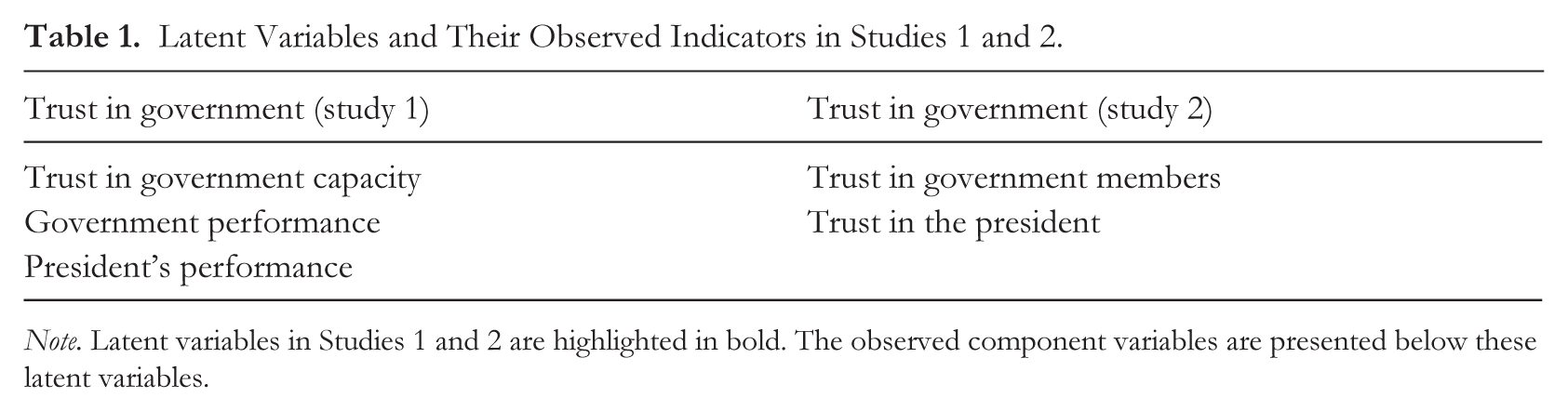
Note. Latent variables in Studies 1 and 2 are highlighted in bold. The observed component variables are presented below these latent variables.
Predictor Variable
The model also included inequality acceptance as a predictor of the latent variable Trust in Government.
Control Variables
The model includes three control variables: participants’ age, sex and level of education. The purpose of including these variables is to find out whether the association between the acceptance of inequality and trust holds when controlling for the effects of these socio-demographic characteristics. The age variable takes into account possible generational differences. Sex allows for the identification of possible gender differences in political perceptions, and level of education provides an opportunity to learn about the possible relationship between education and attitudes towards inequality and institutional trust. Given the small number of people who identified as non-binary (n = 7), these cases were excluded from the analysis.
Results
Robust fit indices indicated an excellent fit of the model to the data (robust χ² (8) = 17.18, p = .03; robust CFI = .99; robust TLI = .99; robust RMSEA = .04, 90% CI [.01, .06], p = .83; SRMR = .02), since all indices exceeded the thresholds for excellent fit presented in Hu and Bentler (1999), namely: CFI/TLI > .95, RMSEA < .06 and SRMR < .08. Figure 1 summarises the results of the structural equations analysis.
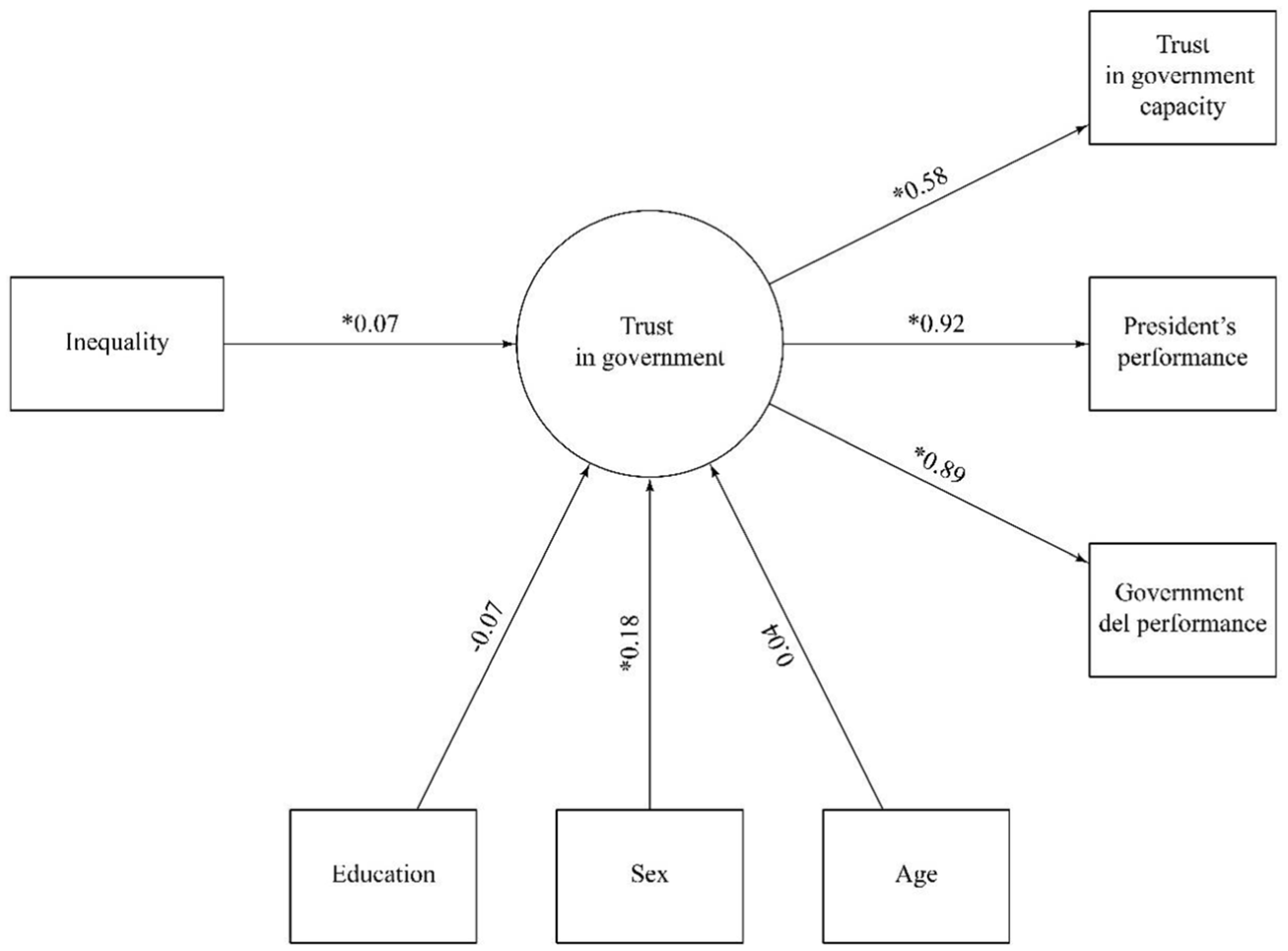
Structural equation modelling (SEM) showing the association between acceptance of inequality and trust in government as a latent variable.
The fully standardised factor loadings of the indicators of the latent variable Trust in Government were significant (p < .001) and high (government performance = .89, president’s performance = .92 and trust in government capacity = .58). The reliability of the Trust in Government factor was also high (α = .84 and ω = .87). The standardised regression coefficient relating the latent variable Trust in Government to acceptance of inequality was significant (β = .07, p = .040), as was that of sex (β = .18, p < .001); given that women were coded 0 and men were coded 1, this implies that men have higher levels of institutional trust on average than women. In contrast, age (β = .04, p = .340) and level of education (β = −.07, p = .050) were not statistically significant. In terms of variance explained, the latent factor Trust in Government explained 79.4% of the variance of government performance, 84.0% of the variance of the president’s performance and 34.1% of the variance of trust in government capacity. Acceptance of inequality explained 5% of the variance of the latent factor Trust in Government.
Discussion
The results of the model proposed in Study 1 show that acceptance of economic inequality is positively associated with trust in government, confirming H1. Thus, we interpret that those who are more accepting of inequality have more confidence in the capacity and performance of the government and the president. These results are in line with previous studies suggesting that those who accept inequality and justify it may be more likely to trust those who administer and manage such a system (e.g., García-Sánchez et al., 2025). This result can be explained by a legitimisation of inequality. Following System Justification Theory (Jost, 2019), some people are motivated to defend and justify the economic system around them, even if it is unequal and sustains their own oppression. Thus, when people accept economic inequality, they are justifying the economic system that allows such inequality and, in turn, tend to evaluate the governing institutions of that system positively in order to continue to support the system. In the case of Costa Rica, levels of inequality have increased in recent years (Córdoba & Robalino, 2024; León Espinoza & Mata Marín, 2017) but levels of support for presidential figures have remained relatively stable (Córdoba, 2025; Corporación Latinobarómetro, 2023). On the one hand, citizens are in an unequal environment, but on the other hand, they justify the existence of differences between those who have more and those who have less. As a result, they do not evaluate the government negatively, even though it has a responsibility to address the country’s needs. Our finding may reflect this process of legitimisation of the status quo, in which the acceptance of economic differences buffers the negative evaluation of the government by citizens.
In addition, our results show that prior attitudes about economic inequality are associated with trust in government and the president (e.g., Benson et al., 2021), in contrast to other research looking at the effect on a broader set of public institutions (e.g., Catterberg & Moreno, 2006; García-Sánchez et al., 2025; Kanji & Nevitte, 2002).
Based on these results, in Study 2 we set out to go a step further by exploring whether trust in government and the president explains the potential relationship between favourable attitudes towards inequality (i.e., acceptance of inequality) and perceptions of the country’s economic performance. Considering studies showing that people’s ideological and political attitudes determine how they evaluate the context around them and, more specifically, the economic situation of their country (Gerber & Huber, 2009; Kirchgässner, 1991; Moreira, 2025), we wanted to examine whether trust in government could serve as a filter to value the economic context more favourably when, previously, one tends to accept the level of inequality in the country, as proposed in H2.
Study 2
Method
Participants
For this study, we sought the most recent sample at the time of research from the public opinion survey conducted by Corporación Latinobarómetro (2023). As an initial sample, 1,000 Costa Rican participants (530 women and 470 men) aged 18–88 (M = 44.61, SD = 17.28) were selected. According to the 2023 report of Corporación Latinobarómetro, the sample is nationally representative of the population aged 18 and over living in the country. As a final sample, we used a total of 862 valid cases (442 women, 420 men; age range 18–88: M = 44.12, SD = 17.06), after excluding 138 cases for missing values on at least one of the variables of interest.
Procedure and Instruments
The survey was conducted from 24 March to 15 April 2023 through face-to-face interviews with the individuals in the sample. The questions included in the survey address various topics such as support for democracy, trust in political institutions, perceptions of the personal and national economic situation, participation in collective action and attitudes towards the rule of law, among others. The analyses were based on the responses to a subset of all the survey questions relating to the first study.
Trust in Government Members
Participants were asked how much trust they had in the government through a single item from the Latinobarómetro block on trust in different groups, institutions or individuals. The general statement of the block was: ‘How much confidence do you have in each of the groups, institutions or individuals on the list?’ We specifically used the item referring to government. Participants responded on a scale of 1 (‘A lot’), 2 (‘Some’), 3 (‘Little’) and 4 (‘None’). Scores on this scale were reversed so that a higher score reflected greater trust in government (M = 2.21, SD = .94).
Trust in the President
This was assessed by means of a single item from the same Latinobarómetro block as the previous variable, using the item referring to the president. The same response scale was also used: 1 (‘A lot’), 2 (‘Some’), 3 (‘Little’) and 4 (‘None’). Scores were reversed as in the previous variable. Thus, a higher score reflects greater trust and confidence in the Costa Rican president (M = 2.68, SD = .99).
Political Orientation
It was explained to people that in politics people usually talk about left and right, after which they were asked to place themselves on a scale where 0 is left and 10 is right (M = 5.81, SD = 2.71).
Perceived Economic Performance
People were asked to rate the country’s economic situation using a single item (‘How would you rate the country’s current economic situation overall?’) and the following response scale: 1 (‘Very good’), 2 (‘Good’), 3 (‘Neither good nor bad’), 4 (‘Bad’) and 5 (‘Very bad’). Scores were reversed so that a higher score meant that the economic situation was perceived as very good (M = 2.58, SD = .91).
Acceptance of Inequality
Participants were asked whether they considered the level of inequality in Costa Rica to be acceptable or unacceptable using the following statement: ‘Would you say that the level of inequality in your country is acceptable or completely unacceptable?’ To answer this question, people had to select a number between 1 and 10 where 1 pointed to a completely unacceptable level of inequality and 10 to a completely acceptable level of inequality (M = 4.64, SD = 2.82).
Data Analysis
As in study 1, a structural equation model was estimated to assess the relationship between the acceptance of inequality and the assessment of the economic situation as mediated by trust in government. This model was estimated using the lavaan package (Rosseel, 2012), employing the Robust Maximum Likelihood estimation method, which provides Huber-White robust standard errors. The Bootstrap method was not used to estimate indirect effects or to calculate confidence intervals. The fit of the model to the data was assessed by the following indices: Comparative Fit Index (CFI), Tucker-Lewis Index, Root Mean Square Error of Approximation (RMSEA) and Standardised Root Mean Squared Residual (SRMR). Factor loadings, regression coefficients, the steering effect and the indirect effects are presented fully standardised.
Dependent Variable
The dependent variable in the model is the perception of the country’s economic performance. This variable represents individuals’ assessment of current economic conditions and is the main outcome that the proposed mediation model seeks to explain.
Mediating Variable
The mediating variable is Trust in Government, defined as a latent variable that captures the population’s trust in government. This latent variable is made operational through two observable indicators: trust in the president and trust in government members. The latent variable Trust in Government acts as an explanatory mechanism through which acceptance of inequality may indirectly influence perceived economic performance.
Predictor Variable
The main predictor variable is acceptance of inequality. In the model, acceptance of inequality exerts both a direct effect on perceived economic performance and an indirect effect through its influence on the latent variable Trust in Government. The model allows us to quantify both effects separately, as well as to calculate the total effect of inequality acceptance on perceived economic performance.
Control Variables
The model includes four control variables: age, sex, political orientation and level of educational. In contrast to the first study, political orientation was included in study two because it is within the database analysed, since it allows us to control for the effect of people’s ideological preferences, a key factor that can influence both trust in government and perceived economic performance. These control variables are included as predictors of both the mediating variable (Trust in Government) and the dependent variable (perceived economic performance).
Results
The robust fit indices indicated an excellent fit of the model to the data (robust χ2 (5) = 17.96, p = .003; robust CFI = .98; robust TLI = .93; robust RMSEA = .05, 90% CI [.03, .08], p = .34; SRMR = .02), since all indices exceeded the thresholds for excellent fit presented in Hu and Bentler (1999).
The fully standardised factor loadings for the indicators of the latent variable ‘Trust in Government’ were significant (p < .001) and high (λs > .70), indicating that both items are good indicators of the construct. The reliability of the Trust in Government factor was adequate (α and ω = .75). In terms of explained variance, the latent factor ‘Trust in Government’ accounted for 58% of the variance in trust in the president and 61.6% of the variance in trust in government members. As for perceived economic performance, the latent factor Trust in Government, acceptance of inequality and the control variables (age, sex, political orientation and level of education) explained 21% of its variance. Finally, acceptance of inequality together with the control variables (age, sex, political orientation and level of educational) explained 13.4% of the variance of the latent factor Trust in Government. Table 2 contains a summary of the direct, indirect and total effects of inequality acceptance on perceived economic performance through Trust in Government.
Direct, Indirect and Total Effects of Inequality Acceptance on Perceived Economic Performance Through Trust in Government.
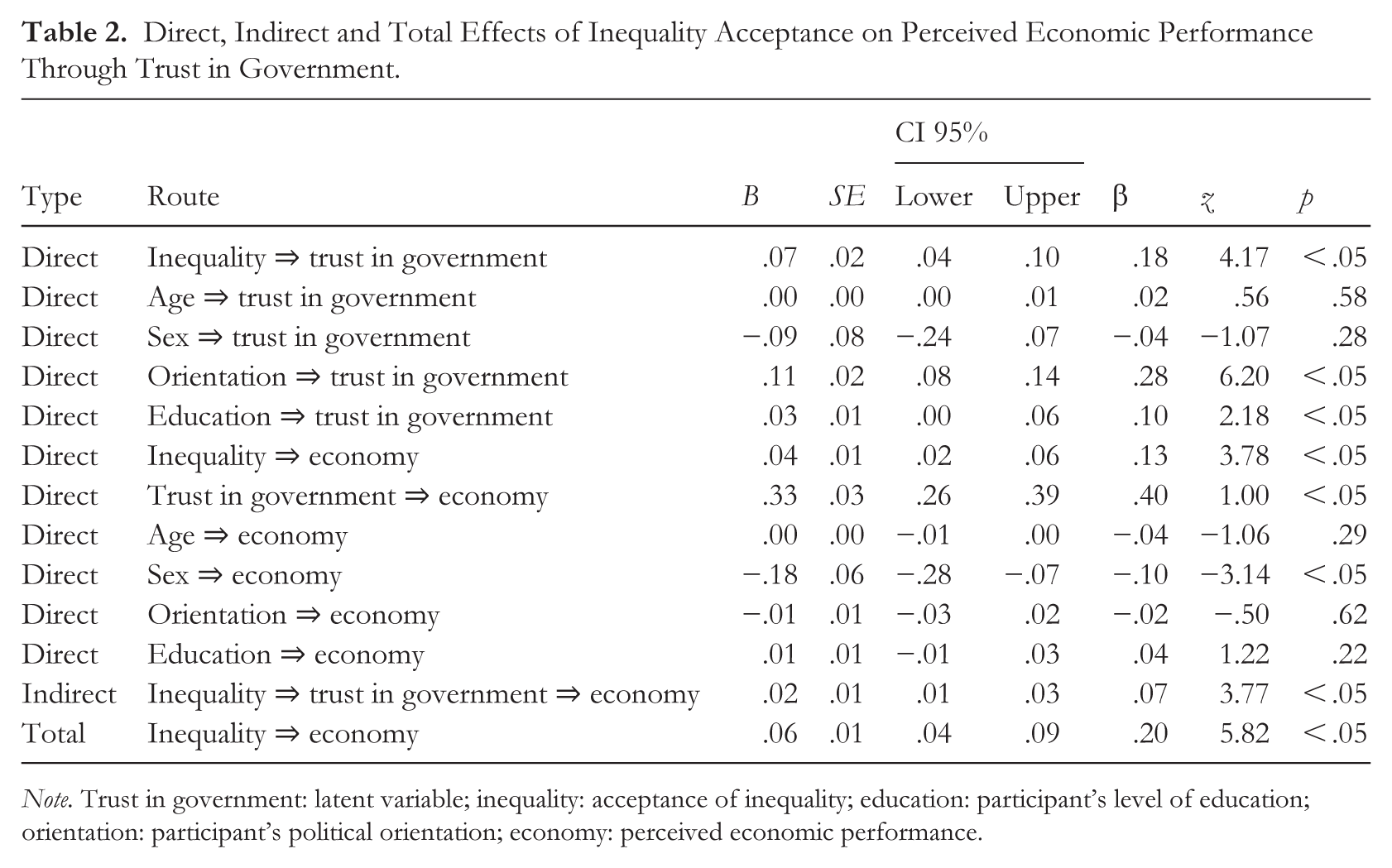
Note. Trust in government: latent variable; inequality: acceptance of inequality; education: participant’s level of education; orientation: participant’s political orientation; economy: perceived economic performance.
Direct Effects
Acceptance of inequality was significantly and positively associated with the latent variable Trust in Government (β = .18, p < .001). This in turn was positively associated with perceived economic performance (β = .40, p < .001). Furthermore, acceptance of inequality had a positive direct effect on perceived economic performance (β = .13, p < .001). Among the covariates, political orientation showed a positive association with the latent variable Trust in Government (β = .27, p < .001), indicating that people with a more right-wing ideological orientation report higher levels of trust in government. Sex (male = 0 and female = 1) had a negative effect on economic evaluation (β = −.10, p = .002), which is evidence that on average women have a more negative perception of economic performance than men. Level of education was positively associated with the latent variable Trust in Government (β = .10, p = .03), which is evidence of a slight increase in trust as level of education increases. Figure 2 provides a representation of the structural equations model.
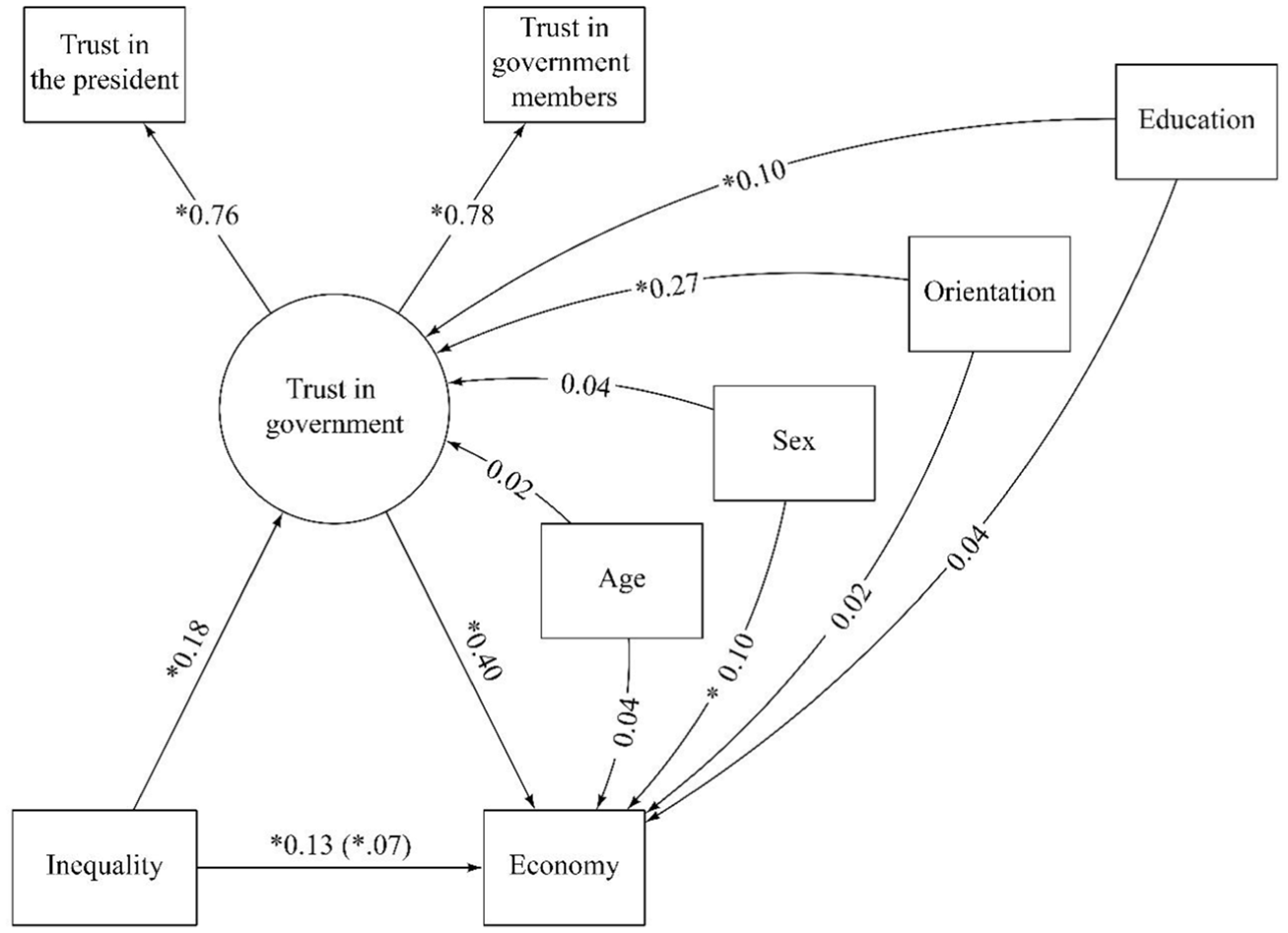
Structural equation modelling (SEM) of the indirect effect of acceptance of inequality on perceived economic performance via trust in government as a latent variable.
Indirect Effect
A significant indirect effect of accepting inequality on perceived economic performance was observed through the latent variable Trust in Government (β = .07, p < .001), indicating a partial mediation process: part of the effect of accepting inequality on economic evaluation operates through an increase in trust in government.
Total Effect
The total effect of inequality acceptance on perceived economic performance was positive and significant (β = .20, p < .001), composed of a direct effect (β = .13, p < .001) and an indirect effect mediated by the latent variable Trust in Government (β = .07, p < .001). This result indicates that acceptance of inequality affects perceived economic performance directly, and partly through trust in government and the president. Figure 3 provides a representation of the direct, indirect and total effects.
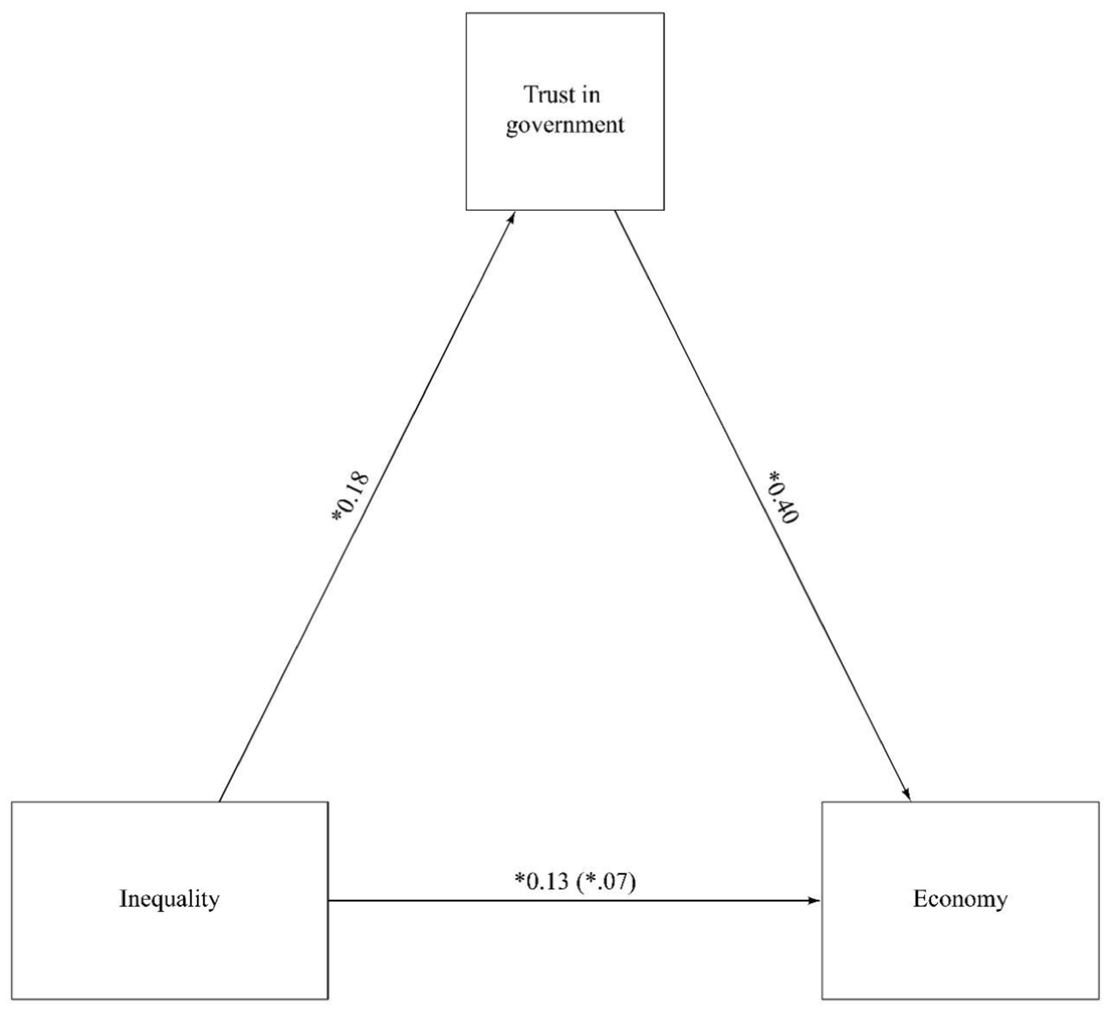
Indirect effect of acceptance of inequality on perceived economic performance via trust in government as a latent variable.
Discussion
The results of Study 2 show that acceptance of inequality is associated with a more positive assessment of the national economic situation through trust in government, confirming H2. This finding is in line with studies indicating that people’s ideological and partisan factors influence how they evaluate the economic context (e.g., Moreira, 2025). The interpretation of our results could indicate that trust in government acts as a legitimising mechanism for the economic situation, characterised by high inequality: when people find the country’s structural inequality acceptable, they tend to trust more in the government and the president that sustains that system, and this trust, in turn, favours a more positive perception of national economic performance. On the other hand, we also find a direct effect for the acceptance of inequality on perceived economic performance. Consequently, the evidence aligns with System Justification Theory (Jost, 2019), which points out that there are different motivational mechanisms by which people come to tolerate inequality in order to respond to epistemic needs, such as a sense of control, existential needs, such as reducing the threat of a hostile economic context, and relational needs, such as a sense of belonging and social identity. Hence, trust in government and the president also represents an adaptive mechanism that legitimises the country’s economic status.
General Discussion
In this research, we set out to examine the relationship between attitudes towards economic inequality, political trust and the assessment of the country’s economic situation. Previous research suggests that there is a positive relationship between favourable attitudes towards inequality and political trust (e.g., Montoya-Lozano et al., 2023). In our research, more specifically, we analysed whether acceptance of economic inequality was positively related to trust in government and in the president of Costa Rica. In Study 1, we analysed national survey data and confirmed that the higher the acceptance of inequality, the higher the reported trust in government, confirming H1. In Study 2, we replicated this association with Latinobarómetro data and, in addition, showed that trust in government acts as one of the mechanisms through which acceptance of inequality contributes to a more favourable perception of the country’s economic performance, confirming H2.
The results of Study 1 and Study 2 suggest that certain attitudes towards the social system, such as acceptance of inequality, may act as mechanisms that sustain trust in political actors. Research in social psychology has indicated that the way in which inequality is evaluated is a central element in shaping certain socio-economic and political belief systems (Azevedo et al., 2019; Shafer et al., 2020). Our results contribute to the evidence that citizens’ political beliefs are structured according to their stance for or against economic inequality. Accepting existing inequality normalises the level of inequality in society, which can lead to it being transferred to institutions and perpetuated as it becomes increasingly difficult to challenge (Suddaby et al., 2018). Moreover, those who find inequality acceptable have a more positive perception of the economic environment. However, this seems to be far from the reality in Costa Rica.
In a social context marked by a negative economic situation, such as the high inequality that characterises the country, one would expect citizens to blame their national government for the bad economic situation (Bukowski et al., 2017; Papastamou et al., 2018). However, data show that the majority of the population has moderate trust in political institutions (OECD, 2024). As suggested by Loveless (2016), the public’s acceptance of inequality influences attitudes towards institutions. Our results indicate that a part of society that supports inequality may not be sensitive to the existence of an institutional and political climate that contributes to maintaining inequality (Montoya-Lozano et al., 2023), and also has a more positive view of the economic system. In contrast, people who do not accept inequality are more distrustful of the government and more critical of the current economic situation. In this direction, the study by Parra Saiani et al. (2024) suggests that distrust in politics may be the result of rational and realistic attitudes towards the context.
Previous research on the acceptance of economic inequality and its socio-political implications has focused on the impact it has on attitudes towards the redistribution of resources (García-Castro et al., 2020) or on trust in institutions itself (e.g., García-Sánchez et al., 2025). In this research, we showed that both the acceptance of inequality and trust in Costa Rica’s government (and its president) are associated with perceptions of the country’s economic performance. This result suggests that both acceptance of inequality and trust in government act as filters that bias the interpretation of the country’s economic environment. This could be explained, in part, by confirmation bias (Wason, 1960). People tend to seek and interpret information in a manner consistent with their prior beliefs (e.g., Modgil et al., 2024). For example, in our case, they will evaluate the country’s economic performance according to their trust in the government or their acceptance of inequality. If both acceptance and trust are ways of justifying and legitimising the existing economic and social order, characterised by inequality, both help to reduce the cognitive dissonance of living in an unequal environment (Kay & Jost, 2003), which is reflected in the perception of a favourable economic performance that does not coincide with the economic reality of the country.
This interpretation of trust in government and the president and its relationship to the economic evaluation of the country should be approached with caution. These findings come from a Latin American context with a highly unequal structuring of power. As previous literature on this topic in the region suggests, these research findings are part of more complex processes of acceptance of inequality in which social organisation is experienced as natural and tolerable even when it is unjust (Rottenbacher de Rojas & Córdova Cáceres, 2014; Robles-Rivera et al., 2024).
It is important to note that the results of this research have been obtained by including socio-demographic variables as covariates in all analyses. The participants’ age, sex, level of education and political orientation have previously been associated with acceptance of economic inequality (e.g., Moreno-Bella et al., 2024) and institutional trust (e.g., García-Sánchez et al., 2025). We therefore decided to control for these socio-demographic variables in our analyses. In our two studies, we see that acceptance of inequality is associated with trust in government and in the president over and above these socio-demographic variables, just as the mediation model for predicting perceived economic performance was also significant considering these variables as covariates.
However, the fact that variables such as right-wing ideological orientation, being male and having a higher level of education increase trust in government, in the president and economic assessment is a relevant result for the purpose of this paper. It seems that the acceptance of inequality is not homogeneous throughout the Costa Rican population but is accentuated in groups with advantaged positions in society. As other studies in Latin America have pointed out (see Beramendi et al., 2020; Brussino & Alonso, 2021), we must distinguish between accepting inequality for one’s own benefit and accepting inequality because it is considered beneficial to society as a whole. It is easier to trust a government and a president and to have a more favourable view of an economy that reproduces economic inequality from a privileged position in the social hierarchy.
Theoretical and Practical Implications
Costa Rica is characterised by higher levels of economic inequality than other Latin American countries (García-Castro & Robles-Rivera, 2025). However, few studies have focused on this Central American country and the region in general. This is why our research advances the theory in terms of the psychology of economic inequality at the global level but also at the Latin American level and, especially, at the Central American level. We encourage future studies to investigate the psychosocial realities of non-WEIRD (Western, Educated, Industrialised, Rich, Democratic) countries as legitimate sources of knowledge to enrich existing evidence on the psychosocial factors that are especially associated with economic inequality.
Moreover, until now, there was no evidence on the acceptance of inequality in Costa Rica. In other words, in a region that is so economically unequal and where citizens are very concerned about economic problems (Corporación Latinobarómetro 2023), the level of acceptance of this inequality was unknown. Through this research, we found that those who accept economic inequality are more trusting of the current government and perceive the economy more favourably, which seems incongruent with prevailing people’s concerns.
This may have consequences for the election results. Economic conditions influence election results (Lewis-Beck & Stegmaier, 2000) as people hold the government accountable for economic performance, rewarding or punishing it at the ballot box. For example, those who rate the economic situation more positively are less supportive of economic redistribution (Morgan & Kelly, 2010). Thus, the assessment of inequality may be key to preferences at the ballot box. In practice, awareness of economic inequality and its consequences in the political arena are important in supporting measures to reduce such disparities. The achievements obtained through the policy of attracting foreign direct investment and the promotion of exports, together with a fiscal policy that only benefits part of the population, have a limited impact on the needs of the population in terms of quality jobs, redistributive policies and improvement of social protection measures (León Espinoza & Mata Marín, 2017; Murillo, 2023).
Limitations and Future Lines of Research
Our research is not without limitations. First, one of the limitations we encountered in developing our research is that we had to use items most similar to those usually used to study the acceptance of inequality and political trust for consistency across studies and because of the databases we had access to. In particular, the inequality acceptance measure in Study 2 does not make explicit reference to economic inequality. Furthermore, measures of trust can be more complex and fine-grained to distinguish government effectiveness or accountability, among others (e.g., Catterberg & Moreno, 2006). In our research, we attempt to alleviate this limitation by using structural equation modelling with the latent variable of Trust. However, other recent research proposes more comprehensive approaches, such as a composite measure that incorporates nine drivers of trust, including consistency, transparency and competence (Mangion & Frendo, 2022). Another study suggests that typical measures of trust primarily reflect perceived competence and, to a lesser extent, perceived motivation among political actors (Rydén et al., 2024). Future research should use specific measures of acceptance of economic inequality and more comprehensive measures of political trust to shed light on which specific dimensions of political trust are most closely related to acceptance of economic inequality.
Secondly, we must recognise that the cross-sectional design of the two studies prevents us from establishing conclusive causal relationships. Future studies should adopt longitudinal or experimental designs to examine the proposed relationship more precisely and even explore other socio-political consequences. Finally, perceived economic performance was assessed through a single general question. However, some studies have pointed out the need to look at specific aspects, such as inflation or unemployment, since people do not always have the same understanding of what the country’s economic performance consists of (Van Erkel & Van Der Meer, 2016). It would be interesting to investigate which specific aspects of a country’s economic performance are associated with trust in government and acceptance of inequality.
Conclusions
Our research shows that acceptance of economic inequality and trust in government coexist and are related to a biased view of the country’s economic situation. Both can be a legitimising mechanism for existing economic inequality. This ‘blindfold’ that some Costa Ricans hold over their eyes could hinder the drive towards redistributive policies that would achieve a more egalitarian society. Understanding these psychosocial mechanisms that legitimise inequality in order to propose ways of proceeding at the political and social level is a matter of urgency, particularly in unequal contexts such as Latin America in general and Costa Rica in particular.