







Abstract
Although single-lung transplantation is an established therapy for respiratory failure secondary to emphysema, hyperinflation of the native lung with concomitant compression of the transplanted lung is emerging as a cause of morbidity. In non-transplant emphysematous patients with hyperinflated lungs, pneumectomy was found to improve pulmonary function and quality of life. We report our experience on 5 single-lung transplant recipients with emphysema who underwent lung volume reduction surgery (pneumectomy, bullectomy, or anatomic resection) following transplantation. There were no perioperative deaths. Three patients underwent lung volume reduction because of a progressive symptomatic decline in pulmonary function that was thought to be secondary to hyperinflation of the native lung. Two of these patients had a sustained improvement in lung function and functional status over several years. Two other patients underwent lung volume reduction for removal of suspicious pulmonary nodules in the native lung. Both patients had a subsequent improvement in forced expiratory volume in one second. In our experience, lung volume reduction surgery after single-lung transplantation in emphysematous patients was a safe means of providing long-term improvement in pulmonary function.
Introduction
Lung transplantation is an established and successful form of therapy for end-stage lung disease, with emphysema being the most common indication. 1,2 In the early 1980s, double-lung or cardiopulmonary transplantation was performed on emphysematous patients because of theoretical concerns that ventilation-perfusion mismatches would occur following a single-lung transplant (SLTx). 2 However, since then, single-lung transplantation has been shown to be a safe and effective therapeutic option for emphysematous patients, with survival results as good or better than those of double-lung recipients. 3 Although ventilation-perfusion mismatch has not been a problem after single-lung transplantation in emphysematous patients, progressive hyperinflation of the native lung is emerging as a cause of long-term morbidity. 4 Lung volume reduction surgery has recently been shown to be an effective means of decreasing lung volumes in emphy-sematous patients with hyperinflated lungs, thereby improving pulmonary function and quality of life. 5,6 There have also been reports of post-SLTx patients with emphysema who have required lung volume reduction because of compression of the transplanted lung and subsequent loss of pulmonary function due to hyper-inflation of the native lung. 7 –10
We present our experience of 5 emphysematous patients who underwent lung volume reduction surgery following SLTx. Three (patients no. 1, 2, and 3) were selected on the basis of a symptomatic decline by more than 20% of the forced expiratory volume in one second (FEV1) from the posttransplant baseline, in association with air-trapping (defined as an abnormally elevated residual volume) and a decline in functional status. Two other patients (patients no. 4 and 5) underwent lung volume reduction because of suspicious nodules in the native lung. None of the patients had concomitant acute rejection, biopsy-proven obliterative bronchiolitis (OB), or infection. Although the etiology of the pulmonary pathology that prompted us to operate on these patients was heterogeneous, all 5 patients had radiographic evidence of hyperinflation of the native lung with flattening of the diaphragm on the native-lung side, shifting of the mediastinum, extension of the native lung across the midline, and compression of the transplanted lung (Figure 1).
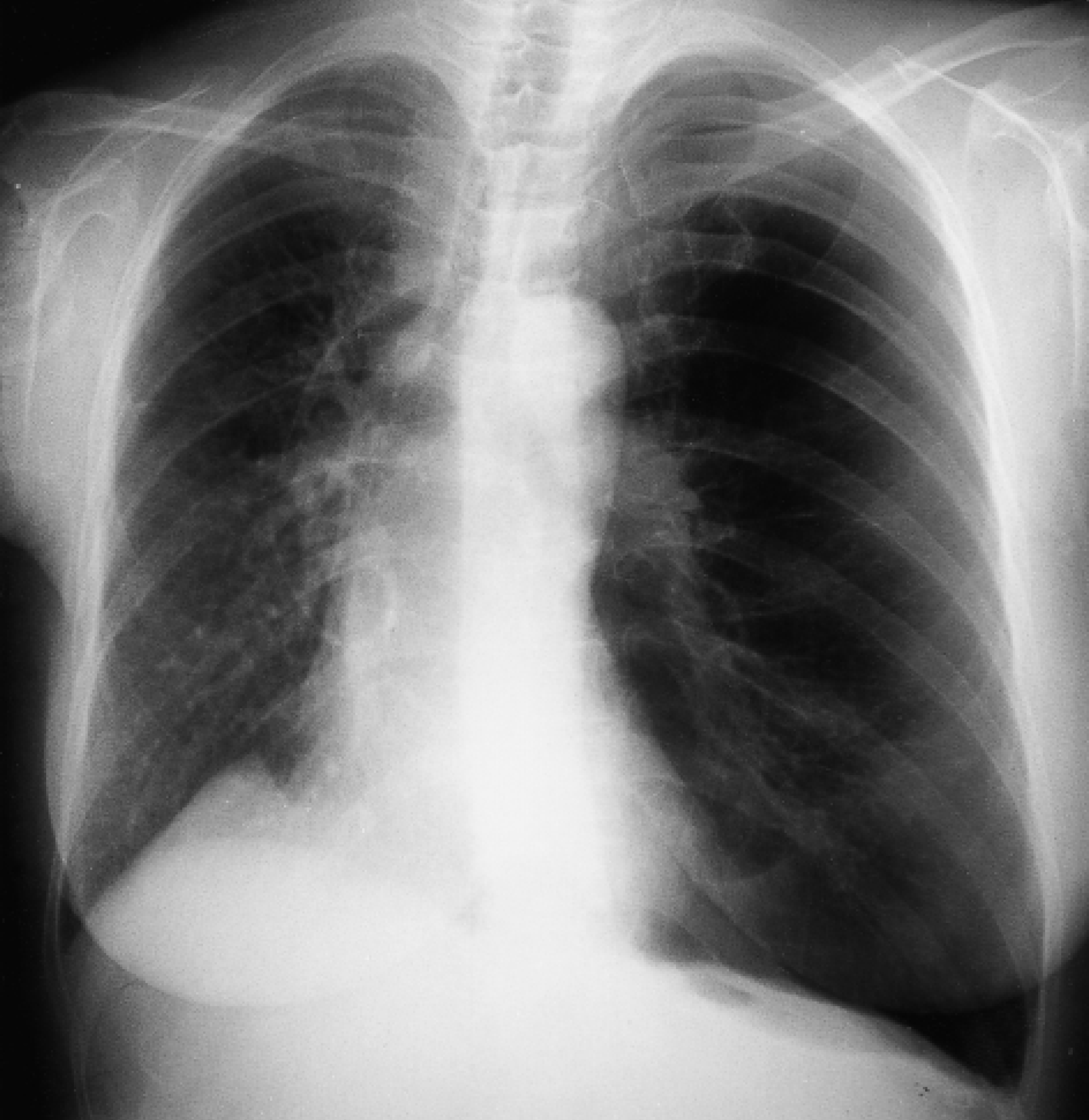
Chest radiograph of patient no. 1 after right lung transplantation and before left lung volume reduction surgery. Note hyperinflation of the native left lung, flattening of the left hemidiaphragm, and extension of the native lung across the midline, causing compression of the transplanted right lung.
Case Reports
Patient 1
A 50-year-old female with alpha1-antitrypsin deficiency received a right-lung transplant. By 57 months post-transplant, she had a progressive decline in her FEV1 with a concomitant increase in residual volume and a decline in functional status. She underwent pneumectomy of the native lung without complications, after which her FEV1 increased by 22% (from 1.14 to 1.39 L) and her residual volume was reduced by 32% (from 2.32 to 1.57 L, by helium dilution). She was alive and well 41 months after lung volume reduction surgery, with maintenance of her improved functional status. Her FEV1 remained higher than her pre-pneumonectomy FEV1 for 27 months postoperatively. Figures 1 and 2 demonstrate the signifi-cant reduction in hyperinflation of the native lung and compression of the transplanted lung following lung volume reduction surgery.
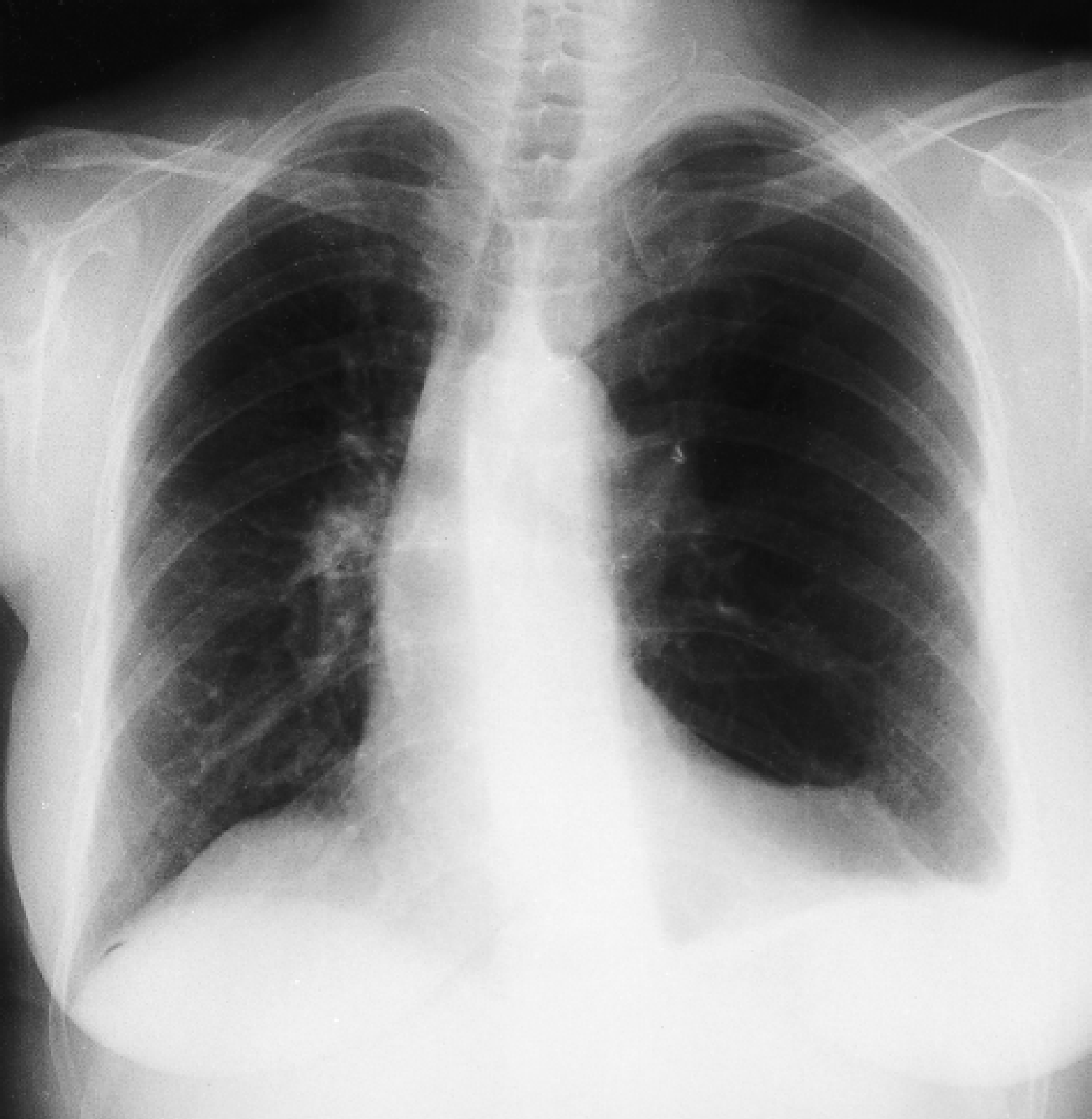
Chest radiograph of patient no. 1 after lung volume reduction surgery, demonstrating reduction of both hyperinflation of the native (left) lung, and compression of the transplanted lung.
Patient 2
A 62-year-old male with bullous emphysema who had a left-lung transplant, also had a progressive decline in his FEV1 associated with an increase in residual volume. By 28 months posttransplant he was short of breath with any physical exertion. He underwent an uncomplicated right-lung bullectomy, with sustained improvement in FEV1 of 77% (from 1.09 to 1.93 L), reduction of residual volume by 21% (from 4.11 to 3.26 L, by helium dilution), and improvement of functional status to New York Heart Association (NYHA) functional class I for 19 months. He died 32 months after lung volume reduction, due to progressive OB.
Patient 3
A 49-year-old male with alpha1-antitrypsin deficiency underwent right-lung transplantation. He had the lowest FEV1 (0.71 L) of the 5 patients studied and the poorest functional status (NYHA class IV) prior to lung volume reduction surgery at 32 months posttransplantation. After an uncomplicated left upper lobectomy, he did not have a measurable improvement in his FEV1 and his residual volume remained unchanged (4.94 L, by helium dilution). Although his functional status improved to NYHA class II for one month, he required a second transplant 12 months later because of continued deterioration in his pulmonary function, due to OB. He died 2 months after the second transplant, from complications secondary to invasive pulmonary aspergillus infection.
Patient 4
A 58-year-old male with emphysema who had received a right-lung transplant, underwent thoracotomy 11 months later because of a soft-tissue density mass observed in the left lower lobe on a computed tomography scan of the chest. There was no associated mediastinal or hilar lymphadenopathy on computed tomography. Mediastino-scopy was performed just prior to the thoracotomy, which confirmed the absence of mediastinal lymphadenopathy. No mass was identified at the time of thoracotomy, however, bullous lung tissue was excised from the area of the suspected mass. Although his FEV1 increased by 25% (from 2.84 to 3.56 L) and his residual volume fell by 32% (from 3.61 to 2.46 L, by plethysmography) after the uncomplicated thoracotomy, he died 17 months later due to metastatic lung cancer.
Patient 5
A 58-year-old female with emphysema who had a left lung transplant, underwent an uncomplicated right upper lobectomy 6 months after transplantation because of stage I anaplastic squamous cell carcinoma of the native lung (grade P0T1N0). Following lobectomy, her FEV1 improved by 16% (from 1.45 to 1.68 L) but her functional status remained unchanged in NYHA class II. Although complete pulmonary function testing was not carried out prior to the right upper lobectomy, her postoperative residual volume was almost within normal limits at 2.08 L (103% of predicted, by helium dilution). This implied that she had a certain degree of hyperinflation of the native lung before the right upper lobectomy. She maintained the improvement in her FEV1 for 10 months but died 32 months after the lobectomy because of respiratory failure secondary to OB.
Discussion
Over the past 10 years, the discrepancy between the number of lung transplant procedures performed in North America and the number of potential recipients waiting for lung transplants has continued to expand. 3 Therefore, it is justifiable to maximize the use of available organs whenever possible. Single-lung transplantation in emphy-sematous patients is a good example of the efficient use of donor organs, allowing 2 patients to receive a SLTx from a single donor. However, in emphysematous SLTx recipients, the native lung can become progressively more hyperinflated, thereby compressing the transplanted lung and causing a loss of pulmonary function. 8,10 A few recent reports have suggested that post-SLTx loss of pulmonary function due to hyperinflation of the emphysematous native lung and compression of the transplanted lung can be reversed by lung volume reduction surgery. 7 –10 These reports have been published in the wake of renewed interest in lung volume reduction surgery for the treatment of end-stage emphysema. It is felt that the benefit of lung volume reduction surgery lies in its ability to restore normal respiratory mechanics and improve elastic recoil of the lung in this group of patients. 5,6 The result is an improvement in the FEV1 and functional capacity, as well as a reduction in the PCO2, and requirement for supplemental oxygen. 5,6
In the case of emphysematous SLTx recipients, the observed improvement in pulmonary function is likely to be multifactorial: improved function of the transplanted lung; improved function of the emphysematous native lung; and improved chest wall and diaphragmatic mechanics. 5,6,8 –10 In this group of patients, there were no perioperative deaths and all 5 improved or maintained their functional status. Of the 3 patients who underwent lung volume reduction because of a significant decline in FEV1 attributed to hyperinflation of the native lung and compression of the transplanted lung, 2 experienced significant objective and symptomatic benefits that were maintained for more than 1.5 years. The third patient had a progressive loss of pulmonary function in spite of lung volume reduction and may have had progressive OB although tests were negative. Therefore, the early identification and correction of hyperinflation of the native lung may be a key determinant of outcome in patients undergoing volume reduction surgery following a SLTx, limiting the application of this therapy to patients without end-stage OB. If the benefit derived from lung volume reduction surgery is primarily due to improved function of the native lung, it may be important to identify patients who would benefit from post-SLTx lung volume reduction before they develop severe OB.
It is interesting to note that the 2 patients who underwent lung volume reduction surgery for resection of pulmonary nodules, also benefited from an increase in FEV1. This suggests that undiagnosed hyperinflation of the native lung and compression of the transplanted lung might contribute to a decline in FEV1 in emphysematous patients who are otherwise diagnosed with OB.
From this small group of patients, it would appear that radiographic evidence of hyperinflation of the native lung, along with elevated residual volume, and significantly decreased FEV1 are the most important factors for identifying good candidates for lung volume reduction surgery following single-lung transplantation for respiratory failure secondary to emphysema. In our experience, lung volume reduction surgery following a SLTx was a safe procedure as there were no perioperative deaths. We concluded that bullectomy, pneumectomy, and anatomic resection were effective means of providing long-term improvements in pulmonary function and functional status in this specific group of SLTx recipients. Emphysematous patients who might be expected to benefit from volume reduction surgery following single-lung transplantation should have a significant decline in pulmonary function associated with hyperinflation of the native lung with no pathological evidence of end-stage OB, acute rejection, or pulmonary infection.
Footnotes
Presented at the Annual Meeting of the International Society for Heart and Lung Surgery, London, England, UK, April 1997.