






Abstract
Music teachers often encounter obstructions in teaching beginners in music reading. Conventional notational symbols require beginners to spend significant amount of time in memorizing, which discourages learning at early stage. This article proposes a newly-developed color music notation system that may improve the recognition of the staff and the numbered musical notation for music beginners. The focus is on single melodies that are relatively easy for music beginners to read and to play, which may increase students’ confidence at the first step of music learning. The color music notation system that associates color music scores with color and music synesthesia by human vision and audition is proposed. Pitch, duration, range, and intensity of music elements are coded as colors, lattices, graphs, and shape sizes, respectively. Based on the 12-tone equal temperament, we adopt the Itten color wheel and the natural color system with 12 primary colors to retain colors accurately when the notation is reproduced. Hopefully, beginners can use the novel colored music scores to read and to play music quickly, accurately, and confidently.
The proposed color music notation system focuses mainly on a single melody, helping beginners to read musical scores, and to obtain comprehensive music information. The proposed color music notation system overcomes the possible problems of the staff and the numbered musical notation (NMN). The main goal of this work is to design a color music notation system based on the frequencies synesthesia of color and music, which are closely related in a physical sense. Via the color music notation system, music beginners may read and learn music easily by the colored musical scores for a single melody.
Music notation records musical information to guide musicians from vision to audition. Many music notation schemes have been developed with different presentations, including neumatic notation, letter notation, tablature, mensural notation, mannered notation, Francesco notation (Roden, Wright, & Simms, 2010), staff, numbered musical notation, klavar notation, microtone notation, and graphic notation. Many studies have examined and analyzed the relationships between music reading and music notation (Bean, 1938; Boyle and Radocy, 1987; Elliott, 1982; Fourie, 2004; Galyen, 2005; Gromko, 2004; Junda, 1994; Kopiez & Lee, 2006, 2008; Mark, 1978; Read, 1987; Thompson, 1987; Truitt, Clifton, Pollatsek, & Rayner, 1997). In this article, we divide the developed history into three stages: early, conventional, and modern music notation stages.
In the early music notation stage, music notation was a simple style that did not include any writing notation. The earliest music notation was found as an oral record of a human’s impression from approximately 1800 B.C. (Gaare, 1997). In the 8th century, the neumatic notation (Randel, 1986) was developed in Europe. At that time, people read neumatic scores and sang chants in Roman Catholic churches. The neumatic scores did not generally indicate rhythm, but additional symbols were sometimes juxtaposed with neumes to indicate changes in articulation, duration, or tempo. The neumatic score was the basic element of Western and Eastern systems of musical notation prior to the invention of the five-line staff notation (Burkholder, Grout, & Palisca, 2009).
The progress of music notation entered the conventional music notation stage. Two conventional notations, staff and numbered musical notation, were constructed during this period, and have evolved into modern schemes. The staff, which is the diastematic notation, was invented by Guido, an Italian monk living in the 11th century. In contrast to the modern five lines staff, the notes were indicated on four horizontal lines, which were first adopted when the Pope ordered all Roman churches to adopt the staff for music notation. Through modifications by musicians from the 11th to the 17th centuries, the staff was gradually completed and transformed from four horizontal lines to five horizontal lines. The staff was used widely following its promotion and further development in France. The final staff resembles the current staff format (Stolba, 1998).
Numbered musical notation was created in the 17th century by Souhaitty (Cohen, 1972), a French Catholic priest. When he taught parishioners to sing hymns, the staff was too difficult for them to read. To simplify the staff, Souhaitty created a more convenient music notation system. The Arabic numerals 1, 2, 3, 4, 5, 6, and 7 represent Do, Re, Mi, Fa, So, La, and Si, respectively. Galin and Paris then rearranged the numbered musical notation system. In the 19th century, Cheve further improved the numbered musical notation. During that period, education institutes in France officially approved the numbered musical notation. Numbered musical notation was also called the Galin-Paris-Cheve notation, or Cheve notation (Sadie & Latham, 1994). NMN is the abbreviation of the numbered musical notation.
Until now, some modern music notations have been designed for various purposes. Klavarskribo (Klavar notation), invented by Pot in 1931, was designed for piano scores. Music learners read Klavarskribo vertically from top to bottom because the staves are vertical. The notes on the staves correspond to keyboard positions on the piano. Klavarskribo is coincident with the target direct view, which is important for music players to map the notes and key locations of the piano (Stone, 1980). Additionally, the graphic notation is another innovative music notation scheme that enables performers to read music graphically. Cage, a well-known avant-garde composer, used graphic notation for his music works (Cage & Knowles, 1973). Other composers, including Brown, Crumb, Feldman, Ligeti, Penderecki, Reynolds, Stockhaunsen, and Wolff also used graphic notation (Cope, 1993). The direct view concept used in Klavarskribo is similar to the proposed color music notation system in this article.
Musical notation using colors
Vision and audition are two major human perceptions. Music received by ears and colors perceived by eyes are recognized by the human brain, which interprets them by certain similar mechanics. Music beginners playing the piano first see the notation as a visual input. Through their mental interpretation, musicians instruct their fingers to strike the corresponding keys. A piano melody and rhythm are used as the output, which are received by their audition. Finally, the music heard by beginners is checked and compared with their music imagination, known as audiation (Gordon, 2001), which is a means for recognizing melody and rhythm, a human capacity outside the realm of words. Color music notation attempts to find the mental similarities between vision and audition, transforming them into the same audiation. Therefore, how to select an appropriate color corresponding to a music tone is a priority for a color music notation system, rather than notation painted by the arbitrarily assigned colorants. The designated color notation by this concept should benefit music beginners.
Another approach for colors applied to music is a colored musical instrument. The method that uses different colors painted directly onto the strings of musical instruments is also referred to as the color-coding method (Dronge, 2005; Kajs, Alaniz, Willman, & Sifuentes, 1998; Mencher, 1996; Oshima, Miyagawa, & Nishimoto, 2002; Randel, 1986; Szilvay Foundation, 2012). The color-strings method uses a simple colored notation system on string instruments based on the Kodaly method (Szilvay Foundation, 2012). The color-strings method began with one line only, then built up to the five-line stave, and eventually the colors disappeared, with a transition to conventional notation (Szilvay & Szilvay, 2011). Because the colored string-arrangement makes it easy to find the pitch positions for music beginners, the color-strings approach could be served as a type of color notation. A popular example is the piano, in which the keys are painted white and black to differentiate between enharmonic tones. Another well-known example is the color harp, with strings that are painted red and blue to indicate the pitches C and F, individually (Randel, 1986). Oshima proposed a music teaching-course with a coloring-in piano by arbitrarily assigned colors (Oshima, Miyagawa, & Nishimoto, 2002). He selected 16 measures in two music scores for testing 20 musicians, and then compared them with the coloring-in and conventional piano and found significant improvement of performance. Dronge (2005) painted assigned colors on each string according to various musical instruments. By marking the corresponding colors on the score, beginners learn the instrument easily. Mencher (U.S. Patent No. 5574238, 1996) adopted a fast and convenient method of pasting colored pieces on the staff. Five lines of the staff are pasted in five colors, increasing players’ concentration. Up to now, the color-coding methods have evolved into a computer assigned a set of arbitrary colors on a computer keyboard to attract users, and the color-coding methods are especially helpful for children and adolescent computer operation (Kajs, Alaniz, Willman, & Sifuentes, 1998). Despite the success of the color-coding method in identifying specific pitch positions for the piano, harp, or computer keyboard, constructing a systematic method of corresponding to colors and music notes is a challenging task.
Similarities in vision and audition originate from synesthesia, which consists of the sensation arising from subjective emotions and the biological perception from an objective neural network. The synesthesia of music and color is widely cited in literature (Galeyev, 2003; Galeyev & Vanechkina, 2001; Goldstein, 2007; Scriabin, 1980; Ward, Tsakanikos, & Bray, 2006). A book, entitled Healing with Music and Color – A Beginner’s Guide (Bassano, 1992), mentioned that music and color can stimulate the human’s perceptions. Additionally, music and color also affect the human spirit and health, providing physiological and psychological feelings of comfort and encouraging healthy lifestyles (Bassano, 1992). People psychologically produce a certain specific color or a set of colors when they hear a single note or a piece of melody. Some persons have a strong color-hearing feeling (Peacock, 1985). Scriabin proposed the concept of color-hearing. His symphonic poem work “Prometheus: the poem of fire” in 1910 applied “Clavier à lumières” which was a color organ with lights (Peacock, 1988). He attempted to enhance the synesthesia of vision and audition in perception and psychology. The arranged colors in musical keys are based on the scheme of tonality by a circle of fifths. Scriabin’s design has interested numerous synesthesia researchers and has been discussed in the mapping of musical keys and colors (Scriabin, 1980). Summarizing the above studies, the process of reading and hearing music can be linked by the synesthesia of coloring and hearing.
The evolution of color reproduction technology has spawned contemporary experts to adopt colors in musical notation. The goal is to identify a useful method for teaching and reading music. For instance, Tobin (1982) constructed the Tobin color notation system based on the five lines staff and seven pitches to assist in staff reading. The Tobin system designates seven colors to the seven pitches without defining color accuracy and color difference (Tobin, 2012). Mencher (1996) developed a music notation system for keyboards. Hoffman (1996) developed a music notation system for reading and teaching music, in which melodies and lyrics of the song “Trope” were marked with colors. While singing “Trope,” learners visualize the melody which has colored notes with lyrics. This method helps music beginners to read music scores (Muller, U.S. Patent No. 6639139 A1, 2003). MacCutcheon (U.S. Patent No. 6870085 B2, 2005) patented another music notation system, as shown in Figure 1. Not only do the MacCutcheon system code pitches correspond to instrument positions for teaching, but also, each pitch in musical instrument is represented by a color and a formation identifier. Each musical alphabet of the pitch is associated with a specific animal whose name has the same beginning letter. For example, Pitch A, B, C, D, E, F, and G are represented as Amethyst (purple) Ant; Blue Bird; Carrot (orange) Cat; Diamond (gray) Dog; Electric (yellow) Eel; Flame (red) Fox; and Green Gator, individually. MacCutcheon claimed that the notation can be applied to three special instruments: piano, guitar, and banjo. The combinations of colors and animal graphics can enhance music reading when beginners read the scores. Additionally, the colors are chosen according to the appearance color on the bug, in which the first letter of the bug names is the same as the pitch name. However, non-native English beginners may have difficulties using the MacCutcheon method. Holcombe (2006) marked five enharmonic notes on lines, and the other seven notes in spaces from bottom to top. In that work, the duration is denoted by lattices. The pitches C, C#, D, D#, E, F, F#, G, G#, A, A#, and B correspond to the colors gold, cream, orange, peach, red, plum, flax, blue, sky, green, mint, and lime, respectively, and numbers 1, 2, 3, 4, and 5 indicate fingering.
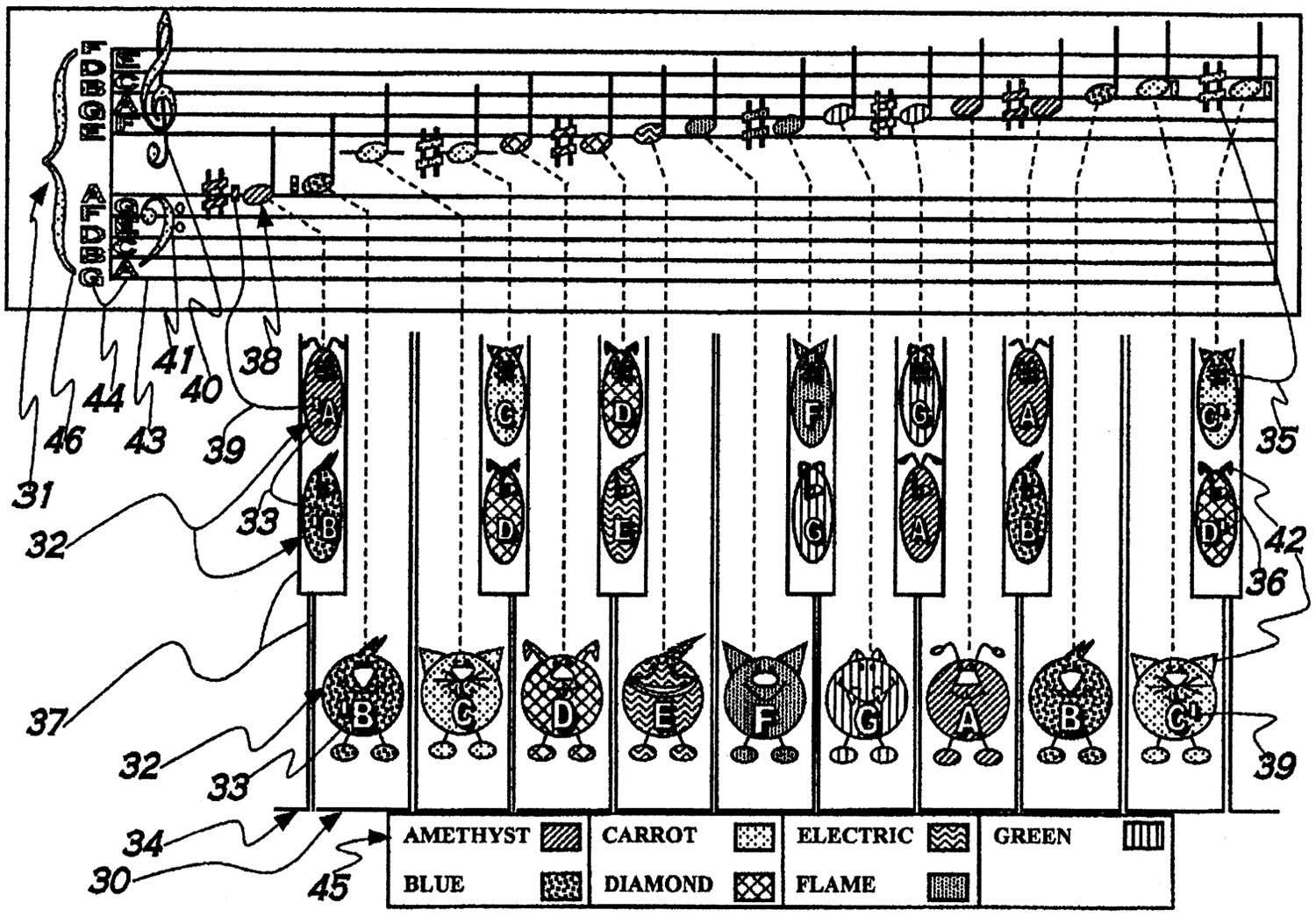
Design of pitches in which animal icons are combined with colors by MacCutcheon (U.S. Patent No. 6870085 B2, 2005).
Most humans’ eyes can visually identify the vivid colors. The color theory of Newton (1730/1979) postulates that colors from visible frequencies of red, orange, yellow, green, blue, indigo, and violet resemble musical pitches from the aural frequencies of C, D, E, F, G, A, and B, respectively. Karkoschka (1972) proposed the music notation guidelines in which music notation should be intuitively readable according to visual perception. Therefore, how to analogize the colors to pitches is a major concern. From a viewpoint of physics, frequency is a good perspective resulting from colors as visible frequencies and pitches as audible frequencies. Castel developed a scheme for applying colors in a music experiment, in which pitches were coded with colors for keyboard positions on the “Clavecin Oculaire” in the 18th century (Allert, 1996). Rimington (1911) utilized an instrument, the “color organ,” to correlate pitches with colors when performing music. By using both texts and graphs in music notation, he combined audio and visual signals. The color-music experiment was conducted only for musical performances, and the musical scores of the color-music experiment did not use colors for recording music notation (Campen, 1997). Other studies have mentioned color and music (Bernard, 1986; Garner, 1978; Klein, 1930; Pridmore, 1992; Slawson, 1985). Collopy (2000) pioneered the “Lumia” art form to present visual art as music and incorporated it into the three dimensions of color, form, and motion. Lubar (2004) applied the color relationship in color intervals to the concept of musical consonance and dissonance in music intervals.
From a music reading perspective, Pick, Unze, Metz, and Richadson (1982) proposed a music learning method for children that it allowed them to read musical scores. They used four colored circles to code pitches on a staff. The colored notes helped beginners to read musical scores rapidly and easily. Rogers (1991, 1996) proposed two studies and discussed the importance of music-reading for learners. Rogers marked musical notes with different colors to attract the attention of primary school students. These experiments were conducted to improve the learning efficiency of primary school students using the staff with colored musical notes. Other studies have noted music reading (Bean, 1938; Boyle & Radocy, 1987; Elliott, 1982; Fourie, 2004; Galyen, 2005; Gromko, 2004; Junda, 1994; Kopiez & Lee, 2006, 2008; Mark, 1978; Read, 1987; Thompson, 1987; Truitt, Clifton, Pollatsek, & Rayner, 1997).
Professionals and music beginners have widely used the staff and the numbered musical notation. The staff is particularly used when teaching classical music. Learners must spend a considerable amount of practice time reading the staff in which notes are recorded on five lines. When the notes exceed the five lines, the staff must add higher or lower lines than the five lines to record these notes. Music beginners read pitches slowly, owing to having the difficulties in identifying accidentals, key signatures, and symbols of the staff at the early learning stage. Beginners see many notes with accidentals on a staff, and often play the wrong notes out of confusion. Although notes of the C clef, F clef, and G clef on the staff are in the same position, the pitches differ from each other. Another popular notation is the numbered musical notation. Commonly applied to popular music, numbered musical notation indicates pitches which correspond to numbers. Although the numbered musical notation is simpler to read and to learn than the staff, it still uses the same signs as the staff (e.g., time signatures, accidentals, and fermatas).
In summary, music notations lack a systematic and scientific design from a color theory perspective. Additionally, no music notations with color synesthesia have been devised especially for music beginners or professional musicians. The staff has also been designed with certain complex symbols and notes that are difficult to identify. We therefore construct and report the development of an intuitive color music notation requiring less preliminary training and fewer symbols. Importantly, this work designs a color music notation system based on the frequency synesthesia of color and music which are closely related physically. The proposed color music notation system offers Karkoschka’s direct visual interpretation-concept to overcome the disadvantages of the conventional music notation (Karkoschka, 1972). Compared to simple black and white colors in the staff and the numbered musical notation, the proposed color music notation system uses several colors corresponding to pitches complied with the basic physical frequency. Furthermore, colors can raise the interest of beginners and children while learning to read music, which is an important reason in this article to use colors in music notation system. However, in the past, color usage has not been widespread because color printing techniques and color displays have been underdeveloped. Therefore, color reproduction was not easy when the musicians attempted to design the color music notation. In the current multimedia era, computer software and color printing technology are well-developed and commercially available. Many elements, including color and form, can be recorded fluently in music notation using these modern techniques. Color reproduction technology is also available, and is popular and convenient making it possible for vivid colors in the color music notation to represent the music pitches or elements. The color translation between various printers or display devices maintains the color constancy by the modern color metrology and can be traceable to the latest international color standard.
This article reports a design of a novel color music notation system, based on the Itten color wheel (Itten, 1997; Figure 2a), which corresponds to the 12-tone equal temperament (White & Louie, 2005). However, the Itten system does not represent the equal distance of color difference accurately when the color notation would be reproduced by modern printing and display technology. To maintain an accurate color in color notation reproduction and 12 colors with equal color difference corresponding to the 12-tone equal temperament, we selected the nature color system (NCS) (Agoston, 1979; Figure 2b), for our color names and color codes. NCS has nearly the same color diagram as the Itten color wheel, except for green-yellow and yellow-red regions. Therefore, the NCS remains the validity of color-music synesthesia. Another advantage is that NCS can be easily traced to the international color standard, CIE-Luv, announced by the International Commission on Illumination, the Commission Internationale de l’Eclairage (CIE). CIE is devoted to worldwide cooperation and information exchange on all matters related to the science and art of light and lighting, color and vision, photobiology and image technology. Since its inception in 1913, the CIE has become a non-profit professional organization that has been accepted as representing the best authority on the subject and is recognized by the International Standard Organization (ISO) as an international standardization body (CIE, 2012; Schanda, 2007).
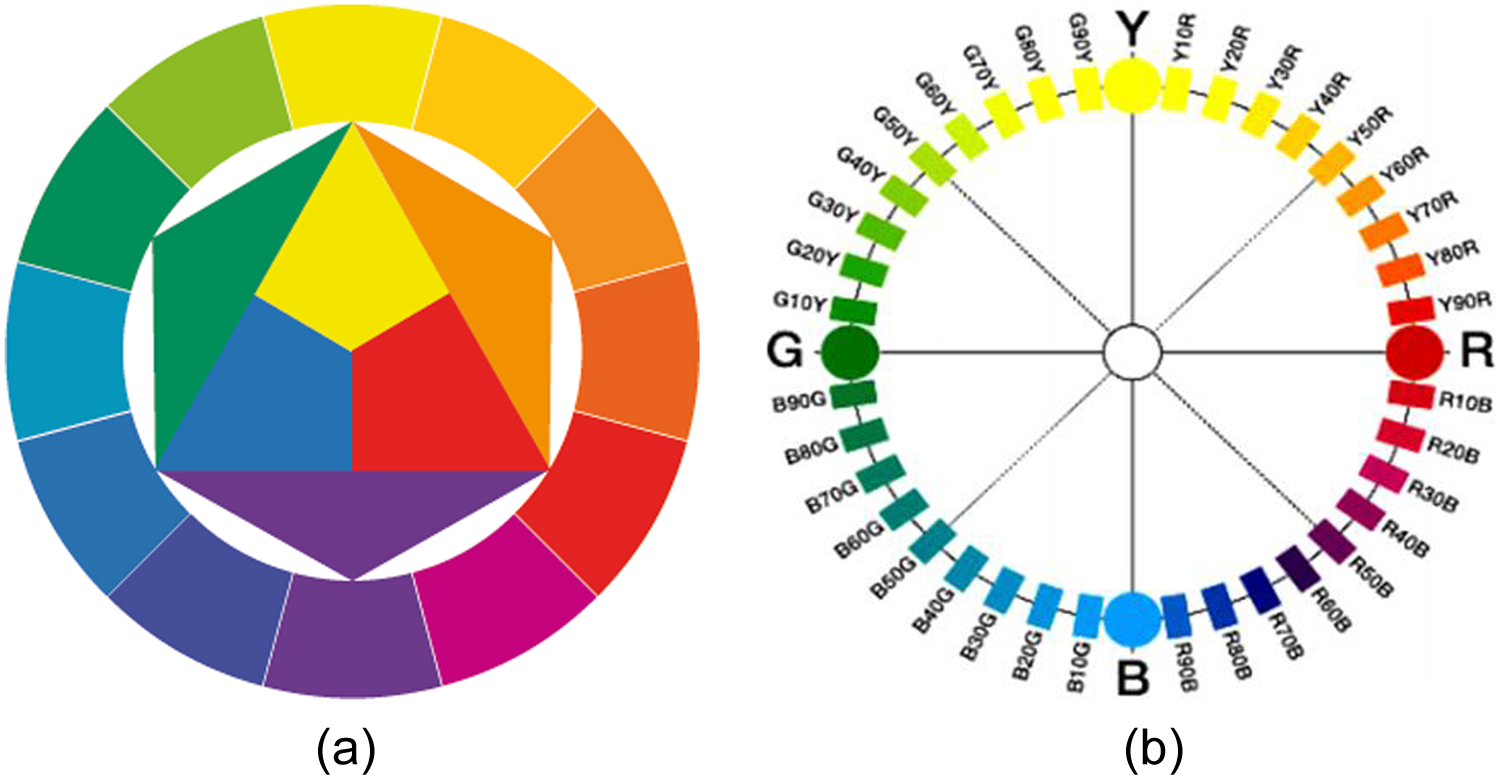
(a) Color wheel – Johannes Itten (1997).
The color music notation system in this article mainly focuses on a single melody to help beginners to read musical scores, and obtain comprehensive music information. The next section presents a detail description of the proposed color music notation system and shows a combination of music, color, and form elements to enhance visual identification of notes. The colored music scores use many colors, subsequently creating visually rich scores. A colored music score may improve the ability of music beginners to read music. Two music scores are transformed to color music notation to demonstrate the design methodology. Notably, we hope that the proposed color music notation system based on the scientific methodology can overcome the troublesome issues of the staff and the numbered musical notation.
Design methodology of the color music notation scheme
This article focuses on music learning and reading for beginners. First, we chose 58 musical learners, aged 15–20 years, with the basic reading ability of staff and number musical notation, to interview their music reading problems from aspects of pitch, duration, intensity, range, and symbol identification. The responses show some possible difficulties, including complex symbols, reading or playing mistakes, identification, and memorization of the conventional notations. Three music professionals, each with more than a decade of experience, discussed the responses of the music learners and investigated the possible learning problems in music reading. Summarizing the interviews of the music learners and the music professionals, music learning and reading problems were analyzed and itemized. Elements of the proposed color music notation system were chosen after the detailed analysis. The design of the color music notation system was adjusted and assessed three times. Designing steps of the color music notation system (Figure 3) are described in details as follows.
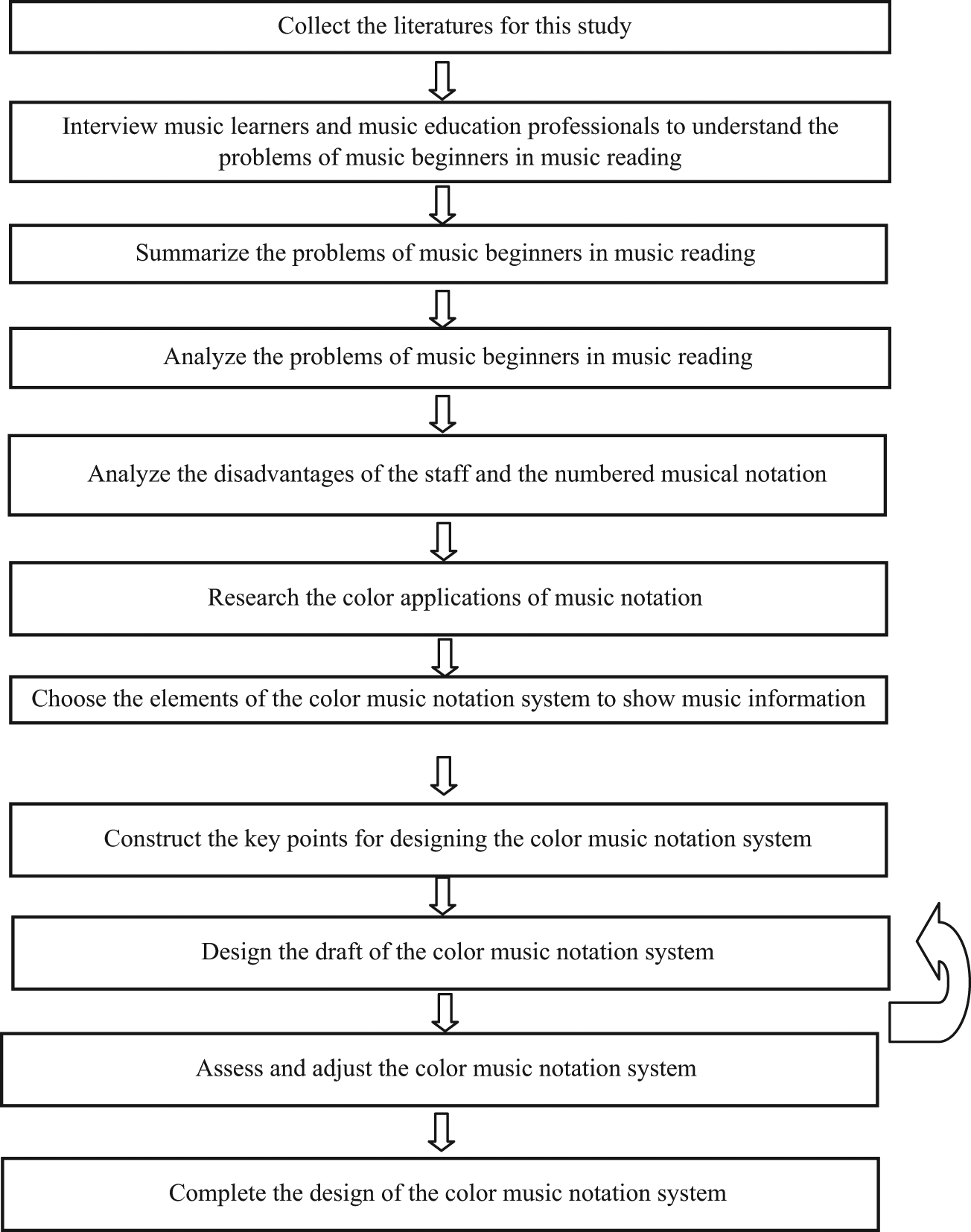
Design steps of the proposed color music notation system.
The previous section reviews the literature on color music studies and demonstrates the trend of combining visible color and audible music. Therefore, designing a new color music notation for beginners is a major issue. Music education for children and adolescents has received considerable attention in the past decade. Our interviews with three music education professionals attempt to identify possible problems of music beginners in reading musical notation to reach a consensus among these professionals (Chen, 1985; Hong, 2000; Hu, 2010). The following procedures of the interviews for professionals are as follows:
Interview each music professional for a minimum of 1.5 hour.
Explain our research and the purpose of the interview.
Record the information of every interviewee including personnel, music resume and teaching experiences.
Discuss the difficulties of music reading for music beginners according to several music elements: pitch, duration, range, intensity, and others.
Consult the possible solutions according to individual experiences.
Conclude and itemize the final summary from three professionals.
The possible music reading problems of music beginners summarized in the interviews are as follows:
Pitches in musical scores are difficult for beginners to memorize.
Music beginners fail to identify notes on musical scores and instrument positions.
Music beginners cannot calculate and play the lengths of notes on musical scores accurately.
When playing instruments using musical scores, beginners find it difficult to control volume levels.
Beginners read the musical scores very slowly, and often play incorrect notes on instruments.
Certain beginners have difficulty in reading musical scores, often leading them to give up learning to practice an instrument.
Comparing the traditional staff and the numbered musical notation, the popular notations for music education involve analyzing their disadvantages. Problems encountered by beginners when reading music are solved in color music notation. The possible limitations of the staff were identified after the interviews as follows:
The staff uses accidentals to record enharmonics. When reading notes with accidentals on the staff, learners become confused. The accidentals, clefs, and key signatures of the staff are particularly confusing to learners.
The staff color is in black and white, which are not visually interesting colors for learners.
The staff is too difficult to read, and beginners must spend a considerable amount of time memorizing many signs.
The notes of different clefs are different pitches in the same positions of the staff, and learners often make mistakes.
Notes located beyond the five horizontal lines of the staff are recorded on additional lines, and learners confuse the notes on these lines.
The numbered musical notation has the following possible limitations:
Numbered musical notation uses the same accidentals, time signatures, and symbols as the staff.
Finger numbers in the numbered musical notation are the same as pitch numbers, often leading to confusion when beginners are reading.
This article sets out the steps undertaken in establishing a color music notation system to express music information for a single melody. The proposed color music notation system overcomes the disadvantages of the staff and the numbered musical notation for beginners learning in reading music scores. Participants using the proposed system must possess satisfactory vision and not be color blind. The color music notation system is designed for a single melody because it is easy for beginners to learn. While playing single melodies in short musical pieces, beginners can learn to perform the pieces in their entirety. Therefore, this work integrates the color elements with form elements corresponding to music elements in the proposed color music notation system. Three types of elements are described as follows:
Musical Element: Four musical elements including pitch, duration, range, and intensity (Stone, 1980) were used in this system. Pitch denotes the tone height. Duration represents the tone length, which is divided into a whole note, half note, quarter note, eighth note, and sixteenth note. Range refers to the tone area, and the different tone areas have 12 semitones. Intensity denotes the tone volume, which has eight levels – ppp, pp, p, mp, mf, f, ff, and fff – from minimum to maximum.
Color Element: Color elements have three items: hue, brightness, and chroma (Malacara, 2002). Here, the color music notation system uses hue, and different colors are to represent different pitches.
Form Element: Circle shapes represent the pitches: C, D, E, F, G, A, and B. Triangular shapes refer to enharmonic pitches: C#/Db, D#/Eb, F#/Gb, G#/Ab, and A#/Bb. Notes with top-dotted and bottom-dotted graphs represent different ranges. The combinations of forms and colors strengthen the visual identification ability of learners reading music.
The next step determines the coding modes for music, color, and form elements in the proposed color music notation system.
Coding mode for music elements
The coding method codes music elements, (that is, pitch, range, duration, and intensity), with color elements and form elements. The proposed system notates without lines, accidentals, clefs, key signatures, and numbers. Pitches are coded with hues and shapes. Ranges correspond to graphs, and the dotted graphs upper or lower on the notes are coded to indicate different ranges. Duration corresponds to lattices that represent different lengths. Intensity corresponds to shape sizes that represent different levels.
Coding mode for color elements
The coding mode for colors relies on hues because frequencies of pitches and colors are relative. In this work, colors and pitches are related to frequencies and synesthesia, and the color wheel developed by Itten is adopted. This color wheel has 12 colors corresponding to 12 semitones.
Coding mode for form elements
Two shapes, a circle and a triangle, are used to represent the pitches. The circular shape represents the pitches C, D, E, F, G, A, and B, whereas the triangular shape represents the enharmonics C#/Db, D#/Eb, F#/Gb, G#/Ab, and A#/Bb.
Results of design in color music notation
The proposed color music notation system uses a combination of music, color, and form elements. The system shows musical information with a few signs. Color, lattice, graph, and sharp size indicate pitch, duration, range, and intensity, individually. The proposed system does not use accidentals, clefs, and key signatures. Hopefully, beginners will read the colored musical scores more accurately and quickly than the staff and the numbered musical notation. Being capable of choosing single melodies as achievable goals, the hypothesis is that beginners will easily read and play notes, and achieve musical proficiency. It is proposed that the system will improve the ability of beginners to read music.
Colored musical scores are written using the proposed color music notation system. Pitch, duration, range, and intensity of music elements are coded using colors, lattices, graphs, and shape sizes, respectively. The color music notation system uses the following items of elements, as described in detail:
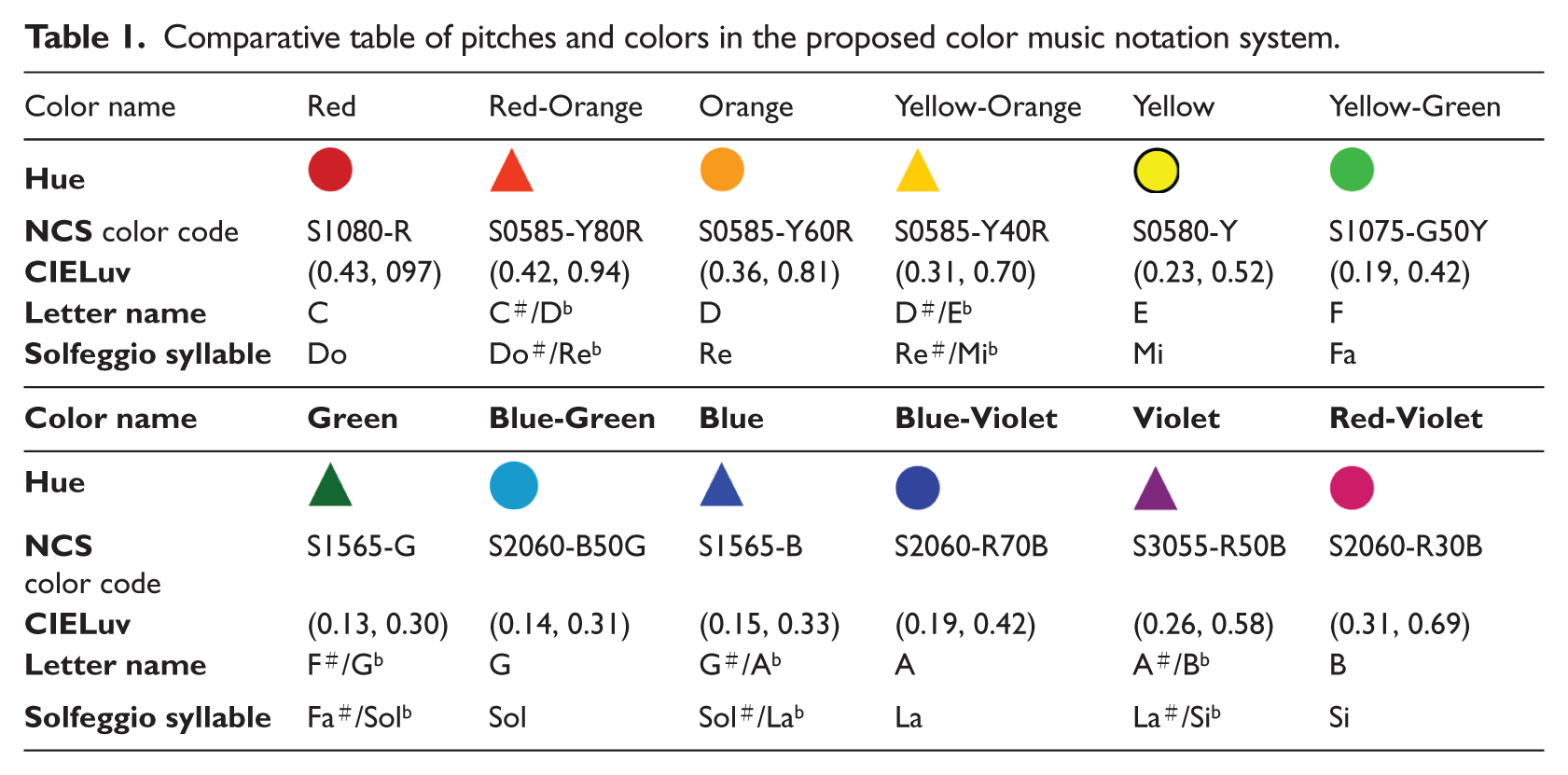
Pitch: Pitches in the proposed color music notation system are based on pitch frequencies that correspond to color frequencies. Itten’s color wheel and natural color system (NCS) are adopted in this system as well. The 12 semitones correspond to the 12 colors of a color wheel. The pitches correspond the seven notes – C, D, E, F, G, A, and B represented by circles, and the pitches correspond to the other five notes – C#/Db, D#/Eb, F#/Gb, G#/Ab, and A#/Bb represented by triangles (see Table 1).
Duration: Duration in the proposed color music notation system includes a whole note (semibreve), half note (minim), quarter note (crotchet), eighth note (quaver), sixteenth note (semiquaver), whole rest, half rest, quarter rest, eighth rest, and sixteenth rest. Lattices are used to determine the lengths of the beat. Each lattice is one beat, and the subdivision of a lattice is the minimum unit of duration. Figure 4 shows the lengths from long to short (1 beat, ½ beat, ⅓ beat, ¼ beat). The tempo mark in the system uses the sign “□=” to denote speed at the beginning, and duration in the proposed color music notation system is indicated by lattices “ ”. The time signature refers to meters using the numbers 2, 3, 4, 5, or 6 to represent two beats, three beats, four beats, five beats, or six beats in each measure, respectively. The sign “━” represents to sustain the forward note, “
 ” represents to repeat the forward section, and “
 ” represents to end the music piece.
Range: The ranges refer to the notes by formatted dots. The middle range is not marked with dots on the note. Ranges refer to different areas using
Intensity: The intensity is marked by different shaped sizes indicating different volume levels. Intensity is divided into eight grades, as shown in Figure 6.
Comparative table of pitches and colors in the proposed color music notation system.
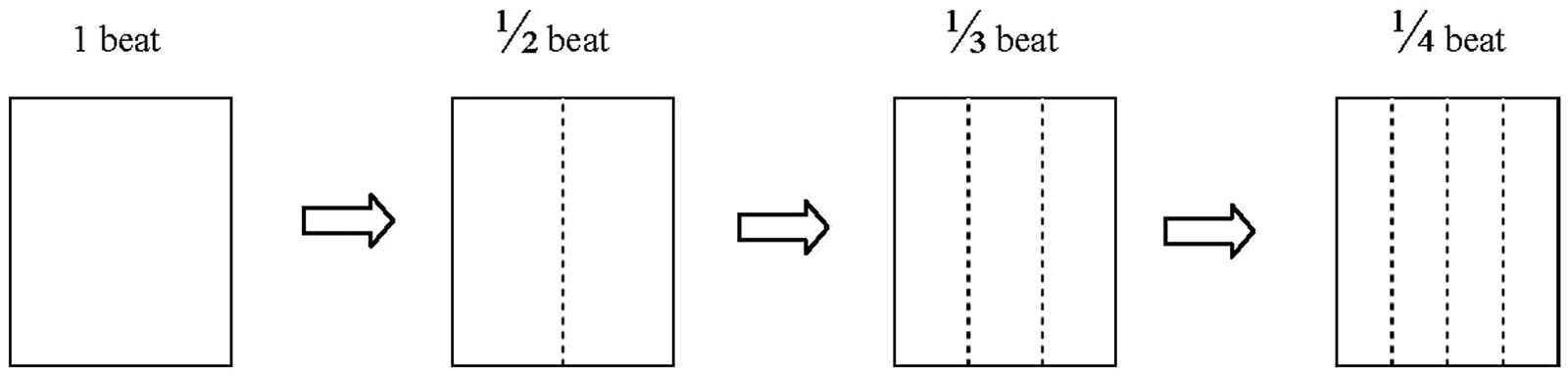
Lattices of duration (from 1 beat to ¼ beat are long to short).
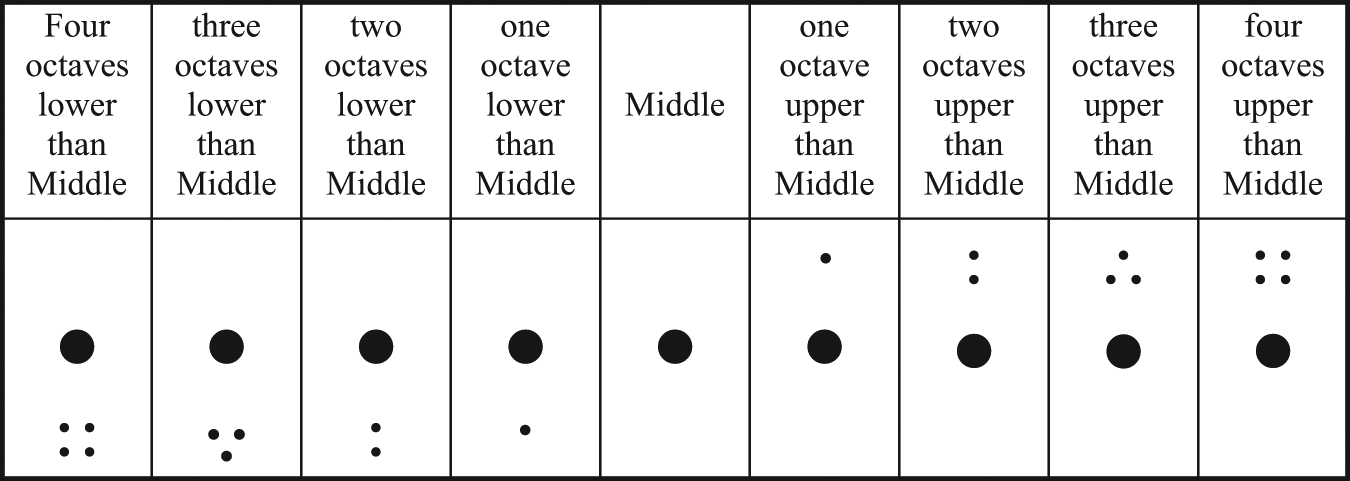
Graph comparisons with dots of the different octaves of range.
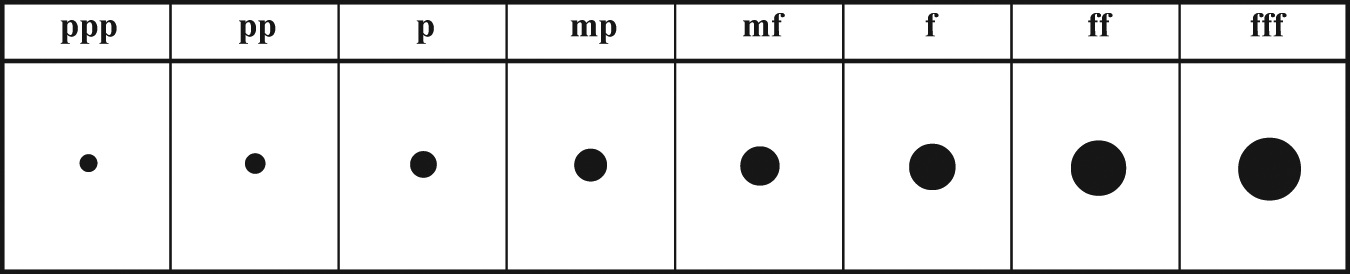
Shape size comparisons of eight levels of intensity.
According to the design method of this article, the single melodies of two music examples, “Twinkle, Twinkle, Little Star” and “Yesterday,” are proposed. The piece “Twinkle, Twinkle, Little Star” has two beats per measure. The minimal unit of length is the quarter note, and the range is in the middle. Figure 7a shows the musical piece “Twinkle, Twinkle, Little Star” as the staff, and Figure 7b displays the colored musical score. Another example, “Yesterday,” has four beats per measure. The minimal unit of length is the eighth note, and the ranges are in the middle, one upper octave than the middle, and one lower octave than the middle. The musical piece “Yesterday” is shown as the staff (Figure 8a) and the colored musical score (Figure 8b).
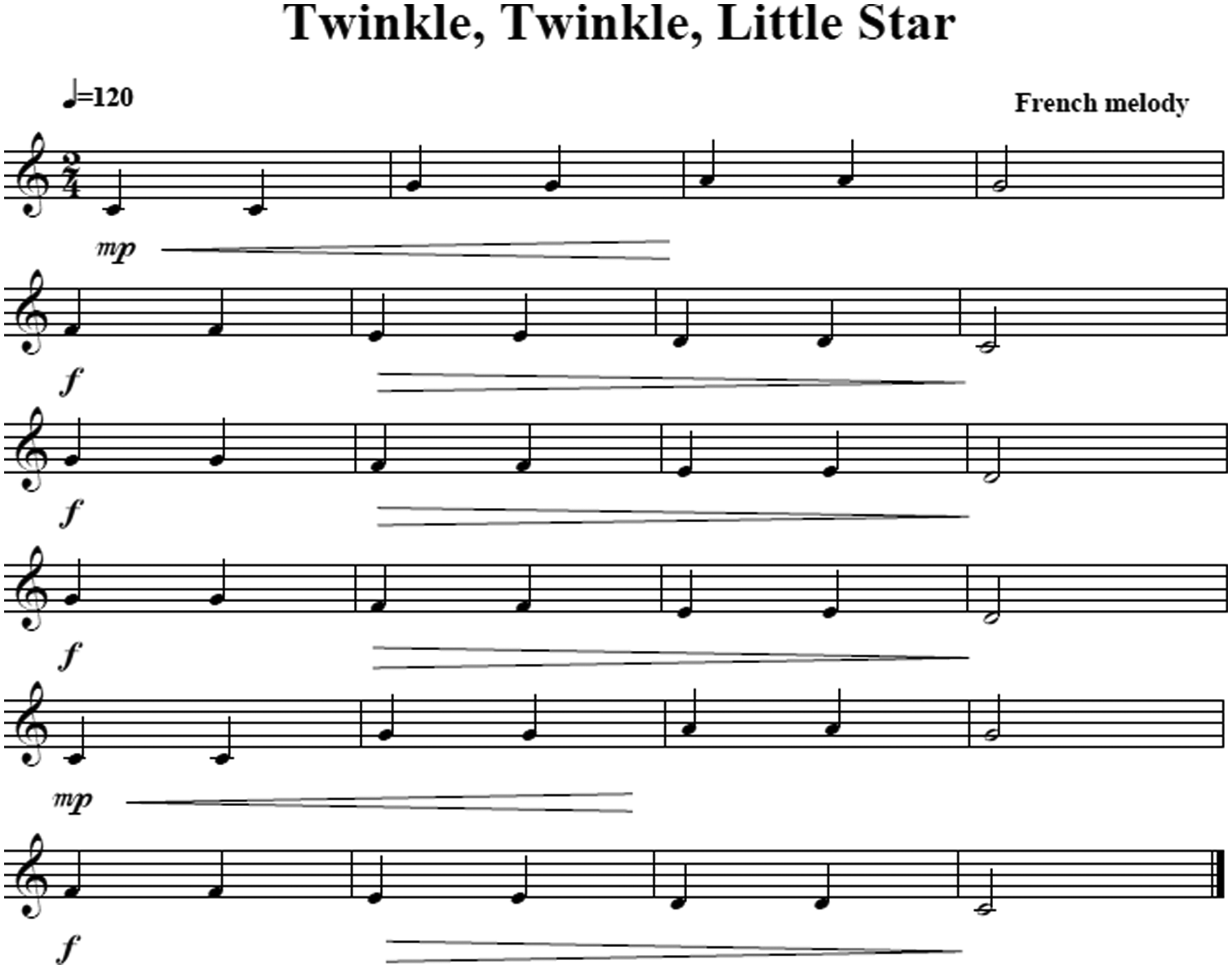
Staff of the musical piece “Twinkle, Twinkle, Little Star”.
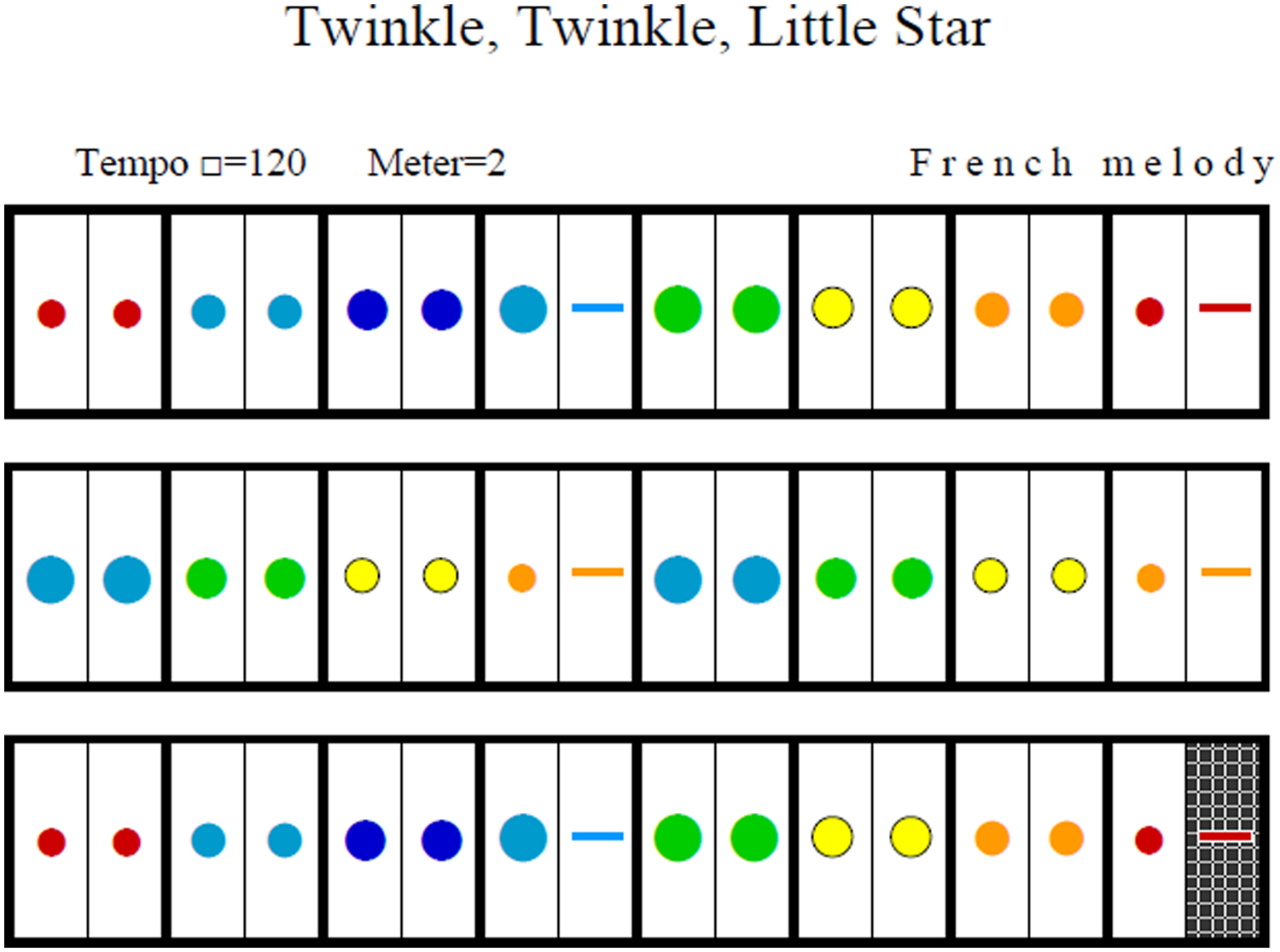
Colored music notation of the musical piece “Twinkle, Twinkle, Little Star”.
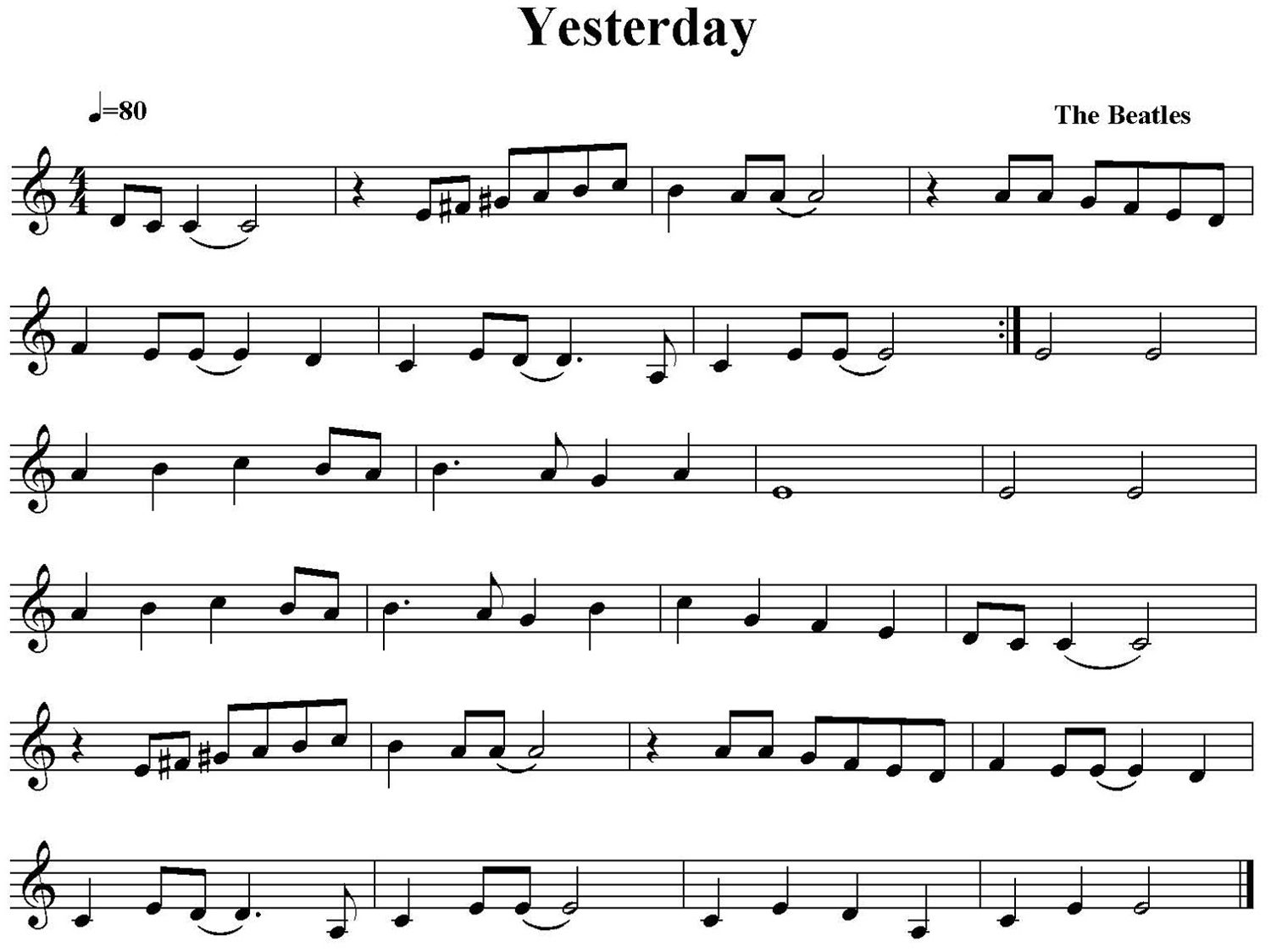
Staff of the musical piece “Yesterday”.
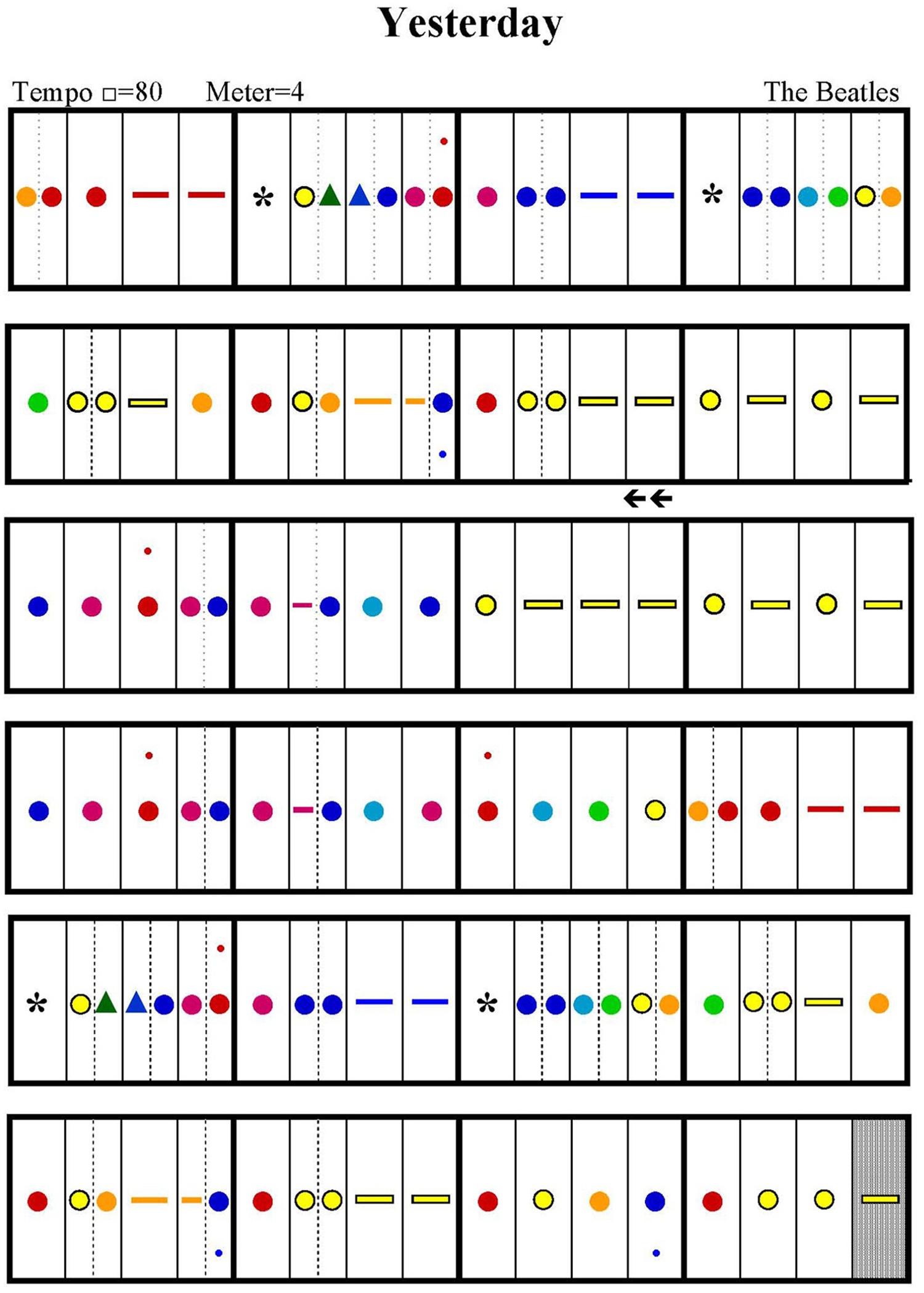
Colored music notation of the musical piece “Yesterday”.
Based on the previous design, several benefits of the proposed color music notation system are proposed as follows:
Simplification: The colored music scores generated by the color music notation system omitted items include accidentals, clefs, key signatures, and other signs used by the staff and the numbered musical notation. Alternatively, the proposed system uses a few color symbols to represent the music several vital elements: pitch, duration, range, and intensity. This simplification would facilitate beginners in memorizing, reading and playing. Although the conventional staff is complete and detailed for recording complicated musical symbols, these are too difficult for beginners to play. The proposed color music notation system extracts the major music items which are transformed into vivid color symbols in order to achieve quick sight-playing. Therefore, the proposed system may overcome the deficiencies of the staff and the numbered musical notation.
Identification: In addition to combining color and form elements to construct colored music scores, the proposed color music notation system applies color, lattice, graph, and shape size to represent pitch, duration, range, and intensity, respectively. The proposed system also enhances the ability of music beginners to identify these elements through visual perception. Moreover, individual identification clarifies the musical structures, and can improve beginners’ abilities to analyze music when reading colored musical scores.
Readability: This proposed system is characterized by its simplicity and direct view, potentially making it easy for music beginners to read and to memorize. The proposed system can also provide an alternative and an autonomous method of music reading and music playing for the beginners, even without learning the conventional staff. Furthermore, the proposed system can provide a parallel way of alleviating the apprehension of the conventional staff among learners with the staff experiences. From our experiences, the color music notation is one of the various music notations that would be easily associated with the conventional staff to expand the scope of music education methods.
Discussion and conclusion
While teaching music-beginners to read music, the proposed color music notation system may overcome the disadvantages of the staff and the numbered musical notation. Beginners can read the colored musical scores to achieve their musical performance goals. The proposed system may also help novices to read and to memorize musical scores, as well as increases their interest in the early stage of learning. Beginners can also identify instrument positions easily and accurately when reading the colored notes of a single melody on a colored musical score. The previous auditory impression of a single melody can help novice musicians to read musical scores and to play musical pieces. Therefore, the single melodies of famous pieces or songs can be chosen for music beginners to practice.
In the current multimedia era, colors on the colored musical scores enrich visual identification capabilities of music learners. Colors can extend music notation possibilities. When reading the colored musical scores, music novices are more interested than the staff or the numbered musical notation because they only use black and white. Additionally, the proposed color music notation system simplifies problems of many signs in the staff and the numbered musical notation. Colors can display information clearly, and the colored music scores can help music beginners to read musical scores easily. The color music notation system is characterized by its direct view and simplicity, as well as its ability to assist music novices in playing rapidly.
The conjunction of music, color and form enhance the ability of music reading for beginners. Each pitch has a representative color, which is easily memorized. Duration, range and intensity are denoted by lattices, graphs and shape sizes, respectively. The combinations of music, color, and form elements in the color music notation system can help beginners in identifying and memorizing musical scores, as well as the system can help them to play the notes on the instrument correct positions quickly.
Additionally, the proposed color music notation system may allow beginners to locate pitches and to calculate lengths from the colored musical scores quickly. The proposed system also shortens the time needed to memorize notes. Beginners can also analyze music using this system, allowing them to find the same melodies and paragraphs based on combinations of music, color, and form elements in the colored musical scores.
The synesthesia of color and music can be related because the color music notation system takes the advantages of mapping between color and music in the human brain through the synesthesia of visual color and audible music. The relationship between music and color causes sensory stimulation as well. When learning music from the colored musical scores, music beginners perceive the similar frequency series of color and music. When listening to music, some individuals may experience a color-hearing phenomenon. Certain musicians and painters have created works based on the relationship between music and color.
There are some implications for future research. First, to what extent the proposed system can extend the color music notation system from a single melody to other musical elements such as chords, tonality, rhythm, and timbre, should be studied. Furthermore, the proposed system can be experimented with and confirmed by the quantitative results objectively in future. The effectiveness of the proposed system should be measured by empirical studies. To what extent the proposed system can act as a means to connect with the conventional notation staff is another meaningful research direction.
Footnotes
Acknowledgements
The authors would like to thank the professional musicians Prof. Mao-Shuen Chen, Prof. Wan-Long Hong, and Dr.
Funding
This work is particularly supported by the National Science Council of Taiwan under contracts NSC 101-2220-E-009-032 and the “Aiming for the Top University Program” of the National Chiao Tung University and Ministry of Education, Taiwan.