







Abstract
Jazz has long been recognized as a male-dominated field, with females traditionally having only limited acceptance, often in the roles of singer and pianist. Researchers have explored sources of the gender imbalance in the field of jazz and jazz education, but there is no theory or framework to organize such findings. This directed content analysis of the journal Jazz Changes, the official magazine of the International Association of Schools of Jazz published from 1994 to 2000, analyzed published answers to the following question posited by the journal editors, “Women in Jazz: Why aren’t there more women in jazz education?” Analysis suggests a model including three social-psychological theories to describe the female experience in jazz. The theories include Rosabeth Kanter’s theory of tokenism, which describes a learning environment that females might perceive or experience in jazz; Claude Steele and Joshua Aronson’s theory of stereotype threat, which offers insight into why female musicians might make a choice to not participate, or discontinue participation, in the jazz idiom; and Albert Bandura’s theory of self-efficacy, which is offered as a possible guide to providing instruction in jazz that fosters female participation. These theories are offered together as a model framework for future study of both historical and present experiences in gender and jazz.
Jazz has traditionally been, and remains, a male dominated field (Ake, 2002; Caudwell, 2010; Dobson, 2010; Gibson, 2006; Oliveros, 2004; Townsend, 2000; Tucker 2004). While participation of females in some male-dominated fields has been improving (American Association of University Women [AAUW], 1999), researchers have reported that females remain a minority in the field of jazz (Alexander, 2011; Gibson, 2006; May, 2003; McKeage, 2004; Steinberg, 2001).
Current jazz-related research has demonstrated female underrepresentation in subject pools (Devroop, 2012; Seddon, 2005; Watson, 2010) and convenience samples (Brand, Sloboda, Saul, & Hathaway, 2012; Dobson, 2010; Macdonald & Wilson, 2006; Norgaard, 2011). Jazz researchers stated that a lack of females in their subject pool is unfortunate and typical, but that they believe female musicians would not have differing views or attitudes towards their audience in a study about musician and audience relationships (Brand et. al., 2012). However, other researchers have suggested that context has a significant effect on the experiences of participants in music (MacDonald & Wilson, 2006; Sloboda, 2010), and some have reported a purposeful attempt to have a more equal gender representation in their studies (Gibson, 2006; Macdonald & Wilson, 2006). Differing experiences in jazz by males and females have emerged in studies when a more equal representation of males and females was achieved (Macdonald & Wilson, 2006; Wehr-Flowers 2006, 2007).
Many studies have found no significant gender differences in relation to jazz performance. These studies have generally examined psychological variables that are skill-specific including vocal jazz improvisation ability, knowledge to become a good improviser (Madura, 1999), and high school instrumentalists’ jazz improvisation skills (Bash, 1984; Hores 1977; McDaniel, 1974). Differences between males and females related to jazz and jazz improvisation become apparent on social-psychological variables such as (a) confidence, anxiety, and attitude (Wehr-Flowers, 2006); (b) physiological states including anxiety; (c) social persuasions including perception of social climate and peer social support; and (d) motivational processes including locus of control, skepticism, and self-efficacy (Wehr-Flowers, 2007). McKeage (2004) found that while both males and females indicated a lack of time as a primary reason for withdrawing from jazz study, women identified additional issues, including a need to focus on classical playing, feeling more comfortable in traditional ensembles than in jazz ensembles, and an inability to tie jazz participation to their career goals. It is possible that feeling uncomfortable in jazz ensembles could influence these additional issues, and it is this uncomfortable feeling that this study seeks to address.
Gender-based differences in instrument choice have been theorized to be a strong contributing factor to the lack of females in jazz (Alexander, 2011; Delzell, 1994/1995); however, more research on the effect of instrument choice on gender in jazz is needed in order for these statements to be supported. Researchers have found other issues that influence gender differences in jazz. McKeage (2004) found a dramatic attrition rate for women between high school and college jazz participation, and a decrease in female participation related to an increased expectation for improvisation. Steinberg (2001) found that even when male to female proportions were accounted for at a school jazz festival, males took more solos in performance and dominated all interactions in post-performance clinics as demonstrated by raising their hands more often, being called upon more often, and being asked to play at a higher rate. Interestingly, no significant differences in solo patterns were found. Rowe (1995) also suggested from her experiences that girls and women are participating more in jazz, but they are not improvising solos. These studies and personal accounts indicate that girls are participating in jazz in their early years, but discontinue participation later suggesting that gender-based differences in instrument choice may not be as strong of a hindrance to female jazz participation as some believe.
Observed male and female differences in their relationships with jazz and jazz improvisation may provide insights into the dynamics of gender in jazz, but fail to explain why these differences exist. There are many examples of opinions and testimonials on this subject, but little theorizing has occurred to organize these contributions in a way that can be used to systematically examine the problem and pursue change. This study’s directed content analysis (Hsieh & Shannon, 2005; Mayring, 2000) used a social constructivist view, and analyzed discourse in an effort to better understand the perceived experience of women in jazz.
Jazz Changes was a magazine published from 1994 to 2000 by the International Association of Schools of Jazz with the purpose of fostering continued dialogue on jazz education (Collier, Gill, & Turkenberg, 1994, p. 2). Volume 1, number 1, in spring of 1994 did not include any references to women with the exception of two pictures, one of a female singing and one of a female at a keyboard. Both of these images reflect traditionally acceptable roles for women in jazz (Aschbacher, 1997; Fjällborg, 1995; Jhaveri, 1995). Then in spring of 1995, Volume 2, number 1, the headline article was “Women in Jazz: Why Aren’t There More Women in Jazz Education?” This article was featured along with an editorial calling for continued dialogue on the subject, and acknowledged the lack of females as a widespread issue in the field of jazz. Collier, Gill, and Turkenburg (1995) stated in their editorial that “While mathematics, common decency and political correctness point one way, few women even audition for jazz programmes and even fewer meet the required standards. This is hard to swallow, but none-the-less, very true” (p. 2). These editors stated that one woman expressed that this was the first time she had been asked about the lack of women in jazz problem, and she was surprised that the question had been asked by a man (1995, p. 2).
The Jazz Changes editors’ question, “Why aren’t there more women in jazz?” was asked in a periodical published by an organization that reflected the male dominance of the jazz field. The editorial acknowledged the issue of a lack of females in jazz as a problem faced by jazz educators all over the world. The article comprised shared stories and opinions from both males and females, and their perceptions of the problem of being female in jazz. The existence of these statements and responses about females in jazz, all published within a short amount of time, provide an opportunity to look back and evaluate, from a distance, how these issues fit together to describe the female jazz experience.
The Jazz Changes editors called for answers to this question, and the responses were published in Volume 2, number 1. Responses represent many nationalities and appear to be unedited. Subsequent editions each included a section titled “Ongoing Dialogues” where the discussion continued through 1997. The purpose of the current study was to analyze the content of these responses to more fully understand the female jazz experience within a framework of social-psychological theory, and to begin to answer the question “Why aren’t there more women in jazz?”
Method
This study’s social constructivist approach involved an in-depth analysis of a relatively small amount of material (Krippendorff, 2013, pp. 22–23). Pre-existing theories used previously in the jazz and gender context (Wehr-Flowers, 2007) were utilized for this directed content analysis (Hsieh & Shannon, 2005; Mayring, 2000) that serves to substantiate and expand on previous theoretical frameworks. The data extracted for this study came from a total of 12 pages of text from the journal Jazz Changes, specifically Spring, 1995 (pp. 2, 5–11); Summer, 1995 (pp. 7–8); Autumn, 1995 (p. 4); and Spring, 1997 (p. 6). The analyzed text included all editorial contributions and responses of males and females concerning the question posed by the editors, “Why aren’t there more women in jazz?” The gender of the responders was not always known, and not a consideration of this study.
The text was divided by the researcher into separate, but complete, thoughts, ideas, concepts, opinions, and stories that will be referred to as sampling units. Latent content (Mayring, 2000) sampling units were classified into categories based on Bandura’s theoretical model of Self-efficacy (1997). This initial analysis revealed repeated references in two areas: (1) being the only female, or one of a very few, and (2) issues of stereotype threat. Though these issues can be addressed in self-efficacy theory, the addition of two additional theories specific to these issues appeared to be warranted. The theories of tokenism (Kanter, 1977) and stereotype threat (Steele & Aronson, 2005) were added to create a three-theory model. For the second level of analysis, the sampling units were coded according to these three theories and theory subcategories. Ten coders from a graduate course in music education research at a Midwestern university in the USA, a music professor familiar with the theories utilized, and the researcher recorded 12 coding sets for inter-rater reliability. Of the 12 coders, three were male and nine were female. All three males reported having jazz experience, five females reported having jazz experience, and four females reported having no jazz experience. For the purpose of this study, jazz experience was defined as having participated in a jazz ensemble.
Utilizing Mayring’s “deductive category application” procedure (2000, pp. 4–6), coders received a list that included each sampling unit, and were asked to place a check mark in the column representing the theory that best categorized the sampling unit. Basic definitions of each theory and sub-theory were included as a reference on the coding form, and explained verbally to the coders. Coders were given an opportunity to ask for clarification. No other training or instruction was provided in order to control for bias. Theory choices included “tokenism,” “stereotype threat,” “self-efficacy,” and “other”. Coders had the option of not selecting any theory, or selecting multiple theories for each sampling unit. Coders were also given the option of specifying subcategories for the roles of tokenism (“mother,” “pet,” “seductress,” and “iron-maiden”); and subcategories of self-efficacy (“mastery experiences,” “social persuasions,” “vicarious experiences,” and “physiological states”). All sampling units with over 70% coder agreement were retained. Category and subcategory assignments were made based on the highest number of assignments by coders. The researcher recoded at a 9-month interval for intra-rater reliability with over 95% agreement with discrepancies occurring only for sampling units that have characteristics of multiple categories. Consistent with a qualitative content analytic approach, the sampling units are intertwined with supporting literature in the discussion to help identify parallelisms, metaphors, and triangulations to contribute to the validation of the model (Krippendorff, 2013, p. 89).
Results
A total of 89 sampling units were obtained from the data set. Then, 86 sampling units were retained after the researcher’s initial analysis with three being discarded. The second level of analysis retained 72 sampling units with 14 discarded due to split assignments by coders and the need for categories to be mutually exclusive (Krippendorff, 2013; Schreier, 2012). Coders assigned 16 sampling units to tokenism, 11 to stereotype threat, and 45 to self-efficacy. Subcategories of tokenism were assigned sampling units as follows: mother, (2); seductress, (2); pet, (3); and iron maiden, (3). Subcategories of self-efficacy were assigned sampling units by coders as follows: vicarious experiences, (12); physiological states, (7); social persuasions, (4); and mastery experiences, (18). The 14 discarded sampling units were consistently split between one of the following paired categories: (a) social persuasions and stereotype threat; (b) physiological states and stereotype threat; and (c) the iron-maiden role with stereotype threat.
The model
Tokenism, stereotype threat, and experiences that lead to low self-efficacy contribute to the overall female jazz experience (see Figure 1) as described by the sampling units in this study. Some sampling units are not listed in the model due to space limitations. Tokenism (Kanter 1977, 1993) describes an environment that some females may experience in jazz study and performance where the female is the only female, or one of only a very few. Token roles contribute to an environment that fosters stereotype threat, a fear of confirming a negative stereotype (Steele & Aronson, 2005). Stereotype threat in a jazz environment can contribute to anxiety and low self-efficacy (Bandura, 1997) for learning or performing jazz. Low self-efficacy contributes to a susceptibility to effects of stereotype threat, and affects motivation for participation. Female students cycle through this model until they either achieve enough positive self-efficacy to move out of the model and function in jazz environments (see Figure 2), or they choose to avoid participation in jazz environments where this model exists (see Figure 1).
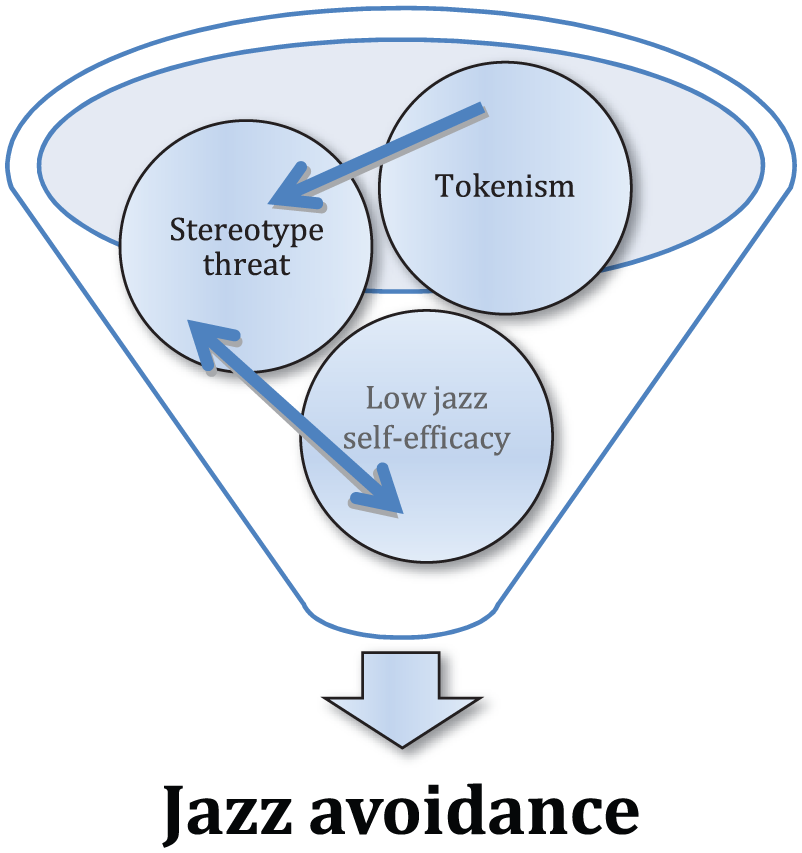
Tokenism (stereotyped roles caused by being the only female, or one of a very few) contributes to stereotype threat (fear of confirming a negative stereotype), which contributes to lowered self-efficacy (belief in one’s own ability to be successful) for jazz. Failure to have an expectation of success leads to avoidance of jazz participation.
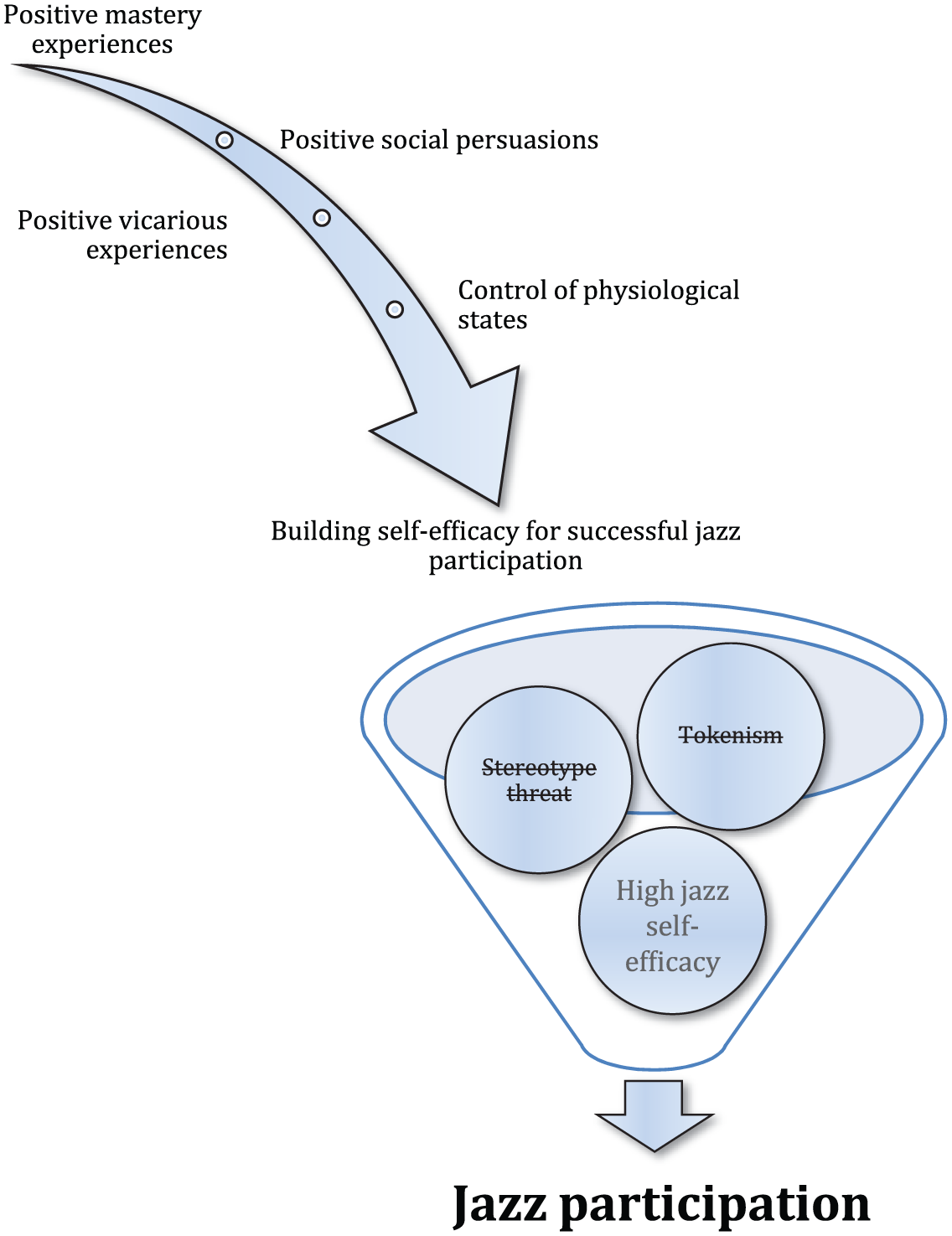
Experiences that contribute to the development of self-efficacy for jazz participation reduce the effects of tokenism and stereotype threat, allowing the student to have an expectation of success that contributes to jazz participation.
Tokenism
The first theory in this model helps to explain the jazz environment from a gendered perspective. Tokenism, as described by Elizabeth Kanter, is being the sole representative of a group, or one of a few in a social setting (Kanter, 1977; Sekaquaptewa & Thompson, 2002). Jazz is characterized as a patriarchal society (Dobson, 2010; MacDonald & Wilson, 2006) where tokenism is common for females participating in jazz, particularly as jazz study becomes more advanced (McKeage, 2004). Also known as solo-status, tokenism occurs when tokens are fewer than 15% of the dominant group (Kanter, 1977). McCord (1985) reinforces the idea of tokenism in jazz education, stating that college jazz courses are heavily dominated by males, and that if there is a girl in the course, she is often the only one.
The following sampling units from writings in Jazz Changes were categorized as demonstrating tokenism in jazz. Aschbacher (1997) stated, “I noticed that every single singer was female, and out of all of the instrumentalists I think there was only one woman” (p. 6). Kaiser (1995) contributed, “I [was] the only one of two girls in a jazz course of 30 or so students” (p. 7). Guilfoyle (in “Why are there?” 1995, p. 7) related the gender ratios to jazz audiences where “there are always more men than women.” Kaiser (1995) illustrated a problem of tokenism, “Having to study in a male dominated atmosphere is not easy” (p. 7).
Kanter (1977, 1993) described the difficulty of working in male-dominated environments according to four informal role traps that categorize token women into a role men respond to and understand: mother, seductress, pet, and iron maiden. Token roles allow men to preserve their generalizations of women by fitting tokens into stereotypical roles. Each role relates to a token woman’s sexuality, and by living up to the expected role as a part of “fitting in,” the token loses her individuality. Kanter’s research was with token women in a corporation, yet based on the sampling units in in this study, the same roles appear to exist in the field of jazz as well.
The mother-role involves sympathetic listening, serving, and taking care of the men (Kanter, 1993). Mother-role tokens are rewarded for their service rather than their professional contributions. Consider the following sampling units categorized into the mother-role: (a) Aschbacher’s (1997) statement, “Why is it that, traditionally, women may be allowed to sing and play the piano but not much else?” (p. 6); and Storb’s (1995) contribution, “Women are nice, helpful, receptive, responsive, etc. They are very often totally devoted, therefore exploitable” (p. 9).
The seductress-role involves the token being viewed as a sex-object who is valued for her looks rather than her musical contribution. This role leads to jealousy and resentment from men if a woman is relationally closer to one man more than the other men, or an even more negative perception if she is over-friendly to all (Kanter, 1977). The following sampling units were categorized as describing a seductress-role. Kavanaugh (1995) stated, “Often if there is one girl in the group she becomes isolated from these (social) experiences, unless she is dating one of the boys” (p. 11). She also recalled a specific event: I was the first bass trombonist at the Notre Dame Jazz Festival to be awarded an Outstanding Performer Award. During the performance with my jazz band from North Texas State University, I removed my jacket because of the intense heat … when I was handed my award the emcee tittered into the microphone: “See what happens when you strip for the judges.” It was a stupid comment that dealt directly with my gender. Unfortunately there have been many more. (Kavanaugh, 1995, p. 10)
The pet-role is characterized by an adoption of the woman by the group as an amusement, a little friend, or kid sister. She is included in the group symbolically as a mascot or cheerleader. Women in this role are praised for their abilities that do not compete with those of the males (Kanter, 1977). Consider the following sampling units that were categorized into the pet-role. Olin (1995) stated an example of this role entrapment: A general problem (not only in jazz, of course) is that women, for various reasons, don’t take themselves seriously. At least not like men do. This leads to a less professional attitude and it stops the development of each woman. (p. 4)
Jhaveri (1995) contributed, “there are many female singers, next would come female pianists. Both these call for less strenuous physical inputs. I am sure the world of classical music finds most females joining their orchestras as violinists for a similar reason” (p. 8).
The iron maiden-role describes the strong-woman who resists being placed in the other categories through demonstrating confidence, and/or by closing off sexual interests. These women are stereotyped as women’s libbers, and often face solitude and abandonment (Kanter, 1977). Consider the following sampling units that describe the iron-maiden role. A Betty Carter quote from Chasing the Vibration (1994, p. 89) by Graham Lock was reprinted in Jazz Changes (“Gender,” 1995, p. 8): The only difference about my being aggressive is that I’m female. If a man’s aggressive, we don’t even talk about it, but he does the same things that I do to get to his goal, right? He works at it, tries hard—but if I do it, I stick out like a sore thumb—“the female’s aggressive.” And aggressive for a woman is negative, but being an aggressive man is wonderful.
Rowe’s (1995) account demonstrates how early individuals can become aware of token roles: I asked some of the guys which of two equally attractive girls they would ask out: one of them is a cheerleader, the other stands in front of the band and plays a really swinging plunger trombone solo. Although many of them were embarrassed to admit it, they said they would not choose the trombone player because she was not their ideal picture of a woman, that she wasn’t feminine enough for them. And I think many of the girls are tapped into this way of thinking, this mentality. (p. 5)
Storb (1995) lists “Ten Statements on Women in Jazz.” The first two are “1. Don’t get pregnant! 2. Don’t marry!” (p. 9). Both statements refer to the woman’s sexuality while dismissing their ability as a musician, and they can be associated with all four token roles.
Stereotype threat
Because jazz was reported as a sex-typed genre that is perceived as predominantly male (North, Colley, & Hargreaves, 2003), jazz, in combination with tokenism and token roles, possibly sets up an environment for stereotype threat. First described by Steele & Aronson (2005), stereotype threat is the fear of confirming a negative stereotype, and associating oneself or one’s group with that stereotype. The following are sampling units associated with stereotype threat. Kavanaugh (1995) referred to stereotype in jazz: “Most of my music career has been spent either battling stereotypes or pretending that they do not exist” (p. 10). Olin (1995) shared this perspective, “One of the problems is that male musicians do not think that female musicians can play or teach” (p. 7). Consider a jazz improvisation task performed by a woman in relation to the token roles. If she plays like the men, she’s considered aggressive, an iron maiden, and does not conform to an acceptable female role, as demonstrated by the Betty Carter quote cited previously. Kavanaugh’s (1995) statement reinforced the idea of masculinity in jazz, “There is no feminine way to belch out bass trombone notes, screech out lead trumpet lines or lean into bop licks” (p. 11). Rowe (1995) contributed three quotes on the conflict females face in playing jazz, “I remember feeling that the sense of swing is unfeminine,” (p. 5); “I really do believe that young girls are more uncomfortable expressing themselves in the swing idiom” (p. 6); and “It (a sense of swing) is associated with masculinity in some people’s minds and I think many young girls are uncomfortable with that” (p. 5). Rowe also shared her own experience: In high school the guys that young women jazz musicians play with are often into screaming lead players, big band drummers, burning tenor players, etc. I never quite felt in high school that I was going to be able to express myself that way, or that I wanted to. (p. 6)
Jazz is about finding your own sound, and finding individuality in musical expression. If a girl turns away from the masculine approach in an attempt to play in her own voice, then she is threatened by the possibility of “playing like a girl.” Collier (1995) demonstrates this conflict with his quote, “The problem is something more than simply between women and men. Jazz is a macho thing, a power thing. You saw it the other night and at every jam session. The gentler way of doing things is often ignored and regarded as effeminate” (p. 7). Rowe (1995) contributed, “I think that more young women would be comfortable expressing themselves if there wasn’t a fear of being stereotyped as a ‘feminine’ player if they chose to play more sensitively or lyrically” (p. 6).
Researchers have found that the combined condition of stereotype threat and tokenism can be more detrimental to women’s performance than either condition alone (Inzlicht & Ben-Zeev, 2000; Sekaquaptewa & Thomas, 2002), and that stereotype perceptions can reduce motivation if a possibility of association with negative group perceptions exists, regardless of performance (Steele & Aronson, 2005). If a woman plays like a man, she is too aggressive and stereotyped as an iron maiden. If a woman plays like a woman, she is too effeminate to be taken seriously, and stereotyped as a pet or mother. If a singer, she is likely viewed in the seductress role, and valued for her looks rather than her musical contribution as demonstrated by Kaiser’s (1995) reference to the “decorative” singer (p. 8). Aschbacher (1997) demonstrated this point: And there are these prejudices against singers, and in particular female singers, that they are not really very musical. I’ve seen this over and over again. It makes it difficult to go into the world of jazz and have to be in this world. (p. 6)
The fact that all 14 of the discarded sampling units were split between stereotype threat and one of three differing subcategories, supports the existence of stereotype threat in this model, and possibly throughout the model. In jazz there exists an environment where if you are female, you must work through a climate of stereotype threat just to be in jazz courses and groups. This takes confidence, and not everyone has developed enough confidence to push through this environment. Rowe (1995) referred to confidence in the following two quotes: “Those expectations (being the center of attention when improvising) aren’t always placed on women and we’re not given the tools, the confidence tools, the esteem tools, if you will, to deal with things like that” and “I carried that (lack of confidence and self-esteem) all the way through college and it reflected in my playing” (p. 5).
Self-efficacy theory
Self-efficacy refers to personal judgments of ability to be successful at a given and specific task, and self-efficacy addresses the sources of personal efficacy beliefs (Bandura, 1997). Self-efficacy is a type of confidence that influences motivation and activity choice (Bandura, 1999). Lundenberg, Fox, and Punćcohaŕ’s (1994) work has demonstrated that males tend to be more overconfident than females dependent upon context and domain. Studies also suggest that females are less confident in their own abilities than males, and that females perform below males if they perceive the subject to be more male appropriate (Solmon, Lee, & Belcher, 2003; Tavani & Losh, 2003; Vermeer, Boekaerts, & Seegers, 2000). Stereotype threat can also reduce self-efficacy, or confidence (Steele, 1997; Steele & Aronson, 2005), so it is perceivable that a lowered sense of efficacy from the perceptions of jazz as a male dominated field, and stereotype threat, can negatively influence girls’ motivation and choices to participate in jazz. Consider the following sampling units for self-efficacy. Makholm (in “Why are there?” 1995) referred to avoidance in his quote, “Often there seems to me to be a reticence towards improvisation on the part of many women” (p. 8). Rowe (1995) shared this awareness of girls’ hesitancy towards committing fully to playing a swing statement. She stated, “The inflections and their ability and willingness to get involved with the swing feel was markedly different between the boys or girls” (p. 5). Rowe also contributed, “I see a lot of high school festivals where I’m adjudicating and there’ll be a lot of women playing written parts but not many of them standing up and soloing” (p. 6). Rowe added, “There may be more girls in high school bands as players than at college level but they aren’t standing up and soloing. That’s a whole different thing” (p. 6).
Self-efficacy theory involves four areas that contribute to how we build up, and break down, our sense of self-efficacy: mastery experiences, vicarious experiences, social persuasions, and physiological states. Mastery experiences involve having multiple small successes to build self-efficacy, or a lack of small successes that reduces efficacy. Vicarious experiences include having examples of role models, or people to whom one can relate who are successful. A lack of these role models reduces self-efficacy. Social persuasion involves the messages, both positive and negative, that we receive from others. Physiological states involve anxiety and the physical and mental effects of stress. All four of these variables are correlated, and improvement or issues in any one area can affect the other areas (Bandura, 1997). This study’s analysis revealed all four areas of self-efficacy as potential influences for reducing women’s self-efficacy for playing jazz, which could possibly contribute to a choice to not participate in jazz. The analysis also demonstrated how these areas also serve as a guide for helping women build self-efficacy for playing jazz.
Mastery experiences are the small successes that contribute to self-efficacy (Bandura, 1997). Classroom environment can influence mastery experiences. Kaiser (1995) stated, “I find that the atmosphere during rehearsals, sessions, concerts, and classes is often mostly competitive, skeptical, sarcastic. The element of ‘having to prove how good you are’ makes it hard sometimes to be open and relaxed” (p. 7). Olin and Aberg (1995) noted that “it is in the group below, the in between the very good and bad, where the problems lie. Female musicians can’t compete, can’t get heard and can’t get the respect they deserve” (p. 4). Rowe (1995) observed, “And certainly when I watch young male students working with the band, they don’t seem to have the problem of just expressing themselves swing-wise” (p. 6).
Social persuasions, and in particular negative social persuasions, can affect one’s development of self-efficacy through inhibiting mastery experiences and setting up stereotype threat environments as demonstrated by the following sampling units. Guilfoyle (“Why are there?” 1995, p. 7) is quoted in a Jazz Changes article having said, “Let’s face it, these gentler players, including many women, will get squashed by the kind of powergames that most of our students play.” Fjällborg (1995) stated, “Women have always been singers, that’s just the way it is” (p. 9). These negative social messages affect motivation through limiting the beliefs of women towards their potential success in jazz. Aschbacher (1997) demonstrated the need for women to hear positive messages, “It’s really important that no one thinks that women can’t be good saxophone players” (p. 6).
Vicarious experiences exist when one’s belief in one’s own potential success is influenced by being able to relate to someone whom one considers to be successful (Bandura, 1997). Vicarious experiences appear related to finding female role models in jazz. Consider the following quotes: After six years playing with male musicians I really got a kick out of the first time I saw Gerri Allen, Michelle Rosewoman, Carla Bley, and Elaine [sic] Elias. These musicians became the most important inspiration for me and are responsible for my continuing in jazz. (Olin, 1995, p. 7) As a female musician it is very important for us to see that other women can play well, write well, teach well, and so on. Once you get to see these women you can get a lot of strength and inspiration. I would say it is “life necessary” (Olin & Aberg, 1995, p. 4).
Rowe (1995) contributed “It would be nice if there were more women educators at high school level who were comfortable enough and knowledgeable enough about the jazz idiom so that they could recognize some of these problems” (p. 6). A lack of, and a need for, role models were the most common statements in this study. From Olin and Aberg (1995), “I have studied music for seven years at different schools … and have never had a female teacher” (p. 4). Olin (1995) wrote, “For women in a male dominated jazz scene it is very important to see a female player” (p. 7). Rowe (1995) agreed, “there are not enough role-models, especially in the brass area,” and “It would be great for young women to see more women directors” (p. 6). Olin (1995) asked, “At Berklee, why weren’t there ever any female teachers or clinicians? That would have really helped,” and “ I only wish I had experienced this (seeing female jazz artists) earlier in my career” (p. 7).
Physiological states include the ability to control one’s mind and body (Bandura, 1997). A lack of physiological control can be associated with anxiety, and contributes to a lowered sense of self-efficacy. Consider the following sampling units associated with physiological states: “I remember taking solos in my high school jazz band and just turning bright red after each one. I just couldn’t handle the attention” (Rowe, 1995, p. 5); “The element of having to ‘prove how good you are’ makes it hard sometimes to be open and relaxed. This atmosphere may make it hard for women to stake their claim in the jazz world” (Kaiser, 1995, p. 7); and “Maria Schneider and I have often compared stories about standing in front of bands, our comfort levels, and the various elements of directing that have made us insecure and that we have had to overcome” (Rowe, 1995, p. 6). Rowe also added, “Thinking about my problems in leading the university band … I really had to work on being comfortable, demonstrating swing phrasing to the band in a confident manner, really get into it and not feel embarrassed …” (p. 6).
Discussion
Why teaching jazz to girls matters
While the editors of Jazz Changes stated, “Jazz educators must seek to address the whole,” they also recognized that many men in jazz may not view a lack of women studying jazz as a problem. The editors refer to one woman’s comment that being concerned about a lack of females in jazz is just not part of young male directors’ job descriptions (Collier et al., 1995, p. 2). A contrasting belief is that more female jazz musicians would bring more money and respect to jazz (Olin & Aberg, 1995).
Consider the following words of Wynton Marsalis from a debate with James Lincoln Collier as recalled by Kavanaugh (1995): Marsalis defended hiring practices of the Lincoln Center for Jazz by listing the number of African Americans, Caucasians, and Hispanics hired during the year, and stated his goal to advance the jazz genre by encouraging young men to continue in jazz. When asked what was being done to help young women learn the genre, Marsalis rolled his eyes and said that he didn’t have time for such political correctness. The unspoken answer was nothing. (p. 10)
Brown (1995) was quoted in a Jazz Changes article saying that “just because it’s fashionable to lament every ‘inequality’ that doesn’t necessarily mean that it is sensible so to do” (p. 8), and Sela (“Why are there?” 1995), also quoted in a Jazz Changes article, said “It’s not something that men can change for women in a patronizing way. If there are more talented women than men, then they’ll make it.” These statements demonstrate attitudes that reflect a non-interest in working toward including more females in jazz studies, and suggest that some believe that teaching jazz to girls does not matter. Contrary to this belief, some believe that teaching jazz to girls does matter. Delzell (1994/1995) asserted that girls not choosing to participate in jazz studies limit the music education and performance career options available to them, particularly their viability for high school band positions where jazz ensembles are often a part of the music program. According to the U.S. Department of Labor (Bureau of Labor Statistics, U.S. Department of Labor, 2006), musicians who learn several similar instruments, and are proficient in a variety of styles including jazz, rock, studio, and orchestra have better employment opportunities available to them. A similar gender issue is documented in music conducting (Sheldon & Hartley, 2012) as women have consistently accounted for fewer than 10% of college band directors (Block, 1988; Gould, 2001, 2003).
Alexander (2011) suggested that research has yet to identify the sources of the problem of being female in jazz in a way that can provide guidance in improving the jazz environment for females. The current study identifies three social-psychological sources of the gender issue based on the accounts published in Jazz Changes from 1995–1997. Self-efficacy appears to be a central issue. In Phillips’ (1984) study, the perception of personal ability was a better predictor of achievement motivation in education than one’s true ability. Research studies in music performance (McPherson & McCormick, 2006) and jazz improvisation performance (May, 2003) suggest that self-efficacy can be the strongest indicator of success. For girls to pursue jazz education, they must first have enough confidence, or self-efficacy for learning jazz (a belief that they can be successful at learning jazz) to motivate them to participate, and Rowe (1995) is attuned to this need for self-efficacy. She wrote that “Women who have succeeded in a typically male arena (do so) by virtue of being good at what they do and believing in themselves” (p. 7).
The problem is that in jazz, a female is often the only one, and potentially placed in a token role that induces stereotype threat that inhibits the experiencing of the multiple, small successes in jazz that build self-efficacy. Kanter (1977, 1993) suggests that the best way to change the behavior and treatment of women in token positions is by changing the proportions. In other words, there need to be more women participating in jazz in order to keep more women participating in jazz. Kanter’s work in tokenism uses 15% as a guide. One might consider the possibility that creating jazz combos by personality, and possibly grouping by gender, could provide a more comfortable environment for learning the jazz language for some, until the students have enough mastery experiences to build their confidence for playing in mixed groups. Gould (2005) has suggested that a lack of role models is one contributor to the lack of females in the conducting area. Finding a woman director, teacher, or clinician for these groups might also help create a learning environment for females. Jazz pedagogy, and the quality of instruction, are important also (Kelly, 2013; Penno, 2013; Watson, 2010), but are outside the scope of this study. By controlling for gender imbalances, token roles are reduced, and stereotype threat is lessened in the immediate environment. The logistics of teaching all girl classes or ensembles, or of grouping students by similar personalities, might be problematic, and Rowe (1995) acknowledges that there will need to be some “nurturing” and “special attention” given for helping girls get into the jazz idiom, (p. 6). She continues: To get young women musicians to the level where they can audition for a jazz program, we have to inspire them through clinics with female teachers, hire female teachers in our jazz schools, and of course hope and wish for the whole scene to become more open about female jazz instrumentalists. That’s going to take a while. (1995, p. 7)
Future gender research in jazz would benefit from theory-driven approaches to direct energies toward common goals. What theories fit current environments in jazz education? Does offering all female instruction build enough confidence for females to continue and be successful later in mixed jazz courses? Or is the message of jazz as a male-dominated field so prominent in society that small changes at local levels are ineffective? Gamlen (1997) voiced that she was disturbed by an Arts Council statement, “Applications involving women composers would be particularly welcomed,” due to the possibility of women not being taken seriously if they are treated differently (p. 6). Would some girls be offended by being offered all female instruction? How does age fit into these three theories? Certainly as one gets older, there has been more time to develop self-efficacy. Does aging, however, create more issues for efficacy if one believes that it is too late to learn? In Rowe’s (1995) case, she states, “I’m only starting to feel comfortable about digging in and swinging as hard as I can now and I’m 35. That’s really sad considering the level of training I have had” (p. 5). Is it possible that token roles and stereotype threat lessen as women grow out of some of the roles? Meredith (1997) advises that when performing at high schools for recruiting purposes, to make sure there is at least one woman in the band, and also bring in at least one important woman for a concert each year (p. 8). Does one girl in a band demonstrate a positive vicarious experience for female students considering jazz study, or does one girl reinforce stereotype threat through the suggestion of tokenism? Are there other social-psychological theories that provide a better fit, or suggest different approaches?
Further research is needed to better understand the effects of changing gender ratios in instruction. Olin and Aberg (1995) suggest that men and women learn in different ways (p. 4), and Rowe (1995) recommends exposing females to less aggressive jazz styles (p. 6). Rowe also believes in having students sing more to get over inhibitions (p. 6), yet previously she referred to the girls’ hesitancy to sing back a swing phrase. Can singing parts before playing them reduce inhibitions of stereotype threat? Kavanaugh (1995) suggests encouraging sections to socialize together to help decrease isolation (p. 11).
Directed approaches to content analysis such as in this study are limited by potential bias and underrepresentation of contextual data due to the focus on pre-selected theories utilized by the researcher (Hsieh & Shannon, 2005; Mayring, 2000). In this study, two additional theories were added to the model when suggested by the data. However, these theories were selected by one researcher, and other researchers might identify different theories either for deductive, or from inductive, analysis. Collier (1995), for example, refers to a discussion at his school where many of the men attributed the problem of a lack of women in jazz to a “victim mentality” (p. 5). This study does not support the victim mentality idea as an issue, but perhaps a different researcher would start with a different theoretical background.
Additional complications in this model are due to the inter-relatedness of the theories utilized. For example, Kaiser’s (1995) comment, “Having to study in a male dominated atmosphere is not easy” (p. 7) demonstrates tokenism in the male dominated atmosphere, but also relates to self-efficacy through mastery experiences, and a difficulty in experiencing success because of the environment. A separation of the theories for this model is necessary to understand the issues that underlie each theory (Krippendorff, 2013; Schreier, 2012), but the three theories are in reality weaved into the same human experience.
This study is limited to statements published by a small number of contributors to Jazz Changes, over a relatively short period of time from 1995–1997. How different is the jazz environment today, and how do programs differ from each other in female representation and the existence of stereotype threat? What are current hindrances to developing jazz self-efficacy in current jazz programs for women? To cite Collier et al. (1995), “Without young women learning the music, there will be few women musicians to act as role models and fewer still joining college faculties” (p. 2). Continued research is needed to demonstrate that there are real social-psychological barriers for women in jazz that need to be addressed if real changes in gender participation are to happen. Without young women learning the music, there will be limited experiences with jazz styles for elementary general music classes where females dominate the profession, and limited high school band teaching opportunities for females in areas where jazz programs are common.