







Abstract
The primary objective of this study is to investigate whether three interaction strategies through mobile apps may be associated with increases in students’ music listening skills. Data was collected from 225 high school students and analysed using the ANOVA procedure in the three ways of music listening: analytic, aesthetic and sensory. Interaction with the app was least influential in the analytic listening of the participants. Interaction with peers was most influential in the aesthetic listening of the participants. Interaction with the app was most influential in the sensory listening of the participants.
Keywords
Introduction
Music listening is one of the most important and basic activities in music education (E. Johnson, 2011). Music listening is not only a meaningful activity for the general population, but is also very important to music education. In the United States, it is essential to each of the 11 “National Core Arts Standards” (National Coalition for Core Arts Standards [NCCAS], 2014) for music and fundamental to other musical experiences as well (Hartshorn, 1957; Kerchner, 2009; Reimer, 2003). The national curriculum in England aims to ensure that all students listen to music across a range of historical periods, genres, styles and traditions, including the works of the great composers and musicians through key stages 1 to 3 (Department for Education, 2013). In Hong Kong, music listening is one of the main focuses in music education in addition to performing and creating (Curriculum Development Council, 2015). As such, music listening is the basic skill required for both learning music and for developing good musicianship. Thus, listening plays a major part in the learning process. Through listening, students expand their musical understanding and increase their enjoyment of music.
Music listening is about understanding and enjoying the meaning, the aesthetics, and the beauty of music (Miller, 1968). It is an activity involving perceiving and understanding the characteristics and principles of the musical elements such as rhythm, melody, harmony, form, dynamics, tempo, and timbre (Reimer, 2003). Moreover, music listening activities include the process of exploring the aesthetic elements in music through understanding of the contextual factors related to music (Elliott, 1995; Boardman, 1996).
Recent technologies, including digital media such as computers, iPods, and cell phones, help us understand concepts and skills required for music listening, play, and creation. Many websites and online podcasts provide easy access and ample opportunities for students to stream and appreciate genres and styles of music anytime, anywhere. A variety of mobile apps are unique in that they are very popular with students today and provide students with music understanding and skills in more individual environments (Bauer, 2014).
Much research has been published regarding technologies as effective tools for facilitating learning in music. Riley (2013) introduced the use of tablet PCs, iPads, and mobile device apps. Riley examined seven types of app which can be used in music education: rehearsal/performance assistance, creating music, teaching instruments, providing virtual instruments, audio/video recording, listening resources, and organizational support.
Additionally, Williams (2014) suggests that the tablet PC can play a role as an instrument in music education. With regards to music listening, students can answer questions and be at a range of listening ability levels within the same group, with the iPad activities being tailored to the students’ individual skill and prior experience. He argues that using iPads has a myriad of possibilities for ensemble performance and music learning. He suggested it differs from the traditional school model in that the aural process provided by iPads is much more authentic and productive. An interactive improvisation system was used to engage students in a musical dialogue by Rowe, Triantafyllaki, & Anagnostopoulou (2015). They report that the system, called Musical Interaction Relying On Reflexion (MIROR)-Improvisation, can enhance young pianists’ musical capability to explore and improvise. Technology is frequently included in early childhood classrooms as an attempt to incorporate music education in the curriculum. Burton and Pearsall (2016) explored the preferences of 4-year-old children for music-based apps in a preschool setting. They found that children preferred those apps that had a high frequency of visual stimulation, were easy to navigate, and/or had familiar music.
Clearly, technology will soon become widely used enough for every student to be issued a device across all subjects. Music teachers in schools that adopt one-to-one models may be inadequately equipped to integrate this kind of technology into their classrooms. According to Dorfman’s study (2016), music teachers have expressed their concerns about the adoption of one-to-one technology in their schools and classrooms as they relate to musical goals, extent of integration, and other pedagogical factors. In contrast with teachers, Chen (2015) indicated that the functions clapping and singing score better than the other function feature (stylistic recognition).
Strategies for music listening
Recently, a variety of strategies have been introduced to increase students’ active and positive participation in music listening. In this effort, attention has been suggested as one of the critical elements for meaningful music listening (Madsen & Geringer, 2008). In order to enhance students’ attention, research has focused on adopting listening maps or verbal description as a learning activity in music (Cassidy, 2001; Flowers & O’Neill, 2005; Gromko & Russell, 2002; D. C. Johnson, 2011; Sims, 2005). Research has also been done on collaborative music listening and interaction with others (E. Johnson, 2011; Smialek & Boburka, 2006).
D. C. Johnson (2011) performed a study on the effects of critical thinking instruction on fifth-graders’ music listening skills measured through written survey responses. While participants in the critical thinking instruction scored higher on verbal descriptions of music compared with the pre-test, the participants in the activity-based instruction demonstrated no significant differences from the pre- and post-tests. However, this study showed enhanced students’ thinking of musical context through analysis and exploration initiated by each student, as shown in Bamberger’s study (2000). Based on the results of the study, it was suggested for teachers to include open-ended questions and improvisation along with vocabulary and response activities when designing music listening instruction.
A contextual analysis of music was a main research topic of Walby (2011). In his article, several techniques were used in integrating vocabulary into listening assignments. Thus, he provides several teaching strategies in pre-written and written assignments for approaching words from both a theoretical and a practical standpoint. Techniques in pre-written assignments include calibration listenings, odd man in/out, partner words, multiple choice, and temporal mapping. Those in written assignments include short-answer and long-answer questions, semantic maps, listening trees, movement maps, and Venn diagrams. He argues not to bypass the mental hurdles that surround challenging, focused vocabulary and listening activities in order to secure “a powerful, educative experience to something more akin to a show-and-tell activity starring the teacher” (2011, p. 59).
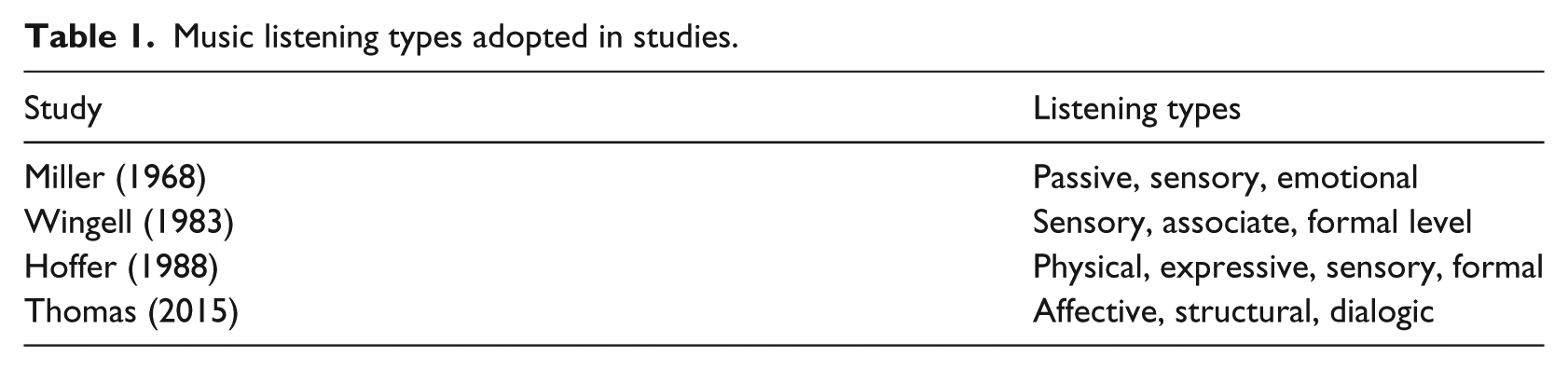
The above studies suggest a proactive approach to music listening. Table 1 summarizes music listening types.
Music listening types adopted in studies.
In fact, people respond to music in various ways and music educators should strive to develop students’ abilities to listen to and describe music, analyze and evaluate it, understand its historical and cultural contexts, and appreciate its relationships to other disciplines, including other art forms (Bauer, 2014).
From the preceding studies, three apparent ways of music listening can be extracted. One way is to appreciate music as it is with our senses without taking any notes and analyzing its characteristics such as tempos, rhythm, or melody. Listeners do not relate the music to cultural or historical context when they are listening. This could be called sensory listening. Another way is to appreciate music with an analysis of expressive characteristics. Appreciating the music, listeners consider several elements such as rhythm, melody, harmony, form, tempo, dynamic, and timbre. This could be called analytic listening. And the last way is to appreciate music with relation to its elements and structural characteristics (Reimer, 2003), historical events, cultural context (Elliott, 1955), and other genres of the arts (Langer, 1953). In short, aesthetic listening is to appreciate and enjoy the pleasure that comes from the beauty of the music. This type of music listening is aesthetic listening.
The primary objective of this study is to investigate whether three interaction strategies including ‘with peers’, ‘with teachers’, and ‘with ‘the app’ through mobile apps may be associated with increases in students’ skills in analytic, aesthetic, and sensory listening.
Research methods and tools
Participants
A total of 225 students were selected from a high school located in Daejeon, South Korea. All of them were in tenth grade and owned a smartphone. In the same context of using technology in music education as with the above research and experience, this study aims to utilize an app and consider its effectiveness in music listening. The primary objective of this study is to examine whether three interactions through mobile apps can enhance students’ music listening. Of the participants, 114 students were boys and 111 students were girls. Two classes were chosen at random and were allocated to each one of the three treatments: 77 students were assigned to the interaction with peers, 72 students to the interaction with teachers, and 76 students to the interaction with the app developed by the author. In the analysis, cases with any missing scores were excluded. The result was that 225 participants for analytic, 214 for aesthetic, and 217 for sensory listening were included in the final analysis.
Music listening test
The music listening test was composed of three sections: analytic, aesthetic, and sensory listening. The analytic section was comprised of six multiple choice items. Three pieces of music were applied for the analytic listening. The first piece was ‘In the Hall of the Mountain King’ from Peer Gynt Suite No. 1 by Edvard Grieg. All six items in the analytic section were applied for this piece. The second piece was ‘The Flight of the Bumblebee’ from Tsar Saltan Suite, Op. 57 by Nicolai Rimsky-Korsakov. Item numbers 5, 6, and 8 were applied for this piece. The third piece was ‘Frightening’ from Scenes from Childhood, Op. 15 by Robert Schumann. This piece was tested using item numbers 4, 7, and 9. Thus, the total score for the analytic listening was 12. Both the aesthetic section and the sensory section were comprised of three short essay questions each. All items were developed by researchers and revised three times by a music teacher who holds a master’s degree in music education. The Cronbach Alpha for the analytic section was .91 and the test–retest reliability was .94 for this section. The aesthetic and sensory sections were graded by three music teachers with master’s degrees in music education and the final scores were obtained by averaging the three scores. The details of the test are presented in Table 2.
Sections and items of the music listening test.
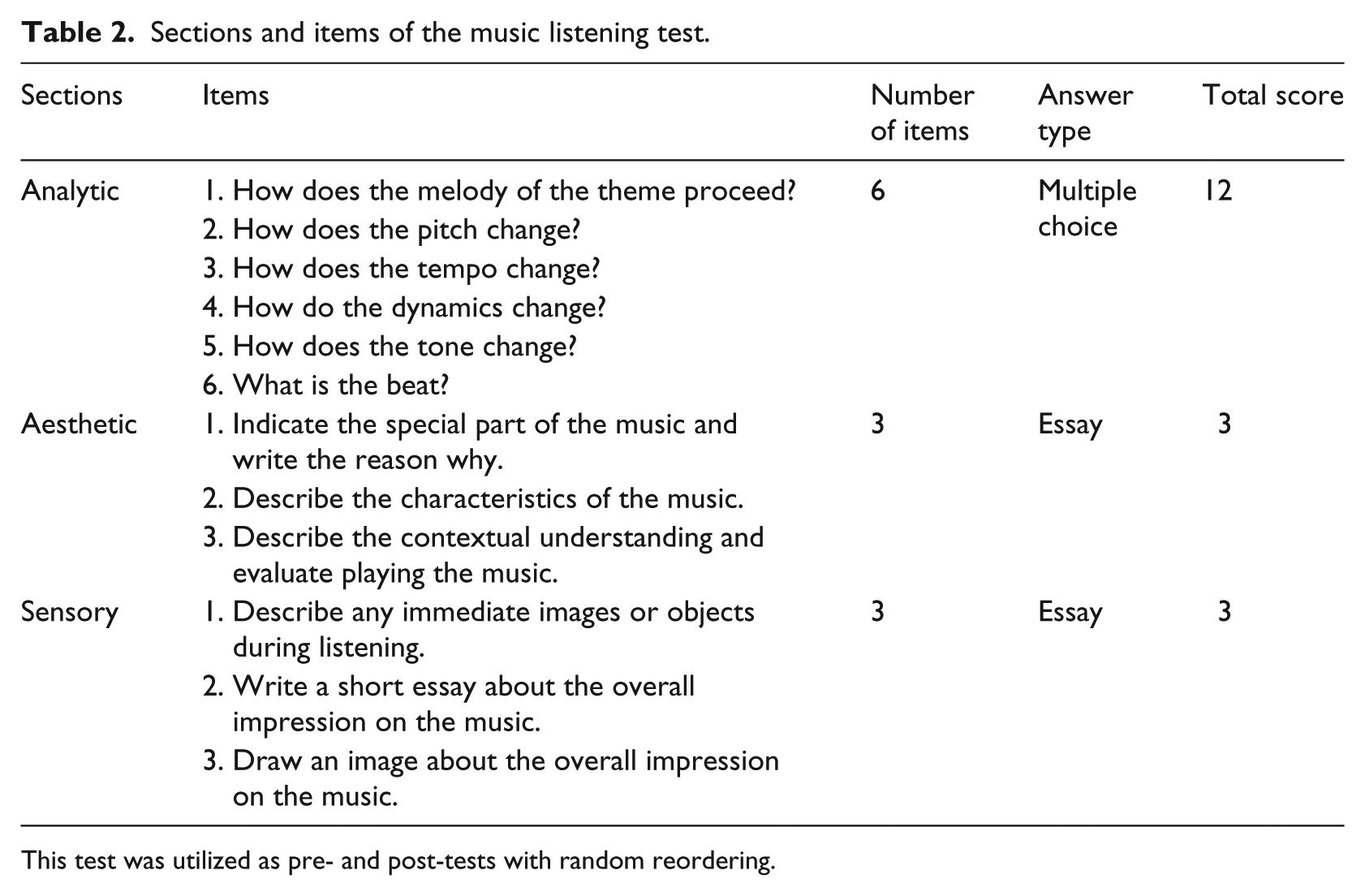
This test was utilized as pre- and post-tests with random reordering.
The app
The app used in the study was developed by Cho (2014) with Eclipse Helios using ASP.Net 2.0, HTML and JavaScript. The app used MS-SQL 2005 as a database under Internet Information Server 6.0 and Windows 7. Users can access the app with their Android phones by following the link http://www.met4u.net/app_note to download and install. This app was designed for students’ active music listening in that they can express their feelings by clicking ‘Likes’ as in Facebook. This app allows students to listen to uploaded music and to write notes on analytic, aesthetic, and sensory listening. Students can share their ideas by communicating with texts, attaching files, and replying to peer posts. Through this link, each group of students could access the app according to their pre-assigned type of interaction.
A total of 13 music titles were embedded in this app. They were selected by the researcher with the criteria of difficulty level and hierarchy of music learning. So, in the analytic music listening, several elements were to be considered such as rhythm, melody, harmony, form, tempo, dynamic, and timbre. Not all the music selections contained all the elements, but rather each title of music varied in its elements. The 13 titles were ordered in sequence so that the students could grasp the music elements and develop their listening ability gradually.
The order of the music was arranged from one with a focus on tempo, which might be easy for students to understand, to one focused on rhythm, beat, melody, and dynamic, in order. Each title was added to the preceding music’s focused element. For example, the ‘Flight of the Bumblebee’ by Rimsky-Korsakov with a fast tempo was placed first, ‘The Death of Ase’ by Grieg with a slow tempo and in timbre (strings) placed second, and ‘Sabre Dance’ by Khachaturian with a fast tempo and in timbre (percussion/wind) placed third. For aesthetic music listening, the program music was mostly selected in consideration of the historical, cultural, and social context. The same basic information and explanation, such as the title, composer and a brief introduction, which does not affect any type of listening, were given to all participants for better understanding the music regardless of what types of interaction they were going to perform.
Procedures and data gathering
Students’ music listening lasted for 3 months from September 7 to December 11, 2015. Before the listening started, the app was installed, and students were informed on how to use it. Twenty-six students, whose devices were not compatible with the app, were provided with smart phones with the app already installed. The participants were given one class hour of instruction on how to listen to music, which included all three ways of listening. They also practiced how to take notes in the app. Thus, all students became familiar with music listening with the app, taking notes, and communicating with others. A pre-test was administered to all participants. This pre-test was a music listening test before the assigned interaction for each group.
For the treatment period, students listened to music each week, and the students were asked to write a listening note. Each pre-ordered music title and its context information was uploaded every Monday with YouTube links. Participants were also allowed to upload their own images together with text as a way of taking music listening notes. All participants were the same in listening to the music, reading the information and explanations, and creating their own notes. In addition to these common activities, the interaction group with the app could see only their own notes and they could proceed at a self-directed learning pace. The interaction group with peers, after writing their notes, could open and comment on others’ notes, share their opinions on the music, and communicate with others using ‘Likes’. The interaction group with teachers could interact with teachers after writing their notes, asking questions regarding each topic. They could read teachers’ comments on their notes.
A post-test was administered after the last listening. This post-test was identical to the pre-test, but the order of items was rearranged. A three group pre- and post-test design was used in this study.
Results
Homogeneity of the groups before the treatment
Before the treatment, homogeneity of the groups was tested for the three ways of music listening. The ANOVA procedure was applied to see if there were any differences in the means in the three ways of music listening. The ANOVA procedure did not produce any significant difference. Therefore, the participants were homogeneous in music listening before the treatment regardless of the group to which they belonged.
Effects of treatments in three ways of music listening
In order to test the effects of the three interactions, the ANOVA procedure was applied to three ways of music listening: analytic, aesthetic, and sensory. Below are the results of the ANOVA on the post-test in the order analytic, aesthetic, and sensory. Table 3 shows the means and standard deviations of the three ways of music listening.
Post-test means and standard deviations of three types of music listening.
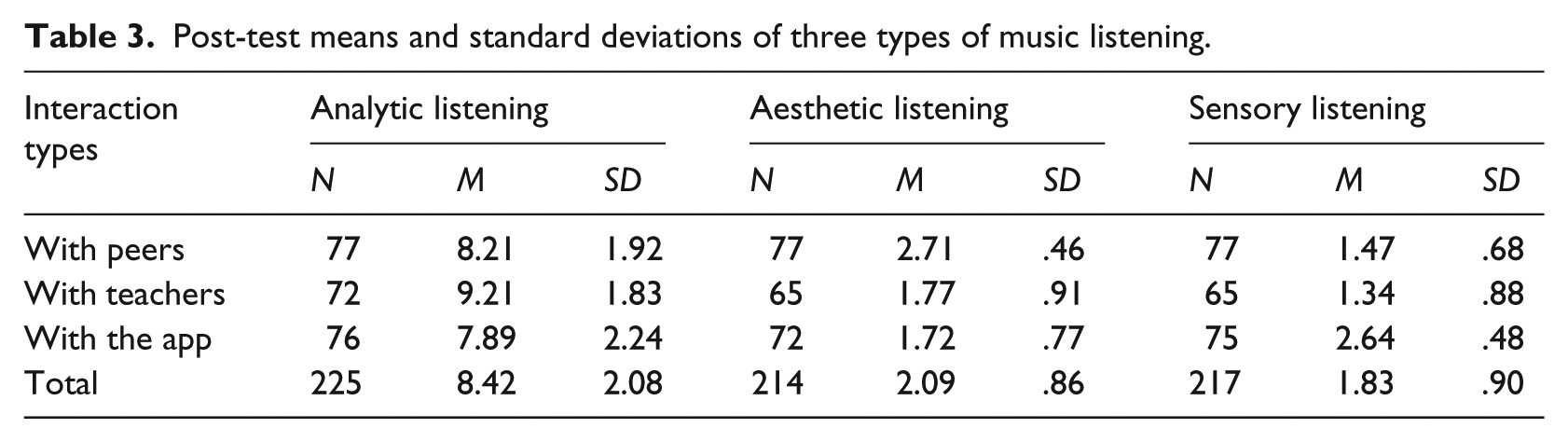
To test if the difference shown in Table 3 for analytic listening is statistically significant, the ANOVA procedure was applied with the post-test score of analytic listening. Significant differences between the three groups were found for analytic listening, F (2, 222) = 8.535, p < .01. The mean of the interaction group with teachers was highest. The mean of the interaction group with peers was the second highest, while that of the interaction group with the app was the lowest. The Least Significant Difference (LSD) procedure showed that mean differences were significant between the ‘with the app’ group and both ‘with teachers’ and ‘with peers’ groups, p < .05, but not between ‘with peers’ and ‘with teachers’ groups, p > .05. Adjustments for multiple comparisons were used in determining significance of differences. Therefore, the interaction with the app was least influential in the analytic listening of the participants.
The same pattern of the analysis was applied to the case of aesthetic listening. To test if the difference shown in Table 3 for aesthetic listening is statistically significant, the ANOVA procedure was applied with the post-test score of aesthetic listening. Significant differences between the three groups were found for aesthetic listening, F (2, 211) = 43.857, p < .01. The mean of the interaction group with peers was highest, and that of the interaction group with teachers was the second highest while that of the interaction group with the app was the lowest. The LSD procedure showed that mean differences were significant between the ‘with peers’ group and both ‘with teachers’ and ‘with the app’ groups p < .01, but not between ‘with the app’ and ‘with teachers’ groups, p > .05. Adjustments for multiple comparisons were used in determining significance of differences. Therefore, the interaction with peers was most influential in the aesthetic listening of the participants.
The same pattern of analysis was applied to the case of sensory listening. To test if the difference shown in Table 3 for sensory listening is statistically significant, the ANOVA procedure was applied with the post-test score of sensory listening. Significant differences between the three groups were found for sensory listening, F (2, 214) = 77.937, p < .01. The mean of the interaction group with the app was highest, and that of the interaction group with peers was the second highest while that of the interaction group with teachers was the lowest. The LSD procedure showed that mean differences were significant between the ‘with the app’ group and both ‘with teachers’ and ‘with peers’ groups, p < .01, but not between ‘with peers’ and ‘with teachers’ groups, p > .05. Adjustments for multiple comparisons were used in determining the significance of differences. Therefore, the interaction with the app was most influential in the sensory listening of the participants.
Discussion, conclusion and suggestions
This study investigated whether three interaction strategies through mobile apps may be associated with increases in students’ music listening skills. The interaction with teachers was most influential in the analytic listening of the participants, while the interaction with the app was least influential in the analytic listening of the participants. Analytic listening is to understand and differentiate the expressive elements of music while listening to music. This could be functional and methodological in that it includes differentiating these elements in the music. Therefore, these skills and methods could be learned effectively and efficiently with the help of experts.
One of the results of this study—that the interaction with teachers was most influential in the analytic listening of the participants—could be due to the instructors’ input. The fact that interaction with the app was least influential in the analytic listening of the participants may be attributable to the non-existence of any help from others in acquiring skills and methods for understanding and differentiating these elements of the music. This result in music listening through the app is supported by the previous studies showing teachers’ roles in music learning. Furthermore, Kirnarskaya and Winner (1997) described the development of the expressive ear, of sensitivity and timbre, and the analytical ear, a focus on structural relationships in music—that is, recognition of musical elements and themes, hierarchical structure, development of structural themes, transformation of themes, etc. They stressed that teachers should organize students’ activities in meaningful ways to ensure students can develop analytic ability in order for them to understand the abovementioned characteristics of music. Bauer (2014) mentioned that teacher-created call charts or listening maps helped students increase their effective music listening.
The interaction with peers was most influential in the aesthetic listening of the participants, while the interaction with the app was least influential in the aesthetic listening of the participants. These results coincide with the findings of Smialek and Boburka (2006). They demonstrated that the consistent use of cooperative listening exercises proved to be effective in developing non-music major students’ critical listening skills in comparison to either the exclusive use of lecture-demonstration or the occasional use of group work after defining critical listening as a combination of perception and critical thinking. The aesthetic listening is to locate overt and covert expressive beauty of music and evaluate its value in the context of the society and culture in which the music was created. This listening accompanies understanding of the music’s characteristics, of related stories and of reflections of them in the music.
In this study, all participants except students interacting with peers could read only their own postings, while participants interacting with peers could share and read others’ posts as well. The participants interacting with peers could communicate all of their comments with others. Because the aesthetic listening is more closely related to the contextual knowledge of the music, participants interacting with peers could enhance their aesthetic listening and their contextual knowledge by reading others’ notes and sharing comments. The lowest aesthetic listening of the participants interacting with the app is attributable to the non-existence of any help from others.
The interaction with the app was most influential in sensory listening of the participant, while the interaction with teachers was least influential in sensory listening of the participants. Sensory listening is to express the listener’s feelings in words, images, or bodily gestures while listening to music. That is, the sensory listening does not accompany any other kinds of deep thinking or understanding; rather, the listeners use their senses to appreciate the music with ease and comfort. In this study, participants interacting with the app listened to the music with the explanation and read how to appreciate the music with no interaction with others. The fact that participants interacting with the app showed higher sensory listening could be due to the fact that they could react to the music with ease and freedom without others’ intervention or control. The other participants interacting with teachers and peers could be distracted during sensory listening in search of analyzing and evaluating the music’s context and elements. This result is also supported by the findings of Sloboda (1990) indicating that students must perceive a nonthreatening environment in order to be comfortable enough to respond emotionally to music.
The implications of this study are that analytic listening can be effective through interaction with experts, aesthetic listening can be enhanced by interactions with peers, and sensory listening can be enhanced through interactions with the app. These results imply that analytic listening needs to be focused on a coaching method involving experts’ guidance, aesthetic listening needs to be focused on a discussion with peers, and sensory listening needs to be focused on more free and comfortable listening environments. The results of this study are expected to provide meaningful evidence for music listening strategies that utilize various interactions in the future. In addition, this study is expected to contribute to the follow-up research as an example of music education using technology that extends the educational space beyond barriers of the classroom.
Footnotes
Funding
This work was supported by the National Research Foundation of Korea Grant funded by the Korean Government (NRF-2013S1A2A1A01066756).