







Abstract
The purpose of this research was to identify the various types of employment held by music alumni at one university. We also compare the perceptions of alumni who currently work primarily in music with those of alumni who work outside the field. A mixed-methods research design that relied on surveys and interviews was used to gather data. Alumni employed primarily outside the field held a wide variety of roles and many reported incorporating their musical skills in these roles and they continued to engage in a variety of activities within the field of music. Those whose employment was primarily in music were more likely to have reported choosing to enroll in a music degree program with an express intention of gaining music-focused employment. Findings from this study illustrate that while graduates of music programs do find employment success, further investigation is necessary to identify the breadth of roles available, yet untapped, for music graduates and the perhaps entrepreneurial requirements for engagement in them. Our findings also point to the need for music programs to realign curriculum to better reflect the ever-expanding music sector.
Keywords
Introduction and review of literature
The purpose of this paper is to describe the various roles held by alumni of undergraduate music programs and to compare the perceptions of respondents who work primarily in music with those who work primarily outside the field. This study is grounded in salient literature related to post-secondary music programs, the cultural industries in Canada, and the experiences of musicians. Following this review of literature, we outline the mixed-method approach used for this study then present our findings in the subsequent section. Finally, we provide a discussion of the findings including implications for post-secondary programming.
The culture industries
The general population, and perhaps family of potential music students in particular, seem not to appreciate the breadth of opportunities associated with completing a post-secondary music degree (Bridgstock, Goldsmith, Rodgers, & Hearn, 2015). Arguably, many people may feel that pursuing education in this field is ill-advised as the job prospects seem very limited (Bennett, 2016; Comunian & Gilmore, 2016). However, researchers and policy-makers have noted the economic growth in domains related to the arts. For example, in Canada where the federal Canadian Heritage department released findings from Statistics Canada indicating that Canada’s culture industries generated C$54.6 billion for Canada’s economy or 3.0% of its GDP (Canadian Heritage, 2016). Cultural industries refers to “[c]reative artistic activity and the goods and services produced by it, and the preservation of heritage” (Statistics Canada, 2011, p. 21). Other researchers and policy-makers have used the terms “creative economy,” “cultural economy,” or “cultural industries” to describe the products related to arts and cultural, income-generating organizations that use creative processes or generate products (see United Nations, 2013 for a more complete discussion.) We have chosen cultural industries to align with salient Canadian research. Statistics Canada has established the following domains within the culture industries: live performance; sound recording; written and published works; heritage and libraries; visual and applied arts; audio-visual and interactive media; education and training; and governance, funding, and professional support. In the domains of education and training as well as governance, funding and professional support are considered transversal as they support the development of goods and services within all domains (Statistics Canada, 2011). A background in music could be an advantage in any of these domains. Interestingly, availability of elementary and secondary school music programs fluctuates widely across provinces in Canada, thus a career in school music that was once considered a practical and secure option for music graduates may no longer be as readily available (Hill Strategies, 2010; People for Education, 2017).
This research illuminates the varied nature and increasing size of the culture industries in Canada, thus suggesting that there are employment opportunities in this field. In the next section how musicians navigate and secure employment within this varied sector is explored.
Educating students for music-related cultural industries
Previous literature has documented the difficulties that many graduates of music programs face securing work. Creech and her colleagues (2008) interviewed both undergraduate students who were transitioning to a professional career and portfolio musicians in Britain. They found that many grapple with the variety of challenges trying to establish themselves in a very competitive field that is often based on precarious work. It was important for musicians to identify and integrate within a network of other professionals in order to find and secure opportunities. These researchers also called upon post-secondary institutions to provide more programming to better equip graduates for the transition to the profession.
The difficulty of securing work within the field music has been documented by other researchers. For example, professional musicians in Australia felt their undergraduate education did not adequately prepare them for the current music industry; they often cited difficulties managing portfolio-based careers and that they lacked entrepreneurial skills (Bennett, 2007). This claim is substantiated repeatedly through a variety of case studies (e.g., Bennett, 2009, 2016; Bridgstock et al., 2015).
A lack of understanding of the scope of possibilities may also be another barrier to accessing work in music. Bennett and Bridgstock (2015) examined the perceptions of students enrolled in dance and music programs at the start of their program and then again 12 to 18 months after graduation. They found that the role-expectations many of their respondents had at the outset of their program of study did not align with the variety of roles they actually pursued as portfolio-based artists.
Similarly, Miksza and Hime (2016) and Miller, Dumford, and Johnson (2017) relied on data from the Strategic National Arts Alumni Project survey to examine the experiences of alumni for undergraduate and graduate music programs at US universities and found a gap in acquired and desired skills and knowledge. Their research also documented that graduates may find work outside of music, indicating graduates’ ability to transfer skills into other contexts. Research from the UK has also illustrated the limited job prospects that those in the creative industries, including music, may face (Communian, Faggian, & Jewell, 2011; Comunian, Faggian, & Li, 2010; Communain & Gilmore, 2016). While this large-scale research provides many insights, the nature of the survey with a focus on a single role does not provide sufficiently nuanced information about the often portfolio-based work, which may include both music and other roles that musicians often undertake.
While the music performance and education roles may be limited, musicians have many transferrable skills that are relevant in other roles. Previous research has documented how musicians are able to develop higher-order thinking skills (Sheldon, 2005) and creative thinking skills (Webster, 2014), which are highly desirable in the contemporary workplace (Comunian, Gilmore, & Jacobi, 2015; Bridgstock & Cunningham, 2016).
Many have called for changes in post-secondary programs to better educate students and equip them with the necessary skills to adapt to the nature and scope of work in the cultural industries (e.g., Belfiore, 2009; Bennett & Bridgstock, 2015; Comunian et al., 2011; Heartfield, 2005). The College Music Society has also acknowledged that post-secondary programs are in need of modernization to better reflect the expanding field of music. Myers et al. (2014) struck a task force to examine ways that Bachelor of Music programs might continue to meet their original purpose of preparing professional musicians. The professional music landscape has changed significantly in North America over the years thus the task force recommended changes in undergraduate curricula in ways that better aligned the ‘music in the world’ with the music in the academy. The Task Force report identified creativity, diversity and integration as three pillars necessary to ensure relevance, quality, and rigor in undergraduate music programs.
In summary, previous literature has identified the expanding culture industries. Despite growth in this field, many musicians struggle to find their place. Calls for changes in the curriculum to more accurately reflect the scope of genres and music-based roles that are part of our culture(s) and creative industries have also been documented in this literature. While previous research examined a series of cases of working artists, additional research that examines the experiences of a cross-section of music alumni –those who work both within and outside of the field – will provide a better understanding of participants’ pathways to the professional world. The findings presented here also examine particular program components that suggest a relationship between program components and participants’ immediate employment context.
Method
Data collection
An explanatory mixed methods design (Creswell, 2015) was used to examine the experiences of music alumni. In the first phase, a survey with 24 closed-ended questions and three open-ended questions was deployed, via email, to all graduates from a medium-sized Canadian university who completed their studies between 2007 and 2014 (n=242). One hundred seventeen (n=117) people completed the survey. At the end of the questionnaire, participants were invited to consider participating in an interview. Seven interview participants were identified from the 51 respondents who had agreed to participate. These respondents were purposefully selected based on mutual availability as well as representation of the breadth of roles represented in the survey data. Interview participants were primarily employed in the following roles: an elementary music specialist; a merchandiser; an online secondary school English and music teacher; a librarian for the federal government; and an instructional designer for a post-secondary institution. One interviewee was a graduate student in performance and one interviewee had just completed a graduate diploma in Business but was seeking employment as a teacher in a Sistema program.
In order to gain a more in-depth understanding of the types of courses and programs available to students, a curriculum review of the university calendars (2003–2014) was conducted to examine the program criteria and course offerings. This program scan enabled us to identify substantive changes in program requirements over the time span under study, gain familiarity with curricular content and proved useful in contextualizing perceptions reported by the participants.
The following research questions guided this study.
What types of employment do respondents currently hold?
To what extent did reasons for pursuing a music program differ between those alumni currently employed in music with those whose primary employment was outside the field?
What, if any, differences are there in the undergraduate program experiences of alumni in music predominant employment and those employed outside music?
Development and deployment of survey and interview questions
The survey and interview questions were developed using themes from the literature as well as the survey developed by Dr. Peter Webster (Webster, 2014), who examined transfer of creative skills of musicians into other creative industries. A preliminary version of the survey was sent to six graduates of a music program to pilot the survey for clarity, readability, and completion time. Their feedback was incorporated into the final version of the survey. The deployed survey comprised four sections: biographical information; reasons for enrolling in a music program and choosing particular courses; perceptions of skills and knowledge learned through the music program; and current music and non-music employment and activities. Three open-ended questions invited respondents to describe aspects of programming they would change, any recommendations they have for those contemplating a music degree, and finally an invitation for an open response on anything they would like to share with the researchers about their post-secondary music education not covered in the survey.
Semi-structured interviews focused on expanding descriptions of alumni’s current roles and how respondents came to hold these positions. Participants were asked about how their various thinking skills (creativity, collaboration, self-regulation) were enhanced through the program and about their perceptions of their ability to transfer those skills across contexts (view survey and interview questions provided in the Supplementary Materials section.)
Data analysis
Descriptive statistics and cross-tabulations of data were used to examine the experiences of the alumni. An emergent thematic analysis of the open-ended questions was conducted. The emergent analysis resulted in themes related to respondents’ reasons for enrolling, perceptions of the programs, including recommendations for change, and present employment situations, as well as perceptions of alignment between present situation and post-secondary learning. The themes generated through the analysis of the open-ended comments were used to inform the focus of the interviews which enabled us to gain in-depth understanding of the experiences of the participants and the relationship between their present situation and their post-secondary experiences.
Findings
The music programs
The School of Music offered a Bachelor of Music (BMus) as well as a Bachelor of Arts (BA) program where music could be selected as a major, medial, or minor concentration of the degree. The Bachelor of Music program was described as a comprehensive program that “combines a balance of theoretical, historical, cultural and technological music studies with practical applications, creative and performing opportunities” (Queen’s University, 2002, p. 278). There were no “streams” or departments within this program. Rather, all students took core programming in Music Theory/Composition, Musicology/Ethnomusicology and Applied Study and could choose their own elective across these areas. Program requirements did not change substantively during the years under investigation, though there were a few minor changes in degree requirements in the Bachelor of Music program. These changes including removal of two previously compulsory core components – Conducting and 20th Century Music – which both then began being offered as electives. In 2010 all students were required to complete a techniques class in order to develop some proficiency on a family of instruments outside their identified primary instrument.
The Bachelor of Arts programs were flexible plans for those interested in combining Music with other areas within the Arts or Sciences. Music Theory/Composition and Musicology/Ethnomusicology courses formed the foundation of this degree option. Students were eligible to take applied instruction, but some applied courses were not available to those in BA concentrations. The arts degree in Music was “designed for specialization in the academic area of musicology or ethnomusicology” (Course Calendar, 2002, p. 277). None of the core requirements in these BA programs changed in the years under investigation in this study.
Respondent characteristics
Most respondents were under the age of 29 (53.8% were between the ages of 25 and 29 and 28.1% were under the age of 25 years of age), the majority of whom (78%) identified as female. A total of 80% had completed the Bachelor of Music program, while 20% graduated from one of the Bachelor of Arts programs with either a major, medial, or minor in Music.
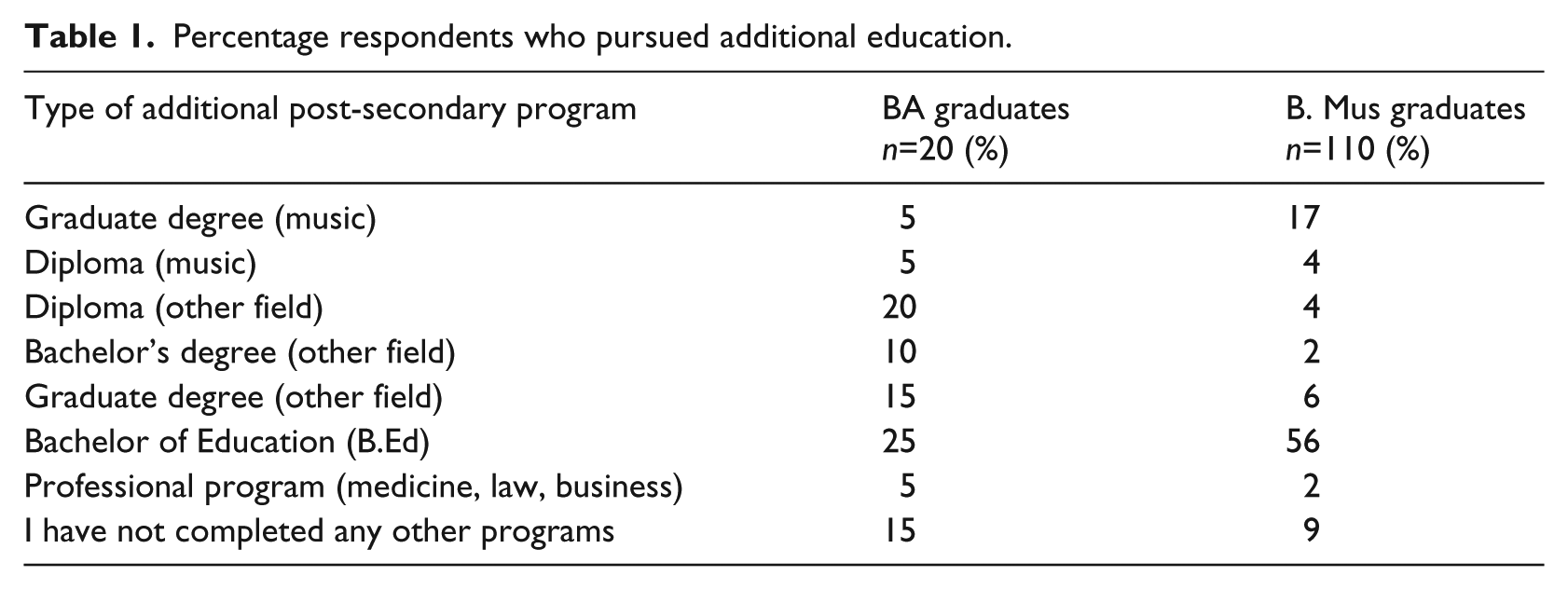
Most of the participants pursued additional post-secondary education (see Table 1). A higher percentage of BMus graduates pursued additional education in Music while a higher proportion of BA graduates pursued additional education outside of music. Most of the respondents (BA and BMus) earned a Bachelor of Education, which is a required degree to receive a license to teach in publically funded schools. This finding indicates that many students seek additional education after completing their music degree.
Percentage respondents who pursued additional education.
Motivation to study music at university
Interest in pursuing work in music was one motivator for pursuing a post-secondary music program. Some 70% of BA respondents and 83% of BMus respondents agreed or strongly agreed with the statement that they enrolled in a music program because they wanted to pursue work in music, while most of the respondents in both programs agreed or strongly agreed that they studied music because they wanted to keep music in their lives or they wanted to learn more about music. While these findings are based on retrospective perceptions of these recent graduates, it nevertheless indicates that there may be multiple reasons for pursuing a post-secondary program which include wanting to explore the subject area as well as hoping to pursue work in the field. The high percentage of BA respondents who were interested in pursuing work in the field suggests that learning more about music might also involve the desire to develop skills that would allow one to pursue work in the area.
The interview data expanded on this idea to gain a better understanding of some of the reasons for pursuing a music program. In particular, one interviewee talked about choosing a post-secondary program that would be challenging.
I’m always looking for the most challenging option, which I think might be relatively unusual, especially for people maybe starting in a music program. At the end of high school everybody said, oh you’re going into science or [you are] going into math or [you are] going into history right? Tell me you are and I said, no I’m going into music. And they said why? Music is the most challenging thing that I’ve ever tried to do. (Interviewee Graduate Student in Business)
Arguably some of our respondents chose to study music because they did not know what else to study. As one interviewee explained, When I look back on the high school version of me. I [was not] really too good at a lot of things … I was good in my music classes and that was fine. And I did a lot of languages and I did all the sciences actually but … I was terrible at math and I loved reading but not reading on demand, so English wasn’t an option (laughs). (Interviewee Merchandiser)
One recurring theme in the open-ended responses was advice from alumni to others, encouraging them to set plans for their futures before entering the program. As one person stated “[do not] go into music because you liked music in high school and didn’t know what else to do. Take a few years off and get your head around your future so you [do not] waste so much time and money on a music degree – unless you truly believe that you can be a professional musician/teacher.” This comment, and others like it reveal a tacit assumption that a post-secondary degree should lead to work in a given field. This assumption also seemed bounded to working only as either a performer or a teacher.
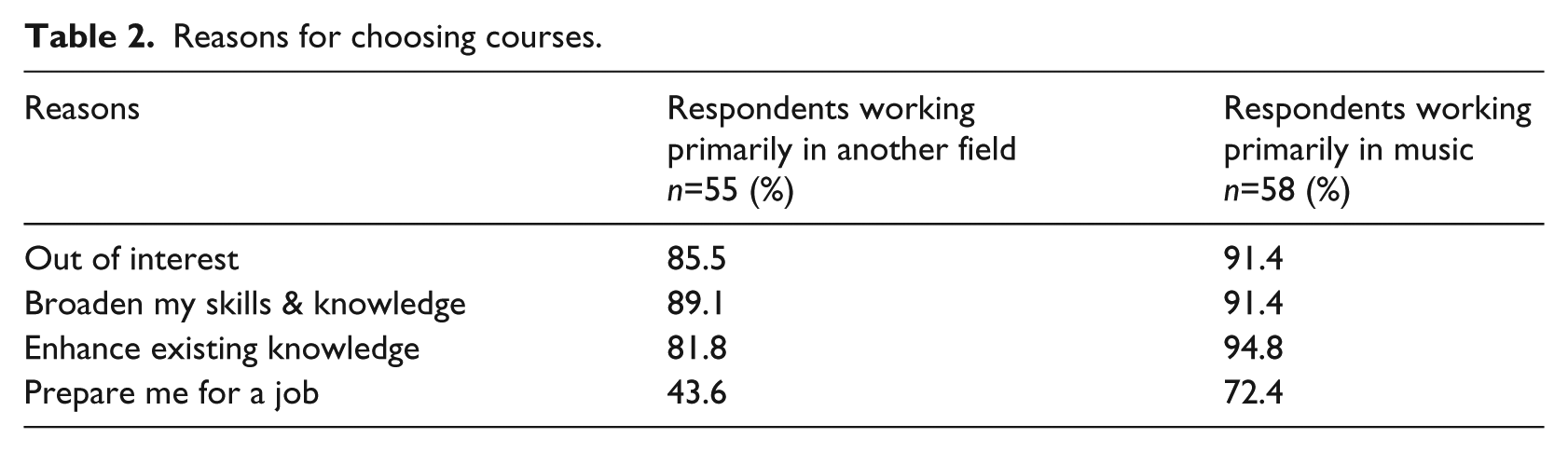
The pattern of responses by those who were employed primarly in and outside of music (over 80%) indicated a tendency to have selected their courses out of interest, to broaden their skills and knowledge (learn different things such as to play a new instruments, or about different genres or styles) or enhance existing skills and knowledge (learn more skills or knowledge that you have had). Additionally, 72.4% reported that they also chose those courses to prepare them for employment. Only 43.6% of those currently working primarily outside of music indicated that they chose courses to prepare them for a job (see Table 2).
Reasons for choosing courses.
Respondents who had a clear idea of a music-related role seemed able to leverage their degree program to support this goal. Those who did not have this type of clarity at the outset of their program reported being less likely to find employment at the end of the program. One question that arose was whether students were even aware of the true scope of possible employment options in the creative industries. This theme emerged from our open-ended comments as one respondent noted in the survey “I would have liked to learn about potential career options other than teaching and performing (arts administration, orchestral management, etc.)” (open-ended comment).
The ability to identify a particular role seemed to be a predictor of working in the field after graduation. One reason for this could be that the program components did not reflect the breadth of roles that were available for those with a music background, and that few formalized opportunities to learn about those roles were provided to help the students translate their desire to keep music in their life with pursuing work in the field. As one person noted in the open-ended comments: “I was given no tools to succeed outside of the school environment. While I enjoyed the music history/theory courses, there was a huge hole in the curriculum and faculty” (open-ended comment). There was a lot of flexibility in both the BMus and BA degree programs, but participants indicated a need for more guidance in how to transfer the knowledge and skills learned in their theory, musicology/ethnomusicology, and applied lessons to the professional world.
University experience: musical skills learned through program
The music program aimed to provide students with balanced study of music theory, history, performance, and education as seen by the lack of streaming (e.g., Performance, Education, or Musicology). The lack of streaming provided students with a balanced curriculum through which to develop a variety of musics and repertoire, an ability to play a variety of genres, love of music, and ability to navigate the world of music (Table 3).
Overall knowledge and skills learned through music program.
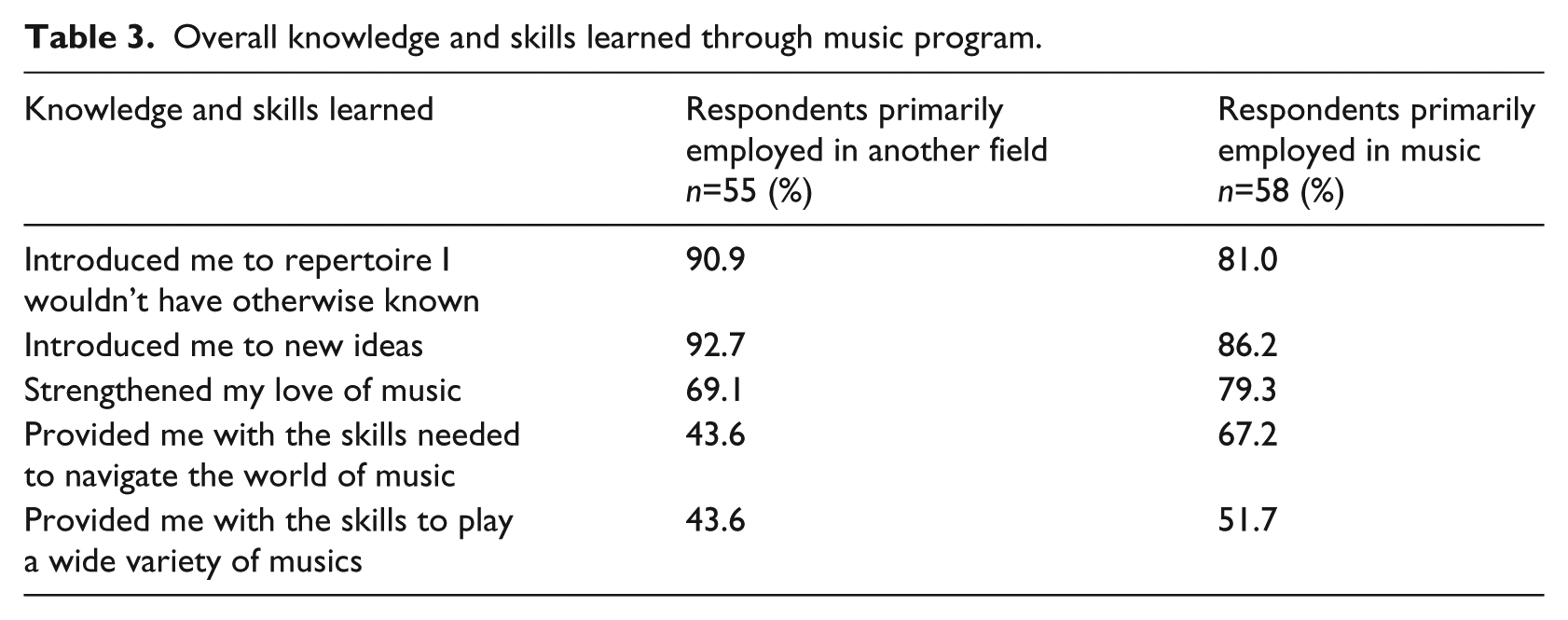
Respondents who held employment primarily outside of the field of music were more likely to agree or strongly agree that they learned more about repertoire and that their degree introduced them to new ideas. They were less likely than those employed in Music to agree or strongly agree that they learned how to play a wide variety of musics, thus suggesting that while their understanding of different musics was broadened, their ability to create music within these genres was not enhanced.
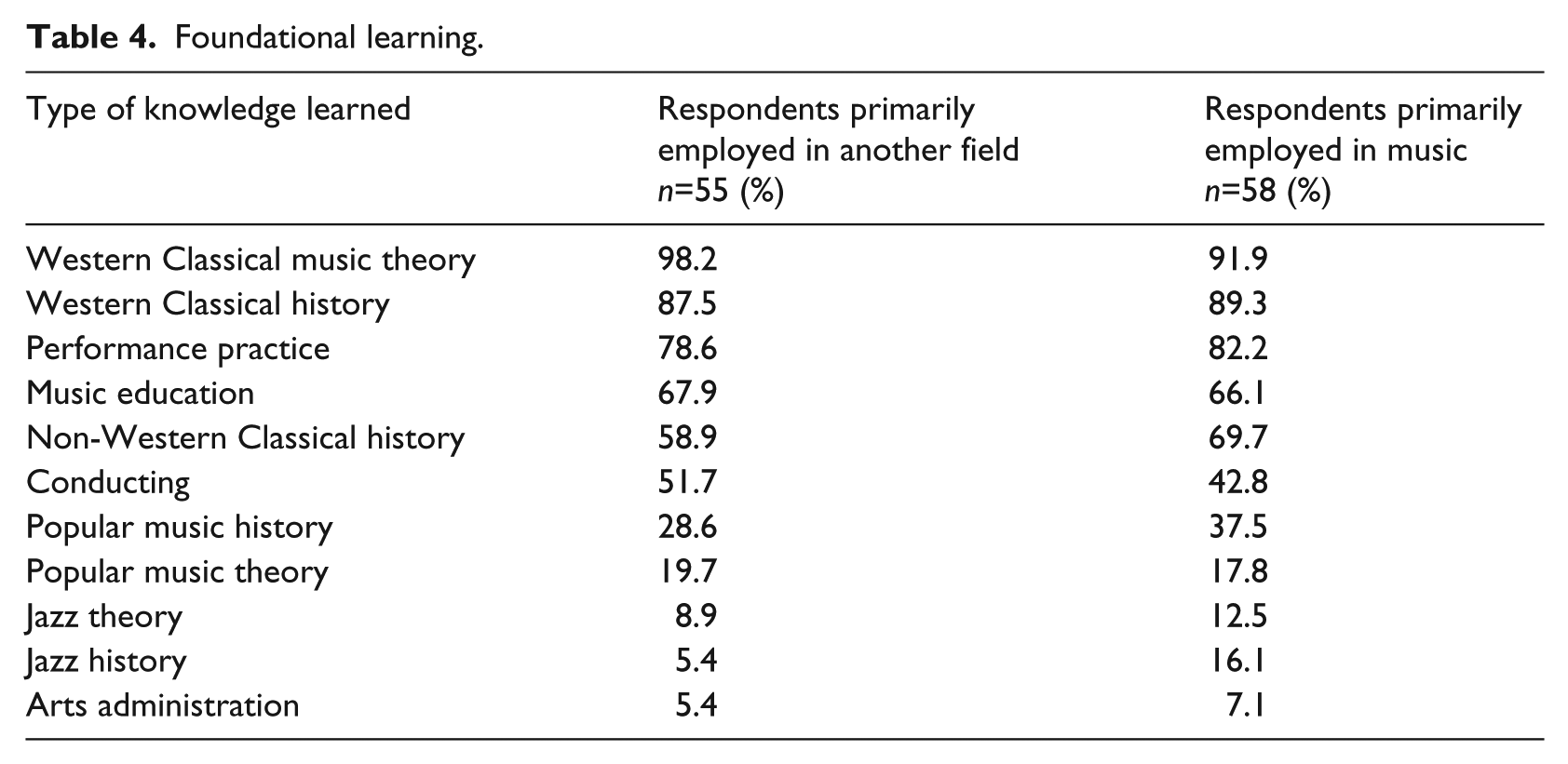
Table 4 documents the specific types of foundational learning that respondents felt they gained through their university program. There was an almost unanimous acknowledgment that their knowledge of Western Classical history and theory was enhanced, though very few felt they gained foundational knowledge related to other genres of music, music education, or arts administration. The limited exposure to other genres was noted in the open-ended comments: “I wish there was a wider range of musical styles included in the required courses. There were a few Jazz courses, but there could have been more, and very few popular music courses or ethnomusicology courses. The ones that were available were wonderful, but it would have been nice to have more of them” (open-ended comment). This program was largely devoted to Western Classical music and respondents indicated that explicit instruction on ways to use and transfer the skills and knowledge was lacking, as were opportunities to experience other types of genres. These findings align with other research (e.g., Bennett, 2007, 2016; Bennett & Bridgstock, 2015; Myers et al., 2014) and provide further evidence of the imminent need to supplement post-secondary music curricula in ways that might better enable graduates to conceive of, and be successful in, the ever-evolving world of music.
Foundational learning.
Current roles
Many of our respondents reported a combination of music and non-music employment. At the time of the survey, 50.4% of our respondents indicated that they worked primarily in the field of music while 49.6% reported working primarily outside the field. Some 25% of respondents indicated that they worked only in music and another 20% indicated that they did not work at all in the field.
Musical roles held by those working primarily in music
All of the musical roles in which the respondents engaged, paid or unpaid (see Table 5), were categorized according to those described by Statistics Canada (2011) and created additional categories for the cultural industries. Additional categories were created for roles not clearly linked to a specific culture industry (e.g., music therapist, theorist, musicologist/ethnomusicologist). Those who worked primarily within the field of music typically held teaching positions and/or performance roles. Over half (56.9%) indicated that they worked as K–12 teachers and/or as studio music teachers. Some 36% of respondents indicated that they performed as soloists and slightly fewer performed in small or large ensembles (32.7% and 31.0%, respectively). A comparison of the number of respondents working in these domains, with the size of the domains as outlined by Statistics Canada, indicated that fewer alumni were working in some of the larger domains such as Film and Video, Broadcasting and Interactive Media, Sound Recording, or even Governance, funding, and professional support. While the open-ended comments and interview data often mentioned the need for more education in arts administration, there was no mention of a need for more courses in policy, sound recording or skills to support development in interactive media. The lack of alumni working in these seemingly large domains, along with the previously presented findings that many respondents simply may not have known what types of work were available to them beyond teaching and performance, suggests that many respondents were simply unaware of the scope of possibilities that are available to those with a music background. While there were composition courses offered, there were no digital media courses available at this time.
Roles (paid or unpaid) held by respondents primarily employed in music.
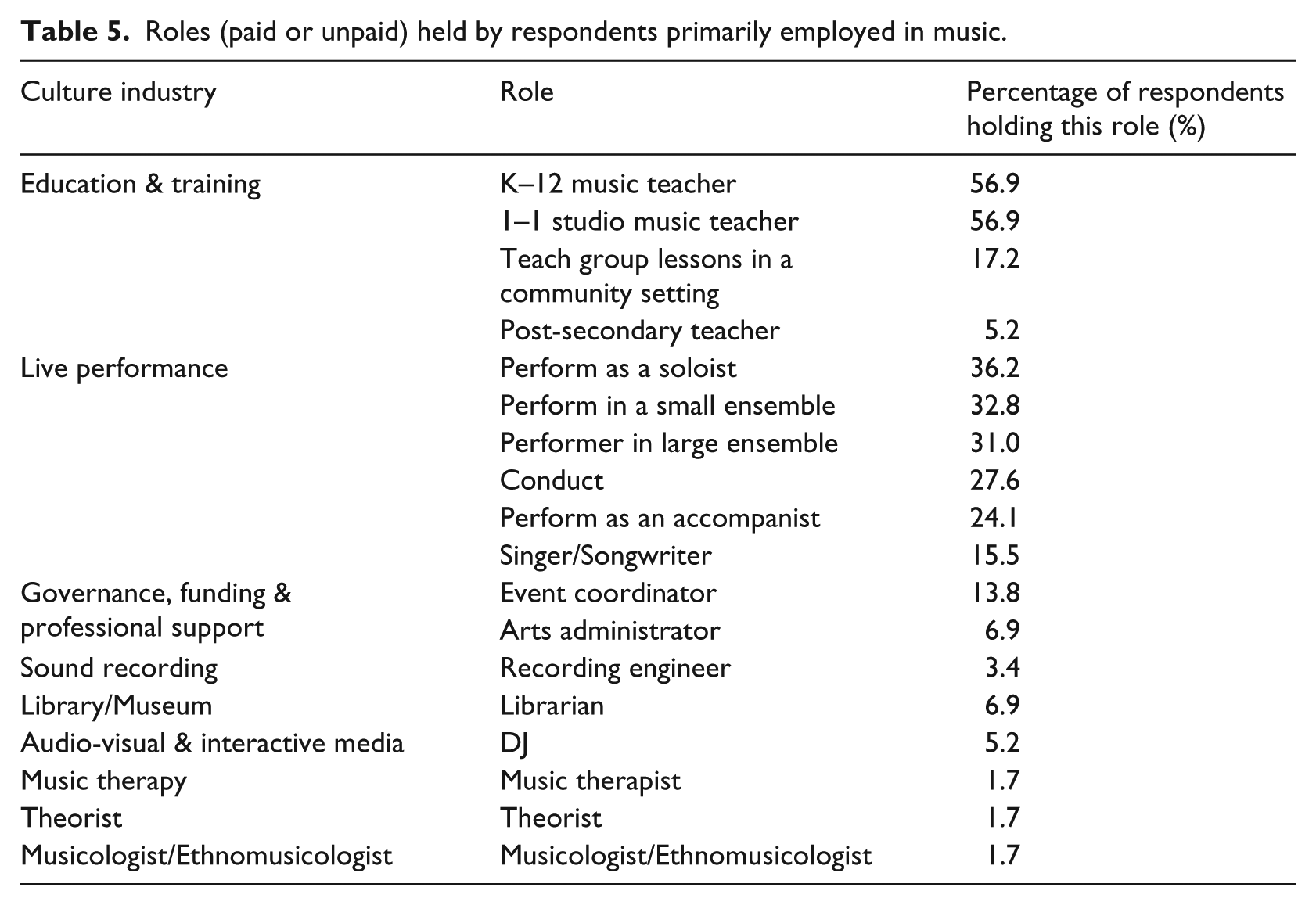
Many respondents could be considered portfolio-based musicians (e.g., Bennett, 2007, 2009, 2016; Bennett & Bridgstock, 2015). While 39% of those primarily in music held only one position, the rest of this group held up to 10 different music-related roles. An example of the types of roles held by alumni is described in one opened-response: “I freelance and teach privately, had a principal cello job in an orchestra, play chamber music and other interesting projects. I make a good living!” (open-ended comments). This example highlights the ways that graduates are using their musical skills to establish a portfolio of activities.
For those who worked as teachers in the public school system, many were teaching music as well as another subject. The combination of teaching music and other subject areas was often a function of course availability. This finding aligns with other literature that documents the decreasing presence of specialist music teachers, and music programs, in schools (e.g., Hill Strategies, 2010; People for Education, 2017). Some open-ended responses cautioned against pursuing work in music education: “Try to encourage students to look for jobs in music outside of teaching … finding a job is increasingly difficult” (open-ended comment). As one interviewee recounted, he was originally hired to teach English (the second area in which he is qualified to teach), and over time, convinced the principal to begin a music program.
[I was] teaching three English classes every semester for the most part [at an online high school]. The more I got thinking about it, the school. .. we think of ourselves as an actual school, students register, we run the semester system, and the arts offering for the [school] was a grade 11 media arts course, a grade 10 media arts course and a grade 11 media arts course and that was it. And I was thinking, if I was in a bricks and mortar school teaching English where there was no arts opportunity, I would find that totally unacceptable. So I went to the principal and I said, I’d like to start a music program and he said, “Great, do it.” [laughs]. So now, I have one section short of full-time work and I have one section of English each semester and I have two music sections in the Fall and one in the Winter the term. (Interviewee secondary music teacher)
In summary, the respondents working primarily in music most often reported working as teachers and/or performers. Many of these respondents were establishing portfolio-based roles where they engaged in multiple teaching and performance opportunities. Even with the teaching profession, alumni often have to think creatively to fashion their own opportunities for music.
Roles held by those who work primarily outside of music
Respondents working primarily outside of music held a wide variety of jobs. While 50.6% of respondents in this group indicated that they worked in Education (non-music), the remainder held work in retail, administration and construction, among other endeavors (see Table 6).
Types of roles held by those working primarily outside of music.
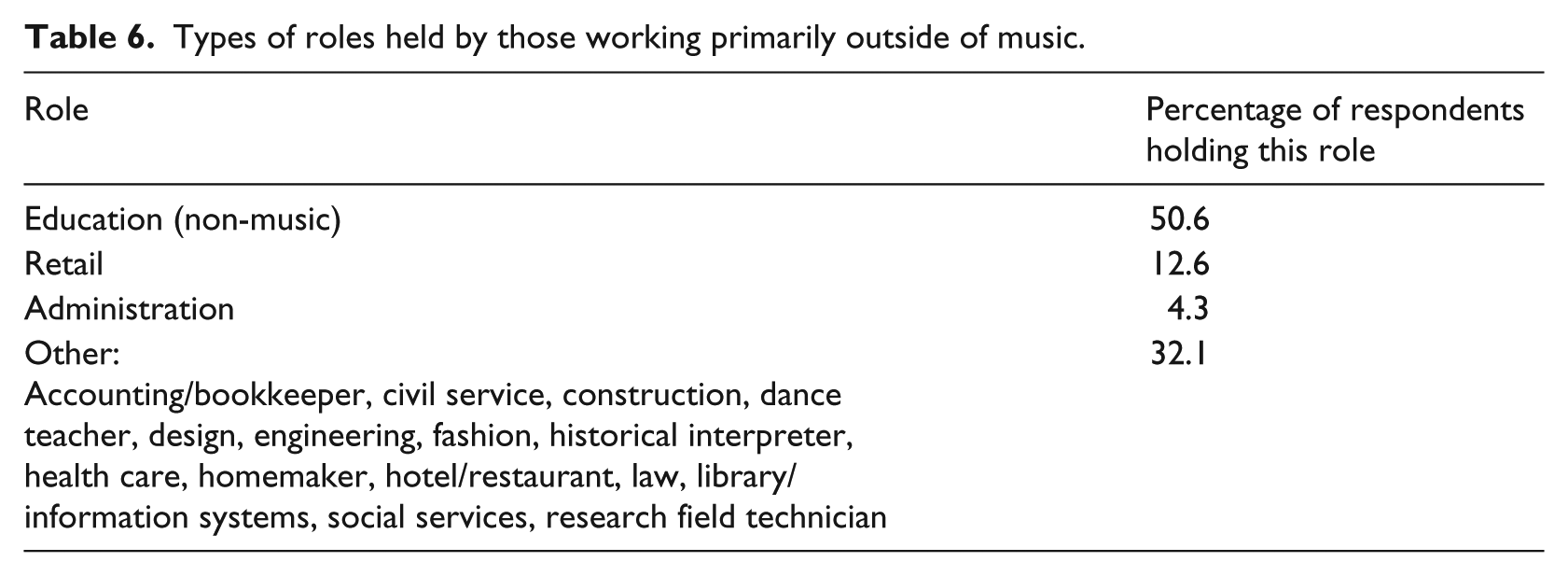
This highly diverse list of employment illustrates the variety of opportunities that alumni were able to find. Participants were asked why they chose to work in another field and responses were varied including attempts to find a passion outside of music. As one person noted: “The experience as a whole was good – I don’t regret it – I just realized that my real passion [does not] lie in the field of music, so I decided to pursue work and education in another field” (open-ended response). Some noted how their undergraduate experiences supported their success in these other fields and also made them realize that music was not the passion that they thought it was. As one person noted, [A] music degree can open the door to many different types of careers. I myself transferred to a career in law. There were many times where I was put down by others – people assumed that music was an easy degree that was not worth anything. In reality, I learned so much from completing a degree in music that I otherwise would not have learned – collaboration, time management, creativity, etc. The skills I learned in my undergraduate degree helped to prepare me for my current career path better than a variety of other programs would have. (open-ended response)
Similarly, results of both the interviews and the survey indicated that those who worked outside of music were able to incorporated music in their present roles and that they still engaged in a portfolio-based career. A comment from the open-ended survey questions illustrates: “I completed a college course in Recreation and Leisure with the intent of being employed in a nursing or long-term care home upon graduation. I frequently combine both my music degree and recreation diploma at work. I perform for the residents, conduct a handbell choir, and do various other music appreciation programs. I also teach private lessons.”
Further, the interviewee who worked in IT spoke of how he used knowledge gained through studying electroacoustic composition as he produced video content for online learning modules: “the videos that we’ve been making, there are a few little ones … like we did an Excel tutorial and … an information literacy module that we’re making. For both of those, the videos felt like they were missing something, so I made jingles for both of them” (IT Interviewee).
The aforementioned examples illustrate the ways that alumni are able to transfer the collaboration, creativity, and time management skills, as well as their musical skills, in their non-music roles. In short, the knowledge and skills gained through the music program were seen to be applicable in a variety of contexts outside of the culture industries.
Discussion and conclusions
Findings from this study reveal the many different roles that music alumni assume. Respondents’ employment fell into one of four categories: (a) exclusively outside of music; (b) primarily in a non-music role with some music; (c) primarily music roles and some non-music roles; (d) and roles exclusively in music. Within the scope of music-based roles respondents typically held a combination of performance and teaching roles, but very few were engaged in other sectors in Canada’s culture industries such as audio-visual and interactive media, sound recording, government funding, and professional support (Statistics Canada, 2011). These findings illuminate the need for higher education programs to provide opportunities for students to have a comprehensive understanding of the roles and salient skills needed to work across the cultural industries beyond roles in education and performance.
Very little knowledge about the cultural industries was reported to be provided during the program and respondents were not aware of what they did not know. For example, interviewees had decided to pursue music, but were unsure of what post-graduation possibilities might be available to them. This finding supports the recommendation from the College Music Society, and other research studies (e.g., Bennett, 2016; Comunian et al., 2011) that call for more career preview and for music programs to better reflect the current and emerging trends in the cultural industries. This knowledge goes beyond being able to play a variety of genres. There is a need to develop skills that can be applied in the music-related cultural domains beyond live performance and education (e.g., Governance, Sound Recording, Library/Museum, Audio-Visual/Interactive Media). These skills can not only be developed through new courses or embedded in existing courses through innovative assignments (e.g., opportunities to link music culture to salient arts policy; creating multi-media performances).
In addition, findings from this research highlight that musicians often hold portfolio-based employment in that respondents have a variety of roles. This finding is consistent with findings from previous research (e.g., Bennett, 2007, 2016; Bennett & Bridgstock, 2015). The fact that many respondents held multiple roles indicates that alumni could establish a portfolio-based career, but their skills seemed to emerge by necessity and were not reported to be explicitly taught in their undergraduate program. Many reported that they did not receive adequate support in their music programs to enable successful navigation in the field of music. Despite that, some respondents did report success in their ability to transfer the skills in collaboration, creative thinking, and time management gained through the Music program in their current non-music contexts.
The incorporation of music skills in non-music roles reveals the multiplicity of ways in which music can be embedded in a variety of roles, leading us to better identify the broad range of opportunities that may be available to Music grads. Post-secondary programs might now be constructed in ways that specifically develop this type of disciplinary transfer.
This research underscores the myriad opportunities available for those with musical knowledge and skills, and offers a counter-narrative to the often-held belief that a music degree will not lead to employment. The findings do illuminate how those who do secure work in this field had a clear idea of their employment goals when they entered their program of study and were able to establish portfolio-based careers upon completion. While the content of the music program aimed to be well-rounded, our results suggest that consideration be given to the ways in which curriculum might better be constructed to support development of the types of knowledge and skills required to navigate, contribute, and innovate during the early stages of graduates’ careers, including offering a variety of courses that are reflective of roles across the cultural industries.
This research study contributes to the emerging body of literature that examines the transition to employment of music alumni. More research is needed that examines this transition from a variety of post-secondary programs. Roles within the cultural industries have grown in a variety of ways independent of post-secondary training and more research is needed to gain a deep understanding of the knowledge and skills that are required for these roles in order to better support the alignment between post-secondary programming and the cultural industries.
Supplemental Material
Survey_and_Intervew_Questions – Supplemental material for Exploring post-degree employment of recent music alumni
Supplemental material, Survey_and_Intervew_Questions for Exploring post-degree employment of recent music alumni by Julia Brook and Sue Fostaty Young in International Journal of Music Education
Footnotes
Funding
This research was generously funded by the Consortium of Music Education (representing the Canadian Music Educators Association and the Coalition for Music Education).
Supplemental material
Supplemental material for this article is available online.
References
Supplementary Material
Please find the following supplemental material available below.
For Open Access articles published under a Creative Commons License, all supplemental material carries the same license as the article it is associated with.
For non-Open Access articles published, all supplemental material carries a non-exclusive license, and permission requests for re-use of supplemental material or any part of supplemental material shall be sent directly to the copyright owner as specified in the copyright notice associated with the article.
