







Abstract
The purpose of this study was to examine the culture of an American middle school music technology classroom based in musical composition. Research questions explored students’ perceptions of how they co-create the classroom culture with the teacher and how the classroom culture influences participation in musical composition activities, if at all. Data sources for this ethnographic case study included field notes from multiple class observations, audio- and video-recordings, and semi-structured interviews. Findings determined that teacher and students’ mutual use of constructive feedback in their discourse, the teacher’s role as co-learner, his facilitation of “messiness” as part of the learning process, and his pedagogical style helped to create an affirming classroom culture that motivated students to compose. Implications for teaching practice include critical examination of classroom cultures and thoughtful inclusion of technology in music education courses.
Introduction
Within a formal schooling environment, students must learn not only concepts belonging to explicitly defined areas of knowledge, but also classroom routines, appropriate forms of classroom participation, and acceptable interactions with peers and the teacher (Collins & Green, 1992). Assimilating these behaviors leads to the creation of a classroom culture, defined as “the common and patterned practices of classroom members” shaped by the values and ideas that reflect the societal norms and mores of a community (Cavanagh & Dellar, 2003; Prentiss, 1998). Each classroom culture is unique due to the expectations and suppositions that students bring to new learning contexts based on their unique lived experiences (Collins & Green, 1992; Prentiss, 1998) and knowledge constructed via processes of social constructivism (Cavanagh & Romanoski, 2008). The teacher, a key member of the class, also brings beliefs grounded in previous professional and personal experiences, such as relationships with colleagues, students, and role models, that can strongly influence classroom events (Fairbanks & Broughton, 2003; Sturtevant, 1996).
Examination of the influences of classroom culture within music education spaces can provide implications that enhance music teaching and learning. While researchers have studied classroom culture in music education (Shouldice, 2019; Woodward, 2013) and provided suggestions for how to create a classroom environment conducive for creative practices, such as composition, improvisation, and arranging (Burnard, Boyack, & Howell, 2013; King, 2012; Lapidaki, de Groot, & Stagkos, 2012; Odena, 2012; Ruthmann, 2012; Ruthmann & Dillon, 2012), a study that explores the classroom culture of a pre-collegiate music class based in creativity practices could assist educators with supporting and encouraging students’ participation in activities that enhance their musical understanding, engage them in musical creative thinking, and help them express their personal identities (Hickey, 2012; Randles & Smith, 2012).
Review of literature
Construction of classroom culture
Echoing constructivist and symbolic interactionist principles (Blumer, 1969; Vygotsky, 1962), Geertz (1983) argued that culture and meanings within cultures are defined in and through people’s interactions, including discourse and actions among them. Collins and Green (1992) suggested that classroom culture is constructed partially through interactions between the teacher and students, and they identified three integral elements of classroom culture: the roles and relationships of students and teacher that determine appropriate and acceptable interactions, the rights and obligations of classroom membership, and the norms and expectations for behavior (e.g., how to interact, how to use time, how to use equipment or materials). Furthermore, Collins and Green found that class routines help students learn how to become class members and that teachers’ practices bring order to classroom life and define the nature of classroom membership and participation.
In his study on literacy learning in nine elementary and middle school classrooms, Gutierrez (1994) found that classroom discourse and interactions were the primary means by which teachers and students constructed a classroom culture. Similarly, in her examination of classroom culture and literacy, Prentiss (1998) emphasized the fluid nature of classroom interactions and students’ responses to the literacy curriculum while acknowledging that patterns of interaction developed over time and took on social meanings for participants. While these researchers have suggested that students have a role in the creation of classroom culture, they did not describe students’ perceptions as to how their actions help to co-create that culture.
Teacher’s influence
In their study of literacy learning in sixth-grade classrooms, Fairbanks and Broughton (2003) argued that the teacher plays a critical role in shaping the development of the classroom culture. The teacher plans the curriculum, develops the organization for classroom structures, establishes rules and expectations, and facilitates student learning. Like the students, teachers bring to the classroom their experiences, both personal and professional, which shape their beliefs about what is appropriate or effective. Sturtevant (1996) also suggested that the beliefs of teachers “can strongly influence classroom events and ultimately student learning” (p. 252). Clandinin (1986), a narrative inquiry scholar, found that these beliefs evolve through narratives of practice—the stories and experiences by which teachers make sense of their experiences. These findings underscore the importance of the role of the teacher in the creation of classroom culture.
Classroom culture, creativity, and music education
Within the field of music education, researchers in elementary general and collegiate settings have studied how teachers seek to co-create positive and nurturing classroom cultures. Shouldice (2019), in an ethnographic case study, explored the beliefs of one elementary music teacher, “Deena,” about the nature of musical ability and the ways in which these beliefs relate to actions and lived experiences in her classroom, including the teacher’s interactions with students and the classroom culture she created. Deena believed that students’ musical success depended on building a positive classroom environment and her practice of establishing a space in which students feel safe, supported, and empowered. Using ethnographic techniques, Woodward (2013) examined the role of classroom culture within a university improvisation-based course consisting of non-music majors and the instructor/creator. Focusing on regularly recurring classroom improvisational activities, student behaviors, teacher practices, and socially constructed meanings of musicianship in the classroom, students felt that being a musician in the class included taking risks during improvisational activities, expressing one’s feelings through music, and recognizing the musician in others.
Music education researchers have discussed classroom environments that are conducive for creativity (Fautley & Savage, 2007; Odena, 2012; Odena, Plummeridge, & Welch, 2005), including physical climate (resources and layout of the room), intellectual climate (appropriate level of challenge), and emotional climate (feeling safe to take risks without fear of failure). In addition, teacher and peer-to-peer criticism and feedback processes help to challenge students’ musical beliefs and ideas during creative endeavors (Burnard et al., 2013; Lapidaki et al., 2012; Ruthmann, 2012). Teachers sharing their own creative works also can challenge students’ conceptions of creativity (Burnard et al., 2013) and help facilitate the creation of a collaborative environment (King, 2012). Examining the classroom culture of a pre-collegiate course based in creative musical endeavors that fosters positive interactions could assist educators with supporting and encouraging creativity in the music classroom (for the purpose of this study, defined as the generation of musical ideas and resultant musical products derived, refined, and evaluated through social interactions within a bounded social context), thus enhancing their music education experiences.
The purpose of the present study was to examine the culture of an American middle school music technology classroom based in musical composition. Research questions that arose from the author’s ethnographic observations of the classroom were as follows:
What are students’ perceptions of how they co-create the classroom culture with the teacher?
What are students’ perceptions, if any, of how the classroom culture influences participation in musical composition activities, if at all?
Method
Study design
Ethnography, a methodological approach that analyzes and helps one understand a particular culture (Creswell & Poth, 2018), is useful in providing unique insight into classroom practices as its focus is on the natural flow of events in a context (Merriam & Tisdell, 2016; Popkewitz & Wehlage, 1977; Tabachnick, 1981). A case study design is suitable for examining a phenomenon of interest in the bounded system that is a classroom (Merriam & Tisdell, 2016). The author employed an ethnographic case study design (Atkinson & Hammersley, 1998; Krueger, 1987; Merriam & Tisdell, 2016; Spindler & Spindler, 1992), as it is useful for understanding influences of culture in a classroom. This methodology blends these two approaches and includes observations and interviews to discover students’ cultural knowledge, how that knowledge is employed in social interactions, and the consequences of its employment (Spindler & Spindler, 1992). In addition, this methodology employs an ethnographic tradition in which the researcher studies a community or cultural unit from within by being part of the community, with multiple sources of data produced through multiple actions, such as note taking, observing, interviewing, and listening (Geertz, 1973).
Descriptions of class and study procedure
A music technology class in which students manipulate musical concepts taught principally through a technological medium (e.g., software programs on laptops, desktops, or mobile devices) served as the site for this study. Music technology offers a learning experience in which all students can participate, regardless of prior musical education or experience (Dammers, 2010). The author became aware of the possibilities of teaching music via technology through his partner, Gerard Iceman, 1 who taught a music technology class in a middle school (approximate ages of students is 12–15) situated in the Northeastern region of the United States. At the time of data collection, he had been teaching for 9 years, 6 of which were at the school. Daily conversations included discussions of class projects, advances in student learning, and vignettes that provided snapshots of the culture of a particular semester’s class. In addition, he shared that every class had a population of students with a wide range of musical backgrounds. The author was intrigued and sought to learn more about how student learning can occur in a music technology class by observing Gerard’s class directly. Furthermore, the author’s “insider” status in our geographical region earned by frequent freelance performances and serving on multiple music education executive boards gave him extensive knowledge of music education electives offered in area schools. To his knowledge, which was confirmed by area K-12 music educators, K-12 arts administrators, and music teacher educators, no school district offered the type of composition-based music technology class that Gerard was teaching.
The author observed Gerard’s 20-week music technology class that comprised 20 eighth-grade students (13–15 years of age), for eleven 45-min class observations. Data sources included field notes (Emerson, Fretz, & Shaw, 2011) from the class observations, audio- and video-recordings of each class, and one semi-structured interview (Patton, 2015) with each of the four students. Topics for the interview questions included students’ interests in taking the class, their interpretation of the classroom culture, how the culture is created and influenced, and how the culture might, in turn, influence their actions within the classroom. These same students also participated in a focus group discussion (Morgan, 1997) that consisted of follow-up questions regarding themes that arose from students’ individual interviews. All student interviews and the focus group discussion lasted approximately 30 min.
In addition, the author interviewed Gerard twice in semi-structured interviews to gain insight into his ideas behind and the process of creating the course, components of the course curriculum, structure and sequence of the course, devices used in the course, and the use of technology in music education. Both interviews with Gerard lasted approximately 1 hr.
At the time of observation, Gerard used a flipped classroom (Mok, 2014) model of instruction for his music technology class. In addition to teaching through the flipped classroom model, the author observed Gerard presenting a lecture about the musical concept being studied at the beginning of several classes. In addition, the author observed two projects during data collection: composing film scores to a silent Charlie Chaplin film using Mixcraft loaded onto HP (formerly known as Hewlett-Packard) laptops and composing a ring tone for their cell phone using Soundation. Other projects throughout the school year included composing in different forms (AABA, rondo), creating melodies with the built-in virtual piano, creating podcasts, and scoring for video games.
The school assigned a Chromebook (a “netbook” similar to a laptop, but without a hard drive, that utilizes Google Chrome OS as its operating system and primarily uses cloud-based applications) as part of its “one to one” (one device to one student) technology initiative to allow access to the Internet and “cloud-based” applications both in and outside of school, and students brought their Chromebooks to the music technology class. Students worked with Mixcraft (a digital audio workstation software program pre-loaded with loops and ability to record sounds, similar to Apple’s GarageBand) and Soundation (a cloud-based digital audio workstation software program used to create sound loops and compositions) throughout the course.
Participants
Students in the class had a wide variety of musical experiences. Before the class, some students had no formal experiences with music other than elementary general music. Some students had no formal experiences with music at all. Others had been playing guitar outside of school, composing music using GarageBand, and participating in the school band and/or chorus.
The author employed maximum variation sampling (Patton, 2015) to select four students to inform his observations, as common themes and patterns that emerge from a markedly heterogeneous sample are of particular interest to note in the attempt to understand a phenomenon. He sought to identify both male and female participants, as well as participants with a variety of musical experiences, ranging from no prior formal musical experiences to current participation in formal and informal musical experiences. In addition, the author asked Gerard for suggestions of thoughtful students who could speak articulately and for students who could provide disconfirming evidence from the evidence provided by his own observations, as he was concerned about the human cognitive bias toward confirmation (Mahoney, 1991). Therefore, he also sought disconfirming evidence that would run counter to primary themes as this would help to achieve rigor (Erickson, 1986). According to Patton (2002), Confirmatory cases are additional examples that fit already emergent patterns; these cases confirm and elaborate the findings, adding richness, depth, and credibility. Disconfirming cases are no less important. These are the examples that don’t fit. They are a source of rival interpretations as well as a way of placing boundaries around confirmed findings. They may be “exceptions that prove the rule” or exceptions that disconfirm and alter what appeared to be primary patterns. (p. 239)
At the time of data collection, Jeffrey played trumpet in the school’s concert band, sang in the school’s choir, performed in musicals, and played piano in the school’s jazz ensemble. Adam played guitar in a student-led ensemble based outside of school. Lisa did not participate in any other formal or informal music experiences inside or outside of school. Jennifer played electric bass in the school’s concert band and jazz ensemble. Gerard was not “out” to his students; therefore, the author was introduced to the class as a “music education researcher” and was not identified as his partner at any point during the study.
Ethics
The author adhered to the American Psychological Association’s (2010) Ethical Principles of Psychologists and Code of Conduct throughout the data collection process and received approval from his university’s Human Research Protection Programs Social Science Institutional Review Board (IRB), the school district’s administration, as well as assent from students and consent from parents/guardians.
Data analysis
Following multiple readings of interview/focus group and video/audio-recording transcripts, the author used Descriptive Coding procedures (Miles & Huberman, 1994) to create an inventory of codes, after which he employed Focused Coding (Charmaz, 2006) to develop themes: teacher’s pedagogical style/technique, interactions and discourse, learning as “messiness,” and student/teacher as co-learners. He also kept a separate codebook with emerging codes and wrote analytic memos for reflection purposes (Saldaña, 2016). In addition, the author evaluated data for substantive significance (Patton, 2015), including determining the extent to which the findings increase and deepen understanding of the phenomenon and are consistent or inconsistent with the extant literature.
Trustworthiness
The author sought data collection triangulation (Merriam & Tisdell, 2016) through field notes, audio- and video-recordings, interviews with multiple students, and a student focus group discussion. Each participant member-checked his or her interview transcript for accuracy (Creswell & Poth, 2018; Lincoln & Guba, 1985; Merriam & Tisdell, 2016; Miles & Huberman, 1994). Student participants made no changes to their respective interview transcripts. Gerard made minor editorial changes (elimination of verbal ticks and word substitutions), but the main ideas of all altered sections remained unchanged. The author also engaged in a peer audit with music education colleagues to strengthen his analysis and reporting (Creswell & Miller, 2000; Lincoln & Guba, 1985; Merriam & Tisdell, 2016; Patton, 2015).
Findings and interpretation
Co-creation of the classroom culture
Students had varying opinions as to the extent of teacher and student involvement in the co-creation of the classroom culture. Jeffrey, an active vocalist and instrumentalist at school, thought that Gerard had a minor role in its creation: There are more of us and we’re the ones who are composing. I think . . . Mr. Iceman is super helpful and he’s the teacher, but because of all the things that we [students] do together, I think we’re [with emphasis] the ones who really make this class what it is. (Student interview)
Although Jeffrey was complimentary of Gerard’s actions to help create the classroom culture, he viewed the teacher’s role in classroom culture creation as subservient to the actions of the students. He believed that the creation of the culture should really be attributed to the students as they comprise the majority of members and continually collaborate.
However, Jeffrey did note that some of Gerard’s pedagogical techniques were influential in the creation of the classroom culture: “If you have an interesting idea, Mr. Iceman will let you go with that. He has us share things that we learn, like keyboard commands. It helps to make a very open-minded, cooperative atmosphere” (student interview). For Jeffrey, letting students develop their original ideas and having them share items of mutual interest (e.g., keyboard “shortcut commands” for applications) assisted with the creation of a classroom culture that facilitated cooperation and creativity.
Other students, such as Lisa, noted in their interviews that Gerard’s influence in the creation of the classroom culture was more pronounced: Mr. Iceman, he definitely leaves a lot of room for our ideas to show in our work. He lets us come up with a lot of things. I think how he teaches and lets us just work with each other—helping each other. There’s a lot of really, really cool ideas in the class because of the culture and how he lets us be. (Student interview)
Lisa thought that Gerard’s pedagogical techniques—in this instance, his use of space and proximity (individual or small group time devoid of direct, whole class teacher instruction)—helped to create a culture that gave her “room” during class to create, explore, and refine ideas for her compositions.
Students also had varying opinions as to the effectiveness and tone of Gerard’s feedback, which he employed when students were working on compositions: Jennifer: He gives the kids helpful advice and gets you to add more in different ways. (Student interview) Adam: He helps us very much. I would say, “Hey, Mr. Iceman, can you listen to my piece?” He would say, “Yeah.” He listens to my piece and would say that it’s good, then give me some helpful advice. (Focus group discussion)
Jennifer and Adam thought that Gerard’s praise and suggestions helped them build and expand upon the foundation of their compositions. Lisa, however, thought differently: Sometimes it seems that Mr. Iceman is in a bad mood, and when I show him my song, I think he’s thinking, “Oh, he’s upset with my work, so I have to improve on it. He doesn’t like this.” So, I go and change it when he may not actually be thinking that I should. (Student interview)
She believed that Gerard’s moods influenced how she interpreted the feedback, perhaps resulting in the needless revision of a composition.
Throughout the author’s observations, Gerard’s pedagogical style included composing with students during class and creating his own compositions to share with his students (rather than using group work time to catch up on administrative tasks), as well as using supportive words of encouragement with students (e.g., “Very cool ostinato pattern, Peter.”), amusing comparisons (e.g., “It sounds like the theme from Psycho. Dude, that’s whack.”), and exclamations (e.g., “That is awesome! Nice! Are you going to add dialogue? Nice!!”). He also advised students on how a composition can be developed further by modifying a rhythmic motive, adding a timbre, or changing tempi, for example: “Stephanie, it’s a good start with a good opening ‘hook’, but it needs more variety to be interesting. Think about changing something after that ‘hook’ for me to still be like ‘WHOA!’” (field note).
Students’ interactions with Gerard comprised several entries in the author’s field notes. He soon realized that both student–student and student–teacher interactions and behaviors were, at times, nearly the same in tone and content: I’ve been observing long enough to notice that students’ interactions with each other are similar to Gerard’s interactions with students: positive attitude/interactions and constructive feedback. Students continually approach Gerard and each other with their laptops for feedback, encouragement, and direction. Gerard affirms students’ efforts and validates their creations through the use of positive feedback. Phrases often used by both teacher and students include: “Great job,” “This sounds so much more cooler,” “Way to go!” (usually followed by a high-five from Gerard). Gerard also finds a way to couch constructive criticism in his comments that motivates them to push themselves and be even more creative: “This [composition] is good, but I think if you make this beat pattern more active, like add more subdivisions, it’ll be even better. Like, people are gonna want to dance to it!” (Field note)
Use of constructive criticism
Lisa, a student with no formal music experiences, acknowledged that, although students may not share the same musical interests, the classroom culture supported an environment of reciprocal respect, thus allowing for positive discourse: I think we all work pretty well together. They [the classmates] might not like the same things I do, but they’ll be like, “Yeah, I like it a lot, but you might want to tweak this or something.” And I’d say that to someone else. (Student interview)
Students, such as Adam, felt that the classroom culture encouraged the use of constructive criticism in their discourse with Gerard and each other that, in turn, created a sense of support among the members of the class: It’s like, “Hey, can I listen to your piece?” They’ll [the classmates] be like, “Yeah.” So, I listen to their piece. “Okay, can I give you some advice?” “Yes.” So, I would give them the advice, and they would say “Okay, let me just try that.” And they say, “Thanks, that really helped.” It feels very, very good to give your own opinion and help someone. I feel like I’m making way more cooler songs because of everything that’s going on. (Focus group discussion)
Adam noted that the classroom culture encouraged students to offer supportive feedback to one another and, in turn, remain open to their classmates’ constructive criticism. He felt that he was composing songs of higher quality as a result of these positive interactions. Jennifer, however, noted that students sometimes felt offended by the tone of the constructive criticism: Well, I think that some people take it [the constructive criticism] in a mean way. “Oh, that doesn’t sound exactly right. Maybe you should fix that.” But we say it in a calm way, a way that we should help them. But, sometimes people take it like, “That sounds horrible.” Like, but, it shouldn’t be taken like that. (Student interview)
In addition, Lisa and Adam identified affirming positive feedback from Gerard and peers as influential in their self-motivation to continue composing and improving as composers: Lisa: When I create something and get a lot of positive feedback from my peers and from Mr. Iceman, I feel really good. I want to do more with music and get better at it. (Student interview) Adam: The comments, all the stuff I get from the students and Mr. Iceman, I do it, it sounds better, and I’m like, “This sounds better! I want to do it more!” (Focus group discussion)
For these students, the classroom culture, which included Gerard’s and students’ constructive criticism and positive interactions regarding student creativity as part of classroom processes, continually encouraged and affirmed students’ efforts to compose works that were meaningful to them. They also believed that the classroom culture encouraged them to compose more and be more active as musicians. Jeffrey echoed this, stating that “[The class] has been really awesome. I want to compose more and explore more ideas” (student interview). For him, the positive nature of the classroom culture had been influential in his desire to pursue additional composition activities.
Jennifer believed that the classroom culture influenced her participation in the class and in the school band: If I show my friends my songs, they’re always like, “Whoa! I didn’t know you could do that! That’s really cool.” I feel more confident in myself. Like, “I can do this!” I can share my songs with more people and not feel like I’m going to get rejected. I want to compose more. I’m even a bit more confident and louder during band performances. (Focus group discussion)
Jennifer not only referenced her desire to compose more but also spoke about how her motivation to compose and her compositions have influenced her personally. Composing in a supportive environment fostered by a positive classroom culture led to more confidence in herself as a person, composer, and performer.
Jennifer also thought that the classroom culture helped to create an environment that encouraged peers to assist each other with technology issues: “When someone doesn’t understand the network or how to copy and paste something, almost everybody is like, ‘I know how to do that!’ We help each other out. So, that’s always good” (focus group discussion). Confusion with mechanics of software platforms can impede students’ progress with creating and refining creative works, resulting in frustration, loss of motivation, and even failure to complete a project (Dorfman, 2013; Watson, 2011). In Gerard’s technology-based music class, peer support with technology was found to be especially helpful in avoiding these negative consequences.
Headbanging and randomness: scenes from the classroom culture
Interactions between students that the author witnessed throughout the classroom tended to be affirming, mutually beneficial for advancing the quality of compositions, and, more often than not, humorous. For example, the author wrote a field note to describe the following interaction: a group of boys known as “Clownfish Incest,” stopped their work on a song, “Jesus Drives a Prius,” to see why a group of three girls is so excited about their ring tone: Jeffrey: What are you doing [said with emphasis]? Tina: We’re working on our ringtone!! [said with a “duh” tone of voice] Erik: Can we listen to it? [Tina plays the current version of the ringtone. All the boys laugh at the end.] That’s hilarious! [The girls scream with excitement once it’s done.] Hey . . . try this sound for your Monica: Omigod!! YES!!! THAT’S SO AWESOME!! [incredibly excited and shouted with almost deafening volume]
This interaction, somewhat representative of encounters between students in the class, and other similar interactions documented by the author, support students’ assertions of a classroom culture that facilitates and encourages constructive criticism and positive interactions as part of classroom processes, resulting in a collaborative environment that seemed to create a space where they can feel uninhibited. This, in turn, helped the students compose music that is meaningful to them and allowed students to feel comfortable being who they are.
There were, however, moments when Gerard felt that corrective action needed to be taken due to off-task behaviors. The author also observed moments of disputes and tension based on disagreements between students. For example, toward the end of one class, he walked into the instrument storage closet where two students, Benjamin and Paolo, were working and expressing divergent opinions on the state of their group composition. The composition sounded like a bunch of motives were being “thrown” together and lacked melodic cohesion: Benjamin: It sounds like we threw all sorts of stuff into a blender. Sounds like Paolo: No, no, no [spoken very quickly]. It’s gotta have this weird vibe. Like, creepy. Benjamin: Carrie, what do you think? [Carrie and her partner, Marissa, walk over and listen] Carrie: Ummm . . . [long pause] I kinda agree with Benjamin. It’s too random. I think you need to separate it out more. Marissa: Really [with surprised emphasis]? The randomness makes it sound really cool.
The four talked over each other, volume and tension rising. The author was not sure if they were listening to each other. Gerard then called for all to return their laptops, as it was the end of class. Paolo and Benjamin looked at each other, frustrated that they had to wait until next class to settle this. While these episodes occurred infrequently, they do suggest that the classroom culture was not always full of positive interactions or on-task behaviors. In fact, for Benjamin and Paolo, Carrie’s constructive criticism instigated additional tension.
Students and teacher as co-learners
Among Gerard’s pedagogical techniques included assuming the role of learner within the classroom culture, further facilitating a feeling of students and teachers as co-learners (Allsup, 2015) within a democratic learning environment (Allsup, 2003). For example, Doug shared a technique that he discovered by accident and wanted to relay to Gerard and his fellow students. Gerard became quite excited and had Doug share his finding with his peers. Doug said something about Mixcraft after Gerard asked if he had a question. Gerard was interested and asked Doug to approach him: Gerard: That’s awesome! After I work with Mike, do you want to do the PSA (Public Service Announcement) on this? I knew there was a reason to keep Doug around. You taught me something new, Doug.
Gerard gathered students around Doug’s laptop on the timpani. Doug then narrated his discovery as everyone was paying attention and seemed quite engaged. Doug narrated while Gerard clarified that Doug’s discovery makes a sound clip independent from the Digital Audio Workstation: Jeffrey (who just tried the “discovery”): It also works for video clips. Gerard: Thank you, Doug! [all applaud]
The collaborative environment that accompanied the supportive classroom culture allowed Doug to assume the role of teacher. Gerard’s role as learner helped him discover a feature of Mixcraft, providing him another opportunity to assist future students with their projects and executing their musical ideas.
Gerard’s enthusiasm for his students’ accomplishments and encouragement is present throughout almost all classes. One student, Greg, approached Gerard for feedback on his composition: Gerard: Dude, check this out. This is so phat! Let’s let the whole world hear. (Gerard disconnects the headphones from the laptop so all can hear the student’s composition. It’s a spooky piano rhythm with a bass line, then drum beat layered on top. Gerard gives him some suggestions for sounds with the Charlie Chaplin soundtrack.) Dude, great ideas! Great ideas! Your brain is a great thing. Greg: Yes, it is. (Observation transcript)
Gerard’s pedagogical techniques, which included positive student–teacher interactions and delivery of constructive criticism (indicated in this vignette), helped to maintain a classroom culture that affirmed students’ creative efforts and influenced them to continue composing. In addition, the author observed students continually approaching each other with their laptops, listening and providing feedback (e.g., “Yeah, that’s cool. Maybe think of this . . .”; “OMG, that’s so awesome!”; “Uh, that’s okay, try this sound over here . . . yeah, I like that more.”), thus suggesting that they seemed to trust one another to give comments that were not only supportive but also constructive and meant to improve a composition.
Discussion
Table 1 presents the main themes developed during data analysis and a summary of each of those themes:
Study themes and summaries.
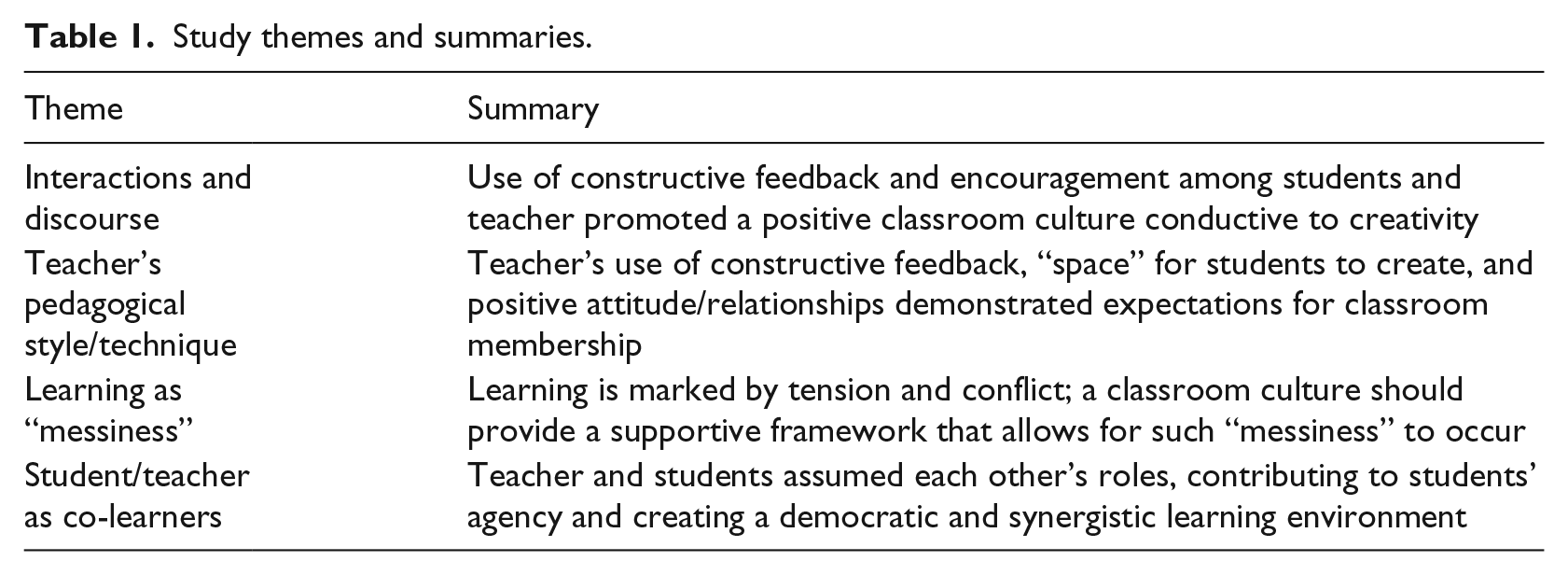
Teacher and students’ mutual use of constructive feedback in their discourse helped to create a sense of support and collaboration between teacher and students, similar to what Shouldice’s (2019) participant sought to create in her classroom and to what Burnard et al. (2013), Lapidaki et al. (2012), and Ruthmann (2012) have recommended. This, combined with students’ perception of the classroom culture as collaborative and supportive, allowed them to feel comfortable being creative and exploring their ideas. Also, students perceived that Gerard’s teaching practices—giving students “space,” constructive feedback, motivation to move students beyond their creative “comfort zones,” and positive attitudes/interactions—were factors that contributed to the positive nature of the classroom culture. Similar to Geertz (1983), Collins and Green (1992), and Gutierrez (1994), classroom discourse was the primary means by which teachers and students constructed a classroom culture. In addition, as with Prentiss (1998), these classroom interactions developed over time and took on social meanings for participants.
Collins and Green (1992) believed that roles and relationships of students and teacher that determine appropriate and acceptable interactions, obligations of classroom membership, and norms and expectations for behavior were key elements of classroom culture. The classroom culture that Gerard and his students created together fostered a collaborative environment through emphasis and reinforcement of appropriate interactions and expectations for behavior. Working with others in a cooperative manner may have been considered an implicit obligation of classroom membership for this class.
Collins and Green (1992) also believed that teachers’ practices bring order to classroom life and define the nature of classroom membership and participation. In addition, Fairbanks and Broughton (2003) and King (2012) argued that the teacher plays a vital role in shaping the development of the classroom culture through the organization of classroom structures and establishment of rules and expectations. Replication of Gerard’s supportive and affirming behavior may have been a tacit expectation between Gerard’s students during their interactions. Gerard’s teaching practices, knowingly or unknowingly, may have implicitly defined the roles and relationships of students—defining the nature of classroom participation. Gerard personified the elements that he valued in a classroom culture, thus demonstrating his expectations for behavior and obligations of classroom membership. In addition, most students perceived that the distance—“space”—that Gerard gave students to feel free to experiment and explore their creative selves seemed to enhance the synergy that contributed to the classroom culture. However, there was some disagreement among students as to the extent of Gerard’s influence on the creation of the classroom culture and the nature of his intent. Jeffrey perceived that students primarily created the classroom culture and that Gerard had minimal influence on classroom culture, as he was perceived not to be as active a member of the class as students. Also, Lisa perceived that, at times, Gerard conveyed contradictory feedback that could have resulted in the needless revision of a composition. Both students, however, agreed with their peers as to the quality of the classroom culture.
Students reported that the affirming and positive classroom culture continually motivated them to compose, allowing them to express themselves through music as did the students in Woodward’s (2013) study, and pushing them to new artistic levels. However, there were moments that suggested otherwise, such as off-task behaviors and disagreements among students (such as with Carrie, Marissa, Paolo, and Benjamin). These episodes demonstrated the complexity and “messiness” of social life (Greener, 2011; Murchinson, 2010) undergirded by a classroom culture that supported learning, another “messy” process (Davis-Seaver, 2000). Inconsistency, tension, and conflict are to be expected during the learning process. The classroom culture of Gerard’s class allowed this “messiness”—learning—to occur within a broader, overarching, and supportive framework created and sustained by the teacher and students.
In addition, Gerard’s multiple roles in the class—both as co-learner and teacher—influenced students’ motivations to continue engaging in creative activities. Gerard did not occupy the “teacher” role exclusively in the class. Instead, he and his students learned from each other within what appeared to be a synergistic, democratic, and collaborative classroom culture. Rather than the teacher taking the role as the sole generator and disseminator of knowledge, both the students and teacher generated new knowledge (as witnessed in Doug’s teaching demonstration), affirmed and celebrated each other’s creations, and encouraged further creative growth through utilization of specific feedback and constructive criticism. In this sense, the teacher not only provides “space” for students to create but also provides “space” for students to share their discoveries in a public manner to encourage continuing creative work and maintaining a positive culture within which to create and refine musical compositions.
Implications for teaching practice
Findings suggest that a positive and supportive classroom culture created and sustained by both students and teacher that allows for “messiness” in learning and has students and teacher as co-learners may encourage students to participate and make a difference in the quality of their musical composition activities. Music educators who value these activities and seek to implement them in their classes may wish to implement a similar culture for their classrooms and determine how to create it with their students.
In addition, music educators may wish to critically examine the culture of their existing classes and consider how their interactions with students are contributing to the formation and sustaining of classroom culture. Behaviors exemplified by Gerard—providing motivating and constructive feedback, maintaining positive relationships with students, being a co-learner with students, composing and sharing one’s own works with students, and creating “space” for students to work on their own and allowing “messiness” to occur—were factors that contributed to the positive nature of the classroom culture. As the author observed with this music technology class, the educator may implicitly define the nature of classroom participation and personify the elements that they value in a classroom culture, thus demonstrating their expectations for participation and influencing the creation and maintenance of the classroom culture. Teachers also may desire to examine critically existing classroom cultures and teaching practices to ensure that they may not be unintentionally reinforcing values that are counterproductive to their philosophies of music education and students’ potential for creativity and collaboration.
Traditional performance-based ensemble classes (e.g., band, chorus, orchestra), which usually require previous ensemble experiences, constitute the majority of music education classes at the secondary level in the United States with relatively few classes offered that do not require prior musical education or experience (Abril & Gault, 2008). Based on the present study’s findings, teachers may also want to explore the potential of creating a culture like that of Gerard’s class in which all students can participate, regardless of previous musical education or experience. Music educators may wish to incorporate composition into all types of music classes as composition activities call for divergent thinking, draw upon students’ creative intelligence in music, and allow students’ inherent musical abilities to be further developed through means other than performance in a traditional ensemble (Hickey, 2012).
Tamin, Bernard, Borokhovski, Abrami, and Schmid (2011) found that students in classes that appropriately and effectively integrated technology exhibited small to moderate gains in learning compared to classes with non-technology-based teaching approaches. However, music education researchers (Dorfman, 2008; Jassmann, 2004) have found that music educators are not utilizing technology in their classes with their students: “digital natives” who have been immersed in technology since a very young age. Gerard’s students seemed adept with using technology as a learning vehicle, easily implementing shortcuts self-discovered and learned from peers. Music educators may wish to explore how to implement technology in their classrooms to improve student learning and use a means of learning with which students might be familiar. However, they should heed warnings that technology should be meaningfully integrated to support a curriculum, rather than use technology for its own sake (Bennett, Maton, & Kervin, 2008; Demski, 2010; Miksza, 2013).
Implications for future research
Carlone (2012) and Woodward (2013) suggested that classroom cultures and expectations may influence students’ identities. Music education researchers and philosophers believe that music and musical identity may influence one’s individual identity and motivations throughout one’s lifetime (Gaztambide-Fernandez, 2010; Hargreaves, Miell, & MacDonald, 2002; Lamont, 2002). Therefore, a study that examines the possible influences of music classroom culture on students’ identities could assist with uncovering ways of helping teachers encourage students’ participation in musical activities from childhood through adulthood.
Many of the students in this study noted that Gerard was key in the creation of the classroom culture. It would be of interest to interview Gerard and other teachers for their perspectives on classroom culture and how they seek to create it. Also, it would also be of interest to interview more students for their perceptions on how classroom culture is created and by whom.
A limitation of this study is that the author was only able to observe the music technology class for the second half of the 20 week semester. Therefore, researchers may wish to conduct a semester- or year-long study of music classrooms similar to Gerard’s to determine from the onset how students and teacher co-create the classroom culture and how it influences participation in musical composition throughout the term of the class. In addition, a longitudinal study that follows Gerard’s students through their secondary and post-secondary education may reveal how the motivation to compose that they developed in the music technology class may have influenced their choices to participate in musical activities and, if so, which types. Similarly, as this was a case study limited strictly to a music technology class, researchers may wish to conduct studies of multiple types of music classrooms (e.g., performance-based ensembles, music theory classes, songwriting classes, etc.) to determine how the culture influences participation in various kinds of musical endeavors (e.g., improvisation, performance, composition, arranging, etc.).
Conclusion
The beginning of the school year brings teacher and students together to transform a room—a space in the social institution called school—into a purposeful place known as the classroom with a unique culture that is co-created by both the teacher and students. Findings from the present study suggest that a classroom culture that encourages collaboration and embraces the “messiness” of learning can be a positive influence on music learning, regardless of previous formal musical experiences. In the interest of providing a meaningful music education for all students, additional research on classroom culture, how it is co-created, and how it may influence music learning and participation in musical endeavors may have substantial implications for the profession and assist with facilitating experiences that help students respond to, create, and perform music—a unique phenomenon that enriches the human experience.
Footnotes
Declaration of conflicting interests
The author(s) declared no potential conflicts of interest with respect to the research, authorship, and/or publication of this article.
Funding
The author(s) received no financial support for the research, authorship, and/or publication of this article.
