







Abstract
In this study, we investigated the use of digital technology for aural skills instruction in Advanced Placement Music Theory (APMT) classes in the United States. Our research questions focused on which technologies teachers use for aural skills, how they incorporate them, and what influences their decisions to use them. We created, piloted, and distributed a survey electronically to a stratified sample by state of 866 instructors. Participants who completed the survey (N = 317, response rate = 36%) were current APMT teachers representing 48 states. Of the 91% of respondents who used digital technologies for teaching aural skills, 93% used websites, 47% used software programs, and 38% used mobile apps. Participants incorporated technology for student practice outside class (93%) and during class (78%), and to present new material during class (55%). Of those who did not use technologies (n = 29), 41% cited lack of funds and 34% cited lack of class time. Participants noted that technology can provide extra practice for students and customization for their needs, but that students’ lack of access and limitations of the programs may temper these benefits. Implications for pedagogical practice and music teacher training are discussed.
In the 2017–2018 school year, Advanced Placement Music Theory (APMT) was taught in 3,240 high schools (College Board, 2018) in the United States, and enrollments appear to be growing, but relatively little information about pedagogical trends in music theory classes has been published. A recent nationwide survey reported that 26% of the APMT teachers did not use digital technologies for aural skills teaching (Buonviri & Paney, 2015), but some teachers still may have a very high success rate as evidenced by their students’ collective scores on the Advanced Placement (AP) exam (Buonviri, 2018). Further investigation of these findings could provide useful information to APMT teachers in an age when technological applications increasingly influence students’ learning environments. Technology training may be helpful to teachers (Bauer & Dammers, 2016) but challenging to provide (Byrne & Macdonald, 2002). Furthermore, teachers wishing to incorporate technology may lack the funding, time, and access to do so effectively (Reese & Rimington, 2000).
Mark David Webster (2017) noted that K–12 technology directors espouse one of two contrasting philosophies of technology implementation: (1) technology should be driven by curricular needs or (2) technology must be incorporated to keep up with developments in modern life. It seems possible that the two perspectives can coexist productively and effectively in schools, but Webster warned that in many cases the second may be eclipsing the first. Understanding the benefits and drawbacks of technology in aural skills instruction could help teachers use it wisely; research that focuses on current technology use in APMT could be an important first step in that direction.
Technology may be especially useful as a supplemental tool for aural skills development outside of the classroom (Kiraly, 2003). Students can monitor their own practice and progress through applications that enable differentiated instruction and show immediate feedback regarding details like pitch and rhythm accuracy (Chen, 2015). In a study of third graders, Paney and Kay (2015) found that a computer program helped students improve their pitch production accuracy over the course of a school year. The researchers noted that the technology provided benefits of an unbiased, objective measure of students’ progress and individual visual feedback to each student without sacrificing class time. Computer programs and apps can be helpful to students, teachers, and parents because they can be set up for direct submission of assignments and subsequent feedback, providing a clear picture of students’ progress quickly and consistently (Chen, 2015; Kiraly, 2003). Students can even use these tools to sharpen their own self-assessment skills for aural tasks (Hart, 2014).
Using technological tools, especially outside of class, can present challenges. Assessment criteria may be unclear to students and automated feedback can be overly sensitive to factors like intonation (Chen, 2015). These tools also require a certain level of familiarity on the part of both students and teachers to ensure appropriate assignment of tasks and interpretation of results. Software programs and apps may be helpful for reducing anxiety and building students’ confidence in assessment situations but should be fully understood and thoroughly practiced to provide reliable and valid information regarding students’ progress (Henry, 2015). Implementing technology in music curricula also requires ongoing updates to equipment and programs, training for teachers in their use, and technical support staff for hardware, software, and connectivity issues (Byrne & Macdonald, 2002).
Teacher training
Successful implementation of technology depends on teachers’ confidence and fluency in using it themselves (Celik & Yesilyurt, 2013). Reese and Rimington (2000) distributed a questionnaire to determine how Illinois music teachers were using technology and what their funding sources and training needs were. Ninety-four percent of their respondents (N = 320) desired more training to know what was available and how it could be used effectively with students. Technological changes, both in hardware and in software, present a perpetual challenge to teachers and teacher trainers seeking the best tools.
Bauer and Dammers (2016) found that only 33% of the music education professors they surveyed in the United States offered a class to preservice teachers that focused specifically on technology. They concluded that a single course on technology may be insufficient training, and that spreading technological instruction across the undergraduate curriculum by embedding it in multiple courses might be more effective. Music education professors have also reported that their preservice music education students faced a lack of funds, access, time, and space for technology training (Bauer & Dammers, 2016; Reese & Rimington, 2000). Investing in training, however, seems to be worthwhile, as evidenced by Bauer et al.’s (2003) finding that week-long workshops can significantly improve teachers’ knowledge of technology and comfort in using it. These training effects declined over a subsequent span of 10 months, however, suggesting perhaps that continued reinforcement of skills and concepts would be necessary for long-term usefulness.
Rationale and research questions
In summary, technological tools are ubiquitous in modern education. They may be helpful in aural skills instruction, but only when used purposefully and appropriately by skillfully trained teachers. Better understanding of current high school music theory teachers’ use of technology for aural skills instruction would be beneficial in that regard. In a recent nationwide survey focused on dictation strategies (Buonviri & Paney, 2015), APMT teachers reported very briefly on software, apps, and websites they used in their classes. The purpose of the current study was to investigate the use of digital technology for aural skills instruction in APMT classrooms in the United States. Our research questions were the following:
RQ1. Which, if any, digital technologies do APMT teachers use specifically for aural skills instruction?
RQ2. For those that use digital technologies, how and when do they incorporate them?
RQ3. What factors influence teachers’ decisions whether to use digital technologies for aural skills instruction?
Method
Survey instrument
We incorporated findings and recommendations from Buonviri and Paney’s (2015) study to draft the current survey, consisting of 14 questions in a combination of six selected-response and eight open-ended answer formats (see Supplemental Materials for all questions). We developed these survey items to target specific factors related to technology use in aural skills instruction that had been described tangentially in the previous study (Buonviri & Paney, 2015) and that served as the framework for our three research questions in the current study. Survey Questions (SQs) 1 and 3 pertain specifically to RQ1, SQs 4−6 pertain to RQ2, and all other SQs pertain to RQ3 or to collection of demographic information. Upon study approval from both of our Institutional Review Boards, we piloted the survey with four music theory teachers to check internal validity factors of electronic distribution, unique recipient links, clarity, and anonymity, and external validity factors of content and relevance of the questions themselves. We then made slight revisions for clarification based on pilot participants’ feedback.
Determining the sample
We accessed a master list of high schools offering APMT (N = 2,347) through the online AP Course Ledger (College Board, 2017). For a confidence interval of ±5 and a 90% confidence level, we needed 242 survey respondents. Estimating a 30% response rate, we needed to sample at least 807 potential participants. The number of schools in each state that offered APMT ranged from 2 (Hawaii and North Dakota) to 252 (Texas). We randomly selected 25 schools from each state and included all schools from states that had fewer than 25. Our process yielded an initial sample of 887 schools.
We searched online for email and contact information for the APMT teacher at each of our selected schools. We sent unique emails through Qualtrics survey software to the teachers in our sample. When an email bounced, we searched online or called the school to confirm the correct contact and replaced the original. In the rare case that this failed, we selected another school in the same state. We successfully found replacements for 47 of the 68 emails that bounced, which brought our total number of schools to 866. Qualtrics sent automated reminders to those who had not completed the survey 1, 2, and 3 weeks after the initial email.
Participants
Participants who responded to the survey (N = 314, response rate = 36%) were current APMT teachers representing at least 48 states (no responses from Hawaii or North Dakota were identified as such voluntarily by respondents). Please see Supplemental Materials for a table of responses by state. Teachers had taught between 0 (less than a year) and 41 years, with an average of 8.3 years, and 94% had teacher certification. The highest degree participants had completed was doctorate (7%), master’s (68%), and bachelor’s (24%). Their average enrollment in APMT was 10 students, with 93% of class sizes containing fewer than 20 students and 99% with fewer than 30.
Results
Participants’ use of technology
Of 314 total respondents, 91% (n = 286) used digital technologies in aural skills instruction (SQ 1 in Supplemental Materials). Of those who did, 93% (n = 266) used websites, 47% (n = 134) used computer software programs, and 38% (n = 109) used mobile apps (SQ 3). The websites most frequently used by participants who chose to list them (n = 175) were musictheory.net (67%; n = 117), teoria.com (46%; n = 81), sightreadingfactory.com (11%; n = 19), and youtube.com (8%; n = 14). Participants who listed software programs (n = 89) most frequently used Auralia (25%; n = 22), Finale (21%; n = 19), and Sibelius (13%; n = 12). The apps most used by participants who listed them (n = 66) were Tenuto (47%; n = 31) and Ear Trainer (6%; n = 4).
Participants used these technologies (SQ 4) for student practice outside of class (93%; n = 183), for student practice during class (78%; n = 152), and to present new material during class (55%; n = 107). Of those who did not use digital technologies (n = 29), 41% (n = 12) cited lack of funds, 34% (n = 10) cited lack of class time, 24% (n = 7) stated that devices did not work well, 21% (n = 6) said they lacked technology support at their school, 21% (n = 6) stated that they lacked comfort with technology themselves, and only one participant reported that technology was distracting in the classroom (SQ 2). Most participants rated their school’s Information Technology (IT) support as “adequate” or better (87%; n = 189) as compared to only 13% (n = 28) who stated it was lacking or nonexistent (SQ 12). Participants did not differ significantly in their use of technology by number of years teaching APMT, χ2(4, N = 217) = 5.98, p > .05; see Table 1.
Use of technology by number of years teaching.
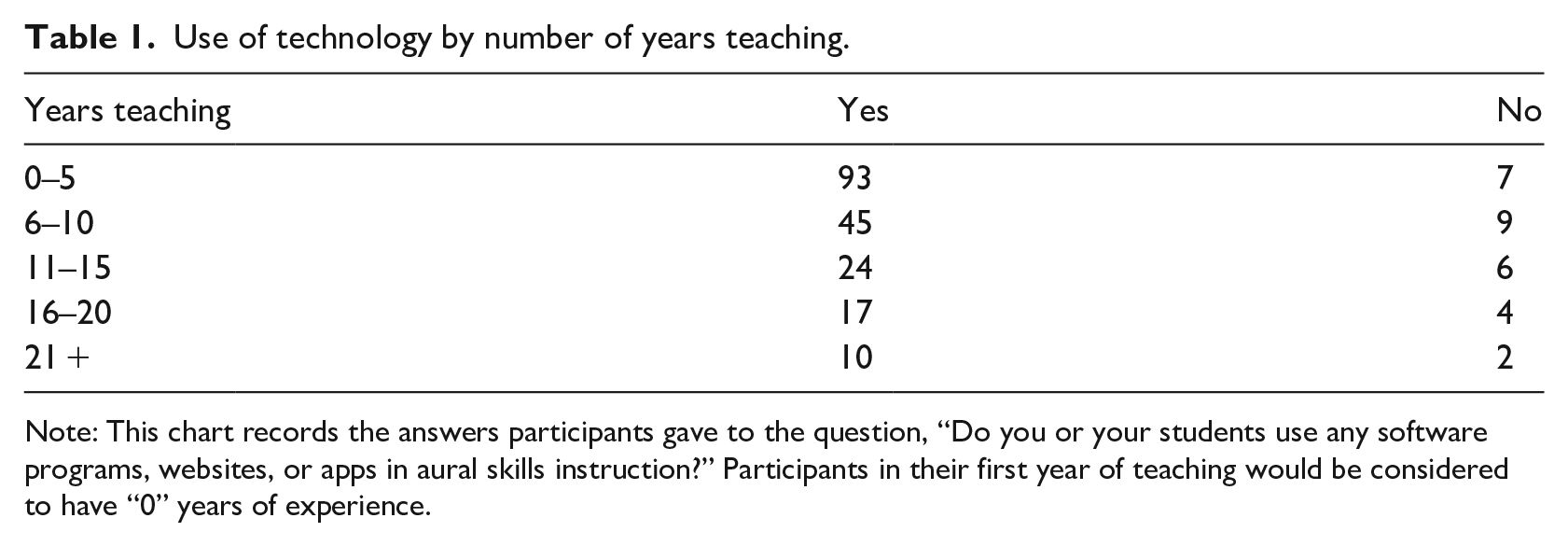
Note: This chart records the answers participants gave to the question, “Do you or your students use any software programs, websites, or apps in aural skills instruction?” Participants in their first year of teaching would be considered to have “0” years of experience.
Advantages and challenges of technology
Participants’ replies to free-response questions highlighted several trends in their technology use. Using an open coding process (Strauss & Corbin, 1990), we first independently analyzed and coded their responses, assigning one- or two-word descriptions to the content of each. We then collaborated to review each other’s analysis and add, delete, negotiate, and finalize those descriptive codes to create summative categories of data. Based on this analysis, the most frequently reported advantages of technology (SQ 5) were extra practice for students (56%; n = 104) and customizing programs to meet students’ needs (24%; n = 45). The main challenges (SQ 6) were lack of access to technology (35%; n = 45) and limits of the programs, including lack of alignment with AP exam content (21%; n = 37). Many participants (n = 174) offered suggestions for other AP teachers who were considering incorporating technology in APMT but were not currently using any (SQ 8). Most of these participants (58%; n = 101) suggested that others start with something simple and build from there, for example, “Just start . . . jump in!”
Past experiences and future plans
Customization to meet students’ needs (24%; n = 42) was the most common factor influencing participants’ decisions to use the technologies they selected. Convenience and ease of use (20%; n = 35) and recommendations from colleagues (20%; n = 35) were the next most selected influences on participants’ choices (SQ 10).
Of the participants (n = 176) describing whether their students enjoyed these technologies, 69% (n = 121) said “yes,” 5% (n = 9) said “no,” and 26% (n = 46) provided a mixed response, stating, for example, that some programs are more effective than others, that some present an initially frustrating learning curve, and that student responses to technology sometimes varied, even within the same class (SQ 7).
Of responses (n = 173) regarding whether they had ever tried a technology in their aural skills class and then reverted back to traditional means of instruction (SQ 13), 28% (n = 48) said “yes.” Reasons they cited for doing so included limitations and cost of the programs, emphasis on the value of human interaction, and challenges with hardware, software, and access. Technical malfunctions and access problems may be decreasing as one respondent mentioned, “Yes [I reverted once], but that was in 2005. The integration into daily instruction is pretty seamless.”
Of participants (n = 197) reporting whether they were considering adding any technologies for future aural skills instruction (SQ 11), 58% (n = 114) said “yes.” For those that responded “no,” reasons included satisfaction with the technology already in place, desire to maintain personal interaction for quality instruction, lack of instructional time, and lack of budget.
Participants also responded to an open-ended question asking whether they wished to say anything more (SQ 9). Some suggested using technology to help students get extra practice, especially with scarce class contact time in a challenging course. Others warned that students still need to be able to write quickly and accurately with traditional notation to successfully complete the AP exam, because they cannot use technology for their responses. Finally, some participants expressed a desire for technology tools particularly tailored to the AP exam.
Discussion
In this sample of APMT teachers, we found that most reported using digital technologies in their aural skills instruction, but also recognized challenges to incorporating them. A large majority used websites; less than half used software programs. We were surprised that so few used mobile apps, given the prevalence of smartphone use among teenagers. Not all students have smartphones, and many of those who do may have limited access to the Internet through their data plans. Perhaps teachers do not feel comfortable assigning work or recommending practice on platforms that may not be equally accessible to all students. This issue deserves attention in future research.
Some reasons teachers hesitated to use technology in aural skills instruction included limitations of the programs, prohibitive costs, lack of access, and challenges with hardware or software. Technological tools may be limited in the sense that teachers cannot use them exactly for the task at hand. For example, an aural identification or dictation program might not offer the particular parameters students need to practice, or may provide only a few target examples when students need many more. The cost of programs and lack of access to them can also pose problems both in the classroom and outside of school for teachers and students. These issues may reflect inequalities of resources across classrooms and consequently exacerbate inequalities in students’ academic performance.
Technical malfunctions and challenges may be declining gradually but teachers will need to feel quite confident in the consistency of relevant technologies if they are to incorporate them regularly. One problem may be the large number of technological options available. It takes time for teachers to sort through current tools and find those that meet their learning objectives. In addition, online applications and mobile apps are frequently updated and may change format, requiring teachers to regularly reevaluate their feasibility in the classroom. Perhaps some of the professional development opportunities many teachers participate in throughout the school year could be focused on solving these challenges. Future research might focus on the extent to which technology training is offered in professional development for music teachers and the influence such training may have on their sense of personal competence with technological tools.
The number of years participants had taught APMT was not a predictor of their likelihood to use technology in their instruction. This result supports the findings of previous studies that more experienced music teachers may be using technology as much as newer teachers. Dammers (2012) found that many high school music technology classes are being developed and taught by veteran instructors, and Reese and Rimington (2000) found that new and experienced K–12 music teachers used computers relatively equally. These findings contrast results of studies from other areas of education, such as the sciences, in which older teachers have reported lower levels of self-efficacy with regard to Web instruction (Lee & Tsai, 2010) and general incorporation of technology into their teaching (Lin et al., 2013). Additional research may help in understanding these findings and why the difference might exist between APMT teachers and teachers in other subject areas.
Music technology courses
One of the perennial challenges music educators face is establishing and maintaining accessibility of their courses to students. Increasing enrollments in music programs is considered a key element of advocacy efforts. Dedicated music technology courses are one way schools can provide music instruction for more secondary students, an approach particularly valuable for those who might not enroll in a band, orchestra, or choir (Dammers, 2010; Nielsen, 2013; Tobias, 2012). This could have major implications for the music education profession, creating larger enrollments of students, a need for additional teachers, and a need for increased technology training within undergraduate teacher education programs and continuing education.
Dammers (2012) surveyed public high school principals in the United States regarding their technology-based music offerings. Only 14% offered technology-based music classes (up from 10% as found in Abril & Gault, 2008), although 66% of those who did not thought they would be a positive offering and 56% thought it would be possible to offer such a course. In a follow-up survey within the same study, the music technology teachers indicated that their classes were generally taken by nontraditional music students and 89% stated that their purpose in offering the classes was to reach those students. Dammers saw value in this increased access to school music for students with diverse abilities and learning styles. He also noted that most classes described by respondents in his survey were started by music teachers themselves with a particular vision, rather than required by school administration. Dammers suggested that technology-based music classes could be a new strand of music in schools complementing traditional offerings like band, choir, and orchestra. This could be a valuable addition to school music curriculum and would require a shift in teacher training programs.
Adding dedicated classes might increase enrollments and accessibility, but technology use in classrooms must meet teachers’ learning objectives. Paul Lehman’s (1985) statement of several decades ago still rings true today: “There are hundreds of ways to misuse computers in education and only a few ways to use them properly” (p. 12). Zelenak (2009) found that middle school students enrolled in technology-enhanced music classes did not exhibit greater self-efficacy nor higher reenrollment than students in traditional classes; he recommended that teachers must be purposeful in using technology for what it can add to the learning experience, “and avoid using it to simply replicate traditional practices” (p. 45).
The results of the current study suggest that some teachers may be reluctant to add technology within existing courses like APMT because they want to maintain a high level of human interaction in the classroom. For them, applications of technology for ancillary purposes like extra practice may be appropriate. Chen (2015) examined the effectiveness of a mobile app for students’ aural skills practice in preparation for the Associated Board of the Royal Schools of Music exams. He reported that the app was quite helpful to students for providing immediate feedback regarding their rhythmic clapping and pitch singing. This sort of self-guided practice with prompt automated feedback, accessible at any time through an app, could be used by APMT teachers to free up more time in class meetings for personal attention, diagnosis of students’ unique challenges, and development of wise and worthwhile solutions. Technology may also be useful for formal assessment and grading purposes, again allowing teachers and students to focus precious class contact time on interactive learning (Chen, 2015). Future research might focus on effects of varying the balance in music classrooms between human interaction and technology incorporation.
Teacher training
Nearly 20 years ago, Peter Webster (2002) presented an optimistic view of how technology can increase the value of instruction and complement standard teaching approaches. He described the important role technology might play in evolving educational philosophies, citing the potential for gradual replacement of teacher-led lower-order thinking skills with student-driven higher-order thinking skills. The effectiveness of such a shift still depends at present on teachers’ knowledge of potential tools and practical applications, and their ability to evaluate when, how, and why to incorporate them for worthwhile pedagogical reasons. Rather than simply suggesting particular technologies teachers should use, teacher training courses and seminars on technology could focus on general principles that would help current and future teachers make informed decisions about selecting and implementing new technologies wisely themselves. The application of such principles to specific content in music courses might be most conducive to lasting learning. As Bauer and Dammers (2016) described it, Looking forward, music teacher educators need to engage in an ongoing, sustained effort to ensure that music teacher education curricula stay current and allow music teacher candidates to capitalize on the pedagogical opportunities possible with technology. While individual courses may be helpful, a single class or experience will probably not sufficiently address this challenge. Rather, the integration of learning about (a) technology, (b) musical content, and (c) pedagogy, in authentic music teaching and learning contexts, will likely be most effective. (p. 12)
Results of the current study offer APMT teachers specific insights regarding which technological tools their colleagues use most and when, how, and why they incorporate, or do not incorporate, them in their classrooms. These results appear to corroborate a growing body of research (e.g., Dieteker et al., 2018; Reiten, 2018; Smith et al., 2017) suggesting that technology certainly should not be used in education curriculum automatically as a “must-have,” but should be gradually and appropriately included in individual courses like APMT when it can improve and enhance students’ learning pace and long-term growth. Teachers who wish to incorporate technology for aural skills instruction should be prepared to evaluate the merits of various programs on multiple platforms to determine what is feasible and how it can help. Music teacher trainers can assist preservice and in-service teachers by offering them both specific recommendations and valuable philosophical perspectives on the role technology might play in their classrooms. Pedagogical practice in high school music theory is currently not very well defined or developed in music teacher training programs in the United States, so teachers may have to actively pursue this guidance themselves as well after graduation. The results of the current study provide a point of departure for such a pursuit by both teachers and researchers.
Limitations of the study and recommendations
As with most survey research, this study was limited by the number of responses from a randomly selected sample. The response rate of 36% is commensurate with similar survey research in the music education field, but nevertheless represents only a portion of the population of AP Music Theory teachers. The study was also limited by the generally descriptive nature of the SQs. Many of the issues raised in the discussion could serve as a foundation for future research, including the accessibility of technological tools to students outside the classroom, the role of technology training in undergraduate and continuing education for music teachers, and the relationship between human interaction and technology incorporation in music classrooms.
Supplemental Material
Technology_Use_in_High_School_Aural_Skills_Instruction_Supplemental_Material_Distribution_by_State – Supplemental material for Technology use in high school aural skills instruction
Supplemental material, Technology_Use_in_High_School_Aural_Skills_Instruction_Supplemental_Material_Distribution_by_State for Technology use in high school aural skills instruction by Nathan O Buonviri and Andrew S Paney in International Journal of Music Education
Supplemental Material
Technology_Use_in_High_School_Aural_Skills_Instruction_Supplemental_Material_Survey_Questions – Supplemental material for Technology use in high school aural skills instruction
Supplemental material, Technology_Use_in_High_School_Aural_Skills_Instruction_Supplemental_Material_Survey_Questions for Technology use in high school aural skills instruction by Nathan O Buonviri and Andrew S Paney in International Journal of Music Education
Footnotes
Declaration of conflicting interests
The author(s) declared no potential conflicts of interest with respect to the research, authorship, and/or publication of this article.
Funding
The author(s) received no financial support for the research, authorship, and/or publication of this article.

Supplemental material
Supplemental material for this article is available online.
References
Supplementary Material
Please find the following supplemental material available below.
For Open Access articles published under a Creative Commons License, all supplemental material carries the same license as the article it is associated with.
For non-Open Access articles published, all supplemental material carries a non-exclusive license, and permission requests for re-use of supplemental material or any part of supplemental material shall be sent directly to the copyright owner as specified in the copyright notice associated with the article.
