







Abstract
The purpose of this case study was to evaluate the elementary general music education majors’ perceptions of preparedness, interest, and comfort with the choral skills presented in a choral methods course. Thirty elementary general music education majors (N = 30) enrolled in a choral methods course responded to a pre- and post-course survey. Participants self-assessed their feelings of preparedness to teach choir, stated their interest in teaching choir, and specified their comfort levels teaching seven choral skills. It was found that there were differences between the participants’ feelings of preparedness to teach choir at the beginning and the end of the semester and in the participants’ indication of interest in teaching choir before and after taking the choral methods course. Participants’ overall comfort ratings on the seven choral music teaching skills increased from the beginning to the end of the semester; choral repertoire was the area that participants felt most comfortable, which is indispensable to provide meaningful choral experiences to young singers. Implications for music education are that music education students’ feelings of preparedness, interest in teaching choir, and their comfort in acquiring the required teaching skills to do so, provides insights into effective preservice music teacher preparation.
Keywords
While universities often provide course evaluation materials, course evaluations constructed by the instructor can often provide course-specific detailed information in a timelier fashion. Colwell and Beall (1985) emphasized the importance of music teacher education systemic evaluation. Ferguson (2007) recommended that music educators perform music program evaluations, aiding music educators in determining a program’s effectiveness. One of the ways to receive student feedback and assess the effectiveness of course content is by conducting course evaluations (Duerksen, 1995).
Methods course evaluations can be beneficial to prepare preservice music teachers to instruct the subject being presented. They provide opportunities to review specific elements of teaching and course content (Berg & Miksza, 2010), which are helpful to assess instructional effectiveness. Course evaluations guide instructors in the examination of course experiences and facilitate more interactive and reflective experiences (Parr, 1999). According to Yourn (2000) course evaluations aid and encourage instructors to reinforce a deeper level of pedagogical interpretation and professional growth by offering more supported and structured practices in the music methods courses.
Preparing students to teach in a specific area of music is a primary goal of music education methods course instructors. Brophy (2002) and Conway (2002) emphasized that undergraduate music education coursework should offer relevant school setting experiences to enhance preservice music teachers’ music teaching preparedness. Groulx (2016) recommended music teacher education curricula include meaningful context that reflects real-world experiences applicable to teaching in classroom settings. Music education researchers have identified the content of methods courses as one of the most effective vehicles to prepare undergraduate music education majors for future classroom instruction (Ballantyne, 2006; Hamann & Ebie, 2009; Parker & Powell, 2014; Teachout, 2004). According to Conway (1997) it is helpful for undergraduate music education methods course instructors to examine students’ preparedness to teach the subject matter being presented to facilitate and aid preservice music teachers’ instructional readiness as future classroom practitioners (Brophy, 2002).
Preparation to teach a class is certainly important but interest in teaching that subject also influences music educators’ instructional goals as well as their pedagogical ideas. According to Abramo and Reynolds (2015), it is important for music educators to observe their students’ interests within a subject especially within methods classes that are specific to a given professional track. Georgii-Hemming and Westvall (2010) reported that teachers’ choices of instructional details, goals, and objectives are often influenced by their own individual interests and that their level of interest in teaching a subject can influence their pedagogical ideas and creativity. Even if music education students demonstrate musical and academic excellence in a methods course, being disinterested in that course might prevent them from achieving their full potential to teach that subject (Draves, 2019). It would then be important to observe whether students awakened an interest in the subject being taught (Georgii-Hemming & Westvall, 2010).
By presenting the most salient information, music education methods instructors can not only influence students’ interest in teaching a particular subject, but also help them feel comfortable doing so. Comfort has been defined as the level of teachers’ confidence, or ease working in the various listed categories (Hamann, 1982; Hamann & Sobaje, 1983; Kelman & Parloff, 1957; Kim, 2018, 2020; Parloff et al., 1954; Pineau, 1982). By focusing on the skills learned from experiences, such as those obtained in methods courses, students can become more comfortable in areas in which one is unskilled (Harreveld et al., 2009). Conversely a lack of comfort can negatively impact a teacher’s music instructional delivery skills (Hamann, 1982). Therefore, the goal of any music education methods course instructor is to help prepare students develop their confidence or comfort to teach the various skills needed to be successful in the classroom.
Music education researchers have investigated the effectiveness of teacher practitioner preparation (Berg & Miksza, 2010). Researchers agree that undergraduate music education method classes are essential for preparing competent classroom practitioners (Conway, 1999; Groulx, 2016; Hamann & Ebie, 2009; Hourigan & Scheib, 2009; Parker & Powell, 2014). It would be beneficial to examine the effectiveness of an undergraduate choral methods coursework experience in terms of students perceived preparedness, interest, and comfort to teach a choral methods course.
An undergraduate choral methods course can include non-choral music education majors who are enrolled to prepare themselves to teach choral ensembles in the teaching field. As non-choral music education majors, elementary general music education majors may not have a specific interest in teaching choir or have experience as vocalists or singing in choirs. Some of them may not want to take choral methods believing that such a course is not a relevant or necessary part of their future work in their undergraduate program. However, it is likely that elementary general music education majors may find themselves in a position that requires them to work with choral ensembles since their teaching certification permits them to teach in all areas and levels of music. The purpose of this study was to evaluate elementary general music education majors’ perceptions of preparedness and interest to teach choir, and to assess their comfort working with seven choral skills that were presented in a choral methods course. The research questions under investigation were as follows:
• Research Question One: Are there any differences in the elementary general music education majors’ self-perceived preparedness in teaching choir before and after taking this choral methods course?
• Research Question Two: Are there any differences in the elementary general music education majors’ interest in teaching choir before and after taking this choral methods course?
• Research Question Three: Are there any differences in the elementary general music education majors’ comfort levels in choral teaching skills before and after taking this choral methods course?
Method
Participants
The participants in this study (N = 30) were third-year elementary general music education majors enrolled in an undergraduate choral methods course at a public university; none of the choral and/or instrumental music education majors were included in this cohort of 30 elementary general music education majors. Elementary general music education majors are defined as individuals who are studying to teach the fundamentals of music to students in grades pre-kindergarten to fifth or sixth grade to sing, perform on classroom instruments, listen to music from around the world, and promote students’ exposure to musical literature, historical context, cultural diversity, and exercises in creativity. I designed this study to assess whether there were differences between pre-and post-survey scores. A paper-based survey was administered at both the beginning and end of the semester as a course evaluation to: (1) compare students’ perceptions of preparedness and interest in teaching choir before and after taking the choral methods course and (2) determine whether any differences existed among the participants’ comfort levels on the seven choral teaching skills before and after taking this choral methods course.
I was the course instructor. For anonymity purposes, participants were asked to use pseudonyms to identify their surveys on the first survey administration and to use the same pseudonym on the final survey administration. None of the participants were forced to participate. Participants were encouraged to respond to survey questions freely and were informed that their course grade would not be affected by either their participation or survey responses. Participants could drop out of the study at any time. No compensation of any kind was given to them for participation in the study. Each survey administration took approximately 15 minutes to complete.
Survey instrument
Participants were asked to report their self-perceived preparedness, interest, and comfort in teaching choir. To rate self-perceived preparedness, participants were to respond whether they felt prepared to teach by selecting one of the following categories: very prepared, somewhat prepared, weakly prepared, or not prepared. To rate interest in teaching choir, participants were to indicate if they were very interested, somewhat interested, mildly interested, or not interested. Finally, participants were to self-rate their comfort levels on seven different choral teaching skills using a seven-point Likert scale. Comfort responses using the Likert scale ranged from 1 to 7, with 1 indicating very uncomfortable and 7 indicating very comfortable. I reviewed literature including choral teaching skills to construct the survey for this study (Byo & Sheldon, 2000; Fisher, 1991; Floyd & Haning, 2015; Ford, 2001; Freer, 2017; Kim, 2013, 2018, 2020; Lane, 2006; McClung, 2001; Melago, 2015; Parker & Powell, 2014; Reames, 2001; Sieck, 2013; Silvey, 2011; Silvey & Major, 2014; Spurgeon, 2004).
Analysis
Descriptive statistics were used to analyze the data. Data collected at the beginning and end of the methods course were analyzed to determine if differences existed in the participants’ perceptions of preparedness and interest in teaching choral music or in their comfort levels on the seven different choral teaching skills. There were differences between the participants’ feelings of preparedness to teach choir at the beginning and the end of the semester and in the participants’ indication of interest in teaching choir before and after taking the choral methods course. Participants’ overall comfort ratings on the seven choral music teaching skills increased from the beginning to the end of the semester.
Results
The first research question pertained to the participants’ feelings of preparedness to teach choral music. The results for preparedness to teach choral music are displayed in Table 1.
Participants’ responses to their preparedness to teach choral music.
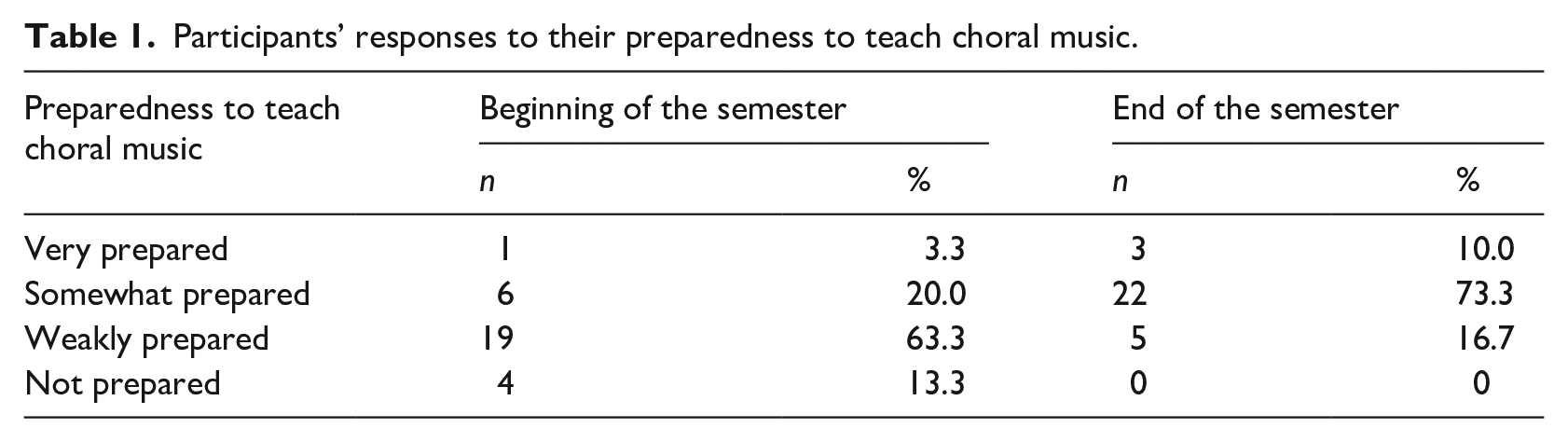
There were differences between the participants’ feelings of preparedness to teach choir at the beginning and the end of the semester. Among the participants, 76.6% (n = 23) felt weakly prepared or not prepared to teach choir at the beginning of the semester while 23.3% (n = 7) responded they felt prepared. However, after completing the choral methods coursework, 83.3% (n = 25) felt they were very or somewhat prepared to teach choir at the end of the semester, while 16.7% (n = 5) still felt weakly prepared. None of the participants indicated that they were unprepared to teach choir at the end of the semester.
The second research question directed participants to indicate if they were interested in teaching the subject at both the beginning and the end of the course. The results for interest in teaching choral music are displayed in Table 2.
Participants’ interest in teaching choral music.
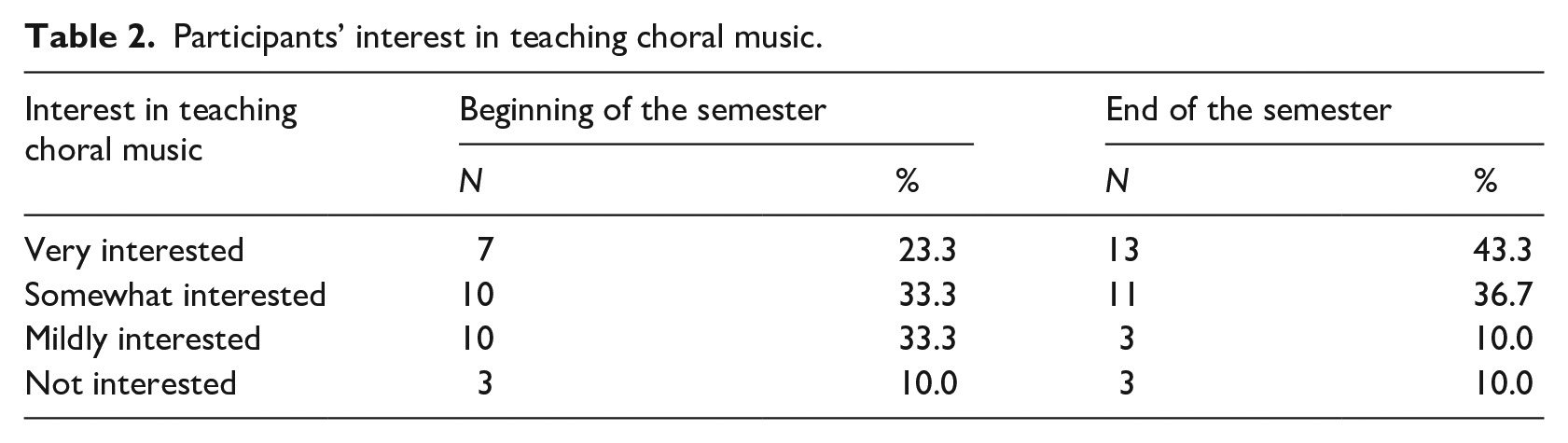
There were differences in the participants’ indication of interest in teaching choir before and after taking the choral methods course. Among the participants, 56.6% (n = 17) expressed interest in teaching choir at the beginning of the semester, while 43.3% (n = 13) responded that they were either mildly or not interested in teaching choir at the beginning of the semester. The number of students that showed interest in teaching choir increased after taking the choral methods course; 80% (n = 24) expressed that they were either very or somewhat interested in teaching choir, while 20% (n = 6) indicated that they were mildly interested or not interested in teaching choir. Even though 10% (n = 3) of the participants responded that they were not interested in teaching choir at all at the end of the semester, none of those participants felt they were unprepared to teach choir.
The third question requested participants to self-assess their comfort on seven essential choral music teaching skills articulated in the survey; students responded to a seven-point Likert scale, with 1 indicating very uncomfortable and seven indicating very comfortable. The means, standard deviations, and mean differences for each of these seven choral music teaching skills assessed are presented in Table 3.
The participants’ comfort ratings for the seven choral teaching skills.
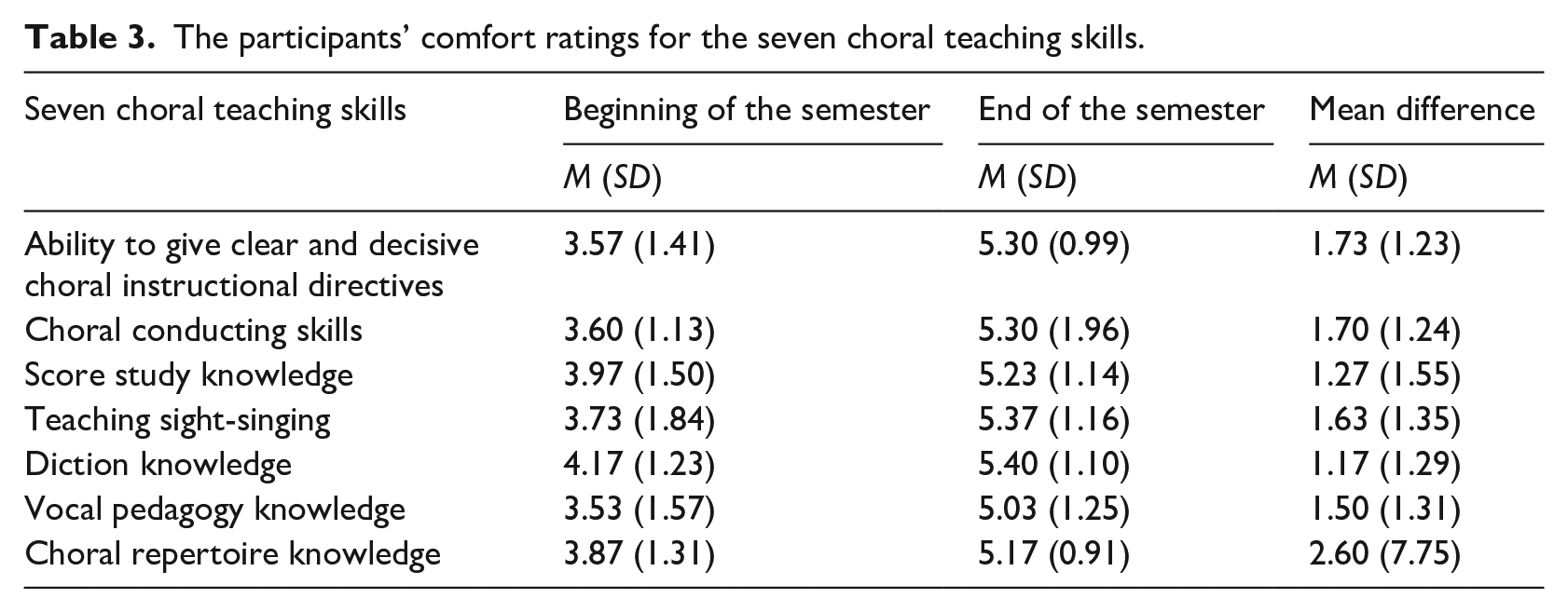
Participants’ overall comfort ratings on the seven choral music teaching skills increased from the beginning to the end of the semester. To specifically explore what participants perceived were the skills they felt most and least comfortable, were they to teach choir, scores were ranked. The following choral skill rankings represent participants’ comfort ratings from most to least comfortable: choral repertoire knowledge, ability to give clear and decisive choral instructional directives, choral conducting skills, teaching sight-singing, vocal pedagogy, score study, and diction.
Discussion
One question to which I was seeking an answer was whether or not students’ feelings of preparedness to teach choir increased from the beginning of the semester to its completion. Initially over three-fourths of the participants indicated that they felt weakly or unprepared to teach choir at the beginning of the semester. However, at the end of the semester, over 83% of the participants indicated that they then felt somewhat or very prepared to teach choir. It is noteworthy that only 16.7% of the participants felt weakly prepared to teach choir at the end of the coursework, but that none felt unprepared to do so. That a majority of undergraduate elementary general music education majors felt unprepared to teach choir at the beginning of the semester, but at the end of the semester a majority felt somewhat or very prepared to teach choir certainly supports the supposition that a single methods course, when prepared and delivered appropriately, can prepare individuals for the possibility of teaching choir in a real teaching situation.
Research questions were constructed to determine whether or not students were interested in teaching choir at the beginning versus the end of the semester. About 43% of the elementary general music education majors expressed low or no interest in teaching choir at the beginning of the semester. However, at the end of the semester 80% of the participants expressed somewhat or high interest in teaching choir; with close to half of the participants stating that they were very interested in teaching choir after taking the choral methods course. Can a single semester choral methods course change the teaching interest of elementary general music education majors? It would seem, based on this study, that effective methods courses can positively influence individuals’ interests to provide instruction in a course outside of their specialization.
The purpose of this study was to determine whether or not participants’ comfort ratings on seven choral music teaching skills would increase from the beginning to the end of the semester. The undergraduate choral methods course taken by the elementary general music education majors appeared to be beneficial in increasing the participants’ comfort levels on all choral music teaching skills; participants’ overall comfort ratings on the seven choral music teaching skills increased from the beginning of the semester to the end of the semester. Overall, the skills the participants felt most and least comfortable were as follows: the most dramatic increase occurred in choral repertoire knowledge, followed by ability to give clear and decisive choral instructional directives, choral conducting skills, teaching sight-singing, vocal pedagogy knowledge, score study knowledge, with diction knowledge being the skill with which participants were least comfortable.
I concluded based on the findings of this study that this specific choral methods class positively influenced the thirty elementary general music education majors’ feelings of preparedness and interest in teaching choir and their comfort in acquiring the required choral teaching skills. This supports Hamann and Ebie’s (2009) findings that while preservice music teachers preferred to teach in their areas of specialization, they felt positive that undergraduate methods courses would adequately prepare them to teach music outside of their specialization areas. The findings from this study also support the importance of using instructor-constructed, course-specific evaluations to assess course effectiveness. While institutionally constructed and/or generic course evaluations offer general types of assessment information, instructor- constructed evaluations can specifically provide the degree to which course experiences enhance students’ feelings of preparedness and interest in teaching choir. Instructor-constructed evaluations can offer additional information by identifying those areas or skills which students find most and least comfortable teaching. From such information revisions to course syllabi can be made to address areas of comparative strengths or weaknesses.
Implications for and applications to the profession
Of the seven choral music teaching skills assessed in this study, participants indicated that knowledge of choral repertoire was the skill with which they were most comfortable and developed the most skill from the beginning to the end of the semester. Scholars suggest elementary general music educators should expand their knowledge of age- and grade-appropriate children’s literature, be exposed to various levels and genres of choral repertoire in a choral methods course and enhance their choral repertoire knowledge (Kim, 2018; Reames, 2001; Spurgeon, 2004; Zeuch, 2014). To this end, I focused on increasing participants’ choral repertoire knowledge which resulted in participants feeling more comfortable using elementary choral repertoire and reinforces the idea that focus on certain skill tasks can indeed produce positive comfort levels.
I emphasized the use of appropriate instructional directives and conducting gestures by incorporating standard elementary repertoire in microteaching settings. Developing clear and decisive instructional skills as undergraduates, learning instructional strategies from past models of their method class professors, and having opportunities to continually practice their conducting techniques are effective techniques in enhancing comfort in choral instructional and conducting skills (Ford, 2001; Legette, 2013; Parker et al., 2017). As a result of such emphasis, students felt comfortable in their abilities to provide clear and decisive choral instructional directives and demonstrate appropriate choral conducting skills in this study.
When analyzing participants’ scoring of the skill teaching sight-singing it was found that this item ranked at a mid-level comfort level among the seven choral skills. Floyd and Haning (2015) stated sight-singing helps young singers advance their musicianship and enhance their choral singing, which saves time in the music learning process in choral classrooms (Melago, 2015). McClung (2001) recommended that choral music educators seek sight-singing teaching professional development opportunities to further develop their pedagogical skills. Given these results and the findings from this study, it appears that participants in this study need to be more comfortable with the skill of teaching sight-singing in the choral classroom and it would be necessary to exercise sight-singing pedagogical skills and participate in sight-singing workshops to enhance their instructional readiness to do so.
When participants’ vocal pedagogy comfort scores were ranked it was found that it was the third lowest in comfort among choral skills. Bass (2009) stated the choir teacher serves in the role of the vocal coach in choral classrooms, and Ebie (2004) reported that students appeared to learn more effectively by listening to their teachers’ vocal demonstrations in choral classrooms. However, Parker and Powell (2014) indicated that instrumental music education majors felt uncomfortable engaging in vocal modeling, leading choral warm-ups, and teaching vocal techniques. To develop vocal modeling skills, it would be helpful to not only visit elementary and secondary choir rehearsals to observe how veteran choral music instructors teach vocal techniques, but also participate in vocal pedagogy classes that are specifically designed to show others how to train young voices.
Score study was found to rank as the second lowest in comfort among participants. Score study prepares preservice music teachers to set clear music goals and objectives for each rehearsal (Silvey, 2011). Byo and Sheldon (2000) and Lane (2006) emphasized that score familiarity reinforces the error identification ability and preparedness, while Stambaugh (2016) stressed that choral score study is fundamental to express a better understanding of the text. Choral score study should be emphasized in a choral methods course to enrich preservice music teachers’ score understanding which would serve to enhance lesson planning, clarify rehearsal goals and objectives, and strengthen performance preparation. It would be helpful to assign several choral study assignments using elementary choral repertoire to provide score study and marking practice opportunities.
Diction was found to be the weakest comfort area among study participants. Appropriate diction instruction is essential in teaching choral music, and diction instruction includes vowel shaping, text pronunciation, and the basic skills of phonation in general (Fisher, 1991; Freer, 2017; Sieck, 2013). To aid preservice music teachers in feeling more comfortable with diction, it would be helpful to emphasize bringing out the text in elementary repertoire choral singing and reading sessions and include useful diction activities while monitoring students’ comfort with and understanding of diction presentation during the choral methods coursework.
Recommendations for future research
This study addressed two valuable areas in music teacher preparation: course specific evaluation and assessment of student comfort teaching outside of their major area. The first value of this study focuses on course specific evaluation. Course instructors normally receive evaluations of course/teaching effectiveness from university/college/school assessment forms at the end of the semester, which provide a generic picture of their efforts. Unfortunately, when such generic evaluations are used, rarely if ever, do they provide information about particular course objectives and goals. To evaluate course effectiveness in future studies of this nature, it is suggested that the following additional assessment procedures be used:
Seeking assessment and feedback from external teachers/evaluators.
Asking for qualitative student feedback on the effectiveness of particular course objectives and goals in addition to the quantitative feedback used in this study.
Having other instructors evaluate their courses using the same rubrics. This study’s rubrics targeted a choral methods course taught by one instructor. It would be interesting to compare evaluations from instructors of other choral methods courses using the same rubrics.
The second value of this study focuses on student assessment. Music education methods course instructors need specific feedback to access the preparedness of our students to teach the subject we are attempting to prepare them to teach. In future studies, it would be helpful to have class participants evaluate the methods course they took by asking for qualitative feedback in addition to the quantitative feedback and by asking several external choral music education professors to assess student preparedness and competencies through pre- and post- in class or videotaped microteaching sessions. Additionally, it would be beneficial to have students videotape their microteaching sessions both at the beginning of the semester and at the end of the semester and use rubrics provided by the instructor to evaluate their levels of comfort in each skill area, identify areas of improvement, and note any uncertainties remaining after completion of the course.
Assessment procedures, such as those used in this study and described above, can enable a methods instructor to evaluate the effectiveness of course content on students’ self-assessed comfort levels on specific choral, commonly required classroom choral teaching skills. Using instructor designed course specific assessment procedures, such as those used in this study and described above, can enable a methods instructor to evaluate the effectiveness of course content on students’ self-assessed comfort levels on specific choral, commonly required classroom choral teaching skills. The question that can be answered is how effective is my course in preparing students to deliver key skill sets comfortably and effectively in real life teaching situations? Using such an assessment strategy can provide an effective vehicle for determining participants’ assimilation of desired course skill acquisition and provide useful data for undergraduate music education methods course instructors to structure intensifed learner-centered courses and strengthen preservice teacher preparation. Furthermore, a new quesiton that I can offer as pathways for future study is what are the areas that students feel unceratin after compelting the course and asking for their qualitative feedback to aid those specific area that they feel insecure.
Such evaluations can also be used to assess the general impact a course has on student preparedness and interest in teaching a particular subject. Assessing participants’ preparedness and interest in teaching a subject from the beginning to the end of the semester provides insights into evaluating course experiences and reviewing course goals and objectives for effective teacher preparation. Furthermore, these evaluation procedures will then influence one’s future instructional course planning.
The participants in this study were elementary general music education majors, who took a choral methods class as a mandatory course to prepare themselves for the possibility of providing choral instruction in a future classroom. The focus of this study was on determining student preparedness to teach and interest in teaching choir as well as their comfort working with certain instructional topics, typically covered in a choral methods class. Such information can be helpful in future course planning. Hence, students’ feelings of preparedness and interest in teaching a subject being presented and comfort in acquiring essential teaching skills can be important areas to review when undergraduate music education methods course instructors assess course effectiveness.
