







Abstract
Academia now has not paid much attention to the career intentions of music performance students from integrated cognitive motivation theoretical perspective. This research sought insights into factors influencing the career intentions of music performance students by empirically combining social cognitive career theory and self-determination theory. Undergraduates from seven Chinese music institutions participated in the survey through self-managed online questionnaires. About 422 valid surveys were used for data analysis using Smart-PLS v3.3.3 to evaluate the measurement and structural models. The multiple regression analysis showed that the proposed model explained 58.3% of the career intentions variance. Self-efficacy, social support, and autonomous motivation positively affect career intentions. Autonomous motivation partially mediated the relationship between self-efficacy and career intentions. This research expands the existing literature on the Chinese music performance industry and helps to propose theoretically driven measures for effective intervention to attract and retain these students.
Keywords
Introduction
Psychologists and researchers have long taken an interest in career intention analysis and prediction involving a wide variety of fields of exploration (Chan et al., 2018; Johnson et al., 2008; Kim & Seo, 2014). The field of music performance industry was not an exception among them (Miksza et al., 2021). Numerous known studies have shown that various factors affect students’ career intentions, such as self-efficacy (Bennett & Chong, 2018), outcome expectation (Diegelman & Subich, 2001), career interests and preferences (Bonneville-Roussy et al., 2017; Johnson et al., 2008), personality and experience of music (Kaufmann & Rawlings, 2004), environment (Parker et al., 2021), career identity formation (Burland, 2005), and self-determined motivations (Miksza et al., 2021). However, a significant number of research relevant to music undergraduates’ career development are concentrated primarily on the group of music education students and their perceptions on music teaching as a career option (Schmidt et al., 2006; Thornton & Bergee, 2008), as well as their motivation to choose teaching as a career (Jones & Parkes, 2010). Additionally, several studies focused on examining teachers’ intentions influenced by identity, values, motivations, and gender perspectives, such as the ones conducted in Singapore (Bennett & Chong, 2018), China (Qin & Tao, 2021), and the United States (Fischer-Croneis, 2016).
On the other hand, although several studies paid attention to music performance students career behavior, most relevant studies tend to explore how to improve students’ employability, how their musical identity changes during the learning process, how these changes affect their future career thinking, and reflect on whether college curriculum construction provides students with sufficient skills and adequate preparation to deal with the workplace (Bennett, 2012, 2016; Pike, 2015; Reid et al., 2019; Rowley et al., 2021), rather than from a theoretical cognitive perspective to intervene the predictors of career intentions of music performance students. Interestingly, Kaufmann and Rawlings (2004) pointed out that when attempting to explore predictive characteristics to manifest the career intentions of musicians, one should consider the musicians’ cognition on both the performing arts career and the individual. Therefore, it is necessary to theorize and clarify career intention behaviors from the cognitive perspective of students.
Considering the likelihood that music performance students would enter the subsequent industry, this involves a series of cognitive behavioral changes. Therefore, the Social Cognitive Career Theory (SCCT), as one of the most prevalent psychological behavior theories, is deemed to have the ability to explain students’ career behavioral intentions (Lent et al., 1994). Moreover, it is critical to attract students with autonomous motivation in an educational setting since high-quality orientation motivation promotes more robust students’ participation in the field (Bonneville-Roussy et al., 2017). However, previous studies demonstrated that the role of motivation varies from field, especially in the music field that highlights ability and talent, which needs to be further investigated (Lavigne et al., 2007).
Taken together, the purpose of this study is to employ an integrated model (social cognitive career theory and self-determination theory) to scrutinize the factors affecting the career intentions of Chinese music performance students. The current research is intended to help related organizations by consciously considering the importance of the career development of music performance students and propose effective intervention measures. Based on the concerning above, the proposed main research question is what factors influencing music performance students’ career intention to enter in music performing industry under the combined theoretical perspective.
Theoretical underpinnings
Literature shows that Social Cognitive Career Theory (SCCT) (Lent et al., 1994) and Self-determination Theory (SDT) (Deci & Ryan, 1985) are the two most verified psychological cognition and motivation theories used to determine individual behavioral intentions in academia (Figure 1). Within SCCT, career intention is a common outcome variable. It was used to measure actions taken by individuals to obtain desired career outcomes (Lent et al., 1994). Similarly, SDT also has the potential to address a broad spectrum of discrepancies in behavioral intentions across a variety of contexts (Feng et al., 2016; Miksza et al., 2021).
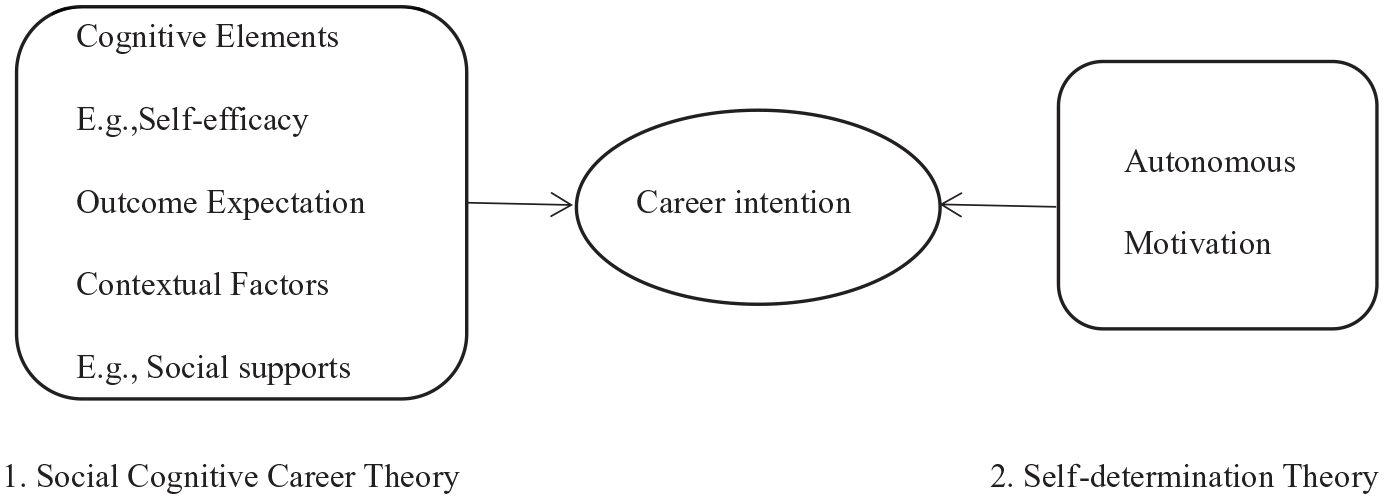
Theoretical framework.
Social cognitive career theory
According to the SCCT, self-efficacy and outcome expectations are the key determinants of behavioral intentions (Lent et al., 1994). Contextual supports and barriers directly or indirectly affect the path of behavioral intentions through self-efficacy (Lent et al., 2011). Self-efficacy is typically defined as individuals’ self-belief of their ability in particular performance domains (Bandura, 1997). Outcome expectation is a confidence calculation of the potential outcomes of a particular action (Bandura, 1997). Environmental factors that facilitate career development are referred to social support. Contrarily, those that can obstruct career advancement are regarded as career barriers (Lent et al., 2001).
The SCCT has been administered to a variety of psychosocial functions and has gained popularity among academics (Chan et al., 2018; Kim & Seo, 2014; Saifuddin, 2015). Nonetheless, as far as researchers are aware, the SCCT has only been documented in a few music-related studies (Bulgren, 2017; Kuebel, 2019; Thornton & Bergee, 2008). Most of these studies are conducted using SCCT as a one-sided approach rather than being systematic. For example, Thornton and Bergee (2008) only tested this theory from a cognitive perspective. Even though Bulgren’s (2017) study covers a wide range of aspects, most of them are discrete analysis. Furthermore, most of the extant studies are qualitative. Although it helps to determine the subject of exploration, it lacks effective quantitative methods. These have paved the way for this research’s implementation and propelled the research in the right direction.
Self-determination theory
SDT regards motivation as a dynamic continuum ranging from external to internal adjustment, and categorizes the different types of motivation (amotivation, autonomous, and controlled) according to the degree of autonomy (Ryan & Deci, 2017). SDT posits that individuals aspire to establish an identity in the world congruent with their internal sense of self. Ryan and Deci (2000) described intrinsic motivation (e.g. a satisfaction of interests, exploration) as the ideal form of self-determined motivation, theoretically placed as an embodiment of an individual’s positive potential, and connected to many favorable outcomes. In the music field, self-determined motivation has always been associated with key behavioral outcomes, such as persistence and future career intention (Bonneville-Roussy et al., 2017; Miksza et al., 2021; Valenzuela et al., 2018).
Within SDT, autonomous motivation was defined as involving in a behavior because that is seen to be congruent with intrinsic aims or outcomes and originates from one’s own self (Deci & Ryan, 2000). The recent literature on motivation consistently shows that autonomous motivation has positive predictive efficacy on career intention. Students with relatively strong autonomous motivation are more inclined to report solid career intentions in the music field (Bonneville-Roussy et al., 2017; Miksza et al., 2021). Thus, it has been integrated into the rigorous conceptual framework. It is speculated that it would improve the overall model’s predictive capacity.
Proposed hypotheses
This research empirically combines SCCT and SDT to explore the career intentions of Chinese music performance students who intend to enter the performance industry, thereby proposing and testing an integrated model. For the sake of clarification, the constructs in this study were operationalized as follows:
(1) Career intention is operationalized as an individual’s plan to obtain a career in the musical performing domain; (2) self-efficacy is operationalized as individuals’ perceived confidence to enter the music performance industry; (3) outcome expectation is conceptualized as students’ expectations evaluation concerning the consequences of entering the music performance industry; (4) social supports are conceptualized as students perceived supports when pursuing the intended career; (5) career barriers are conceptualized as students’ barriers they believed when pursuing the intended career; (6) autonomous motivation is conceptualized as students’ self-determined motivation level to enter the music performance industry.
Figure 2 shows the hypothesized research model for detecting new relationships. Consistent with SCCT’s proposition, self-efficacy, outcome expectation, and environmental variables are the key determinants of career intention. According to existing empirical studies, self-efficacy is a central cognitive factor in predicting career intention of whether students plan to pursue their education or stay in the music industry (Bennett & Chong, 2018; Parker et al., 2021). Moreover, self-efficacy was validated significantly to affect outcome expectations (Cardon & Kirk, 2015; Lent et al., 2010). Thus, the following hypotheses are postulated:
H1. Self-efficacy has a direct positive effect on career intention.
H2. Self-efficacy has a direct positive effect on outcome expectation.
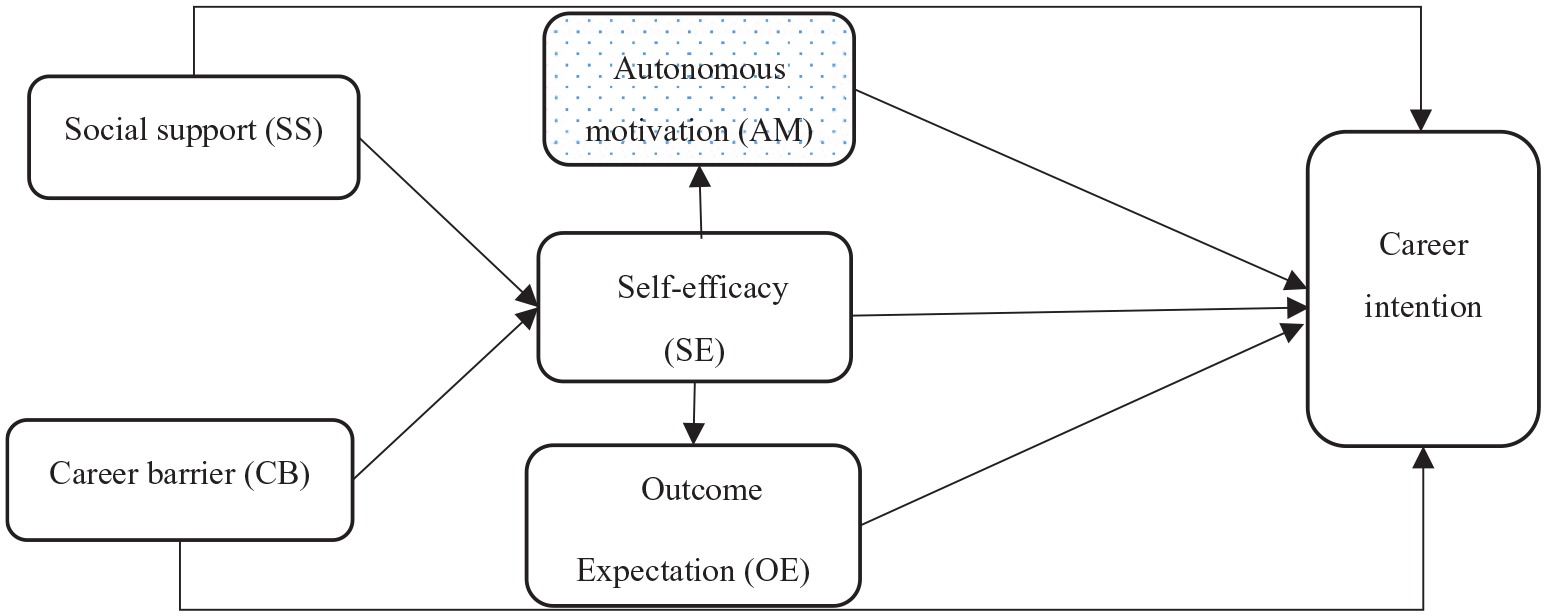
Conceptual framework.
Based on the original hypothesis of Lent et al. (1994), outcome expectation is positively correlated with intention or choice goal. Although only one study scrutinized the relationship between them (Diegelman & Subich, 2001), many studies generally support this hypothetical relationship by verifying the applicability of the SCCT model (Brown et al., 2008; Navarro et al., 2007). In addition, Fouad and Smith (1996) pointed out that there are more indirect paths from self-efficacy to career intention through outcome expectation than its direct paths. Thus, the following hypotheses are postulated:
H3. Outcome expectation has a direct positive effect on career intention.
H4. Outcome expectation mediates the association between self-efficacy and career intention.
The SCCT shows that social support is linked to intention in a direct and positive way (Lent et al., 2005), given that empirical studies have confirmed this hypothesis (Chan et al., 2018; Saifuddin, 2015). In addition, the relationship between social support and intention was established through self-efficacy (Saifuddin, 2015). By contrast, Lent et al. (2005) noted that career barrier has a direct negative impact on choice goals or intentions, which has been validated in cross-domain and international sample studies (Kim & Seo, 2014; Song & Chathoth, 2008). In addition, Lent et al. (2003) believed that career barrier directly or indirectly affects career intention through self-efficacy. Thus, based on this research context, the following hypotheses are proposed:
H5. Social support has a direct positive effect on career intention.
H6. Self-efficacy mediates the association between social support and career intention.
H7. Contextual barriers have a direct negative effect on career intention.
H8. Self-efficacy mediates the relationship between contextual barriers and career intention.
As the highest level in self-determined motivation continuum, previous studies demonstrated that students who owned an autonomous motivational orientation in their careers, their participation in domains, behaviors, emotions, and cognition would have higher quality (Miksza et al., 2021). Therefore, autonomous motivation is perceived as a significant predictor of career intention. In addition, empirical studies showed that both self-efficacy from SCCT and perception of competence from SDT are influential factors in predicting career intentions (Lavigne et al., 2007). The direct connection between perception of competence and intention is consistent with the extensive research on the psychological construction of self-efficacy (Betz & Hackett, 1983; Hackett & Betz, 1989). These two constructs (self-efficacy and perception of competence) can be assumed to be very similar. In addition, empirical research has also confirmed the mediating role of motivation on perceptions of competence and career intentions (Lavigne et al., 2007). However, its mediating effect varies depending on the field (Grouzet et al., 2005; Sarrazin et al., 2002). Researchers advocated for further research in the music domain (Lavigne et al., 2007). Therefore, we infer the hypotheses below:
H9. Autonomous motivation has a direct positive effect on career intention.
H10. Self-efficacy has a direct positive effect on autonomous motivation.
H11. Autonomous motivation mediates the association between self-efficacy and career intention.
Methods
This study conducted a survey among music performance students from seven music institutions in China to collect their opinions and background information. The collected data were utilized to validate the conceptual model through partial least squares structural equation modeling (PLS-SEM).
Participants
The participants are composed of music performance undergraduates (Year 3–5) from seven universities in different geographical regions of China. Due to the non-accessibility of the entire population accessible lists in China, convenience sampling, which is a type of non-probability sampling method, was therefore deemed as an appropriate selection in this research (Lonner & Berry, 1986).
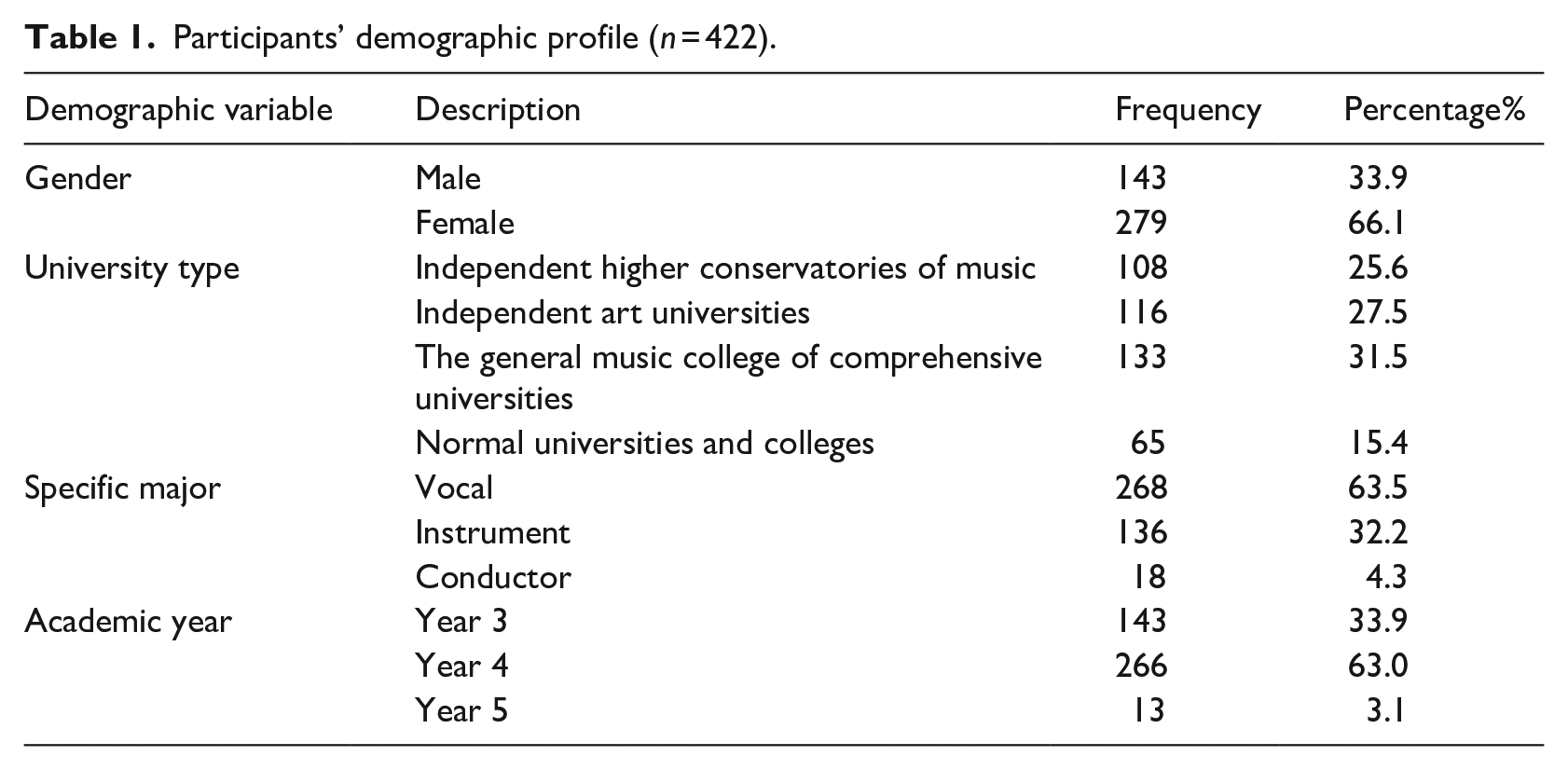
These students are more likely to develop clear and compelling career plans than their peers who have just entered college (Fischer-Croneis, 2016). About 901 questionnaires were distributed, with 724 participants. About 422 valid samples were obtained for data analysis after deleting 302 invalid samples (incorrect or incomplete). The effectivity rate of collection was 58.29%. Table 1 presents the demographic profile of participants.
Participants’ demographic profile (n = 422).
Procedures
Participants engaged in the study in January 2021 through the online survey tool www.sojump.com, a commonly used questionnaire collection website in China. Respondents were required to fill in and select their background information, and they were provided with scenarios in the form of question-and-answer sentences for each variable. The respondents were informed that participate in an anonymous and voluntary form and ensure that their information will be kept confidential.
Instruments
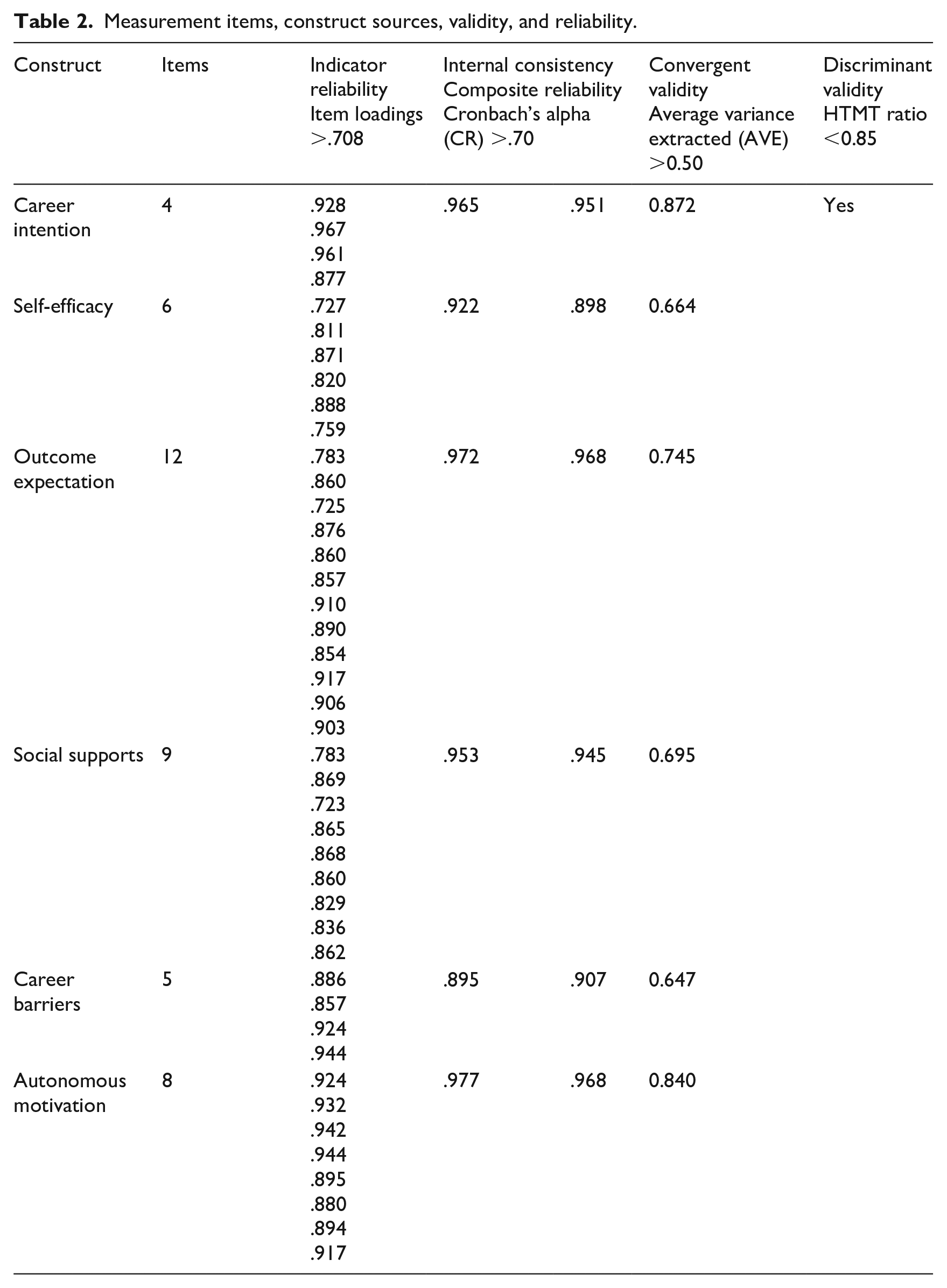
The instruments utilized the statistically validated existing scales in this case. Several items of instruments were properly modified or reworded, to reflect the context of this study. Three experts were invited for reviewing and offering feedback regarding the questionnaire items. Further, a pilot study was performed by employing 60 participants from seven different institutions to determine the attribute of these measures and ensure their comprehensiveness (Lampard & Pole, 2015). The results validated the reliability of the measurements. Table 2 shows the operability and sources of the constructs. Instruments questionnaire see Supplemental Appendix.
Measurement items, construct sources, validity, and reliability.
The questionnaire involves seven instruments and demographics (e.g. gender, university type, major, academic year). Participants reacted on a 7-point Likert-type scale from “strongly disagree” to “strongly agree,” which is deemed suitable for online distribution questionnaires as it provides more selections, which intensifies the possibility to reflect the objective reality of individuals (Joshi et al., 2015). For the sake of clarifying, the greater detailed information is below.
Career intention
This 4-item instrument (α = 0.76) was adapted from the work of Chan et al. (2018) for this study to measure students’ career intention to enter the music performance industry. The background information of “sports management industry” was replaced by “music performance industry.” Measuring career intention in this method followed several prior studies, in which the career intentions were defined operationally as the degree to which people intend and plan to conduct a particular career behavior (Cunningham et al., 2005; Hagger et al., 2001).
Self-efficacy
This 6-item scale was adapted from Chan et al. (2018), with Cronbach α of .88. It was used to measure music student’s self-efficacy to enter the music performance industry with proper modification. Such as changing the contextual information of the “sports management industry” to “music performance industry.”
Outcome expectation
The Vocational Outcome Expectations-Revised scale with 12 items (VOE-R; Metheny & McWhirter, 2013) was adopted to assess students’ perceptions about the consequences of pursuing a career in music performance industry. The scale was considered suitable for current research because it has been administrated and validated based on college students’ samples with a high Cronbach’s α of .93.
Social supports
This 9-item scale was adopted from Lent et al. (2011), with Cronbach’s α of .86. It was used to measure students’ perceived supports when pursuing the intended career. These supports include positive family influences, social encouragement, and access to role models or mentors.
Career barriers
The 5-item scale was adopted from Lent et al. (2011), with Cronbach’s α of .86. It was used to measure students’ perceived barriers they believed when pursuing the intended career.
Autonomous motivation
The 8-item scale of Autonomous motivation (AM) for music performance career choice adapted from autonomous orientations motivation (identified and intrinsic) of Sheldon et al.’s (2017) Relative Autonomy Index (RAI) scale, which was verified its effectiveness of any behavior and role domain. It was used to measure students’ self-determined motivation level to enter the music performance industry. This scale was validated in a previous music study (Miksza et al., 2021), with the internal consistency α = .89, α = .95 on two sets of samples, respectively, proving the validity and applicability of this scale.
In this study, several specific terms derived from Sheldon et al.’s (2017) measuring have been adjusted accordingly to match the current career-relevant context. In addition, to make the content of the items more explicitly, the wording of the original items was modified to reflect music performance background. For example, the content of original intrinsic motivation (e.g. because I enjoy) was concretized as “because I enjoy performing”; the original identified motivation items (because I strongly value X) was modified as “Because performing on the stage will help me improving my skills.”
Data analysis
This study performed PLS-SEM with Smart PLS software v3.3.3 for both measurement model and structural model assessment. The reflective measurement model assessment involved four important evaluation criteria. First, indicator reliability (item loadings >.708). However, if the AVE and CR thresholds reach .50 and .70, the loading between 0.4 and 0.7 was allowable (Hair et al., 2021). Second, the internal consistency reliability (Cronbach’s alpha ⩾.70; Composite reliability ⩾.70) (Hair et al., 2021). Typically, Cronbach’s alpha value ranges from 0 to 1, which above .70 is acceptable (Cortina, 1993). However, a high alpha value was argued that presents insufficient evidence of the reliability of an instrument. As another option, the CR was demonstrated technically more suitable for measuring internal consistency reliability (Hair et al., 2019). Third, convergent validity (Average variance extracted: AVE >0.50) (Fornell & Larcker, 1981). Finally, Heterotrait-Monotrait ratio of correction (HTMT <0.85 (Kline, 2015) or (HTMT <0.90) (Gold et al., 2001). The proposed model evaluation utilizes three recommended fit indices. The standardized root mean squared residuals (SRMR), root mean square residual covariance (RMStheta) are suggested that capable of determining a range of model fit (Dijkstra & Henseler, 2015; Henseler et al., 2014, 2016). The conservative threshold for SRMR (RMStheta) indexes of below 0.08 (0.12) show a good fit (Hu & Bentler, 1998). As an alternative measure in SEM studies, Normed Fit Index (NFI) is recommended (Bentler & Bonett, 1980). NFI values range from 0 to 1. The closer to 1, the better the model fit. NFI value above 0.90 is typically assumed to be better.
The structural model was assessed to test the models’ predictive power and constructs’ relationships using five criteria. First, the collinearity issue between latent variables was evaluated through the variance inflation factor (VIF <5.0 ) (Hair et al., 2021). Next, the path coefficient significance of the hypothetical relationships between the constructs was examined. Then, the coefficient of determination (R2), the effect sizes (f2), and predictive relevance (Q2) were scrutinized to test the predictive validity of the research model.
Results
The measurement model
Table 2 indicated that all the Cronbach’s alpha indices were in line with the acceptable level lies from .45 to .98, mentioned in the study of Taber (2018). Based on the recommendation of Hair et al. (2019), CR and AVE were reported as well, all of which reached the acceptable level. However, the indicator of CB1 was deleted since its factor loading is slightly lower than 0.40. The rest of the item loadings beyond the threshold of 0.708 proposed by Hair et al. (2021). Additionally, all HTMT values under 0.85, which determine the discriminant validity of constructs in the model.
The structural model
In this study, all fit indices suggested that the tested model suited the data well. The SRMR (RMStheta) values were 0.064 (0.12), which achieved an acceptable level. In comparison, the NFI value was 0.843, which is not great but above the threshold criterion. The result shows no multi-collinearity issues in the research model (VIF <5.0). As seen in Figure 3, the total variance of career intention explained by all direct independent variables was 0.583 (R2 = 58.3%) at a moderate-to-substantial level. Self-efficacy accounted for 44.6% of the variance in autonomous motivation, whereas it alone explained 25.2% in outcome expectation. Social support and career barriers cooperatively explained the total variances in self-efficacy at 40.2%.
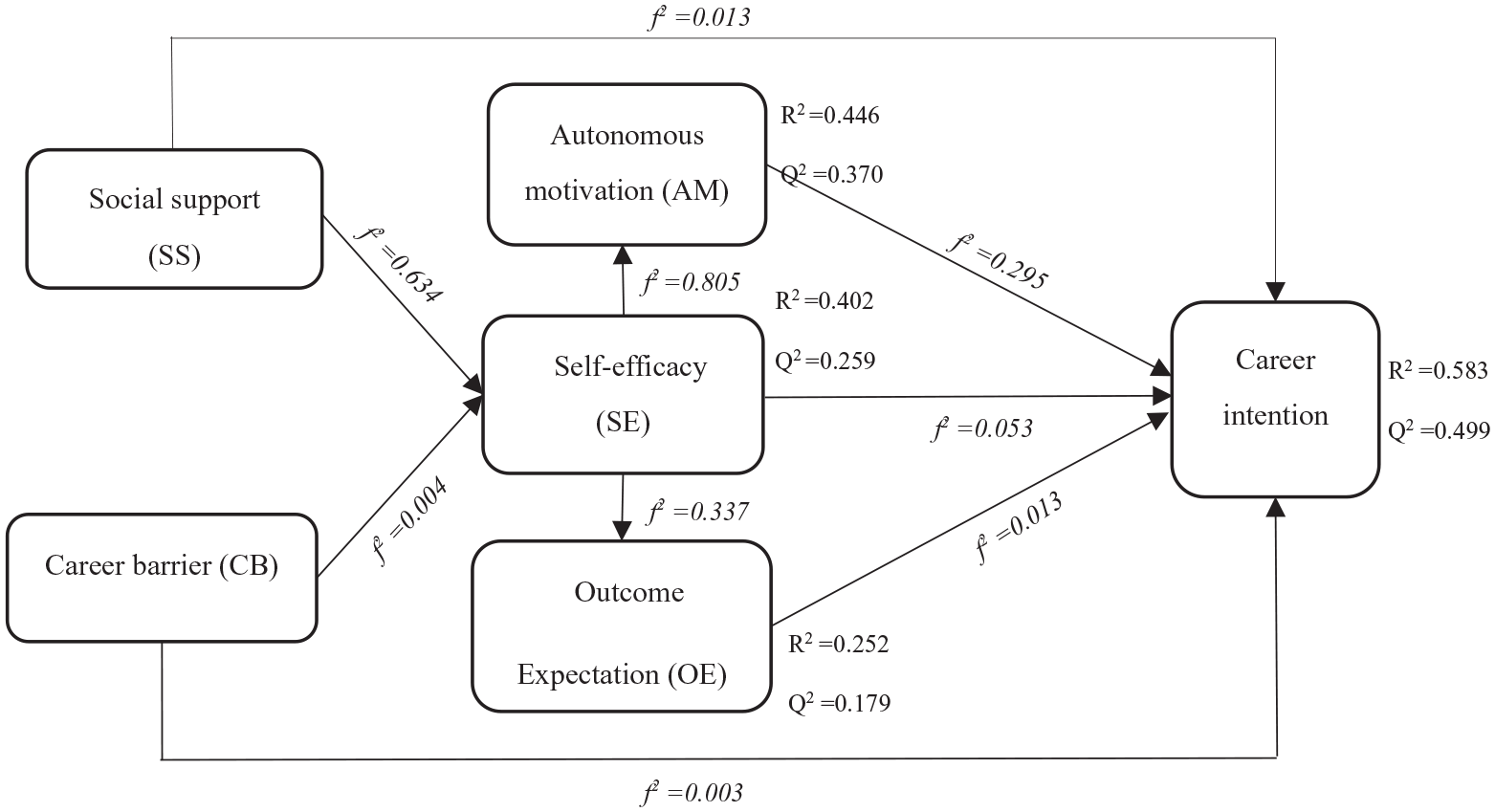
The structural model assessment results.
Furthermore, by employing a bootstrapping procedure, the path coefficient significance of the hypotheses is depicted in Table 3. Except for four hypotheses, the rest of the seven were supported. Self-efficacy significantly correlated with career intention and outcome expectation, with path coefficients β = .211, t-value = 3.872, p < .01 and β = .502, t-value = 13.288, p < .01, respectively. Supporting H1 and H2. On the other hand, H3 and H4 were rejected, as outcome expectation has a statistically significant effect on career intention, but the β value was −.099. Similarly, although outcome expectation statistically significantly mediates the relationships between self-efficacy (t-value = 1.985, p < .05) and career intention, the β value was negative at −.052. Social support (β = .120, t-value = 1.980, p < .05) have both positive effects on career intention directly and indirectly affect via self-efficacy (β = .132, t-value = 3.690, p < .01), establishing H5 and H6. Contrarily, H7 and H8 were rejected, as career barrier (β = −.035, t-value = 0.778, p = .473) indicated neither influence on career intention directly nor indirectly influence through self-efficacy (β = −.011, t-value = 1.073, p = .283). Autonomous motivation (β = .560, t-value = 8.740, p < .01) significantly influences career intention. Self-efficacy (β = .668, t-value = 20.837, p < .01) significantly influence autonomous motivation. Self-efficacy (β = .374, t-value = 8.544, p < .01) has a significant effect on career intention in a positive way via autonomous motivation, supporting H9, H10 and H11.
The path coefficient significance results for hypotheses testing.
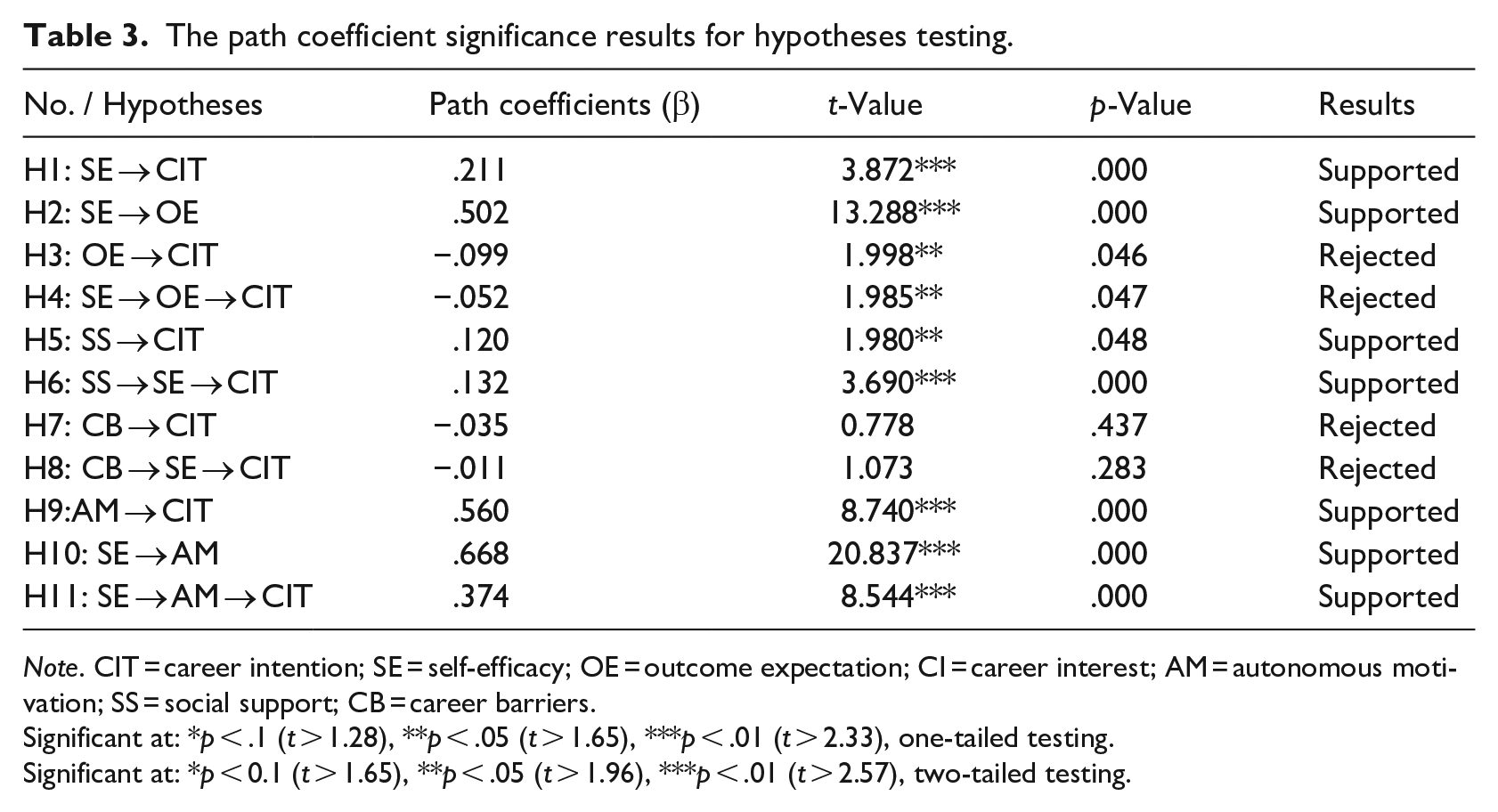
Note. CIT = career intention; SE = self-efficacy; OE = outcome expectation; CI = career interest; AM = autonomous motivation; SS = social support; CB = career barriers.
Significant at: *p < .1 (t > 1.28), **p < .05 (t > 1.65), ***p < .01 (t > 2.33), one-tailed testing.
Significant at: *p < 0.1 (t > 1.65), **p < .05 (t > 1.96), ***p < .01 (t > 2.57), two-tailed testing.
Discussion
This study assesses an integrated research model by combining SCCT and SDT theories to get insights into Chinese music performance undergraduates’ career intention to enter the relevant industry. Through a literature search, this research is one of the earliest studies in China to explore the factors that influence the career intentions of music students through combined theoretical perspectives.
Primary findings
The findings endorsed the integrated theoretical model to assess students’ intentions to engage in the music performance industry as the predictors explained 58.3% of the total variance in music performance students’ career intention. As compared to previous studies by Kim and Seo (2014) (i.e. 37%) and Chan et al. (2018) (i.e. 56%), which predicted students’ career intentions in other majors, the comprehensive model of this research has a higher explanatory power. In general, this research suggested that self-efficacy, autonomous motivation, and social support positively impact students’ behavior intention.
According to the findings of this research, self-efficacy positively and significantly predicted career intention (Chan et al., 2018; Parkes & Jones, 2012) and outcome expectation (Kim & Seo, 2014; Navarro et al., 2007). These findings suggest that Chinese music performance students with higher levels of self-efficacy are more prone to exhibit positive outcome expectations, and subsequently lead to a higher career intention to enter the music performance-related profession. Contrary to several prior studies using SCCT (Navarro et al., 2007; Saifuddin, 2015), the results of this study stated that outcome expectation was negatively related to career intention. A possible explanation is that outcome expectation is not always positive. The negative outcome expectation may inhibit certain behaviors (Bandura, 1977). Moreover, even if a person holds a high self-efficacy, if the outcome expectation is negative, it is possible to inhibit corresponding career intention (Lent et al., 1994). As a consequence of this revelation, music universities can assist students in gaining more positive learning experiences by improving learning environments, thus improving their self-efficacy and stimulating students’ positive outcome expectations to pursue careers in the performing arts.
Moreover, social support positively affects self-efficacy and career intention, consistent with earlier studies (Chan et al., 2018; Lent et al., 2008). This result demonstrates that Chinese music performance students who receive support from their parents, mentors, and significant others are inclined to maintain intense self-efficacy levels. These social support factors would shape their occupational identity and career decisions, echoing the existent viewpoint in music literature (Isbell, 2008; Kos, 2018). In addition, the indirect path from social support to career intention through self-efficacy was confirmed, which suggests that Chinese music performance students who received strong social support are more likely to sustain higher levels of self-efficacy and career intention in the music domain. Therefore, both teachers and parents should be positive concerns for students’ intended career aspirations and support them practically to boost their self-efficacy. Interestingly, despite the existent research indicating the importance of perceived career barriers in the decision-making process (Howard et al., 2010; Saifuddin, 2015), this research failed to confirm the significant connections between career barriers and career intention and the indirect relationship from career barriers to career intention through self-efficacy. In short, social supports, rather than career barriers, plays a more significant role in Chinese students’ career choices (Saifuddin, 2015).
This research strives for innovation by extending the SCCT through involving autonomous motivation from SDT. As expected, the significance of autonomous motivation was identified by its direct influence on career intention. This finding is compatible with what was reported in existing studies (Bonneville-Roussy et al., 2017; Miksza et al., 2021). Likewise, Parkes and Jones (2012) also found that intrinsic interest value was the most crucial consideration while choosing a career in music performance. It means that students love music performance from their innermost being, leading them to their related careers afterwards. In general, the quality of motivation tends to be a definitive explanation for students pursuing a career; music performance students with autonomous motivation are more inclined to continue pursuing this career.
Additionally, this research confirmed the relationship from self-efficacy to autonomous motivation congruent with Bandura’s (1977) original postulation that motivation is derived from efficacy beliefs. Also, the findings resonated with the perception that competence (self-efficacy) positively affects motivation (Lavigne et al., 2007). Meanwhile, the partial mediation of autonomous motivation was confirmed to transfer the correlation from self-efficacy to career intention in a positive way. The results demonstrate that the music performance field is similar to the field of science, that students’ behaviors and choices are affected not only by their motivations in musical performance but also by students’ understanding of abilities and skills to perform well in music (Lavigne et al., 2007).
Implications
Theoretically, the results of this study verified the rationality and effectiveness of adding autonomous motivation to the SCCT model, which complements the existing research. Not only that, this study generated new empirical evidence by examining the mediating effect of autonomous motivation on self-efficacy and career intention. Besides, this research responded to the call of Lent and Brown (2019) and can be considered as one of the few studies that use SCCT in the music field in China. Thus, this study has broadened its appraisal in terms of promoting academic themes and career paths.
Practically, the results of this study could assist music institution administrators and related practitioners in developing and implementing effective strategies to enhance music performance students’ career intentions by understanding the role of cognitive factors. Music performance ability is the most important (and often the only) prerequisite for career advancement in the performing arts (Parkes & Jones, 2012). Thus, educators may provide a way to improve students’ abilities and confidence by regarding the four sources of self-efficacy and career expectations (Bandura, 1997) to encourage students to choose a related career. The most reliable source is students’ own enactive mastery experience (Schunk & Usher, 2012). Specifically, music educators can consider providing venues for students to cultivate autonomy and control their learning to promote enactive mastery experience (Deci & Ryan, 2010) and subsequent self-efficacy development (Renwick & McPherson, 2002). Through cultivating positive beliefs in music performance as a career expectation and stimulating students’ desire in performing arts. Besides, music educators should also fully understand the students’ inherent motivations and attitudes toward music performance during the training process. It may be helpful to show them the importance of music performance. In addition, music practitioners should also pay attention to the impact of environmental factors on students’ careers, since the long-established apprenticeship teaching style wherein teachers are active while students are passive (Gaunt, 2008), teachers’ guidance, and encouragement become meaningful. It was expected to improve the efficiency of students’ decision-making.
Limitation and future research
This research has noteworthy flaws. Firstly, cross-sectional designed studies, which poses a methodological limitation. The present study only measures music performance students’ intention, the results cannot be determined over time whether the key factors will still affect students’ career intentions. As a result, developing a longitudinal research design is a future suggestion. Secondly, this research only discusses the cognitive motivation held by music students in the process of generating career intentions, but it does not explore sources of them and how to influence them. For example, what impacts students’ experiences in college have on their self-efficacy could be addressed by interviews, which may be able to solve this problem in depth. Third, it is interesting that a group of researchers emphasized that coordinating self and career is a vital but neglected aspect of career decision-making (Rowley et al., 2021). Understanding the importance of career self and career decision-making is also exactly what Lent et al. (2016) put forward. They believe that determining the effect of learning is directly related to future career thinking and is adjusted through cognition, which was worthy considered for further study.
Conclusion
This paper established its rationality by evaluating a comprehensive cognitive motivation model, which verified that autonomous motivation is an effective determinant for career intentions, thereby expanding our comprehension of the career decision-making of Chinese music performance students. The results objectively respond to the research hypotheses proposed in the article and show that cognitive factors, motivation, and environmental factors have different degrees of influence on students’ professional intentions. They jointly shape students’ career intentions. The findings bring new perspectives to the administrators and music educators of music institutions that can promote the development of corresponding tactics. In the future, it is essential to conduct a longitudinal investigation based on this research by incorporating antecedents and testing the degrees of factors affecting students’ cognition, as well as the longitudinal design of career intentions to real career choices.
Supplemental Material
sj-docx-1-ijm-10.1177_02557614221077445 – Supplemental material for Factors influencing the career intentions of music performance students: An integrated model analysis
Supplemental material, sj-docx-1-ijm-10.1177_02557614221077445 for Factors influencing the career intentions of music performance students: An integrated model analysis by Ziyun Wang and Kwanyie Wong in International Journal of Music Education
Footnotes

References
Supplementary Material
Please find the following supplemental material available below.
For Open Access articles published under a Creative Commons License, all supplemental material carries the same license as the article it is associated with.
For non-Open Access articles published, all supplemental material carries a non-exclusive license, and permission requests for re-use of supplemental material or any part of supplemental material shall be sent directly to the copyright owner as specified in the copyright notice associated with the article.
