







Abstract
Demonstration lessons are used in China to provide models of quality music instruction. However, to date, no research has been done on the quality of demonstration lessons and how this relates to the improvement of school music education in China. This content analysis provides an insight into China’s music demonstration lesson implementation and its contextual adaptation for student-centered education (SCE). A total of 19 music demonstration lessons over 760 minutes have been examined, using both a systematic observational method and a qualitative thematic analysis method to look at in-class behavior and interaction. An analysis of data reveals that: (a) direct content-driven activities are still taking dominant roles in class, (b) students’ individuality is seldomly promoted, (c) activity-based lesson structures have become prevalent, and (d) sequential patterns under a behaviorist perspective still can be seen in China’s demonstration lessons. Although findings may not necessarily represent exactly what is happening in a regular school setting and it reveals a different adaptation of SCE compared to an international perspective, it serves as a starting point for understanding the official educational views of China and a different angle in perceiving the adaptation of SCE in practice under China context.
Introduction
Student-centered education (SCE) aligning with contemporary educational reform is regarded internationally as one of the most prevalent teaching and learning approaches (Schweisfurth, 2011). Rooted from constructivism, it brings a new educational perspective from relying on knowledge being delivered passively from outside to the inner autonomous construction (Webster, 2015), and further supports the “whole person development” by its promotion on multiple competencies and individuality from the Sustainable Development Goals (UNESCO, 2015).
However, while SCE wins many applauses for its theoretical conception, it also causes controversial discussions on its application (Schweisfurth, 2011). The argument that the implementation of SCE is limited due to the diverse educational contexts has merit, but in what way the lesson is being contextually conducted should be first explored and then make the comparison in SCE being adapted. Without understanding the specific operational aspects in lesson implementation, evidence might get vague and overwhelmed when questioning the effectiveness of SCE (Bremner, 2020; Starkey, 2017).
Then, how should we notice the practice happening in the educational context, especially in a classroom setting? Researchers found that classroom observation, with its nature in receiving detailed operational insight and offering future practical guidance, could provide valuable lenses for in-class practices (Bakeman & Quera, 2011; O’Leary, 2020). In application, observational studies for lesson implementation have been done by international researchers from a teaching perspective in lesson structure and teaching behaviors, a learning lens in students’ behaviors and their learning approaches, and a learning effectiveness aspect in diverse kinds of activities for a long time (Alford et al., 2016; Dorman, 1978; Draper, 2017). Many practical issues have been found through classroom observation and later supported pushing forward the educational reform (O’Leary, 2020).
When zooming in the lens to China context, although SCE has been officially written in the national guiding publication, Music Curriculum Standards of Full-time Compulsory Schooling (hereafter, “Curriculum Standards”) issued by the Ministry of Education (2011), and recommended by many local music educators, the specific lesson implementation in an SCE learning era was still remaining majority unknown (Yang et al., 2021). Therefore, this study uses observation of video recordings by using demonstration lessons to investigate how China music class is presently conducted and in what ways SCE-based activities are embedded in music lessons. The result would provide not only empirical evidence for Chinese educators to understand how selected demonstration music lessons are conducted under a SCE-oriented national guidance, but also offer international researchers a perspective to understand what the official educational views are in China and how SCE is being adapted under China context.
Theory of student-centered education
Student-centered education root in the philosophy of constructivism with an epistemology in people making sense of the world through individual constructions of reality, and knowledge is constructed rather than discovered (Schweisfurth, 2013). Different from an objective perspective on behaviorist notions of “what to know” (Schwandt, 1998), constructivists prefer subjectivist epistemology on “how to know” and “how people come to know” (Denzin & Lincoln, 1998).
In theory, constructivism comprises “cognitive constructivism” and “social constructivism,” two ways of defining how people receive knowledge (Shively, 2015). Cognitive constructivism emphasizes the process of adapting, achieving, and constructing knowledge in highly individual ways. Thus, people maintain ideas, configure new information from their environments, adapt themselves to new environments with fresh abilities, and eventually create a logical understanding of their updated circumstances (Eni Astuti, 2018; Piaget, 1964). In contrast, social constructivism views knowledge as being shaped by involvement with cultural and social interaction. Using the ontology of “humans are social beings,” social relationships become central to the learning process (Schwandt, 1998; Wiggins, 2015).
In education, constructivism provides the new perspective of seeing learners construct their conceptions actively from both internal cognitive formation and external engagement with themselves and their living environment (Wiggins, 2015). It contains an educational goal to promote effective learning, construct positive learning environments, and fulfil learners with considerable social skills (Schweisfurth, 2011). Since constructivism is not about teaching practice but a theory in knowledge and learning (Webster, 2015), the specific pedagogical approach based on constructivism is often recognized as a “child-centered” or “learner-centered” approach, which often presents as a “student-centered” education (Scott, 2011; Webster, 2015).
Adaptation of student-centered education
In recent decades, SCE has started spreading like a “traveling policy” from the original western context to the entire world (Schweisfurth, 2013). The concept and its related pedagogies were adopted into local educational curriculum reforms in territories such as Europe (Sin, 2015), Africa (Mtika & Gates, 2010), the Maldives (Biase, 2019), Singapore (Bautista et al., 2018), the United States (Wiggins, 2015), and China (Law, 2014). With the increasing positive feedback on the stimulation of students’ active thinking, inquiring, and creating, SCE was also confidently applied in multiple subject domains (Bremner, 2020).
However, when many applauses are raising for SCE, the effectiveness in adaptation also caused some controversial discussions (Schweisfurth, 2013). For example, the benefit of strengthening students’ individuality and respecting their varieties by SCE has been mentioned by Elena (2015), whereas Komatsu et al. (2021) argued that the overemphasis on individuality might extend the belief in ontological individualism, which further stymies the “interdependent-collective social benefit” and “sustainability.” Also, when Thompson (2013) promoted that SCE as a western approach could be effectively adapted internationally when promoting properly, Brinkmann (2015), on the contrary, using Indian education as an unadaptable example, raised several concerns, especially for implementing SCE in developing countries.
Actually, similar implementing concerns were also realized by other researchers. In terms of SCE application in education, any situations like unrealistic assumptions toward the theory, limited physical resources, inadequate theory-related training, unsupportive cultural environment, and remaining educational tradition might easily turn the ideal assumption of SCE into the realistic unsuccessful adaptation (Cleaver & Ballantyne, 2014; Schweisfurth, 2013; You, 2019). Due to the concept of SCE having a wide-ranging nature which might be defined and perceived differently based on implementors’ understanding and their teaching environments, researchers suggested that SCE in local contexts should be explored, and the interpretation toward SCE should be more flexible and broadly to match with local contexts (Bremner, 2020; Starkey, 2017).
SCE in China music education
Following the logic in exploring SCE in a local context, studies in China found that SCE has not only been written into China music Curriculum Standards but also highly recommended by many China music educators for its implementation in practice (Chai, 2009; Li, 2017; P. L. Liu, 2012). Similar to SCE being advocated under western context for its benefits on music competencies such as musical independence, musical understanding, and creative thinking (Coss, 2019; Weidner, 2015), Chinese educators added perspectives from a broader education concept and stated that SCE could support “autonomy and engagement” and “comprehensive abilities and artistic promotion” (Chai, 2009, pp. 42, 43) in a music learning environment. Li (2017) further illustrated that SCE matches well with China’s music curriculum reform, and its implementation would enhance the effectiveness in the general music class.
However, compared with the diverse empirical studies in SCE implementation under an international perspective, the situation in China, especially at the primary school level, remains unknown in most aspects. Through a careful meta-analysis, using Chinese research articles published between 2007 and 2019, 16 out of 3,257 studies were reported as relating to the primary school level music context with details of fieldwork data and research methods (Yang et al., 2021). The Author (2019) conducted an empirical study by using a nationwide questionnaire survey of 2,206 music teachers to understand the implementation of the Curriculum Standards. However, the data was self-reported and based on teachers’ perceptions rather than on any observable data that supported a comprehensive understanding.
To this end, since context might vary the implementation of SCE from a global comparative perspective and there is lacking empirical evidence in China’s context, it is necessary to investigate how lessons are implemented in China’s music class under the national guidance with an SCE perspective. This study aims to firstly explore how music demonstration lesson is generally implemented in video recordings provided by the Guangdong Academy of Education from a time spending perspective and then explore the implementation of the activities with an SCE intention in practice. The findings from the following research questions would be combined to present a general picture of the lesson implementation in China’s music demonstration lessons and the implementation of SCE in China context based on the observing features. Accordingly, two research questions were proposed:
How is the time being spent in the proportion of various categories in lesson structure, teacher behavior, student behavior, learning approach, and activity types in demonstration lessons?
In what ways are SCE activities being implemented in a demonstration lesson setting?
Methodology
This study adopted content analysis methods (Krippendorff, 2018) to examine the pedagogy within video recordings in music education contexts. Sequential observational analysis (Bakeman & Quera, 2011) in tandem with qualitative thematic analysis (Miles et al., 2018) were the dominant data analysis methods for exploring the behavioral practices observed in 19 video-taped Music Demonstration lessons. The combination of both statistical data and descriptive vignettes provided a comprehensive picture of the lesson implementation in music education and the implementation of SCE’s activities under China context.
Research data
Following a census data collecting strategy (Krippendorff, 2018), the research data comprised of 19 (5 Grade 1, 5 Grade 2, 3 Grade 4, 5 Grade 5, and 1 Grade 6) video recordings of elementary school music classes in the 2018 Guangdong Music Class Demonstration Event (GMCDE). With a nature in aligning with Curriculum Standards, these lessons taught in Mandarin were originally selected as demonstration lessons by a group of music education experts who were representing the Guangdong Education Bureau from the total 109 participating lessons. During GMCDE, these demonstration lessons (see http://thematic.zy.gdedu.gov.cn/index.html) were conducted again on a performing stage with a group of unfamiliar students and being videotaped formally for later public observation and research purposes (Guangdong Academy of Education, 2018). The non-participant observation method was adapted for observing the downloaded videos to “see what is there” rather than “making inferences” by investigators (Bakeman & Gottman, 1997).
More specific information about this event, firstly, each length of the lesson was 40 minutes long excluding 2 to 3 minutes flexible time. Secondly, participating students came from one primary school in the host city, Jiangmen, with an average class number between 30 and 40. Moreover, two video cameras, one was facing the teachers (see Figure 1), and the other was positioned in the center of the audience seats with a 90° side view of the lesson (see Figure 2), were used for the recordings. All recording videos are accessible from the Guangdong Department of Education’s website as a public learning resource. Copyright permission allowing the use of the videos for research purposes is given on the website (Guangdong Academy of Education, 2018).
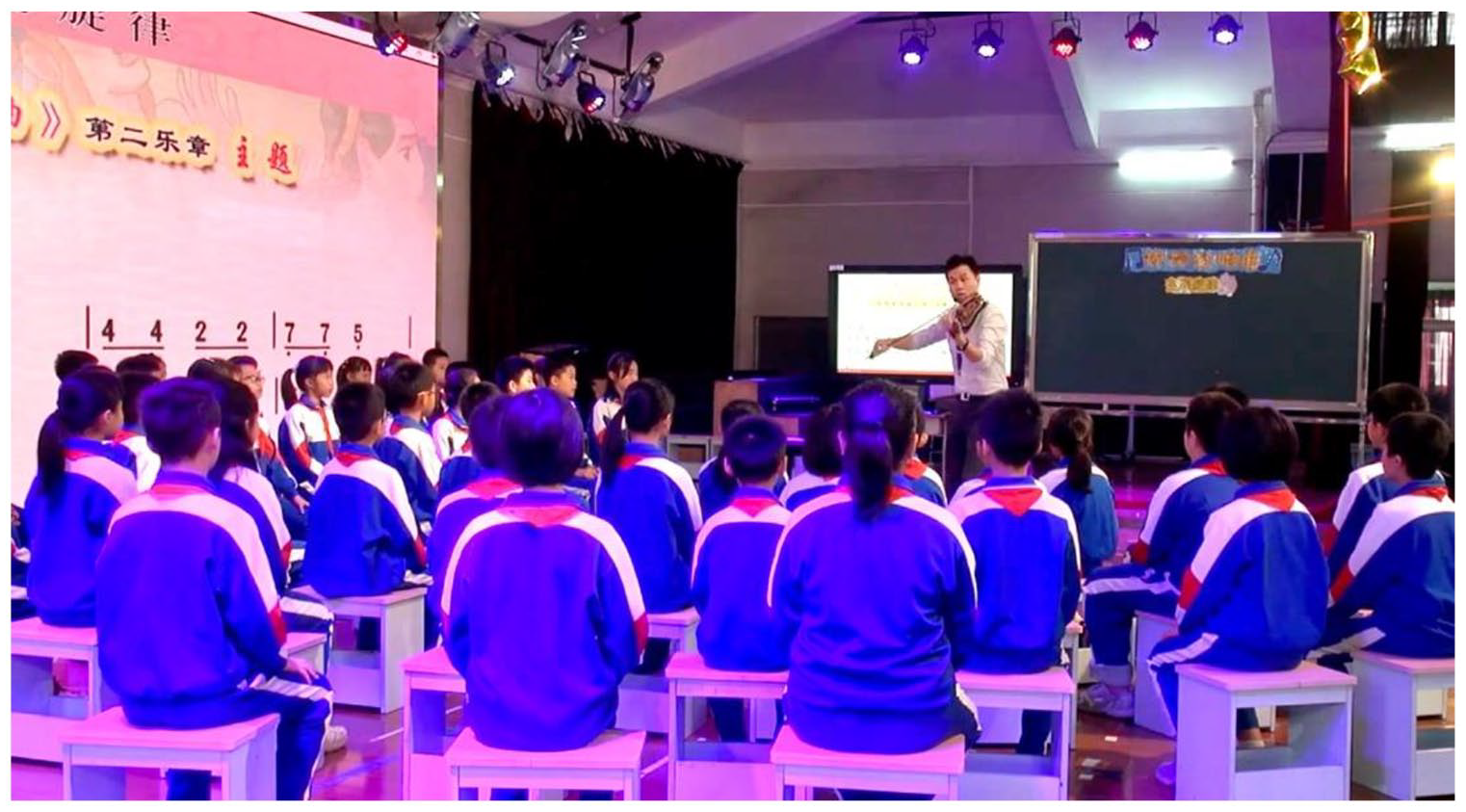
Example of the demonstration lesson from the first camera’s perspective.
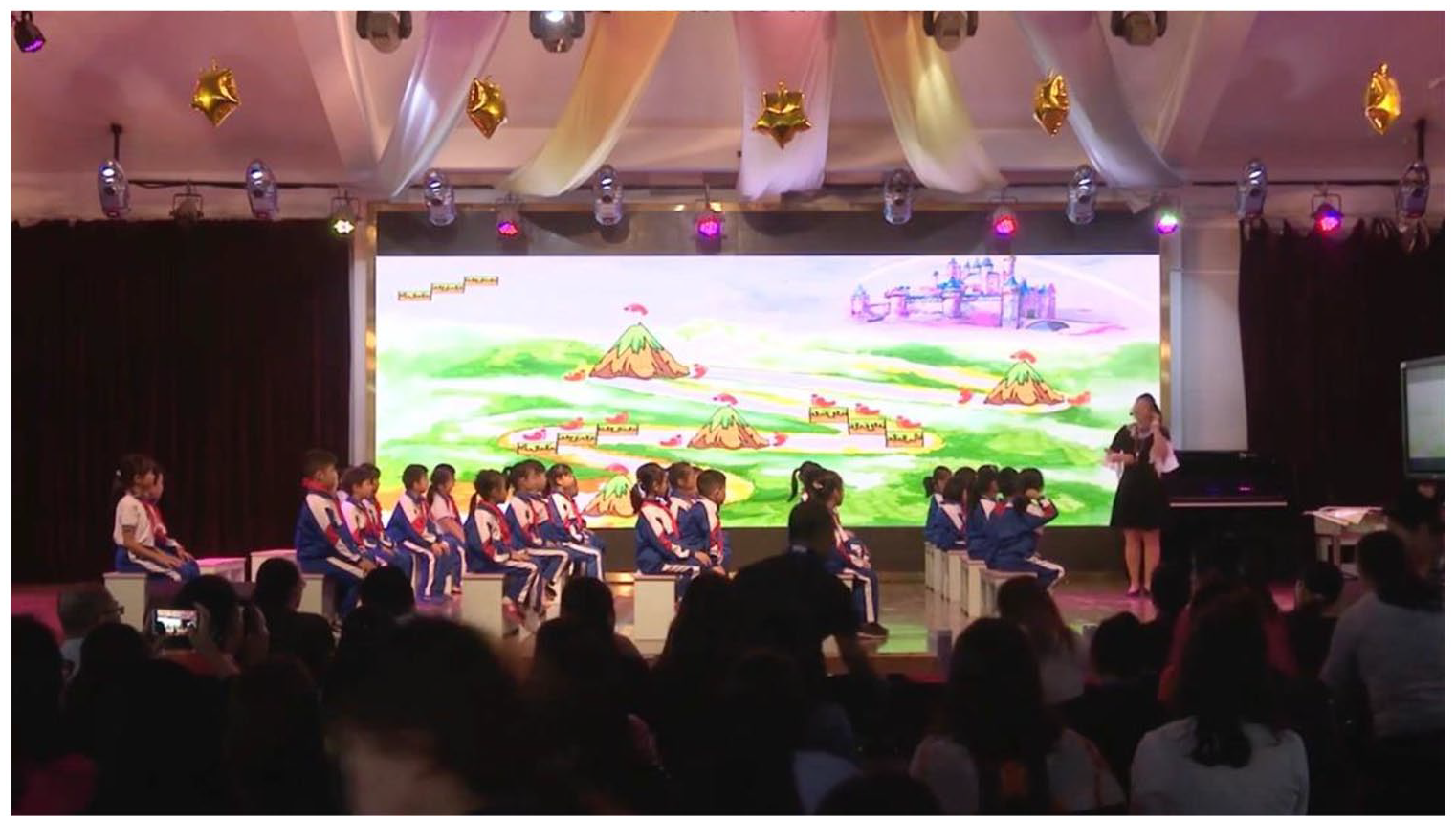
Example of the demonstration class from the second camera’s perspective.
Data analysis
First, the 19 videos were imported into MAXQDA (Kuckartz & Radiker, 2019) for coding and subsequent categorical analysis of classroom behaviors. Based on previous literature (Achen & Lumpkin, 2015), a list of five categories were formulated before the analysis began. Specific codes under each category were drawn from the data during the process of analysis. Similar to the methods used in Yang and Welch’s (2016) study, each lesson was divided into consecutive minute-long sections. Any independent section that crossed two continuous minutes was determined by proportion. To obtain standardized coding criteria, any time of fewer than 30 seconds between 2 minutes was counted as the previous minute. Conversely, any time of more than 30 seconds in-between minutes was added to another minute. Video coding was used for both descriptive statistical and interpretive (observational) data analysis. Every video recording was coded by time-event for the length of 40 minutes (Bakeman & Quera, 2011).
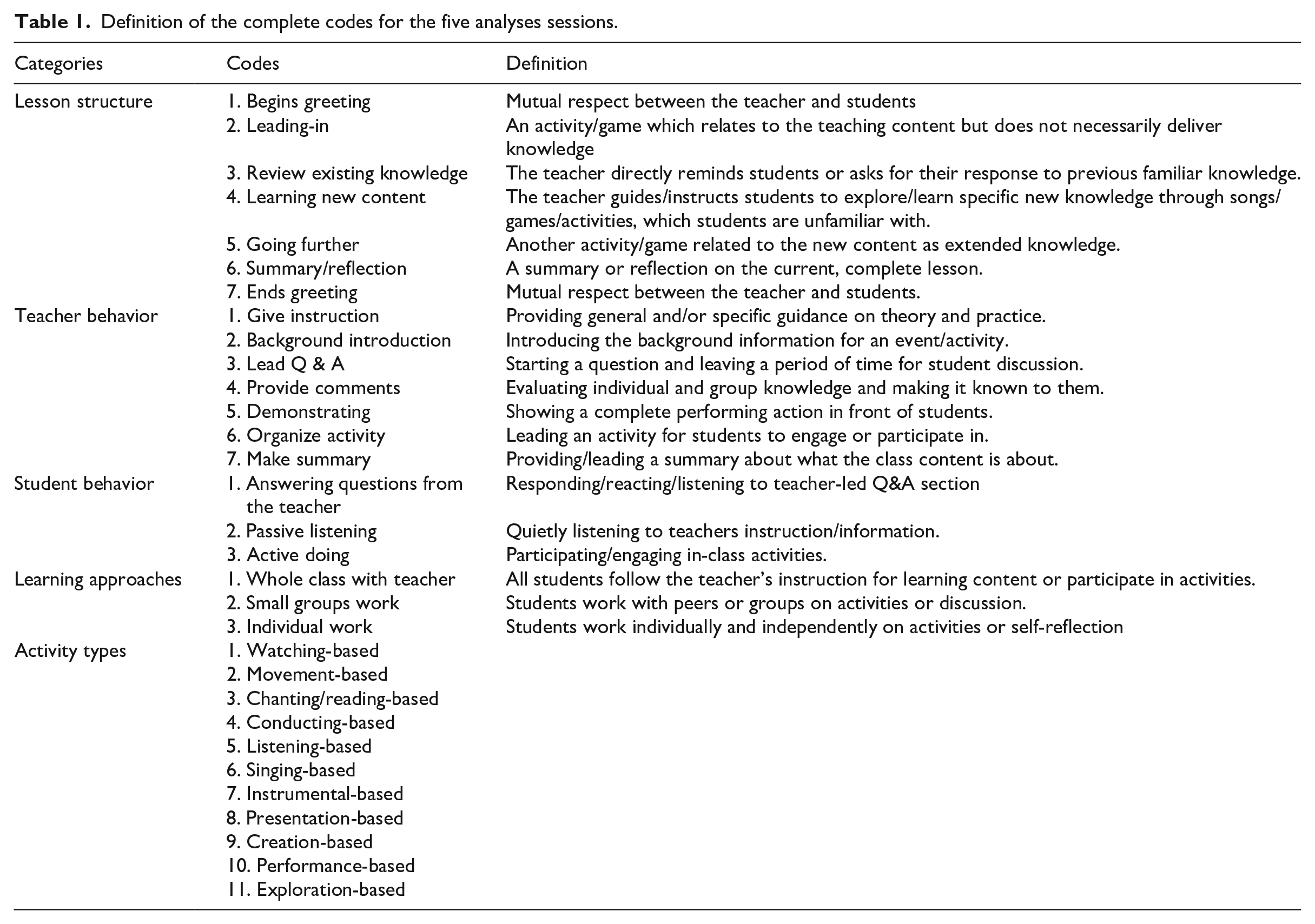
The five coding scheme categories were gathered from the current literature. Teacher behavior and Student behavior were selected as they were the common observable aspects in classrooms (Alford et al., 2016). Lesson structure refers to standardized lesson organization and is an important assessment criterion within China’s teaching context (Zhang, 2017). Learning approaches are similar to the setting (Alford et al., 2016) but are renamed to emphasize how students work in class. The final coding category, Activity types, was added to help explain the character of interaction between teachers and students. A distinct working definition (see Table 1) was given to each coding category to ensure the five categories were “mutually exclusive and exhaustive” (Bakeman & Quera, 2011).
Definition of the complete codes for the five analyses sessions.
In total, 19 videos with 760 minutes were analyzed in the current study. To ensure the accuracy of the coding scheme and the trustworthy of the large data, two reviewers were invited in an “observer agreement” process (Bakeman & Quera, 2011). At first, the first author proposed a set of codes with specific definitions derived from 19 video recordings to the first reviewer, who was the second author of this study. Then, the first reviewer viewed the first three video clips to verify the consistency using the same coding definitions and provided his suggestions.
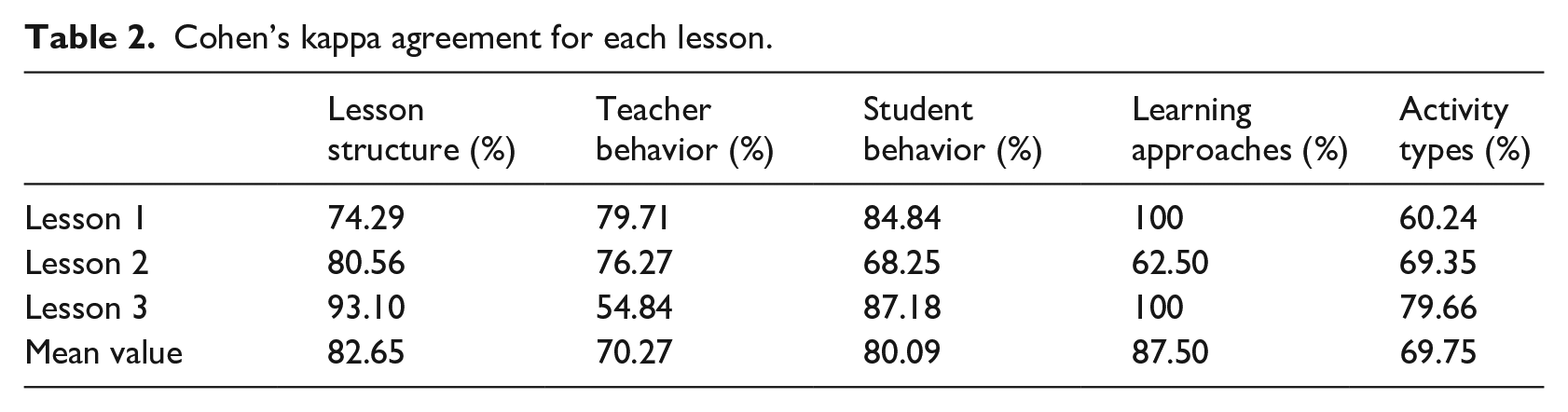
After determining the potential codes, the second reviewer, a school music teacher with more than 20 years of teaching experience, was invited to participate in an “interrater agreement” by applying Cohen’s Kappa’s point-to-point agreement (Bakeman & Quera, 2011) with the first author. In this process, firstly, three random videos, excluding the first three, were selected by the second reviewers. Then, following the standard of setting up the time interval in minute, each category with codes was displayed in an agreement matrix with both tallying agreement and disagreement for each minute (see Figure 3) and calculated by “Cohen’s kappa agreement statistic” (Bakeman & Gottman, 1997, p. 62). Eventually, the mean value of three lessons for each category obtained the overall agreement of 83%, 70%, 80%, 88%, and 70% for codes within Lesson Structure, Teacher behavior, Student behavior, Learning approaches, and Activity types, respectively (see Table 2).
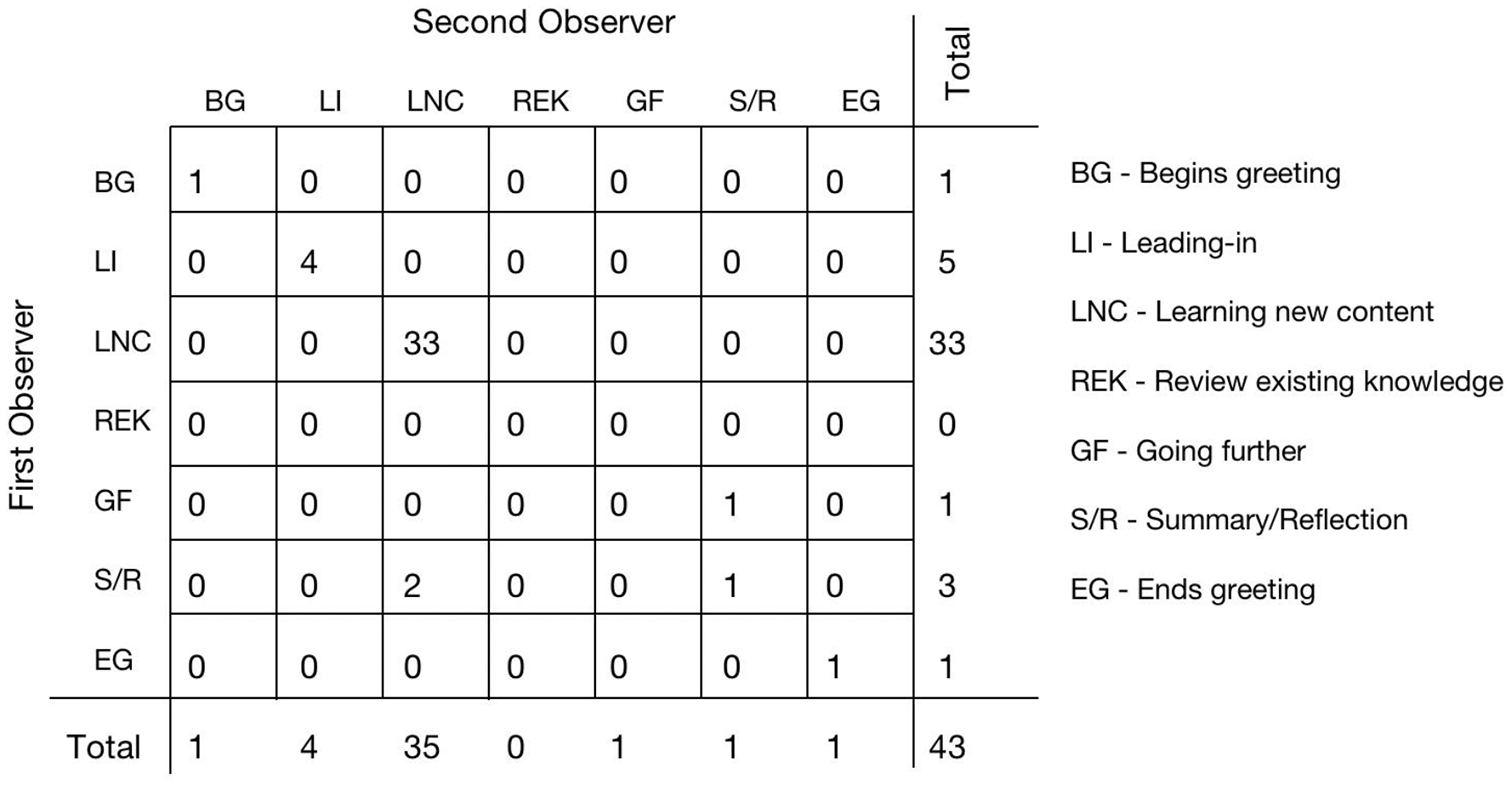
An example of an agreement matrix for coding in lesson structure.
Cohen’s kappa agreement for each lesson.
All video recordings were anonymous after downloading and stored safely within a separate file for this research. A pseudonymous strategy was also employed during the analyzing and reporting process. This article reports part of a doctoral study written by the first author, who had gone through an ethical review by her university.
Results
Lesson structure
To form an overall concept of how teachers organize their lessons, seven codes were identified. Regarding the single lesson structure, learning new content (LNC; 29.56 minutes, 73.91%) had the greatest amount of time devoted to it, whereas review existing knowledge (REK) only occurred in two lessons (3.07 minutes, 7.67%). The other categories, leading-in (LI), going further (GF), and summary/reflection (S/R), have been discovered frequently, and presented an interesting sequential pattern of structural design. A consistent pattern with the fixed sequence in LI–LNC–GF–S/R was found in demonstration lessons. Except one lesson does not have GF, this sequential pattern appeared as a fixed lesson structure in nearly all 19 lessons.
Teacher behavior
Unlike teachers in the past that spent a large amount of time providing instruction (Li, 2017), the findings revealed an increasing tendency for teachers’ organize activity (range 12.18–25.11 minutes, M = 18.02). Give instruction (range 6–12.13 minutes, M = 10.21) occurred as the second largest category, followed by lead Q&A (range 1.29–11.02 minutes, M = 5.64). Comparing with the largest amount of time spent on activities and knowledge delivery, other four teacher behaviors with discovered proportions between 3% and 6% could be regarded as the less time intensive but repetitive in classroom status.
Student behavior
Student behaviors were categorized into three aspects, passive listening, active doing, and answering questions from the teacher. Within the 40-minute lessons, students’ passive listening (range 9.91–28.24 minutes, M = 18.97) occurred slightly more than active doing (range 4.71–28.04, M = 15.8). However, to avoid the extreme data variance between lessons, the strategy of counting medium was considered a complementary result for passive and active statuses. A reverse result showed that active doing (23.29 minutes, 58%) was more frequent than passive listening (19.16 minutes, 48%). As a result, a relatively balanced time spending for students’ static and dynamic learning circumstances can be assumed from the observations.
Learning approaches
Although group work and collaboration were regarded as the defining factor of a SCE class (Bautista et al., 2018), a great contrast was found in whole class with teachers (range 35.02–40 minutes, 97%) in the demonstration lessons. Because most student time is spent following teachers’ guidance and working together, individual work and small groups work was seldomly noted. Among 19 lessons, six were found to involve group collaboration of an average 6.58 minutes. Independent learning was only found in two lessons, one episode of 2.31 minutes and another of 4.98 minutes.
Activities types
To indicate what possible activities might occur during the lessons, five different types were pre-determined by the event organizer for the 19 demonstration lessons. They were (1) 11 Singing Lessons with an emphasis on song singing; (2) Five Music Appreciation Lessons with a focus on music listening; (3) One Music Perception Lesson, which is structured with more conceptual understanding; (4) One Instrumental Lesson with instrument practice; and (5) One Creative Lesson nurturing of musical creativity. Based on the observed 11 types of activities (see Table 2), the average time spending on singing-based (17.27 minutes), listening-based (21.60 minutes), watching-based (11.00 minutes), instrumental-based (30.00 minutes), and creation-based (22.00 minutes) activities, respectively aligned with the above five types of lesson appearing as the longest episodes of activities.
Besides, although multiple types of activities have been shown in demonstration lessons, singing-based activity was still the most occurrence as it was found in all types of lessons with a large proportion of the time. The briefly appearing activities, such as chanting/reading-based and presentation-based, might function as a quick transition – either to evoke students’ learning motivations or just as a showcase for presenting more diverse forms of activity-based organization at the demonstration level.
Statistic descriptive data in RQ1 provides an overall status of lesson implementation from a time spending perspective but not a detailed insight into how SCE has been embedded in practice. Because organizing multiple activities have been increasingly found in teachers’ behaviors but with more emphasis on teacher-led singing-based over student-centered exploration-based and creativity-based activities, there is also a need to understand the implementation of SCE activities in action. Therefore, in this section, qualitative vignettes were documented to answer RQ2 and provide a specific description of the implementation of SCE-suggested activities in China’s application. According to the features of SCE, exploration-based, creation-based, presentation-based, and performance-based were selected to illustrate their initial purpose of promoting student-oriented active participation and musical expression (Shively, 2015; Wiggins, 2015).
Exploration-based activities
Four video recordings demonstrated exploration-based activity. Teachers’ specific instructional words, such as encouraging students to “find out,” “discover independently,” and “think and try,” were all regarded as hints that an exploration-based activity was occurring. Two different kinds of “exploration” were observed during the lessons.
The one that occurred occasionally was when teachers assigned an activity, providing a small amount of time for allowing students to independent discovery and practice. An example is given below: Before a collaborative activity starts, the teacher assigns students into groups and says, “Now, each group will be given two minutes to play the notes on the melody card with the sound bells. Everyone should practice this step, and take turns in playing on the bells and practicing hand signs when singing.” During this activity, the teacher walks around and watches the working process of each group. Then, she stops at each group and listens to students’ dialogues with immediate feedback on the difficulties and problems. Eventually, the teacher asks each group to present their findings and practices.
The majority kind of “exploration” was found as using oral encouragement for students to “find out” what the content fact is but not leave actual time for students to independently think and explore how and why. An example is given below: After teaching how to define a dominant tone in a plain melody, the teacher informs students that the following task would be a difficult type of music variation. He raises the suggestion of asking students to try out defining, but then quickly started singing the melody out loud by pointing out each note on the board. When it comes to the repeated melody, the teacher turns his volume down as a hint but continues singing. When finished, he does not provide time for students to think or practice independently; instead, he asks students to give the answer immediately. With a clear reminder from the teacher (pointing notes and volume control), two voluntary students successfully point out the answer.
Creation-based activities
In total, 10 lessons presented creation-based activities in class. Except for the only one Creative lesson with at least half of the time spent on creativity, creation-based tasks were either rarely found or only had short periods of time devoted to them in other types of lessons. Arrangement was the predominant creating process in the Creative lesson.
In this lesson, the teacher firstly performs a familiar song X with the first half of X arranged in pop style. Then, the teacher encourages students to try out arranging the second half independently. Before the creativity starts, a few given music sections with each unique musical pattern are firstly provided by the teacher. Then he asks students to select their favorite ones to replace the original sections in songs as practicing arranging using the replacing strategy. Later, the teachers provide a few minutes for students to work independently for a free arrangement of the song X.
In other lessons, creating movements for a song was the most commonly observed creative action. However, similarly to the definition of the second exploration-based activity, the teacher did not provide enough time for students to think and create independently. Rather, teacher-led creativity was mostly noted, as in the example below: In one singing lesson, the teacher turns on an audio recording for students to listen and asks them to create (improvise) their movements. When the music starts, the teacher also begins doing her movements in front of the whole class with students together. Rather than creating independent movements, the majority of students imitate the teacher’s movement. When finished, the teacher does not ask students to do again with their creative thinking but rather gives an encouraging comment of “It’s so great!”
Presentation-based and performance-based activities
Presentation-based and performance-based activities occurred in almost all five types of lessons. The analysis revealed that selected individuals, or small groups of students, invited to quickly present their work after practicing were the most common expression of this kind of activity. Formal presentations with multiple choices supporting personal statements, judgments, or performance were not seen in these lessons.
The performance-based activity started with teachers stating, “let’s perform this song. . .” and “here comes a performance. . .” This kind of activity usually happens toward the end of lessons, where whole classes of students demonstrate what they have learned to the teacher or audience. Formal singing and combinations of performances were commonly noted. Compared with the characteristic of SCE as “performing as solving problems” (Wiggins, 2015), performance in current lessons is closer to “performing as demonstrating learned knowledge.”
Discussion
Lesson implementation in China music demonstration class
The results present a general picture of how music lesson is being conducted in a demonstrational setting from a time spending perspective. In the context of lesson implementation in Guangdong, the music demonstration classroom could be interpreted in the following aspects.
Firstly, the greatest amount of time spent on learning new content with an opposite limited time in reviewing existing knowledge indicated that a content-driven teaching mode dominantly appears in the 19 analyzed music demonstration lessons from Guangdong, China. Although the reason causing the significance of learning new content was explained as the compulsory teaching resources (Yu & Leung, 2019), the lacking opportunities for students to review what they had learned in the past might cause the new-learned content stored in their short-term memories only and forgetting easily in a long-run (Monetti et al., 2006). Also, the missing in-class connection between the newly received, and past learned knowledge would expose students to a high chance of passively memorizing the continued cumulating new facts – rather than actively constructing their own holistic understanding of knowledge (Eni Astuti, 2018).
Secondly, findings demonstrate that the observed music teachers spent slightly more time on conducting activities and forming a balanced learning environment for students’ active doing and passive listening. Different from the traditional teacher-dominated lesson environment in China which direct instruction was being the lead (Li, 2017), the phenomenon of emphasizing class activities illustrates that students’ engagement and participation played important roles in teaching during the music lessons in these demonstration lessons.
Thirdly, direct content-driven activities such as singing, moving, or listening to a specific new piece of music still take a dominant role in the observed demonstration lessons. Compared with the little time spent on the activities stimulating thinking processes such as exploring, creating, and presenting, content-driven activities might reinforce the impression that participating in activities can be passive following rather than active thinking (Wiggins, 2015).
Moreover, a fixed sequential pattern was commonly found when the selected demonstration teachers were structuring their lessons under an SCE concept, whereas sequential patterns are usually used to reinforce certain behaviors through repetitive actions based on a behaviorist theory (Yarbrough & Price, 1989). Due to behaviorists believe that students can be managed under teachers’ instruction and target on the learning consequence rather than the process (Schwandt, 1998), the appeared sequential patterns might reduce student authority over knowledge construction and easily turn back into a teacher-oriented education.
Finally, the large proportion of whole-class learning approaches with little collaboration and independent exploration has revealed a teacher-oriented status aligning with the occurred sequential patterns. Teamwork and peer influence, with their high value in power-sharing (Bremner, 2020), are recommended in both SCE and the China Curriculum Standards but rarely noted in the observed classes. This further supports Wang’s (2011) and Yu and Leung’s (2019) studies that a teacher-centered educational mode might still be prevalent in China music teaching context, especially from a demonstration lesson teaching perspective.
Implementation of SCE in Chinese music education context
Based on the findings, classroom realities in demonstration lessons evidently create challenges for adapting SCE from an international perspective in China’s music teaching practice. On the one hand, educators with an SCE mindset regard music learning as a process of making music and solving problems. It maintains an expectation for teachers to encourage students to think, explore, reflect, and make mistakes during the music-making process (Wiggins, 2015). However, the findings reveal the opposite – students were given inadequate time for independent and collaborative exploration. A content-driven lesson featuring predominantly teacher-led whole-class activities strengthens the impression of a “result-driven” rather than “process-driven” classroom. “Following teacher” but not “independent meaning-making” weakens Bremner’s (2020) finding that “power sharing” is mostly emphasized in creative arts classrooms because of their subjective nature.
On the other hand, the ideal-typical SCE was more effectively adapted in less than 40 students with a flexible movable learning environment (Bautista et al., 2018; Mtika & Gates, 2010). In comparison, each observed demonstration lesson has around 40 students on a limited performing stage, which obviously faces the obstacles for SCE implementation. As previous researchers similarly illustrated that teachers would easily reduce the class interaction and require students mostly passive learning with minimal movements when having overcrowded students in a shortage of space (Brinkmann, 2015; Mtika & Gates, 2010), a teacher-centered environment revealed from the findings is not a surprise in such context.
Similar concerns were also brought up in many other developing countries (Murphy, 2020; Schweisfurth, 2011). The limitation in traditional culture restraints, classroom space, class size, and unsupported resources have all been raised as potential obstacles for constructing a student-centered learning environment (Brinkmann, 2015). Consequently, when Chinese educators keep positive reactions to current SCE implementation (Chai, 2009; P. L. Liu, 2012; J. Liu, 2018) and select these demonstration lessons with less supporting empirical research (Yang et al., 2021), the representative effectiveness should also be challenged for these selected lessons. Without noticing the selection process, what were the criteria for these lessons being chosen, and how well do these “best representatives” represent the reality of what is actually occurring in the schools? When 60 to 80 students sit in a classroom with mostly chairs and desks in a rural area (Wang, 2011), how effective could their teacher study from these demonstration lessons? As Schmidt (1998) mentioned, “best practice” or “good practice” has an implication to apply one approach to solve any difficulties. Would the present status in findings truly be the “best solution” for general school music education in China? This study would not answer these questions but evoke a reflection for policymakers to rethink the meaning of SCE and its implementation and adaptation in actual school practice.
In addition, instead of judging the adaptation of SCE in China due to its implementation difficulties, multiple interpretations of SCE have been raised by many international researchers (Bremner, 2020; Schweisfurth, 2019, Starkey, 2017). In their words, the interpretation of SCE varies due to the educational context. Each region might follow its own interpretation, focusing on any particular aspects of SCE (Bremner, 2020). Following this logic, when Chinese educators believe SCE is implemented well in China, they might consider a “collective student-centered” rather than “individual student-centered.” In other words, when interpreting SCE not for individuality but for collective students’ engagement, the observed findings such as content-driven teaching for unified knowledge acquisition, whole-class learning for standardized class interaction, and majority activities focusing on “doing together” rather than “thinking creatively” could all be explained reasonably.
Conclusion
To fill in the gap of inadequate empirical research in China’s primary school lesson implementation (Yang et al., 2021), this study provides an insight into the selected demonstration lessons, which represents the intention of Curriculum Standards. The results demonstrate two aspects. First, lesson implementation of demonstration lessons in Guangdong, China has shown characteristics in fixed lesson structure, content-driven and activity-oriented teaching mode, and whole-class learning approach. Singing-based activity was still the lead in the present demonstrational music class. Second, even though activities with an SCE intention have occurred in demonstration lessons, they provided fewer opportunities to stimulate students’ thinking, inquiring, and creating skills than what SCE expected from an international perspective. The inadequate time for students’ independent exploration, the shortage opportunities in composing music, and solely performing music as knowledge demonstration rather than solving musical problem give a different perspective in SCE’s adaptation in China compared to an international aspect (Shively, 2015; Wiggins, 2015).
These findings not only presented a general picture of music demonstration lessons’ implementation in China and arose a reflection on how well these selected models represent reality, but also got in line with Bremner’s (2020) multiple interpretations of SCE based on China’s contextual SCE implementation in practice. In an era of globalization that highly influences education, understanding China’s evolution of arts education toward a prevalent world approach contributes to the structuring of a comprehensive worldwide educational trend. However, the actual educational status in a real teaching environment is also essential for understanding music education in China as it might reflect China’s philosophy of music education. Although this research merely investigates the primary music demonstration lessons’ implementation and may not reach broad conclusions, it could serve as a starting point for future studies on understanding the official educational views of China and a different angle in perceiving the adaptation of SCE in practice under China context. Also, since SCE is a global educational trend with multiple cultural and contextual adaptations, it is also important to implement further research to study about how Chinese culture may impact on the implementation and learning effectiveness of SCE in schools.
Findings of this study may imply some changes in teaching practices with support and facilitation from the government policy. First, smaller class sizes may facilitate SCE in music teaching. To encourage individualized reflection and deepening of learning, more individual and small group work could be designed. This requires a suitable class size so that the teacher may be able to manage students’ learning. Consequently, it need a sufficient space for students’ work, implying bigger music classroom with adequate music facilities. More resources are needed to improve the quality of learning. Second, teacher education programs need to be reviewed and reconstructed with more training on SCE. Modern learning theories such as metacognition (apart from constructivism) should be included so that pre-service and in-service teachers would be able to plan, monitor and evaluate their teaching and students’ learning effectively (Schraw, 1998). Only when teachers know what their students are trying to learn, what they know and do not know, how they are trying to learn, how effective their strategies are, and what they can do differently to improve their musical understanding, they may be able to facilitate students’ learning.
