







Abstract
The purpose of the study was to examine music teachers’ philosophical beliefs, and their application of those beliefs to teaching and advocacy in the United States. I also explored the factors that might predict those beliefs and their application to teaching and advocacy. To measure music teachers’ philosophical beliefs, I developed the Philosophical Beliefs (Ph.B.) scale based on the foundational utilitarian, aesthetic, and praxial philosophical perspectives. Using the Ph.B. scale, I conducted a survey through the National Association for Music Education in the United States, and 527 music teachers responded to the survey. The results revealed that music teachers’ philosophical beliefs and their use of beliefs in teaching and advocacy varied among the philosophical perspectives. In particular, the aesthetic perspective was most favored as a philosophical belief by music educators but used the least in advocacy. More experienced music teachers had stronger philosophical beliefs and made more use of these beliefs in practice. I discuss how future work may extend the research in this paper to consider additional philosophical and ethical perspectives of music educators.
Since music education first appeared in the US public school system, many music education scholars have sought to characterize the value of music education and imbue it with meaning. Scholars have argued that a critical examination of one’s own philosophical beliefs can help music teachers make the right pedagogical decisions (Abeles et al., 1995; Elliott &, Silverman, 2015; Reimer, 2003), serve as a guide for designing lesson plans, and encourage a productive learning environment with appropriate learning goals (Bauer & Berg, 2001). A philosophy can also promote an effective and positive classroom environment by prompting music teachers to consider why they teach, what they teach, how they teach, and whom they teach, as they situate learning circumstances in the classroom every day (Austin & Reinhardt, 1999; Raiber & Teachout, 2014). In addition to these pedagogical benefits, a cogent music education philosophy can foster an appreciation for music education in both oneself and others, reaffirming its value (Hodges, 2017; Song, 2022), as well as enhancing one’s critical thinking (Jorgensen 1990; Raiber & Teachout, 2014), professional relationships (Baumgartner, 2020; Greene et al., 2019), and personal growth (e.g. influencing self-identity, self-respect, self-criticism, and self-reflection; Allsup, 2010; W. D. Bowman, 1998; Cholbi, 2007; Jorgensen, 1990). Furthermore, an extended outcome of having a coherent philosophy in music education may contribute to advocacy efforts by generating greater satisfaction among administrators, evaluators, and parents (Elpus, 2007; Powell, 2019; Townsend, 2011).
However, it is unclear whether music educators recognize the value of a music education philosophy in their practice of teaching (Song, 2022), or how it is explicitly and implicitly connected with the practical implications of the philosophical choices that they make on a daily basis (West, 2015). Some music teachers have difficulty developing their philosophical beliefs or in connecting their beliefs with their teaching, due to unfamiliar content, a lack of evidence-based applications, and the ambiguous connection between philosophy and practice (Song, 2022; Stauffer, 2012). Others are skeptical, even believing that music education philosophy is irrelevant to what music teachers do (Beck, 1974; Cholbi, 2007). As a result, many music teachers may be reluctant to devote themselves to philosophical content; they may even neglect to apply their philosophy in teaching (W. D. Bowman & Frega, 2012). Moreover, the hierarchical structure of the education system and cultural habits in music ensemble settings—both of which are associated with titles such as director or assistant director in band, orchestra, and choir—may hinder teachers’ critical thinking and forestall their acting on the basis of their philosophical beliefs in public education settings (Powell, 2019).
In view of these possible benefits and the obstacles that music teachers may face, there is a practical need to explore whether and how music teachers make use of their philosophical beliefs in relation to teaching and advocacy. Moreover, understanding the elements that influence music teachers’ thoughts, behaviors, and decision making may allow teachers to be more mindful about their philosophical beliefs, and their use of those beliefs in teaching and advocacy, ultimately increasing the benefits teachers derive from music education philosophy (Elpus, 2007). For instance, professional position or role (e.g. principal, band director, and choir director) can influence decision making in terms of what and how to teach in class (Powell, 2019; Raiber & Teachout, 2014). Specific personal characteristics, professional background, or demographic attributes (e.g. gender, years of teaching experience, grade level taught, and level of education) may also be associated with underlying cultural influences that affect patterns of decision making (Austin & Reinhardt, 1999; Bauer & Berg, 2001; Elpus, 2007; Shouldice & Woolnough, 2022).
Despite the importance of understanding how these philosophical beliefs can guide one’s teaching practices and the factors influencing those beliefs, the empirical research on these topics is scant. Thus, it is essential to explore how music teachers’ philosophical beliefs may manifest in their teaching practice, and what affects their philosophies, especially in educational settings such as in the United States, where music teachers’ philosophical beliefs can play a significant role in shaping the classroom learning environment (Raiber & Teachout, 2014). By gaining a better understanding of music teachers’ philosophical beliefs and the factors that influence those beliefs, music teacher educators and researchers may be better positioned to help music teachers appreciate the relevance of their philosophical beliefs for their teaching practice, ultimately enhancing the quality of music teacher education.
In the past, scales to measure philosophical perspectives have been valuable tools for understanding music teachers’ beliefs, particularly in relation to the utilitarian and aesthetic perspectives in the United States (Austin & Reinhardt, 1999; Bauer & Berg, 2001; Payne, 1990). However, their use seems to have diminished over time, perhaps because the most recent scale has not been updated in over two decades. Therefore, it is imperative to revise the existing scale. A logical starting point for this update could be the inclusion of an influential perspective that has become established (e.g. the praxial perspective) since the previous scales were developed. This approach can avoid excessive complexity while laying the groundwork for future research, which could include more perspectives.
Purpose
The purpose of this study was accordingly to examine music teachers’ philosophical beliefs, their application of those beliefs to teaching and advocacy in the United States (USA), and the factors that may influence those beliefs and their application to teaching and advocacy. According to W. D. Bowman (1998), philosophy is “an ongoing process of critically examining and refining the grounds for our beliefs and actions” (p. 6) based on a systematic foundation. While various definitions of philosophy exist, I adapted Bowman’s definition because it best aligns with this study’s aim of investigating music teachers’ beliefs and actions within their specific educational context and providing practical implications for their examination. However, because I was unable to determine whether music teachers actively engage in an ongoing process of critically examining their beliefs, I used the phrase music teachers’ philosophical beliefs throughout to emphasize the reflection and responses of the participating music teachers in this study.
The following specific research questions guided the study: (a) to what degree do K-12 1 music teachers’ beliefs and the use of those beliefs in teaching and advocacy align with the utilitarian, aesthetic, or praxial philosophies? and (b) what factors might predict K-12 music teachers’ philosophical beliefs and the use of those beliefs in teaching and advocacy? I focused on the utilitarian, aesthetic, and praxial views for three main reasons. First, these views have arguably been the most widely discussed and established in the US music education field (M. Mark & Madura, 2014), and are, thus, most amenable to the design of survey questions that have convergent and discriminatory validity. Second, I updated the existing scales, which were based on the utilitarian and aesthetic views (Austin & Reinhardt, 1999; Bauer & Berg, 2001; Payne, 1990). Building on existing, established scales enhances the credibility of the updated scale, makes the results of this study more comparable to those of previous work, and provides a basis for adding to the scale in future to incorporate other developments in music education philosophy. Lastly, this study is focused on the philosophy of music education per se rather than on philosophy as relates to music itself or broader social issues.
Method
Instrument development
I followed the process of instrument development suggested by DeVellis (2017). The validity of the measurement instrument was checked in three stages prior to its use in the main study: (1) scale development, (2) survey development, and (3) a pilot study. For the scale development, I began by defining terms and synthesizing the core ideas of each philosophy through extensive review of the literature, and I adapted some scale items from exiting studies (e.g. Austin & Reinhardt, 1999; Bauer & Berg, 2001; Payne, 1990). I also used several references (e.g. Alperson, 1991; Elliott, 1995; Elliott & Silverman, 2015; M. L. Mark, 1982; M. Mark & Madura, 2014; Regelski, 2005; Reimer, 2003; Small, 1998) to generate the items, incorporating in-text quotations associated with each perspective (Miksza & Elpus, 2018). In order to ensure the content validity of the scale, I consulted with a philosophy expert, who had been teaching in higher music education for more than 20 years. Then, I consulted with seventeen field experts, who had recently obtained a doctorate or were doctoral candidates in music education and had teaching experience in a K-12 music classroom. Using a survey in Qualtrics, the field experts were asked to choose which one of the three philosophical concepts was most relevant for each item, and to confirm that the items clearly referred to the intended philosophical concept. The field experts were also asked to provide general feedback on each item. The final version of the Ph.B. scale comprised 30 items (ten items for each philosophical view: utilitarian, aesthetic, and praxial) in a 6-point Likert-type scale, ranging from strong disagreement to strong agreement (see the online Supplemental Ph.B. Scale).
Second, I developed a survey in Qualtrics, which began by asking about participants’ demographic information (12 items). Then, using the same Ph.B. scale, a participant would respond to three sets of questions related to their beliefs (30 items), the use of those beliefs in teaching (30 items), and the use of those beliefs in advocacy (30 items). Each set of 30 items appeared in random order so that each participant read the items in a different order. This randomization of the items minimized question order bias and increased external validity. To avoid overly burdening participants, I ensured that the survey directions were clear, that the items used concise and consistent phrasing, and that participants could finish the survey in under 15 min without difficulty. Third, I conducted a pilot study over 2 weeks through music teacher groups on social media, and I received 185 usable responses. The pilot study confirmed the procedures of the survey and the internal consistency of the scale for each philosophy. Cronbach’s alpha (α) for all subscales indicated a high internal consistency for each of the utilitarian (α = .89), aesthetic (α = .90), and praxial (α = .90) music education philosophies.
Main study
Procedure
I conducted the main study, targeting full-time K-12 school music teachers in the United States. The data collection period lasted 2 weeks. The National Association for Music Education (NAfME: A national organization of music educators in the United States) facilitated survey distribution to its members list (N = 26,263). To increase the survey response rate, a reminder email was sent out a week after the first email through the NAfME system. I also used an incentive whereby every 20th participant who completed the survey and provided an email address received a $20 electronic gift card, funded by the institution with which I was affiliated at the time of the study. A total of 830 members (3.2%) responded based on the information from NAfME, and after data cleaning, 527 (2.0%) usable responses remained. Although the low response rate may limit generalizability, the sample exceeded the recommended size of 400 for populations over 5,000 (Gay et al., 2012), ensuring sufficient statistical power. I also compared the participants’ demographics in this study to the overall population of music teachers to assess nonresponse bias (Miksza & Elpus, 2018), finding that participants were generally similar to the overall population but a bit more educated on average (see the detailed illustration in the Participant Section of the Results).
Data analysis
Using the Statistical Package for the Social Sciences (SPSS, Version 29.0.0.0), I removed responses flagged as duplicates or fraudulent by the ReCAPTCHA (Completely Automated Public Turing Test to Tell Computers and Humans Apart) system in Qualtrics. I also employed listwise deletion (LD) to remove survey responses that were less than 60% complete. If the values were partially missing (less than 40% for one observation), I employed multiple imputation (MI) in SPSS, which can be more efficient and generate more statistical power than LD or pairwise deletion (PD) for partially missing data (Dong & Peng, 2013). Cronbach’s alpha (α) for the Ph.B. Scale showed high internal consistency for the utilitarian (α = .82), aesthetic (α = .83), and praxial (α = .87) philosophies. In addition, a confirmatory factor analysis verified the structure of the 30 items in three factors. The supplementary fit indices (Marsh et al., 1988) indicated excellent ranges for the Comparative fit model [CFI] = 0.978 and Tucker-Lewis index [TLI] = 0.975 (CFI > 0.95; TLI > 0.95); and were in the acceptable ranges for the root mean square error of approximation [RMSEA] = 0.068, and standardized root mean square residual [SRMR] = .069 (RMSEA < 0.08; SRMR < 0.08; Miksza & Elpus, 2018).
Results
Participants
I used descriptive statistics to explore the characteristics of the participants. Among the participants (N = 527), the primary emphasis area of teaching was distributed as 37.0% band (n = 195), 25.2% general music (n = 133), 20.3% choir (n = 107), 11.6% orchestra (n = 61), and 5.9% other (n = 31), which included guitar, piano, mariachi, jazz, and modern band. The participants identified as 58.4% female, 39.8% male, and 1.7% other gender with an average of 16 years of teaching experience. The highest music education (or related) degree received was most commonly master’s (61.7%, n = 325), followed by bachelor’s (31.7%, n = 167) and doctorate (4.7%, n = 25; see additional details in Supplemental Table S1).
To address nonresponse bias, I incorporated a strategy from Miksza and Elpus (2018) of comparing the sample participants’ characteristics to the overall US population of music teachers (Elpus, 2016, Data from the 2011 to 2012 wave of The National Center for Education Statistics). The gender (57.32% female) and the average years of teaching experience (15.3 years, SD = 10.66) from the overall population data were similar to those of the participants in the current study. There were a somewhat higher percentage of bachelor’s degrees and a lower percentage of master’s degrees in the previous study (Elpus, 2016), perhaps reflecting growing interest in graduate education among music educators over the past decade in the United States or that education increased the propensity to respond to the survey: associate’s (3.85%), bachelor’s (44.5%), master’s (44.26%), graduate certificate (5.94%), and doctorate (1.44%; Elpus, 2016).
Music teachers’ philosophical beliefs and the use of those beliefs
To answer research question 1, to what degree do K-12 music teachers’ beliefs and the use of those beliefs in teaching and advocacy align with the utilitarian, aesthetic, or praxial philosophies, I calculated the mean and standard deviation for each combination of the two factors, making nine variables in total, as shown in Table 1. The first factor was philosophy, which came in three levels: utilitarian, aesthetic, and praxial. The second factor, action, also came in three levels: beliefs, teaching, and advocacy. Because of the repeated measure design, homogeneity of variance was not a concern.
Music teachers’ philosophical beliefs and the use of those beliefs.
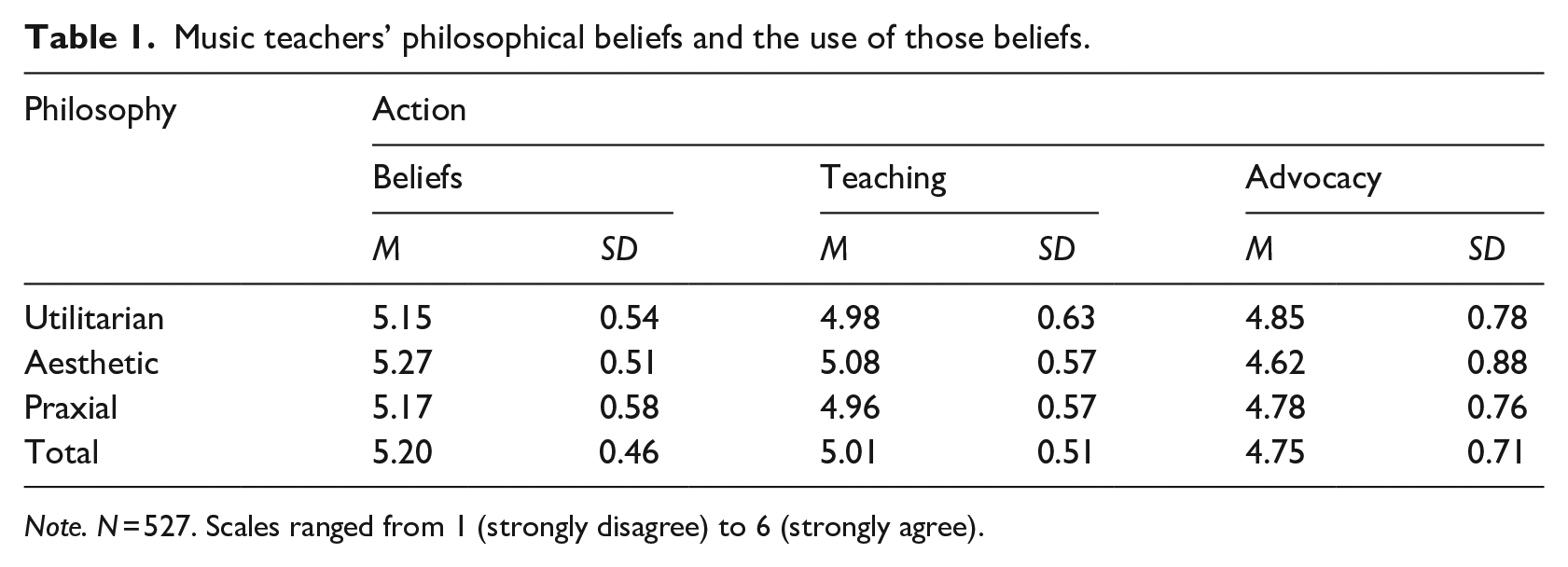
Note. N = 527. Scales ranged from 1 (strongly disagree) to 6 (strongly agree).
I employed a two-way repeated measure analysis of variance (RM ANOVA) with the Bonferroni adjustment. Because Mauchly’s test showed that the assumption of sphericity was violated, I used Greenhouse-Geisser F statistics to adjust the degrees of freedom. The results revealed that there was a significant interaction effect between philosophy and action with a moderate effect size, F (3.08, 1617.66) = 79.30,
For a deeper understanding of this significant interaction, I focused my attention on the cell means, using two forms of analysis: a profile plot, which indicated a markedly disordinal (crossover) interaction (see Figure 1), and the simple main effects approach, which focused on the comparison of cell means (Supplemental Tables S4–S5; Cohen, 2013). All three (utilitarian, aesthetic, and praxial) philosophies exhibited the same pattern: belief in the philosophy was high (Mutilitarian = 5.15, Maesthetic = 5.27, and Mpraxial = 5.17), the use of the beliefs in teaching was somewhat lower (Mutilitarian = 4.98, Maesthetic = 5.08, and Mpraxial = 4.96), and the use of the beliefs in advocacy was lower still (Mutilitarian = 4.85, Maesthetic = 4.62, and Mpraxial = 4.78). The aesthetic philosophy demonstrated the steepest drop-off, having the highest mean for belief (Maesthetic = 5.27), but the lowest mean for advocacy (Maesthetic = 4.62).
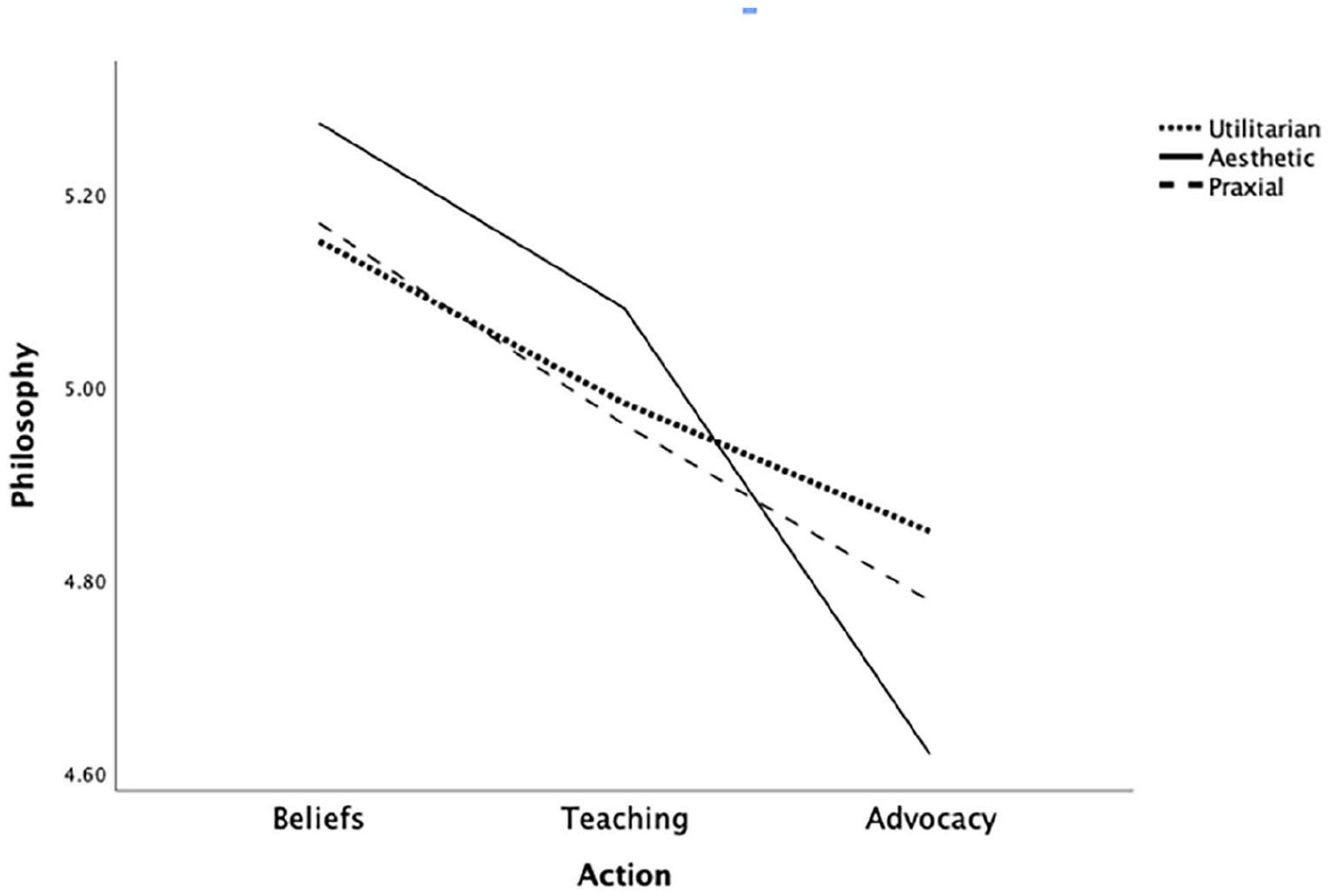
Music teachers’ philosophical beliefs and the use of those beliefs.
Using the simple main effect approach, I examined all possible pairwise comparisons of cell means between actions (beliefs and teaching, beliefs and advocacy, and teaching and advocacy) under each philosophy. This analysis revealed statistically significant differences between music teachers’ beliefs and the use of those beliefs for all philosophical (utilitarian, aesthetic, and praxial) perspectives (p < .001; see Supplemental Table S4). The results of the two-way RM ANOVA provided another set of pairwise comparisons of cell means between philosophies (utilitarian and praxial, utilitarian and aesthetic, and praxial and aesthetic) for each action (see Supplemental Table S5). The results revealed that beliefs, teaching, and advocacy for the aesthetic perspective (Maesthetic and belief = 5.27, Maesthetic and teaching = 5.08, and Maesthetic and advocacy = 4.62) were each significantly different from the corresponding actions for the utilitarian (Mutilitarian and belief = 5.15, Mutilitarian and teaching = 4.98, and Mutilitarian and advocacy = 4.85; p < .001) and praxial perspectives (Mpraxial and belief = 5.17, Mpraxial and teaching = 4.96, and Mpraxial and advocacy = 4.78; p < .001), but there were no significant differences between the utilitarian and praxial perspectives. This analysis corroborated the impression given by Figure 1.
Predictive factors
For research question 2, factors that might predict music teachers’ philosophical beliefs and the use of those beliefs in teaching and advocacy were examined using multiple regression. For each participant, I calculated the means of their responses to all items relating to beliefs, all items related to the use of those beliefs in teaching, and all items related to the use of those beliefs in advocacy. I chose the following predictive factors based on the existing literature (e.g. Austin & Reinhardt, 1999; Bauer & Berg, 2001; Elpus, 2007; Powell, 2019) for two reasons—to make this study as comparable as possible to prior work and to avoid oversaturating the regression with too many variables, which may result in overfitting : (a) primary emphasis area of teaching (general music, band, choir, orchestra, other), (b) gender, (c) years of teaching experience, (d) grade level taught, and (e) the highest degree obtained in music education (or in a related field). For the categorical data (e.g. primary emphasis area), I created dummy variables for every category but the reference category (e.g. general music). Given that only 1.7% of participants identified as other gender, I coded female as “1” and compared it with the reference group of self-identified male and other gender to satisfy the minimum number of observations for a categorical variable (n > 10; Russell, 2018).
To arrive at a final predictive model, I employed multiple linear regression with backward elimination in SPSS. This method proceeds from a fully saturated model and successively removes non-significant variables. Given that the backward elimination method is exploratory in nature, I employed a more conservative alpha (p = .05) rather than the default of .1 in SPSS; that is, at each step, only variables that were significant at a .05 level were retained (Cohen, 2013). Doing so reduced the possibility of Type 1 error. Multicollinearity did not appear to be a concern because the tolerance was greater than .20 and the variance inflation factors were consistently below 4.0 for each independent variable in all regressions (Russell, 2018).
For music teachers’ beliefs, the multiple linear regression revealed three significant predictive factors: years of teaching experience (β = .125, t = 2.792, p = .005), gender (β = .140, t = 3.253, p = .001), and highest degree obtained (β = -.089, t = -1.98, p = .047; R2 = .04, F (3, 523) = 6.76, p < .001). For the use of beliefs in teaching, the multiple linear regression again revealed three significant predictive factors but grade level taught replaced highest degree obtained: years of teaching experience (β = .249, t = 5.931, p < .001), gender (β = .132, t = 3.002, p = .003), and grade level taught (β = .114, t = 2.589, p = .010; R2 = .08, F (3, 523) = 15.29, p < .001). For the use of beliefs in advocacy, the significant predictive factors were the same as those for the use of beliefs in teaching: years of teaching experience (β = .240, t = 5.691, p < .001), gender (β = .105, t = 2.378, p = .018), and grade level taught (β = .100, t = 2.248, p = .025; R2 = .04, F (3, 523) = 6.76, p < .001; see Table 2)
Summary of regression results.
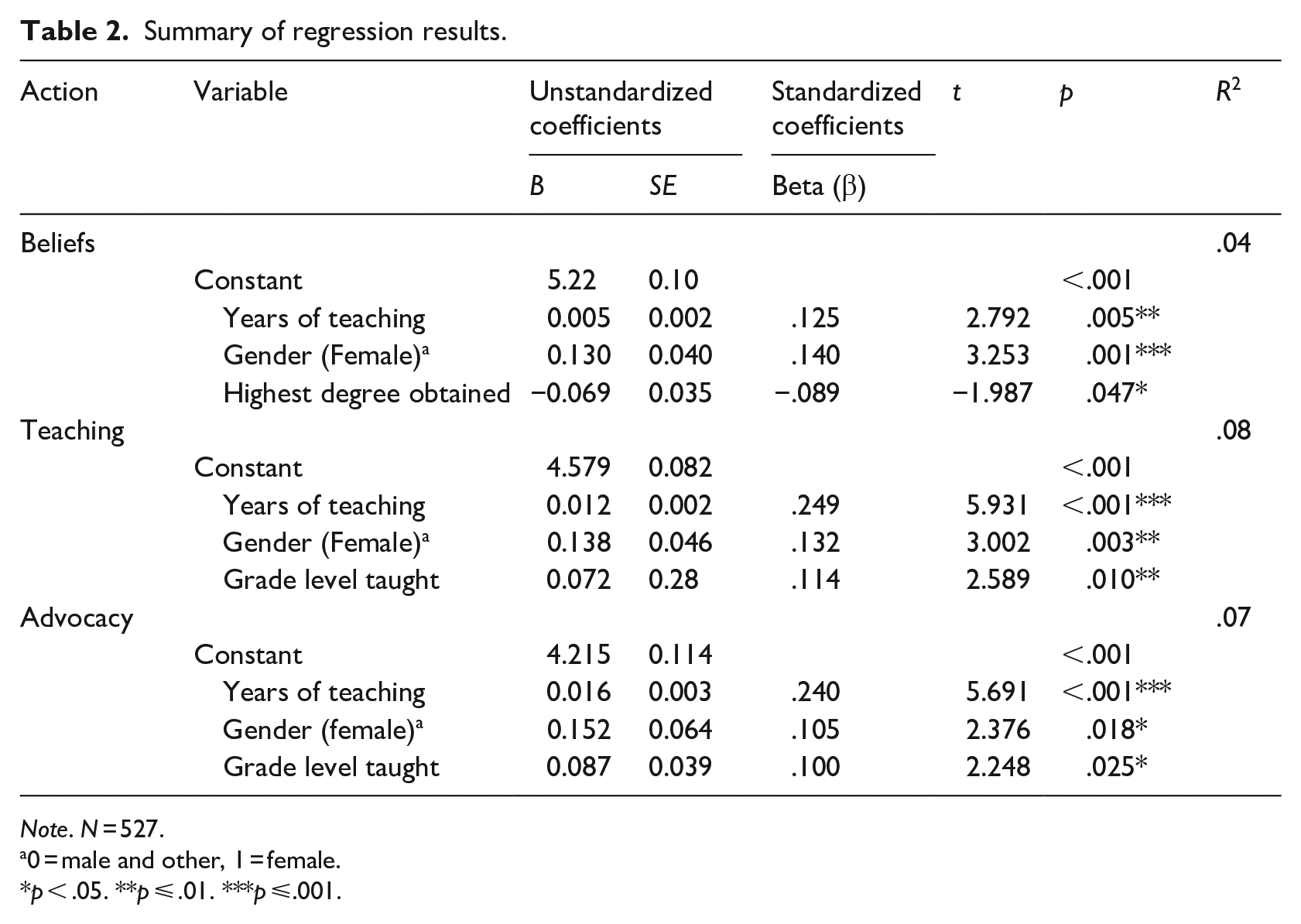
Note. N = 527.
0 = male and other, 1 = female.
p < .05. **p ⩽ .01. ***p ⩽.001.
Years of teaching experience and gender consistently appeared as significant positive predictors of music teachers’ beliefs and their use in teaching and advocacy. The more years of teaching experience a music teacher had, the stronger their beliefs and the greater was their use of those beliefs in teaching and advocacy. Female teachers (in comparison to the reference category of self-identified male and other gender teachers) tended to have stronger philosophical beliefs and make more use of those beliefs in teaching and advocacy. The highest degree obtained in music education (or in a related field) was negatively associated with music teachers’ beliefs. Those significant predictors explained 4% of the variation in music teachers’ philosophical beliefs, 8% in their use of those beliefs in teaching, and 7% in their use of those beliefs in advocacy (The full regression models are in Supplemental Documents Table S6–S8).
Discussion
In this study, I examined music teachers’ philosophical beliefs in the United States and their application of those beliefs in teaching and advocacy, based on the utilitarian, aesthetic, and praxial philosophies. I then explored the factors that might predict those beliefs and their application to teaching and advocacy.
Beliefs and teaching
In this study, music teachers manifested strong beliefs in all three philosophical views. These results are similar to the findings of Austin and Reinhardt (1999), in which preservice music teachers rated the benefits of both the utilitarian and aesthetic perspectives highly. Austin and Reinhardt conjectured that preservice music teachers might have eclectic philosophical beliefs, which they developed from having been exposed to diverse philosophical rationales in music education curricula. The results of the current study suggest that music teachers may also have developed eclectic philosophical views from having been exposed to diverse philosophical perspectives in their careers. Alternatively, perhaps the teachers in this study had not deeply considered their true beliefs and indiscriminately responded that everything is important because, in the moment, the statements seemed plausible.
There is extensive literature on the benefits of having clear philosophical beliefs, for example, that they provide guidance for lesson plans and curriculum design (Elliott & Silverman, 2015; West, 2015), lead to effective teaching (Townsend, 2011), and help foster a positive learning environment (Jorgensen, 1990; Raiber & Teachout, 2014). In this study, music teachers’ philosophical approach to teaching was significantly different from their beliefs across all three philosophical perspectives. Such a discrepancy suggests that music teachers might be unable to fully apply their beliefs in teaching. In other words, having a high intensity of philosophical beliefs and believing that one had a strong philosophy did not guarantee that the teacher was able to put their philosophy into practice.
This raises the questions of why such disconnection occurs and what the obstacles are that prevent music teachers from applying their philosophical beliefs in teaching. W. Bowman (2012) in fact questioned whether music teachers are mindful of their music education philosophy when they transition into teaching practice, as the benefits of applying philosophy in teaching are often unclear. Another possible explanation is the intangible nature of philosophy, given its high level of abstraction and its unfamiliar content (Cholbi, 2007; Leonhard & House, 1972; Regelski, 2005). It is also possible that guidance on how to make use of one’s philosophical perspective in practice is ambiguous (Beck, 1974). Leonhard and House (1972) and Regelski (2005) pointed out that music teachers may believe that philosophy is too abstract or that it has few practical implications for teaching. Some may also claim that there are other more pressing teaching priorities in their teaching that require more effort and attention. Perhaps, school culture or the classroom environment may prevent music teachers from utilizing their beliefs for teaching and advocacy to the degree they desire. Considering such obstacles, music teacher educators should not merely teach the underlying philosophical content but also help preservice and in-service music teachers develop their own philosophies and connect them to practice given the need to conform to a set curriculum and meet standards (Song, 2022).
Beliefs and advocacy
While there were significant differences between music teachers’ philosophical beliefs and the use of those beliefs in teaching, the differences between music teachers’ philosophical beliefs and their use in advocacy were larger still for all three perspectives (see Figure 1). Advocacy scored the lowest among all three philosophical perspectives. One possible explanation is that US music teachers in this study may understand that advocacy serves a different purpose in music education. Hodges (2017) explained that advocacy focuses more on a particular political or financial goal for which the persuasion of others is important, whereas philosophy emphasizes a critical examination of our thoughts and actions. West (2015) also acknowledged that although a music teacher’s philosophy should align with their own teaching, philosophy may not always align with advocacy. Perhaps for those reasons, the utilitarian perspective was most commonly used for advocacy with stakeholders, administrators, and parents among the three perspectives in this study. This result is consistent with the arguments of some scholars (Allsup, 2010; Leonhard & House, 1972) that the utilitarian perspective is a reasonable justification and rationale for music education in the public schools, despite being inadequate for philosophical argumentation due to its potential for lack of logical coherence and its emphasis on non-musical aims (Allsup, 2010).
Other possible causes of the significant differences between music teachers’ philosophical beliefs and their use in advocacy across all three perspectives could be political pressure, job retention rates, job precarity, and a volatile public education system. Additionally, music teachers may encounter conflicting priorities within schools in using philosophy for advocacy, as music is often regarded as less important than other subjects (e.g. math, English, science, etc.) in the United States. An administrator at school may consider music as an auxiliary subject to support the sports team. Such invalidating environments in music could well be frustrating for teachers with strong philosophical beliefs. Alternatively, teachers may have insufficient knowledge and skills in the practical use of music education philosophy to overcome obstacles to advocacy.
It may accordingly not be surprising that the aesthetic perspective, which received the highest scores for beliefs, received significantly lower scores for advocacy than did the utilitarian and praxial perspectives (see Figure 1). It is possible that music teachers may be skeptical that non-musicians would embrace arguments based on the aesthetic perspective. Arguments from the aesthetic perspective may also be harder to justify with concrete evidence due to its emphasis on the intrinsic value of music, whereas utilitarian arguments could be justified by examining, for example, how student grades in other subjects were influenced by the study of music. Finally, not everyone enjoys listening to or playing music, and music teachers may worry that such people would be especially averse to arguments based on the aesthetic perspective. These possible explanations are merely speculations, highlighting the need for more research on philosophical beliefs and advocacy.
Factors that predict US music teachers’ philosophical beliefs and the use of those beliefs in teaching and advocacy
The factors that I examined were (a) primary emphasis area of teaching (general music, band, choir, orchestra, other), (b) gender, (c) years of teaching experience, (d) grade level taught, and (e) the highest degree obtained in music education (or in a related field). Among these factors, years of teaching experience, gender, and highest degree obtained were significant predictive factors of the philosophical beliefs of music teachers in this study; similarly, along with grade level taught (but not highest degree obtained), years of teaching experience, and gender were also significant predictive factors of music teachers’ beliefs for both teaching and advocacy. However, the regression models only explained a small portion of the variation in the dependent variables, possibly indicating that other factors may be more important in explaining music teachers’ philosophical beliefs.
Even so, it is noteworthy that Years of teaching experience was a consistent predictor in the regression models, being generally significant across beliefs, teaching, and advocacy. In other words, controlling for possible confounds with the other variables, the greater one’s teaching experience in years, the stronger were philosophical beliefs, the application of those beliefs in teaching, and the use of those beliefs in advocacy for the participants in this study. This result supports the claim of previous researchers that past experiences are crucial influences for developing a music education philosophy for teaching music (Raiber & Teachout, 2014; Shulman, 1987; Townsend, 2011). In particular, Bauer and Berg (2001) found that the most important factor for instrumental music teachers in planning lessons was their own experience. They also found a significant difference between experienced teachers and novice teachers regarding instrumental teachers’ planning, teaching, and assessment practices. It seems logical that as music teachers gain experience, they develop a strong set of philosophical beliefs and learn how to use those beliefs more often in practice. Another interpretation is that music teachers with more experience might tend to join school programs that align with their personal philosophical beliefs, whereas novice teachers would have less opportunity to choose where they work. It is also possible that music teachers with more teaching experience might generally feel secure enough in their job to be able to apply their beliefs in teaching and to voice their opinions, especially once they have tenure. 2
I also found gender to be a significant predictor in the regression models across beliefs, teaching, and advocacy. Female music teachers tended to exhibit a higher intensity of philosophical beliefs compared to male and other gender teachers. It is interesting to compare these results to the previous study (Austin & Reinhardt, 1999), which found no significant difference by gender. In this study, gender may serve as a proxy for unobservable cultural factors that influence a teacher’s music education philosophy. Notably, the highest degree obtained in music education (or in a related field) was negatively associated with music teachers’ beliefs, yet it did not appear as a predictive factor in their use of those beliefs in teaching and advocacy. Perhaps, the more education that US music teachers acquire, the more critical or less sure of music education philosophy they become. Nonetheless, their critical thoughts and beliefs do not seem to affect their teaching and advocacy. It may be that music teachers suppress their doubts about music education philosophy when teaching and advocating, because they are focused on the task at hand.
Implications and future studies
In the current study, US music teachers held strong philosophical beliefs, but these beliefs were not fully reflected in their teaching practices and advocacy. This indicates a need to explore how philosophical concepts are introduced in music teacher education. Song (2022) suggested that incorporating philosophical concepts in methods classes could help develop a solid philosophical view and illustrate how to use philosophical ideas in teaching. If philosophical concepts are regularly and specifically connected to teaching practice in music teacher education programs, pre- and in-service music teachers may find it easier to make connections between their philosophical beliefs and their teaching practice and advocacy.
Both pre- and in service music teachers can use the Ph.B. scale as a self-reflection tool to compare their beliefs to specific philosophical perspectives and actions, and thereby make music education philosophy more relevant and accessible to them. Baumgartner (2020) suggested sharing a common philosophy would lead to more successful mentoring relationships. In that regard, the Ph.B. scale can help identify common philosophical beliefs between novice and experienced teachers. Additionally, the Ph.B. scale can be used to identify the most persuasive points for advocacy with different stakeholder groups, who may have their own reasons for valuing music education. Thus, the Ph.B. scale can help music teachers practice “an ongoing process of critically examining and refining the grounds for [their] beliefs and actions” (W. D. Bowman, 1998, p. 6) based on a systematic foundation.
Music education researchers should work to expand the measurement of music education philosophies and propose new model(s) that incorporate current issues and perspectives, as the diverse landscape of music education environment continues to evolve across different countries. Likewise, future studies should explore other factors that predict music teachers’ philosophical beliefs in light of ongoing societal changes. The predictive factors examined in this study explained only a small portion of the variation in music teachers’ philosophical beliefs, indicating that music education philosophy is highly individualized. It would be interesting to explore how individual philosophical beliefs evolve from pre- to in service music teachers in future work.
Lastly, NAfME members may not be representative of all music teachers in the USA or elsewhere, and the participants who responded to the survey may not be representative. Future research should explore different populations of music educators, for example, in different types of educational institutions and organizations, as well as in different countries. More research is needed on understanding music teachers’ philosophical beliefs in practice, so that music teachers can maximize the benefits they derive from their philosophy. If music teachers were more mindful that their philosophy should reflect an ongoing process of critical examination of what they believe and how they teach, music teachers may have more confidence in their profession. This greater awareness would ultimately redound to the benefit of students and the field of music education.
Supplemental Material
sj-pdf-1-ijm-10.1177_02557614251339551 – Supplemental material for Music teachers’ philosophical beliefs and the use of those beliefs in teaching and advocacy in the USA
Supplemental material, sj-pdf-1-ijm-10.1177_02557614251339551 for Music teachers’ philosophical beliefs and the use of those beliefs in teaching and advocacy in the USA by Julie Myung Ok Song in International Journal of Music Education
Footnotes
Author contribution
Funding
The author(s) disclosed receipt of the following financial support for the research, authorship, and/or publication of this article: An electronic gift card used for participant recruitment was funded by the institution with which the author was affiliated at the time of the study.

Supplemental material
Supplemental material for this article is available online.
Notes
References
Supplementary Material
Please find the following supplemental material available below.
For Open Access articles published under a Creative Commons License, all supplemental material carries the same license as the article it is associated with.
For non-Open Access articles published, all supplemental material carries a non-exclusive license, and permission requests for re-use of supplemental material or any part of supplemental material shall be sent directly to the copyright owner as specified in the copyright notice associated with the article.
