







Abstract
The role of program leader (also known as “area head,” “coordinator,” or “chair”) in tertiary music education programs is pivotal in terms of administrative oversight and program advocacy, yet seldom researched. The purpose of this study was to explore the experiences of faculty leading music education programs at colleges and universities, with a particular focus on the perspectives and priorities of an international cadre music education faculty serving in the role. Participants (N = 20) engaged in paired depth interviews in which ten program leaders at U.S. universities were paired with ten such leaders at universities around the world. The paired interviews were recorded, transcribed, and analyzed using an inductive coding process. Findings revealed differences among global music education programs in the areas of curricular specificity and institutional governance that could inform efforts to improve music education policy and practice internationally. Additionally, emergent essences of the experience of serving as program coordinator centered on feelings of imbalance and uncertainty, leading to role strain. Findings of this study suggest numerous implications for the field, including greater equity and transparency in determining program leader duties as well as specific approaches for reducing role strain and supporting faculty well-being.
Keywords
Introduction
Music education program leaders at colleges and universities face many issues, often serving as the center of gravity around which a complex network of people, policies, and practicalities revolves. Collegiate music education programs can involve the majority of students in a given school or department of music and require a diversity of coursework, specialized advising, and cultivation of partnerships for teaching observations and internships. As a result, the nature of the program leadership role in music education is strikingly different from corresponding roles within other music specializations, such as theory or performance. This leadership position – also known as music education coordinator, director, area head, or department chair – is multifaceted and challenging, encompassing academic and personnel responsibilities, student-related matters, and resource oversight (Miller et al., 2006; Shirk, 1989). Yet, there is little guidance readily available regarding how one might navigate the position effectively. A lack of research on the experience of serving as music education program leader coupled with the need for specific guidance to help faculty understand the role has created a gap I sought to address in this study.
In academic fields outside music, department- and unit-level leadership has received significant scholarly attention over the past 50 years, drawing attention to leaders’ behaviors, management competencies, and conflicts amid the many roles they serve (Falk, 1979; Kruse, 2022; Lindgreen et al., 2021). Leadership studies specific to collegiate music education programs are scant, entailing surface-level reporting of program leaders’ duties (Shirk, 1989) or analysis of their views on master’s degrees (Conway et al., 2020). More broadly, several researchers have examined the role of music department chairperson and its attendant responsibilities and challenges (Deal, 2014; Miller et al., 2006; Prescott, 1983), all noting a lack of professional development to assist faculty new to the position. A survey of 41 music department chairs (Rahkonen et al., 1993) revealed significant attitudinal misalignment between leadership and faculty regarding resource adequacy, salary levels, tenure criteria, and research, pointing to the need for better communication. Lee and McNaughtan (2021) took a different approach, focusing on music faculty (N = 1,345) perceptions of their leaders and work conditions. Results indicated that when faculty are involved in vision setting and curriculum development and feel they are evaluated equitably, they are more likely to perceive their leaders as cultivating a positive climate, healthy relationships, supportive communication, and sense of purpose.
Embracing a global view of leadership and administrative issues in tertiary music education helps prevent a Western-centric and often myopic view from dominating, which can potentially jeopardize a comprehensive global perspective from emerging to inform solutions. Yet, I could locate only a handful of published studies examining and comparing program-level matters in music education from a truly international perspective (Kertz-Welzel, 2018; Royse et al., 1999; Westerlund et al., 2022). The most wide-ranging of these geographically was Royse et al.’s (1999) study comparing music teacher training practices in the U.S., Africa, Israel, Australia, and the Pacific Rim, which found mostly Westernized models with some cultural distinctions but largely uniform emphasis on content, prescribed methodologies, and applied practice. There is a clear need for research addressing the phenomenon of music education program leadership internationally in order to understand differences among global programs and the demands placed on faculty serving in the role.
Role Theory as a Theoretical Framework
I used role theory as a theoretical lens for examining program leaders’ experiences and challenges at their respective institutions. Role theory (Merton, 1957) is a framework for examining how individuals’ role experiences function and interact within their social environments. A “role” is the set of behaviors, attitudes, and activities expected of an individual in a certain position by the people who interact with and rely on them (Role Theory, 2025). Focus is placed on variation within role experiences, and aspects like (a) the number of roles an individual is attempting to balance at a given time, (b) how salient roles are to their self-identity, and (c) how much stress efforts to balance or multi-task roles causes the individual (Morrow-Howell & Greenfield, 2016).
A particularly important aspect of role theory is the concept of role strain, or the conflict and stress an individual experiences as they try to meet the demands of multiple roles within a single position (Goode, 1960; Holmes et al., 2020). Numerous researchers have investigated the deleterious effects of role strain in both P-12 and tertiary music education contexts (Bernhard, 2007; Scheib, 2003; Taft, 2023). However, it is also important to acknowledge the numerous benefits of role experiences, such as helping stabilize self-identity, enhancing self-efficacy, and contributing to an individual’s sense of purpose in life. Achieving a manageable balance of the various roles one is asked to assume is associated with internal locus of control (Rotter, 1966), or belief in one’s individual agency over the activities and events in their life. Locus of control functions on a continuum from more internal to more external control orientations. Role strain and role overload (Creary & Gordon, 2016) typically accompany an external locus of control, or the feeling of being acted upon by external forces and the attendant loss of self-determination.
Purpose and Research Questions
The role of program leader in collegiate music education programs is pivotal in terms of administrative oversight and program advocacy, yet seldom researched. As a result, little empirical evidence exists to illuminate the nature of this leadership role, its unique challenges, and the priorities program leaders articulate as they seek to advance music education toward a more sustainable and prosperous future. Therefore, the purpose of this study was to explore the experiences of faculty leading music education programs at colleges and universities, with a particular focus on the perspectives and priorities of an international cadre music education faculty serving in the role. I sought to address the following research questions:
Method
I chose a qualitative approach informed by tenets of phenomenology and qualitative descriptive design. Phenomenological research centers on identifying core essences of a shared, often intense human experience as described by participants themselves (Patton, 2015). However, not every aspect of the current study warranted a phenomenological approach. To explore aspects of program leaders’ experiences that centered more on practical matters and their consequences, I utilized a flexible approach based on qualitative descriptive design (Doyle et al., 2020). Qualitative descriptive research is rooted in pragmatist epistemology, generating data that “stay close” to participants by providing “straightforward descriptions of (their) experiences and perceptions” (Doyle et al., 2020, p. 444).
I collected data via semi-structured interviews with a small, purposefully-selected sample of participants. I used the paired depth interview strategy described by Wilson et al. (2016) as “one researcher interviewing two people together for the purposes of collecting information about how the pair perceives the same event or phenomenon” (p. 1549). In this style of interviewing, both interviewees participate as equitably as possible, often interacting with one another as much as they do with the interviewer. Along with the ability to include more participants, benefits of paired depth interviewing include production of more sustained and nuanced conversations, reduction of tangents and off-topic moments, and generation of more complete data (Morgan, 2016). I recruited participants who met the following criteria:
a current full-time music education faculty member at an institution of higher education, either in the U.S. or globally;
who served in a leadership capacity, either as a department chair, program leader, area head, coordinator of music education, or similar role; and
who freely consented to participate according to the protocol stipulated by the IRB at the host institution.
To recruit participants in the United States, I consulted the directory of the National Association of Schools of Music (NASM) to identify colleges and universities with music education degree programs. I began by creating a randomized list of those schools with the intent of generating a broad-based sample, but I shifted to a snowball sampling approach when it became increasingly difficult to recruit program leaders through unsolicited emailing, and to ensure I produced a sample that was diverse in terms of gender, ethnicity, and music education specialization. Fourteen solicitation emails resulted in confirmations from 10 volunteer participants. Using the directory of the International Society for Music Education (ISME), I followed a similar procedure to generate the counterpart pairings of 10 international music education program leaders. I sought potential participants who met the recruitment criteria and would also contribute to geographic diversity within the sample given their locations globally. I emailed 28 potential international participants and confirmed 10 volunteer participants. In an effort to create pairings of participants with shared interests that would hopefully lead to spirited discussions, I matched participants by reading about them online, identifying their interests and specializations, and forming dyads based on those commonalities.
After pilot testing the interview protocol with non-participants to refine the wording and pacing of questions, I completed all interviews within a 4-week time span in the summer and fall of 2024. The interview protocol included questions about participants’ path to tertiary education and leadership; their view of problems, opportunities, and priorities in the field; their experiences as faculty members and program leaders; and related topics. I also built in time within each paired interview for participants to ask questions and share stories with one another, with minimal involvement from me. Interviews took place via Zoom and were recorded and transcribed using a built-in transcription feature. Each interview lasted approximately 75 minutes. All interviews were conducted in English, as all participants spoke English fluently even though it was not part of the inclusion criteria. Throughout the interviews, I kept reflective notes on my observations and initial impressions. To analyze the data, I used an inductive analytic process (Marshall et al., 2022) in three iterative phases: (a) emergent open coding, (b) axial coding to identify patterns within the data, and (c) generation of “core essences,” or recurring themes. This process began after I completed the interviews. Concurrently, I also engaged in qualitative comparative analysis, “systematically analyzing similarities and differences between dyad members . . . to make connections among emergent categories” (Wilson et al., 2016, p. 1561).
To uphold trustworthiness (Lincoln & Guba, 1985), I ensured dependability by asking a colleague with familiarity in qualitative methods to verify my coding schema and initial analysis. I ensured credibility by asking each participant to member-check their dyad’s transcript individually, so they could make clarifications and additions independent of their interview partner. Further, I ensured confirmability by maintaining an audit trail of the research process and writing reflective memos throughout. Last, I sought transferability by connecting findings to existing theories that help explain the phenomena, enhancing theoretical or conceptual engagement. Throughout the project, I also sought to consciously recognize the influence of my own privilege and implicit biases. I, too, am a music education program leader and share many of the experiences, opportunities, and frustrations expressed by the leaders with whom I spoke. I attempted to address these aspects by deeply reflecting on my background and experiences, both in thought and through writing researcher memos. I am confident the study was enacted soundly and systematically, even though, as with all qualitative research, it was filtered through my unique interpretive lens.
Findings and Discussion
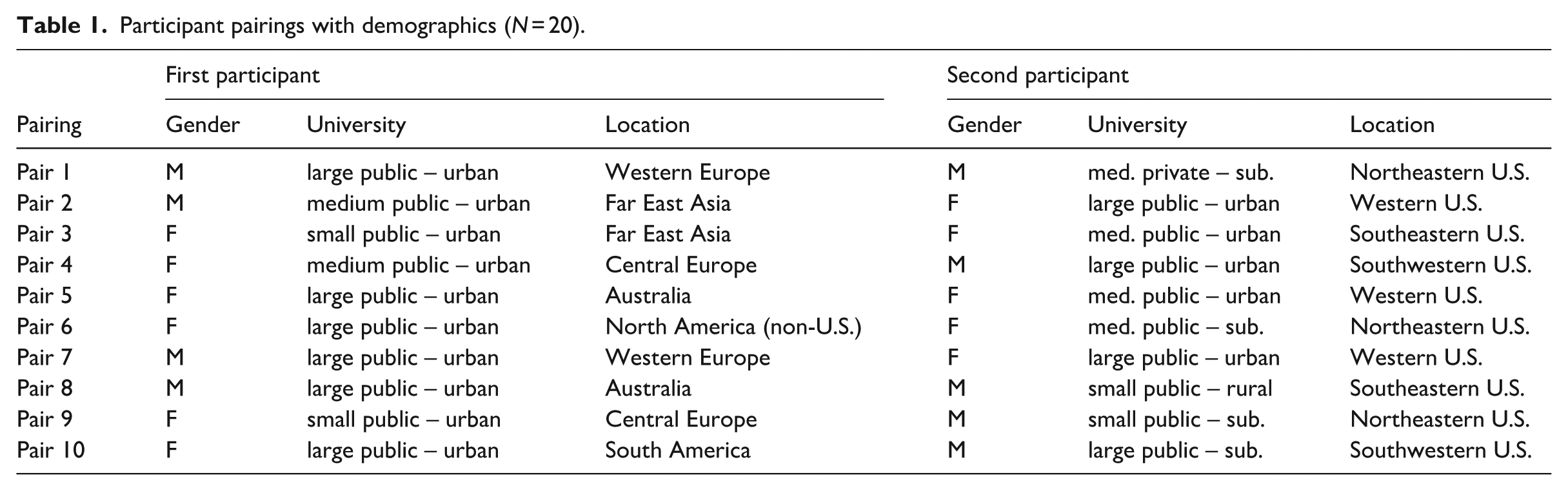
Table 1 displays participant demographic data. Participants were 45% male and 55% female representing North America, South America, Europe, Far East Asia, and Australia. They worked at small (20%), medium (30%), and large (50%) universities located in urban (75%), suburban (20%), and rural (5%) areas; nearly all the universities represented (95%) were public institutions.
Participant pairings with demographics (N = 20).
For the sake of clarity and cohesiveness, findings are presented per research question, with discussion integrated.
RQ1 : Prominent Differences and Similarities
Naturally, the idea of conducting paired interviews stemmed in part from an interest in understanding philosophical and pragmatic differences and similarities among music education programs in diverse locales globally. It is worth encapsulating up front the international differences in both postsecondary music education approaches (Massy & Sembiante, 2022) and predominant employment opportunities for music education degree recipients (Royse et al., 1999). Globally, postsecondary music education approaches can be loosely construed as falling along a continuum between the centuries-old, specialized Western conservatory model, which is especially influential in Europe, and college or university departments of music with a more localized approach and comprehensive offerings spanning academic and professional education, which are prevalent in the U.S. and other parts of the world. In terms of employment options, music education degree alumni outside the U.S. may be more likely to consider a wider variety of employment structures within and beyond music teaching, whereas those within the U.S. typically secure teaching positions in established public school systems that emphasize the large ensemble model—a model not common to government-funded schools in other parts of the world. The most prominent themes that emerged from descriptive analysis of participant testimony were related to the generalist approach of non-U.S. music teacher education programs, including the governance structure of such programs institutionally, and the status of music teacher recruitment and career outlook.
Theme: “We Are Generalists . . . Our Students, They Are Not Performers.”
Most program leaders outside the U.S. commented on the generalist approach of their music teacher training programs and, as a result, a lack of specificity in their curricula regarding development of practical music performing and teaching skills. “Students always complain about the lack of music credits,” Participant I [AU] 1 explained. “Music teachers have to know a little about everything . . . but it is cut into very small courses, so that’s the sad story.” Participant C [FEA] shared that programs in Far East Asia had reduced the music portion of undergraduate music ed degrees to just 25%, with the remaining 75% dedicated to liberal arts and general education coursework. Participant I shared that, in many music teacher education programs in Australia, none of the emphasis area coursework is taught in schools or departments of music—all of it is offered through a college or department of education.
Program leaders in Europe discussed undergraduate programs that included very little one-to-one applied lessons instruction, with some including none at all. As Participant M [WE] described, At my college, we don’t provide musical tuition [private study]. We only provide general musical education, which is very problematic because there are many students who want to be primary music teachers, but we cannot teach them any instruments. The focus is not on the instrumental skills, but more on the educational skills.
In those locales, students desiring a program that includes private study would need to gain acceptance to a conservatory, whereas in the United States and other countries, the majority of collegiate music programs are structured conservatory-style, with compulsory applied lessons for all music education majors.
The dyadic interviews illuminated the much greater extent to which music teacher preparation in the United States hinges on musical skill acquisition and applied performance, a difference also reported by Royse et al. (1999). This created an interesting dichotomy: while U.S. program leaders frequently questioned the outsized role of large ensembles in their programs and how notions of “success” are often tethered to competitive performance, non-U.S. leaders like Participant A [WE] expressed feelings of envy: Unfortunately, in much of Europe we don’t have these high standards– the school choirs or bands that I see in the U.S., which I am very jealous of. Instead, most secondary schools have a general music appreciation class. It’s not interesting at all. Band, choir, and orchestra are done as after school activities, in what we call “schools of music.” These are privately owned or sponsored by municipalities . . . but I hope we shift to the U.S. system, where music classes are ensemble-based and teachers are fortified performers rather than non-musicians teaching music.
Non-U.S. leaders also pointed out that, in many cases, music education did not exist as a standalone unit or entity in their universities. Often, these faculty members were partially or fully based in a department or college of education, not a music unit. “We are fighting to exist,” exclaimed Participant G [CE]. “And because our faculty is largely a faculty of education and psychology, the emphasis is (general) education. They don’t understand what we do.” Other non-U.S. program leaders cited instances of nepotistic or otherwise flawed hiring of leaders, which undermined their feelings of music-specific support. According to Participant K [NA]: The people who lead the faculty are not (true) leaders– they got their positions because they’re friends with somebody. Now they have some power to improve their personal situations . . . but they don’t care about students or improving the system. So basically, if you want to survive in this kind of environment, you have to be very good friends with those who are in power.
Curiously, program leaders in the U.S., despite working within a music-focused institutional structure, were more likely to describe limited financial and human resources impeding their work, and therefore more commonly expressed feelings of workplace burnout.
Theme: “Times Have Changed, and Will Continue to Change.”
The changing landscape of school-based music education, including teacher recruitment challenges, multiculturalism, and shifting societal views of the teaching profession, emerged as a prominent theme in participants’ testimony. Universally, participants shared concerns about the societal view and status of teachers and increasing difficulties recruiting students into the profession (see also: Confredo et al., 2023). Music teaching was not described as a particularly aspirational career path in any of the geographic locales represented, but especially by participants in Europe and Far East Asia, who shared that music teaching is often viewed as a lesser alternative to a performance career in their regions. A generation earlier, a similarly low societal view of teachers was reported by Royse et al. (1999), especially in the Far East. According to Participant E [FEA], in many Asian locales there’s kind of a societal atmosphere that all music majors want to be performing instead of doing a teaching job . . . they think of themselves as conductors, or think of themselves as performers, but they’re not thinking of themselves as educators.
Participants shared their perceptions of the reasons for the lack of interest in music teaching, including residual malaise from the COVID-19 pandemic, poor working conditions, and reductions in once-generous employment benefits for teachers. However, the two most commonly-cited reasons were low pay and lack of teacher autonomy and professional treatment: (Teaching) hasn’t been valued a lot, and especially here or in many other touristic places, people who work in hotels earn so much money that they actually look down on teachers. “Those poor teachers!” . . . What can you say? (Participant Q [CE]) I think it’s hard to convince people to go into the profession because it’s one thing to take a low-paying job because it’s something that you’re passionate about, but then also to not be treated as a professional . . . and I think sometimes high school students see how their teachers are mistreated. (Participant D [US])
As a result, most participants reported music teacher shortages in their global locales, creating problematic staffing scenarios but also plentiful employment opportunities for those aspiring to teach. To cope with teacher shortages, many school systems around the world had turned to hiring underqualified or completely unqualified individuals to teach music. Participants reported that, in some areas with severe teacher shortages, collegiate music education students were being hired to teach in local schools even before beginning their student teaching internships. Outside the U.S., participants reported that most primary/elementary-level music instruction was delivered by non-music specialists, with appropriately qualified/trained music educators only hired to teach secondary-level music classes.
When asked about strategies for strengthening music teacher recruitment, participants focused on what they could control. They highlighted the importance of developing relationships with secondary music teachers, students, and other stakeholders to build a “pipeline” centered on openness and not dependent on involvement of collegiate studio (applied lessons) faculty. Some U.S. participants felt the lack of large ensemble programs in non-U.S. secondary schools might hamper music teacher recruitment in those regions of the world. Nearly all participants articulated the need for policies and practices that help bring students with popular and vernacular music skills into their teacher education programs, so culturally-relevant and accessible musical opportunities become more and more available to diverse students (a sentiment also expressed by Confredo et al. (2023), Kertz-Welzel (2018), and Westerlund et al. (2022)). Participant N [US] summarized this belief as follows: Times have changed, and will continue to change . . . and we need to make ourselves relevant to communities and society in general. We need to provide access for all students and people of color, people who are disadvantaged. We need to provide interesting opportunities and invite students who may have disabilities . . . we need to be relevant, and we need to be more available versus elite.
However, some participants commented on the challenges of preparing “typical” music education students, many of whom grew up in homogenous, sheltered communities, for teaching positions in diverse teaching contexts vastly different from those they experienced in their own schooling. Several participants agreed that this scenario created problems for many young music educators who desired to work in under-resourced school communities; the praxis shock these young teachers experience often results in them leaving the profession.
RQ2 : Collective Essences of Faculty Life
The lived experiences of music education program leaders internationally, as expressed in their own words, were subjected to phenomenological analysis. Emergent themes centered on two shared feelings: a struggle for balance and a sense of uncertainty.
Theme: “I’m Really Trying to Find Balance, and I Haven’t Yet.”
“And how do I keep balance? I don’t have any balance in my life.” With this utterance, Participant K [NA] summarized what most participants expressed: that their music education leadership roles were “overwhelming” and “all-consuming.” No matter their location globally, they universally described “wearing many hats”—struggling to balance heavy teaching loads, inordinate amounts of service, research activity, and the added difficulty of making time to continue performing and fulfill family commitments. Participant N [US] expressed their scenario as follows: I realized that I can’t sustain the level of my service commitments. . . I need to find a better balance. I also have a personal life– I’m married and I have two small children. I think it’s a common struggle for many of us. I can’t say I do it well . . . or even feel good about it.
Many participants emphasized that they were the lone music education specialist on the faculty at their institution, which resulted in them sometimes feeling as if they had to teach it all and do it all, meaning administering all aspects of their program and advising all music education students on top of their other duties. The dyad of Participant I and J shared feelings of overwhelm: “This is a 24/7 job, in a sense– it is a busy life,” said Participant J [US]. Participant I [AU] continued: “You try to set hours for teaching, administration, and research, but the problem with that is there are very large amounts of unseen work that don’t really fit neatly within those categories.” Participant D [US] had a similar experience: “Being the only dedicated music education professor, and being coordinator on top of it, is a lot. There’s no compensation. There’s no course release. There’s no additional pay. It’s just expected.” Participants G and H’s conversational exchange exemplified this expectation: When Participant H [US] shared that “music education coordinator wasn’t even in my job description . . . it was just assumed,” Participant G [CE] responded, “You have a job description?!”
Participants reported a lack of awareness or understanding from their leadership, particularly regarding service expectations. Most spoke about hidden and/or uncompensated labor, and feeling that this extra work went unnoticed or was taken for granted by colleagues. Female faculty were especially susceptible to unreasonable service demands. Participant F [US] shared that: Service is the most concerning because, in the schools I have been at, we definitely have had hiring freezes– not replacing people once they leave or retire. So, it’s calling on smaller and smaller numbers of people to do more and more service work, because those committees still meet, and the work still needs to be done. And that can be all-consuming, it really can.
For several participants, the siloed existence as the only music education faculty member, or the only one in a full-time position, was accompanied by the sense that their expertise was not respected by their faculty colleagues, especially regarding curricular issues. Participant D [US] described this experience: It doesn’t bother me when our composition faculty say “this is what our students need.” I’m like, that’s great– I’m not a composer. If you say that this is the latest trend in composition, go ahead, change your curriculum. But I just find it fascinating that when I want to change our music ed curriculum, everybody suddenly seems to be a music education expert . . . even though a lot of them have never taught in schools.
In Kruse’s (2022) study of 45 department chairs, these types of relationship tensions emerged as “perhaps the most trying responsibility of the job” (p. 752). Participant M [WE] expressed how the glacial pace of change in their European university created tension in their administrative efforts: In my country, to my desperation, the main answer when you want to improve a system is “That’s not possible.” And you say, “Why not?” . . . because it’s possible everywhere else, and it’s just a matter of wanting to do it. “It’s not possible because decree number 123 voted by the government in the year 1990 said that, so we cannot change it.” And so I ask, “Why can’t we change it?” And they say, “Because we cannot. You travel too much!” It’s so frustrating, because I’m trying to offer a kind of leadership to try to make things different. It’s difficult to explain this to outsiders, the way things are in my country. And I say, “Why can’t we do it?” “No, you can’t. It’s forbidden to change anything.”
Generally, sentiments of disrespect and misunderstanding from leadership were more common with participants outside the U.S., which is possibly attributable to the lack of defined departments or faculty units designated specifically for music education.
Theme: “It Felt Very Uncertain Whether I Was Doing Enough.”
Participants shared that they often felt uncertain regarding their workload and whether their contributions as faculty were significant enough to meet the needs of their institution while also meaningfully advancing their individual career trajectories (e.g. toward tenure and promotion; also noted by Rahkonen et al., 1993). Seemingly, the only consistent message they received was that there is always more work to be done– that the job required them to go “well and truly beyond the extra mile,” as Participant O [AU] put it. “When I see programs at other universities that have fallen apart, it’s usually because the faculty member has achieved what I’d call a very good work/life balance!”
Interminable workloads and a sense of precarity were frequently accompanied by a lack of understanding among unit and institutional leaders regarding the nature and value of research activities in music education. Participant K [NA] shared their experience as one of the only research-active faculty members in their school of music: When my school’s leaders arrived here, research was not required . . . so I appeared as somebody who was a kick in the ass. Now I’m one of the few who are committed to do all we’re expected to do. The others, they do not do research, and they don’t care about service. They were very annoyed with my presence for many years, but I got my tenure case through.
For Participant Q [CE], blending research activities with teaching was the solution to frustrations over lack of time for research: I was very stressed to do research when I was younger . . . we have so much workload! And then I realized that my research is my students. So, I do a lot of interesting things with students and publish some of our projects to try to balance things.
Participant F [US] adopted a similar approach: “I decided that in order to have time to research, I needed to switch my agenda to be closely aligned with work I was already doing at the institution.”
One difference affecting participants’ professional activities was varying tenure expectations globally. In many non-U.S. university settings, tenure is granted at the time a hire is made, with promotional opportunities available throughout one’s career path. The alternative, common to U.S. universities and others utilizing the same model, requires new faculty to earn tenure via demonstrated excellence in research, teaching, and service over the course of several years or risk termination. In both scenarios, uncertainty and shifting expectations over time created stress regarding research, as expressed by Participant L [US]: At the department level, everyone was very understanding and appreciative of all the (research) work I did . . . but who’s to say what it would look like at the college or the university level to other (non-music) folks looking at my dossier? There weren’t super clear requirements . . . so it felt very uncertain whether I was doing enough, but I also felt like I was doing two jobs with all the teaching and the service requirements.
Lee and McNaughtan (2021) found similar uncertainty among music faculty, suggesting that music executives “seek transparency, consistency, and fairness” in evaluating colleagues, including in promotion and tenure processes (p. 68). Several participants in the current study commented that they felt fortunate to work at institutions where activities beyond traditional research, such as guest conducting and outreach work, were acceptable outputs toward tenure and promotion.
RQ3 : Role Strain
In all but a few cases, participants expressed intense feelings of role strain and role overload (Creary & Gordon, 2016; Scheib, 2003). An apt summary of participants’ leadership experience is bearing a great deal of responsibility but very little authority (see also: Kruse, 2022). Absent the agency to change things, they experienced precarity and imbalance in their professional lives. Figure 1 depicts the role strain associated with the position of music education program leader internationally. Its design was inspired by Bronfenbrenner’s (2005) social-ecological (or bioecological) model, with micro, meso, and macro levels that represent a more internal, medial, or external locus of control. The 25 roles that appear in this conceptual diagram were specifically mentioned by current study participants in their interviews; there are likely even more at play. The arrows represent the interdependence of micro-, meso-, and macrosystems; this multilayered context forms a complex gestalt of overlapping and oft-competing roles, leading to stress and overload.
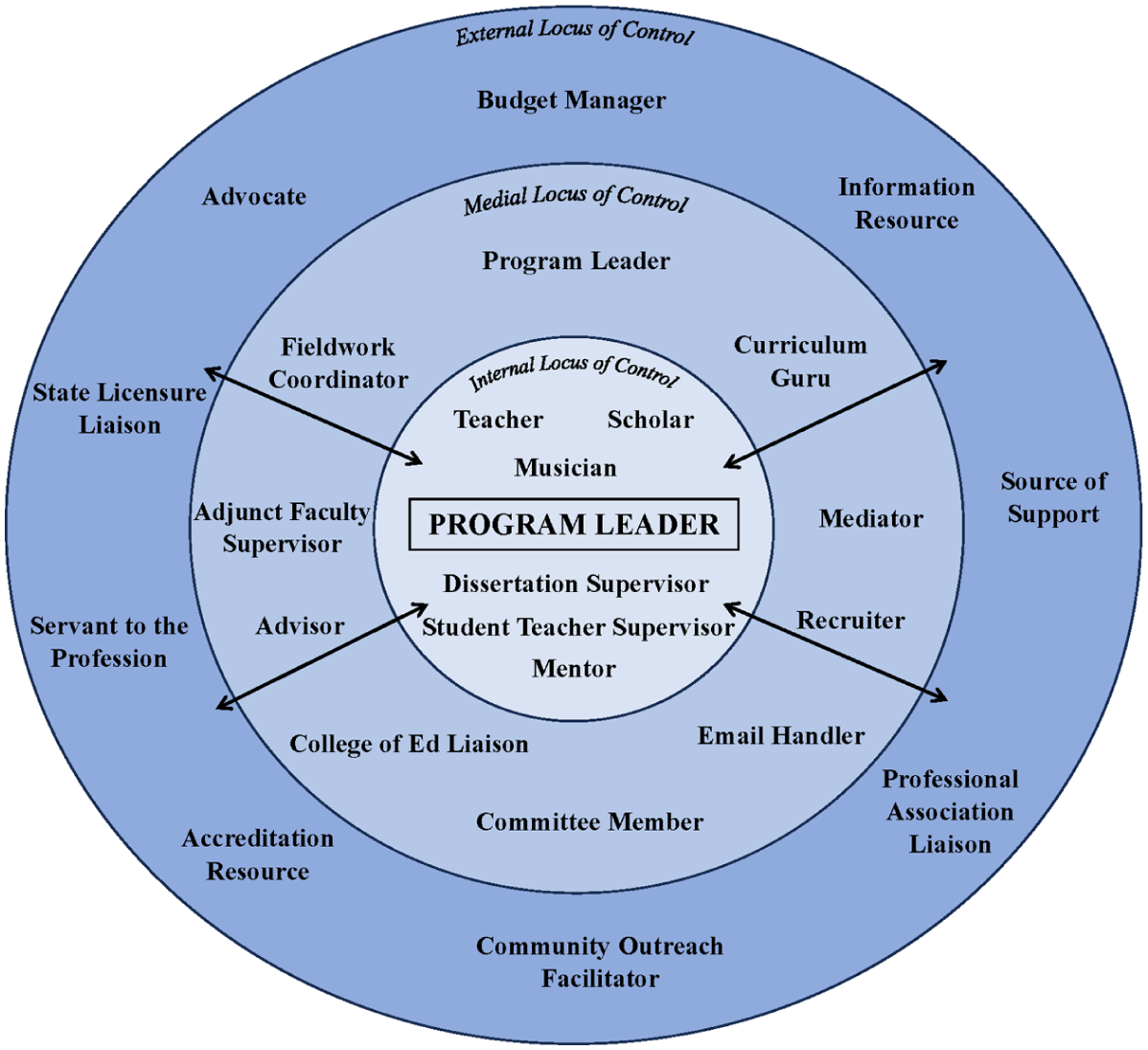
Social-ecological model of role strain experienced by music education program leaders.
There are numerous factors that have led to this preponderance of role strain and overload, including the undermining of shared governance principles, budgetary constraints, an incredibly competitive job market for faculty, and inordinate service loads placed on pre-tenure and female faculty. Unlike in Scheib’s (2003) study of role strain in a high school music department, participants in the current study experienced many forms of role-related stress, including role ambiguity (information deficiency) and nonparticipation (not being included in decision-making).
Implications and Conclusion
The primary objective of this study was to develop a better understanding of the perspectives of a global sample of music education program leaders at tertiary institutions, differences and similarities among their programs and in their work, and their shared experience balancing the many demands on their time. Findings of this qualitative study are not generalizable, but the transferability of many of its implications is bolstered through connections to past findings in the literature, as detailed below. Although a few pronounced differences existed among U.S. and international participants regarding the philosophy, institutional status, and structure of their programs, most interview dyads discovered more commonalities than differences in their conversations. Unfortunately, the notion with which they agreed most vigorously was the intensity of the role strain and overload they experienced in their positions.
Although there are no easy solutions, the following recommendations can help lessen role strain associated with program leadership. Program leaders experiencing role strain have options to combat its effects (Creary & Gordon, 2016; Falk, 1979; Holmes et al., 2020; Taft, 2023), such as:
communicating frequently and honestly,
asking for clarification of roles from leadership,
requesting reallocation of certain duties,
delegating tasks to colleagues or responsible students when possible,
setting firm boundaries for each role,
seeking emotional support, and
yes, dropping one or more roles.
Further, music executives charged with supervising program leaders should work transparently and collaboratively with these faculty to craft specific job descriptions that articulate what is (and is not) part of the position’s duties, involving their human resources office and/or faculty union as needed. When the extent of duties and expectations warrant, supplemental pay and course releases should become standard features of program leadership arrangements, not occasional rewards. In some scenarios, it might be appropriate to split up program leadership duties among multiple faculty members to equitably distribute the workload. Executives should also discuss research and creative activity expectations with program leaders until all parties agree on a sensible, balanced position profile; this was also an implication of Rahkonen et al.’s (1993) previous work.
As noted by Deal (2014), Kruse (2022), and Brown (2003), professional development for department chairs and program leaders is scarce, but music education professional organizations and other faculty development networks could readily address this need and, more broadly, can take the lead in setting standards for the scope, structure, and required compensation of program leadership positions within tertiary music education at large. Finally, in recognition of the disrespect cited by many participants in matters of faculty governance and curriculum reform, it is recommended that music education program leaders always be included in the executive cabinet of a school or department of music, to provide counsel to the executive regarding strategic visioning, curriculum matters, and resource allocation (see also: Lee & McNaughtan, 2021).
Alongside these direct recommendations for reducing role strain, several additional implications emerged from this study that point to challenges that likely contribute indirectly to faculty role strain and burnout. Schools of music without formal departments or faculty units specific to music education should consider creating them. This will allow faculty who specialize in the preparation of music teachers to cohere as a team, build camaraderie, and strategically envision and administer programs aligned with best practices in the field and that fulfill the needs of preservice teachers. Further to this, these teams of music education faculty should be empowered to modify existing curricula, especially in instances where programs of study are devoid of musical skill development and application. In particular, requirements for private study on an instrument or voice as well as other forms of applied and creative music-making should be seriously considered, as these are opportunities to build crucial skills for effective music teaching.
The pressures of enrollment challenges and recruitment contribute to role strain among music education program leaders as well, as evidenced by the testimony of participants in this study. Recruiting students into the music teaching profession will likely remain challenging for the foreseeable future, but there are steps program leaders can take to potentially improve this outlook. For example, findings of this study suggest that stakeholders ought to more prominently advertise the appeal of music teaching as a career path that still affords time for an active performing life. In a similar vein, program leaders should continue to develop avenues for potential teachers with diverse musical interests and educational backgrounds to enter the profession, which also means embracing a more varied array of activities and outcomes befitting popular, vernacular, alternative, and otherwise unconventional musical traditions (Kertz-Welzel, 2018; Westerlund et al., 2022). Finally, in order for students to view teaching as an attractive career path, program leaders would do well to help advocate for greater emphasis on teacher agency, creative discretion, and shared decision-making so that teachers are granted the professional autonomy and respectful treatment they deserve.
Limitations in this study included reliance on a volunteer sample, potential social desirability bias, and the limited scalability of findings inherent to interview-based research. Future research could extend this line of inquiry to other geographic locales, drawing a larger and more globally-representative sample of program leaders. A large-scale survey addressing differences among program leaders and their experiences with role strain would contribute to a more comprehensive understanding of this vital position in schools of music around the world. Additionally, future researchers might consider incorporating focus groups alongside paired depth interviewing to glean collective insights from more participants. Ultimately, by understanding and addressing music education program leadership and the multifaceted nature of faculty role strain, institutions will improve faculty well-being, reduce burnout, and enhance the quality of music education for future generations.
Footnotes
Acknowledgements
Not available.

Ethical Considerations
This study was approved by the University of Memphis Institutional Review Board (approval: FY2024-497) on June 5, 2024.
Consent to Participate
All participants provided informed consent verbally prior to participation.
Consent for Publication
Not available.
Author Contributions
Josef Hanson: Conceptualization; Data curation; Formal analysis; Investigation; Methodology; Project administration; Visualization; Writing – original draft; and Writing – review & editing.
Funding
The author received no financial support for the research, authorship, and/or publication of this article.
Declaration of Conflicting Interests
The author declared the following potential conflicts of interest with respect to the research, authorship, and/or publication of this article: I am an editorial board member for IJME.
Data Availability Statement
The data generated during the current study contains identifying information that would compromise participant confidentiality. Therefore, these data are not publicly available.