







Abstract
What would have been the work of Orff and Kodály if they had been surrounded by the sounds of children deeply engaged in West African ewe drumming and dancing, Indonesian gamelan, Caribbean calypso, Turkish aşık songs, and Saami yoiking? If Orff could have handed over his smart phone to Kodály and said: “Listen to the incredible interlocking patterns in this children’s song from Burundi, the microtones in this Indian raga, the harmonies of this isicathamiya choir from South Africa, the circular breathing that supports the sound of the Australian Indigenous didgeridoo. Imagine our children, in Germany and Hungary, and anywhere in the world, working with these musical sounds and ideas!” Using two theoretical frameworks and this slightly unconventional setting, two senior music education scholars who have been active in projects and advocacy for including musical sounds, concepts and pedagogies from different cultures for over four decades trace the history of cultural diversity over the past 100 years as a sequence of opportunities seized and/or missed, reflecting on the significance of each for the two frameworks, and the implications for music education in the second quarter of the 21st century.
Keywords
“I couldn’t sleep all night, Karl. Just kept thinking of those Samoan children’s choirs, who seem to be able to create four-part harmonies on the spot around any melody. And what about the West-African percussion groups? 7- to 9-year-olds playing multi-part rhythms and improvisations on drums, shakers, and scrapers that would take me weeks to transcribe. And the gamelan workshop! A pack of 10-year-olds sounding like one in an ensemble of gongs with relatively simple individual parts, but an amazing sonic effect after one hour together. Not to mention the beats and backing tracks that the American kids create with technology.”
“I know, Zoltán. I was equally impressed by the Indigenous children from Australia, who somehow embody such a strong bond with their natural and spiritual environment in song. Also, how is it that those young South African choristers can sing and dance like that at the same time? And the teenage mariachi band: amazing abandon in their high-spirited music making. And what’s this AI business? Seems rather promising to me, and scary at the same time. I bet that with what we’ve seen over the past few days, we could develop new pedagogical approaches for children’s musical learning based on their rich musical environment. We could truly prepare children for finding their musical way within the diversity of sounds and technologies they have access to nowadays.”
Introduction
Imagine Carl Orff joining Zoltán Kodály, two giants of music education who transformed their field and inspired music educators for over a century, at the breakfast buffet in a hotel in Amsterdam the morning after a three-day Children’s World Music Festival in 2025. Like all great minds, they could only be inspired by the sounds that surrounded them during their time, with formative years in the first half of the 20th century. The record industry was just evolving: there were no CD collections, no playlists, no smartphones to access all kinds of music from everywhere (cf Marshall, 2012). Orff initiated his ideas for the Schulwerk in the 1920s, at the Guntherschule, a school of music and dance in Germany where he worked with Dorothee Gunther and Gunild Keetman (Kugler, 2014; Regner & Ronnefeld, 2004). Kodály’s contributions to music and education arose from the fervor of 20th century Hungarian nationalism, which inspired his ethnomusicological collection of Hungarian folk music, his insertion of folk music into his late-romantic period compositions, and his reform of Hungarian music education to include “mother tongue” music laden with Hungarian folk songs (Asztalos, 2023). What would they have come up with during our time, when “more people have more access to more music in more ways than ever before in the history of humankind” (cf Schippers, 2016, p. 1)?
It is also important to realize that both men were living at a time when western art music was still considered superior to all other music practices in the world. Consequently, the principal goal of music education in educational mandates and curricular designs in mid-century Europe was to prepare children to be good listeners and amateur performers of “classical music” on piano, in orchestras, chamber groups, and choirs committed to western art music, although of course folk songs were sources of inspiration as well. But what would have been the work of Orff and Kodály—and their conversations—if they had been surrounded by the sounds of children deeply engaged in West African ewe drumming and dancing, Indonesian gamelan, Caribbean calypso, Turkish aşık songs, and Saami yoiking? If Orff could have handed over his smart phone to Kodály and said: Listen to the incredible interlocking patterns in this children’s song from Burundi, the microtones in this Indian raga, the harmonies in this isicathamiya song from South Africa, the circular breathing that supports the sound of the Australian Indigenous didgeridoo. So awesome! Imagine our children, in Germany and Hungary, and anywhere in the world, working with these musical sounds and ideas!
Theoretical Framings
In this article, we will trace 100 years of calls and opportunities to embrace cultural diversity in music education, and frame them against two theoretical frameworks we developed over the past several decades: Schippers’ Twelve Continuum Transmission Framework (TCTF), and Campbell’s World Music Pedagogy (WMP). The first aims to capture important elements in music learning and teaching from a global perspective, formulating a framework to help understand and shape learning environments honoring diverse music practices across cultures, promoting transmission strategies beyond only those featured in formal music education practices that grew out of European formal music education (Figure 1):
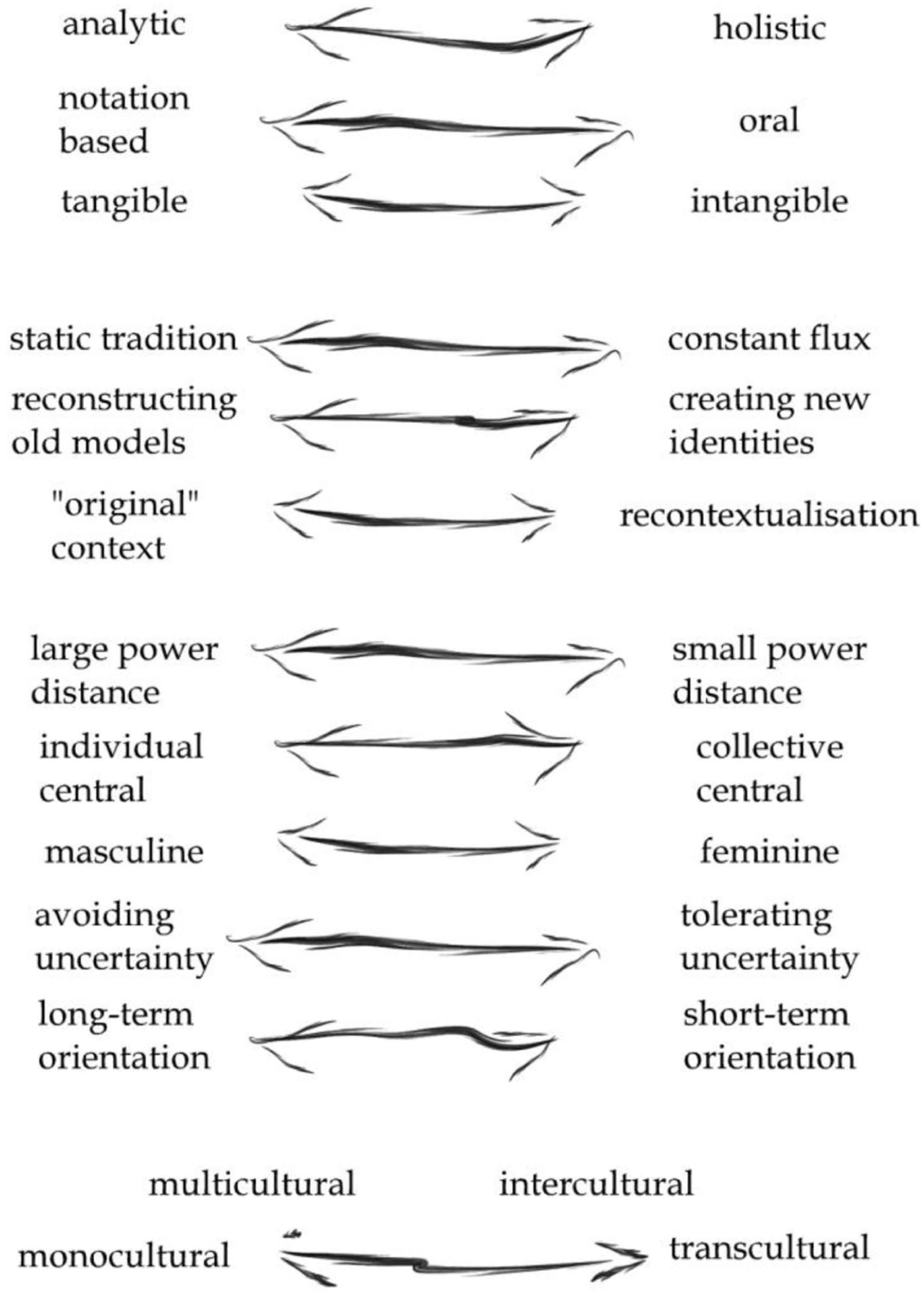
Graphic representation of the Twelve Continuum Transmission Framework (Schippers, 2010, p. 124).
While it goes beyond the scope of this article to recapitulate the extensive research and thinking behind this framework, the 12 dimensions it distinguishes describe impactful decisions in any situation of music learning and teaching in terms of emphasis on modes of learning; approaches to tradition, authenticity, and context; interaction between teacher/facilitator and learner, and approaches to cultural diversity. The distinctions between descriptions on left hand and the right hand (e.g. between “notation-based” and “oral”) are not binary: rather they are to be seen as continuums (many “oral” traditions use some form or degree of notation, and many notated traditions extensively use oral learning). Positions on each of these continuums can vary from situation to situation, lesson to lesson, or even within a single teaching session. Overall, formal music education tends to lean more toward the left, while informal teaching situations (e.g. community settings) lean more toward the right. See Schippers (2010) for a description of the full genesis and application of this framework.
The second theoretical framework, Campbell’s World Music Pedagogy (WMP), lies between theory and practice, as it derives from research in ethnomusicology (Merriam, 1964; Rice, 2017), music cognition (Clayton, 2009; Cross, 2003; Margullis, 2014) and best practices in music education (Campbell, 2018). WMP arose from a recognition of the oral transmission process that characterizes music learning in many cultures, and claims as its trademark an emphasis on listening, learning by ear, as the launch to musical and intercultural understanding. Five dimensions lie at the core of World Music Pedagogy, and together these have been applied to the iconic national identity musical genres of the world’s cultures. Yet along with orality, strategic practices such as retention through repetition, embodied engagement, and holistic learning characteristic of informal and immersive experiences are traceable to research even as it advances to a model for application in various circumstances and settings (Wade & Campbell, 2004). In the WMP model, three listen-to-learn dimensions are considered central to the WMP process, another dimension that recommends possibilities for playful creative expression, and a last dimension that is in fact ever-present throughout the process as music becomes increasingly meaningful through an understanding of its cultural purposes:
Earlier efforts in teacher education to diversify content were geared mostly to “songs of many lands” (Schippers & Campbell, 2012), with cursory glances at (and oversimplifications of) musical cultures but little attention to culturally valued melodic and rhythmic nuances of iconic musical works. With growing attention to the frameworks described above, we notice that teachers and their students are benefiting from transmission strategies and pedagogical techniques that are underscoring the essence of the world’s musical expressions. Week-long training sessions in World Music Pedagogy (WMP) that have been taking place over the past 18 years include emphasis on “the oral tradition,” with attention to orality and aurality, and the integration of music’s cultural meanings. These WMP courses have trained and certified nearly 3,000 participants in the U.S., Mexico, Canada, China, and Thailand. Other high-profile efforts reflective of the noted theoretical frameworks include the attention given by educators to the development of archived recordings for use in classrooms, such as the “Music Pathways” project of Smithsonian Folkways Recordings (Learn | Smithsonian Folkways Recordings) and the “Star-Songs and Constellations” program of the Global Jukebox (The Global Jukebox) based on the Alan Lomax collection in the Association for Cultural Equity (Figure 2).
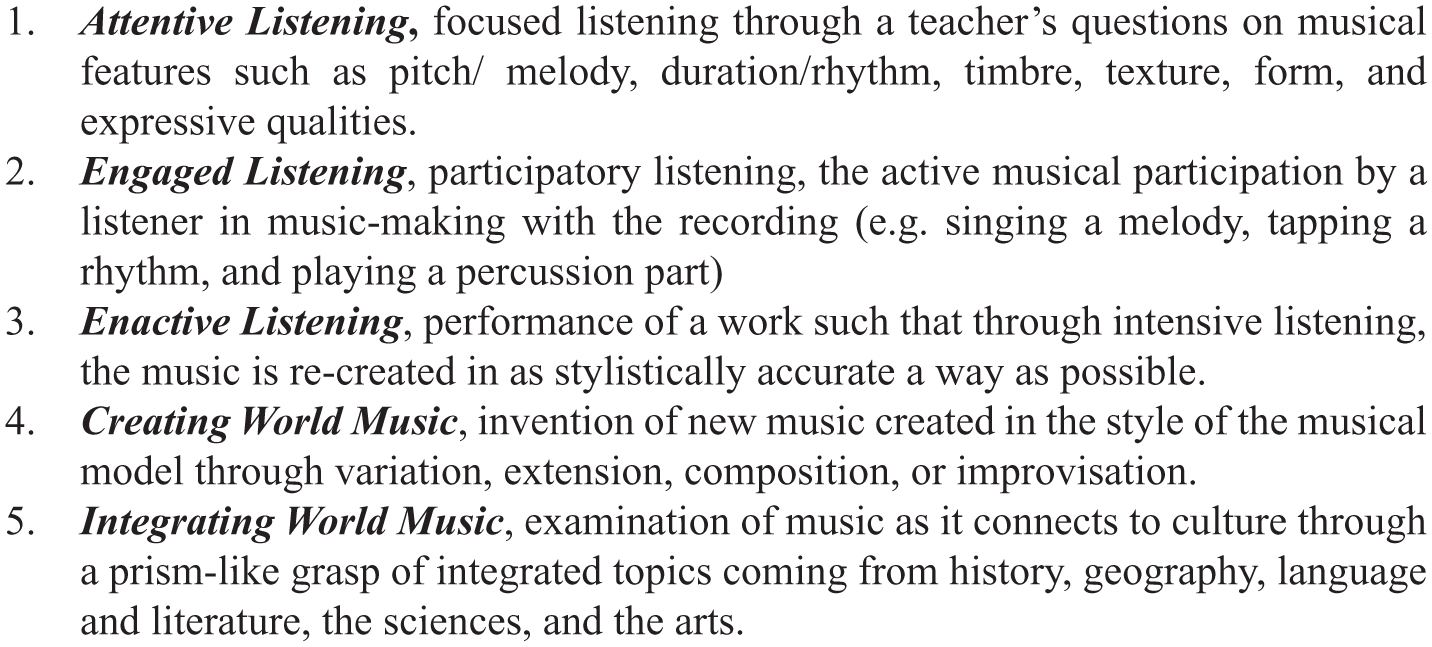
The five-dimension model of world music pedagogy (Wade & Campbell, 2004).
Both frameworks represent a departure from heavily formalized institutional approaches and form a useful reference for a better understanding of developments within music education over the past 100 years. While a little unconventional in academic writing, we deliberately started this article by bringing back to life the imagined voices of two great educators. They help bring home the central message of this article on the past 100 years of cultural diversity in music education, which we argue is not a disruption but rather an organic development, part of music education’s ongoing need for adjustments to ever changing times. It invites music teachers everywhere to continually approach their profession in the same spirit of creativity and innovation as their predecessors. Invoking Orff and Kodaly enables us to present events and developments not only as historical facts, but as a series of real-life opportunities to make ongoing and significant changes to music education, and to track them against the theoretical frameworks above: Some of these have had lasting impact; others have not found wide acceptance (yet).
Awakenings Into Diverse Music Cultures
All the changes we describe occurred between 1925 and 2025, a 100-year period of unprecedented pace of change in music worldwide. Orff and Kodály lived at a time when radio was emerging as a major force; when the recording industry started going around the world and published brief examples of musical styles from every continent; and when comparative musicology‒the ancestor of ethnomusicology and cultural musicology—was beginning to develop (Liebersohn, 2019). After the First World War, there was already some desire to connect people globally through music. Frances Elliot Clark, pioneering music educator from the interbellum, imagined music education as embracing a wider musical world: When that great convention can sit together‒Chinese, Hindu, Japanese, Celt, German, Czech, Italian, Hawaiian, Scandinavian, and Pole‒all singing the national songs of each land, the home songs of each people, and listen as one mind and heart to great world music common to all and loved by all, then shall real world goodwill be felt and realized. (quoted in Volk, 1998, pp. 48–49)
While Clark developed musical experiences via the phonograph and radio, others were exploring “exotic” instruments in classrooms. Satis N. Coleman’s “Creative Music” work with children at New York City’s Lincoln School in the 1920s was intent on drawing out their creative musical impulses through improvisation on homemade instruments modeled from those in many of the world’s cultures, including shepherd’s pipes, ocarinas, marimbas, and Chinese gongs (Southcott, 2009), pre-echoing the development of World Music Pedagogy.
In the 1930s, John Dewey, leading educator of the progressive education movement, advocated for music in the curriculum not only for its creative-expressive benefits for children but also for its capacity to reach into and underscore understandings of history and culture (Campbell & Dahm, 2022). Because he acknowledged the cultural diversity of his students, Dewey called for expanded and integrated studies in which music and the arts were not separated from cultural and world affairs (Kelly, 2012). The application of these ideas was furthered in the scholarship of Mursell (1954) in the 1940s and 1950s, who promoted music education as contributing to individual musical potential as well as cultural understanding and an “improved society” overall. These were early stages of recognizing the importance of music’s cultural context and meaning in school music practice as well as a call to include cultural diversity: not only through the 12th continuum in the TCTF, but also a core driver of WMP.
Mid-Century Momentum in Curricular Practice
A number of events from the 1930s onward were seeding music curricular change in the U.S., with international implications. Through the Good Neighbor Policy of the Roosevelt Administration came the reach of Americans to Central and South America, which resulted in a barrage of Latin American music filtering into textbooks and school-wide performances between 1939 and 1946 (Bannerman, 2023). The folk song collections of the Lomax family of folklorists tumbled into publications like Our Singing Country in 1937, and the eventual transcriptions and re-creations of 90 recordings of Anglo- and African-American folk songs by Ruth Crawford Seeger in American Folksongs for Children (Watts & Campbell, 2008). Then, with the establishment by Moses Asch of the Folkways label in 1948, came a record label that supplied music from all over the world to avid listeners, including teachers (Carlin, 2008). Later, a gathering of musicologists at the Yale Seminar in 1963 resulted in a recommendation for a broader and more varied school music repertory, which launched the development of the Julliard Repertory Project of 230 vocal and instrumental works of music from multiple cultures and various western historical style periods (Scholten, 1998), but still with a predominantly European/US methodology and pedagogical approach.
By mid-century, the ideas of Orff and Kodály began to be known beyond their origin locations in Germany and Hungary. Canadians learned about the Orff approach in the late 1950s through courses at the University of Toronto, while Ball State University in central Indiana offered the first course several years later where the American Orff-Schulwerk Association as established in 1963 (Spitz, 2019). Early proponents of the Kodály concept included Denise Bacon, Lois Choksy, Mary Helen Richards, and Sr. Lorna Zemke, all of whom were intent on working to adapt American and Canadian repertoire to the carefully constructed sequential method that leads to the development of musicality and music literacy in children (Sheridan, 2018). Meanwhile, the ideas of Orff and Kodály were spreading to the UK, across central southern, and eastern Europe, and into Scandinavia (Breuer, 2010). By the late 20th century, Orff and Kodály had become well integrated into music education on both sides of the Atlantic, as well as many parts of Australasia.
On the whole, we can observe that there were ever-increasing calls for musical material from other cultures to be included in the curriculum by the mid-20th century. However, its pedagogical integration does not seem to have reached beyond the kernels of musical diversity and creativity embedded in Orff’s and Kodaly’s methods. Although both pedagogies were not only grounded in European art music, but also the folk songs and musical styles and structures of the composer’s European localities (Germany and Hungary), music beyond these borders was not widely known then, due to homogeneous populations, lack of access to people in many areas of the world, and the incipient stage of recording technology (the LP, enabling 23 min of music per side, was only launched in 1948). Music education was not ready socially, demographically, and technically for the kind of integration of different music practices we have tried to incorporate in our music education models WMP and TCTF.
Expansive Activation of Diversity in Music Education
In terms of musical diversity, a major shift in awareness came in 1967. A group of white, middle aged, male and formally “suited” music education scholars gathered in Massachusetts. However unacceptably unrepresentative this forum was from the perspective of our times, they came up with the rather enlightened Tanglewood Declaration which, while oddly worded from a contemporary perspective, we consider a significant move toward contemporary approaches to diversity, equity and inclusion in music education (Livingston, 2013; McCoy, 2017).
Music of all periods, styles, forms, and cultures belongs in the curriculum. The musical repertory should be expanded to involve music of our time in its rich variety, including currently popular teen-age music and avant-garde music, American folk music, and the music of other cultures. (Choate, 1968)
This call to action triggered the re-writing of policy by professional groups of teachers and the beginnings of change to the content of university-level teacher education programs and in-service training of teachers. In the U.S., it inspired the expansion of repertoire in workshops and publications by leading music educators William M. Anderson, Barbara Reeder Lundquist, Sally Monsour, and James Standifer (Campbell, 2018). Again, it is important to note that the focus of this “movement” was about repertoire rather than pedagogy, which stands in contrast to the view that how and what we hear and learn about music to a large extent determines our engagement with and experience of the music.
Meanwhile, in the U.K, composer and educator Paynter (1970) was shaping composition as core musical activity in classrooms, with the aim of opening ears to All Kinds of Music (Paynter, 1970), including folk music, industrial songs, and the blues. Another influential British educator, Swanwick (1979, 1999), maintained as early as the 1970s that music was both cultural reflection and cultural refraction, with diverse musical sounds and experiences bringing learners opportunities to see and feel in new ways. This was an important step toward integrating repertoire, creativity and cultural context into the learning experience.
This development was strengthened by the rise of “community music” in the late 1960s and early 1970s. Developing out of the UK’s community arts movement, which promoted activist impulses to political and cultural changes expressed through the visual arts, dance, and music (Higgins, 2007), community music put the musical interests and skills of the participants over the aim of perpetuating the classical canon (largely composed by white males) of “North-West Asian Court Music,” as our colleague Drummond (2010) refreshingly argued it should be called (based on the weak claim of Europe to be deemed a continent rather than a part of the massive landmass surrounded by sea called Asia). These developments—and their counterparts in Europe—heralded the beginnings of considering a greater variety of pedagogical strategies, with community music bringing to the table a much less content-focused and more learner-centered approach, which has gained increasing traction since, with considerable promise for music in schools (cf Bartleet et al., 2009). These informal learning practices, also common in learning popular music (cf Green, 2008), represent a significant move toward the models we presented above, especially continuums 7 to 11 in the TCTF.
Multiculturalism, Cultural Diversity, and Music Education
Across the world, curricular aims were turning toward the inclusion of diverse musical forms and practices, fostered in part by the growth of the International Society for Music Education (ISME), whose mission was to promote international understanding of music and music education in its conferences and publications (McCarthy, 2004). In Europe and the UK, the advent of many people from former colonies and the 1987 World Music Campaign prompted thinking about the place of “non-western” traditions in music education, referred to with a terminology stretching from “primitive” to “ethnic” to “migrant” to “strange music”! (Schippers, 2010, pp. 17–28). This created room for innovative thinkers and practitioners on the infusion of world music into the school music curriculum and society at large, and started a strong tradition of rethinking the role of art, popular and traditional music in society, communities, and schools, particularly in Scandinavia (e.g. Skyllstadt, 1998).
In North America, social movements in the U.S. and Canada brought about a growing awareness of diversity in society and its schools, and multiculturalism was shaped as a recognition of the coexistence of diverse cultures, each of which would contribute to society while also maintaining its unique identity. Multicultural education grew from a need for systemic change across the curriculum that would cast aside assimilation and shift to the revision of teaching materials and methods (Banks, 2005). Music educators sought out music they had never known, representing global practices and the cultures of local communities. MENC, the Music Educators National Conference, published a proliferation of materials for classroom use, including three editions of “the big book,” Multicultural Perspectives in Music Education (Anderson & Campbell, 1989; Campbell, 1998/2010). From the 1970s onward, conference sessions featured workshops on teaching music of many cultures, and several stand-alone symposia were entirely devoted to teaching the world’s musical cultures. Rising out of the awareness by music educators of multiculturalism within their classes came the Wesleyan Symposium, a confluence of ethnomusicologists and educators who examined and experienced music and dance as ways to cultural knowledge (McAllester, 1984). This also led to the first in-depth articles linking successful out-of-school music transmission procedures to in-school pedagogies specific to particular traditions (e.g. Trimillos, 1989), all highly relevant to the models above. The discussion is ongoing on the relative merits of directly reflecting the diversity in one’s classroom, through Culturally Responsive Teaching (Gay, 2000; McKoy & Lind, 2016), and (or) through approaches that consider all the world’s music as potential sources of learning, for all learners.
In mainland Europe, the decisive turn toward musical diversity in educational practice came in the 1980s, when it became clear that, in addition to people who had migrated from former colonies, the people attracted from less affluent countries like Turkey and Morocco to do mostly menial work in the 1960s and 1970s were not opting to go back to their native countries, but sought to stay in their new environments, often reuniting with their families. The decision of newcomers to stay in their adopted countries caused some societal panic and triggered cultural policies first focusing on individual migrant cultures, but later also on cultural encounters, which could be experienced as harmonious, or jarring, or both (e.g. Schippers, 2010, pp. 138–140). Combined with the development of international travel and of sound technology feeding a strong curiosity among young people and the cultural elite toward cultures from first Asia, and later Africa and Latin America, this created an open atmosphere and the availability of considerable amounts of funding for performances and education in music practices from different parts of the world. This translated into numerous initiatives focusing on cultural diversity, which came to flourish in the 1990s, especially in Scandinavia, Germany, Switzerland, France, and The Netherlands (e.g. Gutzwiller & Lieth-Philipp, 1995; Campbell et al., 2005; Campbell & Schippers, 2005).
Particularly Northwestern European countries developed a wealth of initiatives featuring music from all over the world in community centers, festivals, and mainstream concert venues. These were often related to specific immigrant groups, but frequently also included other cultures because of their appeal or suitability for audiences and for educational purposes. Work in this field started to feature heavily at conferences and in scholarly publications (e.g. Szego, 2002). In addition, specific collaborations and networks developed, including the informal Cultural Diversity in Music Education (established in 1992), which, in spite of having no formal structure whatsoever, has held 17 biannual international gatherings to date in far-flung locations such as Amsterdam, Dartington, Helsinki, Johannesburg, Kathmandu, Seattle, Singapore, Brisbane, Tel Aviv, Limerick, and in 2027 Zhaoqing, China.
Nurtured by numerous touring artists and a broader reach of accessible high-quality recording of music from hundreds of traditions, these meetings between musicians who were deeply steeped in specific “world music” traditions, open-minded music educators, and ethnomusicologists opened the door to a wave of new approaches at primary, secondary, and tertiary levels of music education. When “authentic” instruments were not available, Orff instruments were often used to introduce traditions with radically different tonalities and structures, for example, in invented classroom Javanese gamelans and balafon ensembles from across West Africa. Instruments from Asia and Africa also began to be used in an “Orffian way,” with melodies and rhythms vocalized prior to their placement on instruments, and physical gestures in the air as preparatory for the transfer of these gestures to instruments. Kodaly’s ideals of mother-tongue music were well-aligned with demonstrations at these meetings of the wide array of iconic folk songs and dances of a wide array of cultures, while the three “p”s of the Kodaly’s method—prepare-present-practice—were also evident in sessions featuring music from South Asia, West Africa, and the Middle East. Frequently, it appeared that the clinical sessions made use of whatever instruments were available in order to provide experiences that would have conference-goers in full participation of principles of a musical practice, nurturing discussions on creative approaches to traditions, authenticity, and context (TCTF, continuums 4-6; cf Schippers, 2010, pp. 41–60).
Education-Based Developments in Ethnomusicology
While this article focuses primarily on what happened in music education in Europe and the US (also recognizing the significant contributions from Australia by scholars like Peter Dunbar-Hall and Kathryn Marsh), it is important to note that in other parts of the world, music educational practices in “non-western” music had been developing as well. From the 1920s, V.N. Bhatkhande and D.V. Paluskar had developed formal systems for learning and setting up schools to learn raga music education in North India (Bakhle, 2005). In Japan, there was a long tradition of teaching traditional music in traditional ways, and Fumio Koizumi’s interests in traditional Japanese music and music transmission along with the musical structures of children’s song (Ogawa, 1994), inspired a generation of ethnomusicologists and educators to work side-by-side in research and the development of instructional materials for school use. While music education in China has focused on western art music for the past century (Zhang, 2025), there is also interest in including Chinese majority (Han) art music and the traditional music of the 55 recognized ethnic minorities. Similar interest in traditional music practices and their teaching-learning processes was rising in Vietnam, Thailand, Korea, Indonesia and from the 1950s onward (Hood, 1960; Lee, 2000; Morton, 1968; Myers, 1992). In Africa, Tracey (1948) was far ahead of his time in his esteem for music in South Africa, followed by Nketia (1986), who stands out as a Ghanaian scholar who helped redefine African music after colonialism; work that was later refined further by his compatriot Agawu (2003).
Such work also created links between music education scholars and ethnomusicologists who were exploring transmission processes in Asia, Africa Latin America, and Australia, as well as aural traditions within Europe and the US. Influential ethnomusicologists Merriam (1964), Blacking (1973), McAllester (1984), Hood (1960, 1995), Nettl (1985), and Rice (1994) all showed a strong interest in transmission, pedagogy, and the transformation of music education to a more culturally diverse musical experience. At the university level, Robert Brown had started world music ensembles in the 1960s as part of ethnomusicology courses (Solis, 2004). So did Ki Mantle Hood, who enthusiastically established gamelan workshops at UCLA as a direct way to the “bi-musical” study of Indonesian music. That was a revolutionary idea at the time: his teacher Jaap Kunst had never deigned it appropriate for the colonizer to sit down at the gamelan with the natives, and Hood (1995) was accused by his university colleagues of “Making students sit on the floor banging pots and pans in the name of music” (p. 58). However, there was a slow shift toward seeing value in embracing and even practicing music from other cultures. Even so, it would be several decades before ethnomusicology and music education would dialog productively, with especially UCLA and the University of Washington as fertile bases for seeding world music cultures into the curricular content of school music programs.
Did any or all of this transform the thinking on music education overnight? Hardly. But gradually, from the 1960s to the 1990s, there was increasing openness and inclination to diversify music education at all levels beyond repertoire, incorporating different ways of learning to play, understand and create diverse music practices in ever-increasing depths. Although it may be naïve to characterize the 1990s as the “Golden Age of Cultural Diversity in Music Education,” this period certainly saw a happy convergence of changing demographics, technological accessibility, cultural curiosity, political goodwill, and funding opportunities, which created the space to experiment and consolidate. Immigrants from all over the world were making their homes elsewhere and exploring their dual or multiple cultural identities; and the growing awareness that European and US cultures were not necessarily superior led many to explore other cultures and their music at home and abroad (Nettl, 2002).
Public authorities sought to accommodate and support new cultural realities. Many arts funding bodies opened their programs to cultural expressions from outside their borders, often with targeted conditions and funding. In music education, many established institutions like conservatoires and community music schools opened their doors to teachers and students who brought different sound traditions to explore and integrate. There, and even in classrooms of music for children, there was a shift by discerning teachers from teaching music from other cultures as static material to treating music as part of a cultural ecosystem (Schippers, 2010, pp. 42–46; 180–181). Teachers were leaning into music of many cultures, “nowadays draw(ing) upon materials from a variety of cultures” (Shamrock, 1997).
Orff Schulwerk and the Kodály approach were also responding to changing contexts and populations, and leading teachers of these methods were mixing their long-standing repertoire with children’s songs, collective folk songs, rhythms, and dance music from many of the world’s cultures. Music from the African continent and across the African diaspora were appearing in conferences and in classrooms with increasing frequency, as was traditional music from the Americas, and soon after materials from Asia began to emerge. World Music Press pioneered the publication of books-with-recordings for teachers, written by culture-bearing artist-musicians in collaboration with experienced teachers, so that materials and instructional sequences were then available for teaching choral songs from Zimbabwe (Adzinyah et al., 1996), songs with guitar accompaniments from Ecuador (Brennan, 1988), and luogu gong and drum ensembles from China (Han & Campbell, 1994). This represented the most far-reaching integration to date of repertoire, pedagogy, and responsiveness to cultural diversity as described in our frameworks.
21st Century Diversity Developments
Then, in the early 2000s, a remarkable turn took place. To the best of our knowledge, there was no sudden decision to explicitly defund initiatives dealing with other cultures after 9/11, but more of an ephemeral glide into being comfortable with not putting them on the agenda. This reflected a move toward nationalism and more right-wing politics and hostility toward people from other cultures, which we see to this day. Cultural diversity gradually became less of a consideration in making policy and funding decisions. This stance bled out into a lot of developing work, with diversity being redefined in many constituencies as attentive to local communities rather than to global perspectives and expressions that had become prominent in the previous few decades (Campbell & Schippers, 2012). Somewhat ironically, during the same period, three important UNESCO (2001, 2003, 2005) Conventions relevant to this field were adopted: The Declaration on the Promotion of Cultural Diversity; the Convention on the Safeguarding of Intangible Cultural Heritage; and the Convention on the Protection and Promotion of the Diversity of Cultural Expressions. These proclamations did not necessarily impact on music education directly, but they contributed to the awareness of the value of diversity in culture, and by extension in music education.
Within the first decades of the new century, another impulse for cultural diversity came with the rise of Diversity, Equity, and Inclusion (DEI; Mimkin, 2023). Combined with diversity within the realms of sexual orientation, gender, ableness, social disadvantage, indigeneity, and decolonization, DEI was a mixed blessing in that marginalized voices were finally recognized at all levels of society (Talbot, 2017), but the breadth of the groups fighting for equal treatment became much broader. The struggles for inclusion were not only broad but also more diffuse, and ideas for cultural content and pedagogy were less fixed on global perspectives (Banks & Banks, 2004; Campbell, 2018). Moreover, the rise of right-wing political movements and governments created a strong counterwave to “wokeness”: once seen as a sensitivity to the needs of everyone, but later became vilified as spoiled behavior of a left-wing elite, especially in America (Iyer, 2024).
Largely independent of academia and politics, musical tastes and practices had also continued to change (Krumhansl, 2017; Lamont & Hargreaves, 2021). While the 1990s were replete with performances and workshops in specific traditions for broad audiences, musical culture in the 21st century moved more toward integrating elements from other cultures organically in other genres, like in hip hop, EDM, and pop. For example, of the most streamed artists in 2023, only one came from mainstream European or English-speaking US backgrounds: Bad Bunny (reggaeton from Puerto Rico), Taylor Swift (genre-fluid pop, country, and Indie music from the USA), and BTS (K-pop from Korea). This may well fit in the cycle of musical development between cultures (TCTF continuum 12): first a single culture is the frame of reference (monocultural); then other cultures come to exist side by side (multicultural); next, cultures start meeting and mixing to some extent (intercultural); and finally new musical genres come into existence based on a profound mixing of musical sounds and ideas (transcultural; cf. Schippers, 2010, pp. 30–32). A powerful example of such a transcultural sonic blend is salsa, due to its African, European, and Indigenous features (Aparicio, 1998).
Meanwhile, often away from the mainstream, many musicians and teachers continued to work quietly in the conviction that children reap musical, cultural, and social benefits from experiences in diverse musical cultures. They developed teaching materials, wrote articles and books, and taught. Children and youth in school music programs are growing their understandings of people and cultures through the music they sing, dance, and play—from the Caribbean percussion groups, the Filipino string-based rondalla, and Irish tin whistle groups, to the South African movement-infused choirs, the Chinese luogu drum-and-gong ensembles, the Appalachian bluegrass bands, and the Mexican-rooted mariachi and banda groups. Scholars and applied ethnomusicologists embark on projects in other continents to (further) develop music education on their own terms (e.g. Westerlund et al., 2021). Many efforts have remained barely visible, yet they are making a difference in the lives of young learners, for example, programs in local schools focusing on the full range from recent arrivals to Indigenous people who have been around for millennia. In international schools, curricula often reflect the backgrounds of the student population and more. There are performances by choirs and instrumental groups that feature a treasure trove of musical expressions from global and local cultures, and classroom projects that provide children with a deeper delving into the music, arts, stories, and cultural heritage of a people and place. But like in the decades up to the 1990s, it seems the main drivers are inspired individuals rather than government policies or institutions with visionary leadership.
Landings and Launches
So here we are, a century after Frances Elliot Clark, and three generations post-Tanglewood. Are we there yet? To a realization of the ideals of culturally diverse music education that does justice to today’s musical realities? Cain (2014) has compared the current status to an inverse pyramid: cultural diversity in music education basks broadly in theory and philosophy, but remains surprisingly narrow in teacher training and even narrower in terms of practical opportunities for learners. Theoretical frameworks like the Twelve Continuum Transmission Framework and the World Music Pedagogy program emerged over twenty ago, ready for the fuller embrace of practicing teachers drawing into their work teaching culturally unfamiliar music. Thanks to many colleagues who have worked from these frameworks with great energy, intelligence, and integrity, more and more practices show a rebalancing toward the right-hand indicators in the TCTF and greater inclusion of the pedagogical principles of WMP. However, the shifts in music education at large we observe are still relatively small and not always sustainable. Institutional inertia and conservatism across societies and their schools have proven to be strong. There are strong political headwinds across the world in countries that are choosing nationalist, even isolationist, positions while renouncing globalist frames of mind. The education of teachers is proving hard and slow to transform, and many active teachers are resorting to teaching as they have been taught, featuring music that adheres to principles and forms of Western art music. There is a now a refined rhetoric in place on the value of infusing diverse musical cultures into the curriculum, but many teaching practice still seem to be running decades behind that (Sarath, 2024).
Importantly, there is strong advocacy. The Manifesto of The College Music Society (2016) underscored the critical importance of moving the ideals of cultural diversity into action, stating that “a core curriculum focused exclusively on the history of European classical music is unethical and immoral in the 21st century” (Sarath et al., 2016). Further to the point is the Manifesto’s stance that the significance of choices for music in school and university curriculum, courses, and ensembles is not just musical: They are a clear statement on people we choose to include and exclude. While easily dismissed as “woke,” the relevance of this statement is as real to university teachers and their students as it is to children and youth in school music programs. Western art music is beautiful and important, but only one of a canon of cultural expressions that deserves the attention of educators with the intention of teaching music as the global phenomenon it truly is. Where we are now is lightyears ahead of where we started. Ideas on diversities of repertoires, pedagogies and cultural background are quite nuanced and actionable. The logic is compelling, but the path to broad implementation is winding, and we have not come to the plain where a commonsense view of all music (Blacking, 1987) reverberates in curricula around the world. A century after Orff and Kodály, it will take another wave of visionary musicians and educators, each one as open-minded, dynamic, strategic, ingenious, and inventive as the previous generations, to create and implement diverse and engaging practices in music education that are meaningful to learners in a connected and globalized world, using the ideas, the pedagogies, and the technology that have come within our reach over the past 100 years.
I just spent a few hours on YouTube, Instagram and Spotify to see the range of music children have access to on touchscreens. Then I did a quick review of music education in Europe and North America. Much of what’s happening in schools now seems oddly detached from today’s musical reality. Still such dominance of wind band, string orchestra, choirs . . . we both love these and the European classical traditions they are based on, but there seems to be so much more now to draw from, to draw children in . . .
I feel the same: as you know I was fascinated when I discovered folk music as a source for music learning. I felt so privileged to have access to these new ways of approaching musical sound and culture. Look at children and their teachers now: they can type Wagogo music in their phone and hear amazing musicians from Tanzania; type reggaeton and travel to the Caribbean; type yoiking and hear Indigenous music from northern Scandinavia.
I would love to have a retreat with all the music education leaders in the world now, pretend we don’t have the systems in place that are ingrained in our minds and practices, and just start again: What are the music practices that truly inspire us? What do children have access to? How can we engage them with sounds and techniques and principles from music around the world, so they can choose who they want to be musically when they grow up? How can we guide them to become global musical citizens?
We could experiment with music from so many places and times, and help children to know music as a pan-human phenomenon. We’d give them license to learn by listening, to sharpen their aural skills, to understand how musical cultures are similar to one another even as they are distinctive from one culture to the next. Maybe, we’d facilitate their learning, but who knows; maybe it’s time they lead the way.
We’d love to be at that meeting.
Footnotes

Ethical Considerations
As this project is purely literature and ideas-based, no ethical approval statement is needed.
Consent to Participate
As this project is purely literature and ideas-based, no consent to participate statement is needed.
Author Contributions
Funding
The authors disclosed receipt of the following financial support for the research, authorship, and/or publication of this article: The research for this article was entirely self-funded.
Declaration of Conflicting Interests
The authors declared no potential conflicts of interest with respect to the research, authorship, and/or publication of this article.