






Abstract
Ungrading is an assessment process that eliminates or reduces the use of points or letter grades. Educators who use ungrading focus on providing detailed feedback to students guiding them to outline and achieve learning goals. Ungrading has been a topic of interest among general education researchers for decades. Recently, researchers have examined the use of ungrading within public school and higher education music settings and found it beneficial to student engagement and learning. The purpose of this sequential mixed methods study was to examine undergraduate perceptions of ungrading on coursework and learning outcomes. Participants self-reported a positive shift in their perceptions of ungrading, from presurvey to postsurvey (p = .01). During interviews, participants shared that ungrading enabled them to engage more with course content and provided clearer evidence of skill development; however, participants also noted struggles with resubmissions and time management. In this article, I include suggestions for implementing ungrading within music education coursework and recommendations for future research.
Introduction
Ungrading is an assessment process that eliminates or reduces the use of points or letter grades. Educators who use ungrading focus on providing detailed feedback to students, or guide them in self-assessment, to center learning outcomes over points achieved on an assignment. The use of ungrading is not uniform and may be implemented in a variety of ways such as contract grading, self/peer assessments, process letters, one-on-one process check-ins, and/or portfolios (Blum, 2020; Stommel, 2021). With some types of ungrading, a letter grade is still given at the end of a course; however, no number grades are provided on assignments during the semester, rather students only receive feedback on submitted work (e.g., contract grading). The use of ungrading, and the benefits to student engagement and learning, in K-12 and higher education has been a topic of interest to many academics and researchers over the past several decades.
Literature Review
Ungrading in General Education
Most research on ungrading exists within high school and higher education settings. Overall, researchers have found a general positive response to the use of ungrading in undergraduate courses (Gabor, 2024; Gorichanaz, 2024; Guberman, 2021; Kesler, 2024; Meinking & Hall, 2022; Stommel, 2023a). Some researchers reported higher student engagement and internal motivation as outcomes of using ungrading as well as increased attempts at risk-taking and independence in learning (Gabor, 2024; Gorichanaz, 2024; Guberman, 2021; Meinking & Hall, 2022; Reardon & Guardado-Menjivar, 2020). Another positive perception of ungrading, noted by researchers, has been opportunities for student autonomy and agency in how students approach completing coursework, and professors approach instruction within higher education settings (Gabor, 2024; Kesler, 2024; Mallette & Hawks, 2020; Meinking & Hall, 2022; Reardon & Guardado-Menjivar, 2020).
Conversely, these researchers also detailed negative aspects of ungrading, including lack of clarity in the ungrading process and feedback given by professors, and difficulty transitioning from traditional grades to ungrading practices. Elbow (1997) shared their frustration with assigning grades to undergraduate writing samples and outlined how to implement minimal grading with low and high-stakes assignments. In reviewing ways to use minimal grading (e.g., ungrading), Elbow problematized the lack of clarity within ungrading types and made recommendations on how to improve clarity to bring meaning to “grades.” Recommendations from Elbow included more than two levels with feedback (e.g., strong/satisfactory/weak vs. complete/incomplete), calculating final grade by level of assignments completed (e.g., low versus high stakes assignment), and professors being more explicit in assignment criteria.
A few researchers noted a lack of clarity and/or unclear expectations in feedback and within ungrading structures stating that students grew resentful of the ungrading process due to these factors (Larson, 2024; Reardon & Guardado-Menjivar, 2020; Spidell & Thelin, 2006). Spidell and Thelin (2006) stated undergraduates felt increased anxiety resulting in tension between themselves and the professor which ultimately made the course difficult. Reardon and Guardado-Menjivar (2020) shared that many undergraduates perceived the contract to be unclear and unfair. Gabor (2024) stated that international students found contract grading confusing at first, especially as related to what constituted a complete assignment. Both Reardon and Guardado-Menjivar (2020) and Gabor (2024) encouraged consistent and clear communication by professors to better contextualize the purpose and implementation of contract grading. Many researchers have stated that students experienced difficulty in transitioning between traditional grades and ungrading practices (Gabor, 2024; Gorichanaz, 2024; Meinking & Hall, 2022; Spidell & Thelin, 2006). To address this transition, Gorichanaz (2024) recommended educators assist students in deconstructing their socialized understandings of traditional grades as well as providing students rich and consistent feedback on assignments.
Ungrading in Music Education Settings
A few scholars have considered ungrading in music education settings (Andrews, 2004; Brinson, 2022; Clennon, 2009; Cohen et al., 2022; Orvek, 2024). Most literature on ungrading in music education is outside of higher education. Brinson (2022) argued that the development of musicianship is cyclical in nature, and that rubrics, quizzes, and performances are not adequate or fair representations of student achievement. Andrews (2004) considered contract learning in secondary music classes. The author outlined how to incorporate student agency in the development of the grade contract and, like previous researchers, advocated for clarity in communicating contract expectations.
Examinations of ungrading in higher education settings are almost non-existent. Orvek (2024) self-reflected on the use ungrading (i.e., feedback and student self-assessment), over two semesters, within a music theory course they taught. The author felt the use of ungrading alleviated the power imbalance between themselves and their students; however, they noted issues with late and missing work as well as poor attendance. Cohen et al. (2022) examined implications of ungrading with graduate students and provided suggestions for initiating contract learning in music education coursework. The authors recommended consistent communication between professor and students and flexibility within course structures.
A Case for Ungrading
Traditional grades are often attributed to enforcing the student/professor dyad (Freire, 2000; hooks, 1994). Grading systems can enforce an idea of rank and competition between students (Hayek et al., 2017; Johnson, 2021). While grades can assist students earn a high GPA, which may assist with scholarships, they also can be detrimental to student learning by creating anxiety, a loss of interest in content, and mental health crises (Gorichanaz, 2024; Stommel, 2023a, 2023b; Zwagerman, 2008). Grading systems may not be equitable and often fail to represent what students have achieved (Ladson-Billings, 2006; Malouff & Thorsteinsson, 2016; Stommel, 2023b). The use of grading may also remove student agency, increase stress, instill competition between peers, and create a transactional relationship between professor and student (Freire, 2000; Gorichanaz, 2024; Hayek et al., 2017; hooks, 1994; Stommel, 2023a, 2023b). The use of contract grading may provide an avenue for mutual trust to develop between professor and student through dialogue, where learning is co-created and the roles of professor and student are shared (Freire, 2000; hooks, 1994).
Purpose and Problems
As there is, to my knowledge, no extant literature on the perceptions of ungrading in undergraduate music methods courses, I wanted to see if implementing ungrading within a methods course would provide insight on the benefits of moving from traditional grade structures to ungrading within music education curricula. Therefore, the purpose of this sequential mixed methods study was to examine undergraduate students’ perceptions of ungrading on coursework and learning outcomes. Specific questions guiding this study were (1) How do students perceive ungrading and does this perception change over time? (2) How does ungrading help or hinder class participation, assignment completion, and commitment to learning? (3) What recommendations do students have on the implementation of ungrading?
Methodology
For this study I chose a sequential mixed methods design. In a sequential mixed methods design, the “phases of the study occur in chronological order, with one strand emerging from or following the other” (Teddlie & Tashakkori, 2009, p. 143). I chose a sequential mixed methods design to “provide further explanations for” quantitative findings and to see where quantitative data converged or diverged with qualitative data (p. 153).
Survey Instrument
I created a survey instrument using previous findings to guide construction of survey items (e.g., Guberman, 2021; Spidell & Thelin, 2006; Stommel, 2021). The survey consisted of 10 Likert-type items on a sliding scale ranging from strongly disagree to strongly agree. Of the items, six were about perceptions of grading and four ungrading. I sent the survey to two colleagues familiar with ungrading practices and adjusted statements based on their feedback. After obtaining Institutional Review Board approval, I invited students enrolled in my elementary general music course to participate via email. I sent emails to students after the first day of class, and the window to participate was open for two weeks. I collected pre survey responses in August and post in December 2022. I asked participants to state their first name and last initial so that I could match pre/post survey data. Survey items are listed in Table 1.
Survey Item Descriptive Statistics.
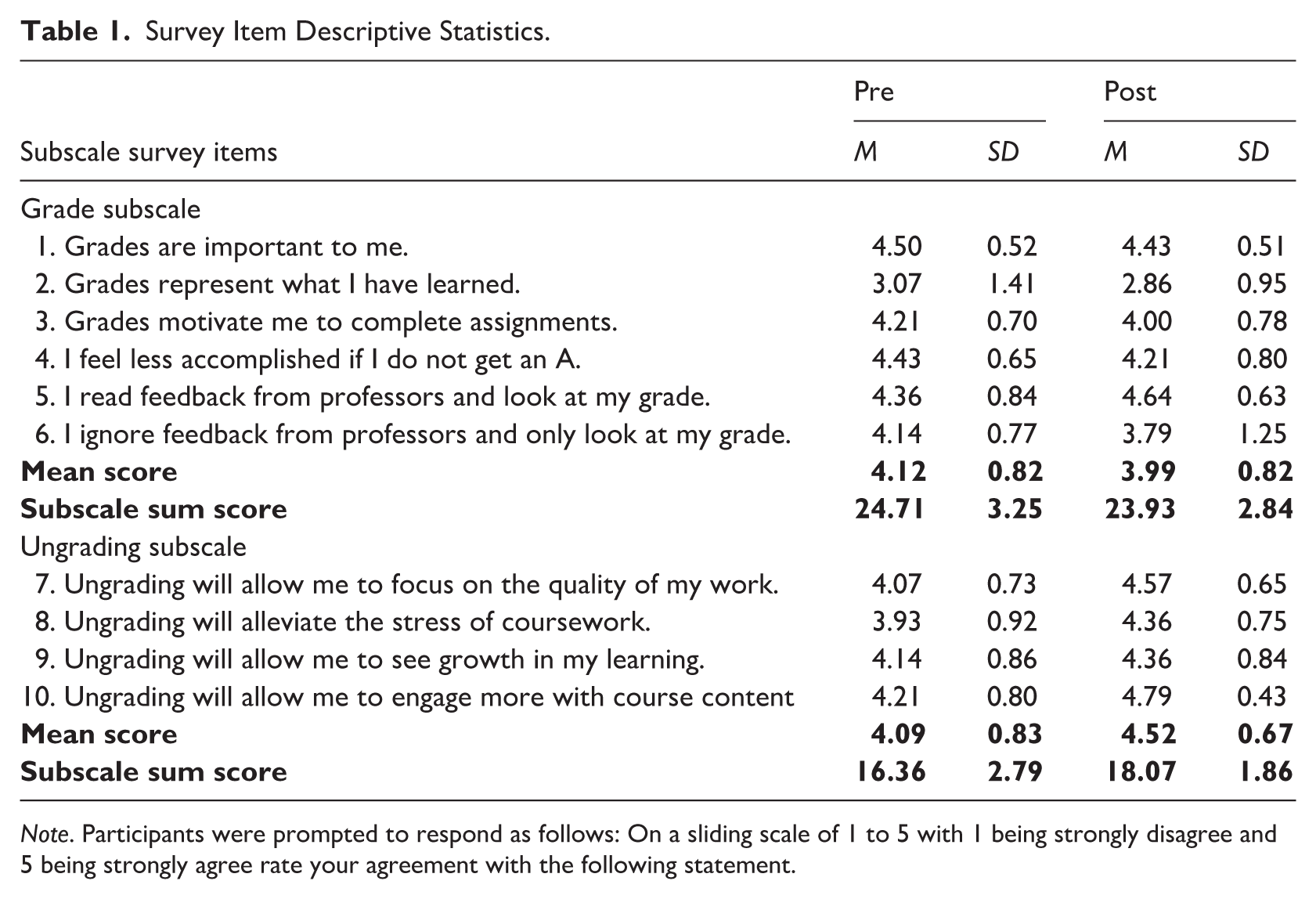
Note. Participants were prompted to respond as follows: On a sliding scale of 1 to 5 with 1 being strongly disagree and 5 being strongly agree rate your agreement with the following statement.
Interviews and Qualitative Analysis
I used notes from contract meetings and integrated the pre/post survey results to develop participant-specific semi-structured interview questions to pinpoint elements of ungrading that influenced undergraduate perceptions and learning outcomes (Teddlie & Tashakkori, 2009). As I was both professor and researcher, I needed to lessen the power differential between myself and participants. To do this, participants selected the day, time, and length of their interviews. I also reminded participants that they could choose which questions to answer, if any. Interviews took place on Zoom after final grades were submitted and averaged 30 min in length. I used Zoom to transcribe interviews and relistened to recordings to fix any AI errors within transcriptions. To remain reflexive in my perceptions of participants’ experiences and to maintain awareness of the student/teacher dyad, I used open coding. I then employed pattern coding and code mapping to tease out understandings of the quantitative data (Saldaña, 2021; Teddlie & Tashakkori, 2009). I kept codes and categories in my researcher journal, which I also used to write down my thoughts to remain reflexive throughout each round of coding. I employed member checks, but I received no responses from participants regarding their interview data.
Theoretical Framing
As I employed code mapping, I saw connections between categories and Foucault’s (1995) theoretical works on relationships between knowledge and power (Cheek & Cheek, 2008; Johnson, 2021). As such, I reviewed the first two cycles of coding and remapped categories through the lens of Foucault’s work, from which I found themes that seemed to explain survey results. Some methods of teaching and learning center the teacher/apprentice model where knowledge is objectively held by the teacher and imparted to the apprentice, thus creating an imbalance of power in favor of the teacher. Often, high-achieving students are perceived to have more value to systems of learning, instilling an internal dialogue within students that their value is based on a number. Johnson (2021) posited that traditional grades are an “imperfect system” and “the product of surveillance” (p. 56). Ungrading itself is an attempt to balance power in the teacher/student dyad and alleviate feelings of being surveilled (Gorichanaz, 2024; Zwagerman, 2008). As participants discussed feelings related to competition, surveillance, and authority, a Foucauldian lens seemed appropriate to frame this study.
Research Context
Course Design
I taught an elementary general music methods course at a large, public, mid-western university in the United States between August and December 2022. Participants (n = 14) were purposively sampled from the students enrolled in the course (N = 15). Those enrolled were either in their third (junior) or fourth (senior) year in their degree and were either vocal or instrumental music education majors. I designed the course to provide students with foundational teaching skills and experiences that would establish a framework for future growth. Content included connecting musicianship skills to teacher-as-musician, examining and applying general music specific pedagogies, recognizing and implementing principles of culturally relevant and sustaining pedagogies, as well as designing and delivering developmentally appropriate lesson plans that demonstrated evidence of student learning outcomes. Students also engaged in practicum visits with inservice music educators in communities surrounding the university.
Ungrading Contract Structure
As this was a university course, I had to assign a letter grade at semester’s end; however, I was able to design course content as I saw fit. As such, I implemented ungrading using contract grading. All students, regardless of participation in the study, contracted for the grade they wished to earn by semesters end. A copy of the grade contract I used may be found in the supplemental materials. The use of contract grading allowed students to have autonomy over their workload. If a student enrolled in a heavier semester (e.g., recital, travel for performance, credit load) or knew they struggled with course load/work/life balance, they could consider the course expectations and decide if they felt a final grade of an A, B, or C was attainable. I provided students a document detailing which assignments must be completed to earn the grade for which they contracted. Students also had the option to recontract1 for their grade at any point in the semester. I provided information on ungrading processes to students in a welcome video, during the first day of class, and for a third time during their first contract meeting. Students enrolled in this course met with me the first week of school to discuss, decide on, and sign grade contracts. We had two additional meetings in the semester: a mid-term and end of the course check-in. I also employed PearDeck2 each class to establish rapport and to learn about students, check-in on work/life balance, and to gauge assistance needed with weekly assignments.
As I was researcher and professor, it was essential I maintained reflexivity in my position and remained aware of my biases (Freire, 2000; Patton, 2015; Pillow, 2003). I did this in multiple ways. During initial contract meetings students asked any questions they had regarding participation in the study in relation to the course itself. Interviews regarding their experience with ungrading were held after final grades were submitted. All students provided feedback to me throughout the semester on their experiences with ungrading. I maintained any responses from students (e.g., email, PearDeck, drop-in meetings) and detailed any researcher tension in my research journal.
Researcher’s Positionality
I bring 16 years of public-school teaching experience in elementary general music into my teaching and research. As a public-school music educator grades were compulsory but, I felt, never adequately communicated to caregivers their students’ progress toward achieving learning goals. As a professor, I overhear students discussing their grades and the numbers game they play trying to figure out where to invest their energy, across courses, to achieve a passing grade. As a mother of a college student, my child also plays the numbers game. It is with these experiences that I approached this study.
Results
First, I will present strand one of this mixed methods design, quantitative findings. Following strand one data, I will then discuss qualitative findings (strand two), which seem to explain quantitative results. Finally, I will integrate strand one and two findings.
Quantitative Analysis
Item Descriptives
Standard deviations and means for each survey item may be found in Table 1. Participants were asked to rate the extent to which they agreed with each statement on a scale from 1 (strongly disagree) to 5 (strongly agree), on 10 statements. Survey item 6, I ignore feedback was reverse coded due to being a negative statement.
Survey Instrument Validity and Regularized Exploratory Factorial Analysis
To determine the construct validity and internal consistency of my instrument I conducted a regularized exploratory factor analysis (REFA) for the Likert-scale survey items (JuliusAI, 2026). As there are no a priori factors related to perceptions of ungrading to confirm, a REFA seemed best. Due to my small sample size, I chose to add a L1 (lasso) penalty (α = 1.0) to navigate the possibility of overfitting variables by reducing weak loadings to zero. Using eigen values of greater than one and confirming with Scree plots, I found a two-factor solution for sample data related to grading subscale which explained 68.47% of variance. Although my overall KMO was miserable (.51), likely due to my small sample size, Bartlett’s test of sphericity was significant (χ2 = 33.46, p = .004). I also found a one-factor solution for sample data related to ungrading subscale which explained 71.2% of the variance in responses. The overall KMO value of ungrading subscale items improved (.69) and my Bartlett’s was significant (χ2 = 26.81, p < .001).
Data loaded onto two components for grading subscale and one for ungrading subscale items: Importance of Grades, Grade Feedback, and Ungrading Optimizes Learning. Factor loadings may be seen in Table 2. As range of loadings were acceptable, I deemed a two-factor solution appropriate for grading subscale, and a one-factor for ungrading.
Loadings for Each Group for the Two- and One-Factor Solutions.
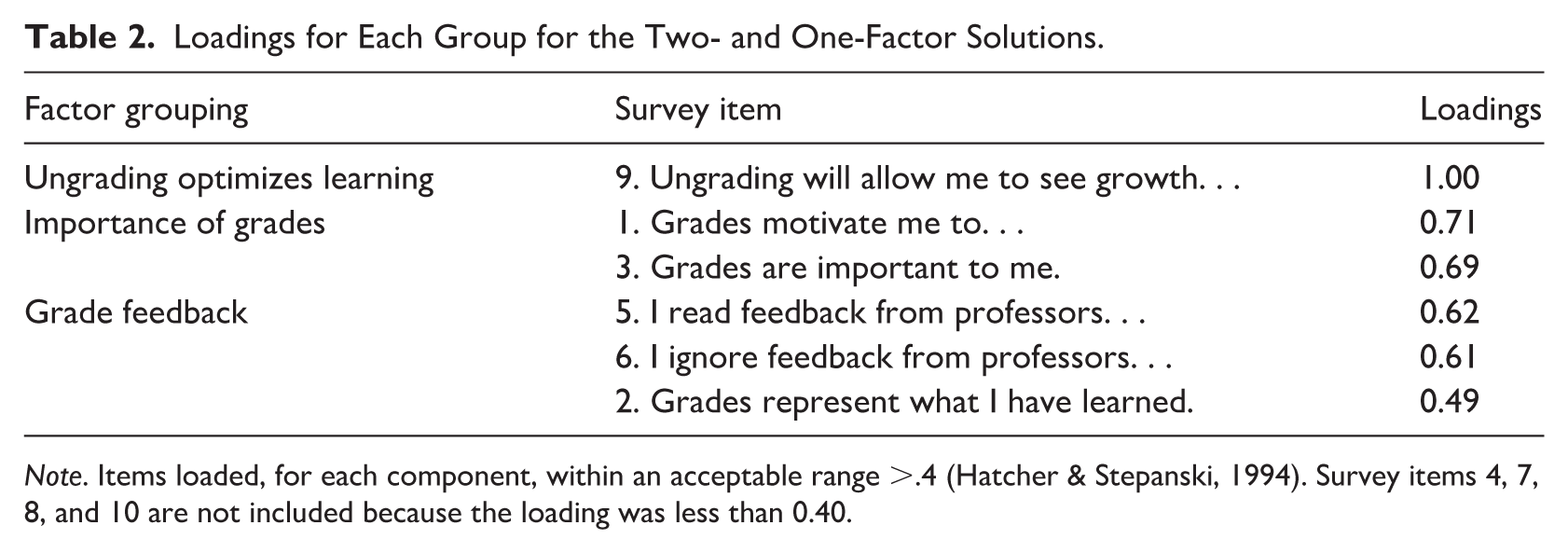
Note. Items loaded, for each component, within an acceptable range >.4 (Hatcher & Stepanski, 1994). Survey items 4, 7, 8, and 10 are not included because the loading was less than 0.40.
Difference Testing
I tested data for internal consistency among items measured (grading α = .85, ungrading = α = .81). After reverse coding survey item six the alpha on grade subscale lowered (α = .63). However, as this item loaded well within the REFA, I determined data were appropriate for subsequent analysis (Hair et al., 2010; Nunnally, 1978). To see if any differences existed in student perceptions of ungrading, I examined survey results by grading and ungrading subscales. Assumptions for normality were met for grading (W = .92, p = .2) but not for ungrading subscale (W = .83, p = .01); as such, I conducted a Wilcoxon test on both subscales. To mitigate a Type I error, I employed a Bonferroni correction (p = .025). I used grading subscale pre sum scores (n = 14, M = 24.71, SD = 3.25) and post sum scores (n = 14, M = 23.93, SD = 2.84) for the first analysis and found no significant difference (n = 14, Z = 0.71, p = .50). For the second analysis, I used ungrading subscale pre sum scores (n = 14, M = 16.36, SD = 2.79) and post sum scores (n = 14, M = 18.07, SD = 1.86). There was a significant difference in participants self-reported perceptions of ungrading (n = 14, Z = -2.67, p = .01). To explore the practical significance of the ungrading subscale, I computed r and found a large effect size (r = -.50) suggesting practical and statistical significance.
Qualitative Analysis
In this section I will discuss qualitative findings. I found four themes which seem to explain participant’s shift in perceptions of ungrading: “Un”Conventional Benefits To Learning, “Un”Stressing the Bad, Balancing the Good, Awareness of Institutional Surveillance, Course Structure can Balance the Student/Teacher Dyad. After detailing each theme, I will integrate quantitative and qualitative strands. Participants shared that their perceptions of ungrading shifted from beginning to the end of the semester. Although most participants initially stated traditional grades were important, those same participants indicated a preference for the structure of ungrading. This supports the difference in participant responses pre to postsurvey.
“Un”conventional Benefits to Learning
Throughout interviews, participants commented on how ungrading heightened their engagement with course content and encouraged freedom in learning. Participants also stated that ungrading provided them more evidence of growth in their knowledge and skill across the semester: In the past, grades represented you got the work done, whether you understood it or not. In your class if I “failed” an assignment, it wasn’t a grade, you just needed to learn the materials. Ungrading represented a beautiful mesh of what you are doing is actually how much you are learning. (Sarah)
Participants shared having the autonomy to complete assignments as they envisioned rather than following narrowly structured guidelines: Not having that thought running in the back of my mind [what’s my grade] allowed me to just focus on learning and doing the assignments, rather than shooting for a number. (Cassie) We can define our own style. You provided parameters, but there was still room that it doesn’t have to be done “
Ungrading made a safe assignment space. I knew in your class that if I put in the effort, I had the space to not understand or misinterpret and then have the chance to redo and improve, which was really freeing. It’s not like, “oh, you missed it, you messed up.” It was, “here’s how you’ll fix it.” (Sarah)
Participants stated that assignment feedback helped guide completion of future assignments and allowed them to focus on the process of learning. Some participants shared that ungrading encouraged them to take risks in other courses: Ungrading helped me think outside of the box. I had an assignment [in gen ed. course] and I used the rubric to get all the points, but I was a little more creative because I could think differently about it. (Brandi)
Another benefit to ungrading was the ability to let go of what participants called the numbers game: Not having to worry about a letter let me do what I thought would help me best on future assignments. (Robert) This is the first time we have gotten lots of feedback in place of a grade. It really helped me because sometimes I get stuck. Feedback helps me grow as a student. (Cora) Ungrading shows progress more. With grades you got an F and then the second time you got a D, and your final grade is a C. It doesn’t show what you’ve learned, it’s just an average. (Brandi)
“Un”stressing the Bad, Balancing the Good
All participants highlighted the issue of stress within coursework. At the beginning of the semester most participants were unsure if ungrading would alleviate their stress and allow them to focus on the quality of their work. During interviews, participants expressed that typical worries related to course work were removed.
I don’t have to worry about making numbers work. I can come in and do my best, and at the end of the day, my best is my best. (Anya) Ungrading helped me not stress as much about other courses. I’m okay with how I’m doing. I’m still studying and doing my best work, but I’m not going to panic for not having an A. (Emma) Ungrading is unique, in that it tests you on your skill level and doesn’t place you in the same category as someone with more experience. (Artie)
While ungrading, according to participants, relieved most course related stress, it created a new type of stress regarding resubmissions and portfolio development.
Awareness of Institutional Surveillance
Most participants suggested a professor’s course structure could increase or lower feelings of surveillance and balance power between them and the professor. Interview data indicated that ungrading also made participants aware of power imbalances and inequities within other courses. During interviews participants outlined differences between this course and others which used traditional grading. For participants, traditional grades created competition between peers, revealed a power dynamic of grade giver vs grade receiver, and highlighted internalized fears of how their grade impacted relationships with professors: I would do exactly what my teacher gave me. If this is what I need to get an A, then I would do exactly that. (Artie) I’ve always been stressed about grades. It was never really about the quality [of learning] but rather just getting it right. I’m just worried about getting the grade to have a good GPA. (Emma) Worrying about lower letter grades made me willing to go about achieving higher grades in an unhealthy way [e.g., late nights, no friends]. (Emma) I have a weird fear of letting down my teachers with a bad grade. (Cora)
In addition to sharing how grades induced feelings of surveillance and erased identity (e.g., Anya stated, I’m more than a number), participants shared that ungrading made them question systemic structures within their degree program. More specifically, the inequity of grading practices between courses: Ungrading kind of raised some questions about how different classes are graded to different standards. If all are graded to different standards, then how can you objectively grade? (Artie) I don’t feel every professor has the same definition of what the grade reflects. (Robert) In our class, the letter didn’t matter. In others, the letter still mattered and affected my future. It was hard to shift between the two. No matter how much effort I put in those other classes, I wasn’t going to get a good grade. (April) No matter how well the contract worked or how great ungrading is, you still end up with a grade that impacts your GPA, and that is the fundamental issue. (Sarah)
Course Structure can Balance the Student/Teacher Dyad
Implementing ungrading throughout the course provided balance between student and professor. Ungrading also seemed to provide participants an awareness of their learning styles and needs: Ungrading gave me a perspective of my other classes, that some professors were not fully accommodating of me or my peers. (Artie) In this class, I never feel like ‘Am I going to pull this off or not?’ (Regan) This class we’re teaching, doing, and learning techniques and stuff. We’re not just sitting and listening to a lecture then taking a multiple-choice exam. This class contributed to me understanding that style of class is not helpful to my learning. (Ash) Other classes could use this. Music is so hard. We are trying to put everybody into an A, B, C, or D, instead of giving feedback specific to [the student] ‘here, this is what you can do to improve.’ (Cora)
Participants expressed that methods type courses were perfect for implementing ungrading. In interviews, participants frequently stated that they appreciated the flexibility in approaching assignments, choosing the content they wanted to teach, and being able to have attempts at failure in learning: It did feel like I was doing my own thing and coming up with lessons I would enjoy teaching. That was fun. (Anya) Ungrading gave the opportunity to try something, and then, if it were a miserable failure, then you could try and do something else, that was more successful based on what you failed before. (Bryant)
Integration of Quantitative and Qualitative Data: Mixed Methods Analysis
All participants (n = 14) participated in both strands of data collection. After analysis of both strands, I compared findings to see where qualitative data confirmed, contradicted, or explained quantitative findings (Teddlie & Tashakkori, 2009). I will present findings by research question, with themes listed beneath to highlight the convergence or divergence of strand findings.
RQ1: How Do Students Perceive Ungrading and Does This Perception Change Over Time?
Perceptions of ungrading changed between the start of semester in August to the end, December 2022. Difference testing indicated a significant shift in perceptions of ungrading in pre/postsurvey scores [Z = -2.67, p = .01, r = -.50]. Overall, qualitative analysis confirmed difference testing. One theme seemed to explain the change in participant perceptions, specifically related to stress, “Un”stressing the Bad, Balancing the Good. This was also confirmed by the factor loading related to ungrading alleviating stress (see Table 2). Participants left the semester with a greater understanding and appreciation for ungrading, and they valued the ability to focus on the learning process, rather than playing the numbers game. Interview data confirmed the increase in mean between presurvey and postsurvey as related to change in perceptions (presurvey M = 16.36, post survey M = 18.07).
RQ2: How Does Ungrading Help or Hinder Class Participation, Assignment Completion, and Commitment to Learning?
Most interview data fell within the second research question. Data analysis confirmed and explained participant survey responses regarding the increase of means between presurvey and postsurvey items regarding ungrading. One theme supported strand one data, answering the second research question: “Un”conventional Benefits to Learning. Many participants guided interviews to discuss how ungrading shifted their perceptions of traditional grades. Participants shared how ungrading helped them develop awareness of unhealthy practices to achieve higher academic standing. This theme confirms changes in perceptions of ungrading from pre/postsurvey and supports the REFA factor Ungrading Optimizes Learning.
Participants did not speak directly to any aspect of ungrading that hindered their learning or engagement; however, participants did discuss issues of balancing assignment resubmissions. Although participants appreciated having the opportunity to resubmit assignments (e.g., I knew if I misunderstood something, there was always a chance to redo it. [Anya]) managing resubmits, for some, seemed to be a barrier to learning which contradicted participant responses to survey item: Ungrading will alleviate the stress of coursework [presurvey M = 3.93, postsurvey M = 4.36]. As a few participants stated: The most difficult was seeing the feedback and adding the resubmit to the list. (Artie) The issue I ran into throughout the semester was working on resubmissions. (Cassie)
The element of resubmitting assignments, an essential component to ungrading, seemed to be the largest factor contradicting strand one findings. Participants struggled to manage their resubmissions in relation to other course assignments.
RQ3: What Recommendations Do Students Have on the Implementation of Ungrading?
During interviews, each participant either directly addressed or alluded to the issue of having to go between ungrading and traditional grade structures. An unexpected theme, Awareness of Institutional Structures, emerged from these conversations. Although not a survey item, through discussing their survey responses, participants made recommendations for the implementation of ungrading throughout their music degree program. These recommendations fell under the theme Course Structures Can Balance the Student/Teacher Dyad. Participants were specific as to what courses they felt ungrading would be best suited. Although they wished ungrading was used in each course, they were unsure how it would work in a music history or music theory setting as “it would be difficult because there is a right or wrong answer” (Anya). Preference for ungrading over traditional grades was consistent across interview data, despite student struggles with resubmission of assignments and moving between ungrading and traditional grading paradigms.
Discussion
Ungrading is a non-traditional method of evaluating and assessing student learning outcomes. Not typically implemented within music education undergraduate course work, I attempted to examine the value of ungrading within an undergraduate music methods course. I did this through a sequential mixed methods study regarding changes in undergraduate perceptions of ungrading. Findings from this study support and extend upon previous literature. However, there are limitations to this study. The purposive nature and small participant sample strongly caution the generalizability of results. Another limitation is my researcher-designed instrument. Although I examined survey items through a regularized exploratory factor analyses to better understand the function of grading and ungrading subscale survey items, my sample was small. Additionally, item six, I ignore feedback from professors, proved problematic once reverse coded. This could be the result of participants misinterpreting the question; however, it negatively impacted the reliability of the grade subscale, and I must reconsider this item. More research, with a larger sample size, and further analysis is needed to confirm possible factors and develop new items for future survey research. Lastly, my position as both researcher and professor, regardless of my attempts at reflexivity and conscientization during instruction and assessment, is an additional limitation (Freire, 2000; Patton, 2015; Pillow, 2003).
Participants in this study consistently highlighted how ungrading allowed them to approach course work in ways that were authentic to their learning styles. In addition, participants expressed that ungrading provided opportunities for creativity in coursework not found in other courses where traditional grades were employed (Danielewicz & Elbow, 2009; Elbow, 1997). Participants discussed the perceived objectivity of traditional grades and the frustration of grade surveillance outside of this methods course (Johnson, 2021; Zwagerman, 2008). Undergraduate perceptions of ungrading align with Elbow (1997) who argued how traditional grades can undermine student learning and are not as objective as one may think. “The point of a contract is to focus less on trying to measure degrees of quality. . . instead emphasize activities and behaviors that will lead to learning” (Elbow, 1997, p. 133, emphasis original). Themes from strand two, “Un”conventional Benefits to Learning and “Un”stressing the Bad and Balancing the Good, support Elbow and other’s work (Gorichanaz, 2024; Kesler, 2024; Meinking & Hall, 2022; Lucas, 2021; Stommel, 2021, 2023a).
Participant data conflicted with previous findings in some of the related literature. Spidell and Thelin (2006) stated that “we do know that students seek grades. . .and a system of evaluation pretending to be anything but evaluative will cause both student suspicion and resentment” (p. 55). Larson (2024) found students to be stressed with the absence of grades. These findings are in opposition to the outcomes of this study. Participants self-reported positive reactions to the implementation of ungrading, even with contradicting strand one results regarding the stress of managing resubmissions. Ultimately, all participants stated a preference for ungrading during interviews despite voicing that the grade was ultimately necessary for the GPA.
Consistent across interview data were participants’ expressed feelings of autonomy in the completion of course work. Participants specifically stated freedom to attempt new ideas that may be outside of assignment parameters, once familiar with ungrading. This aligns with previous findings of ungrading encouraging student autonomy and risk taking (Gabor, 2024; Kesler, 2024; Mallette & Hawks, 2020; Meinking & Hall, 2022; Reardon & Guardado-Menjivar, 2020); however, there were no findings, in strand one or two data, that indicated participants were frustrated with the contract, felt it was unclear or unfair, or undermined their ability to learn. This differs with Reardon and Guardado-Menjivar’s (2020) findings that participants felt the contract was not clearly explained, worked in favor of the professor, and “underestimated [students’] abilities” (p. 2). The inclusion of three contract meetings in the course under examination—combined with consistent feedback and communication—may be why participants in this study felt the contract expectations were clearly communicated and further supported their agency and autonomy as learners. A heightened awareness of academic growth, due to the level of feedback received, was consistent through strand two data.
Interview data indicated a cognitive dissonance between the course under examination in this study and participants’ other course work as perceptions of ungrading shifted from unsurety to preference. Results from this study support various elements outlined by Gorichanaz (2024) such as (a) the transition process from traditional grades to ungrading, (b) deconstruction of socialized norms, and (c) a desire for deeper learning experiences. Throughout interviews, participants shared a constant awareness of the difference between ungrading, and traditional grades used outside of this course. “Ungrading shows progress more than, you got an F and then you got a D and your final grade is a C. [Grades] don’t show you’ve learned, it’s just an average” (Brandi). These statements often pointed out the larger issue of a normed perspective that grades = growth = success. Most participants expressed something similar to Ash’s concluding remark, “I want a class where I enjoy the learning, that’s it. That is all I want.”
One finding not consistent across extant literature was student awareness regarding relationships of knowledge and power within grading practices. Traditional grades imply objective standards with which to assess student learning, creating hierarchies of successful students and an internalized sense of surveillance of comparative success. In Discipline and Punishment, Foucault highlighted Bentham’s Panopticon. The Panopticon is an envisioned, architectural prison design where the locus of power (e.g., the professor) is central to the function of the building. Those with power see all, and those imprisoned, on the periphery, are impaired from seeing. This induces a “state of conscious and permanent visibility that assures the automatic functioning of power” (Foucault, 1995, p. 200). Participants overwhelmingly commented on how ungrading made them aware of inconsistencies in grading practices within other courses. A common topic among interviews were ideas of doing what was necessary to “get the A,” to observe and copy the professor, or to just “be told what to do” (April and Artie). Participants spoke to comparisons between themselves and their peers while learning to be their authentic selves outside of ungrading.
Although participants preferred ungrading, they stated the ever-looming GPA was what mattered as it influenced how they felt perceived by professors, their place among their peers, and the number of scholarships awarded. This is what Johnson (2021) referred to as product and processes of surveillance. We surveil students in class through assignments and projects, and we, as educators, are surveilled based on the success of those we teach. Arguably, a student struggling to be seen amongst their high-achieving peers—or one anxious over loss of scholarship—may bend to this Educational Panopticon and lean into actions that, rather than foster learning and growth, lead to plagiarism and dismissal.
Implications and Suggestions for Future Research
Researchers have demonstrated the impact of ungrading on student engagement and motivation, and its advantages to student learning outcomes (Andrews, 2004; Guberman, 2021; Meinking & Hall, 2022). Ungrading can also provide space for student autonomy and agency within course structures (Gabor, 2024; Gorichanaz, 2024; Lucas, 2021; Meinking & Hall, 2022; Stommel, 2021). As such, it would be beneficial for music teacher educators to consider implementing ungrading practices throughout methods courses. It is within methods courses (e.g., general music, instrumental, conducting) that students begin to shape their teacher identities. In maintaining the master-apprentice model, we risk students striving to “get the A,” rather than nurturing what aligns with their emerging philosophies. This type of learning transmits expectations and value judgments that favor the professor over the student (Daniel & Parkes, 2015). Without ungrading we also risk creating a lineage rather than an innovation of pedagogy.
Participants noted that resubmission of assignments was a barrier. Researchers could focus on the use of resubmissions by exploring how students navigate time-management and edits of their assignments for a resubmission. This examination may help refine ungrading practices within music education curricula and provide more scaffolded structures for successful implementation of ungrading.
Application of ungrading throughout music education coursework may also alleviate typical degree-related stress (McConkey & Kuebel, 2022; Payne et al., 2020) and lessen feelings of surveillance. Participants emphasized how ungrading relieved stress related to coursework and increased comfort in approaching assignments with creativity while lessening fear of failure. Rather than focusing on performance ratings, or rubrics and measures that are ultimately not objective, music education students could emphasize the progression of skills over systems of ranked grading (Elbow, 1997; Johnson, 2021). A continuation of systemic structures that enforce an Educational Panopticon risks the loss of future music educators who cannot thrive within traditional grading structures.
Although participants stated a preference for ungrading in our elementary methods course, they shared that some courses may not fit within ungrading structures. Anya stated, “I think with music theory it would be difficult because there is a right/wrong answer.” Robert also focused on the idea of right or wrong. “I think it depends on the context of the course: math or history, it’s just how much can you get correct. Whereas a course like this, it’s more about growth and effort.” Music teacher educators may wish to collaborate with their music history and theory colleagues to examine the use of ungrading in non-methods courses. Researchers who choose to examine the implementation of ungrading within music education curricula could help refine and evolve ungrading practices related to clarity, communication, and multi-modal approaches to learning and assessment (Reardon & Guardado-Menjivar, 2020). A narrative inquiry of students’ journeys or a comparative study of ungrading styles may also highlight further ideas on the implementation of ungrading across music education curricula.
Although I strove to mitigate the power differential between myself and participants, my role as the professor was a limitation to this study. A replication of this study led by outside researchers might provide a more generalizable understanding of ungrading within music education curricula. Restructuring this survey based on REFA results and distributing it across multiple institutions would also be beneficial.
Finally, a consideration of Self-Determination Theory (Ryan & Deci, 2020) as a lens to examine ungrading also may be beneficial. Although data in this study did not fall into categories of intrinsic and extrinsic motivation, participant data did highlight the benefits of autonomy within ungrading structures. An examination of motivation in learning within an ungraded music methods course may provide further insight into innovative music education curricular practices.
Conclusion
Styles and approaches to evaluation and assessment have and will continue to be a topic of debate, critical conversations, and research in our field. Whatever practices a music educator may value, individualized and student-centered instruction should be our goal. Perhaps with continued research, examination of our individual praxes, and conversations, we may find a path to dismantle hidden panoptic practices within our methods of instruction and assessment.
Supplemental Material
sj-docx-1-ijm-10.1177_02557614261459356 – Supplemental material for Perceptions and Outcomes of Implementing Ungrading in an Undergraduate Music Methods Course: A Mixed Methods Inquiry
Supplemental material, sj-docx-1-ijm-10.1177_02557614261459356 for Perceptions and Outcomes of Implementing Ungrading in an Undergraduate Music Methods Course: A Mixed Methods Inquiry by Rachel Grimsby in International Journal of Music Education
Footnotes
Acknowledgements
The author would like to thank students for their participation, invaluable feedback, and honesty throughout the research and methods course process. The author also would also like to thank Dr. Mozhdeh Forghaniarani for her guidance on the use of REFA.

Ethical Considerations
I was IRB approved in early August 2022. Informed consent was given through a survey when initial data collection began late August 2022. I recruited the students in a methods course via a survey. Participation was voluntary. Participants did nothing outside of participate in class as they typically would. Interviews took place after final grades were submitted.
Author Contributions
Funding
The author received no financial support for the research, authorship, and/or publication of this article.
Declaration of Conflicting Interests
The author declared no potential conflicts of interest with respect to the research, authorship, and/or publication of this article.
Data Availability Statement
Data results are provided within the document.
Data Collection
Data were collected at Illinois State University in 2022; however, all necessary IRBs were transferred to my new institution, James Madison University in 2023. Second IRB (transfer) Analysis, Writing, and Editing all took place at James Madison.
Any Other Identifying Information Related to the Authors and/or Their Institutions,Funders,Approval Committees,etc,That Might Compromise Anonymity
There is nothing to state regarding additional information that may compromise anonymity. I use pseudonyms so participants are protected.
Supplemental Material
Supplemental material for this article is available online.
Notes
References
Supplementary Material
Please find the following supplemental material available below.
For Open Access articles published under a Creative Commons License, all supplemental material carries the same license as the article it is associated with.
For non-Open Access articles published, all supplemental material carries a non-exclusive license, and permission requests for re-use of supplemental material or any part of supplemental material shall be sent directly to the copyright owner as specified in the copyright notice associated with the article.
