






Abstract
The present study attempts to identify the various determinants of Quality of Work Life (QWL), and the level of QWL among the veterinary doctors of Punjab. The factor analysis of 45 variables yielded 13 job characteristics of which ‘Monetary Consideration’, ‘Social Relations at Work’, ‘Constitutionalism at Work’, ‘Pride in Job’, ‘Facilitation for Current Performance and Future Growth’, ‘Security and Safety’, ‘Fair and Unbiased Attitude of Top Officials’, ‘Space and Infrastructure’, ‘Diagnostic Facilities and Staff’ and ‘Reporting’, have been found associated positively and significantly with QWL. ‘Nature of Job’ has been found negatively and significantly related with QWL, whereas ‘Innovative and Challenging Job’ and ‘Less Educated and Ignorant Clients’ have not been found linked with QWL. The respondents were found to experience moderate to high levels of QWL.
Introduction
The genesis of the concern for Quality of Work Life (QWL) may be found in the humanistic tradition within the social sciences that tries to highlight the employees’ need for meaningful and satisfying work and for participation in decisions that influence their work environment (Saklani, 2004). Elizur and Shye (1990) indicated that since a number of approaches have been followed to define QWL, discrepancies still exist in the use of the term. Earlier QWL was seen in terms of availability of jobs, training and mobility, job security, and earnings. Then QWL was perceived to include working conditions, equitable compensation, and job opportunities, while more recently, QWL was viewed as involving autonomy, accomplishment, challenge, personal responsibility, chances to make decisions, and to develop interests and abilities. Lawler (1982) defines quality of work life in terms of job characteristics and work conditions. He highlights that the core dimensions of the entire quality of work life in the organization are to improve employees’ well-being and productivity. The success of any endeavour to improve the QWL and to enhance employee well-being depends upon the accurate diagnosis of various determinants of QWL. Research has highlighted a number of factors that affect QWL.
A significant number of researchers have identified various determinants of QWL across various industries and professions from time to time. For instance, Wilcock and Wright (1991) assessed QWL of employees in the knitwear sector of the Canadian textile industry and found that working conditions, social integration, constitutionalism, and work and life characteristics of the jobs were important determinants of QWL. Chander and Singh (1993) identified four major determinants of QWL of university teachers, namely decision making authority, growth and development, recognition and appreciation, and promotional avenues. Gani and Ahmed (1995) examined various components and correlates of QWL in a public sector company located in Jammu and Kashmir and found that adequate financial returns, besides desires for job security, better working conditions and advancement opportunities, continue to be the major considerations in employee’s working life. Piccinini (1996) reported that Brazilian companies tend to offer benefits with emphasis on workers’ health plans, followed by training and development, good human relationships, and career opportunities, to enhance QWL of their employees. Lau and May (1998) used characteristics such as pay and benefits, opportunities for growth, job security, pride in work and company, openness and fairness, and camaraderie and friendliness, to assess QWL. Lewis et al. (2001) examined the effect of extrinsic traits and intrinsic satisfaction on QWL in health care settings in Canada and objectively identified pay benefits and supervisory style as the major determinants of QWL. Health and safety, economic and family needs, social needs, esteem needs, actualization needs, and knowledge needs, were identified as seven major needs to develop a new measure of QWL. Wyatt and Wah (2001) examined the perceptions of managerial executives of Singapore about the four dimensions of QWL, like favourable work environment, personal growth and autonomy, nature of job and stimulating opportunities. Saklani (2004) suggested that apart from monetary considerations, employees in India accord a high value to factors that satisfy self esteem and self actualization needs of a higher order. Lees and Kearns (2005) showed the outcome of their study in the form of promotion and maintenance of work environment that results in excellence by ensuring open communication, respect, recognition, trust, support, well-being and satisfaction of its members both personally and professionally. Dargahi and Saragi (2007) found that the strongest perceived areas amongst 12 categories developed by the QWL strategic planning committee that the employees agreed to improve their QWL were: communication, leadership, monetary and non monetary compensation and support. Van Laar et al. (2007) developed and tested psychometric properties of the work related quality of life scale for healthcare workers, which included job and career satisfaction, general well-being, home work interface, stress at work, control at work and working conditions. Anbarasan and Mehta (2009) focused on the QWL of sales executives belonging to different sectors, namely pharmaceutical, banking, insurance and finance. The factor analysis resulted in five factors indicating employee’s satisfaction and continuance, perceived job motivators, job awareness and commitment, non conducive work environment and perceived organizational culture. Walton (1975) proposed eight major conceptual categories relating to QWL: adequate and fair compensation, safe and healthy working conditions, immediate opportunity to use and develop human capacities, opportunity for continued growth and security, social integration in the organization, constitutionalism, work and total space of life and social relevance of work life. The literature reviewed highlights that the most common approach to assess QWL has been job characteristics at a generic level.
The present study attempts to identify the various characteristics of the job of veterinary doctors which affect the quality of their work life. Veterinary doctors provide technical services like vaccination, disease treatment, controlling different types of outbreaks, providing artificial insemination for breed improvement, and advising farmers and owners in rearing and maintaining the health of animals. All the veterinary officers, who act as the promoters of human health in taking the responsibility for the hygienic production of meat, eggs, milk etc., at many a times, have to be prepared to work in unhygienic conditions with appropriate protective clothing. They have to work outdoor in all kinds of weather and treat animals, or perform surgeries under unsanitary conditions. They are more exposed to fatal infections and physical risks of being bitten, kicked or scratched. The unfavourable environment under which they are supposed to work might be affecting their QWL adversely, and this encouraged the researchers to carry out the present study.
Research Methodology
This article attempts to explore the determinants of QWL among veterinary doctors in Punjab. The ambit of the study consists of all the 649 veterinary doctors employed by the Punjab government on a permanent basis as of October, 2010. Initially the questionnaire designed for data collection was e-mailed to all the veterinary officers, but due to the lukewarm response of the officers, they were approached personally and through their seniors. Finally, a sample of 322 questionnaires were collected which were considered for the purpose of the analysis. Job Characteristics Scale has been designed to seek information about the various characteristics of the job of a veterinary doctor and Quality of Work life scale has been developed to assess the quality of life of the respondents.
Results and Discussion
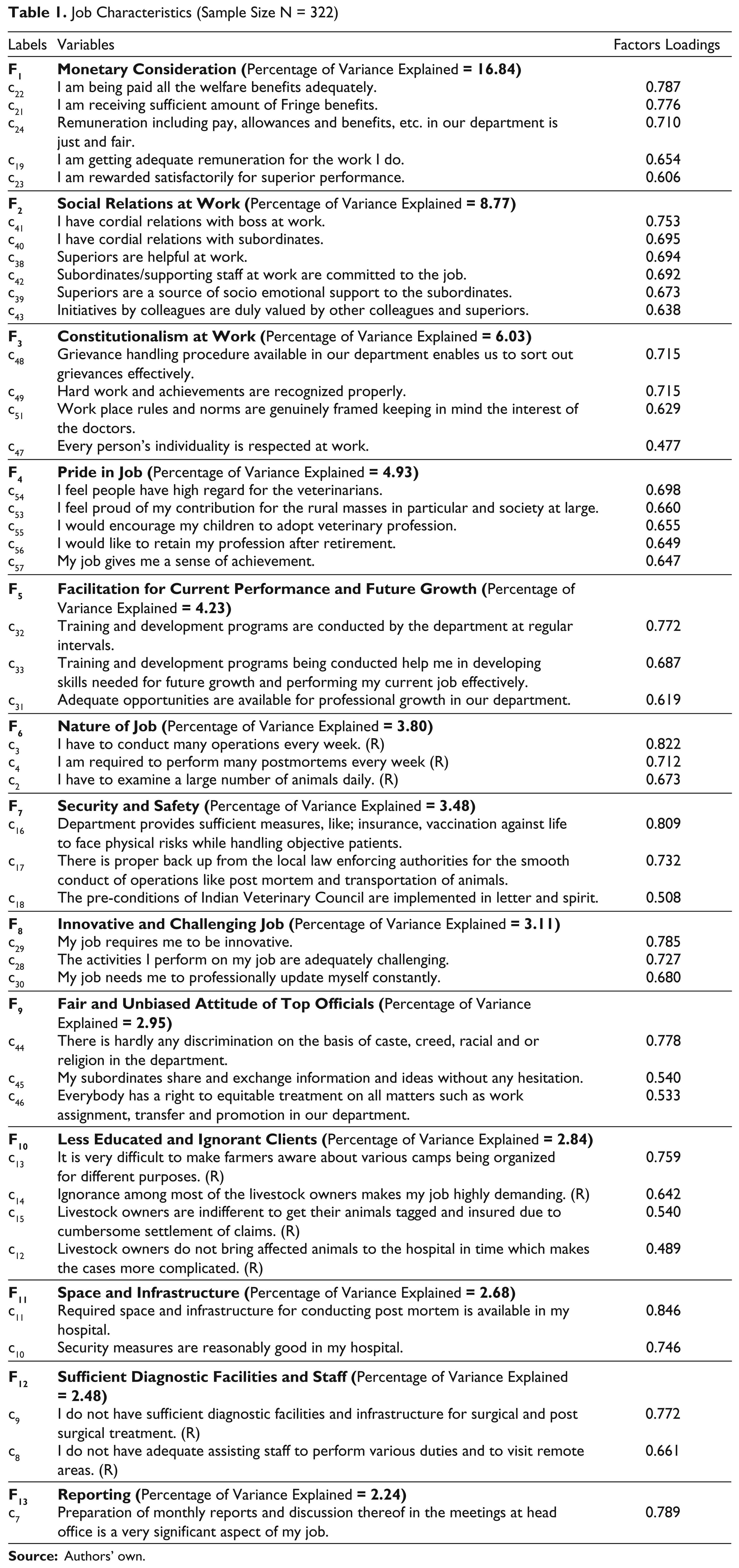
Principle component analysis with Varimax Rotation was employed to examine the structure of the job of veterinary doctors. The factor analysis of 57 items identified 12 items with weak and multiple loadings and were thus excluded from the analysis. Finally, 45 items have been analyzed and used for further analysis. Cronbach Alpha, a measure of the reliability of the internal consistency of the scale, was found to be 0.828 for 45 items. Factor analysis of 45 variables yielded 13 factors which explained 64.36 per cent of variance. The factor loadings which are greater than 0.45 (ignoring sign), are interpreted. The Eigen values for the factor F1to F13are 7.58, 3.95, 2.71, 2.22, 1.90, 1.71, 1.57, 1.40, 1.33, 1.28, 1.21, 1.12 and 1.01. All the extracted factors with their respective structure, percentage of variance explained and loadings are reported in Table 1, and are discussed in detail in the following pages.
Job Characteristics (Sample Size N = 322)
Monetary Consideration (F1)
Various aspects of monetary consideration, like allowances, benefits- both welfare and fringe, fair and just pay, adequate remuneration and satisfactory reward for superior performance, may constitute important components of QWL. ‘Monetary Consideration’ has emerged as the most important job characteristic with six variables loaded on it, and this explains 16.84 per cent of variance. Table 1 shows that the variable ‘sufficient allowances’ (HRA, NPA, Conveyance allowance, Risk allowances and farm allowance) with factor loading 0.796 has been the first variable to load on this factor, followed by ‘welfare benefits’ (0.787), ‘fringe benefits’ (0.776),‘fair and just remuneration’ (0.710), ‘adequate remuneration’ (0.654) and ‘satisfactory reward for superior performance’ (0.606). The results of the present study are in line with the findings of Gani and Ahmed (1995), who found that adequate financial returns from the job continues to be of major consideration in the working lives of employees. Similarly, Lau and May (1998), Lewis et al. (2001), Wang and Ye (2001), Saklani (2004), Beh (2006), Saraji and Dargahi (2006), Khani et al. (2007), and Azril et al. (2010) highlight the significance of various aspects of compensation, like pay benefits, earning opportunities, fair and appropriate compensation, which determine QWL of employees. The primary aim of a person at work is to earn a living to fulfill his/her basic needs. It is therefore natural that QWL is affected by how well this aim is achieved. The findings suggest that the various components of compensation, as well as the feeling about all these being fair and just, might influence the perception of the respondents about the quality of work life.
Social Relations at Work (F2)
‘Social relations at work’ was found to be the second important factor explaining 8.77 per cent of variance. Findings of various studies highlight the significance of social relations at work, example Cansidine and Callus (2002) revealed that the majority of Australian workers felt that having good relationships at work was the most important issue for high quality of working life. Similarly, Dolan et al. (2008) also asserted that job demands and lack of supervisory support result in low QWL. In the present study, six variables which represent various aspects of social relations at work have loaded on this factor. Table 1 shows that the variable ‘cordial relations with boss at work’ has got the highest loading of 0.753, followed by variables ‘cordial relations with subordinates’ with a loading of 0.695, ‘help from superiors at work’ with a loading of 0.694, ‘commitment of subordinates/supporting staff at work’ with a loading of 0.692, ‘superiors as source of socio-emotional support to subordinates’ with a loading of 0.673, and ‘initiative by colleagues being valued by others’ with a loading of 0.638. ‘Social relations at work’ is the everlasting need of every worker. Since work and career are typically pursued within the framework of social organization, the nature of social relationships becomes an important dimension of QWL (Jain, 1991).
Constitutionalism at Work (F3)
‘Constitutionalism at work’, explaining 6.03 per cent of variance, has been identified as a leading job characteristic. Wilcock and Wright (1991) reported that constitutionalism was one of the important determinants in assessing the quality of work life of employees. Lees and Kearns (2005) also showed parity of results with respect to open communication, respect, recognition, trust, support and well being of employees both personally and professionally, to improve QWL of employees. Sirgy et al. (2001) also gave due weight-age to esteem needs while developing a new measure of QWL based on Need Satisfaction and Spillover theories. Table 1 reveals that the variables ‘grievance handling procedure available in the department’ and ‘recognition of hard work and achievements’ have loaded on this factor with a loading of 0.715, each. These are followed by the variable ‘genuineness of work place rules and norms’ with a loading of 0.629, and ‘respect of person’s individuality at work’ with a loading of 0.477. An employee of any department is affected by many decisions taken on his behalf or about his status. A working environment is required which recognizes hard work and protects the employees from the exploitative actions of higher authorities. The variables loaded on this factor are related either with what rights an employee has, or how s/he can protect her/his rights through the grievance handling procedure. The governance by the rule of law and the recognition of hard work and respect for individuality of veterinary doctors defines this factor.
Pride in Job (F4)
The concept of pride in job implies workers’ perception of their work, and the output thereof, and its acceptance in society. Lau and May (1998) confirmed a commonly held belief that companies with high QWL result in employee satisfaction by considering ‘pride in work’ as one of the determinants of QWL. Similarly, Cansidine and Callus (2002) revealed that the majority of Australian workers felt that having interesting and satisfying work was the most important issue for a high quality of working life. Hoonakker et al. (2009) also showed consonance of results with the present study by including task significance and task identity as one of the variables to measure job characteristics. This factor explains 4.93 per cent of variance and the five variables loaded on this factors are; ‘high regard for the veterinarians’ with a loading of 0.698, ‘contribution for the rural masses in particular and society at large’ with a loading of 0.660, ‘encouraging children to adopt veterinary profession’ with a loading of 0.655, ‘retaining profession after retirement’ with a loading 0.649 and ‘sense of achievement’ with a loading of 0.647. High regard of veterinarians for their contribution to society, and a feeling of a sense of achievement, encouraging their children to adopt this profession, and the desire to retain this profession after retirement, define this factor.
Facilitation for Current Performance and Future Growth (F5)
‘Facilitation for Current Performance and Future Growth’ has emerged as a separate factor which explains 4.23 per cent of variance. The variables composing this factor with their loadings are; ‘conducting training and development programs at regular intervals’ with a loading of 0.772, ‘developing skills for future growth through training and development’ with a loading of 0.687, and ‘availability of adequate opportunities for professional growth’ with a loading of 0.619. The relevance of this factor gets adequate support from literature, for example, Chander (1993), Piccinini (1996), Lau and May (1998), Wang and Ye (2001), Wyatt and Wah (2001) Beh (2006), Adhikari and Gautam (2010), Subramanian and Anjani (2010) gave high priority to growth and development, career opportunities, personal growth, training and skill development. Similarly, Saklani (2004) suggested that apart from monetary considerations, employees in India accord high value to the factors that satisfy self esteem and self actualization needs of a higher order. Research supports the notion that career achievement, career satisfaction and career balance have significant impact on QWL (Rose et al., 2006). Self actualization needs of the doctors to acquire required skills through regular training and development programmes, and the availability of other adequate opportunities for professional growth in the department, define this factor.
Nature of Job (F6)
‘Nature of work’ was revealed to be separate factor explaining 3.79 per cent of variance, with three variables loaded on it. The variable ‘conducting many operations every week’ has got the highest loading of 0.822, followed by the variable ‘requirement to perform many postmortems every week’ with a loading of 0.712, and ‘examination of large number of animals daily’ with a loading of 0.673. ‘Nature of job’ has been identified in literature as a leading factor affecting QWL. For example, Herzberg et al. (1959) suggested that motivating factors are intrinsic to job, like job content, the work itself and responsibility. Similarly, Taylor (1979) identified the intrinsic job notions of the nature of the work itself as basic components of QWL. Wyatt and Wah (2001) considered nature of job as one of the dimensions while examining the perceptions of the QWL among managerial executives of Singapore. Lewis et al. (2001) emphasized the significance of intrinsic rewards, including trait specific to the work done, the task content: skill levels, autonomy and challenge. Nature of job is expected to be a critical factor affecting the quality of work life among veterinary doctors.
Security and Safety (F7)
According to Saraji and Dargahi (2006), occupational health and safety plays a vital role in determining overall quality of work life of hospital employees. Azril et al. (2010), Gallie (2000) and Adhikari and Gautam (2010) considered security as an indicator of QWL while examining perception of respondents for QWL. The present study relating to veterinary profession requires the safety and security of the doctors in particular, and that of animals in general. The factor analysis revealed ‘security and safety’ as an independent factor explaining 3.48 per cent of variance with three variables loaded on this factor. The first variable is related to safety of veterinarians, that is ‘departmental efforts to provide sufficient measures, like insurance, and vaccination against life to face physical risks while handling objective patients’ with a loading of 0.809, followed by another variable relating to ‘proper back up from the local law enforcing authorities for the smooth conduct of operations, like post-mortem and transportation of animals, with a loading of 0.732. The third and last variable is ‘implementation of preconditions of Indian Veterinary Council in letter and spirit’ with a loading of 0.508. Considering any profession, where employees are exposed to physical conditions that might be hazardous to their health, ensuring safety and security of employees is an important concern.
Innovative and Challenging Job (F8)
‘Innovative and challenging job’ has emerged as a separate factor explaining 3.11 per cent variance with three variables loaded on it. These variables are; ‘requirement of the job to be innovative’ with a loading of 0.785, ‘need of the job to be adequately challenging’ with a loading of 0.727 and ‘need of updating professionally’ with a loading of 0.680. Work itself enables the worker to use and develop his skills and knowledge, thereby affecting his involvement, leading to self sustenance and enhancing potential to face challenges. The loading pattern of variables on this factor indicates the requirement of the job to be adequately innovative and challenging to enable the veterinarians to keep themselves professionally updated.
Fair and Unbiased Attitude of Top Officials (F9)
Another determinant of QWL that emerged, which explains 2.95 per cent variance, was ‘fair and unbiased attitude of top officials’ at the work place. The three variables loaded on this factor are; ‘no discrimination on the basis of caste, creed, racial and religion’ with a loading of 0.778, followed by ‘subordinates share and exchange information without any hesitation’ with a loading of 0.540, and lastly, ‘right to equitable treatment on all matters, such as work assignment, transfer and promotion’ with a loading of 0.533. The loading pattern reveals a close association between these three variables which suggest that people without any discrimination and with freedom to share and exchange information want to be treated equitably on matters, such as work assignment, transfer and promotion in the department.
Less Educated and Ignorant Clients (F10)
‘Less educated and ignorant clients’ has been identified as a separate factor that accounts for 2.84 per cent variance. Four variables which are loaded on this factor are; ‘difficulty in making farmers aware about various camps’ with a loading of 0.759, followed by variables ‘ignorance among the livestock owners makes the job highly demanding’ with a loading of 0.642, ‘indifference among livestock owners to get their animals tagged and insured due to cumbersome settlement of claims’ with a loading of 0.540, and ‘reluctance on the part of livestock owners to bring affected animals to the hospitals in time’ with a loading of 0.489. The loading pattern of the four variables of this factor suggest that the job of veterinarians becomes more cumbersome while dealing with less educated clients, as their output considerably depends upon the cooperation and willingness of clients with whom they personally interact. Hence, interaction between veterinarians and their clients is expected to determine their QWL.
Space and Infrastructure (F11)
Van Laar et al. (2007) developed and tested the psychometric properties of work related quality of life scale for health care workers by confirming working conditions as one of the factors. Wilcock and Wright (1991), Gani and Ahmed (1995), Trehan (2008) identified working conditions as a potential factor affecting QWL. In the present study, ‘Space and Infrastructure’, with 2.68 per cent variance being explained, has emerged as a separate factor with two variables loaded on it. The first variable ‘availability of required space and infrastructure for conducting post-mortem in the hospital’ got the highest loading of 0.846, followed by the variable ‘security measures are reasonably good in the hospital’ with a loading of 0.746. The required space, infrastructure and security needs are an indispensable part of the working conditions, and the presence of the same in any department may lead to better quality of work life.
Diagnostic Facilities and Staff (F12)
‘Insufficient Diagnostic Facilities and Staff’ was revealed as another factor explaining 2.48 per cent of variance. Two variables; ‘availability of sufficient diagnostic facilities and infrastructure for surgical and post surgical treatment’ got a loading of 0.772, followed by ‘availability of adequate assisting staff to perform various duties and to visit remote areas’ with a loading of 0.661, have loaded on this factor. Adequate diagnostic facilities and availability of assisting staff is very much required for the smooth functioning of hospitals and do affect the perceptions of the respondents regarding their QWL.
Reporting (F13)
‘Reporting’ has been an inseparable task of the job of a veterinary doctor which emerged as a independent factor with 2.24 per cent of variance being explained and comprising of a single variable, namely ‘significance of preparation of monthly reports and discussion thereof in the meetings at the head office’ with a loading of 0.789. This factor highlights the significance of preparation of monthly reports and discussions at head office.
QWL (B)
QWL is not a unitary concept, but has been seen as incorporating a hierarchy of perspectives that not only include work based factors such as job satisfaction, satisfaction with pay and relationships with work colleagues but also factors that broadly reflect life satisfaction and general feelings of well being (Danna and Griffin, 1999). More recently work related stress and the relationship between work and non-work life domains has also been identified as factors that should conceptually be included in QWL (Loscocco and Roschelle, 2007). In the present study overall well-being is used as a surrogate measure to assess QWL of veterinary doctors. A single score has been calculated for each respondent by adding the original score given by the respondents to six measures of well-being. Thus a person’s score varies from 6 to 18 and lower score indicates low level of well-being of the respondent and a higher score indicates higher level of well-being of the respondent. The mean score has been found to be 16.16 with standard deviation 2.03. A total of 315 respondents out of 322 have score more than or equal to 12, whereas only 7 respondents have a score less than 12 which indicates that respondents of the present study have been experiencing moderate to high degree of QWL.
Factors Affecting QWL: Correlation Analysis
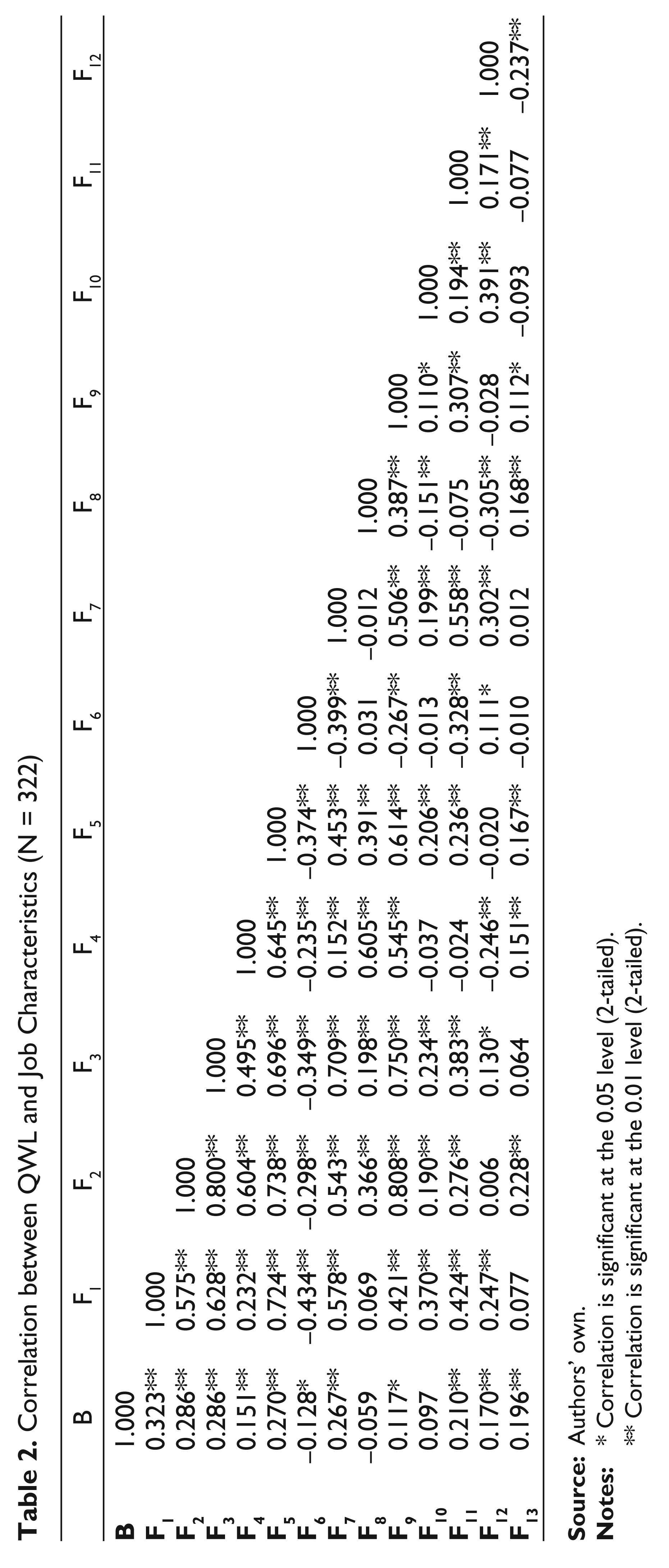
In order to identify the factors affecting QWL of veterinary doctors, correlation analysis was performed. Factor scores have been calculated for 13 factors identified with the help of factor analysis, by multiplying the Rotated Component Matrix with the original raw scores. An examination of the correlation matrix (Table 2) unveils that QWL is associated positively and significantly with Monetary Consideration (0.32), Social Relations at Work (0.29), Constitutionalism at Work (0.29), Pride in Job (0.15), Facilitation for Current Performance and Future Growth (0.27), Security and Safety (0.27), Fair and Unbiased Attitude of Top Officials (0.12), Space and Infrastructure (0.21), Diagnostic Facilities and Staff (0.17), and Reporting (0.20). It may be inferred that these job characteristics have been helping veterinarians in maintaining better QWL. On the other hand, QWL was found negatively associated with Nature of Job (–0.13) and observed no association with Innovative and Challenging Job (–0.6) and Less Educated and Ignorant Clients (0.10). As it has already been mentioned that the nature of the job of veterinarians is very taxing and stressful which seems to be affecting the quality of work life of veterinarians adversely. Innovative and challenging jobs and Less Educated and Ignorant Clients, have not been found affecting the QWL of veterinarians. It may be due to the reason that the veterinary doctors get promotion by virtue of seniority rather than the recognition of their innovativeness. The other reason for the same may be lack of incentives by the department for extraordinary employees. In spite of the fact that veterinary doctors do interact directly with clients, and this is not associated with their QWL, indicates that veterinarians do not seem to be bothered about the education and ignorance of their clients. Rather, it might be the nature and behaviour of the clients which compensate for their education and ignorance.
Correlation between QWL and Job Characteristics (N = 322)
** Correlation is significant at the 0.01 level (2-tailed).
Conclusion and Implications
The study attempted to construct and validate a scale to measure the major dimensions of quality of working life of veterinary doctors. The factor analysis yielded 13 factors; ‘Monetary Consideration’, ‘Social Relations at Work’, ‘Constitutionalism at Work’, ‘Pride in Job’, ‘Facilitation for Current Performance and Future Growth’, ‘Nature of Job’, ‘Security and Safety’, ‘Innovative and Challenging Job’, ‘Fair and Unbiased Attitude of Top Officials’, ‘Less Educated and Ignorant Clients’, ‘Space and Infrastructure’, ‘Diagnostic Facilities and Staff’ and ‘Reporting’, which have been examined for their potential to affect QWL. All factors except ‘Nature of Job’, ‘Innovative and Challenging Job’ and ‘Less Educated and Ignorant Clients’, were found associated positively and significantly with QWL. ‘Nature of Job’ was found negatively and significantly associated with QWL, whereas ‘Innovative and Challenging Job’ and ‘Less Educated and Ignorant Clients’ were not found associated with QWL. The results of the study suggest that there is hardly a single job characteristic which has been affecting the QWL of the veterinary doctors adversely; and that largely they have been enjoying good QWL. This seems to be due to the fact that all the respondents were in government service.