







Abstract
Every organization is interested in improving the work performance of its employees. Also, quality of work life (QWL) has become of paramount importance for the smooth functioning of an organization. The present research study, thus, attempts to assess the impact of QWL on Work Performance and its dimensions—task performance, contextual performance and counter-productive work behaviour (CWB) among the employees of Himachal Pradesh Power Corporation Limited (HPPCL). The data was collected from a sample of 270 HPPCL employees, selected by using convenience sampling technique. Results of this study show that the QWL experienced by the employees of HPPCL has a significant and positive impact on their task, contextual and overall work performance, and a significant, weak and negative impact on their CWB. Results also reveal that the employees often performed their duties satisfactorily. However, they have been found to have a significant involvement in CWB, which has also been found to deteriorate their overall work performance. Thus, CWB is an area of concern for the organization. The study also discusses its various implications for the concerned organization, viz. improving overall work performance of its employees (emphasizing on enhancing their task and contextual performance and reducing their CWB) by adopting various measures to improve their QWL.
Keywords
Executive Summary
A good quality of work life (QWL) has become a prerequisite for organizations to attract and retain efficient and talented human resources, and to ensure that these human resources perform their duties effectively and wholeheartedly (Sandrick, 2003). In the present era, technology is advancing by leaps and bounds, thus, creating work-family conflict, and the repercussions of increased stress are seen in the form of stunted growth and development of individuals which consequently has an adverse effect on their work performance (Ashwini & Anand, 2014). In order to continually attain a higher economic status in the present competitive scenario, people are working really hard, for longer hours, and even in adverse working conditions (Purohit, 2013). This is taking a toll on their health, personal and professional life as it is becoming increasingly difficult to cope with the resultant stress and to maintain work-life balance due to the ever-increasing demands at work (Ashwini & Anand, 2014). This calls for paying immediate attention to enhancing the QWL in organizations so that the employees have a pleasant experience of working there and feel satisfied with their jobs. This would immensely improve their performance as satisfied employees perform better, and would lead to organizational success (Aarthy & Nandhini, 2016).
QWL can be enhanced by improving the physical work environment, providing adequate and fair compensation (salary and additional benefits), providing opportunities for career/professional growth, enforcing constitutionalism in the organization, providing recreational facilities and providing proper work and rest schedules. These are some of the ways of enhancing QWL, among others.
Also, it is of great relevance to assess the work performance of employees and keep track of how well an employee is performing so that any decrease in his/her performance can be identified and rectified (through counseling, training, etc.) before it is too late to do so. This would be in the good interest of both the employee and the organization.
Thus, keeping in mind that QWL has become inevitable for the present day organizations to survive and grow, and acknowledging the possible effect it has on work performance of employees; the present study has been conducted to determine the overall work performance of the employees in Himachal Pradesh Power Corporation Limited (HPPCL), and to measure the impact of QWL on work performance and its dimensions. Results of this study show that QWL has a positive and significant impact on task performance, contextual performance and overall work performance of the employees; and a significant, but weak and negative, impact on counter-productive work behaviour (CWB). The overall work performance of HPPCL employees has been found to be satisfactory, which implies that there is still scope for improvement. This can be accomplished by enhancing the QWL among employees by paying due attention to the various aspects of QWL like remuneration, working conditions, work-life balance, etc. The employees have also been found to exhibit CWB which deteriorates their overall work performance. The organization, must, therefore take steps (like improvement in QWL) to reduce or curb such negative behaviours among its employees in order to improve their performance.
Introduction
Every organization is interested in knowing how well its employees are performing at their jobs, and how can their performance be improved. There are several factors which affect an employee’s performance. These are work environment, compensation, training and development, opportunities for professional or career growth, job security, work-life balance, morale and motivation, organizational culture, leadership, interpersonal relationships and delegation of authority among others. QWL is a term which includes most of the above factors, which makes it a particularly important aspect that can affect the work performance of employees. Thus, every organization must ensure that it provides its human resources with good working conditions, fair remuneration, additional benefits, ample career growth opportunities, safety and security, recreational facilities, adequate training and development opportunities to name a few. This would help the organizations to recruit and retain capable and talented individuals who are an asset to the organization (Sandrick, 2003). This would also ensure that the employees are satisfied and motivated to perform their tasks and duties on the job effectively and efficiently (Aarthy & Nandhini, 2016). If an organization fails to do so, it may have to face grave consequences as the cut-throat competition prevailing nowadays would pose a great threat to the organizations which do not emphasize the vitality of a good QWL. On the contrary, organizations paying due attention towards the improvement of QWL prevailing in them would ensure that their employees have a good experience at their workplace and hence, perform better.
Various studies have been carried out by researchers to study the relationship of QWL with different factors like employee commitment (Nayak, Sahoo, & Mohanty, 2018; Ojedokun, Idemudia, & Desouza, 2015), job satisfaction (Gayathiri & Ramakrishnan, 2013; Kasraie, Parsa, Hassani, & Ghasem-Zadeh, 2014; Rubel & Kee, 2014), job stress (Bolhari, Rezaeean, Bolhari, & Zare, 2012; Kasraie et al., 2014; Ramya & Poornachandran, 2017), etc. Different studies have also been carried out to study the relationship of employee or work performance with other factors like job satisfaction (Bakotic, 2016; Bowling, 2007; Inuwa, 2016; Rubel & Kee, 2014; Saranya, 2014), employee commitment (Bandula & Jayatilake, 2016; Becker, Billings, Eveleth, & Gilbert, 1996), employee engagement (Anitha, 2014; Sendawula, Kimuli, Bananuka, & Muganga, 2018), etc. It has, however, been found that there is a paucity of research in the literature regarding the study of the impact of QWL on work performance and its dimensions—task performance, contextual performance and CWB of employees. Most of the studies conducted in these areas are based on data collected in Western countries. QWL has been found to be mostly studied in healthcare organizations, among medical professionals. So far, no study has been found to be conducted to study the relationship between QWL and work performance of employees in a public sector undertaking (PSU) like HPPCL or any other organization in hydropower sector in the state of Himachal Pradesh. Therefore, this study has been conducted with the aim of bridging this gap by studying these constructs among the employees of HPPCL. The present study, thus, aims to determine the overall work performance of employees of HPPCL and to assess the impact of QWL on work performance dimensions as well as on the overall work performance of these employees.
Results of this study will allow a better understanding of the relationship between QWL and work performance, and of the impact of QWL on work performance as well as its dimensions—task performance, contextual performance and CWB. This will help the organization in identifying areas which need improvement and enhance the work performance of employees. Results of this study will also be helpful in framing the human resource (HR) policies and strategies regarding the salaries and other benefits, training and development, promotions, incentives for higher education, etc.
Review of Related Literature
It was during the 1960s–1970s that QWL began to gain significance as a HR intervention in the USA and Scandinavia. The concept ‘Quality of Work Life’ was first discussed in 1972 during an international labour relations conference in the USA. It became more popular after the United Auto Workers and General Motors initiated a QWL programme for work reforms (Gayathiri & Ramakrishnan, 2013). QWL is a process by which an organization responds to its employee’s needs by making such provisions which allow them to participate in making the decisions which design their lives at work (Robbins, 1989). QWL can also be understood as the effectiveness of work environment which passes on to the meaningful organization, and personal needs in creating the values of employees which encourage and foster better health and well-being with job security, job satisfaction, competency development and work-life balance (Rethinam & Ismail, 2008). QWL is the foundation of HR development, and it is a generic phase which covers an individual’s feeling about every dimension of work including economic rewards and benefits, job security, working conditions, organizational and interpersonal relationships and its intrinsic meaning in an individual’s life (Gorle & Bhatia, 1997).
QWL is not a unitary concept. It is a broad, composite and a multi-dimensional concept (Hsu & Kernohan, 2006). It subsumes a hierarchy of approaches, ranging from work-related factors like fair compensation, working conditions, job satisfaction to broader factors like happiness and life satisfaction (Danna & Griffin, 1999; Warr, Cook, & Wall, 1979). Work-related stress and balance between work and personal life have also been considered to be important factors of QWL (Baba & Jamal, 1991; Ellis & Pompli, 2002; Loscocco & Roschelle, 1991). Identifying the measurement variables of QWL is a daunting task; however, the concept of employee well-being is the most popular measure of QWL. There are certain objective (physical and structural design) factors which provide workplace setting and intervening policy factors which affect work processes of employees. There are certain outcome factors like the immediate impact on the psychology of employees (positive attitudes, commitment and satisfaction) and ultimate impact on organizational performance which are also important (Gayathiri & Ramakrishnan, 2013).
Various authors have different views regarding the components or measures of QWL. For example, Walton (1975) has used eight dimensions to measure QWL—adequate and fair compensation, safe and healthy working conditions, immediate opportunity to use and develop human capacities, opportunity for continued growth and security, social integration in the work organization, constitutionalism in the work organization, work and total life space and social relevance of work life. Nanjundeswaraswamy and Swamy (2013) have used nine components or factors to measure QWL—work environment, organizational culture and climate, relation and co-operation, training and development, compensation and rewards, facilities, job satisfaction and job security, the autonomy of work and adequacy of resources. There has, however, been a general agreement that QWL has a conceptual similarity with the well-being of employees (Gayathiri & Ramakrishnan, 2013; Lawler, 1982) and is different from job satisfaction which is only work-oriented (Lawler, 1982). The concept of job satisfaction, however, is considered to be an essential component of QWL by some authors (Baba & Jamal, 1991; Nanjundeswaraswamy & Swamy, 2013; Warr, Cook, & Wall, 1979) and it has a positive and significant relationship with QWL (Islam & Siengthai, 2009), employee in-role performance (Rubel & Kee, 2014) and organizational performance (Islam & Siengthai, 2009).
Regular assessment of the performance of employees at the workplace is of paramount importance for the organizations to ensure their survival and growth. This enables the organizations to have a fair idea of the achievement of the objectives and goals set for the employees. Employee performance, thus, signifies the actions and behaviours of people in an organization, which are aimed at achieving the goals and targets set by an organization, and the results or outcomes of such actions and behaviours.
Work performance can be understood as scalable actions, behaviour and outcomes that employees engage in or bring about that are linked with and contribute to organizational goals (Viswesvaran & Ones, 2000). It is the degree of achievement of a particular mission and targets of an organization by its employees (Cascio, 2006). Researchers have different perceptions on performance, but most of them relate performance with measurement of transactional efficiency and effectiveness towards organizational goals (Barney, 1991; Stannack, 1996). Certain researchers have identified different attitudes, beliefs and thoughts about performance as it helps in the measurement of input and output efficiency measures that lead to the transactional association (Stannack, 1996).
There are three main dimensions of work performance: task performance, contextual performance and counter-productive work behaviour (Koopmans, 2014).
QWL has also been found to be positively related to performance. Four dimensions of Walton’s QWL model (developing human capabilities, constitutionalism in the work organization, total life space and social integration in work organization) predict performance better than the other four dimensions (adequate and fair compensation, safe and healthy working conditions, opportunity for continued growth and security, and the social relevance of work life) (Shahbazi, Shokrzadeh, Bejani, Malekinia, & Ghoroneh, 2011). A favorable QWL enhances employee performance and also provides ample career growth opportunities to the employees (Sheel, Sindhwani, Goel, & Pathak, 2012). Work performance of employees is strongly related to and affected by QWL (Coculova & Svetozarovova, 2014) as well as its components like job aid and physical work environment (Naharuddin & Sadeqi, 2013). Also, a reward system is the most important QWL factor and opportunity for career development is the least important QWL factor (Coculova & Svetozarovova, 2014).
QWL is significantly and positively related to the manager’s performance (Kaighobadi, Esteghlal, & Mohebbi, 2014) and employee job performance which in turn influences the organizational performance (Rai & Tripathi, 2015). Organizational performance is significantly affected by various QWL factors like work environment, occupational stress, opportunities for development, social support, compensation and rewards and work-life balance; and employee commitment mediates the relationship between QWL and organizational performance (Nayak & Sahoo, 2015).
QWL is positively related to organizational citizenship behaviour (OCB) (Papi & Nuralizadeh, 2014). OCB has been defined as an individual’s behaviour which is discretionary, not directly or explicitly recognized by the formal reward system, and which in the aggregate promotes the effective functioning of the organization (Organ, 1988). This definition of OCB has given rise to a lot of criticism. It is very difficult to reach at an operational definition of this construct due to its nature. Even the discretionary nature of OCB is questionable. In response to such criticisms, Organ (1997) stated that the jobs are no more confined to the well-defined set of tasks and responsibilities, and have developed greatly to even incorporate some vague roles. In the absence of a clearly defined role, it is hard to define what is discretionary. OCB has often been compared to contextual performance as both of these concepts emerged in response to the realization that there is a need to look beyond the task related work behaviours in order to get a clear and complete picture of the job domain (Borman & Motowidlo, 1993). For the present study, OCB has been merged with Contextual Performance dimension of Work Performance.
QWL of non-managerial and operational workers has been found to have a negative and insignificant relationship with organizational performance (Islam & Siengthai, 2009). Organizational culture and QWL also have a significant negative impact on employee performance. However, simultaneously, the variables of organizational culture, locus of control, QWL and employee’s job satisfaction have a significant positive influence on employee performance (Rukminingsih & Mulyanto, 2015).
Objectives of the Study
On the basis of the literature reviewed, the following To assess the impact of QWL on work performance dimensions—task performance, contextual performance and CWB among HPPCL employees. To assess the impact of QWL on overall work performance among HPPCL employees.
In order to achieve these objectives, hypotheses have been framed as discussed in the next section.
Hypotheses
Performance or work effectiveness is an outcome variable (Hackman & Oldham, 1980) which can be measured with the help of different dimensions like task performance, contextual performance and CWB (Koopmans, 2014). Task performance and contextual performance are two distinct dimensions which improve organizational effectiveness (Griffin, Neal, & Neale, 2000). Task performance represents those activities which are concerned with an organization’s technical aspect (Borman & Motowidlo, 1997). It is prescribed by the formal job role/description (Johnson, 2001). Various components of QWL like compensation (Dillard & Fisher, 1990), working conditions, etc., affect the task performance of employees (Kahya, 2007). Thus, it is proposed as,
Contextual performance consists of activities which are concerned with an organization’s social and psychological aspects (Borman & Motowidlo, 1997). These activities are generally performed by an individual voluntarily and at his/her own discretion. These activities are not prescribed by an individual’s formal job description, but research studies show that these are evaluated by the management while conducting performance appraisals. This signifies the increasing importance of contextual performance in organizations (Johnson, 2001). It is, therefore, considered to be as important as task performance (Borman & Motowidlo, 1997). Contextual performance is also important because it represents a kind of behaviour which mostly depends on the motivation of employees (Griffin, Neal, & Neale, 2000). A favourable QWL is also known to ensure that the employees are satisfied and motivated to perform their job efficiently (Aarthy & Nandhini, 2016). Working conditions, which are a factor of QWL (Walton, 1975) affect the contextual performance of employees (Kahya, 2007), and hence we expect the following relationship:
CWB is a type of behaviour which is voluntary in nature, and which jeopardizes the individual and organizational well-being by violating the organizational norms and rules (Robinson & Bennett, 1995). QWL has a significant influence on the CWB of employees. By improving the QWL of the employees, their CWB can be reduced significantly. CWB can also be decreased by paying due attention to various aspects of QWL, viz. fair and adequate remuneration, work environment, job security and opportunities for career advancement, norms and rules in an organization, optimum use of capacities, skill development, work and family life balance, interpersonal relationships and team spirit among employees (Masoomzadeh, Feizi, & Alipour, 2013). Thus, it is proposed as,
QWL indicates the degree to which an individual can define and shape his/her work according to his/her needs, preferences and interests (Chib, 2012). QWL is positively related to work performance of employees (Beh & Rose, 2007; Coculova & Svetozarovova, 2014; Shahbazi et al., 2011) and it impacts the work performance of employees significantly and positively (Aketch & Settle, 2010; Coculova & Svetozarovova, 2014; Sheel et al., 2012). QWL has, however, also been found to have a significant negative relationship with employee performance (Rukminingsih & Mulyanto, 2015). Factors of QWL like compensation (Darma & Supriyanto, 2017), working conditions (Kahya, 2007; Seppanen, Fisk, & Lei, 2006), etc., affect employee (work) performance significantly. On the basis of the above elaborations, the hypothesis can be drawn as follows:
The research methodology adopted to meet the objectives of this study, and to test the alternate hypotheses framed on the basis of the literature reviewed, is discussed in the following section.
Research Methodology
The present study uses cross-sectional and empirical research designs. A sample of 270 employees of HPPCL working at the corporate office, design office and different projects in Himachal Pradesh was selected for the present study by using convenience sampling technique. Convenience sampling technique was used as the representative sample was chosen from a well-defined population, and this method is time and cost effective. The sample size was determined with the help of Cochran’s (1963) and Yamane’s (1967) formulae.
Data was collected using both primary and secondary sources. A pen and paper survey was conducted to collect the primary data for this study. A questionnaire consisting of three parts—personal information, QWL questionnaire and individual work performance (IWP) questionnaire was used as a tool for data collection. Questionnaires developed by Timossi, Pedroso, Francisco, and Pilatti (2008) and Koopmans (2014) were used to measure QWL and work performance respectively, on 5-point Likert scales. Reliability of the questionnaires was checked by using Cronbach’s alpha. Cronbach’s alpha was 0.947 for QWL questionnaire, 0.732 for IWP questionnaire and 0.941 for the final questionnaire (personal information, QWL and IWP questionnaires taken together). Face validity was established for the questionnaires used in the study by the experts to ensure that the measures are relevant for the present study. A total of 270 questionnaires were personally distributed to the respondents, all of which were received by the researcher. None of the questionnaires was rejected, so there was a 100 per cent response rate.
Secondary data was obtained from books, journals, publications, internet, etc. Frequencies and percentages were used to understand the demographic profile of respondents. Descriptive statistics (mean and standard deviation), correlation analysis and simple linear regression were used for analyzing the data with the help of SPSS software (version 21).
For the present study, QWL has been derived by taking an average of the sum of eight dimensions of QWL, viz. adequate and fair compensation, safe and healthy working conditions, immediate opportunity to use and develop human capacities, opportunity for continued growth and security, social integration in the work organization, constitutionalism in the work organization, work and total life space and social relevance of work life. Similarly, the overall work performance of the employees has been derived by taking an average of the sum of the three dimensions of work performance—task performance, contextual performance and CWB.
Results
Demographic characteristics of the respondents are illustrated in Table 1. These sample demographics show that most of the respondents (83%) were males, and more than half of the respondents (53%) were 30–50 years in age. Findings presented in Table 1 also reveal that 4 per cent of respondents worked at W1–W5 worker levels, 6 per cent of respondents corresponded to W6–W11 hierarchical levels, 26 per cent belonged to S1–S4 supervisory levels, majority (44%) were lower and middle management executives lying in the E0–E4 executive levels, and the remaining 20 per cent were middle and higher management executives corresponding to E5–E9 executive levels. More than half of the respondents (53%) had an annual income of ₹500,000–₹1 million and only 5 per cent of them had an annual income of less than ₹200,000. Most of the respondents (84%) were married.
Demographic Characteristics of Respondents
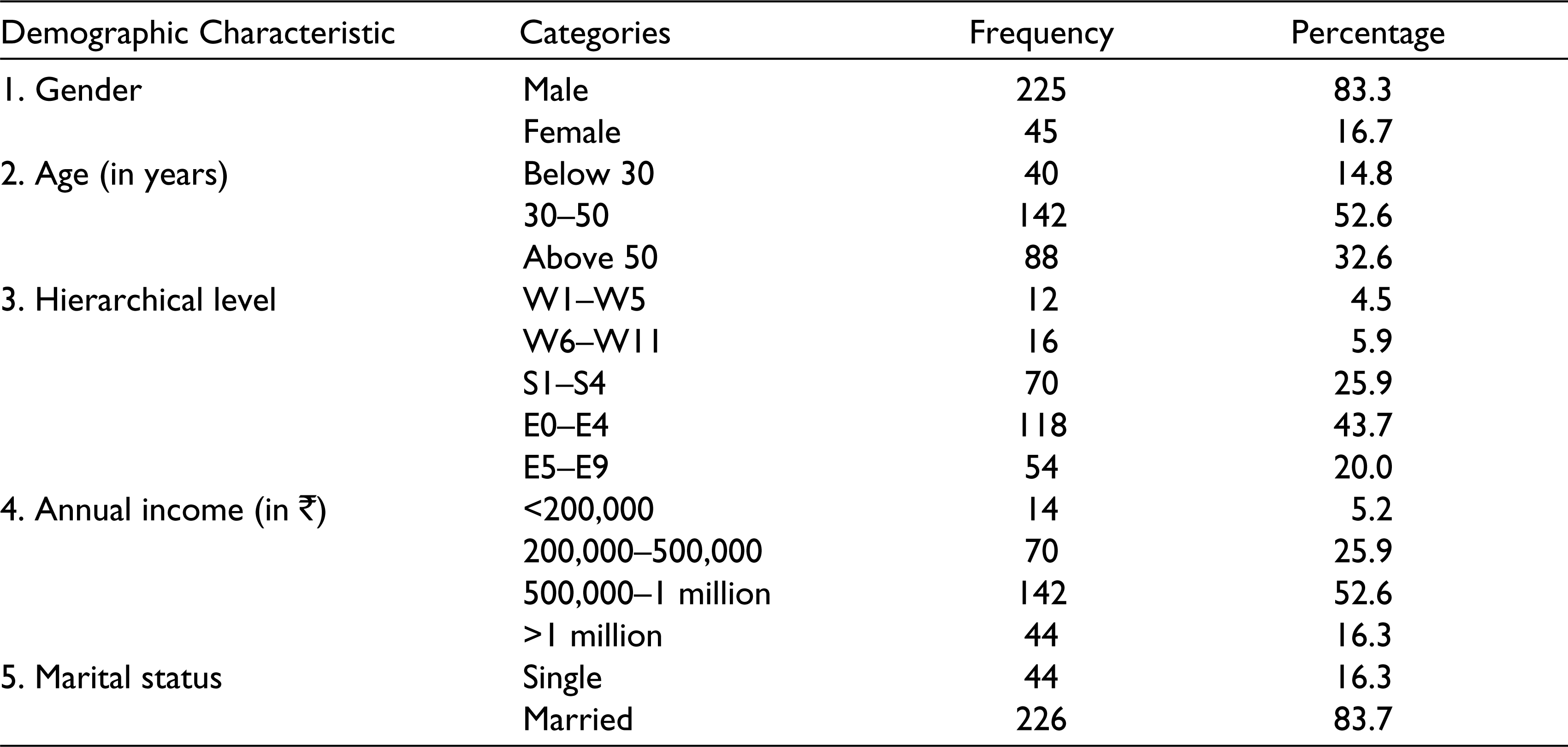
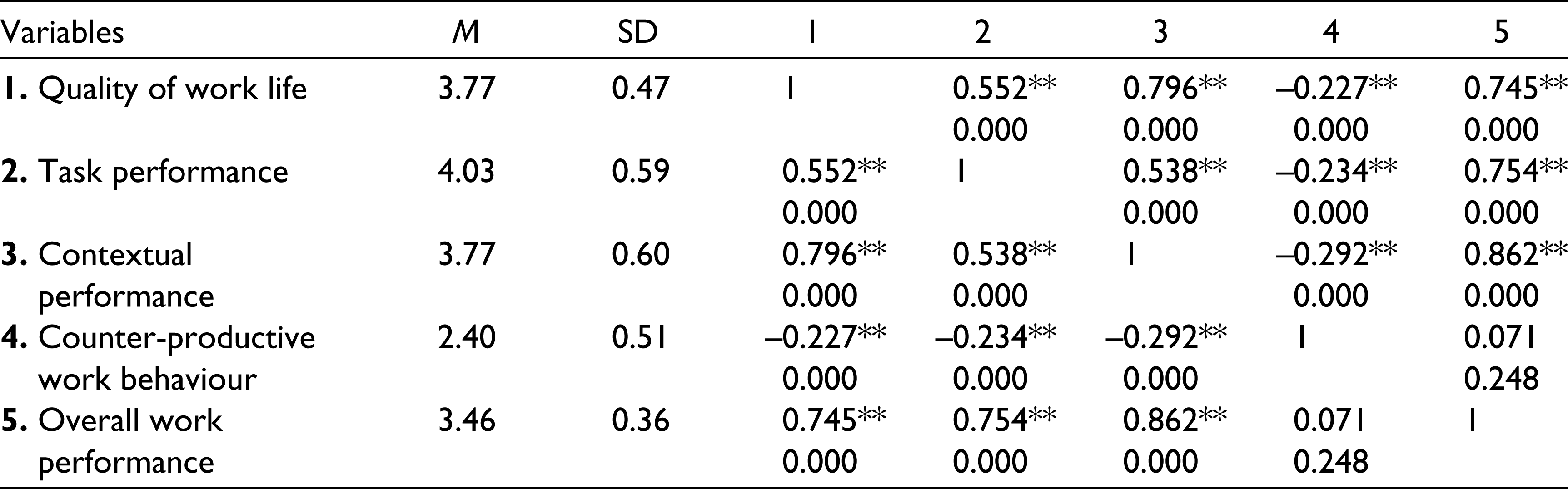
Table 2 displays the mean scores, standard deviations and correlations between QWL; work performance dimensions (task performance, contextual performance and counter-productive work behaviour) and overall work performance. Results reveal that the employees were often able to deliver satisfactory task performance (M = 4.03, SD = 0.59). Also, the contextual performance of employees was often found to be satisfactory (M = 3.77, SD = 0.60). The mean score for counter-productive work behaviour shows that the employees were frequently involved in activities which deteriorated their work performance (M = 2.40, SD = 0.51). The overall work performance of employees was frequently found to be satisfactory (M = 3.46, SD = 0.36). The mean score of QWL also shows that the employees were mostly satisfied with the QWL in the organization (M = 3.77, SD = 0.47). Results of the Pearson correlation analysis indicated that there was a significant, moderate and positive relationship between the QWL and task performance (r[268] = 0.55, p < 0.001). A significant, strong and positive relationship was found between the QWL and contextual performance (r[268] = 0.80, p < 0.001), and the QWL and overall work performance (r[268] = 0.75, p < 0.001). Results also reveal a significant, weak and negative relationship between the QWL and CWB (r[268] = –0.23, p < 0.001).
Means, Standard Deviations and Correlations Among Constructs
Hypotheses-testing
In order to meet the objectives of this study, alternate hypotheses have been formulated on the basis of the literature reviewed. Simple linear regression has been used to test these hypotheses, the results of which form the basis for acceptance or rejection of the alternate hypotheses.
H1 states that QWL has a significant impact on task performance among employees. Tables 3a, 3b and 3c present the results of simple linear regression used to measure the impact of QWL on task performance. H1 is accepted as b = 0.690, t(268) = 10.84, p < 0.001. QWL also explained a significant proportion of variance in task performance, R2 = 0.31, F(1,268) = 117.45, p < 0.001.
Regression Analysis for Measuring the Impact of Quality of Work Life on Task Performance



H2 states that QWL has a significant impact on contextual performance among employees which is also accepted. Tables 4a, 4b and 4c display the results of simple linear regression used to measure the impact of QWL on contextual performance. QWL significantly predicted contextual performance, b = 1.013, t(268) = 21.56, p < 0.001. QWL also explained a significant proportion of variance in contextual performance, R2 = 0.63, F(1,268) = 464.69, p < 0.001.
Regression Analysis for Measuring the Impact of Quality of Work Life on Contextual Performance



H3 states that QWL has a significant impact on counter-productive work behaviour among employees. Simple linear regression was used to test this hypothesis, the results of which are presented in Tables 5a, 5b and 5c. In this case, b = –0.245, t(268) = –3.81, p < 0.001, which signifies that QWL significantly predicted the counter-productive work behaviour. This also reveals a negative relationship between QWL and counter-productive work behaviour. QWL was also found to explain a small but significant proportion of variance in counter-productive work behaviour, R2 = 0.05, F(1,268) = 14.52, p < 0.001. Thus, H3 is accepted.
Regression Analysis For Measuring The Impact of Quality of Work Life on Counter-productive Work Behaviour



H4 states that QWL has a significant impact on overall work performance among employees. This hypothesis is well supported by the findings of simple linear regression as illustrated in Tables 6a, 6b and 6c. QWL was found to significantly predict overall work performance as b = 0.574, t(268) = 18.27, p < 0.001. QWL was also found to explain a significant proportion of variance in overall work performance, R2 = 0.56, F(1,268) = 333.74, p < 0.001.
Regression Analysis for Measuring the Impact of Quality of Work Life on Overall Work Performance



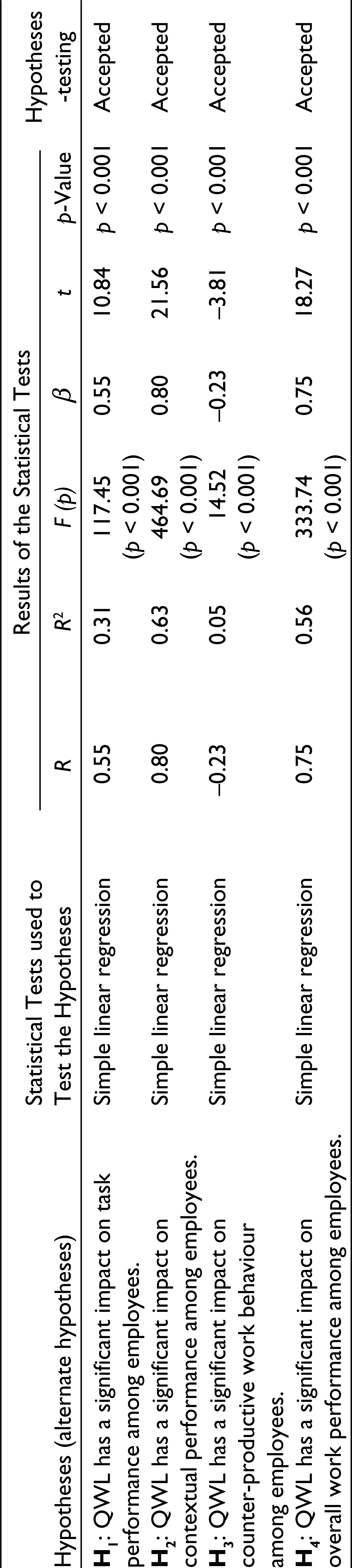
Results of this study have been summarized in Table 7 (Hypotheses-testing).
Results of the Study (hypotheses-testing)
Discussion
Results of this study clearly show that task performance and contextual performance enhance and contribute to overall work performance, whereas counter-productive work behaviour deteriorates the overall work performance of employees. The values of standard deviation lie between 0.3 and 0.6, which shows that the employees did not have much difference in their opinions regarding the various work performance dimensions. HPPCL is a State PSU, and as the demographics of the employees suggest, most of the employees are young, married male executives having a good annual income. The similarity in opinions of various employees regarding various work performance dimensions can, thus, be attributed to the similarity in their demographic profiles.
Results of correlation analysis show that QWL is related positively to task performance, contextual performance and overall work performance, but is related negatively to counter-productive work behaviour as it is a negative aspect of work performance. QWL has the strongest relationship with contextual performance and the weakest relationship with counter-productive work behaviour.
Results of simple linear regression show that QWL has a significant influence on all the three work performance dimensions, as well as on the overall work performance. Results show that 31 per cent of the variance in task performance is explained by QWL. QWL also explains a significantly large proportion of variance (63%) in contextual performance. The value of constant is not significant in this case. This can be attributed to the fact that contextual performance denotes those activities which make a contribution to organizational effectiveness by shaping the social, psychological and organizational context which serves as a catalyst for task (performance) activities and processes (Borman & Motowidlo, 1993). Contextual performance can, therefore, have a constant value which is insignificant or equal to 0 if QWL is 0 as QWL also includes activities that improve the quality of social, psychological and organizational aspects of the workplace. This means that if QWL is 0, contextual performance may also be 0 or of insignificant value.
QWL has a weak and negative, but significant influence on CWB, and it accounts for merely 5.1 per cent of the variance in CWB. Results also reveal that QWL is strongly related to overall work performance. Furthermore, QWL significantly affects overall work performance and explains a significant proportion of variance (56%) in it.
These results are in consonance with the results of some previous studies (Coculova & Svetozarovova, 2014; Kaighobadi, Esteghlal, & Mohebbi, 2014; Naharuddin & Sadeqi, 2013; Rai & Tripathi, 2015; Shahbazi et al., 2011). These findings are, however, inconsistent with the findings of some studies conducted in the past (Islam & Siengthai, 2009; Rukminingsih & Mulyanto, 2015).
Results of this study have many implications for HPPCL. The employees were found to perform the core tasks and duties related to their own job, satisfactorily. They also made a satisfactory contribution to the enhancement of the effectiveness of the organization which facilitated and improved the performance of their core job activities (task performance). This indicates that the employees helped and co-operated with each other in accomplishing the duties assigned to them.
CWB, however, is the area of concern for HPPCL as it is prevalent among its employees and it decreases their overall work performance. Therefore, efforts need to be made to ensure that the employees do not get involved in CWB. The organization must, therefore, take steps to minimize the CWB of employees. This can be done by improving their QWL, that is, by making a provision for better and improved remuneration and reward system, better working conditions, more opportunities for professional growth, strengthening interpersonal relationships, maintaining a balance between personal and professional life, and ensuring employee autonomy, etc. The organization must also take measures like the establishment of a proper grievance redressal system, employee counseling, proper feedback system, open communication and encouraging employee participation in decision-making. The organization must take such steps to minimize the CWB of employees in order to ensure that the employees, and hence, the organization perform well and there is minimum wastage of the organization’s resources.
It can be inferred from the values of standard deviation that there is a similarity in opinions of various employees regarding the different work performance dimensions which implies that the organization can adopt similar QWL measures to improve its employee’s performance.
HPPCL must make efforts to enhance the QWL of employees as it has a huge impact on their contextual and task performances, both of which have been found to significantly contribute to their overall work performance. Efforts must also be made to reduce the CWB of employees as it has an adverse effect on their performance.
The overall work performance of HPPCL employees has been found to be satisfactory, but it is not enough as it still has a great room for improvement. Therefore, HPPCL must focus on enhancing the QWL of employees in order to improve their task performance as well as contextual performance and to decrease their CWB so that the overall work performance of the employees can be increased from satisfactory to outstanding.
Conclusion
Keeping the ever-increasing relevance of QWL and its possible effect on work performance in mind, the present study has been conducted to study the impact of QWL on work performance and its dimensions—task performance, contextual performance and CWB among the employees of HPPCL.
Results of the study reveal that the employees of HPPCL often performed satisfactorily; however, they have also been found to be involved in activities which deteriorate their performance. Task performance and contextual performance have been found to enhance and contribute to overall work performance, whereas CWB deteriorated the overall work performance of employees.
Results also show that QWL has a positive and significant impact on two of the work performance dimensions (task performance and contextual performance) as well as on the overall work performance of the employees. QWL has been found to have a significant but weak and negative impact on CWB. Contextual performance has been found to be influenced to the greatest extent by the QWL. On the contrary, CWB has been found to be the least affected by the QWL. It is, thus, concluded that the QWL is of paramount importance to an organization and every organization must strive to improve its QWL in order to improve the performance of its employees.
Limitations of the Study and Scope for Future Research
This study made a significant contribution in understanding the relationship between QWL and work performance among the employees of HPPCL—a PSU in the state of Himachal Pradesh, by providing insights into the positive as well as negative relationships and effects of QWL on work performance and its dimensions. However, interpretation of the results of this study needs some caution.
As the research was limited to a single government organization—HPPCL, generalization and application of findings of this study to the entire public sector may be difficult. Both primary and secondary data were used in the present study. Primary data was collected through standardized questionnaires. Although sincere efforts were made to avoid the drawbacks inherent in this method, such as perceptual and psychological differences among the respondents, there are chances that some biases on part of the respondents might have crept in. The circumstances of respondents while filling the questionnaires could also have influenced their responses. Also, there were significantly more male participants than female participants in this study which could have biased the results. However, the sample was representative of the actual proportion of gender distribution in the organization.
The present study uses a cross-sectional research design. A longitudinal research study may be conducted by researchers in the future. This study has been conducted in a government organization in the power sector. A similar study can also be conducted in private organizations. Researchers can also conduct a comparative study among organizations in other sectors like manufacturing, retailing, telecommunications, banking and insurance, etc. A study involving more constructs such as employee commitment, spirituality at the workplace, job satisfaction, etc., can also be undertaken.
Footnotes
Declaration of Conflicting Interests
The authors declared no potential conflicts of interest with respect to the research, authorship and/or publication of this article.
Funding
The authors received no financial support for the research, authorship and/or publication of this article.
Supplemental Material
Supplemental material for this article is available online.