






Abstract
Social media, unlike other resources, is nowadays an organizational resource. The reason can be attributed to its vast and extensive usage in sharing relevant information within a group and its influence on communication and organizational dynamics. The study investigates the role of individual social media self-efficacy (SMSE) and social media participation (SMP) on E-Leadership self-efficacy (ELSE). It further explores the mediating role of individual social media collective efficacy (SMCE) and SMP on SMSE and ELSE. Data for the study were collected from the employees of ITES firms in Delhi NCR, Bengaluru and Pune, India by the online survey method. A total of 478 respondents who were actively engaged in social media activities such as sending and sharing relevant information on different social media groups were included. Structural Equation Modelling followed by mediation analysis was conducted using AMOS 22 and Process Macro software, respectively, to analyse the structural and mediation relationship among the different constructs. The findings confirmed the positive influence of SMSE and participation on collective efficacy and e-leadership efficacy. The study extends the current literature and integrates social media self, collective efficacy, and participation to investigate ELSE in the perspective of IT organizations.
Introduction
Social media is ubiquitous and all pervasive. It is now a widespread field covering vast regions across the globe and is dramatically transforming society (Swain et al., 2020). It came into public light and became a part of the culture in the 1990s with the rise of online forums, chat groups and newsgroups where one could interact with like-minded people from across the world and share information in real time. These forums further evolved into social networking sites that enhanced connectivity, engagement and participation, driving various organizations across the globe to adopt them. On the one hand, social media, being participatory and interactive, helps in decision making and enhances productivity (Metcalf et al., 2019), on the other hand, managing and motivating employees on social media platforms is a difficult task. This calls for an insightful examination of employee social media self-efficacy (SMSE) and collective efficacy (CE) to better understand individual and group behaviour.
Individual self-efficacy in virtual work engagement is decisive as it is shaped by the interplay of the self and situational environment. Participation in social media groups for organizational tasks develops collective self-efficacy. It has been observed that one’s willingness to engage in a task and act may not be enough to develop self-efficacy. It is the actual engagement with others at work that strengthens one’s self-efficacy (Vancouver et al., 2014). Better engagement comes from working together on assigned tasks which also enhances self-efficacy level (Newman et al., 2018). Self-efficacy may further be augmented through interpersonal relationships, particularly when individuals are virtually engaged in any organizational task.
CE has emerged as an important concept in communities and in social media literature. The concept has spawned considerable theoretical and empirical excitement. ‘Collective efficacy is simply the aggregate capacity of a community to work towards a common goal’ (Sampson, 2006). Social media’s CE is conceptualized as group members’ confidence in their shared ability to deal with organizational responsibilities (Tafesse & Korneliussen, 2020). Further, e-participation creates a dialogue between the host and the user. E-participation helps managers understand what employees and customers are thinking and it guides them on how to put it into practice.
Information Communication Technology has transformed the leadership role. In social media communities, the development of leadership skills such as sense of confidence, persistence, ability to motivate others and being part of a collaborative network structure fosters a leader’s self-efficacy (Liou & Daly, 2020). E-leadership is an enhanced version of leadership and can be understood as technology mediated leadership (Van Wart et al., 2019) where leaders use information technology to achieve leadership goals (Liu et al., 2018). For effective e-leadership, technology and self efficacy are significant characteristic. E-leadership self-efficacy (ELSE) refers to a ‘specific form of efficacy beliefs related to leadership behaviours dealing with individual self-efficacy beliefs to successfully accomplish the leadership role in virtual groups’ (Van Wart et al., 2019).
Past research on leadership ignored the challenging issues of the virtual work environment (Avolio et al., 2014). E-leadership research is at a nascent stage of development (Gupta et al., 2022; Liu et al., 2018; Oh & Chua, 2018). It is too early to make any comprehensive conclusion about e-leadership and therefore an empirical examination of e-leadership efficacy in context of social media is warranted. Research on ELSE revealed a direct relationship between self-efficacy and leadership roles (Kraft, 2019). While various studies (Oh & Syn, 2015; Zhou, 2021) have examined the influence of social media on leadership development, it is at an early stage of understanding and requires additional examination to gain better insights.
This study utilized the Social Network Theory (Liu et al., 2017) to understand the social interactions of virtual leaders in determining leaders’ self-efficacy. Increased research interest is evident in Social Network Analysis and its impact on exceptional leaders in psychology and organizational behaviour. Also, the study takes into consideration the social learning approach (Reed et al., 2010) to understand the core aspects of self-efficacy and e-leader’s self-efficacy from the perspective of social media. Through interaction in social media, the development of self-efficacy beliefs can be better understood using the social learning approach (Pekkala & van Zoonen, 2022).
This study aims to investigate the influence of SMSE on ELSE with the interventions of social media collective efficacy (SMCE) and social media participation (SMP). Also, it examines the mediating role of SMCE and SMP on SMSE and ELSE.
The study has been structured as follows: The next section discusses the conceptual background and hypotheses development. The subsequent section deals with the research methodology followed by the data analysis, findings and discussion. The implications of the study and conclusion are discussed in the last section.
Literature Review
Theoretical Background and Hypotheses Development
By the beginning of the twenty-first century, physical, social and power distance were reduced. Organizations shifted their focus to online platforms thereby helping external stakeholders share their interest in the organization (Kahai et al., 2017; Oh & Chua, 2018). This gave rise to research related to social media from an organizational perspective. Social media allows users to share, discuss and co-create knowledge and information. Whether it is seeking guidance from mavens or sharing personal experiences (Cheung et al., 2013; Harrigan et al., 2020), social media has increased employee participation in sharing expertise even from a distance. Social media, by connecting knowledge experts from across the world, enhances overall team performance (Cao et al., 2016).
For decades, researchers across the world have studied and explored the concept of self-efficacy. Some considered self-efficacy to be a key internal factor that impacts both individual and organizational level results (Kwahk & Park, 2016; Tims et al., 2014). There is also research specific to the external behaviour of a leader’s self-efficacy such as leadership skills, social skills and managerial skills (Liou & Daly, 2020).
Using the Social Network Theory (Liu et al., 2017) and the Social Cognitive Theory (Bandura, 2001), the current study highlights the influence of SMSE on ELSE. The Social Network Theory proposes network centrality measures and states that opinion leaders usually inhabit the degree centrality which identifies the number of links to and from an individual in a network (Liu et al., 2017). In other words, individuals who have high degree centrality are more likely to become opinion leaders and are more influential. They have more social connects and can reach more individuals within the network, thereby disseminating the information faster (Liu et al., 2017).
According to the social cognitive theory, there exists a difference between personal efficacy and CE. Personal efficacy epitomizes the individuals’ shared beliefs in their collective power to produce desired results (Bandura, 2009). CE is an emergent group-level property and is mostly relevant in organizational context where the outcome is based on collective effort (Tafesse & Korneliussen, 2020). Further, the theory suggests that leadership self-efficacy is the main cognitive variable regulating the leader’s functioning in a dynamic milieu. The model helps to understand leadership processes in three categories: a leader’s cognition, a leader’s behaviour and the leadership environment. Among these, leader’s cognition, which refers to the individual’s self-efficacy for leadership, is the most significant (Bayraktar & Jiménez, 2020). The social cognitive theory (Bandura, 2001) advocates a positive impact of leadership self-efficacy on individual outcomes (Schmitz & Ganesan, 2014). The reason for this could be self-belief that they are able to perform managerial activities efficiently.
Numerous studies have highlighted the importance of self-efficacy in developing leadership. LSE develops a belief amongst employees that they can perform effectively in social situations by facilitating teamwork and leadership skills. For measuring the interpersonal competence belief in technology and social media settings, a leadership self-efficacy scale has been developed by Deemer et al. (2020).
Social Media Self-efficacy
In today’s world, social media is all pervasive and broadly used in organizations among employees and managers (Swain et al., 2020). It involves a range of application such as blogs, wikis, microblogs, social tagging tools and social networking sites (Wang et al., 2016). Self-efficacy is the result of differences in individual behaviour. It works as an appealing factor that refers to positive self-belief in one’s competency to successfully accomplish a task and thereby achieving the desired result affecting the cognition level of the individual (Karimova et al., 2020). According to Bandura (2006), ‘Self-efficacy is the judgment of one’s capability to accomplish a certain level of performance’. Further, he identified four important sources of efficacy beliefs: vicarious experience, performance accomplishment, emotional arousal and verbal persuasion. Researchers (Cheung et al., 2013, Kwahk & Park, 2016) found that self-efficacy is an important determinant that influences the adoption of social networks to disseminate knowledge and information. Quite a few psychological processes are affected by self-efficacy belief such as achievement of personal goals, maintaining resilience after a setback, increasing effort and determination during difficulties, and selecting conditions, environments and activities (Bandura, 2009; Bayraktar & Jiménez, 2020; Gegenfurtner et al., 2013).
SMP intends to promote the comprehensive and conscious participation of individuals in decision making, administration, service delivery and policy making. Ellison and Boyd (2013) emphasized three key aspects of social media which could contribute to increased involvement and active participation by users. First, each user is unique in the sense that their digital profiles consist of content shared by them. Second, users can create a web of connections in the online domain which can be viewed by all; and third, users can create content and get influenced by the content produced by their connections on the site.
However, it was found that perceived CE does not belong to homogenous group attributes. It differs from individual to individual and from activity to activity performed by the members of a group (Bandura, 2000). Thus, it can be inferred that self-efficacy leads to the development of CE. Additionally, prior literature reveals that individuals with higher CE can augment the self-efficacy of other individuals of the community by demonstrating expected community behaviours (Band et al., 2019).
From the organizational viewpoint, self-efficacy leads to the development of leadership and emphasizes the role of leadership on organizational effectiveness (Newman et al., 2018). The varied range of information among different group members is expected to develop collective self-efficacy (Cheng, 2020). Past studies have examined the positive role of social media efficacy on an employee’s innovative performance and LSE (Ding et al., 2019). Therefore, the study proposes the following hypotheses:
H1: Social media self-efficacy positively and significantly influences the SMP. H2: Social media self-efficacy positively and significantly influences the SMCE. H3: Social media self-efficacy positively and significantly influences the ELSE.
Social Media Collective Efficacy
CE was originally defined by Bandura (2000) as ‘a group’s shared belief in its conjoint capabilities to organize and execute the course of action required to produce given level of attainment’. It exists in and is operated by every individual member of a group. This is because ‘there is no emergent entity that operates independently of the beliefs and actions of the individuals who make up a social system’ (Bandura, 2006).
Considering the definition of CE as suggested by Bandura to be all encompassing, coordinated, interactive with shared beliefs, efforts, effects, persistence and purpose to seek behavioural outcomes (Bandura, 2009), there is an urgent need for in-depth investigation as to how individuals relate to one another, sharing several relationships and supporting each other within a single network. Tafesse and Korneliussen (2020) found that CE is measured through various independent yet interrelated constructs such as ‘social control, cohesion, support and capital’. Vassilev et al. (2014) advocated the probability of attaining a high level of CE in personal communities if there is availability of low intensity, all-inclusive and significant support opportunities for a long period of time.
Social media eases teamwork effectively (Patroni et al., 2016) and therefore, in social media and leadership research, the role of CE has gained importance. SMCE helps team achieve shared goals in a desired manner (Leonardi, 2014). According to Cheng et al. (2019), SMCE advances through group-level cognition. The shared awareness of differentiated knowledge among members is likely to lubricate CE. Social network group interaction is more likely to increase CE and to promote collective action (Leonardi, 2014; Tafesse & Korneliussen, 2020). CE, as a group level construct, has been investigated in detail by several organizational and educational researchers (Donohoo et al., 2018). Group CE was found to affect individual as well as group performance level significantly and positively. It was found that groups having high CE better succeed at achieving group goals (Stajkovic et al., 2009). Hence, we propose that:
H4: SMCE positively and significantly influences the ELSE.
Social Media Participation
Social media is a powerful communication platform which improves organizational efficiency (Yusuf et al., 2020). Jabagi et al. (2019) argued that when people post and tweet on various social media platforms, their self-motivation, a ‘connective action’, is enabled which is characterized by weak coordination and decentralization. However, when these individual posts/opinions/tweets are clustered together, it leads to the formation of a crowd-sourced organizational structure which could manage resources, respond to external action, and adequately cope up with changes, keeping in mind the perspective in the long run (Bennett et al., 2014).
People’s participation on social media is termed as ‘people social participation’ (Uysal & Akfırat, 2021). Participation by employees on social media groups mainly includes sharing information, interaction and a few important activities with other group members (Song et al., 2019). Currently, as there is no broadly accepted definition for online participation, there is a need for serious discussion and deliberation over the issue. Social media serves various purposes such as employee engagement, employee collaboration and leadership skill development (Ewing et al., 2019; Men et al., 2020; Oksa et al., 2021; Zhou, 2021). SMP exposes employees to social information and such a network facilitates team support through thought-provoking activities (Hou & Ge, 2019; Leonardi, 2014). SMP contributes to team performance and leadership efficacy (Nissen & Bergin, 2013). Therefore, the study proposes the following hypothesis:
H5: SMP positively and significantly influences the ELSE.
E-Leadership Self-efficacy
Leadership self-efficacy is an explicit form of self-efficacy. Leaders engage on digital platforms to develop digital leadership competency (Darics, 2020; Deemer et al., 2020). It can also predict leaders’ improved behaviour and group success (Kulshreshtha & Sharma, 2021). Lester et al. (2011) identified self-efficacy as an important tool for motivating leaders’ efficiency and effectiveness and for inspiring others to take up future leadership roles, experiences and challenges.
Liou and Daly (2020) found that effective leaders inspire and encourage followers to take responsibility and to mobilize changes in social reality. The growth of e-leadership requires a variety of competencies equivalent to, but distinct from, traditional competencies. Further, it was found that culture plays a significant role in e-leadership (Gupta et al., 2022; Liu et al., 2020). As rooted in the social cognitive theory, leadership self-efficacy refers to the belief that one has in their ability to perform a particular task. There are various factors such as competency, self-esteem and environment that can change individual’s belief (Liou & Daly, 2020). Liou and Daly (2020) have mentioned that leadership self-efficacy is the foundation to understand the level of people’s performance and for developing coordination and leading others. Thus, self-efficacy in leadership can be explained through various characteristics such as one’s confidence and ability to lead and influence others.
Gazit and Bronstein (2020) opined that leadership behaviour can be observed on different social media platforms where leaders engage members by providing relevant information and content and motivate them to aim for high performance. Wolor et al. (2020) revealed that e-leadership influences employee performance. Therefore, organizations should focus on participation and develop a sense of self-efficacy so that collectivism may develop.
Tafesse and Korneliussen (2020) opined that ‘SMCE can contribute to a firm’s social media performance by increasing team members’ motivation and outcome expectations, optimizing their choice of work processes and sustaining their efforts until desired outcomes are achieved’.
It can reasonably be expected that deliberations on public issues and incidents happening on social media that have a wide audience base across continents, could be especially significant to the individual’s sense of CE (Ding et al., 2019). The interpretation for the relatedness between social media and participation is also reflected in previous studies. The mediating role is explored using interpersonal communication between media usage and employee engagement (Cai et al., 2018). Chen et al. (2019) found that CE mediated the relationship between leadership efficacy and employee job performance. SMP and SMCE enhance the capability of e-leadership in organizations. Social media efficacy influences ELSE.
H6: SMCE positively and significantly mediates the relationship between SMSE and ELSE.
H7: SMP positively and significantly mediates the relationship between SMSE and ELSE.
Research Methodology
Framework
The study primarily focuses on the influence of SMSE on ELSE. The framework of the study creates a link between four individual variables—SMSE, SMP, SMCE and ELSE. The model is depicted in Figure 1. Initially, the framework represents the influence of SMSE on SMP, SMSE and ELSE.
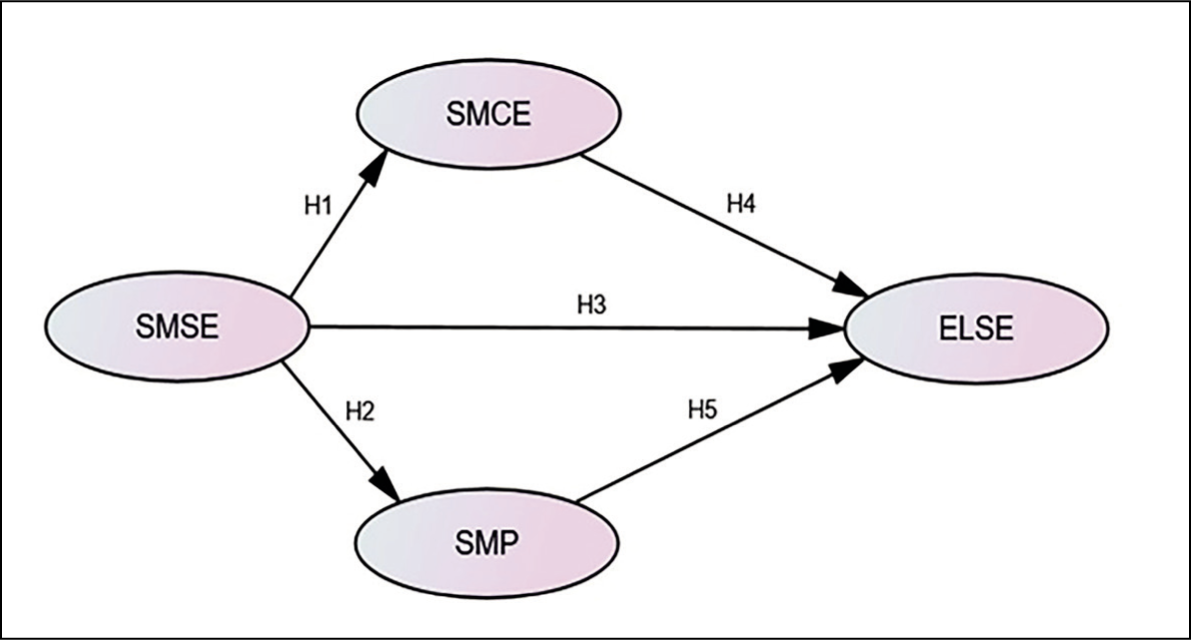
Hypothetical Model. SMCE, social media collective efficacy; ELSE, e-leadership self-efficacy; SMP, social media participation; SMSE, social media self-efficacy.
Further, the framework reflects the mediating effect of SMP on SMSE and ELSE. Similarly, SMCE is mediating the effect of SMSE on ELSE.
Measures
The proposed measurement model is assessed using a structured questionnaire with 22 items related to the constructs of SMSE, SMP, SMCE and ELSE. To examine SMSE, the study adopted six items from Bayraktar and Jiménez (2020) and Gegenfurtner et al. (2013). SMP constructs were measured using six individual items adopted from Brandtzaeg et al. (2015) and Hou and Ge (2019). SMCE measurement items were taken from Tafesse and Korneliussen (2020) and Velasquez and LaRose (2015). Five items adopted from Paglis (2010), Van Wart et al. (2019) and Deemer et al. (2020) were used to measure the ELSE construct. Retaining the context of the measurement constructs, the survey items were modified. To measure the response, a five-point Likert scale was used. Face validity and content validity were performed to ensure the depth, language and appropriateness of the questionnaire. For pretesting, experts from the field of management and social media and language experts were consulted and ambiguous and irrelevant items were modified and removed. The detailed description is presented in Appendix Table A1.
Sample and Data Collection Procedures
Data were collected through an online survey. The target population consists of employees of ITES firms located in Delhi NCR, Bengaluru and Pune, India. As this study is based on SMSE, SMP, SMCE and ELSE, data were collected from employees holding admin positions in any social media group, and those who were actively engaged in social media activities such as sending and sharing relevant information in different groups. The convenience sampling procedure was adopted to draw the sample from the population. The online survey was conducted from September 2020 to October 2020. For multivariate data analysis, a sample size of 200 to 300 is fair enough (Siddiqui, 2013). Hair et al. (2014) suggested that the sample size should be 5 to 10 times the number of variables used in the study. A total of 22 items were incorporated to measure the four constructs. Therefore, the minimum sample size required for this study was 220. For better generalization of results, a total of 660 respondents were targeted.
Respondents were asked to fill in the questionnaire only if they held an admin position of any social media group. A total of 550 questionnaires were received from 660 respondents. After reviewing the filled questionnaires, 478 questionnaires were found usable while the remaining 72 questionnaires were either incomplete or not appropriately filled.
Demographic characteristics of the sample are shown in Table 1. The resulting sample includes 165 female and 313 male respondents. The average age falls in the range of 19–35 years. With respect to educational background, most of the respondents were graduates. A total of 67% respondents spent 2 to 4 hours daily on social media. Almost 70% of respondents held admin positions in 1 to 3 social media groups.
Demographic Description.

Data Analysis Procedures
Data analysis was conducted in stages. First, to check the normality of the data, normality assumptions and the Common Method Variance (CMV) were performed. Second, Confirmatory Factor Analysis (CFA) using AMOS 22 was done to check the reliability, convergence validity and discriminant validity of the measurement model. Structural Equation Modelling (SEM) was used to test the structural relationship between several measured and latent variables simultaneously (Mishra & Gupta, 2020; Nunkoo & Ramkissoon, 2012). Third, PROCESS Macro of Hayes (2013) was used to test the mediation of the hypothesized model.
Results
Normality and Common Method Bias
For multiple regression analysis, the multivariate analysis technique was used and hence, the assumptions of the multivariate analysis were tested. First, using the Pearson’s Skewness and Kurtosis parameters, a normality test was conducted to test the normality assumption of data (Mishra & Gupta, 2020). The value obtained was between −2.58 and +2.58, showing normal distribution (Khatun, 2021). Linearity and multi collinearity tests have been applied using the curve estimated method of regression and the F values were found to be significant.
Next, the collinearity statistics test was performed to assess multicollinearity (Mishra & Gupta, 2020). All the explanatory variables had VIF between 1.852 and 2.535. Also, low correlation was observed among the variables and the tolerance values were between 2.0 and 5.0. This shows the absence of multicollinearity among the variables. Further, using the Harman single factor test, the Common Method Bias was estimated (Craighead et al., 2011). The obtained test value was 34.611%. Since the value obtained is less than 50%, the study is free from common method bias (Podsakoff et al., 2003).
Measurement Model
The adequacy of the four-factors model with 22 items was assessed by the individual item’s reliability and the convergent and discriminant validity. Based on the results of the preliminary CFA, six items (SMSE3, SMSE6, SMCE5, SMP3, SMP6 and ELSE4) having a factor loading less than the cut-off value, that is, 0.6, were discarded from the subsequent analysis to get sufficient reliability and validity (Hair et al., 2014).
Finally, CFA was conducted for the four factors measurement model with 16 items. All the fit indices of the measurement model were found to have an acceptable fit (Bagozzi & Yi, 1988). The values of model fit indices, that is, χ2/degree of freedom (df) = 3.045, goodness of fit (GFI) = 0.924, normed fit index (NFI) = 0.925, adjusted goodness of fit (AGFI) = 0.931, comparative fit index (CFI) = 0.921, standardized root mean square residual (SRMR) = 0.045 and the root mean square error of approximation (RMSEA) = 0.065 shows a good model fit.
The factor loading of all 16 items was more than 0.6, indicating satisfactory item reliability for the measurement model (Hair et al., 2014). In addition, all items were loaded significantly on the latent factors (ranging from 0.6 to 0.9) (see Table 2).
Convergent Validity and Reliability of Each Construct.
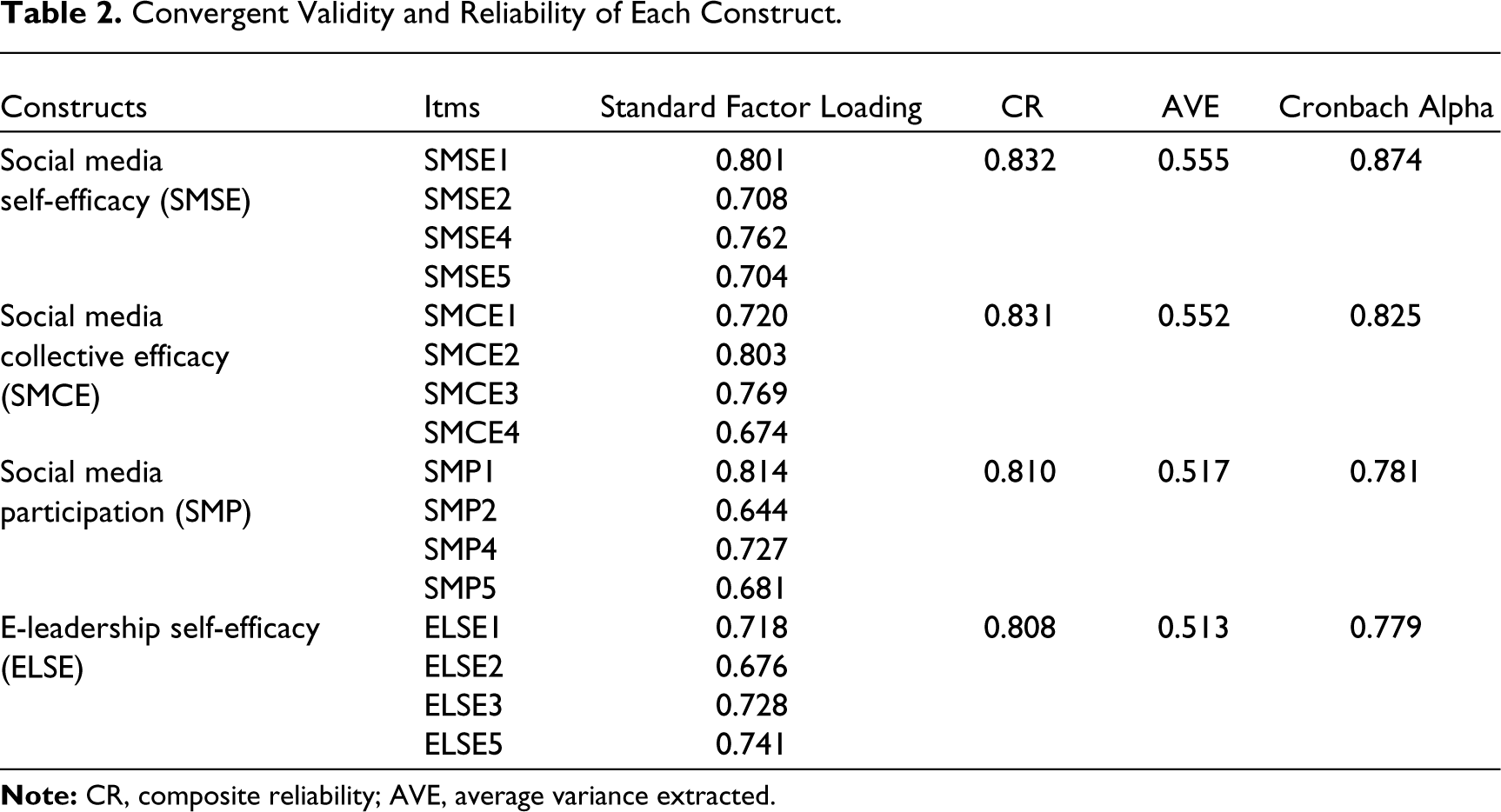
All the standardized estimated values were found to be greater than 0.6 and were thus significant, as suggested by Fornell and Larcker (1981). Finally, the average variance extracted (AVE) and composite reliability values for each construct was greater than 0.5 and 0.8, respectively (Fornell & Larcker, 1981) (see Table 2). This confirms convergent validity of the measurement model.
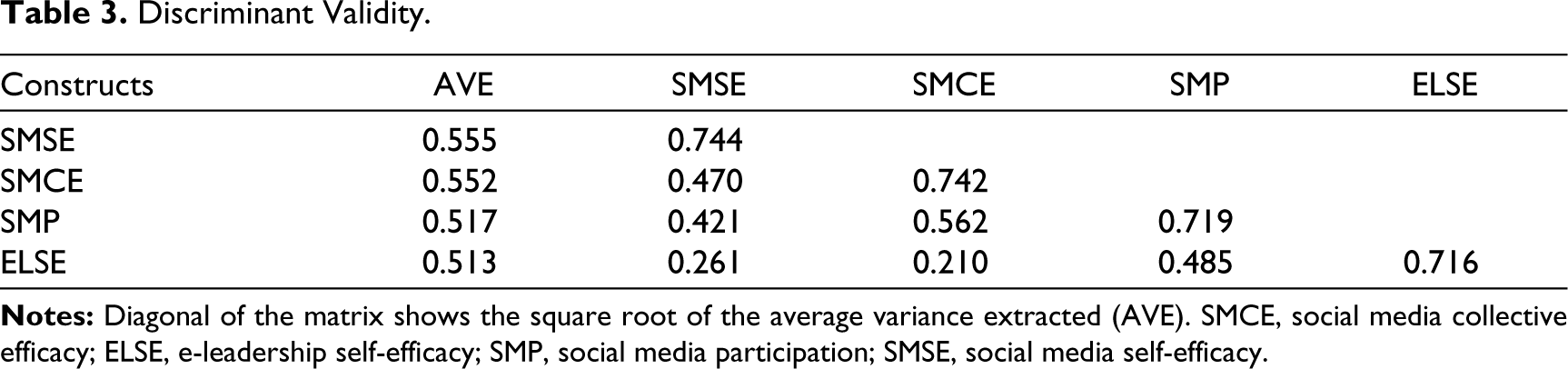
Next, the discriminant validity was assessed by comparing the square root of the AVE with the correlation estimates of the same pair (Fornell & Larcker, 1981). The results revealed that the square root of the AVE value for each construct is much greater than the correlation value of all the constructs (see Table 3). It implies that all four constructs are distinct from each other. Therefore, the finding confirms the presence of discriminant validity in this model.
Discriminant Validity.
Hypotheses Testing
To examine the structure model and to measure the effect among the three latent constructs, the SEM technique was used. A total of five hypotheses have been developed. From the SEM results, all the five hypotheses were found to be positive and significant. Table 4 shows the standardized path coefficients among the constructs.
Results of SEM.

SMSE has a positive and significant effect on SMCE (β = 0.851, SE = 0.026, p < .000), SMP (β = 0.361, SE = 0.035, p < .000) and ELSE (β = 0.516, SE = 0.041, p < .000). Further, SMCE (β = 0.439, SE = 0.038, p < .000) was found to influence ELSE positively and significantly. Similarly, SMP (β = 0.295, SE = 0.029, p < .000) positively and significantly affected ELSE. The result of the study confirms the role of SMSE in influencing leadership self-efficacy. The finding is in sync with the studies conducted by Uysal and Akfırat (2021). The path analysis established a strong relationship between efficacy and leadership, which is supported by earlier studies (Newman et al., 2018; Zhou, 2021). They considered SMCE to play a superior role in the ELSE. The relation between SMP and ELSE was found to be significant. Individuals with higher SMSE developed better ELSE as compared to individuals with lower SMSE.
Mediation Effect of SMP and SMCE
To test the mediation effect, the bootstrapping method by Hayes (2013) was used. Model 4 of PROCESS macro was employed to test the joint mediating effect of SMP and SMCE between SMSE and ELSE. Table 5 depicts the results of the mediation analysis.
The results revealed a significant indirect effect of SMSE (β = 0.231, p < .000; (95% CI: 0.052 to 0.145)) on ELSE through SMCE. Likewise, there exists a significant indirect effect of SMSE (β = 0.146, p < .000; (95% CI: 0.084 to 0.179)) on ELSE through SMP. This supports hypothesis H6 and H7. The direct and indirect effects of SMSE have been found to be significant on ELSE. This confirms the presence of partial mediation. The findings relate with the earlier study conducted by Bayraktar and Jiménez (2020).
Mediation Analysis Results.

Discussion
The global COVID-19 pandemic gave rise to the hybrid organizational structure which, in turn, has extensively increased information sharing through social media. Factors responsible for such active participation include increased awareness among the users, thereby gaining a competitive advantage, leadership skills and self-efficacy. To gain better insights, a greater emphasis must be attributed to SMP apart from ELSE.
Past studies explored SMSE and CE as separate factors to predict ELSE. The current study, using the Social Cognitive Theory (Bandura, 2001) and the Social Network Theory (Liu et al., 2017), established that the combination of CE and self-efficacy leads to the development of leadership self-efficacy in the virtual world.
The study established a strong relationship between efficacy and leadership, which is in sync with prior studies (Liu et al., 2017; Newman et al., 2018; Zhou, 2021). Besides, the results of the study reveal that SMSE has a significant effect on SMCE. The result is aligned with the previous study by Velasquez and LaRose (2015). SMSE indicates that it has the ability to influence others and share relevant information which is useful for developing CE. Subsequently, the results also indicate that SMSE is significantly related with SMP. Similar results were identified by Men et al. (2020) and Ewing et al. (2019).
The study found a significant influence of SMSE on ELSE. SMSE is an important aspect of leadership and aids to influence others and share relevant information through social media. These results are in sync with past studies by Liou and Daly (2020); and Chen et al. (2019). CE such as trust in social media, the ability to develop healthy relationships and supporting collectively has the full potential to develop ELSE (Liu et al., 2018; Paglis, 2010). Therefore, SMCE was found to play a superior role in ELSE. In the development of ELSE, individuals with higher SMSE performed better as compared to individuals with lower SMSE.
The relation between SMP and ELSE was also found to be significant. The attributes of SMP helps to develop ELSE which empowers social media platforms to write comments, share important posts, motivate others for higher participation and bring changes in the thought pattern of leaders. These important facets of SMP influence ELSE. Similar findings are reported in the studies of Uysal and Akfırat (2021); Halpen et al. (2017).
The study also investigated the mediating effect of SMSE and ELSE on SMCE and SMP. The results indicated that the indirect effect (0.095 and 0.127) is less than the direct effect (0.231 and 0.146). This shows the partial mediating effect of SMCE and SMP. A few recent studies have also highlighted the mediating role of self-efficacy (Bayraktar & Jiménez, 2020; Pekkala & van Zoonen, 2022). In today’s hybrid organizations, the findings of this study enrich the understanding of SMSE, SMP, SMCE and ELSE.
Theoretical and Managerial Implications
The study provides a theoretical base for future researchers in the field of social media leadership and efficacy. It offers novel contributions to existing literature by adding quality insights to the limited literature on social media efficacy and ELSE.
Previous studies explored SMSE and CE as separate factors to predict ELSE. The current study hypothesized and established that coalescing CE and self-efficacy can lead to a better development of leadership self-efficacy in the virtual world. It supports studies on the use of social media for knowledge and information sharing, leading to active SMP. Further, this study includes the constructs of SMP and SMCE as mediators in the relationship between SMSE and ELSE. Therefore, it provides a novel perspective in understanding the interaction between self-efficacy – participation and CE from the perspective of social media and leadership. Limited studies have examined the different levels of self and perceived CE (Velasquez & LaRose, 2015). This study investigates the impact of perceived CE with respect to various dimensions of efficacy and participation as the single predictor of ELSE.
Additionally, it has practical implications for managing and leading formal, informal and virtual groups of IT firms. It enunciates ways in which leadership self-efficacy can be improved while using social media such as knowledge sharing, continuous monitoring, impersonating proficient users, support from friends/colleagues and practicing emotional regulation. Organizations can monitor and identify suitable individuals for specific tasks through group participation activities. Self-efficacy and CE also develop a sense of belonging among group members and increase cohesiveness, leading to the participative leadership approach.
Limitations and Future Research Direction
Every research has its limitation, and this study is no exception. First, the study limits itself in terms of the sampling technique used and the area chosen for study. The respondents were selected using a convenience sampling technique and the sample was collected through an online survey from respondents in Delhi-NCR, Bengaluru and Pune, India. Second, this study utilized data from employees of ITES firms; therefore, the findings of the study are confined only to ITES firms of India. It may pose a threat to the generalization of the findings. Lastly, since it is a cross-sectional study, the underlying nature of the hypothesized relationships is circumspect. But these limitations direct us towards scholarly research in related fields. Areas such as instrumental leadership, distributive leadership and ethical leadership can be examined in the future. It also seeks attention to investigate the influence of specific social media platforms with respect to specific industries in India. The concept and variables of this study hold great potential to be studied and explored in organizations where social media is extensively used for communication and information sharing. Moreover, studies can be conducted using the same constructs in different industries with different geographical boundaries. To further test these relationships for future longitudinal studies, the findings provide initial support. The longitudinal research examining social media efficacy and leadership self-efficacy is encouraged.
Conclusions
Considering the dynamic work environment, SMSE, SMP, SMCE and e-leadership efficacy have great potential for today’s organizations. Also, leadership self-efficacy is a significant cognitive variable that regulates the functioning of leaders. Self-efficacy positively contributes towards individual performance and enables leaders to perform leadership roles efficiently by motivating group members to aim for a higher level of CE through participation. The study measures both self as well as CE, in the view of leadership in the virtual media. Using the social cognitive theory and the social network theory, the study examined the influence of SMSE on ELSE mediated by SMCE and SMP. The results support the significant and positive effects of SMSE and SMP on collective efficacy and e-leadership efficacy.
Footnotes
Declaration of Conflicting Interests
The authors declared no potential conflicts of interest with respect to the research, authorship and/or publication of this article.
Funding
The authors received no financial support for the research, authorship and/or publication of this article.
Appendix
Detailed Description of the Constructs.

| Constructs | Items | Code |
| Social media self-efficacy (SMSE) | I believe I can use different social media platforms to disseminate knowledge/expertise. | SMSE1 |
| I believe I can influence others to share their knowledge/expertise over social media. | SMSE2 | |
| I am confident about using social media platforms. | SMSE3 | |
| I believe I can argue effectively with others over social media. | SMSE4 | |
| I share only relevant information on social media to express my thoughts. | SMSE5 | |
| I keep myself updated and informed about specific measures to use social media sites and applications. | SMSE6 | |
| Social media collective efficacy (SMCE) | I can rely on the social media groups for help in critical situations. | SMCE1 |
| I believe social media groups will work together to achieve group goals. | SMCE2 | |
| I can maintain a healthy relationship with people on social media groups. | SMCE3 | |
| I believe there are people in social media groups who know how to support me. | SMCE4 | |
| I do not expect support from my social media circle as they have their own limitations. | SMCE5 | |
| Social media participation (SMP) | I post relevant comments on social media platforms. | SMP1 |
| I reply to other people’s posts on social media. | SMP2 | |
| I share relevant content on social media to support the ideas that my group advocates. | SMP3 | |
| I share with my social media friends the content posted on my page. | SMP4 | |
| I invite and encourage people to participate in my social media community. | SMP5 | |
| I motivate and coordinate with others to organize group activities in my social media group. | SMP6 | |
| E-leadership self-efficacy (ELSE) | I believe I can lead the change process in social media groups. | ELSE1 |
| I can develop and manage interpersonal relationships with social media groups. | ELSE2 | |
| I can motivate various social media communities. | ELSE3 | |
| I can gain consensus among social media group members. | ELSE4 | |
| I intend to make online social media a significant part of my leadership approach. | ELSE5 |