







Abstract
This study critically investigates the impact of sleep deprivation on the well-being of shift workers in a Mumbai-based manufacturing facility, highlighting a significant yet often overlooked occupational health concern. Employing a robust, two-phase mixed-methods approach, phase 1 quantitatively assessed the sleep patterns, quality and daytime sleepiness of 85 shop floor workers using sleep diaries, Fitbit wristbands, Actigraphy and validated tools such as the Epworth Sleepiness Scale and the Pittsburgh Sleep Quality Index. Phase 2 comprised in-depth qualitative interviews with 14 workers experiencing poor sleep, alongside interviews with four plant managers and family members. Thematic analysis of the interview data revealed a compelling narrative: shift work fundamentally disrupts circadian rhythms, precipitating irregular sleep patterns, chronic sleep deprivation and a marked decline in workers’ physical and psychological well-being. The study also identifies effective strategies to mitigate the adverse effects of shift work. It contributes valuable insights, proposing a framework for future studies to develop targeted, evidence-based interventions that address the critical issue of sleep deprivation among shift workers.
Introduction
Sleep is a fundamental component of human functioning, and disruptions in its quality or quantity can significantly impair cognitive processes such as attention, memory, reasoning, decision-making and learning. Despite its critical role, the prevalence of sleep disturbances is escalating worldwide. Clinical data indicate that approximately 4% to 5% of the Western population experiences excessive daytime sleepiness (Ulfberg et al., 1996). Moreover, insomnia has become the most common sleep disorder linked to COVID-19, undermining immune function and heightening vulnerability to infections (Bocek et al., 2023). In modern industrial operations, shift work is indispensable, with around one in five employees engaged in non-traditional work shifts (Folkard & Tucker, 2003; Wickwire et al., 2016). In industries requiring 24/7 operations, working across three shifts is unavoidable (Costa, 2003; Folkard & Tucker, 2003). However, shift work has been consistently associated with disruptions in daily life compared to standard day shifts (Åkerstedt, 1990). For example, Palo and Das (2021) found that 11% of rotating shift workers reported poor sleep quality in their study. Shift workers are particularly vulnerable to sleep-related issues, such as sleep attacks, which can result in drowsiness during shifts and affect their well-being beyond work hours (Sandberg et al., 2011). Despite this, the relationship between shift work and its impact on both on-shift and off-shift outcomes remain underexplored, particularly within Indian organizations. This study aims to fill this gap by examining the effects of inadequate and poor-quality sleep on the off-shift well-being of shift workers. Specifically, we will explore three key aspects: work-to-family conflict, mental well-being, and social engagement.
Shift Work and Sleep-Related Challenges
Shift work, which involves non-traditional working hours outside the standard daytime schedule (typically 9:00 a.m. to 5:00 p.m.), is widespread across healthcare, transportation, hospitality and manufacturing sectors. Extensive research has established a strong link between shift work and various adverse health outcomes, including sleep disorders, metabolic syndromes, cardiovascular diseases, gastrointestinal problems and mental health issues (Chen et al., 2022; Härmä, 2019). The literature consistently highlights that shift work poses significant health risks primarily due to the disruption of circadian rhythms and consequent sleep disturbances. Poor sleep, as a result of shift work, is strongly associated with numerous health problems, including obesity, hypertension, diabetes and declining mental health (Armstrong et al., 2022; Palo & Das, 2021).
Disruptions to circadian rhythms are particularly severe among night shift workers, exacerbating these health risks (James et al., 2007; Åkerstedt, 1990; Davis & Mirick, 2006). Given these findings, there is a pressing need for comprehensive sleep studies targeting shift workers in diverse settings, especially those involved in demanding shop floor roles with irregular shift patterns. While much of the existing research has focused on specific groups such as nurses, call centre employees and truck drivers (Baulk & Fletcher, 2012; Hittle et al., 2023), shop floor workers still need to be represented. Research on this overlooked population is crucial to address their unique health challenges. Gathering robust data on the interplay between sleep and shift work can support the development of sophisticated work systems that consider human sleep variations, potentially reducing occupational hazards and associated health issues linked to different shift patterns (Kim & Kim, 2008).
Theoretical Framework
The current research is founded on the Workers’ Well-being Framework and Effort Recovery theory.
Well-being at Work
There are two main perspectives on the meaning of well-being. The hedonic perspective emphasizes happiness and encompasses satisfaction with life, a positive mood and the absence of a negative mood. The eudaimonic perspective focuses on self-actualization and suggests that activities that promote autonomy, acceptance and mastery over work are crucial for an individual’s well-being. This study defines well-being as combining these two perspectives, which involve feeling good and functioning well. The ‘Workers’ Well-being’ framework developed by Chari et al. (2018) considers worker well-being as a holistic concept encompassing an individual’s quality of life, including their health, work-related environment, organizational and psychosocial factors.
The framework consisted of five major domains. The workplace encompasses various dimensions that collectively influence employee well-being. The physical environment and safety climate address the tangible aspects of the work setting and the safety protocols in place. Workplace policies and culture encompass the organizational procedures and practices that shape worker experiences and contribute to their overall well-being. Health status pertains to employees’ general physical and mental health, impacting their ability to perform effectively. Work evaluation and experience focus on factors that affect the quality of work life, including job satisfaction and perceived work conditions. External factors such as home, community and societal influences also play a significant role in shaping workers’ overall well-being. The framework embodies work and non-work contexts for a fuller picture of factors affecting workers’ health and quality of life (Chari et al., 2018).
Effort Recovery Theory
The Effort Recovery theory (Meijman & Mulder, 1998) highlights that work-related stressors demand individual effort, affecting their physiological and psychological well-being. Typically, outside of work, individuals recover and maintain optimal psycho-physiological levels. However, ongoing stress reactions can disrupt sleep quality in high-stress work situations. This results in individuals starting work in suboptimal conditions, needing extra effort to reach their best state. This additional effort places a heavy load on recovery processes and can lead to long-term health issues, including poor sleep and psychosomatic complaints (Åkerstedt, 2006).
The Present Study
Research Setting
Data collection for this study was conducted at a manufacturing plant located in Mumbai over a period spanning from July 2018 to June 2019. The plant had an eight-hour shift work system for managers and workers. The workers were assigned to a rotating shift schedule.
Operational Definition of Study Constructs
Shift work—‘Arrangement of working hours that uses teams (shifts) of workers in order to extend the hours of operation of the work environment beyond that of the conventional office hours’ (Knutsson, 1989).
Sleep—‘A recurring period in human activity that is defined as a state of immobility with greatly reduced responsiveness, which can be distinguished from coma or anaesthesia by its rapid reversibility’ (Siegel, 2005).
Sleep quality—‘Difficulty an individual faces falling asleep, staying asleep and the number of awakenings experiences throughout the night’ (Ebert et al., 2015).
Sleepiness—‘The tendency to fall asleep’ (Ferrara & DeGannaro, 2001).
Sleep apnoea—‘A common sleep disorder marked by abnormal patterns in breathing’ (White, 2006).
Well-being—‘Well-being includes the presence of positive emotions (e.g., contentment, happiness) and moods, the absence of negative emotions (e.g., depression, anxiety), satisfaction with life, fulfilment and positive functioning’ (Diener et al., 1998; Frey & Stutzer, 2003).
Data Collection
Critical case sampling was employed to select the respondents for the interviews. This method aims to choose a small number of critical cases that are expected to provide the most helpful information and significantly influence knowledge development (Patton, 2001, p. 236). Two phases of data collection were conducted to identify individuals with poor sleep patterns as critical cases.
First Phase
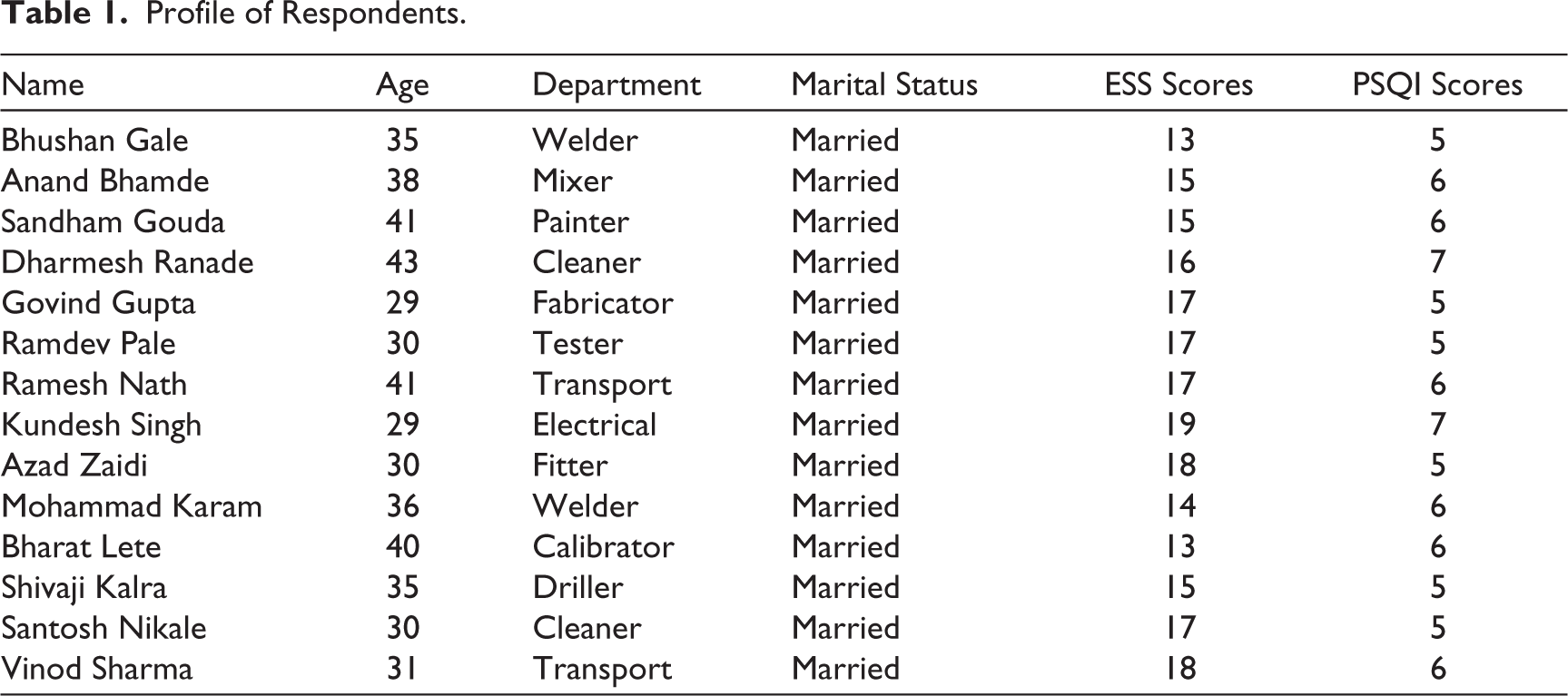
During the study’s first phase, we used the Pittsburgh Sleep Quality Index questionnaire (PSQI), the Epworth Sleepiness Scale (ESS) and Fitbit to identify workers with poor sleep quality. The poor sleepers were identified based on their PSQI and ESS scores and the Fitbit readings. A total of 85 male workers were administered these tools and selected from a single company, with job profiles including painter, cleaner, fabricator and welder (Table 1). Our criteria for selecting healthy individuals included those who had not taken any sleep-affecting medication in the last three months, those with no history of psychological or sleep disorders, and those who did not suffer from chronic sleep problems or any other severe illness that could affect their sleep. All 85 workers were administered the above tools to assess their sleep problems.
Profile of Respondents.
Second Phase
The study gathered comprehensive information on the sleep patterns of 85 shift workers using the instruments mentioned earlier, identifying 25 workers experiencing inadequate and low-quality sleep. Subsequently, we conducted 14 semi-structured interviews with these poor sleepers and other relevant parties, such as their colleagues, supervisors and family members. Family member interviews, including spouses parents and siblings living in the same household, were conducted at their homes, as shown in Table 1. Additionally, three interviews with plant managers were conducted in their respective offices.
In qualitative research, researchers gather information about people’s experiences, ideas and perspectives in their own words. This is typically done through a semi-structured interview process. Researchers use a preplanned list of questions (an interview guide) and unscripted questions to probe for deeper understanding (Buchner et al., 2004). In the current study, both of these approaches were used. Participants were first asked the preplanned questions from the interview guide, followed by additional questions based on their responses. On average, interviews lasted 45 minutes.
Ethical Guidelines Were Followed in the Research
This study strictly adhered to ethical guidelines and received approval from the Tata Institute of Social Sciences Institutional Review Board. Before the study, all participants were presented with consent forms, allowing them to decide about their participation voluntarily. Each questionnaire was accompanied by a cover letter that ensured confidentiality by using coded personal data instead of names. The research objectives were transparently communicated to the respondents, and data collection was scheduled at their convenience. As the study occurred within a plant setting, the research team discussed defining the study’s scope with union members and addressing any concerns. Following consent from senior management and union representatives, union leaders, HR managers and supervisors distributed communications regarding the study to all participants.
Data Analysis
Results of the First Phase
Based on Table 2, it can be seen that in the first phase of the study, 85 participants had their sleep analysed. The mean and median sleep durations were 6 hours and 11 minutes and 6 hours and 25 minutes, respectively. The average and median sleep quality scores were 4.32 and 4.11, indicating no significant sleep quality issues. The mean and median sleepiness scores were 8.23 and 8.11, respectively, which suggests slightly higher than normal daytime sleepiness. Table 3 shows the average sleep duration as 6 hours, 22 minutes and 25 seconds, with a minimum of 4 hours, 21 minutes and a maximum of 7 hours, 43 minutes, as measured through a Fitbit. Finally, the mean and median sleep apnoea scores were 1.33 and 1.11, indicating a low risk of sleep apnoea among the participants.
Results of Sleep Analysis.

Sleep Hours Measured Through Fitbit.

Results of the Second Phase
The integrated approach used for data analysis involved both inductive and deductive methods. The inductive method was used to develop codes from the ground up. In contrast, the deductive method was used to organize the code types based on the interview protocol and emerging new concepts. The two authors independently applied the codes to three interview transcripts and had lengthy discussions to ensure a similar understanding of the code definitions. The first author then continued to use the codes for the remaining process. We conducted a manual thematic analysis of the transcripts because it provides a thorough approach to gaining a deeper understanding of the subject matter. According to Namey et al. (2008), this method identifies and describes implicit and explicit ideas through codes that summarize raw data. It enables researchers to connect various participant perspectives and compare data collected at different times and contexts, offering various interpretive possibilities.
Results
The major themes that emerged from the data analysis are presented below. Some respondents shed light on the importance of shift work and how industries would completely shut down without shift workers doing their jobs.
Role of Physical Environment and Sleep Challenges
The workplace’s physical environment, lighting, temperature and noise levels can significantly affect employees’ sleep quality and quantity. The respondents unanimously agreed that insufficient or excessive lighting, especially in the evening, negatively impacts their sleep quality and quantity. Additionally, exposure to noise from machinery was identified as a major sleep disruptor. According to one respondent,
Our workstation is equipped with proper lighting, ventilation, and safety measures, which help us feel less fatigued during work. However, the relationship between sleep and fatigue is obvious, and ignoring the feeling of sleepiness can lead to various issues. With experience, those who have worked in this field for an extended period often learn how to manage such situations, preventing themselves and others from unforeseen incidents.
Another respondent said,
The physical area within my factory is quite spacious, and most machines are fully automated, producing minimal noise. As a result, the night shift does not require significant physical exertion, even though we must remain awake. If one of us feels drowsy, we typically ask a colleague to watch while we briefly nap.
However, some respondents reported that the temperature in the workplace was not regulated appropriately, making them uncomfortable and affecting their sleep. One respondent stated, ‘The temperature is either too hot or too cold, and we cannot control it. It makes it difficult to sleep’.
Accordingly, the physical environment of the workplace, such as lighting, temperature and noise levels, can significantly affect shift workers’ sleep quality and quantity, according to the respondents.
Safety Policies and Sleep
Safety policies can have a positive impact on sleep quality. One respondent mentioned,
When working with machinery during a shift, constant vigilance is necessary to maintain safety. However, if one does not feel secure, it can lead to anxiety and significantly disrupt sleep. The need for continuous attention and the potential dangers associated with operating complex machinery or performing hazardous tasks can heighten stress levels, particularly among workers who may already be experiencing fatigue from irregular or long shifts. This heightened anxiety can manifest in a variety of ways, such as difficulty falling asleep, frequent waking during the night, or non-restorative sleep, which fails to provide the restorative benefits necessary for physical and mental recovery.
Another respondent mentioned,
The management in this organization places a high priority on the safety of its workers. They have provided us with up-to-date safety equipment and regularly remind us to follow safety protocols.
One more respondent said,
Workplace safety policies in our organization are strictly enforced, with clear safety rules and procedures in place. We take every precaution to ensure a safe working environment. In addition, our managers, supervisors, and colleagues are incredibly supportive, fostering a culture where everyone’s well-being is a top priority. It’s not just about following rules; it’s about genuinely caring for each other and making safety a shared responsibility.
Shift Rotation Policy
Workplace policies and climate are crucial in workers’ attitudes towards shift work. Few of them appreciated the fairness that was being maintained in terms of their rotating schedule. No matter how difficult it is to work in a rotating shift system, they understood that nobody else in the team had it easy, so the question of bias towards one group over the other did not arise as all would receive their share of day and night shifts based on their schedule. One respondent said, ‘Although it may be challenging, we have all become accustomed to working in this manner, and the compensation is generous, so it is acceptable’.
Workers typically prefer to avoid rotating shift schedules when workplace policies are perceived as fair. Providing sufficient notice of the shift schedules lets them plan their personal and professional activities accordingly.
Work and Life Balance
Even though a few identified certain benefits of the shift work, the majority thought otherwise. One shift worker said, ‘The big thing is going home at odd hours when everyone is sleeping or returning to work at an odd hour. It can be quite frustrating sometimes’.
Some even added that at times if workers do not turn up for their shifts due to specific issues, the ones present at the site need to do overtime work, and that gets very challenging for them in such cases if there are initial plans or family programmes, things get cancelled last minute.
One of the siblings of the worker we spoke to said, ‘My brother is not working his usual job, so his challenges are higher. He needs to catch up on so many things that people with other jobs do not’.
Most workers added that they missed the critical events in their children’s lives. One worker stated,
I do not want my children to think I am a bad father, as I do not have time to go to their school functions or play with them as much as I would want. I hope they do not grow up thinking I did not care for them much because that is untrue, but that upsets me.
Another added,
The other day, we were supposed to go and watch my son play in school. I had planned everything too, but at the last moment, my reliever (the person who comes for the second shift, after which the worker can leave their workstation and go) got sick and could not come, so I had to do overtime shift.
Another respondent said,
The work-life balance is shaken because no matter how hard I try, I feel like I am always failing at something. Because of the odd work timings, I cannot plan and take my family out for picnics or day trips. Sometimes, even if it is not my work day, if the other worker who is supposed to replace me does not come on time or does not show up for work due to some emergency, I have to be in his place and do the job.
Conjugal Life
Many participants expressed their challenges in balancing their professional and personal lives due to working irregular hours. They also shared how this has led to severe issues in their marriages and other aspects of their lives. One of them said,
We desire to return home and cherish quality time with our spouse and children, but most days; we are too exhausted to do so. Despite remorse, the weariness after work leaves us wanting to sleep or rest. This has a significant impact on our physical as well as emotional intimacy level.
Another respondent mentioned,
Insufficient sleep is adversely affecting our marital relationship. There have been days when my partner and I have argued about personal or intimate matters. After a long day at work, I feel exhausted and drained, and I prefer sleeping early instead of engaging in sexual activity, which often frustrates my partner.
However, another respondent said,
While I am confident that my wife knows I love and care for her, my work schedule demands often leave me tired and drained when I return home, particularly after a night shift. Consequently, I may have little energy or inclination to engage in other activities, even though I would like to.
Social Engagements
The impact of poor sleep goes beyond an individual’s personal life and can significantly affect their social and community activities. In this regard, a respondent stated,
Holidays and significant family events often challenge me, as everyone expects my presence despite my demanding work schedule. Although they know my shift work, they need help understanding my situation from my perspective. This disconnect can create additional stress as balancing professional obligations with family expectations becomes increasingly complex.
Another worker experienced guilt and discomfort when work obligations clashed with important family events. He said,
I do not want to upset my family, but what do I do? I work and earn for them so that we can live a comfortable life. I also want to spend time with them, but my work schedule does not allow that.
The Subjective Experience of the Impact of Poor Sleep on Overall Health Conditions
The health status of individuals reflects their overall physical, mental and general well-being. According to multiple respondents, they have experienced a decline in both the quality and quantity of their sleep due to shift work, which negatively impacted their health. While some respondents believed that individuals could find ways to sleep despite the challenges of shift work, others acknowledged the isolating nature of specific tasks and their negative impact on one’s well-being, mainly when working alone. One worker’s parent emphasized the importance of good health and sleep patterns but acknowledged that the need to earn a living often takes precedence, causing concern for their well-being.
Mental Well-Being
There is a connection between poor sleep and negative health consequences, including mental health issues. A respondent shared that he occasionally feels down during work, and while he may not fully comprehend the reason behind it, he attributes it to a lack of quality sleep or feeling unwell. Despite these difficulties, he has learned to adapt to the job’s demands and has found ways to manage his well-being over time. In the words of this respondent,
Someday, I feel shallow, and I do not understand why, maybe because I lost some good sleep time or was not feeling well, but yes, it gets better after a while, so I am used to it now.
Another respondent added, ‘Despite adhering to regular exercise and timely meals, mental stress is inevitable due to shift work’s unpredictable nature, so we think there is little we can do about It’.
A respondent mentioned that the physical and mental strain of irregular working hours has prompted them to contemplate other job prospects that provide more conventional working hours. He mentioned,
The unconventional schedule of waking up, working, and going to bed has negatively affected me physically and mentally. That is why I am exploring other job options that offer ‘normal’ working hours, allowing me to eat, work, and sleep like most others.
Relationship at Work
Shift work can often disrupt workers’ relationships and dynamics at the workplace. One employee remarked,
Although we enjoy each other’s company, our work schedule sometimes prevents us from being cheerful. During breaks and time off, we joke and laugh with one another, but if someone has missed a significant amount of sleep, they typically use that time to catch up on some much-needed rest’.
Another employee added,
Occasionally, we face work-related conflicts that can result in arguments on tough days, but these moments are rare. Our work environment is quite unique, which often leads to stronger and more distinct relationships than those in traditional workplaces.
Discussion
Shift work has become increasingly common in modern society. Sleep disturbance is a common consequence of shift work, with shift workers experiencing shorter sleep duration, poorer sleep quality and an increased likelihood of sleep disorders such as insomnia and obstructive sleep apnoea. Several factors contribute to these sleep disturbances, including disruption of the circadian rhythm, physical factors such as exposure to artificial light at night and social factors such as difficulty maintaining a consistent sleep schedule.
Shift work schedules affect every aspect of the worker’s life, whether at work or outside. The workers risk developing various health problems and declining overall quality of life. It is associated with various adverse health outcomes, including an increased risk of cardiovascular disease, metabolic disorders and certain cancers. In this study, most participants did not experience inferior sleep quality, and we tried to probe why. The findings indicated that it could be attributed to a few factors, such as the overall environment at their workplace, as well as their experience of working in this field for a long time and thus having decent knowledge as to how to get the required amount of shut-eye for their optimal functioning.
The study highlights how workplace policies, the physical environment, the safety climate, the quality of workplace relationships and leadership style can impact the sleep quality of shift workers. Several studies have shown that safety policies can positively impact sleep quality. A study by Ruggiero et al. (2020) found that workers who received training on sleep hygiene as part of their workplace safety programme reported improved sleep quality. Moreover, safety policies can promote healthy sleep habits by addressing factors that disrupt sleep, such as exposure to noise or light. For instance, the National Institute for Occupational Safety and Health (NIOSH) recommends that employers provide workers with access to quiet areas for relaxation and minimize exposure to bright light during the nighttime to promote healthy sleep habits. Based on this finding, that is, adequate lighting, natural ventilation, effective noise control and safety policies are some of the factors that can help improve the physical and safe environment, thus sleep quality, we propose:
Another interesting finding relates to employee’s perceptions of fairness in policies and procedures. If they perceive inequitable treatment, it gives rise to dissatisfaction and resentment, which are likely to impact the quality of sleep. A study by Pignata et al. (2016) found that perceptions of fairness in workplace policies and procedures that are perceived as fair can reduce stress and anxiety levels among employees, which can, in turn, improve their sleep quality. The study also found that perceptions of procedural justice, or the fairness of procedures used in decision-making, were significant for sleep quality.
Another study by Van Laethem et al. (2021) found that healthcare workers who perceived fairness in scheduling policies had better sleep quality. Additionally, a study by Jensen et al. (2018) found that workplace interventions to improve perceptions of fairness and reduce perceived injustice can improve employee sleep quality.
Fairness can be perceived in various ways, such as consistent application of policies, clear communication of expectations, involvement in decision-making and equitable distribution of workload and rewards. Employers who prioritize fairness in their policies and procedures may see improvements in their employees’ overall well-being, including their sleep quality. Based on the findings mentioned above, we can propose the following proposition:
In this study, shift work has been linked to various adverse health outcomes, including mental health problems such as mood swings, irritability, depression, etc. Sleep is essential for our brain to process emotions, and sleep deprivation can make it difficult for individuals to regulate their emotions effectively. One study found that shift workers were more likely to experience symptoms of depression and anxiety than those who worked traditional hours (Kalmbach et al., 2015). Another study by the authors conducted in 2018 found that shift work was significantly associated with higher depression, anxiety and stress (Kalmbach et al., 2018). This finding led us to the proposition that,
There are several potential ways shift work can negatively impact mental health. First, chronic sleep deprivation can disrupt the regulation of the stress hormone cortisol, leading to increased stress levels and worsened mental health outcomes (Kalmbach et al., 2018). Second, the circadian rhythm disruption caused by shift work can lead to changes in neurotransmitter levels in the brain, which can contribute to the development of mental health disorders (Chen et al., 2017).
The study showed that shift work could also impact work-life balance, which refers to balancing work and personal life responsibilities, due to the erratic nature of their work schedules. The interviews were conducted to illuminate the very important yet easily overlooked or ignored aspects of an individual’s life, such as the issue of marital relationships and quality of life affecting their relationship with significant others such as parents, partners, children, etc. The irregular and unpredictable schedules of shift work can make it difficult for individuals to plan and engage in activities outside of work, such as spending time with family and friends or pursuing hobbies. This can lead to feelings of isolation, social disconnection and reduced quality of life (Costa et al., 2016). Based on the findings mentioned above, we propose the following proposition:
The study found that shift work negatively impacted the quality of relationships among couples. It is associated with decreased frequency of sexual activity and decreased time spent together as a couple. In a similar study by Jansen et al. (2017), it was found that shift work was associated with decreased relationship quality, lower levels of intimacy and decreased sexual satisfaction among couples. The study also found that shift work was associated with increased conflict and decreased communication among couples. According to a study conducted by Wong et al. (2019), shift work was associated with lower levels of intimacy, decreased sexual satisfaction, increased conflict and decreased communication among couples. Moreover, the adverse effects of shift work on work-life balance and social relationships can have long-term consequences for workers. Based on the above findings, we can come up with the following proposition:
The current study found that employees who experience poor sleep quality or quantity are more likely to experience difficulties in interpersonal relationships, decreased social engagement and reduced participation in community activities. A study reported that poor sleep was associated with reduced participation in leisure activities, such as sports, hobbies and cultural events (Åkerstedt et al., 2002). Goldman-Mellor et al. (2018) also found that poor sleep quality has been linked to reduced participation in community activities and decreased social support, which is essential for promoting overall well-being. These findings thus suggest the proposition as follows:
Lack of sleep also can impact the development and maintenance of social connections in the workplace. Several studies have demonstrated the impact of sleep deprivation on social connections in the workplace. According to a study, individuals lacking sufficient sleep showed a diminished perception of social connectedness within their work environment and reduced motivation to interact with colleagues (Barnes et al., 2016).
Sleep deprivation can significantly negatively impact social connections in the workplace. This can include reduced motivation to engage in social activities with coworkers, impaired communication and team cohesion. Based on these findings, the following is proposed:
The importance of sleep analysed above can be understood regarding workers’ well-being and the ‘Workers’ Well-being’ framework. Sleep is a crucial factor closely linked to these dimensions of workers’ well-being. The physical and psychosocial work environment, work-life balance, social support and personal factors are all critical considerations in promoting healthy sleep habits and mitigating the adverse effects of poor sleep on workers’ overall health and well-being.
The study’s findings are closely linked to the effort recovery because the interviews reflected how lack of sleep hampers their work and lives outside it. It is easier for them to be at their optimal level if they have the required rest that allows their body to charge up for the next day.
While sleep is a crucial aspect of our lives, it is important to understand the different needs of workers in different professions. People working in fields that are not conventionally attuned to function as per the circadian rhythms (biological clock for the body) need facilities and adjustments to ensure their sleep needs are met.
Theoretical and Practical Implications of the Study
This study deepens our understanding of the impact of shift work on sleep and overall well-being by highlighting several previously overlooked factors. It uncovers a complex interplay between sleep disturbances, workplace policies and the physical and social environments in which shift workers operate. Additionally, it reveals how perceptions of fairness within the workplace can significantly affect sleep quality. Shift work disrupts circadian rhythms and subjects workers to conditions such as artificial light exposure and irregular schedules, increasing the risk of sleep disorders like insomnia and obstructive sleep apnoea.
The study contributes substantially to occupational health literature by proposing a comprehensive framework that links environmental, organizational and psychosocial factors to sleep quality and well-being among shift workers. This multi-dimensional approach underscores the need for holistic interventions that address the work environment’s physical and psychological aspects to promote better sleep health. By integrating theories from organizational justice, environmental ergonomics and occupational health psychology, the framework provides a solid foundation for future empirical research and offers valuable insights for developing practical interventions. Employers should implement several key strategies to improve sleep quality and overall well-being among shift workers.
Environmental Enhancements: Introduce noise reduction measures and ensure access to proper lighting to facilitate better sleep quality and quantity.
Safety Policies and Practices: Develop and enforce safety policies that include sleep hygiene practices, providing a supportive framework for improving sleep among workers.
Flexible Scheduling: Consider policies that accommodate employees’ unique needs, such as flexible scheduling options and quiet areas for rest during breaks.
Supportive Workplace Environment: Foster a culture of fairness and support to promote healthy sleep habits. This includes encouraging practices like avoiding caffeine and alcohol before bedtime and incorporating relaxation techniques.
Educational Initiatives: Educate workers about the importance of sleep and provide resources like sleep hygiene workshops and access to sleep-tracking apps.
Relationship Support: Develop programmes to support relationships affected by shift work, including couples counselling and relationship workshops.
Mental Health Resources: Offer comprehensive mental health resources to address the psychological impacts of shift work and sleep deprivation.
Limitations and Pointers for Future Research
The study sample was drawn from a manufacturing plant with a favourable work environment and contented workers, as indicated by qualitative interviews. Consequently, the findings are likely most relevant to rotating shift workers in similar settings. The research focused on healthy workers without chronic sleep issues or severe health conditions, which may limit the applicability of the results to those with health challenges. Additionally, the study predominantly included male shift workers. Examining how shift work affects both male and female workers can help identify gender-specific issues and lead to more inclusive solutions. While data were collected at different times, a longitudinal study with varying time intervals would offer more profound insights into workplace-related sleep issues; however, resource constraints prevented such an approach. Future research should address these limitations by including diverse gender representation and considering different contexts. Innovative research methodologies or collaborative approaches should be developed to address resource constraints and delve into the complex, multi-dimensional issues related to shift work and sleep.
Footnotes
Declaration of Conflicting Interests
The authors declared no potential conflicts of interest with respect to the research, authorship and/or publication of this article.
Funding
The authors received no financial support for the research, authorship and/or publication of this article.
Appendix A. Measures Used in the Study
In the study, several measures were employed to assess sleep quality and related factors.
Appendix B. Interview Protocol
We are soliciting your responses to a research study entitled ‘Sleep of Rotating Shift Workers and Impact on their Well-being’. We would require approximately 45 minutes of your time to complete this conversation. Your participation is voluntary, and all the information you provide will be kept confidential. The data collected will be used solely for academic research purposes. We will start the interview once we receive your informed consent to participate. If you have any questions or concerns about this study or would like to receive a summary of the findings.
Thank you for your willingness to contribute to this study. Your participation is greatly valued.