







Abstract
This is an essay highlighting the fundamental importance of agriculture (historical and present) in the agro-socioeconomic evolution of human societies, from the times of the hunter/gatherers to the modern day. Attention is drawn in the text to the importance of deforestation in relation to micro and macro climate changes, and the vital role of carbon dioxide to plant and animal life. The essay also relates the world’s natural resources to the present unsustainable population pressures.
Preamble
My lifetime career in tropical agronomy, which has involved me working in or visiting over 50 countries in tropical and Mediterranean climates, has allowed me to collect many of the pieces of the jigsaw representing the complex story of the evolution of what we are pleased to call human society. If one can collect sufficient pieces of a jigsaw, it is possible to assemble a picture, interpret it and from this arrive at synthesis. Thomas Malthus observed that sooner or later population gets checked by famine and disease’. He wrote in opposition to the popular view in 18th-century Europe that saw society as improving and in principle as perfectible. William Godwin and the Marquis de Condorcet, for example, believed in the possibility of almost limitless improvement of society. So, in a more complex way, did Jean-Jacques Rousseau, whose notions centred on the goodness of man and the liberty of citizens bound only by the social contract – a form of popular sovereignty. (quoted from Wikipedia)
In a strange way, the same idea of sidelining the Malthusian view, encouraged by the technological advancement leading to the self-sufficiency of man, exists today.
Objective
The objective of this essay is to compress my understanding of the critical relationship between human populations and the requirement for food and convey something of the urgency of addressing both food and population equations, which must balance if Homo sapiens life is to be sustainable.
Historical angles
To me, the most fascinating story about life on planet Earth is its evolution over the last 3 billion years. The first 2.5 billion years or so were dominated by prokaryotes – simple, unicellular life forms which exist in an anaerobic environment and at the same time excrete oxygen from photosynthesis. Then, almost suddenly, when the oxygen tension made aerobic life possible, multi-cellular air-breathing animals evolved. The 32 phyla we know today came into existence in what is often referred to as the Cambrian Explosion. The sequence of the rise in dominant species and their collapse is well recorded in fossils from the rise and fall of the giant ammonites, graptolites and trilobites, and more recently the demise of the giant reptiles and giant mammals. The most recent example is, of course, the advent of Homo sapiens. The stage of hunter/gatherers led to fewer resources on the land and mankind embarking on the long journey to master the most fundamental foundation skill in his evolution as we know him today. This skill was agriculture, or the raising of crops and the rearing of livestock. Without this, mankind could never have evolved to his present sophistication. This skill commenced some 8000 years ago (Cole, 1970), and is most probably associated with fishing communities. The fish and aquatic foods were, and until very recently still were, in abundance. However, with diminishing land stocks, the mastery of food production became a necessity. This mastery released time for other activities such as the creation of fire and smelting, the conceiving of alphabets, the written word, mathematics and science and eventually the industrial revolution and automation (Toffler, 1981).
None of these advances could have taken place without the mastery of food production. Agriculture is of primary and supreme importance and remains so today. Lack of appreciation of the fundamental importance of agriculture can only lead to long-term insidious world disaster and the breakdown of what we term human society.
Society and governance
As mankind mastered agriculture, another important factor appeared – the creation of societies and a form of governance for these societies. At the beginning there were small groups of settled farmers, but whether they were small or large there was immediately a problem of leadership. A common saying is ‘born to lead’. Aristotle stated that ‘from the hour of their birth some are marked out for subjection and some for command’ (Aristotle, 2005). Early human societies found chiefs, paramount chiefs and kings, and then eventually democracy, but none of these is a perfect mode of governance.
A society that is of interest is that of termites, who have workers, gardeners, soldiers and heating engineers – a very well-structured, stable society, but essentially all termites are identical. For mankind, there is the problem that we, apart from monozygotic twins, are not identical individuals, or, as Scheer wrote, ‘L’inegalitie est une loi de la nature aussi bonne que n’importe laquelle’ (‘Inequality is a law of nature without exemption’) (Barth, 1904).
So, the issue of ‘governance’ and the social values by which mankind live have preoccupied men’s minds for years without ever coming to an agreed utopia, as evidenced by the plethora of forms of government. It would seem that there is no difficulty in drawing up constitutions for human societies, but there is a worldwide problem in finding and electing good and competent leaders. For many countries, the government has been in the form of military dictatorships, particularly in Africa.
I have no difficulty in accepting the various forms of governance, apart from my personal interpretation of what is and what is not good governance, but I disapprove of any government that abuses the members of their own society, for example absolute dictatorships. Moreover, I totally reject forms of governance that do not fully comprehend the fundamental importance of food production, in a world context. Nor am I happy with leaders who indicate no clear demonstration of their concepts of society and their enormous responsibility in leading that society. I must also, again, include in that responsibility an awareness of the importance of agriculture, both nationally and internationally.
Role of agriculture
Having stated that agriculture has been, and remains to be, fundamental to the well-being of any human society, it is necessary for me to elaborate my thesis.
First of all, let us consider not the evolution of agriculture but the position of one country in particular, that is the USA. The USA has one of the most well-developed agricultural industries in the world, without exception, and it is that strong agriculture that makes the country so powerful in the world. It was said loosely that one man in the field of agriculture in the USA provided enough food for 35 people, five of whom were overseas. This was not an unplanned situation, but was directly related to the Morrill Land Grant College Act of 1862, which allocated land for the purpose of creating state colleges, with the requirement that the colleges must teach agriculture and military science.
Britain, by contrast is probably producing only 60% of its food requirements, and there is no Ministry of Agriculture! It is possible that in other essays I have over-stressed the role and importance of agriculture to the world’s population, particularly in developing countries. In this essay I intend take it as a given that the reader appreciates the fundamental importance of agriculture, and to concentrate more on the demographic aspects of human society that may destroy the world’s agricultural environment.
Sufficient to say here that the world evolved into an environment, which we may refer to as a tree climax, in which over a million species of life live. Unfortunately, the unrestrained increase in the world’s population has resulted in critical destruction of that tree climax, causing both micro and macro climate change (to be discussed in the ‘Demography’ section).
Our world is a small planet with a land area of 148,939,063 km2, or 29% of the world’s surface area, with a population of nearly 6.5 billion persons – a density of 45 per square kilometre, or 2.29 hectares per person. (Not all of this area is available for cultivation, as it includes Antarctica, deserts and mountains.) This relatively small finite area has to provide all the resources for the nutrition, housing and security for the world’s population, including animals, year in and year out.
In 1928, the year of the writer’s birth, the world had a population of some 2 billion persons. There are now three persons for every one in that year, and each has a right to an adequate standard of living and a share of the world’s resources. It is estimated that there may be 10 billion persons in the world by 2050. Ignoring the controversial side issue of global warming, there are strong indications that it may be that the world’s population has reached, or is reaching, its limits in terms of the world’s available natural resources. After the Second World War, biologists often referred to the danger of over-population. However, with vast oceans and fish being the last remaining wild source of food, it was thought that the oceans would feed the rising populations. For a while it seemed so, as the wild catch increased year by year. However, now we have realized that the wild catch of fish reached a plateau about 20 years ago.
Some facts regarding agriculture and populations
It is necessary to give some parameters here to set the scene:
In 1870, 70–80% of the US population was involved in agriculture.
In 2007, 33% of the world’s population was working in the field of agriculture (producing 5% of the world’s gross domestic product).
In 2008, some 2–3% of the US population was directly involved in agriculture.
The UK has a surface area of 244,755 km2, with a population of 60.5 million and a population density of 247 per square kilometre, or 0.4 hectares per person. Approximately 76% of the land area is dedicated to agricultural use, or 0.3 hectares per person.
We tend to think of subsistence farming as a system to be found in very undeveloped countries, primitive backwaters of the world, but this is incorrect. Firstly, subsistence agriculture is not a primitive farming system, but a system that has evolved over many centuries and requires considerable skill on the part of the farmers who practise it on their holdings. In Bangladesh, farmers may have to follow several different rotations on their holdings, with a possibility of three crops per year, on land that may be covered with 20 feet of water during the rainy season and be dry during the ‘winter’ period. Mastering the seasons, storing the seeds and integrating the crops with each other in order to provide sustenance for the family is no easy task, requiring a knowledge of crop husbandry that would tax many western factory farmers. Secondly, the subsistence farming system is not to be found in the backwaters, but is the basis of life for nearly half of the population of the world. For example, examination of Table 1, derived from the World Development Report of 1985, shows that 2500 million people are in the two poorest economic groups.
Rural population of the world – 1985 data.
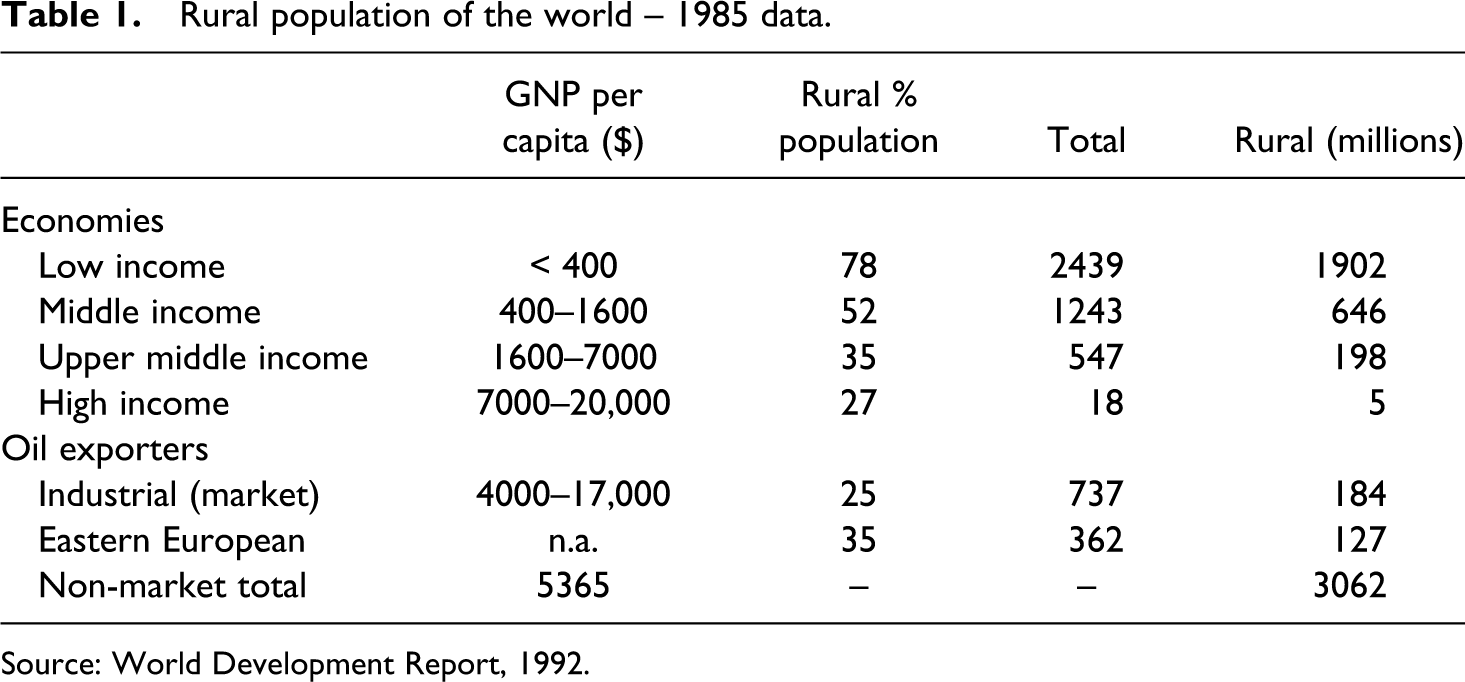
Source: World Development Report, 1992.
Most, although not all, low-income countries, comprising 72,128,000 km2 or 47% of the land area of the world, are located in the tropical parts of Africa and the Far East. Within these land areas a wide range of environments are to be found, from deserts to tropical rainforests, each with its own subsistence farming system. Fertility of the soils is frequently low but some of the oldest cultivated lands in the world are located in these areas, such as the Nile Delta and ancient irrigated lands in Sri Lanka. I have stood on top of a small temple carved out of living rock at Anuradhapura and looked down upon a small irrigated block of land that is known to have been cultivated for more than 2000 years, which makes one ponder about the infertility of tropical soils.
Industrialization
The 1800s witnessed the mastery of steam and the consequent industrial revolution. It was centred in Western Europe until the Second World War. Cheap manufactured goods were readily available and towns became centres for employment. The farmers, many of whom were essentially crofters, found that they were losing labour and were forced from using the horse to using the tractor. Until the Second World War, the industrial nations had the world as their market. Since then there has been a tremendous shift from West to East, particularly to China and India. These countries have very large populations to support, and, apart from China, they have not recognized the need to reduce population growth. Africa, too, unfortunately has little industrial strength, but does have populations with high fertility rates, with many women having up to eight children.
Present situation
The western industrial countries do not seem to have appreciated the significance of these shifts of production centres to their own economies (wrongly thinking that they could survive on banking and financial services), nor have they appreciated the dangers of an over-populated world and the effects on the world environment in terms of micro and macro climate change – global warming can be dismissed as poor semantics.
There can be no objection to industrialization, particularly as a means of employing people, if the food security situation is good (the USA is in a powerful position), but bad governance in the banking and financial sectors can lead to economic difficulties.
However, there is one field of mankind’s agro-socioeconomic set up that is not properly, indeed irresponsibly, acknowledged, and that is the potentially self-destructive effects of over-population.
Demography
At the beginning of the Agricultural Revolution, around 8000
The inexorable rise in the world’s population has become of increasing concern to all countries in the developing world. Strangely enough, this rise in population has often been encouraged by the politicians of developing countries because of the perception that more people mean more strength. This is a philosophy that fits in with the subsistence farmer’s own ideas, it being commonly believed that having many children means a secure old age. Combined with political encouragement, improved preventative medicine has meant that life expectancy has increased, more babies survive, people live longer and populations have become unstable as the average age of the population has gone down. For many countries, 45% of the population is now under the age of 15 years.
Undoubtedly population increases in the world have become one of the most serious constraints on the development of third world countries. The scale of the problem is well indicated in Table 2, which gives some data on the change of population in Sri Lanka over a 100-year period.
Population of Sri Lanka, 1871–1980.
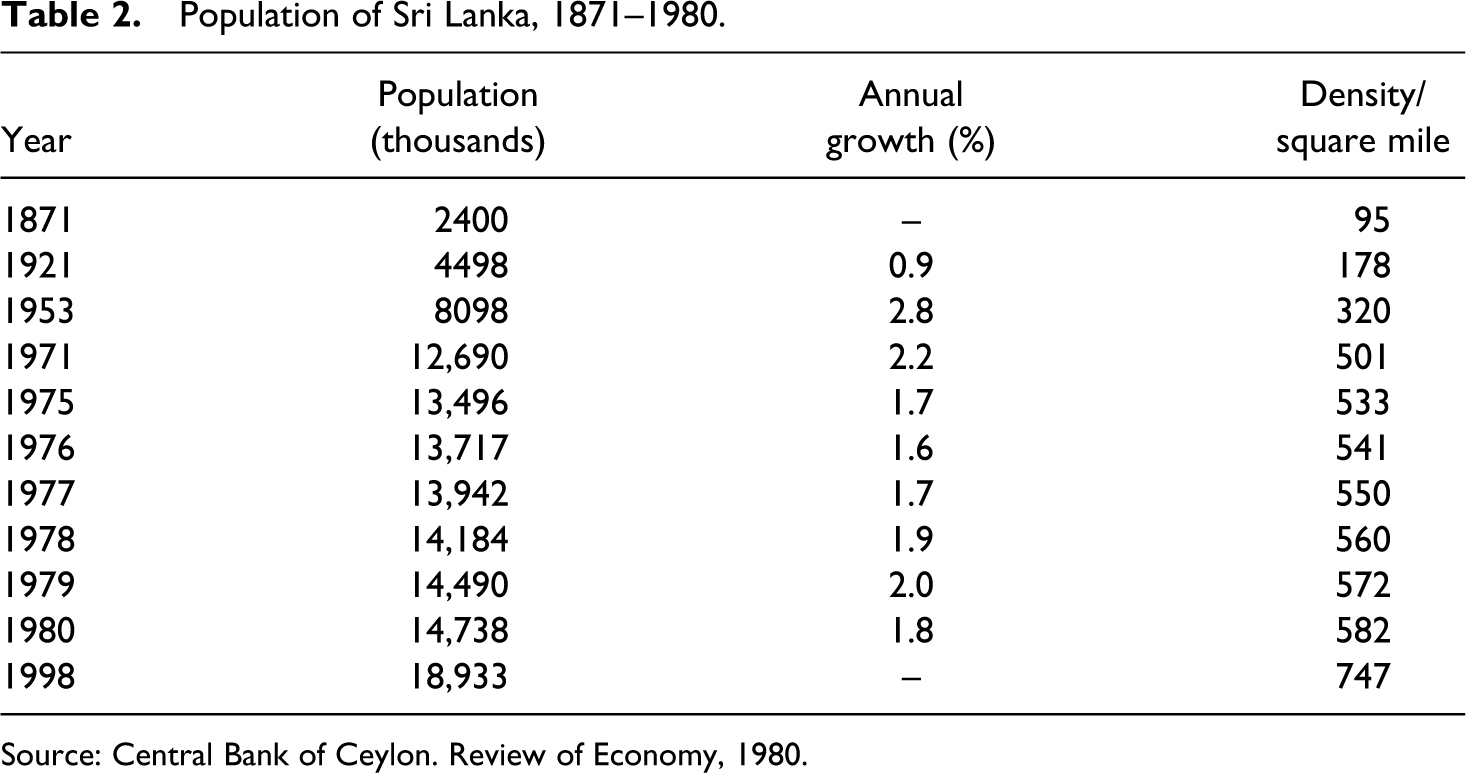
Source: Central Bank of Ceylon. Review of Economy, 1980.
The serious food security problems which faced the world after the Second World War, when the population numbers were increasing rapidly, were masked for a time by the Green Revolution. This was a brilliant piece of breeding work by researchers working in Mexico and the Philippines, who bred stiff-strawed varieties of wheat and rice that could stand up to high-nitrogen fertilizer applications and which had high yield potentials. The results were almost unbelievable increases in grain production. While oil prices were low, the package of inputs required by the high-yielding varieties were affordable by all, even by countries who had only negligible amounts of foreign exchange. Although countries were not always consistent in their priorities, it is true to say that the use of fertilizers and farm machinery increased quite markedly in developing countries in the 1960s and 1970s. In Bangladesh, for example, the use of commercial fertilizers rose from 275,000 tonnes in 1969–1970 to 830,000 tonnes in 1981–1982 – a significant increase, although small compared with the 48 million tonnes used in the USA in 1982.
In my opinion, population control is the most urgently needed action in the third world. Without population control, the future is bleak for the rural masses of the developing world, that is for the hundreds of millions of subsistence farmers and their families. One of the results of the rising world population is that the land pressure problems are becoming more evident. Farm sizes are decreasing, fragmentation is common (in Bangladesh a farmer has on average five to six parcels of land) and landless families are commonplace. As the pressure mounts, so people are forced into increasingly adverse environments, for example the char lands (emerging sandbanks) in the Bay of Bengal or the infertile podsols of Sumatera. In some reports, the term ‘functionally landless’, meaning rural families with less than half an acre (0.2 ha), is being used. Increasingly, hills are being denuded and forest cover removed; for example, the hills immediately above Freetown in Sierra Leone are now red scars, whereas 35 years ago they were renowned throughout West Africa for their rich green cover of jungle.
Climate change and global warming
Some present day data relating to demography that all climate change – global warming do-gooders should be aware of:
The world is increasing its population by 6,000,000 a month.
The population of India in 1951 was 320 million and is now 1.1 billion.
27% of the worlds population is under 15 years of age.
In many industrialized countries of the world, women are opting out of having children, preferring to be career women, or have children when they are in their late thirties.
80% of the world’s population live in countries with less than $2.50 per day per capita.
I have shown in previous essays that wherever man settles there must be micro climate change by the simple fact that, once he progressed beyond the hunter/gatherer stage to grow food crops, he had to destroy the forest tree climax. As the population grew, he progressively destroyed more and more forest cover. This was no problem provided the availability of forested land was not a limiting factor. This has been the case until comparatively recent times, and there are now indications that the present level of world population is too great for the natural resources of the world. This has been recognized by the Chinese government, which has endeavoured to reduce the number of children to one per family.
This policy has not been entirely successful, although the endeavour still exists to restrict family sizes. China is the only country in the world, apart from India, which introduced a policy of paying men to be vasectomized, that has recognized the dangers of the world’s population out-running the resources.
Most of the world’s agro-socioeconomic woes can be laid at the doors of ‘world over-population’. Strangely, most of the developed world’s leaders, both scientific and political, have ignored this issue (judging by the lack of mention in the Western presses), and diverted themselves into considering what are simply symptoms. In particular, the main distraction is global warming, or climate change. Undoubtedly this is a major issue for the world’s ecological stability, but there seems to be little understanding that this is a symptom and not the cause, which is leading politicians into massive expenditures in attempting to control carbon dioxide emissions.
This expenditure will be a complete waste of time. In my opinion, to pinpoint carbon dioxide emissions is erroneous. It is not the carbon dioxide that is the problem. Indeed, high levels of carbon dioxide in the atmosphere are beneficial for plant growth. Any global warming is almost entirely due to the removal of forest cover. In addition, the destruction of estuaries and coast lines by pollution has killed much of the photosynthetic capability of inshore marine life.
Politicians and even some scientists do not seem to appreciate the critical role of trees in the world’s ecology. Few do not even seem to appreciate why it is cool when one walks into a forest, and hot when one comes out into the sunlight. Most people think that the forest is cool because it provides shade. This is true in the same way that corrugated iron sheets will provide shade and some reduction in temperature. But the tree is an entirely different matter. The tree during daylight carries out photosynthesis on a grand scale, converting carbon dioxide and water in the presence of chlorophyll to carbohydrates (timber), using vast amounts of incoming solar energy as it does so. This process takes the heat out of the surrounding atmosphere – the tree’s immediate micro climate). It also uses up energy in transporting water from the soil and evaporating it into the atmosphere – the latent heat of evaporation equation is considerable.
Nobody with a modicum of scientific knowledge will deny that mankind is the cause of climate change – every time a family cuts down tree cover to grow annual crops, he inevitably changes the micro climate. The natural ecology of Earth is a tree climax, which creates a sustainable macro climate. If the tree cover is removed, as has happened, and is happening, in the world, then the ecological stability is endangered. The cause of this instability and rising temperatures is entirely due to population pressure on a finite resource, that is cultivable land area, and most certainly not due to carbon dioxide emissions. (Air pollutants are obviously creators of social problems, such as pea-souper fogs, smoke and nuclear waste, but they are normally micro climate changes, not macro climate changes.)
It is critical in the management of the world’s ecology that the relationship between man (and indeed all animals) and plants is understood. The most important element in the world is carbon, for both plants and mankind. Life is not based on silicon or nitrogen, or any other element, although they are all involved in organic chemistry; no, the world is a carbon-based environment. Another fact is that man and animals cannot live or survive without plants, although plants can survive without animals. The next most important fact which has to be understood is that ‘animals need oxygen and plants need carbon dioxide’. Man cannot survive without oxygen and plants cannot survive without carbon dioxide. I apologize for repeating these statements, but my firm impression is that these simple facts of the world’s nature are not adequately appreciated or understood.
The tree
Let us now consider the importance of the tree in the world’s global nature. Thousands of years ago the ecology of Earth was predominantly a tree climax, with upper storey and lower storey environments. With the unstoppable increase in man’s population, the tree has been removed simply because it does not allow man to cultivate the soil and grow food crops. However, the tree (and other green plants) remains an important part of the world’s natural cover, and without its natural biology man would be unable to survive on planet Earth.
The science is simple. Thus, six molecules of carbon dioxide plus six molecules of water in the presence of chlorophyll in plant leaves, plus incoming solar energy (sunlight), produces one molecule of carbohydrate plus, and this is an important plus, six molecules of oxygen:
So, carbon dioxide is an important part in any plant’s carbon cycle, but, strangely, although it is so important, it is actually a trace element in the atmosphere, being only, say, 350 parts per million. Indeed, references can be found to it being a limiting factor for plant growth. If the carbon dioxide content of the atmosphere is increased, then plant growth is increased. It follows, therefore, that the trees and other plants welcome any increase in carbon dioxide in the atmosphere and increase their photosynthetic activity accordingly. It also follows that for plants, any increase in carbon dioxide in the air from petrol engines, etc., is welcome. It may be deduced that any attempt by man to reduce the output of carbon dioxide is counterproductive in terms of plant growth and the production of oxygen.
The counter argument against carbon dioxide in the atmosphere is that it captures incoming infrared rays and consequently raises the world’s temperature. To deal with this argument, I can do no better than quote from Emsley (1994): The Earth’s atmosphere keeps the temperature reasonably stable, smoothing out the daily changes, and seasonal ones. The vapour that does this so effectively is water. Without water, the average temperature of the planet would be 33oC colder than it is. Water is very good at trapping a lot of the infrared rays which would otherwise be lost to space, and water vapour alone is responsible for a warming of roughly 32 oC, or about 97% of the green house effect. Carbon dioxide helps a little bit as well, accounting for about 1oC.
I have referred in a previous dissertation (MacDonald, 2010) to the effects of clouds – water vapour – providing a cooling effect on a hot, sunny day. The contrast is the unbearable soil temperatures in the Empty Quarter of Saudi Arabia, where the moisture content in the air is virtually nil. There are no trees there!
To the urban dweller in London, trees are pleasant to look at and provide nice shade in summer, but produce fallen leaves as a nuisance in autumn. They may not appreciate that the tree is actually taking heat out of the atmosphere (during the process of photosynthesis, and also because of the enormous latent heat of evaporation by the trees as the water is transported from the roots to the canopy and evaporated off as vapour into the atmosphere).
In Africa, even in the semi-arid environments of Karamoja and the like, the acacia and balanite trees create microenvironments that draw water from the deep tables to provide the semi-arid adapted large mammals with water in the leaves at night and shade during the day. The shade and water vapour provide the environment for a wealth of bushes, herbs, sedges and grasses to grow beneath their umbrellas. This in turn provides food for a variety of animals, including birds and bees. The latter contribute to pollination and seed production, which provides food for the birds, which then distribute the seeds to maintain, if not extend, the ecosystem. The biomass of the ecosystem is equivalent to the best Norfolk pasture. Again, however, thoughtless policies have resulted in the loss of the trees, wildlife and desertification.
The carbon dioxide scam
I think that enough has been said to show that the carbon dioxide hysteria demonstrated by some is nothing more than a scam and is being used as an opportunity to raise taxation and other prices, pleading that it is being done to save the planet. A better use of taxpayer’s money would be to save the world’s watersheds, stop criminal deforestation to grow biofuels and address the rate of population increase.
I accept that at the present rate of consumption of fuel oil, the resource will soon run out, but this is a different issue to global warming. Mankind has to seriously look at the looming energy crisis, but without this senseless and useless diversion of the public’s attention and monies to false global warming scares and the evil carbon dioxide emissions. The powers that be must examine the causes and not the symptoms.
Role of the present leaders
The world leaders have a responsibility to rule, but their prime aim should be to keep the world's population negative.
The message
The message is simple. The world must stop increasing its population numbers, or it is doomed (as has happened in the past to other civilizations).
Conclusions
Ever since mankind stopped being a hunter/gatherer, he has, in cutting down forest trees, been responsible for micro climate change. As numbers increased, so the destruction of forests resulted in macro climate change, eventually resulting in failed civilizations. (For example, the Sahara, Ephesus, ancient civilizations in Central America, Indonesia and the Middle East.) The cause of these failures was undoubtedly over-population, associated with poor agriculture – for example irrigation techniques resulting in soil salinity.
It is correct that carbon dioxide is an important gas in the atmosphere, in that without it plants cannot live. However, there are only some 350 parts per million of carbon dioxide in the atmosphere, and there are scientific papers referring to it as a limiting factor to plant growth. Strangely enough, the more carbon dioxide there is in the atmosphere, the greater the amount of plant growth and release of oxygen, which is essential for animal life.
Again, I have to repeat that the cause of climate change is increasing world population numbers and the destruction of rich photosynthetic systems. The world’s population is now at a level beyond that which the world’s natural resources can support. Even more alarming is the fact that the world’s population is increasing by 6,000,000 per month (more than Norway’s entire population).
The world’s leaders should be considering population numbers (as China is), and not carbon dioxide.
Footnotes
Acknowledgements
I wish to acknowledge the help of my wife, who has proofread all my writings, and the hundreds of others who have contributed to the conclusions in this paper. They include subsistence farmers, colleagues in the Colonial Service, academia and the commercial sector in the tropical world over a period of 30 years. I conclude my tropical career working as a freelance consultant.
This research received no specific grant from any funding agency in the public, commercial or not-for-profit sectors.