







Abstract
Background
Regular breakfast consumption is crucial to optimise people's physical and mental health and social and emotional wellbeing (Bartfeld et al., 2019; Harris et al., 2021; Monzani et al., 2019; Sincovich et al., 2022; Smith et al., 2017). Current research suggests that breakfast skipping, in different ways, results in a broad range of adverse health outcomes, such as eating disorders, obesity, mental health issues, and cardiovascular diseases (Harris et al., 2021). Evidence suggests that internationally, around 10%–30% of children and adolescents regularly skip breakfast (Monzani et al., 2019; Sincovich et al., 2022). Home breakfast consumption is vital for kindergarten children, whose dietary behaviours are contingent on the extent of appropriate breakfast preparation and supplies in their family environments, where their parents have an important role in promoting children's home breakfast consumption (Bartfeld et al., 2019; de Buhr and Tannen, 2020; Smith et al., 2017). Parents who do not usually consume breakfast, for example, are more likely to develop habitual behaviours of breakfast skipping amongst their children. Although there are numerous school-based public health campaigns promoting breakfast consumption in children (Bartfeld et al., 2019; Harris et al., 2021; Lundqvist et al., 2019; Metcalfe et al., 2020; Monzani et al., 2019; Sincovich et al., 2022), little is known about children's home breakfast consumption at the family setting (Bartfeld et al., 2019; Giménez-Legarre et al., 2020; Monzani et al., 2019). Extant research has an inadequate focus on investigating the experiences, contexts, and frequencies of home breakfast consumption in children (Bartfeld et al., 2019; Giménez-Legarre et al., 2020; Monzani et al., 2019). In particular, whether parental breakfast consumption literacy is associated with children's home breakfast consumption remains somewhat unclear (Bartfeld et al., 2019; Harris et al., 2021; Lundqvist et al., 2019; Monzani et al., 2019; Metcalfe et al., 2020; Sincovich et al., 2022). There are two main reasons that may possibly explain the scarcity of empirical research to date in this field. First, much of the research related to children's breakfast consumption is focused on the kindergarten setting instead of the family setting (Gréa Krause et al., 2018; Gibbs et al., 2018; Thompson et al., 2022). Second, in spite of numerous published valid and reliable measurement tools, such as surveys and audits, that assess the extent of parental health literacy in the broad nutrition context, there appear to be no well-validated tools that specifically and relatively objectively assess parental breakfast consumption literacy. Given these research gaps, parental breakfast consumption literacy in this study refers to whether parents have basic knowledge of health impacts of breakfast consumption (e.g., importance, benefits, risks). In considering the important roles of parental influences on children's health in the broad health context, this study aimed at understanding the relationship between parental breakfast consumption literacy and children's home breakfast consumption.
Methods
This study, employing a cross-sectional design, included 275 children aged 6–7 years and their parents. In total, 275 children and 275 parents participated in this study. These children were recruited from a local Chinese leading kindergarten, with this study conducted in September 2021. The research team involved research staff who had expertise in health education and health promotion. The brief survey for each child and the tailored questionnaire for each parent were developed by the research team based on the existing valid and reliable broad nutrition-related surveys (Gibbs et al., 2018; Gréa Krause et al., 2018; Thompson et al., 2022). As illustrated previously, to date, there are no published valid and reliable tools that specifically assess parental breakfast consumption literacy, this study aimed to devise a relatively feasible and basic survey that covered fundamental conceptions of parental breakfast consumption literacy. The survey devising process was informed by the existing published tools in the broad nutrition literacy literature, as well as consultation with the research staff in health promotion, public health, nutrition, and behaviour change. Guided by the Health Belief Model (Green et al., 2005), the assessed items, contained in the survey, were mainly related to whether parents were aware of the benefits of breakfast consumption and risks of breakfast skipping. The detailed survey devising process will be reported elsewhere and not be the scope of this study. However, the research team piloted these measurement tools in ten children and ten parents prior to implementing this study, each tool achieving high feasibility and satisfaction.
The recruitment process was relatively effective, given the assistance of the teachers and administrative staff of this local kindergarten. Children were eligible to participate in this study if they were: (a) current students enrolling in this kindergarten and (2) aged 6–7 years. Eligible children's parents were eligible to participate in this study.
Frequency of breakfast consumption was categorised into only one classified variable, “breakfast consumption” (i.e., breakfast consumption over the past week before participating in this study). The 6–7 times of breakfast consumption in children over the past week (before participating in this study) were considered a unit of “regular breakfast consumption.” The questionnaire sent to each participating parent involved a range of questions to measure breakfast consumption literacy, such as naming five health benefits of breakfast consumption and five health risks of breakfast consumption. The responses to these questions were assessed and the scores of breakfast consumption literacy for participating parents were calculated by the research team. For statistical analysis, the research team reclassified these scores into two groups, “adequate breakfast consumption literacy (6–10 scores)” and “inadequate breakfast consumption literacy (1–5 scores)”. The research team initially aimed to gain rich qualitative data pertaining to how parents perceived benefits of breakfast consumption and risks of breakfast skipping through the open-ended questions in these surveys, the majority of participating parents, however, did not fully answer these questions and stated that they were not aware of any health impacts of breakfast consumption. For parents who answered these questions, the reported benefits of breakfast consumption mainly included “improved worker productivity” and “great start of the day (happiness)”; the reported risks of breakfast skipping mainly contained “feeling hungry at work” and “limited worker productivity”.
Socio-demographic data consisted of children's age and gender, children's and parents’ residential status, parental educational level, and parental employment status. Children's age ranged from 6 to 7 years; children's and parents’ residence included living in either “rural” or “urban” areas; parental level of education was classified into three groups, comprising “low” (not attending university), “normal” (bachelor), and “high” (master or above) groups. Parental employment status was grouped into “employed” and “unemployed” groups.
The frequencies of children's home breakfast consumption amongst different subgroups of children were measured by the one-way analysis of variance and independent-sample t-test. Multiple linear regression models were employed to measure which variables were associated with children's home breakfast consumption when controlling for parental socio-demographic factors. The significance was set at <0.05. All data in this study were analysed by the software of R Commander.
Ethical approval has been obtained from the Human Research Ethics Committee of this local kindergarten (approval number: 46283628). All children and parents were entitled to withdraw from this study at any time without any harm. Their identified information and research-related data were only available to the research team. Recruitment strategies consisted of text messaging, group emails, and information sessions. Participants who initially provided written consent forms all participated in this study, with the attrition rate of participation being zero.
Results
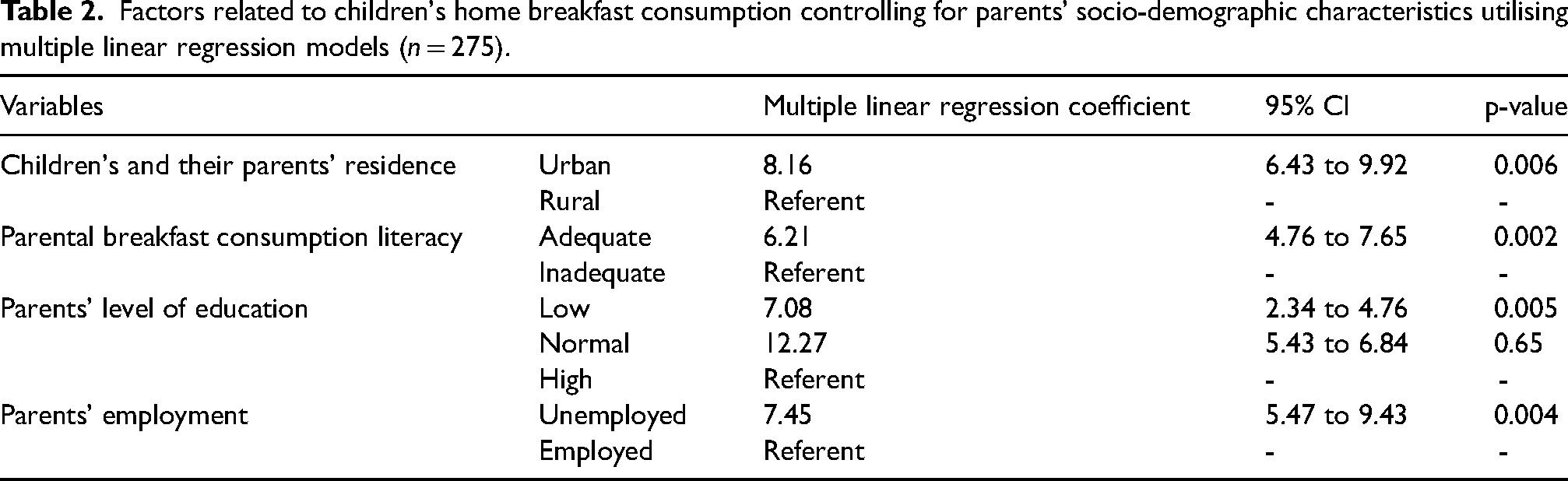
In total, 275 children (45% males and 55% females) aged 6–7 years and their parents participated in this study. Parents who were employed (p = 0.03), with high level of education (p = 0.007), and living in rural areas (p = 0.004), had children who had more home breakfast consumption (Table 1). Boys (p = 0.001) had less home breakfast consumption in comparison with girls; older children (p = 0.003) had less home breakfast consumption, compared with younger children (Table 1). Parents with inadequate breakfast consumption literacy (p = 0.006) had children with less home breakfast consumption (Table 1). Employing multiple linear regression models, living in urban areas (p = 0.006, 95% CI: 6.43–9.92), low level of education (not attending university) in parents (p = 0.005, 95% CI: 2.34–4.76), and parental unemployment (p = 0.004, 95% CI: 5.47–9.43) were significantly associated with less children's home breakfast consumption (Table 2). Adequate parental breakfast consumption literacy (p = 0.002, 95% CI: 4.76–7.65) was significantly associated with more children's home breakfast consumption (Table 2).
Children's home breakfast consumption in terms of children's and their parents’ socio-demographic factors (n = 275).
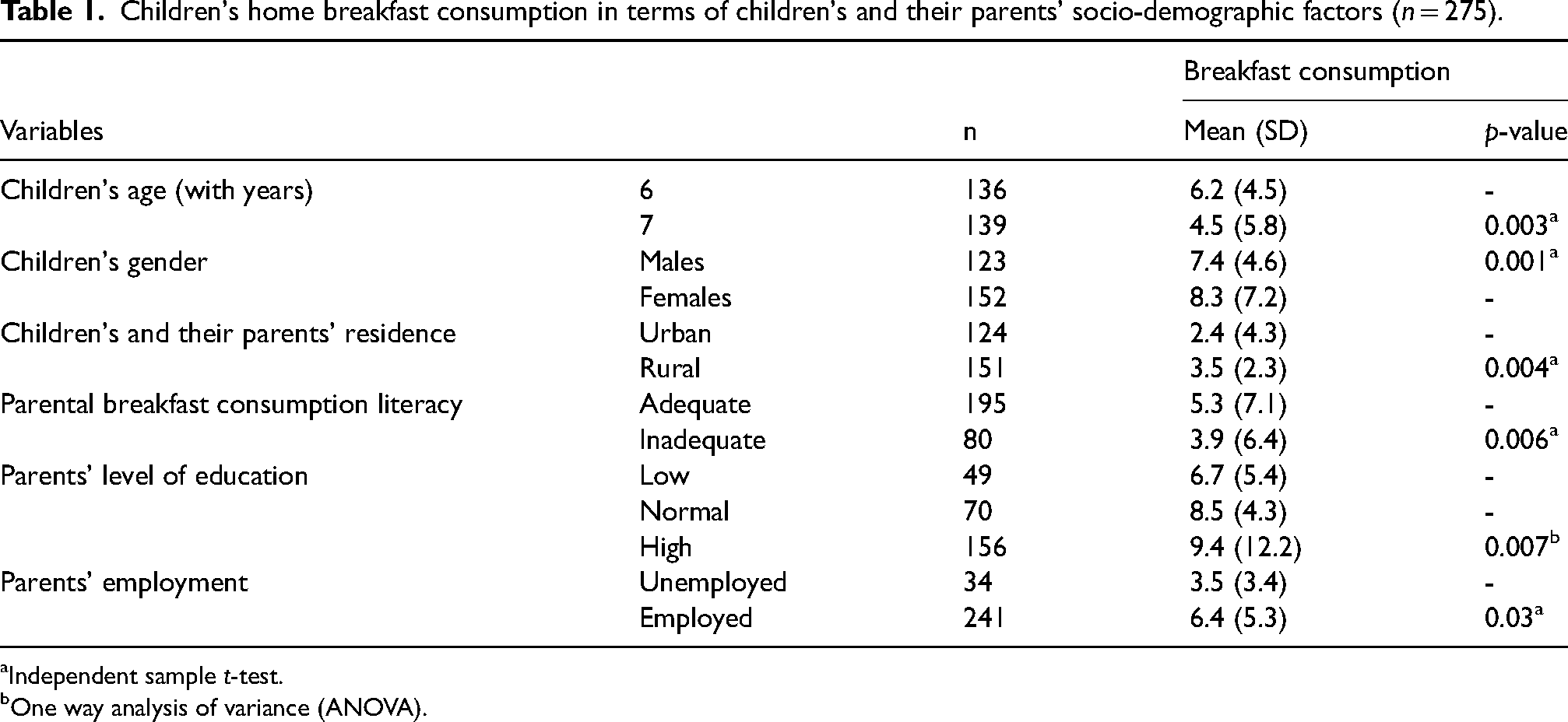
Independent sample t-test.
One way analysis of variance (ANOVA).
Factors related to children's home breakfast consumption controlling for parents’ socio-demographic characteristics utilising multiple linear regression models (n = 275).
Discussion
Utilising a cross-sectional design, this study mainly revealed that inadequate parental breakfast consumption literacy was associated with more home breakfast skipping amongst children. After multiple linear regression models, living in urban areas, inadequate parental breakfast consumption literacy, low level of education, and parental unemployment were significantly associated with less home breakfast consumption in children.
This study, consistent with the previous research, acknowledged the important roles of parents in influencing dietary behaviours amongst their children (de Buhr and Tannen, 2020; DeWalt and Hink, 2009). An extensive literature suggests that inadequate parental health literacy has an adverse impact on children's development of health behaviours, such as hand hygiene and sleep hygiene (Bellissimo-Rodrigues et al., 2016; Jarrin et al., 2020). Health promotion interventions are, therefore, warrened to promote parental health literacy, health self-awareness and ultimately to develop long-term healthy lifestyles. Recent research has posited the importance of lifestyle-based interventions acting on intrapersonal, interpersonal, and ecological risk factors of health issues affecting children and their family members (Binkley and Johnson, 2013; Crosby and Noar, 2011; Porter, 2015). This study purported that the level of education amongst parents, parental health literacy, and parental employment were important predictive factors contributing to the level of children's home breakfast consumption. In considering the low modifiability of parental educational level, lifestyle-based intervention strategies should focus on how to encourage parents to make quick, affordable, and nutritious breakfast for their children. Interestingly, some, although not all, participating parents in this study were aware of the limited health impacts of breakfast consumption, suggesting that parental nutrition education in this context is warranted. Future research is required to understand the interactive mechanisms between these factors utilising qualitative methodologies. The precede–proceed model is a potentially suitable theoretical framework to investigate why negative health issues occur from behavioural, environmental, learning, and ecological perspectives (Binkley and Johnson, 2013; Crosby and Noar, 2011; Porter, 2015; Saulle et al., 2020).
Interestingly, this study observed that children living in rural areas had more home breakfast consumption. This is somewhat inconsistent with the literature to date (Bettenhausen et al., 2021; Probst et al., 2018). In the broad context of health research, target groups living in rural areas are often considered socioeconomically disadvantaged, given that where they live usually faces shortages of good health infrastructures, healthy food supplies, and educational facilities (Bettenhausen et al., 2021; Probst et al., 2018). Of importance, people living in rural and remote areas are more likely to have inadequate health literacy (Aljassim and Ostini, 2020). This study noted, however, that parents living in rural areas had children with more home breakfast consumption. Future research should comprehensively investigate dietary patterns amongst this group and why such high consumption occurs. One possible explanation is that living in rural areas may have unrecognised health benefits which have not been explored by current research, such as the novel transformation of rural food production systems (Woodhill et al., 2022).
Furthermore, older children in this study had less home breakfast consumption. One possible explanation is that parents may have less control and/or influences in preparing breakfast for children when they grow up. This is consistent with the literature relating to children's development, that is, the extent of autonomy in children increases with their increasing ages (Black, 2020; Linkiewich et al., 2021). Children in this study, however, may still not develop good lifestyles, albeit with increasing ages. Health promotion interventions should develop tailored strategies targeting different age groups of children. In addition, boys in this study had less home breakfast consumption. One possible explanation is that they may spend more time playing games than girls, a finding supported by Pizarro and colleagues (Pizarro et al., 2017).
Conclusion
This study revealed that parental breakfast consumption literacy, residential status, parental level of education, and parental employment were associated with children's home breakfast consumption. Adequate parental breakfast consumption literacy was significantly associated with more children’ home breakfast consumption. Given the tailored cross-sectional design of this study, findings may not widely represent the wider children or parents. To the knowledge of the author, this study is, however, the first research that specifically examined the association between parental breakfast consumption literacy and children's home breakfast consumption. The findings of this study may provide insights into future epidemiological studies with more comprehensive measurements in this context. Future research should understand more about the experiences and contexts of children's home breakfast consumption within the family environments, with a focus on employing qualitative approaches. Health promotion intervention strategies should act on multidimensional factors contributing to home breakfast consumption amongst children.
Supplemental Material
sj-docx-1-nah-10.1177_02601060231159943 - Supplemental material for Impacts of parental breakfast consumption literacy on children's home breakfast consumption
Supplemental material, sj-docx-1-nah-10.1177_02601060231159943 for Impacts of parental breakfast consumption literacy on children's home breakfast consumption by Yanming Lu in Nutrition and Health
Footnotes
Acknowledgement
The author would like to thank the participants involved in this research.
Author contribution
Study design, data collection, data analysis and manuscript writing were carried out by Yanming Lu.
Author note
Yanming Lu, Haian Second Experimental Kindergarten, Haian, Jiangsu Province, China.
Availability of data and materials
Data supporting this research are available from the corresponding author upon reasonable request.
Consent for publication
I give my consent for the publication of this research in the journal in which the manuscript is submitted.
Declaration of conflicting interests
The author declared no potential conflicts of interest with respect to the research, authorship, and/or publication of this article.
Ethical approval
Ethical approval has been obtained from the Human Research Ethics Committee of the Second Experimental Kindergarten, Haian City, Jiangsu Province, China (approval number: 46283628).
Funding
The author received no financial support for the research, authorship, and/or publication of this article.

Supplemental material
Supplemental material for this article is available online.
References
Supplementary Material
Please find the following supplemental material available below.
For Open Access articles published under a Creative Commons License, all supplemental material carries the same license as the article it is associated with.
For non-Open Access articles published, all supplemental material carries a non-exclusive license, and permission requests for re-use of supplemental material or any part of supplemental material shall be sent directly to the copyright owner as specified in the copyright notice associated with the article.
