







Abstract
Introduction
The benefits of fresh fruits, vegetables, lean meats, and other minimally processed foods are known, however dietary patterns among United States (US) adults remain poor (Lee, 2022). This includes ultra-processed foods (UPF) consumption (Juul et al., 2022). Per the Nova Food Classification System, UPF are “industrial formulations typically with five or more and usually many ingredients…not commonly used in culinary preparations…” (Monteiro et al., 2016). Excessive UPF intake is linked to chronic illness (Pagliai et al., 2021). Food categorization per Nova presents a novel way of appraising food. For example, red meat is often viewed negatively given excessive consumption is linked to chronic disease (Shi et al., 2023). However, per Nova, when prepared from fresh, red meat is potentially favorable compared to ultra-processed alternatives (e.g., fast food hamburgers), regardless of energy/nutrient content (Monteiro et al., 2016). It is unknown how this system influences perceptions.
UPF overconsumption contributes to chronic disease via nutrient profiles (e.g., added sugars) and behavior, as it drives intake in excess of need. When individuals consume 100% UPF diets for two weeks, they eat more ad libitum and gain weight compared to those consuming non-UPF (Hall et al., 2019). The ubiquity of UPF in food environments may contribute to preference and anticipatory reward sensations (Tseng et al., 2022). These attributes override homeostatic processes that regulate intake, driving consumption due to hedonic influences (e.g., taste) (Kelly et al., 2022). Thus, ingestion of UPF may occur in response to implicit cognitive and emotional processes (rather than hunger), contributing to a desire to consume experienced implicitly, or below conscious awareness. Such phenomena are not directly observable, thus cannot be measured via self-report items common in nutrition-related research (e.g., surveys), limiting ability to measure and/or modify these phenomena. It is essential to overcome associated challenges in nutrition-related research (e.g., social desirability bias) (Hebert et al., 1995), and tools that measure food-related cognition are a candidate to do so.
The implicit association task (IAT) is a cognitive task under-used in nutrition. The IAT is an implicit association paradigm that assesses cognitive mechanisms that influence ingestion of substances tied to reward processing (e.g., alcohol, tobacco, food) (Greenwald et al., 1998). The IAT is a computerized reaction time task wherein participants sort stimuli into groups. The primary assumption is participants will be faster at categorizing congruent stimuli (e.g., Smoking = unhealthy) than incongruent stimuli (e.g., Smoking = healthy). For example, using an “approach-avoid” paradigm, participants may sort images of alcohol and water (a neutral stimuli) with “avoid” and “approach” words, and individuals with implicit preference for alcohol (e.g., alcohol use disorder) will pair images of alcohol with “approach” words faster than with “avoid” words (A. M. Cohn et al., 2012).
The IAT has been employed to evaluate implicit appeal for food, however with a primary focus on energy and/or nutrients (e.g., sugar) (Wang et al., 2015) or certain populations (e.g., eating disorders (Elran-Barak et al., 2020)). The emerging concerns regarding UPF warrants method development to evaluate associated perceptions. The IAT has not been used for evaluation of UPF, and it is critical to develop stimuli that can be employed in this capacity. This necessitates specific stimuli that can detect a difference in perception of UPF and non-UPF, and given the novelty of Nova, no stimuli exist. Thus, the objective of this study was to develop and validate UPF and non-UPF stimuli by evaluating their ability to detect differences in perception of healthfulness. As such, we hypothesized significant differences would exist in perceived healthfulness across similar UPF and non-UPF foods.
Methods
Participants
Participants were 100 Amazon Mechanical Turk (MTurk) workers with a Masters Qualification, meaning MTurk analysis of worker performance indicates it is of high quality. Per best practices per Greenwald et al., we sought a similarly small sample size as in previous literature (Ashby & Stritzke, 2013) to first demonstrate participants could successfully differentiate stimuli, prior to implementing in larger, more diverse samples (Greenwald et al., 2022). The only inclusion criterion was aged ≥18 years. Data were collected from 11/07–11/29/2022. This study was advertised to workers as a “Short survey about food.”
Experimental design
This cross-sectional study included development and distribution of UPF and non-UPF stimuli and a corresponding survey via Qualtrics to gauge perceptions of healthfulness of the stimuli for validation in a UPF-specific cognitive task, including the IAT. All procedures were approved and deemed exempt by the institutional review board: IRB-22-240.
Stimuli development
Existing literature has tested and validated specific “Approach” and “Avoid” words for IATs; these were employed for this study (approach: approach, closer, near, forward, toward, desire, attract, want; avoid: avoid, further, escape, reject, leave, repel, away, flee) (Cohn et al., 2017; Palfai and Ostafin, 2003). To develop UPF and non-UPF stimuli, non-UPF images were selected to represent the five primary food groups (dairy, fruit, grains, protein, vegetables), according to the United States Dietary Guidelines for Americans and federal food and nutrition recommendations (i.e., MyPlate). Because the IAT requires pairs of congruent and incongruent stimuli, we next selected a UPF counterpart per each non-UPF. This UPF counterpart met as many of these criteria as possible: (a) contained either the same underlying core ingredient (e.g., French fries vs. baked potato), (b) had similar sensory attributes (e.g., fruit-flavored candy vs. fresh berries), and (c) are consumed similarly (e.g., baby carrots vs. snack chips as a snack) (Figure 1). We selected foods that were UPF or non-UPF per Nova yet distinguishable upon visual inspection without packaging. We also prioritized stimuli that introduced variability within food groups (e.g., red meat, white meat, and plant-based protein). Additional ingredients or foods were avoided unless necessitated to enable presentation of the food in a traditional way for ease of identification by participants. Food quantities were matched for volume versus nutrient or energy content to avoid different preferences per volume. All foods were procured or prepared immediately before photographing and presented similarly (without packaging, on white or clear glassware on a white background). Brand names were avoided as brand preference could impact ratings. The number of images selected was based on previous studies, which typically include five to seven stimuli and related words. Including too many stimuli could overwhelm participants and dilute the potential impact of reaction time on word pairing, while including too few would artificially inflate reaction time and reduce variability in responses.
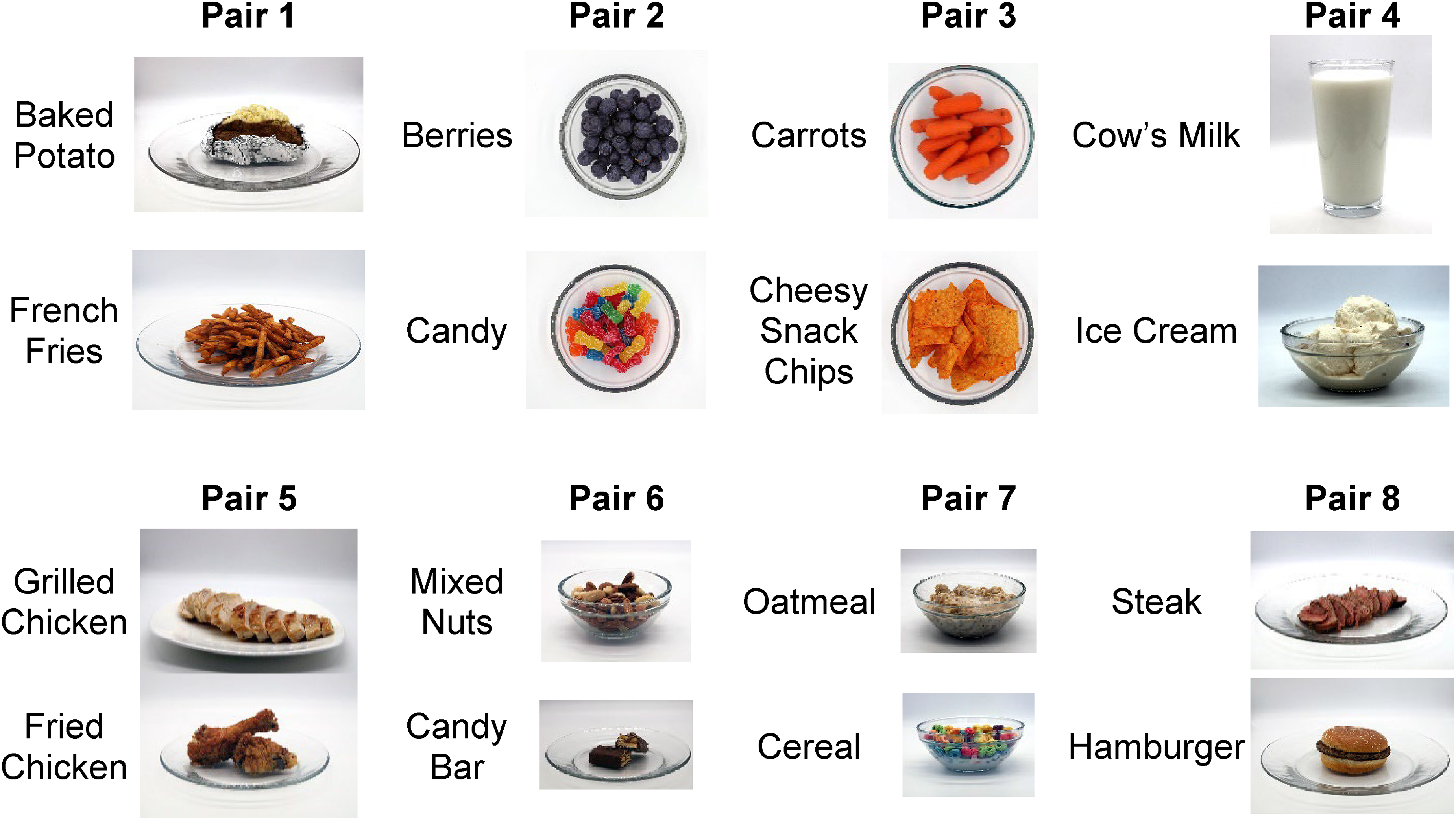
Stimuli developed to compare similar ultra-processed and non-ultra-processed foods.
Data collection
Participants completed a brief survey, the first page of which included an informed consent, with all participants having to indicate if they provided informed consent with a yes/no question to proceed. The survey included the 16 images of UPF and non-UPFs. Participants were instructed to rate each image on a scale from 0 to 10, 0 being “Completely Unhealthy” and 10 being “Completely Healthy” (higher scores = greater healthfulness). The adjective of “healthy” was selected to invite variability to determine if a general population would perceive the foods selected as different in terms of the extent to which they influence health, regardless of how that perception is formulated. While differences exist regarding what makes a food perceived as healthy (e.g., Bisogni et al., 2012), there is a general understanding that the adjective healthy relates to health promotion. Neutral descriptors were used to identify foods, avoiding adjectives that could influence evaluation (e.g., “fresh”). UPF and non-UPF images were presented sequentially and randomly. A total of five quality checks were included (e.g., “Paying attention and reading the questions is critical. If you are paying attention, please select ‘Silver’ below.”). Responses were omitted if >1 quality control question was failed. MTurk workers were compensated $1 for completion of the survey and passing quality checks, similar to other MTurk studies.
Statistical methods
Paired-samples sign tests were performed to detect differences across ratings of images within each pair given the non-normal distribution of the data set per visual inspection. Descriptive statistics were computed to examine trends across stimuli. The absolute value of the difference between images in each pair was computed to compare the magnitude of the difference in perceived healthfulness. All statistical tests were performed in SPSS Version 29.
Results
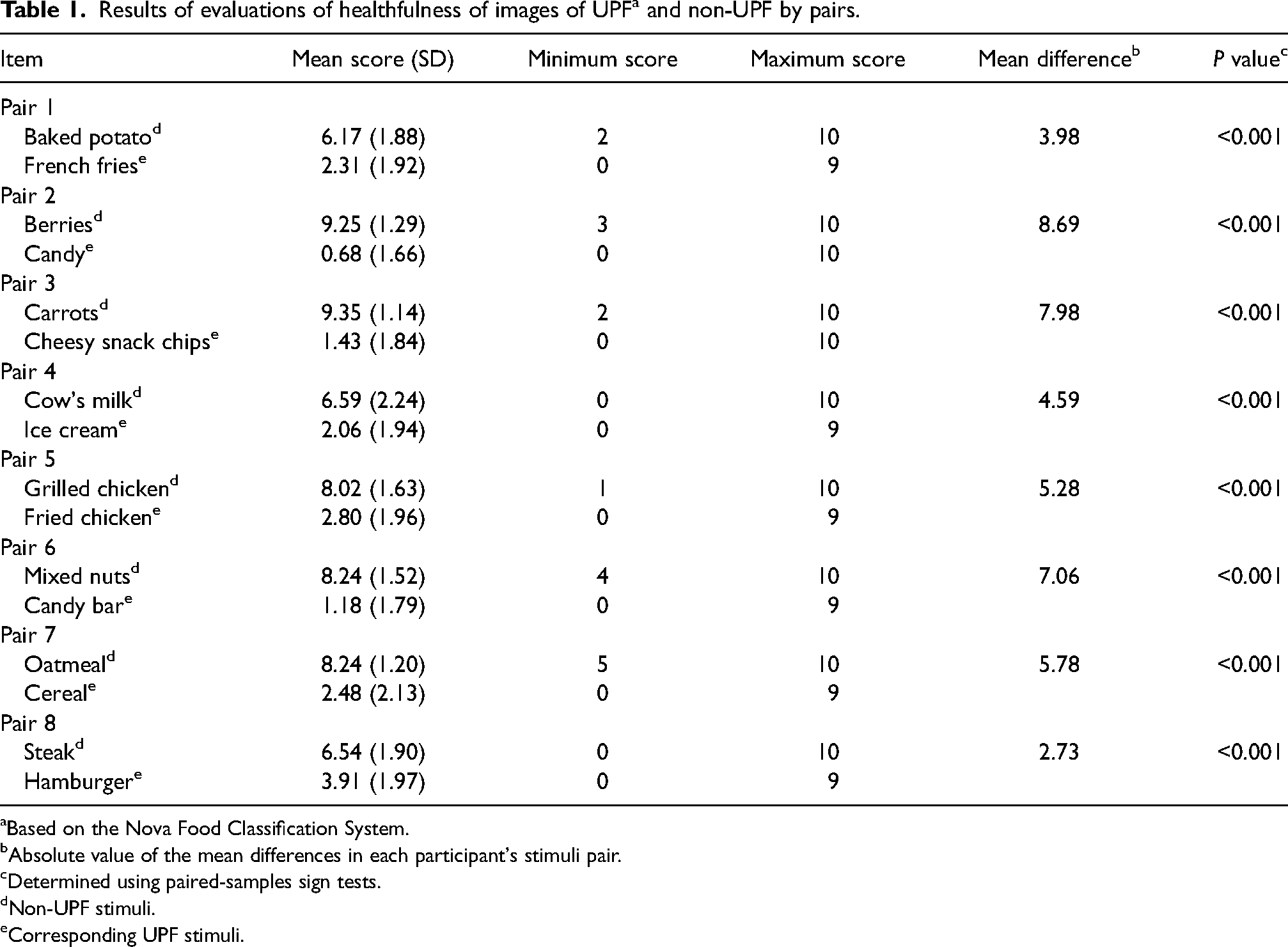
Significant differences in perceived healthfulness were found within each pair (Table 1, all P < 0.001). The lowest ranked (i.e., most “unhealthy”) food was candy, the highest was carrots. The lowest and highest ranked non-UPFs were potato and carrots, respectively, while the lowest and highest UPF were candy and hamburger. Berries, ice cream, grilled chicken, fried chicken, mixed nuts, candy bar, oatmeal, cereal, steak, and hamburger were all rated “Completely Unhealthy” at least once across all respondents. Similarly, baked potato, French fries, berries, candy, carrots, cheesy snack chips, cow's milk, ice cream, oatmeal, and steak were ranked as “Completely Healthy” at least once. The greatest difference in perception existed for berries versus candy, while the smallest difference for steak versus hamburger. This indicates there was wide agreement that fruit is “more healthy” than candy, but less agreement that steak was “more healthy” than a hamburger. The lowest ranked UPF was candy and highest ranked non-UPF was carrots.
Results of evaluations of healthfulness of images of UPF a and non-UPF by pairs.
aBased on the Nova Food Classification System.
bAbsolute value of the mean differences in each participant's stimuli pair.
cDetermined using paired-samples sign tests.
dNon-UPF stimuli.
eCorresponding UPF stimuli.
Discussion
This study indicates our UPF and non-UPF stimuli do discriminate between people's perception of healthfulness, and are suitable for use in cognitive tasks, including IATs. Previous literature has explored food-related stimuli for IATs, including “processed food” in the FoodPics database (Blechert et al., 2014; Lakritz et al., 2022), however stimuli representing UPF as defined by Nova have yet to be validated, including in comparison to non-UPF alternatives.
Significant differences were noted across food pairings. However, the magnitude of these differences varied. For example, the absolute difference between mean rankings of steak/hamburger was 2.73, versus for berries/candy, which was 8.69. This highlights the influence of broader culture and social factors (Lakritz et al., 2022). For example, excessive red meat consumption is associated with poor health (Shi et al., 2023) though does offer advantageous nutrient profiles (e.g., iron, vitamin B-12). This is opposed to candy, which offers little nutritive value. Similarly, rankings across foods suggest differences attributable to social/cultural influences. For example, fried chicken was ranked as high as 9 (10 = “completely healthy”) and candy as high as 10. These rankings suggest perceptions influenced by cultural relevance, preference, satisfaction, marketing/media, and/or availability. Similarly, individuals’ perceptions may be informed by flexible restraint (e.g., eating in moderation), acknowledging foods like candy as having a place in the diet based on satisfaction/pleasure. Previous work using food-related IATs has explored the relationship between perceptions and appraisals of this nature. Lakritz et al.'s IAT included evaluation of stimuli based on energy density and purity/morality, finding significant associations between the two (Lakritz et al., 2022). Energy density can vary in non-UPFs (e.g., avocado, steak), thus this novel evaluation presents new questions. Variability across numerous foods could influence results interpretation when employing stimuli in an IAT, however, these are common in nutrition-related research, where variability in perceptions exists. Results across foods may serve as an aggregate representation of all UPF versus non-UPF, though this should be explored by measuring and controlling for individual differences.
This study has numerous strengths, including developing stimuli specific to UPF. However, there are limitations. Given interest in validating ratings of the food images, we did not collect individual-level data about study respondents. Future work should include these measures to examine associations in future use of these stimuli and control for variables in analyses. We also validated a small set of UPF and non-UPF. There are a wide range of foods, but only a few can be included in cognitive tasks as proxies. This is not dissimilar to other tasks which also include only a few images of each target substance.
This study included evaluations of “healthfulness” to detect differences in food appraisal. While the underlying factor differentiating the stimuli in this study was processing, classification of foods per Nova is unlikely without education (Nazmi et al., 2019). Our intent was not to evaluate accuracy of UPF classification, rather to determine if UPF and non-UPF stimuli pairs could detect differences in appraisals of health-related attributes. In conclusion, the stimuli developed in this study are valid and able to be used to measure implicit response to UPF versus similar non-UPF.
Footnotes
Abbreviations
Acknowledgements
The authors would like to thank the participants who completed this study.
Authors contributions
Conceptualization, investigation, and methodology were done by AB, MS, AC; data curation, formal analysis, project administration, and writing—original draft were done by AB; funding acquisition was done by AB, AC; writing—review & editing: AB, MS, EG, AC
Availability of data and materials
Data available upon reasonable request.
Consent for publication
All authors approved the submission of the manuscript and consented to the publication of this manuscript.
Declaration of conflicting interests
The authors declared no potential conflicts of interest with respect to the research, authorship, and/or publication of this article.
Ethical statement
The study was conducted in accordance with the Declaration of Helsinki and approved by the Oklahoma State University Institutional Review Board on 06/02/2022. An approved informed consent document was included in the survey and completed by all participants involved in the study.
Funding
The authors disclosed receipt of the following financial support for the research, authorship, and/or publication of this article: This work was funded in part by the Oklahoma Tobacco Settlement Endowment Trust (TSET) (TSET R23-02) and the OU Health Stephenson Cancer Center via an NCI Cancer Center Support Grant (P30CA225520) and the Oklahoma State University Vice President for Research.
