







Abstract
In the present study, we examine the relationship among sovereign yields, temperature and precipitation using a large monthly panel data set, which consists of 20 eurozone members, over the period 1980M1–2023M4. To account for possible asymmetries along the distribution of the climate variables, we assume a quadratic modelling specification and apply various mean panel estimation techniques of heterogeneous coefficients. In the next step, to consider possible non-linearities in the distribution of the dependent variables (sovereign yields), we apply the quantile via moments methodology of Machado and Santos Silva, which accounts for possible cross-sectional dependence and slope heterogeneity. We contribute to the existing literature in two main ways. First, we apply a quantile methodology that provides a more in-depth analysis of the climate effects along the distribution of the sovereign yields, especially in the presence of non-normally distributed data. Second, we find that climate change, as proxied by higher temperatures or lower precipitation (drought), will increase the sovereign risk of all countries, but the magnitude of the impact will be higher for countries that are already characterised by higher sovereign risk levels and/or face extreme weather conditions (hotter countries and/or countries with low levels of precipitation).
Keywords
Introduction
While some may still find the impact of anthropogenic climate change irrelevant or insignificant, most recognise its effects, which are sadly becoming both more frequent and more intense. The effects of climate change are far reaching, but in many cases, because their impact may not always be immediate, they tend to be clouded by significant uncertainty. Economic activity and as such economic policy are certainly impacted by climate change in numerous ways. In this article, we explore how two climate-related variables, namely temperature and precipitation, can affect sovereign risk as measured by yields on sovereign bonds.
We contribute to the existing literature in two ways. First, we apply a quantile methodology, assuming a quadratic modelling specification, that accounts both for cross-sectional dependence and for slope heterogeneity. This method allows for a more in-depth analysis of the climate effects along the distribution of the sovereign yields, especially in the presence of non-normally distributed data. Second, we find evidence that climate change will increase the sovereign risk of all countries, but the magnitude of the impact will be higher for the countries that are already characterised by a higher sovereign risk level and/or face extreme weather conditions (hotter countries and/or countries with low levels of precipitation). The main findings of our research are as follows: First, we find strong evidence of a dual non-linear relationship between the variables under study. As a result, the mean panel estimators cannot fully identify the relationship between precipitation and sovereign yields due to limitations arising from their mean approach properties. Second, we find that the impact of temperature on sovereign yields increases in magnitude as the sovereign risk and/or the temperature rises. Additionally, the impact of precipitation on sovereign yields increases in magnitude as the sovereign risk rises and/or the precipitation decreases.
The rest of the article is organised as follows: in the second section, we discuss the relevant literature on the relationship between climate-related variables and sovereign risk. The third section describes the data and the statistical properties of the variables used, along with the econometric methodology. In the fourth section, we present and discuss the empirical results and several robustness checks. The fifth section concludes and discusses possible directions for future research.
Literature Review
The literature studying the impact of climate-related risk on the fiscal sector is relatively small but growing. There are two main lines of research and relevant hypotheses: (a) how climate and weather variables affect sovereign risk or sovereign default, and (b) how climate-related and weather events affect the fiscal budget. An alternative classification of the relevant literature could be in terms of transition and physical risks. Transition risks refer to those associated with adjusting to a low-carbon economy, while physical risks are those emanating from adverse weather events.
In one of the first papers focusing on the impact of extreme weather events on budget balances in a panel of countries, Lis and Nickel (2010) find that the change in the budget balance as a percentage of GDP following an extreme weather event is relatively modest at 0.23%. However, the impact increases up to 0.47% when they focus on the lower middle income economies in their sample of 138 countries in total. Moreover, they find that for warmer countries, which tend to be more vulnerable to extreme weather events, the fiscal impact is larger.
Melecky and Raddatz (2021) use a panel vector autoregression model to analyse the impact of three different types of disaster shocks on government expenditures, revenues and deficits. More specifically, using annual data from 1975 to 2008 on high- and middle-income countries, the authors find that the three types of disaster shocks, namely geological, climatic and other disasters, have a negative impact on both output and deficit levels by leading to higher expenditures and lower revenues. This effect is greater for the lower middle income countries of their sample. Interestingly, they also find that higher debt levels (associated with deficit deteriorations) signal better ability to borrow in capital markets rather than a constrained fiscal position.
Crifo et al. (2017) find that environment, social and governance (ESG) indicators are important in explaining sovereign credit risk. Specifically, using data on 23 OECD countries over the period from 2007 to 2012 and employing a panel IV methodology with country- and time-fixed effects, they show that a higher ESG rating has a negative effect on sovereign bond spreads. However, the effect of these extra-financial metrics, while significant, is not as important as credit ratings.
Kling et al. (2018) use a panel ordinary least squares model linking sovereign bonds yields to measures of climate vulnerability and social preparedness, while controlling for standard macroeconomic variables. Using data for countries on the V 20 group of climate vulnerable countries, the authors find evidence of a significant positive impact of climate vulnerability measures, such as dependency on natural capital or water dependency, on sovereign borrowing costs. Social preparedness, on the other hand, is associated with a negative impact on sovereign yields. Additionally, using a logistic model, they find evidence of a negative correlation between climate vulnerability and access to capital markets. Bachner and Bednar-Friedl (2019) develop a computable general equilibrium model for Austria to analyse the impact of climate change on public budgets. The authors consider three climate scenarios with a model base year of 2008 and trace the impact in 10 sectors of the economy for a 2°C increase in temperature by 2050. They show that the overall effect of climate change on GDP, welfare and budgets is negative.
One of the first papers to study the effect of climate change on sovereign credit ratings is that of Cevik and Jalles (2020). Using a sample of 67 advanced and lower middle income economies over the period from 1995 to 2017 and three estimation methodologies (OLS, binary-choice model and 2SLS with instrumental variables), they examine the relationship between climate vulnerability and climate resilience on credit ratings, controlling for standard macroeconomic and fiscal variables. Their results based on the whole sample indicate that on average a 1% increase in climate vulnerability leads to a 0.23% drop in credit worthiness, while an increase of 1% in climate resilience leads to a 0.09% drop in credit rating. Beirne et al. (2021a) study the effects of climate-related risks on the pricing of sovereign bonds in a panel of 40 advanced and emerging economies using quarterly data from 2002 to 2008. Their findings indicate that both the immediate impact of climate risks (climate vulnerability) and resilience to climate risk have an important effect on the cost of foreign borrowing. They find the former to be more important than the latter. This affects disproportionally emerging economies, many of which are more vulnerable to climate risks and may thus face a double challenge.
Focusing on six Southeast Asian economies which are more prone to climate stress, Beirne et al. (2021b) estimate the links between climate vulnerability and resilience and sovereign bond yields. They use monthly data over the period from 2002 to 2018 and take two estimation approaches: country-specific OLS regressions and a fixed-effects panel model. Both approaches lead to the same main conclusion, namely that climate vulnerability has a significant positive impact on sovereign bond yields, while climate resilience has a negative but smaller effect. Reinforcing the results of their previous work stated above, the authors also point out how a vicious cycle can manifest in countries that face a higher climate risk. Higher sovereign yields increase the cost of borrowing needed to finance adaptation and resilience investment and a worsening of public finances.
A slightly different in focus but still related work is developed by Kling et al. (2021), who focus on the impact of climate vulnerability on the cost of debt and equity financing for private firms, as well as access to capital. The authors develop panel regression and structural equation models with firm-level data on 15,265 firms in 71 countries over the period from 1997 to 2017 and different measures of climate vulnerability based on the ND-GAIN index. They find that while climate vulnerability increases the cost of debt, the effect is insignificant for the cost of equity. The effect of the former also has an indirect effect through a negative impact on access to financing. Kizys et al. (2021) further provide evidence of a positive relationship between temperature and sovereign bond yields. Using daily observations on 31 countries over the period from 1980 to 2020 and different maturities, the authors use panel regressions and find that on average a 10°F increase in temperature leads to a 0.22–0.85 basis point increase in yields. Moreover, they also provide evidence of a non-linear, and more specifically quadratic, relationship between temperatures and bond returns.
Semet et al. (2021) examine the relationship between sovereign bond spreads and ESG indicators. The authors identify 21 ESG metrics from a long list of relevant variables as the ones having the greatest impact on sovereign bond spreads. Their analysis covers the period from 2015 to 2020 and is based on 67 countries. Their results indicate that the environmental pillar is the most important one, followed by the governance and lastly the social pillar when looking at the whole sample.
Boehm (2022) constructs a measure of temperature anomalies, that is, deviations from average temperatures, using monthly data on 54 emerging economies over the period from 1994 to 2018. He then examines the relationship between sovereign creditworthiness and temperature anomalies and precipitation. His findings, using OLS panel regressions, indicate that higher temperature anomalies lead to increases in sovereign risk in countries that are either warmer and/or lag with respect to different measures on institutional development. Finally, the author highlights the importance of a recurring pattern, namely that countries such as the ones in this sample (i.e., emerging economies) stand to experience more negative impacts of climate change (proxied by increases in temperature anomalies in this article), even though they have not contributed the same to global CO2 emissions as more advanced economies.
Building on their previous work (Cevik & Jalles, 2020), Cevik and Jalles (2022a) use a sample of 98 advanced and lower middle income countries over the period from 1997 to 2017 to re-examine the relationship between sovereign bond yields and spreads and the ND-GAIN measures of climate vulnerability and resilience. The authors confirm their previous findings showing climate vulnerability as having a positive impact on both yields and spreads, whereas climate resilience has a negative one. Once again, this study also finds that the effects are greater in lower middle income countries.
Cevik and Jalles (2022b) are perhaps the first to examine the relationship between climate change and sovereign defaults. The authors use a panel of 116 countries over the period from 1995 to 2017 and estimate the probability of sovereign default based on a function of climate vulnerability and resilience. Using a logit model in their baseline specification, they provide evidence of a strong positive impact of climate vulnerability on the probability of default, while climate resilience has a negative one. As in most previous studies, this one also finds evidence of differences among high- and low-income counties, with the impact of the latter group being greater.
Assab (2023) studies how the urban heat island (UHI) effect and the urban forest cover can affect sovereign yields. The UHI effect refers to the higher land temperatures in urban areas as opposed to rural ones, as a result of human activity. The analysis is done for 68 countries over the period from 2008 to 2020. The author provides evidence of a negative impact of UHI on sovereign yields, which can be mitigated by the positive impact of urban forest. Moreover, the positive impact of urban forest cover is greater in countries with higher fiscal decentralisation. The latter implies the importance of local policies when it comes to adaptation strategies. The impact of the UHI effect as well as of the urban forest cover deems more attention from researchers and should be further explored.
Cheng et al. (2023) centre their analysis on transition risks and examine whether these are reflected into the pricing of sovereign bond yields, as well as whether policies that address these risks can have a mitigating effect on sovereign bond pricing. The authors estimate a panel model with country- and time-fixed effects where sovereign yields are a function of a constructed measure of transition risks and a set of macroeconomic and fiscal control variables. Their results, based on a sample of 25 countries during the period from 1995 to 2018, indicate that there is a positive relationship between transition risks and sovereign bond yields, while policies aimed to address such risks can have a negative effect.
Along the same lines, Collander et al. (2023) also focus on transition risks and how these impact sovereign yields and spreads. Their sample includes 39 countries over the period from 1999 to 2021. The authors break down transition risks into three main components: CO2 emissions, natural resource rents and renewable energy consumption. These together with a set of macroeconomic control variables are used to explain sovereign yields and spreads in a panel setting over not only the entire sample but also in two country groups (advanced and lower middle income economies). Their results show a positive relationship between CO2 emissions and borrowing costs in both country groups. The impact of natural resource rents and renewable energy consumption is, however, different among the two groups. While lower natural resource rents are associated with lower borrowing costs in advanced economies, the relationship is reversed for developing ones. As for renewable energy consumption, the link is indirect for advanced economies but again reverses for developing ones.
Klusak et al. (2023) use machine learning to simulate the impact of climate change, as proxied by rising temperatures due to higher CO2 emissions, to sovereign credit ratings. Their analysis, based on 109 countries, results in sovereign credit ratings that internalise the impact of climate change. These climate- adjusted ratings lead to substantial credit downgrades as early as 2030. However, if countries follow the Paris Climate Agreement and commit to following policies consistent with the 2˚C target of temperature increases, the impact can be substantially reduced and even eliminated. The authors also quantify the monetary impact of downgrades driven by climate change for both sovereign and corporate debts. Under a scenario consistent with stricter climate policies, the additional borrowing cost for sovereign debt is estimated to be from US$45b to $64b, whereas it rises to US$105b–203b under a ‘business as usual’ scenario. Similarly, for corporate debt, the above ranges are US$10b–17b and US$35b–61b under the two scenarios. As the authors point out, the model should be extended to include political instability due to climate change, transition and litigation risks.
An interesting question examined in Saxena and Singh (2023) is whether markets reward countries whose governments participate in climate agreements. To answer this, the authors examine the relationship between sovereign yields before and after participation in climate agreements using a difference-in-differences approach. Focusing on the Kyoto Protocol and the Paris Agreement, they find that investors indeed favour governments that participated in these agreements, with the effect being stronger in the case of the Kyoto Protocol. The role of incentives, which may be the reason why these effects are different, is an open question which the authors emphasise.
Sun et al. (2023) revisit the relationship between climate risks and sovereign ratings. The authors employ a generalised logit ordered model with climate vulnerability and readiness as the two main explanatory variables, together with standard macroeconomic variables shown to affect sovereign ratings. In addition, a random forest model is used to compare the importance of the two climate variables relative to the other indicators. In line with previous studies, their results show that climate vulnerability has a significant negative effect on sovereign ratings, while climate readiness, a positive one. Both impacts are found to be higher for lower middle income and high-damage countries.
Overall, the above literature review revealed that there is a strong link between sovereign risk and climate variables. Different authors have used different proxies for sovereign risk (e.g., yields on sovereign bonds, sovereign ratings) and several ways to proxy for climate change (e.g., rising temperatures, composite measures of resilience/vulnerability). The findings are fairly consistent across studies: the impact of climate-related variables on sovereign risk is positive, but there are important differences among different economies such as developed versus developing. Therefore, we conclude that there is research space for further examining the possible uneven impact of climate-related variables on sovereign risk by using an econometric approach that allows us to focus on non-linearities and to examine whether the relationship changes at percentiles other than the median (tail-dependence).
Data Statistical Properties and Econometric Methodology
Data Sources and Statistical Properties of Variables
In our empirical investigation, we use a panel quantile framework to examine the effects of temperature (temp) and precipitation (precip) on sovereign yields (yield). Our sample includes 20 eurozone members over the period 1980M1–2023M4. Table 1 reports the notation of each variable as well as the corresponding source and link.
Variables and Sources of Variables.
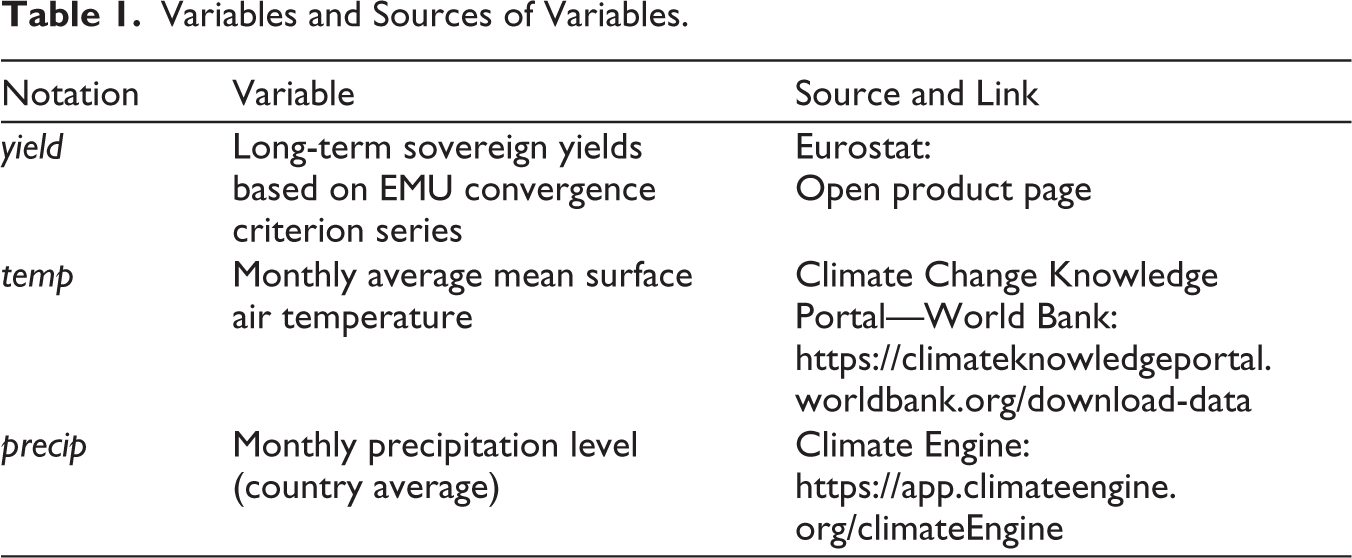
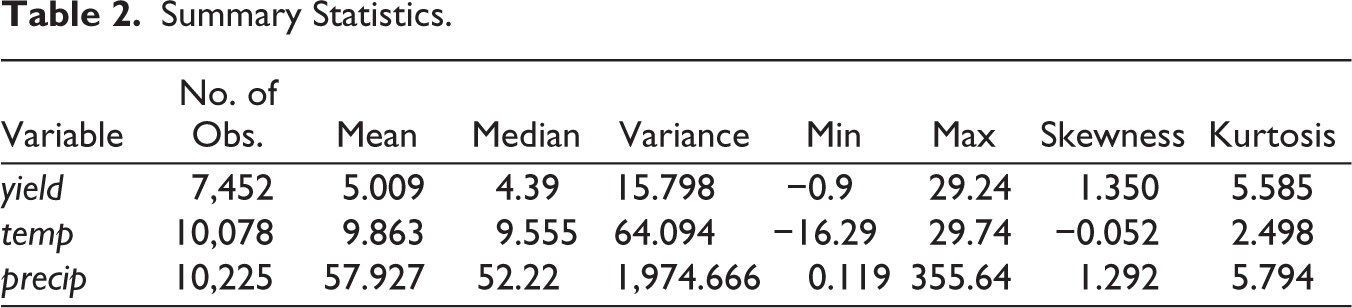
Table 2 presents the summary statistics for the variables. Skewness is a measure of symmetry of the probability distribution of a variable about its mean, while kurtosis is a measure of tail heaviness of the distribution, measuring the weight of the tails relative to the rest of the distribution. Our data reveal that, with respect to skewness, the yields and precip series are highly positively skewed, while the temp series is symmetric. Further, considering kurtosis, the yields and precip series are leptokurtic, while the temp series is mesokurtic. Overall, we conclude that the yields and precip series exhibit characteristics of a non-normal distribution, while the temp series is consistent with a normal distribution. Therefore, given the signs of non-linearities, we need to apply econometric techniques that depart form the standard Gaussian assumptions.
Summary Statistics.
Econometric Methodology
The previous data analysis revealed the existence of possible asymmetric features in the panel, which indicates the need for applying econometric techniques that allows us to examine the temperature and precipitation effects across the distribution of the sovereign yields. Specifically, we need to distinguish among climate effects on different quantiles of the distribution of the dependent variable. Given that sovereign yields indicate the level of risk of each economy, we will distinguish among climate effects on low-risk economies (lower quantiles of the dependent variable), normal-risk economies (middle quantiles) and high-risk economies (upper quantiles).
Our econometric methodology consists of the following steps: First, to examine the order of integration of our variables, we conduct various panel unit-root tests, namely Phillips–Perron and Dickey–Fuller–Fisher type tests (Choi, 2001), Im–Pesaran–Shin (2003) test and Pesaran (2007) test. The latter will lead us to the decision concerning the formulation of our modelling specification. Second, we apply cross-sectional independence (Pesaran, 2004; Pesaran & Xie, 2021) tests and the slope homogeneity test of Pesaran and Yamagata (2008) in order to choose the proper econometric methodology. Third, considering the indications of the previous two steps, together with the data analysis, we apply various mean panel estimation techniques of heterogeneous coefficients in large panels, allowing for dependence between cross-sectional units. More specifically, we consider the OLS location and scale estimator, the cross-sectional autoregressive distributed lag (CS-ARDL) estimator (Chudik et al., 2016), the mean–group (MG) estimator (Pesaran & Smith, 1995) and the dynamic common-correlated effects (DCCE) estimator (Chudik & Pesaran, 2015). Fourth, to consider possible non-linearities and account for differences in the impact of the climate variables along different levels of sovereign risk, we apply the quantile via moments methodology of Machado and Santos Silva (2019), by developing a location-scale model of the following form:

where Pr{δi + Z 'itγ > 0} = 1 and (αi, δi), i = 1, …, n, capture the individual i fixed effects and Z is the vector of known differentiable transformations of X. The sequence {Xit} is strictly exogenous, i.i.d. for any fixed i and independent across i, and denotes a vector of the independent variables, namely temp, temp_sq for the temperature specification model and precip, precip_sq for the precipitation specification model. Uit are i.i.d., statistically independent of Xit and normalised to satisfy that E(U) = 0 and E(|U|) = 1. Given the above assumptions, Equation (1) gives that the following:

In Equation (2), the quantile τ fixed effect for individual i is given by the coefficient αi(τ) ≡ αi + δiq(τ) and can be estimated as follows:

where R denotes the estimated residuals
The main advantages of the above methodology are the following: First, quantile regression analysis provides a more comprehensive description of the conditional distribution than the ordinary mean approach and it is a more robust econometric technique in the presence of conditional heterogeneity and departures from the Gaussian conditions. Second, the quantile via moments methodology accounts for possible cross-sectional dependence and slope heterogeneity. Finally, the main advantage of this methodology is that it allows the use of methods that are valid in the estimation of conditional means, while still providing information on how the regressors affect the entire conditional distribution (Machado & Santos Silva, 2019).
Empirical Analysis and Discussion
We frame our empirical analysis as follows: Initially, we present our preliminary findings, which include unit-root tests, cross-sectional independence and slope homogeneity tests. We then proceed to apply various panel mean regression estimators, and finally, we focus on our main analysis, employing the quantile via moments econometric methodology. The above structure allows us to derive a clear picture with respect to the development of the modelling specification that better fits the climate impact of sovereign risk, as well as to explore all possible asymmetries.
Preliminary Results
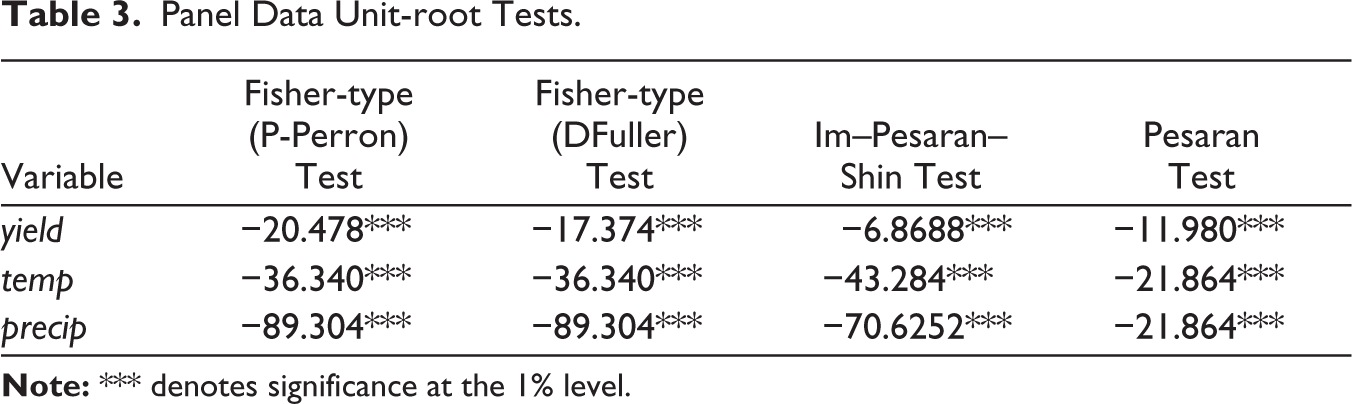
The results of our unit-root tests are presented in Table 3. The null hypothesis in these tests is that the panels include a unit root (non-stationary data). Fisher-type tests, in the form of both Phillips–Perron and Dickey–Fuller–Fisher, as developed by Choi (2001), test for panel data unit roots from a meta-analysis perspective; that is, they conduct unit-root tests for each panel individually and then combine the p values from these tests to produce an overall test. To mitigate the impact of possible cross-sectional dependence, we follow Levin et al.’s (2002) procedure, which, for each time period, computes the mean of the series across panels and subtracts this mean from the series. Next, we apply the Im et al. (2003) test to account for the possibility that our panel data set does not share a common autoregressive parameter. Finally, to check the robustness of our previous findings, we use the Pesaran (2007) unit-root test. In all cases, our results indicate a rejection of the null hypothesis of non-stationarity.
Panel Data Unit-root Tests.
At the next step, we procced with the cross-sectional independence tests, to examine the null hypothesis that the error terms are characterised by independence across different cross-sectional units. According to Philips and Sul (2003), Chudik and Pesaran (2013) and Pesaran (2016), ignoring cross-sectional dependence of errors leads to serious limitations in the estimation efficiency. Moreover, the empirical experience shows that cross-sectional dependence in economics is usually the rule rather than the exception. Further, as mentioned by De Hoyos and Sarafidis (2006), cross-sectional dependence may be caused by the presence of common shocks and unobserved components incorporated in the error term. Subsequently, to account for possible common shocks with a heterogeneous impact across countries and/or for local spillover effects between countries (Eberhardt & Teal, 2011), we choose to apply the Pesaran (2004) CD test, which assumes cross-sectional independence as the null hypothesis. We apply the test for the variables, the temperature model and the precipitation model. Our results, reported in the second column of Table 4, show that the null hypothesis of cross-sectional independence is rejected. Further, to examine whether the cross-sectional dependence is weak, we apply the bias-corrected CD* test from Pesaran and Xie (2021). The alternative hypothesis in this test is that cross-sectional dependence is strong. Our results, reported in the third column of Table 4, indicate that we reject the null hypothesis; that is, our cross-sectional dependence is strong.
Next, we test for slope homogeneity. In case a model consists of heterogeneous slopes, imposing slope homogeneity yields inconsistent and biased results. We perform a test that is a standardised version of Swamy’s (1970) test for slope homogeneity presented by Pesaran and Yamagata (2008). A main advantage of the test is that it can be used for both balanced and unbalanced panels. The null hypothesis of the model assumes slope homogeneity across cross-sectional units; that is, the slope coefficients are identical. It should be noted that we use the specification of the heteroskedasticity and autocorrelation consistent (HAC) test statistic of Blomquist and Westerlund (2013), and in addition, following Andrews and Monahan (1992), we also perform pre-whitening to reduce sample bias in the HAC estimation. Our results, reported in the fourth column of Table 4, show that, in all cases, the null hypothesis of slope homogeneity is rejected.
Cross-sectional Independence Test and Slope Homogeneity Test.
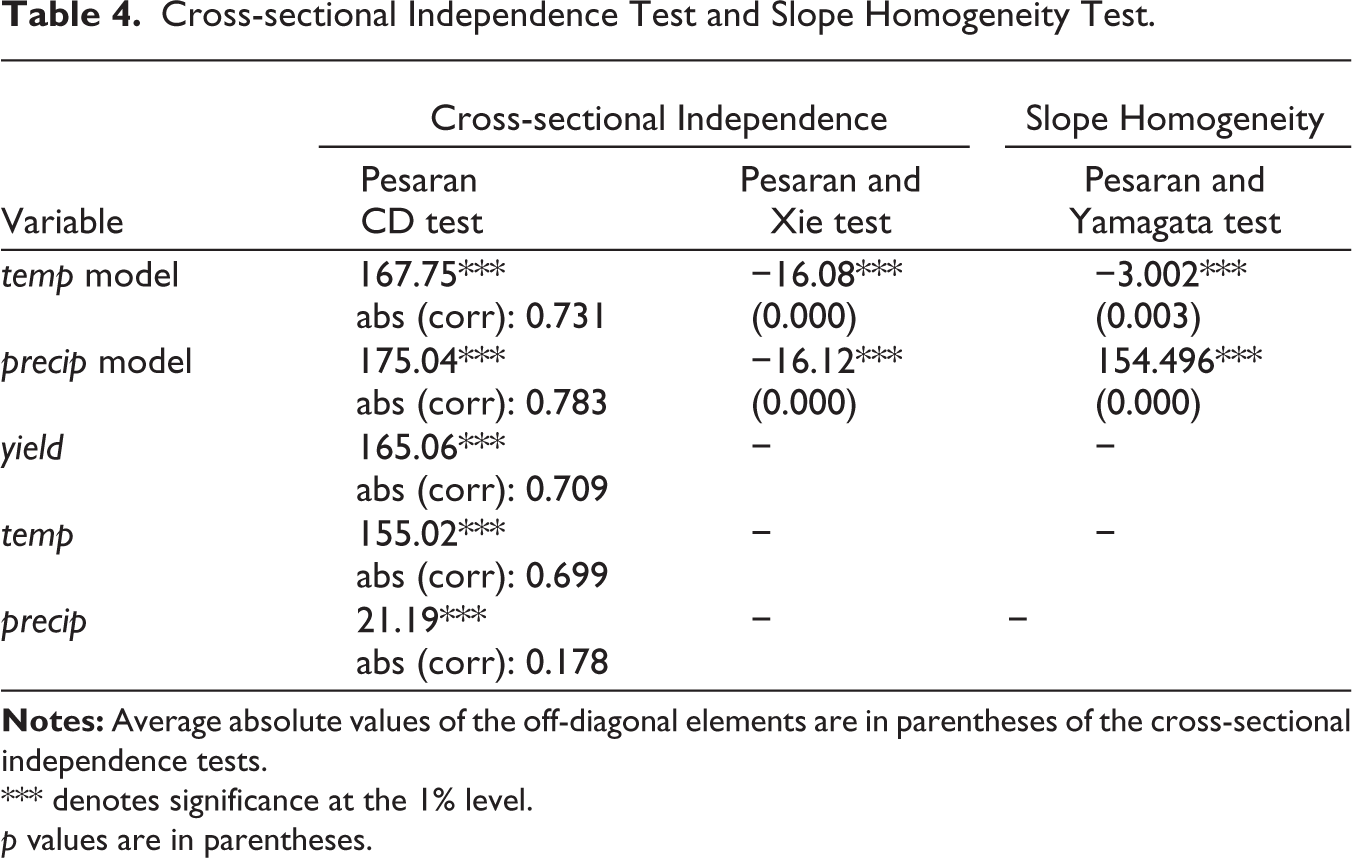
*** denotes significance at the 1% level.
p values are in parentheses.
Main Results: Mean and Quantile via Moments Analysis
The non-linear features of our data suggest that we should choose a modelling specification able to consider the effects of climate variables on the sovereign yields, allowing for differences in magnitude (e.g., extremely high temperatures or low precipitation/drought). In addition, the specification should account for an in-depth analysis of the climate effects on the entire distribution of the sovereign yields. Moreover, the results of the cross-sectional independence tests, as well as the slope homogeneity test, point to the need to choose an econometric technique consistent with strong dependence in the error terms and slope heterogeneity. To account for the above issues, we choose a quadratic modelling specification and apply various panel econometric techniques that focus on the entire distribution of the dependent variable and are also sensitive to short- and long-run effects.
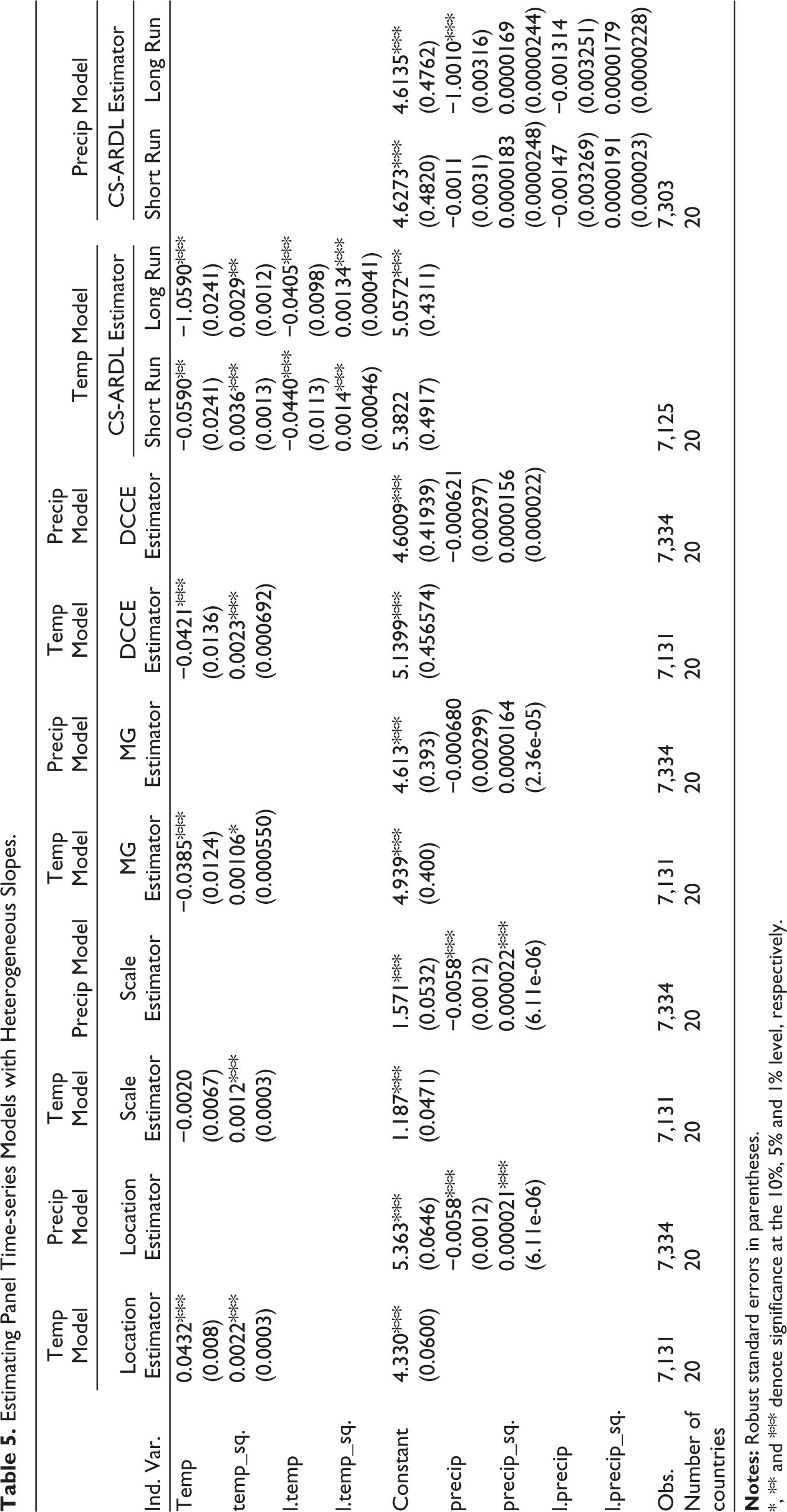
Table 5 presents the estimation results of various mean panel time-series models with heterogenous slopes, for both the temperature and the precipitation model. Columns 2–5 report the results of the location and scale estimators (OLS) as mentioned in Machado and Santos Silva (2019). The statistically significant coefficients on tempsq of 0.0022 for the location estimator and 0.0012 for the scale estimator, as well as on precipsq of 0.000021 for the location and 0.000022 for the scale estimators from the quadratic econometric models, indicate their convexity. More specifically, the impact of the climate variables becomes negative at extreme negative values of temperature and precipitation and positive at extreme positive values. However, it should also be noted that the magnitude of the impact of precipitation is low. Next, we apply the mean–group (MG) estimator (Pesaran & Smith, 1995) that accounts for heterogeneous slopes (Columns 6 and 7). In this case, we observe that the impact of tempsq (0.00106) is positive and statistically significant, while the impact of precipsq (0.0000164) is insignificant. The same holds when it comes to the DCCE estimator (Chudik & Pesaran, 2015), which accounts for the endogeneity that occurs when a lag of the dependent variable is added to the model specification. Specifically, we observe (Columns 8 and 9) that the impact of tempsq (0.0023) is statistically significant, while the impact of precipsq (0.0000156) is not. Finally, Columns 9 and 10 report the results of the cross-sectional autoregressive distributed lag (CS-ARDL) estimator (Chudik et al., 2016). A main advantage of the CS-ARDL estimator is that it distinguishes between long- and short-run effects. According to our estimations, the coefficients on tempsq are positive and statistically significant in both the short (0.0036) and long (0.0029) runs, while the coefficients on the precipsq, for both the short and long runs, are statistically insignificant. Overall, the mean panel time-series estimations reveal that the impact of temperature on sovereign yields is quadratic and specifically of convex shape, while the results concerning the impact of precipitation are mixed.
Estimating Panel Time-series Models with Heterogeneous Slopes.
*, ** and *** denote significance at the 10%, 5% and 1% level, respectively.
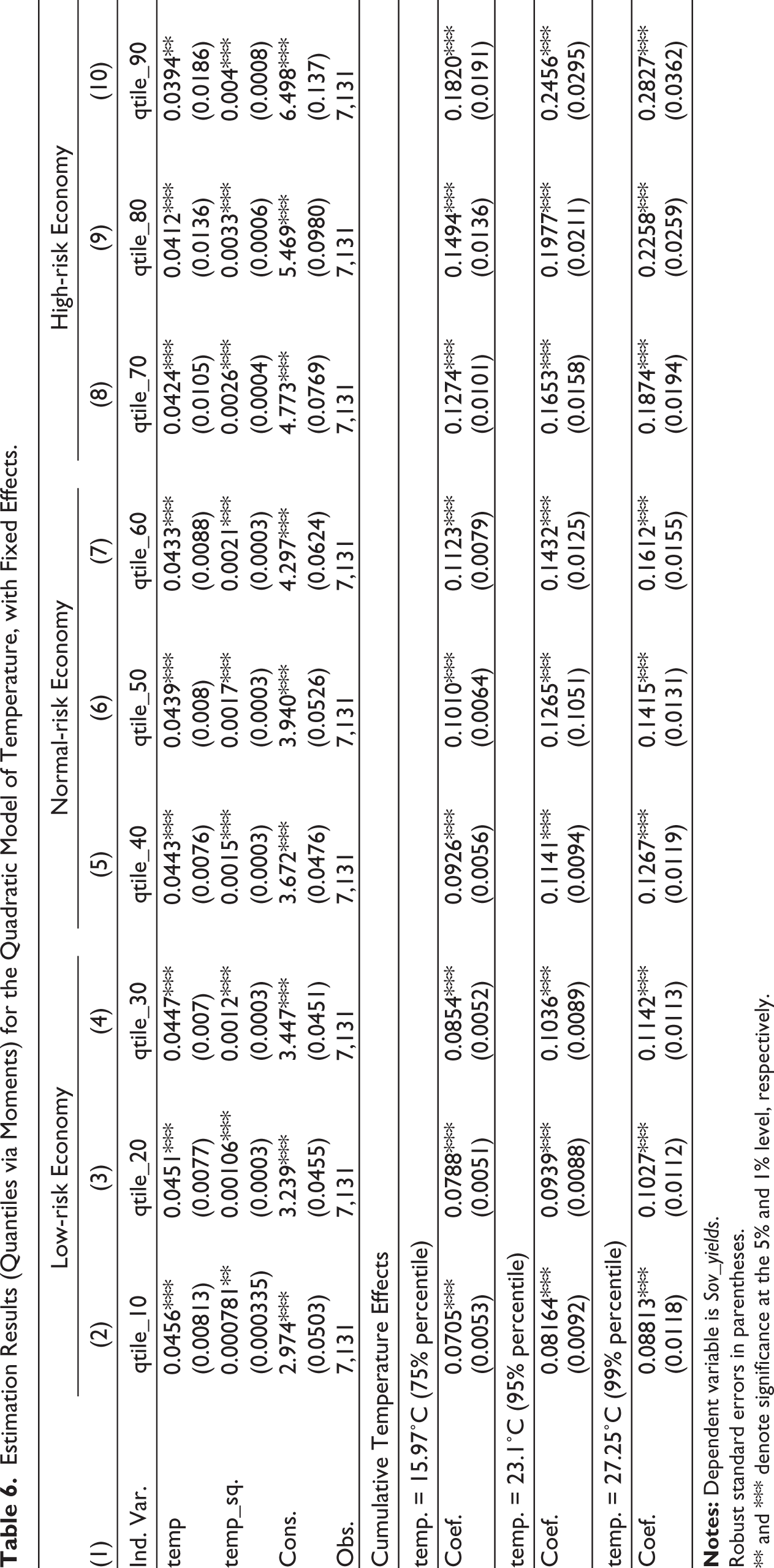
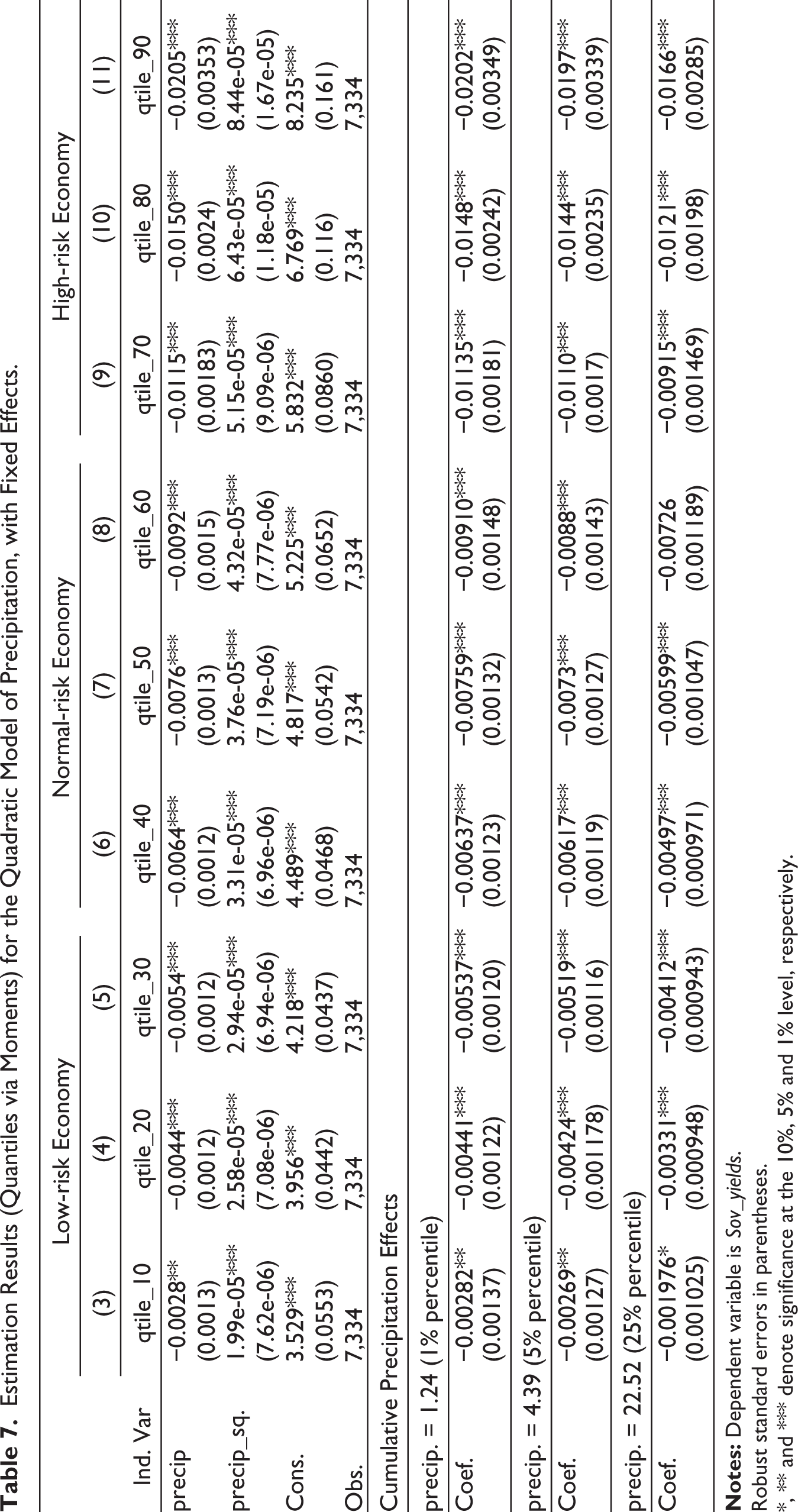
Even though the analysis so far has assumed a quadratic impact of the climate variables, it has not considered possible asymmetries along the distribution of the dependent variable. Therefore, as a next step, we apply the quantile via moments methodology of Machado and Santos Silva (2019), with fixed effects, that additionally accounts for both cross-sectional dependence and conditional heterogeneity. Tables 6 and 7 present the estimation results of the pairwise relationships of tempsq and precipsq with sovereign yields, respectively. Following Lolos et al. (2021), we categorise the quantiles of sovereign yields into three regimes, namely a low-risk economy (τ = (0.10,0.20,0.30)), a normal-risk economy (τ = (0.40,0.50,0.60)) and a high-risk economy (τ = (0.70,0.80,0.90). Further, as before, we use a quadratic specification to account for the impact of the climate variables (tempsq, precipsq) on sovereign yields. Therefore, the quantile via moments methodology combined with the quadratic specification accounts for dual non-linearities: first, by considering non-linearities caused by the variation in the dependent variable (quantile method) and, second, by considering non-linearities caused by the variation of the independent variable (quadratic specification). Consequently, in line with Kiley (2021), to calculate the combined coefficients of temperature and precipitation, we use various thresholds corresponding to extreme conditions.
Estimation Results (Quantiles via Moments) for the Quadratic Model of Temperature, with Fixed Effects.
Robust standard errors in parentheses.
** and *** denote significance at the 5% and 1% level, respectively.
Estimation Results (Quantiles via Moments) for the Quadratic Model of Precipitation, with Fixed Effects.
Robust standard errors in parentheses.
*, ** and *** denote significance at the 10%, 5% and 1% level, respectively.
Specifically, for the pairwise relationship between temperature and sovereign yields (Table 6), we choose as thresholds the 75th (15.97ºC), 95th (23.1ºC) and 99th (27.25ºC) percentiles. The choice of these percentiles shows that we are interested in focusing on the impact of high temperatures on sovereign yields, as climate change is expected to increase average temperatures. We observe that for higher levels of temperature, the effect on sovereign risk is positive, as excepted by the convexity of our quadratic model specification. Additionally, the impact increases as we move from the lower quantiles (low-risk economy) towards the upper quantiles (high-risk economy). The same pattern is repeated for all three selected percentiles. Specifically, for the 75th percentile, the impact of temperature at the lowest bound (extreme low-risk economy) is 0.0705 and after a gradual consistent increase reaches the upper bound (extreme high-risk economy), which is equal to 0.1820. The corresponding lower bound for the 95th percentile is 0.08164, while the upper bound is 0.2456. Finally, for the 99th percentile, the lower bound is 0.08813, while the upper bound is 0.2827.
When it comes to the pairwise relationship between precipitation and sovereign yields (Table 7), we choose as thresholds the 25th (22.52ºC), 5th (4.39ºC) and 1st (1.24ºC) percentiles. The choice of these percentiles shows that we are focusing on the impact of low precipitation levels (drought) on sovereign yields, as climate change is expected to decrease the frequency of precipitations. We observe that for lower levels of precipitation, the effect on sovereign risk is negative, as excepted by the convexity of our quadratic model specification. Additionally, the impact increases as we move from the lower quantiles (low-risk economy) towards the upper quantiles (high-risk economy). The same path is repeated for all three selected percentiles. Specifically, for the 25th percentile, the impact of precipitation at the lowest bound (extreme low-risk economy) is −0.001976, and after a gradual consistent increase, in absolute terms, it reaches the upper bound (extreme high-risk economy), which is equal to −0.0166. The corresponding lower bound for the 5th percentile is −0.00269, while the upper bound is −0.0197. Finally, for the 1st percentile, the lower bound is −0.00282, while the upper bound is −0.0202. It should be noted that the impact of precipitation, according to the quantile approach, is found to be statistically significant, in contrast to the findings of the mean panel estimators, where the results were mixed. The latter finding is mainly because the quantile via moments estimator can consider non-linear features along the distribution of the sovereign yield and therefore is not limited to the mean. Moreover, the estimator accounts for both strong dependence in the error terms and slope heterogeneity.
According to the above findings, the impact of temperature on sovereign yields increases in magnitude as: (a) the sovereign risk rises and (b) the temperature rises. Further, when it comes to the impact of precipitation on sovereign yields, it increases in magnitude as: (a) the sovereign risk rises and (b) the precipitation decreases. These findings have the following important policy implications— climate change, in the sense of an increase in the temperature: (a) will increase the sovereign risk of all countries, but the magnitude of the impact will be higher for the countries that are characterised by a higher sovereign risk level, and (b) will increase the sovereign risk of the hotter countries. In addition, climate change, in the sense of a decrease in precipitation: (a) will increase the sovereign risk of all countries, but the magnitude of the impact will be higher for the countries that are characterised by a higher sovereign risk level, and (b) will increase the sovereign risk of the countries that already face drought issues. Our findings are in line with Cevik and Jalles (2020), Beirne et al. (2021a), Cevik and Jalles (2022a, 2022b) and Assab (2023), who show that the impact of extreme weather conditions is more pronounced in more vulnerable economies, where the vulnerability takes different forms. However, to the best of our knowledge, the impact of extreme weather conditions along the distribution of the sovereign yields and assuming a quadratic modelling specification has not been examined before.
Conclusion
In this study, we examine the relationship among sovereign yield, temperature and precipitation using a large monthly panel data set, which consists of 20 eurozone members, over the period 1980M1–2023M4. To account for possible asymmetries along the distribution of the independent variables, we assume a quadratic modelling specification and apply various mean panel estimation techniques.
We contribute to the existing literature in two ways. First, we apply a quantile methodology, assuming a quadratic modelling specification, that accounts for both cross-sectional dependence and slope heterogeneity. This method allows for a more in-depth analysis of the climate effects along the distribution of the sovereign yields, especially in the presence of non-normally distributed data. Second, we find that climate change will increase the sovereign risk of all countries, but the magnitude of the impact will be higher for the countries that are already characterised by a higher sovereign risk level and/or face extreme weather conditions (hotter countries and/or countries with low levels of precipitation).
The main findings of our research are the following: First, we find strong evidence of a dual non-linear relationship between the variables under study. Specifically, the impact of temperature and precipitation on sovereign yields varies because of non-linearities caused by the variation in the dependent variable (quantile method) and by non-linearities caused due to the variation of the independent variable (quadratic specification). The mean estimators cannot identify the quadratic relationship between precipitation and sovereign yields due to limitations arising from their mean approach properties. Second, we find that the impact of temperature on sovereign yields increases in magnitude as the sovereign risk rises and/or as the temperature rises. Additionally, the impact of precipitation on sovereign yields increases in magnitude as the sovereign risk rises and/or the precipitation decreases.
The above findings have important policy implications as they indicate that climate change is expected to affect more severely countries that already face high economic risks and are characterised by extreme weather conditions (higher temperatures, droughts). This highlights the uneven impact of environmental variables on economic ones. More work needs to be done on this front and will guide our future research.
Footnotes
Declaration of Conflicting Interests
The authors declared no potential conflicts of interest with respect to the research, authorship and/or publication of this article.
Funding
The authors received no financial support for the research, authorship and/or publication of this article.