







Abstract
This qualitative research study explores prisoner and rehabilitation staff perspectives (N=26) on the phenomenon of ‘change’ as a mode of enforced performance in a work release programme in Illinois. Research questions were developed on the basis of a prolonged encounter with re-entering ex-offenders during a project that combined theatre and research. Bringing together two distinct disciplines – Performance Studies and Critical Social Policy – we explore the extent to which re-entering prisoners and rehabilitation staff conceive of their work release programme as enforcing a performance of change into a rehabilitated self. Our results show that all participants feel that the programme enforces such a performance. However, some saw this performance as truly transformative, while others considered it politically oppressive and instrumental. Language performance in particular was considered a strictly imposed demand on prisoners, mostly black, who were advised not to use Ebonics outside of the facility. Implications for policy are outlined.
Initially it is about wearing a mask, but eventually the mask can become your new reality. It can become your new face.
1
Introduction
The dominance of mainstream white culture in American society (Leonardo, 2004) has often been described with regards to the subjugation of minority identities and the devaluation of cultures that are not ‘white’ (Blauner, 2001). In this context, scholars have addressed how marginalised groups adapt to oppressive social and political structures often by altering their behaviour to align with socially-enforced, hegemonic norms, thereby undermining their own cultural heritage (Coates, 2015).
In this context, re-entry programmes provide a unique example of an apparatus that enforces structured behavioural change on targeted minorities. This article explores these topics through a study conducted with a work release programme for male prisoners in Illinois (Institution X 2 ). The study attempts to determine the extent to which re-entry programmes offer an actual path to change or merely teach prisoners to perform a new identity that is more acceptable for normative society. Additionally, we explore the extent to which rehabilitation staff perspectives support or contradict prisoners’ perspectives.
Critical perspectives on re-entry
The topic of re-entry touches on broader issues of prisoner agency and the meaningfulness of re-entry programmes’ goals in the United States. US incarceration rates have increased dramatically over the past few decades: 100 per 100,000 in 1973 to around 500 per 100,000 in 2008. In 2014, 612 per 100,000 residents aged 18 or older were imprisoned, which makes for an estimated total of 1,561,500 incarcerated individuals, out of whom 37% were black Americans and 22% Hispanic. Since 1990 an average of 590,400 ex-offenders have been released annually. In 2015 about five million ex-offenders were still under community supervision (James, 2015). These statistics demonstrate how minority groups constituted a sizeable majority of the US prison population, and black males suffered the highest incarceration rate in every age group (Bureau of Justice Statistics, 2015).
Critical Social Policy perspectives acknowledge oppressive factors such as race, social class, and inequality that influence re-entry (Reisig et al., 2007), making it an apt lens through which to examine incarceration in the United States, a phenomenon that predominantly affects low-income, disadvantaged minority populations (Pratt, 2008). Moreover, a major claim of critical perspectives is that justice in America has a ‘colour’, namely, that African-Americans are more likely to receive harsher punishments (Alexander, 2010, 2011) and that offences that might be overlooked for others are strictly disciplined when performed by African-Americans. Consequently, African-American communities are more likely to suffer from high rates of incarceration and re-entry.
In light of the fact that prisoners often come from disenfranchised ethnic minority groups (Opsal and Foley, 2013), some critical researchers perceive re-entry as a continuation of prisoner economic exploitation (Mitford, 1974; Smith and Hattery, 2010). As Angela Davis (1998) has argued in her influential conceptualisation of the prison as an exploitive ‘industrial complex’, after their incarceration, ex-offenders often return to their former communities, now with even less agency than before. Davis’s macro-analysis of prisons could be complemented with a micro-analysis based on new research into what kind of psychosocial adjustments prisoners make during the process of re-entry, and how these adjustments are deployed once prisoners are back on the job market. Until now, little research has been conducted on this topic.
Passing for white
Many scholars have already suggested that a major strategy of the oppressed to integrate into society is to internalise their oppression, that is, to legitimise the social myth that justifies one’s own oppression, to accept the value system of the oppressor, and to ‘normalise’ one’s own behaviour (Brown, 1991; Prilleltensky and Gonick, 1996). Moreover, these theories all stress that the oppressed subject will frequently mimic his oppressor’s behaviour in an attempt to escape oppression by complying with the behavioural norms of the oppressor.
The term ‘passing’ was coined to describe such mimicking, by which “individual members of various minority/subordinate groups will achieve an identity as a member of the dominant/superordinate group” (Brown, 1991: 33) by accepting the dominant social norms, and then by performing those norms in public (Alexander, 2004). As much as this process promotes ‘adjustment’, it is often unsuccessful, and bears high social and psychological costs (Ogbu, 2004) such as denial of self, alienation, and failure to be accepted by either one’s oppressors or one’s fellow oppressed subjects (Adam, 1978).
However, despite its extensive coverage in the literature, passing is almost always described as an individual reaction to experiences – such as negative stigma or devaluation from higher classes (Ginsberg, 1996) – whereas little attention has been given to the institutional and structural forces that promote such performances. A study of rehabilitation programmes can help us to understand how ‘passing’ reinforces identity subordination, and is incorporated into a larger system of institutionalised oppression.
The fact that prisoner re-entry programmes explicitly seek to change the behaviours and perspectives of ex-offenders (Cullen and Gendreau, 2000; Seiter and Kadela, 2003), and/or to assist them in complying with societal norms – for example by providing education that enables them to live a ‘normative’ life (Varghese, 2013) – begs the question whether such programmes offer tools for actual change, or whether they merely enforce a ready-made character based on a pre-existent, dominant group. In this way, re-entry programmes can serve as paradigmatic examples of how mainstream forms of citizenship structurally coerce individuals to perform normative identities – that is, to ‘pass’ – as part of their re-entry process.
To further develop this account of ‘passing’ or ‘Identity Performance’, let us briefly lay out the dominant claims of Performance Studies.
Performance studies, incarceration and re-entry
Performance studies is a theoretical approach that attends to the performative aspects of self-determining practices, such as the construction of identity (Schechner, 2013) and the consolidation of institutional identities (Goffman, 1959). In performance studies, actions and behaviours are considered to be not an inherent essence of oneself, but rather a kind of ongoing rehearsal (Schechner, 2008). Although the discourse of performance studies comprises a host of competing theories, it uniformly views the body “[as] a stage on which socially-determined meanings are formed, practiced, repeated, changed and passed on” (Komitee, 2006: 13). Informed to a great extent by Jacques Lacan’s re-conception of ego formation as taking place within a pre-existing symbolic order (Lacan, 1977), many of the key voices in performance studies disavow the category of an ‘authentic self’, in favour of a self that is a product of its repeated real-life rehearsal.
Re-conceptualising the self as rehearsed, performance studies has made great strides in the re-framing of gender and race as both symbolically-conditioned as well as performative categories. Butler’s Gender Trouble (1990, see also Butler, 1988) broke new ground with the claim that normative gender behaviours are essentially performative. These views gained traction across other disciplines, including the study of race (Willie, 2003) and the formation of identity politics (Hetherington, 1998). In light of the institutional deployment of gender and race as key structural principles of imprisonment and thus of prisoner rehabilitation (Davis and Shaylor, 2001), performance studies enables us to complicate the concept of prisoner self-change by means of understanding change within a set of performative expectations potentially related to issues of power and oppression.
One example of these expectations is the performance of language. Within the performance studies paradigm, language too is considered to have a performative potential. This derives from language’s ability not only to describe something, but also to ‘do’ or ‘perform’ it. To illustrate this, J.L. Austin famously used the example of marriage vows, e.g. the utterance of the words “I do” transforms two individual persons into a legally married couple (Austin, 1975). Likewise, identity can be seen as a result of using a certain language as opposed to language being tied to a certain identity (Bauman, 2000). This assumption is supported by various researchers, who claim that language is used to enact and negotiate different identities, such as: organizational identity (Cornelissen et al., 2007), racial identity (Bailey, 2000) or gendered identity (Butler, 1999).
Goffman’s performances of everyday life
A complementary axis between different kinds of performances is outlined in Erving Goffman’s theatrical conceptualisation of society (Goffman, 1959). Goffman’s basic claim is that everybody performs, but not necessarily knowingly: “an individual may be taken in by his own act or be cynical about it” (1959: 11). Goffman (1968) further developed his theory of performance in ‘total institutions’. Goffman holds that total institutions (e.g. prisons) deprive a prisoner of his ‘identity kit’, leaving him with no choice but to comply and enact a different character from what he perceives as his true self. Goffman’s thesis has been further developed into arguments that a prisoner will draw “a distinction between his ‘true’ identity (i.e., his pre-prison identity) and a ‘false’ identity he creates for the prison world”, and that the performance of a “prison identity” protects the vulnerability of the true self from becoming exposed (Schmid and Jones, 1991: 419; Bandyopadhyay 2006), oftentimes by enacting toughness (McCorkel, 2003) or masculinity (Bandyopadhyay, 2006). By doing this, a performed ‘false’ identity helps prisoners survive in a challenging environment.
These extensions of Goffman’s insights on total institutions (Goffman, 1968) and the core assumptions of performances studies offer us two possible models of an enacted ‘self’. The first can be described as the ‘everyday self’ which refers to the self that is perceived by subjects as familiar, neutral, and effortless. The ‘everyday self’ can be characterised by a sense of self-fashioning, namely the choosing of one’s own expressions of identity (identity kit), such as language, hobbies, and dress. Contrary to this, the ‘forced self’ is explicitly experienced as subjugated to practices of social control and discipline, and represents a self that contradicts the everyday self. 3
Methodology
Research process
The first research phase included the formulation of research questions. Six re-entering prisoners from Institution X were invited to the University of Chicago’s Richard and Mary L. Gray Center for Arts and Inquiry to participate in a six-month theatre project with student-volunteers. Participants were invited through open sessions conducted at Institution X. There was no selection process, and all interested participants were invited to join. Prisoner participants were provided with free private transportation. Group meetings were held once a week. Group activities included group discussions about any topic raised by participants in relation to the process of re-entry, life in the work release centre, their individual re-entry process, and inter-community encounters. Group activities also included theatre activities, such as improvisation, that culminated in the writing and staging of two performance pieces.
These activities were facilitated by the authors of this article, both trained theatre directors, one of whom has a PhD in Social Work (Barak). After the six months concluded, the research team analysed the topics raised by the prisoners during group activities, and concluded that the institutional expectation that prisoners replace their everyday identity with a ‘rehabilitated identity’ represents a major concern for prisoners. On the basis of this, the authors developed a semi-structured interview guide. This process provided a meaningful way to formulate research questions based on a prolonged encounter with research participants. Ethical questions that might be raised in regards to this phase are addressed under ‘Ethical issues’.
Sample
To pursue our research questions, we conducted semi-structured interviews both with focus groups as well as with individual prisoners and staff members from Institution X. Our sampling process was consistent with Patton’s (2002) concept of a maximum variation sample with an emphasis on phenomenal variation (Sandelowski, 1995). This entails intentionally selecting participants with a diverse set of experiences with regard to the phenomenon under investigation. To achieve this, interviews were conducted with both prisoners and staff members from Institution X. In total, we conducted three focus groups and three interviews with individual ex-offenders in addition to interviewing five staff members for a total of twenty-six participants (N=26). Table 1 summarises the prisoners’ sample demographics.
Characteristics of prisoner participants (N = 21).
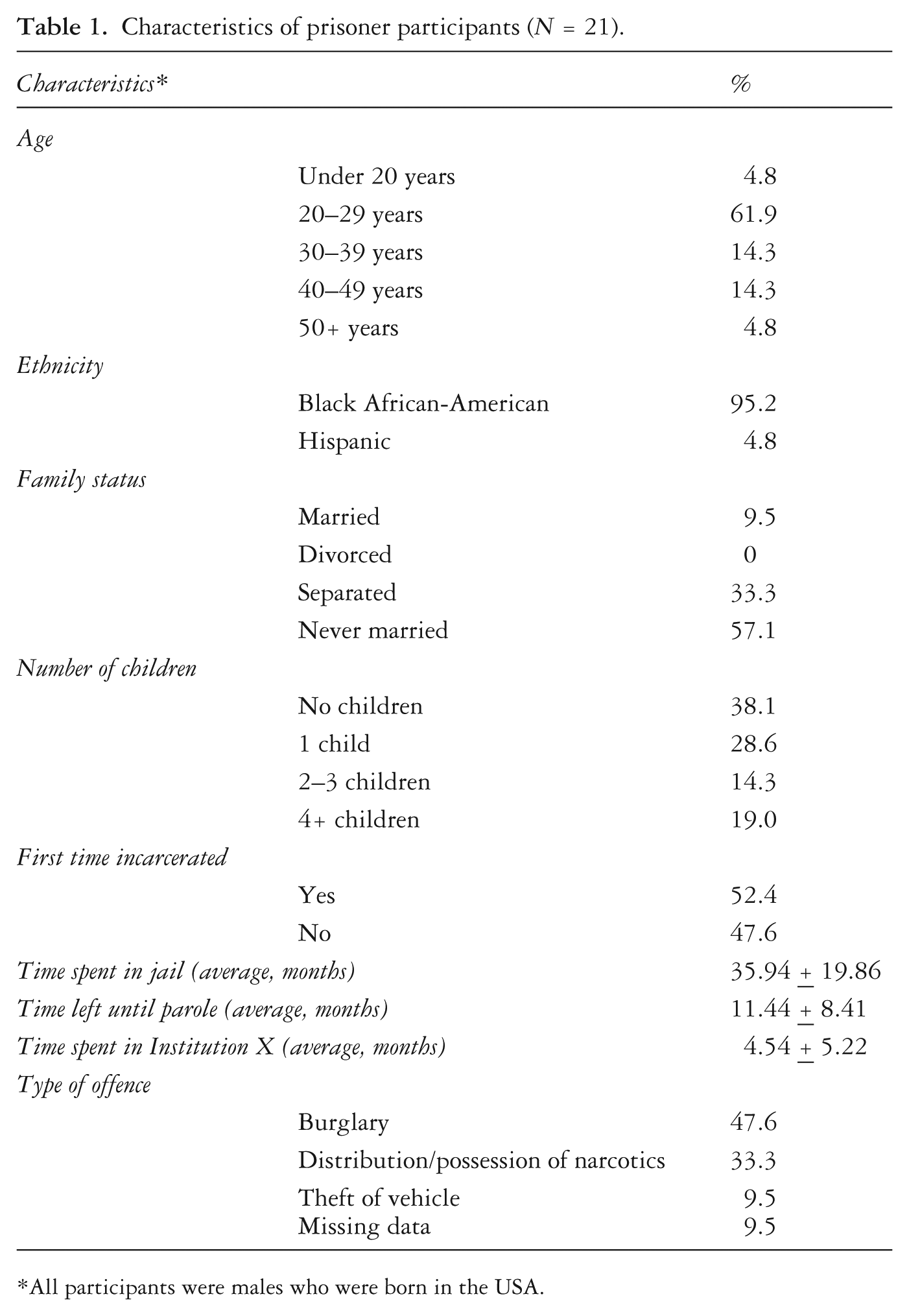
All participants were males who were born in the USA.
The five staff members who participated in the study ranged from a high-ranking manager to staff members with direct contact with prisoners: a policy director, a director of client services, a programme manager, a volunteer manager, and a therapist. Two of these were women, and the rest were men. Their mean age was 46.6±13.5 years (min=25, max=60) with 4.6±4.15 years (min=1, max=10) of experience at the organisation. Three of them had received some graduate education. The rest had received some undergraduate education.
Data collection
Upon receiving Institutional Review Board approval from the University of Chicago, and approval of Institution X, we began interviewing prisoners from Institution X. Interviews were held on a weekly basis at Institution X. Owing to the unpredictability of prisoners’ schedules and the fact that telephone and email communication were unreliable, it was impossible to schedule interviews with specific prisoners. Instead, participants were recruited through bulletin board and loudspeaker announcements at the time of the interview. Interested parties were brought to a separate room and were informed about the purpose of the interview. This took place in the absence of any Institution X staff in order to give participants a fair chance to decline to participate in the study. Moreover, no list of participants was provided to staff members so as to ensure that there would be no sanctions for those who chose not to participate.
After this step, participants were provided with a verbal clarification of the terms of consent, and asked to sign a consent form. In order to reach a maximum variation of prisoners, the authors made an effort to hold interviews on different days at different hours. This enabled us to meet with residents who inhabited Institution X at different parts of the day. Sampling procedures were upheld until our sample reached saturation (Morse, 1995).
In contrast to prisoners, staff members were selected in order to maximise the variation of relationships to prisoners. This included interviewees from multiple managerial positions (e.g. project manager) and interviewees with a micro-perspective of prisoners (e.g. therapist). Interviews were held with all relevant staff members who were determined by us in consultation with our staff interviewees (snowball sample) as having the potential to make a meaningful contribution to our research questions. Staff were recruited by email invitation. This was followed by a phone call to explain the purpose of the research study. Staff were also asked to sign a consent form. All interviews (staff members and prisoners) were held between June and August 2014.
Interviews
Prisoners
Three focus groups and three individual interviews were conducted by the first author of this article with twenty-one prisoners. The focus group discussions as well as the individual interviews were facilitated through a semi-structured interview guide, which was designed to cover a range of topics to gauge prisoners’ perspectives about their re-entry process. Research interviews covered the following areas: a) General perspectives about re-entry. b) Perspectives about re-entry as performance. c) Perspectives about the role of different communities in re-entry. d) Perspectives about making art during re-entry and incarceration.
Questions posed to prisoners that fall in the frame of this article are: a) In the process of rehabilitation, what change is perceived as real, and what is perceived as enacted or ‘performed’? b) When do you feel that performance of change is enforced on you by the programme? c) When do you benefit from performing change and when do you feel that performance results in a disadvantage? d) When do you choose to knowingly perform change? e) When and how do you resist performance?
Staff
Staff interviews were conducted after prisoner interviews were completed. Staff were asked to provide their perspectives on the same subjects as prisoners and to comment upon preliminary findings from prisoners’ interviews. They were also asked to: a) Describe their perspective about re-entry as performance. b) Highlight subjects within findings they think are important. c) Describe their personal opinion on the findings (give examples). d) Describe their professional opinion on the findings (give examples). e) Contextualise our findings within a broader picture of prisoner rehabilitation in Illinois.
Data analysis
The authors of this article were responsible for coding transcripts of the focus group and individual interviews with prisoners and staff. This multiple coding procedure enhanced the reliability of the results by comparing codes, discussing disagreements, refining coding frames, and eliminating misunderstandings of the text (Mays and Pope, 1995). Preliminary findings were discussed in regularly held research team meetings to assure the reliability and quality of the analysis.
In the analysis phase, we coded the data with an open coding process to organise the research materials into main subjects and categories. During the initial coding, all codes were revised by the research team and finalised using cross-case analysis and constant comparison techniques (Glaser and Strauss, 1967; Strauss and Corbin, 1990). This analysis method was inspired by Grounded Theory Analysis based on the assertion that Grounded Theory Analysis can produce trustworthy results even if the research project is not following a strict Grounded Theory design or attempting to produce Grounded Theory (Barak et al., 2014; Ramey and Rose-Krasnor, 2015). This process led to a finite list of codes that represented the main themes that emerged in the interviews. The final codes are summarised and presented in this article.
Ethical issues
The research team’s primary ethical consideration was to prevent research participants from being identified by others, and to ensure that there were no negative consequences for either participating or not participating in the study. We took the following steps to ensure this: 1) The research study and design were reviewed and approved both by the Institutional Review Boards of the authors’ institutions and by Institution X. 2) We made focus group participants aware of the voluntary nature of the study and provided informed verbal as well as written consent – this procedure ensured that prisoners with different levels of literacy could follow and understand their consent. 3) We discussed issues of confidentiality at the beginning of each focus group and/or individual interview, and addressed any concerns that were raised. 4) We identified and removed from the article any information that could have facilitated recognition of either staff or prisoners. All research data was de-identified. 5) Prisoners and students participating in the Richard and Mary L. Gray Center for Arts and Inquiry group (phase 1) were informed about and consented to the multiple objectives of the group, including both theatre-based activities and scholarly research.
Findings
Prisoners’ views
Instrumental vs. transformative performance
All prisoners described performance as a requirement of their rehabilitation programme and as a principal experience of living in a work release centre:
I feel, like everybody in this building pretends … Residents, teachers, everybody in here pretending like that they like what’s really going on. … Even the staff, they pretend like they like to be here. … We just pretending [in order] to get home.
However, prisoners were divided between seeing performance as instrumental or transformative. In the case of an instrumental performance, no real change occurred, but rather the prisoner made conscious changes to his everyday behaviour in order to achieve a known goal. In the case of the transformative approach, prisoners felt that what they currently perform as a ‘fake’ behaviour might become a true and improved reality in the unknown future.
Performance as instrumental
Prisoners often described performing as a means to an end, rather than as a way to change:
To get a job, you have to pretend to be this so-called person that you’re not in order to land this job that you’re looking for. It may be a beautiful girl that you may see, and you know that you a thug, but she’s a very high-class lady. You’re gonna have to pretend to be this so-called sophisticated guy in order to win her over.
Instrumental performances were mainly described by prisoners as performing a positive self, which often contradicts their present emotional experience.
I went to this job interview at Dunkin’ Donuts … I put on a good smile, I represent myself well, I generally shake the man’s hand, give some good feedback on the questions he ask me. You have a positive attitude even though I still have some situations at home.
Performance as transformative
The interviewees’ experience of transformative performance differed from that of instrumental performance insofar as the former was considered to promote a new and improved internal reality. To that end, a preliminary phase of ‘performing’ was expected by prisoners to be accompanied by a second phase of ‘becoming’:
If you just, I say, a person out here that wants drugs, alcohol, whatever the case may be, and now all of a sudden you want to go ahead and clean that up, so you gonna have to pretend to maybe not be in that category again … You can only do pretending for so long until you gonna become accustomed to the fact that you are used to this lifestyle … and you want to live it from now on.
Performance arenas
Prisoners described the arenas in which they felt forced to perform, the type of performance required within each arena, and their evaluation of this performance. Within each stage, the prisoners described a different performative requirement. In some cases, resistance to performance was described.
Workplace performance
The workplace was described by prisoners as a special arena, in which they meet people (co-workers) from the outside. These co-workers, whether equals or superiors, were seen by the prisoners as an outsider-eye watching over them and keeping track of their actions. Thus, this arena, which could have supported a different and less stressful interaction than that at Institution X, was revealed to be even more demanding in terms of performance. The most common performance described by prisoners in this context was ‘performing being content’. As one participant related:
[You have to wear a mask of someone who is] happy working. It can be a smile and the motivation to get back here on time … Knowing that you are outside and breathing fresh air, but you’re still locked up and you have to go straight to work and back here, ain’t no stopping to see anybody, you can’t go to your career, you can’t go hug loved ones.
4
… I mean, it is a real easy mask to put on because at any moment we can go back [to prison] … because if we take that mask off for one second…
Another participant summarised this idea in a few simple words: “You got to wear the mask at work, we can’t be upset. We can’t say certain things.” Being content and wearing a mask to work was considered by some of the prisoners as false, or in their words “overkill”.
[They wanted me to but] I never dressed up in there, ever, never work or anything. They always want you to get a suit and a tie for interviews … The job that they were having, like Taco Bell, Jiffy Lube … McDonald’s, these are jobs I had before. I didn’t wear a suit and a tie to get them … That’s overkill to me.
Quotations like the above highlight how, during the re-entry process, some prisoners feel that they are asked to perform an ideal character and to act better than others, which they perceive as an unbelievable performance of a character who contradicts their own experience.
Performance of language
Prisoners also described their use of language as a type of required performance. Mainly, their own language was not considered legitimate by staff, and therefore they had to learn a different way of presenting themselves in speech. One of the prisoners described the dual language he uses “amongst each other” (that is, among other prisoners) and when talking “to you” (that is, to the authors):
We could talk a totally different language … you got the real language, the proper English, and then you got the sub-culture – the language that we use amongst each other. If I was trying to explain something to you I might use proper English, ’cause that’s probably the only language you probably know … They want us to just stop using it [our language] so much … ’cause we have to go on job interviews they want us to learn proper English.
Similar statements were made by prisoners when describing their use of language in the programme.
Performance at Institution X
In addition to their performance at the workplace, prisoners felt they also had to perform in different programme activities at the work release centre. These performances were given in front of the staff, usually in order to ‘not get in trouble’ or to receive privileges granted to prisoners for good behaviour. This kind of performance was described mainly as instrumental. Performance in therapy was a frequent example given to describe this:
If you point out something, even if it’s fact-based, they’ll still dispute it or they’ll try to quiet you. Then you feel like, ‘Why am I in this group if I can’t express how I feel or if I don’t believe this?’ That’s what I’m saying. They’ll get you into something, and then you’ll start thinking, ‘I don’t believe.’ And they’ll threaten you, like, ‘You can’t quit because if you quit, you’ll face repercussions.’
Another statement expands this idea further:
Why would you want me to say [yes] if I’m not agreeing with what you’re saying or what you preach? Just like a Catch-22 with that place … [Take for example] the substance abuse program, a lot of times they would say stuff that I didn’t agree with, but I didn’t express my opinion because I didn’t want a backlash to where I just would be quiet even though I knew. A lot of times in life you say to yourself, I know that this is not right, but I’m not in control, so I know to follow who is in control or else…
This paradox undermines the essential role of therapy as a facilitator of self-improvement. If a prisoner feels he must ‘fake it’ in order to avoid punishment, how can he be expected to change?
Staff perspectives
Instrumental vs. transformative performance
Staff members were also divided between seeing prisoners’ performances as instrumental or transformative. Staff interviews demonstrated two opposing assertions: 1) Criticism of the expectation for prisoners to perform as being culturally oppressive and racist. 2) Justification of prisoner performance as conventional and even transformative. Interestingly, Institution X staff did not regard the argument that prisoners are expected to perform a new identity as untrue. Rather they accepted this as a fact, which they then evaluated according to different criteria. The following quote from a staff member demonstrates this affirmative view of performance as an opportunity to learn new behaviours:
I think it all comes down to your values and what you see as being normal. We all come from different backgrounds and upbringing, and if you’re in a situation where you grow up and the expectation on you is to go to school and to go to work, and that’s what you see your parents doing, then that to me is normal … Whereas if that’s not what you saw maybe when you were growing up … going to work or going to school or doing those things may not be normal to you, and so I can see how they would see that potentially as acting…
Performance as transformative
Staff members who considered performance during re-entry as transformative based their opinions on the evaluation of prisoners’ earlier behaviour as a failure insofar as it led to their incarceration. If prisoners’ everyday performance had failed, a performance of a different self could potentially transform the past failure into a future success. Performing, in this regard, was perceived as a way out of a failing life course. The underlying message delivered to prisoners was: if you want to stay out of jail, you have to stop acting like yourself and start acting like someone else.
I think it’s a challenge for most people who are entering the reentry process. The authentic self led to the incarceration. When people are trying to reenter society, the most important thing is taking that critical look at self to realize how did I get here and why did I get here … I think it’s critical for our people to understand what mainstream is … If you’re coming in with your pants sagging, if you’re coming in with the same conversation that you would have on the streets, that’s not going to work.
The same message was delivered by other staff members who considered the normal self of prisoners to violate the performance expected by society of successful mainstream citizens. In the following quote, a prisoner’s history of self is described in negative terms as constituted from absences, rather than achievements:
I think initially, you mimic something, and then if you mimic it long enough it becomes your normative behavior. That’s the whole process of us believing that work is a transformative thing for them. If you come from an environment where you don’t see your mother and father get up every day and go to work, how is it that you think you’re somehow supposed to figure that out?
While this quote highlights potentially transformative aspects of performance, it also disregards the life experience of prisoners. Is their former life experience – as drug dealers, for example – not to be regarded as an activity that also demanded discipline and commitment?
Performance as instrumental
This issue was addressed by a staff member who objected to the prevailing view of performance as transformative, and emphasised the instrumental aspects of performance. Her view of the instrumentality of performance regarded performance as a way to get along in an oppressive society and within an oppressive situation. In the following quote, she describes white people as oppressors (“the king”) and prisoner rehabilitation programmes as enforcing ‘the language of the king’:
You have to speak the king’s language, and when in Rome you do as the Romans. If you think of African-Americans as a whole, we’re not in our own homeland. We were taken against our will, so we’re here and we have to do as the Romans do, if we want to be successful … If you think about incarceration, the ‘New Jim Crow’ and all the conversations around that, then that’s what it is. It’s non-compliance, we don’t think about how to empower those people to use their natural skills. You think about people who are selling drugs for example: natural salesmen! But we’re not teaching them to be salesmen in their own right with their own product. We’re teaching them how to be salesmen with the Roman’s product, so we don’t empower people in America, particularly African-American people…
Performance arenas
Staff members described the arenas in which they felt prisoners were forced to perform, the type of performance required by prisoners within each arena, and their evaluation of the prisoners’ performance. Within each stage, the staff members described a different performative requirement.
Workplace performance
Generally, staff members at Institution X accepted the assertion that prisoners have to perform in the workplace, describing the performative mask as a mask that is shaped by professional expectations in the workplace:
Now I’m leaving the center. Here’s where I begin to dress and put on my mask because now, I’ve got to leave the center and go look for a job or go to a job … There’s expectation already attached to me, and so I’m either living up to or down to that expectation. I fully understand why someone would feel like I’m not me, because me is in transition anyway. Me is in transition.
Performance of language
Staff members, similar to prisoners, regarded a change of language as a necessary step for succeeding in their programme. Specifically, changing their language was intended to help prisoners communicate with employers who might otherwise not hire them:
There’s a comfort level, because when you’re changing, you’re stepping into another realm, and you’re holding on to whatever was comfortable, whatever felt good, especially with language. You want to be able to communicate comfortably with the employers. They’re not receptive to slang, so you have to be able to make the change, to acclimate or assimilate to the new environment.
Similar to prisoners, staff regarded prisoners’ language as race-related. A true change of language is therefore a change – or even a disavowal – of race. Prisoners, in that regard, were expected to ‘mature out’ of race-related language, while, by that same token, they were expected to return to the same communities in which this language is spoken.
The African-American male, the African-American female sub-group, the Latino sub-group, the white American sub-group may have a sub-language that is truly racial, if you will, maybe even age appropriate … Then I’ve got to go home and be the real me, and I don’t want people to think that I’ve punked out or I’m not man enough or I’m not standing on my square or whatever, so I don’t really, yet, want to let go [of the language I use], and I think that’s when we circle back to what internal, true decisions have you made. It’s a part of the maturity process, the aging process for all of us.
Performance at Institution X
Staff regarded Institution X as a place where performance occurs. Specifically, it is required that the experience of certain emotions be contained and hidden. A therapist described one of her encounters with a resident:
I asked him, I was like, I’ve never seen you look angry or behave in an angry way or anything like that [in here], and he goes, ‘This [anger] is what I feel in the inside, this is what I’m feeling all the time, and to be able to cope with my environment I have to, like, physically, emotionally, stop myself, truncate my emotions from my behaviour.’
This therapist further developed this view, claiming that a performance that negates internal feeling is actively encouraged at Institution X:
Being so emotionally cut-off from anything that you’re going through is really supported in those environments. It’s like they don’t want to hear the guys talk about stuff … like, nobody asks them what they hope and what they dream for, what their ideal job would be. It’s a work release center, so, like, finding a job is what they’re tryin’ to do there, but nobody asks them, like, what kind of job would you really want if you had a choice? They just send [them] to whatever job that they have an opening for.
Discussion
Our results demonstrate that passing – that is, enacting normative, ‘white’ behaviour – is indeed enforced by Institution X, although it is often described as ‘change’ or ‘transformation’. Placed within the broader context of identity subordination (Brown, 1991; Prilleltensky and Gonick, 1996), this study validates our concern that re-entry programmes serve, among other things, as an institutionalised apparatus that coerces targeted minority groups into performing normative identities in their efforts to rehabilitate and reintegrate prisoners. When considered in the context of the data provided in the critical perspectives section – namely, that since 1990 an average of 590,400 ex-offenders have been released annually and that in 2015 about five million ex-offenders were still under community supervision (James, 2015) – this study demonstrates the significant role enforced hegemonic performance plays in prisoner re-entry, and the degree to which it bears out in the lives of large populations of marginalised individuals in American society.
As demonstrated in this article, within an economic discourse, passing is justified as a way to re-adjust to the job market and to sustain good relationships with an employer. In this way, Institution X explicitly promotes a ‘good worker performance’, which is intended to enhance prisoners’ chances of finding employment and to reduce recidivism. While one might argue that this subordination of one’s everyday identity is no different from anyone else’s (including non-prisoners’), we believe that the unique economic vulnerability of re-entering prisoners – as made evident by the fact that many employers require clean criminal records and that employment is often a requirement for parole (Simonson, 2006; Stafford, 2006) – qualifies the identity subordination of prisoners as especially oppressive. Moreover, these explicit institutional aspects of enforced passing make re-entry programmes a unique example of how oppressive social norms are not offered, but rather institutionally coerced, and on a large scale.
The example of language change can be raised here to highlight this point of tension from a cultural angle. In their interviews, staff members emphasised that what some have termed ‘racial language’ is unacceptable in the job market and, therefore, maladaptive to the re-entry process. However, as various scholars have noted (Bucholtz and Hall, 2004; Urciuoli, 2013), changing one’s language is not only adaptive, it is also oppressive. Ebonics could serve as a case example. Hartman (2010: 195) puts it starkly: “Not allowing African-American speech patterns into social discourse maintains white supremacy.” While we do not deny the claim that Ebonics might not serve re-entering prisoners well on the job market, the oppressive act of forcing a re-entering prisoner to change his or her speech should also be acknowledged and critically addressed.
A new reading of Goffman’s theory of performance could complement these findings. It is generally agreed that correctional institutions force prisoners to give up their identity kit and to perform as a means of individual survival (Goffman, 1968; Schmid and Jones, 1991; McCorkel, 2003; Bandyopadhyay, 2006). However, it seems that Institution X offers a much more ambiguous form of performance than Goffman suggests, insofar as it establishes a blur between life in the ‘total institution’ and life in society. This blur is largely based on the simple fact that residents frequently go in and out of the institution, but are nevertheless expected to constantly sustain their performance. In that sense, institutional life is characterised by Institution X’s staff as a simulator, so to speak, a rehearsal for how real life ‘really is’.
Having been in close connection with Institution X for a whole year, we strongly feel that staff members are truly committed to the residents’ successful rehabilitation and re-entry into society. However, this socio-political concern cannot be overlooked. Following numerous critiques – from Foucault’s (1979) conceptualisation of prisoners as ‘docile bodies’ to Angela Davis’s (1998) concerns with the ‘prison industrial complex’ to Mitford’s (1974) assertion that work release programmes are a continuation of prisoners’ economic exploitation, or to Goffman’s Asylums (1968), which deals with invisible deprivation of prisoners’ ‘identity kit’ – we call for a close examination of how social power relations are maintained and reinforced through practices of performance, and how this is justified as ‘therapy’, ‘job market demands’, or as a problematic, yet necessary and brief step toward a better, socially-integrated life.
Before we turn to concrete policy recommendations, it should be noted that the majority of policy recommendations for re-entry programmes is influenced by the programmes’ official aim to “[assist] those returning from prison and jail in becoming productive, tax-paying citizens and saving taxpayer dollars by lowering the direct and collateral costs of incarceration” (Caporizzo, 2011: 1); yet these programmes rarely address issues related to racial oppression. Some exceptions include recommendations that are based on an anti-oppressive awareness, such as ‘the convict criminology group’ (Richards et al., 2011), which focuses on massive, albeit vague, reforms to the corrections system (p. 204). These kinds of recommendations are related to the radical thought of figures such as Angela Davis, but make no critical recommendations as to how to improve race and power relations within the boundaries of current re-entry programmes.
Our policy recommendation brings this question into focus. After decades of gathering solid data on re-entry programmes through the sole lens of recidivism, the time has come to consider other political issues at the core of re-entry programmes’ mission. Rather than institutionally enforce passing, re-entry programmes should involve ex-offenders to seek their own self-determined path for their post-incarceration life. Furthermore, re-entry programmes should acknowledge and address the inherent tensions between performance, adaptiveness, and oppression in their curricula. Additionally, ex-offenders should be given a dialogic framework in which to address these subjects, perhaps in therapy or in group discussions. In this way, residents could make informed decisions about their own personal praxis, and staff members could be made alert to the negative feelings residents might experience when controlling their desire to maintain their everyday self instead of performing the imposed character of a rehabilitated prisoner.
Limitations
Some limitations to this study should be considered. Firstly, our study is based on a small sample of prisoners and staff from Chicago. A different sample from a different region might yield different conclusions. However, our review of the literature revealed that Institution X operates with no significant difference from other halfway houses and work release programmes across the USA. Furthermore, Institution X is part of one of Illinois’ largest prisoner re-entry and rehabilitation organisations and, as such, should offer a reliable example of mainstream intervention across the state and country. Secondly, our research process – which began with a weekly group meeting for theatre activities and open discussion – might be considered an influencing factor on the residents, exposing them to the terms and critique of performance and dramatic enactment within re-entry prior to the interview. However, these participants do not represent a control group for this research study. They constitute a separate investigation, the results of which exceed the scope of this article. For this reason, we have not included findings based on this group here.
Finally, although this research focuses mainly on the performance of change in prisoner re-entry, we acknowledge that additional topics necessary for a complete account of re-entry – such as masculinity, age, and/or sexuality – are not addressed in this article. We do plan, however, to address these topics in future studies.
Footnotes
Acknowledgements
The authors wish to acknowledge the support of the Richard and Mary L. Gray Center for Arts and Inquiry at the University of Chicago, especially Inaugural Director David J. Levin, Inaugural Curator Leslie Buxbaum Danzig, and Program Coordinator Michael Schuh. Additionally, we are greatly indebted to staff members at Institution X, and student volunteers at the University of Chicago. Most of all, we thank the incarcerated volunteers and research participants whose commitment and trust were essential to the realisation of this study.
Funding
This research was funded in part by the Richard and Mary L. Gray Center for Arts and Inquiry at the University of Chicago.