







Abstract
This article unfolds the personal creative characteristics of an educator in the field of gifted education, and examines creativity as expressed in childhood and its transformation into adulthood. Dr. Erika Landau is a pioneer of gifted education in Israel, an internationally renowned scholar and educator, and the founder of the Young Persons’ Institute for the Promotion of Creativity and Excellence. The Personal Creative Characteristics Model of Treffinger and colleagues was used as a framework to analyze her creativity. The creative characteristics of openness and courage to explore ideas and listening to one’s inner voice were detected in her in childhood from her descriptions of the hardship she faced surviving in concentration camps during the Second World War. A full range of categories of creative characteristics, including generating ideas and digging into ideas, were detected in her in adulthood. Her creative characteristics in childhood were transformed in adulthood, making meaning of suffering and focusing on giving back to society, especially teaching gifted and talented children how to be creative and productive.
Creativity characteristics
Three categories of characteristics emerge from studies on creativity: cognitive characteristics, personal characteristics, and biographical events. Cognitive characteristics are connected to the way people use problem-solving skills and associations (Treffinger et al., 2000). Personal characteristics are connected to values, temperament, and motivation, which are related to the application of thinking (MacKinnon, 1978). Biographical events are connected to experiences that lead the person to creative achievements (Csikszentmihalyi, 1996; Gardner, 1993; Sternberg, 2000). The combination of these characteristics is complicated as they do not appear to the same extent in all people and no person possesses every characteristic in each category. Many of the characteristics can be learned and nurtured, and it is difficult to predict which students will be creative, but these students need to be supported and their creativity needs to be developed (Treffinger et al., 2002). Personal creativity characteristics are defined by Treffinger et al. (2002) to include the following:
This article examines the creative characteristics of Landau to unfold and better understand the connection between her personal characteristics of creativity expressed in early childhood and in adulthood.
Dr Erika Landau, an Israeli psychotherapist and researcher in creativity, giftedness, and education, was born in Romania in 1931. After spending 4 years in concentration camps, she was immigrated to Israel in 1947. Landau has a BA degree in Psychology and History from Tel Aviv University, and a PhD in Psychology and History of Art from Ludwig Maximilian University in Munich, Germany. In 1968, Landau founded the Young Persons’ Institute for Promoting Creativity and Excellence, which was Israel’s first center for gifted children, a non-profit association to help gifted and talented children to cope with their problems. The institute strives to develop creative thinking, using the unique creative approach developed by Landau, based on meeting and studying thousands of children. More than 40,000 children (kindergarten through ninth grade) have attended the program. The institute, located on the Technical College Campus of Tel Aviv University in Ramat Aviv, works with about 800 children each semester and focuses on enrichment and nurturing, particularly with the advancement of Ethiopian children.
Landau taught psychotherapy in the Department of Psychotherapy at the School of Medicine, at Tel Aviv University, and she has published several books, translated into 12 languages, and dozens of articles in scientific journals.
A semi-structured interview with Landau was recorded (31 October 2012, see http://www.erika-landau.net/ypipce-en.htm) and transcribed to enable the collection of information on her creative characteristics, including stories from her childhood and her creative approach as an adult. Key documents in the form of books, articles, and personal and institute websites were examined to complement the stories and the descriptions of her creative approach (see http://www.erika-landau.net/personal-en.htm).
Early life – surviving the holocaust
As a child, Landau experienced the horrifying situation of living in the concentration camps during the Second World War. The interview and documents analyzed yielded creative characteristics in two categories: openness and courage to explore ideas; and listening to one’s inner voice, based on the memories she recounted in the interview and in her book Giving Sense (de-Nur, 2000).
Openness and courage to explore ideas
High levels of curiosity and aesthetic sensitivity
Landau mentioned two very distinct events in which her aesthetic sensitivity and high level of curiosity were involved. One was related to a certain painting and the other to music. One of the moments of grace I experienced was with an art history teacher, by the name of Dr. Rappaport. Instead of warm clothes he took to the camp reproductions of renaissance paintings. To the light of an oil lamp he showed me the pictures of Leonardo de Vinci and Botticelli. One painting that I remember very well is the Return of Judith to Bethulia. Dr. Rappaport showed me the painting and said: “You see Erika, there were always young Jewish girls who suffered, but they survived.
1
I was nine when our piano teacher recommended me and two other friends of mine to take part in a competition. My father was abroad and my mother got ill, but there was a good feeling of belonging and togetherness with the other competitors and their parents. Waiting for the decision of the jury, eyes met, hands touched, sharing hopes and giggles. When the first prize was announced I walked up to the stage bewildered, shook hands with strangers turned around bowed to the public and looked for a pair of eyes to share my embarrassment. BUT my friends looked down and their mothers had narrow lips. Later my friends bunched in a group, did not invite me to join them. I was an outsider, not wanted. I hated the prize I had once coveted. I felt lonely for the first time and very often since.
Playfulness and capacity of fantasy and/or imagination
Landau indicated that what kept her alive was her ability to fantasize and daydream. Her daydreams involved music and the vast arena of knowledge out there that she was ready to absorb. I survived by daydreaming. In the cold nights when even sleep avoided me, I thought and dreamt with open eyes. I saw myself and my fingers on the piano and played and played till the morning came. In another repeated daydream I was standing in front of school, and near me was standing a man with no face. We were waiting for the results of exams. I knew there was a world of knowledge to learn from. My mother taught me all she remembered about poets, music and other things. I had a feeling inside me that I must survive to learn.
Risk-taking and open to feelings and emotions/shows emotional sensitivity
Landau recalled an incident in which she went against her father’s commands, risking herself and her family, to help a boy in the camp, which demonstrated her emotional sensitivity and deep feelings: With the morning the suffering began with breaking the ice over the water to wash ourselves. To this we were very attentive to keep clean, because dirt brought lice. The louse was the most frightening being in our life. They brought the sickness, the illness of which many died and only a few survived. Many years later, after a television talk, a man called and reported he woke up one day in the camps, after this illness and around him all were dead. He walked out on the street of the camp, everybody avoided him, because he was uncombed and people were afraid of his lice. He was weak and sat down, and cried in his despair. A girl came up to him and asked why he was crying. He told her about his illness, and the fact that his parents did not move and now “nobody wants to speak to me.” “But I speak to you,” said the girl and smiled. And seeing me on television, he recognized my smile. And in spite of those sad memories I was glad that I had helped that desperate child, who, according to him, got strength out of my smile. Yet, at the same time, guilt feelings came up. What about those I had not smiled at? Those, that life too had not smiled at them? And those that died of hunger, sickness and pain? Why did they have to die? In what way were they bad or wrong and I was good and right?
Emotional sensitivity and problem sensitivity
Landau drew on her experience in the concentration camps to help a young man who was suffering from a similar problem that she had faced after the holocaust, demonstrating emotional sensitivity. Many years later, during the Yom Kippur War, I was asked to help a young man, who for three days did not react, did not speak, just lying there with wide open eyes without seeing, without movement. The only thing I knew about him was, that he was the only survivor of a tank that was hit. I sat down, held his hand and tried to remember what I had studied. What did I know about how to help him? From my brain, I received no answer, but from the depth of my guts came the words, “You feel guilty that you are alive and your friends had to die”. He turned his head and asked, “How do you know?” “For I feel guilty too, that my friend died in the holocaust and I am alive”. He pressed my hand. And I understood that my suffering got some sense. That from my suffering, I could help a young man.
Listening to one’s inner voice
Awareness of creativeness
As a child in the concentration camps, Landau was not aware of her creativity, but actually practiced it in trying to save the lives of her parents. At that time, I did not know that it was creativity. No one spoke about creativity. I had a happy childhood. I was loved and gave love. Suddenly came Hitler and took the family (mother, father my sister and me) to a concentration camp. My parents got sick with typhoid and had very high fevers. At 10 years old, I walked out, very sad, searching for something. I saw a big potato. I took the potato and cooked it and made a whole meal. The water in which the potato was cooked became soup. The outer part (the peel) I cut into small pieces and made some kind of schnitzel and served it with the potato. My mother was not conscious, but my father, who could not speak, looked at me with his big eyes and said thank you. His smile was a reward for me.
Independence of thought
An incident in which Landau demonstrated independence of thought was when she approached the boy with lice, despite knowing it was risky and forbidden. She sat with him because she understood the meaning of being alone without support, and she thought she could help the boy. She did so in spite of what she had seen and heard around her, feeling she could make a difference: I remember, the anger of my father, seeing me with a boy with lice. And when I did not want to leave the boy, feeling his despair, my father in his anxiety tore me away. This was the only time in my life that my father had been rude with me. And in spite of those sad memories I was glad that I had helped that desperate child.
Interest in reflective thinking/introspective
Landau demonstrated an introspective ability that helped ease her suffering during a very stressful event. She knew she was not allowed to cry and found within herself a way to cope: I was 12 years old and quite tall compared to my classmates. The Ukrainians came into the house. They were the worst. They took people away, killed people, and violated the women. When they came into the house my mother pushed me into a hole/niche in the wall and pushed a cupboard against me. There I was crying quietly and standing in the dark hole. My feet hurt because I could not move, as the stone wall had spikes that hurt my flesh. Suddenly I made a small movement and for a second it did not hurt. Then I moved another finger and another, and this way I could ease my suffering. Many years later I came to the conclusion that in a surrounding, as narrow as it is, you can find alternatives - you can give a child some alternatives.
Adult life – the creative approach
As an adult, Landau developed a creative approach for teaching gifted children. Analysis of the interview and documents found Landau to have characteristics in all four categories of the Treffinger Model of Personal Creative Characteristics: Generating ideas, digging deeper into ideas, openness and courage to explore ideas, and listening to one’s inner voice.
Generating ideas
Originality
The first time Landau came across the term creativity she was motivated to tackle this subject and she was one of the first to write a book on how to teach creativity to gifted and talented children. Writing my doctoral proposal at the University of Munich in the 1960s, I found the word creativity in a UNESCO document. They said that when the Sputnik was sent by the Russians, Americans came to the conclusion that it must be something else not only knowledge and intelligence, but it must be creativity. This was the first time I encountered the word. My book on creativity, which was published in 1969 and translated into 12 languages, was the first one. I saw that there is a way to teach children to look at creativity. The creative approach challenges the personality at its whole. The problem is approached from all aspects of the personality: intellectually, emotionally and socially. The problem is seen in its course of a process and not in its static position in time and space. The creative approach flows in time and space, present, past towards the future. The creative approach makes learning an experience and each experience is a building block of the personality. It does not burst or break frames, but tries to find alternatives within the given frame. It is transferable and can be learned. Creativity enriches life, and makes it more interesting, more enjoyable and more beautiful. It gives life meaning – “my meaning.”
Landau was the first to offer programs and courses in Israel to the gifted and talented children she had identified in 1968. The institute she founded has been in operation for almost 45 years. In 1968, I founded “The Young Persons’ Institute for Promoting Creativity and Excellence” – Israel’s first center for gifted children, a non-profit association to help talented and gifted children to cope with their problems. The Institute strives to develop creative thinking, according to the unique creative approach I developed, based on meeting thousands of children and studying the subjects. Up until now, more than 40,000 children attended the program; the Institute works with about 800 children each semester. The institute started as an educational experience in the Tel Aviv Museum. I started teaching creative thinking. I had to teach them [the children] to ask questions. Students (mostly from elementary school) take creative thinking and other interdisciplinary courses like humor, neurotransmitters, technology and science, and archaeology. When the story of cloning “Dolly” was published in May we started a course in September. Teachers at the institute are mostly former students.
Elaboration – elaborating on the creative process
Landau concluded that children need to be taught how to ask questions: The most important aspect of education is the way of asking questions. It is through questioning that the individual looks for himself for his own individual way towards the solution. Thus I prepare the partnership of the student to develop the creative approach to their life. I usually start from the present and insist on looking at what is happening “here and now”, and only after seeing what is really happening do I ask the causal question WHY? The question “What can I do and what is in me to do about it?” is the reformulation of the depressive, causal question ‘Why is this happening to me?’ into an active, creative question: it is the new beginning from a disturbed infantile into a mature and creative being. This change in form and tense of asking the question is the change from the deterministic approach to the security and freedom to choose the creative alternative.
Digging deeper into ideas
Analyzing and synthesizing
Landau looked deeper into the ways of solving problems, analyzing the process of finding creative solutions and what prevents us from doing so: Life is a perpetual search for different ways to find and to solve problems, to feel free to choose among them, to dare to try them out and be responsible for your choice. One of the biggest obstacles to finding creative, original and innovative solutions is our acquired stereotyped and mechanical ways to solve problems. In our desire to be loved, liked and accepted, we tend to speak and behave in terms we know a priori will please the society. Looking at the situation from different angles, we can work ourselves up to different alternatives and the ultimate choice of the most relevant alternative to the real situation is the product of intellectual, emotional and social participation of each student. It is a combination of inner abilities with outer challenges, interaction of outer logic and inner fantasy, intellect and emotions according to the social needs of the individual in the society.
Reorganizing and modifying
In Landau’s approach to teaching gifted and talented students, she dug deeper into the problem and recognized relationships between the personal characteristics of the children and the encouragement needed to develop and express their creativity: I first look for the strength in my student – “I strengthen the strength” in order to give them the force to confront their weakness. One needs courage in order to confront one’s weaknesses: it is much easier to hide behind social conventions and walk trod ways others went than try out individual ways according to one’s own potentials with the risk of failure. We are allowed to make mistakes, what we should not do is not learn from them. Failure could be a good beginning of something new.
Openness and courage to explore ideas
High levels of curiosity and aesthetic sensitivity
Landau offered a course in creative thinking to gifted and talented children interested in arts. The institute started as an educational experience in the Tel Aviv Museum. I started teaching creative thinking. I taught them to experience, to look at things from different angles, and to ask questions.
Risk-taking and open to feelings and emotions
Landau said, for the child to be him- or herself and to be secure in taking risks, a special open atmosphere needs to be created: We must create an atmosphere for the gifted and talented child which conveys security, so that he dares to be his outgoing, warm, participating [self] as well as his bright, dominating [self] and will feel the inner freedom to venture into a wider world without the perpetual need to compete, to be constantly admired, and always be best. We need to create an atmosphere which will enable him to play and experiment, invent and create, love and share for his own good, as well as that of society.
Shows emotional sensitivity and problem sensitivity
The biggest problem in the education of children, according to Landau, is the gap between high intelligence and low emotional maturity, which is a result of parents and schools mostly challenging only the intellectual aspect of a child. She went on to elaborate on how the child’s emotional abilities need to be challenged: To challenge their emotional abilities, is as, or even more important, than the challenge of their intellectual abilities. Children should be taught: a) to look at the matter from all aspects of their personality: intellectual, emotional and social aspect; and b) to ask questions and become aware that each question has different answers and each answer could be asked with continuous questions such as: ‘What more?, What else could be done?, or could be seen?’ to see any concept in its process. To flow in their thinking, to defer judgment as opposite to thinking in static terms, that lead to deterministic, rigid and narrow conceptions.
Listening to one’s inner voice
Awareness of creativeness
Landau found a method for freeing creative potential and developing a creative attitude in children that would make them aware of their creativity and help them in real-life situations: To understand the different stages in this creative process, to activate bipolar thinking (imagination and logic, subjective and objective, intra- and interpersonal communication) to know the theoretical aspects, to experience the practical exercises – are the helpful conditions to free the creative potentials buried sometimes under layers of habits and inhibitions. These conditions could help to develop the creative attitude to become a general factor in the personality which will find the creative solutions in any existential or learning situation. Most of all, we need this attitude in the very frequent crisis-situations in our present life. The future might find us unprepared; therefore, we must learn how to create new ways, new reactions, and new solutions.
Demonstration of autonomy/independence of thought
To demonstrate individual and independent thought or autonomy, based on Landau’s approach, children need to gain self-confidence and believe that they can conquer all obstacles and be productive: The aim of education is to give the individual the confidence that he/she has the strength, not only to adapt himself [herself] to the demands of the environment, but also to go out and meet its challenges. It is the acceptance of the student’s anxiety; to help him/[her] to live actively in the present in spite of this anxiety and insecurity – thus preparing him for his independent creative future.
Interest in reflective thinking/introspective
Landau stated that the experience and feelings that go with reflective thinking are a major factor in the creative approach, and making meaning of experience is performed via reflective thinking and introspection: I revised the aim of education. I came to the conclusion that when things are connected with feelings or a certain person that you love or hate, you will remember. This is the basis to look at things with brains, with feelings and with social interaction. For me, education is not only the aim of knowing. To learn is to experience with many senses. When gifted experience they do not forget; they feel it, they think about it, and reflect on it. Then they can transfer what they had learned to other areas.
Landau proposed a model for developing creative thinking in gifted children that combined a balance of logic and imagination. It addressed four dimensions: ideas, thinking, communication, and self (Landau, 2002). Figure 1 illustrates the creativity thinking model.
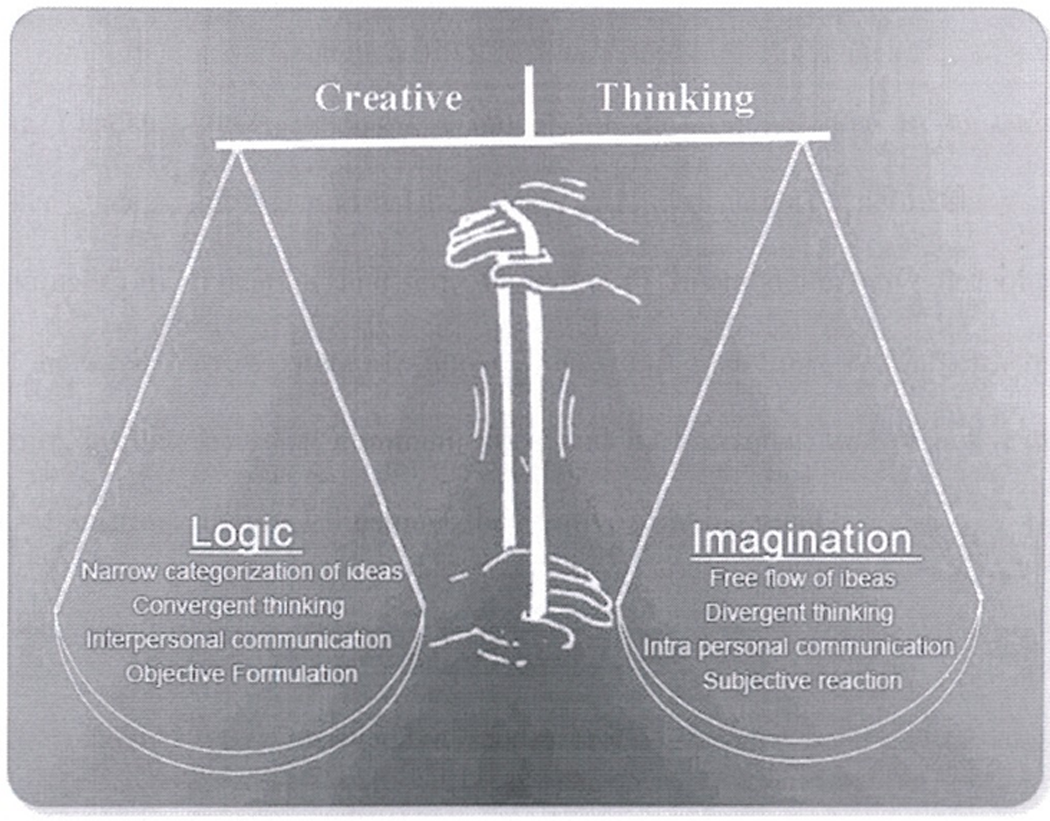
Creative thinking model (Landau, 2002).
Personal creative characteristics in childhood transformed into adulthood creativity
One significant event Landau experienced as a child was learning from Dr. Rappaport about the painting of Judith, and recalling his words struck a chord with her that led her to the deep realization of a new path that she wanted to take: Years later I went to see this painting in the Uffizi Museum in Florence. I imagined it was a big picture, but it was very small. I stood in front of the picture and understood the legacy. I realized I must answer the curious children’s questions. This was the turn from creativity to taking care of gifted children.
Landau is a very introspective and reflective person, who has always thought about making meaning of what happened to her as a child in the concentration camps. As an educator and therapist, she advocates speaking about the dark times, and for this reason she published her book Giving Sense (de-Nur, 2000).
Directing questions in order to find the right answers and working for the benefit of others are very important to Landau and she would like to instill them in children. Her experience in the concentration camps taught her to deal with a variety of situations: With time I dared to see that suffering was not in vain. Suffering could give another meaning. I think I am a better person because I taught myself to give. This is what I also teach the children, and especially to give to our country, because for me, Israel gave me back my feeling of being a human being. Creativity for me is not a state but an attitude of living and surviving. We are partners in our destiny, without our participation, stating and choosing alternatives, there is no real life. The ability to cope with the future is in us. We have only to free it … and learn how to use it creatively.
As a person Landau is just like the children she teaches. She never ceases to ask herself questions, and these questions are turned into positive ways of coping: I never give up. I am ready for surprises and go on asking what else? How else can you cope? You lose something and look for new ideas. You do not regret what happened. You ask questions like, what can I do about it?
Landau redirected her suffering to create an educational approach to help children who were similar to her. She actualized herself and became an innovator and leader in the field of gifted education in Israel, and in the world, because she understood that An up-to-date, innovative society needs conscious, daring, creative, flexible and self-actualizing individuals. To actualize one-self means to function according to one’s abilities…to become one’s potential. Life is a perpetual creative process.
Landau is an example of an individual possessing personal creative characteristics in childhood, which were developed and actualized by strong introspective and reflective abilities into an innovative approach of educating gifted and talented children. Her inner voice helped her create meaning of her suffering and transform it into a positive innovative outcome which has helped thousands of children.
Footnotes
Funding
This research received no specific grant from any funding agency in the public, commercial, or not-for-profit sectors.