







Abstract
In the 21st century support for gifted education and talent, as are many other earlier values and solutions, is being reassessed. In the age of rapidly changing values, keeping provision up-to-date is achieved through the continual rethinking, reviewing and challenging the concept of giftedness and talent. The perception and our understanding of what is described as ‘talent’ is a social product; that is, it is culture-dependent, but it does have some basic characteristics which are universal and which help us understand what is meant by the term ‘talent’ both in the past and the present. However, talent is not a homogeneous concept, even though it is often depicted as such in talent support, scientific studies of talent and talent models alike. Talents with different development histories have different needs and the environment necessary for development can differ substantially by age and talent forms. Consequently, provision should not be homogeneous, either. In the present study, through a rethinking of the talent concept, I propose an approach which favours network-based functioning, an approach better suited for use in today’s culture.
Talent groups
Talent is a generic, umbrella term. Talented individuals differ from each other and from everyone else with regard to a large number of variables such as abilities, interest and needs. Different dimensions of heterogeneity therefore need to be taken into account in addition to the key common characteristics in talent provision and popular understanding of the concept of Talent.
The scientific study of talent which flourished in the 20th century was hampered by two basic problems: 1. Due to the heterogeneity of the concept of talent, it is far from obvious whether different studies are actually about the same phenomenon.
We can identify differences of definition and description in historical approaches. The geniuses described by Lombroso (1891) were physically disabled, and could be considered at best to be neurologically and mentally unstable, while in the study of Terman (1926), only a few decades later, geniuses not only had outstanding intelligence, but were also strong and healthy, as well as highly mature from a social and even moral point of view. It is impossible to believe that the two studies are about the same population without entertaining a suspicion of some serious error. We will return to this point later. 2. The experimental scientific approach to talent, and generally any study of talent that focuses on assessments, is unable to handle multiple aspects of talent.
The studies carried out under controlled conditions in the laboratory of Sir Francis Galton and later his followers revealed several important aspects of talent (Galton, 1869). These very same conditions, however, made the study of several other important aspects of talent impossible.
A quantitative definition of talent as used by Galton fails to provide an explanation for a number of phenomena without a description of the thinking processes and an understanding of the qualitative characteristics inherent in the development and functioning of talent.
The first problem, therefore, is an approach that significantly reduces the efficiency of talent provision, namely, one that is about ‘talent’ in general and according to which talent provision is designed for the ‘talented’ in general. This problem is similar in some ways to cancer research. Hundreds of billions of dollars have been and are still consumed by studies in which researchers seek a cure for malignant tumours or, in the case of mental health research, seeking to match ‘cause and effect’ and cure mental health issues. However, the more medicine knows about tumours, the more certain it appears to be that there will not and cannot be any generic cure for cancer which is able to treat and eradicate each and every tumour. In a similar vein, it is impossible to provide for ‘talent’. Talent is heterogeneous, as should be its provision.
To date, talent support has started to reach the level where, similar to cancer research, it has abandoned universal solutions and, based upon the accumulated knowledge, looks upon the issue in a more differentiated way. What remains, therefore, is for us to put this into practice.
Research and practice both reveal that there are easily-discernible groups of talents and that these require different provision for their development. Talents linked to specific areas of ability and interest must receive area-specific provision, but over and above that there are also talent groups which can be set apart on the basis of other criteria and which differ substantially in their developmental characteristics. The development of a child prodigy is very different from the development of a late-blossomer talent and both differ from a harmonically evolving talent. A gifted child with specific learning difficulties or highly able persons with autism show very different developmental patterns.
We generally think of a differentiation in terms of ability levels, and talk about talents, outstanding talents and geniuses. This is also a valid approach, but it is not a substitute for taking the difference in the development and needs of these talent groups into consideration. An outstanding talent in, for example, hockey or economic analysis may mask other talents worthy of support and development. There will be students who with double exceptionality have multiple talents and double exceptionality which will present complex, and multi-agency, solutions.
Confucius (552–479 BC) classified outstanding individuals as follows (Harsányi, 1994: 18): The dull, who gain knowledge by overcoming difficulties through the devotion of great effort; The mediocre, who primarily gain knowledge through learning; The intelligent, who are born with knowledge; and Those with marvellous abilities who can outstrip ten thousand others.
This classification has reached us through the intervention of several translation steps. Just as there is still a debate about whom we call talented, it is not evident whom Confucius called ‘outstanding’. If we believe our sources, Confucius lists ‘dull’ and ‘mediocre’ individuals even among the outstanding. One clear conclusion can be drawn: from the categories offered by Confucius in his categorization there are at least four kinds of groupings leading to high achievements.
In the 19th century, Sir Francis Galton (1869) characterized the level of talent according to its prevalence. In his statistical view, outstanding individuals are those who represent a small percentage of the population. In his examples, judges and bishops reached the level that only one in four thousand could: geniuses were one in a million.
Lombroso (1864) chose detailed descriptions as the basis for the distinctions. He believed that talents are conscious, and know why and how they can arrive at certain principles and conclusions, while geniuses are unconscious, and are unaware of the ‘why’ and ‘how’. The higher the mental ability, the higher the sensitivity, as well.
These two outstanding thinkers of the 19th century captured all that science has since worked outto date: that some forms of talent are more frequent, while others are more rare, and these forms exhibit different, complex and interwoven mental and emotional functioning. As a result of this complexity, they also have different needs. What is noteworthy is that in order to ensure suitable provision, we need to know the differences in the manifestations and particular needs of talent.
Talent forms based on statistics
When talking about talent provision, we are not considering an elite, but rather wide layers of the population. Renzulli (1986) characterized 20–25% of the population as the ‘talent pool’, while Gagné (1999) labelled 10–15% of the population as gifted on the basis of their ability. If we accept these ratios, we can see that at least 4–7 children in each typical kindergarten or school class will enter the talent pool.
If, for the sake of simplicity, we only consider intellectual abilities at present, then approximately this means an intelligence quotient of 110–130, the above-average individuals. These children have the potential to become talents such as Albert Einstein or Marie Curie, or outstandingly achieving individuals who manifest themselves in some other way. Their development is not promoted by singling them out and isolating them; all the more so because at this level a potential for the development of talent is not clear-cut and the identification of talent itself is certainly not feasible and so serious mistakes can be made (nZiegler and Stoeger, 2004; Freeman, 2006).
The next, higher level of ability, however, involves a qualitative difference. Hollingworth (1926) calls the intelligence quotient range 125–160 as the ‘socially optimal intelligence’. In her studies she found that these children are balanced, assertive and are able to build up a good social situation for themselves.
They can be the ‘ideal talents’, that is, the individuals who are easiest to identify by virtue of their outstanding performance and relative pliability. This is the talent Terman (1926) targeted with his IQ-based study at Stanford University. Five to seven percent of the population falls into this category, which indicates 1–2 such children in a typical school class.
The integration of children with an intelligence quotient above 160–180 is, however, greatly hampered by the inordinate difference in their thinking in comparison to the intellectual capacity of those in their environment (Hollingworth, 1942).
This problem is strongest at ages 4–9 (Hollingworth, 1931). These are the exceptional or outstanding talents and their unconventional way of thinking, attitude and reactions can be the source of much misery to them in a social environment. Outstanding talents comprise not more than 1% of the population, but are of immense significance. At this level of ability, talent is unquestionable, but what is questionable is whether and how the individual can turn it into achievement.
This outstandingly talented population can be classified as special talents due to its particular situation, and differs significantly in its provision from the populations at the other two levels of talent and ability.
It is primarily this population about which Lombroso reports in his studies. He writes about geniuses who struggle with bigger difficulties than the other two groups as regards integration. Beside these outstanding talents, Lombroso also describes another group of talents at a disadvantage with respect to integration, namely, multiple exceptional talents.
Multiple exceptional talents or, stated perhaps more appropriately, talents in a special situation, are those who have to cope with some special situation or condition over and above talent.
Talents have an exceptional attitude and personality, which is an exceptionality in itself and thus gives rise to what can be regarded as a minority situation. This may be coupled with other exceptionalities of different natures combined in many cases with lack of opportunity or exposure to pathways to realize a talent or potential in a talent areas, such as: Socio-cultural situation; Ethnic-minority situation; Neurological differences; Behavioural and emotional exceptionalities; and Sensory–kinaesthetic differences.
All of these exceptionalities can also be regarded as a minority situation, and due to the difficulties with integration into society of the majority, they often lead to disorders and difficulties, giving rise to: Socio-cultural disadvantage; Ethnic-minority situation; Neurologically-based achievement disorders, most frequently with a diagnosis of learning difficulties, dyslexia, dyscalculia or dysgraphia; Behavioural and emotional disorders, most frequently with a diagnosis of attention deficit, hyperactivity disorder, autism or Asperger’s syndrome; and Sensory–kinaesthetic disorders, most frequently with a diagnosis of blindness, visual impairment, deafness, or reduced mobility.
Multiple exceptionality therefore stems from the special situation of these individuals, who can thus be referred to with the working expression talents in a special situation (see Figure 1)
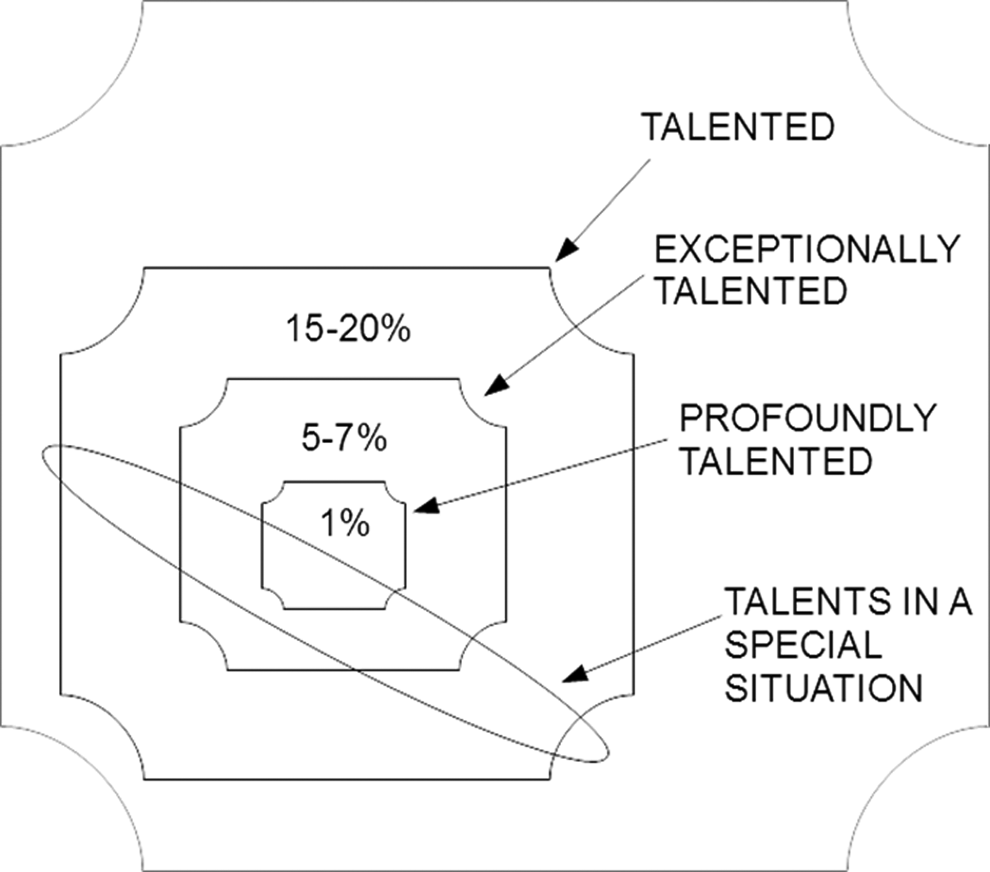
Talent groups and their estimated ratio in the population. In a wide talent pool, we can establish ability levels which make the manifestation of talent more probable. At the same time, there are some factors which give rise to special situations and cases in talent development. We are unfamiliar with the size of this latter talent population.
Irrespective of the strength of the talent aspect, we can find individuals at all levels who start out from an atypical position because of their special situation. The position of outstanding talents is exceptional even within the talent population, because their way of thinking and reactions differ radically from that characteristic of what may be described as regular talents. They usually become labelled as having behavioural and emotional disorders in areas where institutions and existing expertise can be brought in to ‘treat’ such children and thus often become talents in a special situation in a similar way to people classified historically as ‘lunatics’, being recognized as having mental health issues rather than learning needs.
Professionals working with talent and giftedness describe the manifestations of talent in different ways and different ratios, but groups of talents with different needs are discussed in the literature.
Gross (1993) was one of the authors to call attention to the difference in the needs of children with an IQ between 130 and 180, which should be taken into account in designing their provision. She proposed the following classification of outstanding individuals based on the level of their intelligence quotient. Moderately gifted, 130–144 Highly gifted, 145–159 Exceptionally gifted, 160–179 Profoundly gifted, 180+.
The four categories bear an uncanny resemblance to the categories of Confucius, as if these were the 20th century psychometric projections thereof. As such, it is also apparent that the use of ratios and numbers in capturing degrees of talent provide much less information about its development than the perhaps wiser, ancient designations.
Gagné (2000), also following the Galtonian statistical tradition, regards an individual as outstanding if, with reference to the normal curve of natural abilities, the individual is among the top 10% of their age peers in the domain of the relevant ability or activity. The top 1% are moderately, the top 0.1% highly, the top 0.01% exceptionally, and the top 0.001% are extremely gifted or talented in his classification. This classification seems compatible with the system devised by Gross based on the intelligence quotient, although Gross spoke of intelligence level rather than giftedness and talent.
If we think in terms of Gagné’s system, the total number of talents can exceed 10% of the population, because even though overlaps are possible it is mostly not the same individuals who are talents in different domains. For example, the individuals who make it into the top 10% in the domain of musical abilities are not identical to those in the domain of language abilities, and so in total we may arrive at Renzulli’s 20–25% as an estimate for the talent pool.
The basic attitude of talents
Notwithstanding the heterogeneity of talent, a common basis can be identified: an attitude combining sensitivity, obsession, effectiveness and productivity, which many authors have described, but which is always worth re-examining. ‘There is no great genius without some touch of madness.’ (Seneca)
The question asked by talent is not ‘Can it be achieved?’, but ‘How can it be achieved?’. This attitude unites the internal drive, which is responsible for motivation and supplies the energy for the efficient activity and creativity which seeks out options and alternatives. This attitude can be manifested in diverse domains, and so even a modest degree of above-average ability can be sufficient for outstanding performance. This is what Renzulli’s (1978) now classical ‘three-circle model’ addresses: it is also illustrated by a number of outstanding achievements and their originators.
In his book Ben Mezrich (2009) a former friend and colleague of Mark Zuckerberg – the social network founder – formulated the following statement in connection with Zuckerberg, a man who became a billionaire at a young age and who hacked into Harvard university’s database when creating Facemash, a system that can be regarded as a forerunner of Facebook: Kind of an extension of the hacker’s creed: if there’s a wall, you find a way to knock it down or crawl over it. If there’s a fence, you cut your way through. The people who built the walls, the ‘establishment’ – they are the bad guys. The kid is the good guy, fighting the good fight. Information is meant to be shared. Pictures are meant to be looked at. — (Mezrich, 2009, chapter 6)
Science, true to its paradigm, studies talent and its components through an approach of categorization and gathers information for use in practice this way. In gifted education and talent provision, however, the categories themselves are no longer valid: it is only the information that can be utilized. There are merely situations in which the processes described as lying behind the oft-described characteristics are set off and lead to effective and productive activities.
The vectors of the talent force
Abilities, creativity and motivation can be studied in isolation, but they are not pertinent without each other. In what follows, I will establish the inseparability of these relations in development.
The ABILITY-CREATIVITY vector: Creativity forms an organic unit with its subject, at which it is directed.
Creativity is not simply fantasy at work, but the joint manifestation of logic, learning, knowledge and fantasy (Landau, 1974). Knowledge in itself is not sufficient beyond a certain point in the creative process, which is the point where fantasy sets in, seeking, and in fortunate cases finding, new solutions. Beyond that point methodical knowledge is needed once more; that is, working it out is what will make a new piece of knowledge usable.
A model set up quite some time ago now to understand the relationship between intelligence and creativity is the so-called ‘threshold’ conception. A moderate correlation has been found between intelligence and creativity up to an IQ-level of about 120, but above this neither the intelligence quotient nor academic results can predict the degree of creativity (MacKinnon, 1962).
According to McNemar (1964), should the most intelligent 1–5% be selected as the talent population, then a quite sizeable percentage of creative individuals would fail to make it into the group. In other words, high IQ is no guarantee for creativity, though low IQ, in turn, leaves no possibility for it.
The CREATIVITY-MOTIVATION vector: Research from very different domains shows that creativity also has an extremely large motivational content.
Empirical investigation over many years has proved that extrinsic motivation reduces creativity, and that the intrinsic motivation is conducive (Amabile, 1985).
Questionnaires targeting creativity often identify motivated children (Gyarmathy, 2007). According to Barrett and Morgan (1995), the ‘mastery’ motivation is multidimensional and self-rewarding and incites the individual to persevere in situations presenting at least a minor degree of challenge in which skills need to be mastered and tasks need to be solved. The two chief components of the mastery motivation are:
The instrumental component; and
The expressive or affective component.
The instrumental aspect may be manifest in cognitive tasks, social relations and motor activities.
The strong connection between creativity and mastery motivation is indicated by the fact that in the study of the creative climate by Péter-Szarka Szilvia (Szilvia, 2012a, b), mastery motivation was a much better predictor of the effect of the creative climate than creativity test results.
Talents have a very strong mastery motivation, a power to achieve, a power to create: the creative power.
The MOTIVATION-ABILITY vector: Ability development is engendered by persevering action, which is in turn sustained by interest and learning-directed energy.
The interplay of these three vectors is illustrated in Figure 2.
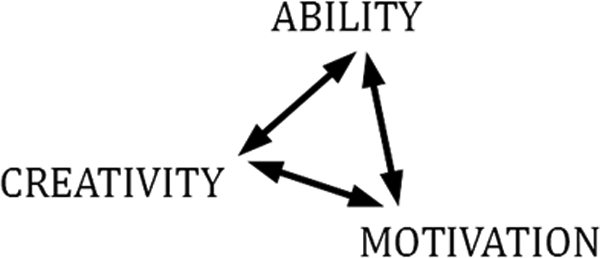
The attitude characteristic of talent is not simply the result of three characteristics, but the interplay of three vectors, three directions of force.
Most talent models, like the classical model proposed by Renzulli (1978) or that by Tannenbaum (1986) describe intelligence and motivation as two separate components of talent, even though they are not independent of each other. The force and the direction of effort depends on the level an individual is capable of achieving in the particular domain.
Ericsson et al. (1993) showed that in most diverse domains outstanding achievement requires at least ten years’ grounding and exercise. They did not find a single case in which someone reached the top without exerting effort. It seems that what distinguishes outstanding individuals from others is that they work much harder. According to their results the difference between those who achieve remarkably and those who achieve merely well lies primarily in the amount of time dedicated to practice.
Gladwell (2008) found that the foremost deciding factor is for our work to completely fill our personality and cause us pleasure. People are highly motivated to carry out sensible work, talented people even more strongly so. Sensible work is interesting for the individual, it is complex and provides autonomy. We can call this the optimal challenge and we arrive at the sense of flow as described by Csikszentmihályi (1990).
Productivity can be described as an energy field which incorporates creative energy, motivational strength and mental efficiency, thereby making achievement possible. Each factor is connected with the others, and the whole thus forms an organic unit. In addition, this organic form operates through the utilization of environmental factors.
Task makes talent
The slogan, ‘I don’t care if it’s impossible’ unifies intrinsically the mastery-directed internal drive, the search for solutions and the knowledge necessary for it. All of this is steered towards creative directions by the challenges the individual encounters. The optimal degree of challenge is highly person-dependent, but is definitely a necessary condition of development. Challenges determine the direction of talent development. The internal drive finds itself a subject and grows into interest. The optimal level of difficulty presented by the task and the search for solutions provide an opportunity for further development. The Beatles would play in a small local club in Hamburg for years as a minor, unknown and underpaid band under rather poor circumstances. They played and thereby practised and thereby improved more and more, and so received more and more invitations to play and started becoming successful. Soon, they would be playing eight hours each night every day of the week. By the time they hit the international stage, they had given over 1200 concerts. Today’s bands never play as much put together during their career.
The Beatles used their initial less than perfect performances as opportunities to practise and improve. They were motivated by a complex set of needs and imperatives. It is often such forced situations that present the individual with opportunities. If it is necessary to work overtime to make a living, it will detract time from individual development activities, and there will not be enough time to practise. Where the outstanding differ is that they turn everything to the benefit of their development: even working overtime.
The productivity at work in a talent will surface whatever it takes, because the tension inherent in the internal drive makes it impossible for a gifted individual to while away the time doing nothing. Mastery motivation, creative power – however we describe it and from whichever way we approach it – strives for and seeks activity. Once it finds its subject, the challenges it is faced with will broaden its domain.
The leading talent models capture all this in different ways, but we often lose sight of the simple details and confuse different concepts precisely because of scientific accuracy.
The Gagné model (2000; 2003) makes a distinction between giftedness as a potential and talent that is actually realized. He makes several attempts to bring order to the chaos prevalent in the relevant literature.
The problem Gagné raises is that the term ‘giftedness’ is most frequently used to denote high cognitive abilities, while the word ‘talent’ is used to refer to other forms of giftedness (such as those in the domain of sports or art). In other cases, ‘giftedness’ and ‘talent’ signify potential and realized talent, respectively. Gagné himself favours this latter usage.
Gagné, in his ‘Differentiated Model of Giftedness and Talent’ eventually applies the term ‘giftedness’ to those superior natural abilities which place the individual in the top 10% of the relevant age group in at least one domain of abilities. He uses the term ‘talent’, in turn, for individuals who make it into the top 10% of the relevant age group by virtue of systematically developed skills and activities. A considerable number of factors mediate superior ability during this development.
It is clear that the 10% of gifted and the 10% of talented will not be the same population, because the catalysing factors designate the development. Equally, it is clear that the ‘10%’ is no more than an arbitrary statistical statement. There are far more gifted persons by nature, and a network of the necessary inner and external factors affect the development. Optimal task and challenge is a key.
Practice shows that talent manifests itself and environment takes notice of talent in situations in which the degree of challenge is exactly right to set off productivity. An excellent example is the primary school in Hejőkeresztúr, Hungary.
This school, at first sight, does not appear to be a stronghold of talent with 70% of its students having multiple disadvantages and/or special education needs, and thus the craze for talent identification missed it entirely. Nevertheless, through the use of optimal tasks, the school as a whole achieves better results than comparable populations, and talents have automatically surfaced and continue to reap successes (Kovácsné, 2000; 2005; 2007).
Problems are often caused by the failure of the social environment to provide a suitable challenge for the internal drive, as a result of which productivity will find ways in undesirable, perhaps overtly antisocial directions, rather than toward realizing talent. The result may be empty, obsessive and/or destructive activities. These do not conform to the ‘value criterion’ of giftedness set down by Sternberg (1993), see Figure 3, although productivity may be apparent even in criminality.
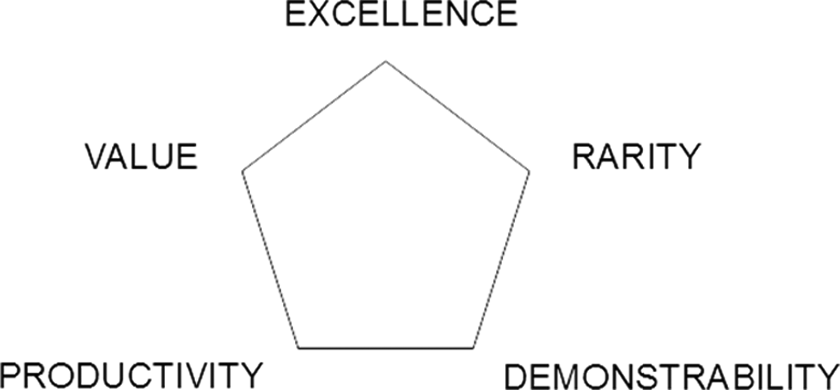
The pentagonal model of Sternberg (1993). Sternberg described the criteria of giftedness in a pentagonal model. Based on this, talent is manifest in rare, excellent, demonstrable and valuable productivity.
The gifted individual’s pursuit of activity often leads to behaviour that is unacceptable for the community if the individual fails to find a suitable challenge. In the case of outstanding talents this can be especially overwhelming, manifesting itself as a disorder, as a result of which the individual will become a talent in a special situation.
The social environment conveys social values to the gifted and talented through tasks. Values change and so, therefore, does giftedness that turns into achievement: that is, talent.
Talent is something we invent rather than discover. It is what one society or another wants it to be, and the concept therefore regularly changes with the needs of the particular society. Having a usable definition of talent has beneficial consequences for both the society and the individual. However, if the definition is not usable enough, valuable talents will be lost and the support and encouragement will benefit less valuable ones. This is why it is important for us to understand what the concept of talent means to us and others (Sternberg, Davidson, 1990).
The value system of the culture and the society serve as filters. If the gifted are presented with challenges along the lines of these values, then those talents will emerge who represent a value for the relevant society. Efficient gifted education is therefore inclusive and offers tasks and challenges suitable for development, thereby providing an opportunity for achievements as high-level as possible.
Social values – that is, the way of thinking characteristic of the community – govern the manifestation of talent not only with respect to its domain but also its associated personal characteristics. If, for example, society does not regard achievements easily attained as a value, then it will have a preference in gifted education for the ‘dull’, who achieve talent through struggles, and will regard the ‘intelligent’, who were born brilliant, with suspicion. However, each kind of talent is valuable. What is more, heterogeneity itself is valuable.
A society which offers only a limited number of possible routes and ignores or even penalizes other achievements will severely limit and restrict the growth of the talent pool it educates. A talent-friendly society makes a variety of tools accessible for development and tolerates heterogeneous routes of development. If however a society treats the dimensions of achievement and effort as contrary to each other, it will continue to keep the population capable of outstanding achievements through outstanding abilities in a disadvantaged position.
The founders of Microsoft, Bill Gates and Paul Allen, left college to found their company. Does this mean that it is not worth going to college and study?
Avoiding college is not necessarily a key to success, but learning and studying definitely is. Education and learning are not the same, even if society often believes they are and values certificates of qualification instead of knowledge. As Albert Einstein said, ‘The only thing that interferes with my learning is my education’.
Development of talent is made possible by the challenge and, of course, the tools necessary for an intensive activity. All that is then required is an internal need, the ‘touch of madness’ mentioned by Seneca. When the environment fails to present talents with a suitable task, their drive will compel them to search for it and they will thus not rest until they find both the suitable challenge and the tools for the task.
Bill Gates spent thousands of hours programming. He attended an elite private school which in 1968 had a computer. The school purchased the computer terminal for US$3000 for its computer club. In those days, even universities offering access to a computer were rare. Gates was fortunate to live with his parents near such a university and so he could gratify his obsessive programming desires by sneaking into the university at night: he gained a significant advantage as a result (Gladwell, 2008).
Several thousand other students grew up under the same conditions as Bill Gates, but they never became ‘billgates’, either because this was not their route, or because they were not insistent enough on their route. Talent is best characterized by an overwhelming internal force. This is what makes it different and this is what will not permit it to be diverted from its activity, which is what happens to others. This internal force compels the talent to grasp everything for the sake of its development.
Talent is not pliant and it is not easy to accept and like. The autonomy of a talent capable of performing at outstanding levels can be unpleasant for its environment, but may also be highly profitable from the point of view of achievement. A talent builds a network for itself using elements of its environment and adjusts and harnesses them to support the attainment of its goal, as Bill Gates did.
The attitude characteristic of talent is embodied in network thinking
The basis for outstanding achievements is never a single ability or a single type of knowledge. New solutions are always born of new combinations of old possibilities.
In addition to internal drive, talents also have the ability to mobilize knowledge and even the ability to acquire knowledge from somewhere else. The key to success lies not only in recognizing problems and incongruities, but also in creating new connections.
Creative thinkers connect what appear to be unconnectable, because their knowledge makes it possible to approach the situation from different angles and they are also able to mobilize mutually distant functions within themselves.
Talent is characterized by functioning that is strongly network-based. This does not necessarily appear in the social activities of a talented individual, since network thinking has several levels.
The essence of network-based functioning is captured in what Csermely (2008) wrote about creative elements: They have significantly more transient weak links than average; They are in the overlaps of multiple modules, and change modules by virtue of their transient links; and They can have a key role in the new integration of disconnected modules following stress.
A problem situation can be regarded as a crisis or a stress situation, in which old solutions are no longer functional and so new solutions are needed. In this case, it is not sufficient to know any of the old solutions well enough. The situation calls for several old and new solutions and their integration.
Talents thus regard each situation as a learning situation, but they retain what they learn in such a way that it can be mobilized and changed, and so they are able to employ it easily in a new context.
Thomas Alva Edison, for example, did not invent the light bulb, but merely found the solution for a usable bulb by learning from the deficiencies of earlier attempts. Albert Einstein did not invent anything new, but simply integrated existing pieces of knowledge in a novel way. Both of these individuals developed insights and actualized the research and work of others in order in turn to create new insights upon which others could build.
Siegler and Kotovsky (1986) described two major forms of giftedness decades ago. One is the schoolhouse or test-taking talent, an excellent professional, the user of knowledge, the ‘consumer’. Such individuals are easy to identify, because they can be outstanding at academic tasks at school and they can solve tests dependably. Creative-productive giftedness, however, is characteristic of creative thinkers, the ‘producers’, whose identification is neither easy, nor fast.
It is open to debate whether we can genuinely call individuals ‘gifted’ who merely use knowledge but do not create it.
Naturally, academic success does not preclude someone being a ‘producer’. On the contrary, knowledge is very important and indispensable. Not even ‘producers’ can create new links without the knowledge of the old elements; but even the most profound knowledge is insufficient in itself in solving an as-yet unsolved problem, or in reforming some domain. A characteristic of creative-productive giftedness is network thinking, which makes it suitable for such tasks.
Network-based thinking is often manifested in interdisciplinarity, the transition between different scientific domains. The opportunities for interdisciplinarity are continually growing, because scientific disciplines themselves are starting to become interdisciplinary. For quite a few decades now, proficiency in a single domain has not been sufficient for outstanding achievements.
In our digital age, work tends instead to be organized around problems, projects and tasks to be solved. The number of hybrid areas is increasing. For example, and staying with questions of human learning/development, we now have psychopedagogy, pedagogical psychology, neuropsychology and psychophysiology, sociopsychology and sociopedagogy in addition to simple physiology, pedagogy, psychology and sociology (Gyarmathy, 2013).
Interdisciplinary associations and organizations are also becoming more and more frequent, an example being the ‘International Society for the Interdisciplinary Study of Symmetry’, whose members include, beside several other distinguished scientists and artists, the engineer Dan Shechtman, who won the Nobel Prize in chemistry for proving the existence of quasicrystals. Symmetry and interdisciplinarity played a major role in his thinking about crystal structures, but so did the fact that he approached a problem in chemistry and mathematics as an engineer. According to theory, the crystal he found could not have existed. That is why he called it a ‘quasicrystal’. Using his engineer’s way of thinking, he transcended pure theory and took the small errors of nature into consideration when calculating the possibilities, which led him to his discovery.
Researchers often adapt the results of one discipline in another. Péter Csermely (2008) applied their results about networks in natural science to sociological processes, among others.
Talents often create professions for themselves when going in new directions, as did, for example, Dr Bertalan Meskó, a medical doctor already showing outstanding thinking abilities in childhood, who engaged in the study of the tools and communications of the digital age and created the profession of a ‘medical futurist’ for himself.
The highly intensive grounding of talent involves exploiting everything for the sake of its development. It discovers opportunities related to its subject everywhere, ‘associates everything with it’. Thus, a composer might think of a tune at the back of his mind when taking a shower, inspired by the sound of the water; or it may require no more than an apple falling from a tree for a scientist to work out a general theory of why this occurred.
The network-based functioning of talent is multi-levelled, and forms an activity network composed of elements which are difficult to isolate. It can be realized as: Interdisciplinary thinking; A joint artistic and scientific approach; Organization of information; Organization of resources of information and tools; Linking of distant ideas and elements; Linking of professional groups; Organization of social relations; and The touching of other minds and other forms of thinking.
Summary
When considering the education opportunities for the gifted and talented, it is important to take into account that giftedness and talent are heterogeneous, and their different forms require different provision. At the same time, a basic attitude common to all talents is what Seneca called ‘a touch of madness’ which appears as the ‘network power’, and roots in the ‘I don’t care if it is impossible’ attitude.
Giftedness and talent is an extraordinary natural force which keeps this specific attitude in motion. This attitude stimulates the individual to persevere in activity, search and effort. Experience gained through search activities grows into knowledge, which opens up increasingly greater opportunities for achievement. Talents make available the inordinate amount of time necessary for grounding through network-based functioning. They integrate the available factors and use them to help in achieving their goals. The key is whether there are available factors at all in the social dimension or that the talent should turn to asocial or antisocial directions to discover what the inner drive urges.
Talent is the result of a highly efficient and active network-based functioning emerging in a network of diverse factors. Understanding and promoting it can best be achieved through a network of provision. Thus, gifted education and talent support itself should strive for a network-based structure.
Footnotes
Acknowledgements
I am grateful to the children, young and adult talents, their parents, teachers and mentors, because I obtained my knowledge mostly from working with them. My special thanks go to John Senior for his valuable advice on this study, and to Anna H. Nagy, the Associate Professor of Eotvos Lorand University, for her continuous support of my professional work.
Declaration of Conflicting Interests
The author(s) declared no potential conflicts of interest with respect to the research, authorship, and/or publication of this article.
Funding
The author(s) disclosed receipt of the following financial support for the research, authorship, and/or publication of this article: This research was supported by the Literacy Project (7th Framework programme, Nr. 288596).