






Abstract
Giftedness often is seen primarily in terms of individual differences in abilities—with some individuals standing above others. However, what are perceived as differences in abilities are sometimes, rather, differences in stances—decisions made by individuals as to how to utilize their abilities. These stances, as expressed in the utilization (as opposed to the mere possession) of abilities, are analytical--to stand out and over; practical--to stand with and fit in; creative--to stand apart and against; wisdom--to stand beyond; and courage
When educators think of giftedness, they sometimes think of it as a “thing,” or as a single quality, such as IQ or some form of achievement. On this view, what distinguishes the gifted from the rest, perhaps largely although not necessarily solely, is their IQ or a related ability construct such as general mental ability (GMA) (e.g., Gross, 2004; Hollingworth, 1926; Jensen, 1998; Neubauer & Opriessnig, 2014; Silverman, 1993; Terman, 1925; Wechsler, 1958). A more nuanced position views giftedness as comprising multiple abilities, talents, or intelligences (e.g., Gagné, 2004, 2005; Gardner, 2011; Thurstone, 1938). A still more nuanced position views giftedness as comprising abilities and talents but also other attributes, such as motivation (e.g., Cross, 2011; Feldhusen, 1986; Renzulli, 1978, 2002, 2005). An even more nuanced view considers the cultural and other contexts in which one lives (e.g., Ford, 2011, 2013; Gentry et al., 2022; Lee et al., 2022; Olszewski-Kubilius & Thomson, 2015; Subotnik et al., 2011; Tannenbaum, 2003; Ziegler, 2005).
How does one even identify children (or adults) as gifted? The underlying basis for the current model is the implicit theory of giftedness presented by Sternberg (1993) and elaborated on by Sternberg and Zhang (1995). One recognizes giftedness through the work children (or adults) do. First, the work is excellent. Excellence refers to the consistently superior, impressive quality of the work that has been done. Value means that there is a knowledgeable audience of good judgment that believes that the products are significant, important, or consequential in some way. Rarity signifies that whatever it is that the individual does well, there are not a lot of other people who can do it at the same level. Demonstrability signifies that the individual can show, in some meaningful manner, that they excel in their work; they do not merely say they do excellent work or act as though they do such work without showing concretely that they produce the excellent work. Finally, productivity signifies that the individual can repeat their excellent work—they are not just one-time wonders or people who achieved recognition primarily through good luck. Giftedness is represented by the intersection of these five elements.
This article presents a model of five stances of giftedness in action. In the ideal, they would be combined in a single individual. In the real world, they may not be combined but rather distributed among gifted individuals. However, they are not mutually exclusive, nor are they simply inborn: They are stances through which individuals, drawing on their gifts and talents, put their gifts into action. They may lead to the development of certain gifts and talents over others, as gifted individuals who emphasize a stance also emphasize the development of those abilities that are relevant to that stance. They derive, in part, from Sternberg’s (2005, 2009) WICS (wisdom-intelligence-creativity synthesized) model of giftedness, but go beyond that model. In particular, this article is the first to attempt to explain how analytical, creative, practical, and wisdom-based aspects of adaptive intelligence and giftedness (Sternberg, 2021b) relate to each other in terms of alternative but also complementary stances for giftedness in action. Each stance constitutes a distinctive way of putting giftedness into action.
What, exactly, is a stance? A stance, quite simply, is an “intellectual or emotional attitude” (https://www.merriam-webster.com/dictionary/stance). The claim of this article is that stance matters at least as much for giftedness and how it will be utilized as do abilities. Largely the same components of information processing are used in a wide variety of intellectual and other endeavors. Individuals have a choice as to how they prefer to utilize them. Thus, a stance is not an ability but rather how one chooses to utilize the ability. It is not a trait because it is not built into a person and is certainly not a matter of genetic determination; rather, it is something one decides upon, literally, every day. A stance is not a particular behavioral tendency, because there are many different behaviors that can result from a stance, with the behaviors depending on the task at hand and the situation in which the task is encountered. And it is not merely a motivation, such as achievement or affiliative motivation, but it can be a basis for how those motivations are expressed in the everyday world. A stance reflects a value system, but two people could have similar or even the same value systems but come to different conclusions as to how to express those values (e.g., in political work or in scientific work). A stance, rather, is simply a choice about the utilization of one’s intellectual capital, which can be affected by a variety of emotional states at a given time and in a given place.
It is particularly important to distinguish a stance from an ability, even an ability, broadly defined. As Sternberg (2022a, 2025a) has pointed out, adaptive intelligence in action depends at least as much on attitudes as abilities. Attitudes are not a matter of how well you do something, but rather, of how you think about what to do and not do, and then, how you choose to do or not do it. For example, in terms of general intelligence or general mental ability (Gottfredson, 1997; Sackett et al., 2020; see entries in Sternberg, 1994), it is one thing to have a high level of analytical and related abilities; it is quite another to decide whether to use those abilities in one’s life and how to use them. And it is quite another again to decide to enhance these abilities (Sternberg, 2002). Many people have the intellectual ability to achieve at high levels but decide that there are other things that are more important to them. Or they may be inclined to make decisions primarily on the basis of emotions rather than intelligence or rational thinking. In the theory of adaptive intelligence, creative, analytical, practical, and wisdom-based elements of intelligence have both ability and attitudinal components. This article is the first to suggest that the attitudinal component of each is of key interest not only as a way of manifesting intelligence in action, but also as a way of choosing, in the first place, how to manifest one’s intelligence, and thus, of classifying kinds of giftedness based on these stances.
Simply adopting a stance does not necessarily mean that one adopts it effectively, at least in terms of results. But stances, like most other things in life, improve through deliberate practice (Ericsson & Pool, 2017). As is true for abilities (Sternberg, 2002)—intellectual, musical, athletic, artistic, or whatever–one becomes better through guided practice, learning from mistakes, and setting and working toward goals for self-improvement (Dweck, 2017). With a stance, as with any kind of cognitive or motivational development, one can become more effective by traveling through one’s zone of proximal development (Vygotsky, 1978). Thus, one is not stuck at a particular level of performance with respect to a stance, any more than one is stuck at a level of an ability (Dweck, 2006; Dweck & Leggett, 1988; Feuerstein et al., 1980, 2006, 2010; Jaeggi et al., 2008; Klingberg, 2010). One develops one’s performance in a stance the same way one develops any other kind of performance—by deliberately practicing it and improving upon its execution.
This five-stance model in some respects reverses traditional views of the multiplicity of giftedness. The usual view is that individuals have different patterns of abilities, which in turn lead to different kinds and qualities of actions based on the individuals’ capabilities. This is fair enough: Certainly, people do differ in abilities and what kinds of actions they thus are capable of performing. But in this model, what is at least as important as the abilities for action, and especially gifted action, if not more important, is how individuals choose a stance or stances to utilize their abilities. This view stems back, in part, to Sternberg (2021b, 2021c). By choosing particular utilizations, individuals may develop certain relevant talents more, and others, less.
There are some commonalities among the stances. What exactly is it that is common to the utilization of intelligence, regardless of stance and utilization? From what common base do varied utilizations of intelligence and gifts of all kinds extend?
In the theory of adaptive intelligence (Sternberg, 2021a, 2022b), the metacomponents (executive processes) of thinking are the same for all these forms of intellectual endeavor followed by action. In every case, the metacomponents are to: 1. Recognize the existence of a problem—is there a problem lurking somewhere in one’s life that is in need of solution? 2. Define what the problem is—what is the problem that needs to be solved? 3. Mentally represent the problem—what are the various aspects of the problem, including ones that might not be obvious at first, that will need to be addressed and also that may help or hinder solution? 4. Decide that the problem is self-relevant—is the problem one’s own or a problem that one will allow or encourage others to solve, should they choose to? 5. Decide that the problem is of sufficient importance that it is worth one’s devoting the resources to solve it—does one really want to devote time, energy, and resources to solving this problem, even if it is self-relevant? 6. Allocate resources to solving the problem—if the problem is worth solving, then what will be needed to solve it? 7. Devise a strategy for solving the problem–how does one get to a solution, from where they are to where they need to go to get the problem solved? 8. Monitor solution processes—is the problem solving taking the problem-solver toward a solution, or is the problem-solver stuck, lost on a garden path, or otherwise not getting to the goal? 9. Devise backup strategies as called for—if needed, devise one or more backup strategies in case the first strategy (or more than one strategy) fails—how can the problem-solver get the problem solved, given that the first strategy (or further strategies) failed? 10. Evaluate the solution—once the problem appears to be solved, analyze the solution to ensure that one has really solved the problem—is what the problem-solver initially thinks is the solution, really the solution?
The claim here is that all problem solving must go through an iterative, sometimes recursive, series of steps toward solution, regardless of what kind of problem it is. Thus, metacomponential (executive) processing is always needed, and is, in a sense, the heart of adaptive intelligence (Sternberg, 1985, 2021a). This article claims, for the first time, that what differs across the different applications of intelligence and gifted performance is not just the abilities involved (analytical, creative, practical, wisdom), but also the stance one takes in problem solving.
Various studies have shown the relevance of executive processing across a very wide range of cognitive functioning (e.g., Baddeley, 2012; Bransford & Stein, 1993; Diamond, 2013; Engle, 2002; Friedman & Miyake, 2017; Miller & Cohen, 2001; Miyake et al., 2000). Consider an example of just the first two metacomponents and how they apply to various kinds of problems (for more detail, see Sternberg et al., 2008). For example, consider a task that could be approached in a variety of ways: Crime has been rising in River City! How might one approach this problem? Consider alternative ways of defining the problem, which are not mutually exclusive.
An analytical stance might lead someone to define the problem as understanding the causes—is it changing demographics, poverty, gangs that have moved into River City, failures of law enforcement, or perhaps some combination? A creative stance might lead one to define the problem as one of finding creative ways to fight the crime—greatly increasing penalties for crimes, increasing security in homes and businesses, hiring many more law-enforcement officers, asking whether everything counting as a “crime” is really a crime. A practical stance might focus on how to gather together resources, not necessarily creatively, to implement crime-reduction measures, such as allocating a larger proportion of tax money to crime prevention and crime fighting, providing police with more powerful crime-deterrent weapons, giving convicted criminals longer sentences, taking police out of safer areas and putting more of the police into high-crime areas. A wise stance might involve asking whether the community is supplying enough jobs for young people and whether it could provide more to encourage them to find more prosocial activities, asking whether schools are educating enough for character and positive community values and not just for academic content, whether people are being forced into crime and if so, how and why. A courageous stance might lead one to dig deeper, for example, into whether there is any collusion of city government with, or payoffs by, criminals; whether some seemingly legitimate businesses are criminal fronts or laundering operations, or to confront “respectable” systems that are believed to have connections to the criminals. These courses of action all would involve substantial personal risk. The stances are not mutually exclusive. They merely lead to somewhat different definitions of the problem, and then to different ways of solving the problem, or at least, trying to solve the problem.
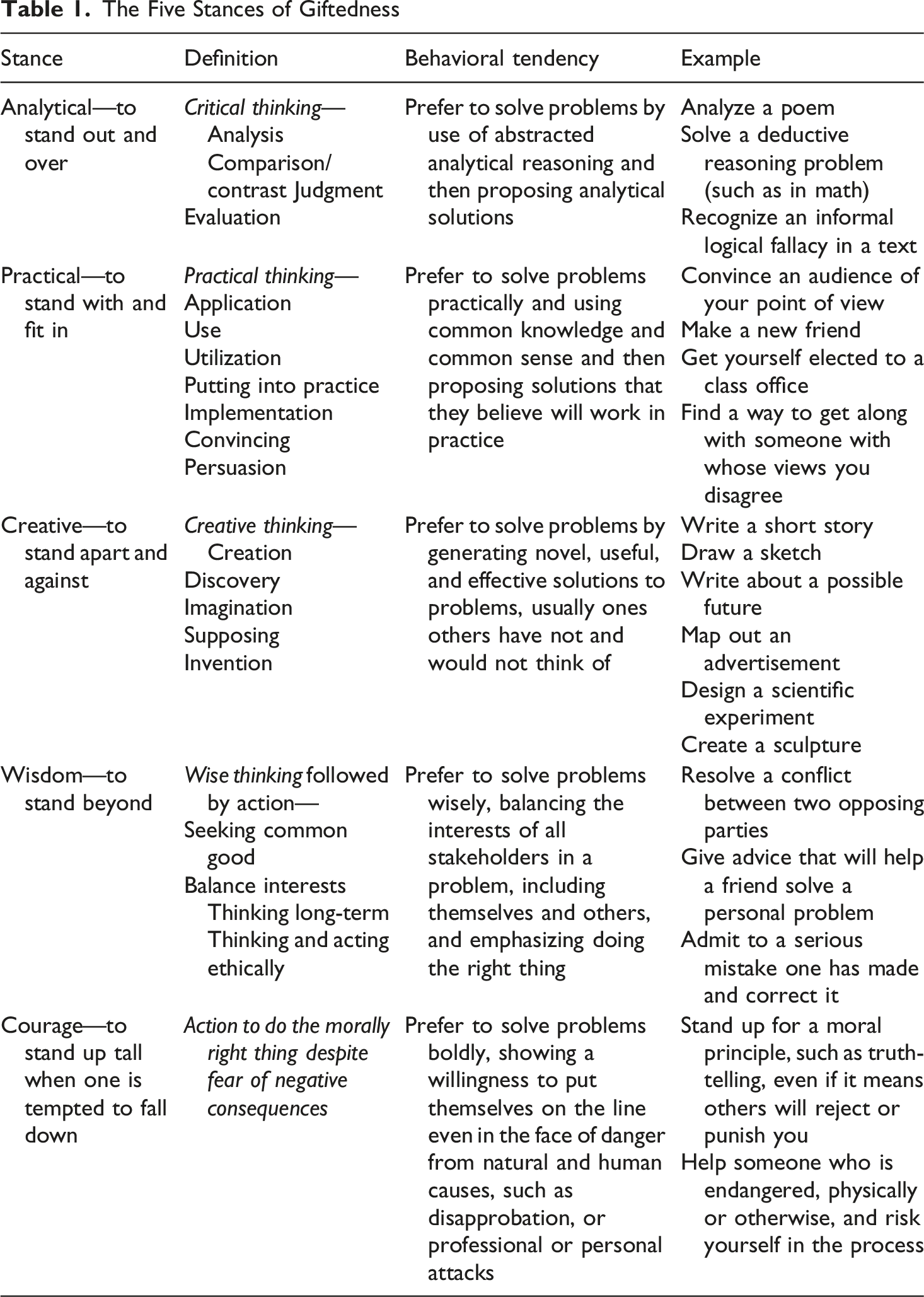
In particular, a person with a given pattern of abilities can choose to utilize their abilities (a) analytically, (b) creatively, (c) practically, and/or (d) wisely. They also can choose to utilize their abilities (e) courageously or not. Figure 1 illustrates the five stances of giftedness pictorially and Figure 2 illustrates them schematically. Table 1 illustrates the categories and examples of each. Five stances of giftedness pictorially represented Five stances of giftedness schematic represented The Five Stances of Giftedness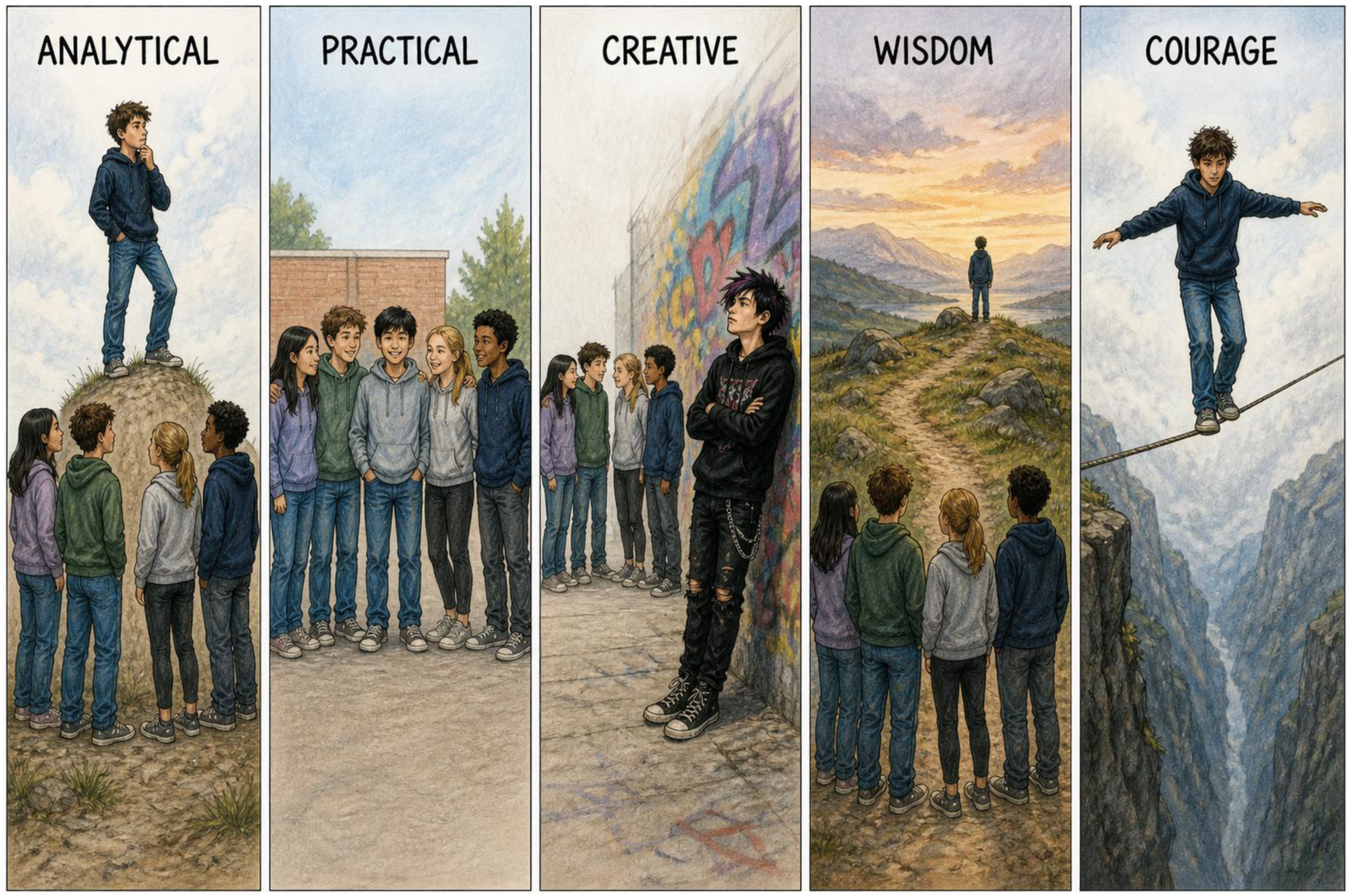
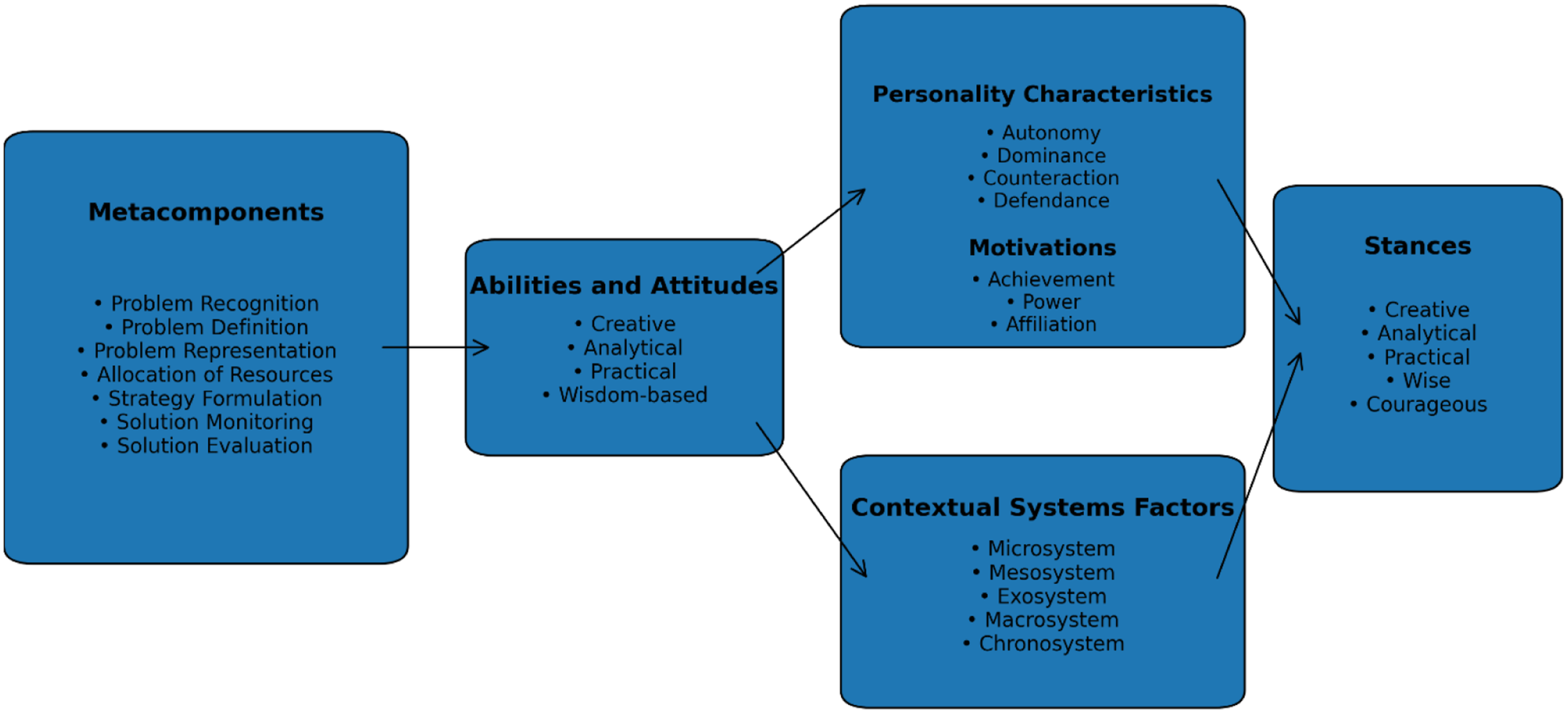
The five stances are not mutually exclusive. They interact with each other and with tasks, situations, and the audiences that observe them in action (Sternberg et al., 2023). One can adopt multiple stances or, of course, none at all. The stances also are not of a single epistemological class. Attitudes are multifarious and are determined by psychological categories, not logical ones. Sternberg (2020) has argued that in difficult and fraught real-world tasks (as opposed to the school tasks on which much of the abilities literature focuses) of consequence, there are, in most cases, four complex processes needed: creative to find a way to define or redefine a problem and solve it in a way that is useful and works, which may be entirely novel; analytical, to analyze the found problem and understand its elements; practical, to formulate a solution in a way that can succeed in the everyday world and that can be presented in a way to persuade others of its usefulness; and wisdom-based, to ensure that the solution helps to achieve common good, not just a good for oneself and one’s family, friends, and associates. The stance of courage is being added here because it has become clear to the author that, in these times, what people often lack is not abilities, knowledge, or resources, but rather, the courage to realize a course of action that may be risky and that, if it fails, may result in unfavorable or even disastrous consequences for oneself. The staggering corruption in organizations and governments around the world (see, e.g., Kellerman, 2004; Örtenblad, 2021; Lipman-Blumen, 2006; Sternberg et al., 2024) often makes it extremely difficult and dangerous to do the right thing, so that one may have all the resources it takes to do the right thing, but nevertheless, lack the courage to do it. Too often, cowardly actions are falsely presented to the world as “courageous.” In this case, people adopt a pseudo-courageous stance. In that case, all the other abilities and attitudes may be for naught.
The Five Stances for Activating and Utilizing Intelligence and Other Forms of Giftedness
In a nutshell, the basic idea of this model is that there are five ways to be gifted–five stances. Any one individual can be gifted in one or more of them. They differ in how one chooses to stand in relation to others and to tasks and the situations in which those tasks are confronted. Whether the gifted individual’s choice succeeds depends in part upon abilities, but also upon one’s attitudes toward oneself, others, and accomplishing tasks and solving life problems:
Note that these stances are not mutually exclusive. One can take multiple stances in the course of problem solving in life. And they all require a mix of abilities and attitudes as well as personal dispositions.
Consider each stance in turn.
Analytical Stance
The analytical stance is what is traditionally labeled as giftedness in schools. In the present model, however, it is only one of the five stances for being gifted and so plays a much less critical role. The tradition of labeling this stance of giftedness as the sole form of “giftedness,” while excluding other forms, is viewed here as too limited.
The traditionally analytically gifted person stands out and over. If one imagines a profile of many different abilities, they stand out and over on some or perhaps most of them (high general intelligence). They are top-of-the-class types. They often make others uncomfortable, but people understand them because what they are good at is what others do but are not as good at.
In the figure, the analytically gifted individual is shown as standing above the others. The individual is seen as scoring higher, or writing at a higher level, or being at a higher level of mathematical problem solving, or functioning at a higher level on whatever particular kind of performance is involved. Standardized tests, which largely measure analytical ability (and related attitudes), place people on scales from higher to lower; the metaphor in the figure represents this hierarchy of perceived abilities.
Practical Stance
The practically gifted stance can have many facets, from excellence in dealing with oneself, to dealing with others, to dealing with things. The aspect of the practical stance being discussed here is dealing with others (the social intelligence part—Kihlstrom & Cantor, 2020; Sternberg, 1985), which is important in almost every facet of life. It is a stance of standing with others. Whereas the analytically oriented individual is seen as standing above others, the practically oriented individual is seen as fitting in—they know how to stand with others and get along with the people they have to deal with in diverse environmental contexts. The practically oriented individual stands with others and blends in. They fit in with the group. They may have interpersonal skills that exceed those of others, but their greatest skill is not in flaunting or standing out for those skills, but in making themselves seem like they are, in a major respect, just like the others. They make others comfortable rather than uncomfortable.
For example, to be attractive in a political campaign, one needs to fit in—as it is sometimes said, to be someone with whom voters would want to have a beer. Mounk (2020) proposed the “inverted beer test,” suggesting that the candidate who will succeed is not the one with whom voters want to have a beer, but rather, the one whom voters think would want to have a beer with them—in other words, a candidate who sees the voter as an equal rather than as looking down on them. The practically gifted often are consummate “organization” men and women. Even in academia, many people get hired and then get tenure not because they are different from and excel above others, but rather, because they are so like others. They fit in. They have a practical stance.
It is perhaps relevant that people find most attractive faces that are exactly average (Langlois & Roggman, 1990). We are attracted to other people who are like us. Highly practically oriented people are ones who we feel are just like us–except that many people feel that way because the practically oriented know how to make everyone think that they, the practically gifted individual, are just like the others. They are the ultimate chameleon, in the positive sense of fitting in and blending with an environment so that people want them there as a source of security. They don’t threaten anyone because they stand with the rest.
Creative Stance
The creative stance leads gifted individuals to defy the crowd (Sternberg & Lubart, 1995) in the production of novel and useful ideas and products. They stand apart and against. They do not typically stand above others in the normal profile of abilities (like the analytically gifted) but rather stand away and apart from others. They are, in a word, people who do not quite fit in. They oppose traditional ways of doing things and, sometimes, the people who do them that way. They often make other people uncomfortable because they do not fit into the usual slots, which is why they may be labeled as “misfits,” as “crazy,” or as “eccentric.” What they do well is not in the normal analytic profile, so people don’t know quite what to do with them. They excel in a profile, just not the same one as everyone else. The dimensions are different. Some with a gifted creative stance will be recognized as creative, but others will be viewed as misfits or as behavior problems. It is not enough just to stand apart: In doing so, one must be prepared to produce creative (novel and useful) work.
There are forms of creativity that do not set creative people apart as much as the crowd-defiers. These are forms whereby people make small incremental contributions to existing paradigms of thinking or action (Sternberg et al., 2002). These individuals are typically highly analytical and see things as others see them; they also see the next, often small, step forward. In contrast, the kind of creativity being considered here is that of one who stands apart and redefines, redirects, or reinitiates lines of inquiry (Sternberg, 2025b). They are not merely incrementers to existing paradigms but rather opposers of old paradigms and creators of new paradigms.
Wise Stance
A wise stance, as shown in Figure 1, places one to stand beyond. It is shown by someone who is distinct from others, but not necessarily in opposition to or defiance of them. Rather, it is someone who seeks to think on a different plane, in a more universal and even cosmic way, seeking a common good for all. They consider themselves, of course, but they also consider the effects of their actions on others, both individually and collectively, and in both the short- and the long-term. They want to make the world better for others, not just for themselves. So, they do not stand above others, and do not quite stand apart either. Rather, they stand beyond others on a different plane, one that seeks to change the world to be better for all. Young people can be on the road to wisdom; but it is a road with no end point. One never arrives, in the sense of being a “consummately wise” person. Rather, one is always learning and pondering, thinking about ways that they can better use their knowledge and skills for the common good.
The wise stance is a crucial one for a society because people can be darkly analytically, creatively, and practically intelligent and even gifted in these kinds of dark abilities (Sternberg, 2022c, 2024). Dark intelligence and giftedness occur when abilities and attitudes are used for harmful, destructive, and even toxic purposes. Wisdom, in contrast, can never be dark by its nature, as it seeks a common good.
A question many ask is how people determine a common good. That question fundamentally mistakes the role of the common good in wisdom. Wisdom does not, in itself, ensure that one will identify a “common good.” Indeed, often, there is no unique common good. Rather, the wise stance involves using wisdom to seek, almost always in collaboration with others, a common good that best fits everyone’s needs. Wisdom is about advanced ways of seeking a common good, usually collaboratively, not about knowing a particular “correct” answers, as in a multiple-choice test. Wisdom is a process, not a guaranteed outcome.
Courageous Stance
A courageous stance places one to stand up tall and not fall down in the face of opposition, repression, and danger. Courage is not typically thought of as an ability, and it probably is not. Sometimes, it is a split-second decision, as to run into a house on fire to save a person or a pet; and other times, it is a carefully pondered decision, such as to stand up against a tyrannical government or boss who is taking advantage of their power to abuse those for whom they are supposed to be responsible. Courage is standing up on principle, for one’s beliefs, in the face of personal danger. Like wisdom, it is a stance that people take only somewhat rarely—not because they cannot, but rather because they choose not to. Yet, in today’s world, where countries are falling prey to autocrats and corruption (Sternberg et al., 2024), one could argue that the world needs people willing to take a courageous stance even more than it needs people taking any of the other stances.
An additional explanation may be necessary about courage because it has not appeared in previous theories upon which this work builds (e.g., Sternberg, 2021a, 2021b, 2021c, 2022a). What exactly is courage and why is it even here in this model? “Courage is a willful and intentional act that is (a) executed after mindful deliberation, (b) involves objective and substantial risk to the actor, (c) is primarily motivated to bring about a worthy purpose or a noble good, and (d) is executed despite the presence of the emotion of fear” (Chowkase et al., 2024). The reason courage is in the model is simply that its lack is one of the greatest problems facing adaptivity that serves the world today.
Politicians regularly sell out and tell people what the politicians think their constituents want to hear in order to gain and keep power (Lipman-Blumen, 2006; Sternberg et al., 2024). Scientists find themselves not only censored by politicians and other scientists, but by their own self-censorship (Chamlee-Wright, 2019; Clark et al., 2023; Krylov & Tanzman, 2025; Norris, 2023). University and business leaders often have to be careful that they are not censored or attacked by their government (Raymond & Singh, 2025; Reuters Staff, 2025; Scarcella, 2025). The bottom line is that, today, without courage, abilities will get one only so far; if one lacks courage, one may end up solving problems not through the utilization of knowledge or abilities but rather by submission to one’s natural tendency to play it safe—that is, through cowardice (Sternberg, 2026).
Origins of Stances
Where do stances come from? What factors might determine the stance or stances one takes? There would seem to be two kinds of factors that would be especially influential, personal and ecocontextual.
Personal Factors
A first personal factor is certainly personality. Gifted individuals who are gifted often have a high need for achievement (Murray, 1938), but those who have a strong need for dominance, autonomy, and counteraction are more likely to take a creative stance of standing apart from others, whereas those who have a high need for affiliation or deference are more likely to stand with or possibly stand out and over others. (It is perhaps worth noting that Murray’s theory is almost a century old and yet proves to be the most useful for present purposes. A more recent and currently widely used theory, five-factor theory [McCrae & Costa, 1999], is very useful for many purposes, but less useful for the purposes of the present analysis.)
A second personal factor is an individual’s style of thinking (Sternberg, 1997b; Zhang & Sternberg, 2002). A gifted individual with a legislative style likes to come up with their own, distinctive ideas and may be drawn to a creative, stand-apart stance, whereas an individual with an executive style prefers to be given guidance and to be given guidelines for work, and so may be drawn to analytically standing above others, thereby excelling without metaphorically overturning any widely accepted conventions. A gifted judicial individual may find themselves wishing to stand beyond others, like a good judge, and render wise judgments in difficult situations.
A third personal factor is profile of abilities. If a gifted individual excels in divergent thinking, they may be more drawn to standing apart from others; but if they excel in convergent thinking, they may be more drawn to standing out and over others. Someone who excels in both convergent and divergent thinking may adopt more of a mixed stance.
Ecocontextual Factors
Stances develop as an interaction between a person’s abilities and preferences, the tasks an individual confronts, the situations in which the individual confronts them, and the audience that one is trying to impress (including oneself as an audience). Ecocontextual factors may lead gifted individuals to adopt one stance or another. Consider some examples.
A first factor may be sociocultural—part of individuals’ macrosystems (Bronfenbrenner, 1979a, 1979b). Gifted individuals are raised in different ways that encourage or discourage different stances. For example, one may be brought up to believe that the measure of a person is their courage (a stance of standing up tall), or conversely, one may be brought up to believe that, as Leo Durocher (2009), former manager of the Brooklyn and then Los Angeles Dodgers once wrote, “Nice guys finish last”–that those who put themselves out for others end up losers in the game of life.
Culture probably has a substantial effect on the development of stances. If a culture discourages creativity—as in authoritarian cultures (religious, ideological, political, or whatever), the creative stance will be discouraged because it leads to questioning of authority. That is why authoritarians and would-be authoritarians almost always start with major universities, as did Viktor Orbán and as has Donald Trump (Associated Press, 2025; Reuters, 2025). (The two things that are certain with authoritarians is the attacks on education and the press, and the defense of the attacks by those who seek to profit personally from the attacks and by those who have felt victimized by the system and wish to see the universities and the press brought down a few notches [Sternberg et al., 2024]). In such cultures, a practical stance is likely, but it is a practical stance that involves going along to get along.
A second factor may be the sociopolitical—part of gifted individuals’ exosystems (Bronfenbrenner, 1979a, 1979b). In a democratic and truly free environment, one may be brought up to believe that one should be creative and find one’s true self. But in an authoritarian state, one might be brought up to believe that creativity—a stance apart–is only a source of trouble and possible serious danger, and that one should keep quiet and do as one is told. In authoritarian states such as Russia and China (Fong & Maizland, 2025), or rapidly developing authoritarian states such as some see the United States of 2026 as being, saying what one believes can be a source of difficulty, especially if one is being carefully watched.
A third factor may be the immediate home and/or school environment—part of a gifted individual’s microsystem (Bronfenbrenner, 1979a, 1979b). In a strictly controlled home or school with authoritarian adults, a child may learn that one’s goal ought to be to fit in (standing with others), rather than standing out from others in any particular way.
Sometimes, mentors within one’s microsystem can be influential. In the case of the author of this article, his undergraduate mentor (Endel Tulving) was one of the most creative and eminent psychologists of the 20th century (and actually appears in multiple such lists, e.g., Diener et al., 2014). Tulving was especially known for his creativity and his belief that if most people believe something, it is probably wrong and one should show them that they are wrong (a basis for a particular theory of creativity—Sternberg & Lubart, 1995). Tulving served as a role model for a creative stance. One of the author’s best friends for a period of over 40 years was psychologist Ellen Berscheid, another eminent psychologist of incredible courage, who did research on love and, as a result, received major career setbacks and public criticism from colleagues and even a U.S. senator, William Proxmire. Another psychologist/psychiatrist, Viktor Frankl, took notes for his later to be published blockbuster book (Frankl, 1959), Man’s Search for Meaning, while in a Nazi concentration camp. And Kenneth and Mamie Clark (1947) had the courage to do research on the effects of segregation on Black children’s self-esteem—at a time when many in the country were extremely unappreciative of the research (which later became a basis for the landmark Supreme Court ruling, Brown vs. Board of Education). These examples as well as others showed to the author the importance of courage in doing work that others may critique or even condemn.
A fourth factor may be the gifted individual’s chronosystem (Bronfenbrenner, 1979a, 1979b), or time in which one lives. For example, in the United States, immigrants and even citizens used to have a great deal of freedom to say what they wished. In a time of masked, “ICE” (Immigration and Customs Enforcement) agents whisking people off the streets and forcing them from their homes (2026) to immigrant mass detention and internment centers, many people, especially immigrants, are being more careful in what they say and do (Gulrani, 2026; Ray & Sanchez, 2026). Standing up or apart, as in Russia, a brutal and full autocracy (Hassner, 2008), has become more dangerous in the US as it moves toward autocracy, a time reminiscent of the age of Joseph McCarthy, a U.S. Senator who stirred up mass hysteria against imagined traitors.
Of course, another factor affecting stance is pattern of abilities. Styles represent how people choose to use their abilities (Sternberg, 1997b). People often choose to use their abilities in ways that enable them to capitalize on their strengths and to correct or compensate for their weaknesses (Sternberg, 1997a).
Stances, therefore, are not merely a matter of abilities or even attitudes, but rather an interaction of personal abilities and attitudes with ecocontextual factors. To view stance as originating solely inside the person—in terms of a set of psychological traits—would be a limited view. The field of giftedness has overemphasized abilities at the expense of the varied kinds of factors that can affect the stance in life and work that any gifted individual shows.
In general, then, one is not born with stances. They develop from the interaction of personal dispositions, with tasks one chooses to perform, and the ecological and historical context in which one grows up. One then must decide what audience one cares most about, and for many of the gifted, the audience is themselves. It may take years for their work to be recognized, but they decide to remain true to themselves. Some, like Vincent Van Gogh, hardly see the fruits of their labor, even in their entire lifetimes.
Conclusion
Gifted individuals are “standouts” but they can adopt different stances. These stances may be determined in part by patterns of abilities, but they are at least as much determined by decisions gifted individuals choose to make. The individuals’ mental sets may be more influential than their abilities in determining what stance or stances they choose. One gifted individual may choose to develop and express their giftedness by standing above others on typical tasks found in classrooms and testing. A second individual may choose to blend in. For example, rather than emphasizing academics, they may emphasize social and group activities that enable them to show that they are supremely “regular”—that they are the ultimate fit to whatever environmental context they need to negotiate. A third gifted individual, with comparable metacomponential skills, may have a personality structure and attitudinal structure that leads them to want to stand apart—to defy the crowd (Sternberg, 2025b). They may choose even to defy conventions that others take for granted. Their creativity is expressed in a stance—as an attitude of defiance. A fourth gifted individual may choose a stance beyond others, seeking a more existential or spiritual plane where they consider what is good for all—a common good—rather than what will make them stand out. They may sacrifice personal for group gains. And finally, one may take a stance of standing tall when others prefer to avoid personally dangerous challenges. The person taking this stance may decide that what matters most is the courage of one’s convictions and expressing that courage through action.
On this view, the stance one chooses in life may be at least as important as one’s profile of abilities. Stance may determine achievement as much as, and sometimes more than abilities do, depending on the task, situation, and audience evaluating the resulting actions. Most likely, abilities and stances interact on a continual basis. One may take a stance that is compatible with one’s ability profile, and one may choose to exercise and develop those abilities most consistent with one’s stance. Stances may even lead one to develop certain abilities at the expense of other abilities because of the way one wishes to show one’s giftedness in life. In choosing a stance, one chooses to develop and express the abilities that make one the person one seeks to be and to become—that give life meaning in a way that is unique to them.
How would one test a model such as the five-stance model? The model is newly proposed (for the first time in this article), so there have not been any empirical tests yet. Here is a limited sample of the measures we initially plan to use. For each item in the sample, participants are asked to rate on a 1-5 Likert scale, self-reported stances (1 = not at all, 2 = not likely, 3 = perhaps, 4 = yes, probably, 5 = yes, definitely): (a) This is something I would gladly choose to do. (b) This is something I believe I could do well.
Sample Items
1. [Creative] If asked to write a short story on a topic of my choice….
2. [Creative] If asked to create a picture of the end of time, in any medium….
….
3. [Analytical] If asked to analyze whether health-compromising ultra-processed food should be taxed at a higher rate than other food….
4. [Analytical] If asked to objectively compare and contrast the arguments in two articles on voting rights, one written by a political conservative and one by a political liberal….
….
5. [Practical] If asked to try to convince someone to hire me for what I believe is my dream job,….
6. [Practical] If asked to give a 10-min talk on a cause in which I passionately believe,….
….
7. [Wisdom] If two friends are having an argument and ask me to help resolve it in a way that is fair and equitable to both,….
8. [Wisdom] A river runs through two countries, and you are asked how the countries might decide what amount of water each country is entitled to….
….
9. [Courage] You see your roommate openly cheating on a take-home exam, and you decide that you have to say something to him, risking your friendship, before deciding what, if anything, to do next….
10. [Courage] You know that a friend is taking drugs that are harming her performance and her relations with others, but you know she considers it no one else’s business; nevertheless, you decide you have to warn her that if she does not stop, you will have to report it….
The prediction is that scores will be only weakly correlated with each other (<0.4) but will be moderately correlated with other measures that measure the relevant skills (creative, analytical, practical, wisdom-based, courage-based) and attitudes. Correlations with general-mental-ability measures are expected to be moderate (0.4-0.6) for the analytical stance and weak for the other stances.
How does a teacher develop a stance in gifted children or in anyone else? The answer is that the teacher doesn’t. The goal of a teacher should not be to develop a particular stance or set of stances, but rather to show and model for gifted students the various stances that are and will be available to them. After that, it is the students’ choice. Stance is not about doing what a teacher or society wants of a person. Stance is about making informed choices and adopting the stances that fit the problems with which one is presented in the real-world contexts in which one lives. Stances are modeled by good education that shows how principled persons have lived their lives. Regrettably, such principled persons sometimes seem hard to find in the everyday world of today. And that is all the more reason we need gifted young people to become aware of the stances they can adopt and then to become role models for the next generation.
Footnotes

Funding
The author received no financial support for the research, authorship, and/or publication of this article.
Declaration of Conflicting Interests
The author declared no potential conflicts of interest with respect to the research, authorship, and/or publication of this article.