






Abstract
In the ever-increasing globalization of the world, there has been a parallel increase in the amount of contact between members of different social groups, and thus, more opportunities than ever before for discrimination based on prejudice. This article is premised on the belief that language plays a central role in prejudice. Taking as a base the 2007 Journal of Language and Social Psychology special issue on language and discrimination, this review examines empirical evidence linking language and prejudice. It offers a taxonomic classification using a modified version of an earlier model crossed with three causal hypotheses. From this review, it can be concluded that prejudice can have both an implicit and explicit effect on language and that language plays a critical role in every form of prejudice. This strongly suggests that not only are language and prejudice inextricably linked but also that the study of prejudice without a consideration of language is incomplete.
Keywords
Multicultural societies are characterized by frequent contact and communication between members of different social groups. Undoubtedly, prejudices, or beliefs about a particular social group, affect the nature and quality of interactions with members of that group, whether it is to censure what is said or to qualify what is heard. Prejudice is defined as “an antipathy based upon a faulty and inflexible generalization. It may be felt or expressed. It may be directed toward a group as a whole, or toward an individual because he is a member of that group” (Allport, 1954, p. 9). It is considered to be the major determinant of discrimination, and it is the focus of this review.
Though it is clear that prejudice and language are related, these constructs have traditionally been treated as separate and distinct in psychology. In fact, prejudice has been a central topic since Gordon Allport’s (1954) classic text, while language has, historically, been largely ignored in both mainstream psychology and social psychology in particular (Holtgraves, 2010). Not coincidentally, the social psychology of language is a relatively young and still developing subfield. It can be argued that the impact of a subfield may be evaluated by examining its unique contribution to mainstream issues and core topics. What, then, if anything, has the study of language contributed, above and beyond social psychology, to the understanding of prejudice?
This question was addressed in 2007 by Taylor and Usborne in a special issue of the Journal of Language and Social Psychology (JLSP) on communication, language, and discrimination (Clément, 2007). The special issue was the product of the third taskforce of the International Conference on Language and Social Psychology. The featured articles varied greatly by approach, focus, and methodology, and at first glance, seemed to be lacking a unified theme or theoretical framework. It is through Taylor and Usborne’s (2007) critical analysis, that the significance of each work, and the special issue as a whole, becomes clear. First, language can be a tool for prejudice: Using illustrative examples at the interpersonal and institutional level, both Ng (2007) and Augoustinos and Every (2007) demonstrated how language is a powerful force in the perpetuation of inequality and discrimination, the latter revealing that despite the increase in anti-prejudice norms and corresponding decreases of overtly prejudiced expressions, prejudice in language still persists in more subtle forms. Furthermore, Carnaghi and Maass (2007) illustrate how semantically identical words for groups, or labels, can themselves have different meanings and consequences, both of which can be different for members of different social groups. Second, language is an embodiment of culture and an anti-prejudice tool: (a) Learning a second language means learning a second culture and forming an identity associated with the second language group, and this is a mechanism through which language can be an anti-prejudice tool (Rubenfeld et al., 2007) and (b) bilingual education can reduce prejudice for majority students and heritage–language education can mitigate the negative effects of prejudice (Wright & Bougie, 2007). Thus, rather than being a random disconnected collection of works, Taylor and Usborne (2007) show that the featured articles typify the diversity that lies at the heart of every strong discipline and the special issue, as a whole, demonstrates that a study of language and prejudice has implications for inclusive and positive language norms, second language learning, education policy, and law. Taken together, then, the special issue showcased the central topics defining the field at that stage in its development. As Taylor and Usborne conclude, each of the articles demonstrate that the study of language offers unique insights into the core topic of prejudice, indicating that the field of social psychology and language has developed beyond a specialized niche into a field poised to make significant theoretical innovations.
To pursue that goal, it would seem that the multitude of diverse research on the intersection between language and prejudice could usefully be organized into a coherent whole. Taking as a base research published since 2007, the goal of this article is, therefore, to (a) expand the different conceptualizations of the relationship between language and prejudice articulated in the special issue, (b) place relevant research conducted in the years following the special issue into a coherent framework, and by so doing (c) identify current trends and directions for future research, and finally (d) draw conclusions about the role of language in the study of prejudice.
The articles gathered for the purposes of this review were collected through 10 different psychology, communication, linguistics, sociology, and education databases. Each database was searched using the keywords “(language OR communication OR linguistic) AND (prejudice OR stereotype).” There were three inclusion criteria: (a) the article involved the study of different social groups, (b) language was the variable of interest, and (c) the article was published between 2007 and 2011, inclusively. Articles were excluded if they were (a) dissertations, master’s abstracts, or conference papers, (b) analyses of fictional works, (c) lacking a clear or systematic methodology, or if they were about (d) research or test bias (e.g., standardized tests in different cultures), or (e) nonverbal communication. This resulted in a final database of 76 articles, which are tabulated in the online supplemental material accompanying this review. 1 The majority of articles cited in this review are from this database, but it was impossible to include a comprehensive summary of each study. Instead, the articles were organized into categories, and specific contributions were chosen to best exemplify each theme found in the literature.
Organizing Framework
In organizing the retained articles, two related taxonomies were applied. The first distinguishes between three ways that language and prejudice can intersect. First, and most straightforward, is the effect of prejudice on language; of which the typical example is the verbal expression of prejudiced beliefs. It would be a mistake, however, to assume that this is the only way that language and prejudice can interact. Although less intuitive, language can also have an effect on prejudice. Carnaghi and Maass (2007) provide a demonstration of this: Although different and technically synonymous labels, such as gay and fag, can be used to refer to members from a single group, in actuality they each have different connotations and activate different perceptions of the group. Finally, the relationship between language and prejudice can also be moderated by third variables within the communication context. Social norms, for example, moderate the relationship between prejudiced beliefs and prejudice expression by prescribing whether such expressions are appropriate in a given situation.
The second taxonomy concerns the different roles and functions of language. Sutton’s (2010) model involves three metaphors for current conceptualizations of language in the field of intergroup relations: language as a vessel, barometer, or lens. In its simplest form, language can be conceptualized as a vessel or container for holding and conveying cognition: Speakers have thoughts that they wish a recipient to know and they choose and speak the appropriate words to convey those thoughts to the recipient. This includes the strategic use of language, which is, metaphorically, choosing the right vessel to present information in a certain way in order to achieve a certain purpose. Language as a vessel is most easily recognized as the explicit expression of prejudiced beliefs. In essence, language is seen as a neutral tool that can be used to reliably and accurately encode and decode cognition.
Language can also be conceptualized as a barometer for revealing cognition: Recipients are able to gauge a speaker’s attitudes and beliefs based on the types of words and phrasing they use. As Sutton (2010) rightly indicates, recipients are not always able to successfully recognize prejudiced people because some forms of linguistic bias are not reliably signified through language or may be difficult to identify. Finally, language can be conceptualized as a lens that directs and distorts cognition: Language itself has a transformative power on attention, thought, and memory; it is not simply a neutral tool for cognition. The clearest illustration is the use of masculine terms when a generic meaning is intended. Although a conceptualization of language as a vessel might suggest that a generic meaning can be conveyed through masculine terms because of linguistic conventions, a conceptualization of language as a lens suggests that masculine terms lead to meanings that exclude women.
One change to Sutton’s (2010) model imposed here involves the inclusion of an additional metaphor. In organizing the literature, any formulation of language that could not be visualized as a vessel or barometer was categorized into language as a lens, which became a heterogeneous catch-all category that contained very different types of studies. To remedy this, it is suggested that a distinction be made between the transformative and characteristic effects of language through the addition of a fourth metaphor—that of language as a sign. Thus, language can also be conceptualized as a sign that focuses cognition: Language can be a factor itself, as a form of communication, an attribute of identity, or a signal that draws attention or makes salient certain aspects of the social context. The simplest example is how speaking language with an unfamiliar accent can make the group membership of the speaker salient.
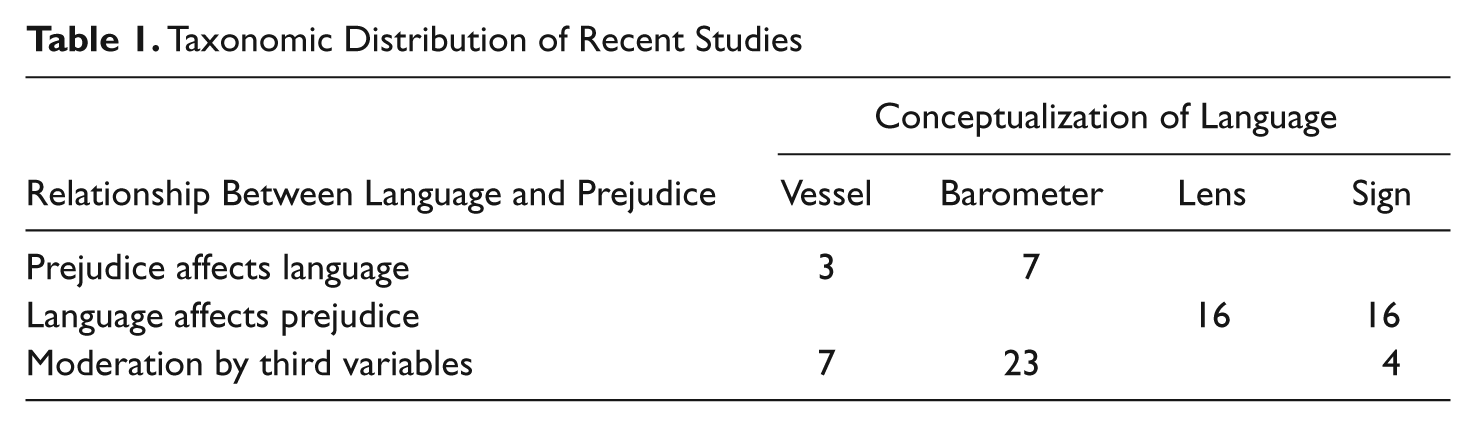
Table 1 catalogues the distribution of studies according to the two taxonomies mentioned earlier: the different types of relationships between language and prejudice as well as the modified version of Sutton’s (2010) model. As can be seen, very little research is concerned with the effect of prejudice on language, while the bulk of the studies are concerned with how language affects prejudice and how the relationship between language and prejudice is moderated by third variables.
Taxonomic Distribution of Recent Studies
The Effect of Prejudice on Language
Explicit Expressions of Prejudice
The simplest way to conceptualize the effect of prejudice on language is the explicit or overt expression of prejudiced thoughts and beliefs, such as hate speech and derogatory slurs. Very few studies have, in recent years, studied explicit effects. Those that have are concerned with either (a) the features of language such as word choice, phrasing, and style, which are used strategically to persuade and incite prejudice in others (Taylor, 2007) or (b) the relationship between explicit expressions of prejudice to measures of prejudice and behavior (Poteat & DiGiovanni, 2010). In all cases, there is malicious intent since language is seen as a vessel that is intentionally used to convey prejudice beliefs. Today, however, explicit expressions of prejudice are relatively rare given current social norms condemning them, which might explain the lack of research in this field.
Implicit Expressions of Prejudice
In contrast to the explicit expression of prejudice, our language can be affected by prejudice in more subtle ways. Prejudice, just like any belief that we hold, can, without our awareness, influence the words we choose to use. Thus, language can reflect implicit beliefs. Phenomena of this type have been termed linguistic bias and typically involve the description of stereotype-consistent and stereotype-inconsistent behaviors. The Stereotype Consistency Bias is defined and measured by the amount and type of information that is transmitted. It describes the tendency for more stereotype-consistent than stereotype-inconsistent information to be transmitted. The Linguistic Expectancy Bias (LEB; Wigboldus, Semin, & Spears, 2000) and the Linguistic Intergroup Bias (LIB; Maass et al., 1989) are defined through the use of linguistic abstraction.
Linguistic abstraction is measured using the Linguistic Categories Model (LCM; Semin & Fiedler, 1988), which proposes that a specific behavioral event can be accurately described by any one of four types of increasingly abstract words: Descriptive Action Verbs (DAVs), Interpretive Action Verbs (IAVs), State Verbs (SVs), and Adjectives (ADJs). Thus, if person A hits person B, the event can be described as “A hits B” (DAVs), “A hurts B” (IAVs), “A hates B” (SVs), or “A is aggressive” (ADJs). Thus, the LEB (Wigboldus et al., 2000) is the tendency to describe stereotype-consistent behavior more abstractly than stereotype-inconsistent behavior, regardless of whether the behavior is desirable or undesirable. The LIB (Maass, Salvi, Arcuri, & Semin, 1989) describes the tendency for desirable behaviors by in-group members and undesirable behaviors by out-group members to be described more abstractly than undesirable behaviors by in-group members and desirable behaviors by out-group members, which may reflect the fact that stereotypes tend to be negatively distorted for out-groups (Howard & Rothbart, 1980).
Although Sutton (2010) categorizes research on linguistic bias into language as a vessel, it is arguable that this research is more suited to the barometer category. The key issue is that linguistic bias is expressed without the intention to reveal biased beliefs. Researchers must, therefore, infer the nature of the speakers’ beliefs on the basis of the language used. Linguistic bias is thus used as an indicator of the prejudiced beliefs held by the speaker, or metaphorically, as a barometer to reveal the speakers’ cognition (e.g., von Hippel, Sekaquaptewa, & Vargas, 1997).
Researchers who study implicit effects focus their attention on specific features of language and how they serve to perpetuate prejudice by reflecting prejudiced beliefs. For example, if stereotype-inconsistent information must be communicated, then speakers will unintentionally use subtle features of language, such as negations, that imply that the information is unexpected or atypical (Beukeboom, Finkenauer, & Wigboldus, 2010). If a group member from a stereotypically unintelligent group performs a studious behavior, it is more likely that the behavior will be described using a negation, such as [s/he] did not write a bad report, rather than an affirmation, such as [s/he] did write a good report. These subtle features are of great consequence since they influence the cognition of those exposed to them, reinforcing or inculcating prejudiced beliefs in others and leading to the pervasiveness and ubiquity of prejudiced beliefs. This theoretical argument offers a plausible explanation of how prejudiced beliefs about specific groups become shared despite the increase in social norms inhibiting overt expressions of prejudice. It also has implications for any context in which judgments about a person are made on the basis of their behavior, such as admission and hiring decisions.
The Effect of Language on Prejudice
Language Distorts Perception
Language can also affect prejudice, and it is this ability of language to influence cognition on which researchers of explicit and implicit expressions of prejudice rely. Before conclusions about the consequences of linguistic bias can be made with any certainty, however, research must also demonstrate that language has a corresponding effect on prejudice. Thus, complementarily to research on implicit expressions, a subset of research on the effect of language on prejudice investigates the corresponding process to see what impact different linguistic choices have on those who are exposed to them. Here, language is a lens that distorts recipient’s perceptions to be more similar to the presumed perception of the speaker. Recent findings reinforce those on implicit effects: negated descriptions, for example, mitigate the valence of the behavior and leads recipients to believe that the speaker actually has opposite expectations for the person performing the behavior when compared with affirmations (Beukeboom et al., 2010; see also Geschke, Sassenberg, Ruhrmann, & Sommer, 2010). In other words, describing the performer of a studious behavior as not stupid would lead the recipient to (a) perceive that the behavior is not as positive as when the performer is described as intelligent, (b) believe that the speaker does not expect the performer to engage in studious behaviors, and (c) attribute the behavior to the situation rather than the performer’s disposition. Mere exposure to derogatory comments about a stigmatized group can also spur negative evaluations of group members (Goodman, Schell, Alexander, & Eidelman, 2008), which suggests, similar to the conclusions of Carnaghi and Maass (2007), that there is merit in campaigns arguing for inclusive and positive language.
There is, however, some evidence that linguistic biases may not contribute to the maintenance of stereotypes. Geschke, Sassenberg, Ruhrmann, and Sommer (2007) found that concrete descriptions of stereotype-inconsistent behavior had a stronger effect than abstract descriptions on recipients’ perception. This suggests that explicit evidence might be necessary to support stereotype-inconsistent assertions, and linguistic bias may be a reflection of this need. It may also be that concrete descriptions have a strong impact on perception in the short-term, but that abstract descriptions play a stronger role in the long term. So while it is clear that linguistic biases are consistently and reliably produced, it is not clear what impact biased messages have on recipients or whether linguistic biases do indeed play a role in the perpetuation of prejudice through this mechanism.
Beyond demonstrating that language has a corresponding effect on prejudice, research in this area shows that words themselves, and the connotations they have, may distort the perception of recipients in ways that are not necessarily similar to the perception of the speaker. Most of this research focuses on gender and language. A clear finding is that mental representations of gender are formed through an interaction of semantic information and stereotypes (Gabriel & Gygax, 2008; Gygax, Gabriel, Sarrasin, Oakhill, & Garnham, 2008). Essentially, words, such as role nouns (e.g., housekeeper and carpenter ), which are intended to be gender neutral, in that they do not have a grammatical or denoted gender, actually activate gender stereotypes (Cacciari & Padovani, 2007). Furthermore, masculine forms of words that are intended to be generic are not interpreted that way; instead, they lead to mental representations that exclude females (see also Stout & Dasgupta, 2011; for consequences not related to gender see Cimpian, 2010).
Peripheral structural features of language can also influence perception. Grammar, for example, requires that comparisons have a direction—either x is compared to y or y is compared to x. Whichever group is the basis for comparison (y in the first formulation and x in the second) forms an implicit norm, where differences from that group need to be articulated and explained. Comparing women to men, for example, would result in statements that focus on women, such as “women are emotional,” since men form the implicit norm. Comparing men to women on the other hand, would result in statements that focus on men, such as “men are strong,” since women form the implicit norm. The group that forms the basis for comparison is the norm so it is not necessary to say, for example, that men are not emotional and women are not strong. Bruckmüller and Abele (2010) show that the implicit norm group is perceived as more powerful and of higher status than the other group, and their typical members are perceived as more agentic and less communal. It is a linguistic convention to compare smaller to larger groups, or compare the group that is perceived to be different to the group that is perceived to be “normal.” This is so ingrained that the direction of comparison now has the power to influence perception. These results provide a demonstration of how linguistic practices serve to perpetuate the status quo of power relations between groups and once again confirm that information beyond semantic content is inferred from communication (see also Maass, Pagani, & Berta, 2007).
A final set of studies indicates that the content of a speaker’s message can affect the recipient’s perception of the speaker. For example, speakers who used abstract language to describe positive behavior and concrete language to describe negative behavior were perceived as more likeable than speakers who abstracted negative behavior and situated positive behavior (Douglas & Sutton, 2010; see also Reitsma-van Rooijen, Semin, & van Leeuwen, 2007). Another study found that speakers who expressed positive stereotypes about a group, that Blacks are athletic for example, were perceived as less likeable, more biased, less qualified for a diversity job, and generally perceived more negatively than speakers who did not express a positive stereotype (Czopp, 2008). Thus, it seems that what a speaker says reflects on how that speaker is perceived by recipients.
In sum, this research shows that language cannot be considered a neutral vessel in which to carry or transmit cognition. It has an unyielding transformative effect: changing what it carries and distorting the perception of those who are exposed to it. This influences prejudice by activating culturally shared ideas and creating implicit expectations that subtly transform the perception of groups and group members.
Language Signals Group Membership
Other aspects of language, beyond the properties of words themselves, can also influence perception. Specifically, peripheral nonstructural aspects of language, such as the accent with which it is spoken, can influence perception by allowing the recipient to make inferences about the speaker’s group membership, suggesting a link between language and social identity. Here, as in the modification to Sutton’s (2010) model proposed earlier, language is a sign; it is not actually distorting perception, cognition, or memory, it is merely making group membership salient, which, as an indirect consequence, may make the speaker a target of prejudice.
The majority of studies show that when language signals group membership, either through accent or the use of in-group-specific phrasing (Mange, Lepastourel, & Georget, 2009), there is a shift in how the speaker is perceived. The central and foremost finding is that speakers who have an accent, or more accurately, speakers who do not have the same accent as the recipients, are evaluated more negatively by recipients than speakers who are perceived not to have an accent (because they have the same accent as recipients; e.g., Hosoda, Stone-Romero, & Walter, 2007). The finding is robust and, in recent years alone, has been replicated with English and Welsh native speakers, with Asian-, regional American-, Spanish-, Latin American-, French-, and Japanese-accented English speakers, and with mild to heavily accented speakers. Native speakers (or speakers who have the same accent as the recipients) are perceived as more potent, intelligent, perceptive, knowledgeable, capable, educated, successful, as a more representative of the in-group, and as having a better ability to communicate than nonnative speakers (e.g., Weyant, 2007). Even the content of language spoken with an accent is subjected to bias (Lev-Ari & Keysar, 2010).
The perception of nonnative speakers is influenced by stereotypes, such that people with some types of accents are perceived as more foreign than others (Cargile, Maeda, Rodriquez, & Rich, 2010) and as more suitable for certain types of jobs (Hosoda & Stone-Romero, 2010). Having an accent is related to fewer feelings of belonging, more perceived stigmatization (Gluszek & Dovidio, 2010), and more depressive symptoms (Kim, Wang, Deng, Alvarez, & Li, 2011). Accents alert the recipient that the speaker is not a part of the in-group and allow the speaker to be a target for prejudices directed toward that group. Research suggests that perspective taking (Weyant, 2007) and awareness of bias (Lev-Ari & Keysar, 2010) might be effective means of reducing prejudice against nonnative speakers. Antiprejudice campaigns should be educational in nature, making people aware of how nonnative speech may indirectly affect their perception and encouraging them to consider the nonnative speaker’s perspective.
Using language as a sign of group membership might have been evolutionarily advantageous because even infants and children show a preference for native speakers (Kinzler, Corriveau, & Harris, 2010; Kinzler, Dupoux, & Spelke, 2007). Since this preference develops earlier than racial preferences (Kinzler & Spelke, 2011), language may have been a more useful signal than race in the past. Indeed, neighboring communities were likely to have differed by regional accent, but not by race, making language a more reliable cue to in-group membership and highlighting the link between language and identity. In support of this, one study suggests that language can signal one’s own group membership. In this study, bilingual participants completed the same Implicit Association Task (IAT) for attitudes toward Moroccan and French people in Arabic and French. Participants had stronger pro-Moroccan attitudes when they completed the IAT in Arabic versus French. In a second study, participants had more pro-Hispanic attitudes when they completed a Hispanic American IAT in Spanish rather than English. In essence, language influenced positive implicit attitudes by shifting them in the direction of the linguistic in-group associated with the language being used (Ogunnaike, Dunham, & Banaji, 2010). This demonstrates an interconnection between language and identity, such that using a specific language activates shared cultural beliefs of, and encourages identification with, the social group associated with it.
Language Defines Group Boundaries
Language can also be used to define the boundaries between groups, emphasizing the link between language and identity. Here, language is either a sign or a lens. The social identity approach suggests that it is intimately connected with the nature of intergroup relations (Tajfel & Turner, 1979; Turner, 1999). Accordingly, research in this area demonstrates that using language as an in-group attribute (perhaps strategically) to define who is a member of the in-group, must also include, by default, a definition of the out-group and, therefore, has consequences for intergroup relations. For example, national identification predicts anti-immigrant prejudice most strongly in countries where national identity is based on language (e.g., Matser et al., 2010; Pehrson, Vignoles, & Brown, 2009). In this case, language is a sign, signalling the in-group identity and, indirectly, affecting intergroup relations. It does not necessarily distort or change perception, but is an attribute of the in-group.
On the other hand, if language is an in-group attribute, then group boundaries may be less definite and more permeable since people are able to learn other languages. Learning a second language then may break down barriers between groups, and a recent study suggests that this is the case (Ekşi, 2009) similar to Wright and Bougie (2007) and Rubenfeld et al. (2007). In this case, language is a lens, transforming the monolingual speaker into a multilingual speaker with multiple and changing identities. In sum, language can play a more central role in the definition of group boundaries, increasing or decreasing the permeability and strength of, or distance between, groups.
The Moderated Relationship Between Language and Prejudice
Whereas the research reviewed in previous sections focused on unidirectional influences between language and prejudice, the studies presented in this section focus on aspects of the social context that moderate the relationship between language and prejudice. Typically, language and prejudice are studied within the context of communication, especially between members of different groups. A communication approach suggests that there are implicit conversational norms that interlocutors follow, and assume their partner follows, so that the meaning of each communication can only be understood with respect to these norms (e.g., Grice, 1975; Kashima, Klein, & Clark, 2007). These researchers rely on the idea that what is not said is just as important as what is said, as this type of information can be understood to be shared between interlocutors. Accordingly, in most of the research in this area, the meaning of a communicated message is not taken at face value but is analyzed within the context of a communication act to understand its true meaning. Here, language is a barometer, when the focus is on understanding situational constraints so that the nature of what is said can be understood on a more implicit level, or a vessel, when the focus is on what is and is not expressed. Among the reviewed studies, there are three contextual factors that moderate the relationship between language and prejudice: group membership, communication strategy, and social norms.
Group Membership
The first moderating aspect of the social context is group membership: Speakers do not operate in isolation, where the information they convey is a sole function of intention. First, group membership of the speaker, through stereotypes, can affect how the same words are interpreted by the same group of recipients. For example, Maoz (2009) found that a proposal for compromise offered by a female opponent, in an intergroup negotiation context, is valued more favorably than the same proposal offered by a male opponent. Presumably, stereotypes that women are warmer, more trustworthy, and less aggressive than men inform expectations for, and influence the perception of, an individual woman’s language and how her message is received. Collins, Biernat, and Eidelman (2009) provide a demonstration of how stereotypes can affect interpretation through common ground. When asked to interpret descriptions of academic records back into objective academic scores, translators decoded more favorable descriptions into weaker academic performances when the student was purported to be Black. No explicitly racist comments were expressed but, implicitly, what interlocutors were saying was that “the Black student did well for a Black person (with presumably lower standards).” Through an analysis of language within the appropriate communicative context, language that was not overtly negative (and was in fact ostensibly positive) was shown to be a reflection of a deeply rooted prejudice against Black people. In sum, the group membership of the speaker and the person being discussed influence the interpretation of what is communicated.
Other studies investigate how the group membership of the speaker, recipient, and subject of communication may influence what is and what is not expressed. The major contribution of this research is to place the previously mentioned linguistic biases in context, showing definitively that linguistic bias is not as straightforward as previous research would suggest. In fact, it appears that the LIB is only expressed by high- and low-status groups (Moscatelli, Albarello, & Rubini, 2008) and is used differently by majority and minority group members (Shulman, Collins, & Clément, 2011). Both minority and majority groups, for example, express a LIB and a reverse LIB, but majority members are more likely to show a pronounced LIB effect while minority members are more likely to show a pronounced reverse LIB effect. Essentially, the LIB is or is not expressed based on the group membership of the interlocutors. This contributes to research on prejudice by indicating that status asymmetries and power relations between groups enhance out-group derogation. It also indicates that our language does not always reflect our implicit beliefs and may be subject to influence from the communicative context. More specifically, the group membership of the interlocutors and the status differences between their respective groups will influence whether or not, and how, a linguistic bias is expressed. Klein, Clark, and Lyons (2010) show that there is a greater stereotype consistency bias between friends and that it correlates with measures of interpersonal closeness. This suggests that the stereotype consistency bias might even be a tool that can be used strategically to achieve intimacy with conversational partners.
A final study adds another layer of complexity to the studies on linguistic bias. Participants who were exposed to language that was subtly biased against them perceived more interpersonal distance with their communication partner than participants exposed to language that was biased toward them (Reitsma-van Rooijen et al., 2007). This would, presumably, result in lower levels of communication satisfaction and a resistance to engaging in intergroup interaction in the future. Here, language is a sign of group membership and a tool that can be used to suggest social distance between interlocutors.
Overall, this research brings into question previous formulations about the nature of linguistic bias. If linguistic bias is truly an implicit indicator of prejudice and not subject to conscious control (Franco & Maass, 1996; von Hippel et al., 1997), then it cannot theoretically be used strategically or be subject to influence from the social context as recent research suggests. In sum, the group membership of the speaker, recipient, and subject of conversation, all combine to create a communicative context through which all communication must be interpreted. Implicit biases may or may not be transmitted depending on the intergroup nature of the context, and paradoxically, may even be used intentionally for some communicative goal.
Communication Strategy
The communication strategy of the interlocutors is another aspect of social context that moderates the relationship between language and prejudice, as the content and style of communication may be intentionally altered to meet interlocutors’ communicative goals. In this area, language is conceptualized as a barometer since research goes beyond the face value of the content in communicated messages to try to interpret the speakers’ intentions.
First, results show that the communication strategies a speaker employs during intergroup interactions can change the language that is used or the style with which it is communicated (e.g., Ladegaard, 2011). Second, speakers from different groups pursue different impression management goals, and have different communication strategies, in intergroup interactions, and these are based on the stereotypes of the speaker’s group (e.g., Bergsieker, Shelton, & Richeson, 2010). For example, Whites, who are worried about appearing prejudiced during interracial interactions, strive to appear moral and want to be liked by their conversation partner. Minorities, who are worried about being negatively evaluated, strive to appear competent and want to be respected by their conversation partner. Third, groups also differ in what they believe are the most useful strategies to achieve the same impression management goals. For example, both Black men and Black women are concerned with being negatively evaluated by a White conversational partner but Black women think that being nicer than usual will garner a positive impression while Black men think that adhering to White norms is a more useful strategy (Shapiro & Neuberg, 2008).
This research also demonstrates, however, that the intentional use of communication strategies can be ineffective. For example, women who adopt a more masculine style of communication (e.g., more direct, with fewer hedges and hesitations; von Hippel, Wiryakusuma, Bowden, & Shochet, 2011) to appear as a more effective leader are actually perceived less favorably, and communication partners were less willing to comply with their requests. Furthermore, using a communicative strategy may influence the quality of the intergroup interaction. For example, Black patients perceived White physicians who were high on both implicit and explicit prejudice more favorably than those high on implicit and low on explicit prejudice (Penner et al., 2010). This suggests that conforming to social norms, or having a communicative agenda, such as attempting to appear unprejudiced, forces one to act incongruently with one’s implicit (and, presumably, true) beliefs. This subtly disrupts interaction behaviors, leading to less positive interactions and lower levels of communication satisfaction.
Social Norms
Social norms regulate all public behavior by specifying what behaviors, attitudes, and beliefs are expected and acceptable in all contexts in which we are in contact with others. Language is particularly subject to social norms as they define how appropriate it is to express certain views and beliefs. A recurrent finding is that most statements that are made to an audience are done so in support of implicit norms—that speakers’ messages conform to the speakers’ perception of prevailing views (e.g., Shapiro & Neuberg, 2008; see also Pratto, Korchmaros, & Hegarty, 2007). Research also shows that this may actually change the speakers’ perception of the message content (e.g., Carnaghi & Yzerbyt, 2007). Language, through group discussions, may also change norms or the effect of stereotypes via the creation of new local norms (e.g., Smith & Postmes, 2009, 2011).
Interlocutors are aware of situational constraints on communication but the consequences of this are not clear. Conway et al. (2009) asked participants to read a short story about a group of students discussing a fraternity in a positive manner. In the censorship norms condition, a fraternity member was present during the discussion. This implicitly suggests a censorship norm—that making negative comments about the fraternity would be inappropriate in this situation. When participants were asked what they would communicate about the fraternity to a friend (with no fraternity member present), participants in the censorship norms condition were more likely to disparage the fraternity. This suggests that self-censorship norms can backfire: Participants were aware of the situational constraints on the opinions expressed and overcompensated for those constraints later. A second study suggests, however, that social constraints may temper reactions, leading to more positive intergroup interactions (Mallett & Wagner, 2011). In this study, male participants were confronted by a female confederate for being sexist because they had ostensibly used the pronoun she to refer to a nurse in a discussion of a moral dilemma. After a confrontation, participants compensated for their sexist behavior, experienced more mutual liking with the confederate, and were better at detecting sexist language than participants who did not experience a confrontation. In this case, self-censorship led to more positive interactions and increased the participant’s awareness of sexist language. Thus, it is not clear whether self-censorship norms, such as those advocated by positive and inclusive language campaigns, are effective at reducing prejudice, as research on direct effects would suggest.
Conclusion
This review attempts to bring together research findings into a single taxonomy that highlights current themes. It also illustrates the varying roles that language can play in the study of prejudice. Language is the primary means through which prejudice can be explicitly and implicitly communicated and is, therefore, a major contributor to its transmission and maintenance. But language can also play a more rooted and integral role in prejudice: changing perception by distorting the information it carries, focusing attention on social identities, and being a factor in the definition of group boundaries. Elements of the social context moderate the relationship between language and prejudice, and this is most clearly illustrated by the salience of group membership: What is said and what is heard depends on who you are, who you are talking to, and who you are talking about.
But the relationship is much more complex than this suggests. Language is generally used to support prevailing social norms, but may also be a tool to change social norms and stereotypes. Stereotypes about different groups influence intergroup communication goals and choice of communication strategy which, in turn, determines the style of communication that is adopted. In sum, language is inextricably linked with every form of prejudice; be it explicit expressions, implicit transmission of beliefs, or the subtle distortion of perception. It transmits prejudice, reveals prejudiced beliefs, distorts perception, and can be the basis of prejudice or a tool for change. The only thing it is not is a neutral vessel through which information can be simply communicated.
Furthermore, studies conducted without reference to social context provide useful demonstrations of direct effects but may not be able to yield effective applications. As this review demonstrates, situating phenomena in the appropriate social context often leads to completely different results. For example, research in the first two sections, where the studies were conducted without reference to social context, suggest that self-censorship norms or perspective-taking might be viable methods to reduce or eliminate prejudice. Research on moderating effects, however, demonstrates the futility, or at least doubtful usefulness, of such methods.
This review identified three issues that future research should address. The first consists of three areas in which articles contradict each other: (a) the paradoxical finding that unintentional linguistic biases can be used strategically or be subject to influence from the social context, (b) inconclusive findings on the impact of biased language use, and (c) inconsistent findings on the role of self-censorship norms, which has implications for the utility and effectiveness of both inclusive and positive language campaigns and also social norms that suppress explicit expressions of prejudice. The second is related to the conditions under which communication strategies are or are not effective in attaining communication goals such as impression management (e.g., appearing unprejudiced). The third and final issue is epistemological and relates to a desirable shift from a paradigm-oriented approach, in which studies are conducted in isolation without reference to other relevant works, to an object-oriented approach, in which studies are situated within the field. The framework presented in this review will help researchers identify connections between their respective paradigms. By placing research in context, theories or general principles can be generated to characterize the nature of the contribution of language to the study of prejudice.
Application of Sutton’s (2010) metaphors in this article differs slightly from the original formulation but these differences are mostly a function of approach. For each study, the conceptualization of language differs based on which perspective is taken. This is most easily demonstrated by research involving communication dyads, where the sender may be using language as a vessel while the receiver uses language first as a barometer, to understand what the sender is communicating, then as a vessel, to convey further information. To avoid these problems, this article always approached the use of metaphors from the researchers’ perspective. This resulted in at least one major deviation from Sutton’s (2010) framework, that of the categorization of research on linguistic bias. Sutton approached this area by focusing on the research as a whole, categorizing it into language as a vessel since, theoretically, linguistic bias is the implicit conveyance of prejudiced beliefs. The present approach, in contrast, categorizes these studies into language as a barometer. It is argued here that by focusing on the researchers’ perspective on language, important features of the research are made salient.
The major differences with Sutton’s (2010) original formulation are the modification to the definition of the metaphors and the addition of a fourth metaphor. The lens category now represents research in which language has more direct and automatic transformative effects. The new sign category represents research in which language has less direct effects that are by no means automatic. For example, the accent with which language is spoken may signal group membership but does not necessitate that the speaker must be a target of prejudice. There also may be indirect nontransformative consequences, such as the definition of the in-group and the perception of intergroup boundaries. These changes were borne out of a limitation of Sutton’s (2010) metaphors to clearly represent the research on moderated effects. In research on direct effects, the conceptualization of language as vessel, barometer, or lens is straightforward, but this clarity disintegrates for research on moderated effects where no specific features of language are studied. It is argued that conceptualizing language as a sign captures the indirect and nontransformative effects of language by representing studies in which language is an attribute or factor itself (e.g., Smith & Postmes, 2011).
Some researchers may also take issue with Sutton’s (2010) metaphors and terminology. Communication researchers, for example, may balk at the idea of language as a simplistic and neutral vessel for cognition, and the term barometer might wrongly imply a sense of objectivity and accuracy of interpretation. It should be noted, however, that the metaphors are not meant to quantify the nature and role of language in reality, but to capture how language is conceptualized by researchers in their respective fields. A discussion of which approach is of value or not is a moot point. It remains that Sutton’s (2010) metaphors were able to capture the varied approaches to language. Considering that they were not intended to be a formal model that accurately and comprehensively represented the nature of language but as a tool to illustrate and explain the role of language in the field of intergroup relations, criticisms must be appropriately restrained. In this review, we find that the metaphors add value, beyond what was originally intended by Sutton, in discussing and categorizing research on language and prejudice. It has been a useful framework that, with very little modification, was able to characterize the different ways that researchers conceptualize language. It is yet to be seen if it will help researchers conceptualize their research in new ways, leading to new avenues of research.
In conclusion, the 30th anniversary of JLSP provides an excellent opportunity to review the state of the field that the journal represents. The 2007 special issue showcased the diversity of research at the intersection of language and prejudice and represented the central issues in the field that were identified by a special task force of the International Association of Language and Social Psychology. This review not only illustrates the richness and diversity of studies of language and prejudice but also firmly establishes the necessity of considering social context. As a whole, this research suggests that language truly bridges the cognitive and social worlds: language reflects thought, is strategically tuned to affect the external world by influencing the cognition of others, and is molded by elements in the external world. As such, it may act as a vessel that conveys cognition, a barometer that reveals cognition, a lens that distorts cognition, and a sign that focuses cognition. This review also demonstrates that, as Taylor and Usborne (2007) conclude in their review, the study of language adds value beyond that of a purely social psychological approach to prejudice.
Footnotes
Acknowledgements
The authors would like to thank Howard Giles, Margaret Pitts, and Bernadette Watson for their insightful and constructive comments on a previous version of this article.
Declaration of Conflicting Interests
The authors declared no potential conflicts of interests with respect to the research, authorship, and/or publication of this article.
Funding
The authors disclosed receipt of the following financial support for the research, authorship, and/or publication of this article: The authors gratefully acknowledge a research grant awarded to the second author, which facilitated the preparation of this article, from the Social Sciences and Humanities Research Council of Canada.