







Abstract
The present research investigates whether arguments encourage speakers to use and to approve of gender-fair language. We collected and pretested arguments regarding gender-fair language and masculine generics and created four messages which supported either gender-fair usage or masculine generics (strong and weak arguments) as well as two control texts. Results showed that speakers changed their language behavior more in the direction of gender-fairness when they had been exposed to arguments for gender-fair language than after control texts. We did not find any effect of arguments promoting masculine generics and no effect on cognitive responses and attitudes. Taken together, these results show that arguments promoting gender-fair language can motivate speakers to use gender-fair wording, a new and important finding in the context of implementing gender equality in language.
Keywords
Use of gender-fair language is crucial for gender equality because it helps to reduce cognitive and behavioral male biases evoked by exclusively masculine forms (Stahlberg, Braun, Irmen, & Sczesny, 2007). In many languages, masculine forms are traditionally used as generics when referring to mixed-gender groups or persons with unknown gender (e.g., the pronoun he), even though feminine forms exist (Hellinger & Bußmann, 2001). In contrast, gender-fair language demands the use of both feminine and masculine forms (feminization; e.g., he or she) and/or gender-neutral forms (neutralization; e.g., they; Mucchi-Faina, 2005). Past research has revealed that gender-fair forms trigger less male representations than masculine generics (e.g., Irmen, 2007) and influence decisions, for example, they lead to more favorable hiring decisions for women and positively influence women’s self-perceptions in job interviews (Horvath & Sczesny, 2014; Stout & Dasgupta, 2011).
Despite the empirical evidence documenting positive effects on gender equality, the question how speakers can be persuaded to accept and employ gender-fair forms has rarely been investigated. For instance, ordinary speakers of German rarely use gender-fair language and tend to reject it (Demarmels & Schaffner, 2011), although it is promoted by official guidelines and regulations (e.g. American Psychological Association, 2009; Schweizerische Bundeskanzlei, 2009). After attending training interventions on gender-fair language, speakers of English were found to use slightly more gender-fair pronouns to complete sentences than nonattendants (McMinn & Foster, 1991; McMinn, Troyer, Hannum, & Foster, 1991; Prentice, 1994), but they did not change their attitudes (Prentice, 1994). Generally, the few existing studies lack theoretical foundation and are limited to behavioral interventions.
In this article, we focus on arguments that may persuade speakers to use and approve of gender-fair language, because arguing is an effective means of persuasion, at least among those who are willing to consider pertinent arguments. Our research is based on the well-established Elaboration Likelihood Model because it integrates different aspects of the persuasion process by including behavioral and attitudinal changes as well as cognitions to investigate underlying mechanisms (Petty & Cacioppo, 1986; cf. Briñol & Petty, 2012). The model suggests two different strategies of persuasion: making a good case for the issue (elaborated processing on the central route) or providing peripheral cues, such as characteristics of the persuader (unelaborated processing on the peripheral route). Processing on the central route requires sufficient ability and motivation to process information elaborately (e.g., high personal relevance, Petty, Cacioppo, & Goldman, 1981), but attitudes modified with a higher cognitive effort (empirically reflected in more attitude-relevant thoughts; Greenwald, 1968) have been shown to persist over time, to resist change, and to better predict behavior than low-effort thinking (Petty, Haugtvedt, & Smith, 1995).
Focusing on true-to-life circumstances, we assumed that people process information on gender-fair language elaborately, because their processing capability is not usually restricted and they are aware of the importance of the topic. At least in German-speaking countries, impetuous reactions to gender-fair language are a daily experience, as documented in 341 online comments that appeared within 24 hours on a newspaper article about Swiss guidelines (“Keine ‘Fußgängerstreifen’,” 2010), in the fact that an article on the language regulations of Leipzig University was the most discussed article of the day on a newspaper website, and in media reactions to gender-fair revisions of German road traffic regulations (cf. Pusch, 2014).
Overview of the Present Research
We investigated the effects of pretested persuasive messages and of control texts on cognitions as well as on behavioral and attitudinal change. We assumed that arguments lead to persuasion by central route processing and function similarly as behavioral interventions. We conducted our research on German, a grammatical gender language, where several parts of speech are marked for gender (Bußmann & Hellinger, 2003). Therefore, gender-fair wording is more difficult to achieve than in English and persuasion may be more challenging. We proceeded from the following assumptions:
These hypotheses are in line with the Elaboration Likelihood Model even though attitudinal change was not found in the intervention study by Prentice (1994).
We also took participants’ gender into account, but we did not make any predictions, since past research has yielded mixed findings, for example, women used gender-fair language more frequently and reported more positive attitudes than men (Prentice, 1994; Sarrasin, Gabriel, & Gygax, 2012) or no such differences were observed (Sczesny, Moser, & Wood, 2014).
Pretest 1
We collected arguments for gender-fair language and masculine generics mentioned in earlier studies (Blaubergs, 1978; Blaubergs, 1980; Hellinger, 1985; Hellinger, 2000; Parks & Roberton, 1998), in newspaper articles, guidelines, books, web pages, and blogs (e.g., Pusch, 2011). Arguments were summarized and rephrased into general statements. To gain the whole range of persuasiveness, we created an equivalent pro-MG for each pro-GFL, and vice versa (e.g., “Gender-fair forms are precise” vs. “Masculine generics are precise”) if possible, resulting in 73 arguments.
In an online study, 66 native speakers of German (48 women, 17 men, 1 unspecified,
Pretest 2
We created four messages (cf. Petty & Cacioppo, 1986): Each message contained the definitions used in Pretest 1 followed by the four to five most persuasive pro-GFL or pro-MG arguments with which participants had (dis)agreed most 1 (see the appendix).
At the University of Heidelberg, Germany, 45 native speakers of German (24 women, 21 men; Mage = 22.27 years, range: 16-34 years; 6 nonnatives were previously excluded) read one of the messages and indicated how persuasive, comprehensible, and well-formulated they considered it on 7-point scales.
We excluded one outlier each in three of the four groups (2 women, 1 man, age = 25-26 years) who evaluated persuasiveness contrary to all other participants. Planned contrasts showed that strong arguments were more persuasive than the respective weak ones; Mstrong pro-GFL = 5.30 (0.95), Mweak pro-GFL = 3.70 (1.42), t (41) = 3.14, p = .003; Mstrong pro-MG = 4.64 (0.81) versus Mweak pro-MG = 2.36 (1.29), t (41) = 4.68, p< .001, but equally comprehensible and well-formulated, ts ≤ 1.70, ps ≥ .097. Corresponding analyses including the outliers yielded the same levels of significance, except for the persuasiveness of strong versus weak pro-GFL.
Main Study
The main study investigated whether strong or weak messages promoting gender-fair language or masculine generics (see pretests) versus two control texts (see below) resulted in a change of attitudes and language use and evoked different cognitions.
Method
Participants and Design
For the online study, 257 native speakers of German (175 women, 82 men; Mage = 23.83 years, age range = 18-69 years; 98.1% living in Germany; 9 nonnatives were previously excluded) were recruited at several universities with different gender ratios of their student population. They gave informed consent and were distributed equally across conditions, χ2overall(5) = 1.14, p = .950, χ2female(5) = 2.91, p = .714; χ2male(5) = 5.51, p = .357. Response rate was 67.98 % (431 participants at t1, 293 finished t2), 27 data sets could not be matched.
The experiment was based on a 6 (Message: strong pro-GFL, weak pro-GFL, strong pro-MG, weak pro-MG, awareness control text, baseline control text) × 2 (Participant Gender: female, male) between-participants design. Attitudinal and behavioral changes and cognitions served as dependent variables. Social desirability functioned as a control variable.
Materials
Messages
At Time 2, we presented the four messages of Pretest 2, an awareness control text containing definitions, but no arguments, and a baseline control text about forests.
Change of attitudes
At both times of measurement, we assessed attitudes toward gender-fair language and masculine generics with fivesemantic differentials containing 7-point scales (Eagly, Mladinic, & Otto, 1991; Cronbach’s α = .92-.94).
Change in language use
At both times of measurement, we assessed language use with ten texts with filled-in gaps. Each text was presented with three or four gaps. One of the gaps could be filled with either a masculine generic or a gender-fair form (i.e., feminine-masculine word pair or gender-neutral noun; Kuhn & Gabriel, 2014; Sczesny et al., 2014).
Cognitive responses
After reading one of the messages, participants described all thoughts they had had during reading in maximum ten boxes with a time limit of 2.5 minutes. Instructions were a shortened version of Cacioppo and Petty’s instructions (1981, p. 318; thought-listing task). Two independent raters coded the thoughts as favorable (122 cases, 16%), unfavorable (173 cases, 23%), or neutral/irrelevant (466 cases, 61%) toward gender-fair language (cf. polarity dimension and judges’ rating in Cacioppo & Petty, 1981). Agreement between raters was κ = .818 (Landis & Koch, 1977); all doubtful cases were clarified by discussion.
Social desirability
Social desirability was included as a control variable, as is recommended for gender issues (Dalton & Ortegren, 2011). We used the German version of the Balanced Inventory of Desirable Responding (Musch, Brockhaus, & Bröder, 2002), which contains 20 items such as: “I sometimes drive faster than is permitted”. Responses were indicated on a 7-point scale (1 = totally disagree, 7 = totally agree; α = .69).
Procedure
The alleged topic of the online study was “how people perceive and memorize different text types”. At Time 1, participants created an identification code, filled in the gaps and the semantic differentials (embedded in fillers; in randomized order), some other questions, the Balanced Inventory of Desirable Responding, read a filler text and provided their demographic variables and their email address (saved separately) for a reminder.
Ten days later, participants entered their code. Then, each person was asked to read one of the six texts (randomly assigned) thoroughly. They filled in the thought-listing task, the gaps and semantic differentials (as at Time 1) and some further questions. Finally, they had the opportunity to win a voucher, were thanked and debriefed. None of the participants was able to guess the experimental manipulation.
Results
Descriptives are reported in Table 1. Prescores for attitudes and use (controlled for social desirability) did not differ across conditions or the interaction between conditions and participant gender, Fs ≤ 1.28, ps ≥ .272. Women and men did not differ significantly in their language use, F(1, 244) = 0.00, p = .956, but women reported more positive attitudes toward gender-fair language, F(1, 244) = 12.83, p< .001, partial η2 = .050, and less positive attitudes toward masculine generics than men, F(1, 244) = 17.20, p< .001, partial η2 = .066.
Means, Standard Deviations, and Correlations of Gender-Fair Language (GFL) Use, Attitudes toward GFL and Masculine Generics(MG), and Cognitions (N = 257).
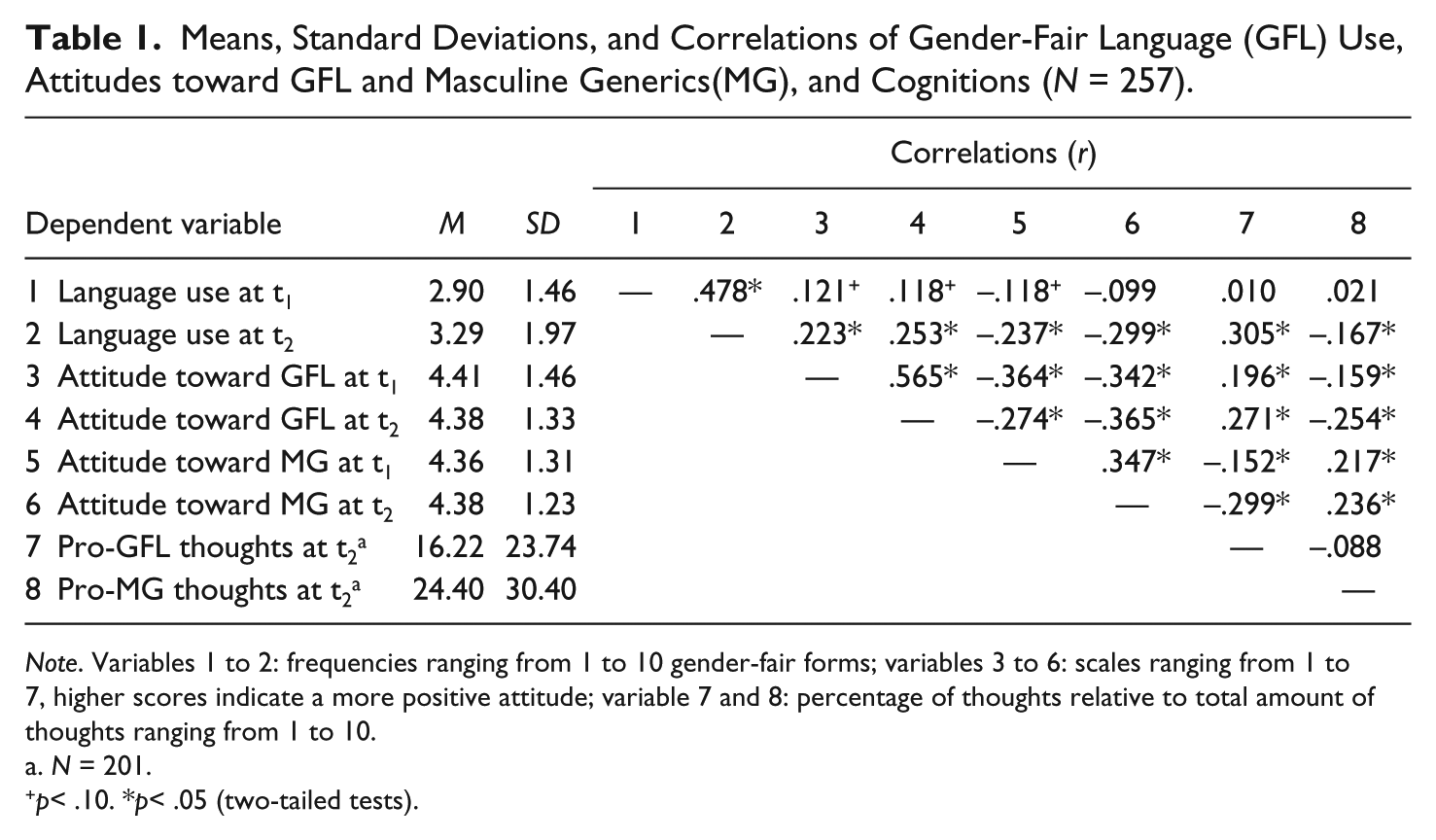
Note. Variables 1 to 2: frequencies ranging from 1 to 10 gender-fair forms; variables 3 to 6: scales ranging from 1 to 7, higher scores indicate a more positive attitude; variable 7 and 8: percentage of thoughts relative to total amount of thoughts ranging from 1 to 10.
N = 201.
p< .10. *p< .05 (two-tailed tests).
We conducted analyses of covariance (ANCOVAs) with Message and Participant Gender as independent variables and the respective prescores and social desirability as covariates. 2 Means and results are given in Tables 2 and 3. 3
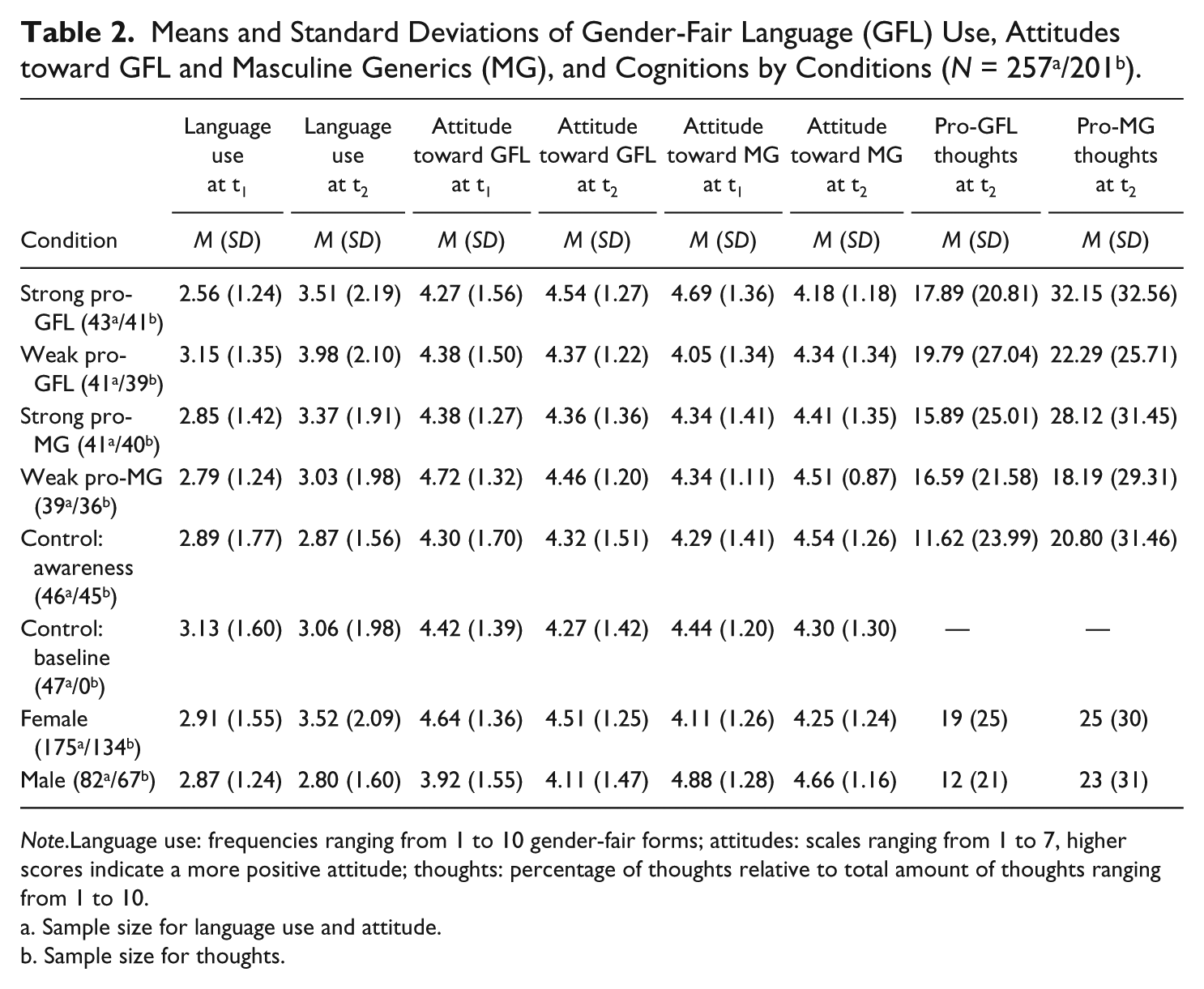
Note.Language use: frequencies ranging from 1 to 10 gender-fair forms; attitudes: scales ranging from 1 to 7, higher scores indicate a more positive attitude; thoughts: percentage of thoughts relative to total amount of thoughts ranging from 1 to 10.
Sample size for language use and attitude.
Sample size for thoughts.
Results of ANCOVAs for GFL Use, Attitudes Toward GFL and MG, and Cognitions.
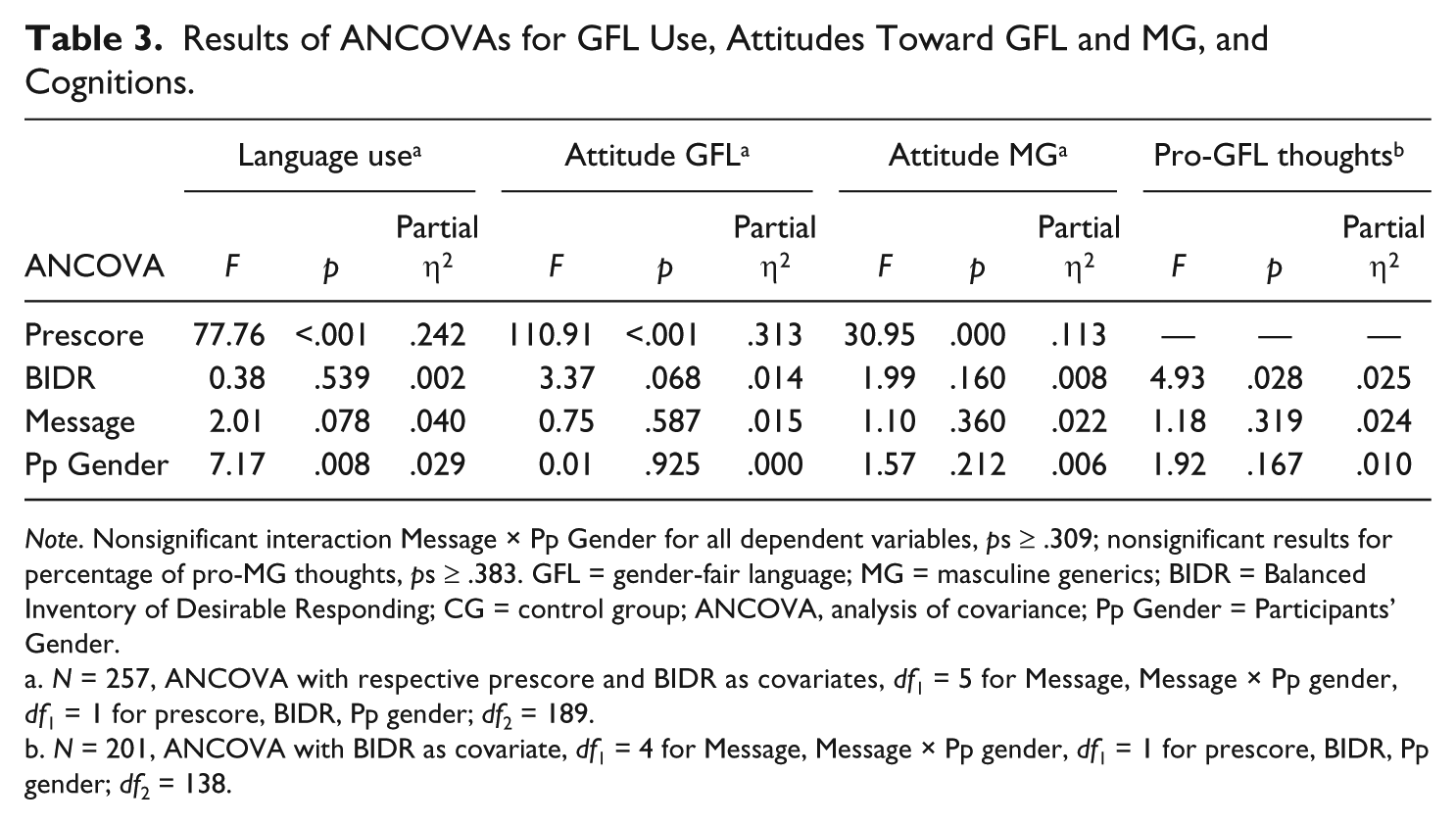
Note. Nonsignificant interaction Message × Pp Gender for all dependent variables, ps ≥ .309; nonsignificant results for percentage of pro-MG thoughts, ps ≥ .383. GFL = gender-fair language; MG = masculine generics; BIDR = Balanced Inventory of Desirable Responding; CG = control group; ANCOVA, analysis of covariance; Pp Gender = Participants’ Gender.
N = 257, ANCOVA with respective prescore and BIDR as covariates, df1 = 5 for Message, Message × Pp gender, df1 = 1 for prescore, BIDR, Pp gender; df2 = 189.
N = 201, ANCOVA with BIDR as covariate, df1 = 4 for Message, Message × Pp gender, df1 = 1 for prescore, BIDR, Pp gender; df2 = 138.
Change of attitudes
Contrary to Hypotheses 1a and 1b, the ANCOVAs on attitude toward gender-fair language and masculine generics revealed no significant effects. The initial gender differences persisted, FattGFL(1,254) = 5.61, p = .019, partial η2 = .022; FattMG(1, 254) = 6.92, p = .009, partial η2 = .027, means shown in Table 2. 4
Change in language use
The ANCOVA revealed a marginal main effect of Message. Contrasts (considering the same covariates as the ANCOVA) partially supported Hypothesis 2a: Participants did not change their language use more after the strong pro-GFL message than after the weak pro-GFL message, t(82) = −0.14, p = .889, but changed significantly toward gender-fair language after the weak pro-GFL message than after control texts, t(133) = 2.26, p = .025. 5 Participants changed their language use more toward gender-fair language after the strong pro-GFL message than after control texts, t(135) = 2.50, p = .025. Contrary to Hypothesis 2b, there were no effects of pro-MG messages, ts ≤ 1.00, ps ≥ .319. A main effect of Participant Gender showed that women changed their language use significantly more toward gender-fair language than men did.
Cognitive responses
Contrary to Hypotheses 3, the ANCOVAs on the percentage of thoughts in favor of gender-fair language and of masculine generics relative to the total amount 6 revealed no significant effects.
Discussion
The present study aimed at investigating whether arguments promoting gender-fair language or masculine generics influence attitudes, language use, and cognitions with a pre-post design. This is the first study to collect, combine, and test arguments for both positions.
Messages promoting gender-fair language increased use of gender-fair forms compared with two control texts. This finding confirms behavioral training effects (McMinn et al., 1991; McMinn & Foster, 1991; Prentice, 1994) within a broader design and for German, where gender-fair language is more complex than in English. Participants responded not only to a strong message, as hypothesized, but also to a weak one. Reasons may be that they were already familiar with the strong arguments, that the weak message struck the right note, or that they were not motivated to process the information thoroughly on the central route. Messages promoting masculine generics had no influence, which may be caused by the fact that only support for gender-fair language, the less common option (Demarmels & Schaffner, 2011), is perceived as important. Surprisingly, women changed their language use more in the direction of gender-fair language than men. Correlation patterns suggest a possible explanation: Postmeasured language use correlated significantly with (pre and post) attitudes, with women preferring gender-fair language more than men.
Attitudes were not changed, although the messages targeted mainly an attitudinal change. Changing language behavior may be easier because speakers know which forms fit the arguments, but changing attitudes may require more than a single brief exposure to a couple of arguments. A promising finding is the increased correlation of postmeasured language use with (premeasured and postmeasured) attitudes, which points to a possible attitudinal change via behavioral change that did not reach statistical significance but might be focused in further research.
Cognitive responses were not influenced by arguments. In applying the thought-listing technique to the context of gender-fair language for the first time we found that participants in all groups reported few thoughts and that both experts could not code 61% of the thoughts that appeared ambivalent or ironic. Post hoc, we found large differences in intensity, for example, “Personally, I do not mind if masculine generics are used” versus “I hate using word pairs”, which we could not sort into clear-cut categories. Weighting the intensity of thoughts showed no impact on persuasiveness ratings (Cacioppo & Petty, 1981), but it might have an effect with such a controversial topic. Improvements could be achieved with more direct instructions, such as listing only thoughts elicited by the text, or having participants rate the valence and intensity of their thoughts (see Cacioppo & Petty, 1981).
Our results show that the strength of arguments is less important than expected. Future research might obtain a more sophisticated image of argument strength by creating messages in a different way, for example, by elaborating arguments into coherent statements, by strengthening them via other persuasion cues (e.g., Areni, 2003), or by investigating the processing route in a more controlled way, for example, by manipulating the motivation to process via personal relevance. Because some individual factors such as sexism (Parks & Roberton, 2008) correlate with use of and attitudes toward gender-fair language, it is important to investigate their impact on the acceptance and rejection of such messages in more detail. Finally, it is an interesting question whether the way such a controversial issue is dealt with can be explained by more dismissive-focused (e.g., attitudinal ambivalence, Jonas & Ziegler, 2007) or reactance-focused approaches (e.g., Grandpre, Alvaro, Burgoon, Miller, & Hall, 2003).
Conclusion
Our research proceeded from the practical question whether a rational strategy, such as arguing, can convince speakers to use and approve of gender-fair language. We presented a comprehensive collection of arguments and provided first evidence that arguments promoting gender-fair language can play an important role in changing language use. However, more research is needed to understand the mechanisms underlying the persuasiveness of arguments and the characteristics of speakers who reject these arguments. The present study is the first one that investigated persuasion by arguments concerning gender-fair language. It indicates that arguments can be an effective tool for making speakers use gender-fair language.
Footnotes
Appendix
Strong arguments promoting gender-fair language: Use of gender-fair language is an important aspect of gender equality. Masculine generics do not specify whether women are included and they make reference to women less explicit than reference to men. In contrast to the ambiguous masculine generics, gender-fair forms are precise.
Weak arguments promoting gender-fair language: Research findings in this area are free of ideology and therefore reliable. Masculine generics have a short tradition in language history, but they are also awkward and uncommon. A change-over to gender-fair forms is easy.
Strong arguments promoting masculine generics: Masculine generics do not imply ways of thinking or acting that are detrimental to women. Gender-fair forms, on the other hand, are complicated and awkward. Moreover, linguistic tradition views the masculine as the generic form, that is, the generalizing form.
Weak arguments promoting masculine generics: Language does not influence society and using masculine generics is regarded as politically correct. Research findings are ideologically motivated and are therefore doubtful. The use of gender-fair language leads to an increase of anglicisms. Masculine generics should also be preferred because they occur in newspapers.
Acknowledgements
The authors thank Anja Ghetta for coding and two anonymous reviewers for their insightful comments on an earlier version of this article.
Authors’ Note
The studies were authorized by the ethics committee of the Faculty of Human Sciences at the University of Bern, Switzerland.
Declaration of Conflicting Interests
The author(s) declared no potential conflicts of interests with respect to the authorship and/or publication of this article.
Funding
The author(s) disclosed receipt of the following financial support for the research, authorship, and/or publication of this article: The research leading to these results was conducted within the Marie Curie Initial Training Network on Language, Cognition, and Gender (ITN LCG),funded by the European Community’s Seventh Framework Programme (FP7/2007-2013) under grant agreement 237907.